Upgrade to Pro — share decks privately, control downloads, hide ads and more …

AI in Clinical Diagnostics — Promise vs. Reality

AI in Clinical Diagnostics — Promise vs. Reality

AI in Clinical Diagnostics is transforming disease detection, medical imaging, and decision-making, but its real-world impact depends on accuracy, integration, and clinical adoption. Explore the promise and reality of AI in diagnostics and how Bacancy Technology helps healthcare organizations build scalable, secure, and intelligent solutions. With advanced Healthcare AI solutions, Bacancy enables faster insights, improved workflows, and better patient outcomes through AI-powered diagnostic platforms.

Avatar for Vinod Vasava

Vinod Vasava

August 03, 2026

Other Decks in Technology

Transcript

  1. AI IN CLINICAL DIAGNOSTICS Promise vs. Reality What the data

    actuallyshowsaboutdiagnosticAIinhospitalstoday, thebreakthroughs, the blind spots, and the gapbetweenclearanceandclinicalimpact. Bacancy Technology
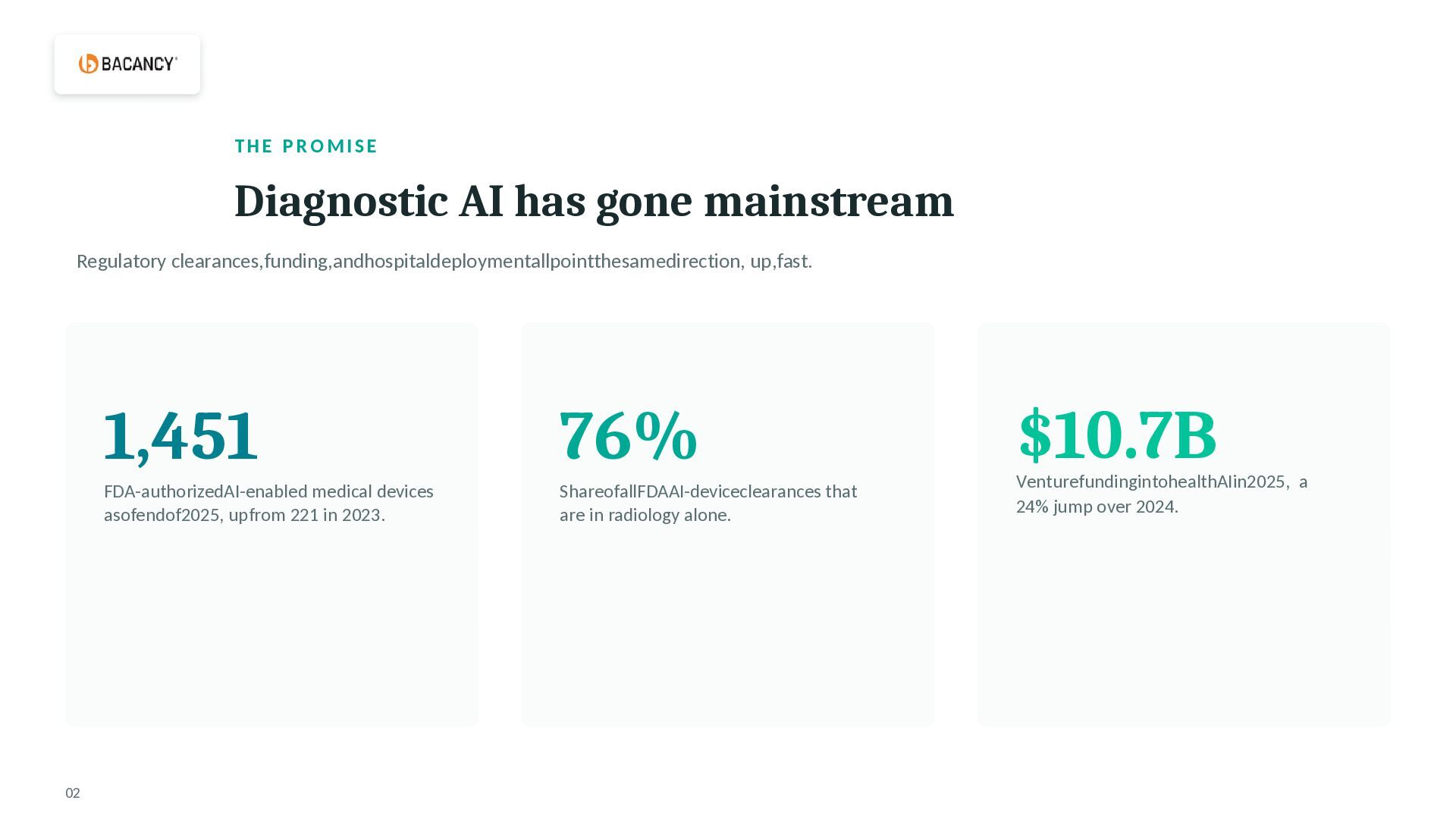
  2. THE PROMISE Diagnostic AI has gone mainstream Regulatory clearances,funding,andhospitaldeploymentallpointthesamedirection, up,fast.

    02 1,451 76% FDA-authorizedAI-enabled medical devices asofendof2025, upfrom 221 in 2023. ShareofallFDAAI-deviceclearances that are in radiology alone. $10.7B VenturefundingintohealthAIin2025, a 24% jump over 2024.
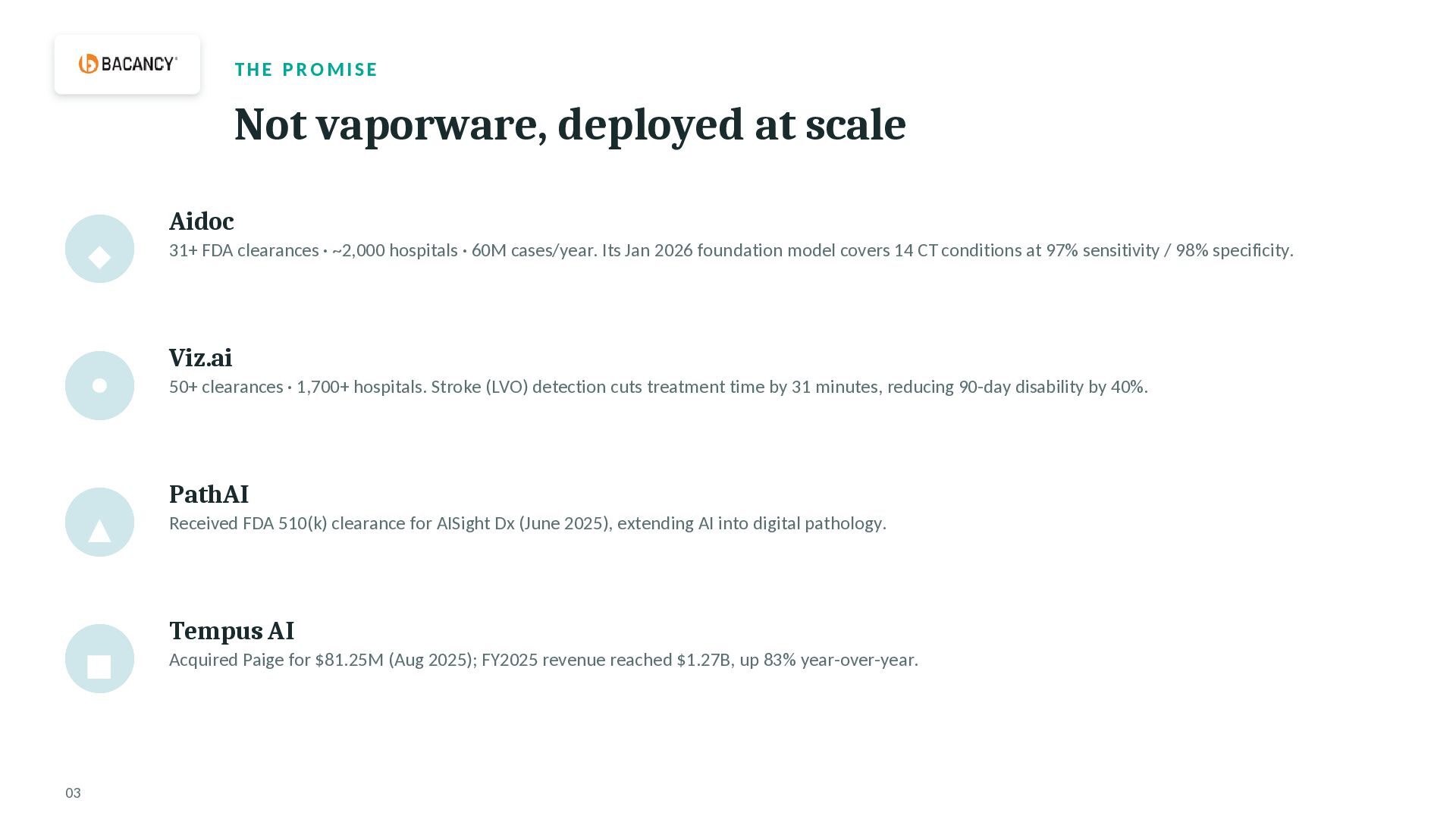
  3. THE PROMISE Not vaporware, deployed at scale Aidoc ◆ •

    31+ FDA clearances · ~2,000 hospitals · 60M cases/year. Its Jan 2026 foundation model covers 14 CT conditions at 97% sensitivity / 98% specificity. Viz.ai 50+ clearances · 1,700+ hospitals. Stroke (LVO) detection cuts treatment time by 31 minutes, reducing 90-day disability by 40%. PathAI ▲ Received FDA 510(k) clearance for AISight Dx (June 2025), extending AI into digital pathology. Tempus AI ▪ 03 Acquired Paige for $81.25M (Aug 2025); FY2025 revenue reached $1.27B, up 83% year-over-year.
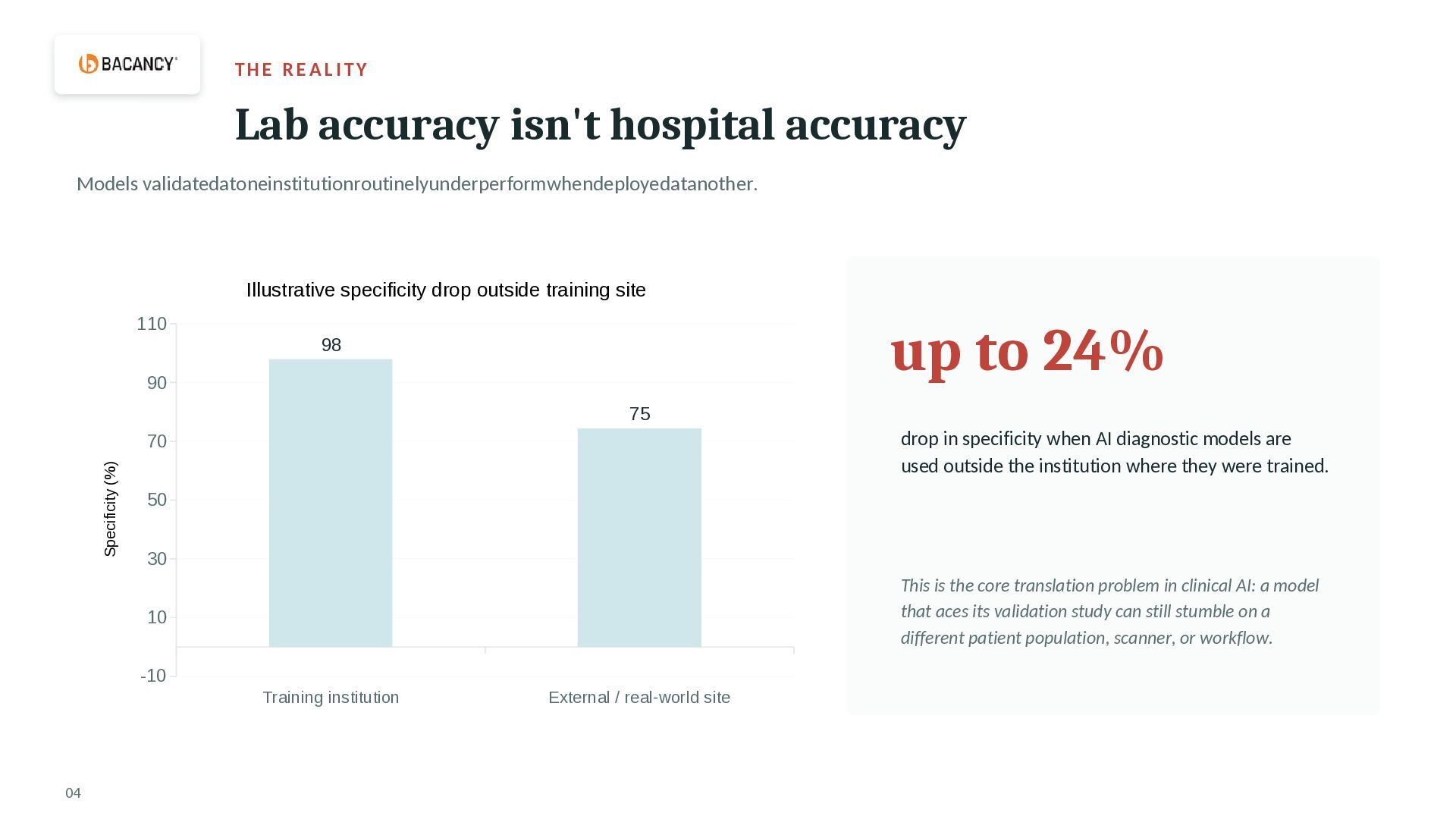
  4. THE REALITY Lab accuracy isn't hospital accuracy Models validatedatoneinstitutionroutinelyunderperformwhendeployedatanother. Illustrative

    specificity drop outside training site 110 up to 24% 98 90 75 drop in specificity when AI diagnostic models are used outside the institution where they were trained. Specificity (%) 70 50 30 This is the core translation problem in clinical AI: a model that aces its validation study can still stumble on a different patient population, scanner, or workflow. 10 -10 Training institution 04 External / real-world site
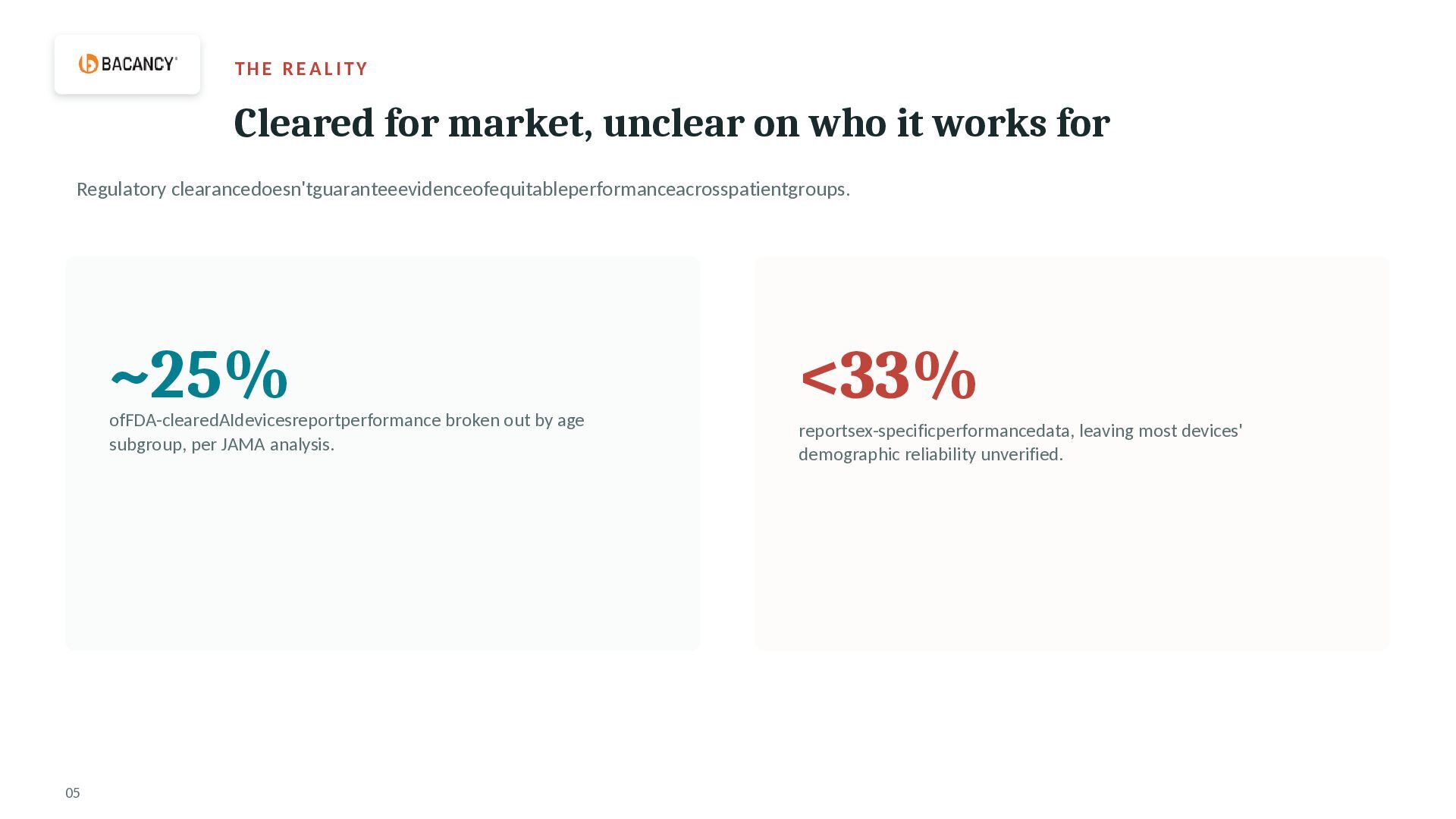
  5. THE REALITY Cleared for market, unclear on who it works

    for Regulatory clearancedoesn'tguaranteeevidenceofequitableperformanceacrosspatientgroups. ~25% ofFDA-clearedAIdevicesreportperformance broken out by age subgroup, per JAMA analysis. 05 <33% reportsex-specificperformancedata, leaving most devices' demographic reliability unverified.
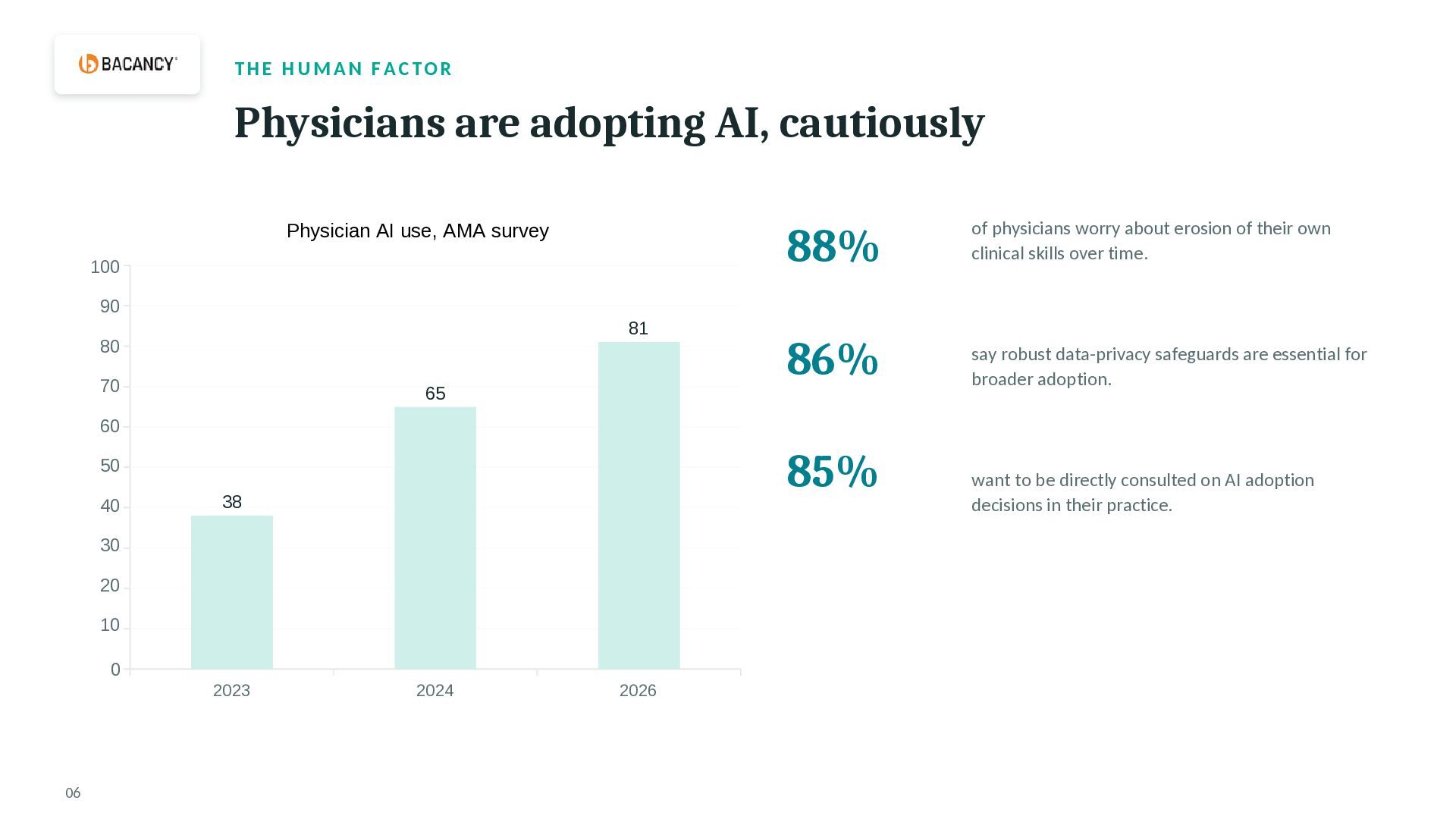
  6. THE HUMAN FACTOR Physicians are adopting AI, cautiously Physician AI

    use, AMA survey 100 88% of physicians worry about erosion of their own clinical skills over time. 86% say robust data-privacy safeguards are essential for broader adoption. 90 81 80 70 65 60 85% 50 40 38 30 20 10 0 2023 06 2024 2026 want to be directly consulted on AI adoption decisions in their practice.
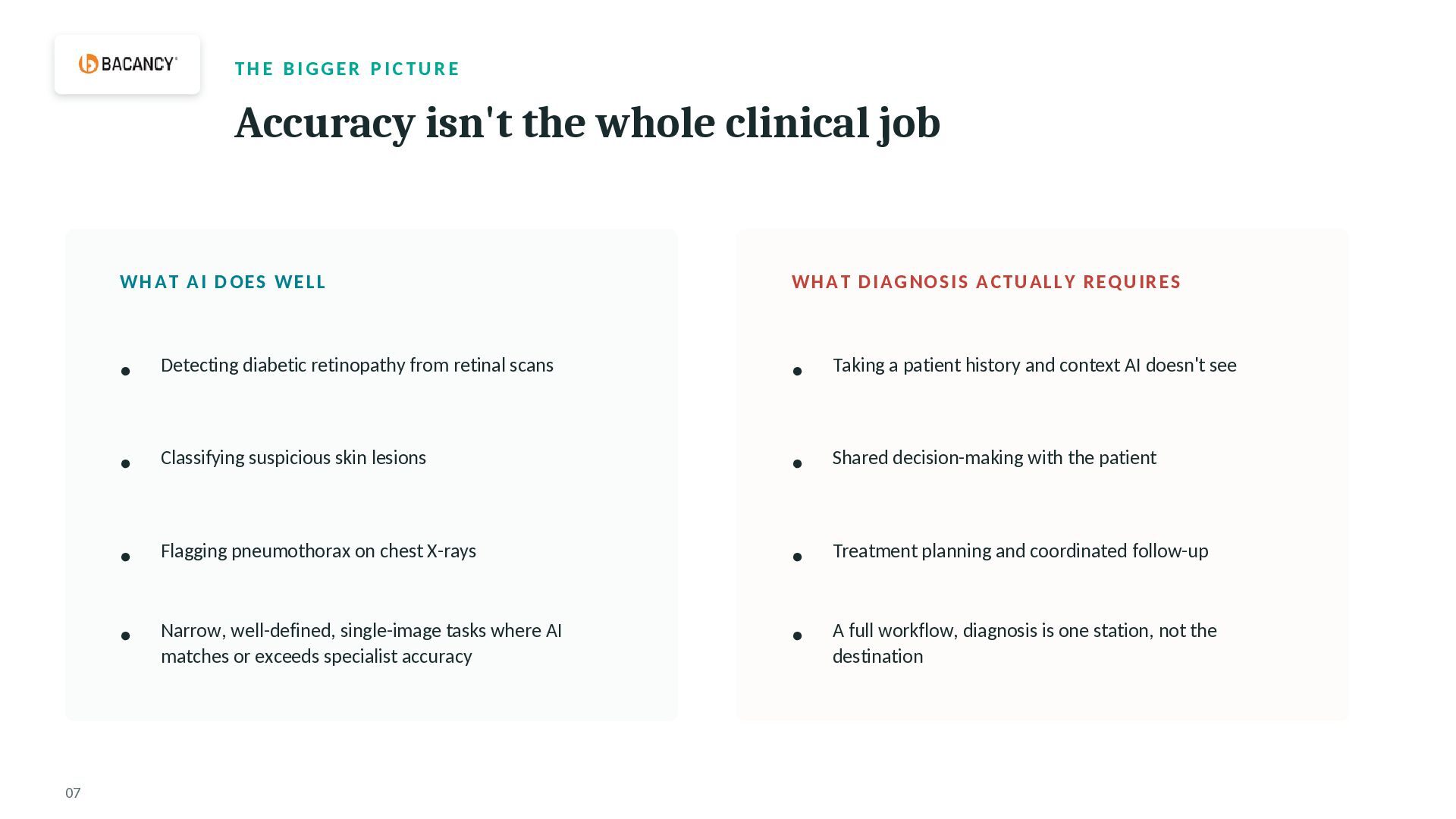
  7. THE BIGGER PICTURE Accuracy isn't the whole clinical job WHAT

    AI DOES WELL 07 WHAT DIAGNOSIS ACTUALLY REQUIRES • Detecting diabetic retinopathy from retinal scans • Taking a patient history and context AI doesn't see • Classifying suspicious skin lesions • Shared decision-making with the patient • Flagging pneumothorax on chest X-rays • Treatment planning and coordinated follow-up • Narrow, well-defined, single-image tasks where AI matches or exceeds specialist accuracy • A full workflow, diagnosis is one station, not the destination
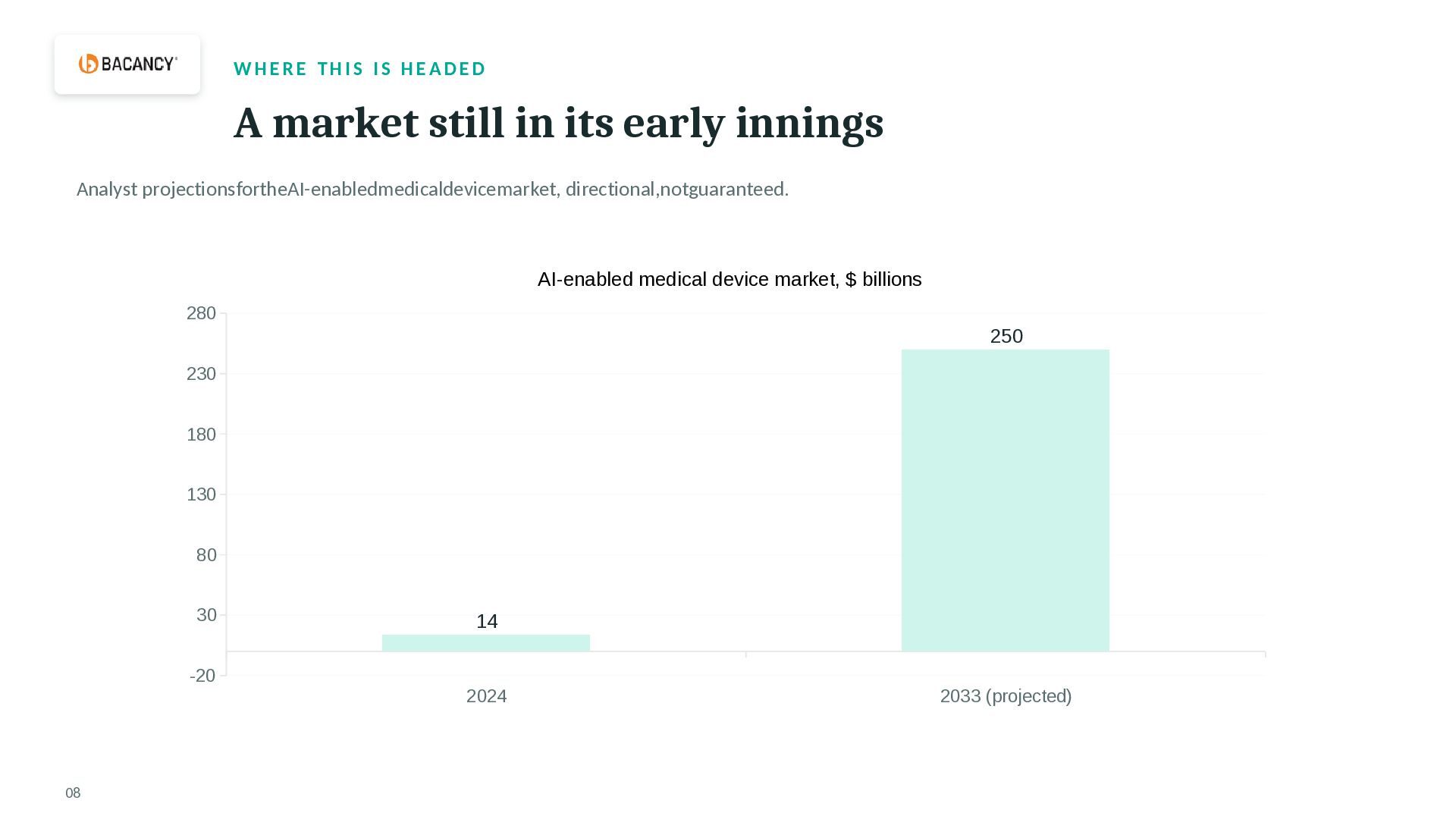
  8. WHERE THIS IS HEADED A market still in its early

    innings Analyst projectionsfortheAI-enabledmedicaldevicemarket, directional,notguaranteed. AI-enabled medical device market, $ billions 280 250 230 180 130 80 30 14 -20 2024 08 2033 (projected)
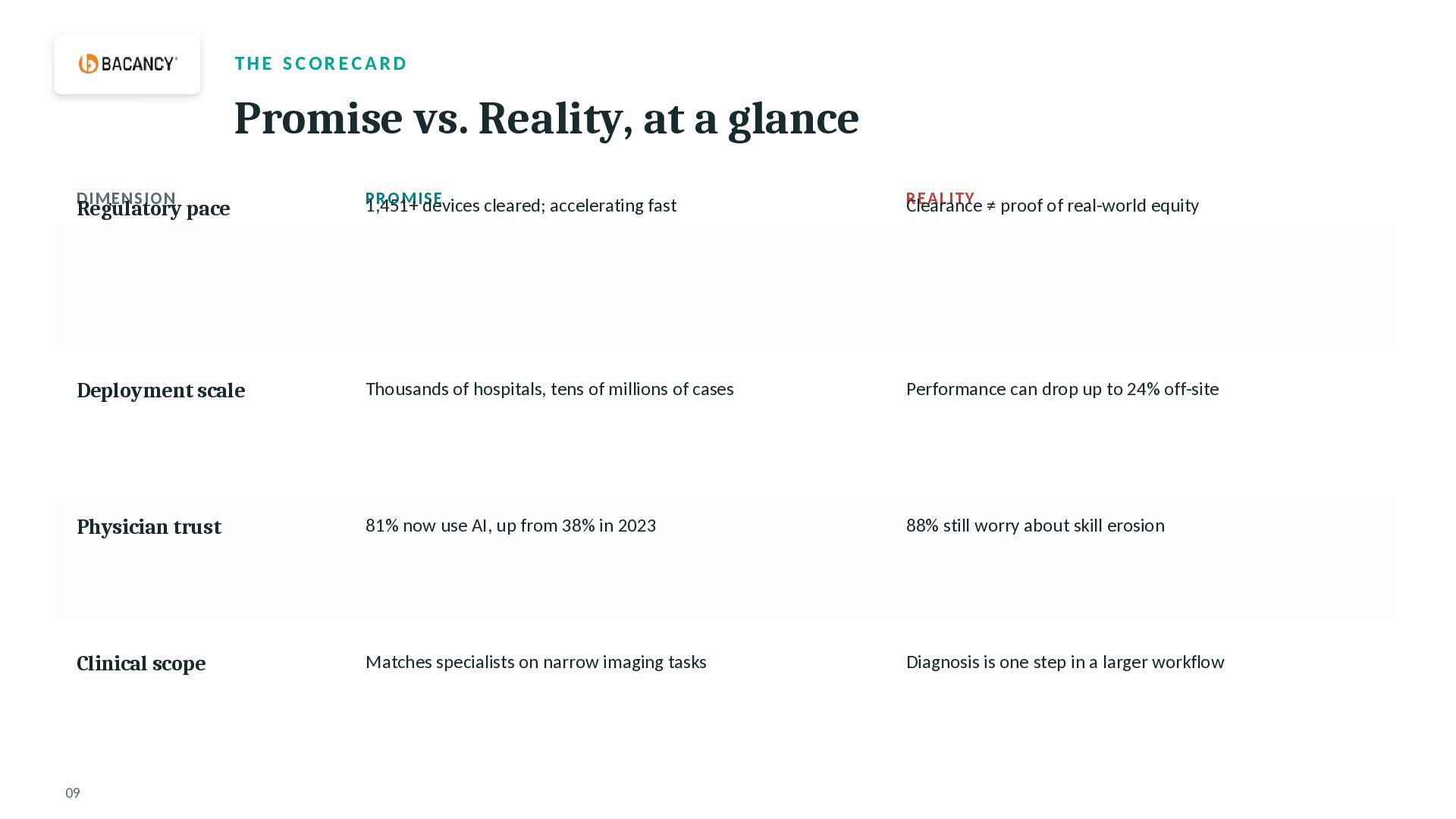
  9. THE SCORECARD Promise vs. Reality, at a glance DIMENSION Regulatory

    pace PROMISE 1,451+ devices cleared; accelerating fast REALITY Clearance ≠ proof of real-world equity Deployment scale Thousands of hospitals, tens of millions of cases Performance can drop up to 24% off-site Physician trust 81% now use AI, up from 38% in 2023 88% still worry about skill erosion Clinical scope Matches specialists on narrow imaging tasks Diagnosis is one step in a larger workflow 09
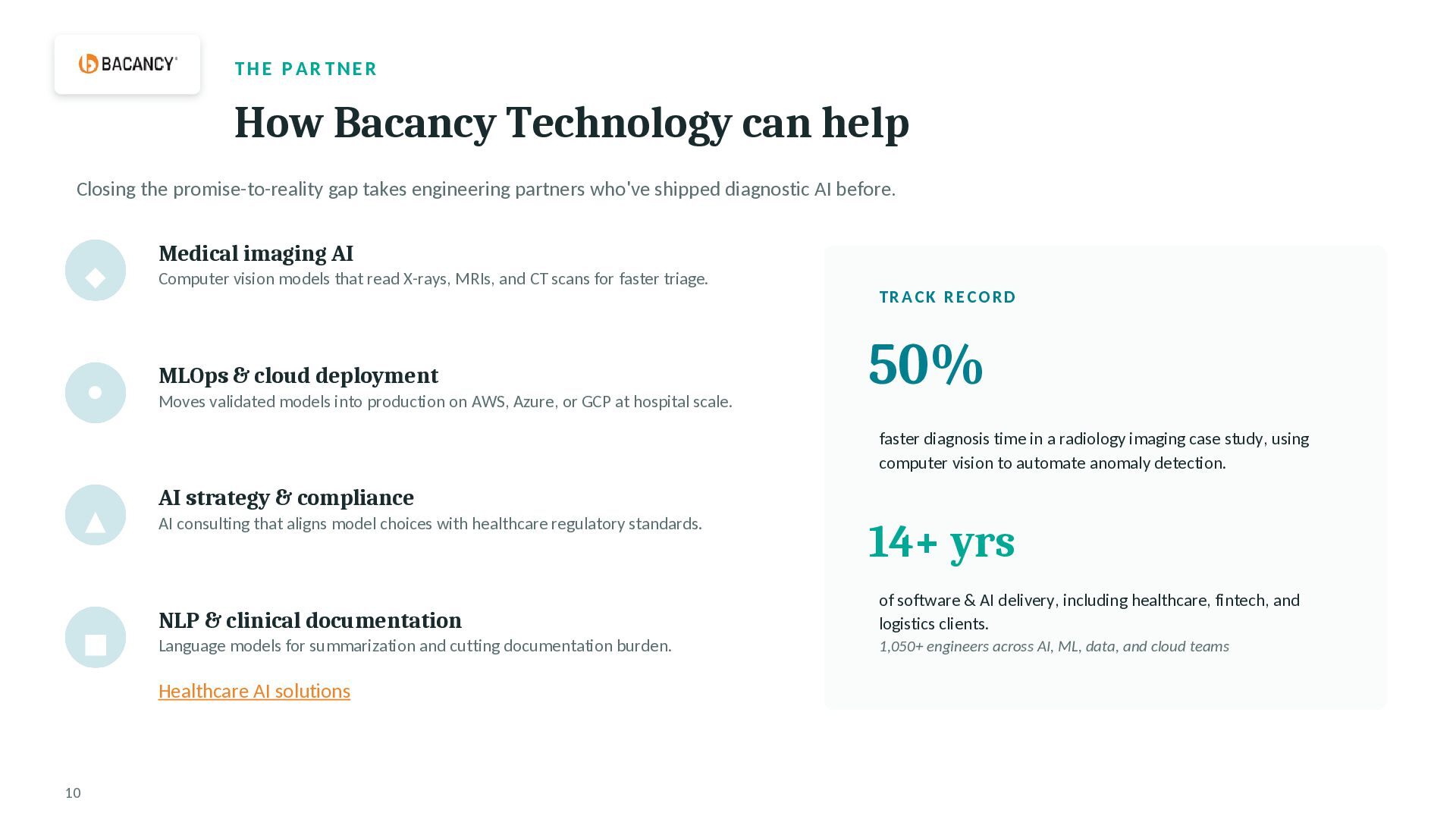
  10. THE PARTNER How Bacancy Technology can help Closing the promise-to-reality

    gap takes engineering partners who've shipped diagnostic AI before. ◆ • Medical imaging AI Computer vision models that read X-rays, MRIs, and CT scans for faster triage. TRACK RECORD MLOps & cloud deployment Moves validated models into production on AWS, Azure, or GCP at hospital scale. 50% faster diagnosis time in a radiology imaging case study, using computer vision to automate anomaly detection. ▲ ▪ AI strategy & compliance AI consulting that aligns model choices with healthcare regulatory standards. NLP & clinical documentation of software & AI delivery, including healthcare, fintech, and logistics clients. Language models for summarization and cutting documentation burden. 1,050+ engineers across AI, ML, data, and cloud teams Healthcare AI solutions 10 14+ yrs
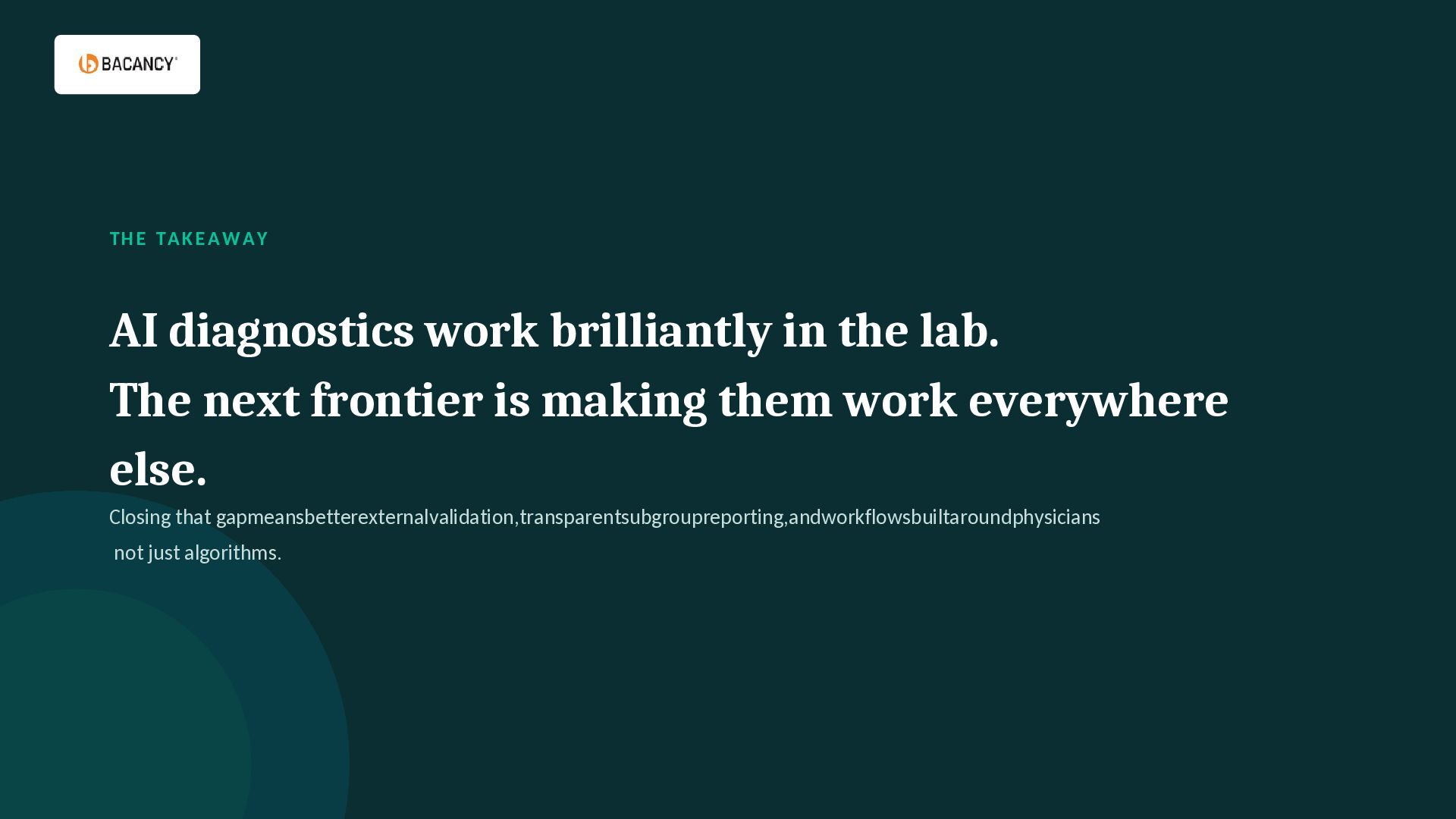
  11. THE TAKEAWAY AI diagnostics work brilliantly in the lab. The

    next frontier is making them work everywhere else. Closing that gapmeansbetterexternalvalidation,transparentsubgroupreporting,andworkflowsbuiltaroundphysicians not just algorithms.