please read through this entire presentation. • All employees are required to participate. • Before September 14, 2018, please sign the affidavit at the end of this presentation to acknowledge viewing and return to your school’s main office. • This power point serves as a supplemental training. Thank you, in advance for your compliance with these legal requirements.
Department of Elementary and Secondary Education (DESE). • This training protects individuals and the district and ensures that all employees know their rights and responsibilities. • The mission of the Winthrop Public School District is to provide a nurturing and safe environment for our students and staff. Having informed employees will help foster a healthy work and learning environment. • If you have questions about any information contained herein, please contact your building principal.
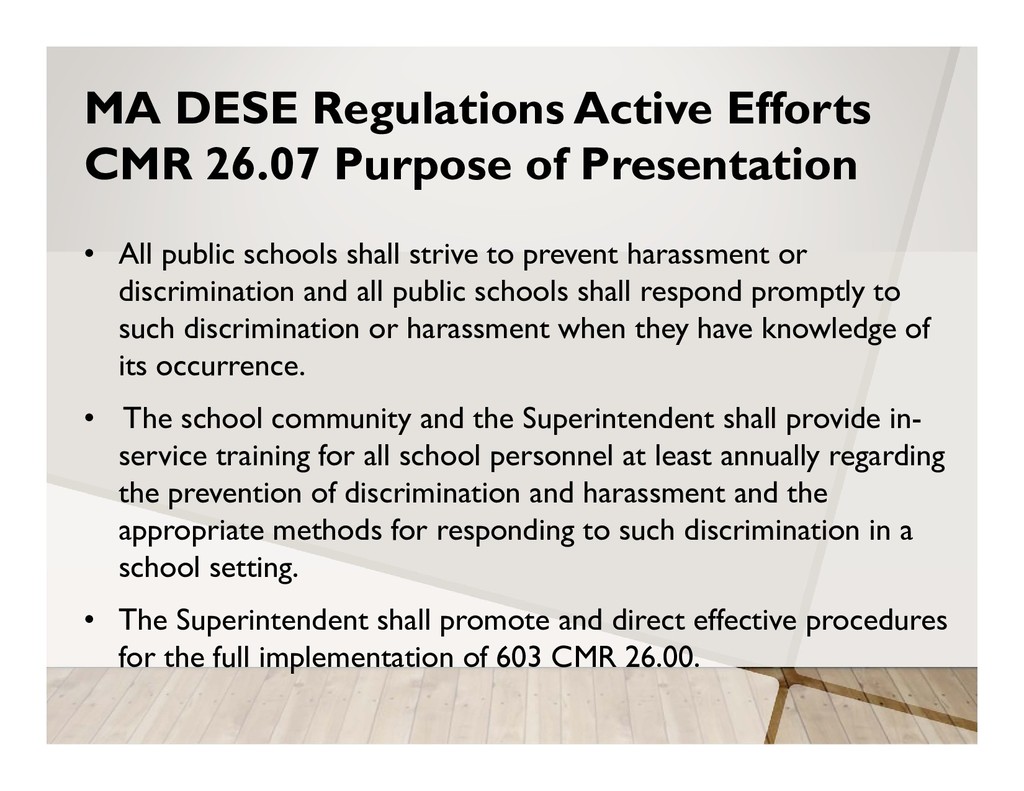
• All public schools shall strive to prevent harassment or discrimination and all public schools shall respond promptly to such discrimination or harassment when they have knowledge of its occurrence. • The school community and the Superintendent shall provide in- service training for all school personnel at least annually regarding the prevention of discrimination and harassment and the appropriate methods for responding to such discrimination in a school setting. • The Superintendent shall promote and direct effective procedures for the full implementation of 603 CMR 26.00.
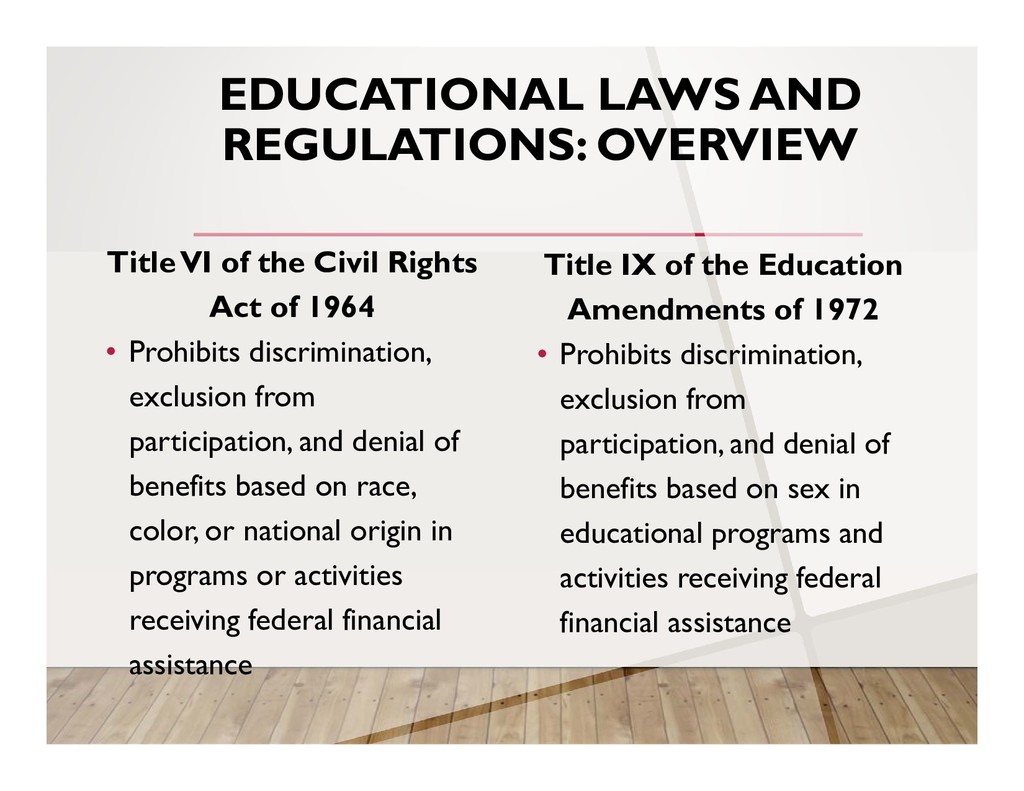
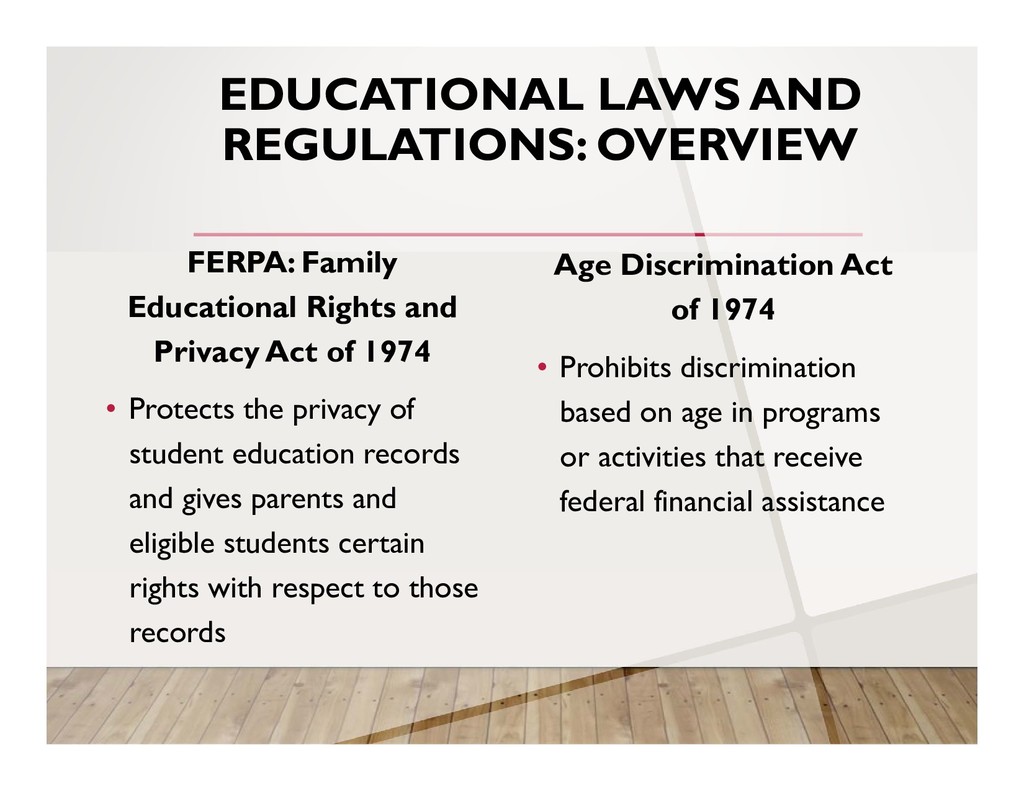
Rights Act of 1964 • Prohibits discrimination, exclusion from participation, and denial of benefits based on race, color, or national origin in programs or activities receiving federal financial assistance Title IX of the Education Amendments of 1972 • Prohibits discrimination, exclusion from participation, and denial of benefits based on sex in educational programs and activities receiving federal financial assistance
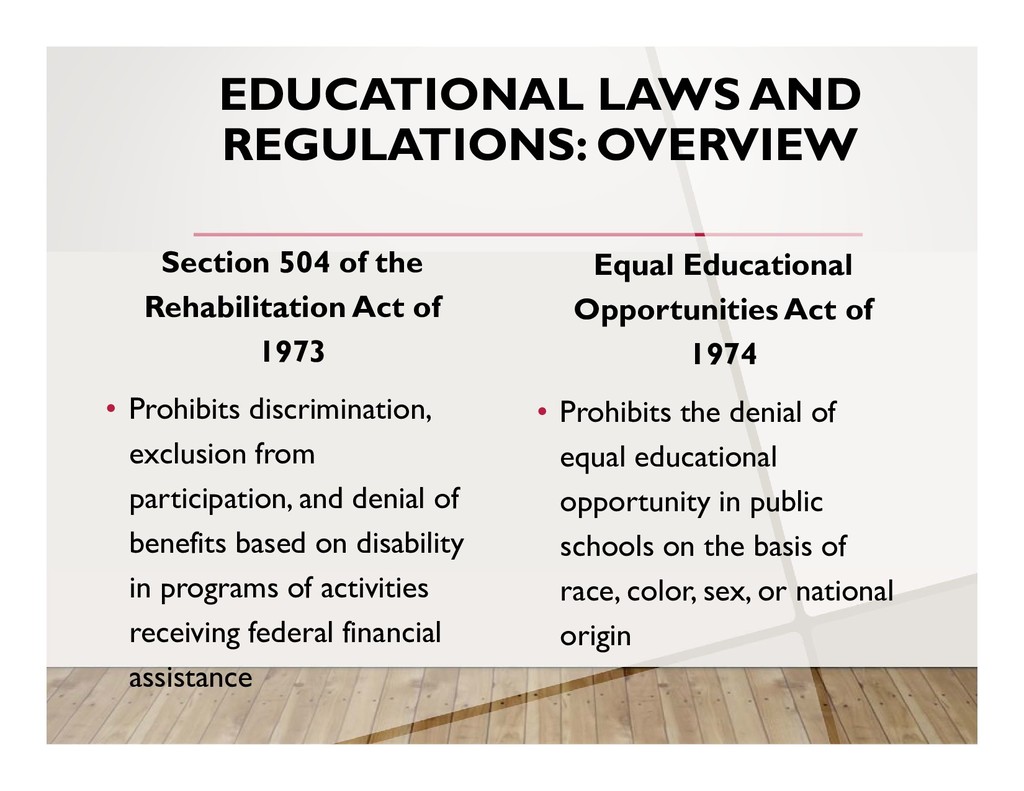
Act of 1973 • Prohibits discrimination, exclusion from participation, and denial of benefits based on disability in programs of activities receiving federal financial assistance Equal Educational Opportunities Act of 1974 • Prohibits the denial of equal educational opportunity in public schools on the basis of race, color, sex, or national origin
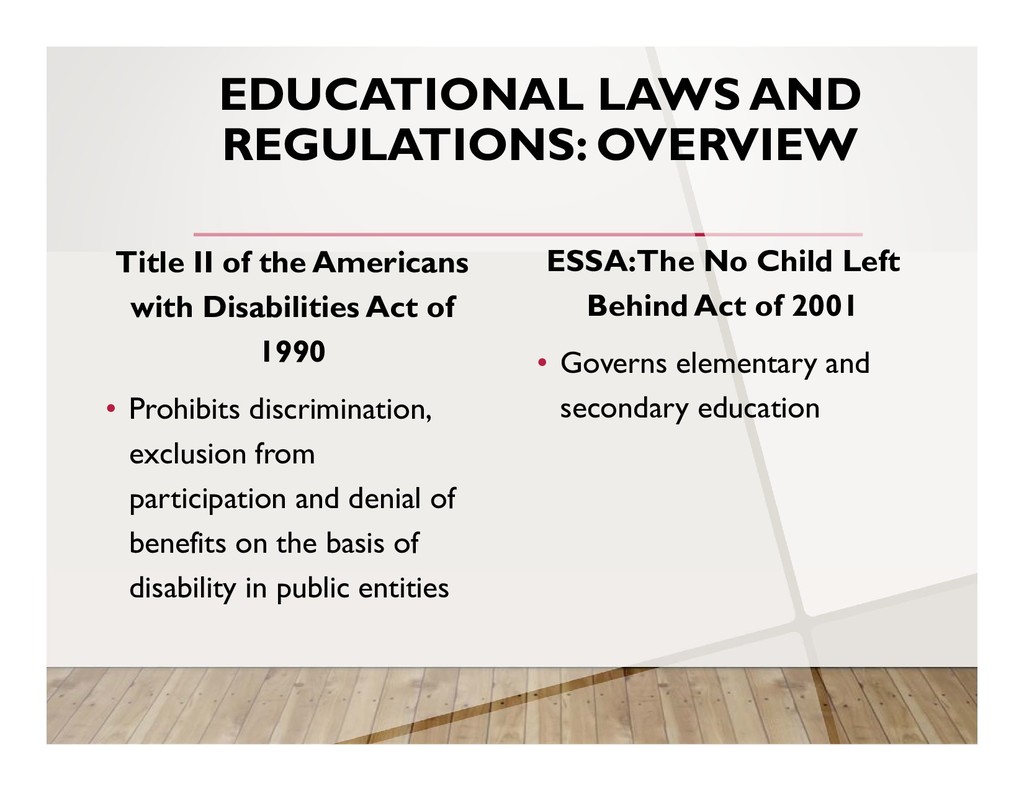
Privacy Act of 1974 • Protects the privacy of student education records and gives parents and eligible students certain rights with respect to those records Age Discrimination Act of 1974 • Prohibits discrimination based on age in programs or activities that receive federal financial assistance
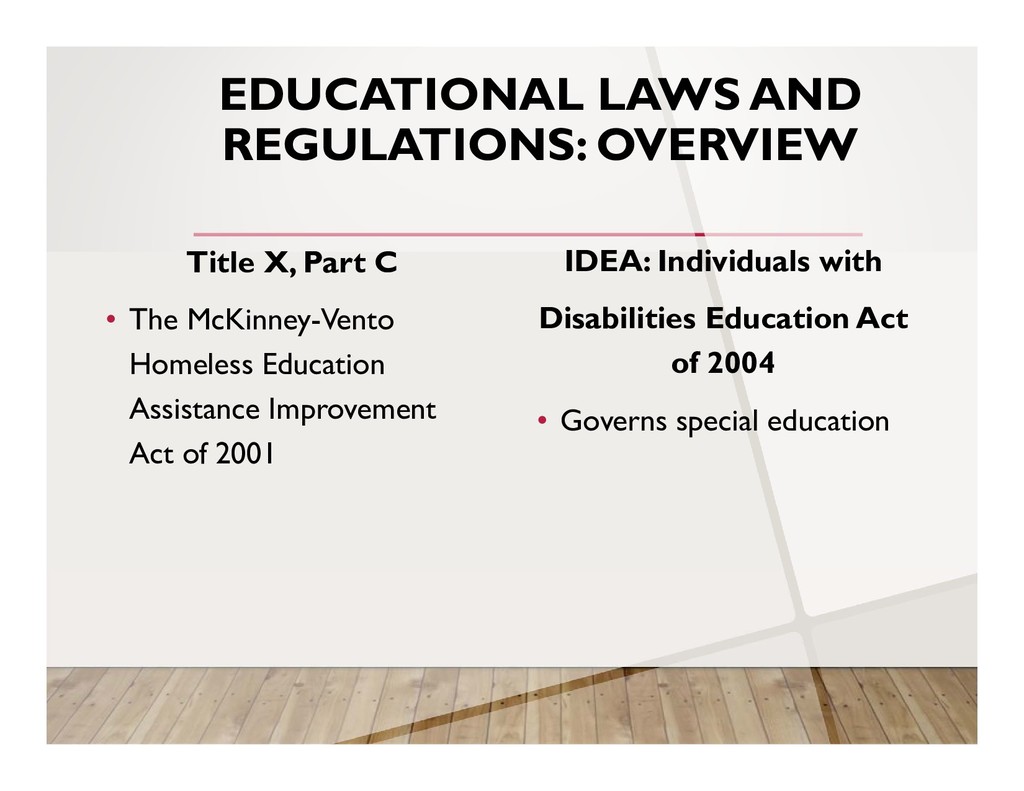
with Disabilities Act of 1990 • Prohibits discrimination, exclusion from participation and denial of benefits on the basis of disability in public entities ESSA: The No Child Left Behind Act of 2001 • Governs elementary and secondary education
The McKinney-Vento Homeless Education Assistance Improvement Act of 2001 IDEA: Individuals with Disabilities Education Act of 2004 • Governs special education
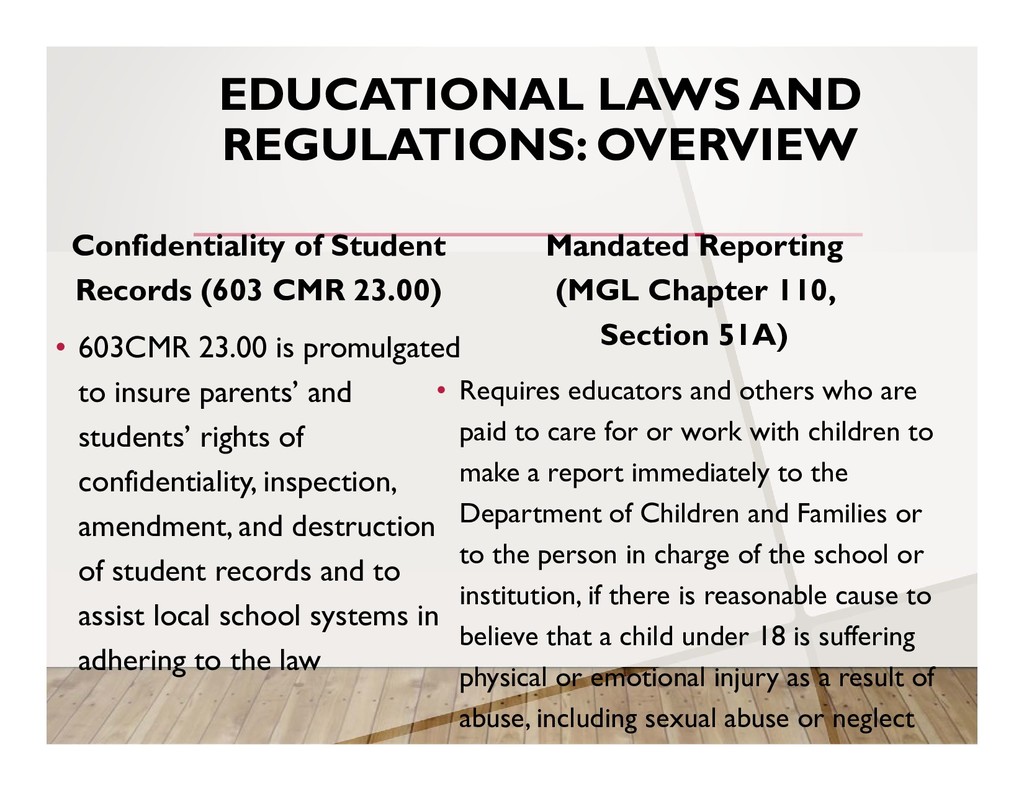
CMR 23.00) • 603CMR 23.00 is promulgated to insure parents’ and students’ rights of confidentiality, inspection, amendment, and destruction of student records and to assist local school systems in adhering to the law Mandated Reporting (MGL Chapter 110, Section 51A) • Requires educators and others who are paid to care for or work with children to make a report immediately to the Department of Children and Families or to the person in charge of the school or institution, if there is reasonable cause to believe that a child under 18 is suffering physical or emotional injury as a result of abuse, including sexual abuse or neglect
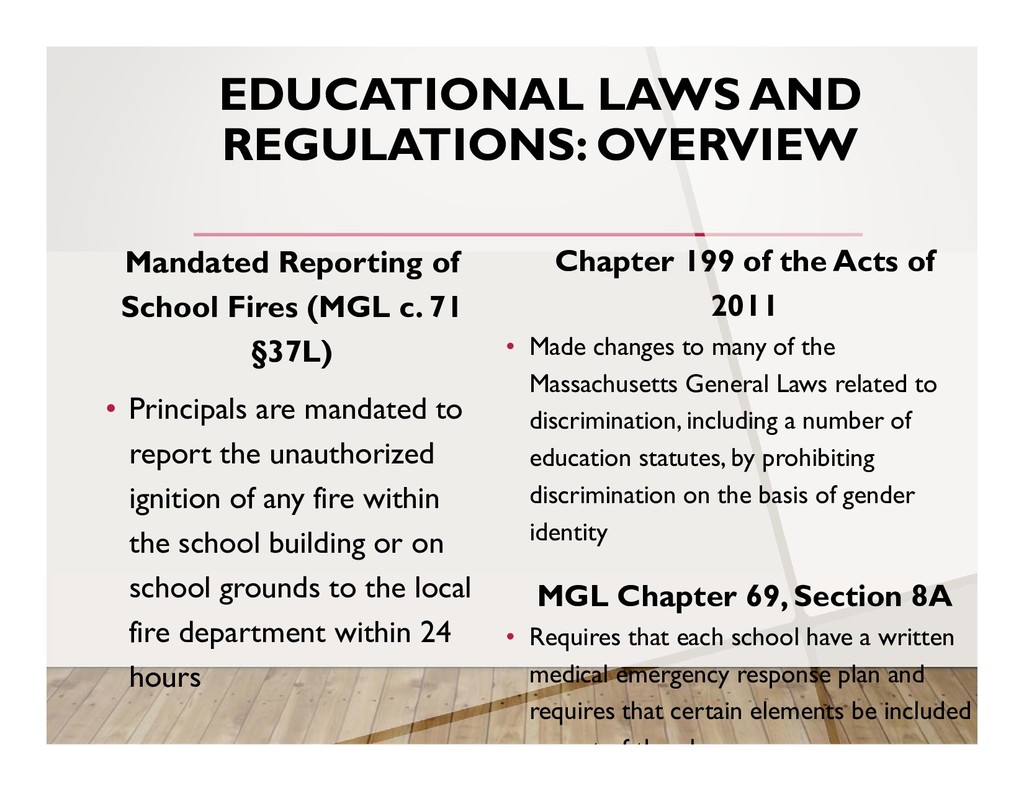
(MGL c. 71 §37L) • Principals are mandated to report the unauthorized ignition of any fire within the school building or on school grounds to the local fire department within 24 hours Chapter 199 of the Acts of 2011 • Made changes to many of the Massachusetts General Laws related to discrimination, including a number of education statutes, by prohibiting discrimination on the basis of gender identity MGL Chapter 69, Section 8A • Requires that each school have a written medical emergency response plan and requires that certain elements be included t f th l
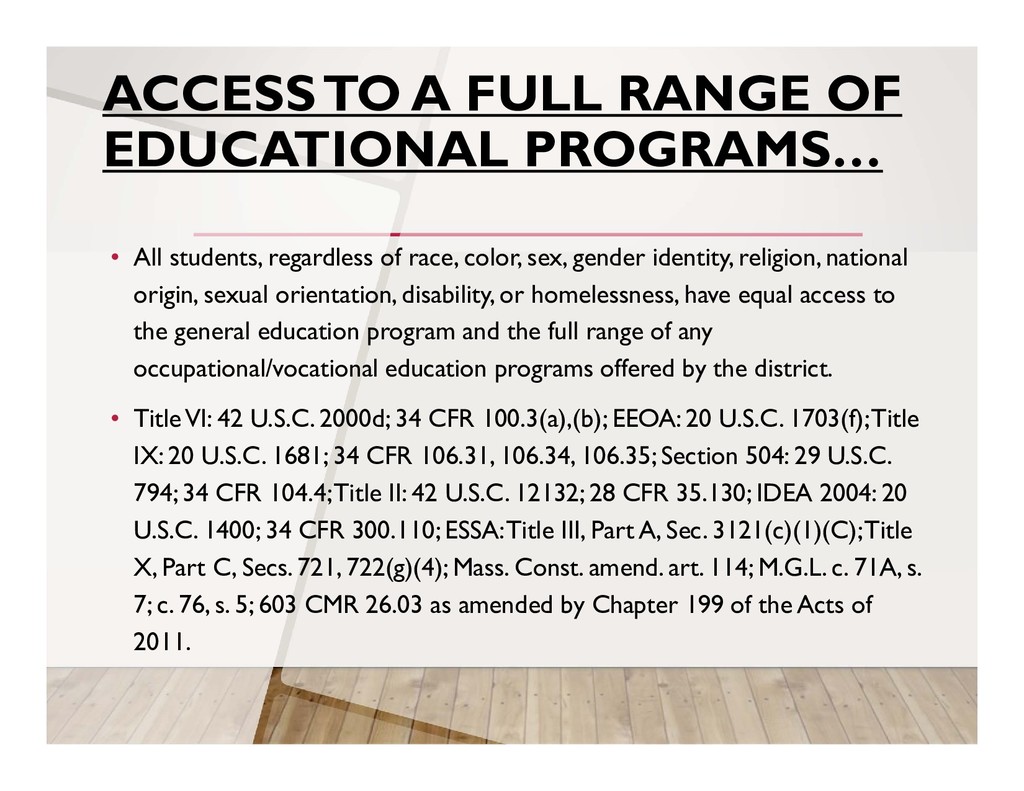
students, regardless of race, color, sex, gender identity, religion, national origin, sexual orientation, disability, or homelessness, have equal access to the general education program and the full range of any occupational/vocational education programs offered by the district. • Title VI: 42 U.S.C. 2000d; 34 CFR 100.3(a),(b); EEOA: 20 U.S.C. 1703(f); Title IX: 20 U.S.C. 1681; 34 CFR 106.31, 106.34, 106.35; Section 504: 29 U.S.C. 794; 34 CFR 104.4; Title II: 42 U.S.C. 12132; 28 CFR 35.130; IDEA 2004: 20 U.S.C. 1400; 34 CFR 300.110; ESSA: Title III, Part A, Sec. 3121(c)(1)(C); Title X, Part C, Secs. 721, 722(g)(4); Mass. Const. amend. art. 114; M.G.L. c. 71A, s. 7; c. 76, s. 5; 603 CMR 26.03 as amended by Chapter 199 of the Acts of 2011.
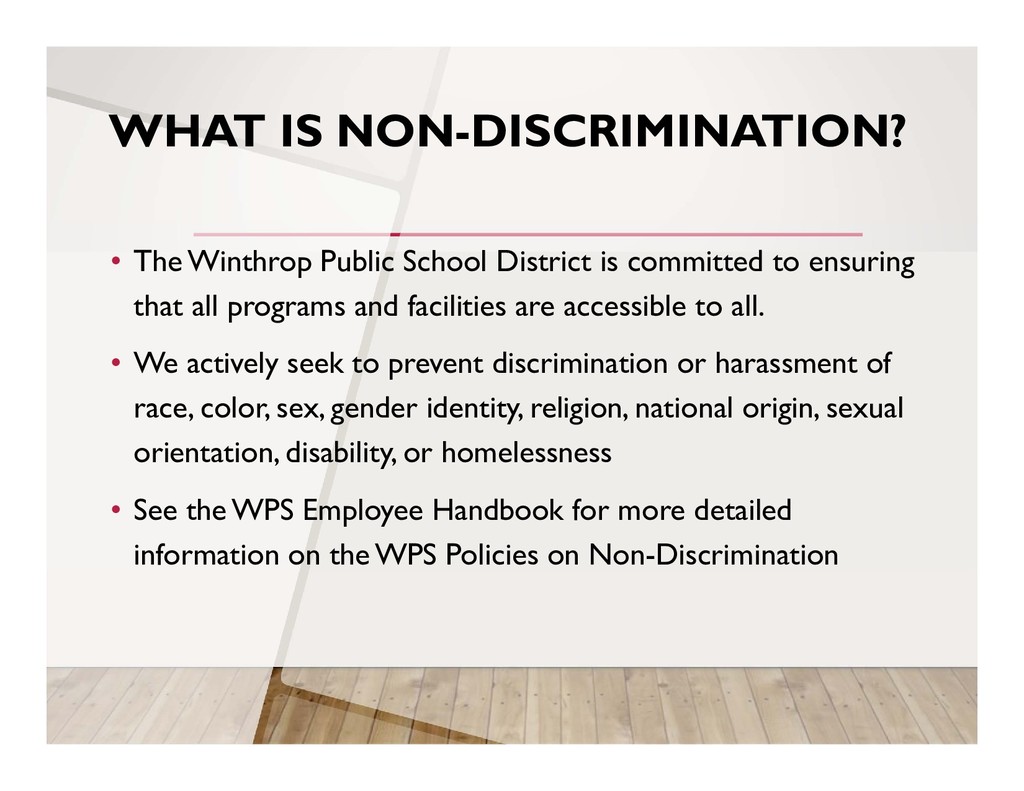
committed to ensuring that all programs and facilities are accessible to all. • We actively seek to prevent discrimination or harassment of race, color, sex, gender identity, religion, national origin, sexual orientation, disability, or homelessness • See the WPS Employee Handbook for more detailed information on the WPS Policies on Non-Discrimination
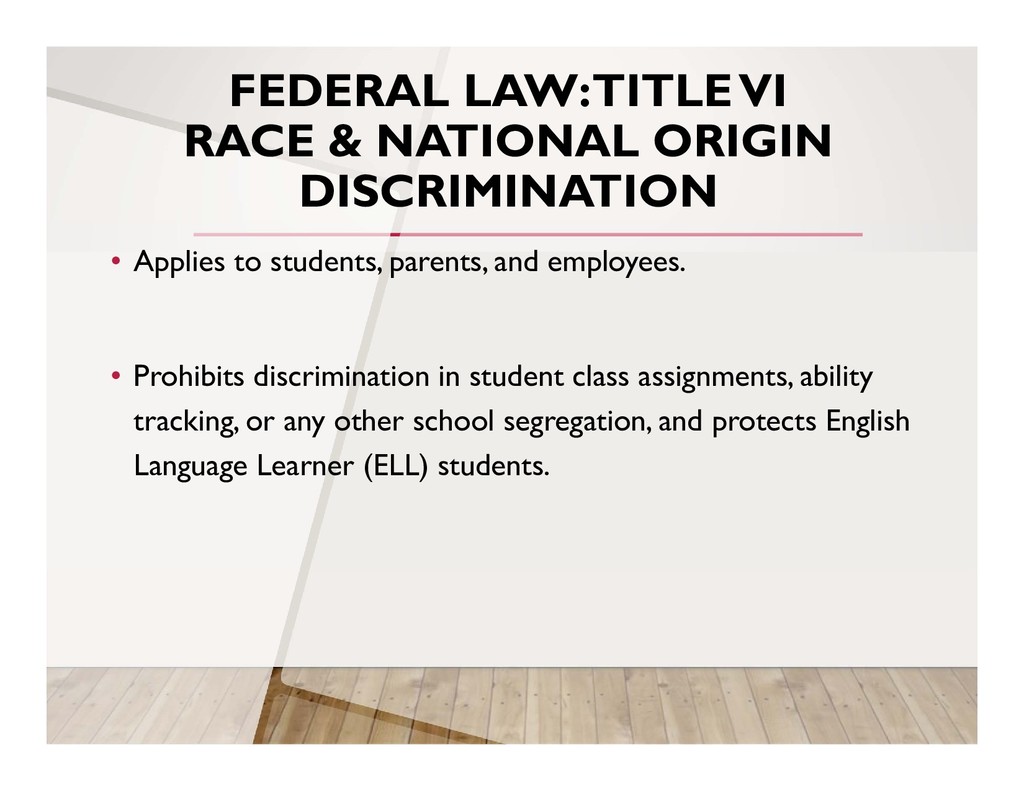
Applies to students, parents, and employees. • Prohibits discrimination in student class assignments, ability tracking, or any other school segregation, and protects English Language Learner (ELL) students.
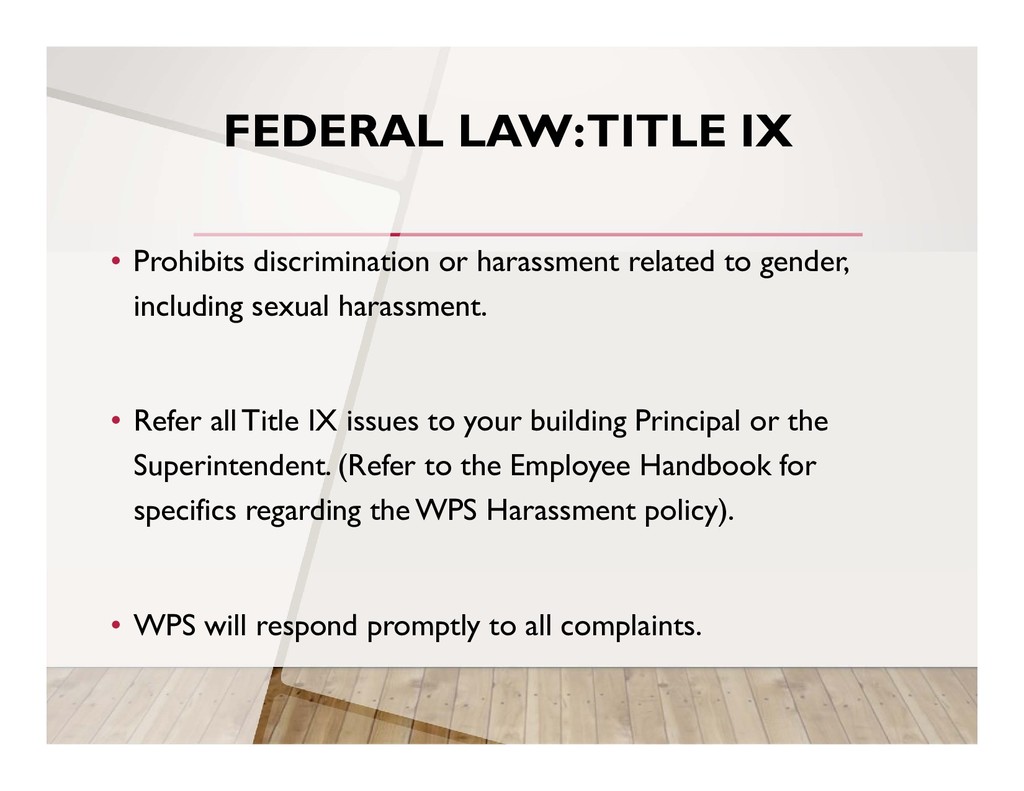
to gender, including sexual harassment. • Refer all Title IX issues to your building Principal or the Superintendent. (Refer to the Employee Handbook for specifics regarding the WPS Harassment policy). • WPS will respond promptly to all complaints.
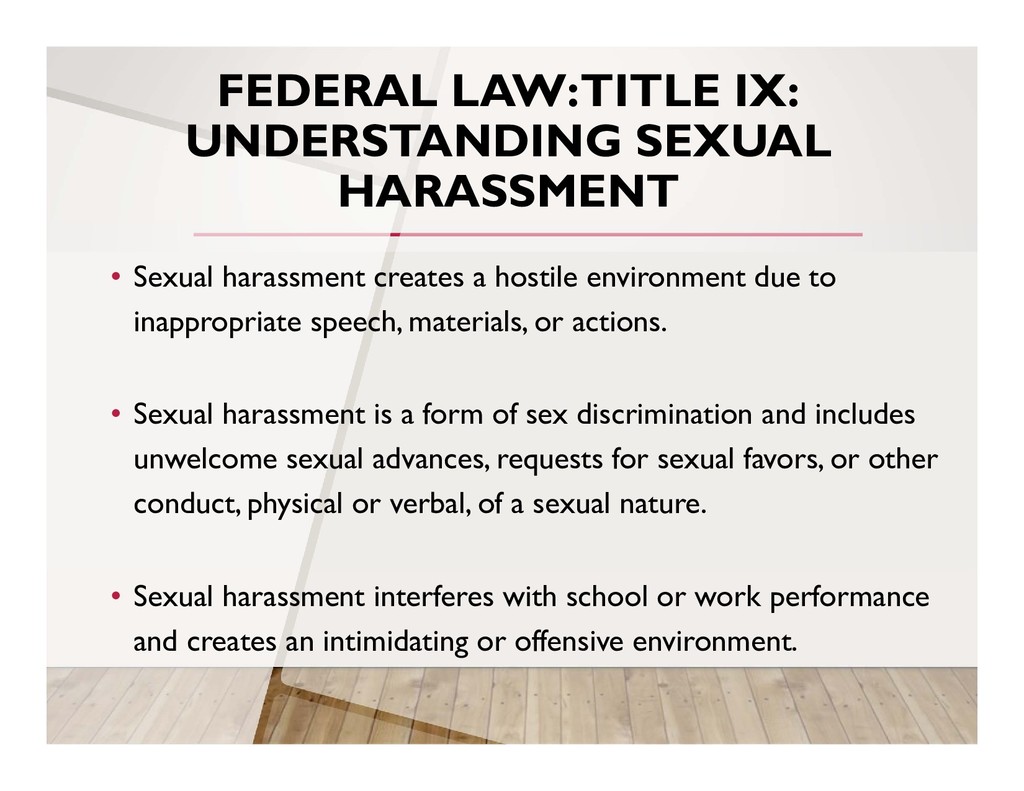
creates a hostile environment due to inappropriate speech, materials, or actions. • Sexual harassment is a form of sex discrimination and includes unwelcome sexual advances, requests for sexual favors, or other conduct, physical or verbal, of a sexual nature. • Sexual harassment interferes with school or work performance and creates an intimidating or offensive environment.
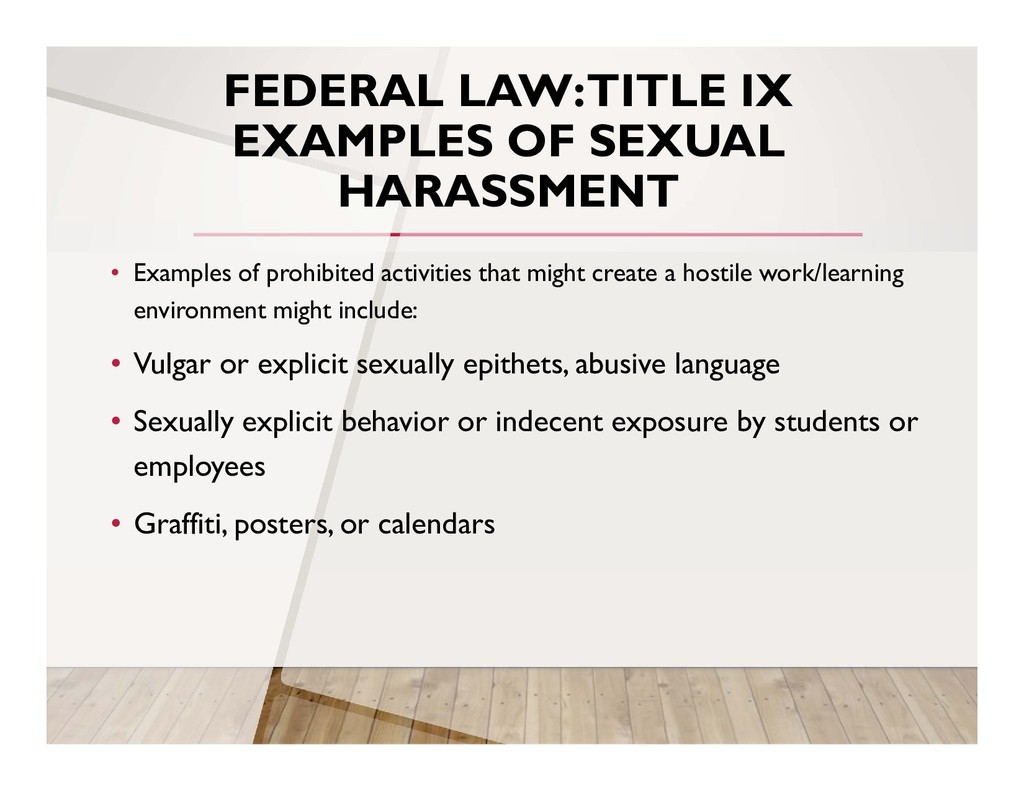
of prohibited activities that might create a hostile work/learning environment might include: • Vulgar or explicit sexually epithets, abusive language • Sexually explicit behavior or indecent exposure by students or employees • Graffiti, posters, or calendars
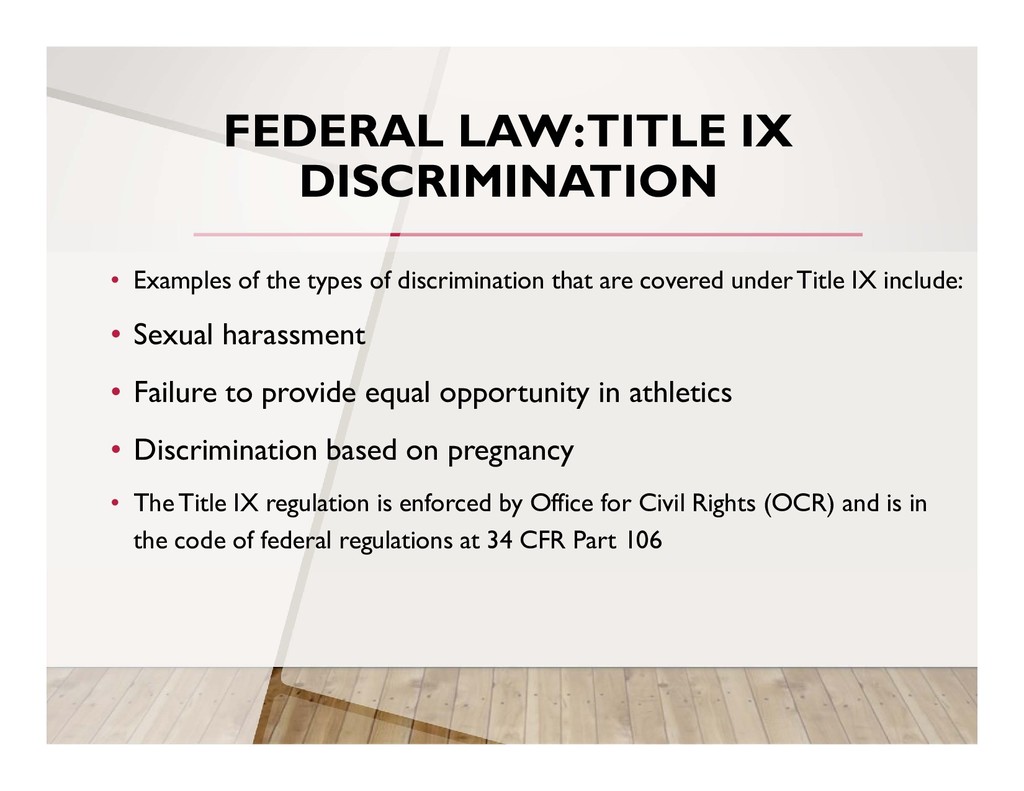
of discrimination that are covered under Title IX include: • Sexual harassment • Failure to provide equal opportunity in athletics • Discrimination based on pregnancy • The Title IX regulation is enforced by Office for Civil Rights (OCR) and is in the code of federal regulations at 34 CFR Part 106
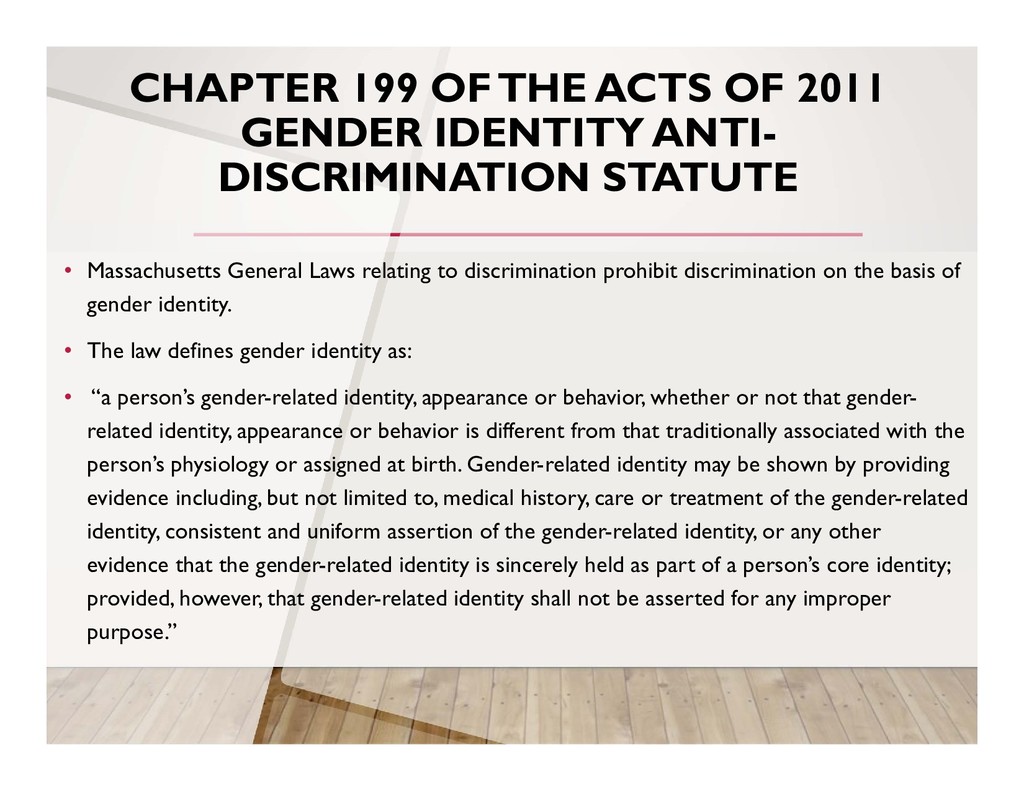
DISCRIMINATION STATUTE • Massachusetts General Laws relating to discrimination prohibit discrimination on the basis of gender identity. • The law defines gender identity as: • “a person’s gender-related identity, appearance or behavior, whether or not that gender- related identity, appearance or behavior is different from that traditionally associated with the person’s physiology or assigned at birth. Gender-related identity may be shown by providing evidence including, but not limited to, medical history, care or treatment of the gender-related identity, consistent and uniform assertion of the gender-related identity, or any other evidence that the gender-related identity is sincerely held as part of a person’s core identity; provided, however, that gender-related identity shall not be asserted for any improper purpose.”
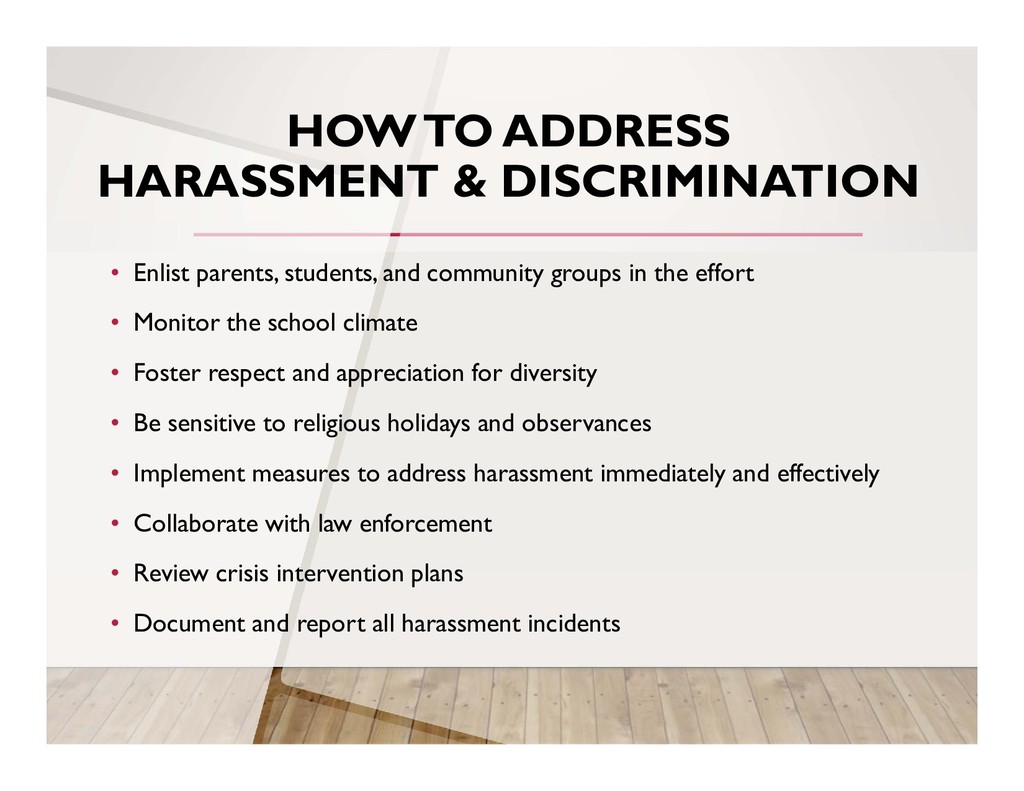
and community groups in the effort • Monitor the school climate • Foster respect and appreciation for diversity • Be sensitive to religious holidays and observances • Implement measures to address harassment immediately and effectively • Collaborate with law enforcement • Review crisis intervention plans • Document and report all harassment incidents
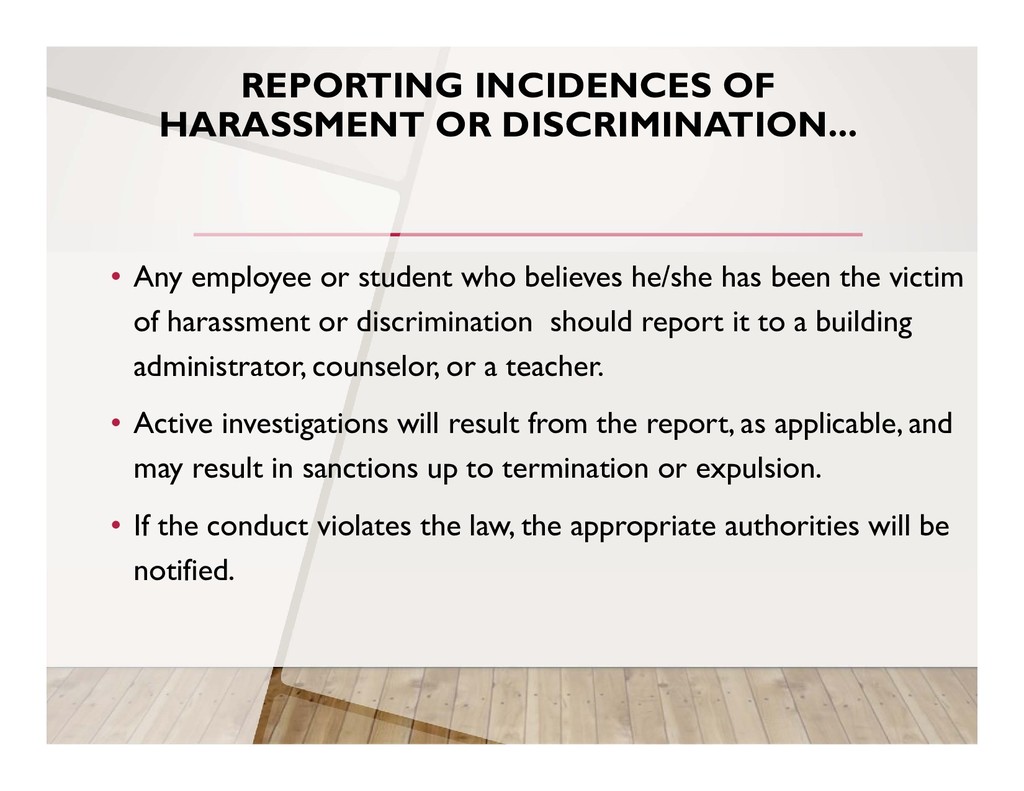
student who believes he/she has been the victim of harassment or discrimination should report it to a building administrator, counselor, or a teacher. • Active investigations will result from the report, as applicable, and may result in sanctions up to termination or expulsion. • If the conduct violates the law, the appropriate authorities will be notified.
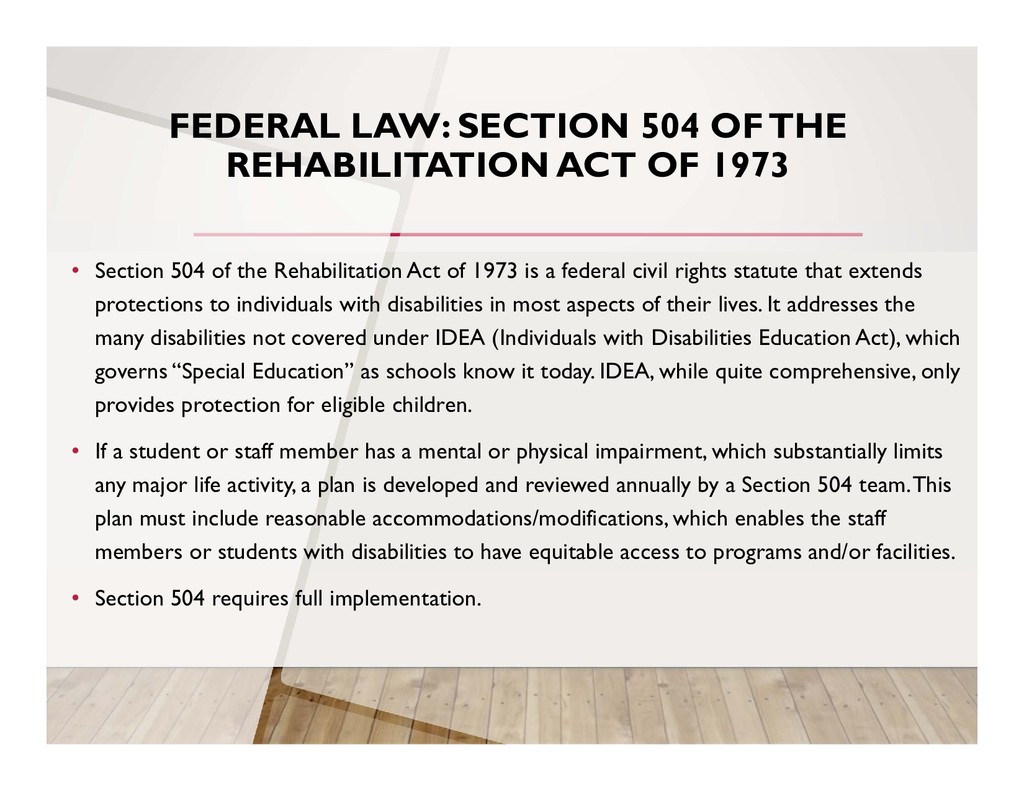
• Section 504 of the Rehabilitation Act of 1973 is a federal civil rights statute that extends protections to individuals with disabilities in most aspects of their lives. It addresses the many disabilities not covered under IDEA (Individuals with Disabilities Education Act), which governs “Special Education” as schools know it today. IDEA, while quite comprehensive, only provides protection for eligible children. • If a student or staff member has a mental or physical impairment, which substantially limits any major life activity, a plan is developed and reviewed annually by a Section 504 team. This plan must include reasonable accommodations/modifications, which enables the staff members or students with disabilities to have equitable access to programs and/or facilities. • Section 504 requires full implementation.
with a disability will be permitted in any of the programs of the Winthrop Public Schools. • §504 is a civil rights statute and not a special education statute. Therefore, it is the responsibility of regular education staff and administration to implement those practices and procedures necessary for a school to fulfill this law’s requirements. It is also important to understand that Winthrop Public School District receives no additional funding to implement §504 accommodations. The responsibility for insuring §504 compliance rests with the District’s §504 Coordinator. Please note that when working with disabled students, §504 serves the same purpose as ADA (Americans with Disabilities Act). • Questions about eligibility and enforcement should be directed to the 504 Coordinator in your building.
types of discrimination: • Access to educational programs • Denial of the free appropriate public education for elementary and secondary students • Section 504 and Title II also prohibit employment discrimination • The WPS has designated the Director of Pupil Personnel Services as the person to coordinate its efforts to comply with ADA. • Inquiries, requests, and/or complaints should be directed to: Director of Pupil Personnel Services, Jennifer O’Connell, 400 Main St, Winthrop MA 02152 (617)329-3609
special education system is based on federal special education law and the Individuals with Disabilities Education Improvement Act (IDEA, 2004 CFR 300) in concert with the state special education laws and regulations (MGL c. 71B and 603 CMR 28.00) • These laws protect students with disabilities who are eligible for special education and guarantees them an Individual Education Program (IEP) to meet their unique needs. • Students must be provided a Free and Appropriate Education (FAPE) that prepares them for further education, employment and independent living. • The Winthrop Public School District provides a full continuum of special education services for students with disabilities ages 3-22 who have been found eligible for special education.
ongoing throughout the school year. • Once a child is identified as possibly needing special education and related services, a referral is made to begin the special education evaluation process. • Parental consent is required for all evaluations. The team, which consists of parents, special educators, regular educators, the Special Education Team Chair, related service providers, an individual who can interpret the instructional implications of the evaluation results, and the student (when appropriate), meets to decide eligibility, IEP services, and placement. • For further information relative to special education procedures, contact your building administrator or the Office of Pupil Personnel Services at (617)329-3609
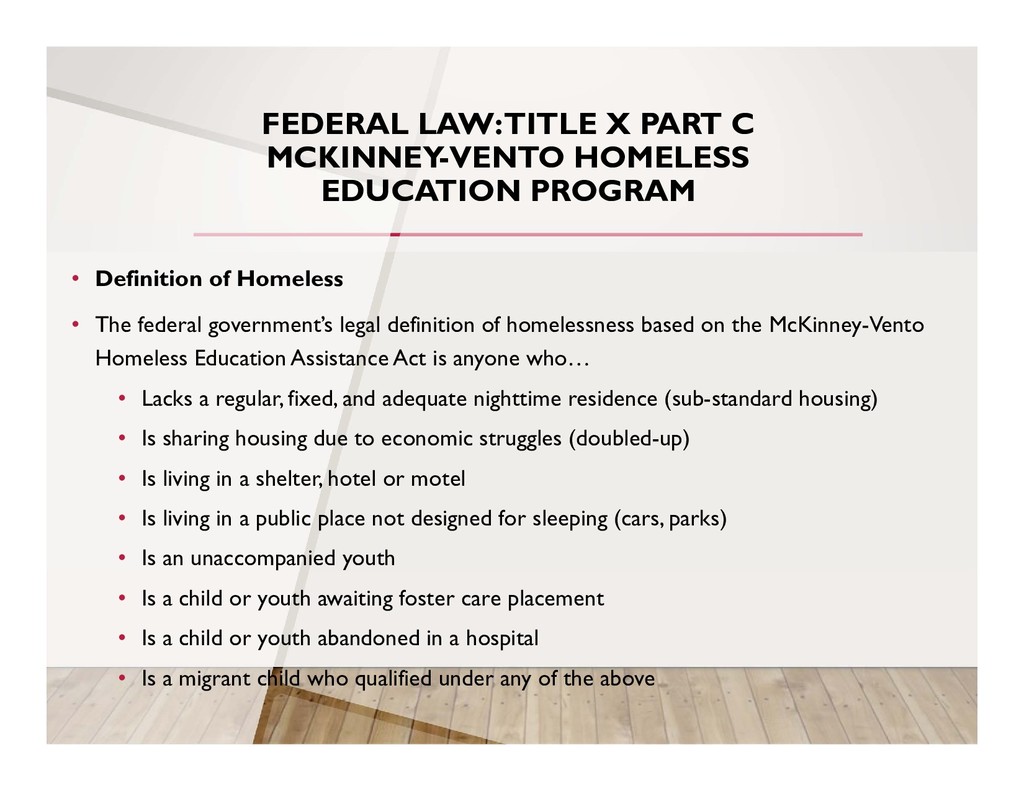
• Definition of Homeless • The federal government’s legal definition of homelessness based on the McKinney-Vento Homeless Education Assistance Act is anyone who… • Lacks a regular, fixed, and adequate nighttime residence (sub-standard housing) • Is sharing housing due to economic struggles (doubled-up) • Is living in a shelter, hotel or motel • Is living in a public place not designed for sleeping (cars, parks) • Is an unaccompanied youth • Is a child or youth awaiting foster care placement • Is a child or youth abandoned in a hospital • Is a migrant child who qualified under any of the above
that a student is homeless, notify the principal, school counselor, or school nurse so that an appropriate referral can be initiated. • The district’s liaison for homeless students carrying out duties as described in ESSA Title X, Part C, Sec. 722 (g) (6) is the Director of Pupil Personnel Services, Jennifer O’Connell, 400 Main Street, Winthrop MA 02152 (617)329-3609
Family Education Rights and Privacy Act of 1974 • Parents and eligible students have the right: • To inspect and review their child’s file • To inspect and review their child’s file prior to any meeting regarding an IEP • A reasonable fee may be charged for copies of records • To request that the information in their child’s file be changed if they believe it to be inaccurate or if it violates the student’s rights
student records maintained in the school must be private and secure. Computerized systems should be electronically secure. • School personnel should be informed of the provisions of 603 CMR 23.00 and MGL c. 71, § 34H. These documents can be reviewed online. • www.doe.mass.edu/lawsregs/603cmr23.html?section=01www.malegislature.gov/Laws/GeneralLaws /PartI/TitleXII/Chapter71/Section34H • It is important that the information contained in student records is private and confidential.
School personnel are mandated reporters legally obligated to contact the Massachusetts Department of Children and Families (DCF.) • It is important that educators understand their obligation under § 51A and the penalties for failure to comply. Please refer to the law in its entirety for complete information. • http://www.malegislature.gov/Laws/GeneralLaws/PartI/TitleXVII/Chapter119/Section51A • If school personnel have reasonable cause to suspect physical or emotional abuse or substantial risk of harm/neglect they must follow DCF 51A reporting requirements and are legally obligated to contact Massachusetts DCF at 800-792-5200 or 617-660-3400. • Consult with your Principal, social worker, school nurse, or the district’s Director of Pupil Personnel Services for assistance if abuse or neglect is suspected. A team approach to these difficult decisions is recommended • All reports are confidential.
on August 10, 2006, provides greater protection for our children and will enable local authorities to identify possible juvenile fire setters and provide appropriate early intervention. • If you see a fire on school property, activate the fire alarm system, and when safe to do so inform your building principal.
36 Prepared by the Massachusetts Department of Education and Colby C. Brunt, Esq. Stoneman, Chandler & Miller LLP for use by Public Education Programs in Annual Staff Training.
Review: • School restraint policy • Methods of prevention of need for physical restraint • Types of restraint and related safety considerations • Administering restraint in accordance with students needs/limitations • Required reporting & documentation • Identification of selected staff to serve as information resource to school
requirements for the use of physical restraint, but does not iterate all of the detail in the regulations. • All school staff should read and be familiar with the regulations. • Viewing this presentation does not substitute for a careful reading of the full regulatory requirements
better able to promote effective teaching and learning. • Preparing appropriate responses to potentially dangerous circumstances helps to eliminate or minimize negative consequences.
apply to all public education programs including school events and school sponsored activities. Lack of knowledge of the law will not protect you or your students from the consequences of inappropriate actions.
emergency situations of last resort. . . . • Nothing in 603 CMR 46.00 precludes any teacher, employee or agent of a public education program from using reasonable force to protect students, other persons or themselves from assault or imminent, serious, physical harm.
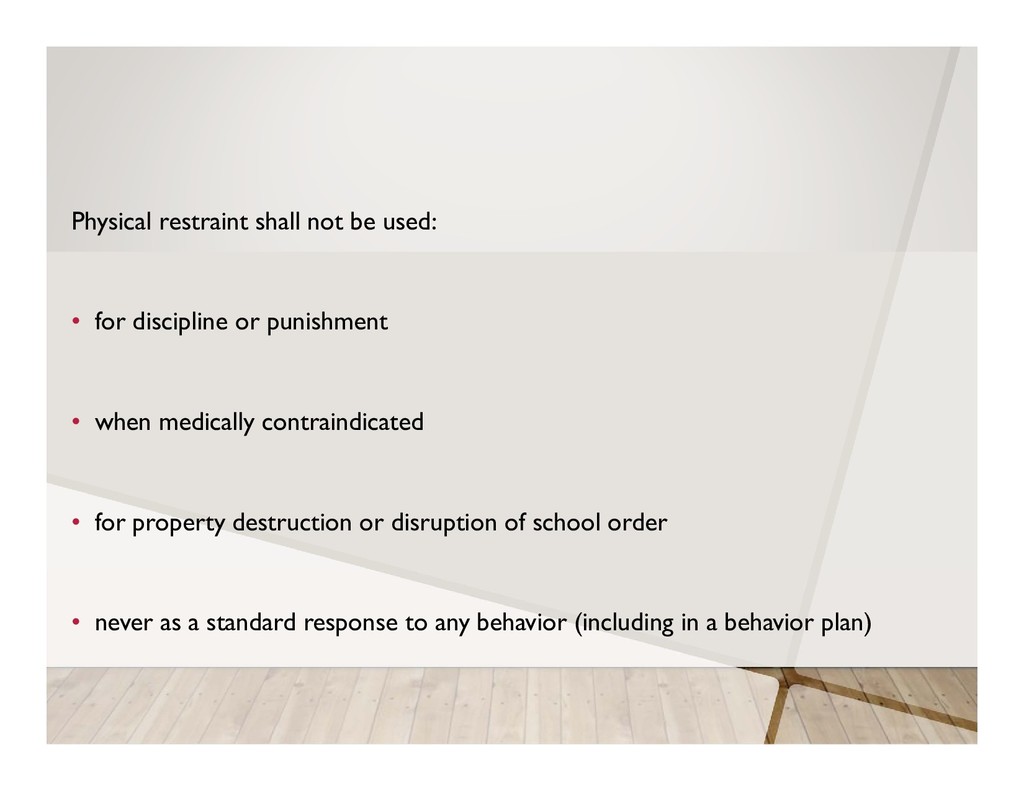
punishment • when medically contraindicated • for property destruction or disruption of school order • never as a standard response to any behavior (including in a behavior plan)
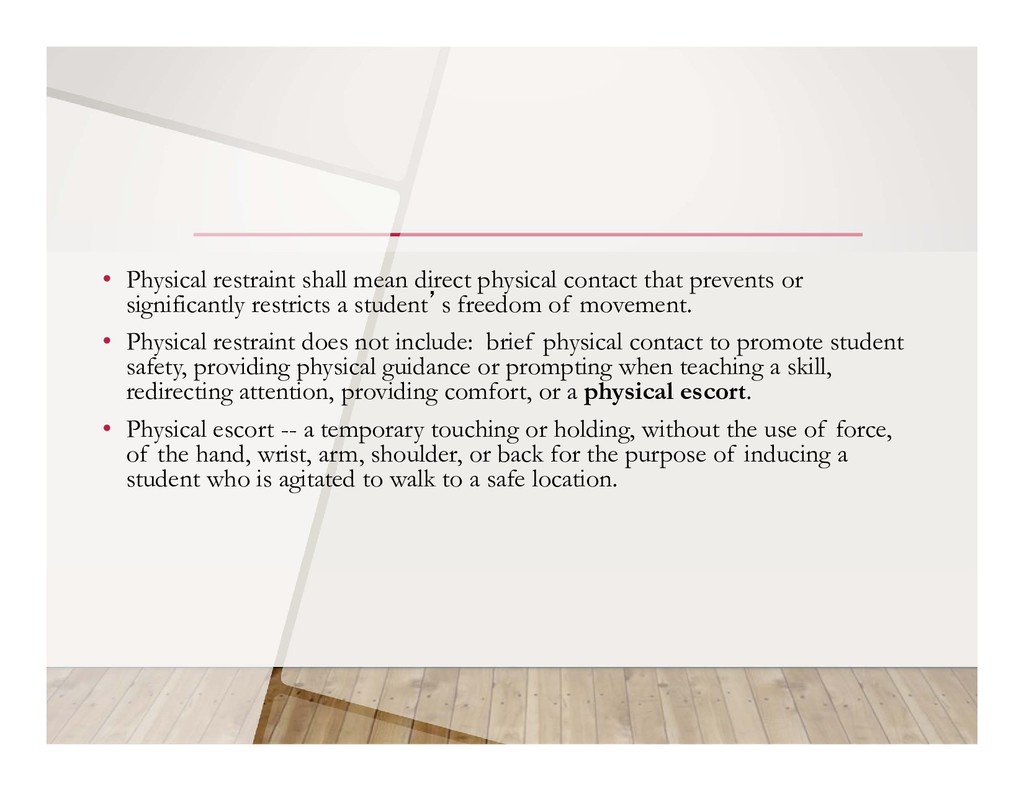
or significantly restricts a student’s freedom of movement. • Physical restraint does not include: brief physical contact to promote student safety, providing physical guidance or prompting when teaching a skill, redirecting attention, providing comfort, or a physical escort. • Physical escort -- a temporary touching or holding, without the use of force, of the hand, wrist, arm, shoulder, or back for the purpose of inducing a student who is agitated to walk to a safe location.
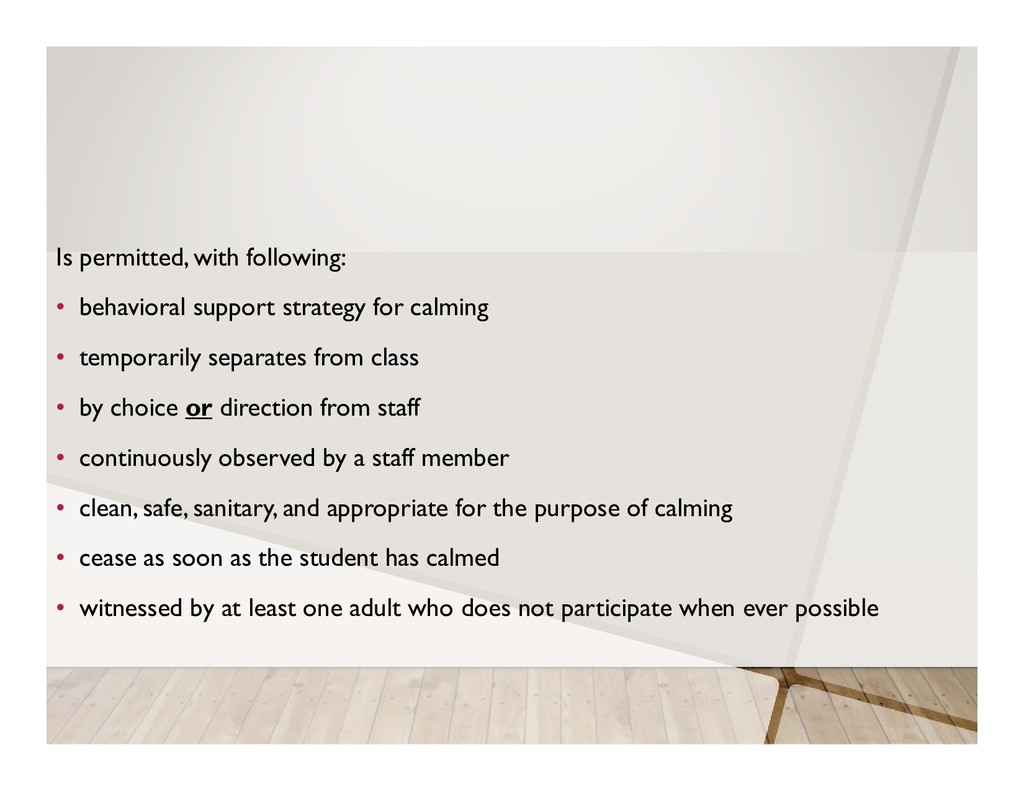
• temporarily separates from class • by choice or direction from staff • continuously observed by a staff member • clean, safe, sanitary, and appropriate for the purpose of calming • cease as soon as the student has calmed • witnessed by at least one adult who does not participate when ever possible
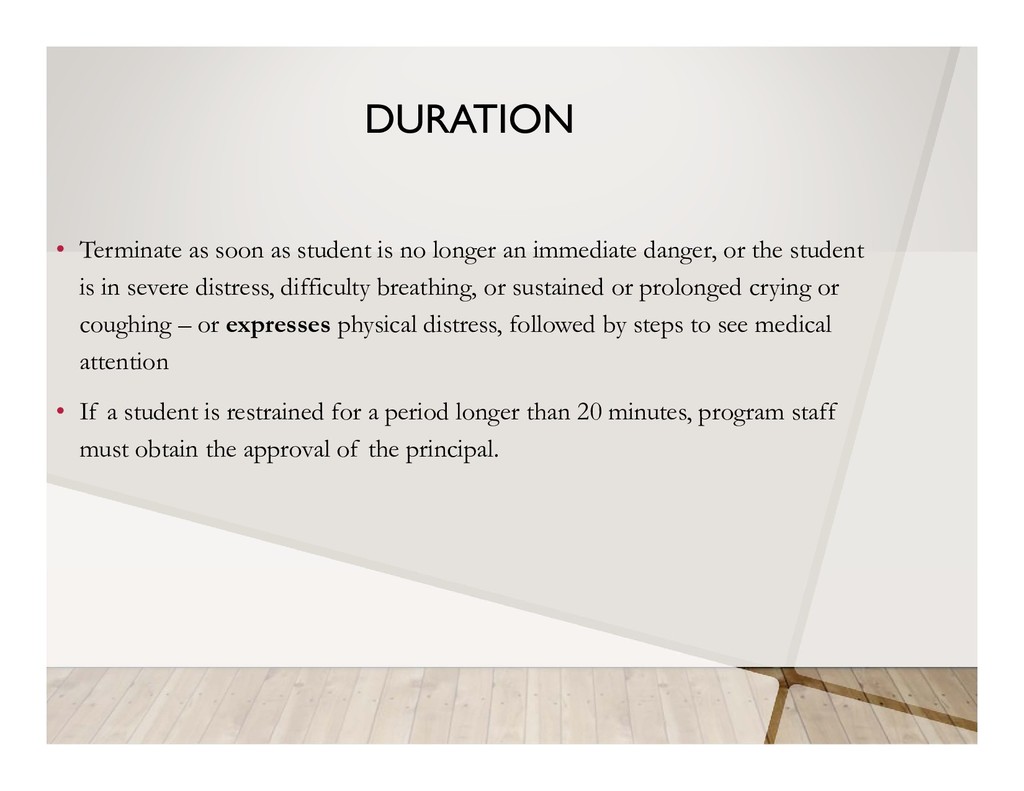
an immediate danger, or the student is in severe distress, difficulty breathing, or sustained or prolonged crying or coughing – or expresses physical distress, followed by steps to see medical attention • If a student is restrained for a period longer than 20 minutes, program staff must obtain the approval of the principal.
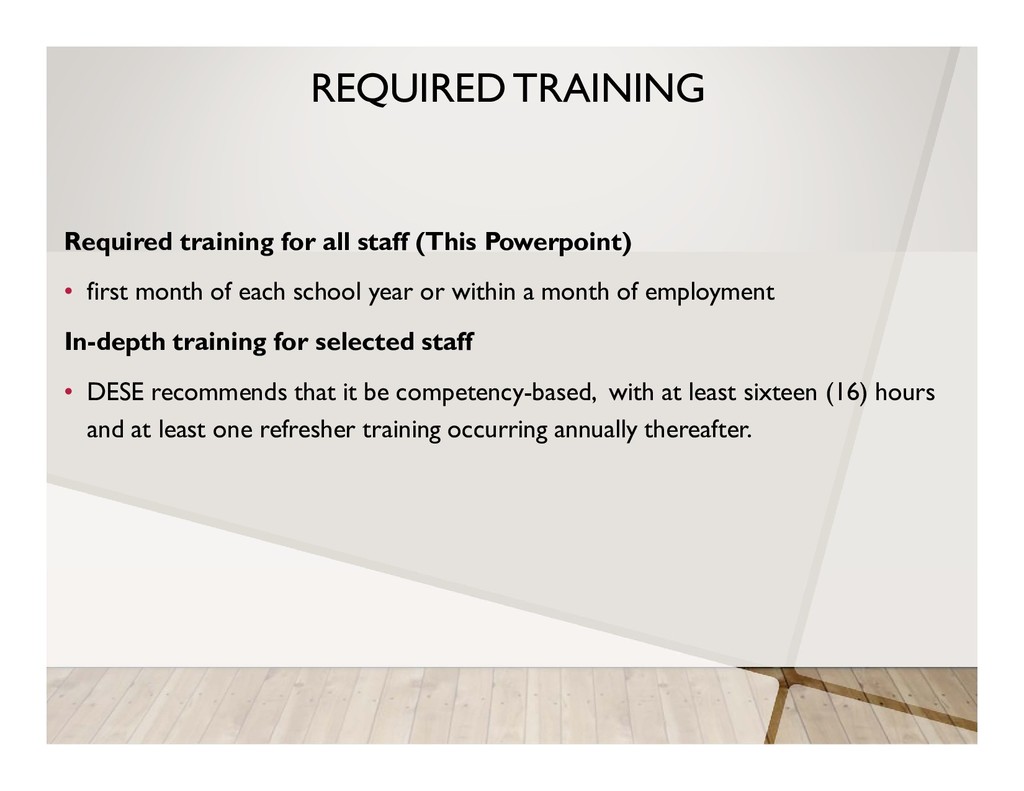
first month of each school year or within a month of employment In-depth training for selected staff • DESE recommends that it be competency-based, with at least sixteen (16) hours and at least one refresher training occurring annually thereafter.
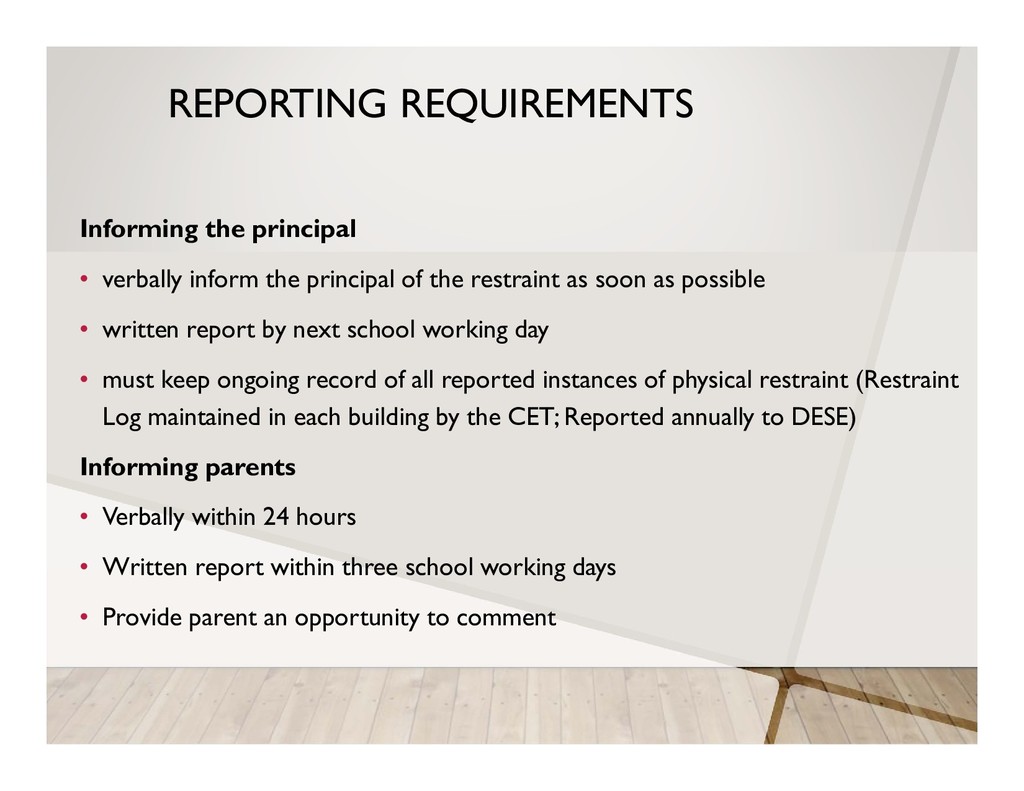
of the restraint as soon as possible • written report by next school working day • must keep ongoing record of all reported instances of physical restraint (Restraint Log maintained in each building by the CET; Reported annually to DESE) Informing parents • Verbally within 24 hours • Written report within three school working days • Provide parent an opportunity to comment
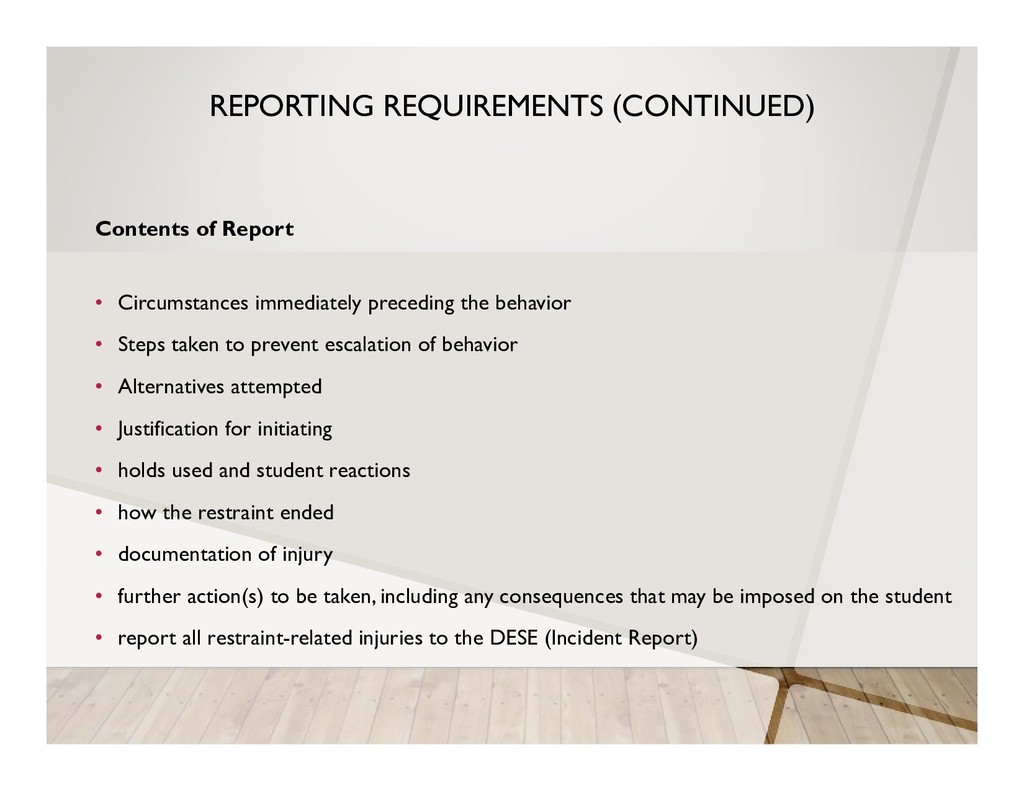
the behavior • Steps taken to prevent escalation of behavior • Alternatives attempted • Justification for initiating • holds used and student reactions • how the restraint ended • documentation of injury • further action(s) to be taken, including any consequences that may be imposed on the student • report all restraint-related injuries to the DESE (Incident Report)
and provided to program staff and made available to parents, including -- • Strategies for preventing violence and suicide • Strategies for engaging parents in discussions • Alternatives to physical restraint • Requirement for verbal notice to parent of the use of restraint within 24 hours, followed by written notice within three school working days • Provisions for time-out that include a process for obtaining principal approval of time-out for more than 30 minutes
You are responsible for your own actions…The Winthrop Public School System, along with the other organizations sponsoring this Internet link-up, will not be liable for the actions of anyone connecting to Internet through this hook-up. All users shall assume full liability, legal, financial, or otherwise, for their actions. • Verify your information and trust the source…The Winthrop Public School System makes no guarantees, implied or otherwise, regarding the reliability of the data connection. Neither Winthrop Public Schools, nor the sponsor organizations, shall be liable for any loss or corruption of data resulting while using the Internet connection. • Aarrgghh!!!...The Winthrop Public School System strongly condemns the illegal distribution of software, otherwise known as pirating • You are a representative of the Winthrop Public Schools…all users must behave in an ethical and legal manner * Highlights ONLY…A complete copy of the policy may be found on PDF Document emailed to all employees


 marktimemedia
 charlesmeaden
 leimatthew05
 mkilby
 deanohume
 lcolladotor
 inesmontani
 popppiees
 axbom
 takai
 marketingsoph
 kneath