Upgrade to Pro — share decks privately, control downloads, hide ads and more …

The Z.ai Ecosystem in Practice — A Technical R...

Sponsored · SiteGround - Reliable hosting with speed, security, and support you can count on.

The Z.ai Ecosystem in Practice — A Technical Reference for Engineers

Japanese Edition
https://daisuke.masuda.tokyo/article-2026-08-24-0212

This slide is a 21-slide technical reference for engineers covering Z.ai's GLM-5.3 model, the ZCode development environment, and the AutoClaw business agent. It digs into specs, benchmarks, pricing and workflows, then compares Claude Code, Codex and OSS rivals to guide your tool selection.

This slide was created by GLM-5.3.

Avatar for Daisuke Masuda

Daisuke Masuda PRO

August 23, 2026

More Decks by Daisuke Masuda

Other Decks in Technology

Transcript

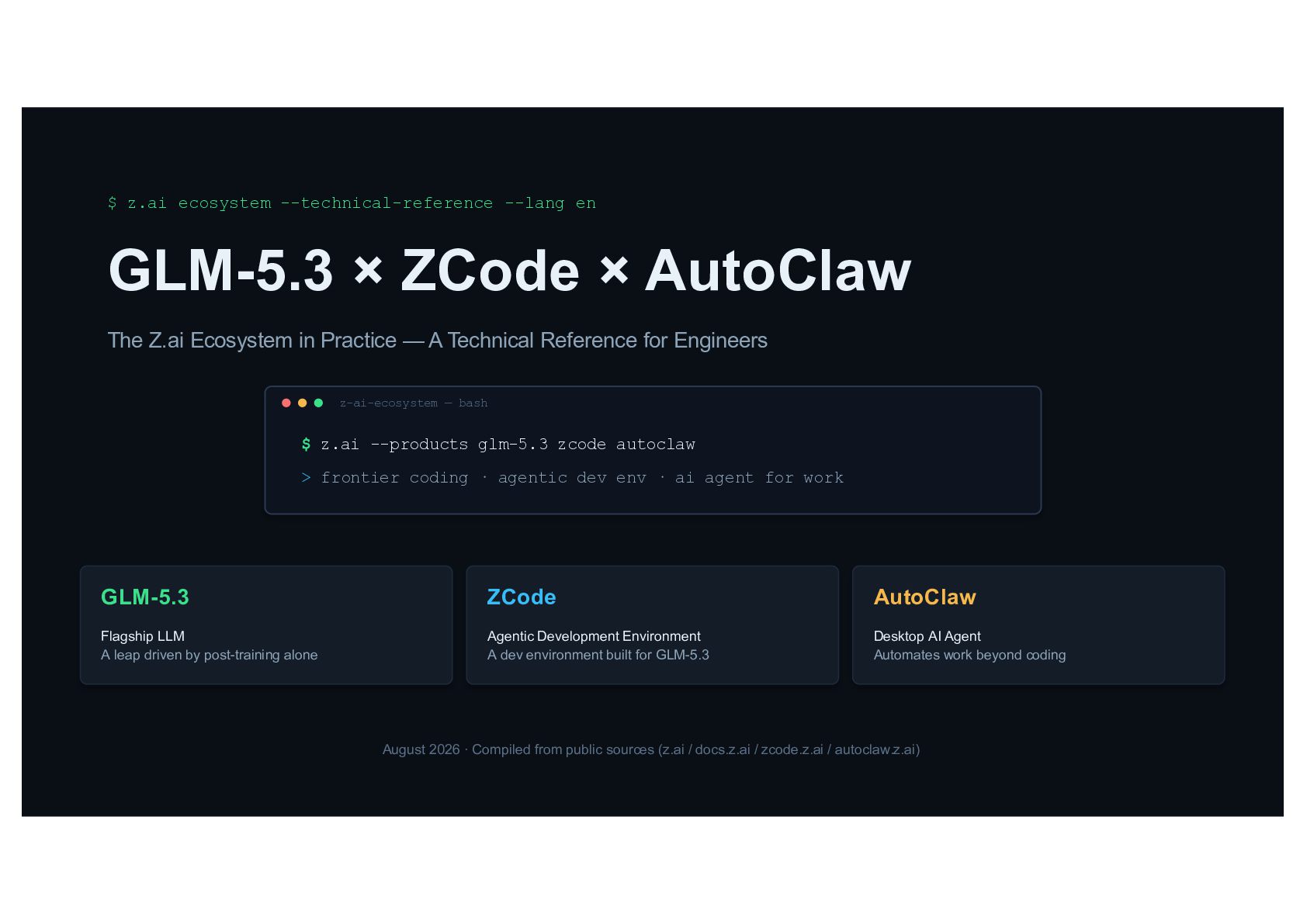
  1. $ z.ai ecosystem --technical-reference --lang en GLM-5.3 × ZCode ×

    AutoClaw The Z.ai Ecosystem in Practice — A Technical Reference for Engineers z-ai-ecosystem — bash $ z.ai --products glm-5.3 zcode autoclaw > frontier coding · agentic dev env · ai agent for work GLM-5.3 ZCode AutoClaw Flagship LLM A leap driven by post-training alone Agentic Development Environment A dev environment built for GLM-5.3 Desktop AI Agent Automates work beyond coding August 2026 · Compiled from public sources (z.ai / docs.z.ai / zcode.z.ai / autoclaw.z.ai)
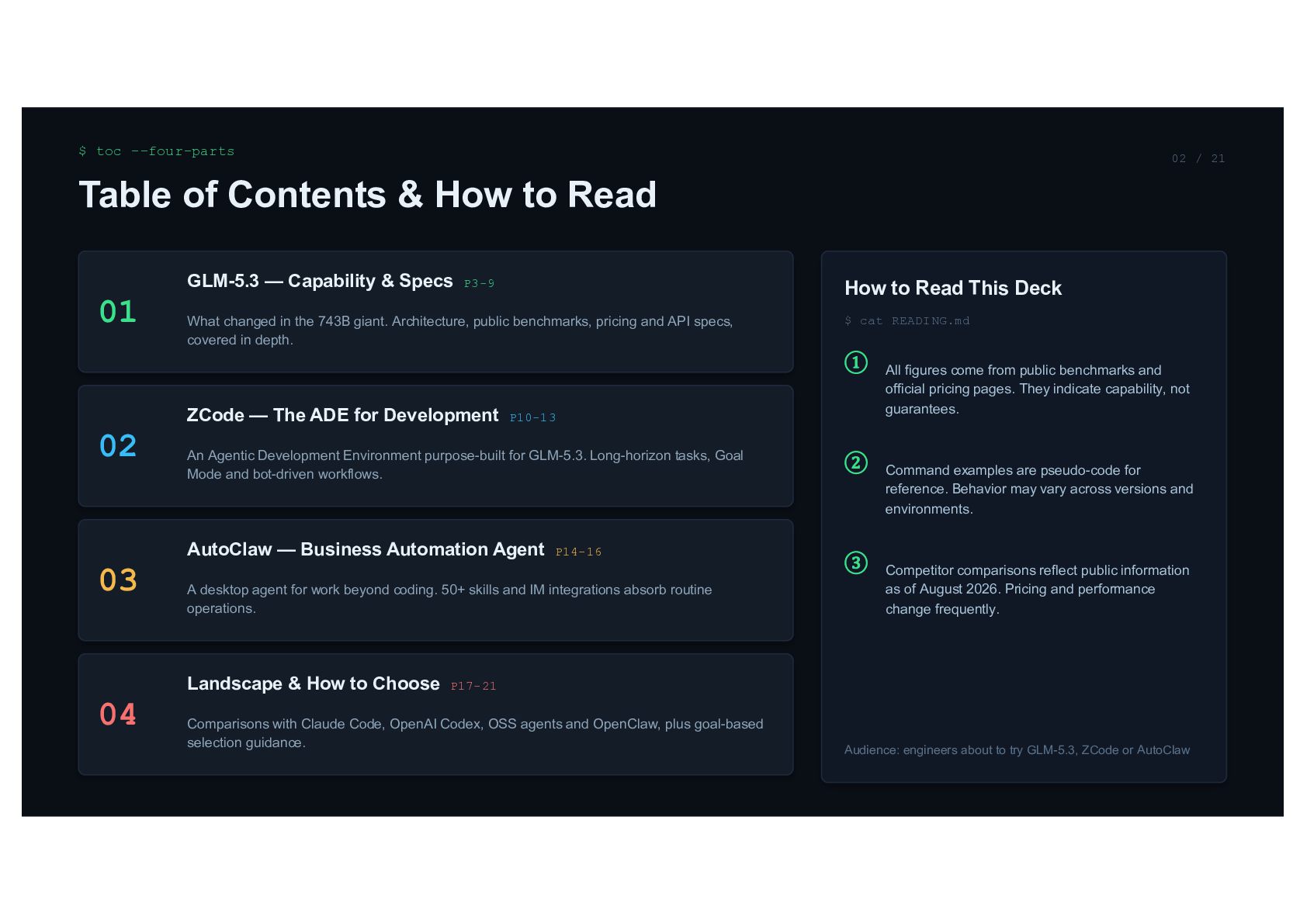
  2. $ toc --four-parts 02 / 21 Table of Contents &

    How to Read GLM-5.3 — Capability & Specs P3-9 01 What changed in the 743B giant. Architecture, public benchmarks, pricing and API specs, covered in depth. How to Read This Deck $ cat READING.md ① ZCode — The ADE for Development P10-13 02 An Agentic Development Environment purpose-built for GLM-5.3. Long-horizon tasks, Goal Mode and bot-driven workflows. AutoClaw — Business Automation Agent P14-16 03 A desktop agent for work beyond coding. 50+ skills and IM integrations absorb routine operations. ② ③ All figures come from public benchmarks and official pricing pages. They indicate capability, not guarantees. Command examples are pseudo-code for reference. Behavior may vary across versions and environments. Competitor comparisons reflect public information as of August 2026. Pricing and performance change frequently. Landscape & How to Choose P17-21 04 Comparisons with Claude Code, OpenAI Codex, OSS agents and OpenClaw, plus goal-based selection guidance. Audience: engineers about to try GLM-5.3, ZCode or AutoClaw
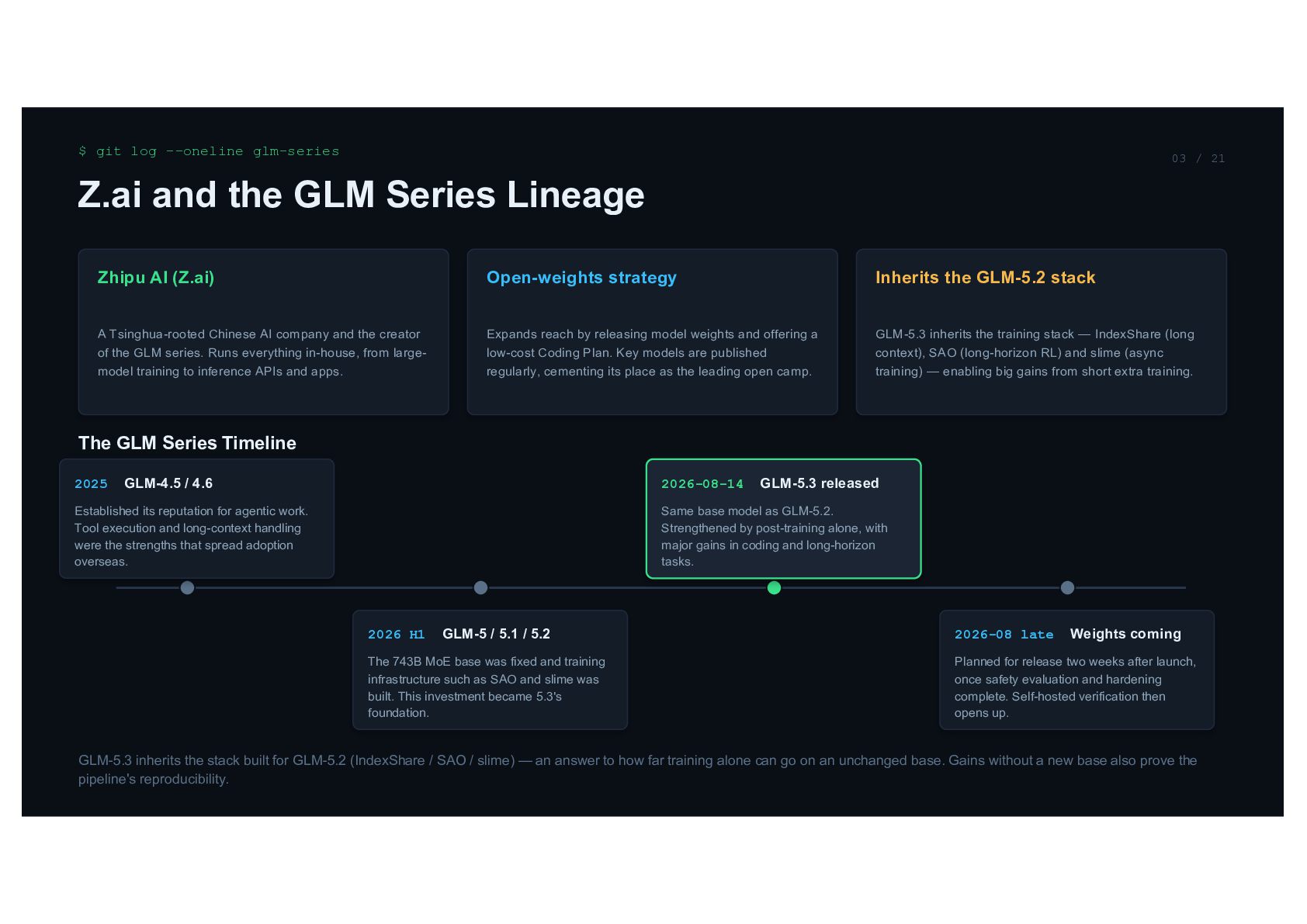
  3. $ git log --oneline glm-series 03 / 21 Z.ai and

    the GLM Series Lineage Zhipu AI (Z.ai) Open-weights strategy Inherits the GLM-5.2 stack A Tsinghua-rooted Chinese AI company and the creator Expands reach by releasing model weights and offering a GLM-5.3 inherits the training stack — IndexShare (long of the GLM series. Runs everything in-house, from large- low-cost Coding Plan. Key models are published context), SAO (long-horizon RL) and slime (async model training to inference APIs and apps. regularly, cementing its place as the leading open camp. training) — enabling big gains from short extra training. The GLM Series Timeline 2025 GLM-4.5 / 4.6 2026-08-14 Established its reputation for agentic work. Tool execution and long-context handling were the strengths that spread adoption overseas. GLM-5.3 released Same base model as GLM-5.2. Strengthened by post-training alone, with major gains in coding and long-horizon tasks. 2026 H1 GLM-5 / 5.1 / 5.2 The 743B MoE base was fixed and training infrastructure such as SAO and slime was built. This investment became 5.3's foundation. 2026-08 late Weights coming Planned for release two weeks after launch, once safety evaluation and hardening complete. Self-hosted verification then opens up. GLM-5.3 inherits the stack built for GLM-5.2 (IndexShare / SAO / slime) — an answer to how far training alone can go on an unchanged base. Gains without a new base also prove the pipeline's reproducibility.
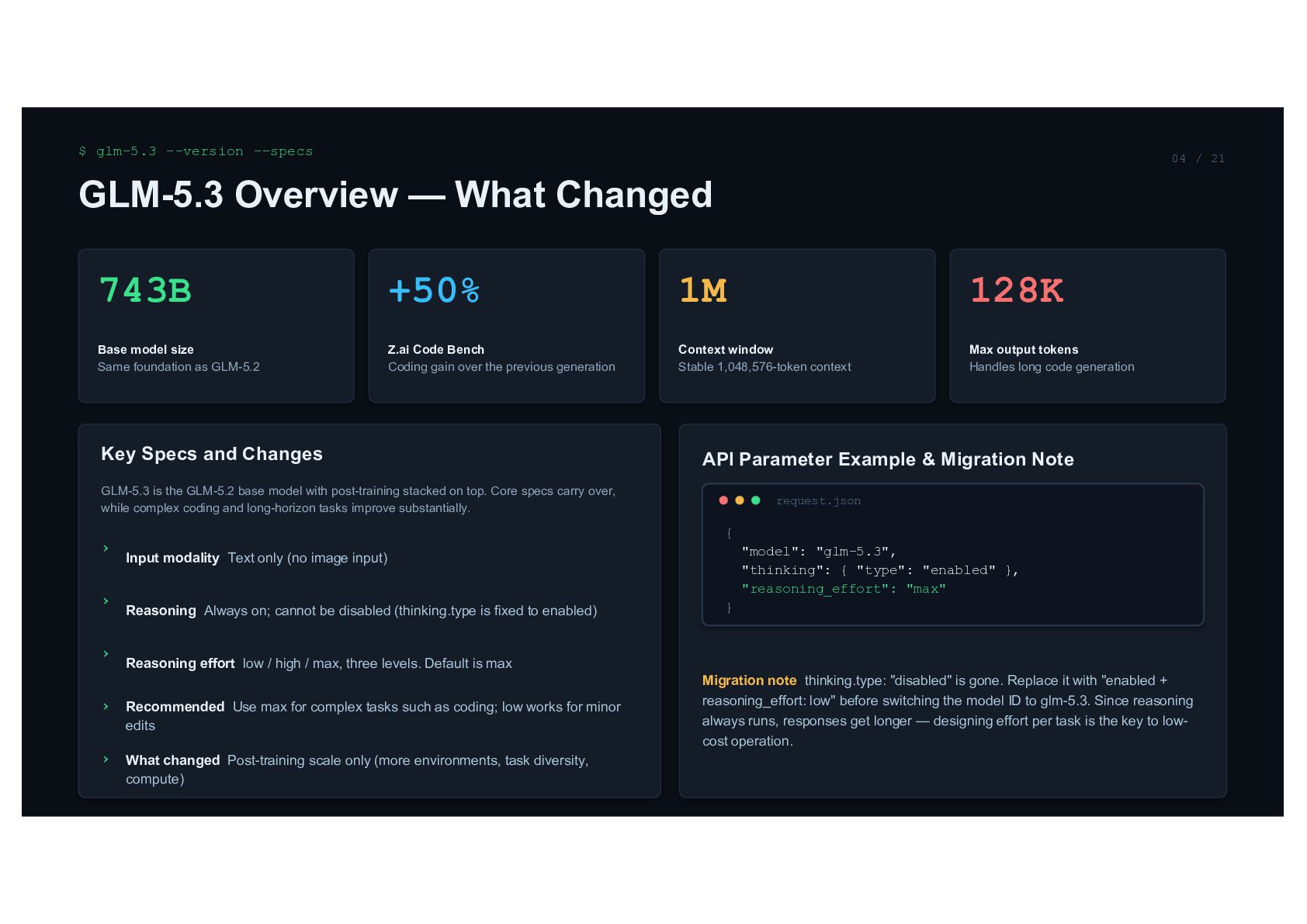
  4. $ glm-5.3 --version --specs 04 / 21 GLM-5.3 Overview —

    What Changed 743B +50% 1M 128K Base model size Same foundation as GLM-5.2 Z.ai Code Bench Coding gain over the previous generation Context window Stable 1,048,576-token context Max output tokens Handles long code generation Key Specs and Changes API Parameter Example & Migration Note GLM-5.3 is the GLM-5.2 base model with post-training stacked on top. Core specs carry over, while complex coding and long-horizon tasks improve substantially. › › › request.json { "model": "glm-5.3", "thinking": { "type": "enabled" }, "reasoning_effort": "max" Input modality Text only (no image input) Reasoning Always on; cannot be disabled (thinking.type is fixed to enabled) } Reasoning effort low / high / max, three levels. Default is max › Recommended Use max for complex tasks such as coding; low works for minor edits › What changed Post-training scale only (more environments, task diversity, compute) Migration note thinking.type: "disabled" is gone. Replace it with "enabled + reasoning_effort: low" before switching the model ID to glm-5.3. Since reasoning always runs, responses get longer — designing effort per task is the key to lowcost operation.
  5. $ post-training --stack --pipeline 05 / 21 GLM-5.3 Architecture —

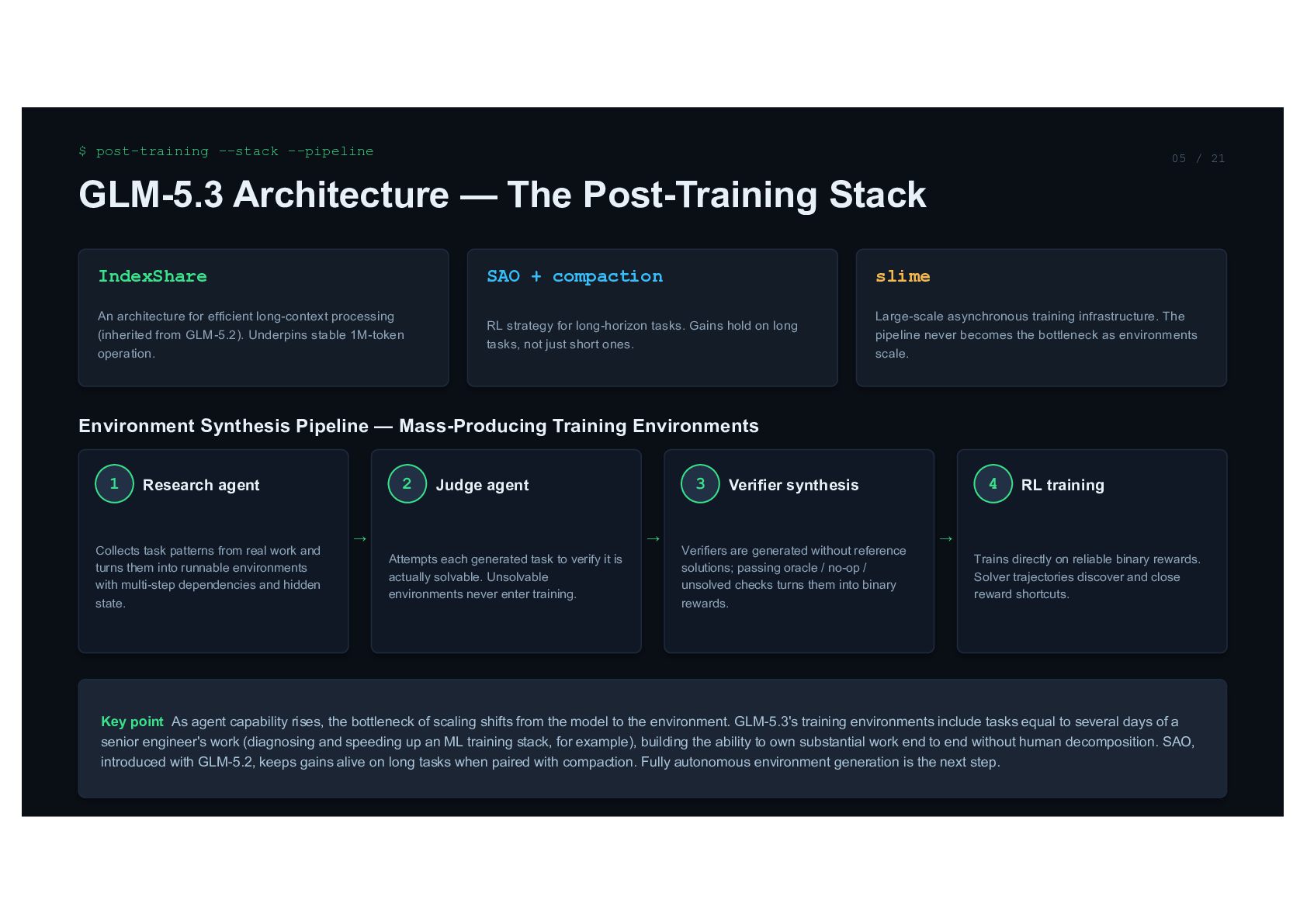
    The Post-Training Stack IndexShare SAO + compaction An architecture for efficient long-context processing (inherited from GLM-5.2). Underpins stable 1M-token operation. slime RL strategy for long-horizon tasks. Gains hold on long tasks, not just short ones. Large-scale asynchronous training infrastructure. The pipeline never becomes the bottleneck as environments scale. Environment Synthesis Pipeline — Mass-Producing Training Environments 1 Collects task patterns from real work and turns them into runnable environments with multi-step dependencies and hidden state. 2 Research agent 3 Judge agent → → Attempts each generated task to verify it is actually solvable. Unsolvable environments never enter training. 4 Verifier synthesis Verifiers are generated without reference solutions; passing oracle / no-op / unsolved checks turns them into binary rewards. RL training → Trains directly on reliable binary rewards. Solver trajectories discover and close reward shortcuts. Key point As agent capability rises, the bottleneck of scaling shifts from the model to the environment. GLM-5.3's training environments include tasks equal to several days of a senior engineer's work (diagnosing and speeding up an ML training stack, for example), building the ability to own substantial work end to end without human decomposition. SAO, introduced with GLM-5.2, keeps gains alive on long tasks when paired with compaction. Fully autonomous environment generation is the next step.
  6. $ benchmark --coding 06 / 21 Benchmarks ① — Coding

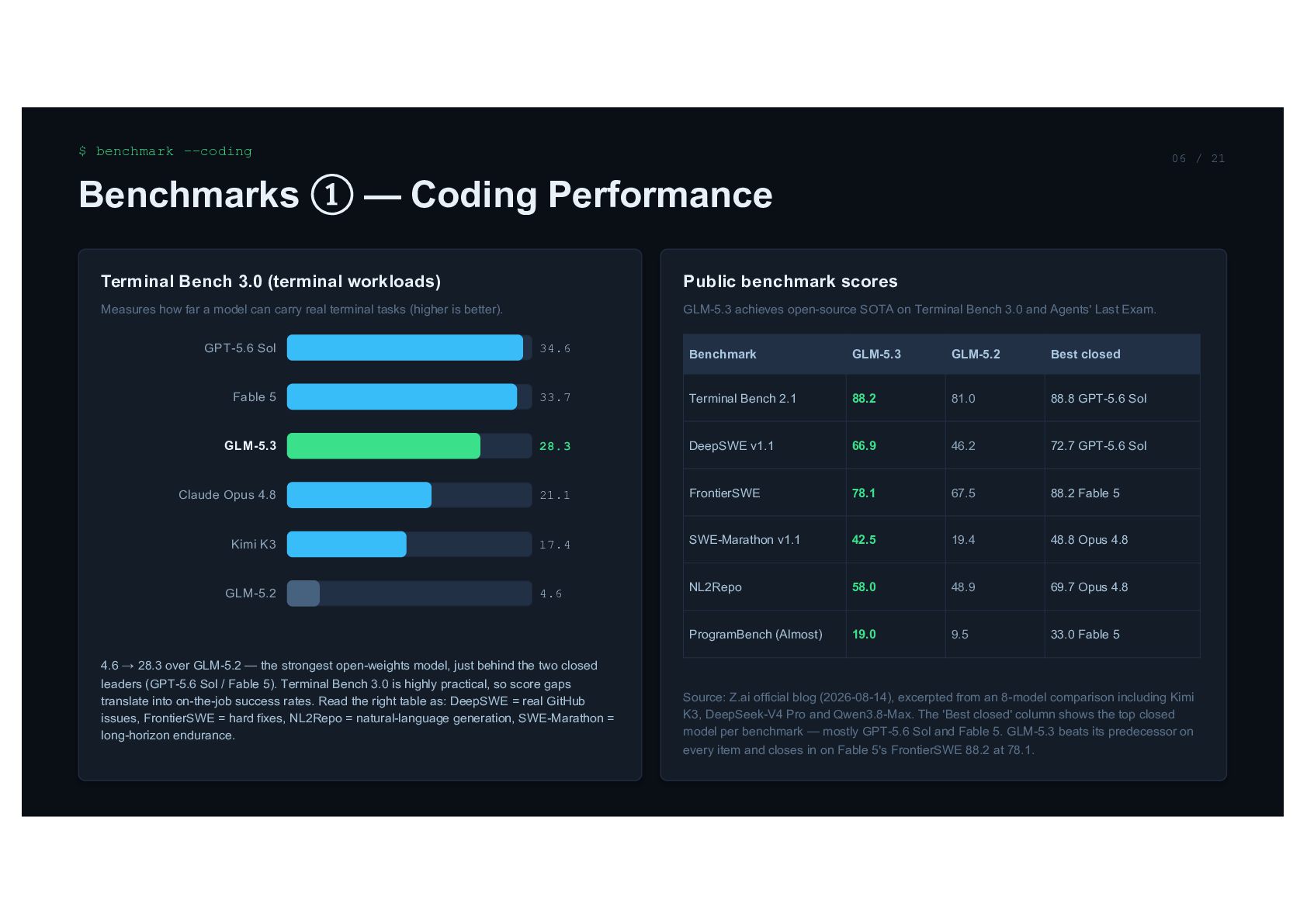
    Performance Terminal Bench 3.0 (terminal workloads) Public benchmark scores Measures how far a model can carry real terminal tasks (higher is better). GLM-5.3 achieves open-source SOTA on Terminal Bench 3.0 and Agents' Last Exam. GPT-5.6 Sol 34.6 Benchmark GLM-5.3 GLM-5.2 Best closed Fable 5 33.7 Terminal Bench 2.1 88.2 81.0 88.8 GPT-5.6 Sol GLM-5.3 28.3 DeepSWE v1.1 66.9 46.2 72.7 GPT-5.6 Sol Claude Opus 4.8 21.1 FrontierSWE 78.1 67.5 88.2 Fable 5 Kimi K3 17.4 SWE-Marathon v1.1 42.5 19.4 48.8 Opus 4.8 GLM-5.2 4.6 NL2Repo 58.0 48.9 69.7 Opus 4.8 ProgramBench (Almost) 19.0 9.5 33.0 Fable 5 4.6 → 28.3 over GLM-5.2 — the strongest open-weights model, just behind the two closed leaders (GPT-5.6 Sol / Fable 5). Terminal Bench 3.0 is highly practical, so score gaps translate into on-the-job success rates. Read the right table as: DeepSWE = real GitHub issues, FrontierSWE = hard fixes, NL2Repo = natural-language generation, SWE-Marathon = long-horizon endurance. Source: Z.ai official blog (2026-08-14), excerpted from an 8-model comparison including Kimi K3, DeepSeek-V4 Pro and Qwen3.8-Max. The 'Best closed' column shows the top closed model per benchmark — mostly GPT-5.6 Sol and Fable 5. GLM-5.3 beats its predecessor on every item and closes in on Fable 5's FrontierSWE 88.2 at 78.1.
  7. $ benchmark --efficiency 07 / 21 Benchmarks ② — Z.ai

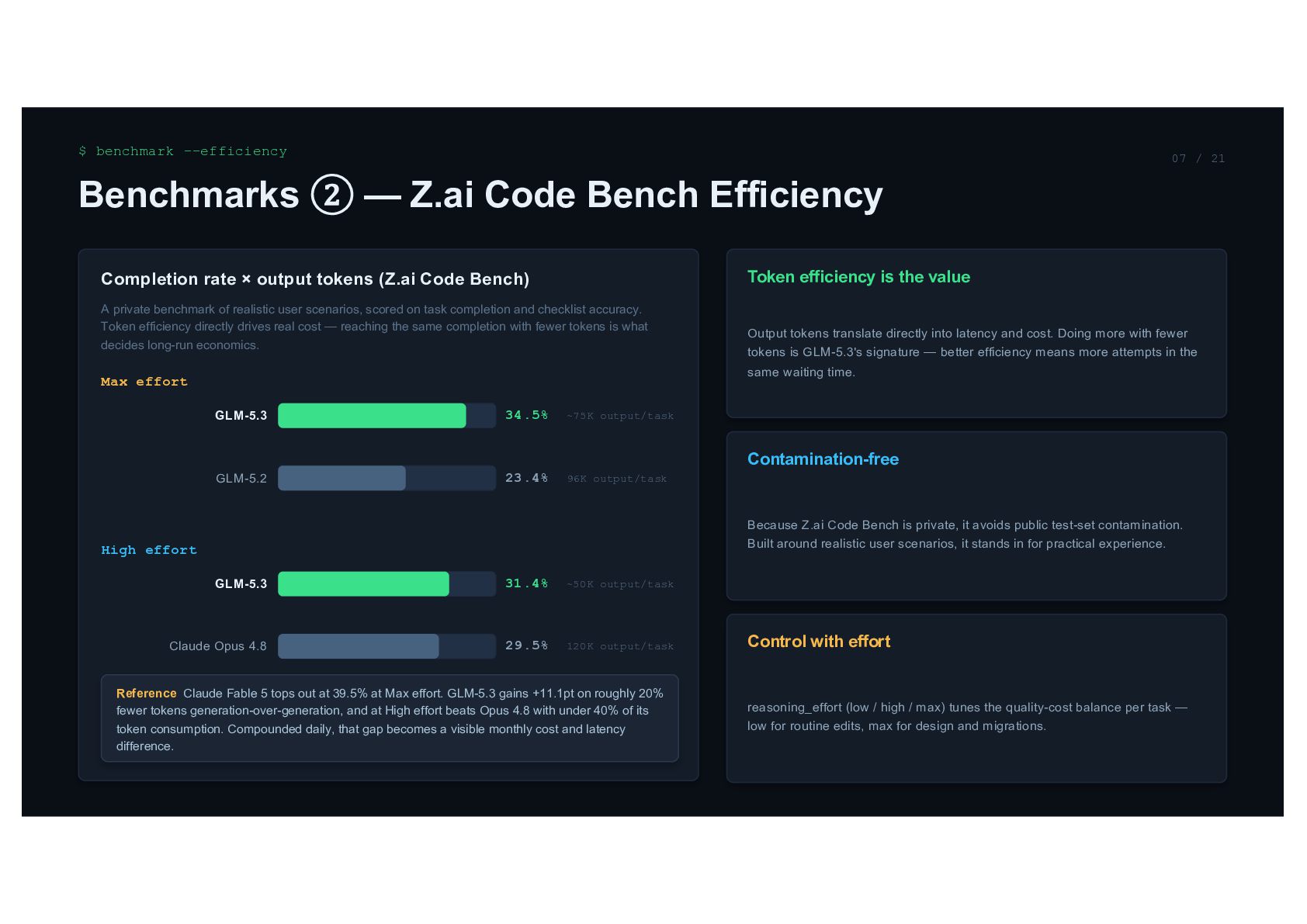
    Code Bench Efficiency Token efficiency is the value Completion rate × output tokens (Z.ai Code Bench) A private benchmark of realistic user scenarios, scored on task completion and checklist accuracy. Token efficiency directly drives real cost — reaching the same completion with fewer tokens is what decides long-run economics. Output tokens translate directly into latency and cost. Doing more with fewer tokens is GLM-5.3's signature — better efficiency means more attempts in the same waiting time. Max effort GLM-5.3 34.5% ~75K output/task GLM-5.2 23.4% 96K output/task Contamination-free Because Z.ai Code Bench is private, it avoids public test-set contamination. Built around realistic user scenarios, it stands in for practical experience. High effort GLM-5.3 31.4% ~50K output/task Claude Opus 4.8 29.5% 120K output/task Reference Claude Fable 5 tops out at 39.5% at Max effort. GLM-5.3 gains +11.1pt on roughly 20% fewer tokens generation-over-generation, and at High effort beats Opus 4.8 with under 40% of its token consumption. Compounded daily, that gap becomes a visible monthly cost and latency difference. Control with effort reasoning_effort (low / high / max) tunes the quality-cost balance per task — low for routine edits, max for design and migrations.
  8. $ benchmark --cyber --agentic 08 / 21 Benchmarks ③ —

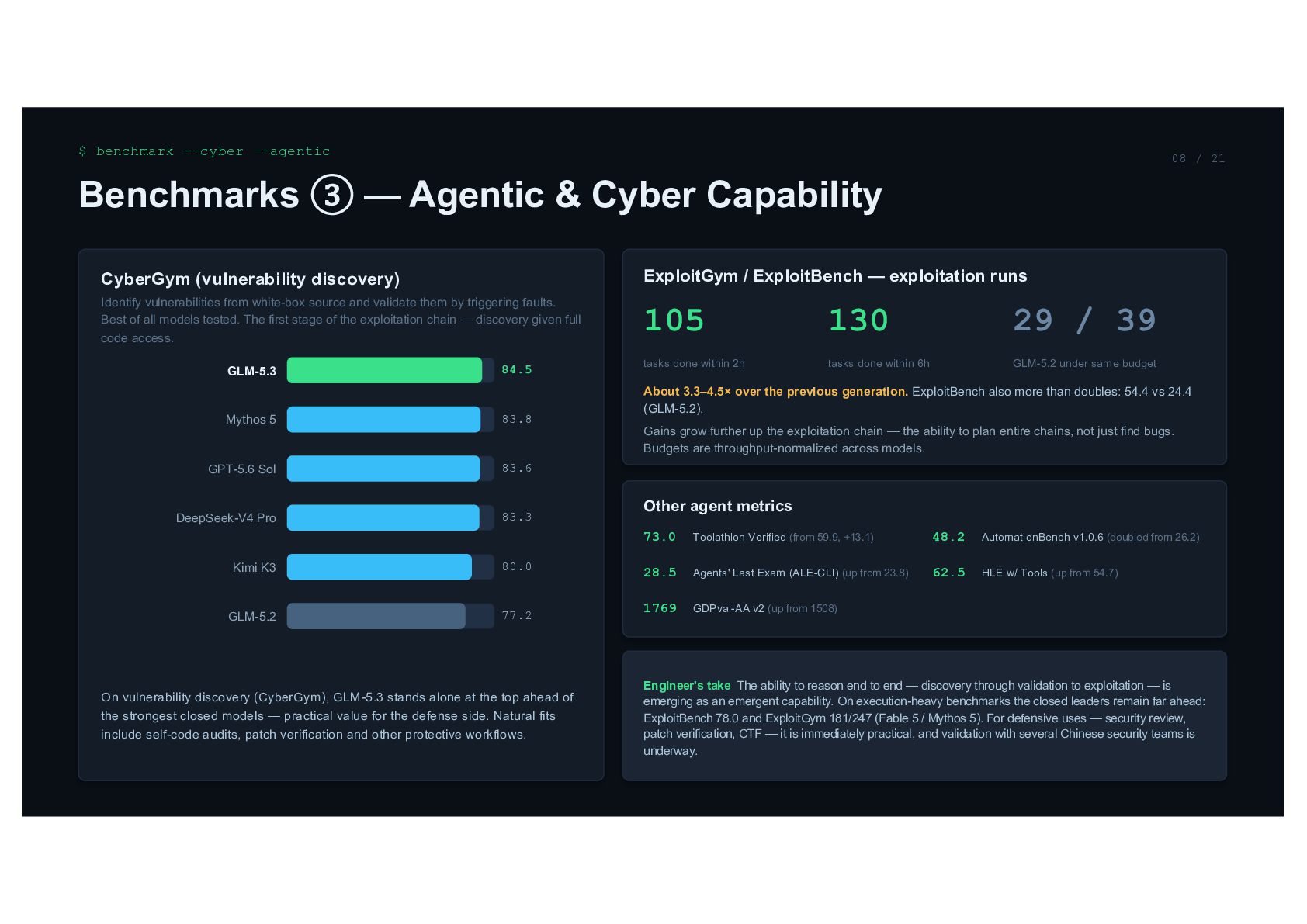
    Agentic & Cyber Capability ExploitGym / ExploitBench — exploitation runs CyberGym (vulnerability discovery) Identify vulnerabilities from white-box source and validate them by triggering faults. Best of all models tested. The first stage of the exploitation chain — discovery given full code access. GLM-5.3 84.5 Mythos 5 83.8 GPT-5.6 Sol 83.6 DeepSeek-V4 Pro 83.3 Kimi K3 80.0 GLM-5.2 77.2 On vulnerability discovery (CyberGym), GLM-5.3 stands alone at the top ahead of the strongest closed models — practical value for the defense side. Natural fits include self-code audits, patch verification and other protective workflows. 105 130 29 / 39 tasks done within 2h tasks done within 6h GLM-5.2 under same budget About 3.3–4.5× over the previous generation. ExploitBench also more than doubles: 54.4 vs 24.4 (GLM-5.2). Gains grow further up the exploitation chain — the ability to plan entire chains, not just find bugs. Budgets are throughput-normalized across models. Other agent metrics 73.0 Toolathlon Verified (from 59.9, +13.1) 48.2 AutomationBench v1.0.6 (doubled from 26.2) 28.5 Agents' Last Exam (ALE-CLI) (up from 23.8) 62.5 HLE w/ Tools (up from 54.7) 1769 GDPval-AA v2 (up from 1508) Engineer's take The ability to reason end to end — discovery through validation to exploitation — is emerging as an emergent capability. On execution-heavy benchmarks the closed leaders remain far ahead: ExploitBench 78.0 and ExploitGym 181/247 (Fable 5 / Mythos 5). For defensive uses — security review, patch verification, CTF — it is immediately practical, and validation with several Chinese security teams is underway.
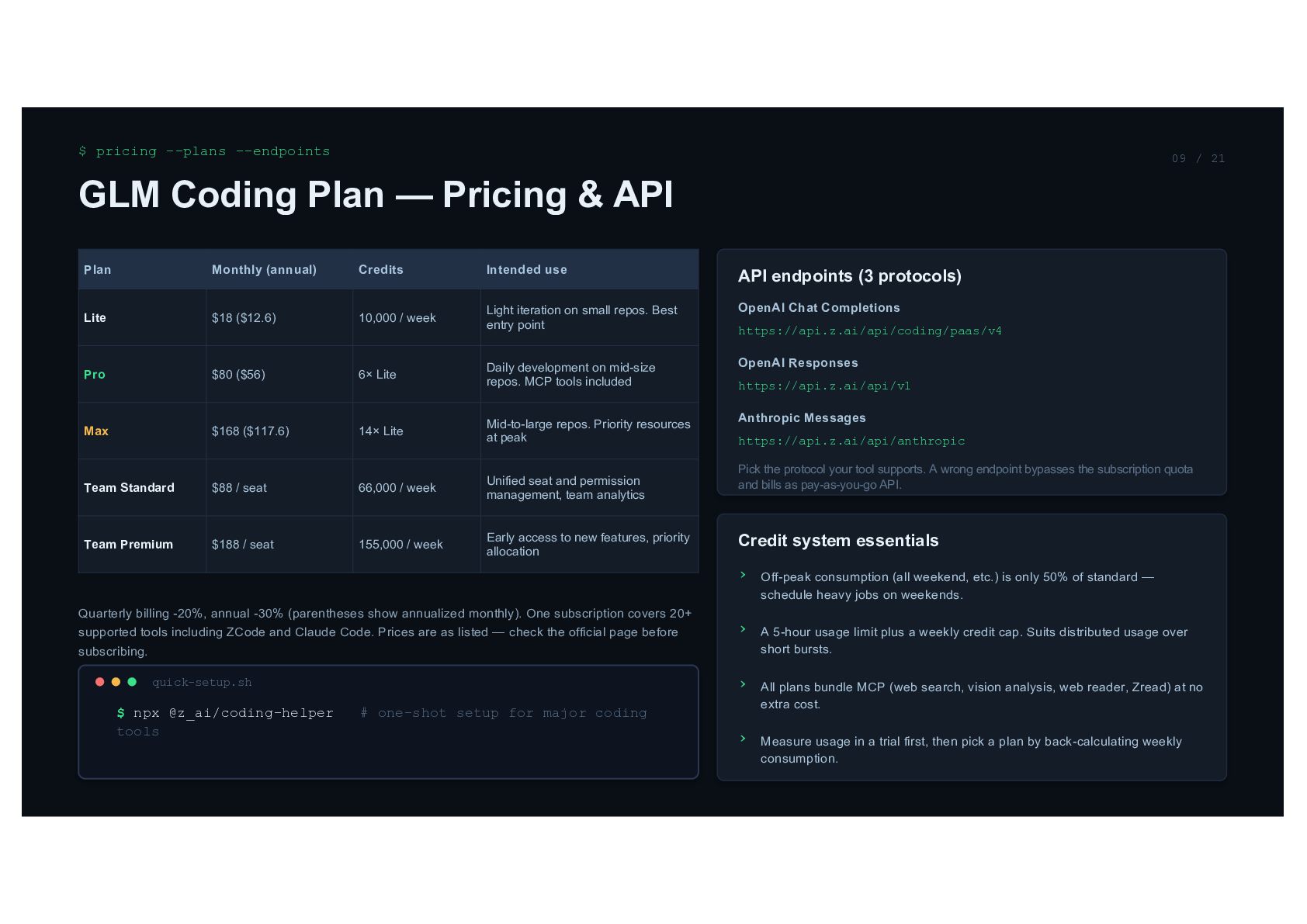
  9. $ pricing --plans --endpoints 09 / 21 GLM Coding Plan

    — Pricing & API Plan Monthly (annual) Credits Intended use API endpoints (3 protocols) Lite $18 ($12.6) 10,000 / week Light iteration on small repos. Best entry point OpenAI Chat Completions Pro $80 ($56) 6× Lite Daily development on mid-size repos. MCP tools included OpenAI Responses Max $168 ($117.6) 14× Lite Mid-to-large repos. Priority resources at peak Team Standard $88 / seat 66,000 / week Unified seat and permission management, team analytics Team Premium $188 / seat 155,000 / week Early access to new features, priority allocation https://api.z.ai/api/coding/paas/v4 https://api.z.ai/api/v1 Anthropic Messages https://api.z.ai/api/anthropic Pick the protocol your tool supports. A wrong endpoint bypasses the subscription quota and bills as pay-as-you-go API. Credit system essentials › Off-peak consumption (all weekend, etc.) is only 50% of standard — schedule heavy jobs on weekends. Quarterly billing -20%, annual -30% (parentheses show annualized monthly). One subscription covers 20+ supported tools including ZCode and Claude Code. Prices are as listed — check the official page before › A 5-hour usage limit plus a weekly credit cap. Suits distributed usage over short bursts. subscribing. › All plans bundle MCP (web search, vision analysis, web reader, Zread) at no quick-setup.sh $ npx @z_ai/coding-helper tools # one-shot setup for major coding extra cost. › Measure usage in a trial first, then pick a plan by back-calculating weekly consumption.
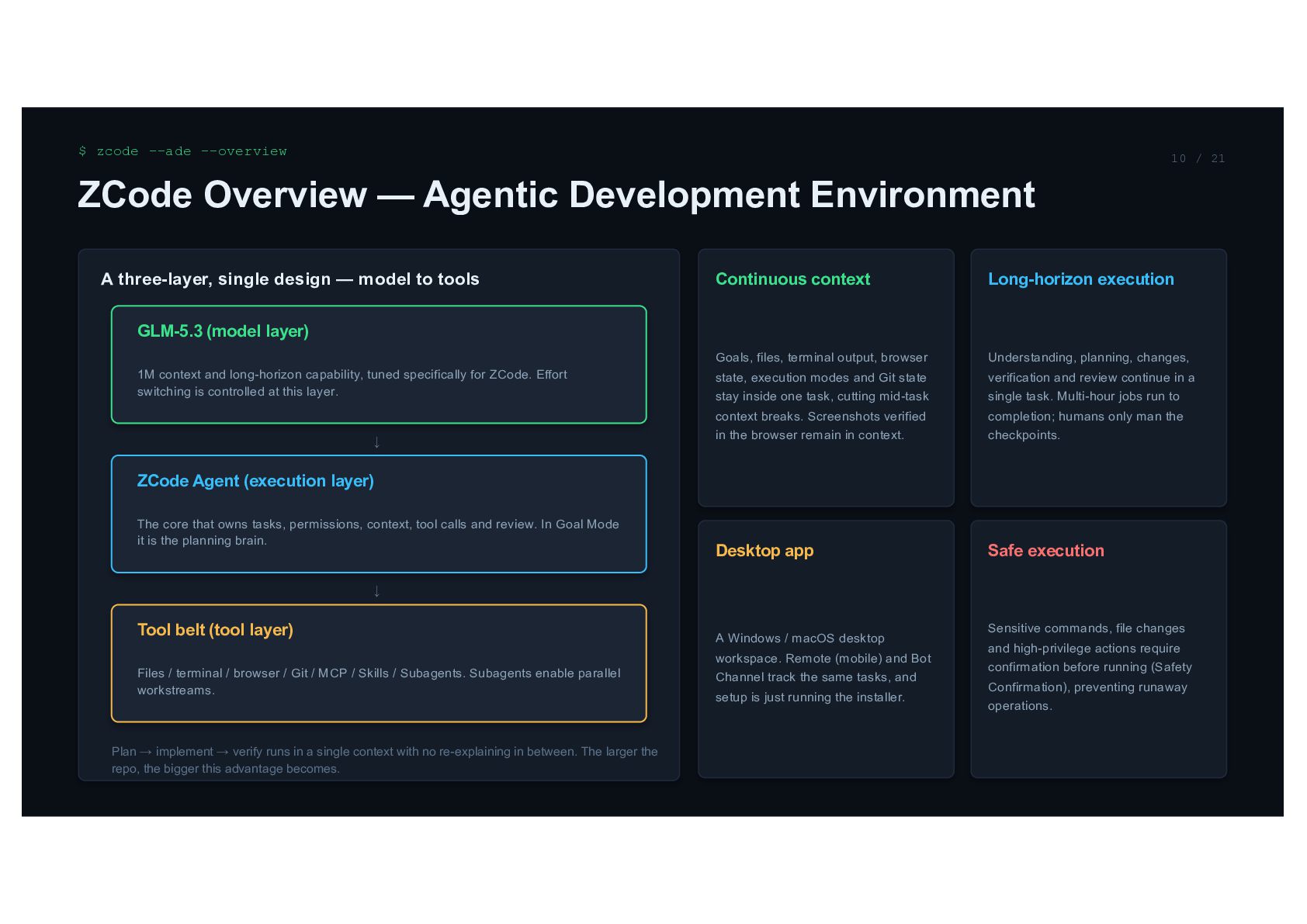
  10. $ zcode --ade --overview 10 / 21 ZCode Overview —

    Agentic Development Environment A three-layer, single design — model to tools Continuous context Long-horizon execution Goals, files, terminal output, browser Understanding, planning, changes, state, execution modes and Git state verification and review continue in a stay inside one task, cutting mid-task single task. Multi-hour jobs run to context breaks. Screenshots verified completion; humans only man the in the browser remain in context. checkpoints. Desktop app Safe execution GLM-5.3 (model layer) 1M context and long-horizon capability, tuned specifically for ZCode. Effort switching is controlled at this layer. ↓ ZCode Agent (execution layer) The core that owns tasks, permissions, context, tool calls and review. In Goal Mode it is the planning brain. ↓ Tool belt (tool layer) A Windows / macOS desktop workspace. Remote (mobile) and Bot Files / terminal / browser / Git / MCP / Skills / Subagents. Subagents enable parallel workstreams. Plan → implement → verify runs in a single context with no re-explaining in between. The larger the repo, the bigger this advantage becomes. Channel track the same tasks, and setup is just running the installer. Sensitive commands, file changes and high-privilege actions require confirmation before running (Safety Confirmation), preventing runaway operations.
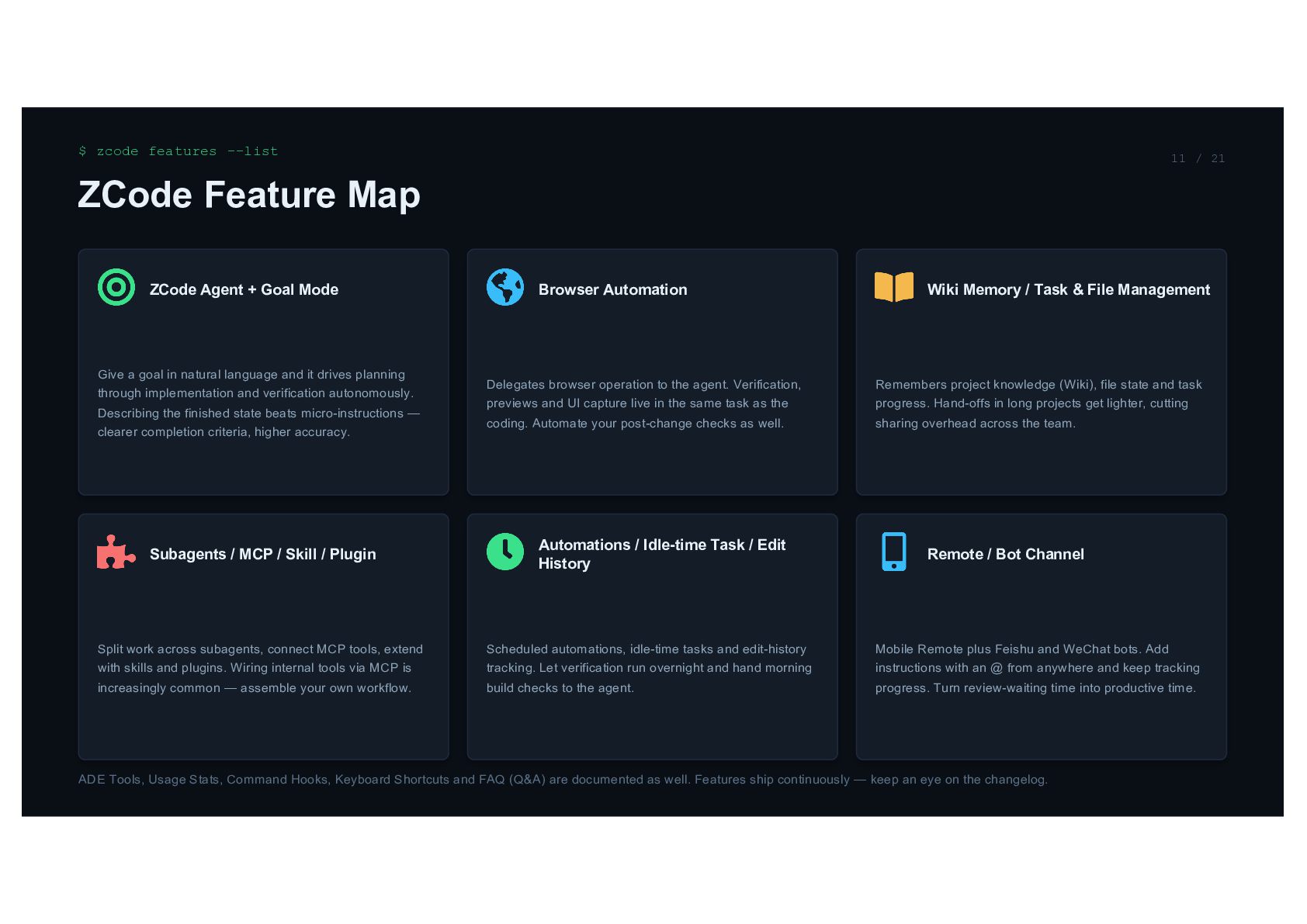
  11. $ zcode features --list 11 / 21 ZCode Feature Map

    ZCode Agent + Goal Mode Give a goal in natural language and it drives planning through implementation and verification autonomously. Describing the finished state beats micro-instructions — clearer completion criteria, higher accuracy. Subagents / MCP / Skill / Plugin Browser Automation Wiki Memory / Task & File Management Delegates browser operation to the agent. Verification, Remembers project knowledge (Wiki), file state and task previews and UI capture live in the same task as the progress. Hand-offs in long projects get lighter, cutting coding. Automate your post-change checks as well. sharing overhead across the team. Automations / Idle-time Task / Edit History Remote / Bot Channel Split work across subagents, connect MCP tools, extend Scheduled automations, idle-time tasks and edit-history Mobile Remote plus Feishu and WeChat bots. Add with skills and plugins. Wiring internal tools via MCP is tracking. Let verification run overnight and hand morning instructions with an @ from anywhere and keep tracking increasingly common — assemble your own workflow. build checks to the agent. progress. Turn review-waiting time into productive time. ADE Tools, Usage Stats, Command Hooks, Keyboard Shortcuts and FAQ (Q&A) are documented as well. Features ship continuously — keep an eye on the changelog.
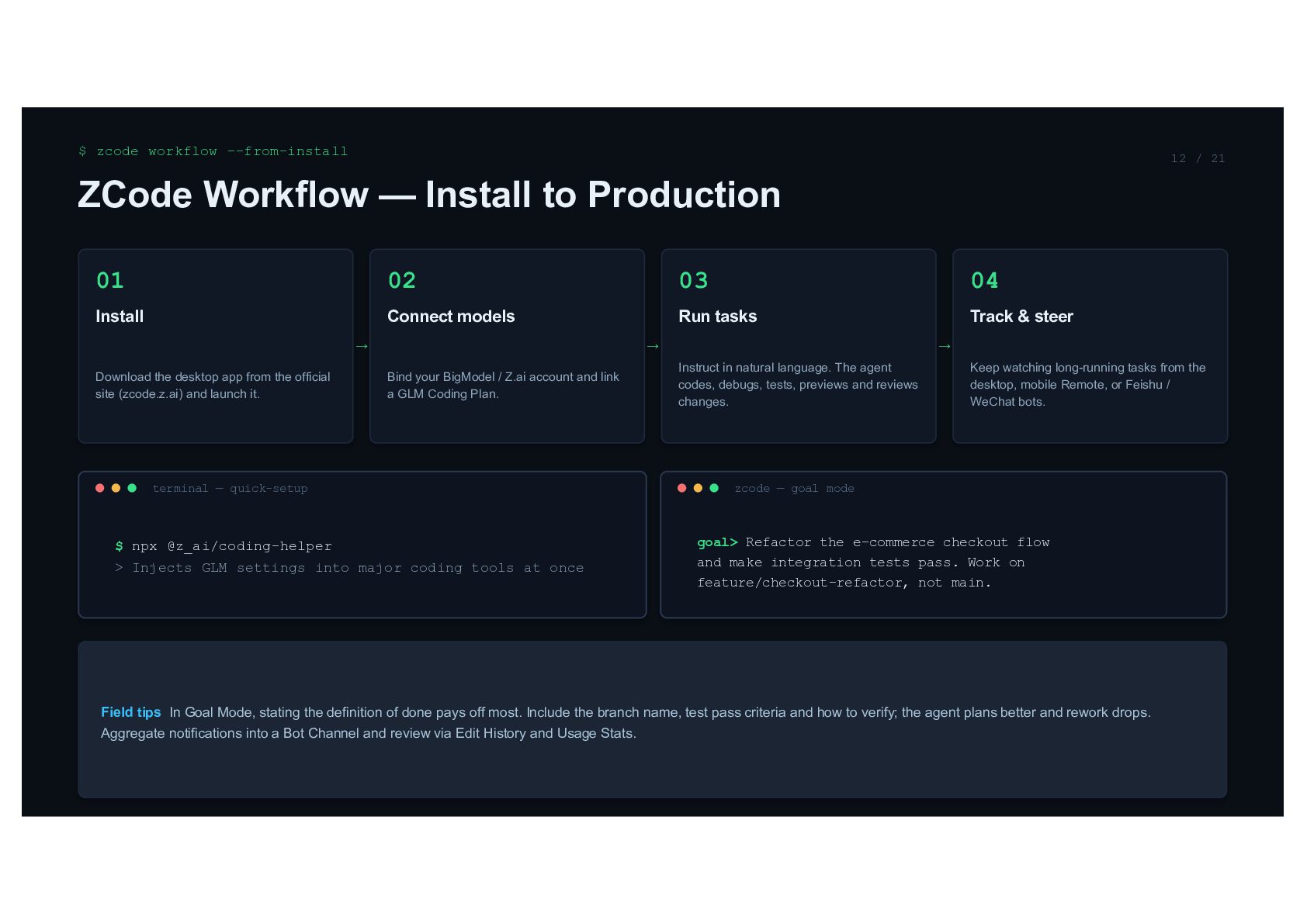
  12. $ zcode workflow --from-install 12 / 21 ZCode Workflow —

    Install to Production 01 02 03 04 Install Connect models Run tasks Track & steer → Download the desktop app from the official site (zcode.z.ai) and launch it. → Bind your BigModel / Z.ai account and link a GLM Coding Plan. terminal — quick-setup $ npx @z_ai/coding-helper > Injects GLM settings into major coding tools at once → Instruct in natural language. The agent codes, debugs, tests, previews and reviews changes. Keep watching long-running tasks from the desktop, mobile Remote, or Feishu / WeChat bots. zcode — goal mode goal> Refactor the e-commerce checkout flow and make integration tests pass. Work on feature/checkout-refactor, not main. Field tips In Goal Mode, stating the definition of done pays off most. Include the branch name, test pass criteria and how to verify; the agent plans better and rework drops. Aggregate notifications into a Bot Channel and review via Edit History and Usage Stats.
  13. $ zcode benefits --ecosystem 13 / 21 ZCode Perks &

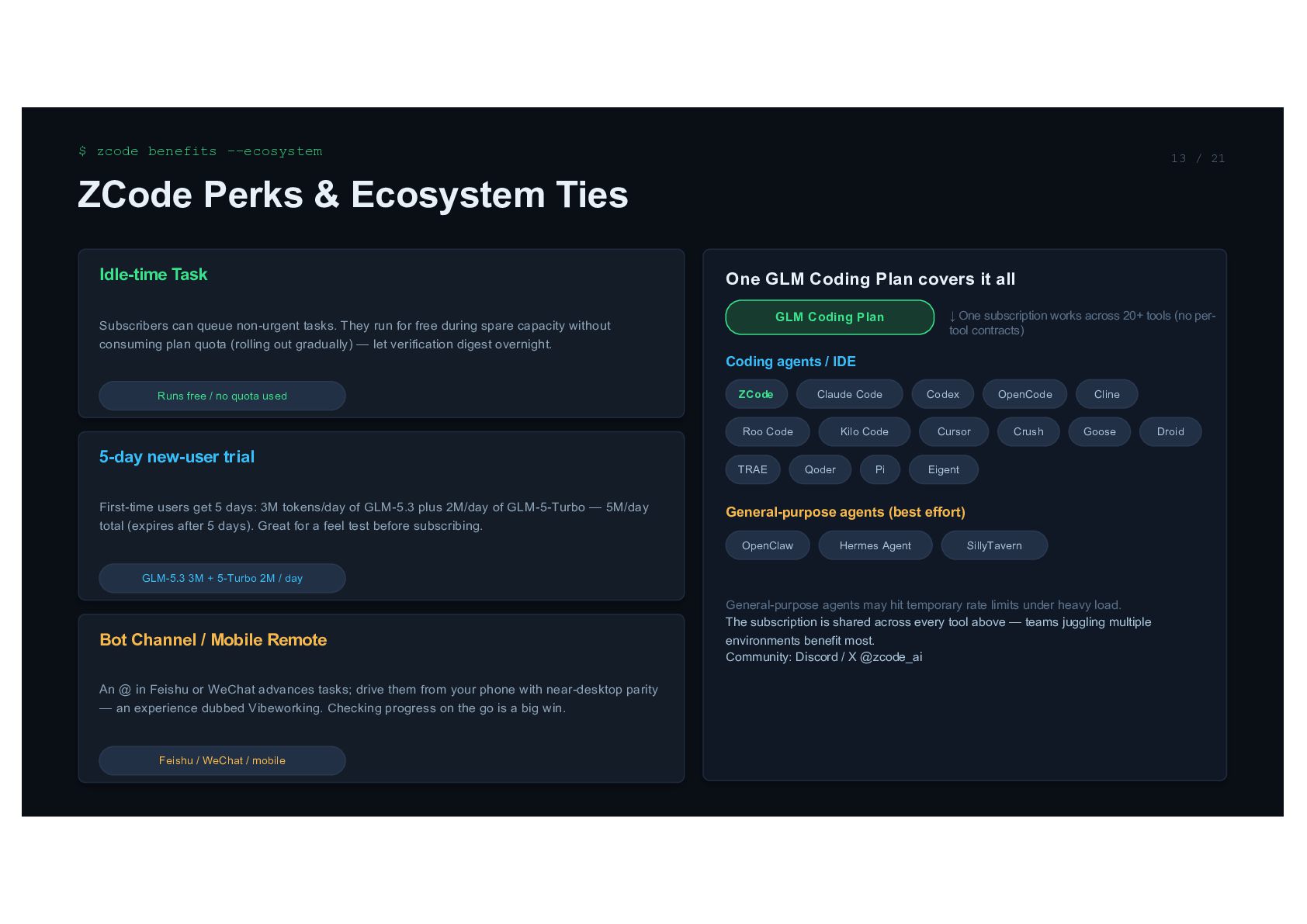
    Ecosystem Ties Idle-time Task One GLM Coding Plan covers it all GLM Coding Plan Subscribers can queue non-urgent tasks. They run for free during spare capacity without consuming plan quota (rolling out gradually) — let verification digest overnight. ↓ One subscription works across 20+ tools (no pertool contracts) Coding agents / IDE Runs free / no quota used ZCode Claude Code Roo Code 5-day new-user trial First-time users get 5 days: 3M tokens/day of GLM-5.3 plus 2M/day of GLM-5-Turbo — 5M/day total (expires after 5 days). Great for a feel test before subscribing. TRAE Kilo Code Qoder Pi Codex Cursor OpenCode Cline Crush Goose Eigent General-purpose agents (best effort) OpenClaw Hermes Agent SillyTavern GLM-5.3 3M + 5-Turbo 2M / day General-purpose agents may hit temporary rate limits under heavy load. The subscription is shared across every tool above — teams juggling multiple Bot Channel / Mobile Remote An @ in Feishu or WeChat advances tasks; drive them from your phone with near-desktop parity — an experience dubbed Vibeworking. Checking progress on the go is a big win. Feishu / WeChat / mobile environments benefit most. Community: Discord / X @zcode_ai Droid
  14. $ autoclaw --agent-for-work 14 / 21 AutoClaw Overview — AI

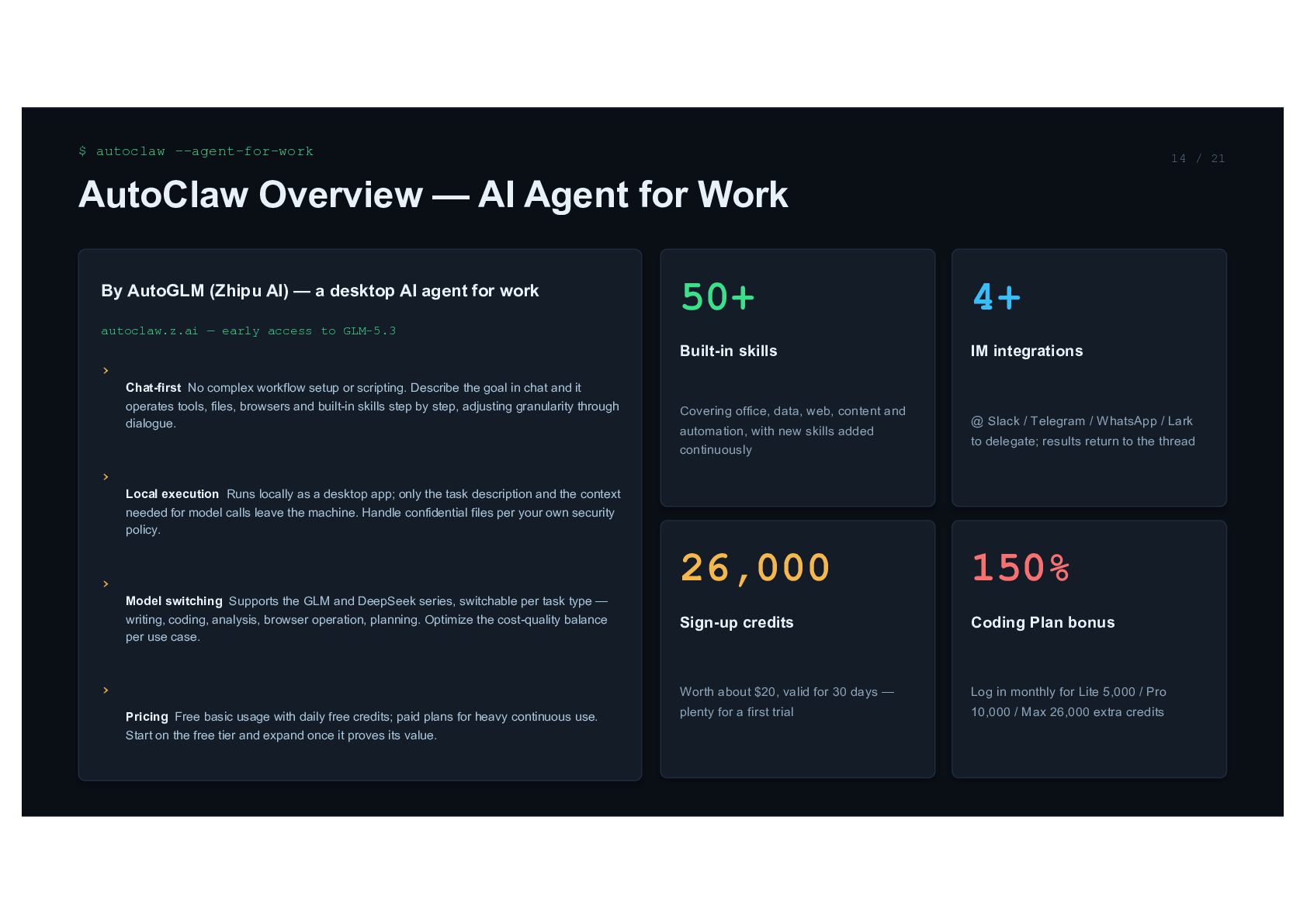
    Agent for Work By AutoGLM (Zhipu AI) — a desktop AI agent for work 50+ 4+ Built-in skills IM integrations autoclaw.z.ai — early access to GLM-5.3 › Chat-first No complex workflow setup or scripting. Describe the goal in chat and it operates tools, files, browsers and built-in skills step by step, adjusting granularity through dialogue. Covering office, data, web, content and automation, with new skills added continuously @ Slack / Telegram / WhatsApp / Lark to delegate; results return to the thread › Local execution Runs locally as a desktop app; only the task description and the context needed for model calls leave the machine. Handle confidential files per your own security policy. › 26,000 150% Sign-up credits Coding Plan bonus Worth about $20, valid for 30 days — Log in monthly for Lite 5,000 / Pro plenty for a first trial 10,000 / Max 26,000 extra credits Model switching Supports the GLM and DeepSeek series, switchable per task type — writing, coding, analysis, browser operation, planning. Optimize the cost-quality balance per use case. › Pricing Free basic usage with daily free credits; paid plans for heavy continuous use. Start on the free tier and expand once it proves its value.
  15. $ autoclaw skills --core-six 15 / 21 AutoClaw: Six Core

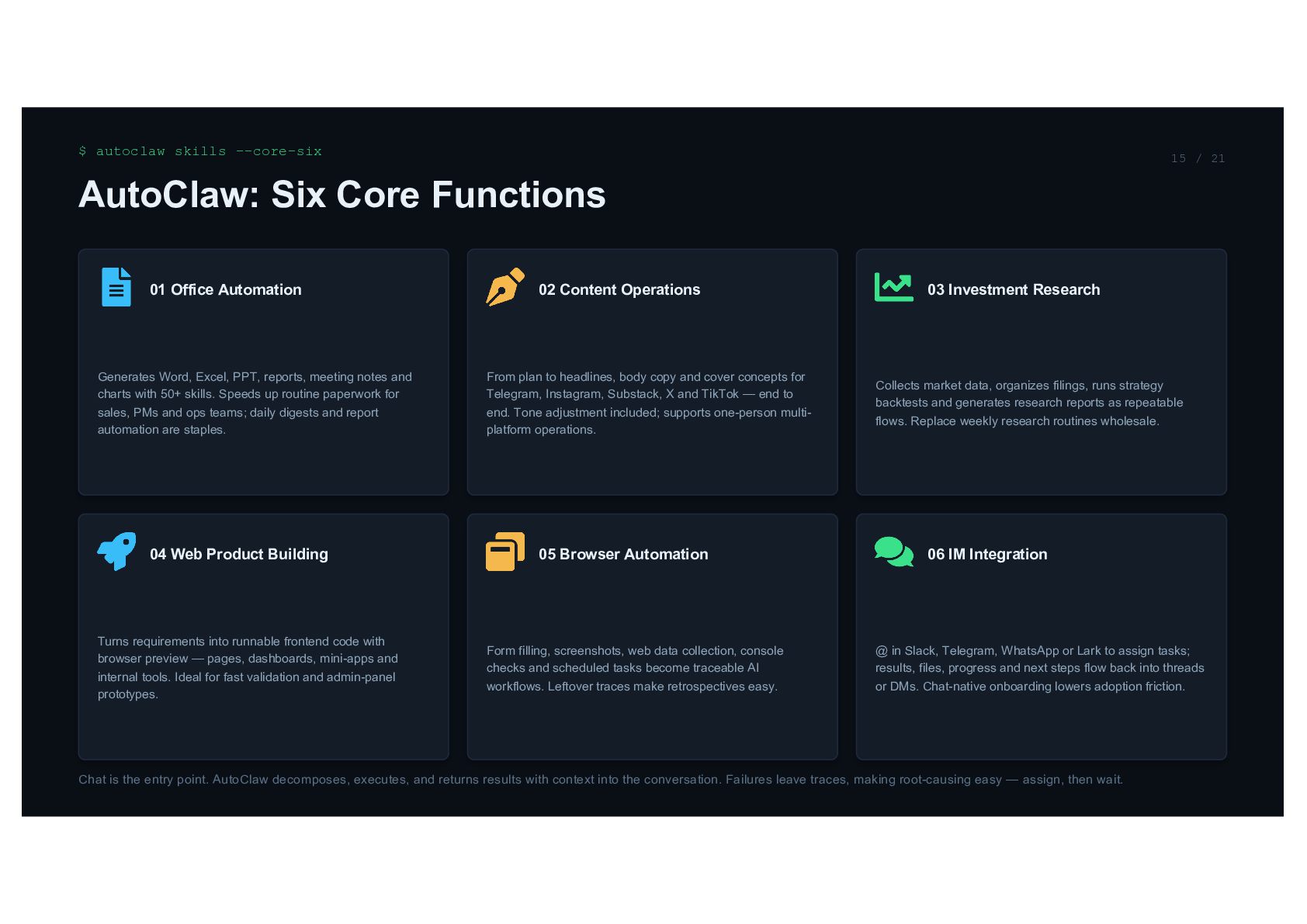
    Functions 01 Office Automation 02 Content Operations Generates Word, Excel, PPT, reports, meeting notes and charts with 50+ skills. Speeds up routine paperwork for From plan to headlines, body copy and cover concepts for Telegram, Instagram, Substack, X and TikTok — end to sales, PMs and ops teams; daily digests and report automation are staples. end. Tone adjustment included; supports one-person multiplatform operations. 04 Web Product Building Turns requirements into runnable frontend code with browser preview — pages, dashboards, mini-apps and internal tools. Ideal for fast validation and admin-panel prototypes. 05 Browser Automation 03 Investment Research Collects market data, organizes filings, runs strategy backtests and generates research reports as repeatable flows. Replace weekly research routines wholesale. 06 IM Integration Form filling, screenshots, web data collection, console checks and scheduled tasks become traceable AI @ in Slack, Telegram, WhatsApp or Lark to assign tasks; results, files, progress and next steps flow back into threads workflows. Leftover traces make retrospectives easy. or DMs. Chat-native onboarding lowers adoption friction. Chat is the entry point. AutoClaw decomposes, executes, and returns results with context into the conversation. Failures leave traces, making root-causing easy — assign, then wait.
  16. $ autoclaw usecases --specs 16 / 21 AutoClaw Use Cases

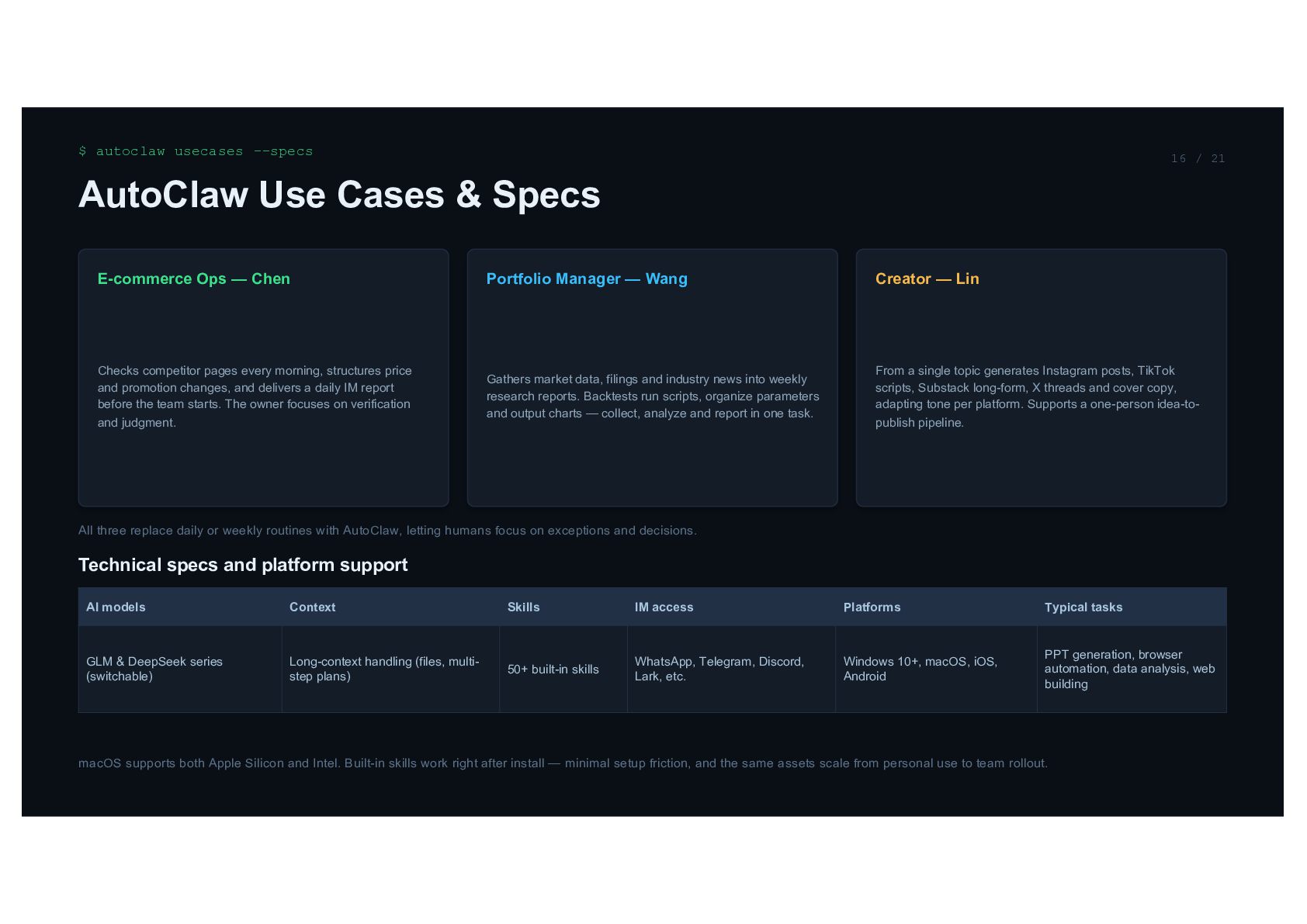
    & Specs E-commerce Ops — Chen Checks competitor pages every morning, structures price and promotion changes, and delivers a daily IM report before the team starts. The owner focuses on verification and judgment. Portfolio Manager — Wang Gathers market data, filings and industry news into weekly research reports. Backtests run scripts, organize parameters and output charts — collect, analyze and report in one task. Creator — Lin From a single topic generates Instagram posts, TikTok scripts, Substack long-form, X threads and cover copy, adapting tone per platform. Supports a one-person idea-topublish pipeline. All three replace daily or weekly routines with AutoClaw, letting humans focus on exceptions and decisions. Technical specs and platform support AI models Context Skills IM access Platforms Typical tasks GLM & DeepSeek series (switchable) Long-context handling (files, multistep plans) 50+ built-in skills WhatsApp, Telegram, Discord, Lark, etc. Windows 10+, macOS, iOS, Android PPT generation, browser automation, data analysis, web building macOS supports both Apple Silicon and Intel. Built-in skills work right after install — minimal setup friction, and the same assets scale from personal use to team rollout.
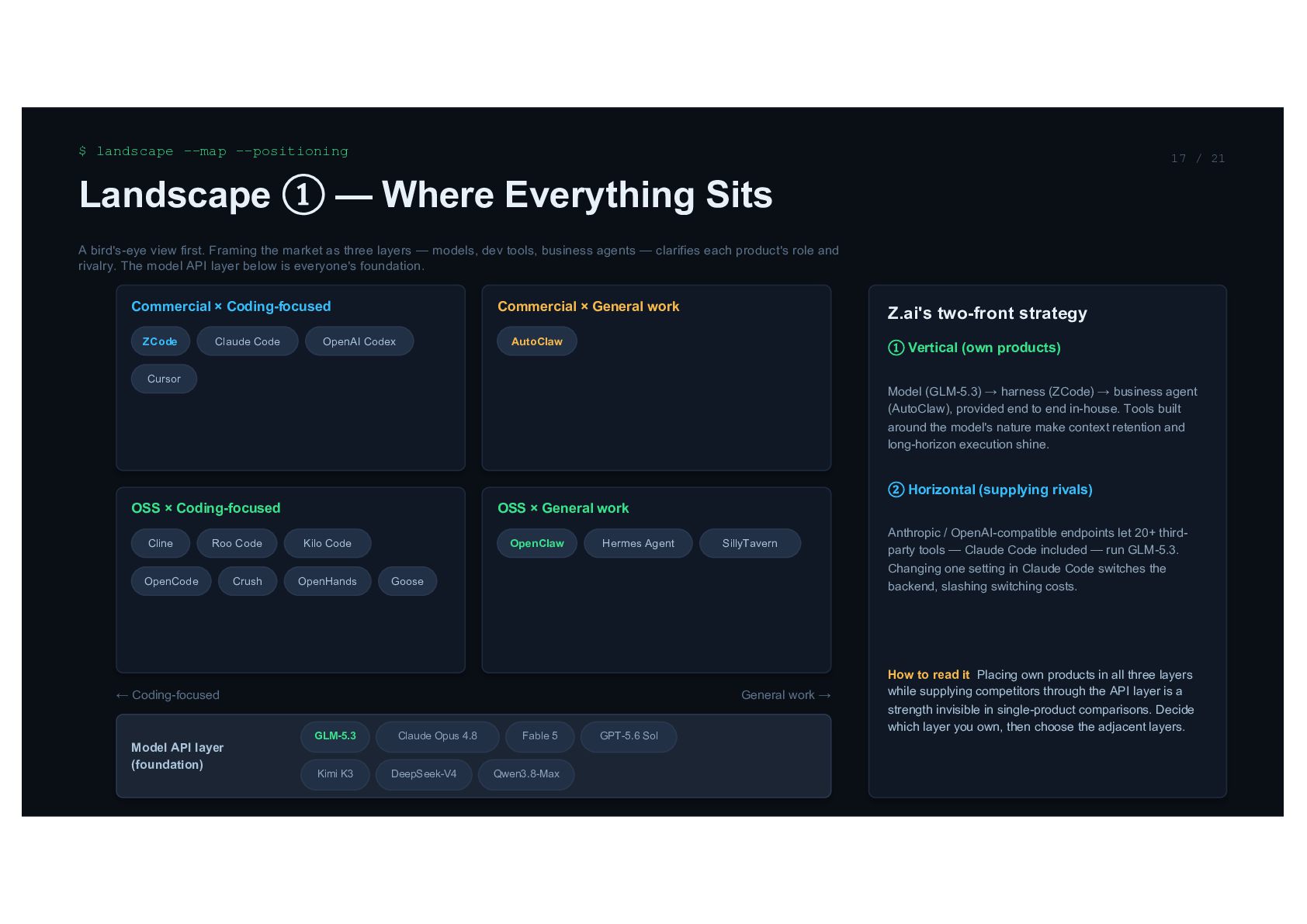
  17. $ landscape --map --positioning 17 / 21 Landscape ① —

    Where Everything Sits A bird's-eye view first. Framing the market as three layers — models, dev tools, business agents — clarifies each product's role and rivalry. The model API layer below is everyone's foundation. Commercial × Coding-focused ZCode Claude Code Commercial × General work OpenAI Codex Z.ai's two-front strategy AutoClaw ① Vertical (own products) Cursor Model (GLM-5.3) → harness (ZCode) → business agent (AutoClaw), provided end to end in-house. Tools built around the model's nature make context retention and long-horizon execution shine. ② Horizontal (supplying rivals) OSS × Coding-focused Cline OSS × General work Roo Code Kilo Code Crush OpenHands OpenCode OpenClaw Hermes Agent General work → GLM-5.3 Claude Opus 4.8 Kimi K3 DeepSeek-V4 Anthropic / OpenAI-compatible endpoints let 20+ thirdparty tools — Claude Code included — run GLM-5.3. Changing one setting in Claude Code switches the backend, slashing switching costs. Goose ← Coding-focused Model API layer (foundation) SillyTavern Fable 5 Qwen3.8-Max GPT-5.6 Sol How to read it Placing own products in all three layers while supplying competitors through the API layer is a strength invisible in single-product comparisons. Decide which layer you own, then choose the adjacent layers.
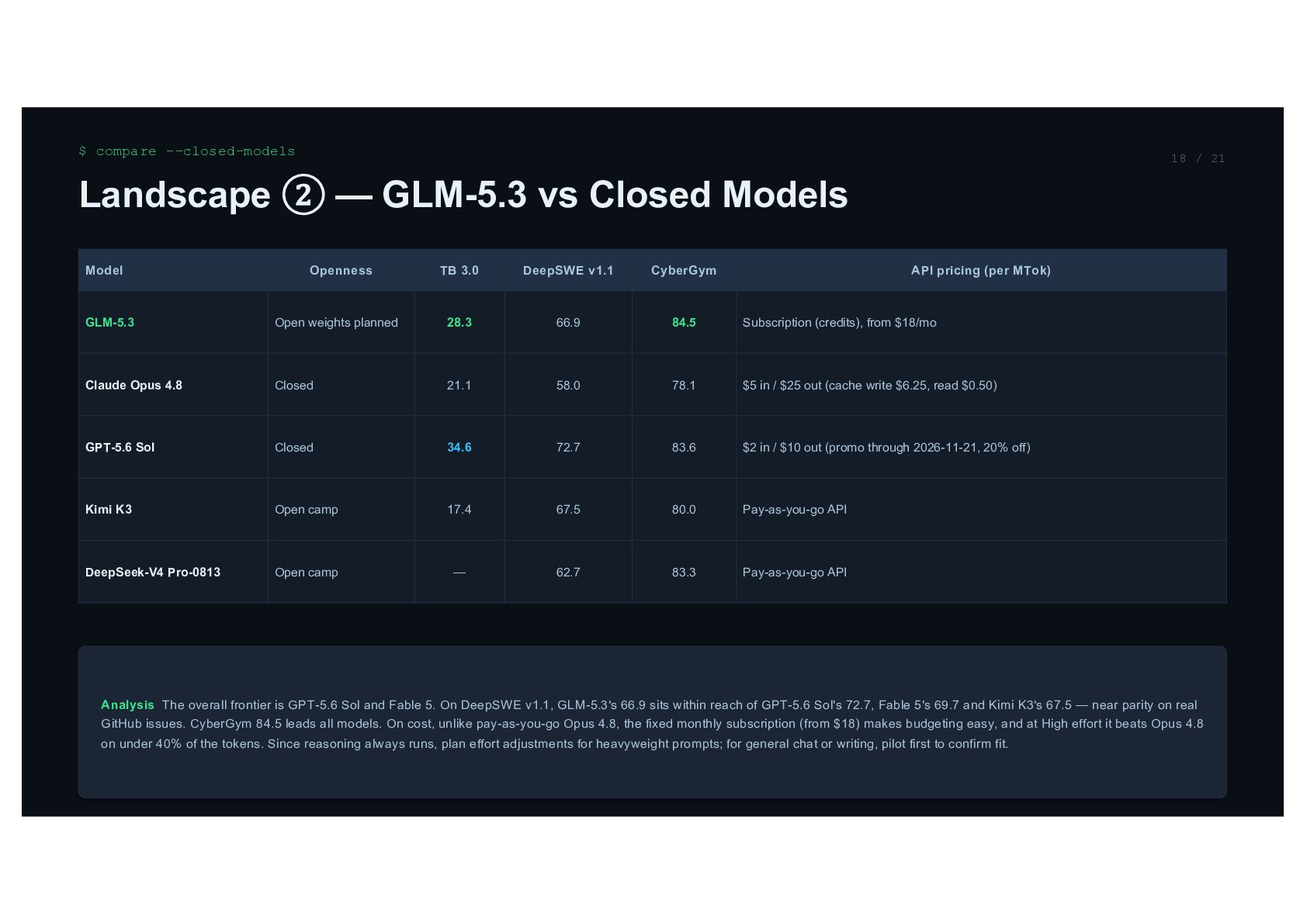
  18. $ compare --closed-models 18 / 21 Landscape ② — GLM-5.3

    vs Closed Models Model Openness TB 3.0 DeepSWE v1.1 CyberGym API pricing (per MTok) GLM-5.3 Open weights planned 28.3 66.9 84.5 Subscription (credits), from $18/mo Claude Opus 4.8 Closed 21.1 58.0 78.1 $5 in / $25 out (cache write $6.25, read $0.50) GPT-5.6 Sol Closed 34.6 72.7 83.6 $2 in / $10 out (promo through 2026-11-21, 20% off) Kimi K3 Open camp 17.4 67.5 80.0 Pay-as-you-go API DeepSeek-V4 Pro-0813 Open camp — 62.7 83.3 Pay-as-you-go API Analysis The overall frontier is GPT-5.6 Sol and Fable 5. On DeepSWE v1.1, GLM-5.3's 66.9 sits within reach of GPT-5.6 Sol's 72.7, Fable 5's 69.7 and Kimi K3's 67.5 — near parity on real GitHub issues. CyberGym 84.5 leads all models. On cost, unlike pay-as-you-go Opus 4.8, the fixed monthly subscription (from $18) makes budgeting easy, and at High effort it beats Opus 4.8 on under 40% of the tokens. Since reasoning always runs, plan effort adjustments for heavyweight prompts; for general chat or writing, pilot first to confirm fit.
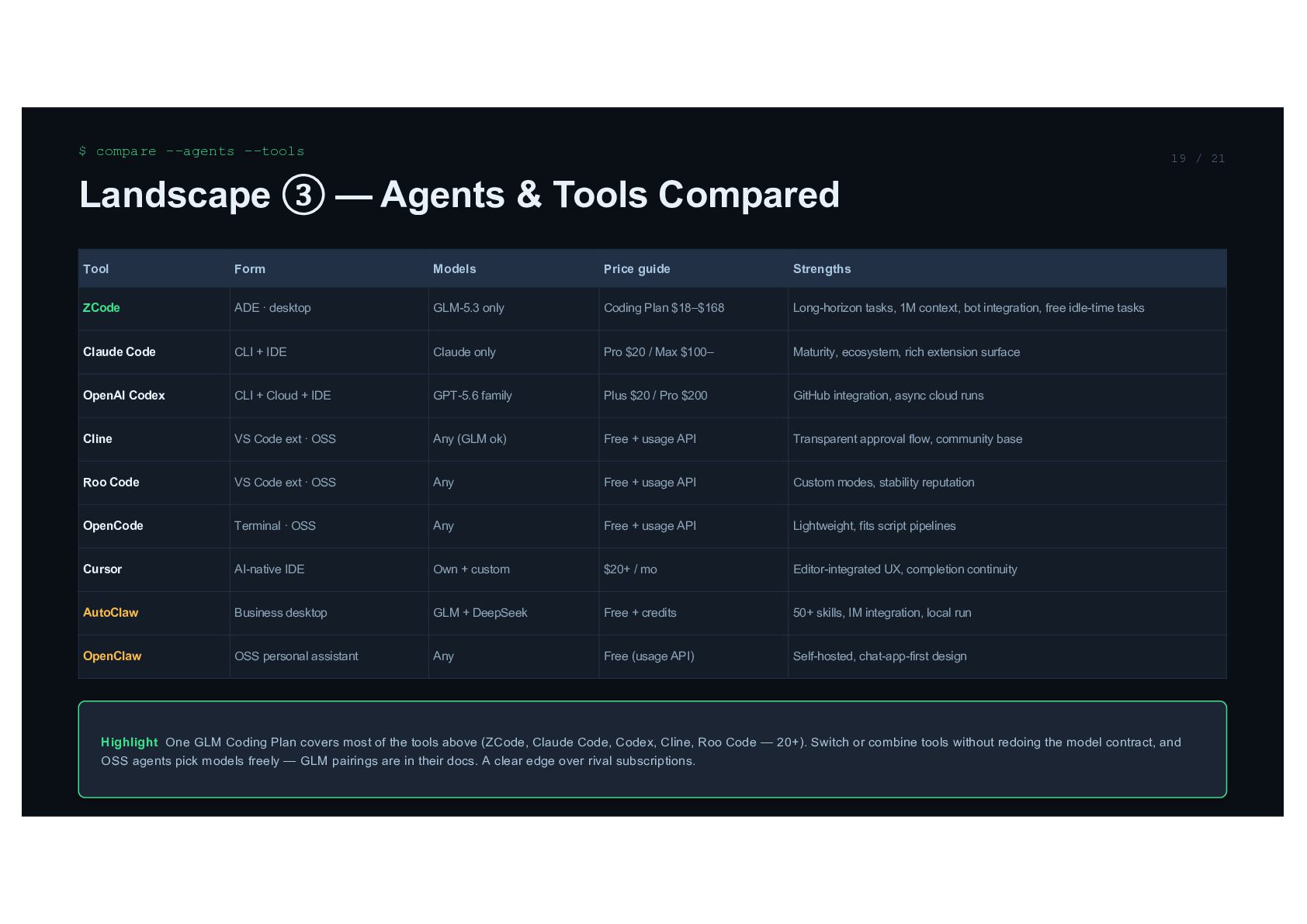
  19. $ compare --agents --tools 19 / 21 Landscape ③ —

    Agents & Tools Compared Tool Form Models Price guide Strengths ZCode ADE · desktop GLM-5.3 only Coding Plan $18–$168 Long-horizon tasks, 1M context, bot integration, free idle-time tasks Claude Code CLI + IDE Claude only Pro $20 / Max $100– Maturity, ecosystem, rich extension surface OpenAI Codex CLI + Cloud + IDE GPT-5.6 family Plus $20 / Pro $200 GitHub integration, async cloud runs Cline VS Code ext · OSS Any (GLM ok) Free + usage API Transparent approval flow, community base Roo Code VS Code ext · OSS Any Free + usage API Custom modes, stability reputation OpenCode Terminal · OSS Any Free + usage API Lightweight, fits script pipelines Cursor AI-native IDE Own + custom $20+ / mo Editor-integrated UX, completion continuity AutoClaw Business desktop GLM + DeepSeek Free + credits 50+ skills, IM integration, local run OpenClaw OSS personal assistant Any Free (usage API) Self-hosted, chat-app-first design Highlight One GLM Coding Plan covers most of the tools above (ZCode, Claude Code, Codex, Cline, Roo Code — 20+). Switch or combine tools without redoing the model contract, and OSS agents pick models freely — GLM pairings are in their docs. A clear edge over rival subscriptions.
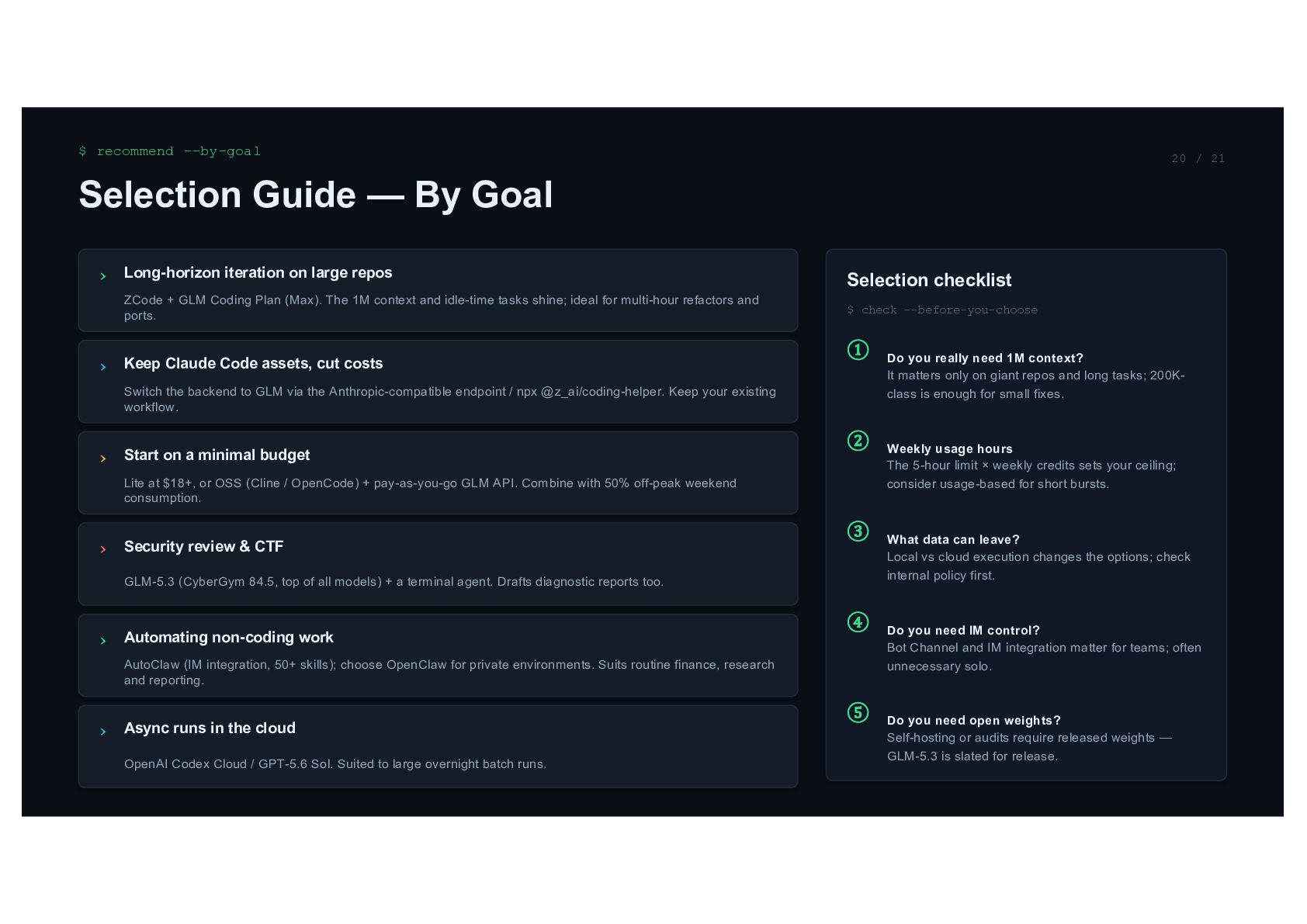
  20. $ recommend --by-goal 20 / 21 Selection Guide — By

    Goal › Long-horizon iteration on large repos ZCode + GLM Coding Plan (Max). The 1M context and idle-time tasks shine; ideal for multi-hour refactors and ports. › Keep Claude Code assets, cut costs Selection checklist $ check --before-you-choose ① Switch the backend to GLM via the Anthropic-compatible endpoint / npx @z_ai/coding-helper. Keep your existing workflow. › Start on a minimal budget class is enough for small fixes. ② Lite at $18+, or OSS (Cline / OpenCode) + pay-as-you-go GLM API. Combine with 50% off-peak weekend consumption. › Security review & CTF ③ OpenAI Codex Cloud / GPT-5.6 Sol. Suited to large overnight batch runs. What data can leave? Local vs cloud execution changes the options; check internal policy first. ④ AutoClaw (IM integration, 50+ skills); choose OpenClaw for private environments. Suits routine finance, research and reporting. › Async runs in the cloud Weekly usage hours The 5-hour limit × weekly credits sets your ceiling; consider usage-based for short bursts. GLM-5.3 (CyberGym 84.5, top of all models) + a terminal agent. Drafts diagnostic reports too. › Automating non-coding work Do you really need 1M context? It matters only on giant repos and long tasks; 200K- Do you need IM control? Bot Channel and IM integration matter for teams; often unnecessary solo. ⑤ Do you need open weights? Self-hosting or audits require released weights — GLM-5.3 is slated for release.
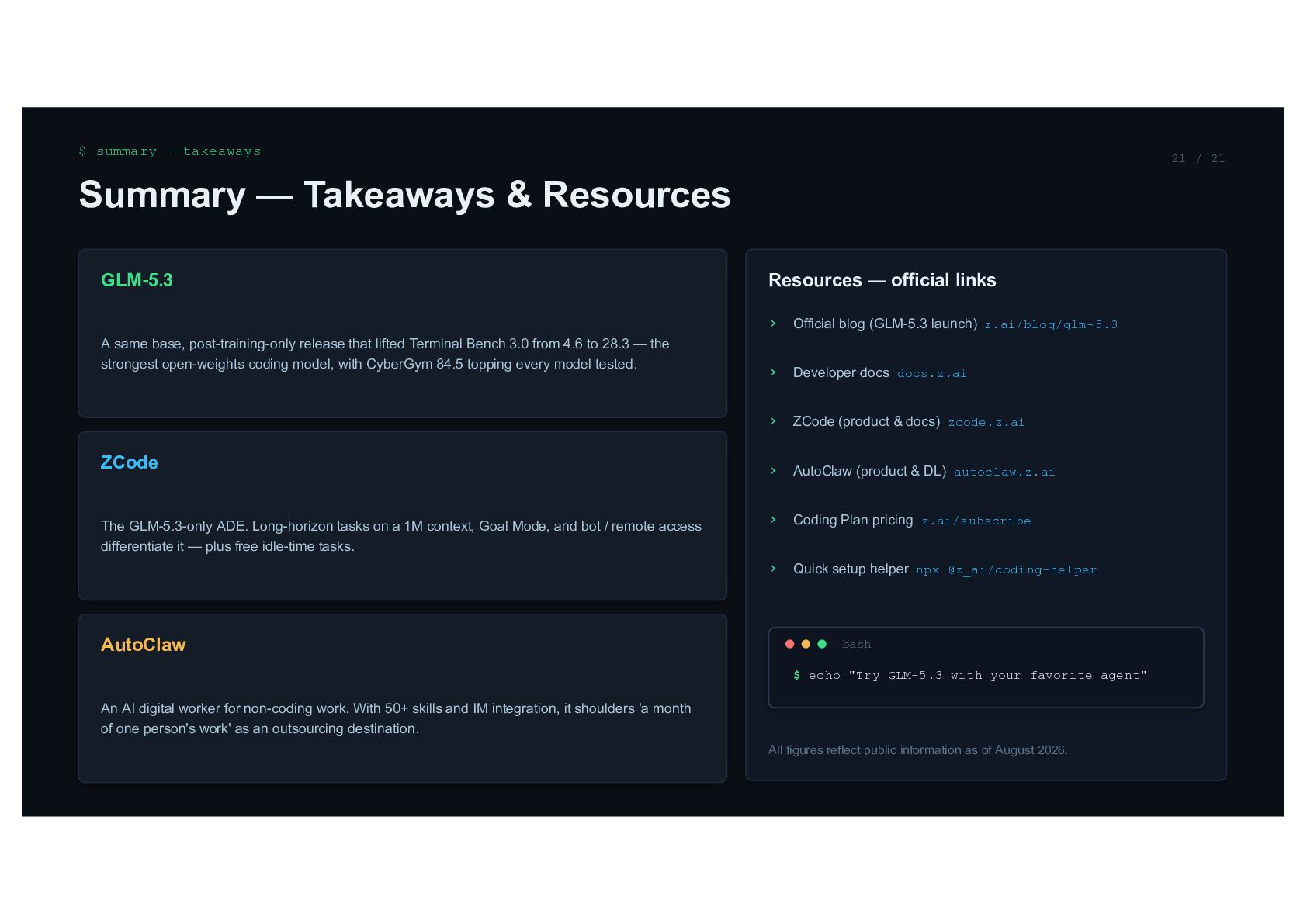
  21. $ summary --takeaways 21 / 21 Summary — Takeaways &

    Resources GLM-5.3 Resources — official links › Official blog (GLM-5.3 launch) z.ai/blog/glm-5.3 A same base, post-training-only release that lifted Terminal Bench 3.0 from 4.6 to 28.3 — the strongest open-weights coding model, with CyberGym 84.5 topping every model tested. › Developer docs docs.z.ai › ZCode (product & docs) zcode.z.ai ZCode The GLM-5.3-only ADE. Long-horizon tasks on a 1M context, Goal Mode, and bot / remote access differentiate it — plus free idle-time tasks. › AutoClaw (product & DL) autoclaw.z.ai › Coding Plan pricing z.ai/subscribe › Quick setup helper npx @z_ai/coding-helper AutoClaw bash $ echo "Try GLM-5.3 with your favorite agent" An AI digital worker for non-coding work. With 50+ skills and IM integration, it shoulders 'a month of one person's work' as an outsourcing destination. All figures reflect public information as of August 2026.