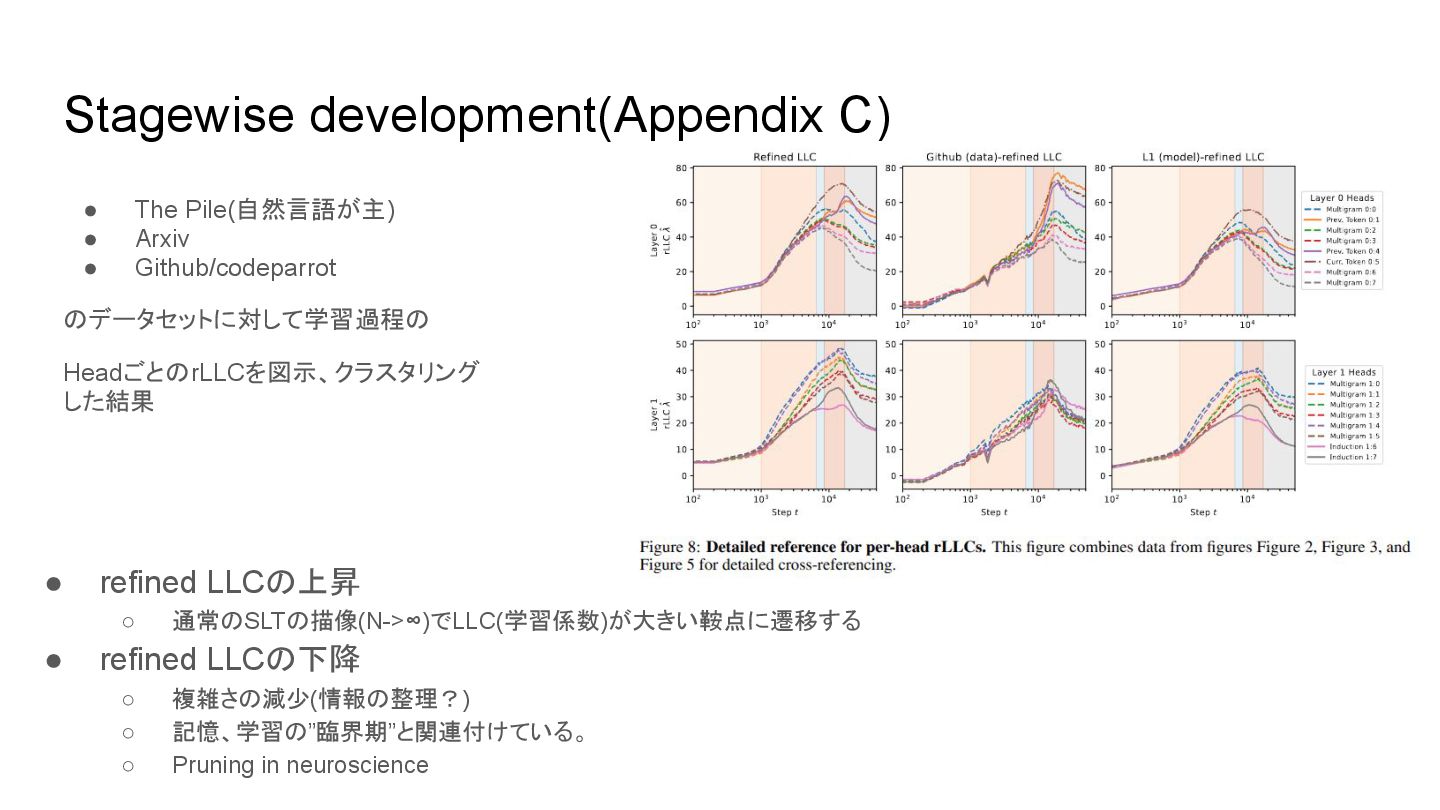
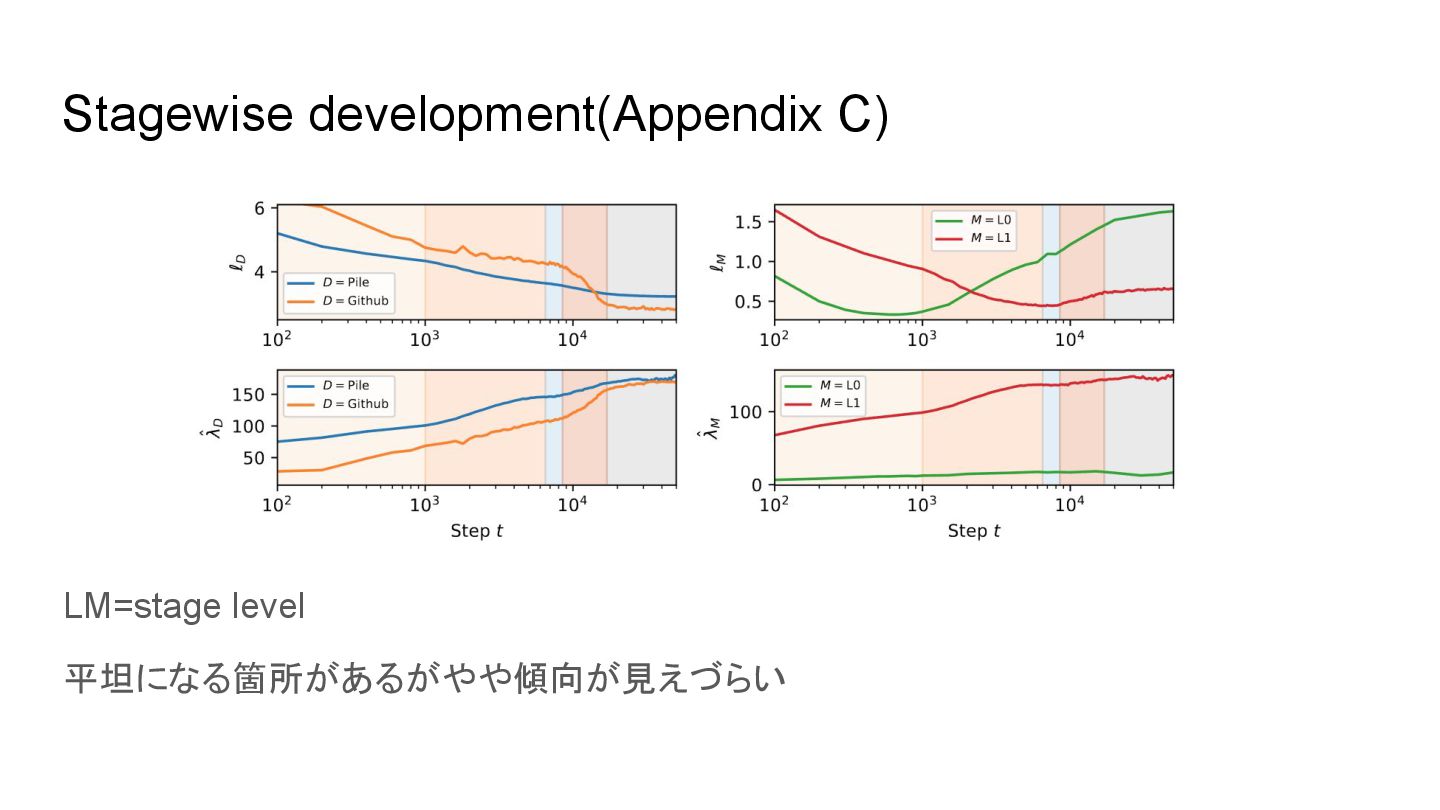
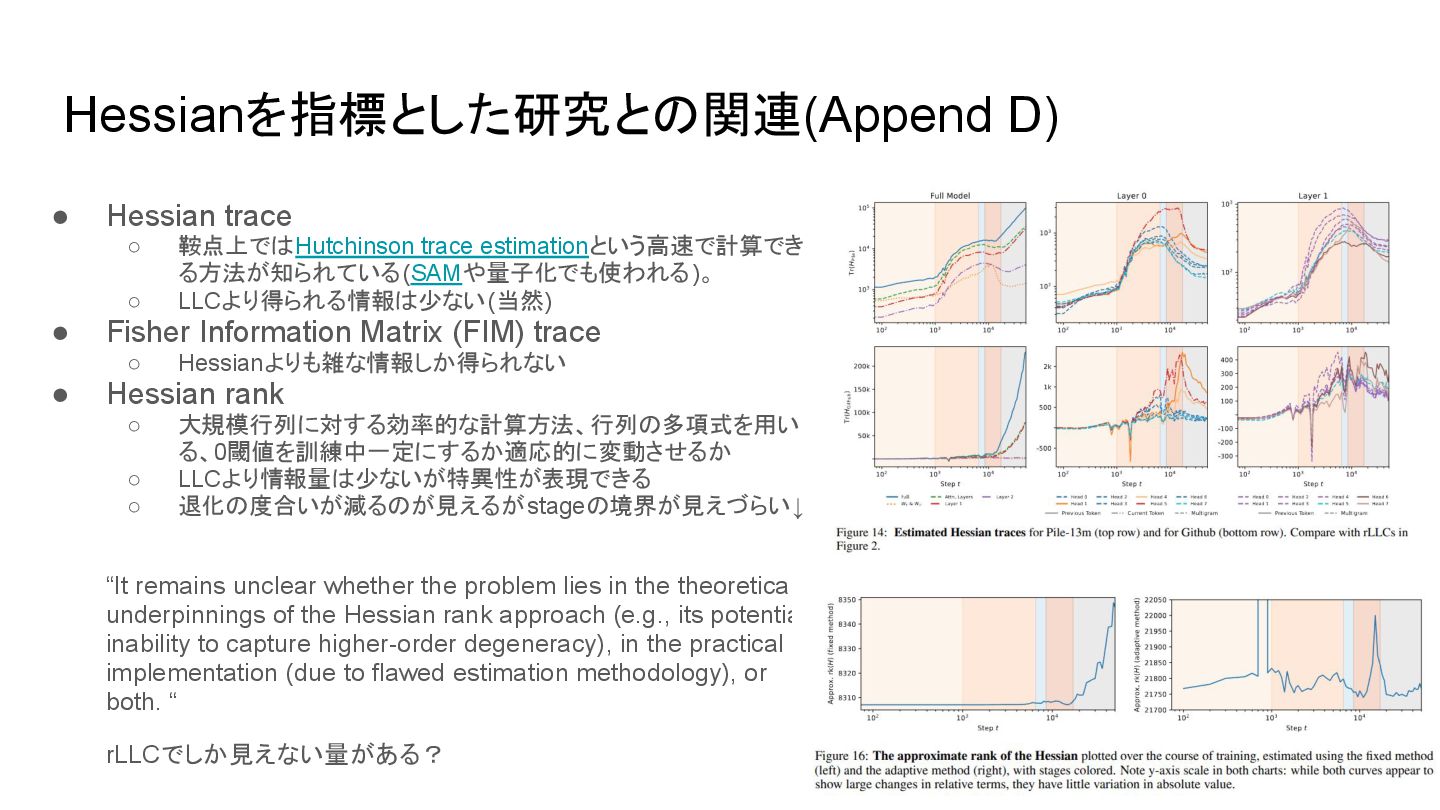
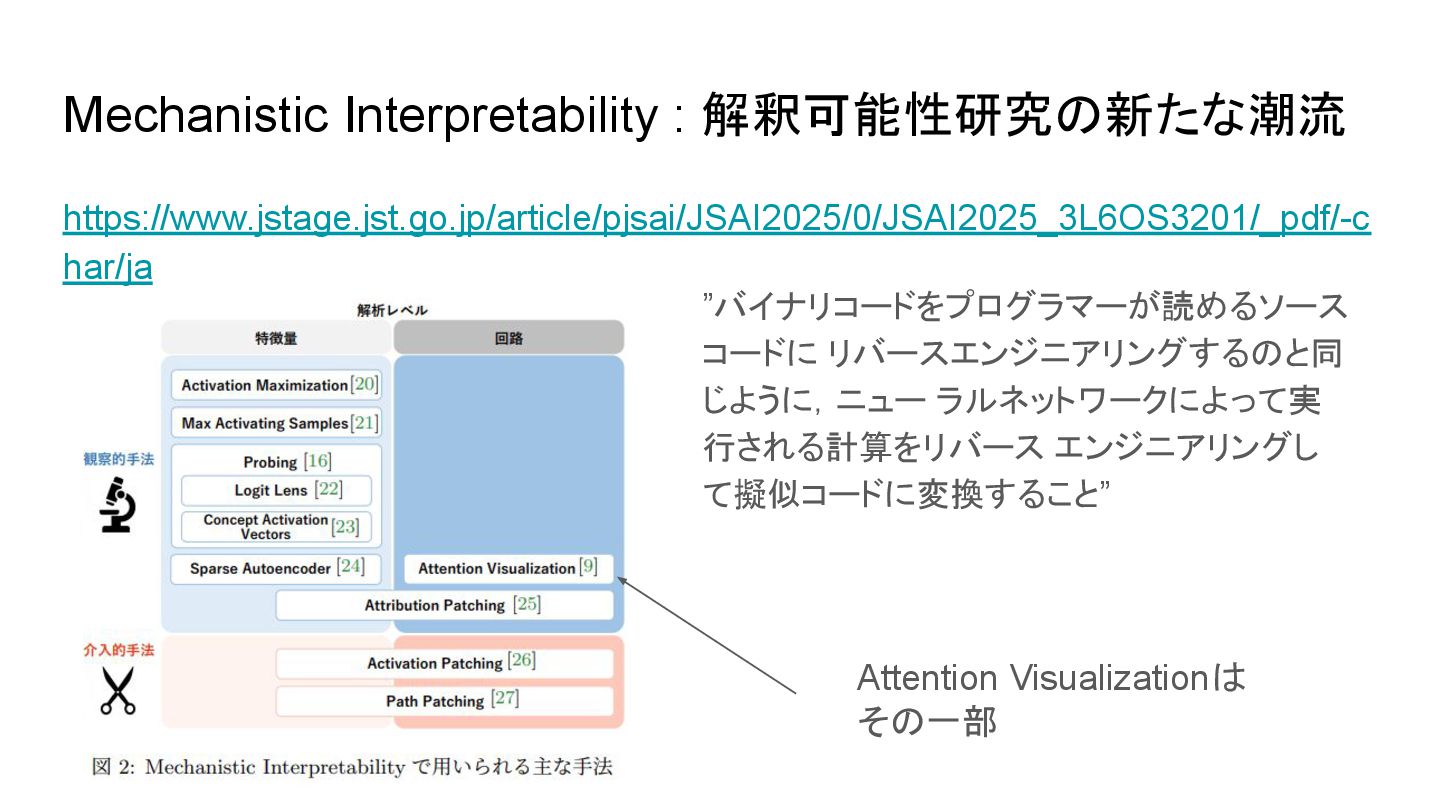
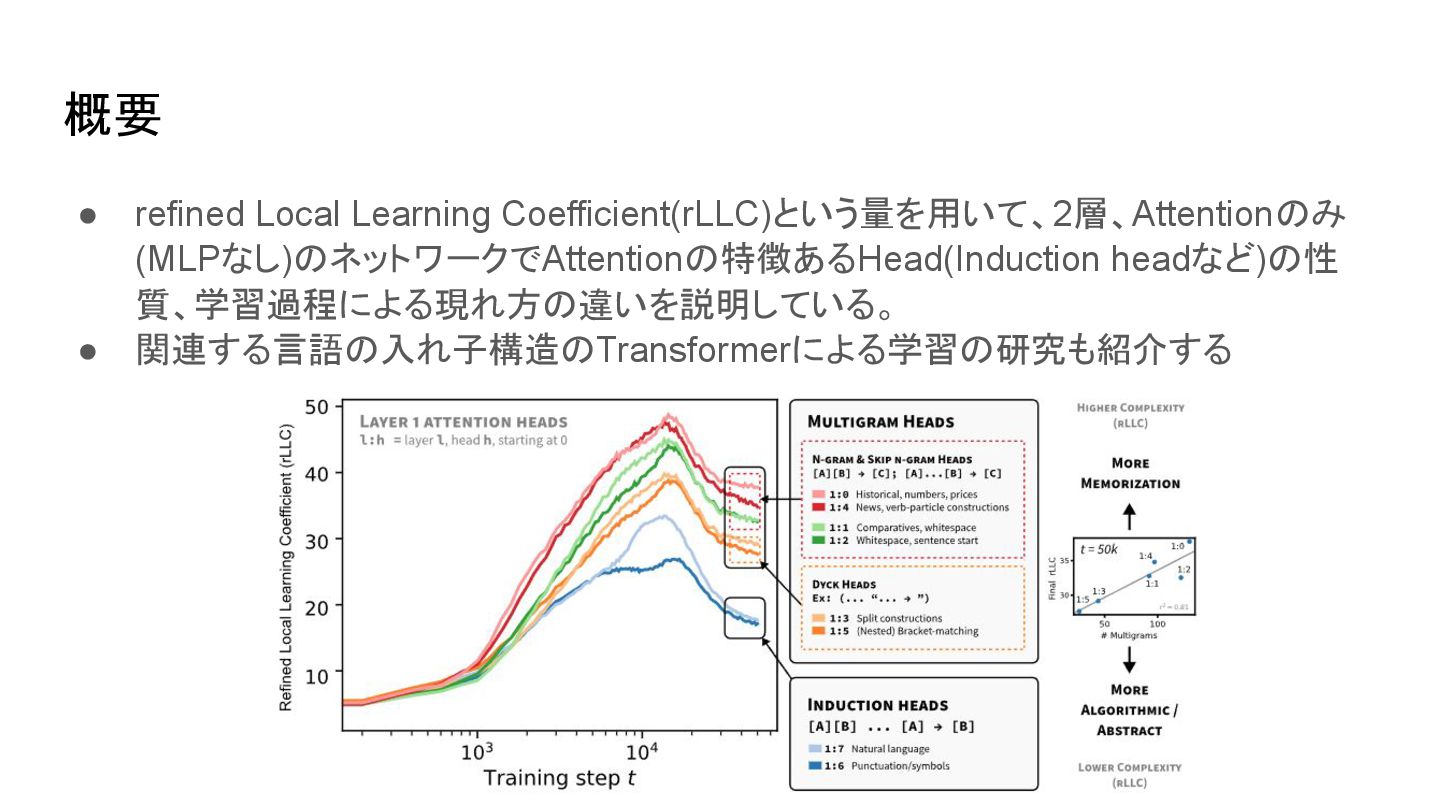
coefficient. Appendix B: provides further details on the head classification. We describe the methodology we followed to manually classified each head, and offer more explanation and examples of each head’s classification and specializations. Appendix C: discusses the significance of critical points, increases, and decreases in the (r)LLC in relation to stagewise development in artificial and biological neural networks. We provide additional results for the full-weights data-refined LLC for a variety of common datasets. Appendix D: compares the rLLC to the Hessian trace, Fisher Information Matrix (FIM) trace, and Hessian rank. We show that the LLC consistently outperforms these other techniques. Appendix E: compares the rLLC against ablation-based metrics that are common to mechanistic interpretability (zero ablations, mean ablations, and resample ablations). We discuss the strengths and weaknesses of each of these methods in relation to the rLLC. Appendix F: provides more experimental details on the architecture, training setup, LLC hyperparameters, using models as the generating process for data-refined LLCs, composition scores, and automated clustering analysis. Appendix G: examines the consistency of our findings across different random initializations, supporting the generality of our conclusions. This analysis further supports the robustness of our observations across various model components. Additional figures & data can be found at the following repository: https://github.com/timaeus-research/paper-rllcs- 2024.
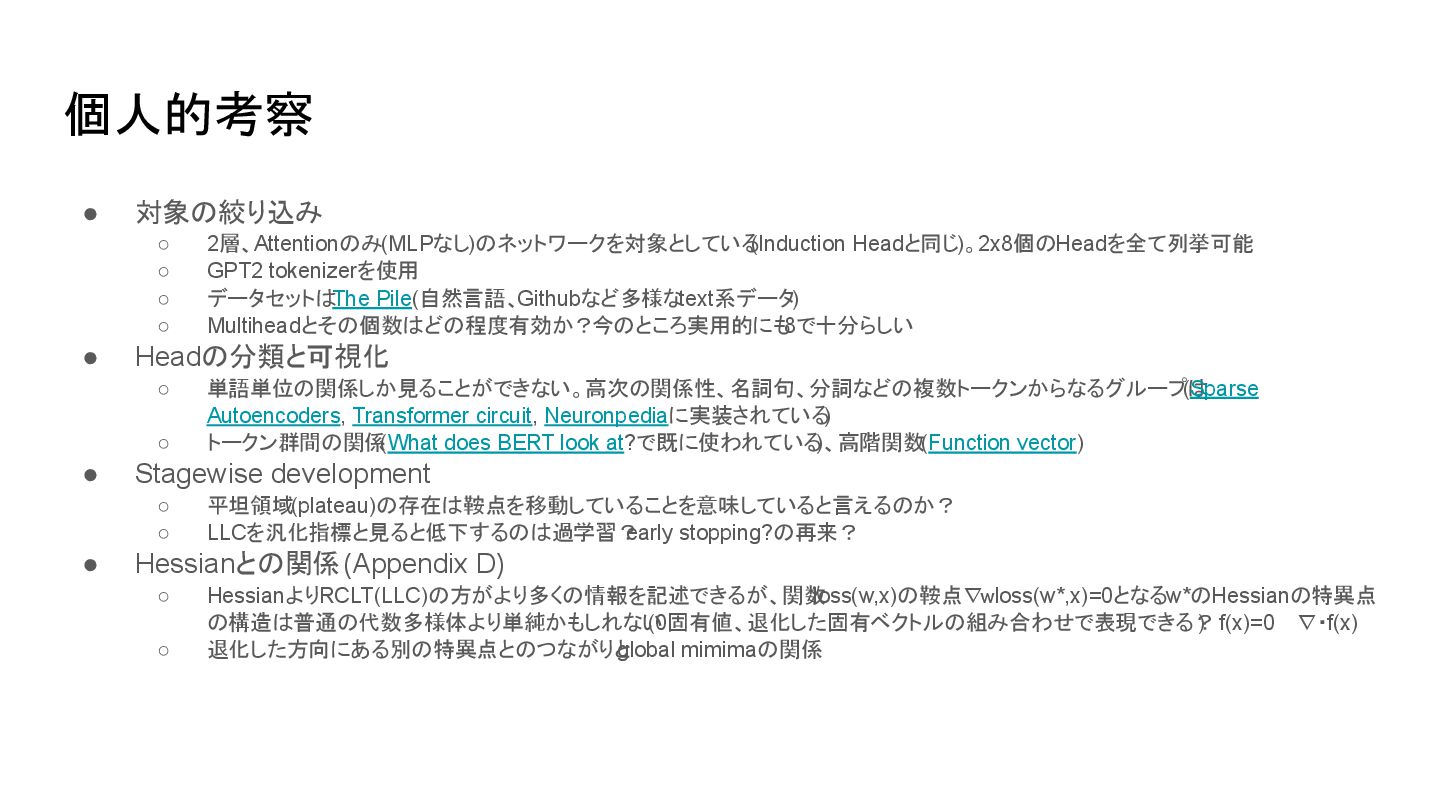
◦ LLCより得られる情報は少ない(当然) • Fisher Information Matrix (FIM) trace ◦ Hessianよりも雑な情報しか得られない • Hessian rank ◦ 大規模行列に対する効率的な計算方法、行列の多項式を用い る、0閾値を訓練中一定にするか適応的に変動させるか ◦ LLCより情報量は少ないが特異性が表現できる ◦ 退化の度合いが減るのが見えるがstageの境界が見えづらい↓ “It remains unclear whether the problem lies in the theoretical underpinnings of the Hessian rank approach (e.g., its potential inability to capture higher-order degeneracy), in the practical implementation (due to flawed estimation methodology), or both. “ rLLCでしか見えない量がある?
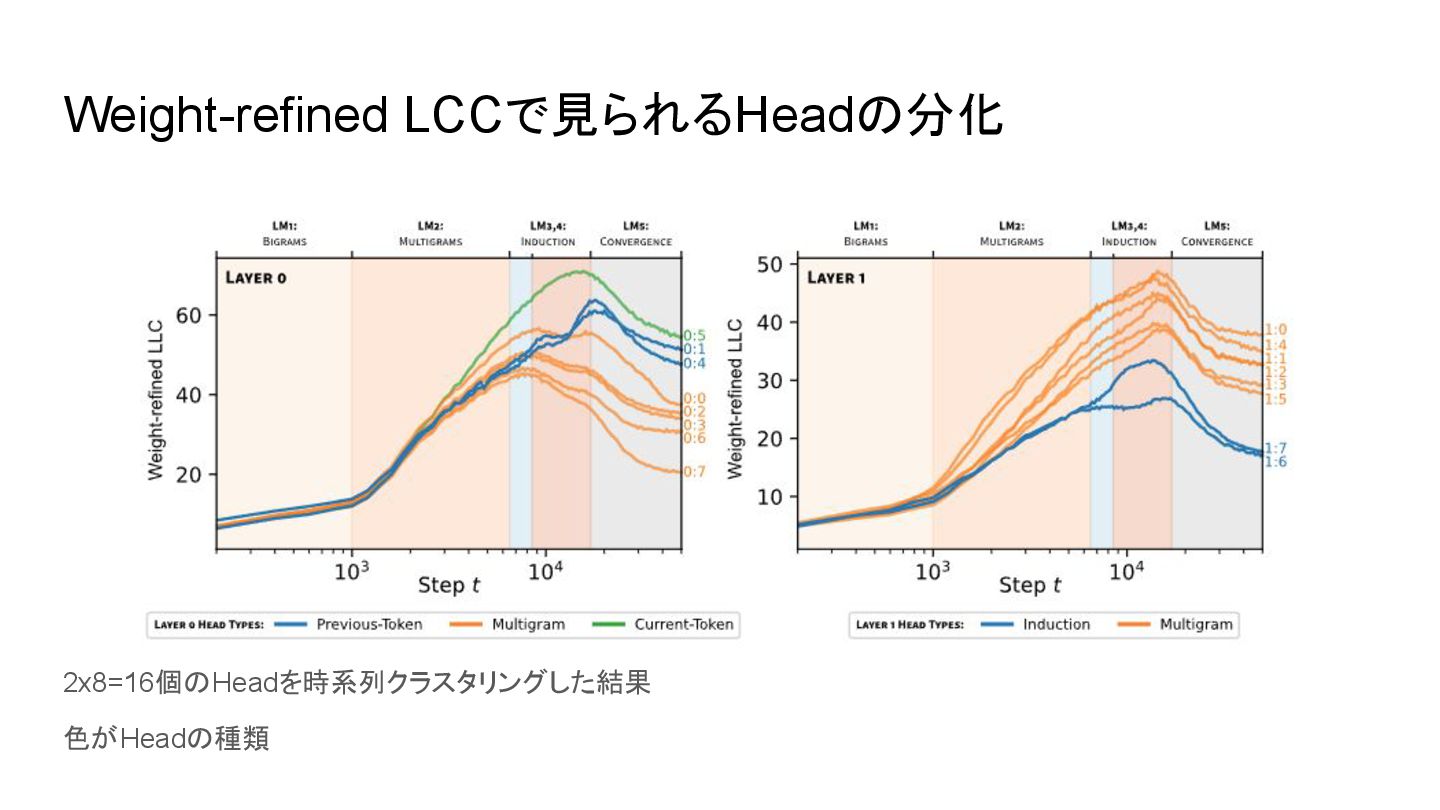
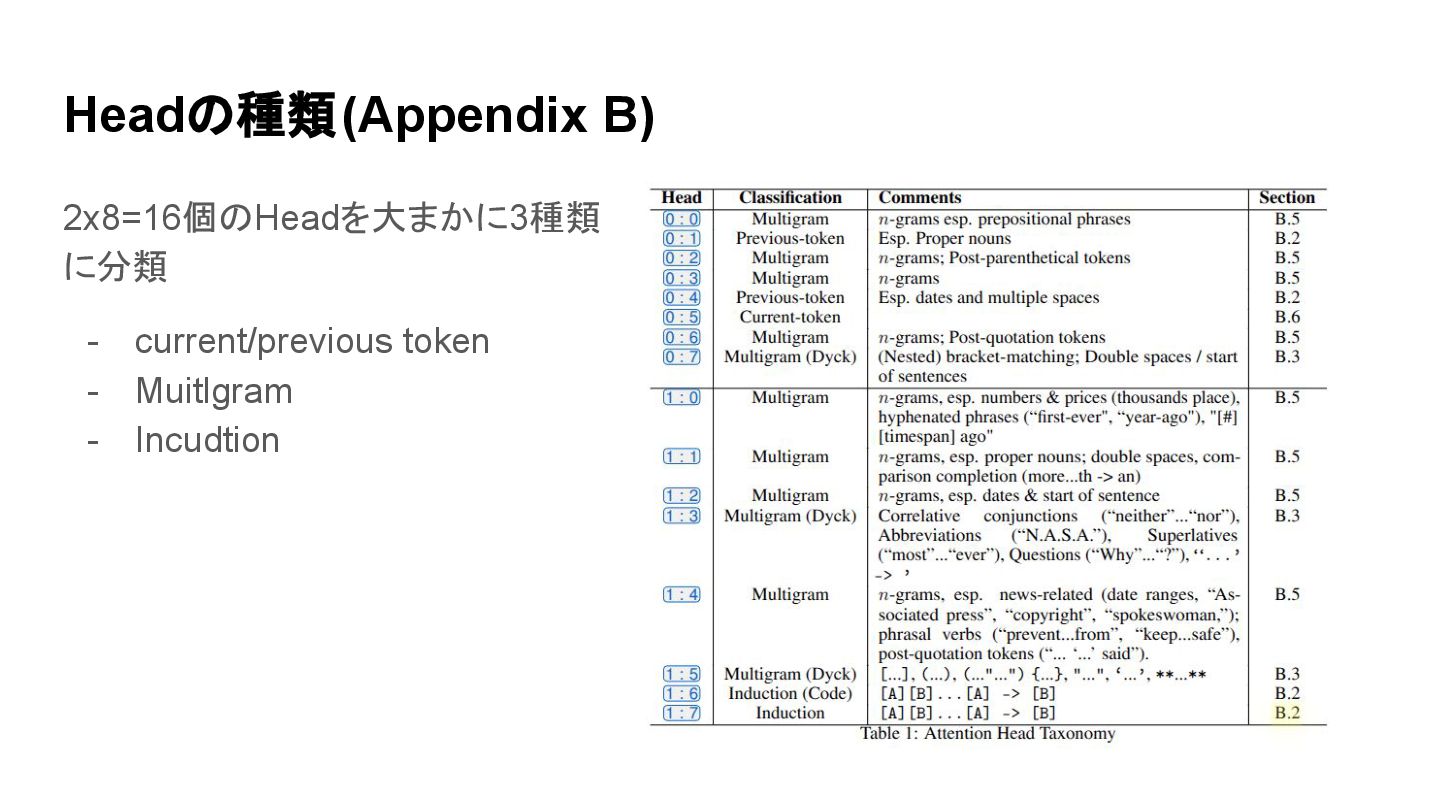
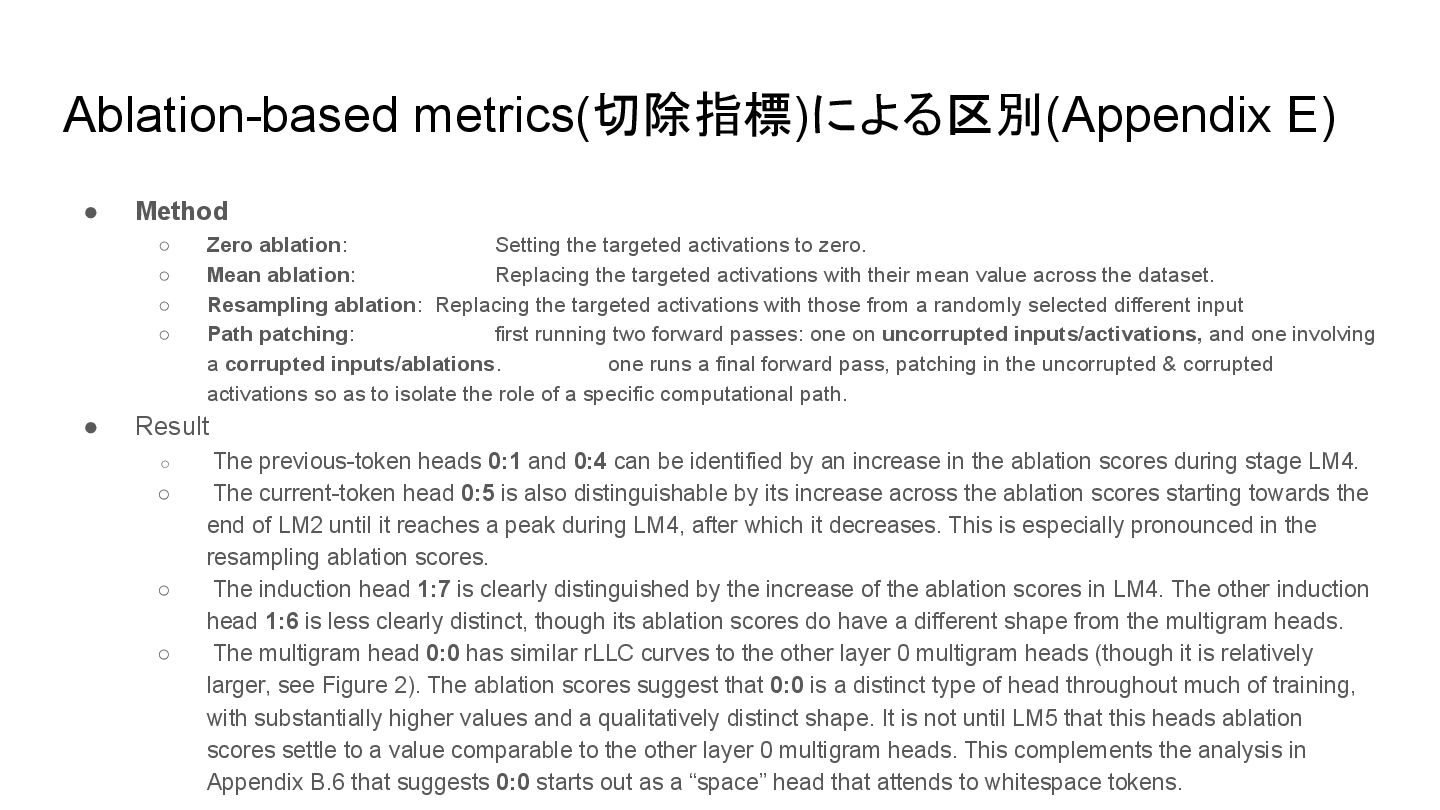
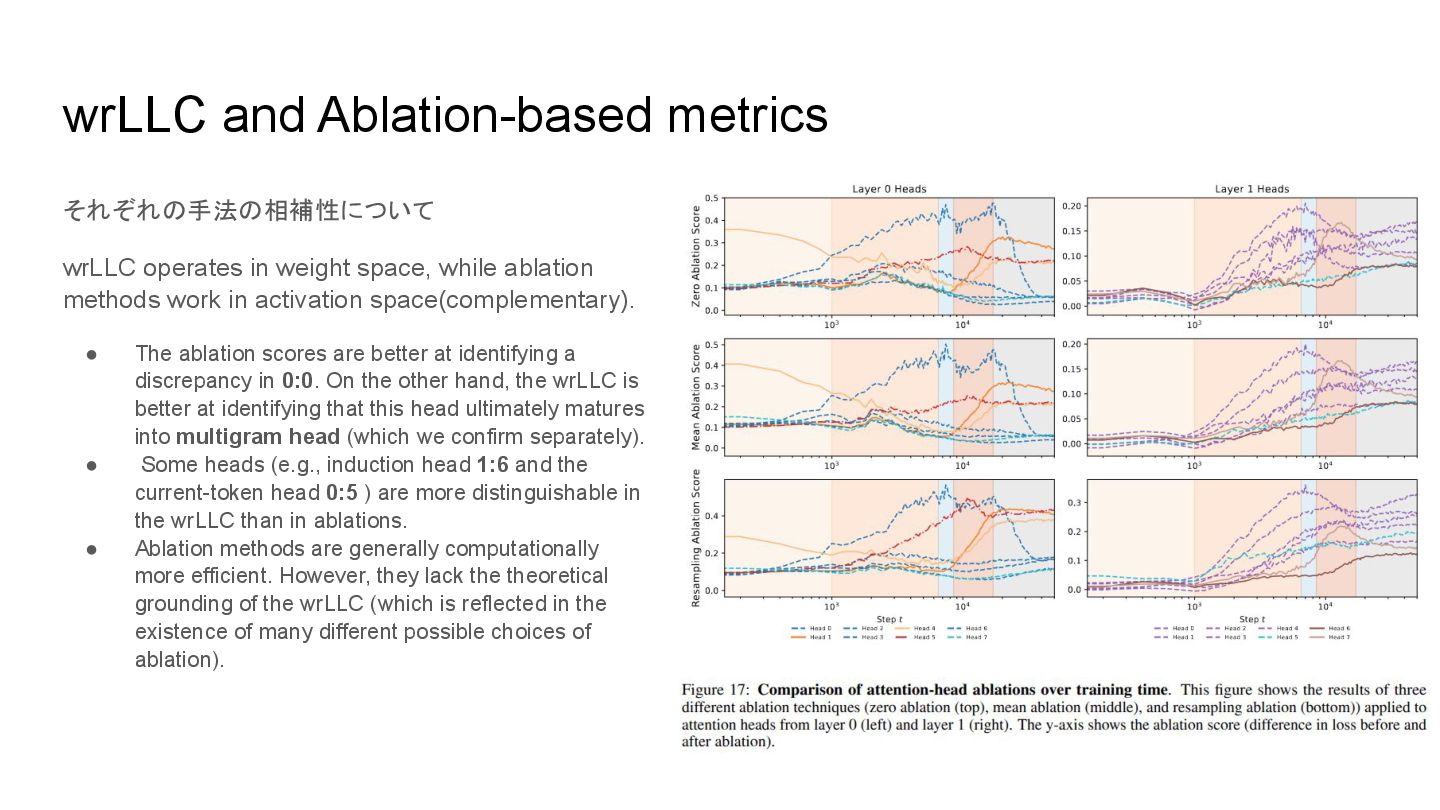
targeted activations to zero. ◦ Mean ablation: Replacing the targeted activations with their mean value across the dataset. ◦ Resampling ablation: Replacing the targeted activations with those from a randomly selected different input ◦ Path patching: first running two forward passes: one on uncorrupted inputs/activations, and one involving a corrupted inputs/ablations. one runs a final forward pass, patching in the uncorrupted & corrupted activations so as to isolate the role of a specific computational path. • Result ◦ The previous-token heads 0:1 and 0:4 can be identified by an increase in the ablation scores during stage LM4. ◦ The current-token head 0:5 is also distinguishable by its increase across the ablation scores starting towards the end of LM2 until it reaches a peak during LM4, after which it decreases. This is especially pronounced in the resampling ablation scores. ◦ The induction head 1:7 is clearly distinguished by the increase of the ablation scores in LM4. The other induction head 1:6 is less clearly distinct, though its ablation scores do have a different shape from the multigram heads. ◦ The multigram head 0:0 has similar rLLC curves to the other layer 0 multigram heads (though it is relatively larger, see Figure 2). The ablation scores suggest that 0:0 is a distinct type of head throughout much of training, with substantially higher values and a qualitatively distinct shape. It is not until LM5 that this heads ablation scores settle to a value comparable to the other layer 0 multigram heads. This complements the analysis in Appendix B.6 that suggests 0:0 starts out as a “space” head that attends to whitespace tokens.
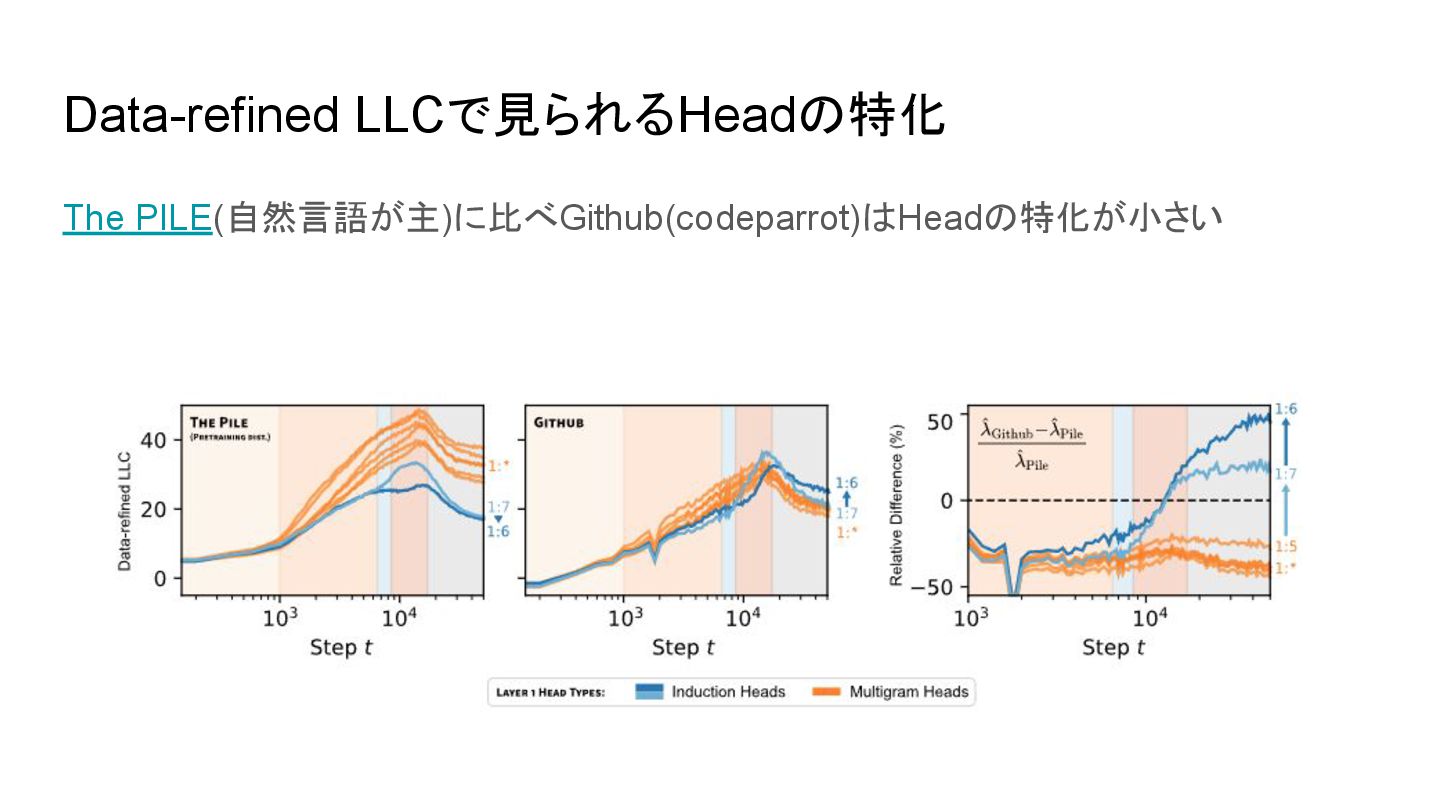
while ablation methods work in activation space(complementary). • The ablation scores are better at identifying a discrepancy in 0:0. On the other hand, the wrLLC is better at identifying that this head ultimately matures into multigram head (which we confirm separately). • Some heads (e.g., induction head 1:6 and the current-token head 0:5 ) are more distinguishable in the wrLLC than in ablations. • Ablation methods are generally computationally more efficient. However, they lack the theoretical grounding of the wrLLC (which is reflected in the existence of many different possible choices of ablation).
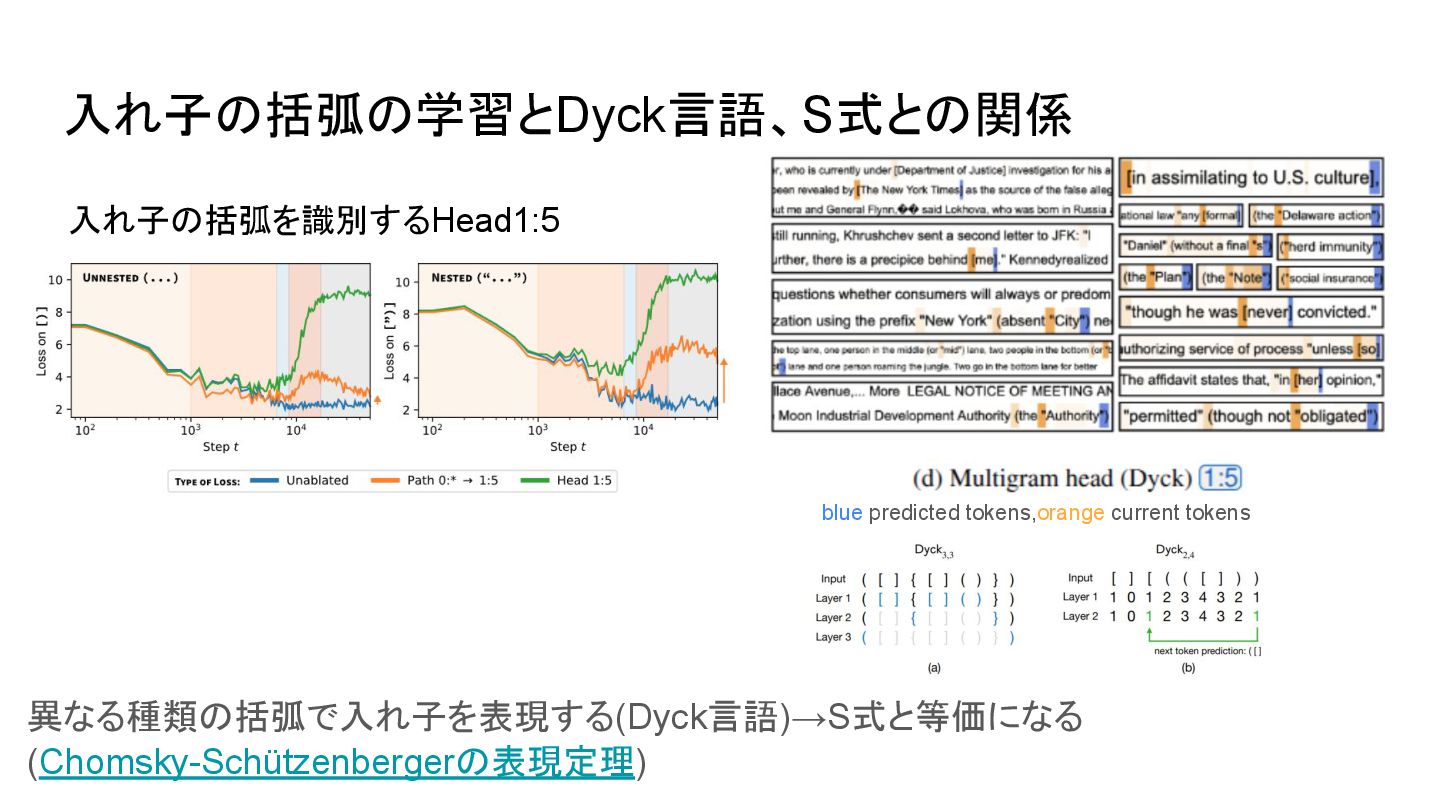
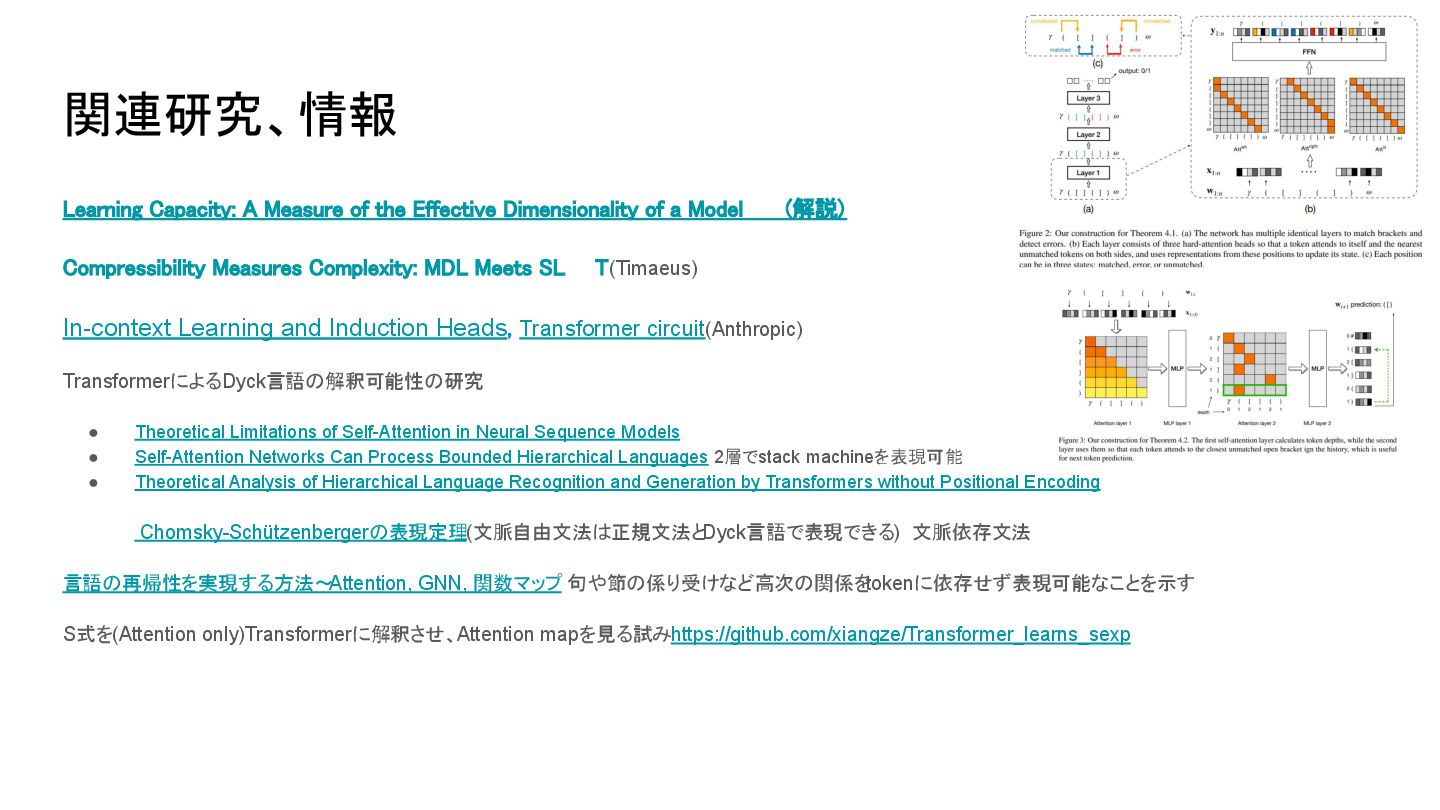
a Model (解説) Compressibility Measures Complexity: MDL Meets SL T(Timaeus) In-context Learning and Induction Heads, Transformer circuit(Anthropic) TransformerによるDyck言語の解釈可能性の研究 • Theoretical Limitations of Self-Attention in Neural Sequence Models • Self-Attention Networks Can Process Bounded Hierarchical Languages 2層でstack machineを表現可能 • Theoretical Analysis of Hierarchical Language Recognition and Generation by Transformers without Positional Encoding Chomsky-Schützenbergerの表現定理(文脈自由文法は正規文法とDyck言語で表現できる) 文脈依存文法 言語の再帰性を実現する方法〜 Attention, GNN, 関数マップ 句や節の係り受けなど高次の関係を tokenに依存せず表現可能なことを示す S式を(Attention only)Transformerに解釈させ、Attention mapを見る試みhttps://github.com/xiangze/Transformer_learns_sexp

 Your Podcast. Everywhere. Effortlessly.


 xiangze
 addyosmani
.jpg) cargoodrich
cargoodrich
 lara
lara
 samtorres
 marktimemedia
 mkilby
 csswizardry
 reverentgeek
 akosma
 codingconduct
 aleyda
 joshbly
![[論文紹介]Differentiation and Specialization of Attention Heads via the Refined LLC(rLLC)](https://files.speakerdeck.com/presentations/325965156f2944f78e0b813fab377b09/slide_0.jpg)
![帰納ヘッド(In-context Learning and Induction Heads) “過去に同じトークンになったときに次はどうなったかを参照”する [A*][B*] … [A] →](https://files.speakerdeck.com/presentations/325965156f2944f78e0b813fab377b09/slide_10.jpg)