We? Network security experts in R&D labs • Working for France Telecom - Orange (major telco) Speakers at security-focused conferences • ShmooCon, ToorCon, FIRST, Eurosec… Wi-Fi security focused speakers ;-) • “Wi-Fi Security: What’s Next” – ToorCon 2003 • “Design and Implementation of a Wireless IDS” – ToorCon 2004 and ShmooCon 2005 • “Wi-Fi Trickery, or How To Secure (?), Break (??) and Have Fun With Wi-Fi” – ShmooCon 2006
released 3 new tools at ShmooCon 2006 • Raw Fake AP: an enhanced Fake AP tool using RAW injection for increased effectiveness • Raw Glue AP: a Virtual AP catching every client in a virtual quarantine area • Raw Covert: a tricky 802.11 covert channel using valid ACK frames We released at BlackHat US 2006 Tricks to “hide” access points and stations (madwifi patches) • From scanners and wireless IDS Raw Covert v2: new implementation (python) and features All this stuff is available at • http://rfakeap.tuxfamily.org
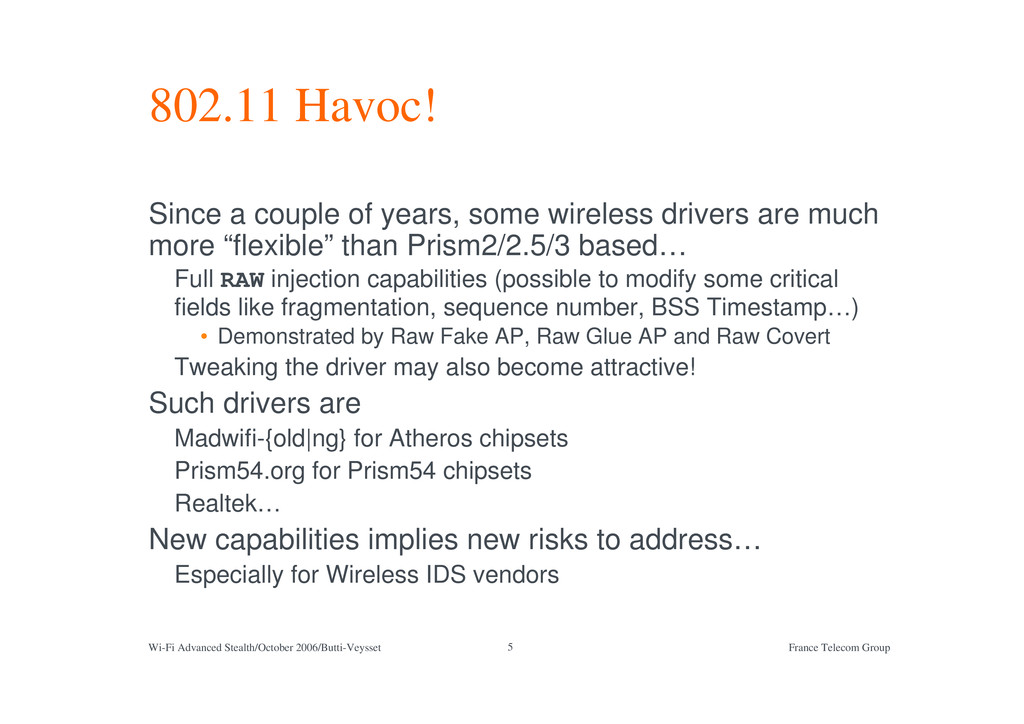
Since a couple of years, some wireless drivers are much more “flexible” than Prism2/2.5/3 based… Full RAW injection capabilities (possible to modify some critical fields like fragmentation, sequence number, BSS Timestamp…) • Demonstrated by Raw Fake AP, Raw Glue AP and Raw Covert Tweaking the driver may also become attractive! Such drivers are Madwifi-{old|ng} for Atheros chipsets Prism54.org for Prism54 chipsets Realtek… New capabilities implies new risks to address… Especially for Wireless IDS vendors
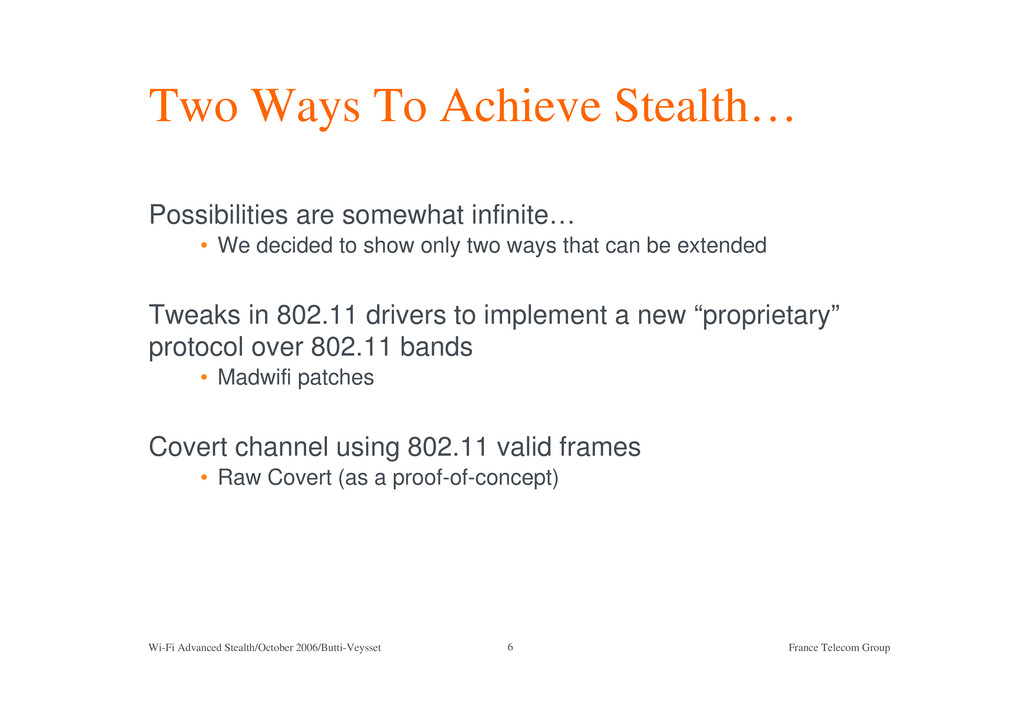
To Achieve Stealth… Possibilities are somewhat infinite… • We decided to show only two ways that can be extended Tweaks in 802.11 drivers to implement a new “proprietary” protocol over 802.11 bands • Madwifi patches Covert channel using 802.11 valid frames • Raw Covert (as a proof-of-concept)
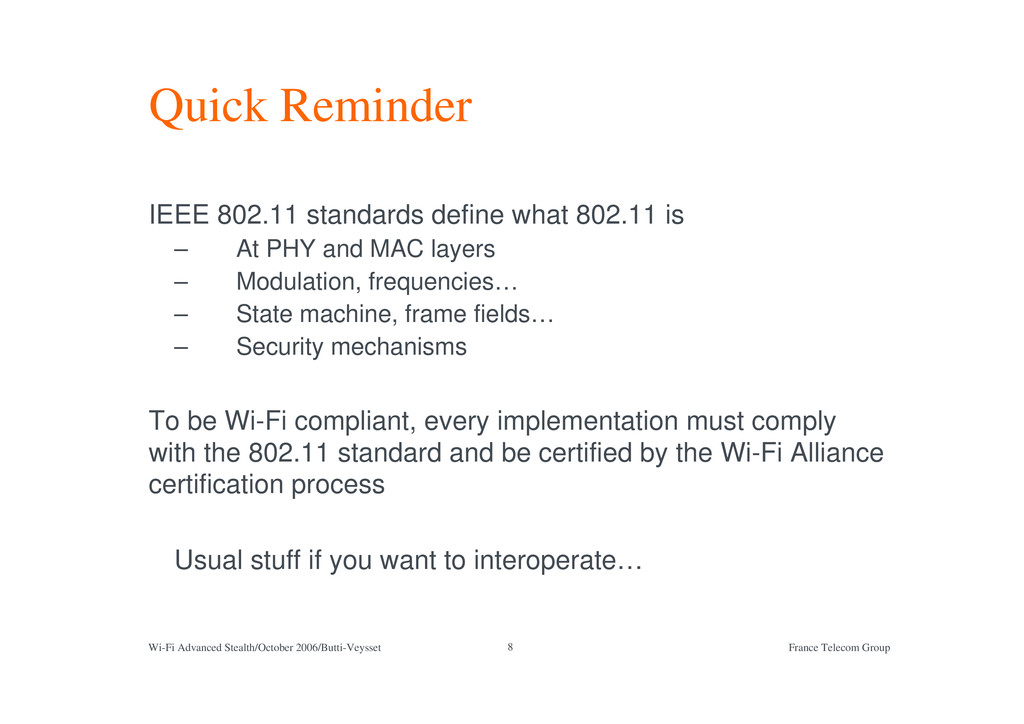
IEEE 802.11 standards define what 802.11 is – At PHY and MAC layers – Modulation, frequencies… – State machine, frame fields… – Security mechanisms To be Wi-Fi compliant, every implementation must comply with the 802.11 standard and be certified by the Wi-Fi Alliance certification process Usual stuff if you want to interoperate…
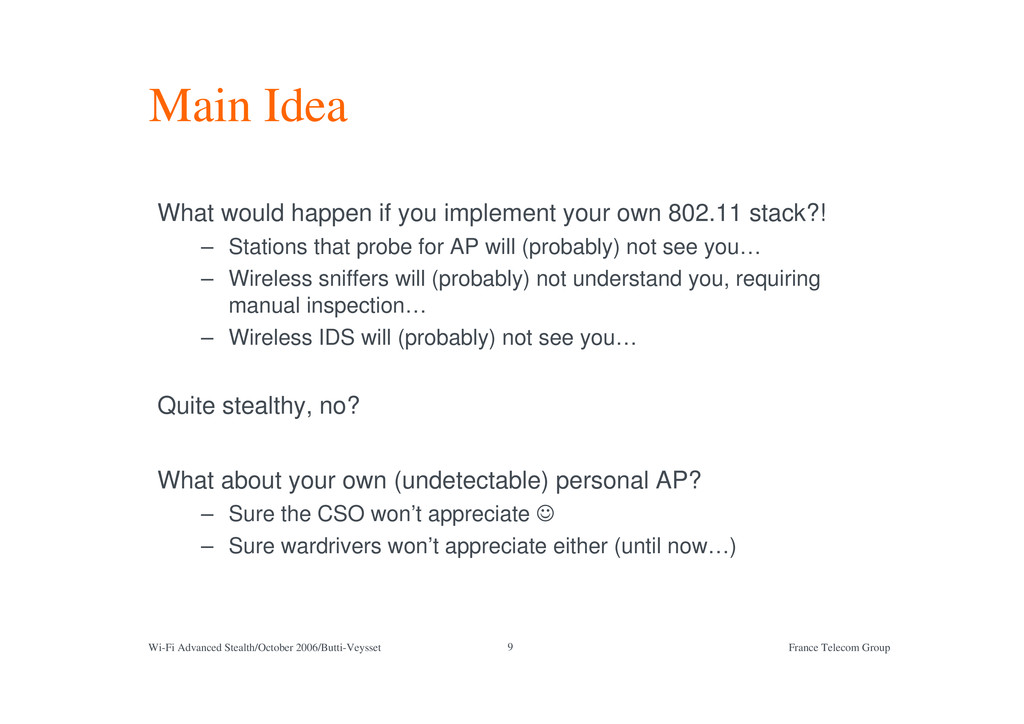
What would happen if you implement your own 802.11 stack?! – Stations that probe for AP will (probably) not see you… – Wireless sniffers will (probably) not understand you, requiring manual inspection… – Wireless IDS will (probably) not see you… Quite stealthy, no? What about your own (undetectable) personal AP? – Sure the CSO won’t appreciate ☺ – Sure wardrivers won’t appreciate either (until now…)
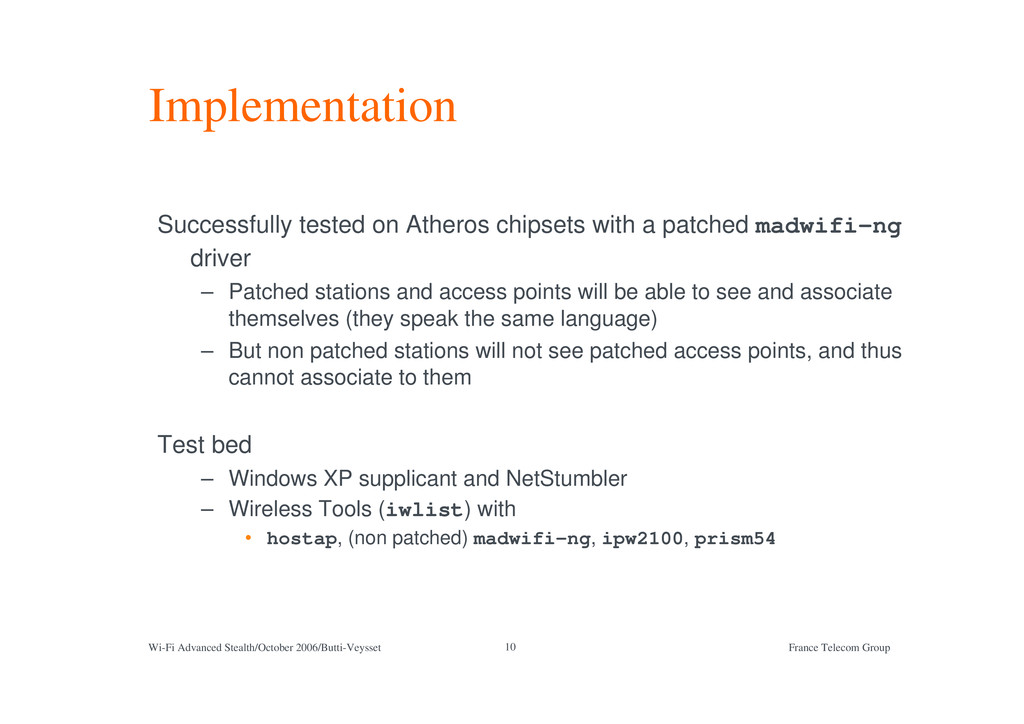
tested on Atheros chipsets with a patched madwifi-ng driver – Patched stations and access points will be able to see and associate themselves (they speak the same language) – But non patched stations will not see patched access points, and thus cannot associate to them Test bed – Windows XP supplicant and NetStumbler – Wireless Tools (iwlist) with • hostap, (non patched) madwifi-ng, ipw2100, prism54
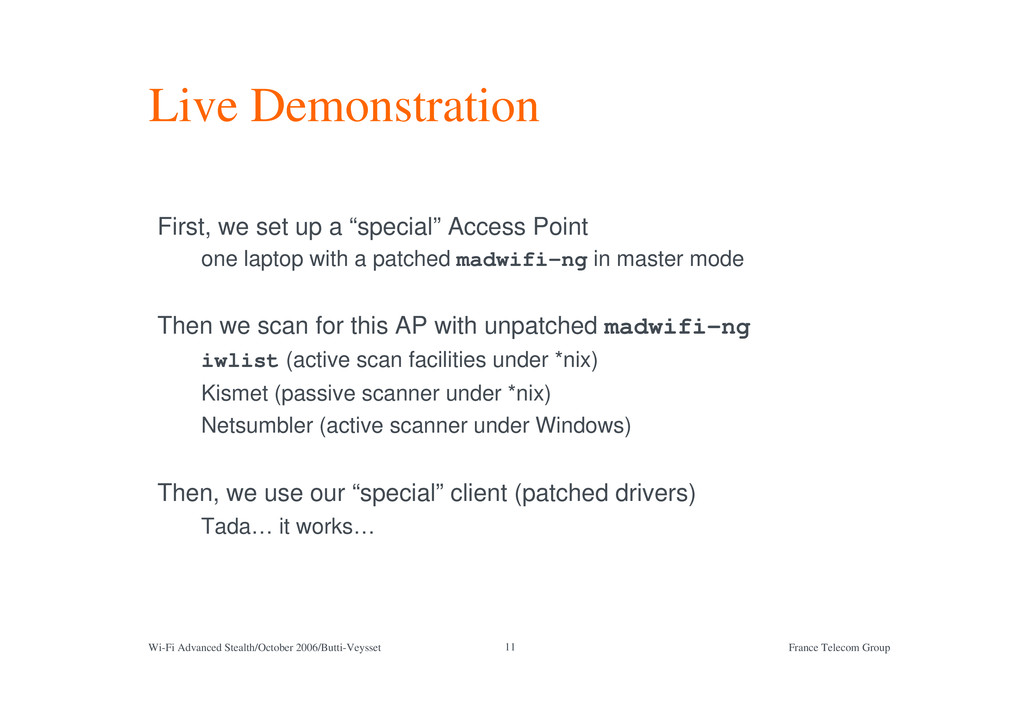
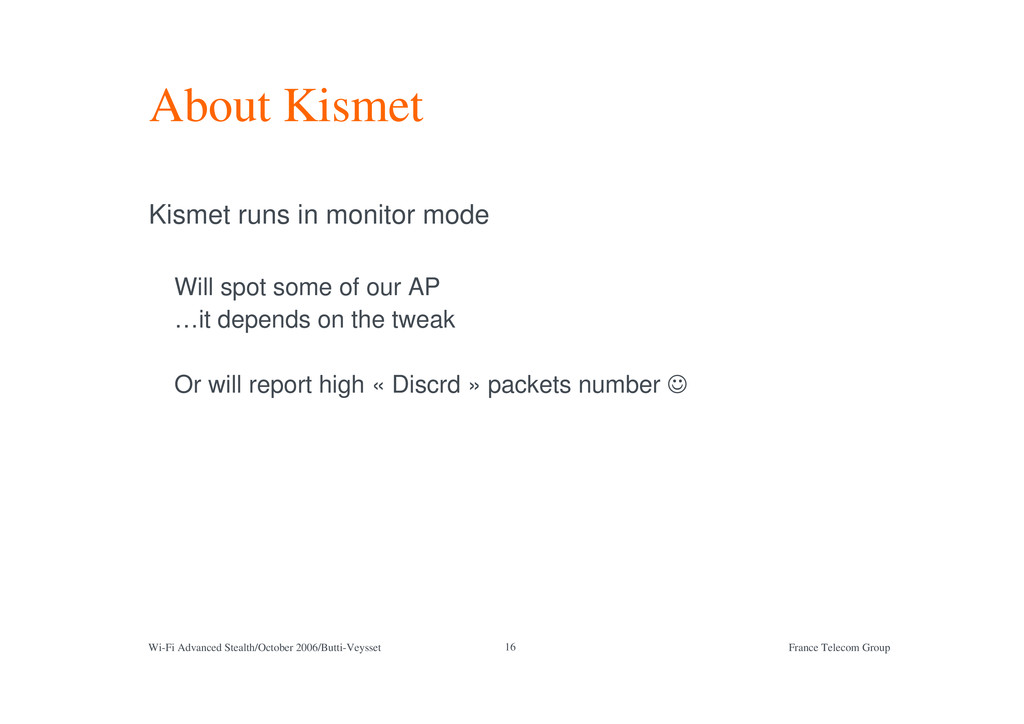
First, we set up a “special” Access Point one laptop with a patched madwifi-ng in master mode Then we scan for this AP with unpatched madwifi-ng iwlist (active scan facilities under *nix) Kismet (passive scanner under *nix) Netsumbler (active scanner under Windows) Then, we use our “special” client (patched drivers) Tada… it works…
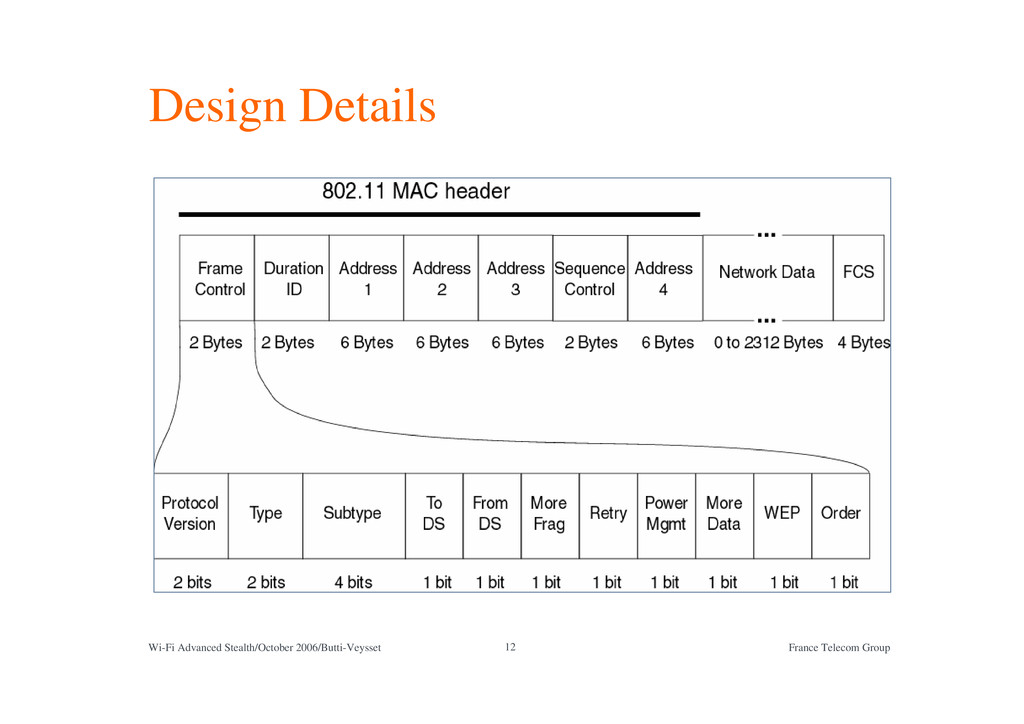
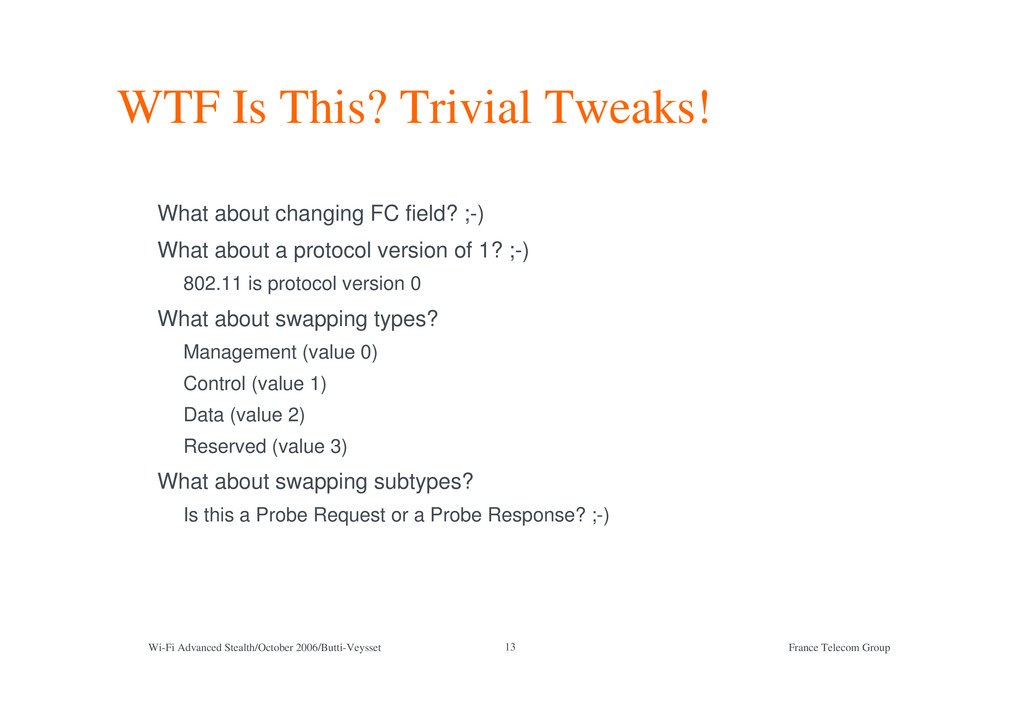
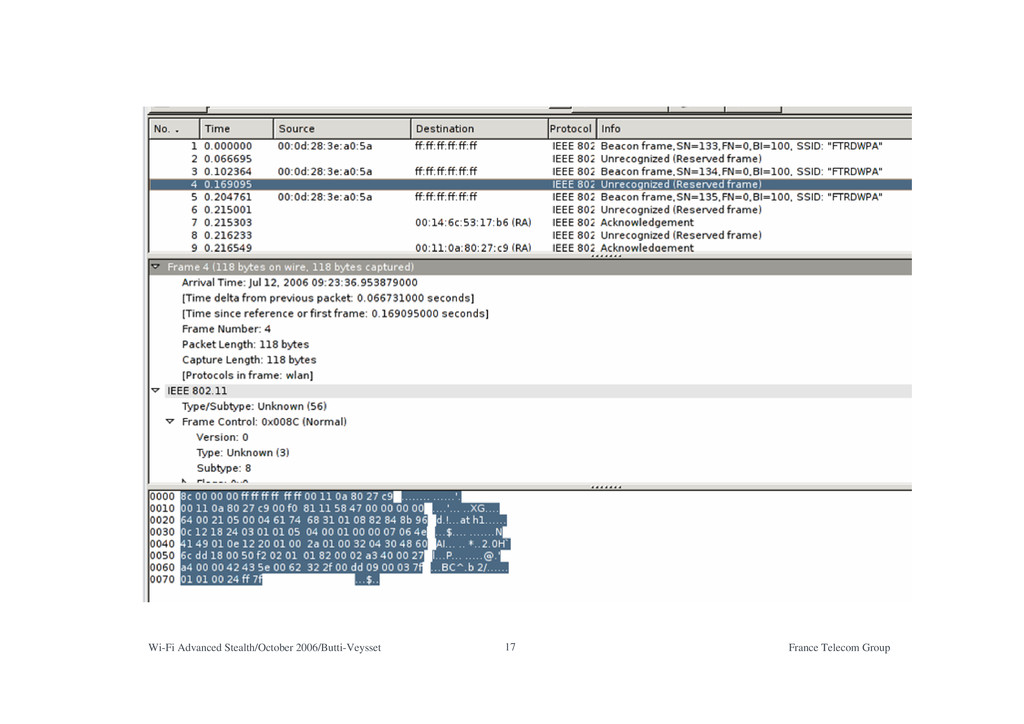
This? Trivial Tweaks! What about changing FC field? ;-) What about a protocol version of 1? ;-) 802.11 is protocol version 0 What about swapping types? Management (value 0) Control (value 1) Data (value 2) Reserved (value 3) What about swapping subtypes? Is this a Probe Request or a Probe Response? ;-)
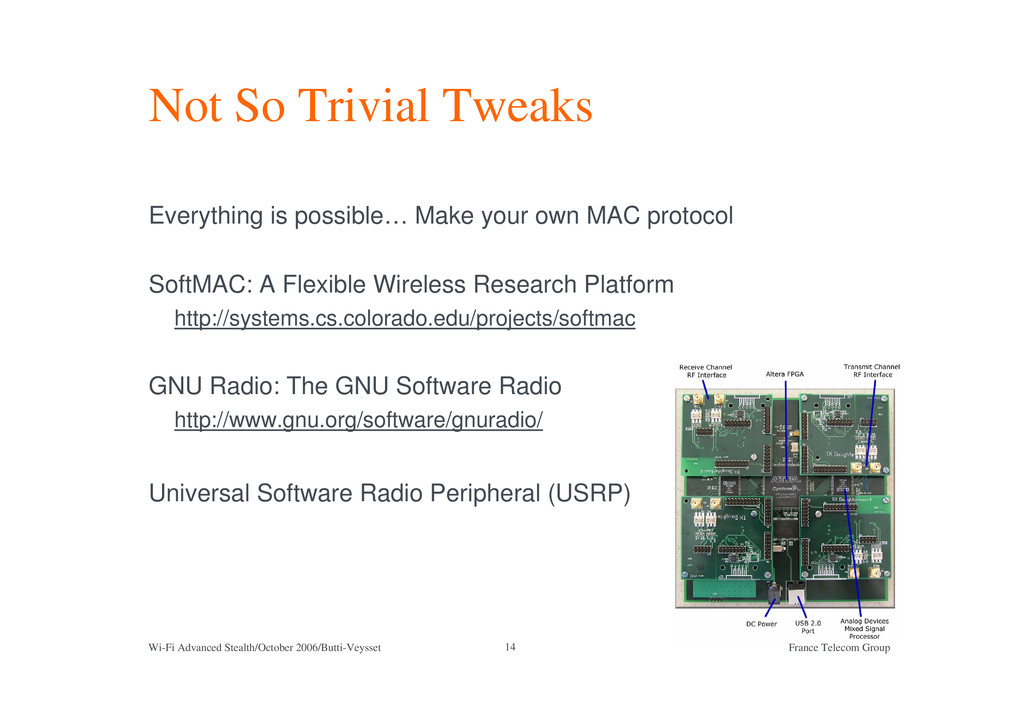
Trivial Tweaks Everything is possible… Make your own MAC protocol SoftMAC: A Flexible Wireless Research Platform http://systems.cs.colorado.edu/projects/softmac GNU Radio: The GNU Software Radio http://www.gnu.org/software/gnuradio/ Universal Software Radio Peripheral (USRP)
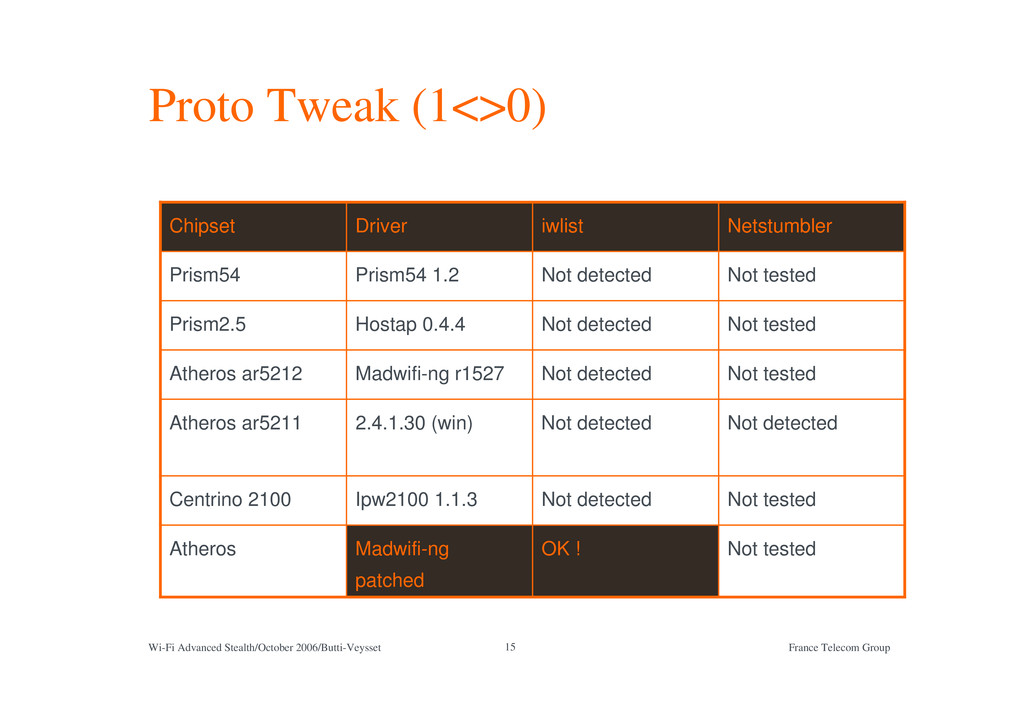
(1<>0) Chipset Driver iwlist Netstumbler Prism54 Prism54 1.2 Not detected Not tested Prism2.5 Hostap 0.4.4 Not detected Not tested Atheros ar5212 Madwifi-ng r1527 Not detected Not tested Atheros ar5211 2.4.1.30 (win) Not detected Not detected Centrino 2100 Ipw2100 1.1.3 Not detected Not tested Atheros Madwifi-ng patched OK ! Not tested
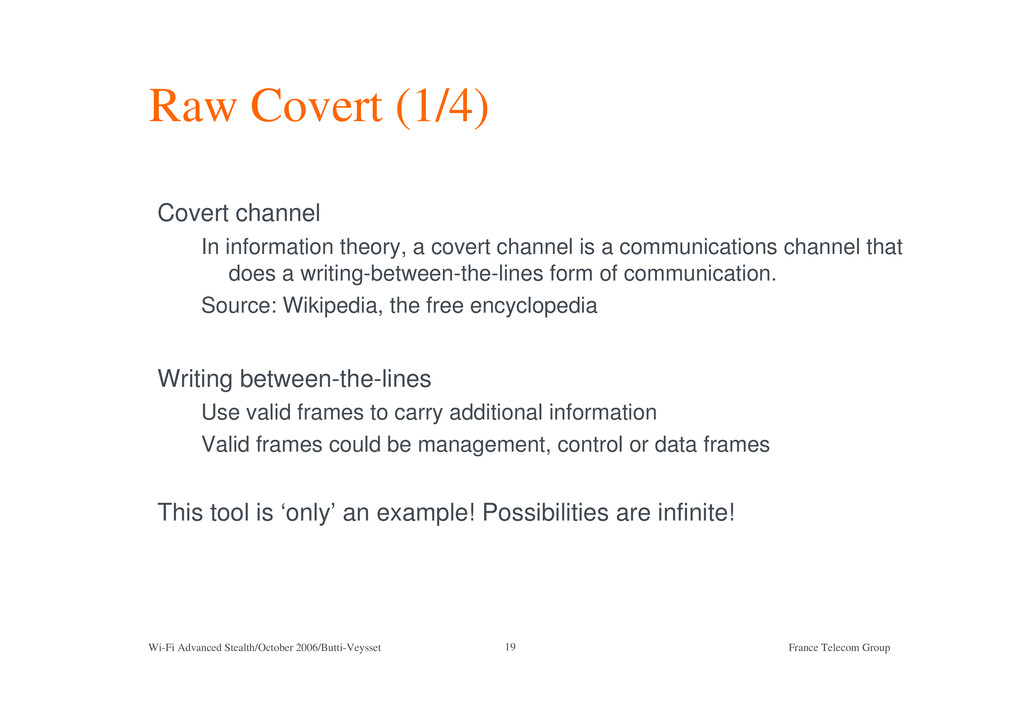
(1/4) Covert channel In information theory, a covert channel is a communications channel that does a writing-between-the-lines form of communication. Source: Wikipedia, the free encyclopedia Writing between-the-lines Use valid frames to carry additional information Valid frames could be management, control or data frames This tool is ‘only’ an example! Possibilities are infinite!
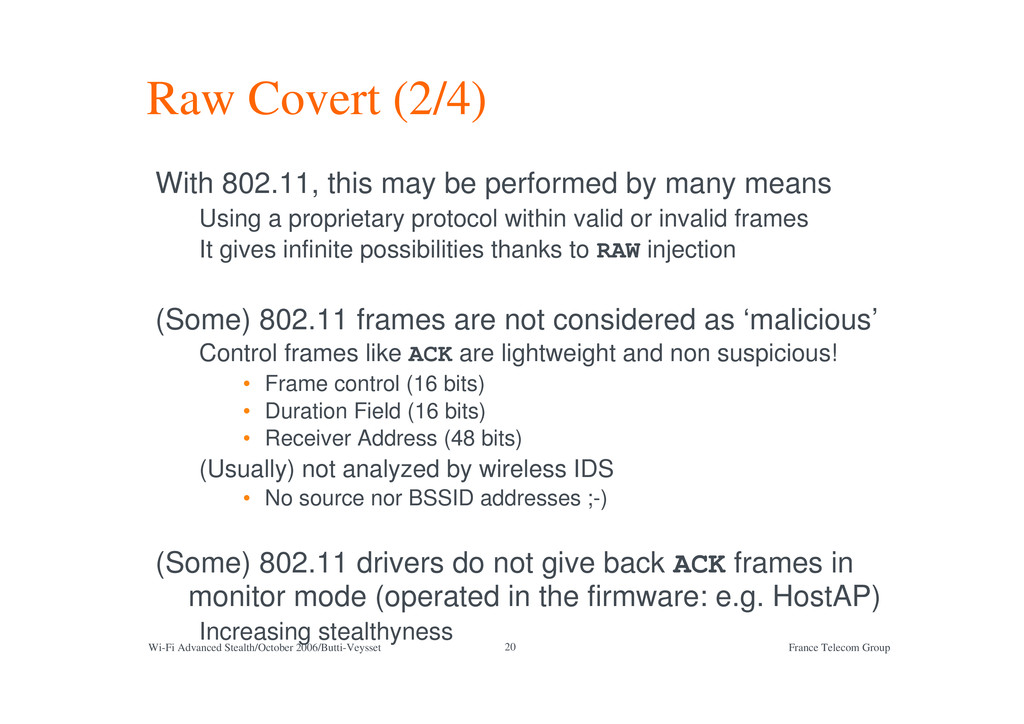
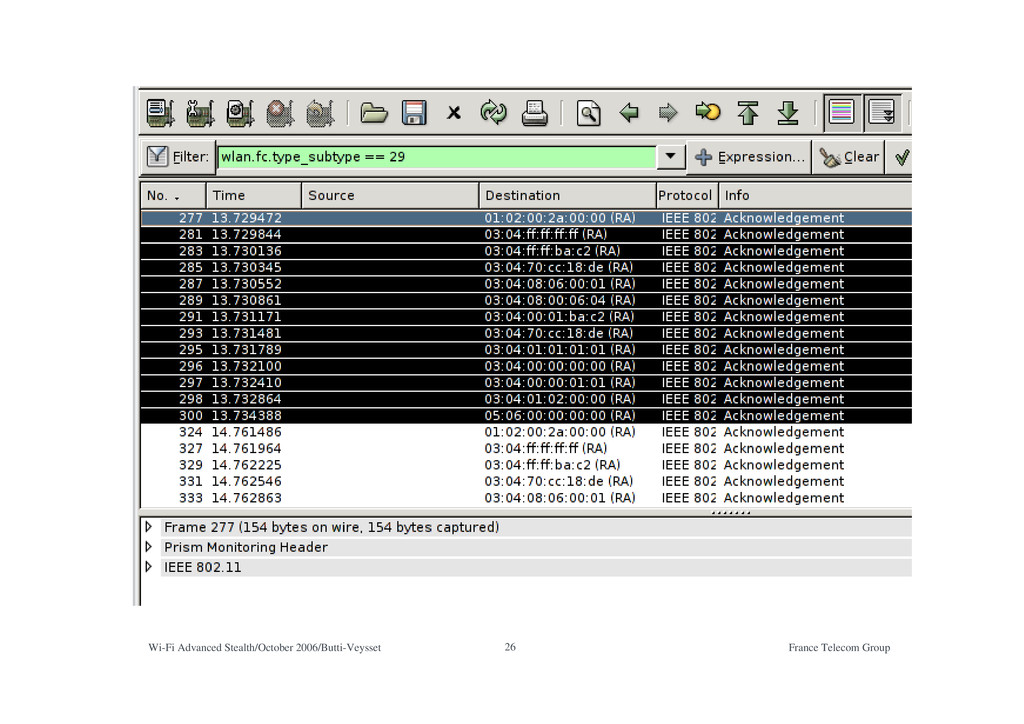
(2/4) With 802.11, this may be performed by many means Using a proprietary protocol within valid or invalid frames It gives infinite possibilities thanks to RAW injection (Some) 802.11 frames are not considered as ‘malicious’ Control frames like ACK are lightweight and non suspicious! • Frame control (16 bits) • Duration Field (16 bits) • Receiver Address (48 bits) (Usually) not analyzed by wireless IDS • No source nor BSSID addresses ;-) (Some) 802.11 drivers do not give back ACK frames in monitor mode (operated in the firmware: e.g. HostAP) Increasing stealthyness
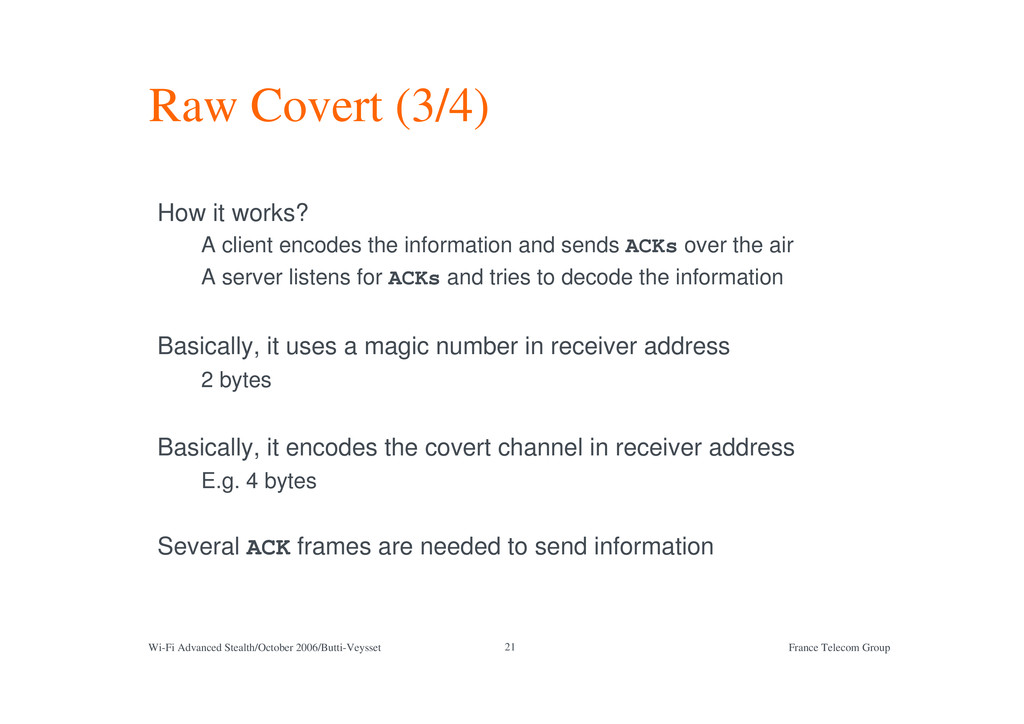
(3/4) How it works? A client encodes the information and sends ACKs over the air A server listens for ACKs and tries to decode the information Basically, it uses a magic number in receiver address 2 bytes Basically, it encodes the covert channel in receiver address E.g. 4 bytes Several ACK frames are needed to send information
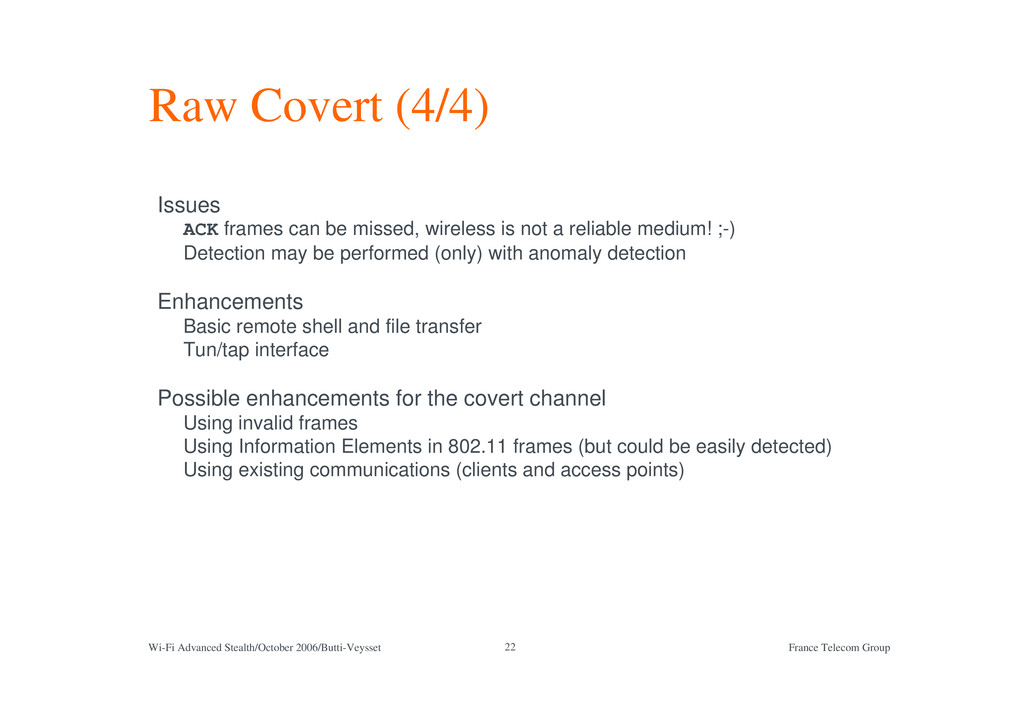
(4/4) Issues ACK frames can be missed, wireless is not a reliable medium! ;-) Detection may be performed (only) with anomaly detection Enhancements Basic remote shell and file transfer Tun/tap interface Possible enhancements for the covert channel Using invalid frames Using Information Elements in 802.11 frames (but could be easily detected) Using existing communications (clients and access points)
Enhancements (1/2) Invalid frames (in the 802.11 sense, i.e. proprietary frames) But would (?) be detected by any wireless IDS performing sanity check on every frame FCS invalid frames Should require driver/firmware modifications to inject bad FCS Wireless IDSs do not analyze such bad frames But should be detected with FCSerr statistics (even if harder to diagnose as a covert channel)
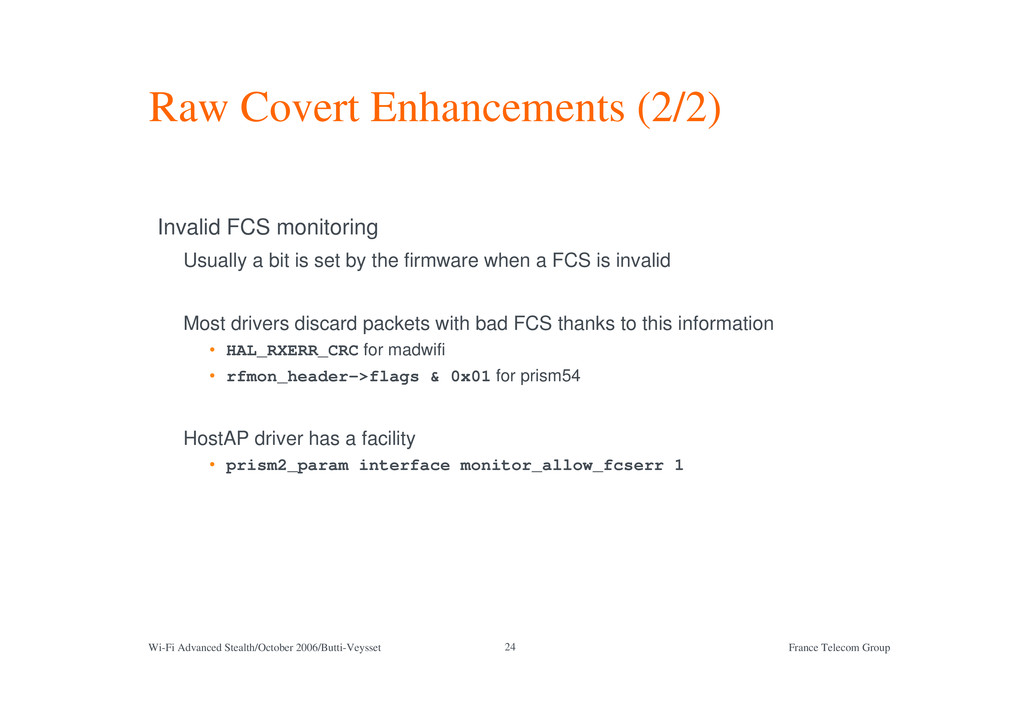
Enhancements (2/2) Invalid FCS monitoring Usually a bit is set by the firmware when a FCS is invalid Most drivers discard packets with bad FCS thanks to this information • HAL_RXERR_CRC for madwifi • rfmon_header->flags & 0x01 for prism54 HostAP driver has a facility • prism2_param interface monitor_allow_fcserr 1
(1/2) Fuzzing Fuzz testing is a software testing technique. The basic idea is to attach the inputs of a program to a source of random data. If the program fails (for example, by crashing, or by failing built-in code assertions), then there are defects to correct. From Wikipedia, the free encyclopedia
(2/2) Fuzzing is not something really new… Remember ISIC? • http://www.packetfactory.net/projects/ISIC/ But it is still of interest… Recent work on Bluetooth Fuzzing (Pierre Betouin) • http://www.secuobs.com/bss-0.6.tar.gz Fuzzing with Scapy… (Phil Biondi) • Plenty of cool things to do with scapy…
IEEE 802.11 amendments are more and more numerous 802.11e, 802.11i, 802.11k, 802.11r, 802.11s, 802.11w… Axiom Complexity more code more bugs more vulnerabilities Guess what? IEEE 802.11 may be susceptible to fuzzing!
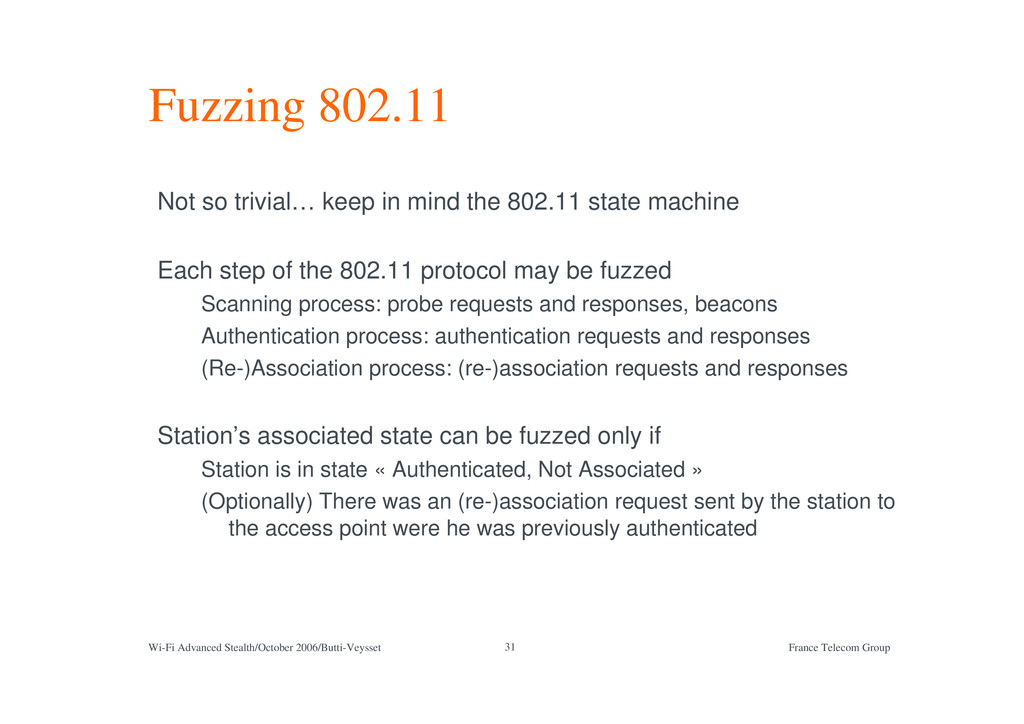
Not so trivial… keep in mind the 802.11 state machine Each step of the 802.11 protocol may be fuzzed Scanning process: probe requests and responses, beacons Authentication process: authentication requests and responses (Re-)Association process: (re-)association requests and responses Station’s associated state can be fuzzed only if Station is in state « Authenticated, Not Associated » (Optionally) There was an (re-)association request sent by the station to the access point were he was previously authenticated
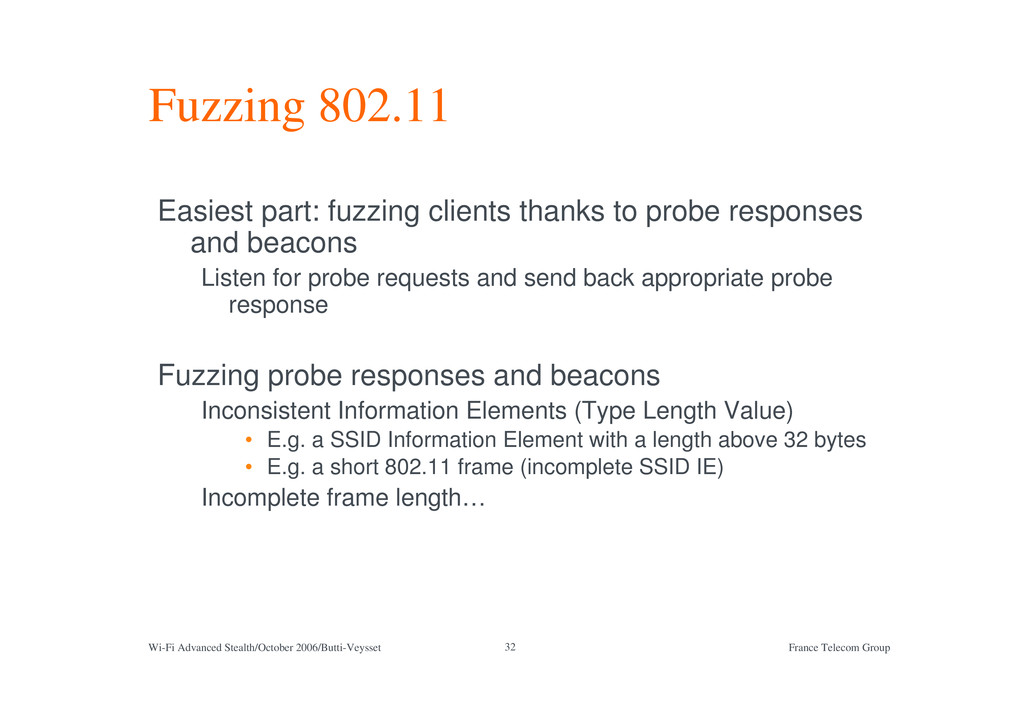
Easiest part: fuzzing clients thanks to probe responses and beacons Listen for probe requests and send back appropriate probe response Fuzzing probe responses and beacons Inconsistent Information Elements (Type Length Value) • E.g. a SSID Information Element with a length above 32 bytes • E.g. a short 802.11 frame (incomplete SSID IE) Incomplete frame length…
Seems to be quite a hot topic (much renewed interest) – Apple patches – Centrinoo patches David Maynor / Johnny Cache blackhat talk last august… They released « Fuzz-E »… More on this soon…
Oudot’s wknock http://www.rstack.org/oudot/wknock/ Pierre Betouin’s Bluetooth Stack Smasher http://www.secuobs.com/bss-0.6.tar.gz scapy (Phil Biondi) http://www.secdev.org SoftMAC: A Flexible Wireless Research Platform http://systems.cs.colorado.edu/projects/softmac MadWiFi patches and rawcovert http://rfakeap.tuxfamily.org


 0xd012
 shogo4131
 yamanoku
 takuroabe
 satoshi7
 techtekt
 teamlab
 gionn
gionn
 iktakahiro
 bgpat
bgpat
 ivry_presentationmaterials
 odashi
 rfdnxbro
 rkaga
rkaga
 colly
colly
 jonoalderson
 62gerente
 sabderemane
 scottboms
 shpigford
 portentint
 tamaranovitovic
 dougneiner
 skipperchong
 mraible