Share
Embed
Technical SEO: A Practical Checklist for Making a Website Easier to Crawl and Understand
Technical SEO plays an important role in making websites easier for search engines to crawl, understand, and index. This practical checklist covers crawlability, indexability, XML sitemaps, internal linking, redirects, page performance, mobile usability, duplicate content, structured data, and Search Console. It also explains how to prioritise technical SEO issues and turn an audit into actionable improvements.
a2zdm
September 14, 2026
Transcript
15 slides
-
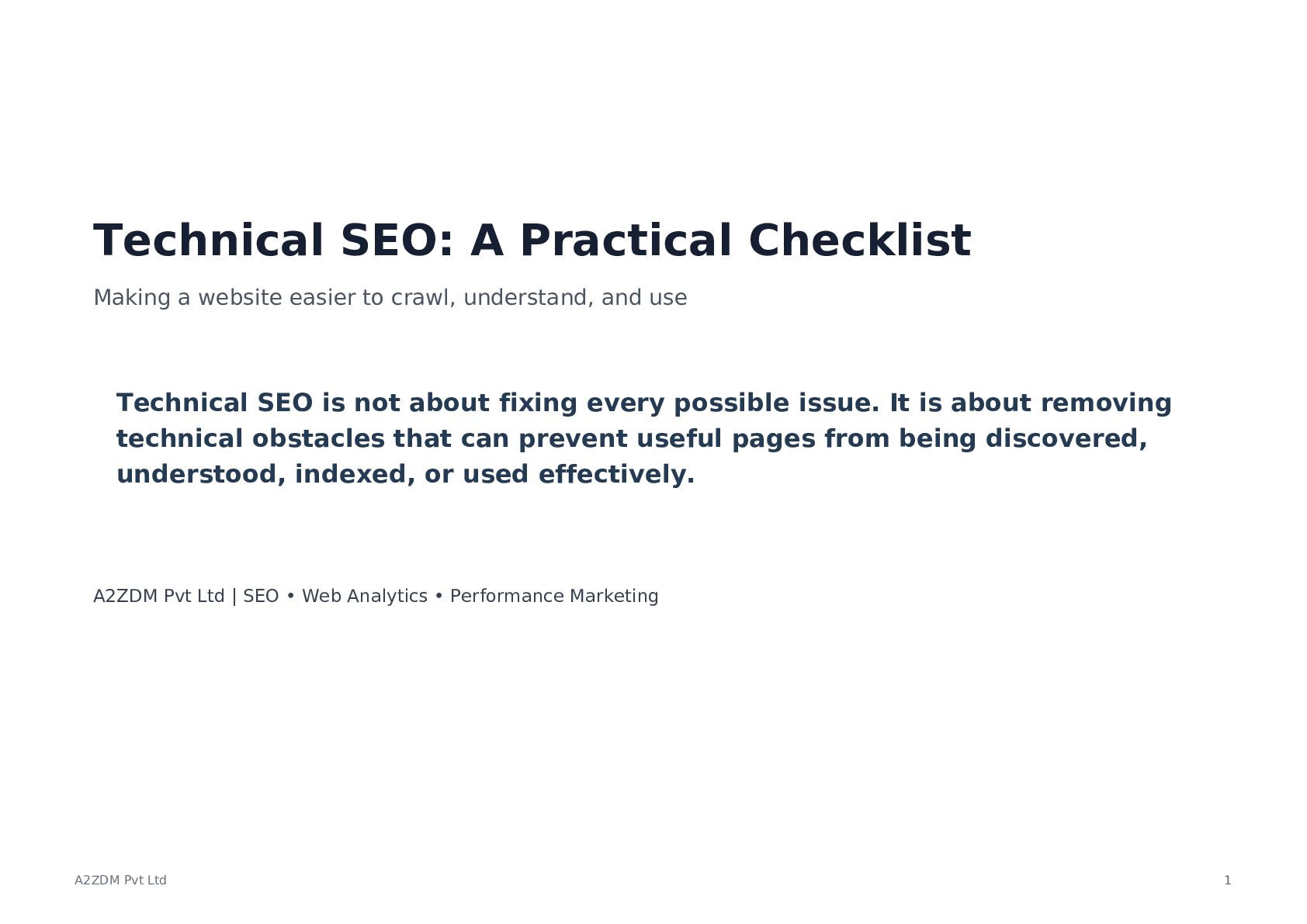
Technical SEO: A Practical Checklist Making a website easier to
crawl, understand, and use Technical SEO is not about fixing every possible issue. It is about removing technical obstacles that can prevent useful pages from being discovered, understood, indexed, or used effectively. A2ZDM Pvt Ltd | SEO • Web Analytics • Performance Marketing A2ZDM Pvt Ltd 1 -
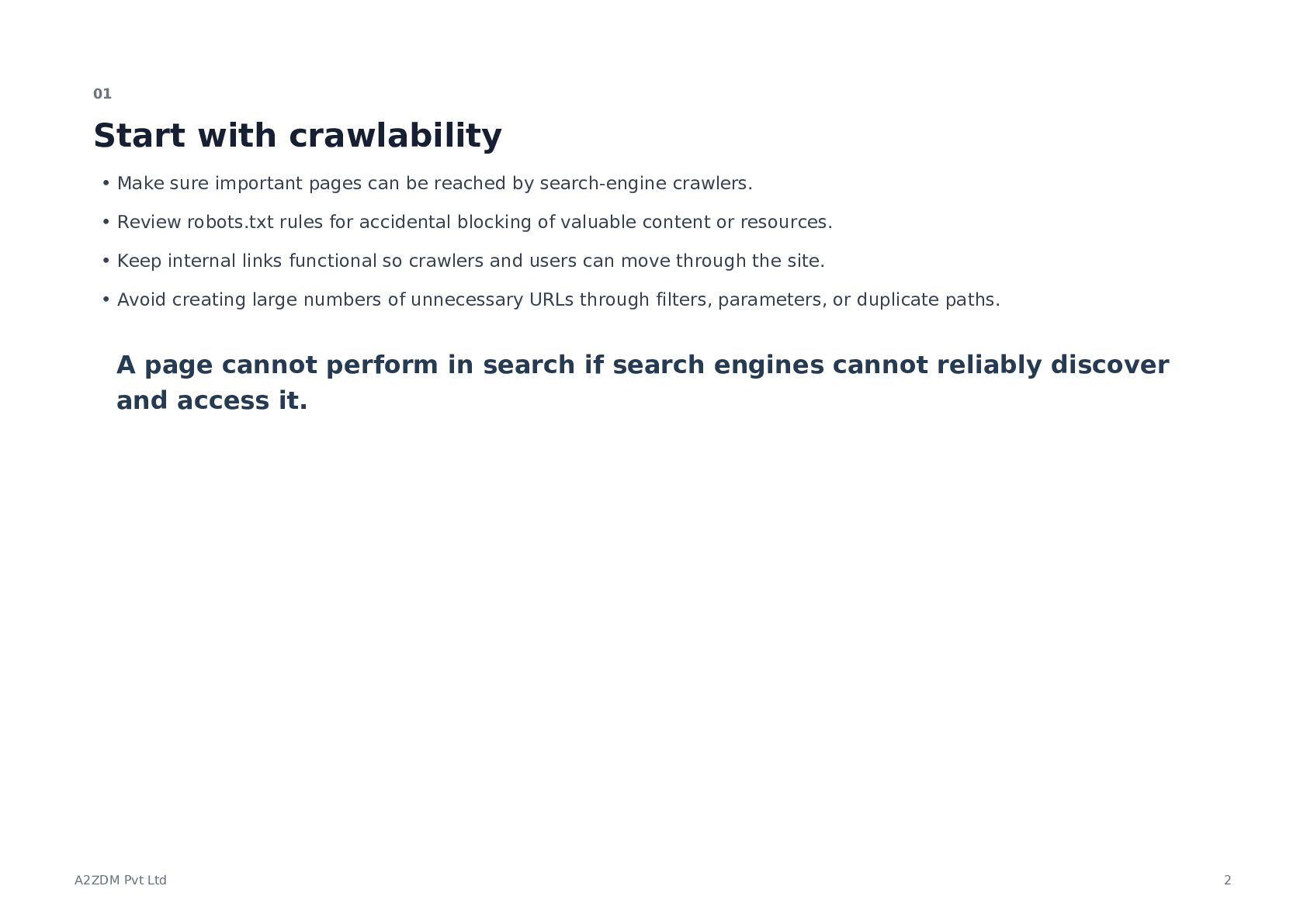
01 Start with crawlability • Make sure important pages can
be reached by search-engine crawlers. • Review robots.txt rules for accidental blocking of valuable content or resources. • Keep internal links functional so crawlers and users can move through the site. • Avoid creating large numbers of unnecessary URLs through filters, parameters, or duplicate paths. A page cannot perform in search if search engines cannot reliably discover and access it. A2ZDM Pvt Ltd 2 -
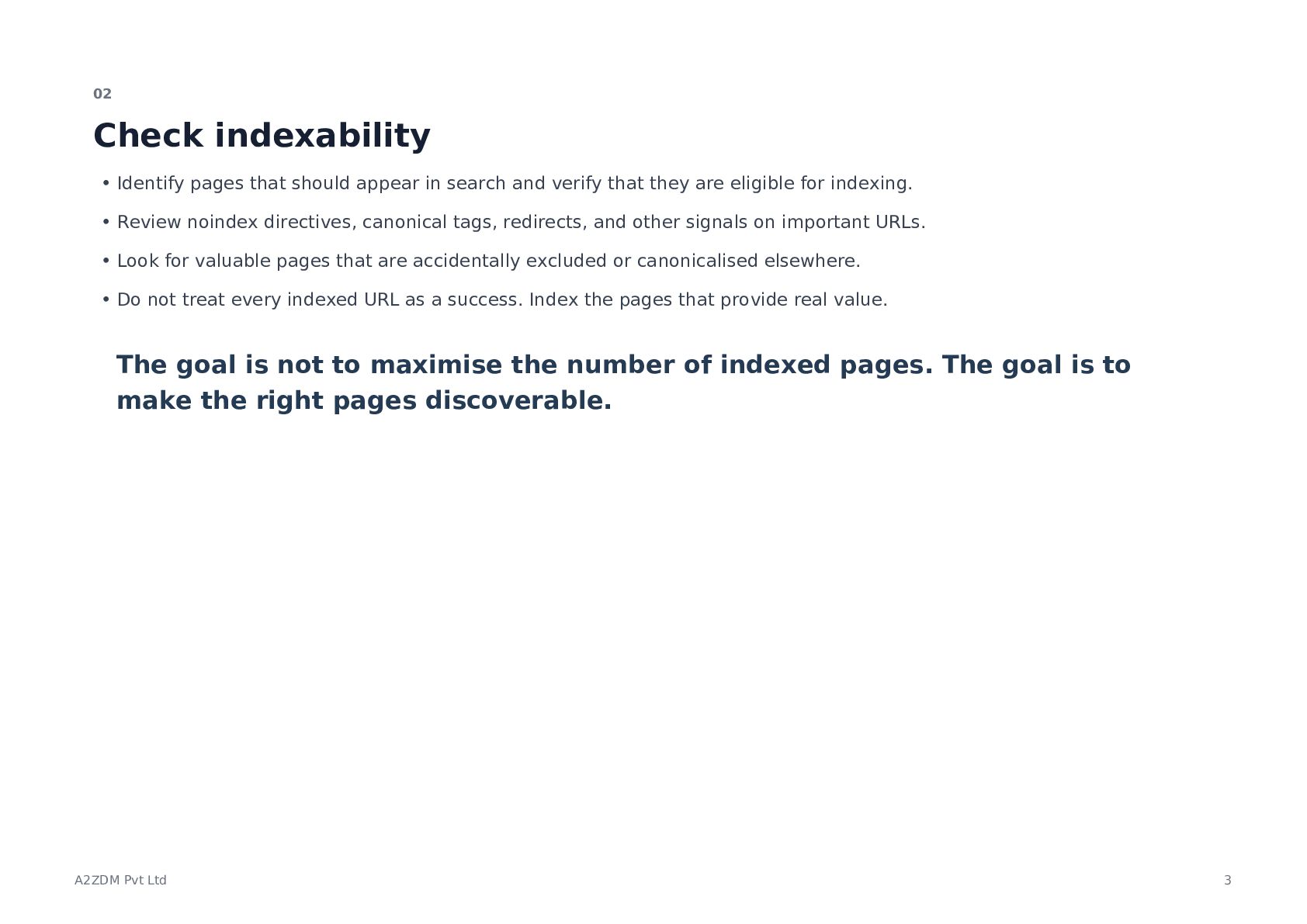
02 Check indexability • Identify pages that should appear in
search and verify that they are eligible for indexing. • Review noindex directives, canonical tags, redirects, and other signals on important URLs. • Look for valuable pages that are accidentally excluded or canonicalised elsewhere. • Do not treat every indexed URL as a success. Index the pages that provide real value. The goal is not to maximise the number of indexed pages. The goal is to make the right pages discoverable. A2ZDM Pvt Ltd 3 -
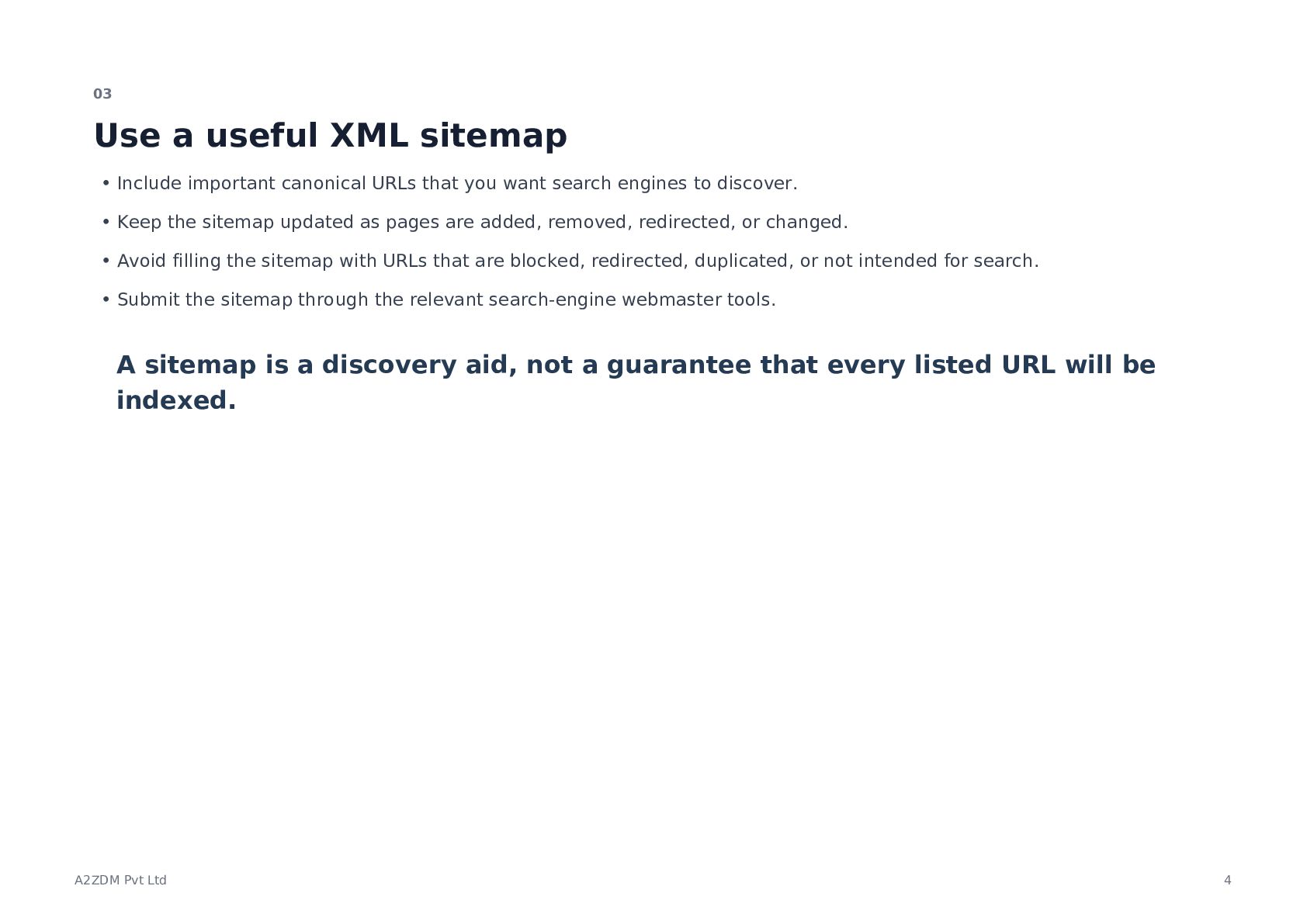
03 Use a useful XML sitemap • Include important canonical
URLs that you want search engines to discover. • Keep the sitemap updated as pages are added, removed, redirected, or changed. • Avoid filling the sitemap with URLs that are blocked, redirected, duplicated, or not intended for search. • Submit the sitemap through the relevant search-engine webmaster tools. A sitemap is a discovery aid, not a guarantee that every listed URL will be indexed. A2ZDM Pvt Ltd 4 -
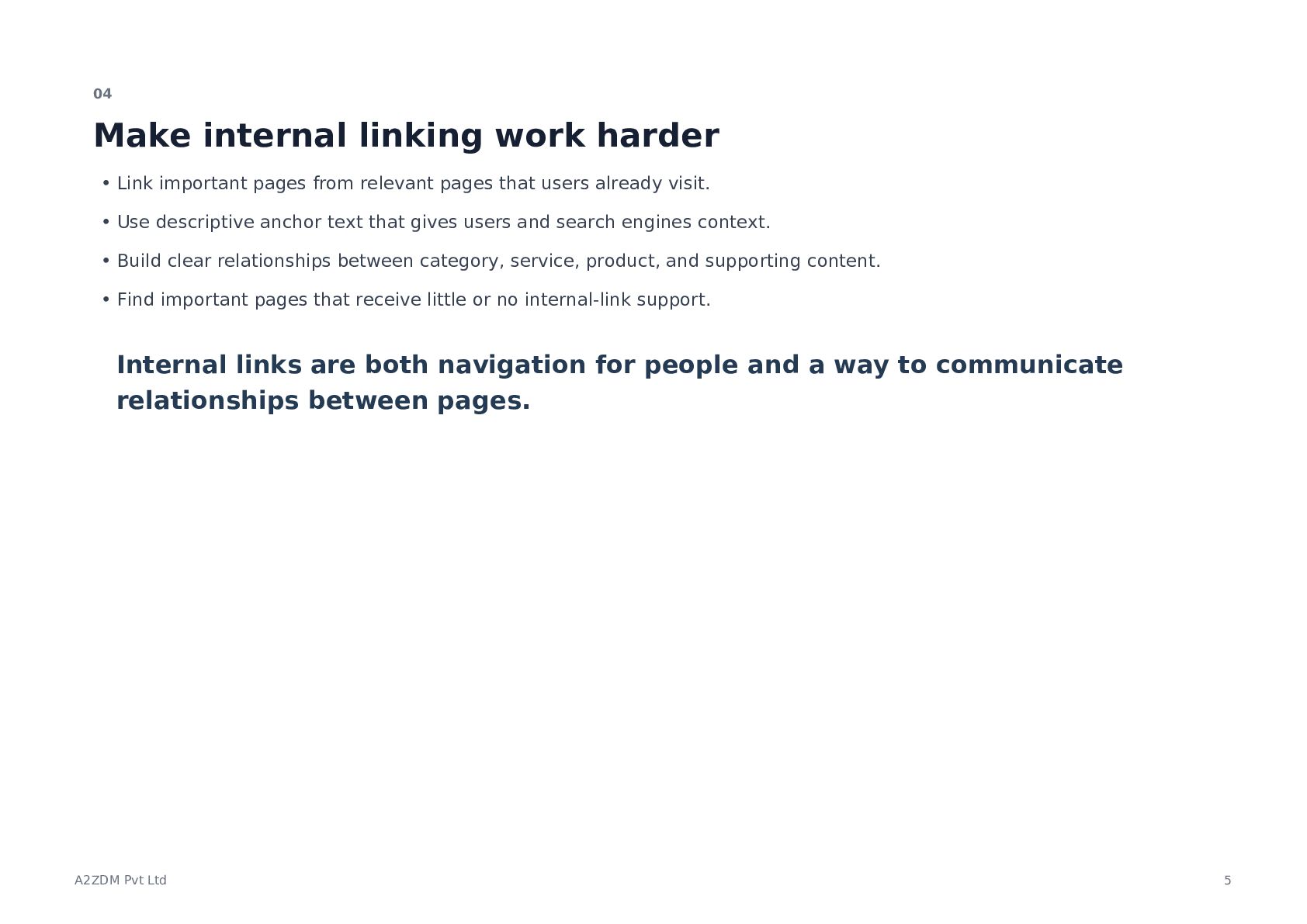
04 Make internal linking work harder • Link important pages
from relevant pages that users already visit. • Use descriptive anchor text that gives users and search engines context. • Build clear relationships between category, service, product, and supporting content. • Find important pages that receive little or no internal-link support. Internal links are both navigation for people and a way to communicate relationships between pages. A2ZDM Pvt Ltd 5 -
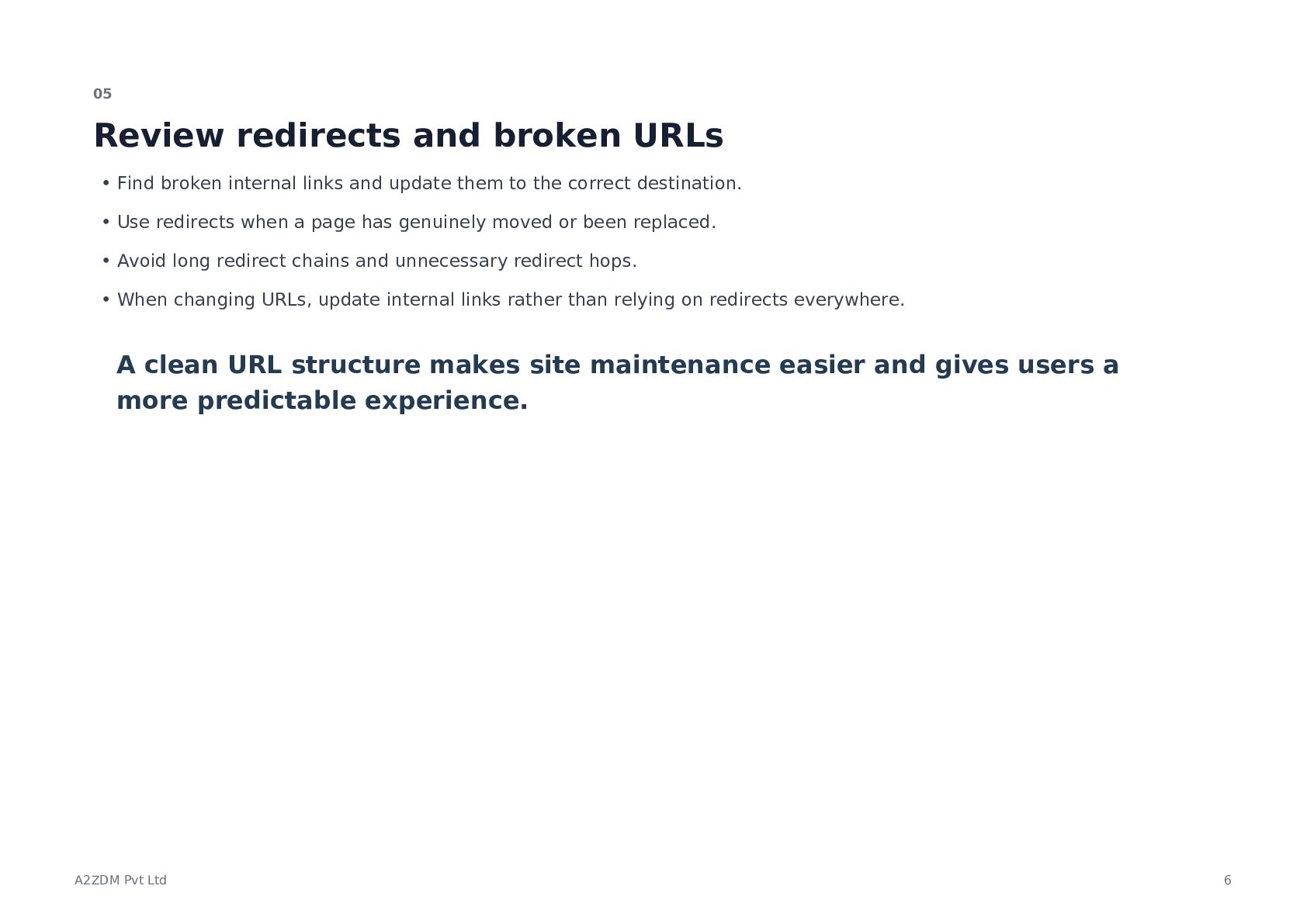
05 Review redirects and broken URLs • Find broken internal
links and update them to the correct destination. • Use redirects when a page has genuinely moved or been replaced. • Avoid long redirect chains and unnecessary redirect hops. • When changing URLs, update internal links rather than relying on redirects everywhere. A clean URL structure makes site maintenance easier and gives users a more predictable experience. A2ZDM Pvt Ltd 6 -
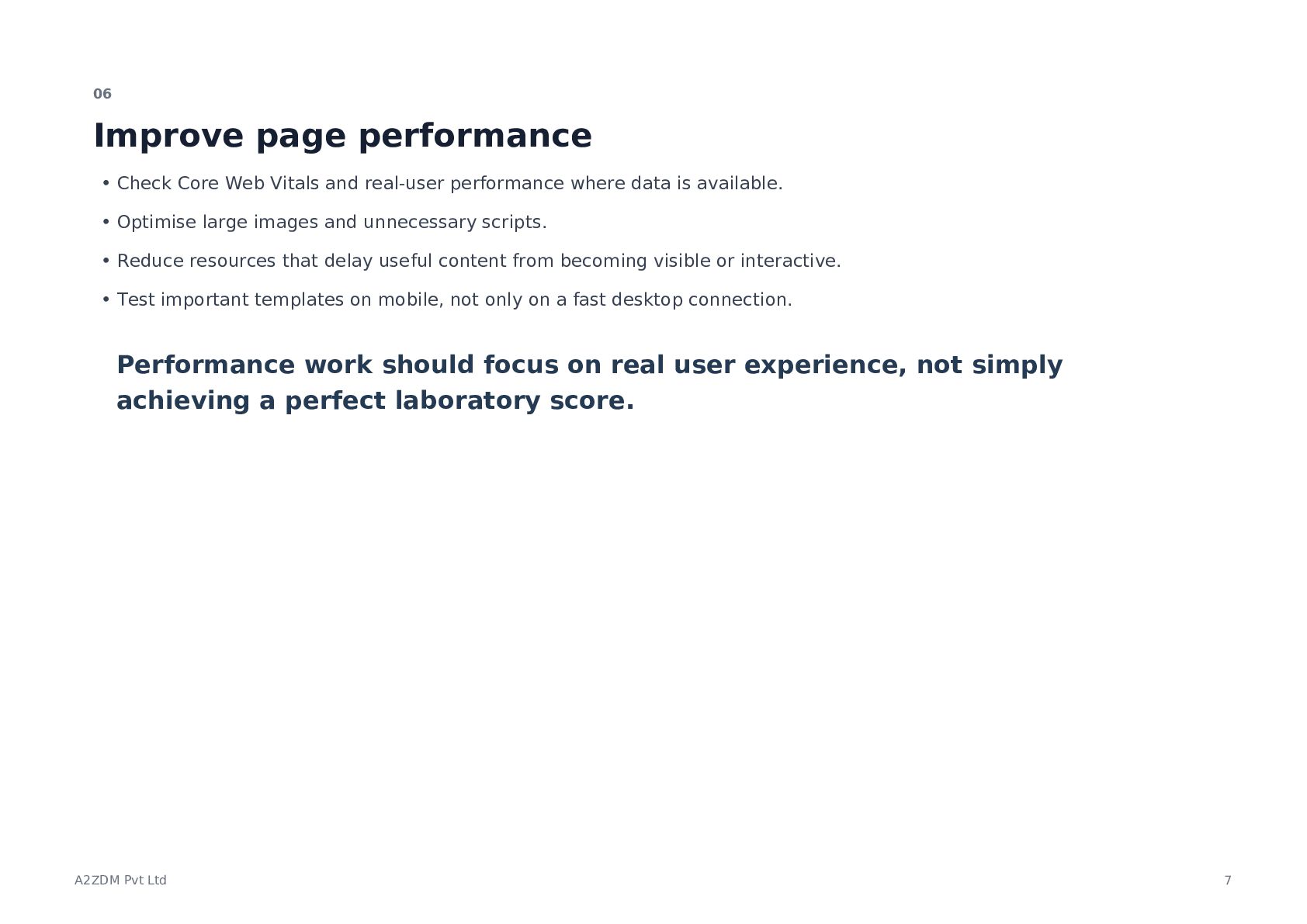
06 Improve page performance • Check Core Web Vitals and
real-user performance where data is available. • Optimise large images and unnecessary scripts. • Reduce resources that delay useful content from becoming visible or interactive. • Test important templates on mobile, not only on a fast desktop connection. Performance work should focus on real user experience, not simply achieving a perfect laboratory score. A2ZDM Pvt Ltd 7 -
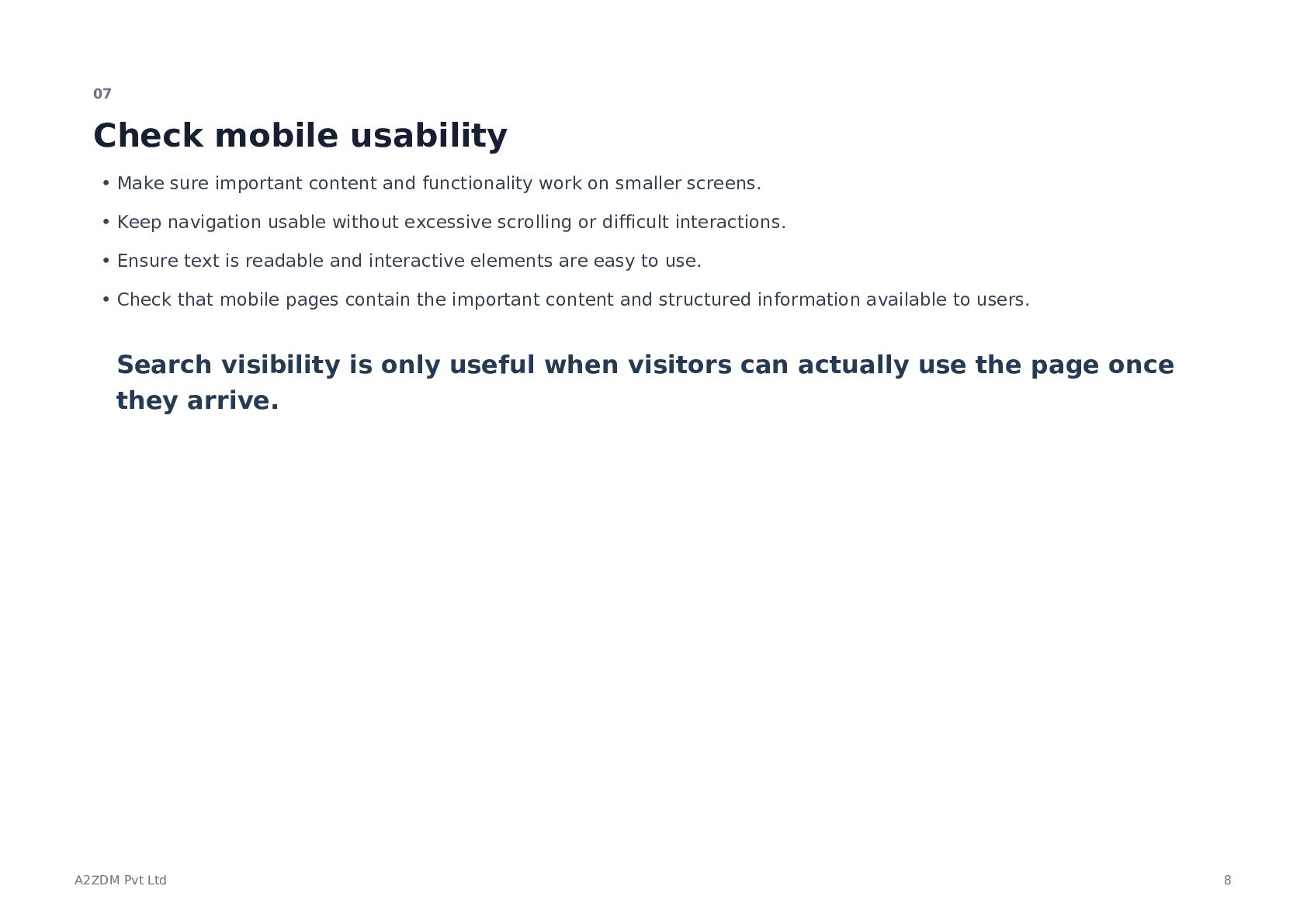
07 Check mobile usability • Make sure important content and
functionality work on smaller screens. • Keep navigation usable without excessive scrolling or difficult interactions. • Ensure text is readable and interactive elements are easy to use. • Check that mobile pages contain the important content and structured information available to users. Search visibility is only useful when visitors can actually use the page once they arrive. A2ZDM Pvt Ltd 8 -
08 Manage duplicate content carefully • Identify substantially similar URLs
created by parameters, filters, archives, or alternative paths. • Use canonicalisation where appropriate and consistent. • Avoid publishing multiple pages that exist only to target tiny keyword variations. • When duplicate pages serve different users, make the distinction meaningful rather than cosmetic. Technical SEO and content strategy overlap here: a cleaner site usually makes it easier to decide which pages deserve attention. A2ZDM Pvt Ltd 9 -
09 Use structured data when it adds meaning • Implement
structured data that accurately describes the page and its visible content. • Follow the search engine's documentation for the relevant structured-data type. • Do not add markup simply to create more code or because a competitor has it. • Validate implementation and monitor for errors after deployment. Structured data should describe what is actually on the page. It is not a shortcut to better rankings. A2ZDM Pvt Ltd 10 -
10 Audit the site with Search Console • Review indexing
reports for excluded or problematic URLs. • Check page indexing and inspect important URLs when investigating visibility issues. • Review Core Web Vitals and HTTPS-related issues. • Use performance data to connect technical changes with changes in search visibility. Search Console is especially useful when technical SEO decisions need to be tied back to actual search visibility. A2ZDM Pvt Ltd 11 -
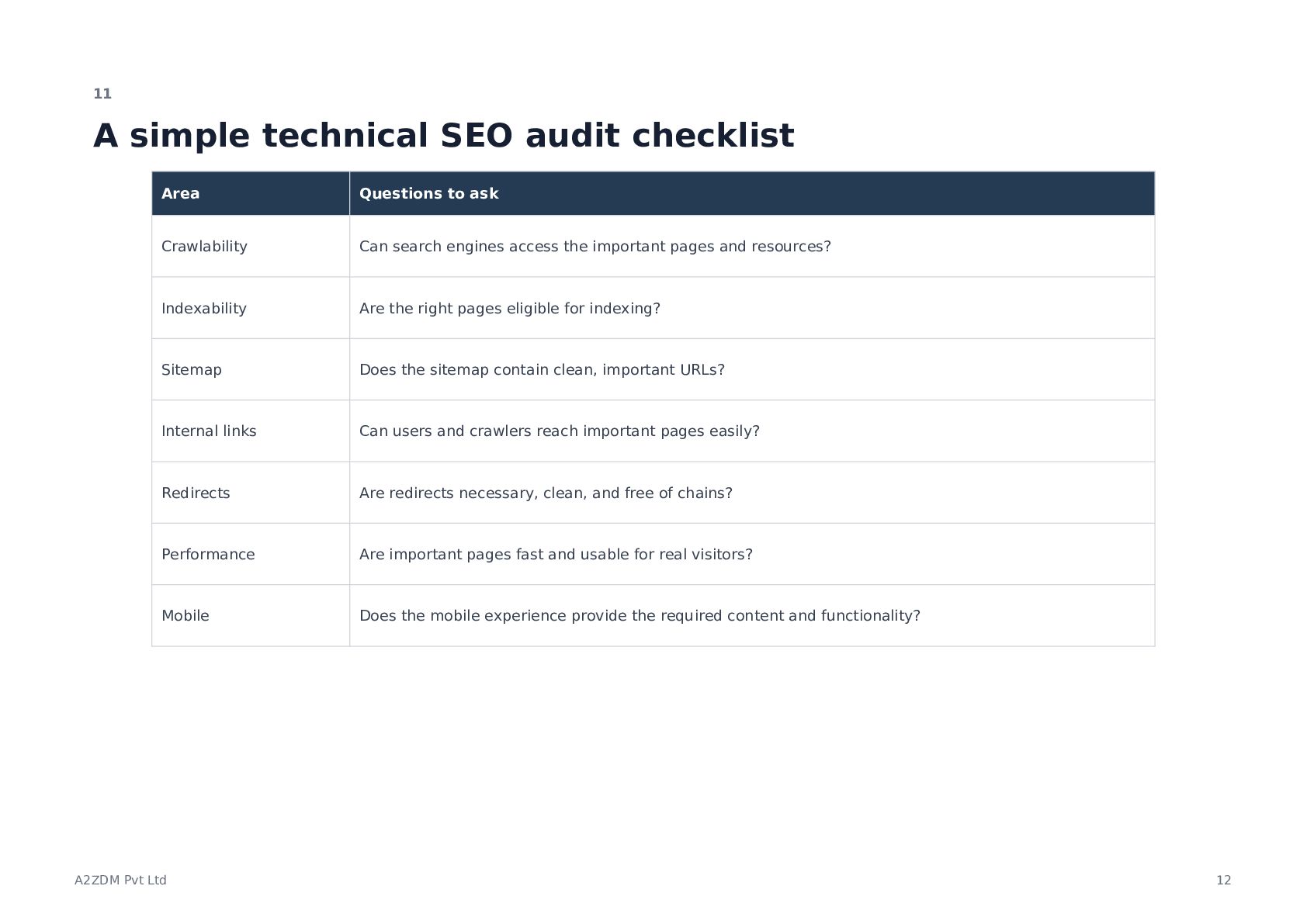
11 A simple technical SEO audit checklist Area Questions to
ask Crawlability Can search engines access the important pages and resources? Indexability Are the right pages eligible for indexing? Sitemap Does the sitemap contain clean, important URLs? Internal links Can users and crawlers reach important pages easily? Redirects Are redirects necessary, clean, and free of chains? Performance Are important pages fast and usable for real visitors? Mobile Does the mobile experience provide the required content and functionality? A2ZDM Pvt Ltd 12 -
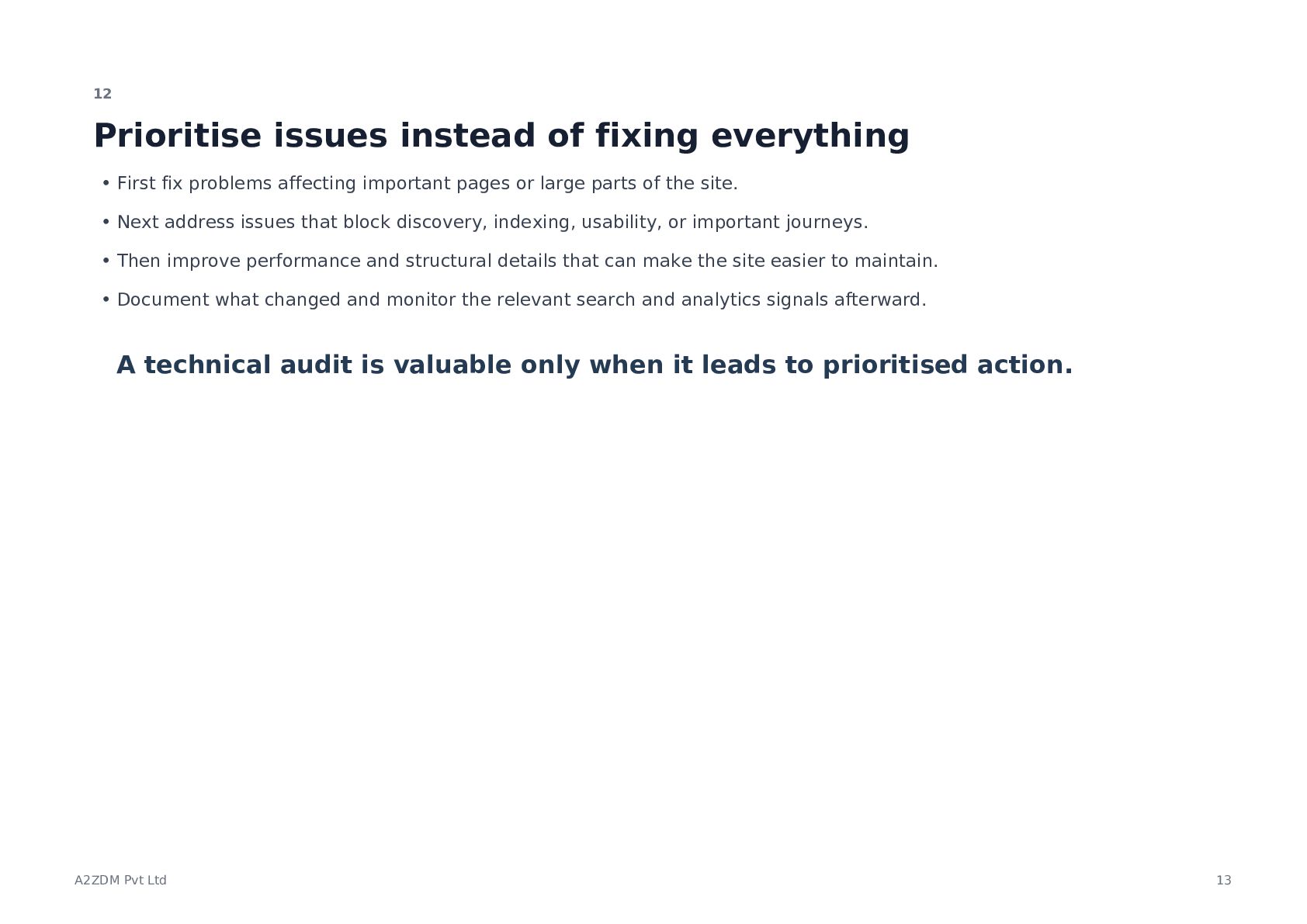
12 Prioritise issues instead of fixing everything • First fix
problems affecting important pages or large parts of the site. • Next address issues that block discovery, indexing, usability, or important journeys. • Then improve performance and structural details that can make the site easier to maintain. • Document what changed and monitor the relevant search and analytics signals afterward. A technical audit is valuable only when it leads to prioritised action. A2ZDM Pvt Ltd 13 -
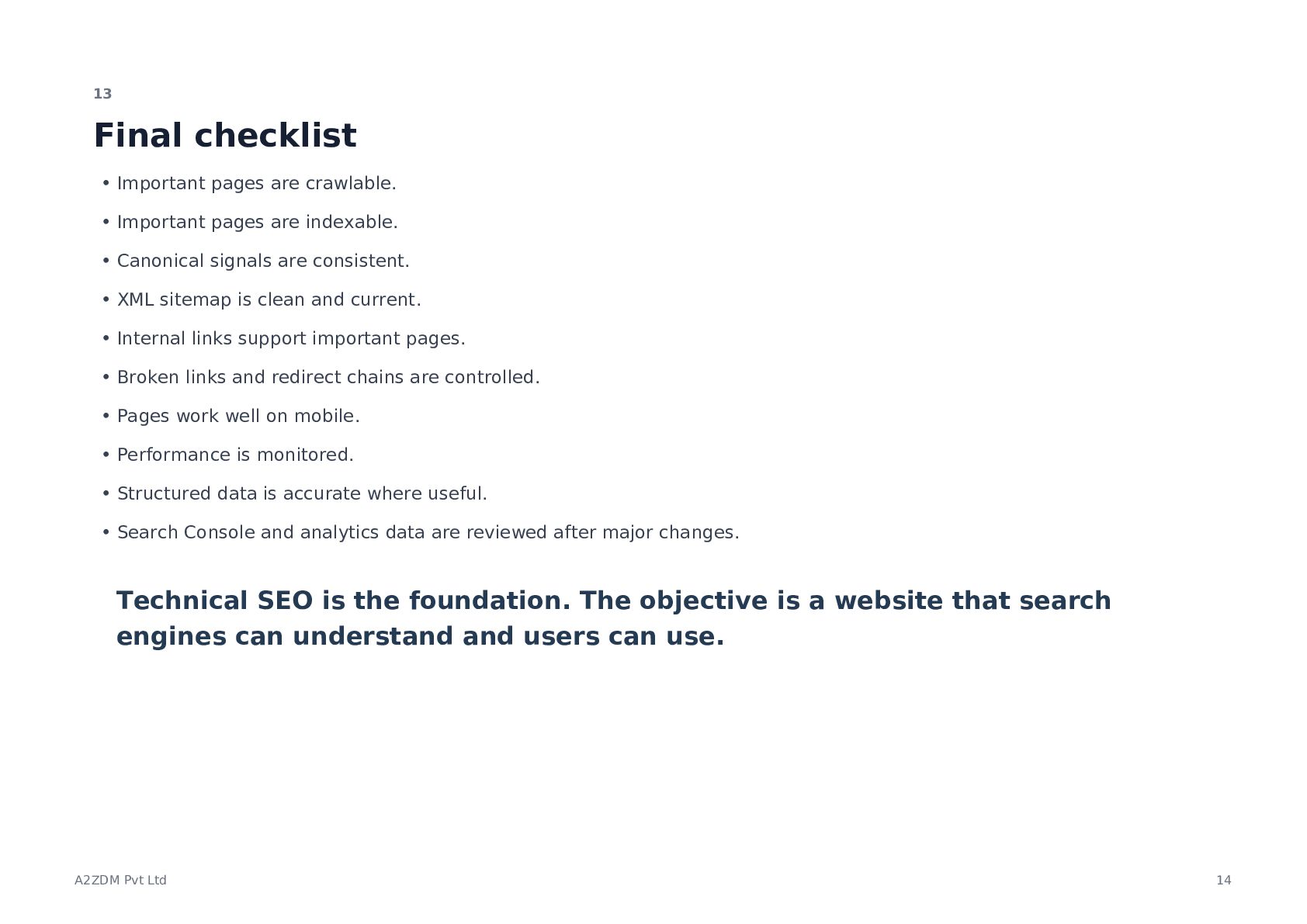
13 Final checklist • Important pages are crawlable. • Important
pages are indexable. • Canonical signals are consistent. • XML sitemap is clean and current. • Internal links support important pages. • Broken links and redirect chains are controlled. • Pages work well on mobile. • Performance is monitored. • Structured data is accurate where useful. • Search Console and analytics data are reviewed after major changes. Technical SEO is the foundation. The objective is a website that search engines can understand and users can use. A2ZDM Pvt Ltd 14 -
About A2ZDM A2ZDM Pvt Ltd provides SEO, web analytics, performance
marketing and digital marketing solutions for businesses. Learn more: https://a2zdm.com/ This presentation is intended as a practical technical SEO checklist. Always validate implementation against current search-engine documentation and the specific website's requirements. A2ZDM Pvt Ltd 15