Upgrade to Pro — share decks privately, control downloads, hide ads and more …

The Tactical Guide to Optimising for Google Dis...

Sponsored · SiteGround - Reliable hosting with speed, security, and support you can count on.

The Tactical Guide to Optimising for Google Discover

Slides from my talk at the Belgrade SEO Conference where I spoke about optimising for Google Discover. I cover the technical optimisations necessary for optimal performance, and how you can maximise your content's visibility in the Discover feed.

Avatar for Barry Adams

Barry Adams

September 18, 2026

More Decks by Barry Adams

Other Decks in Marketing & SEO

Transcript

  1. Barry Adams ➢ Active in SEO since 1998 ➢ Specialist

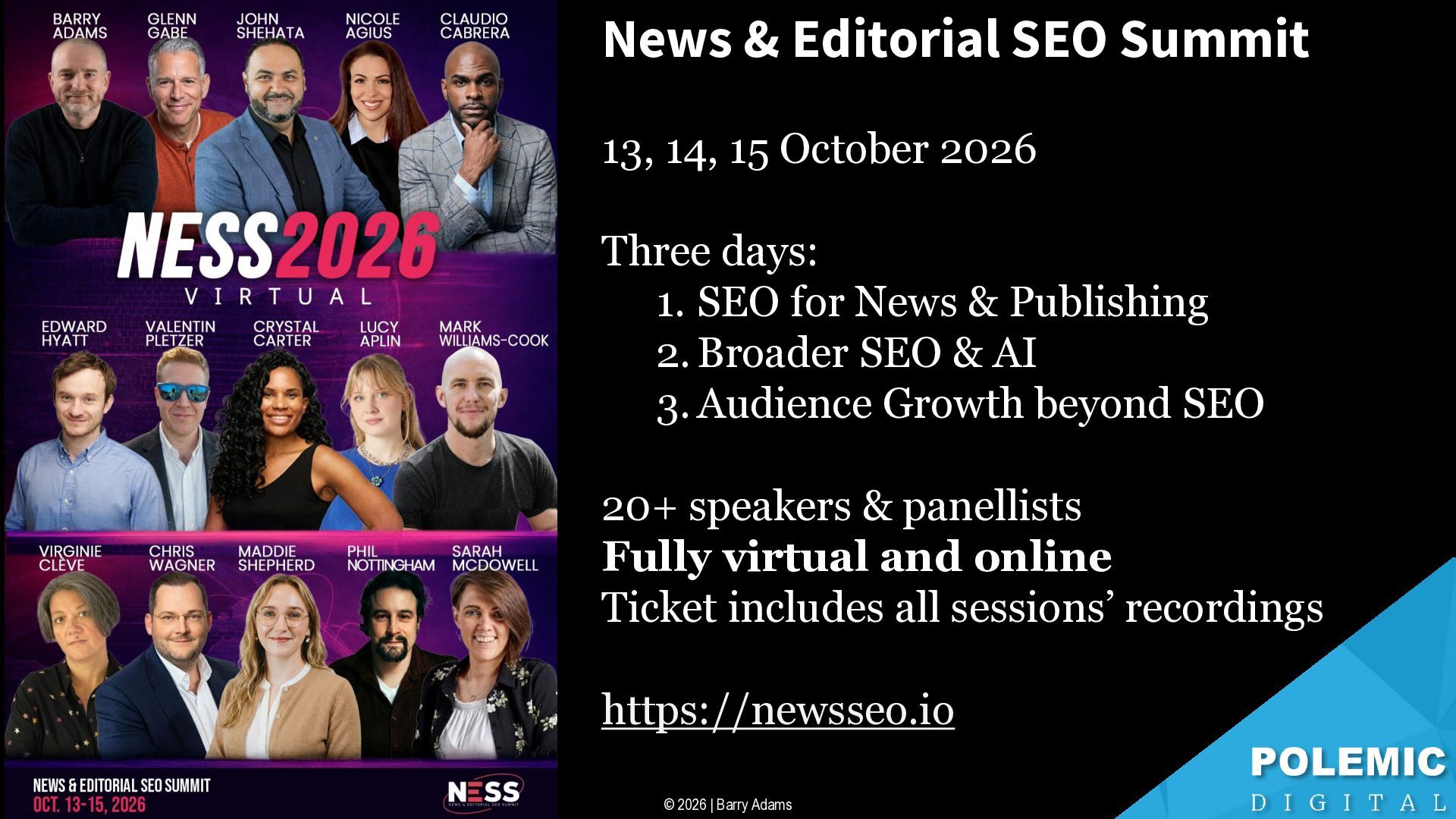
    in SEO for news & publishing ➢ Newsletter: SEOforGoogleNews.com ➢ Co-founder: News & Editorial SEO Summit © 2026 | Barry Adams
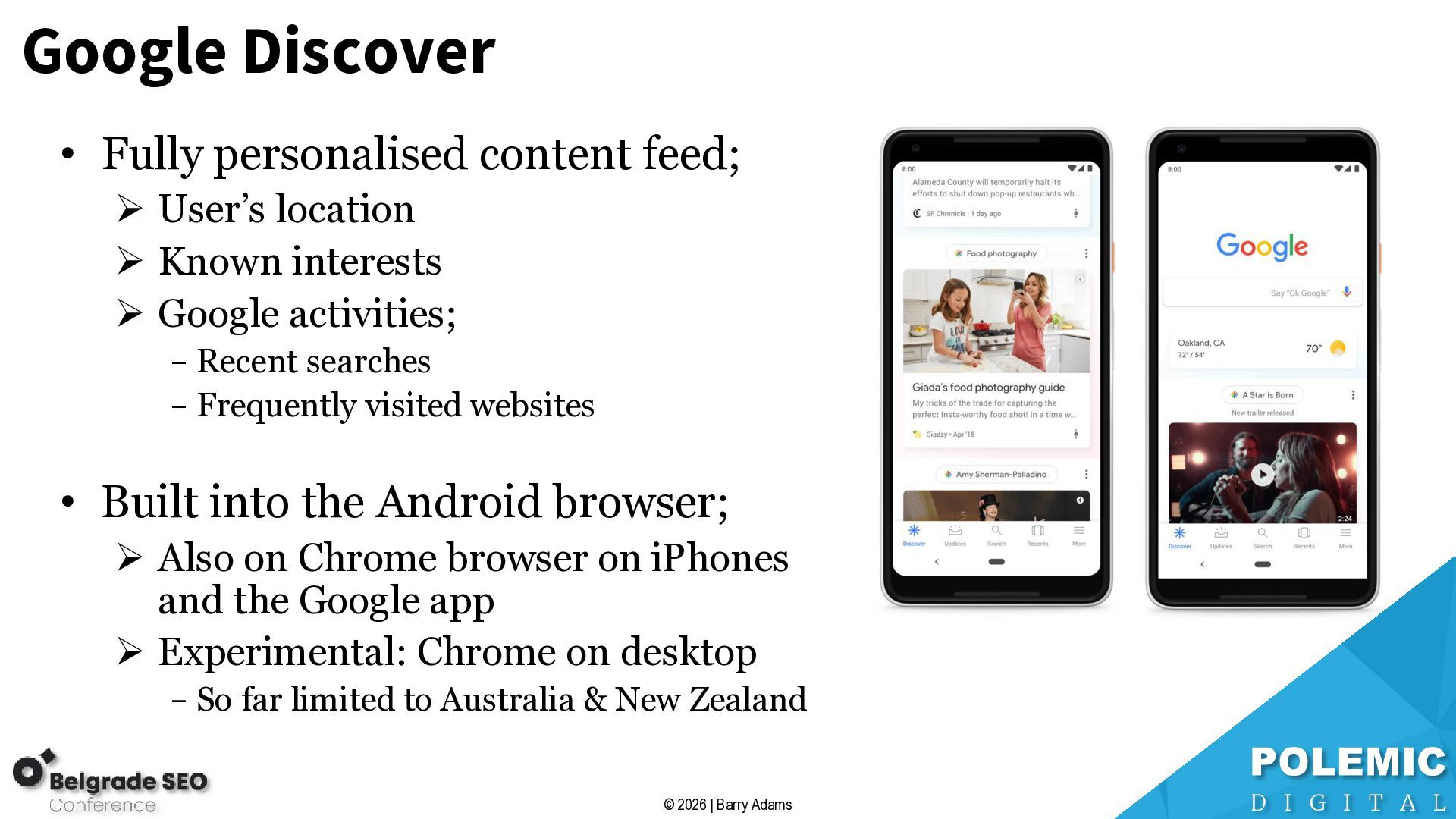
  2. Google Discover • Fully personalised content feed; ➢ User’s location

    ➢ Known interests ➢ Google activities; - Recent searches - Frequently visited websites • Built into the Android browser; ➢ Also on Chrome browser on iPhones and the Google app ➢ Experimental: Chrome on desktop - So far limited to Australia & New Zealand © 2026 | Barry Adams
  3. Optimise for fast crawling • Minimise crawl waste; ➢ Google

    has a predetermined crawl budget for every hostname ➢ Most, if not all, crawlable URLs should be indexable webpages and page resources ➢ Minimise crawl effort wasted on unindexable URLs © 2026 | Barry Adams
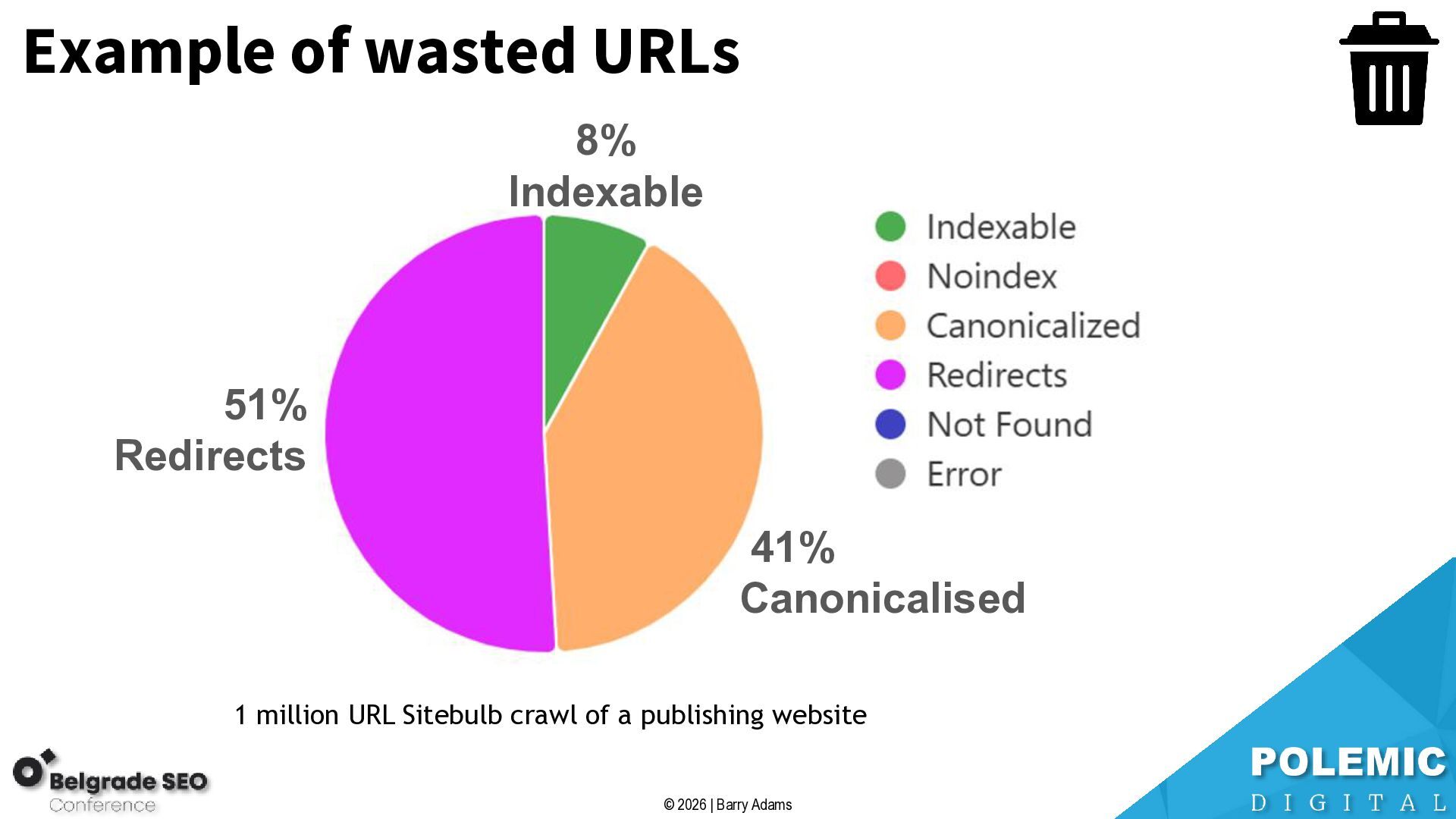
  4. Example of wasted URLs 8% Indexable 51% Redirects 41% Canonicalised

    1 million URL Sitebulb crawl of a publishing website © 2026 | Barry Adams
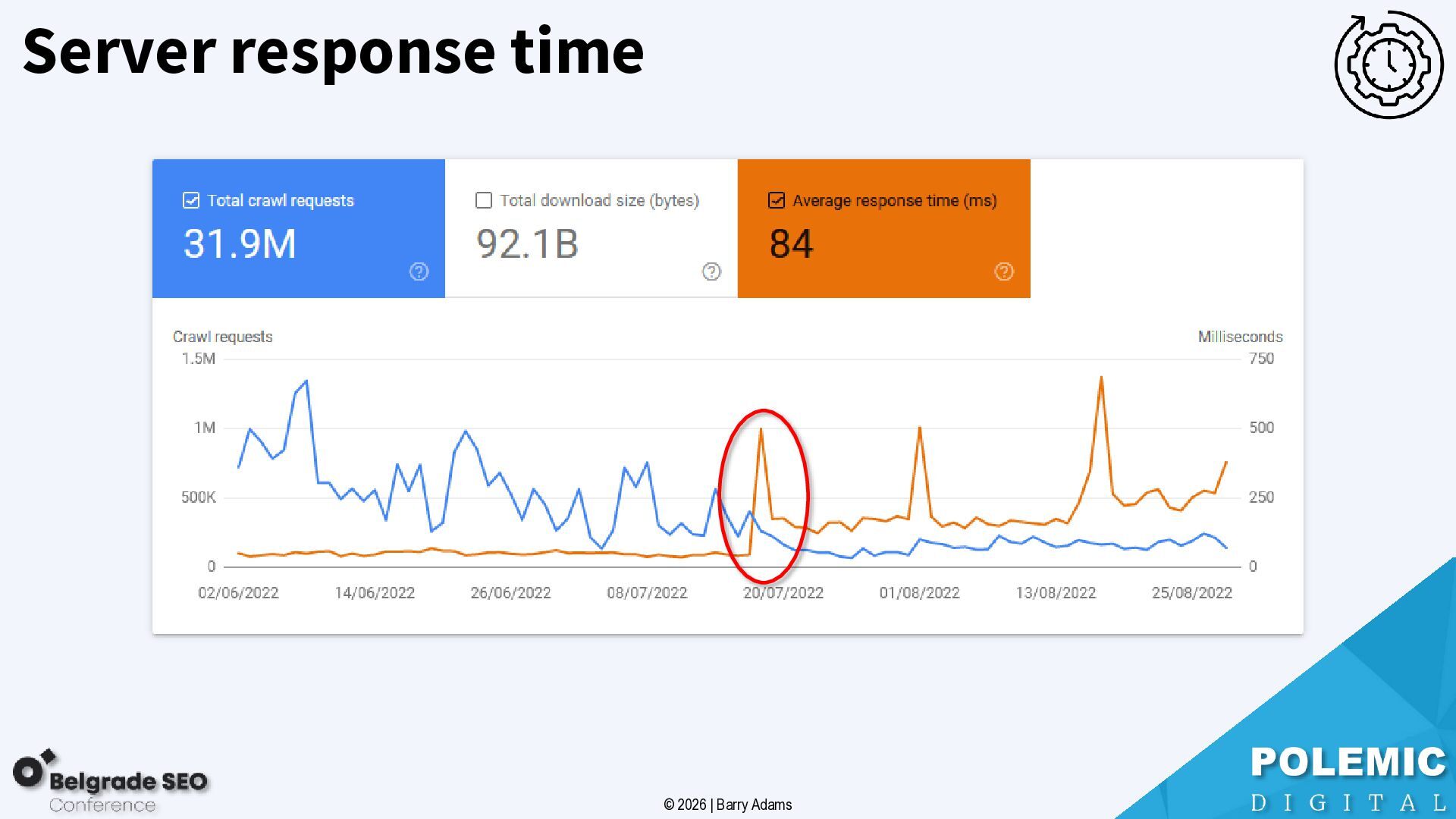
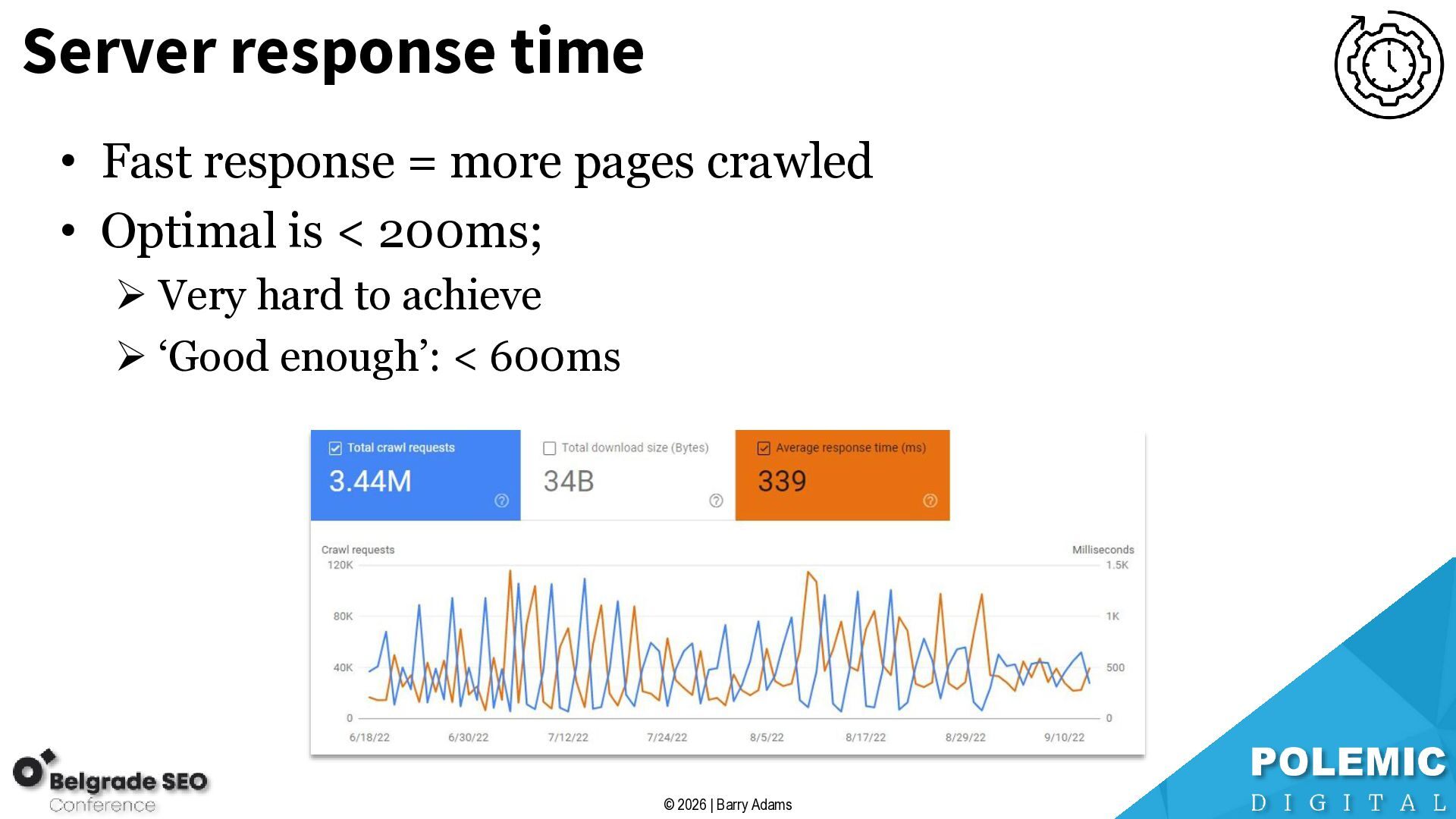
  5. Server response time • Fast response = more pages crawled

    • Optimal is < 200ms; ➢ Very hard to achieve ➢ ‘Good enough’: < 600ms © 2026 | Barry Adams
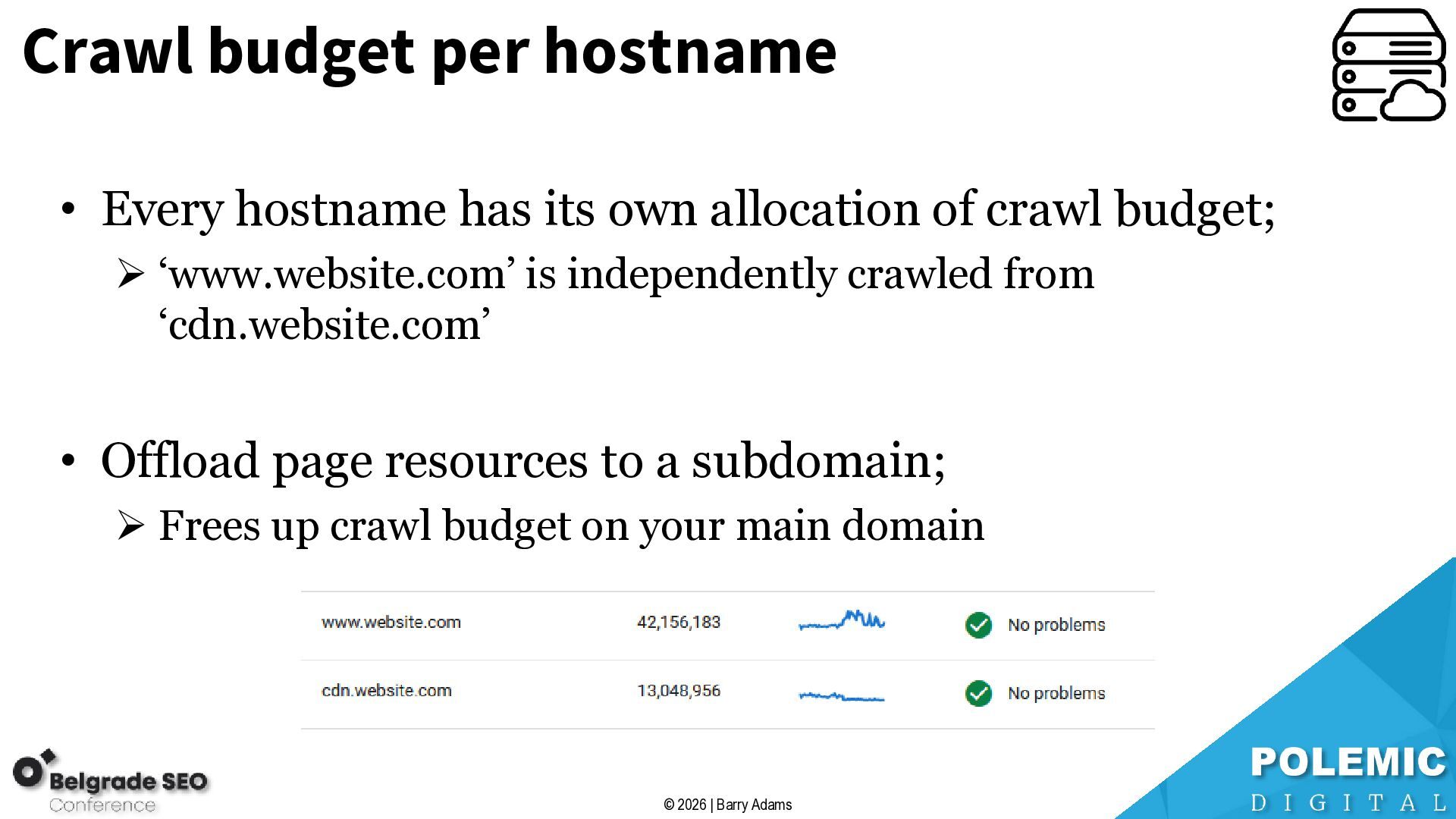
  6. Crawl budget per hostname • Every hostname has its own

    allocation of crawl budget; ➢ ‘www.website.com’ is independently crawled from ‘cdn.website.com’ • Offload page resources to a subdomain; ➢ Frees up crawl budget on your main domain © 2026 | Barry Adams
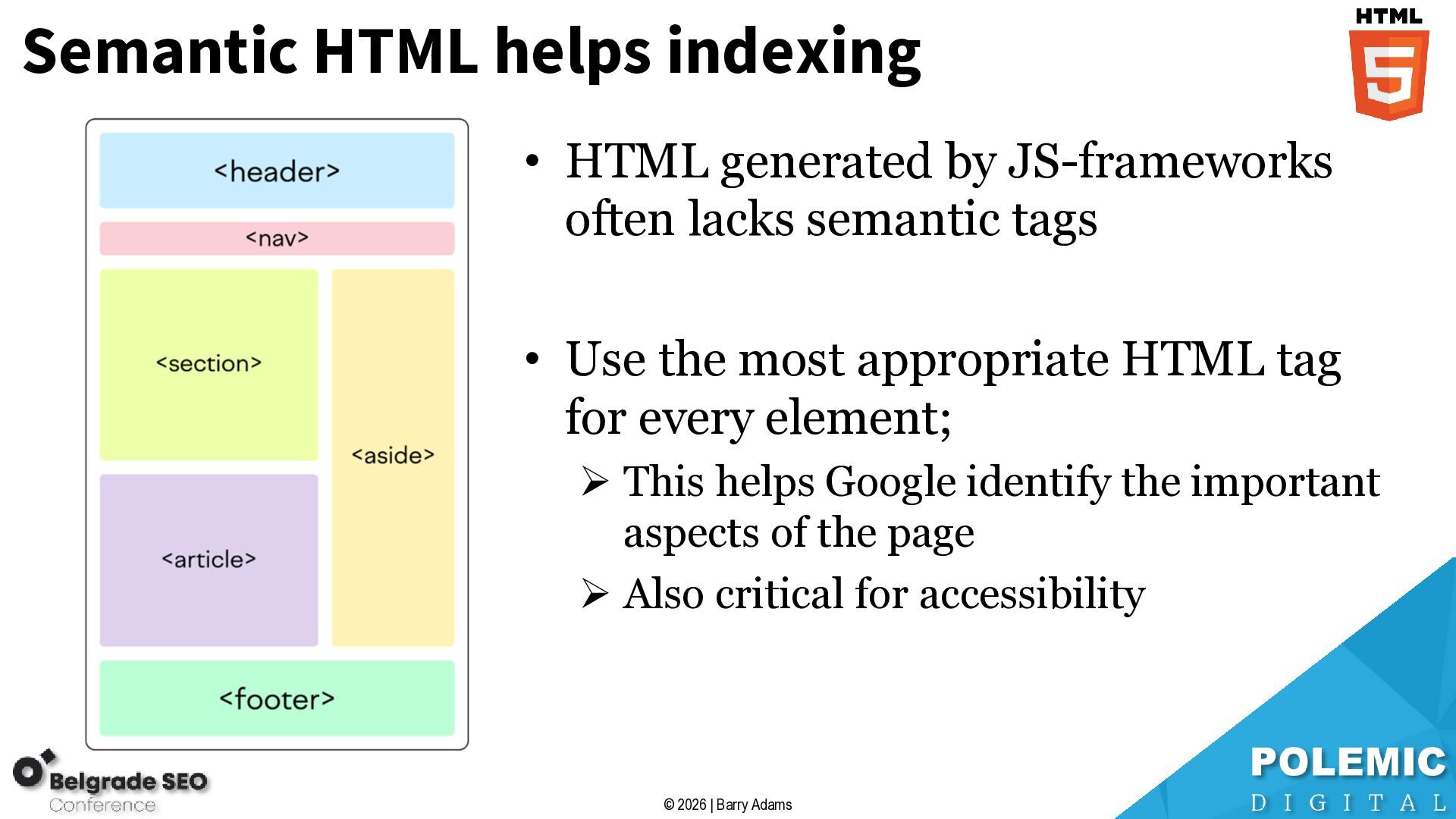
  7. Semantic HTML helps indexing • HTML generated by JS-frameworks often

    lacks semantic tags • Use the most appropriate HTML tag for every element; ➢ This helps Google identify the important aspects of the page ➢ Also critical for accessibility © 2026 | Barry Adams
  8. Structured data • Standard articles: • Live articles: Article /

    NewsArticle LiveBlogPosting • Reviews: Review • Author pages: Person / ProfilePage • Homepage: (NewsMedia)Organization • Others: FactCheck / FAQ / Event / Q&A / … © 2026 | Barry Adams
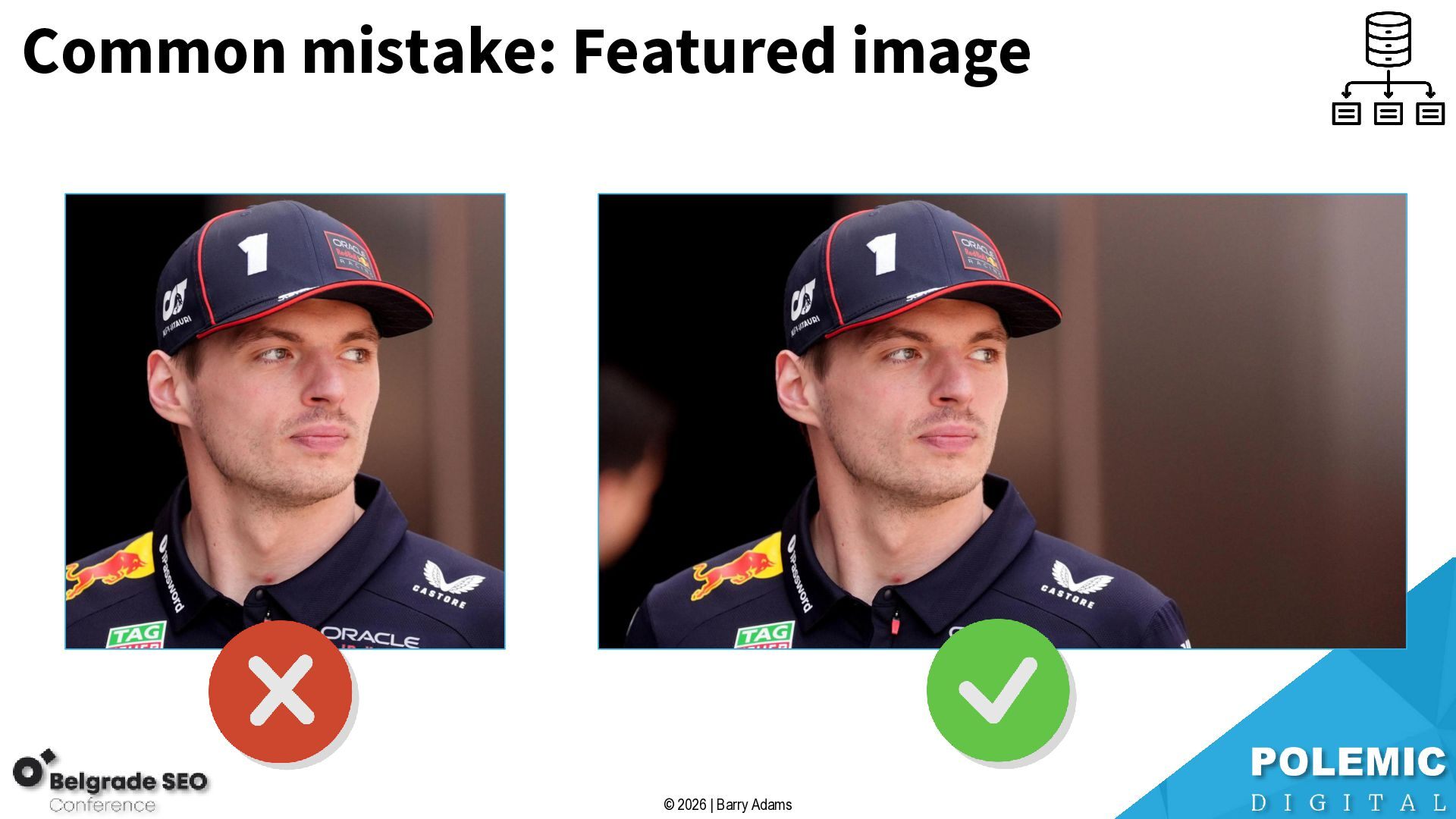
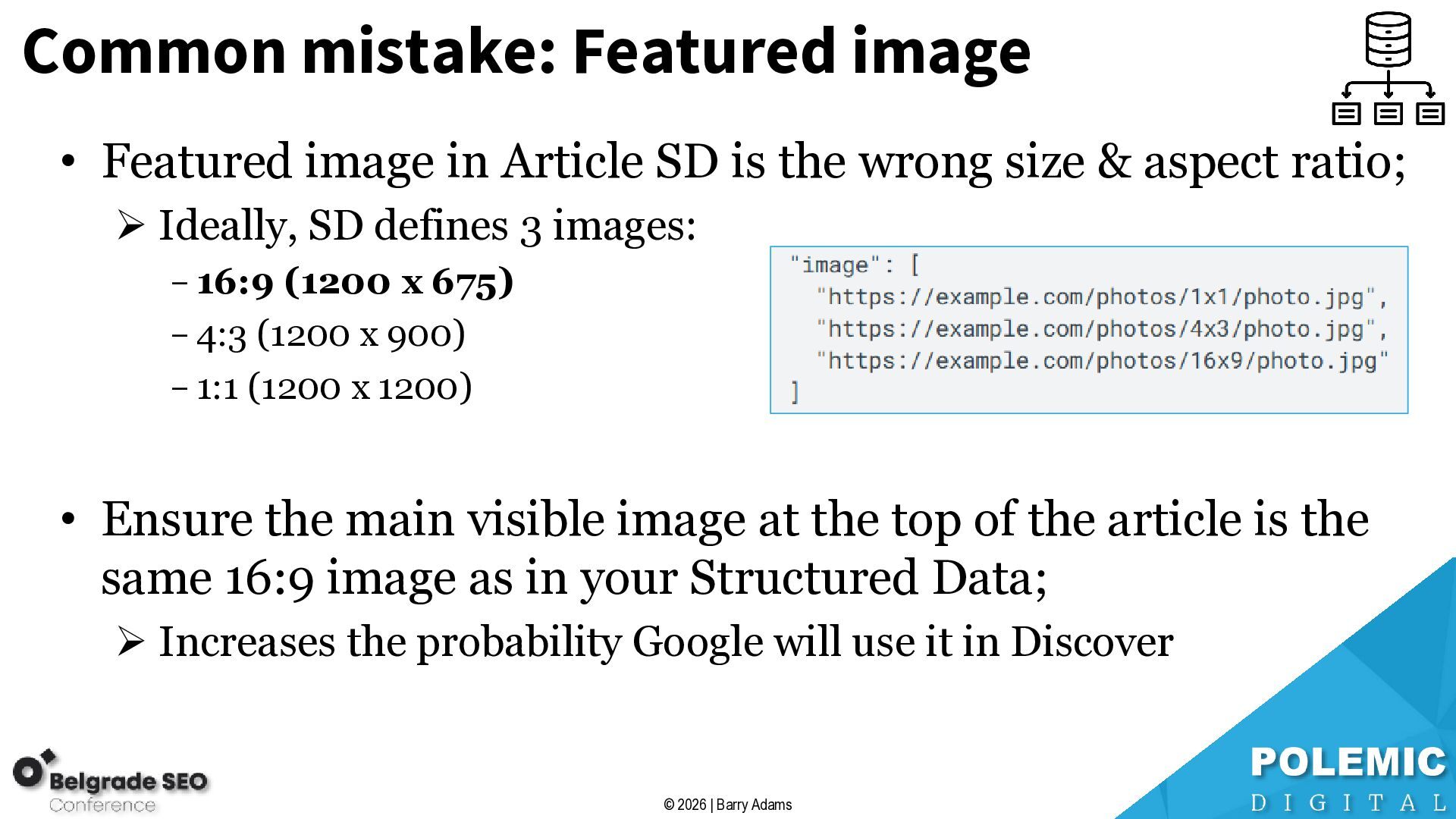
  9. Common mistake: Featured image • Featured image in Article SD

    is the wrong size & aspect ratio; ➢ Ideally, SD defines 3 images: - 16:9 (1200 x 675) - 4:3 (1200 x 900) - 1:1 (1200 x 1200) • Ensure the main visible image at the top of the article is the same 16:9 image as in your Structured Data; ➢ Increases the probability Google will use it in Discover © 2026 | Barry Adams
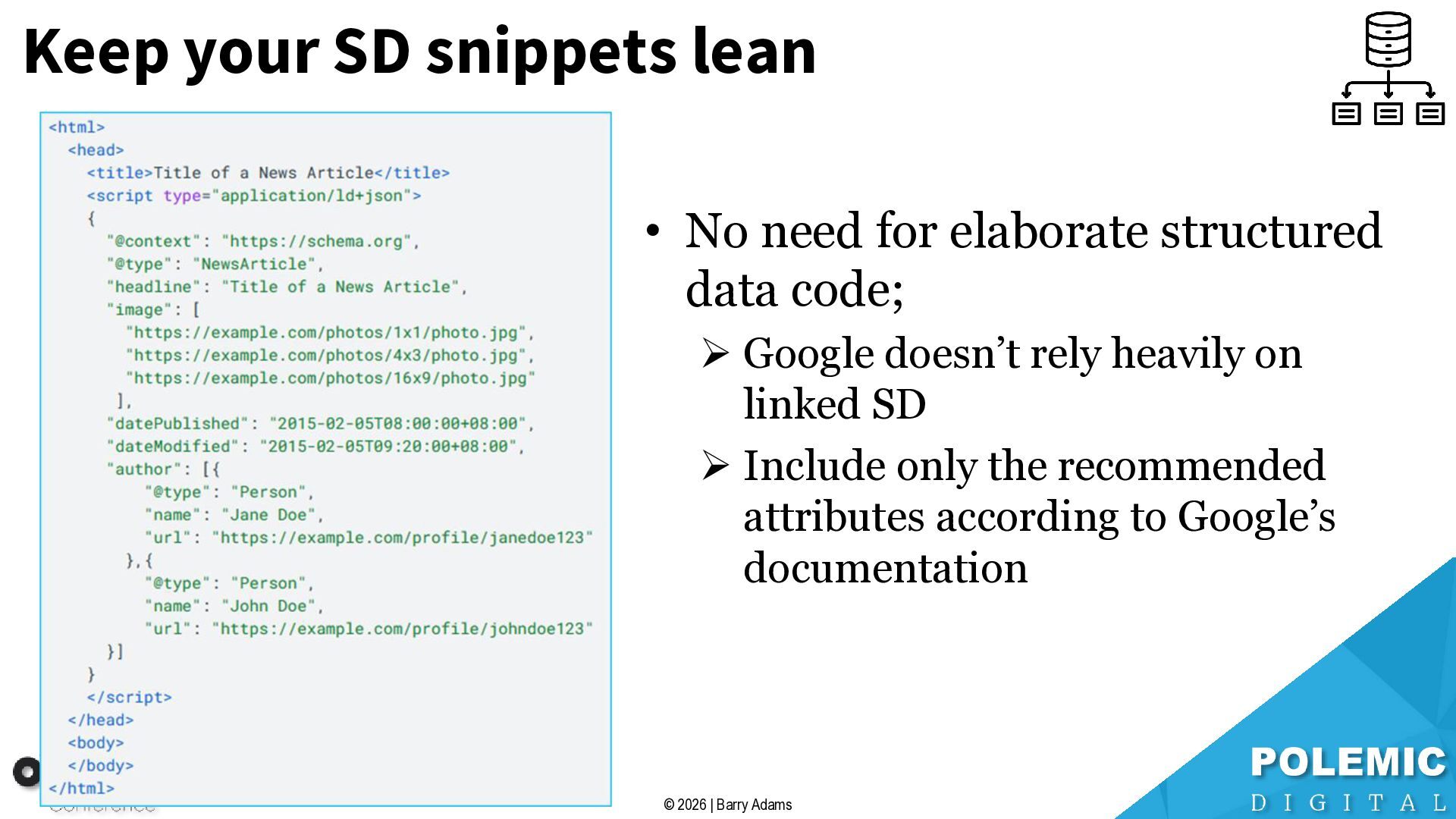
  10. Keep your SD snippets lean • No need for elaborate

    structured data code; ➢ Google doesn’t rely heavily on linked SD ➢ Include only the recommended attributes according to Google’s documentation © 2026 | Barry Adams
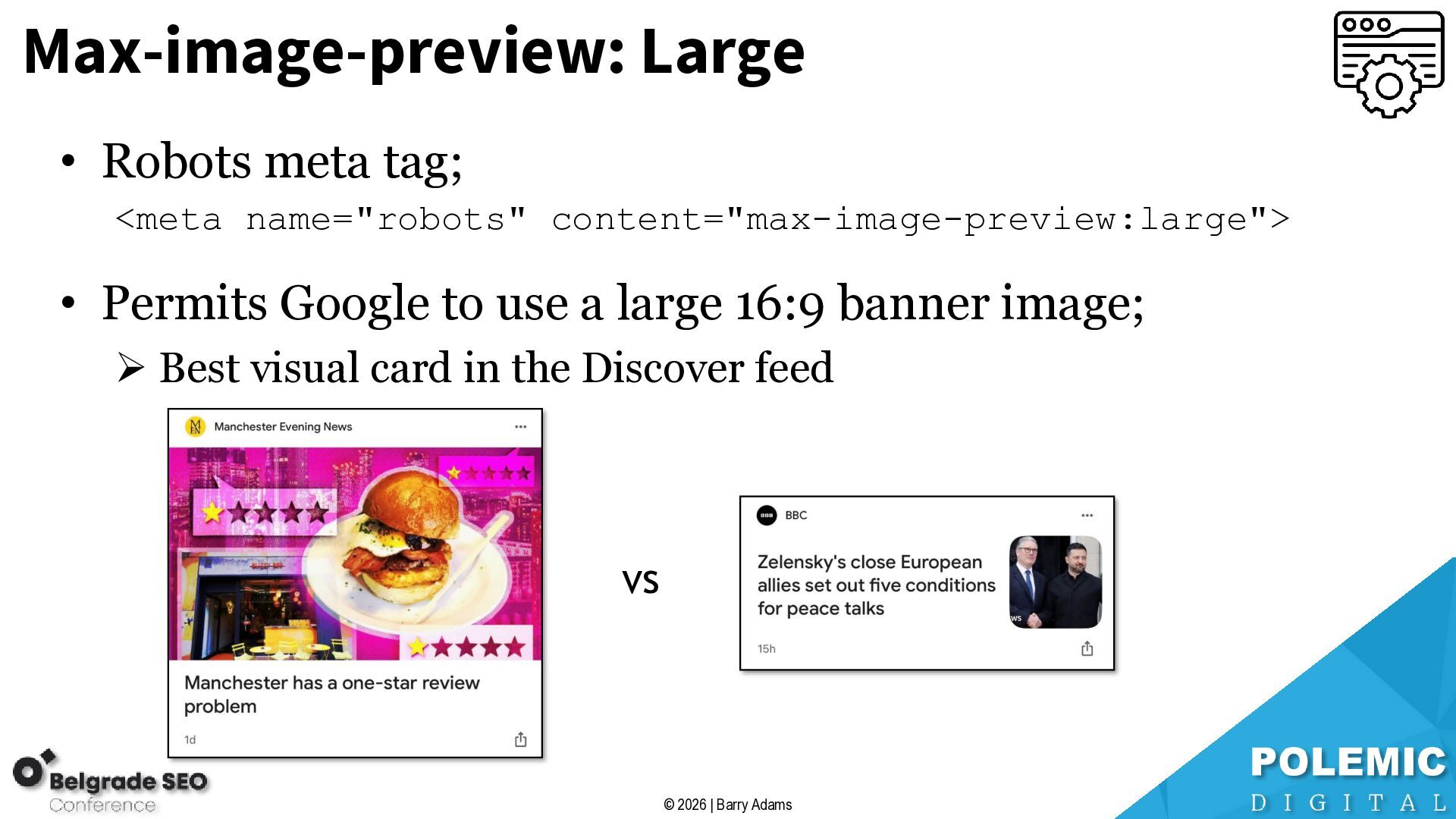
  11. Max-image-preview: Large • Robots meta tag; <meta name="robots" content="max-image-preview:large"> •

    Permits Google to use a large 16:9 banner image; ➢ Best visual card in the Discover feed vs © 2026 | Barry Adams
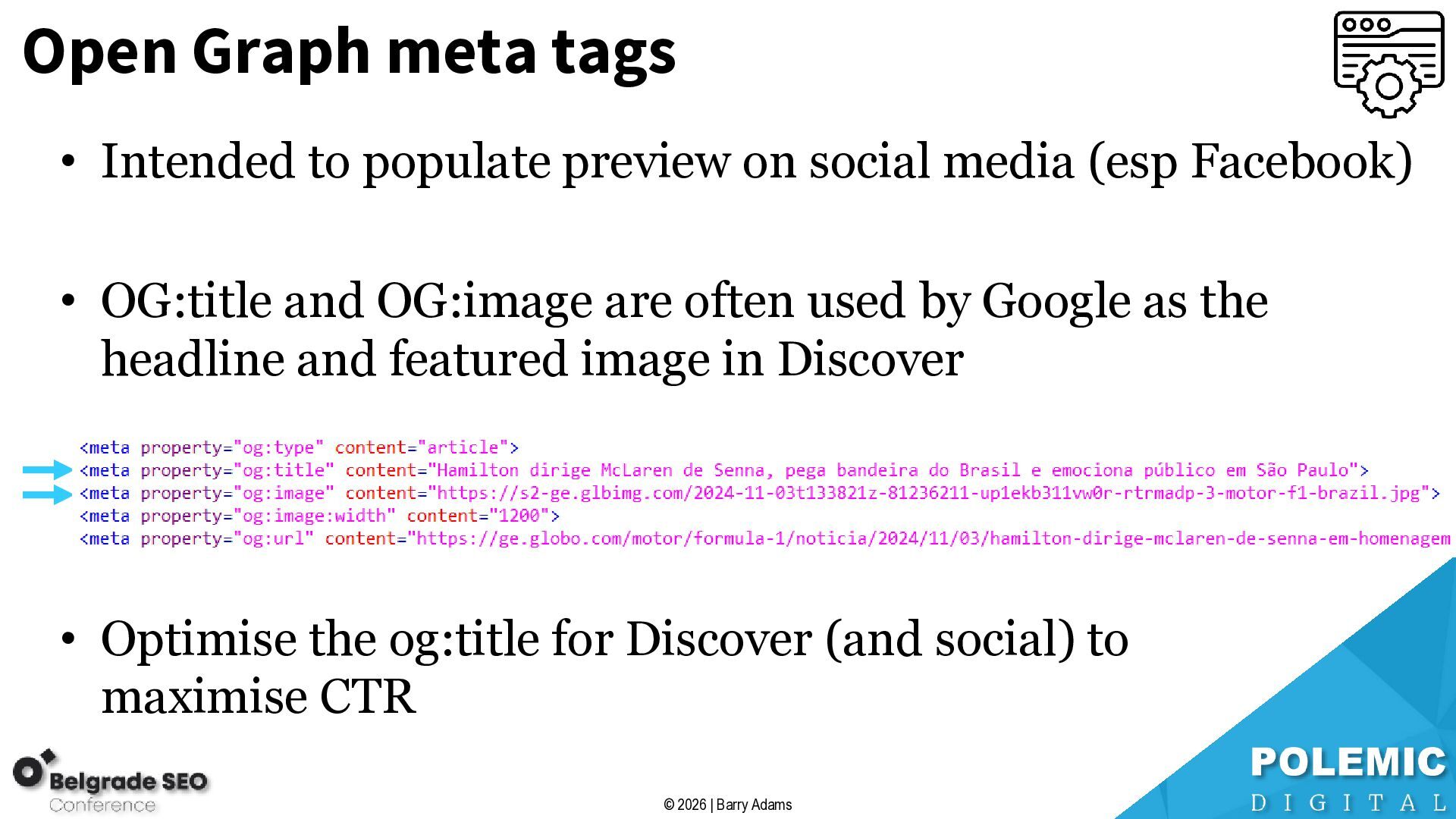
  12. Open Graph meta tags • Intended to populate preview on

    social media (esp Facebook) • OG:title and OG:image are often used by Google as the headline and featured image in Discover • Optimise the og:title for Discover (and social) to maximise CTR © 2026 | Barry Adams
  13. Don’t rely on client-side JavaScript • All critical content should

    be in the HTML response • Google will eventually render the page and see JS-loaded content; ➢ However, this can be a delayed process ➢ The article is relatively old by then ➢ Google strongly prefers fresh articles © 2026 | Barry Adams
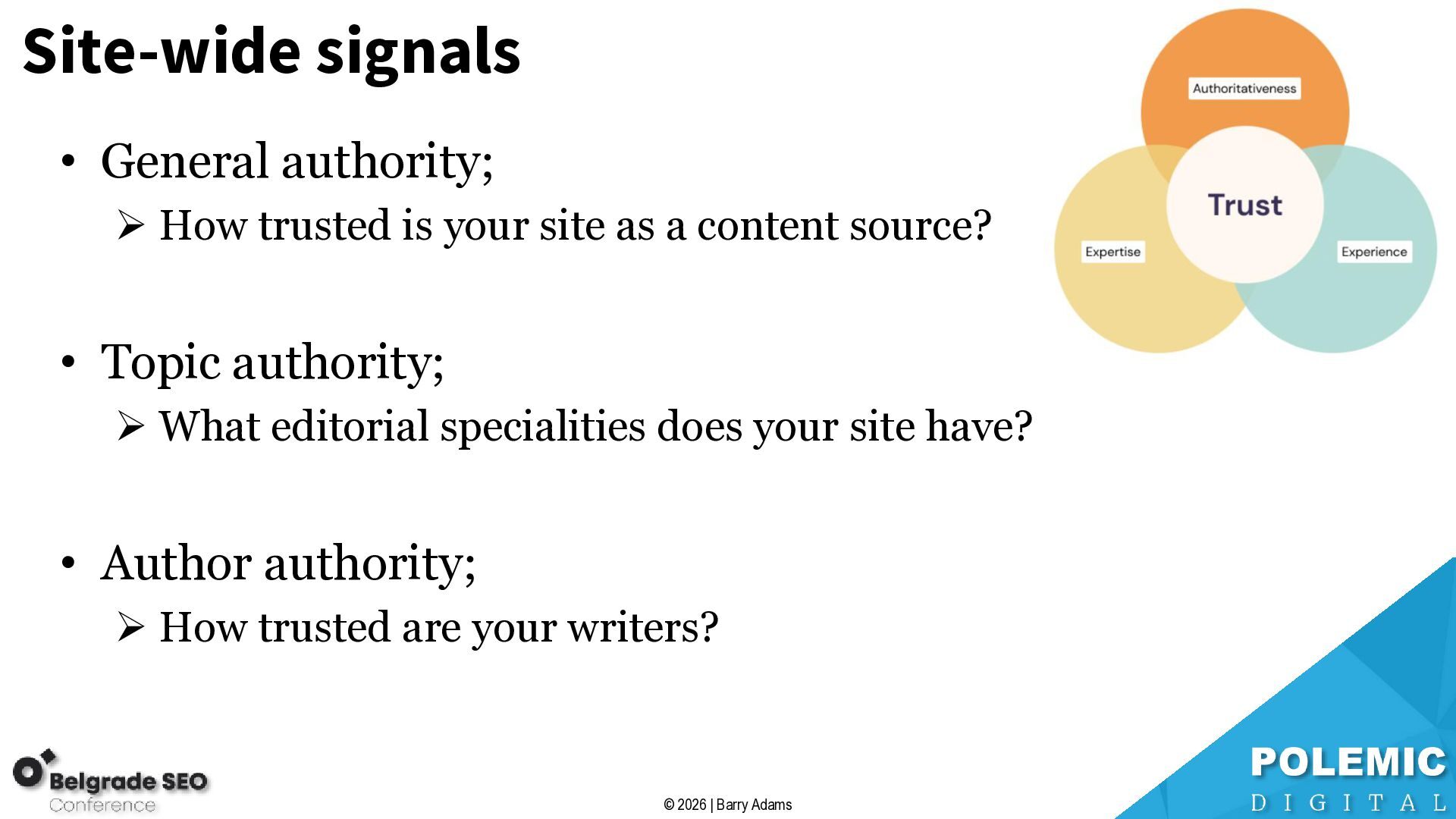
  14. Site-wide signals • General authority; ➢ How trusted is your

    site as a content source? • Topic authority; ➢ What editorial specialities does your site have? • Author authority; ➢ How trusted are your writers? © 2026 | Barry Adams
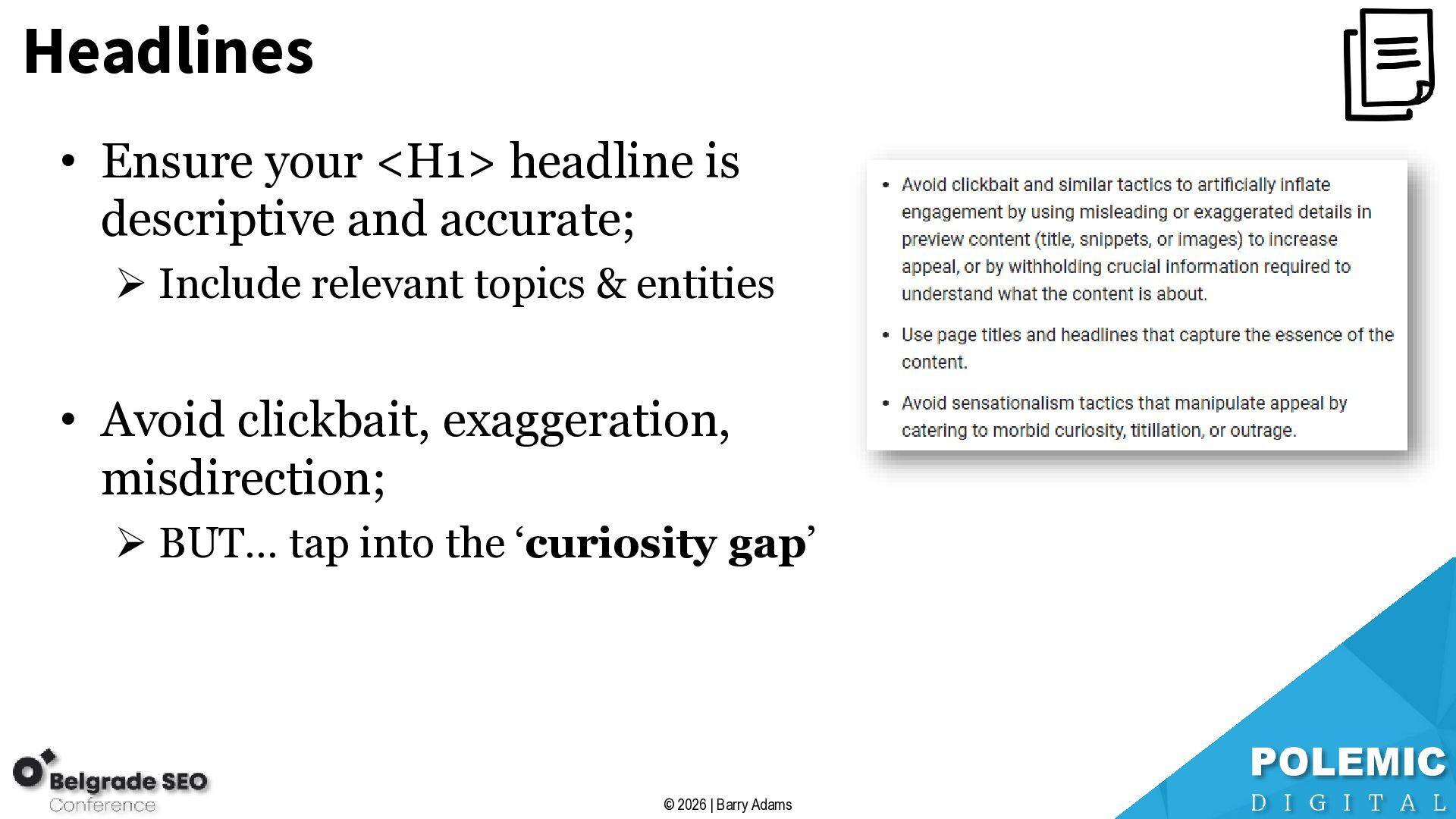
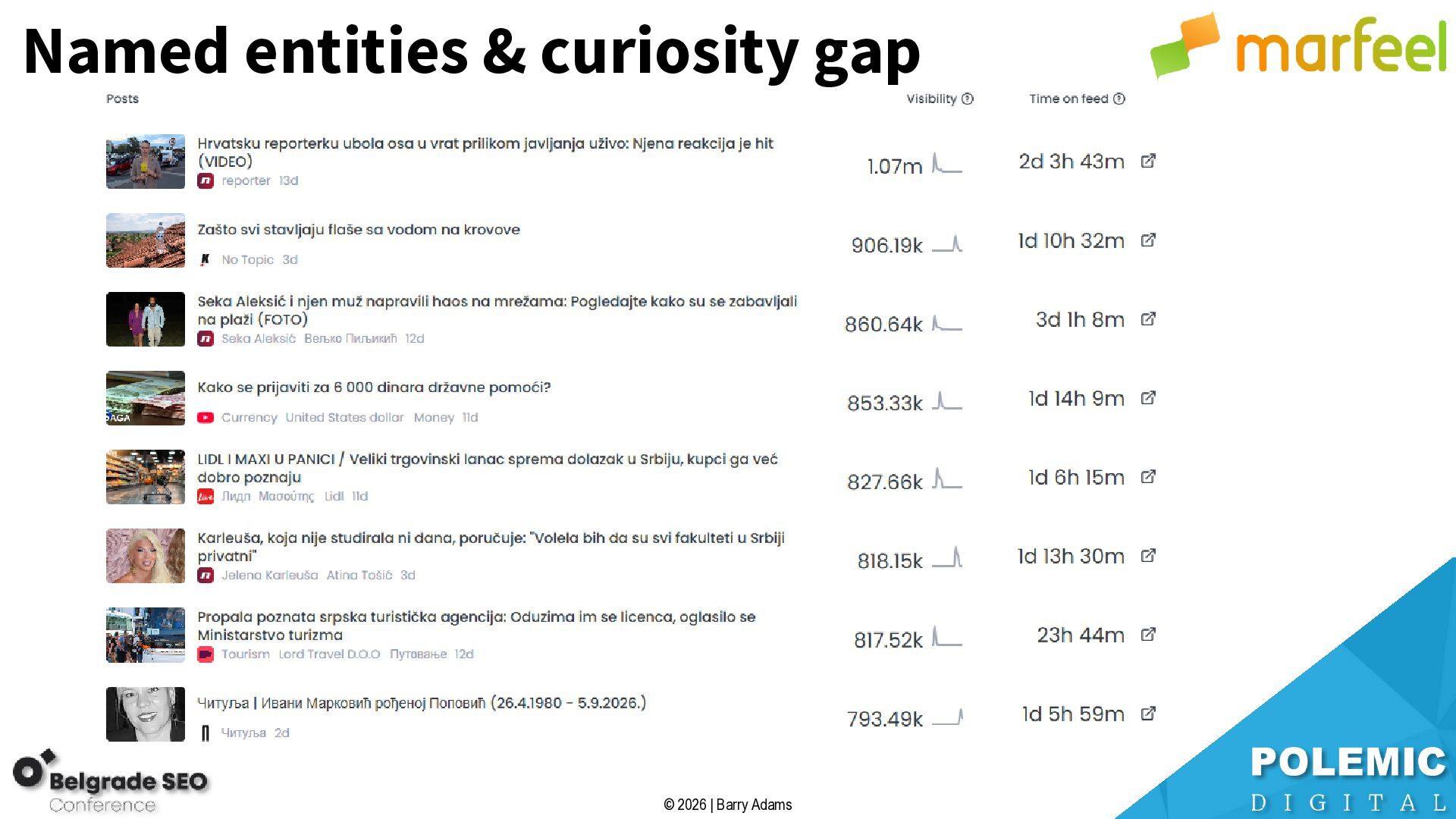
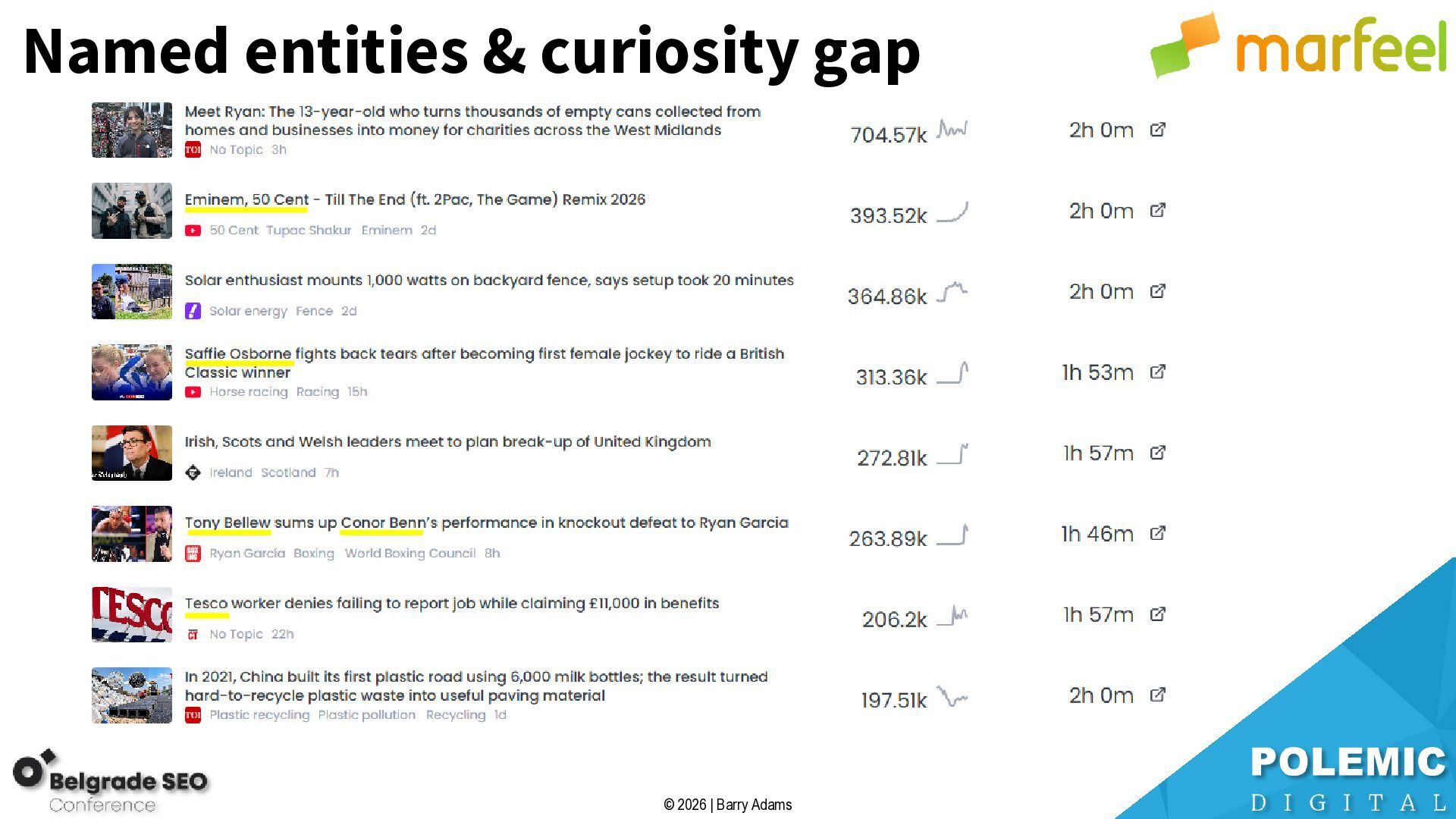
  15. Headlines • Ensure your <H1> headline is descriptive and accurate;

    ➢ Include relevant topics & entities • Avoid clickbait, exaggeration, misdirection; ➢ BUT… tap into the ‘curiosity gap’ © 2026 | Barry Adams
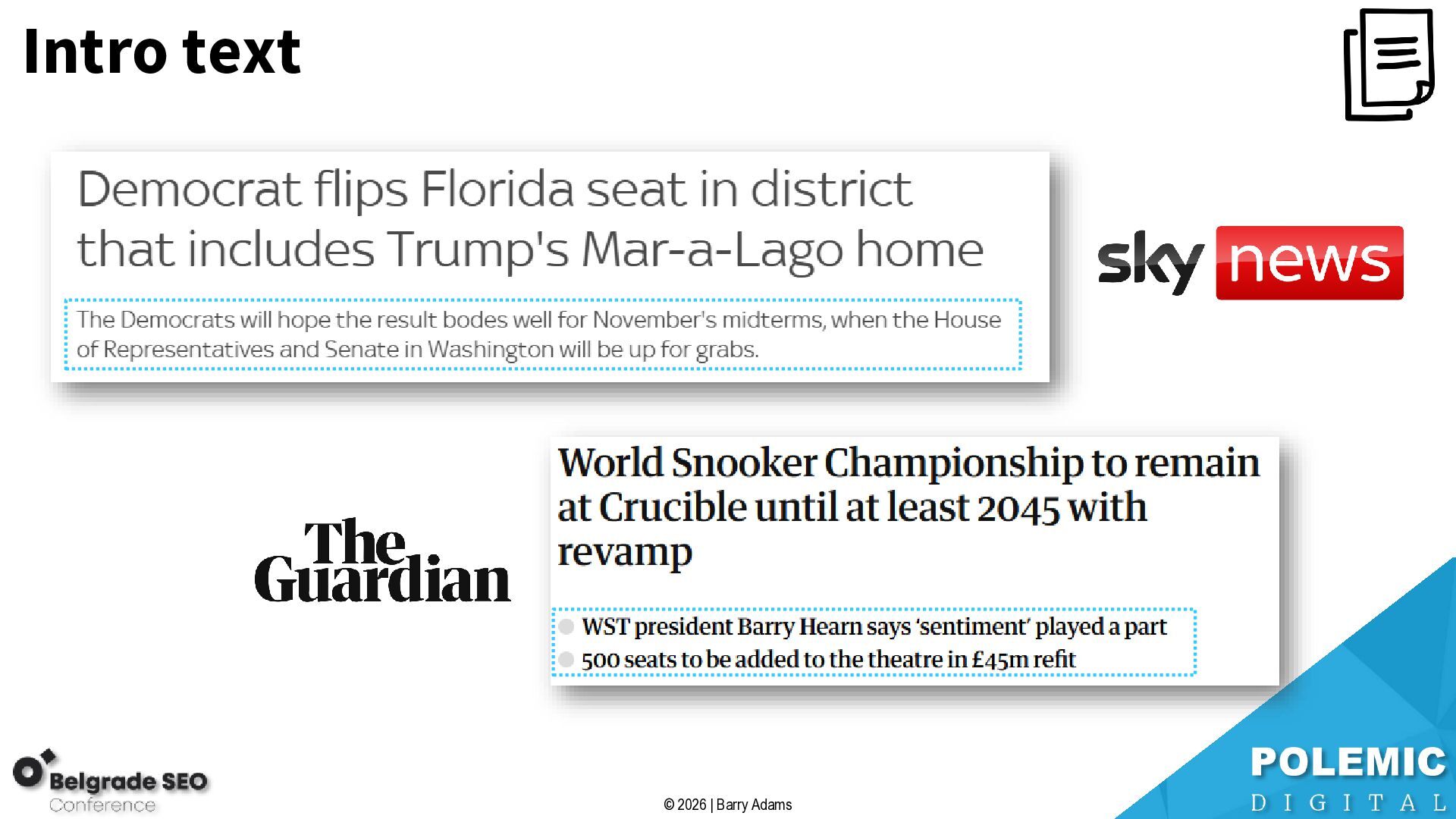
  16. Intro text • Short description / summary of the article

    content; ➢ Sentence or bullet points • Include additional topics & entities; ➢ Expands the article’s relevance • If possible, use semantic HTML; ➢ <H2/3/4/5>, <em>, <strong> © 2026 | Barry Adams
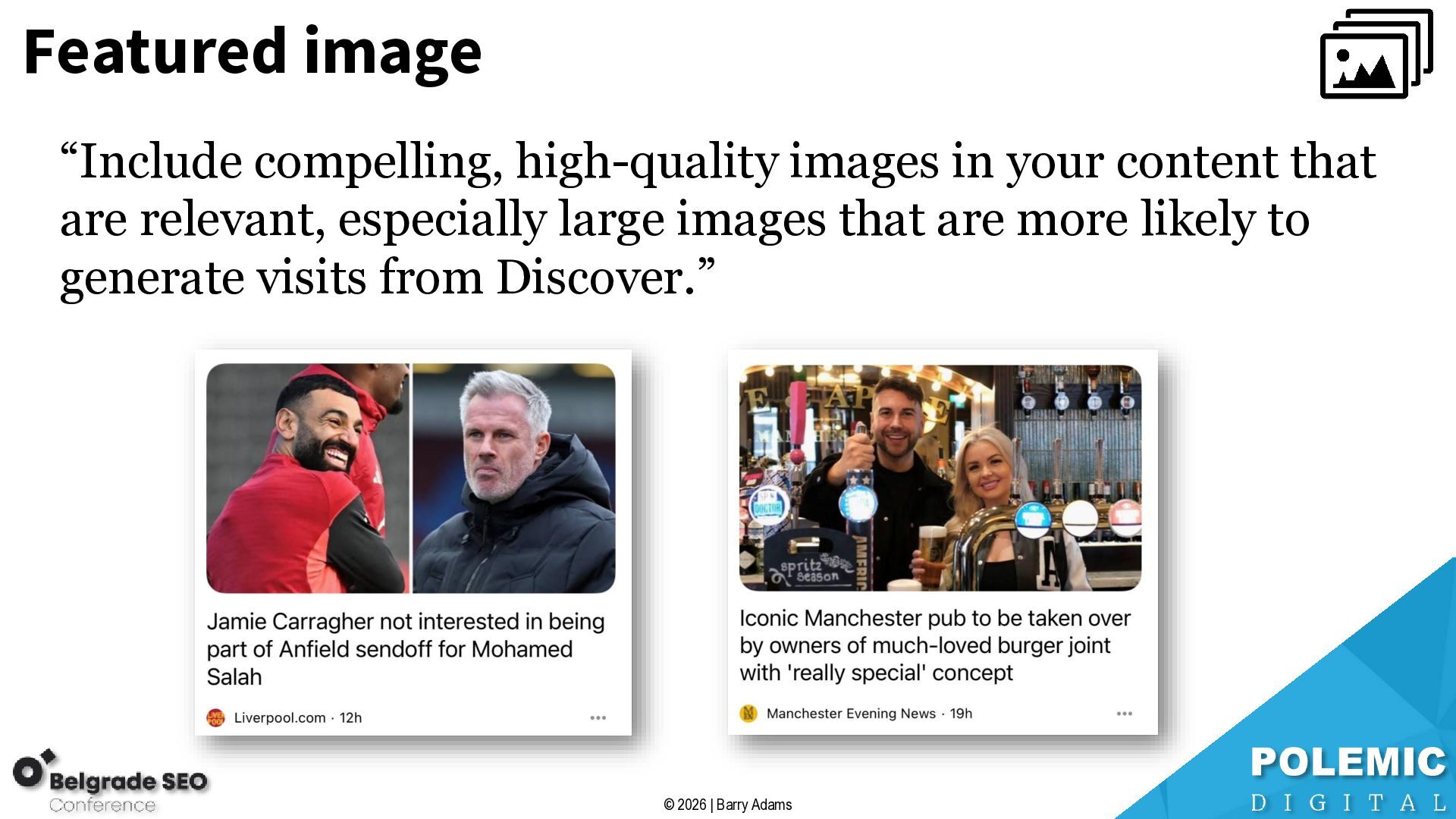
  17. Featured image “Include compelling, high-quality images in your content that

    are relevant, especially large images that are more likely to generate visits from Discover.” © 2026 | Barry Adams
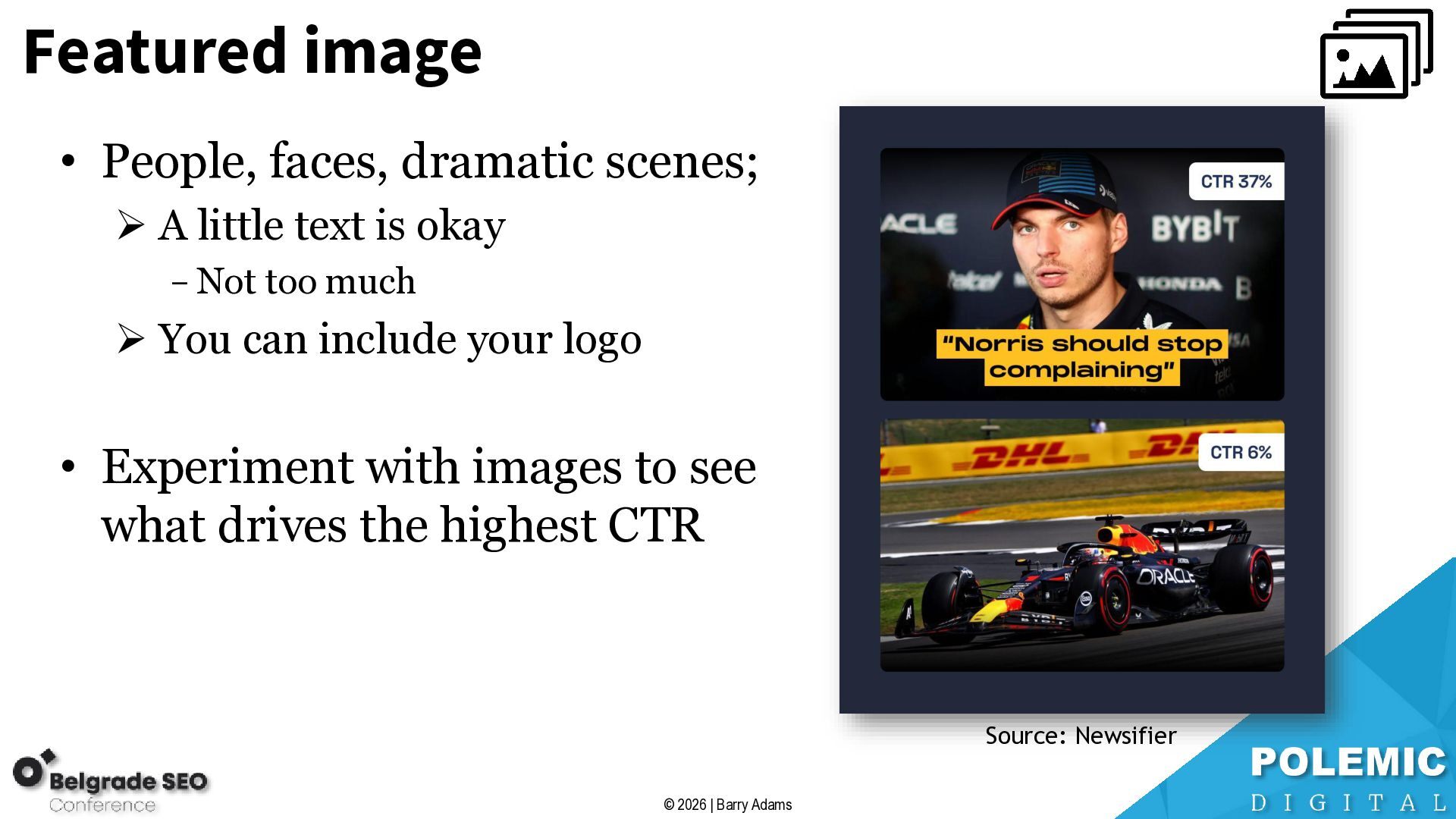
  18. Featured image • People, faces, dramatic scenes; ➢ A little

    text is okay - Not too much ➢ You can include your logo • Experiment with images to see what drives the highest CTR Source: Newsifier © 2026 | Barry Adams
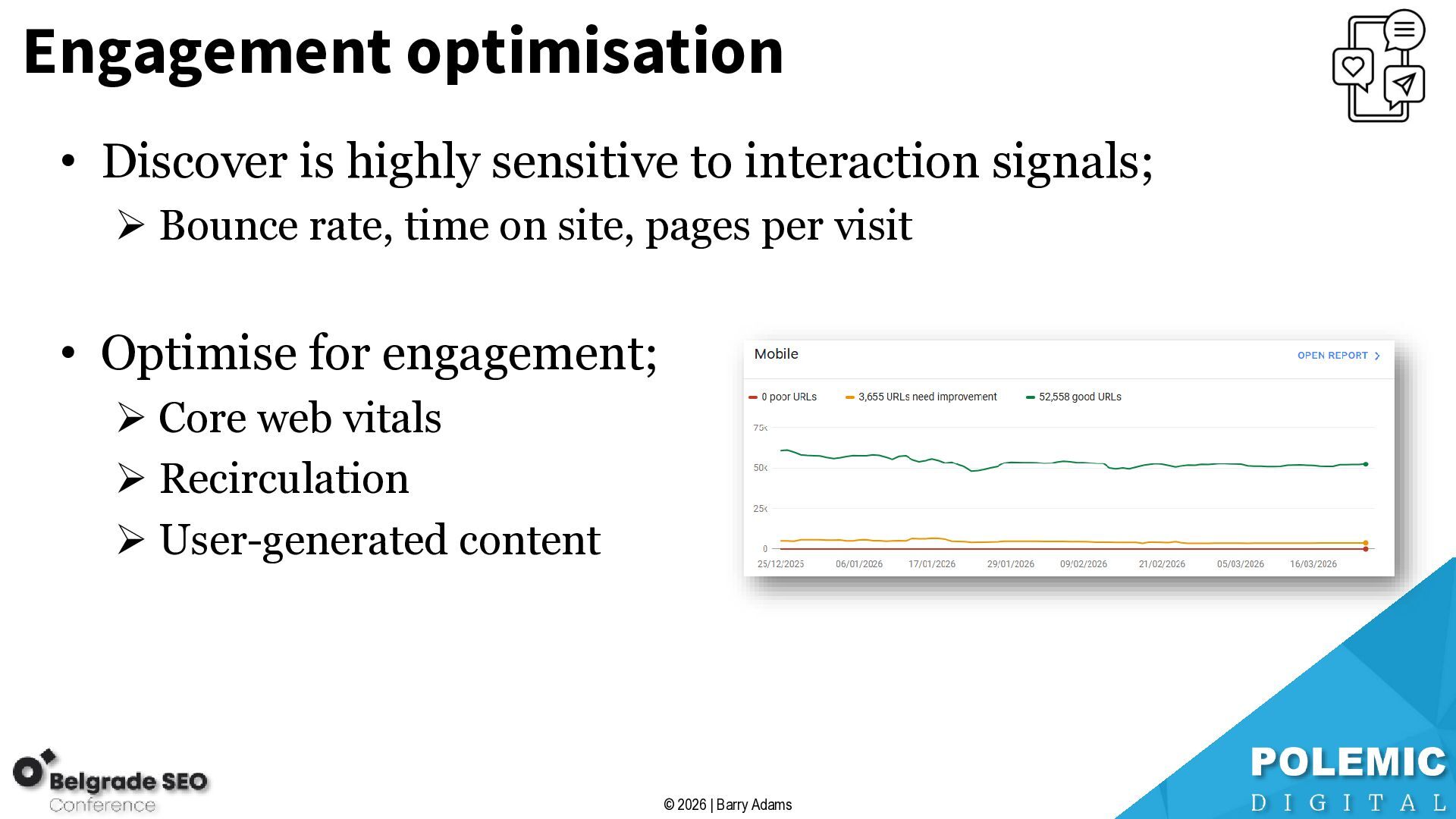
  19. Engagement optimisation • Discover is highly sensitive to interaction signals;

    ➢ Bounce rate, time on site, pages per visit • Optimise for engagement; ➢ Core web vitals ➢ Recirculation ➢ User-generated content © 2026 | Barry Adams
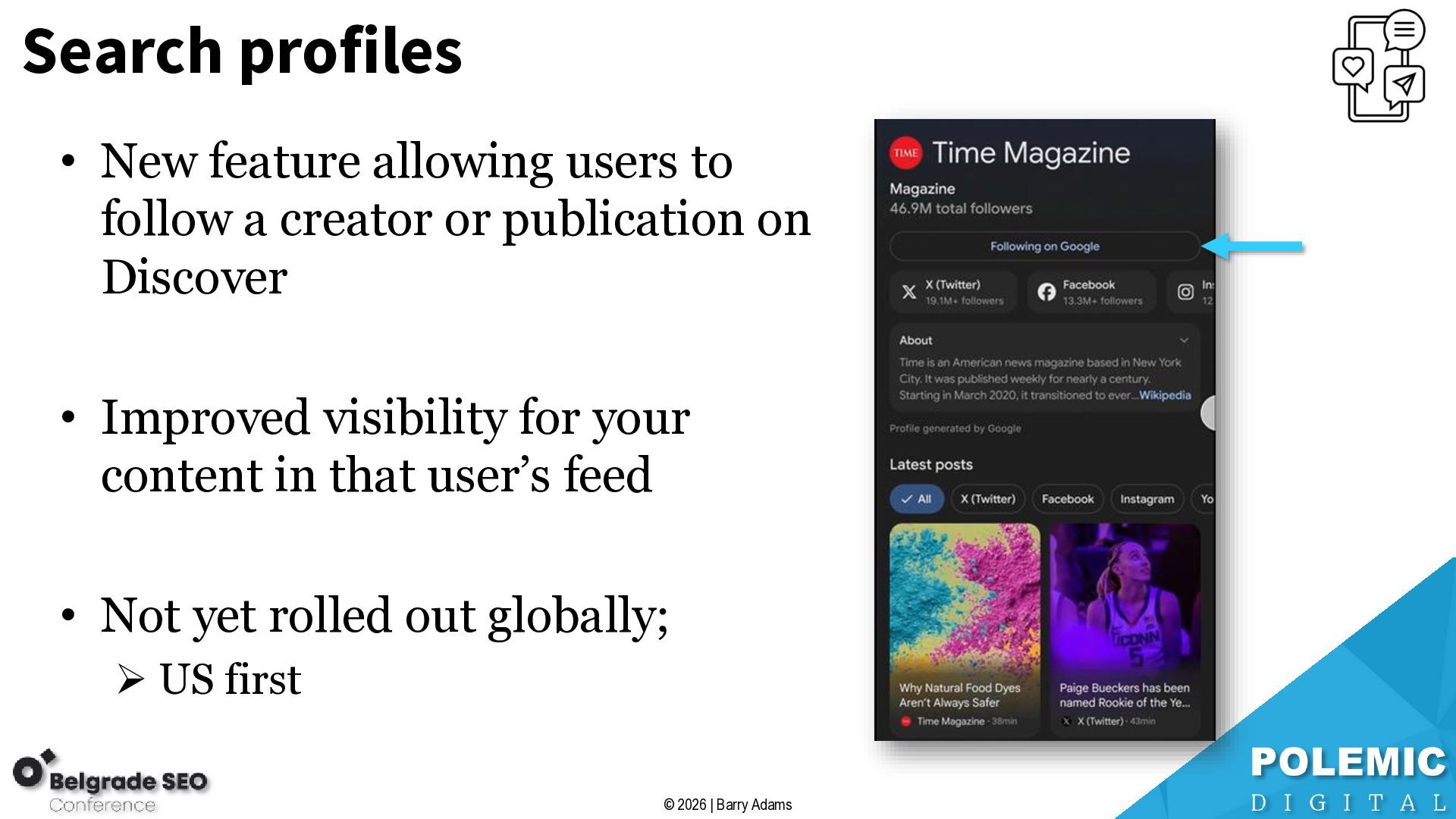
  20. Search profiles • New feature allowing users to follow a

    creator or publication on Discover • Improved visibility for your content in that user’s feed • Not yet rolled out globally; ➢ US first © 2026 | Barry Adams
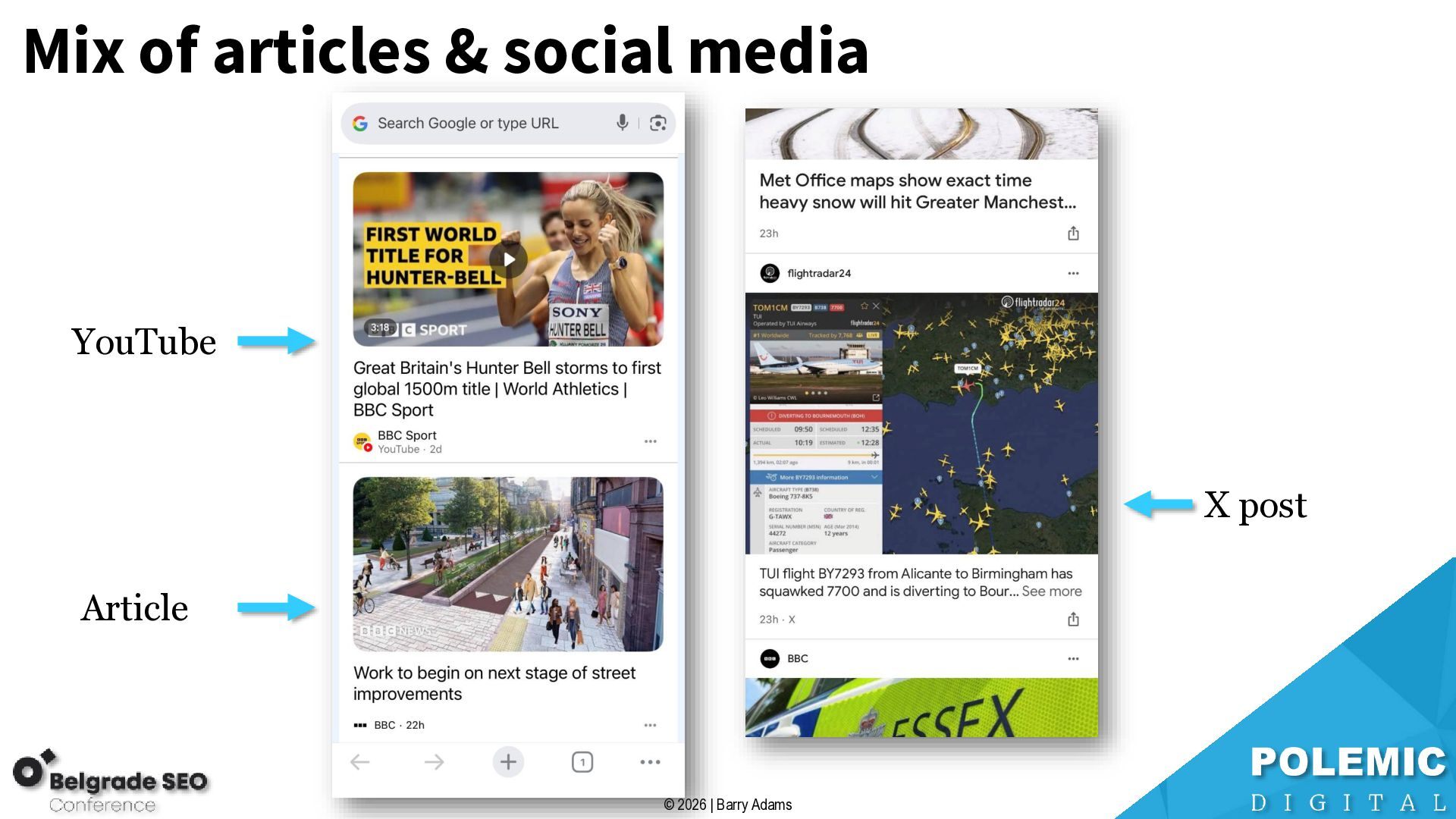
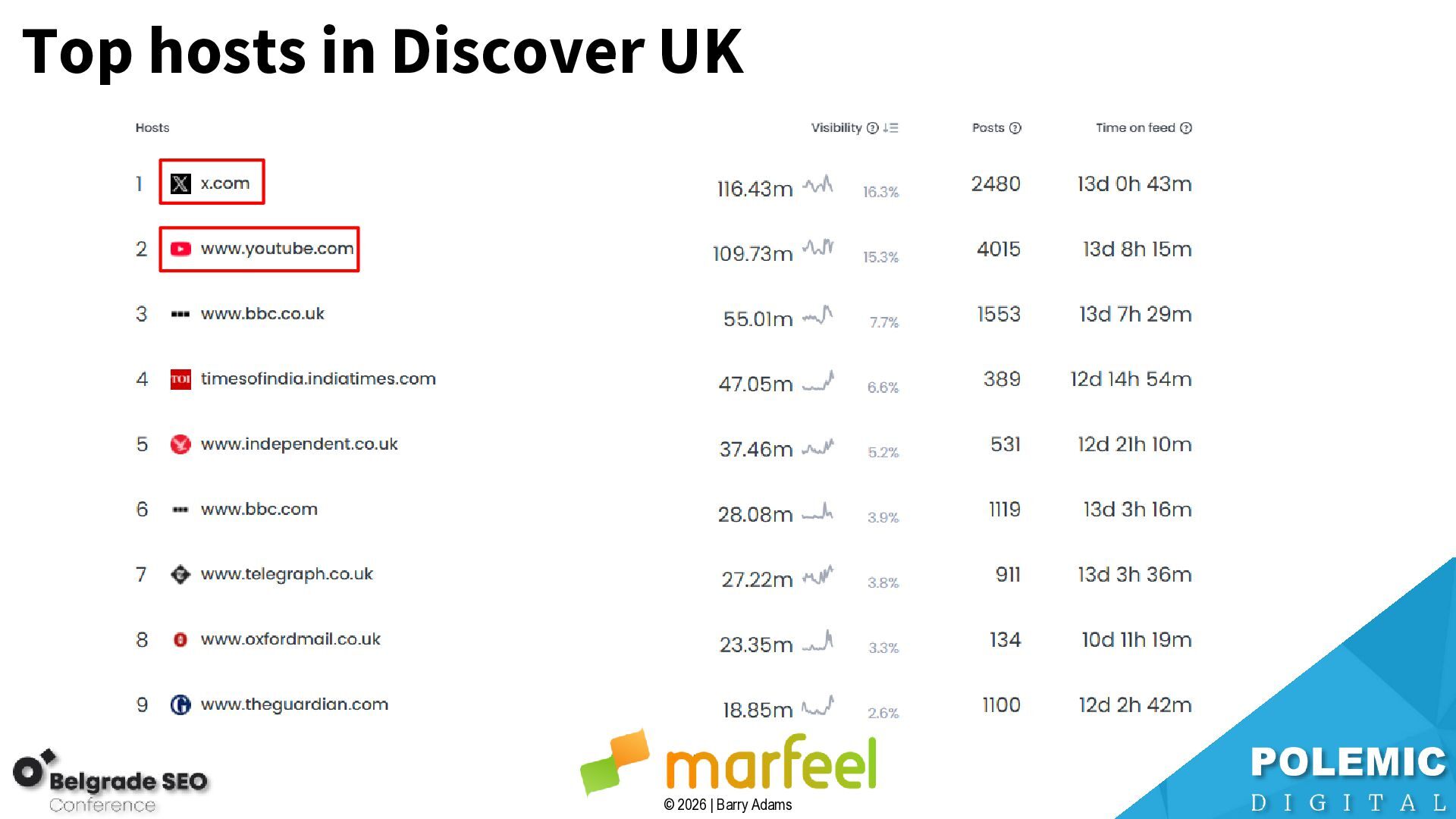
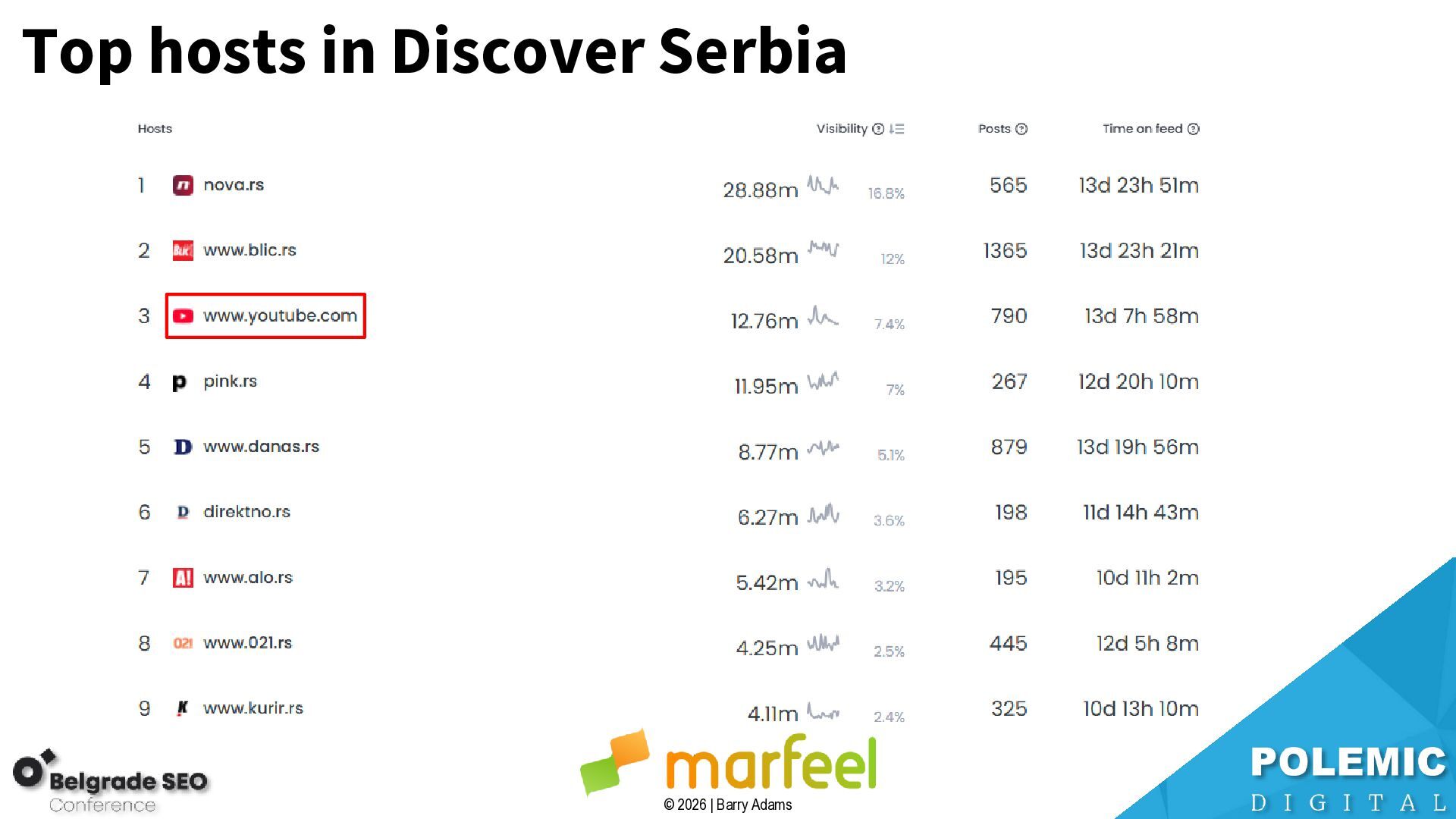
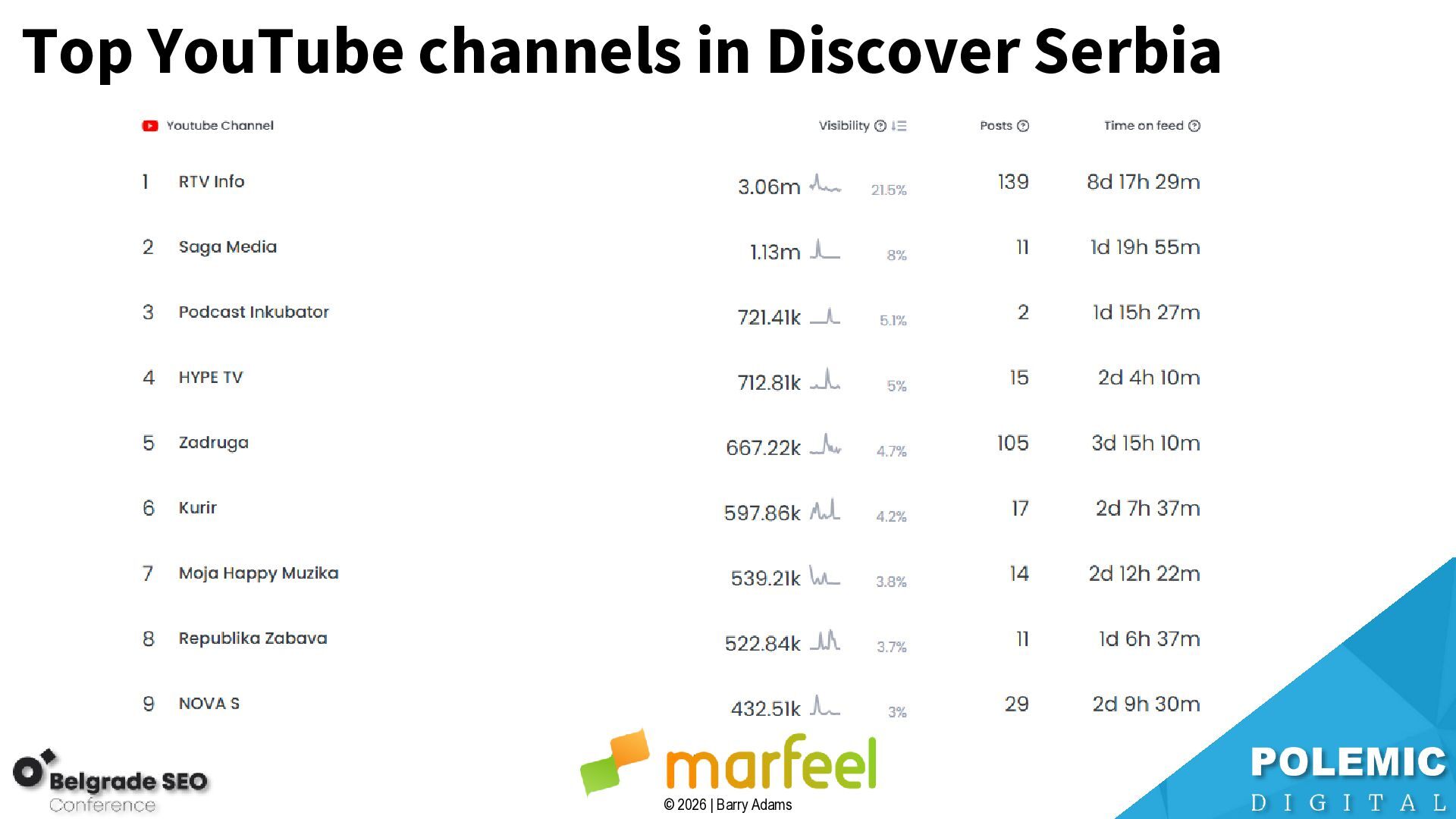
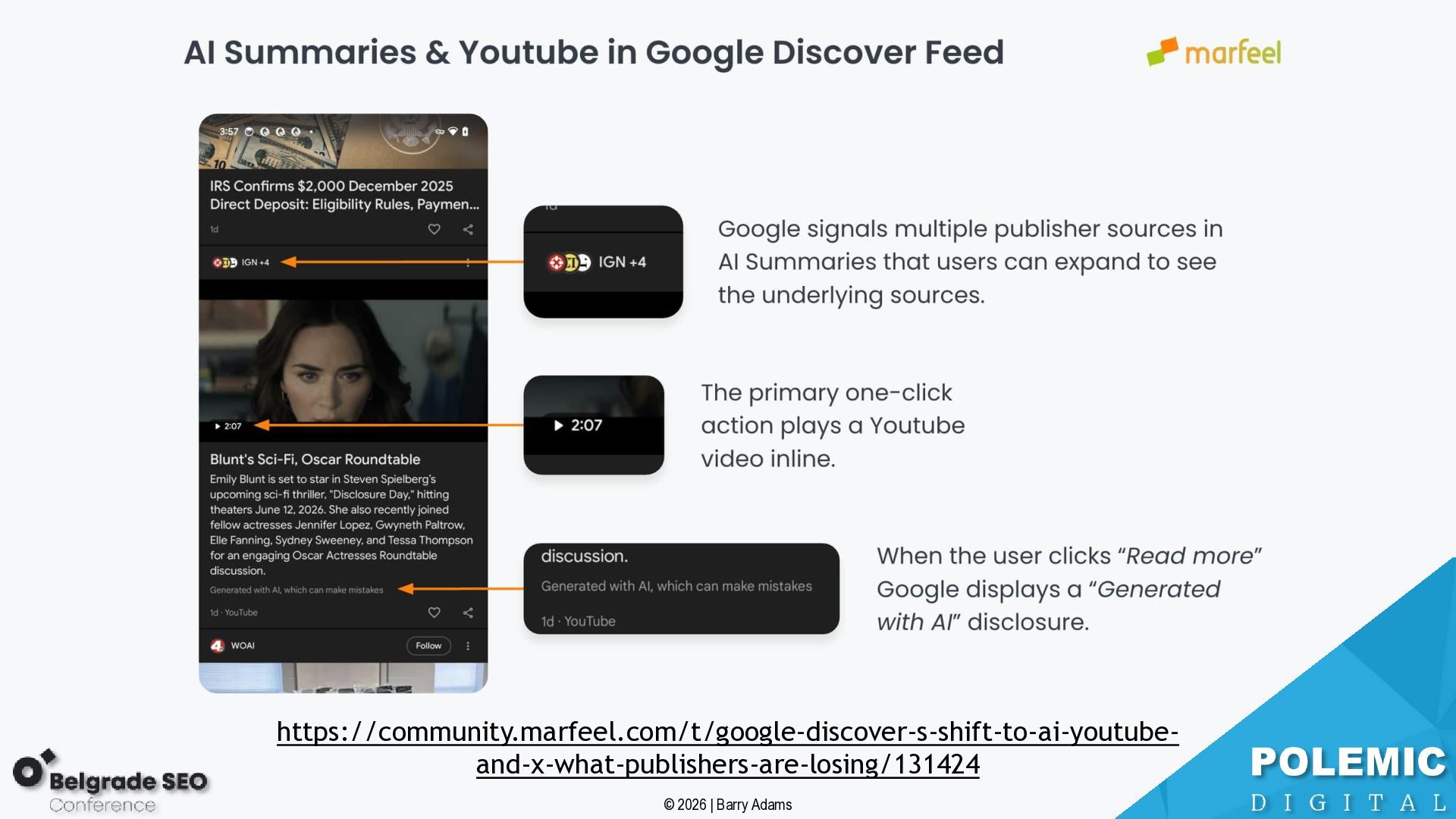
  21. Social media & Discover • Direct visibility in Discover feed;
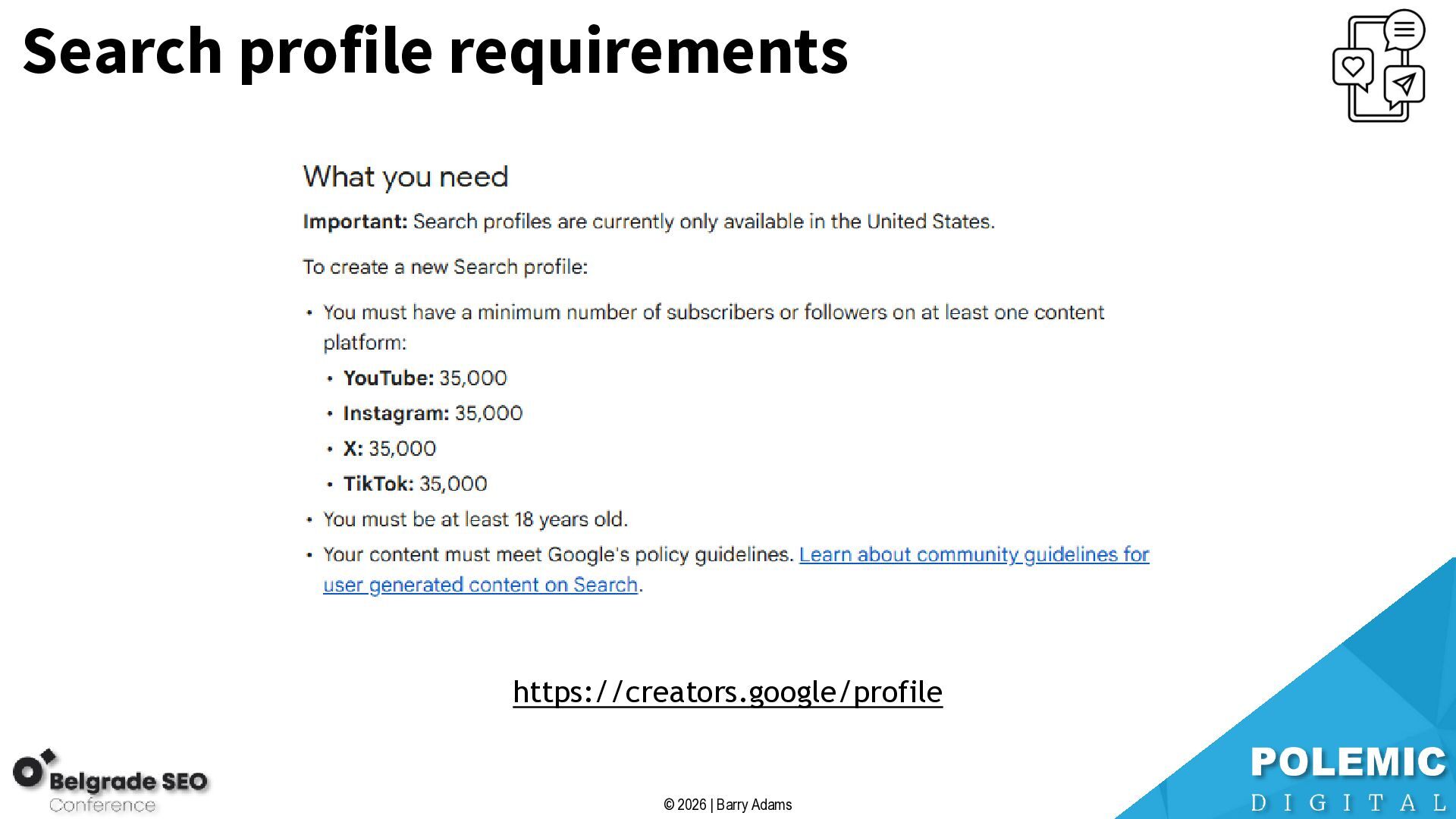
    ➢ YouTube, X, Instagram, TikTok, LinkedIn ➢ Build strong social media channels that focus on your site’s core topics & entities • Indirect impact; ➢ Articles that achieve a lot of traffic in a short time via non-Google channels often see a boost in Discover ➢ Google measures traffic (Chrome browser) and knows what’s popular ➢ Use social / email / promotion to drive traffic to key articles © 2026 | Barry Adams
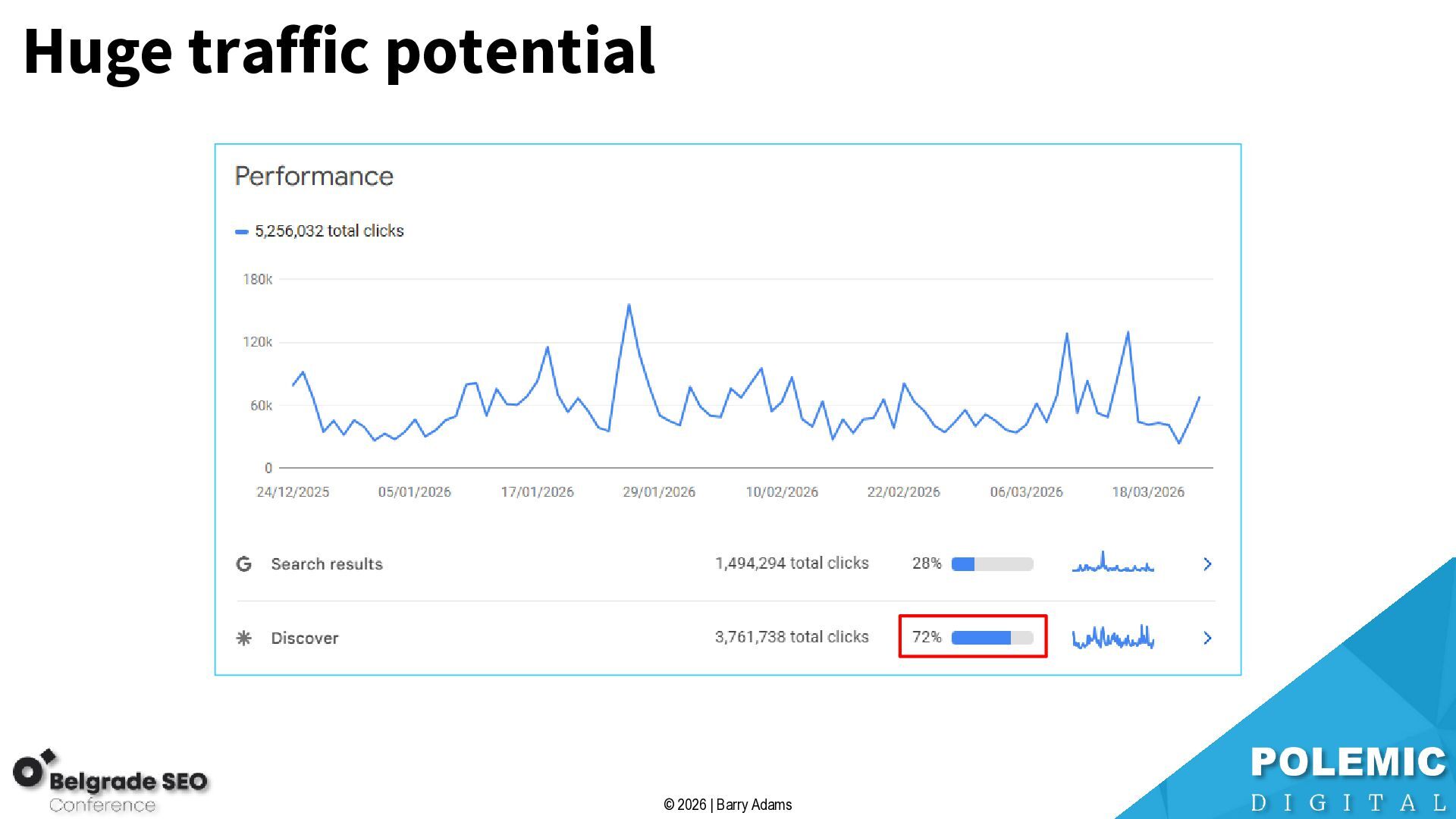
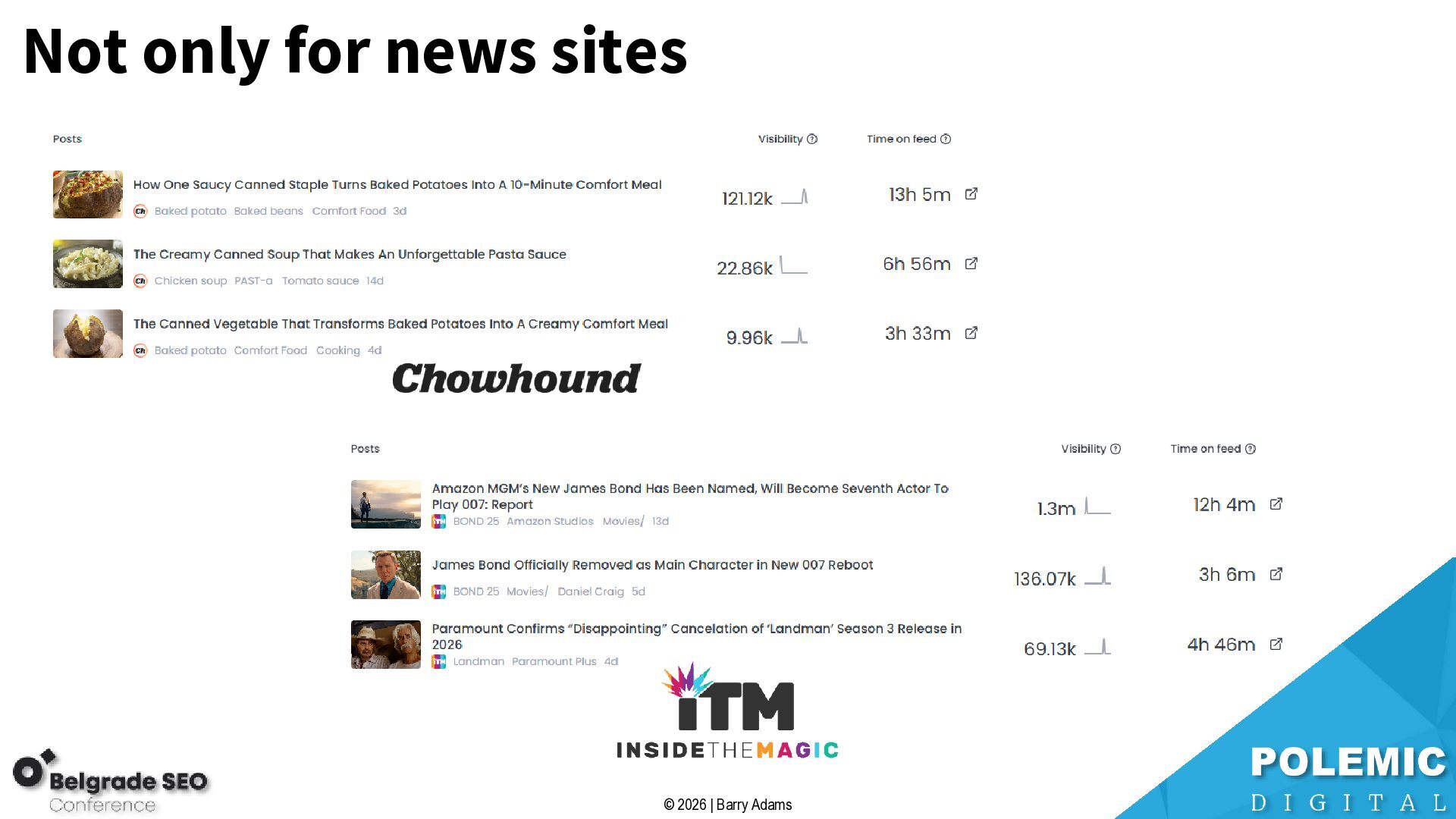
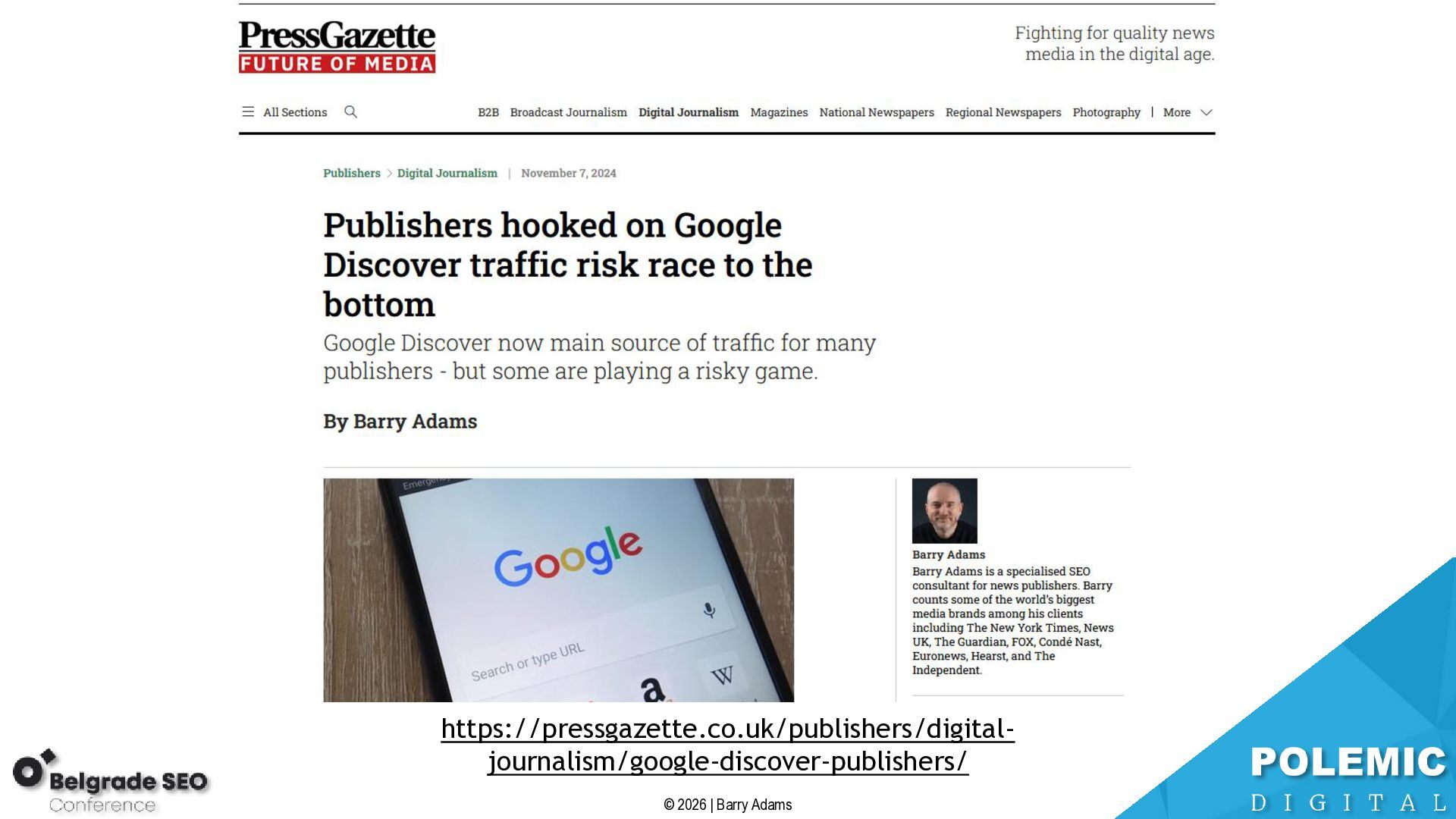
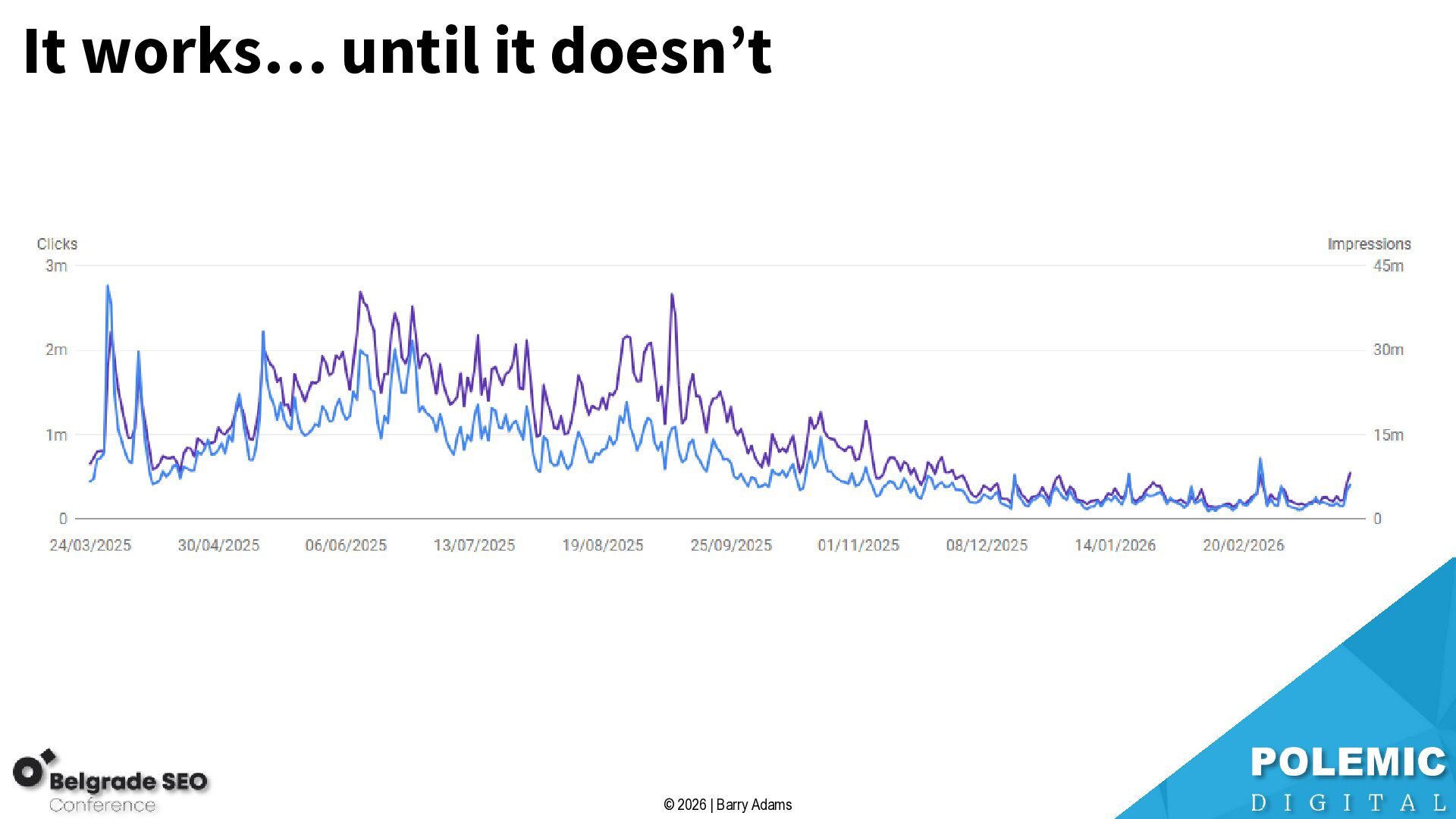
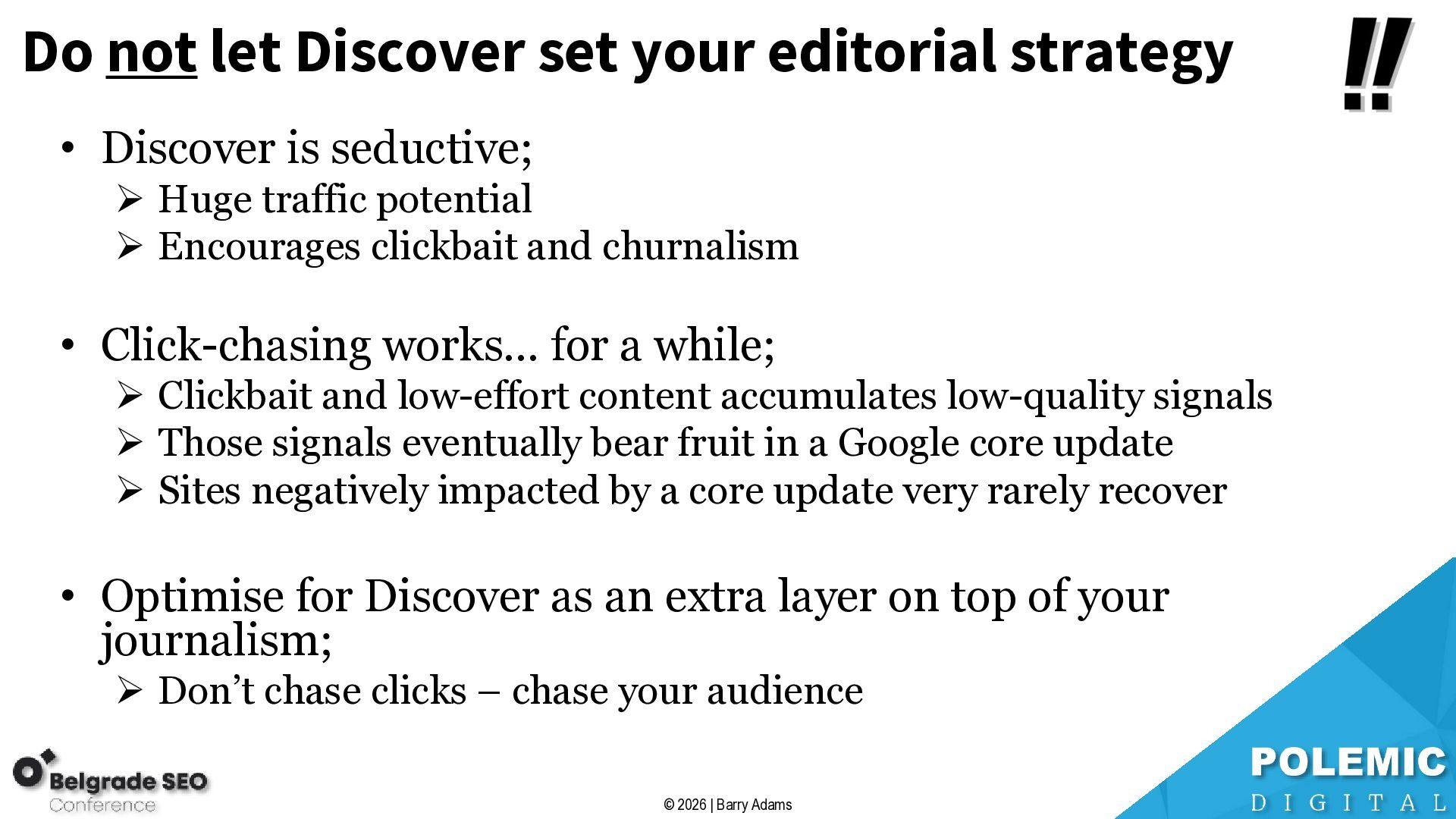
  22. Do not let Discover set your editorial strategy • Discover

    is seductive; ➢ Huge traffic potential ➢ Encourages clickbait and churnalism • Click-chasing works… for a while; ➢ Clickbait and low-effort content accumulates low-quality signals ➢ Those signals eventually bear fruit in a Google core update ➢ Sites negatively impacted by a core update very rarely recover • Optimise for Discover as an extra layer on top of your journalism; ➢ Don’t chase clicks – chase your audience © 2026 | Barry Adams
  23. News & Editorial SEO Summit 13, 14, 15 October 2026

    Three days: 1. SEO for News & Publishing 2. Broader SEO & AI 3. Audience Growth beyond SEO 20+ speakers & panellists Fully virtual and online Ticket includes all sessions’ recordings https://newsseo.io © 2026 | Barry Adams