Upgrade to Pro — share decks privately, control downloads, hide ads and more …

Aalto - STVP faculty visit, briefing package

Avatar for aaltovp aaltovp
January 14, 2012
100

Aalto - STVP faculty visit, briefing package

Avatar for aaltovp

aaltovp

January 14, 2012

Transcript

  1. This booklet was put together by Juhana Nurmio, Kristo Ovaska

    & Linda Liukas. All feedback & comments welcome to linda.liukas (a) aaltoes.com
  2. Preface About this visit. Goals for the visit are three-fold.

    In the end of the trip to have a shared vision and a developed plan for Aalto Ventures Program with a mandate and resource commitment from Aalto management as well as close collaborative relationships with STVP and Stanford faculty. In more detail: 1) Developing an in-depth, shared understanding of how a world- class venturing program is built and what it takes in terms of curriculum, recruiting (faculty + adjuncts), and resources. 2) Creating direct peer-to-peer relationships between Aalto and Stanford people at all levels. 3) Building a common team spirit & understanding between peo- ple from different parts of faculty. Specific questions we look to answer: - How a world-class venturing program is built and what it takes? - Strategy - Recruiting (tenure track & adjuncts) - Resources - How to encourage and support researchers to create spinoffs? - Tech-transfer - IPR or commercialization - How to build a curriculum? - Curriculum building - pitfalls to avoid - Course selection - Teaching methods 00- Student involvement
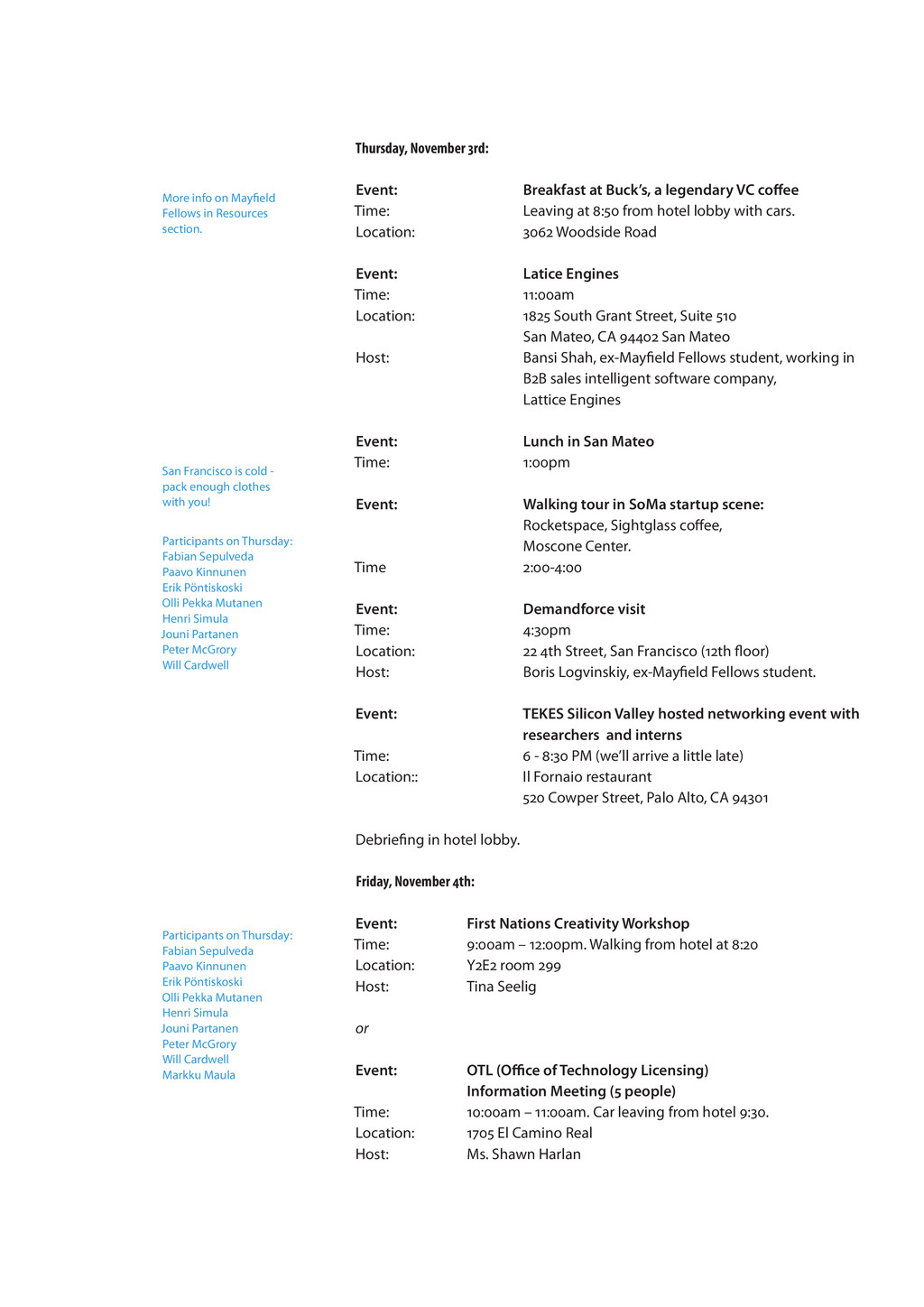
  3. Programme of the week Program for Aalto University at Stanford

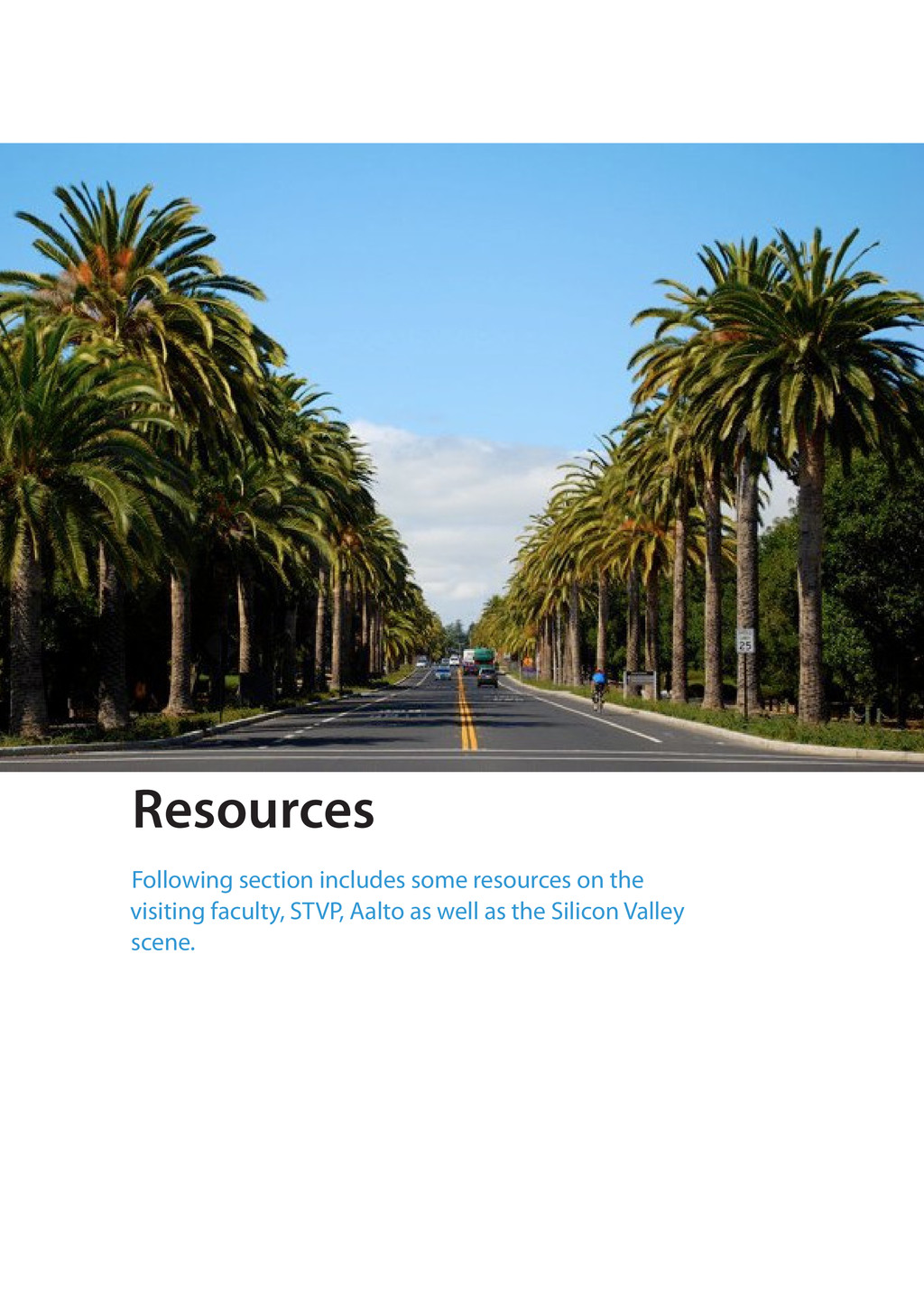
    University November 2-8, 2011 Tuesday, November 1st: The Beginning Event: Briefing dinner Time: 6:00pm Location: Stanford Park Hotel, Menlo Grill Host: Will Cardwell Wednesday, November 2nd: STVP and Curriculum Building Meeting in the morning in hotel lobby at 8:30 am. Breakfast together and walking through the Palm Drive to STVP. Event: Welcome meeting Time: 11:00am Location: STVP Offices, Suite 003 Huang Engineering Center 475 Via Ortega Stanford CA 94305 Host: Tina Seelig, Executive Director for the Stanford Technology Ventures Program Event: Lunch with STVP Faculty Time: 12:00pm Location: STVP Offices, Suite 003 Huang Engineering Center Host: Tina Seelig More: Faculty & Staff * See resources for more information on faculty Event: STVP Overview and Outline Goals & Project Launch Time: 1:00pm to 2:45pm Location: STVP Conference Room * See Resources for more info on STVP Event: Campus Tour Time: 3:00 to 4:15 Location: Starting and ending at STVP Host: Stacey Velazquez (SCPD, Stanford Center for Professional Development) For Wednesday, please see prepare for ETL class with homework (see Resources) The Stanford guest wire- less information: username: aaltoonline password: stvp2011 Present: on Wednesday Erik Pöntiskoski Fabian Sepulveda Henri Simula Olli-Pekka Mutanen, Jouni Partanen Peter McGrory Will Cardwell
  4. Event: Entrepreneurial Thought Leaders’ Seminar Time: 4:30pm to 5:30pm Location:

    NVIDIA: Huang Engineering Center, floor -1 Host: Lecture by: Marten Mickos Event: The Spirit of Entrepreneurship Time: 5:15pm-6:30pm Location: Huang Engineering Center 18, the room next to ETL Host: Heidi Roizen Meeting in front of Nvidia hall 6:30. Taking the Marguerita Shuttle, Line Y, to hotel. Event: Dinner at Stanford Park Hotel Time: 7:30 PM Host: Tina Seelig and Rebecca Edwards, De-brief in the hotel bar - checking out everyone has a carpool place for next day. More information on ETL and homework for Heidi Roizens class in Resources section.
  5. More info on Mayfield Fellows in Resources section. San Francisco

    is cold - pack enough clothes with you! Participants on Thursday: Fabian Sepulveda Paavo Kinnunen Erik Pöntiskoski Olli Pekka Mutanen Henri Simula Jouni Partanen Peter McGrory Will Cardwell Participants on Thursday: Fabian Sepulveda Paavo Kinnunen Erik Pöntiskoski Olli Pekka Mutanen Henri Simula Jouni Partanen Peter McGrory Will Cardwell Markku Maula Event: TEKES Silicon Valley hosted networking event with researchers and interns Time: 6 - 8:30 PM (we’ll arrive a little late) Location:: Il Fornaio restaurant 520 Cowper Street, Palo Alto, CA 94301 Debriefing in hotel lobby. Friday, November 4th: Event: First Nations Creativity Workshop Time: 9:00am – 12:00pm. Walking from hotel at 8:20 Location: Y2E2 room 299 Host: Tina Seelig or Event: OTL (Office of Technology Licensing) Information Meeting (5 people) Time: 10:00am – 11:00am. Car leaving from hotel 9:30. Location: 1705 El Camino Real Host: Ms. Shawn Harlan Thursday, November 3rd: Event: Breakfast at Buck’s, a legendary VC coffee Time: Leaving at 8:50 from hotel lobby with cars. Location: 3062 Woodside Road Event: Latice Engines Time: 11:00am Location: 1825 South Grant Street, Suite 510 San Mateo, CA 94402 San Mateo Host: Bansi Shah, ex-Mayfield Fellows student, working in B2B sales intelligent software company, Lattice Engines Event: Lunch in San Mateo Time: 1:00pm Event: Walking tour in SoMa startup scene: Rocketspace, Sightglass coffee, Moscone Center. Time 2:00-4:00 Event: Demandforce visit Time: 4:30pm Location: 22 4th Street, San Francisco (12th floor) Host: Boris Logvinskiy, ex-Mayfield Fellows student.
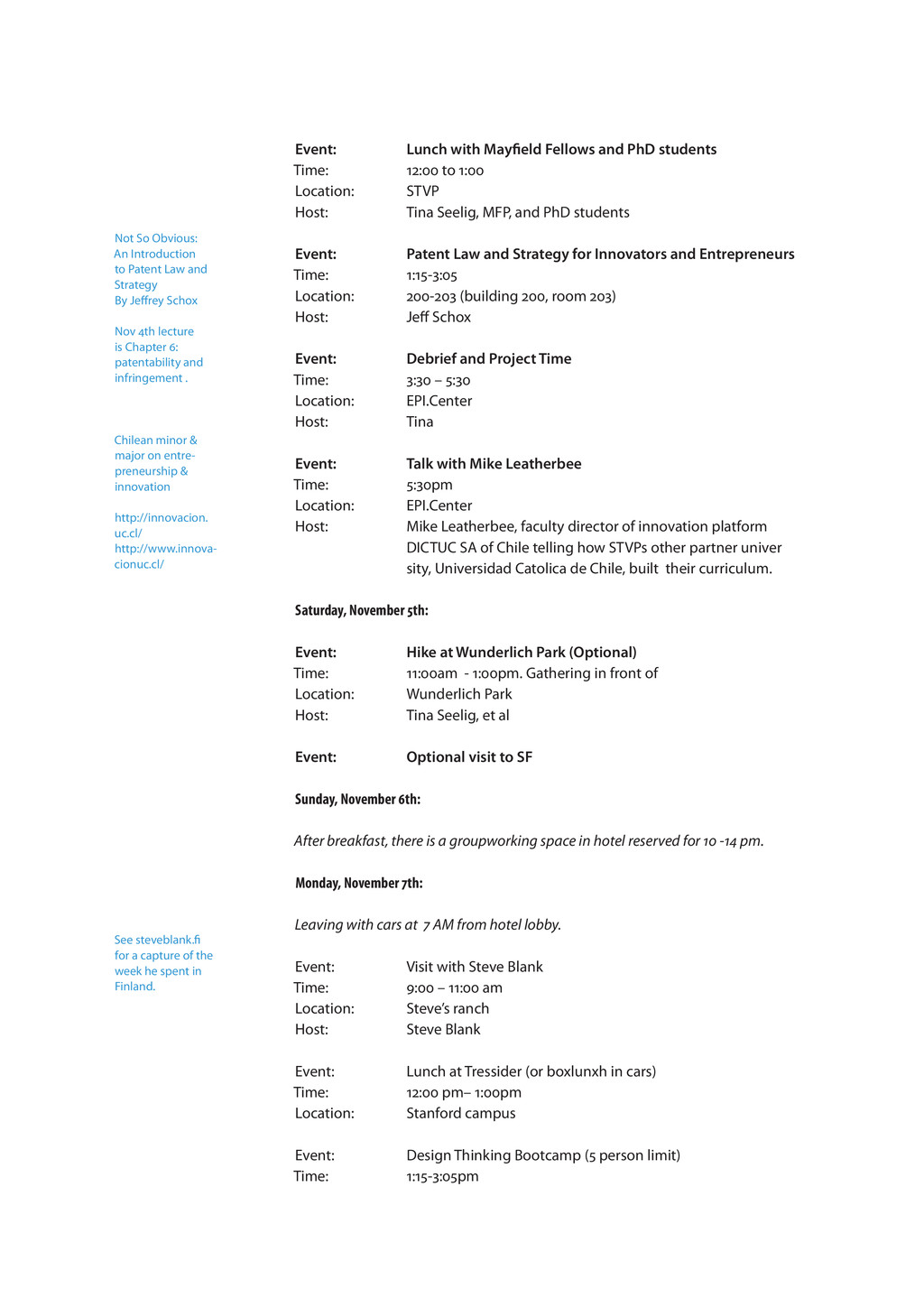
  6. Event: Lunch with Mayfield Fellows and PhD students Time: 12:00

    to 1:00 Location: STVP Host: Tina Seelig, MFP, and PhD students Event: Patent Law and Strategy for Innovators and Entrepreneurs Time: 1:15-3:05 Location: 200-203 (building 200, room 203) Host: Jeff Schox Event: Debrief and Project Time Time: 3:30 – 5:30 Location: EPI.Center Host: Tina Event: Talk with Mike Leatherbee Time: 5:30pm Location: EPI.Center Host: Mike Leatherbee, faculty director of innovation platform DICTUC SA of Chile telling how STVPs other partner univer sity, Universidad Catolica de Chile, built their curriculum. Saturday, November 5th: Event: Hike at Wunderlich Park (Optional) Time: 11:00am - 1:00pm. Gathering in front of Location: Wunderlich Park Host: Tina Seelig, et al Event: Optional visit to SF Sunday, November 6th: After breakfast, there is a groupworking space in hotel reserved for 10 -14 pm. Monday, November 7th: Leaving with cars at 7 AM from hotel lobby. Event: Visit with Steve Blank Time: 9:00 – 11:00 am Location: Steve’s ranch Host: Steve Blank Event: Lunch at Tressider (or boxlunxh in cars) Time: 12:00 pm– 1:00pm Location: Stanford campus Event: Design Thinking Bootcamp (5 person limit) Time: 1:15-3:05pm Not So Obvious: An Introduction to Patent Law and Strategy By Jeffrey Schox Nov 4th lecture is Chapter 6: patentability and infringement . Chilean minor & major on entre- preneurship & innovation http://innovacion. uc.cl/ http://www.innova- cionuc.cl/ See steveblank.fi for a capture of the week he spent in Finland.
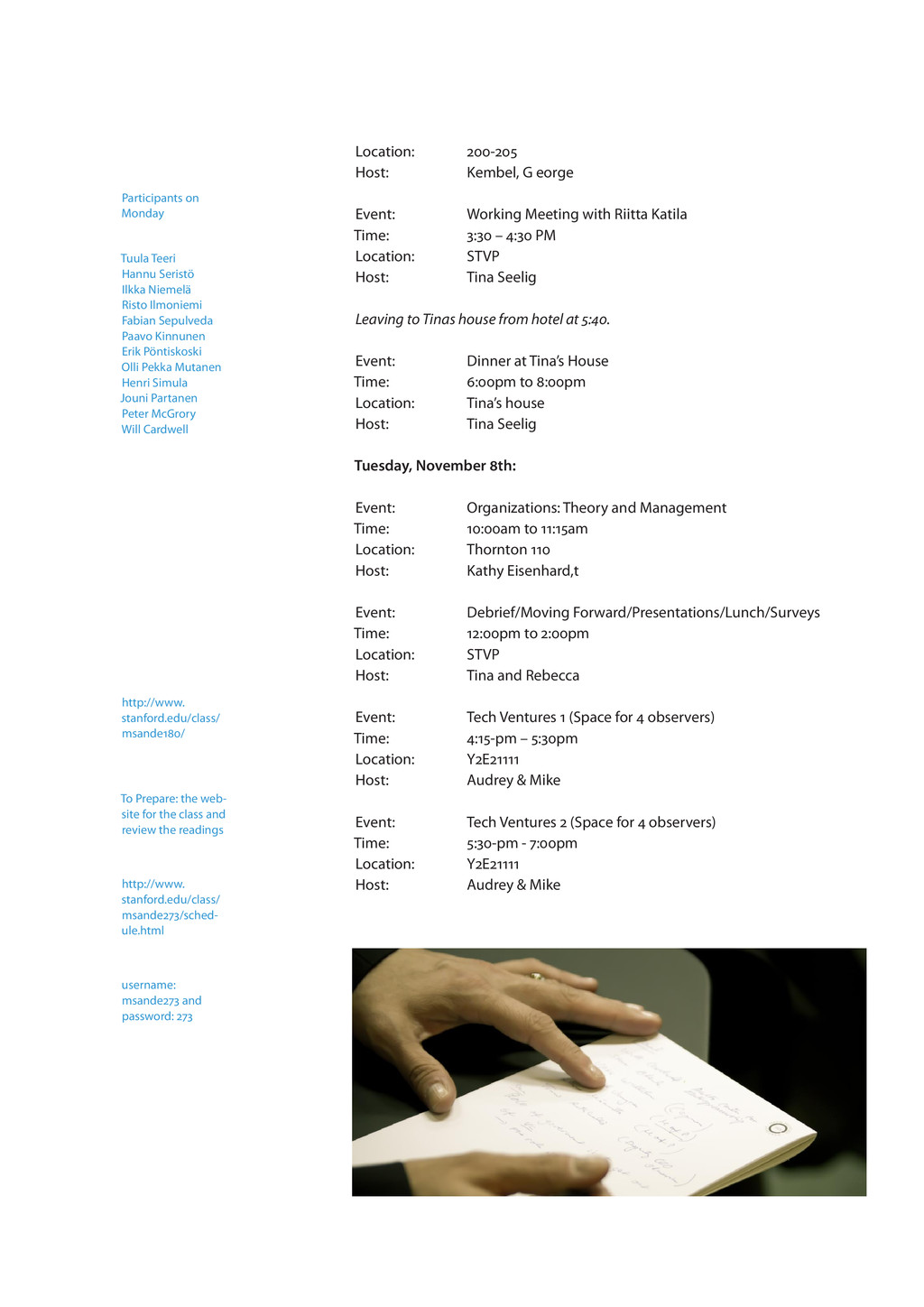
  7. Location: 200-205 Host: Kembel, G eorge Event: Working Meeting with

    Riitta Katila Time: 3:30 – 4:30 PM Location: STVP Host: Tina Seelig Leaving to Tinas house from hotel at 5:40. Event: Dinner at Tina’s House Time: 6:00pm to 8:00pm Location: Tina’s house Host: Tina Seelig Tuesday, November 8th: Event: Organizations: Theory and Management Time: 10:00am to 11:15am Location: Thornton 110 Host: Kathy Eisenhard,t Event: Debrief/Moving Forward/Presentations/Lunch/Surveys Time: 12:00pm to 2:00pm Location: STVP Host: Tina and Rebecca Event: Tech Ventures 1 (Space for 4 observers) Time: 4:15-pm – 5:30pm Location: Y2E21111 Host: Audrey & Mike Event: Tech Ventures 2 (Space for 4 observers) Time: 5:30-pm - 7:00pm Location: Y2E21111 Host: Audrey & Mike Participants on Monday Tuula Teeri Hannu Seristö Ilkka Niemelä Risto Ilmoniemi Fabian Sepulveda Paavo Kinnunen Erik Pöntiskoski Olli Pekka Mutanen Henri Simula Jouni Partanen Peter McGrory Will Cardwell http://www. stanford.edu/class/ msande180/ To Prepare: the web- site for the class and review the readings http://www. stanford.edu/class/ msande273/sched- ule.html username: msande273 and password: 273
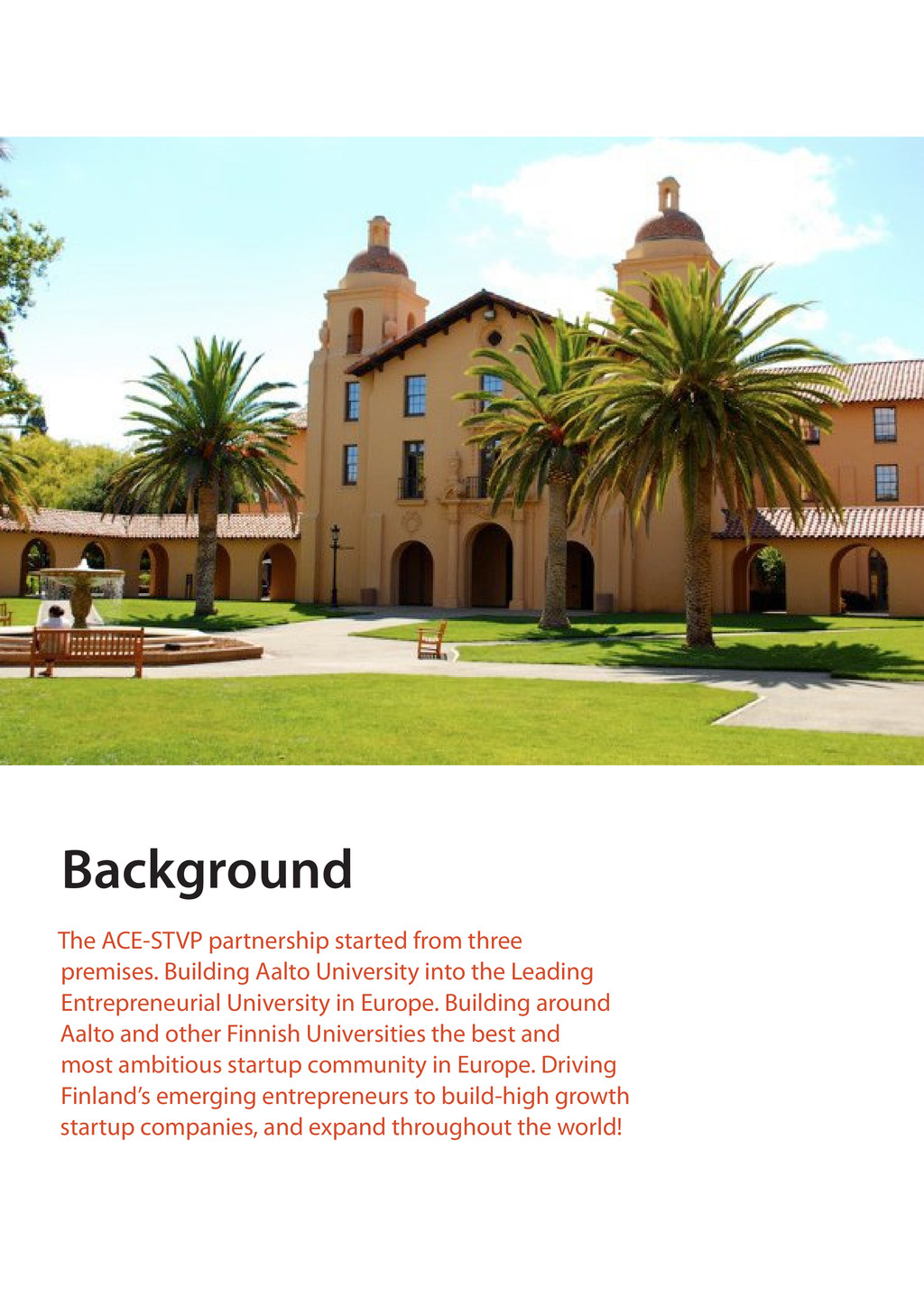
  8. Background The ACE-STVP partnership started from three premises. Building Aalto

    University into the Leading Entrepreneurial University in Europe. Building around Aalto and other Finnish Universities the best and most ambitious startup community in Europe. Driving Finland’s emerging entrepreneurs to build-high growth startup companies, and expand throughout the world!
  9. T he Aalto Center for Entrepreneurship (ACE) launched a 3-years

    partnership program in March 2011 with Stanford Technology Ventures Program (STVP) that is the most recognized Growth Entrepreneurship Education brand in the world. The program aims to transfer knowhow from STVP to Aalto, and to create brand new know-how based on the interaction of the two universities around the subject of Growth Entrepreneurship and Venturing. Te program is strongly supported by TEKES, the Finnish Funding Agency for Technology and Innovation. The Partnership opens up a two-way flow of ideas, content and people between Stanford Technology Ventures Program and Aalto’s students, researchers, and professors. It aims to bring long-term impact to Finland, recognizing that we need to achieve “quick wins” to dem- onstrate the potential, as well as to bring lasting commitment to Stanford who is constantly approached by potential international partners. The activities are considered in terms of whole Aalto ecosystem in Finland and the Baltic Rim, and thus the program is open to other Universities in Finland already during late 2011, and then will be expanded to other Baltic Rim universities in 2012-2013. The program aims create brand new know-how based on the subject of Growth Entrepreneurship and Venturing. In practice, the activities during 2011-2013 will offer Aalto students possibility to participate courses in STVP-program, support on theses and interning in Silicon Valley. For Aalto person- nel the partnership offers support from in research, study trips to Stanford and the Valley and help in creating entrepreneurship curriculum, as well as direct content and teaching support. In addition, Aalto will host the Accel REE conference in September 2012, the first time it has been organized in Finland. ACE will organize open events and lectures whenever hosting a high-profile Stanford visitor. First in the line was Donna Novitsky’s visit in March, which will be followed by big time experts such as Riitta Katila, Forrest Glick, Steve Blank, Tina Seelig and Tom Byers in 2011. All the public events will be listed on ACE’s web-page. Excellent potential, major opportunities According to Tina Seelig, the executive director of STVP, “One of the main reasons Aalto University was chosen as our first official European partner is the remarkable startup culture created by the students of Aalto Entrepreneurship Society. We also see excellent potential in the multidisciplinary model of Aalto University, which has many links already in place with
  10. T he Aalto Center for Entrepreneurship (ACE) launched a 3-years

    partnership program in March 2011 with Stanford Technology Ventures Program (STVP) that is the most recognized Growth Entrepreneurship Education brand in the world. The program aims to transfer knowhow from STVP to Aalto, and to create brand new know-how based on the inter- action of the two universities around the subject of Growth Entrepreneurship and Venturing. Te program is strongly supported by TEKES, the Finnish Funding Agency for Technology and Innovation. The Partnership opens up a two-way flow of ideas, content and people between Stanford Technology Ventures Program and Aalto’s students, researchers, and professors. It aims to bring long-term impact to Finland, recognizing that we need to achieve “quick wins” to demonstrate the potential, as well as to bring lasting commitment to Stanford who is constantly approached by potential international partners. The activities are considered in terms of whole Aalto ecosystem in Finland and the Baltic Rim, and thus the program is open to other Universities in Finland already during late 2011, and then will be expanded to other Baltic Rim uni- versities in 2012-2013. Through workshops and courses run by the world- leading experts of Stanford University, our students, faculty and startups will gain unique learning opportunities In practice, the activities during 2011-2013 will offer Aalto students possibility to participate courses in STVP-program, support on theses and interning in Silicon Valley. For Aalto personnel the partnership offers support from in research, study trips to Stanford and the Valley and help in creating entrepreneurship curriculum, as well as direct content and teaching support. In addition, Aalto will host the Accel REE conference in September 2012, the first time it has been organized in Finland. ACE will organize open events and lectures whenever hosting a high-profile Stanford visitor. First in the line was Donna Novitsky’s visit in March, which will be followed by big time experts such as Riitta Katila, Forrest Glick, Steve Blank, Tina Seelig and Tom Byers in 2011. All the public events will be listed on ACE’s web-page. Excellent potential, major opportunities According to Tina Seelig, the executive director of STVP, “One of the main reasons Aalto University was chosen as our first official European partner is the remarkable startup culture created by the students of Aalto Entrepreneurship Society. We also see excellent potential in the multidisciplinary model of Aalto University, which has many links already in place with Stanford. In addition, we admire the award-winning, grassroots impact the entrepreneurial students have had at the university and across Finland. We look forward to contributing to this effort.”
  11. “This partnership is a major opportunity for Aalto University. Through

    workshops and courses run by the world-leading experts of Stanford University, our students, faculty and startups will gain unique learning opportunities,” says Will Cardwell, head of Aalto Center for Entrepreneurship. Happened so far Aalto and TEKES began a 3-year partnership with Stanford Technology Ventures Program in January 2011. STVP was selected as our partner since it is acknowledged as the leading growth entrepreneurship education program in the world, and is targeted at equipping engineers with the tools to act as entrepreneurs within any organiza- tion they choose to enter. Since we announced the partnership, their reputation has only grown – recently STVP won a large and highly-competed grant from the National Science Foundation to develop an approach to entre- preneurship that can be implemented within any engineering or research organization. In addition and very importantly, Stanford is rated as the 2nd best research university in the world in the most recent Shanghai ratings, proving and entrepreneurial mindset can exist alongside very high-end research. The end goal is to use this partnership as a platform to change the ambition and passion level of future entrepre- neurs emerging from Finnish research and student communities. We initially created the following 3-year roadmap: 2011 Inspiring the Stanford Faculty on the potential of Finland; Inspiring the Aalto community, and the broader Finnish University community, on the value of collaborating with Stanford to raise the level of Finnish growth entrepreneurship; Identifying key Aalto faculty and student changemakers, and executing initial exchanges 2012 Facilitating a growing amount of exchange between the universities around the subject of creating high-growth startups; Building the Aalto Ventures Program curriculum and offering first courses; Continuing inspiration, and in particular globally marketing the interim results by i.e. execut- ing the Accel Roundtable on Entrepreneurship Education (September 5-7, 2012) 2013 Building out the new Aalto Ventures Program curriculum, adding additional courses and con- tent; Continuing to inspire, develop, and exchange students and faculty.
  12. 2011 has brought some major accomplishments, which will be fully

    documented by the middle of December. Over the last year we have brought 8 high profile Stanford Technology Venture Program team members to Finland, each with different themes depending on their special areas. Mike Lyons, Curriculum development; Mike is co- teaching “New Venture Formation” course atAalto with Will Cardwell in Q1 2012. Donna Novitsky, Coaching Startups; Donna met with more than 10 startups in Helsinki, did a major public presenta- tion, and travelled to Tampere to coach Tampere-based startups. She has subsequently helped a number of Aalto based startups in the Valley. Tina Seelig, Creativity and Education operational man- agement of entrepreneurship programs; Tina did a major public presentation, and met a number of members of Aalto and TEKES management. Tom Byers, Curriculum Development and strategic man- agement of entrepreneurship programs; Tom did 2 public talks, and led a full-day workshop with Aalto’s faculty entrepreneurial changemakers. Steve Blank, Startup creation and growth, ecosystem development; In his one week visit, Steve reached in public appearances 1000s of entrepreneurs, coached 17 startups, delivered 12 lectures, made 9 interviews, met 8 VCs, participated in 4 panels, met 2 ministers, 2 members of parliament, 1 public pension fund, and was featured in a TV documentary. In addition he is in the process of investing into 2 Aalto-based startups, and made the clear point that Finnish startups can and will compete on the global stage. Riitta Katila, Execution of growth entrepreneurship research; Riitta led a doctoral colloquium and coached nearly 10 doctoral and masters students one-to-one. Kathy Eisenhardt, Strategic management and entrepre- neurship; Kathy led a doctoral colloquium, and received an honorary doctorate from Aalto. Forrest Glick, media and communications of entre- preneurship programs: Forrest led a public session on communication skills, and coached ACE and Aalto Entrepreneurship Society on its media strategy, which has led to excellent new content that can be seen at both AES and ACE websites and YouTube/ Vimeo channels. We have sent 6 interns to work in Valley-based startups through our Startup Life program, living and working for at least 3 months each. We have sent over 100 students to network in the Valley, many of whom are starting to build their own startups and are leveraging the Stanford network. Finally, we are preparing for a major Aalto faculty visit to Stanford, where 10 faculty members will take part in a transformative program led by the STVP team. While preparing for this event, we have been able to identify the most motivated and well-suited Aalto faculty members, across the 3 campuses, to drive forward our Aalto Ventures Program curriculum development. In addition to building on all the achievements of 2011, 2012 will feature the execution of the Accel Roundtable for Entrepreneurial Education in September 5-7 2012 (Finnish Entrepreneurship Week). Entrepreneurship edu- cators from all over the world will attend, and we will build around it a showcase of the partnership and the Finnish startup community. The collaboration has dramatically increased the entrepre- neurial spirit in and around the Aalto Campus, and raised the ambition level and confidence of emerging entrepre- neurs. The significant contribution of the Finnish Funding Agency for Technology and Innovation, Tekes, is gratefully acknowledged. The collaboration has dramatically increased the entrepreneurial spirit in and around the Aalto Campus
  13. Resources Following section includes some resources on the visiting faculty,

    STVP, Aalto as well as the Silicon Valley scene.
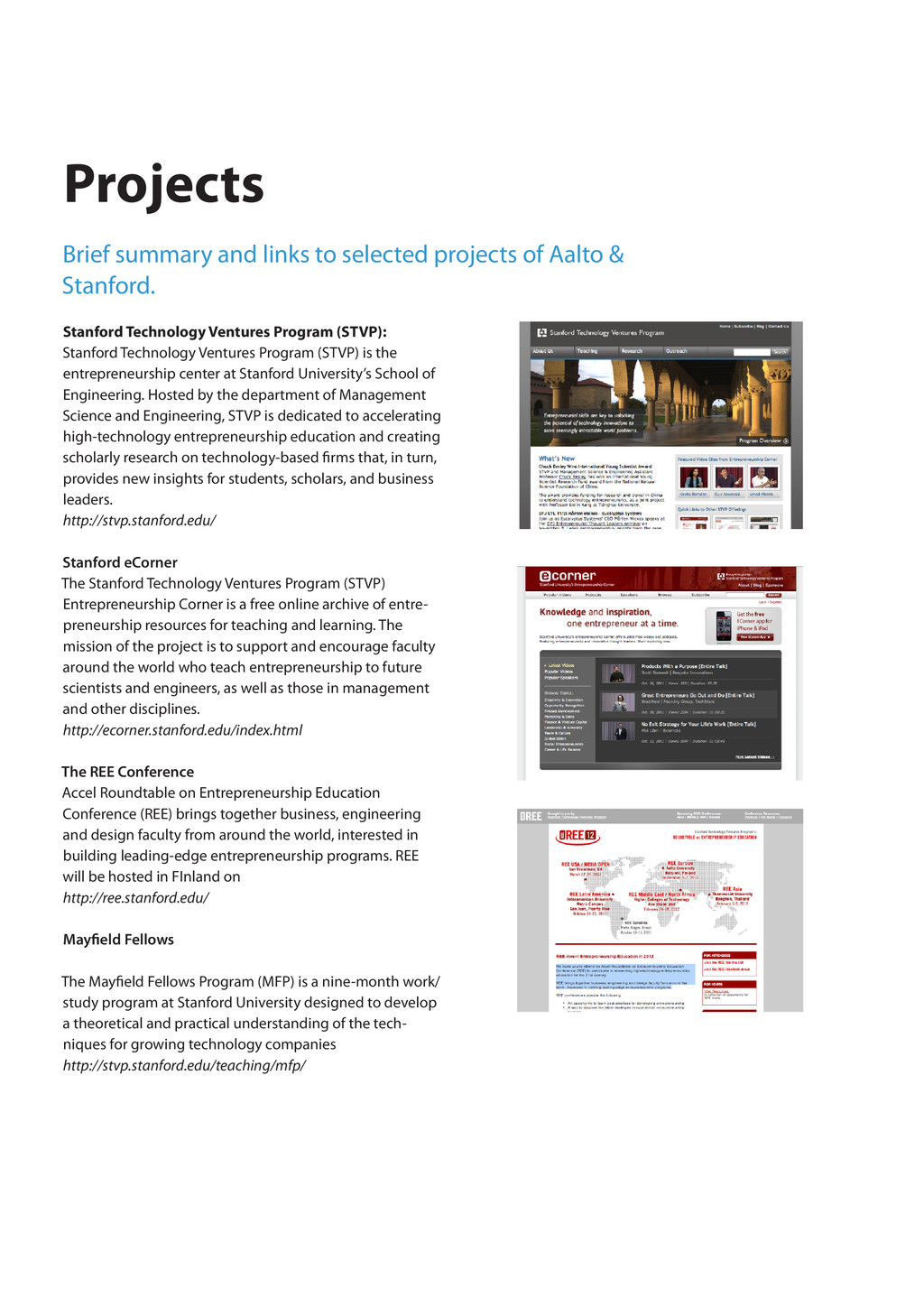
  14. Stanford Technology Ventures Program (STVP): Stanford Technology Ventures Program (STVP)

    is the entrepreneurship center at Stanford University’s School of Engineering. Hosted by the department of Management Science and Engineering, STVP is dedicated to accelerating high-technology entrepreneurship education and creating scholarly research on technology-based firms that, in turn, provides new insights for students, scholars, and business leaders. http://stvp.stanford.edu/ Stanford eCorner The Stanford Technology Ventures Program (STVP) Entrepreneurship Corner is a free online archive of entre- preneurship resources for teaching and learning. The mission of the project is to support and encourage faculty around the world who teach entrepreneurship to future scientists and engineers, as well as those in management and other disciplines. http://ecorner.stanford.edu/index.html The REE Conference Accel Roundtable on Entrepreneurship Education Conference (REE) brings together business, engineering and design faculty from around the world, interested in building leading-edge entrepreneurship programs. REE will be hosted in FInland on http://ree.stanford.edu/ Mayfield Fellows The Mayfield Fellows Program (MFP) is a nine-month work/ study program at Stanford University designed to develop a theoretical and practical understanding of the tech- niques for growing technology companies http://stvp.stanford.edu/teaching/mfp/ Projects Brief summary and links to selected projects of Aalto & Stanford.
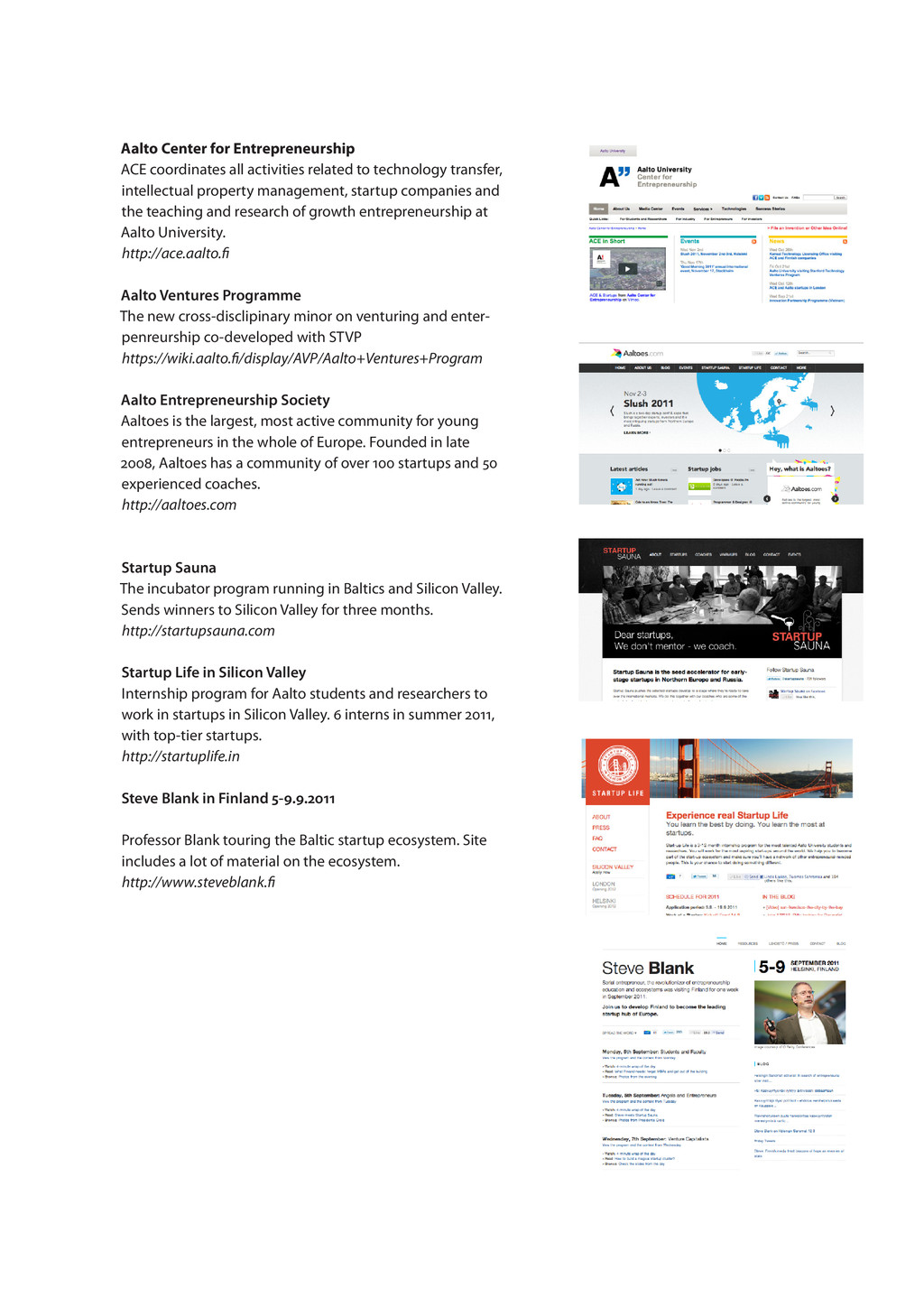
  15. Aalto Center for Entrepreneurship ACE coordinates all activities related to

    technology transfer, intellectual property management, startup companies and the teaching and research of growth entrepreneurship at Aalto University. http://ace.aalto.fi Aalto Ventures Programme The new cross-disclipinary minor on venturing and enter- penreurship co-developed with STVP https://wiki.aalto.fi/display/AVP/Aalto+Ventures+Program Aalto Entrepreneurship Society Aaltoes is the largest, most active community for young entrepreneurs in the whole of Europe. Founded in late 2008, Aaltoes has a community of over 100 startups and 50 experienced coaches. http://aaltoes.com Startup Sauna The incubator program running in Baltics and Silicon Valley. Sends winners to Silicon Valley for three months. http://startupsauna.com Startup Life in Silicon Valley Internship program for Aalto students and researchers to work in startups in Silicon Valley. 6 interns in summer 2011, with top-tier startups. http://startuplife.in Steve Blank in Finland 5-9.9.2011 Professor Blank touring the Baltic startup ecosystem. Site includes a lot of material on the ecosystem. http://www.steveblank.fi
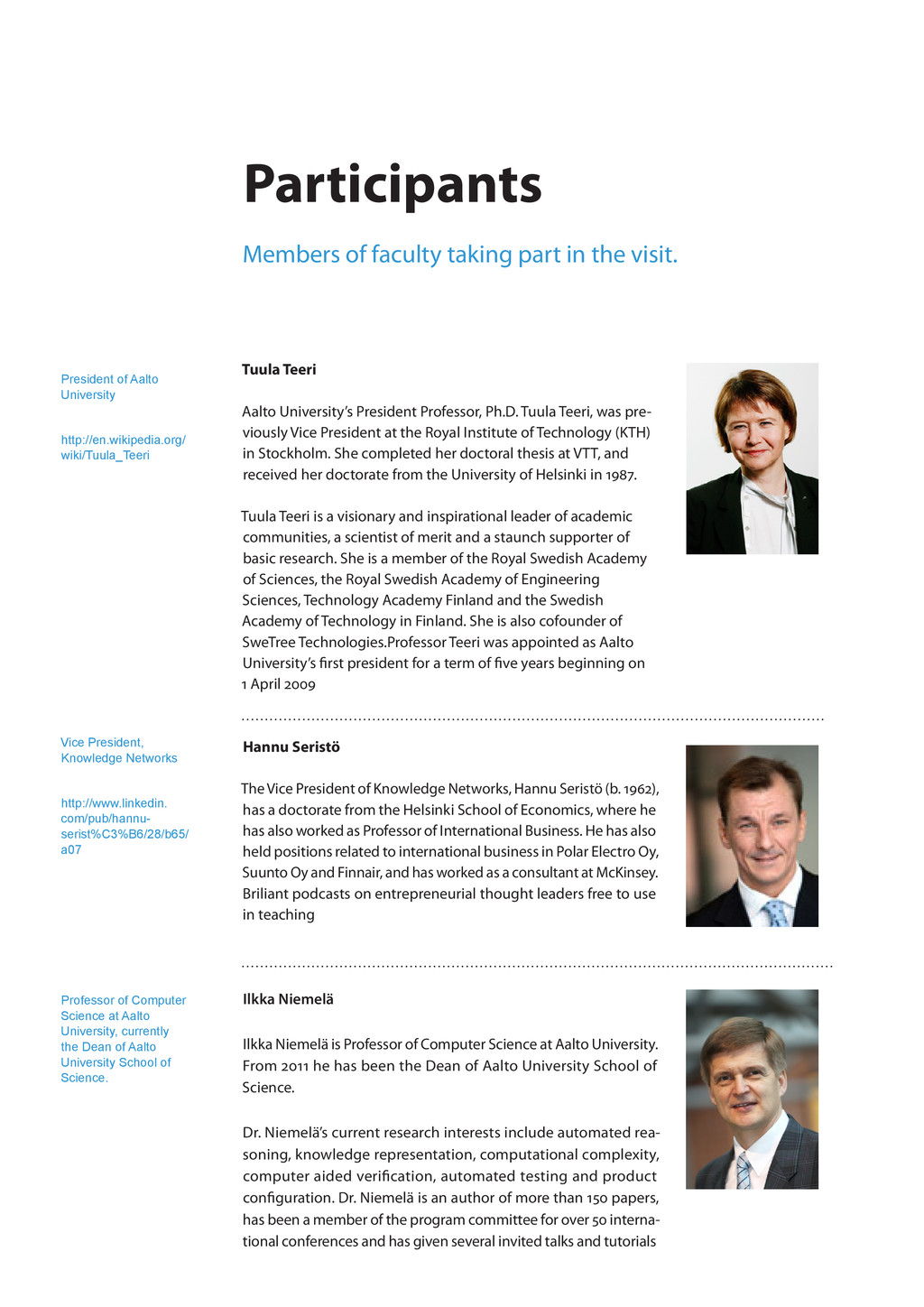
  16. Participants Members of faculty taking part in the visit. Tuula
    Teeri Aalto University’s President Professor, Ph.D. Tuula Teeri, was pre- viously Vice President at the Royal Institute of Technology (KTH) in Stockholm. She completed her doctoral thesis at VTT, and received her doctorate from the University of Helsinki in 1987. Tuula Teeri is a visionary and inspirational leader of academic communities, a scientist of merit and a staunch supporter of basic research. She is a member of the Royal Swedish Academy of Sciences, the Royal Swedish Academy of Engineering Sciences, Technology Academy Finland and the Swedish Academy of Technology in Finland. She is also cofounder of SweTree Technologies.Professor Teeri was appointed as Aalto University’s first president for a term of five years beginning on 1 April 2009 Hannu Seristö The Vice President of Knowledge Networks, Hannu Seristö (b. 1962), has a doctorate from the Helsinki School of Economics, where he has also worked as Professor of International Business. He has also held positions related to international business in Polar Electro Oy, Suunto Oy and Finnair, and has worked as a consultant at McKinsey. Briliant podcasts on entrepreneurial thought leaders free to use in teaching Ilkka Niemelä Ilkka Niemelä is Professor of Computer Science at Aalto University. From 2011 he has been the Dean of Aalto University School of Science. Dr. Niemelä’s current research interests include automated rea- soning, knowledge representation, computational complexity, computer aided verification, automated testing and product configuration. Dr. Niemelä is an author of more than 150 papers, has been a member of the program committee for over 50 interna- tional conferences and has given several invited talks and tutorials President of Aalto University http://en.wikipedia.org/ wiki/Tuula_Teeri Vice President, Knowledge Networks http://www.linkedin. com/pub/hannu- serist%C3%B6/28/b65/ a07 Professor of Computer Science at Aalto University, currently the Dean of Aalto University School of Science.
  17. Will Cardwell Will is currently run the Aalto Center for

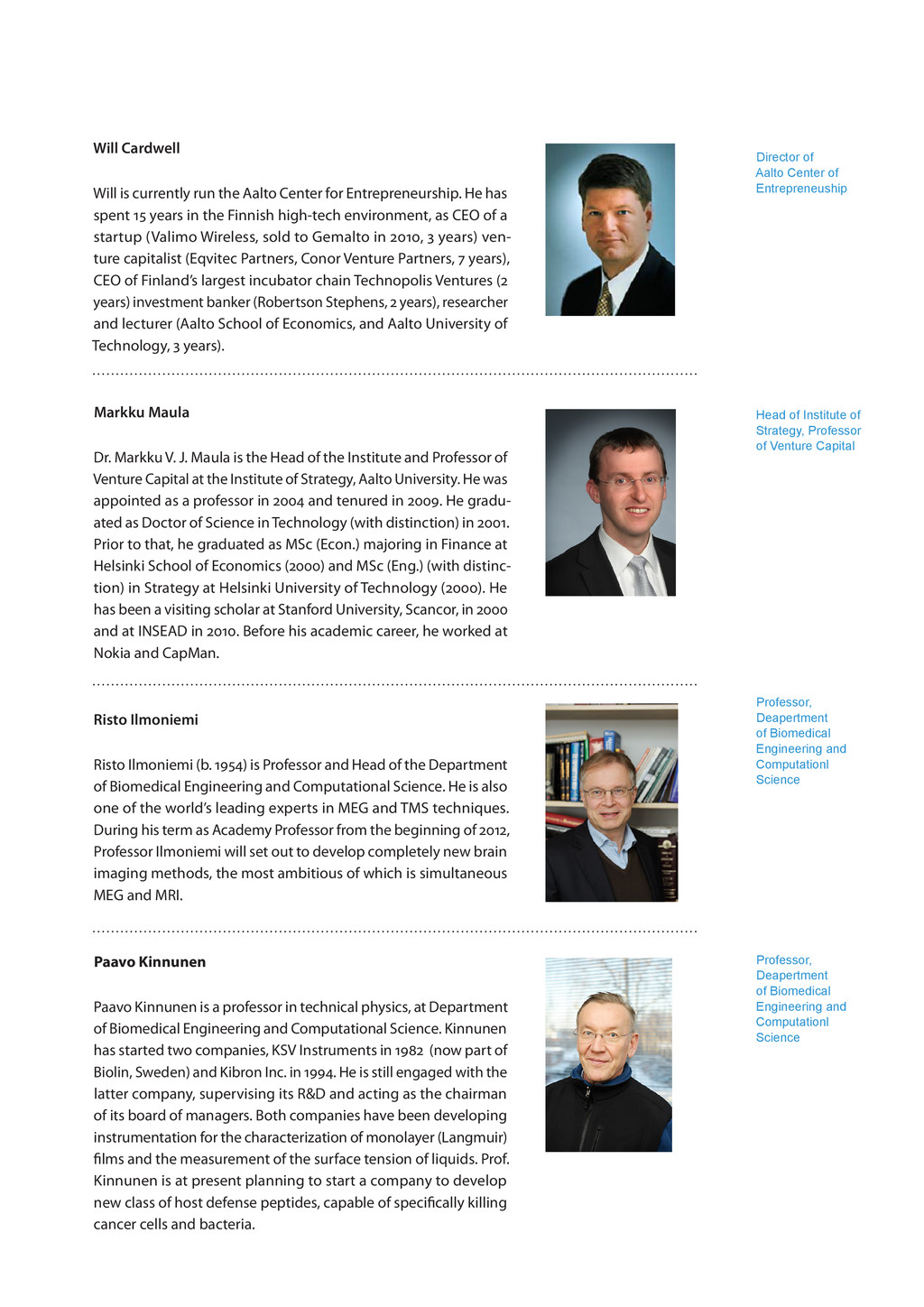
    Entrepreneurship. He has spent 15 years in the Finnish high-tech environment, as CEO of a startup (Valimo Wireless, sold to Gemalto in 2010, 3 years) ven- ture capitalist (Eqvitec Partners, Conor Venture Partners, 7 years), CEO of Finland’s largest incubator chain Technopolis Ventures (2 years) investment banker (Robertson Stephens, 2 years), researcher and lecturer (Aalto School of Economics, and Aalto University of Technology, 3 years). Markku Maula Dr. Markku V. J. Maula is the Head of the Institute and Professor of Venture Capital at the Institute of Strategy, Aalto University. He was appointed as a professor in 2004 and tenured in 2009. He gradu- ated as Doctor of Science in Technology (with distinction) in 2001. Prior to that, he graduated as MSc (Econ.) majoring in Finance at Helsinki School of Economics (2000) and MSc (Eng.) (with distinc- tion) in Strategy at Helsinki University of Technology (2000). He has been a visiting scholar at Stanford University, Scancor, in 2000 and at INSEAD in 2010. Before his academic career, he worked at Nokia and CapMan. Risto Ilmoniemi Risto Ilmoniemi (b. 1954) is Professor and Head of the Department of Biomedical Engineering and Computational Science. He is also one of the world’s leading experts in MEG and TMS techniques. During his term as Academy Professor from the beginning of 2012, Professor Ilmoniemi will set out to develop completely new brain imaging methods, the most ambitious of which is simultaneous MEG and MRI. Paavo Kinnunen Paavo Kinnunen is a professor in technical physics, at Department of Biomedical Engineering and Computational Science. Kinnunen has started two companies, KSV Instruments in 1982 (now part of Biolin, Sweden) and Kibron Inc. in 1994. He is still engaged with the latter company, supervising its R&D and acting as the chairman of its board of managers. Both companies have been developing instrumentation for the characterization of monolayer (Langmuir) films and the measurement of the surface tension of liquids. Prof. Kinnunen is at present planning to start a company to develop new class of host defense peptides, capable of specifically killing cancer cells and bacteria. Director of Aalto Center of Entrepreneuship Head of Institute of Strategy, Professor of Venture Capital Professor, Deapertment of Biomedical Engineering and Computationl Science Professor, Deapertment of Biomedical Engineering and Computationl Science
  18. Jouni Partanen Dr. Jouni Partanen is Director of the BIT

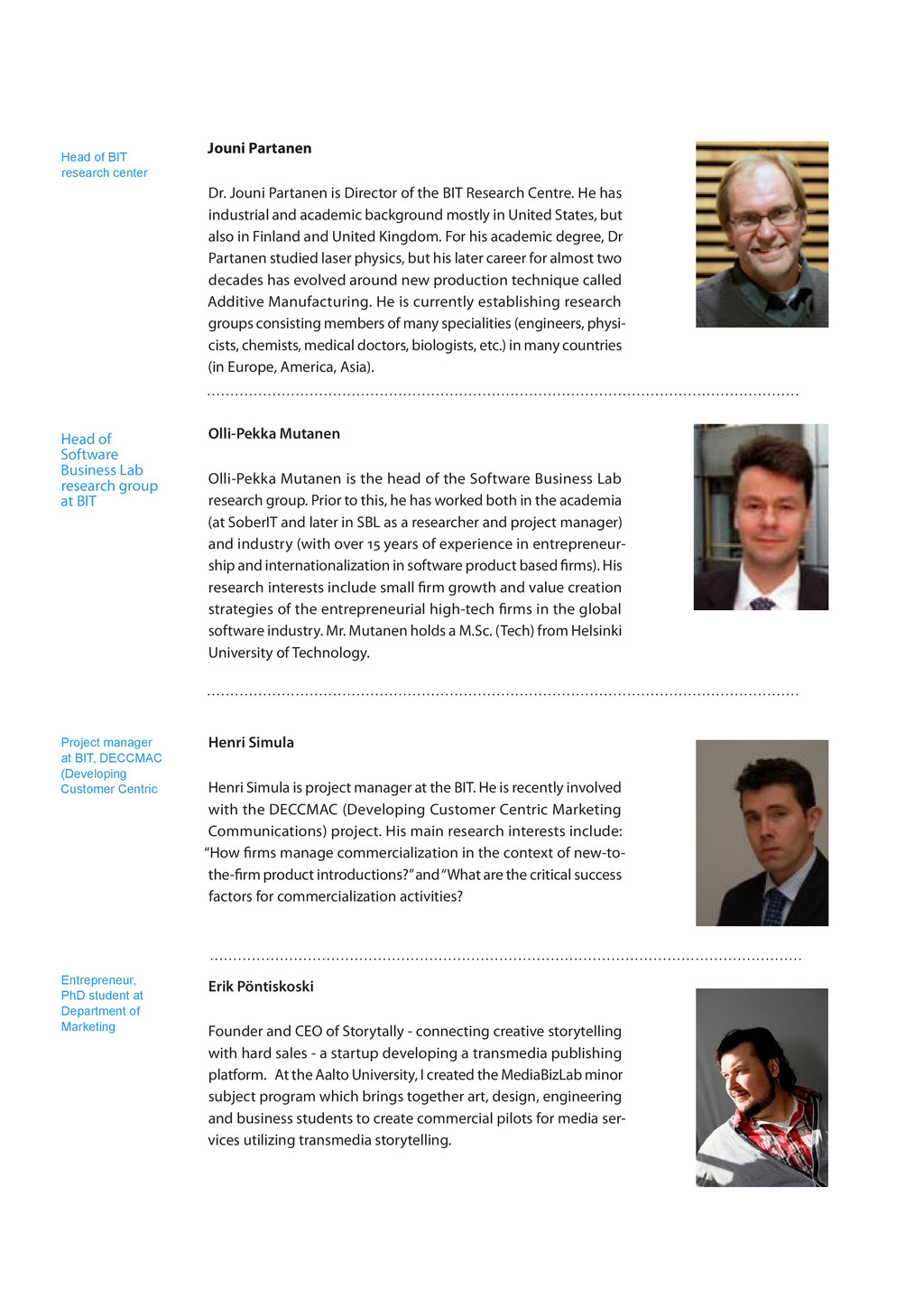
    Research Centre. He has industrial and academic background mostly in United States, but also in Finland and United Kingdom. For his academic degree, Dr Partanen studied laser physics, but his later career for almost two decades has evolved around new production technique called Additive Manufacturing. He is currently establishing research groups consisting members of many specialities (engineers, physi- cists, chemists, medical doctors, biologists, etc.) in many countries (in Europe, America, Asia). Olli-Pekka Mutanen Olli-Pekka Mutanen is the head of the Software Business Lab research group. Prior to this, he has worked both in the academia (at SoberIT and later in SBL as a researcher and project manager) and industry (with over 15 years of experience in entrepreneur- ship and internationalization in software product based firms). His research interests include small firm growth and value creation strategies of the entrepreneurial high-tech firms in the global software industry. Mr. Mutanen holds a M.Sc. (Tech) from Helsinki University of Technology. Henri Simula Henri Simula is project manager at the BIT. He is recently involved with the DECCMAC (Developing Customer Centric Marketing Communications) project. His main research interests include: “How firms manage commercialization in the context of new-to- the-firm product introductions?” and “What are the critical success factors for commercialization activities? Erik Pöntiskoski Founder and CEO of Storytally - connecting creative storytelling with hard sales - a startup developing a transmedia publishing platform. At the Aalto University, I created the MediaBizLab minor subject program which brings together art, design, engineering and business students to create commercial pilots for media ser- vices utilizing transmedia storytelling. Head of BIT research center Head of Software Business Lab research group at BIT Project manager at BIT, DECCMAC (Developing Customer Centric Entrepreneur, PhD student at Department of Marketing
  19. Professor, Department of Design Researcher, Department of International Business Peter

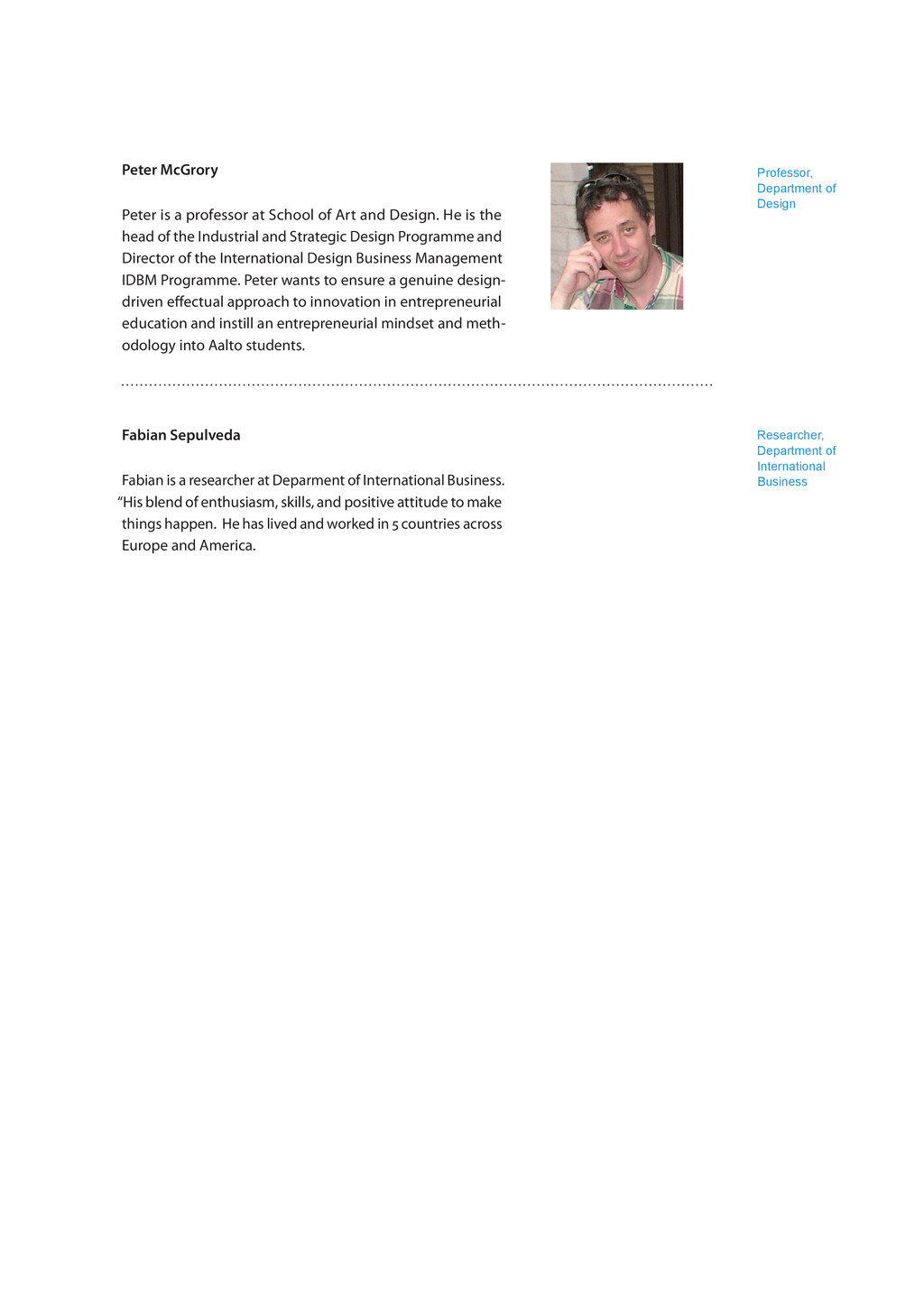
    McGrory Peter is a professor at School of Art and Design. He is the head of the Industrial and Strategic Design Programme and Director of the International Design Business Management IDBM Programme. Peter wants to ensure a genuine design- driven effectual approach to innovation in entrepreneurial education and instill an entrepreneurial mindset and meth- odology into Aalto students. Fabian Sepulveda Fabian is a researcher at Deparment of International Business. “His blend of enthusiasm, skills, and positive attitude to make things happen. He has lived and worked in 5 countries across Europe and America.
  20. Hosts People & places we’ll be visiting during the week.

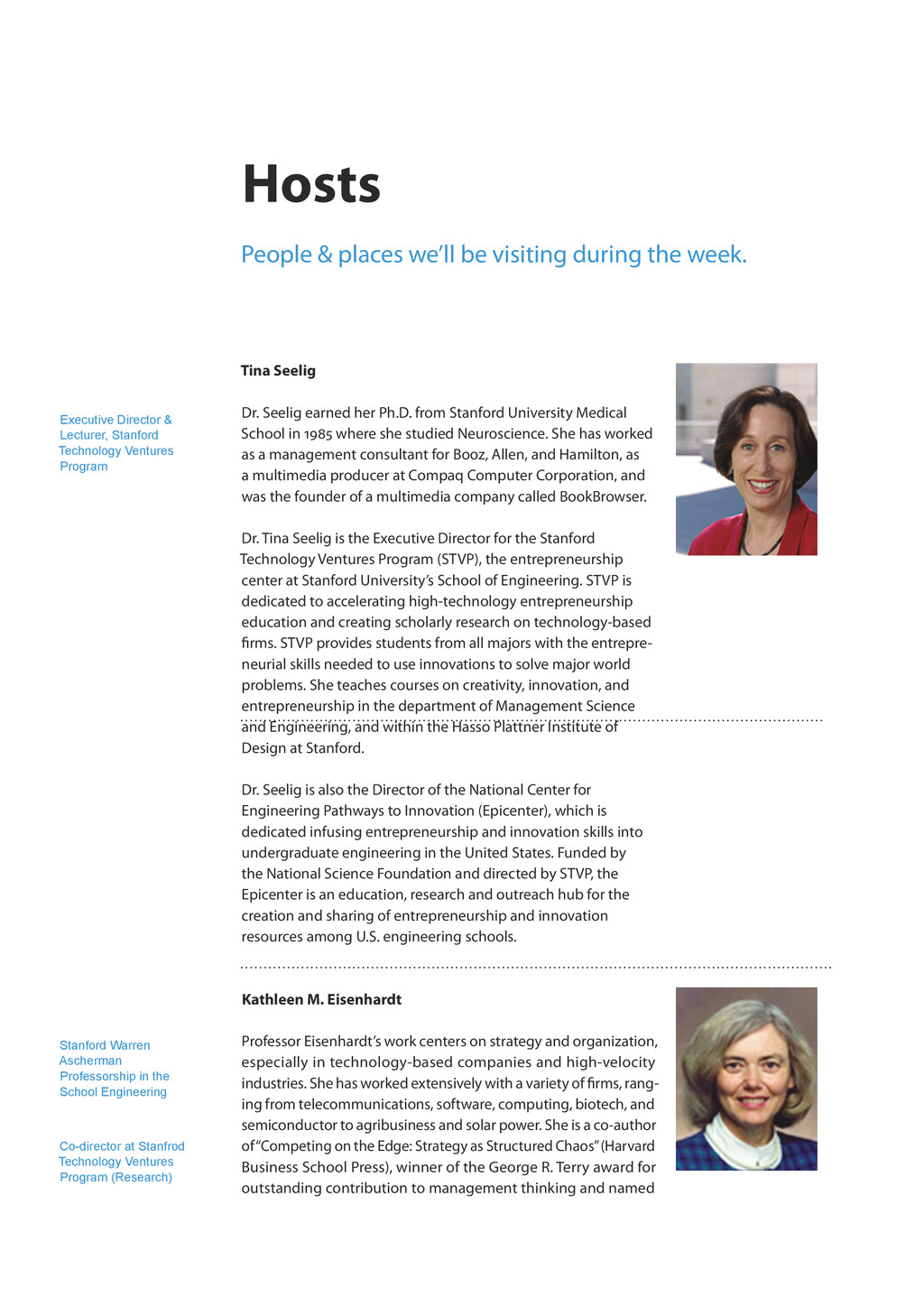
    Tina Seelig Dr. Seelig earned her Ph.D. from Stanford University Medical School in 1985 where she studied Neuroscience. She has worked as a management consultant for Booz, Allen, and Hamilton, as a multimedia producer at Compaq Computer Corporation, and was the founder of a multimedia company called BookBrowser. Dr. Tina Seelig is the Executive Director for the Stanford Technology Ventures Program (STVP), the entrepreneurship center at Stanford University’s School of Engineering. STVP is dedicated to accelerating high-technology entrepreneurship education and creating scholarly research on technology-based firms. STVP provides students from all majors with the entrepre- neurial skills needed to use innovations to solve major world problems. She teaches courses on creativity, innovation, and entrepreneurship in the department of Management Science and Engineering, and within the Hasso Plattner Institute of Design at Stanford. Dr. Seelig is also the Director of the National Center for Engineering Pathways to Innovation (Epicenter), which is dedicated infusing entrepreneurship and innovation skills into undergraduate engineering in the United States. Funded by the National Science Foundation and directed by STVP, the Epicenter is an education, research and outreach hub for the creation and sharing of entrepreneurship and innovation resources among U.S. engineering schools. Kathleen M. Eisenhardt Professor Eisenhardt’s work centers on strategy and organization, especially in technology-based companies and high-velocity industries. She has worked extensively with a variety of firms, rang- ing from telecommunications, software, computing, biotech, and semiconductor to agribusiness and solar power. She is a co-author of “Competing on the Edge: Strategy as Structured Chaos” (Harvard Business School Press), winner of the George R. Terry award for outstanding contribution to management thinking and named Executive Director & Lecturer, Stanford Technology Ventures Program Stanford Warren Ascherman Professorship in the School Engineering Co-director at Stanfrod Technology Ventures Program (Research)
  21. one of the top 10 business and investing books by

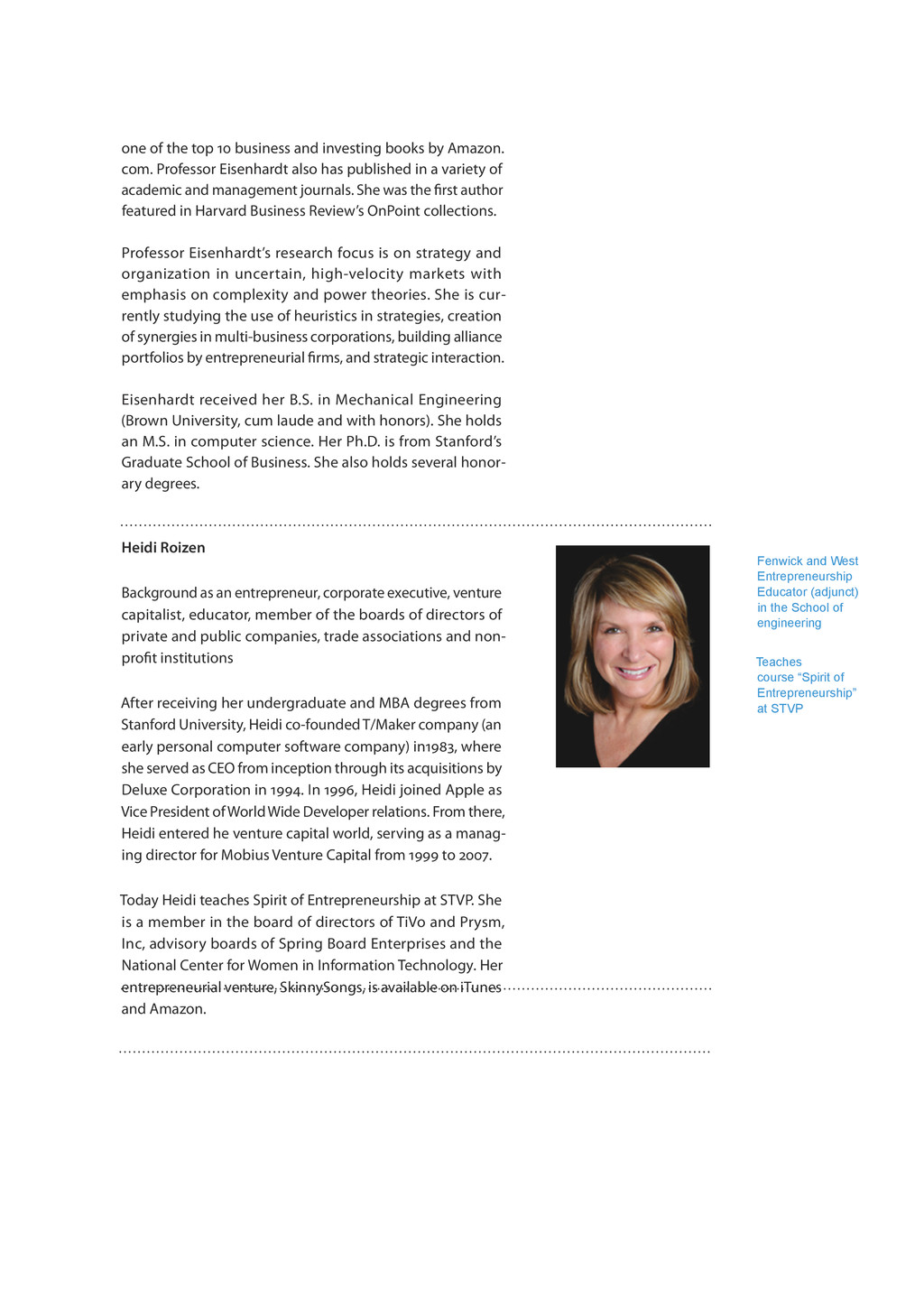
    Amazon. com. Professor Eisenhardt also has published in a variety of academic and management journals. She was the first author featured in Harvard Business Review’s OnPoint collections. Professor Eisenhardt’s research focus is on strategy and organization in uncertain, high-velocity markets with emphasis on complexity and power theories. She is cur- rently studying the use of heuristics in strategies, creation of synergies in multi-business corporations, building alliance portfolios by entrepreneurial firms, and strategic interaction. Eisenhardt received her B.S. in Mechanical Engineering (Brown University, cum laude and with honors). She holds an M.S. in computer science. Her Ph.D. is from Stanford’s Graduate School of Business. She also holds several honor- ary degrees. Heidi Roizen Background as an entrepreneur, corporate executive, venture capitalist, educator, member of the boards of directors of private and public companies, trade associations and non- profit institutions After receiving her undergraduate and MBA degrees from Stanford University, Heidi co-founded T/Maker company (an early personal computer software company) in1983, where she served as CEO from inception through its acquisitions by Deluxe Corporation in 1994. In 1996, Heidi joined Apple as Vice President of World Wide Developer relations. From there, Heidi entered he venture capital world, serving as a manag- ing director for Mobius Venture Capital from 1999 to 2007. Today Heidi teaches Spirit of Entrepreneurship at STVP. She is a member in the board of directors of TiVo and Prysm, Inc, advisory boards of Spring Board Enterprises and the National Center for Women in Information Technology. Her entrepreneurial venture, SkinnySongs, is available on iTunes and Amazon. Fenwick and West Entrepreneurship Educator (adjunct) in the School of engineering Teaches course “Spirit of Entrepreneurship” at STVP
  22. Jeffrey Schox Jeffrey has a BS (Mechanical Engineering) from University

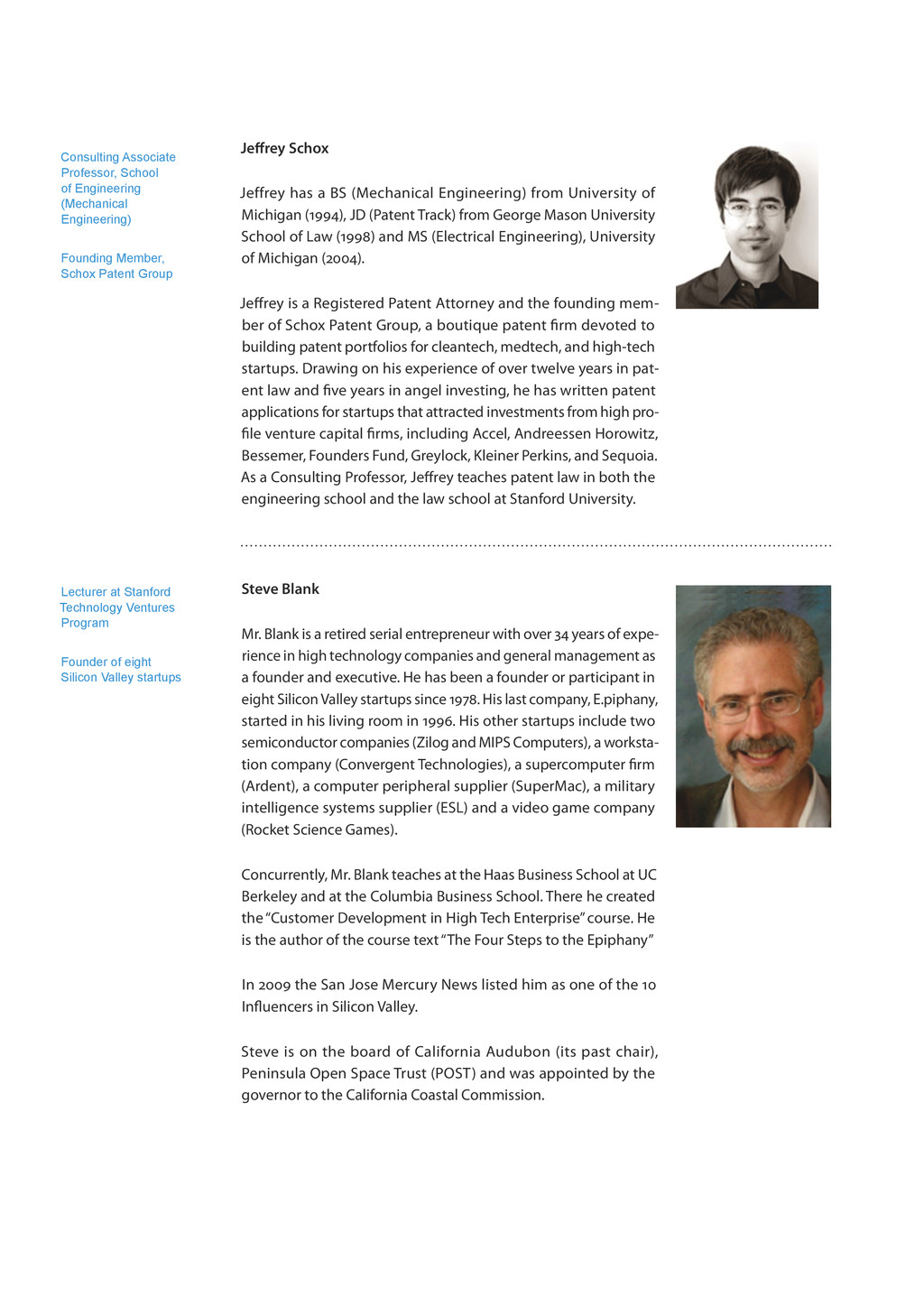
    of Michigan (1994), JD (Patent Track) from George Mason University School of Law (1998) and MS (Electrical Engineering), University of Michigan (2004). Jeffrey is a Registered Patent Attorney and the founding mem- ber of Schox Patent Group, a boutique patent firm devoted to building patent portfolios for cleantech, medtech, and high-tech startups. Drawing on his experience of over twelve years in pat- ent law and five years in angel investing, he has written patent applications for startups that attracted investments from high pro- file venture capital firms, including Accel, Andreessen Horowitz, Bessemer, Founders Fund, Greylock, Kleiner Perkins, and Sequoia. As a Consulting Professor, Jeffrey teaches patent law in both the engineering school and the law school at Stanford University. Steve Blank Mr. Blank is a retired serial entrepreneur with over 34 years of expe- rience in high technology companies and general management as a founder and executive. He has been a founder or participant in eight Silicon Valley startups since 1978. His last company, E.piphany, started in his living room in 1996. His other startups include two semiconductor companies (Zilog and MIPS Computers), a worksta- tion company (Convergent Technologies), a supercomputer firm (Ardent), a computer peripheral supplier (SuperMac), a military intelligence systems supplier (ESL) and a video game company (Rocket Science Games). Concurrently, Mr. Blank teaches at the Haas Business School at UC Berkeley and at the Columbia Business School. There he created the “Customer Development in High Tech Enterprise” course. He is the author of the course text “The Four Steps to the Epiphany” In 2009 the San Jose Mercury News listed him as one of the 10 Influencers in Silicon Valley. Steve is on the board of California Audubon (its past chair), Peninsula Open Space Trust (POST) and was appointed by the governor to the California Coastal Commission. Consulting Associate Professor, School of Engineering (Mechanical Engineering) Founding Member, Schox Patent Group Lecturer at Stanford Technology Ventures Program Founder of eight Silicon Valley startups
  23. George Kembel George graduated from Stanford University with a bachelor’s

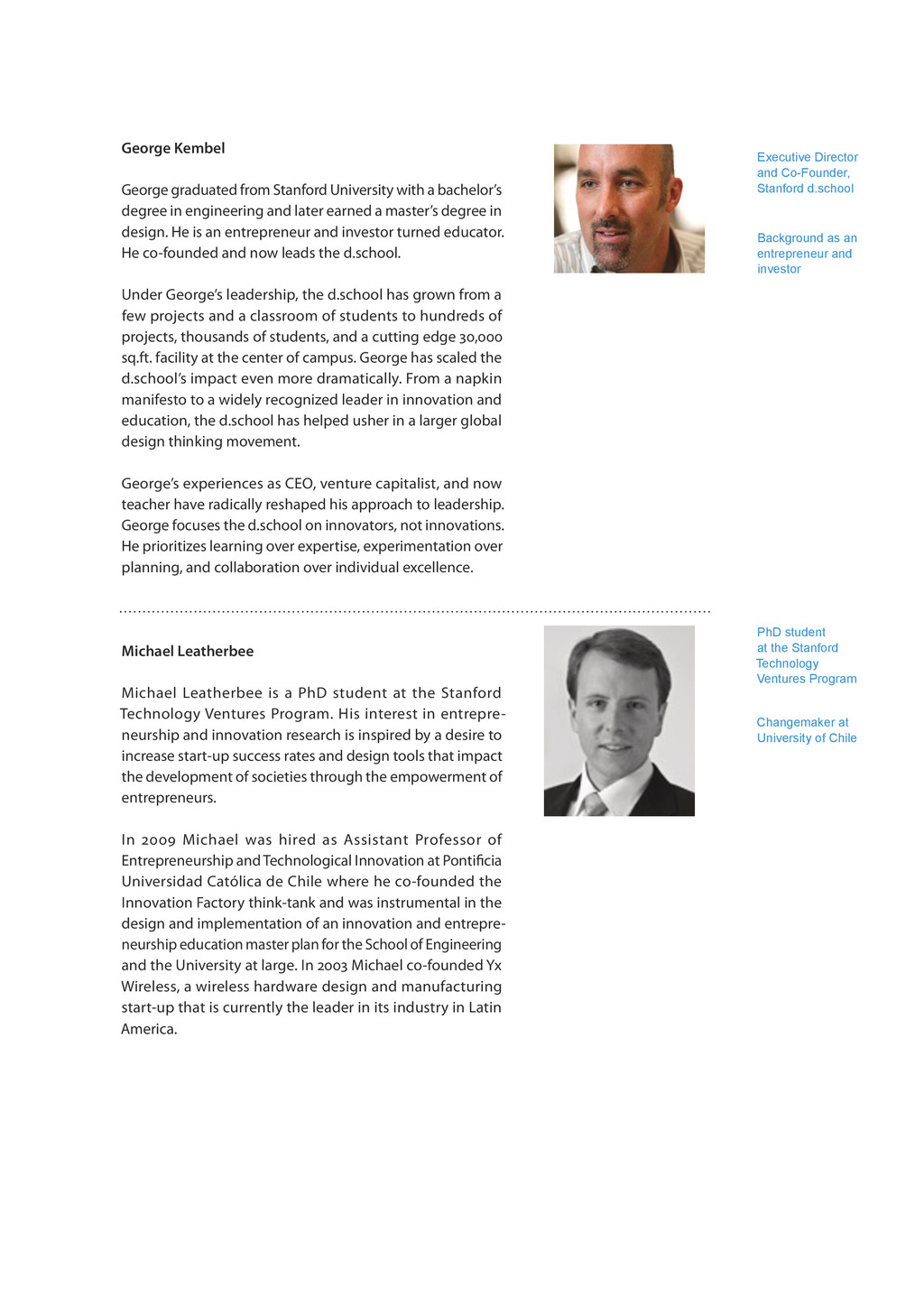
    degree in engineering and later earned a master’s degree in design. He is an entrepreneur and investor turned educator. He co-founded and now leads the d.school. Under George’s leadership, the d.school has grown from a few projects and a classroom of students to hundreds of projects, thousands of students, and a cutting edge 30,000 sq.ft. facility at the center of campus. George has scaled the d.school’s impact even more dramatically. From a napkin manifesto to a widely recognized leader in innovation and education, the d.school has helped usher in a larger global design thinking movement. George’s experiences as CEO, venture capitalist, and now teacher have radically reshaped his approach to leadership. George focuses the d.school on innovators, not innovations. He prioritizes learning over expertise, experimentation over planning, and collaboration over individual excellence. Michael Leatherbee Michael Leatherbee is a PhD student at the Stanford Technology Ventures Program. His interest in entrepre- neurship and innovation research is inspired by a desire to increase start-up success rates and design tools that impact the development of societies through the empowerment of entrepreneurs. In 2009 Michael was hired as Assistant Professor of Entrepreneurship and Technological Innovation at Pontificia Universidad Católica de Chile where he co-founded the Innovation Factory think-tank and was instrumental in the design and implementation of an innovation and entrepre- neurship education master plan for the School of Engineering and the University at large. In 2003 Michael co-founded Yx Wireless, a wireless hardware design and manufacturing start-up that is currently the leader in its industry in Latin America. Executive Director and Co-Founder, Stanford d.school Background as an entrepreneur and investor PhD student at the Stanford Technology Ventures Program Changemaker at University of Chile
  24. AVP hosted by the Department of Industrial Engineering and Management

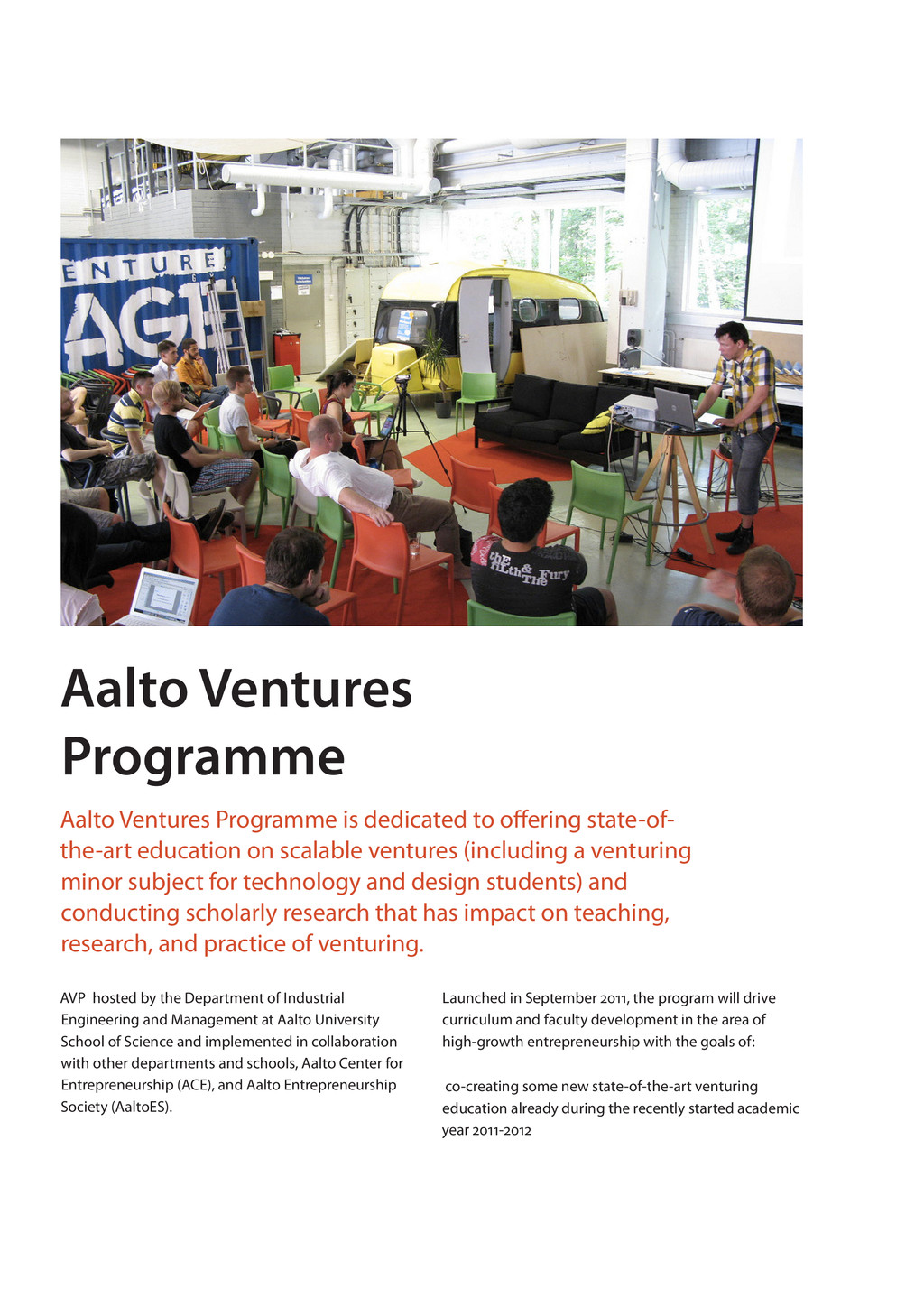
    at Aalto University School of Science and implemented in collaboration with other departments and schools, Aalto Center for Entrepreneurship (ACE), and Aalto Entrepreneurship Society (AaltoES). Launched in September 2011, the program will drive curriculum and faculty development in the area of high-growth entrepreneurship with the goals of: co-creating some new state-of-the-art venturing education already during the recently started academic year 2011-2012 Aalto Ventures Programme Aalto Ventures Programme is dedicated to offering state-of- the-art education on scalable ventures (including a venturing minor subject for technology and design students) and conducting scholarly research that has impact on teaching, research, and practice of venturing.
  25. - making the already existing venturing courses more eas- ily

    and broadly available for Aalto students already during the recently started academic year 2011-2012 - co-creating venturing minor subjects to be included in the official study guide for the next academic year 2012-2013 - developing the faculty (both tenure track and adjunct), the curriculum, and the research activities for Aalto University to have a world-class venturing program by 2013 In terms of curriculum development, the roadmap for the future includes both inspiration and startup basics offered to a large proportion of technology and design students as well as intensive small group courses combin- ing the latest venturing insights and hands-on practice for those who have found the passion Existing course Venturing related courses at Aalto University already avail- able for technology students: TU-91.2003 New Venture Development I TU-91.2005 Strategic Management of Technology and Innovation TU-91.2008 New Venture Development II TU-91.2009 Entrepreneurial Finance TU-91.2035 Financial Modeling in Strategy and Venturing TU-91.2036 Contracting in Strategy and Venturing TU-91.2038 Strategies for Growth and Renewal T-128.1000 Introduction to Software Business and Venturing T-128.5400 Software Entrepreneurship Seminar This is not yet a complete list, and it will hopefully evolve fast. If you teach one that should be on the list, please add! Roadmap The roadmap for the development of the venturing cur- riculum has now been started. In terms of curriculum development, the roadmap for the future includes both inspiration and startup basics offered to a large proportion of technology and design students as well as intensive small group courses combin- ing the latest venturing insights and hands-on practice for those who have found the passion The roadmap for the develop- ment of the venturing curriculum has now been started. New course ideas being explored: “Entrepreneurial Thought Leader Seminar” Inspiration, Attitude, Courage Contacts: Erik Pöntiskoski, Peter Kelly, Juhana Nurmio, AaltoES “Entrepreneurship Driver’s License” Finding the passion & rules of the road – a prerequisite for intensive small group courses Contacts: Peter Kelly, Juhana Nurmio, qACE “Creativity & Innovation” Contacts: Peter Kelly, Peter McGrory, Juhana Nurmio “Lean Launchpad” Real life experience and coaching, in connection with Summer of Startups Contacts: Olli-Pekka Mutanen, Juhana Nurmio, AaltoES, ACE International Ventures” Contacts: Olli-Pekka Mutanen, Erkko Autio, Juhana Nurmio Do you have ideas or suggestions or would you be willing to contribute to the development and implementation of these course ideas or other courses that should be offered as a part of the venturing curriculum? If so (and hopefully so), please contact the contact persons mentioned above or Markku Maula or Juhana Nurmio
  26. Silicon Valley is a unique mixture of research, universities, business

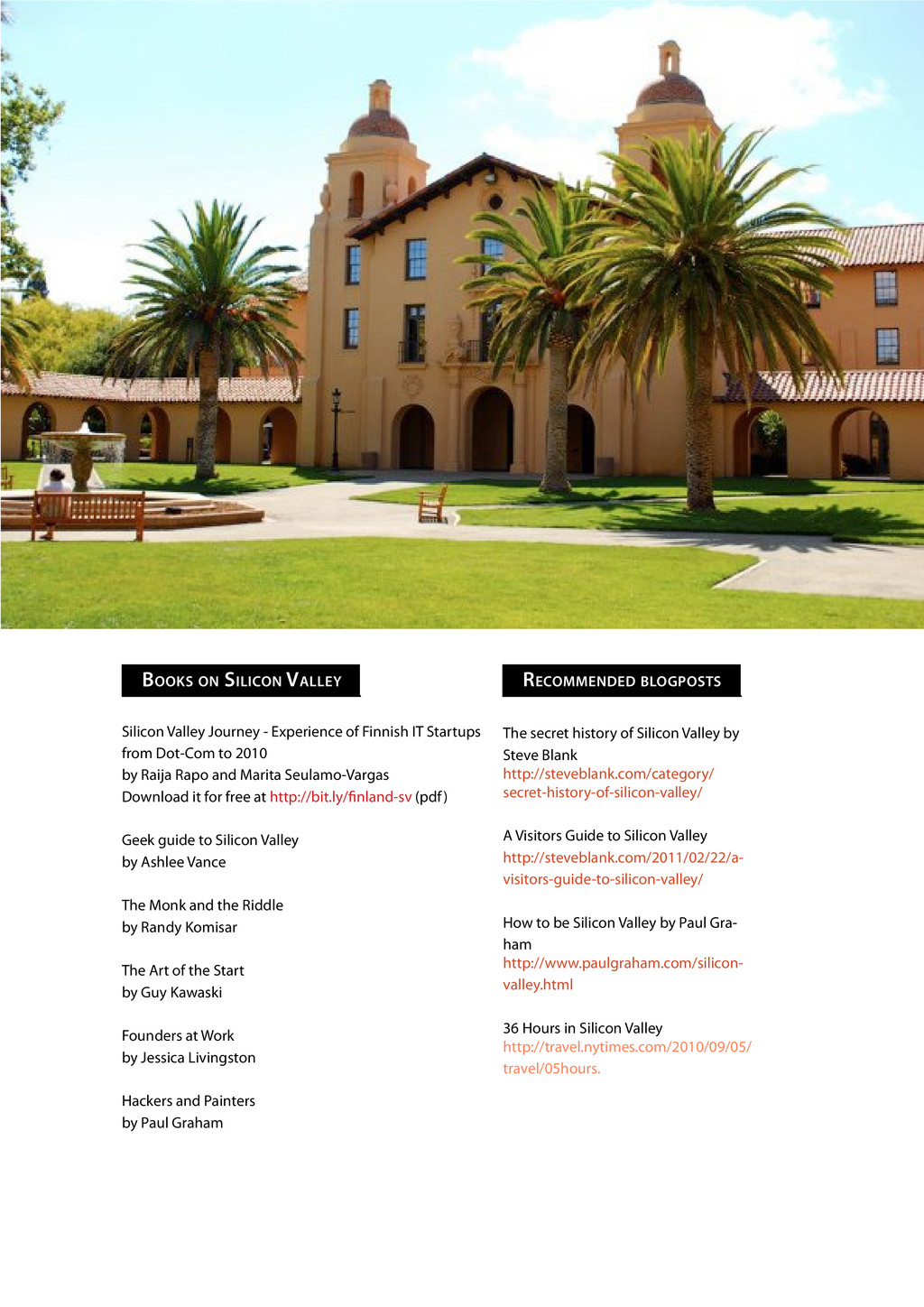
    and design that turned the area into a high- tech Mecca. Thousands of high technology companies are headquartered in Silicon Valley; among those, the following are in the Fortune 1000: Adobe Systems, Ap- ple Inc, Cisco Systems, eBay, Google, Hewlett-Packard, Intel, Nvidia, Oracle Corporation, SanDisk, Sun Microsys- tems, Symantec and Yahoo. Stanford, which is the 2nd best school in the world, lies in the heart of the Valley. While on campus, try running around the Dish (dish. stanford.edu), visit the Hoover Tower, Treehouse and the Rodarte Museum. DSchool (dschool.stanford.edu/) and STVP (stvp.stanford.edu) might also be of interest. Or why not take a peak at 165 University Avenue and it’s tiny office space that has produced a stream of block- buster companies including Google and PayPal. For the best cofee of the Valley go to Philz Coffee (3191 Middlefield Rd), for the best celebrity spotting Univer- sity Coffee (271 University Avenue) and for the best internet-fame the infamous Coffee where the iPhone 4 ptototype was discovered (Gorumet Haus Staudt 2615 Broadway) Have a beer at Antonio’s Nut House (321 California Avenue, Palo Alto) and grab a sandwich from JJFs (520 College Ave). Drive down the Sand Hill Road, where most of the big VC firms are, visit Konditorei cafeteria (3130 Alpine Road) and listen to an authentic VC pitch or catch a glimpse of a Tesla car. Drive past Mountain Views Google HQ and Y-Combi- nator. For some Garage-vibes, visit HackerDojo (140A South Whisman Rd) Short history of Silicon Valley & Stanford Silicon Valley is the southern part of the San Francisco Bay Area. The “classic SV” along the south-western corner of the bay (Cupertino, Sunnyvale, Mountain View, Palo Alto, Menlo Park) dates from the old the 60s to 80s: the term originally referred to the region’s large number of silicon chip innovators and manufacturers, but eventually came to refer to all the high-tech businesses in the area; it is now generally used as a metonym for the high-tech sector
  27. Silicon Valley Journey - Experience of Finnish IT Startups from

    Dot-Com to 2010 by Raija Rapo and Marita Seulamo-Vargas Download it for free at http://bit.ly/finland-sv (pdf) Geek guide to Silicon Valley by Ashlee Vance The Monk and the Riddle by Randy Komisar The Art of the Start by Guy Kawaski Founders at Work by Jessica Livingston Hackers and Painters by Paul Graham Books on Silicon Valley Recommended blogposts The secret history of Silicon Valley by Steve Blank http://steveblank.com/category/ secret-history-of-silicon-valley/ A Visitors Guide to Silicon Valley http://steveblank.com/2011/02/22/a- visitors-guide-to-silicon-valley/ How to be Silicon Valley by Paul Gra- ham http://www.paulgraham.com/silicon- valley.html 36 Hours in Silicon Valley http://travel.nytimes.com/2010/09/05/ travel/05hours.
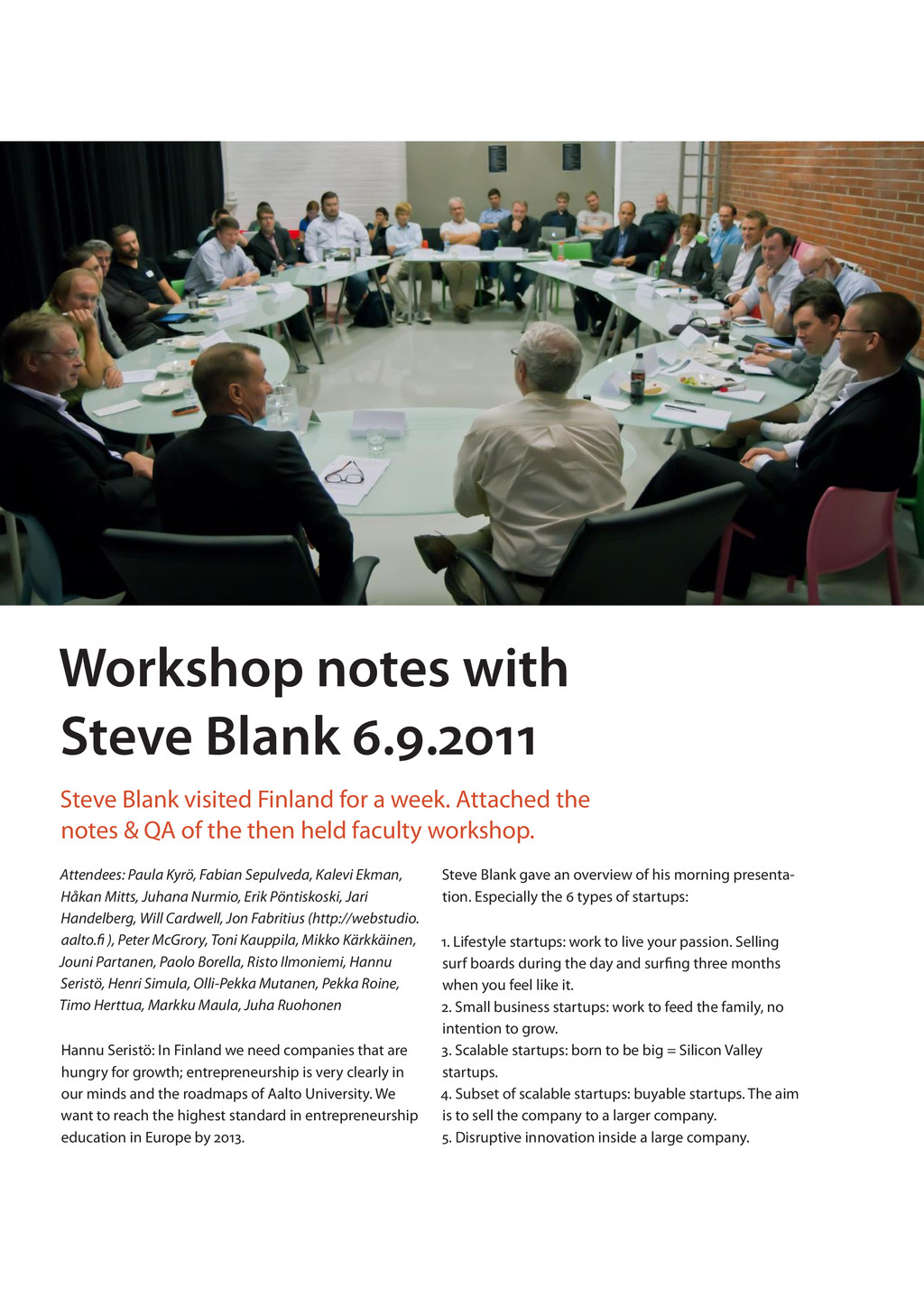
  28. Workshop notes with Steve Blank 6.9.2011 Steve Blank visited Finland

    for a week. Attached the notes & QA of the then held faculty workshop. Attendees: Paula Kyrö, Fabian Sepulveda, Kalevi Ekman, Håkan Mitts, Juhana Nurmio, Erik Pöntiskoski, Jari Handelberg, Will Cardwell, Jon Fabritius (http://webstudio. aalto.fi ), Peter McGrory, Toni Kauppila, Mikko Kärkkäinen, Jouni Partanen, Paolo Borella, Risto Ilmoniemi, Hannu Seristö, Henri Simula, Olli-Pekka Mutanen, Pekka Roine, Timo Herttua, Markku Maula, Juha Ruohonen Hannu Seristö: In Finland we need companies that are hungry for growth; entrepreneurship is very clearly in our minds and the roadmaps of Aalto University. We want to reach the highest standard in entrepreneurship education in Europe by 2013. Steve Blank gave an overview of his morning presenta- tion. Especially the 6 types of startups: 1. Lifestyle startups: work to live your passion. Selling surf boards during the day and surfing three months when you feel like it. 2. Small business startups: work to feed the family, no intention to grow. 3. Scalable startups: born to be big = Silicon Valley startups. 4. Subset of scalable startups: buyable startups. The aim is to sell the company to a larger company. 5. Disruptive innovation inside a large company.
  29. 6. Social entrepreneurship startups: solving social problems. The first year

    or two of a startup are so different that they require different skills and they need to be taught in a different way. The customer development model has become known within the last 5 years. VCs went from not knowing about it, to now asking if you use the methodology. Blank also gave a quick summary of his career and revealed that he has had both highs and lows. Four of his companies have gone public but he revealed “I’ve lost in total about 50 million dollars for VCs.” Educators need to understand that a good chunk of a successful entrepreneurship ecosystem is culture. In the Valley, it’s not just American culture but Silicon Valley culture. There is nothing magic about what I’m teaching; a lot of it is intuitively easy. It’s not a science but a method- ology. I have insights and background, but I’m trying to multiply myself by sharing what I’ve learned. All my presentations are online on SlideShare, blogs, videos - everything I have is shared there. Please consider if the ideas I’m sharing are valuable to you or not and which parts would work well in this ecosystem. I hope you will put a couple of hours into thinking about what an entrepreneurial curriculum might look like at Aalto. Aalto University wants to reach the highest standard in entre- preneurship education in Europe by 2013. Business schools have existed for the last 100 years with essentially the same curriculum - how to execute a business. But there isn’t yet a school with an entre- preneurship curriculum – an E school. We have lots of individual classes to teach in entrepreneurship,for example: - creativity: Tina Seelig teaches how to extract ideas from people - business model design: See Alex Osterwalder’s model - HR, culture & teamwork: how do we build teams? - entrepreneurial finance None of this stuff is ever taught as a management stack for entrepreneurship Q&A Jan Fabritius: There is a long tradition of small scale businesses in Aalto’s design school. One study fol- lowed alumni 2 years after graduation; only 1% of graduates from the business and engineering schools had started companies, while 12% of design grads had. These are category 1 or 2 companies according to Blank’s hierarchy (either lifestyle companies or small businesses). They’ve been bootstrapping their companies and there is potential to make the compa- nies much bigger. How could we teach students with companies like this how to scale them? Blank: A big part of students not scaling their com- panies could be that they may not even identify, that it’s something they could do or that they’re in that category. So one of the things would be to start talking about it and teaching the startup hierarchy. Once you do some- one may see that “that is what I’m doing and it doesn’t have to be constrained to a lifestyle business”. Big com- panies acquire design companies too. You can identify whether there is potential to scale by doing a joint class. How does one take a stable small business and scale? When you actually have customers and revenue, in many ways you’re ahead of most startups, these compa- nies also tend to understand their market better. Juha Ruohonen: Who should be teaching entrepreneurship? In a perfect world, entrepreneurs would teach entre- preneurship. However, I would let anyone teach it who appreciates that the skills needed are different than ones you get during an academic career or from consulting for big companies. People who understand
  30. that this is different from what they learned in business

    school, helped out by adjuncts. The value of adjuncts shouldn’t be underestimated. Eric Pöntiskoski: You have a course called “Entrepreneurial Spirit” at Stanford. How do you teach something like that? We have a course called Entrepreneurial Thought Leaders seminar that brings in the most interesting entrepreneurs, CEOs, VCs etc to talk to students once a week. In addition, we’ve started a new course alongside the visiting speaker seminar series, the aim of which is reverse engineering the ETL speakers – convincing speakers to talk to the students to get them thinking around this course – “What did successful entrepre- neurs do before their success? How did they start out? What was the first thing they screwed up?” We did this to inspire students and show that successes aren’t overnight. Paula Kyrö: How do you select students for courses? Are there prerequisite skills? Should it also be taught on B.Sc. level? Entrepreneurship should be taught as an art. Everyone takes some basic art classes, though few people become artists or musicians, the classes serve to build some art appreciation skills. Everyone should learn the basics of entrepreneurship to know is this is something I’m even interested in. How do we select the most potential students? One heuristic that VCs use is that an A team with a B prod- uct is 10 times more valuable than a B team with an A product. Selection should not happen based on the best idea but students who want into the course the most. The most persistent students – the ones who get my home phone number or stop me in the parking lot tend to be the ones who get the most of the courses and bring the most to them. I would advise not being selective and aiming to expose as many people as possible to entrepreneurship on the undergrad level (do mass lectures and programs) and to be more selective on the grad level. Markku Maula: How does the model between STVP and other professors and researchers work? There is no specific process for becoming adjunct. I got asked to do a visitor lecture, and then I got involved in co-teaching courses. Then I got asked to write a course at Berkeley, which is one of their most popular now. The lecture notes of which I turned into the book 4 Steps to Epiphany. Then I got asked to lecture at Stanford. The entrepreneurship dept should be biggest pain in the ass for administration at a university. I’m sure there are formal processes for getting courses approved, I just don’t know them. Once I told my students who had already talked to nearly 200 customers that they needed to contact more. Then I got a call that “some of your students hijacked the Stanford IT dept and 16 000 contacts, the network had to be shut down”. If you’re running an entrepreneurship dept and following the rules, you’re doing it wrong. Fly your pirate flag. We’ve done more formal research too. We’ve learned a lot from it and adjuncts are welcome in research too. Researched 35 000 Stanford alumni trying to under- stand what happened in their entrepreneurship careers. An old student of mine who dropped out created the Startup Genome project and interviewed some 3500 startups to identify patterns. He’s only 21. Stanford and MIT are some of the best examples of outward facing universities. Stanfordhas long roots in this. Read my Secret History of Silicon Valley for more. It originated during the Cold War, when Prof Terman essentially turned the engineering school into a govern- ment research unit. ¾ of all grad theses were classified in the 50s and 60s. These were the beginnings of entre- preneurship. Terman was the dean and later provost (COO) of Stanford. He decided there would be no tech transfer office and that if you leave or dropout, you can take any tech you want with you. He started with Hewlett and Packard, this started a culture. Stanford’s current president John Hennessy also has an entrepre- neurial background. It was a place where it was good for your academic career to advise startups; advising was not looked down on. Toni Kauppila: There is paradox in going from execu- tion to search on the education side too, of needing
  31. to achieve the project in the end. You drew parallels

    to creating artwork. You do you go about teaching creative work, taking risks and encouraging failures? Blank: When you teach entrepreneurship there is a pro- cess that is measurable – you can measure the process. What about and how much did you learn? Who and how many did you talk to? I recommend a constant flow of students and educators through the Valley until you no longer need to send them there. You might lose 10%, but that’s the price you pay. Also a work study program in Silicon Valley, because students need to understand what speed, risk and passion mean in the big leagues. It’s not about skill, it’s about culture. Once you get exposed, you can decide if you wanna play or not. If you’re running an entrepre- neurship dept and following the rules, you’re doing it wrong. Fly your pirate flag. Paulo Borelli: What is needed to accelerate the crea- tion of new startups apart from the educational elements? Blank: Education is just one component of an eco- system. Many people come to the Valley and want to replicate the model. They should really aim to extract some of the key lessons. Here in Finland you don’t seem to really appreciate existing research on the topic ofcreating entrepreneur- ship ecosystems. The VICTA report was one of the most insightful and dispassionate reports I’ve read on the topic. Maybe you need to hear it from a foreigner? An entrepreneurship ecosystem needs incubators, VCs, a culture that celebrates risk taking and entrepreneurs as heroes, as well as education. Government has a role too, in the good and bad. You need to understand all the components.. Customer development is an exten- sion of the scientific method, it’s just hypothesis testing. Fabian Sepulveda: Students might be scared to attend growth entrepreneurship courses when their ideas aren’t high tech. High growth companies like Ikea, that aren’t high tech, are important too. How would you resolve this? Early in my teaching career, I threw out teams with ideas like these. However, I’ve come to realize that the customer discovery process and business model canvas models are applicable even for non high tech compa- nies. In order for these startups to succeed, they need mentors who are industry experts in their field. Usually in the Valley and in my courses there is bias, especially since its all tech VCs grading the course. However, the economy isn’t just tech. If it makes “non tech students” less nervous, offer the same course and emphasize the search for a repeatable and scalable business models. Fabian Sepulveda: Where I came from in the US, entrepreneurship was something to aspire to. Here in Finland you’re cheered on only in specific circles. What needs tochange? Blank: This is a little “above my pay grade”, but I will give you my opinion. If the issue is interpreted in terms of compensation etc there seems to be confusion in about the difference between highly paid CEOs and successful entrepreneurs. We need to get the press and bloggers talking about startups and entrepreneurs, regardless of if anyone is listening. You need to get them as speakers at confer- ences and guest lecturers. We need to differentiate the entrepreneurs; it’s about the robber barons of capital- ism vs. the creators of wealth and jobs. The fact that entrepreneurs “worked their butts off” should also fit the Finnish work ethic. Jouni Partanen – Why should we teach entrepreneur- ship to everyone? The numbers are really bad. As you said, 90% of startups and VC investments fail. Blank: As I said, teaching entrepreneurship is like teaching art appreciation, we don’t expect all people to become artists. Even teaching the taxonomy of entrepreneurship will be useful for students. Courses shouldn’t focus just on experiential entrepreneurship. There are lots of places for theory. Courses with lec- tures, cases and simulations; it’s not all about building a
  32. startup. It’s important to build a body of knowledge for

    entrepreneurship. What replaces the business plan? The business model as a scorecard with 9 boxes. A model that’s dynamic and reflects the changes within the business. Alex Osterwalder and I are writing book together about combining our two approaches. In it we assume there is a Z axis in the customer development model that changes over time. Timo Herttua: I’m a user of Customer Development model and an Aalto student. I know action towards becoming an entrepreneurship school is being taken, but faculties and structures etc are slowing the change. You went thru the unofficial channels – what should guys like me do to help this wonderful university? I originally got involved in teaching entrepreneurship, when the business school staff realized there was revo- lution going on outside the building that they couldn’t reach. Startup incubators were essentially substitutes for a formal university entrepreneurship education; programs like Y combinatory are attracting major talent. I wanted to bring some academic weight behind the incubator model + some thought leadership. Then students started writing to the dean and presi- dent of university to get courses like these > customers speaking up and asking for what they wanted. There will be big changes coming now that Nokia is no longer the symbol of Finnish innovation. Will Cardwell: Message to students is that feedback from students is fundamental – the more often and more constructively given, the better. Juhana Nurmio: Students need to hear from successful entrepreneurs from early first days in the university. We will have 200-300 new students listening to Steve Blank’s talk. In addition to early expo- sure, we need a selective and intense program for those who want it. Aaltoes is already doing this, and we have a common goal in building Helsinki into the Silicon Valley of Europe. Håkan Mitts: To what degree are traditional engineer- ing/business/design skills still needed in relation to entrepreneurship skills? Blank: The jury is still out on the right ratio. I teach hard core engineers in Stanford and business professionals in Columbia and Berkeley. You need to teach differ- ently depending on who you’re teaching. For example income statements are a second order problem at most for engineers and in business school they don’t need to be taught at all. Should entrepreneurship be a degree or a minor? I think it should be a minor, a part of the degree. Paula Kyrö: By now we know business planning doesn’t speed up the growth or development of businesses. We have previously had a course where students have their own ventures, this year we added the idea of that they could commercialize university technology. Will Cardwell: Aalto University’s technology transfer office processes 300 idea disclosures per year. There has been talk of match making between some of the better ideas and teams. You will want to be tough and require real work. It’s not mean or bad, but Darwinian is the name of the game in Silicon Valley Blank: The question is: can you become passionate about someone else’s idea? This can work as a teach- ing method, but the team still needs to be passionate. The idea has to become their idea. Nowadays, you can’t apply to class without an idea and a team. It saves a week and half of match making and lets me focus on vetting which ideas can scale. But is it possible to do a real company this way? My students do 10-15 hours of work outside the class- room per week. They do a weekly 10 min presentation
  33. on their progress and we’re not polite about it when

    they don’t do well. The peer pressure brings the teams’ level’s up. Unless they’re passionate about the idea, they won’t stand the process. Risto Ilmoniemi: What about science based startups? Business ideas that emerge after 10 years of research and could require another 10 years to develop into a commercial product? How is it done in Stanford? I can speak for entire US in terms of National Science Foundation selection process, which for a government organization is very good in filtering. 1) Firstly, you need to identify the raised hand – researchers who thing “there is something that needs to be commercialized”, who have a belief 2) Then you need a process for asking if it’s still in research phase or ready for further development and worth taking further. 3) Remember not to confuse the principle instigator and future CEO, you need an entrepreneurial lead + local mentor Henry Simula: Finnish students don’t pay tuition, should we make them use real money during course to make it more real? Stanford students pay 50 000 dollars a year for their education. The “more skin in the game” you have, the more you seriously you take it. I don’t require that students spend money during the course. However, I let them know that without some sort of prototype they will get a B. To succeed in the course, most students will end up spending some money to build a prototype or, for example, spending 39 dollars on a www.user.com to test their user interface. Maybe you can make the course more serious by requir- ing other things in curriculum - work study, a trip to the US trip, something that gives them a different career path than sitting in Helsinki for 3 years. The further in the curriculum they are, the more “skin in the game” you should require -don’t graduate life style entrepreneurs. You will want to be tough and require real work. It’s not mean or bad, but Darwinian is the name of the game in Silicon Valley. Does studying entrepreneurship help student who end up working in big corporations? Yes, those people become mavericks within the big companies. Nokia understood about the iPhone, they probably had 400 meetings with people talking about the problem and what to do with it. However, there is often a lack of corporate ability to move at a speed fast enough to respond when the environment shifts. With the disruption cycles become quicker, smart organi- zation have some mavericks to help them maneuver quickly when they need to. They are sources of internal innovation and “intrapreneurship”. Blanks ends with a disclosure: everything you heard today is my opinion. It’s not the way to do it, but the start to a conversation. There will be a few sessions to develop the insights here further and a group will go the Valley this fall. The Stanford-Aalto platform runs from 2011-13. 2012 and 2013 have not yet been planned out. Resources: National Science Foundation Innovation Corps: http://www.nsf.gov/news/special_reports/i-corps/ Steve’s blog, class notes, lecture slides, the Secret History of Silicon Valley etc. www.steveblank.com Books mentioned: 4 Steps to Epiphany, Steve Blank http://www.stanford.edu/group/e145/cgi-bin/winter/ drupal/upload/handouts/Four_Steps.pdf or http://www. stevenblank.com/books.html Business Model Generation, Alex Osterwalder www.businessmodelgeneration.com/book Lean Startup, Eric Ries http://www.startuplessonslearned.com/
  34. Rational heuristics: the ‘simple rules’ that strategists learn from process

    experience Christopher B. Bingham1,*, Kathleen M. Eisenhardt Strategic Management Journal, Volume 32, Issue 13, pages 1437–1464, December 2011 Volume 32, Issue 13, pages 1437–1464, December 2011 "While much research indicates that organizational processes are learned from experiences, surprisingly little is known about what is actually learned. Using a novel method to measure explicit learning, we track the learned content of six technology-based ventures from three diverse countries as they internationalize. The emergent theoretical framework indicates that firms learn heuristics. These heuristics have a common struc- ture centered on opportunity capture and are learned in a specific developmental order. This results in a deliberately small, yet increasingly strategic, portfolio of heuristics. Broadly, we contribute to the psychological foundations of strategy by highlighting the rationality of heuristics as strategy, capability creation as the cog- nitive transition from novice to expert heuristics, and simplification cycling as a critical dynamic capability for sustaining competitive advantage." http://onlinelibrary.wiley.com/doi/10.1002/smj.965/ abstract - an interesting detail here is that the data included two Finnish companies (you can try to guess which ones). Chris was our guest when he was doing interviews, Tomi Laamanen helped him in that Another interesting one by their new Assistant Prof Chuck Eesley on an interesting and relevant topic from AVP point of view, e.g. Entrepreneurs from technology-based universities: Evidence from MIT David H. Hsu, , , Edward B. Roberts, , Charles E. Eesley Research Policy Volume 36, Issue 5, June 2007, Pages 768-788 "This paper analyzes major patterns and trends in entrepreneurship among technology-based university alumni since the 1930s by asking two related research questions: (1) Who enters entrepreneurship, and has this changed over time? (2) How does the rate of entre- preneurship vary with changes in the entrepreneurial business environment? We describe findings based on data from two linked datasets joining Massachusetts Institute of Technology (MIT) alumni and founder infor- mation. New company formation rates by MIT alumni have grown dramatically over seven decades, and the median age of first time entrepreneurs has gradually declined from about age 40 (1950s) to about age 30 (1990s). Women alumnae lag their male counterparts in the rate at which they become entrepreneurs, and alumni who are not U.S. citizens enter entrepreneur- ship at different (usually higher) rates relative to their American classmates. New venture foundings over time are correlated with measures of the changing external entrepreneurial and business environment, suggesting that future research in this domain may wish to more carefully examine such factors."http://www.sciencedi- rect.com/science/article/pii/S0048733307000728 Recent research from the STVP faculty Some highlights from the recent STVP research.
  35. Katila, R., Rosenberger, J., and Eisenhardt, K. (2008) Swimming with

    sharks: Technology ventures, defense mechanisms, and corporate relationships Administrative Science Quarterly, 53(2): 295-332. "This paper focuses on the tension that firms face between the need for resources from partners and the potentially damaging misappropriation of their own resources. Taking a unique entrepreneurial lens, we study this tension at tie formation in corporate invest- ment relationships in 5 technology-based industries over a 25-year period. Central to our study is the "sharks" dilemma - i.e., when do entrepreneurs choose partners with high potential for misappropriation over less risky partners. Our findings extend resource dependence theory in terms of multiple resources and contribute the uncertainty logic of resource misappropriation to the theory. They also offer novel insights about resource mobilization including the unique defense mechanisms (i.e., secrecy and timing) and surprising power of entre- preneurial firms." http://asq.sagepub.com/content/53/2/295.short Constructing Markets and Shaping Boundaries: Entrepreneurial Power in Nascent Fields Filipe M. Santos1, Kathleen M. Eisenhardt2 Academy of Management Journal Volume 52, Number 4 / August 2009, Pages 643-671 "We examine how entrepreneurs shape organizational boundaries and construct markets through an inductive, longitudinal study of five ventures. Our central contri- bution is a framework of how successful entrepreneurs attempt to dominate nascent markets by co-construct- ing organizational boundaries and market niches using three processes: claiming, demarcating, and controlling a market. We propose that power is the underlying boundary logic and indicate the "soft-power" strategies by which entrepreneurs compete in highly ambiguous markets. Overall, we develop a holistic view of organi- zational boundaries and offer insights into institutional entrepreneurship and resource dependence theories. Our most important contribution is reinvigorating the study of interorganizational power." https://aomarticles.metapress.com/content/ p061w13241w515hg/
  36. Contact information Phonenumbers & e-mail addresses of participants. Hannu Seristö

    [email protected] +358 50 3832478 Markku Maula [email protected] +358 40 556 0677 Ilkka Niemelä [email protected] +358 50 511 3013 Fabian Sepulveda [email protected] +358 40 353 8389 Paavo Kinnunen [email protected] +358 50 540 4600 Erik Pöntikoski [email protected] Olli-Pekka Mutanen [email protected] +358 400 444 609 Henri Simula [email protected] +358 9 451 6136 Jouni Partanen [email protected] +358 50 576 9804 Peter McGrory [email protected] +358 50 303 6543 Risto Ilmoniemi [email protected] +358 50 5562964 Will Cardwell [email protected] +358 40 514 1325 Juhana Nurmio [email protected] +358 50 3367923 Linda Liukas [email protected] +650 283 5458 Kristo Ovaska [email protected] +358 50 5938907
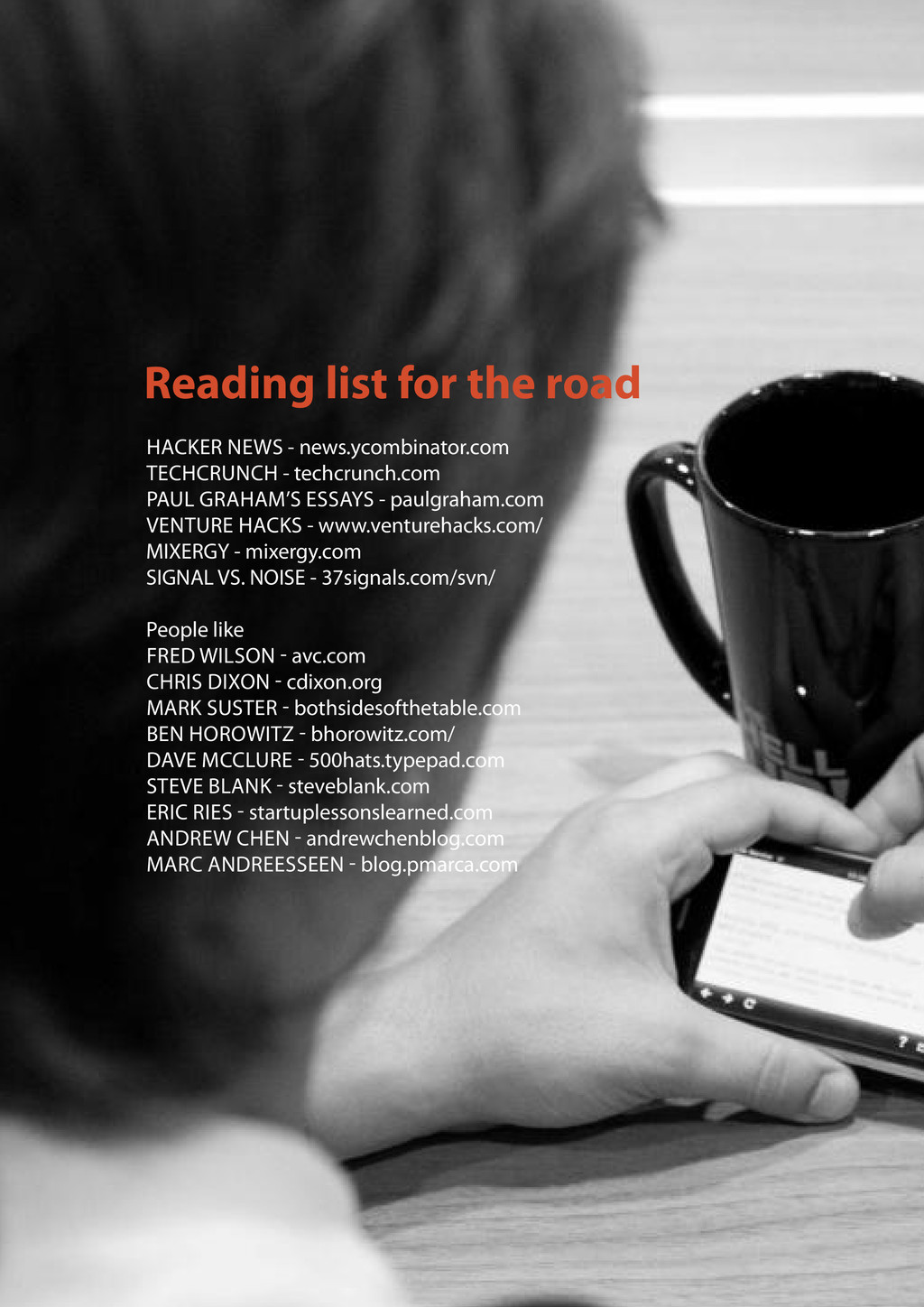
  37. HACKER NEWS - news.ycombinator.com TECHCRUNCH - techcrunch.com PAUL GRAHAM’S ESSAYS

    - paulgraham.com VENTURE HACKS - www.venturehacks.com/ MIXERGY - mixergy.com SIGNAL VS. NOISE - 37signals.com/svn/ People like FRED WILSON - avc.com CHRIS DIXON - cdixon.org MARK SUSTER - bothsidesofthetable.com BEN HOROWITZ - bhorowitz.com/ DAVE MCCLURE - 500hats.typepad.com STEVE BLANK - steveblank.com ERIC RIES - startuplessonslearned.com ANDREW CHEN - andrewchenblog.com MARC ANDREESSEEN - blog.pmarca.com Reading list for the road