Upgrade to Pro — share decks privately, control downloads, hide ads and more …

How do KOS work with AI?

Sponsored · Your Podcast. Everywhere. Effortlessly. Share. Educate. Inspire. Entertain. You do you. We'll handle the rest. →

How do KOS work with AI?

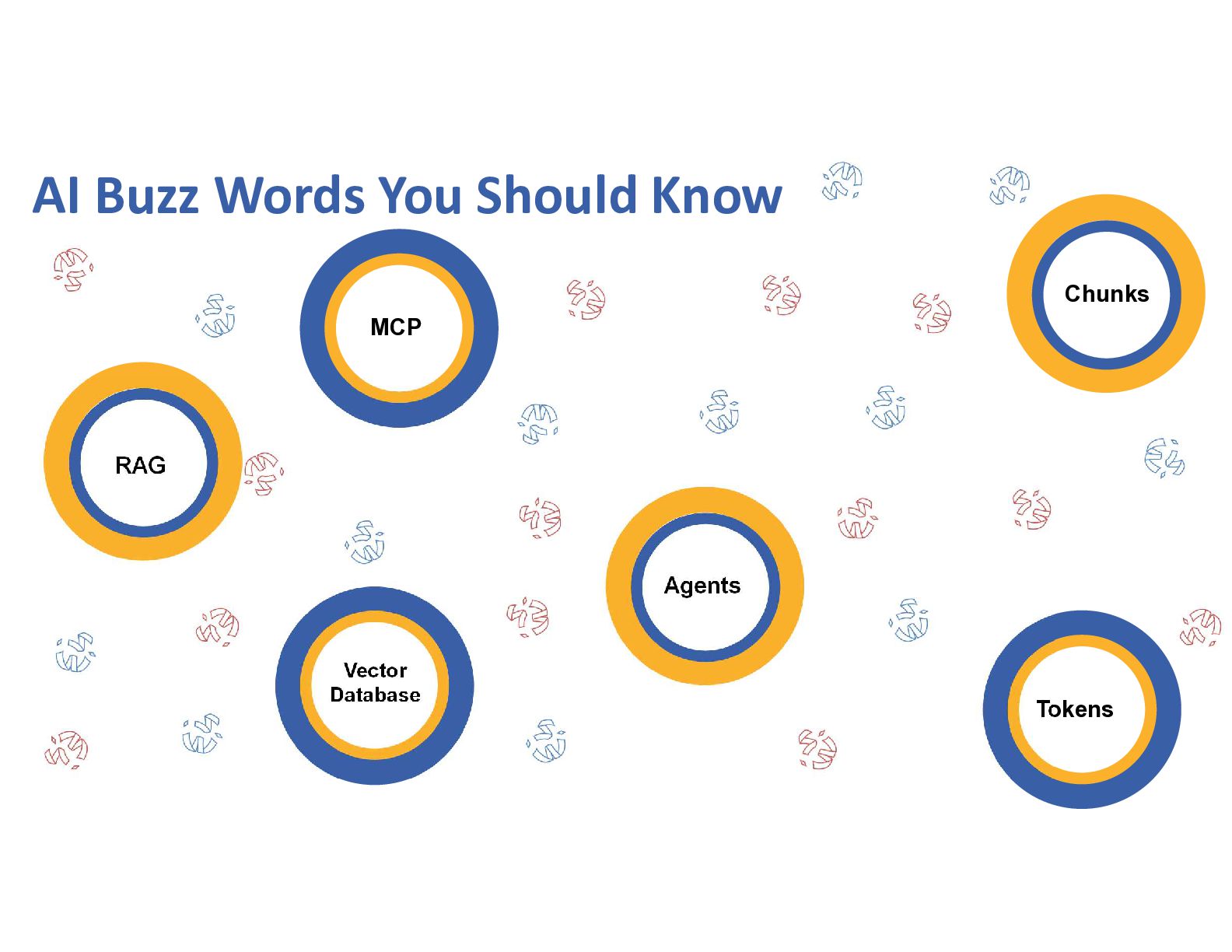
Some people have said that taxonomies are dead - no longer needed in the Age of AI. The reality is that they are needed more than ever. This presentation explains their role in the systems and outlines the strategy for adding KOS to the "chunks" needed to create a AI implementation. To build a Vector Database, Retrieval Augmented Generation (RAG) or Model Content Platform (MCP) content needs to be chunked into small parcels of text which are then tokenized. What role do subject metadata from a KOS and provenance play in this process? How does that process work? What needs to be done to the data? Can it be done automatically? What resources are available now to ensure data retains its history and intellectual property is protected for recognition and inclusion?

This talk takes the listener through the steps and the technology behind the scenes to get data ready for LLM ingestion and use in conversational search responses.

Avatar for AccessInnovations

AccessInnovations

October 13, 2026

More Decks by AccessInnovations

Other Decks in Technology

Transcript

  1. How Do KOS Work With AI? Webinar – September 15,
    2026 ISKO London Marjorie M.K. Hlava, Chief Scientist [email protected] @mmkhlava LinkedIn, Twitter, BlueSky, Facebook
  2. Who is Marjorie Hlava? Chief Scientist, Founder, Chair of the

    Board Access Innovations, Inc. Software and services company Albuquerque, New Mexico, USA Standards background Dublin Core (SDC) 1984 ISO 15836, ANSI/NISO Z39.85 Thesaurus Standard (SDC) NISO Z39.19 BISG ONIX – BISAC (Model) Indexing Standard (SDC) NISO Z39.14 DOI Syntax (SDC) NISO Z39.84 / ISO 26324 Credit Standard (secretariat / Model) NISO Z39.102 Crossref Contributed Metadata Set (NFAIS model WG) Standards Specific Ontology Standard SSOS (secretariat / Model) NISO Z39.103 ISO 25964 – Parts 1 and 2: 2026 Information and documentation — Thesauri and interoperability with other vocabularies (Convenor)
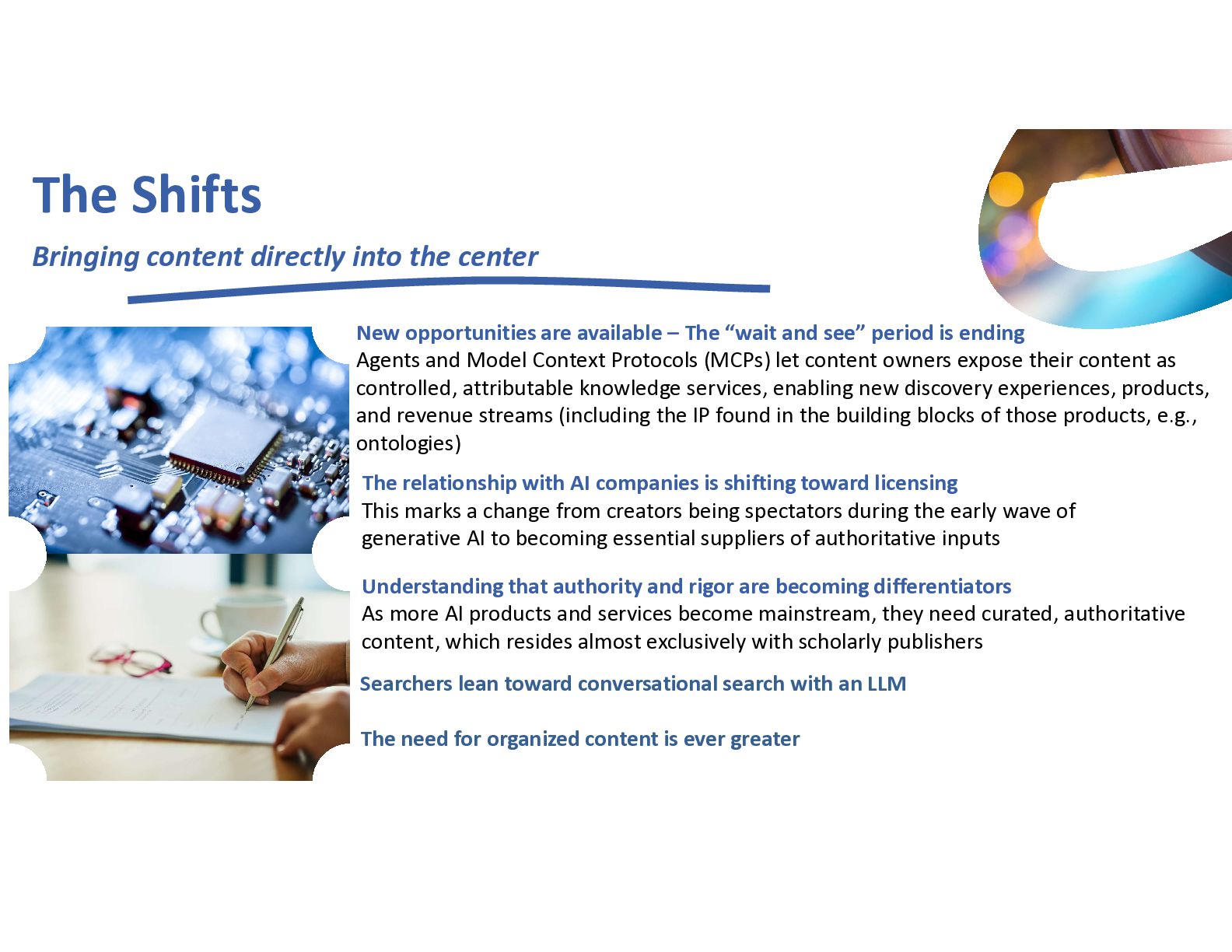
  3. The Shifts Bringing content directly into the center New opportunities

    are available – The “wait and see” period is ending Agents and Model Context Protocols (MCPs) let content owners expose their content as controlled, attributable knowledge services, enabling new discovery experiences, products, and revenue streams (including the IP found in the building blocks of those products, e.g., ontologies) The relationship with AI companies is shifting toward licensing This marks a change from creators being spectators during the early wave of generative AI to becoming essential suppliers of authoritative inputs Understanding that authority and rigor are becoming differentiators As more AI products and services become mainstream, they need curated, authoritative content, which resides almost exclusively with scholarly publishers Searchers lean toward conversational search with an LLM The need for organized content is ever greater
  4. • controlled (3.16) and structured vocabulary (3.71) in which concepts

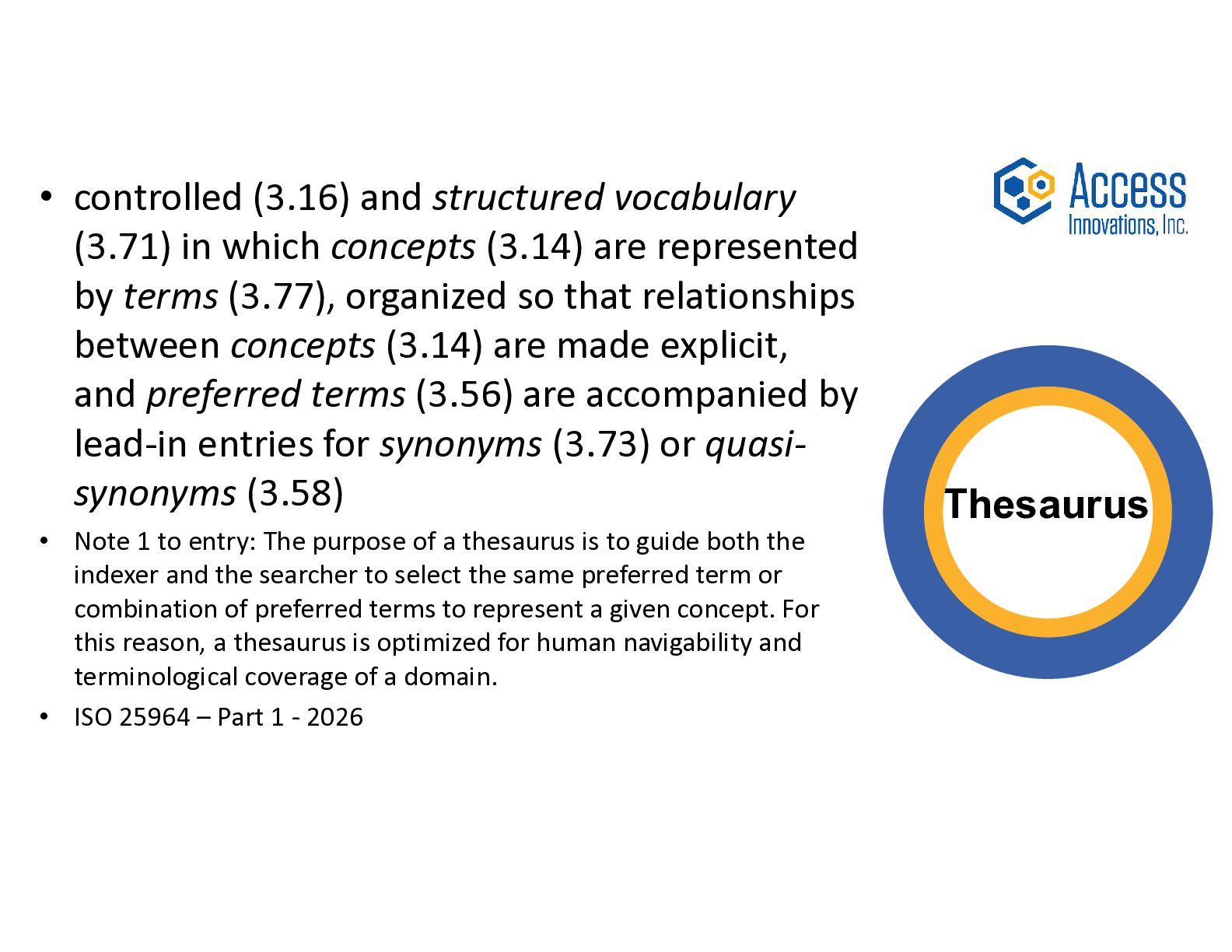
    (3.14) are represented by terms (3.77), organized so that relationships between concepts (3.14) are made explicit, and preferred terms (3.56) are accompanied by lead-in entries for synonyms (3.73) or quasisynonyms (3.58) • Note 1 to entry: The purpose of a thesaurus is to guide both the indexer and the searcher to select the same preferred term or combination of preferred terms to represent a given concept. For this reason, a thesaurus is optimized for human navigability and terminological coverage of a domain. • ISO 25964 – Part 1 - 2026 Thesaurus
  5. • Collection of controlled vocabulary terms organized into a hierarchical

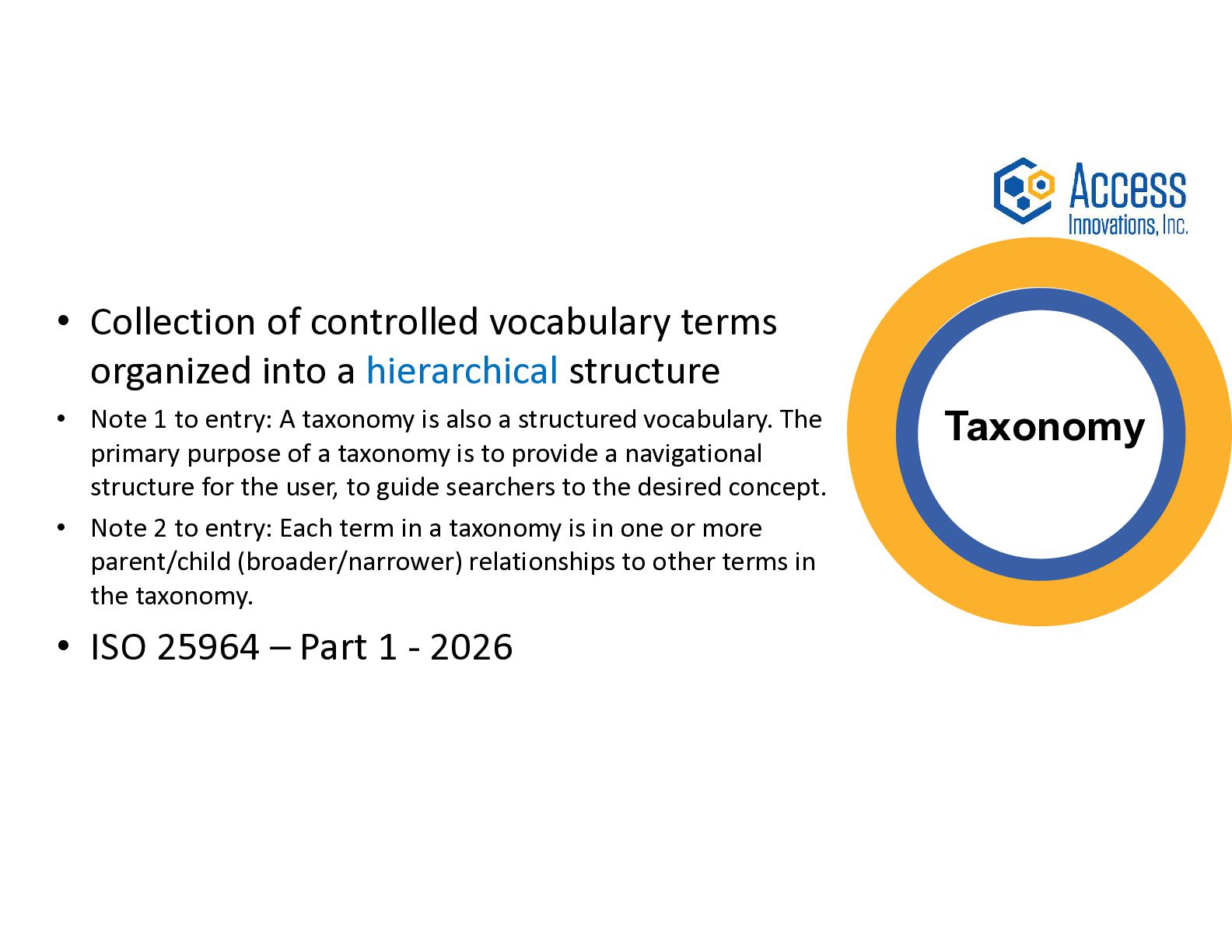
    structure • Note 1 to entry: A taxonomy is also a structured vocabulary. The primary purpose of a taxonomy is to provide a navigational structure for the user, to guide searchers to the desired concept. • Note 2 to entry: Each term in a taxonomy is in one or more parent/child (broader/narrower) relationships to other terms in the taxonomy. • ISO 25964 – Part 1 - 2026 Taxonomy
  6. • An ontology is a formal, machine-readable data model that

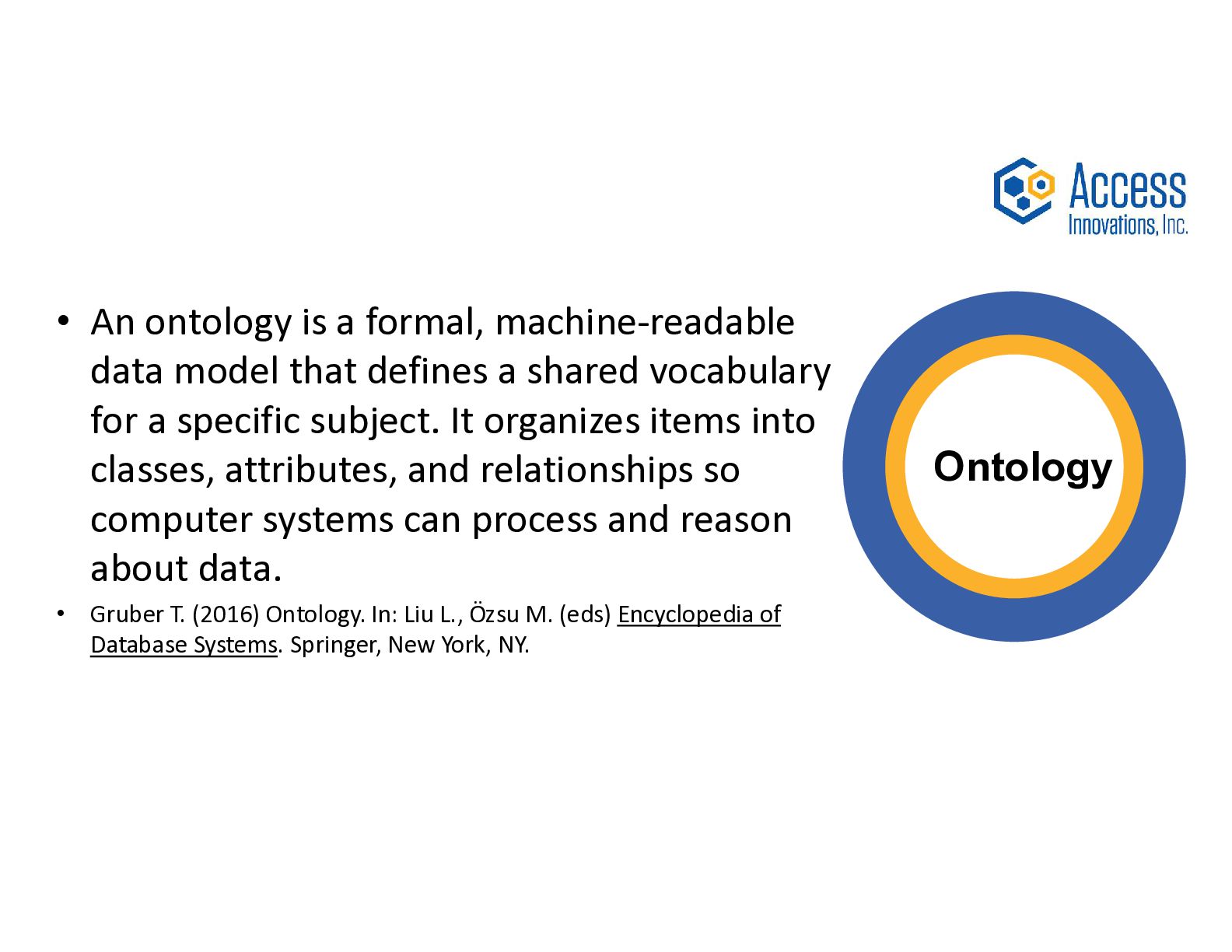
    defines a shared vocabulary for a specific subject. It organizes items into classes, attributes, and relationships so computer systems can process and reason about data. • Gruber T. (2016) Ontology. In: Liu L., Özsu M. (eds) Encyclopedia of Database Systems. Springer, New York, NY. Ontology
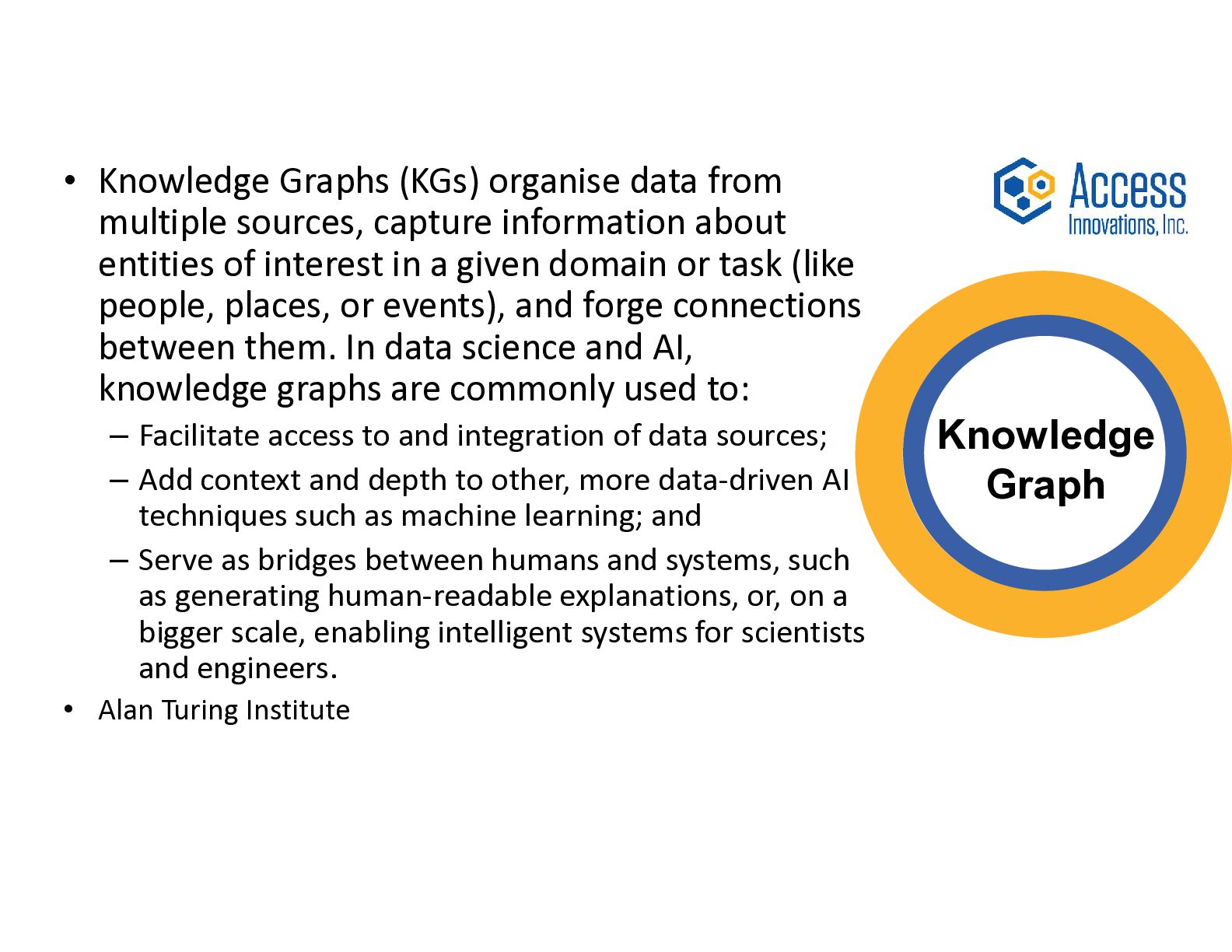
  7. • Knowledge Graphs (KGs) organise data from multiple sources, capture

    information about entities of interest in a given domain or task (like people, places, or events), and forge connections between them. In data science and AI, knowledge graphs are commonly used to: – Facilitate access to and integration of data sources; – Add context and depth to other, more data-driven AI techniques such as machine learning; and – Serve as bridges between humans and systems, such as generating human-readable explanations, or, on a bigger scale, enabling intelligent systems for scientists and engineers. • Alan Turing Institute Knowledge Graph
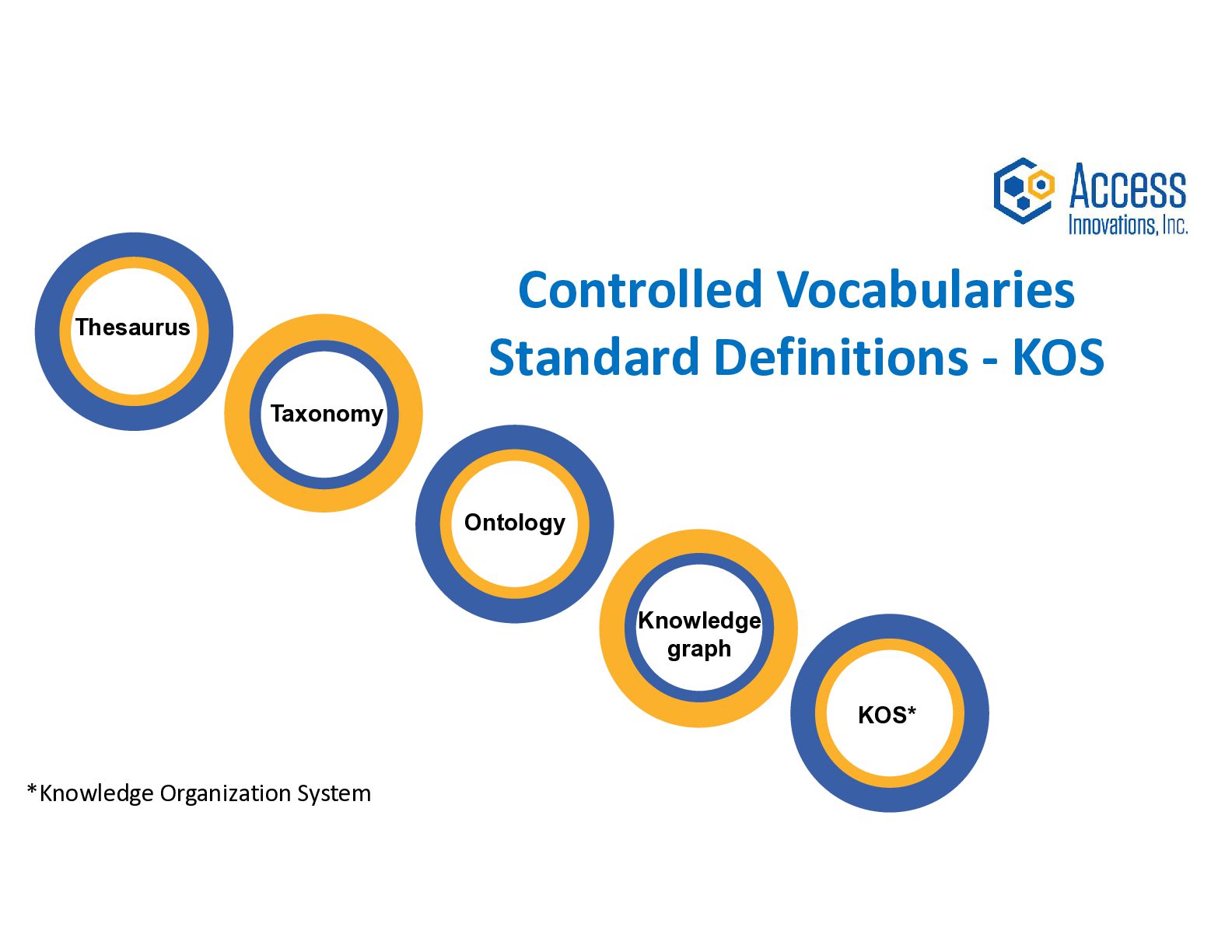
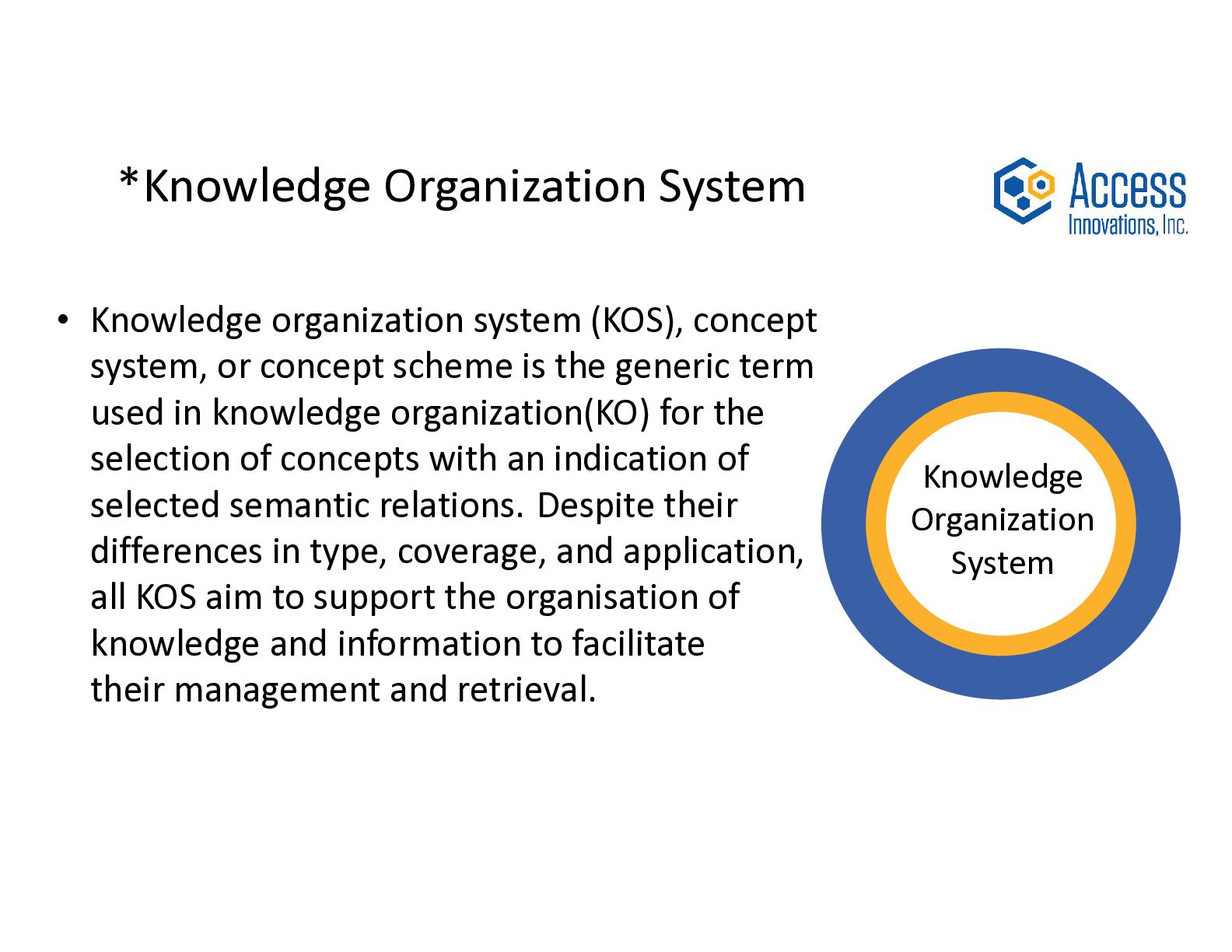
  8. *Knowledge Organization System • Knowledge organization system (KOS), concept system,

    or concept scheme is the generic term used in knowledge organization(KO) for the selection of concepts with an indication of selected semantic relations. Despite their differences in type, coverage, and application, all KOS aim to support the organisation of knowledge and information to facilitate their management and retrieval. Knowledge Organization System
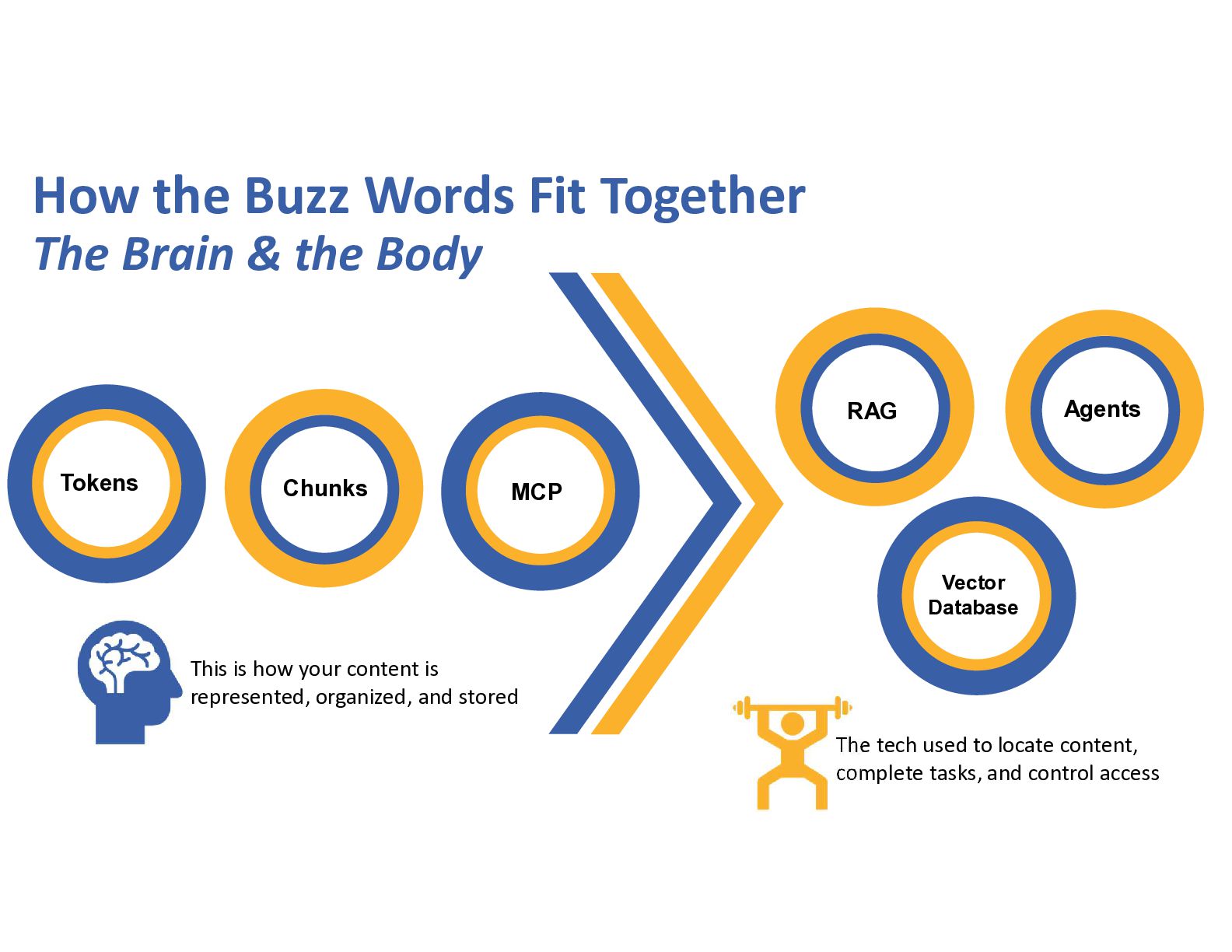
  9. How the Buzz Words Fit Together The Brain & the

    Body Agents RAG Tokens Chunks MCP Vector Database This is how your content is represented, organized, and stored The tech used to locate content, complete tasks, and control access
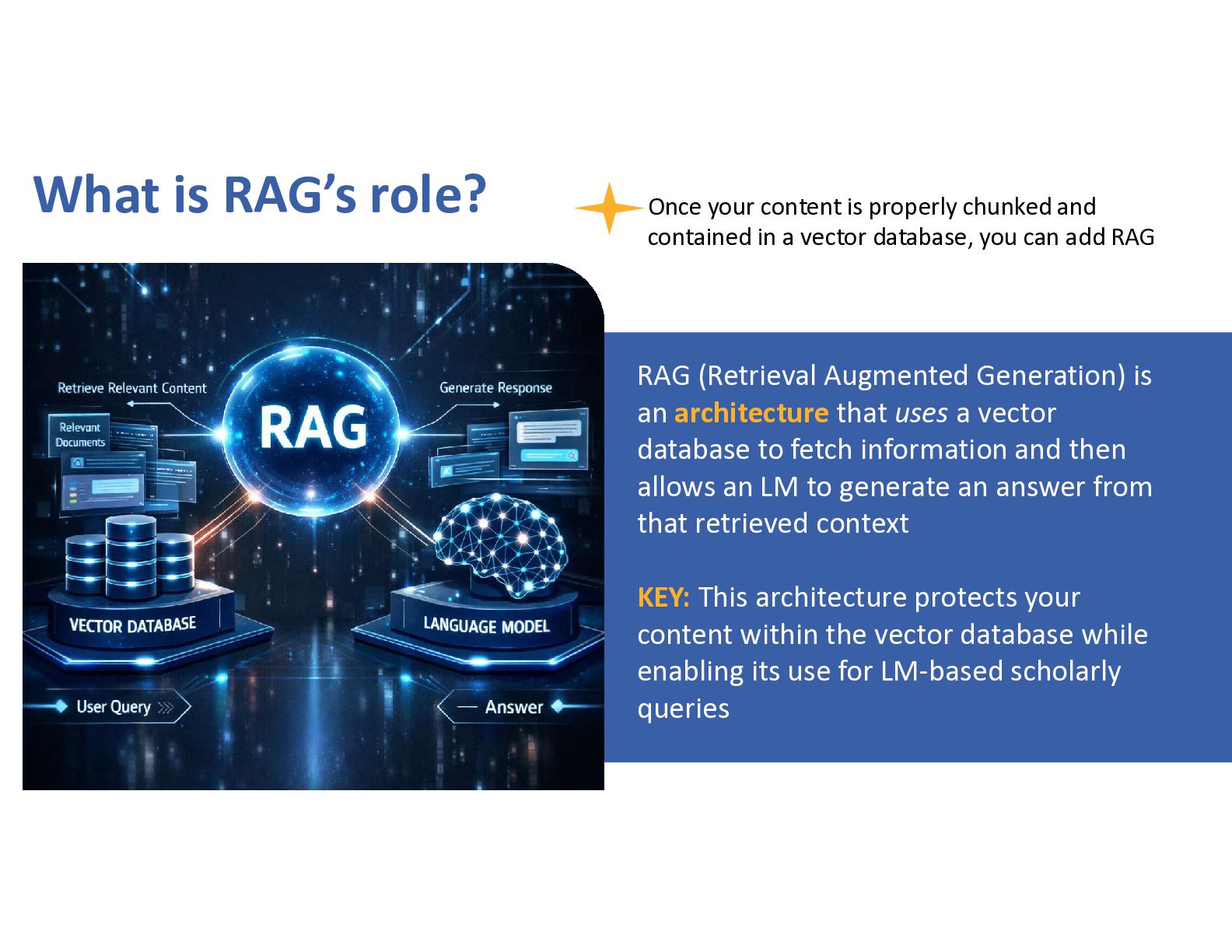
  10. What is RAG’s role? Once your content is properly chunked

    and contained in a vector database, you can add RAG RAG (Retrieval Augmented Generation) is an architecture that uses a vector database to fetch information and then allows an LM to generate an answer from that retrieved context KEY: This architecture protects your content within the vector database while enabling its use for LM-based scholarly queries
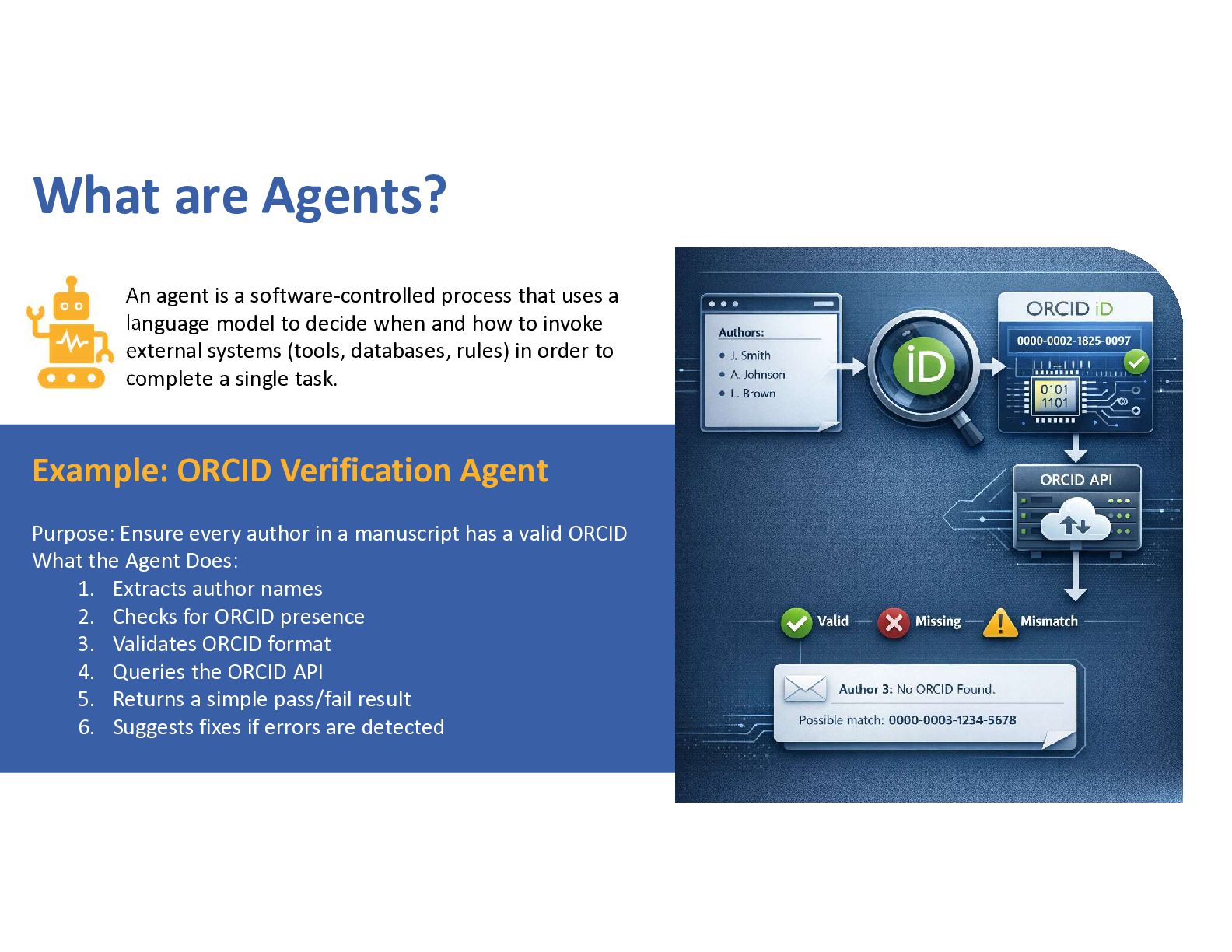
  11. What are Agents? An agent is a software-controlled process that

    uses a language model to decide when and how to invoke external systems (tools, databases, rules) in order to complete a single task. Example: ORCID Verification Agent Purpose: Ensure every author in a manuscript has a valid ORCID What the Agent Does: 1. Extracts author names 2. Checks for ORCID presence 3. Validates ORCID format 4. Queries the ORCID API 5. Returns a simple pass/fail result 6. Suggests fixes if errors are detected
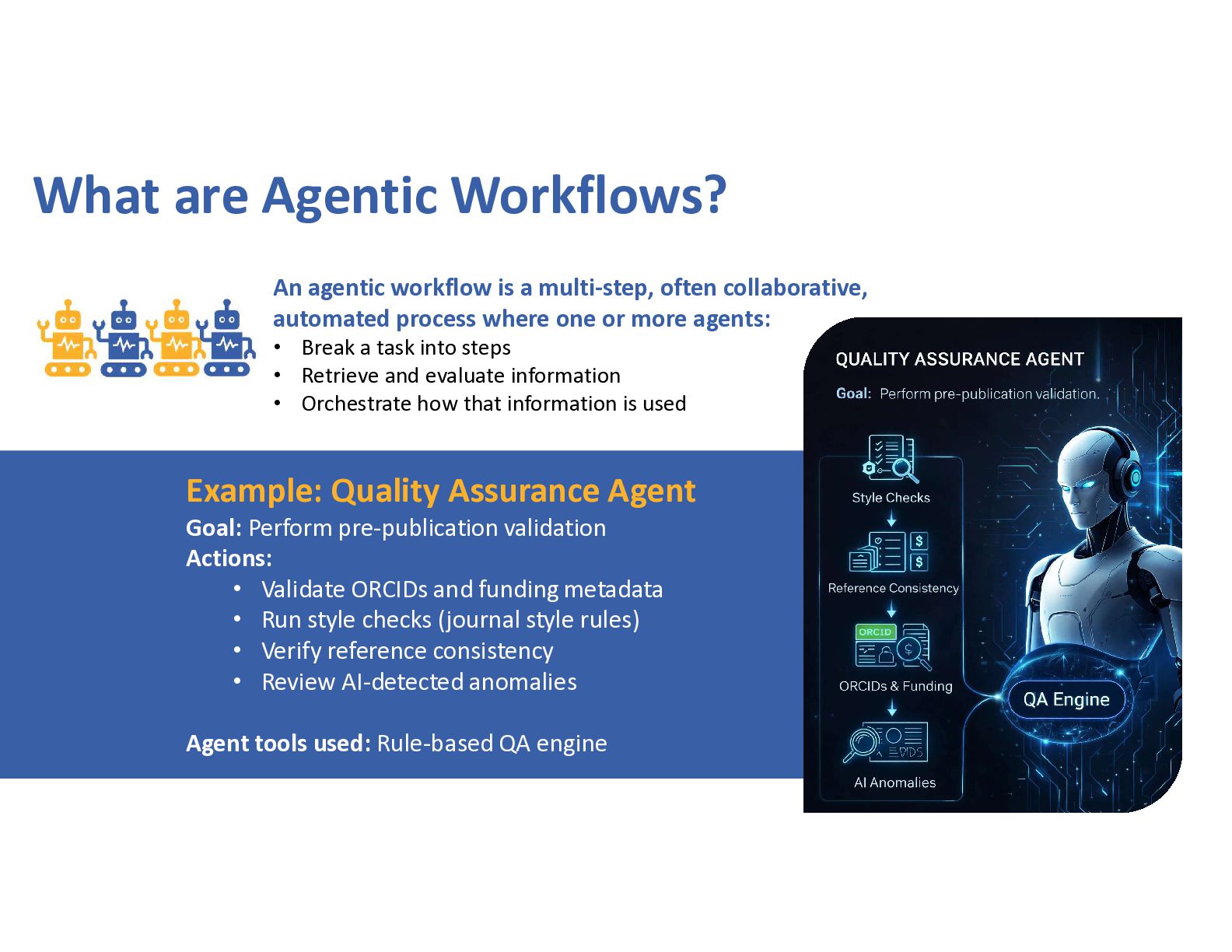
  12. What are Agentic Workflows? An agentic workflow is a multi-step,

    often collaborative, automated process where one or more agents: • Break a task into steps • Retrieve and evaluate information • Orchestrate how that information is used Example: Quality Assurance Agent Goal: Perform pre-publication validation Actions: • Validate ORCIDs and funding metadata • Run style checks (journal style rules) • Verify reference consistency • Review AI-detected anomalies Agent tools used: Rule-based QA engine
  13. What is MCP’s role? Once you have a VD, RAG,

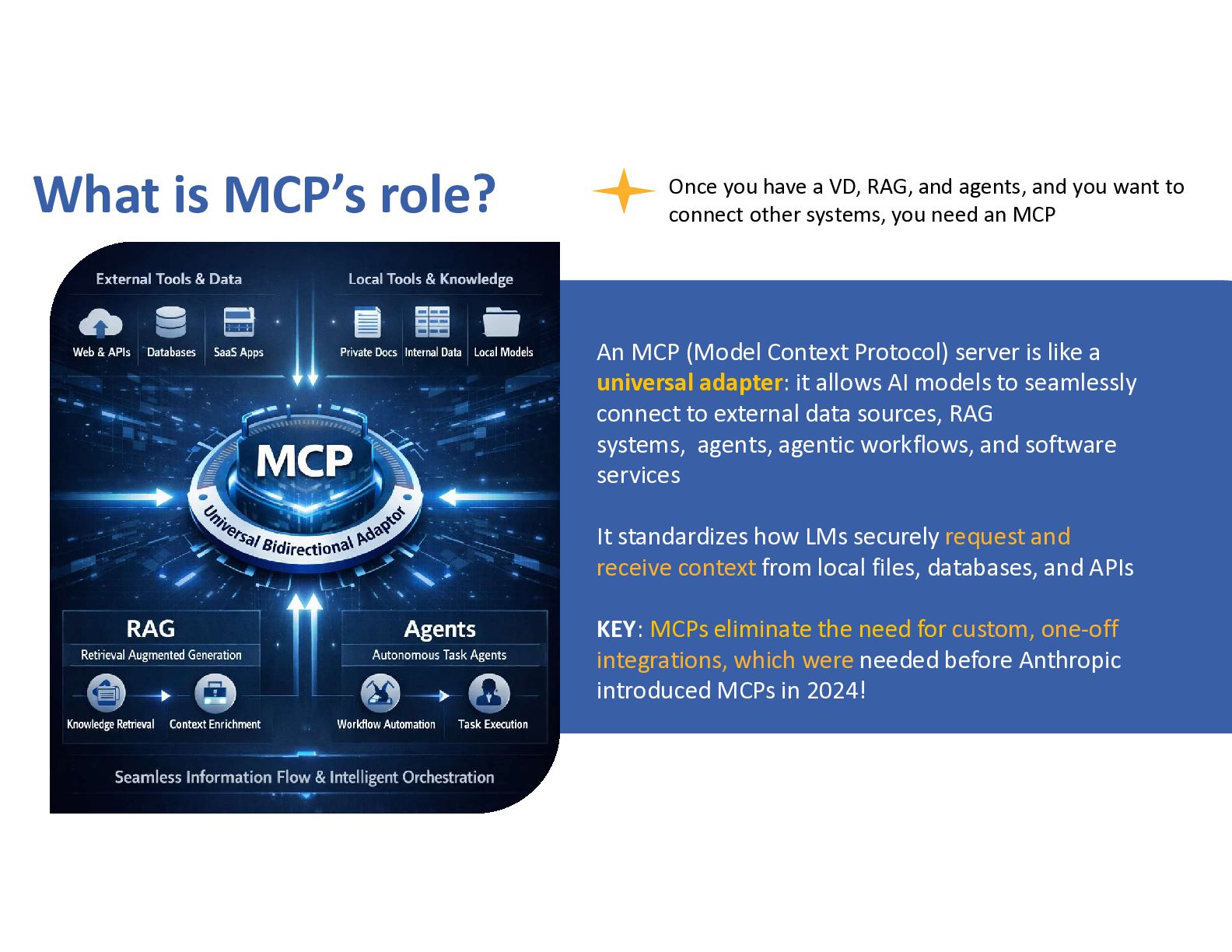
    and agents, and you want to connect other systems, you need an MCP An MCP (Model Context Protocol) server is like a universal adapter: it allows AI models to seamlessly connect to external data sources, RAG systems, agents, agentic workflows, and software services It standardizes how LMs securely request and receive context from local files, databases, and APIs KEY: MCPs eliminate the need for custom, one-off integrations, which were needed before Anthropic introduced MCPs in 2024!
  14. How publishers think of content The primary focus is on

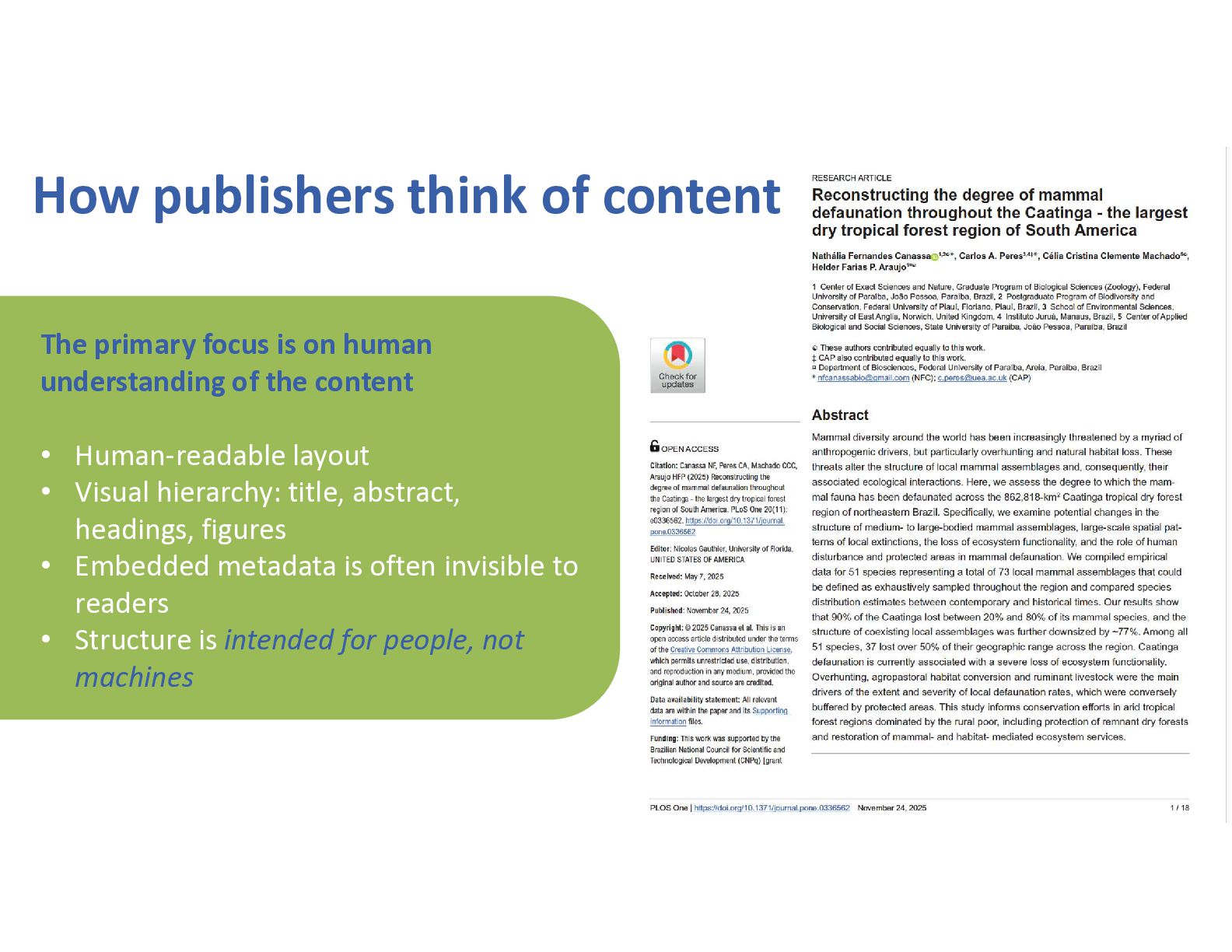
    human understanding of the content • Human-readable layout • Visual hierarchy: title, abstract, headings, figures • Embedded metadata is often invisible to readers • Structure is intended for people, not machines
  15. How platforms think of content The primary focus is machine

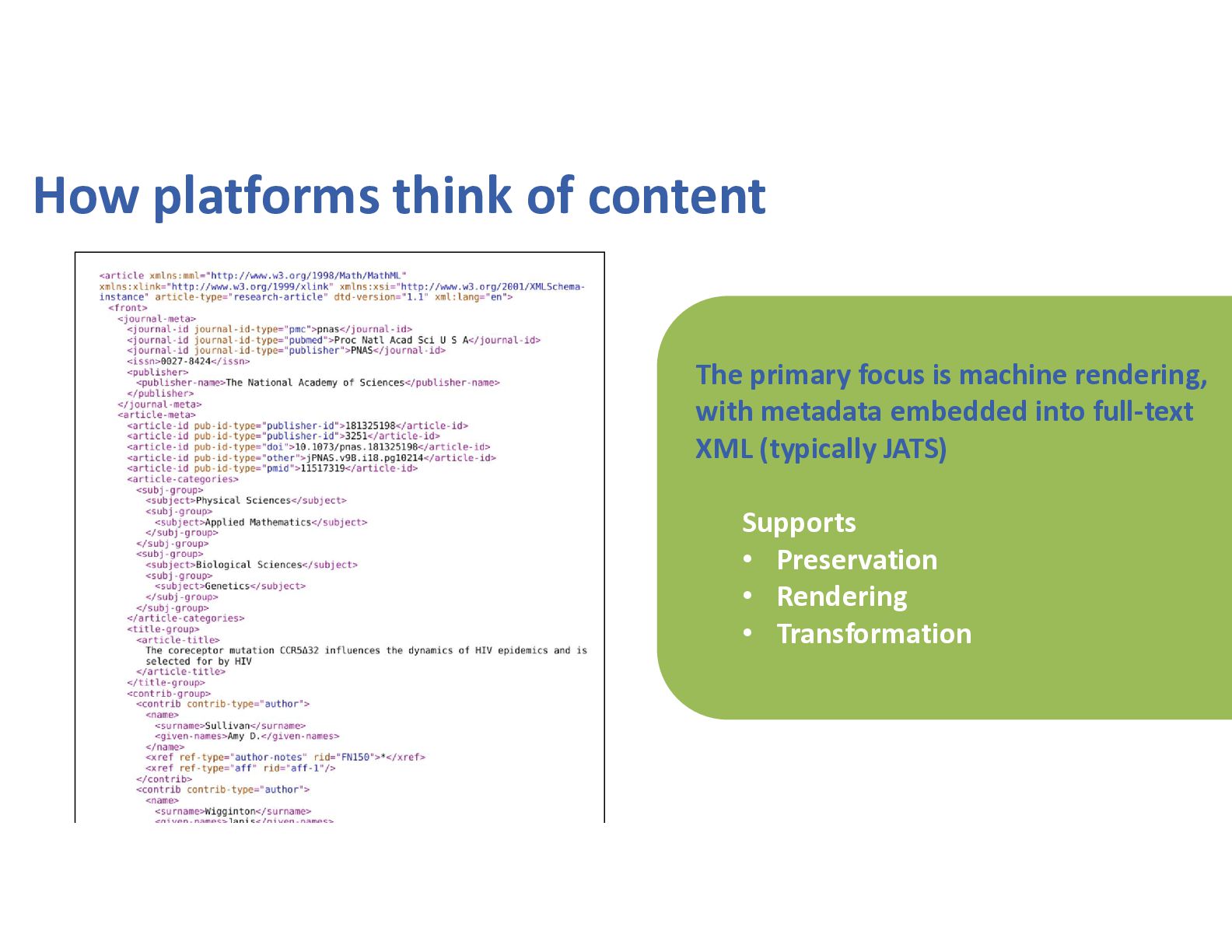
    rendering, with metadata embedded into full-text XML (typically JATS) Supports • Preservation • Rendering • Transformation
  16. How search systems think of content The primary focus is

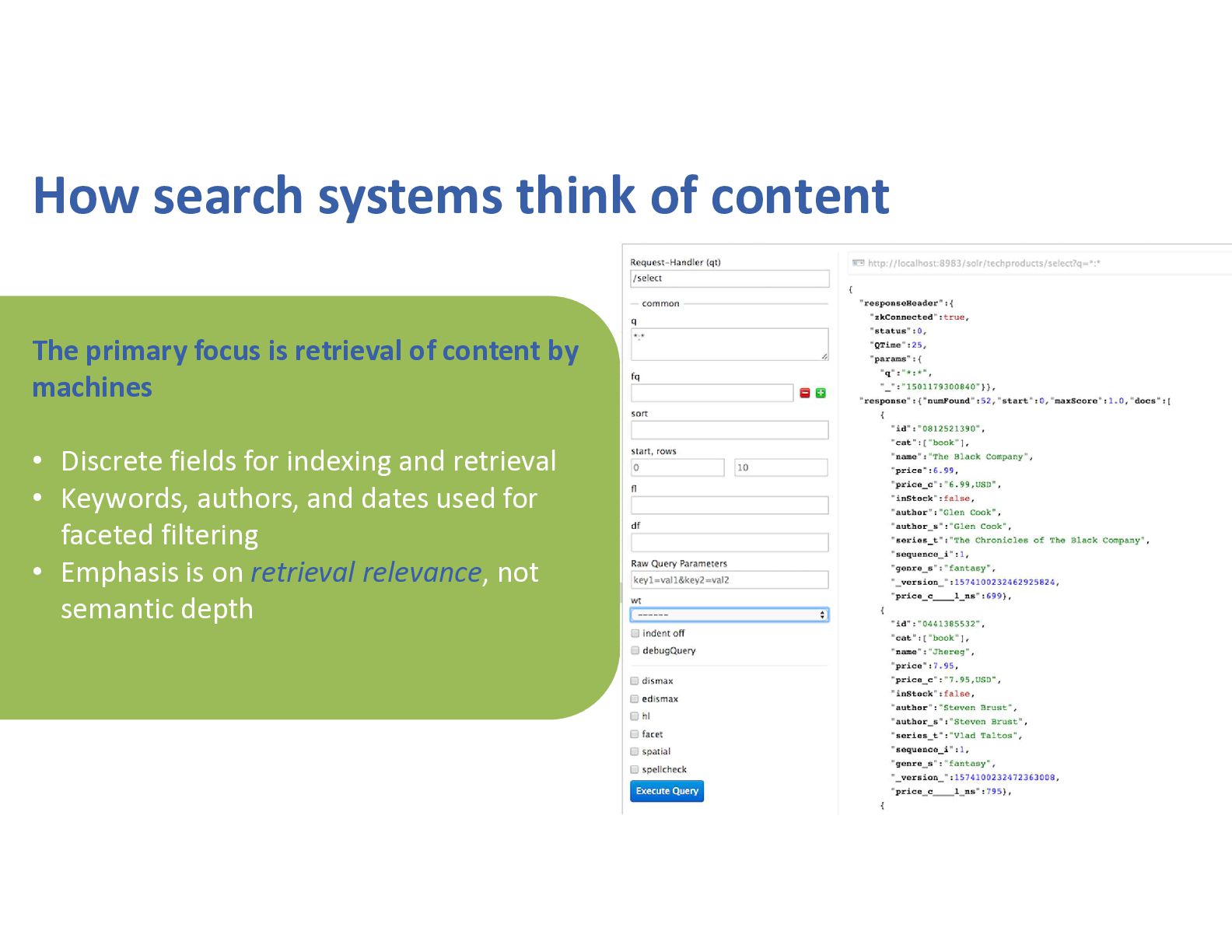
    retrieval of content by machines • Discrete fields for indexing and retrieval • Keywords, authors, and dates used for faceted filtering • Emphasis is on retrieval relevance, not semantic depth
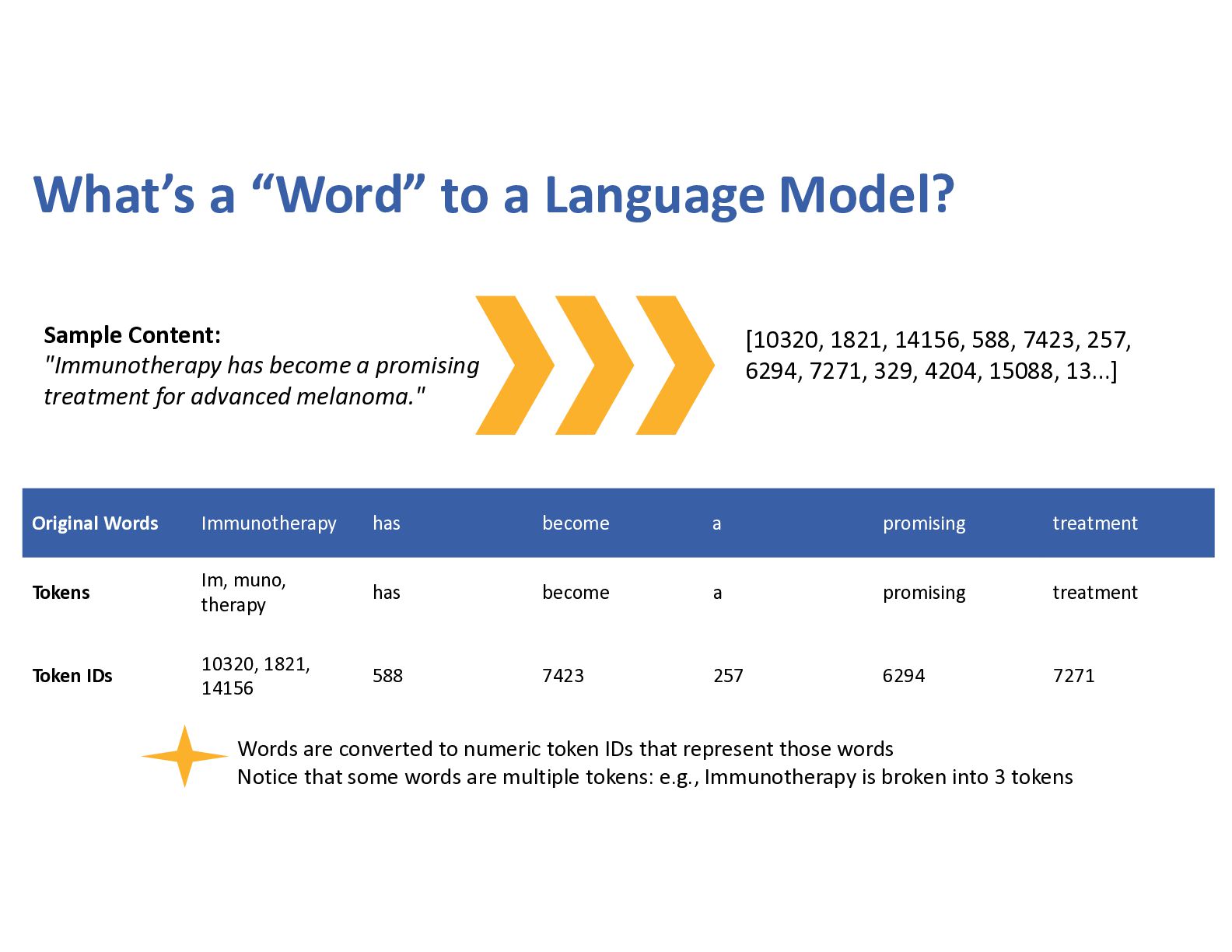
  17. What’s a “Word” to a Language Model? Sample Content: "Immunotherapy

    has become a promising treatment for advanced melanoma." [10320, 1821, 14156, 588, 7423, 257, 6294, 7271, 329, 4204, 15088, 13…] Original Words Immunotherapy has become a promising treatment Tokens Im, muno, therapy has become a promising treatment Token IDs 10320, 1821, 14156 588 7423 257 6294 7271 Words are converted to numeric token IDs that represent those words Notice that some words are multiple tokens: e.g., Immunotherapy is broken into 3 tokens
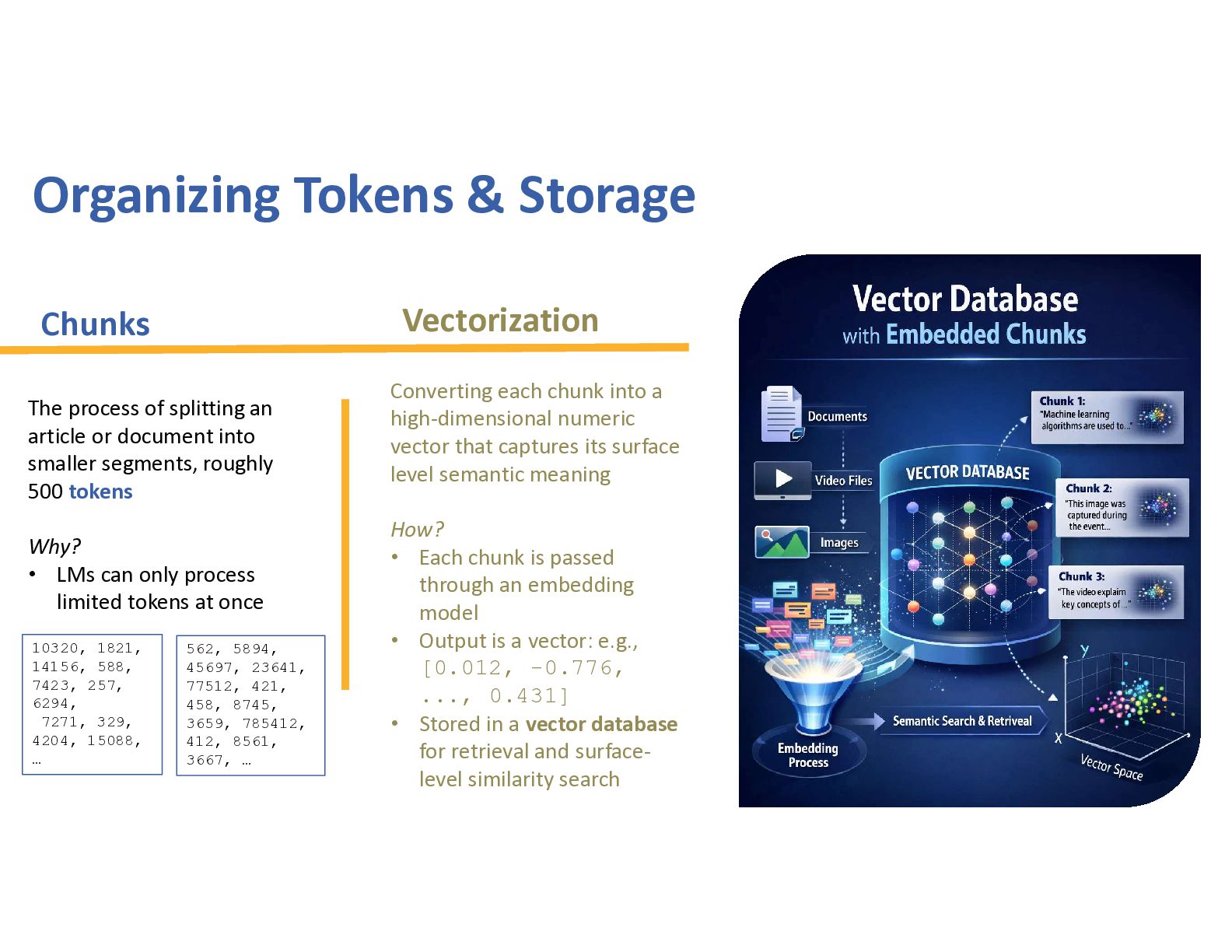
  18. Organizing Tokens & Storage Vectorization Chunks The process of splitting

    an article or document into smaller segments, roughly 500 tokens Why? • LMs can only process limited tokens at once 10320, 1821, 14156, 588, 7423, 257, 6294, 7271, 329, 4204, 15088, … 562, 5894, 45697, 23641, 77512, 421, 458, 8745, 3659, 785412, 412, 8561, 3667, … Converting each chunk into a high-dimensional numeric vector that captures its surface level semantic meaning How? • Each chunk is passed through an embedding model • Output is a vector: e.g., [0.012, -0.776, ..., 0.431] • Stored in a vector database for retrieval and surfacelevel similarity search
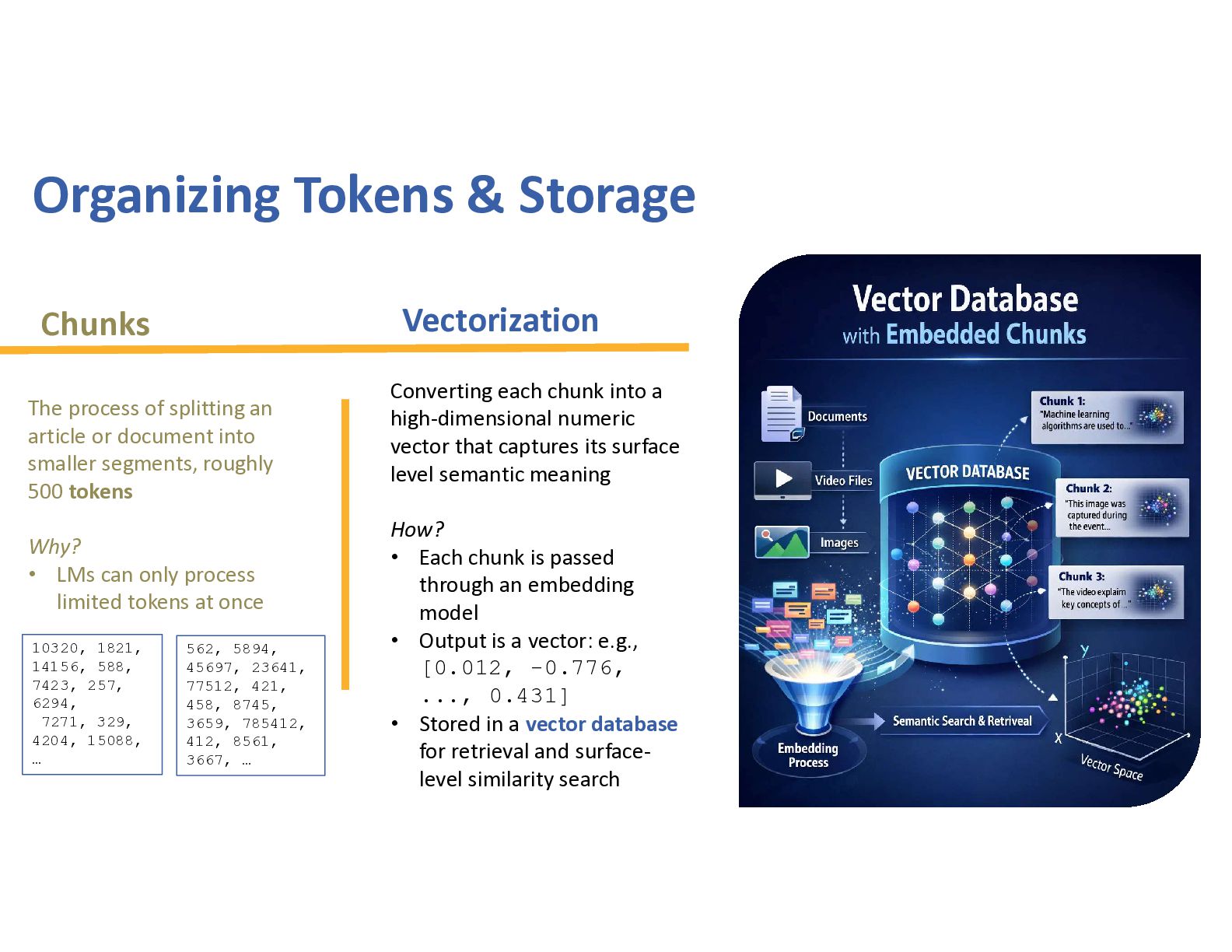
  19. Organizing Tokens & Storage Vectorization Chunks The process of splitting

    an article or document into smaller segments, roughly 500 tokens Why? • LMs can only process limited tokens at once 10320, 1821, 14156, 588, 7423, 257, 6294, 7271, 329, 4204, 15088, … 562, 5894, 45697, 23641, 77512, 421, 458, 8745, 3659, 785412, 412, 8561, 3667, … Converting each chunk into a high-dimensional numeric vector that captures its surface level semantic meaning How? • Each chunk is passed through an embedding model • Output is a vector: e.g., [0.012, -0.776, ..., 0.431] • Stored in a vector database for retrieval and surfacelevel similarity search
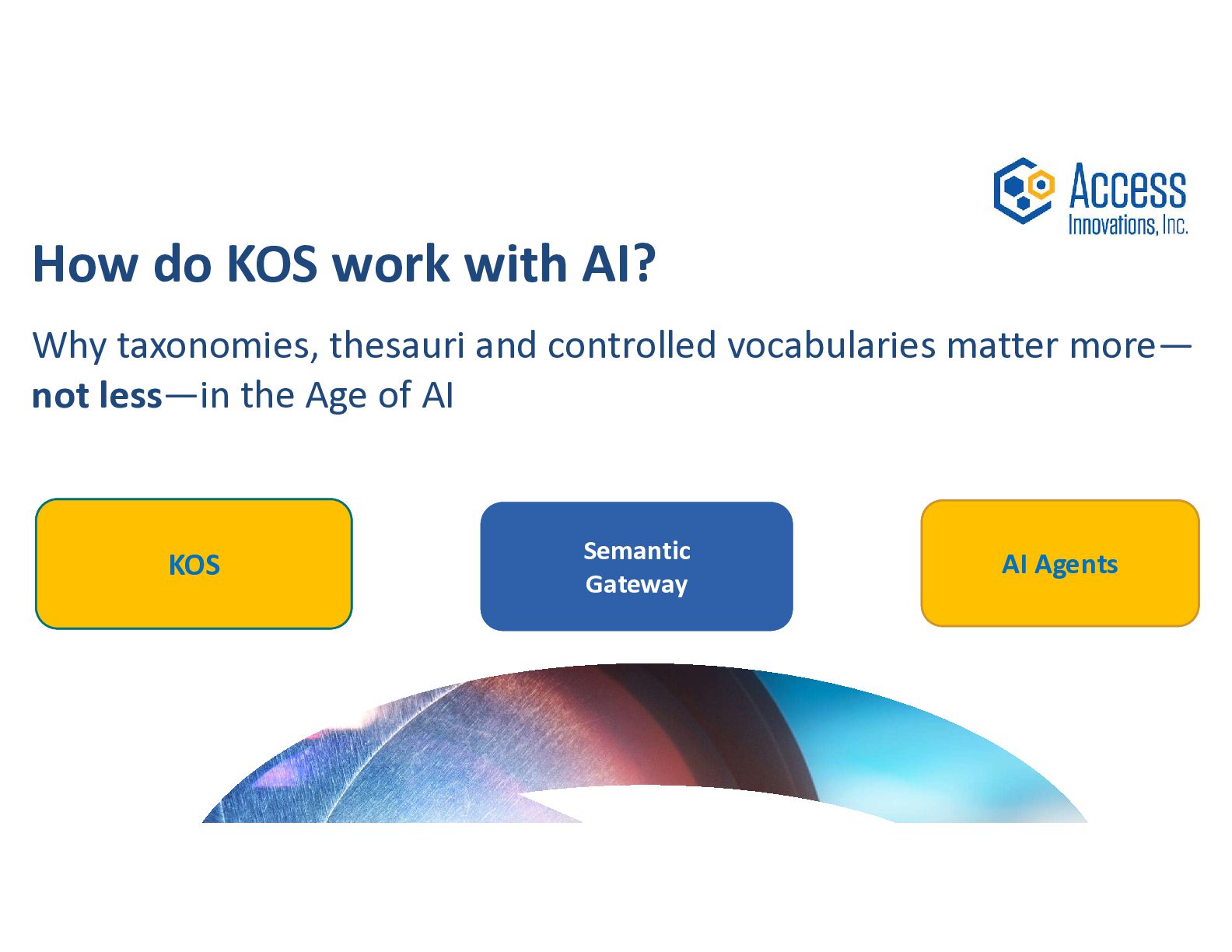
  20. How do KOS work with AI? Why taxonomies, thesauri and

    controlled vocabularies matter more— not less—in the Age of AI KOS Semantic Gateway AI Agents
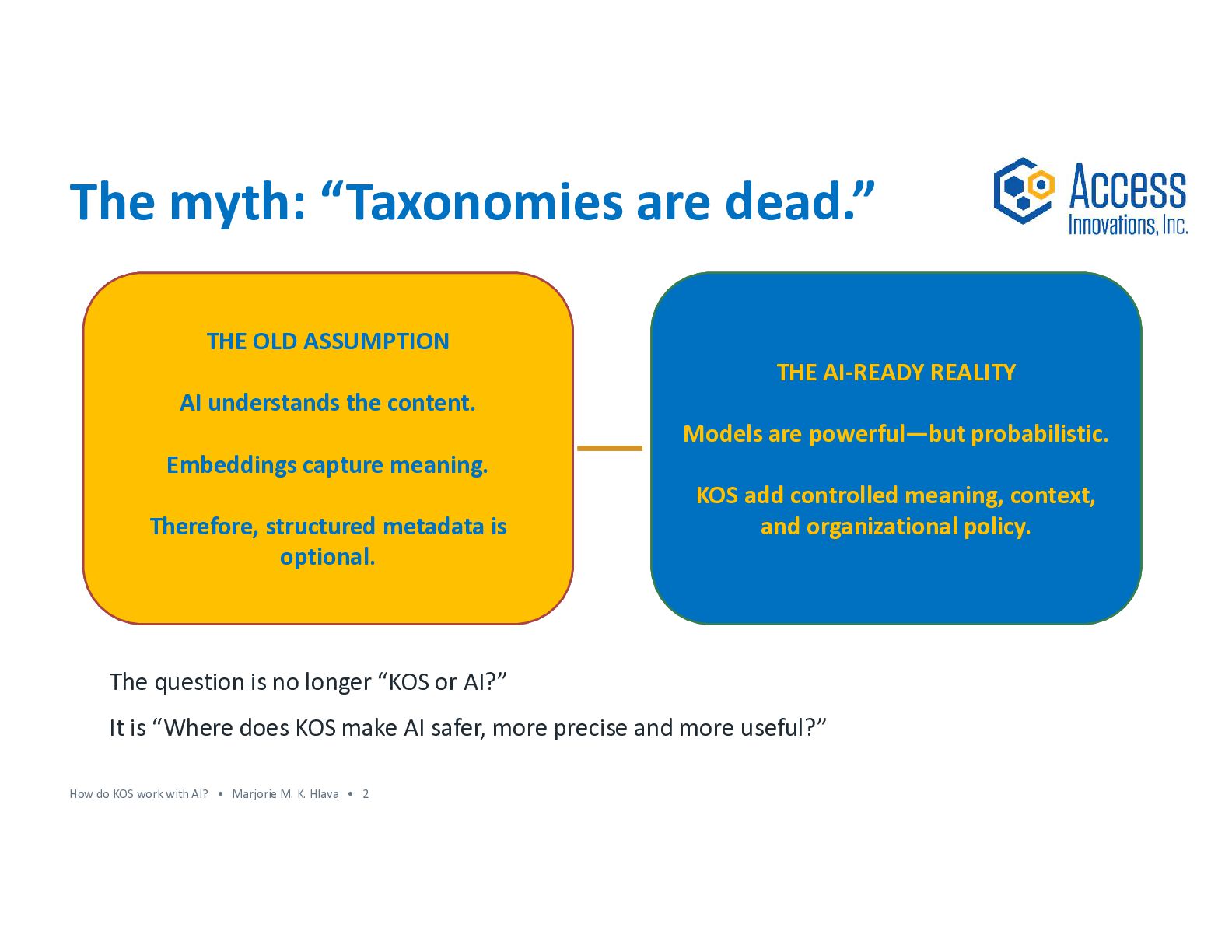
  21. The myth: “Taxonomies are dead.” THE OLD ASSUMPTION AI understands

    the content. Embeddings capture meaning. Therefore, structured metadata is optional. THE AI-READY REALITY Models are powerful—but probabilistic. KOS add controlled meaning, context, and organizational policy. The question is no longer “KOS or AI?” It is “Where does KOS make AI safer, more precise and more useful?” How do KOS work with AI? • Marjorie M. K. Hlava • 2
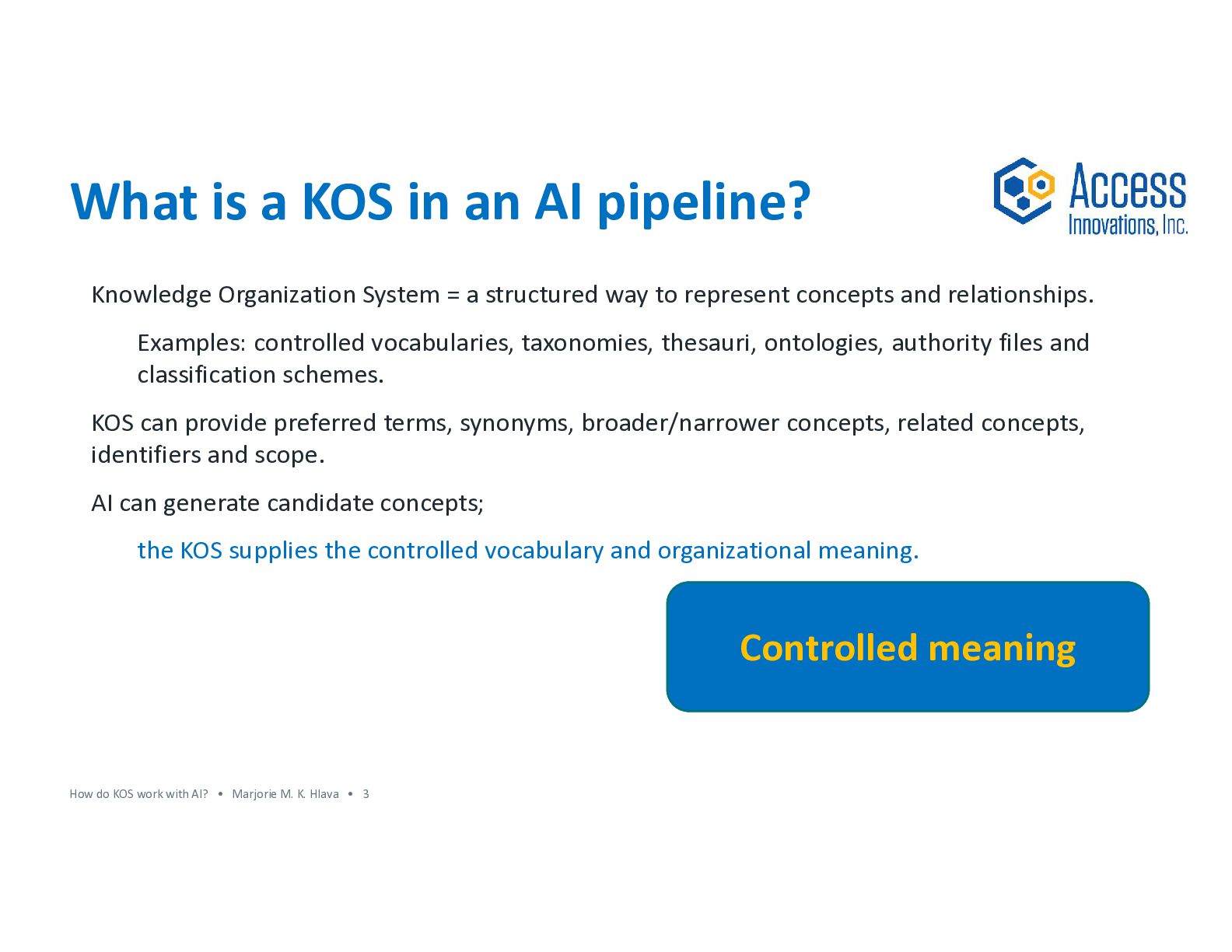
  22. What is a KOS in an AI pipeline? Knowledge Organization

    System = a structured way to represent concepts and relationships. Examples: controlled vocabularies, taxonomies, thesauri, ontologies, authority files and classification schemes. KOS can provide preferred terms, synonyms, broader/narrower concepts, related concepts, identifiers and scope. AI can generate candidate concepts; the KOS supplies the controlled vocabulary and organizational meaning. Controlled meaning How do KOS work with AI? • Marjorie M. K. Hlava • 3
  23. Where KOS enters the AI stack Source content documents •

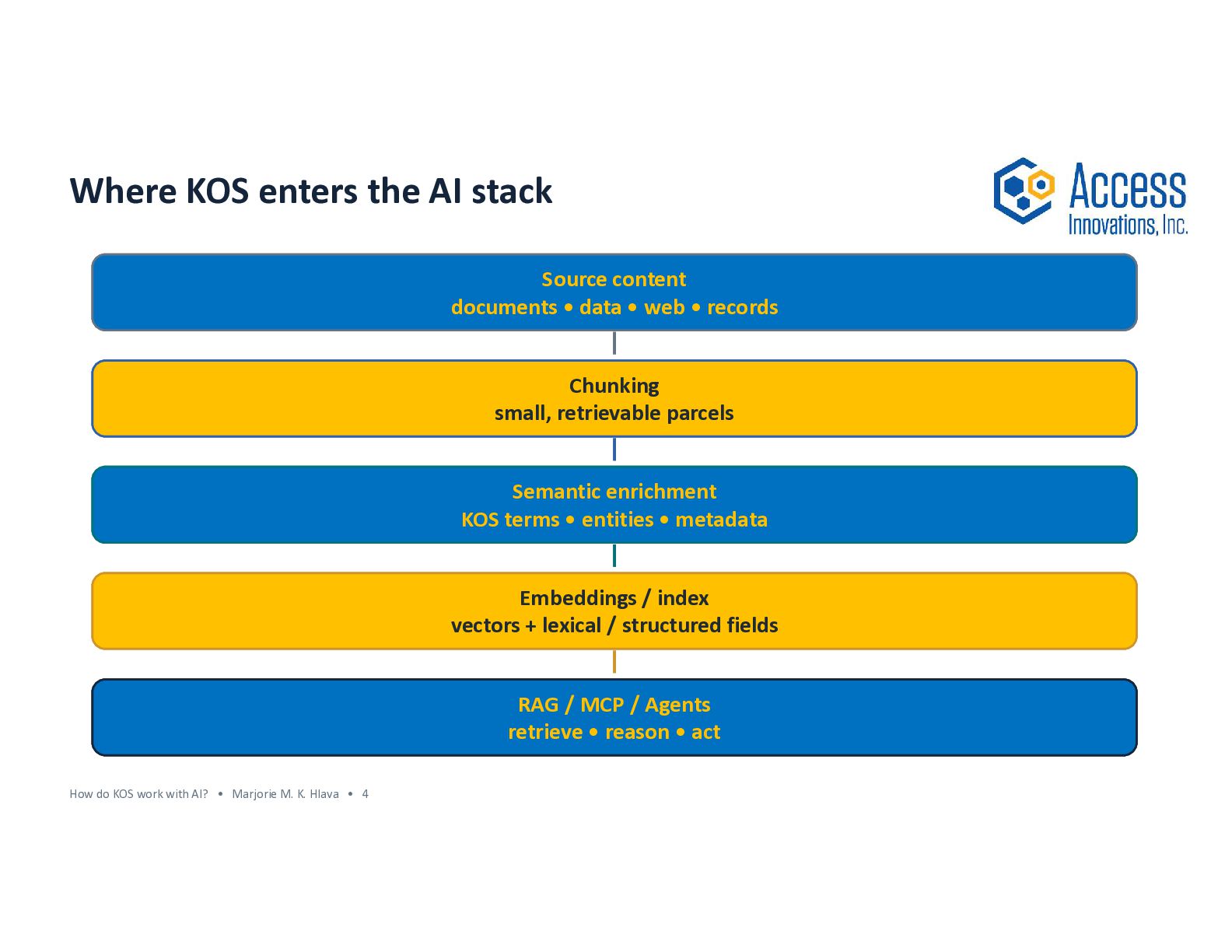
    data • web • records Chunking small, retrievable parcels Semantic enrichment KOS terms • entities • metadata Embeddings / index vectors + lexical / structured fields RAG / MCP / Agents retrieve • reason • act How do KOS work with AI? • Marjorie M. K. Hlava • 4
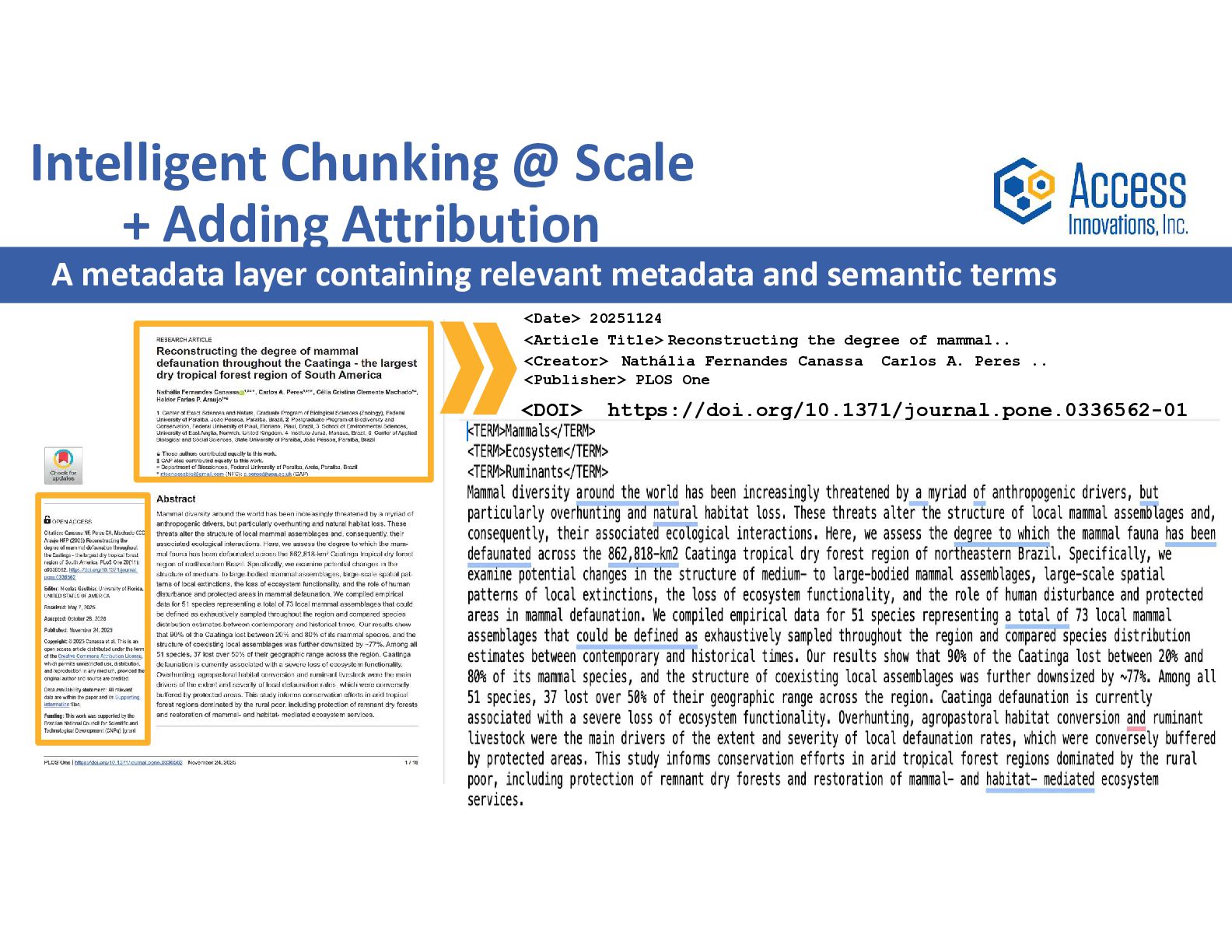
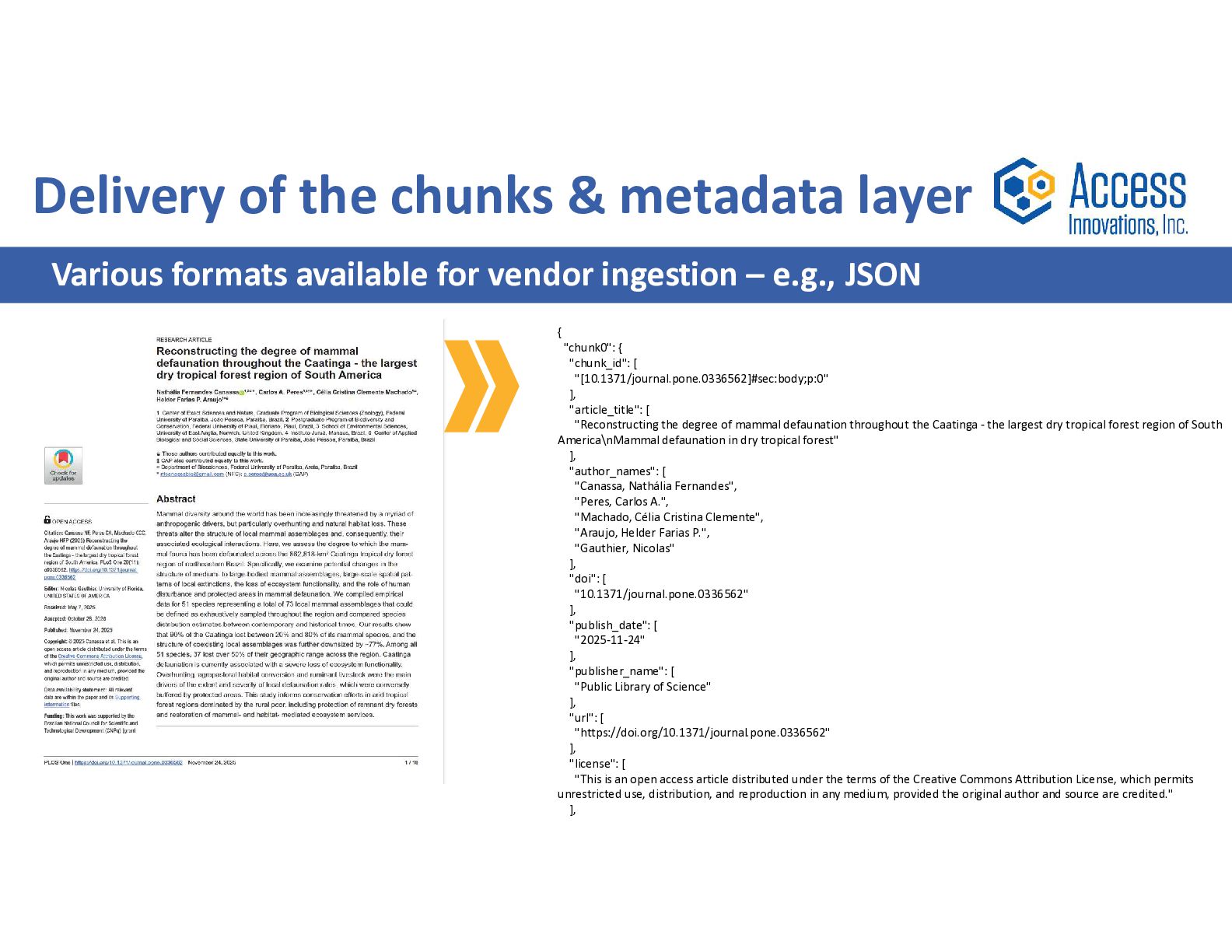
  24. Intelligent Chunking @ Scale + Adding Attribution A metadata layer

    containing relevant metadata and semantic terms <Date> 20251124 <Article Title> Reconstructing the degree of mammal.. <Creator> Nathália Fernandes Canassa Carlos A. Peres .. <Publisher> PLOS One <DOI> https://doi.org/10.1371/journal.pone.0336562-01
  25. The chunk is the unit of AI retrieval DOCUMENT Long

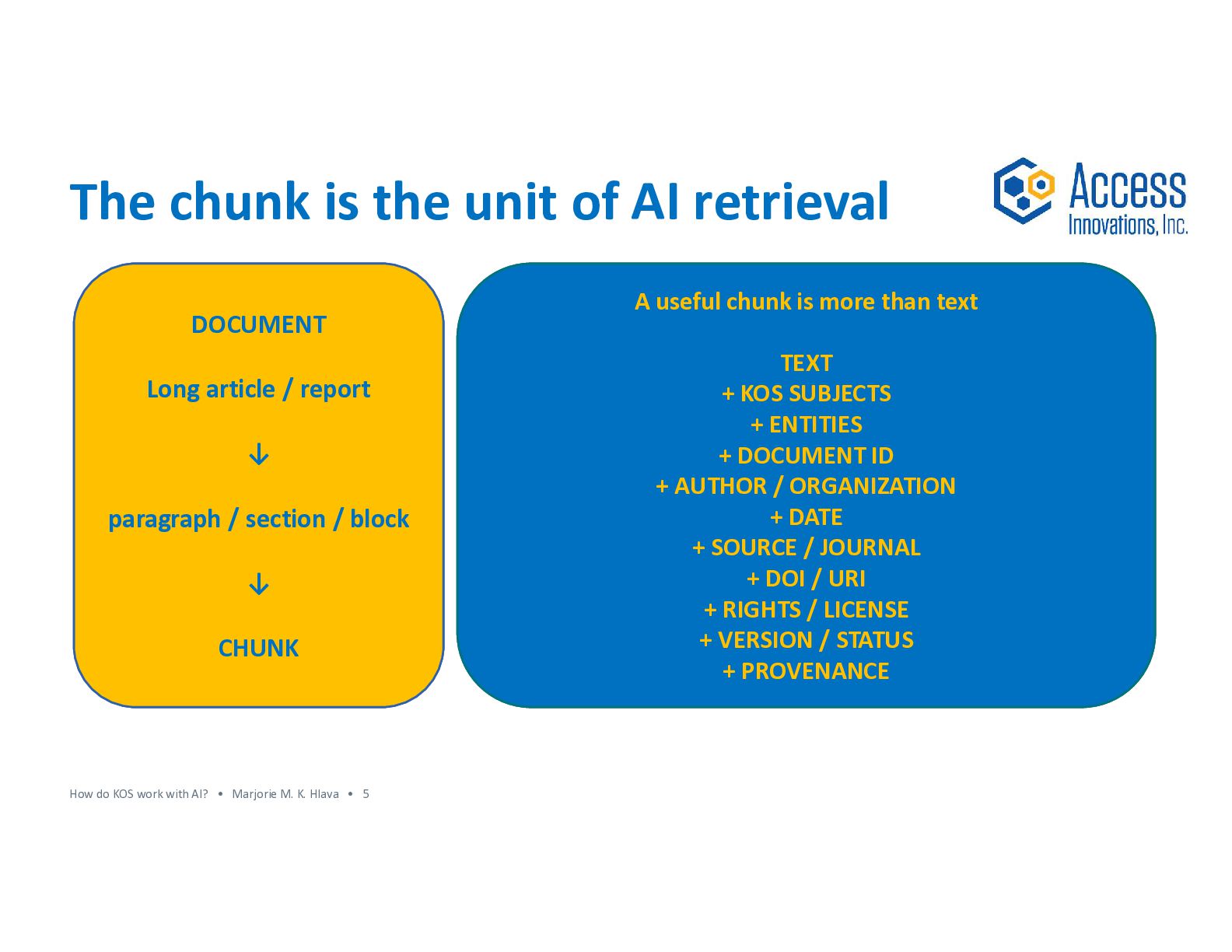
    article / report ↓ paragraph / section / block ↓ CHUNK How do KOS work with AI? • Marjorie M. K. Hlava • 5 A useful chunk is more than text TEXT + KOS SUBJECTS + ENTITIES + DOCUMENT ID + AUTHOR / ORGANIZATION + DATE + SOURCE / JOURNAL + DOI / URI + RIGHTS / LICENSE + VERSION / STATUS + PROVENANCE
  26. What does KOS enrichment actually do? 1 4 Detect What

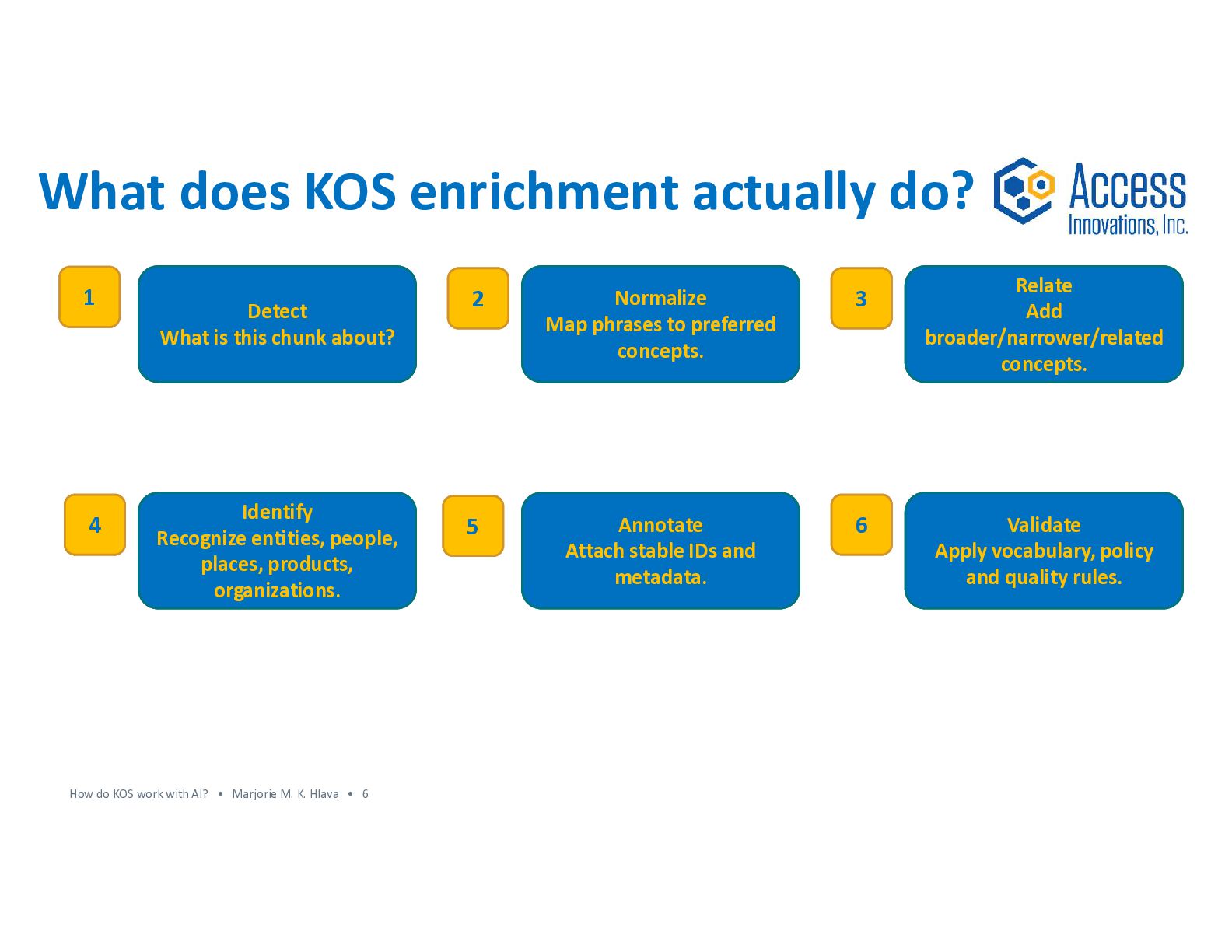
    is this chunk about? Identify Recognize entities, people, places, products, organizations. How do KOS work with AI? • Marjorie M. K. Hlava • 6 2 Normalize Map phrases to preferred concepts. 3 5 Annotate Attach stable IDs and metadata. 6 Relate Add broader/narrower/related concepts. Validate Apply vocabulary, policy and quality rules.
  27. Delivery of the chunks & metadata layer Various formats available

    for vendor ingestion – e.g., JSON { "chunk0": { "chunk_id": [ "[10.1371/journal.pone.0336562]#sec:body;p:0" ], "article_title": [ "Reconstructing the degree of mammal defaunation throughout the Caatinga - the largest dry tropical forest region of South America\nMammal defaunation in dry tropical forest" ], "author_names": [ "Canassa, Nathália Fernandes", "Peres, Carlos A.", "Machado, Célia Cristina Clemente", "Araujo, Helder Farias P.", "Gauthier, Nicolas" ], "doi": [ "10.1371/journal.pone.0336562" ], "publish_date": [ "2025-11-24" ], "publisher_name": [ "Public Library of Science" ], "url": [ "https://doi.org/10.1371/journal.pone.0336562" ], "license": [ "This is an open access article distributed under the terms of the Creative Commons Attribution License, which permits unrestricted use, distribution, and reproduction in any medium, provided the original author and source are credited." ],
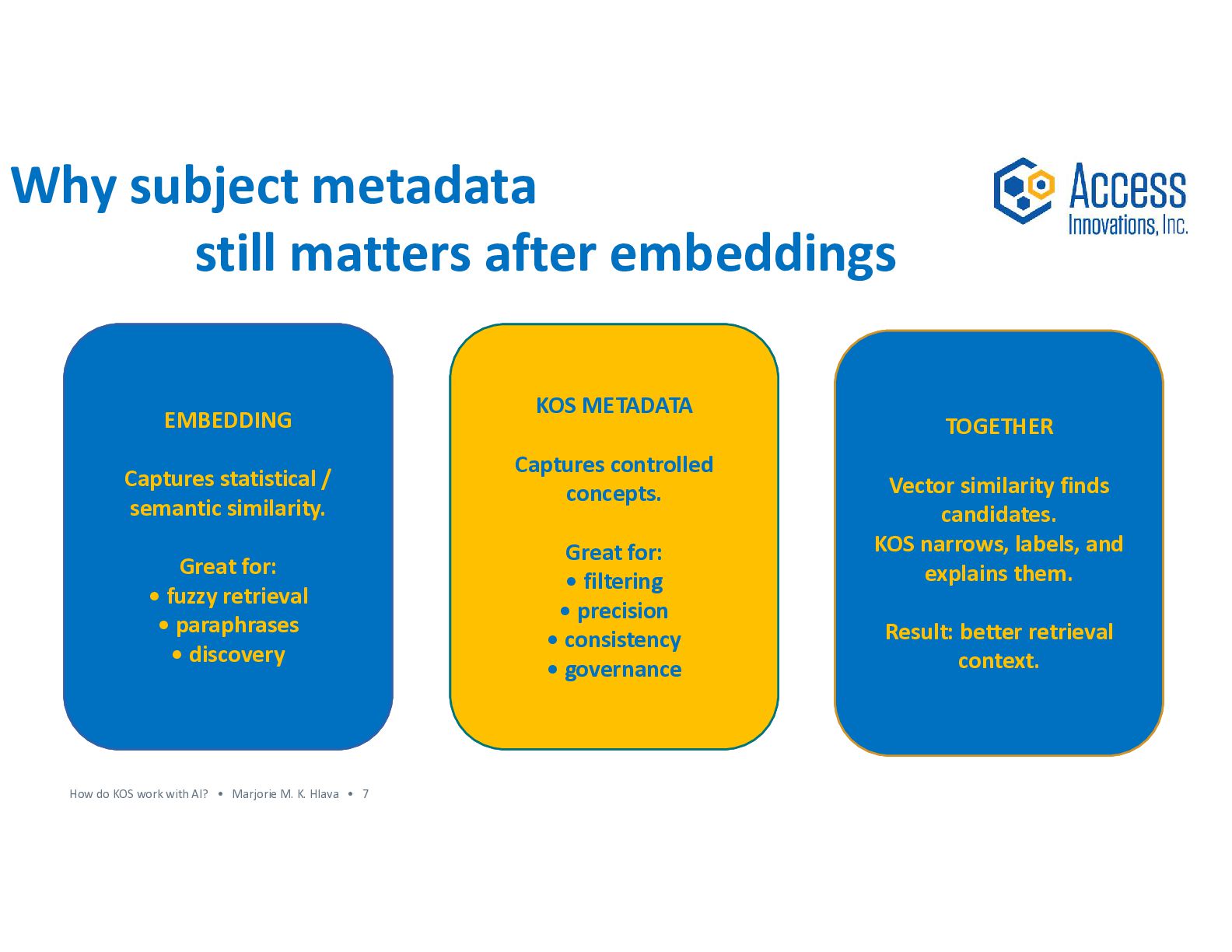
  28. Why subject metadata still matters after embeddings EMBEDDING Captures statistical

    / semantic similarity. Great for: • fuzzy retrieval • paraphrases • discovery How do KOS work with AI? • Marjorie M. K. Hlava • 7 KOS METADATA Captures controlled concepts. Great for: • filtering • precision • consistency • governance TOGETHER Vector similarity finds candidates. KOS narrows, labels, and explains them. Result: better retrieval context.
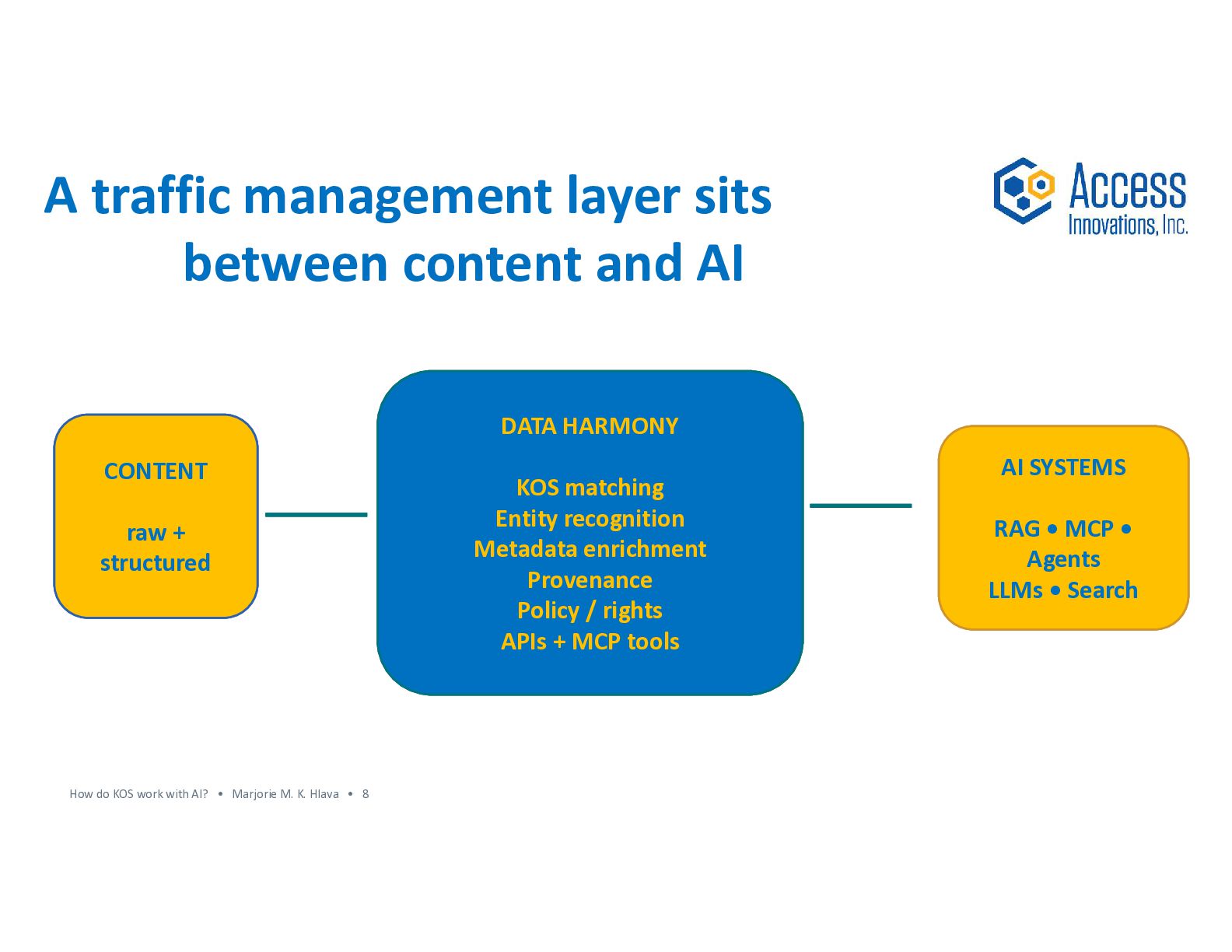
  29. A traffic management layer sits between content and AI DATA

    HARMONY CONTENT raw + structured How do KOS work with AI? • Marjorie M. K. Hlava • 8 KOS matching Entity recognition Metadata enrichment Provenance Policy / rights APIs + MCP tools AI SYSTEMS RAG • MCP • Agents LLMs • Search
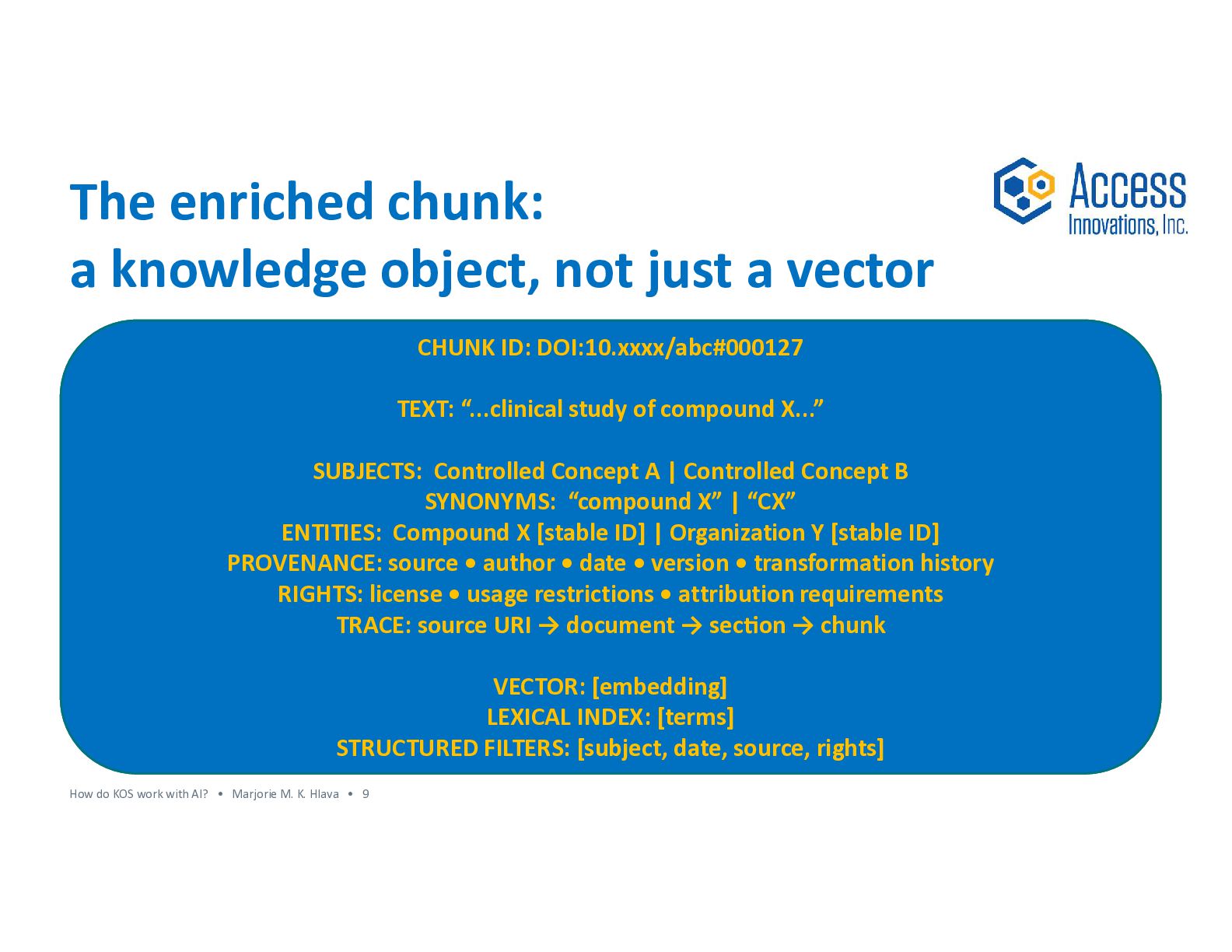
  30. The enriched chunk: a knowledge object, not just a vector

    CHUNK ID: DOI:10.xxxx/abc#000127 TEXT: “...clinical study of compound X...” SUBJECTS: Controlled Concept A | Controlled Concept B SYNONYMS: “compound X” | “CX” ENTITIES: Compound X [stable ID] | Organization Y [stable ID] PROVENANCE: source • author • date • version • transformation history RIGHTS: license • usage restrictions • attribution requirements TRACE: source URI → document → sec on → chunk VECTOR: [embedding] LEXICAL INDEX: [terms] STRUCTURED FILTERS: [subject, date, source, rights] How do KOS work with AI? • Marjorie M. K. Hlava • 9
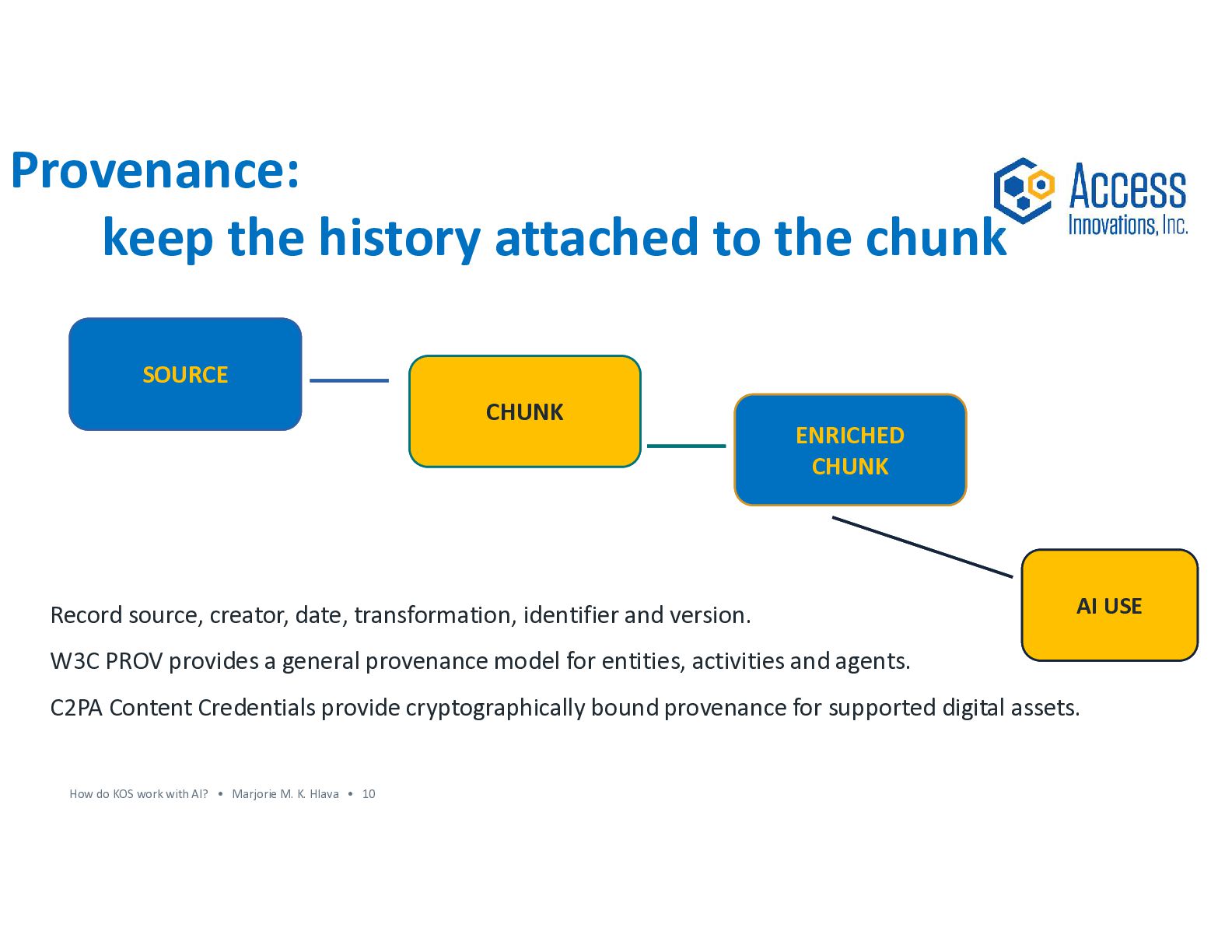
  31. Provenance: keep the history attached to the chunk SOURCE CHUNK

    ENRICHED CHUNK Record source, creator, date, transformation, identifier and version. AI USE W3C PROV provides a general provenance model for entities, activities and agents. C2PA Content Credentials provide cryptographically bound provenance for supported digital assets. How do KOS work with AI? • Marjorie M. K. Hlava • 10
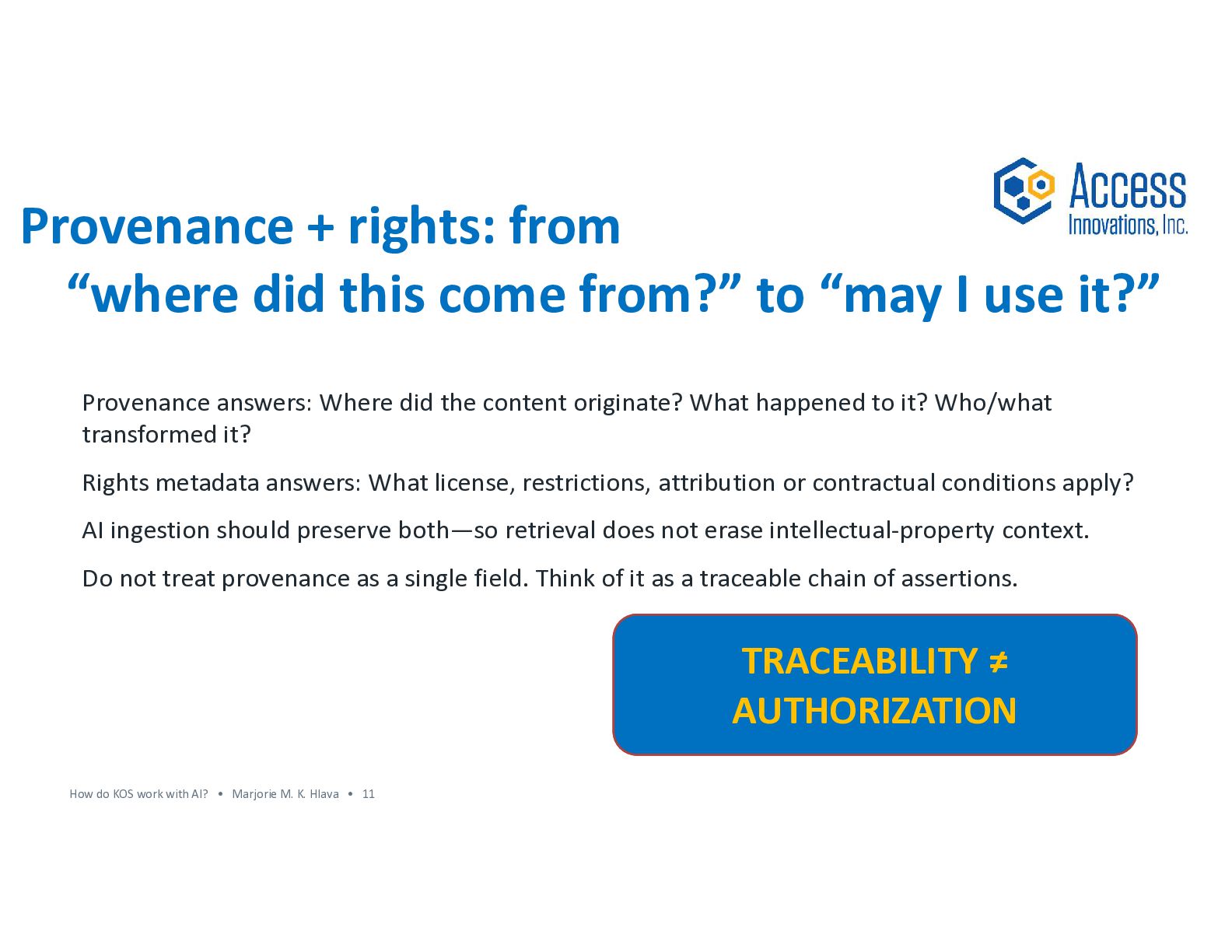
  32. Provenance + rights: from “where did this come from?” to

    “may I use it?” Provenance answers: Where did the content originate? What happened to it? Who/what transformed it? Rights metadata answers: What license, restrictions, attribution or contractual conditions apply? AI ingestion should preserve both—so retrieval does not erase intellectual-property context. Do not treat provenance as a single field. Think of it as a traceable chain of assertions. TRACEABILITY ≠ AUTHORIZATION How do KOS work with AI? • Marjorie M. K. Hlava • 11
  33. Can this be automated? Yes—“magic tagging.” AUTOMATE VALIDATE • term

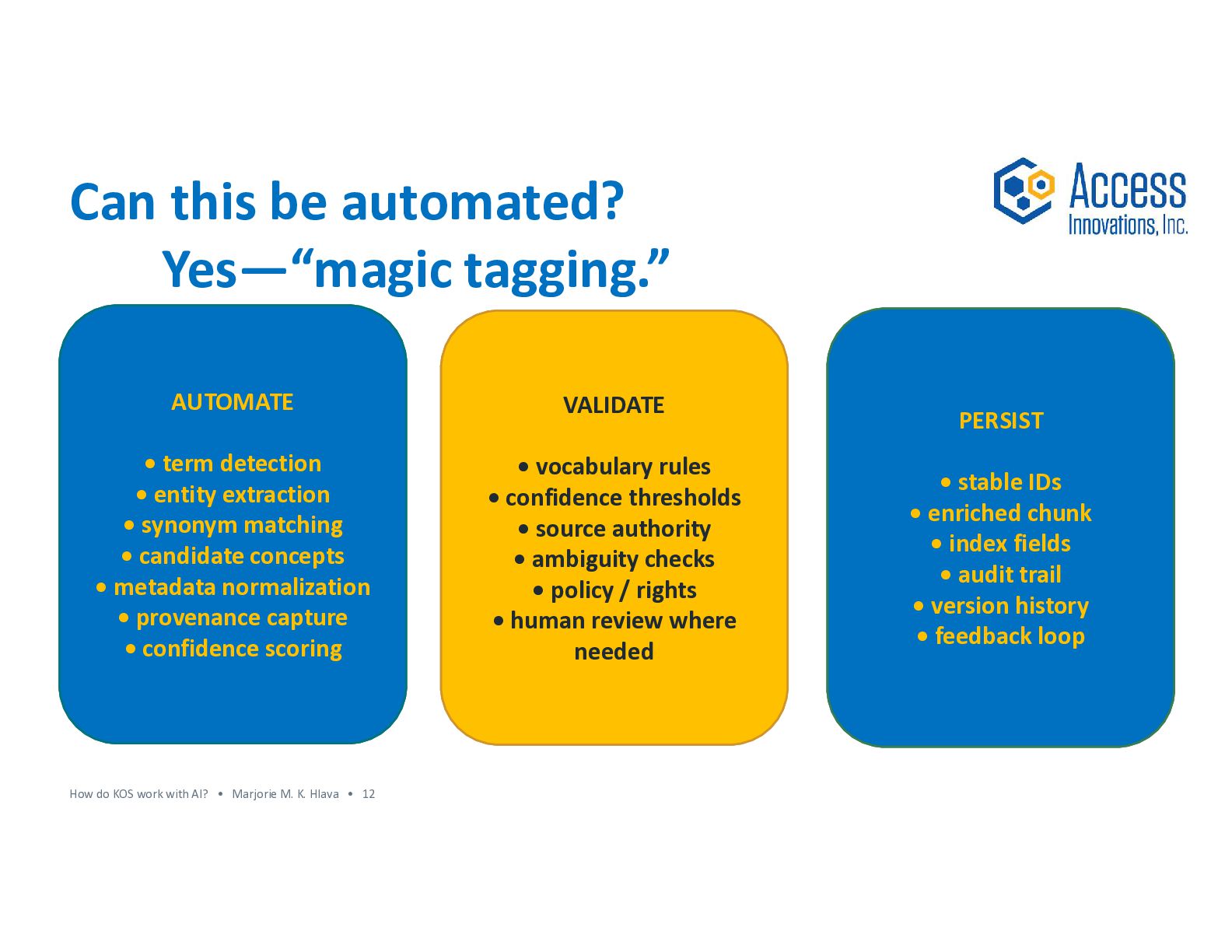
    detection • entity extraction • synonym matching • candidate concepts • metadata normalization • provenance capture • confidence scoring • vocabulary rules • confidence thresholds • source authority • ambiguity checks • policy / rights • human review where needed How do KOS work with AI? • Marjorie M. K. Hlava • 12 PERSIST • stable IDs • enriched chunk • index fields • audit trail • version history • feedback loop
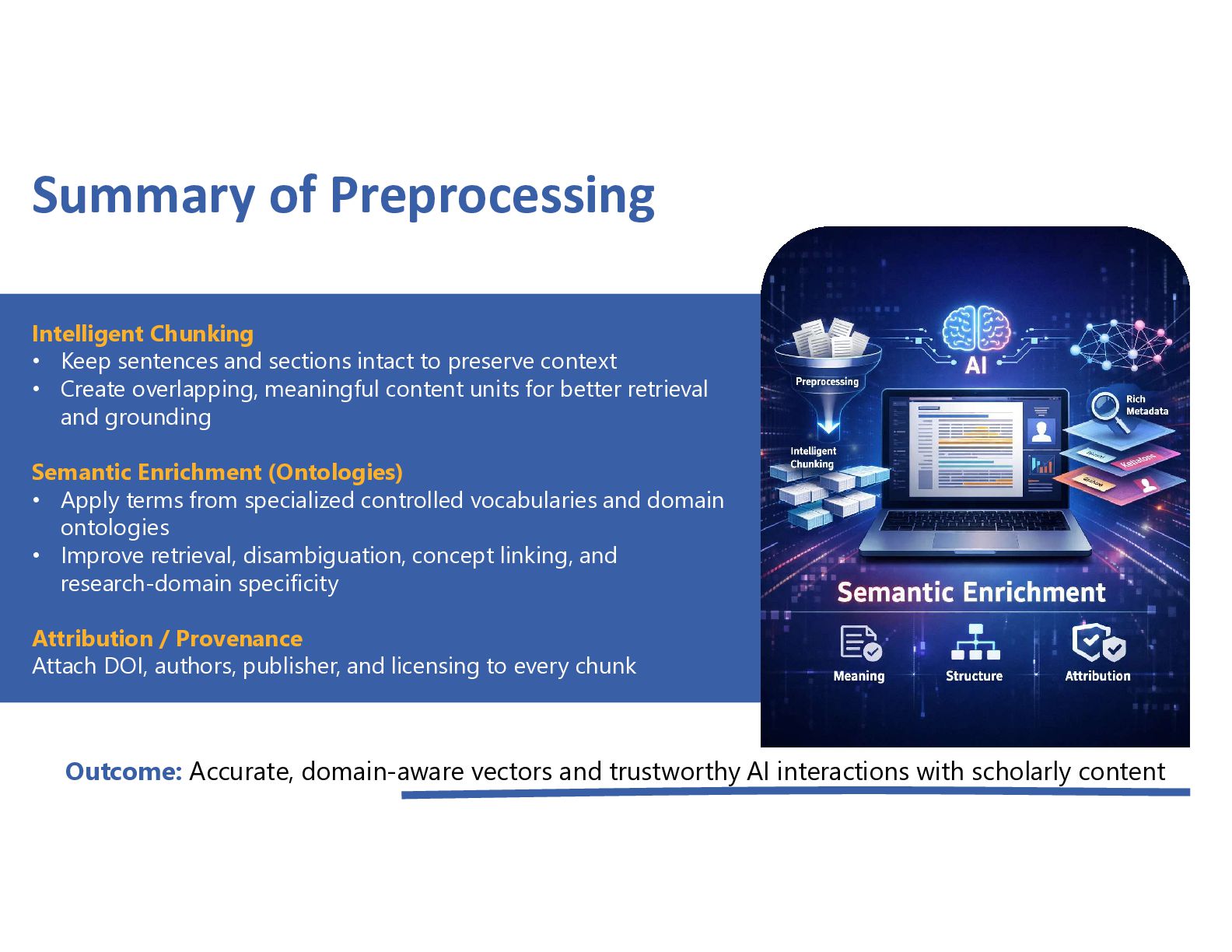
  34. Summary of Preprocessing Intelligent Chunking • Keep sentences and sections

    intact to preserve context • Create overlapping, meaningful content units for better retrieval and grounding Semantic Enrichment (Ontologies) • Apply terms from specialized controlled vocabularies and domain ontologies • Improve retrieval, disambiguation, concept linking, and research-domain specificity Attribution / Provenance Attach DOI, authors, publisher, and licensing to every chunk Outcome: Accurate, domain-aware vectors and trustworthy AI interactions with scholarly content
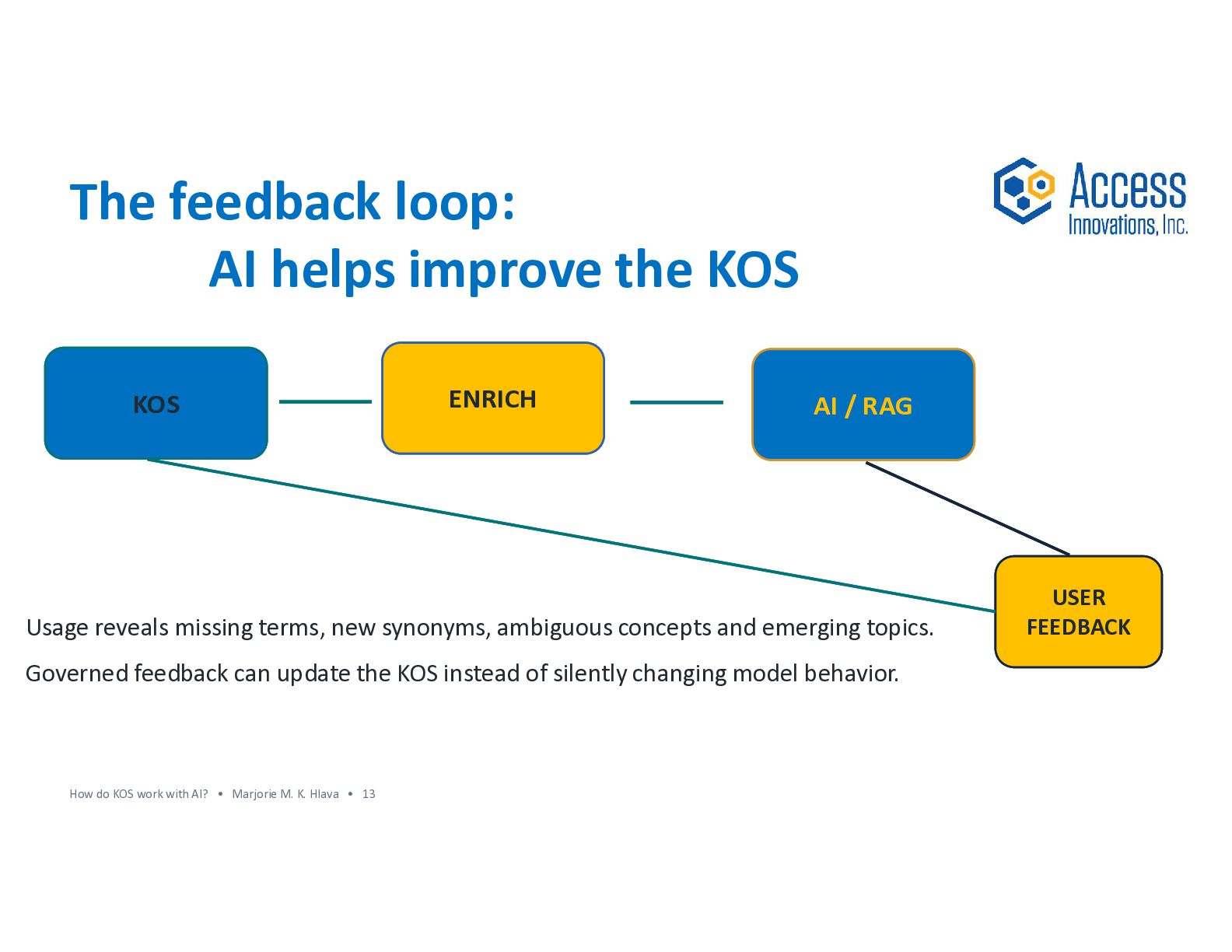
  35. The feedback loop: AI helps improve the KOS KOS ENRICH

    AI / RAG Usage reveals missing terms, new synonyms, ambiguous concepts and emerging topics. Governed feedback can update the KOS instead of silently changing model behavior. How do KOS work with AI? • Marjorie M. K. Hlava • 13 USER FEEDBACK
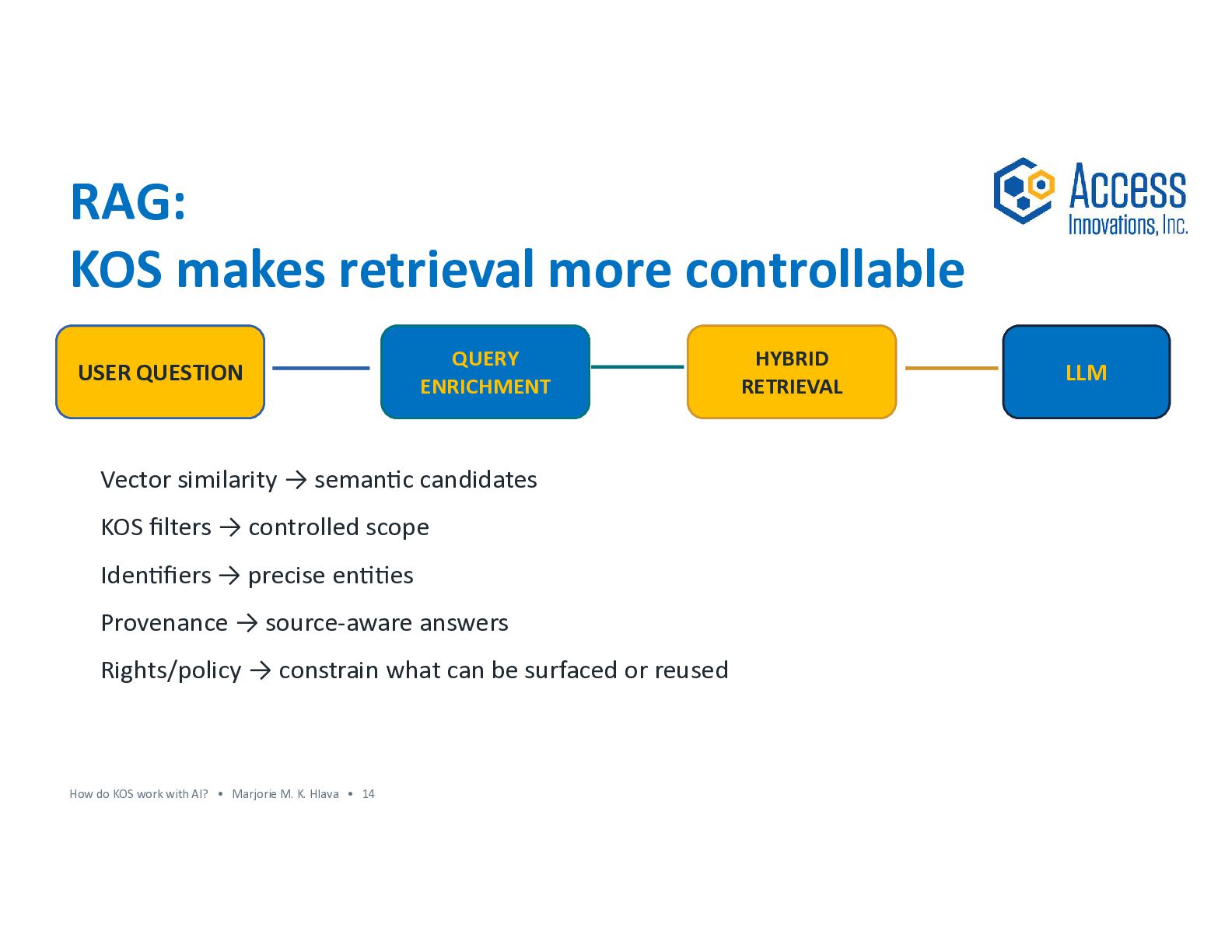
  36. RAG: KOS makes retrieval more controllable QUERY ENRICHMENT USER QUESTION

    Vector similarity → seman c candidates KOS filters → controlled scope Iden fiers → precise en es Provenance → source-aware answers Rights/policy → constrain what can be surfaced or reused How do KOS work with AI? • Marjorie M. K. Hlava • 14 HYBRID RETRIEVAL LLM
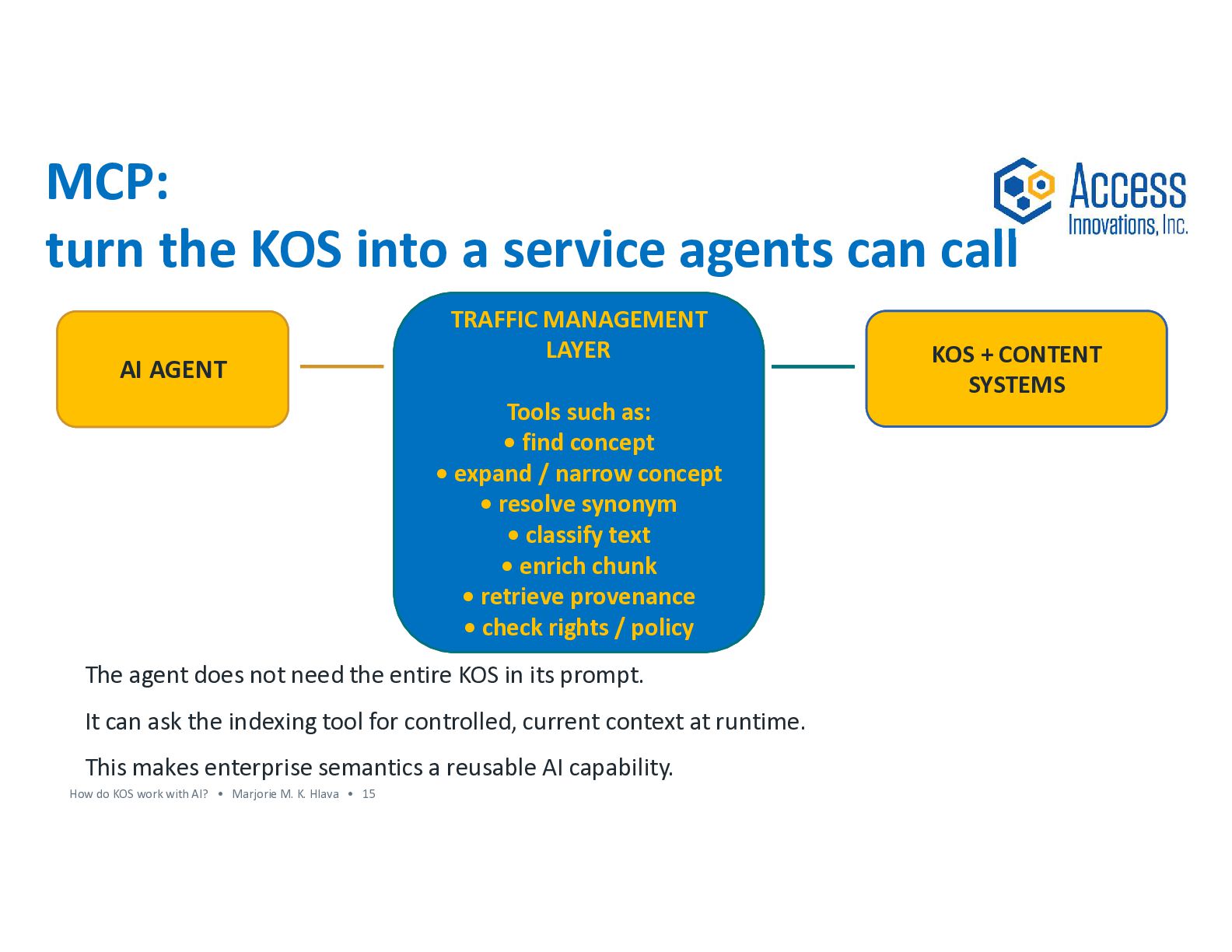
  37. MCP: turn the KOS into a service agents can call

    AI AGENT TRAFFIC MANAGEMENT LAYER Tools such as: • find concept • expand / narrow concept • resolve synonym • classify text • enrich chunk • retrieve provenance • check rights / policy The agent does not need the entire KOS in its prompt. It can ask the indexing tool for controlled, current context at runtime. This makes enterprise semantics a reusable AI capability. How do KOS work with AI? • Marjorie M. K. Hlava • 15 KOS + CONTENT SYSTEMS
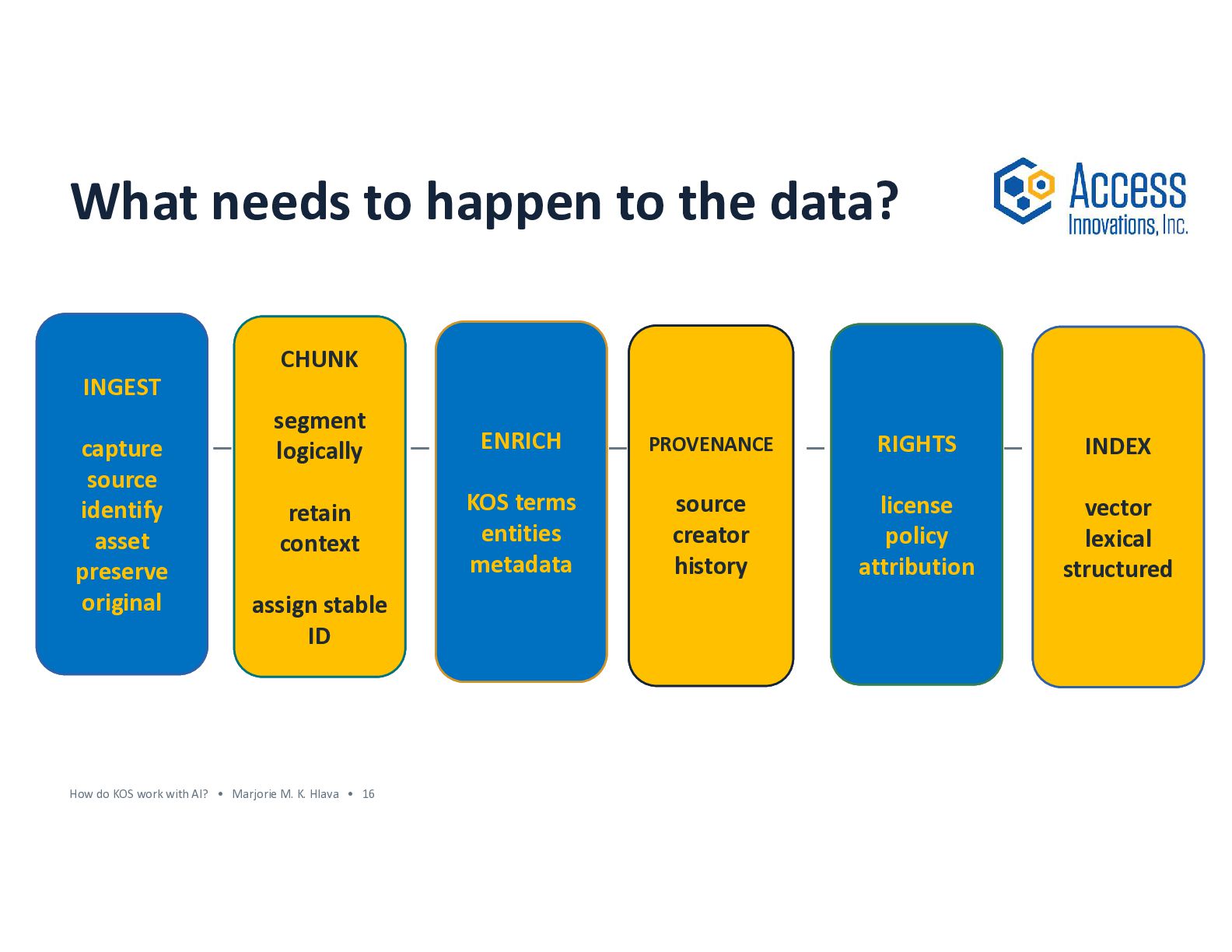
  38. What needs to happen to the data? INGEST capture source

    identify asset preserve original CHUNK segment logically ENRICH PROVENANCE RIGHTS INDEX retain context KOS terms entities metadata source creator history license policy attribution vector lexical structured assign stable ID How do KOS work with AI? • Marjorie M. K. Hlava • 16
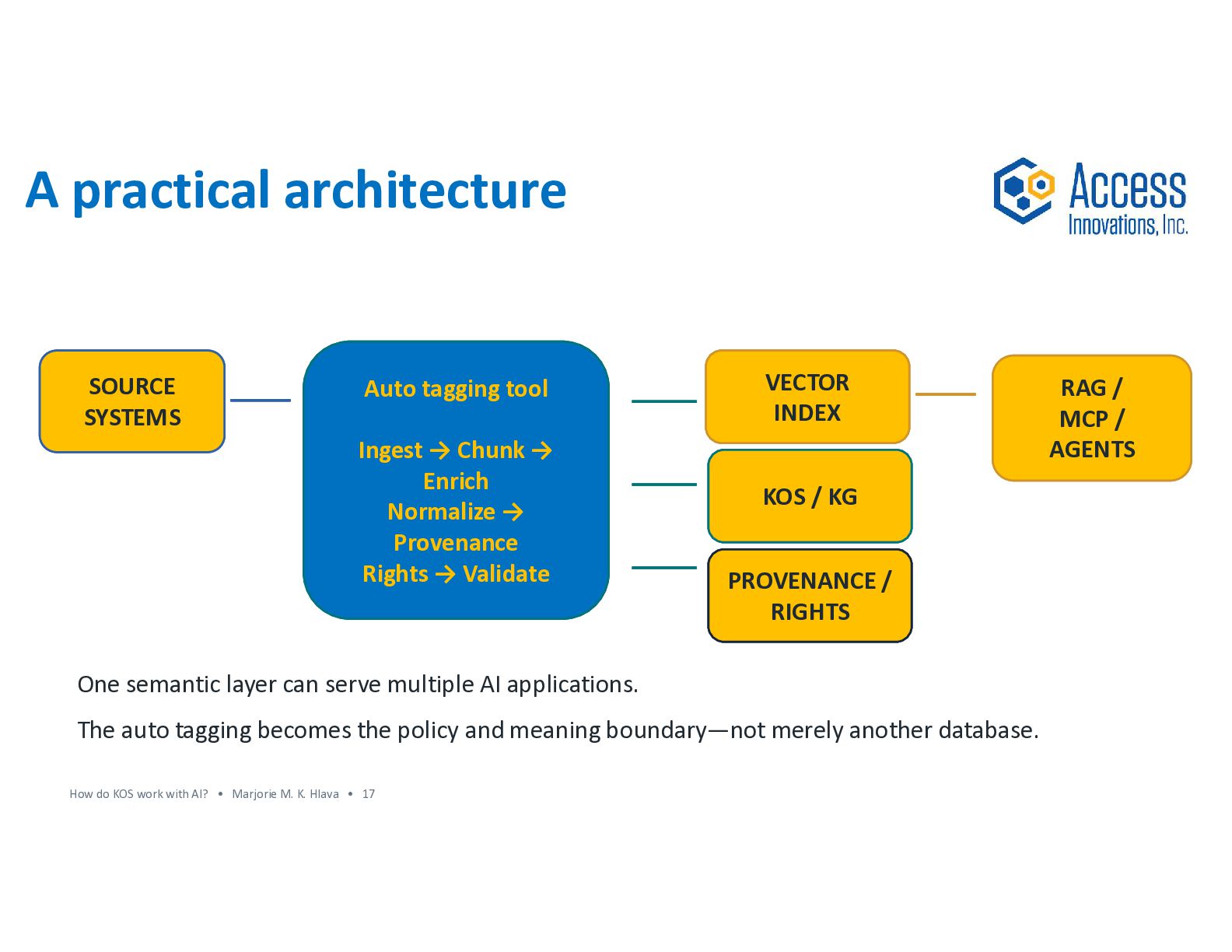
  39. A practical architecture SOURCE SYSTEMS Auto tagging tool Ingest →

    Chunk → Enrich Normalize → Provenance Rights → Validate VECTOR INDEX KOS / KG PROVENANCE / RIGHTS One semantic layer can serve multiple AI applications. The auto tagging becomes the policy and meaning boundary—not merely another database. How do KOS work with AI? • Marjorie M. K. Hlava • 17 RAG / MCP / AGENTS
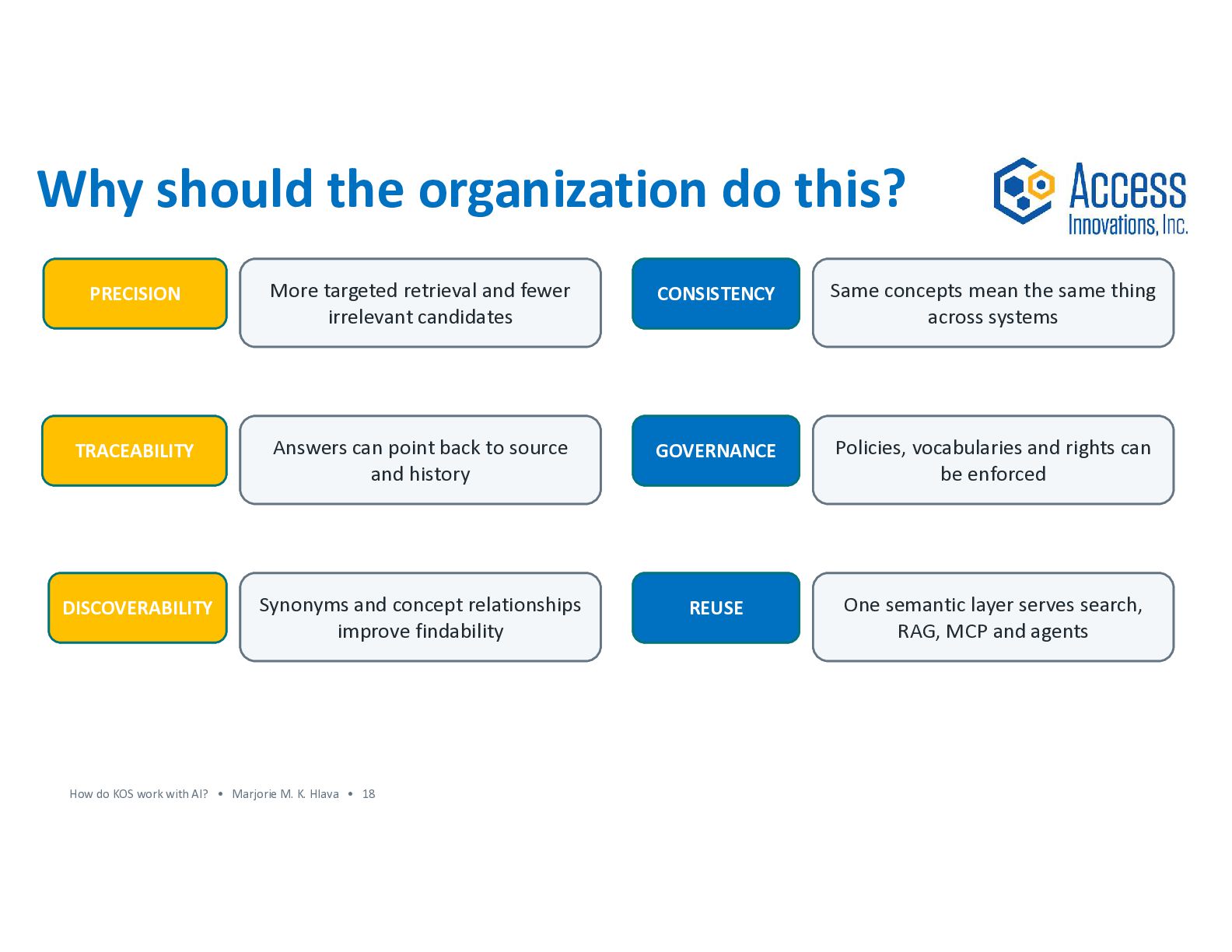
  40. Why should the organization do this? PRECISION More targeted retrieval

    and fewer irrelevant candidates CONSISTENCY Same concepts mean the same thing across systems TRACEABILITY Answers can point back to source and history GOVERNANCE Policies, vocabularies and rights can be enforced DISCOVERABILITY Synonyms and concept relationships improve findability REUSE One semantic layer serves search, RAG, MCP and agents How do KOS work with AI? • Marjorie M. K. Hlava • 18
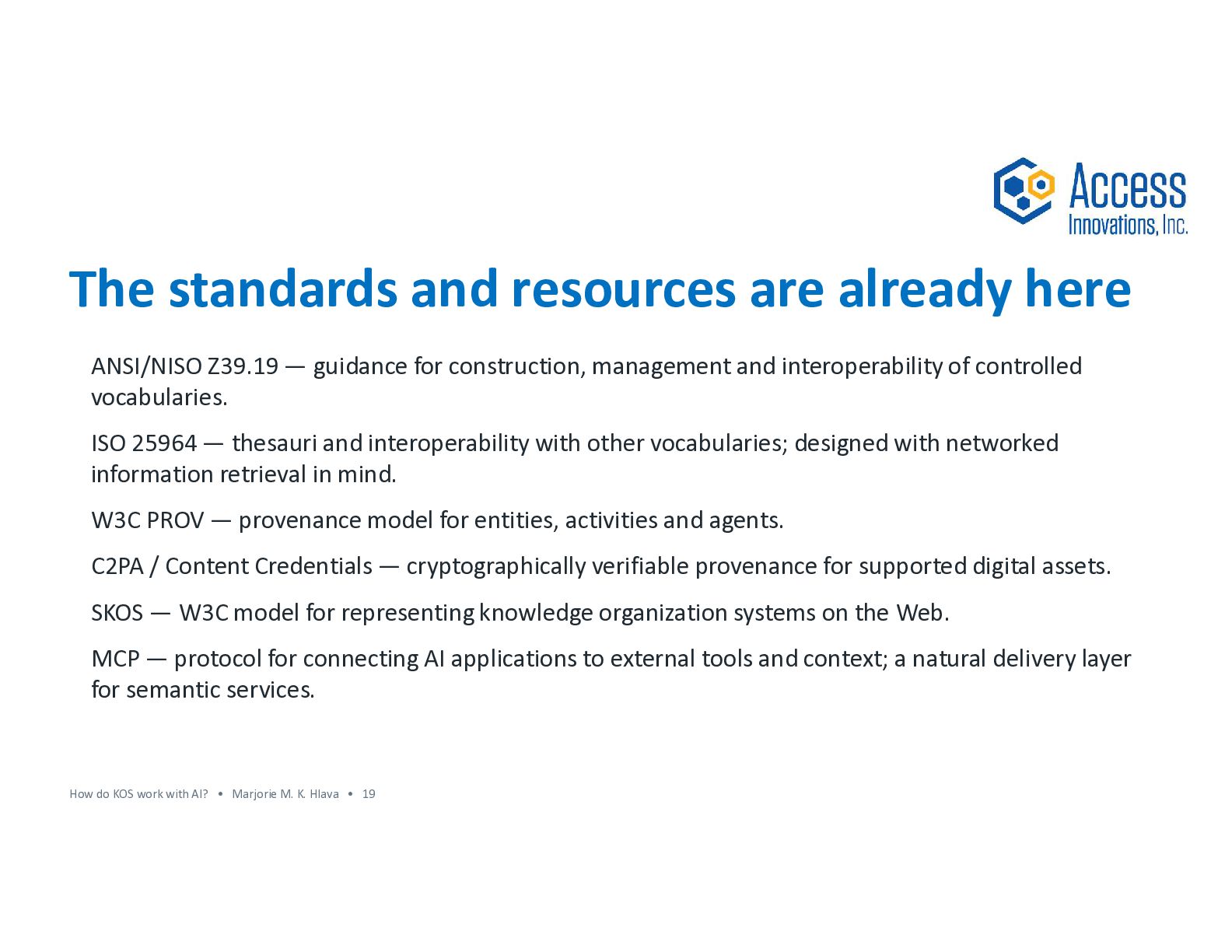
  41. The standards and resources are already here ANSI/NISO Z39.19 —

    guidance for construction, management and interoperability of controlled vocabularies. ISO 25964 — thesauri and interoperability with other vocabularies; designed with networked information retrieval in mind. W3C PROV — provenance model for entities, activities and agents. C2PA / Content Credentials — cryptographically verifiable provenance for supported digital assets. SKOS — W3C model for representing knowledge organization systems on the Web. MCP — protocol for connecting AI applications to external tools and context; a natural delivery layer for semantic services. How do KOS work with AI? • Marjorie M. K. Hlava • 19
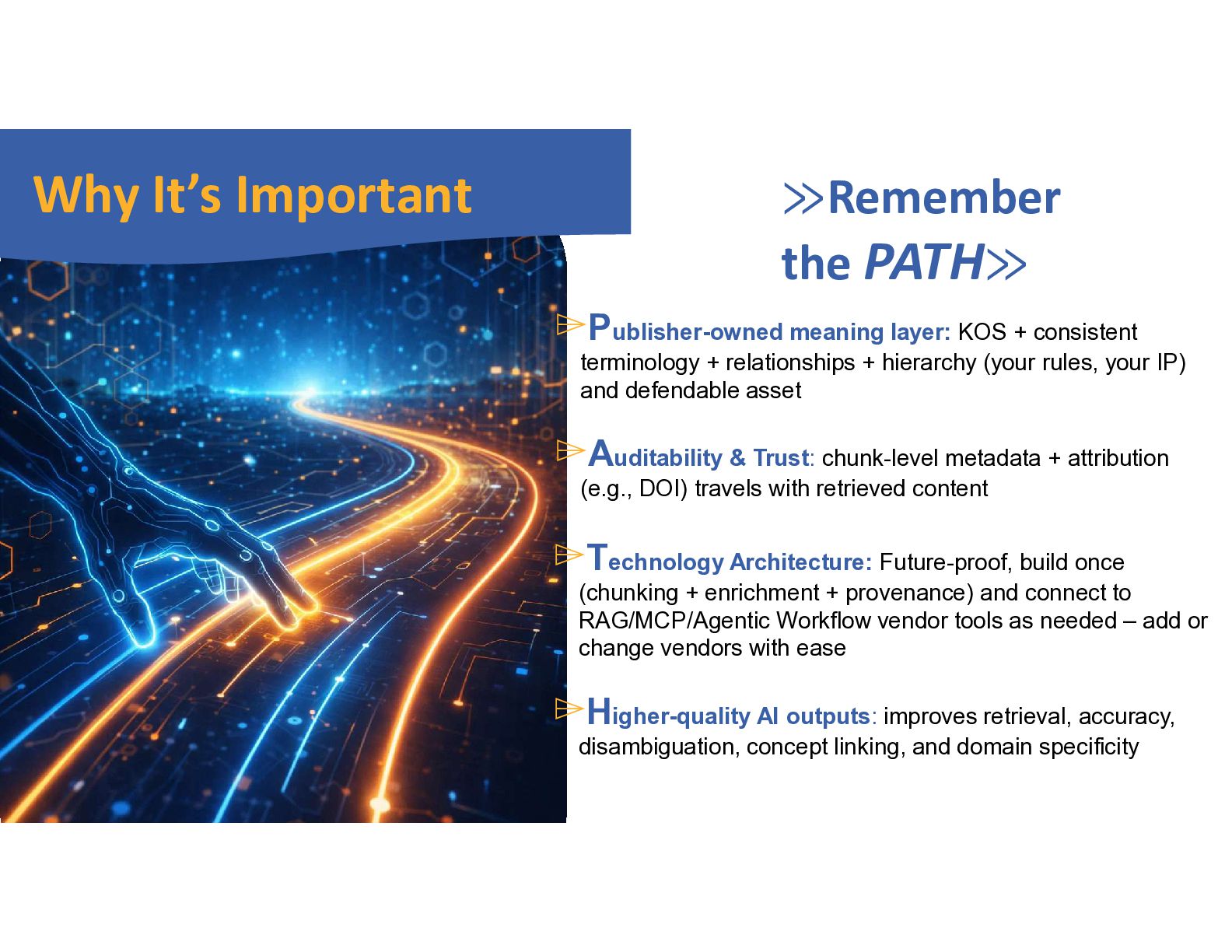
  42. Why It’s Important ≫Remember the PATH≫ ⌲Publisher-owned meaning layer: KOS

    + consistent terminology + relationships + hierarchy (your rules, your IP) and defendable asset ⌲Auditability & Trust: chunk-level metadata + attribution (e.g., DOI) travels with retrieved content ⌲Technology Architecture: Future-proof, build once (chunking + enrichment + provenance) and connect to RAG/MCP/Agentic Workflow vendor tools as needed – add or change vendors with ease ⌲Higher-quality AI outputs: improves retrieval, accuracy, disambiguation, concept linking, and domain specificity
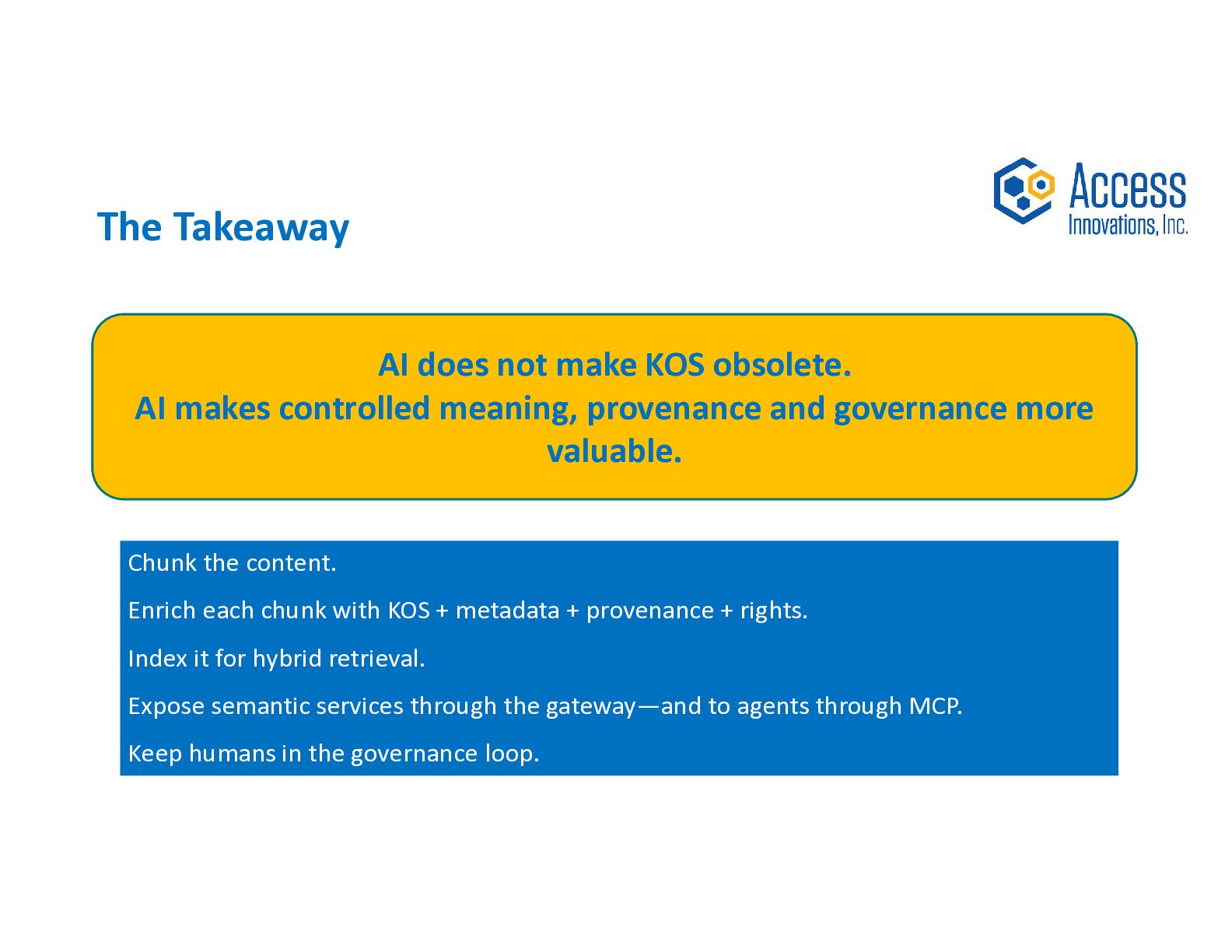
  43. The Takeaway AI does not make KOS obsolete. AI makes

    controlled meaning, provenance and governance more valuable. Chunk the content. Enrich each chunk with KOS + metadata + provenance + rights. Index it for hybrid retrieval. Expose semantic services through the gateway—and to agents through MCP. Keep humans in the governance loop.
  44. Discussion AI is the engine KOS is the semantic road

    system. The opportunity: make existing knowledge assets AI-ready without throwing away the intellectual work already invested in them. The next step: build the semantic gateway once—and let many AI applications use it. How do KOS work with AI? • Marjorie M. K. Hlava • 22
  45. Selected sources NISO — ANSI/NISO Z39.19: Guidelines for the Construction,

    Format, and Management of Monolingual Controlled Vocabularies. NISO — ISO 25964: Thesauri and Interoperability with Other Vocabularies. W3C — PROV Family of Documents / PROV Data Model. C2PA — Content Credentials Technical Specification and Explainer. Model Context Protocol — July 28, 2026 Specification. Data Harmony by Access Innovations — semantic enrichment / controlled vocabulary platform (company materials). How do KOS work with AI? • Marjorie M. K. Hlava • 21