Upgrade to Pro — share decks privately, control downloads, hide ads and more …

The ISO 25964 standard on Information and docu...

Sponsored · Your Podcast. Everywhere. Effortlessly. Share. Educate. Inspire. Entertain. You do you. We'll handle the rest.
Avatar for AccessInnovations AccessInnovations
September 09, 2026

The ISO 25964 standard on Information and documentation — Thesauri and interoperability with other vocabularies

This presentation was given at the International Society for Knowledge Organization meeting Sao Paolo Brazil in August, 2026. This presentation is broken into two parts. Part 1: Thesauri for information retrieval, creation, management, and use. Part 2: Interoperability with other vocabularies. This presentation outlines the status and progress of the standard including some of the challenges ensuring that it meets the demands of the world today including the pressures of AI. The need for clean, well-structured subject metadata has never been stronger; this standard outlines both the many parts of a thesaurus / taxonomy / ontology in support of those goals as well as the (Part 2) best practices for the industry. The presentation also outlines the process of creation using the ISO standards practices and the workings of the working group, with Marjorie Hlava as the convener.

Avatar for AccessInnovations

AccessInnovations

September 09, 2026

Other Decks in Design

Transcript

  1. ISO 25964-1 working group ISO/TC 46/SC 9/WG 8 Information and

    documentation — Thesauri and interoperability with other vocabularies — Part 1: Thesauri for information retrieval, creation, management, and use Part 2 Interoperability with other vocabularies Presented by Marjorie Hlava, Convenor
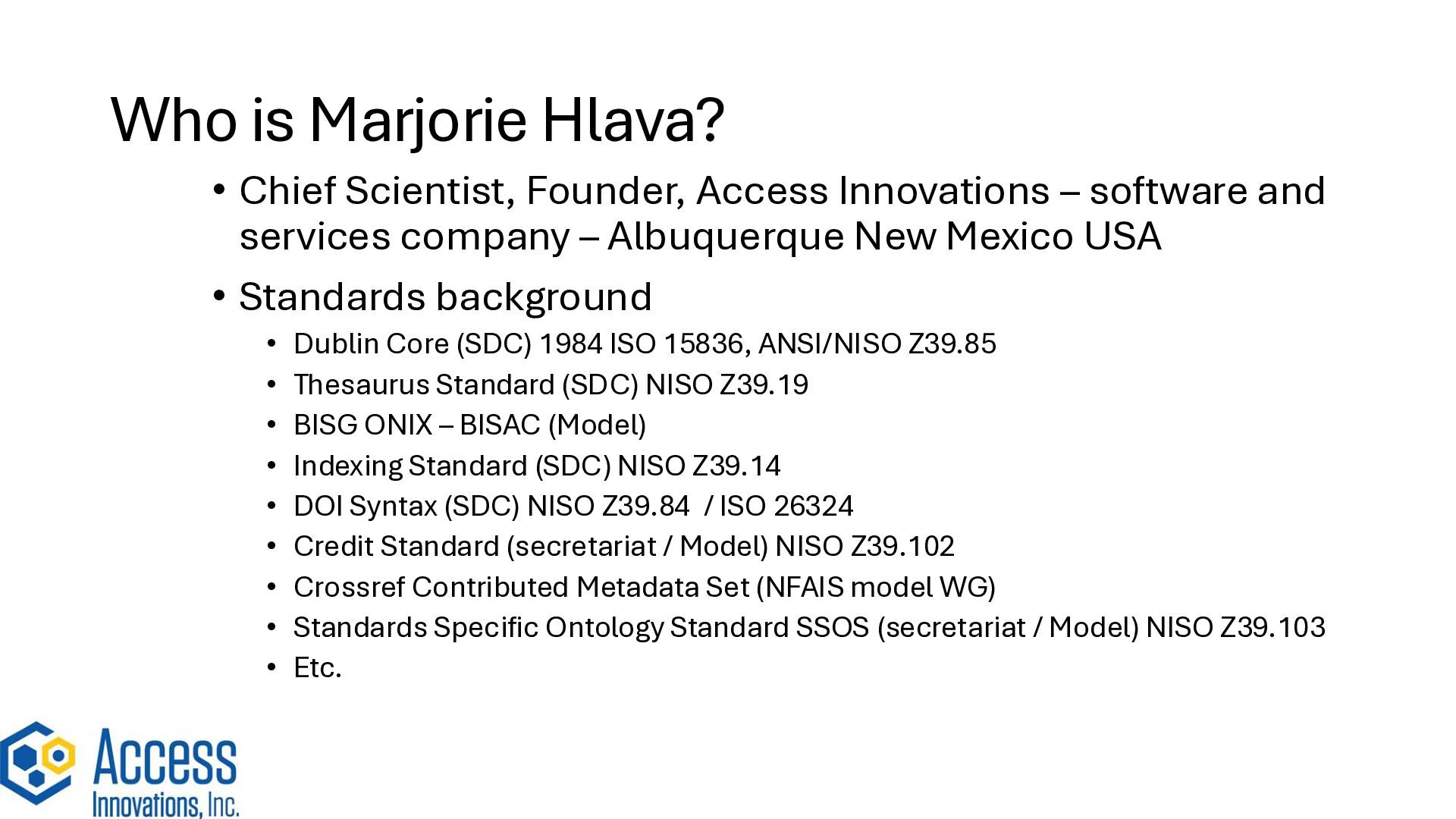
  2. Who is Marjorie Hlava? • Chief Scientist, Founder, Access Innovations

    – software and services company – Albuquerque New Mexico USA • Standards background • Dublin Core (SDC) 1984 ISO 15836, ANSI/NISO Z39.85 • Thesaurus Standard (SDC) NISO Z39.19 • BISG ONIX – BISAC (Model) • Indexing Standard (SDC) NISO Z39.14 • DOI Syntax (SDC) NISO Z39.84 / ISO 26324 • Credit Standard (secretariat / Model) NISO Z39.102 • Crossref Contributed Metadata Set (NFAIS model WG) • Standards Specific Ontology Standard SSOS (secretariat / Model) NISO Z39.103 • Etc.
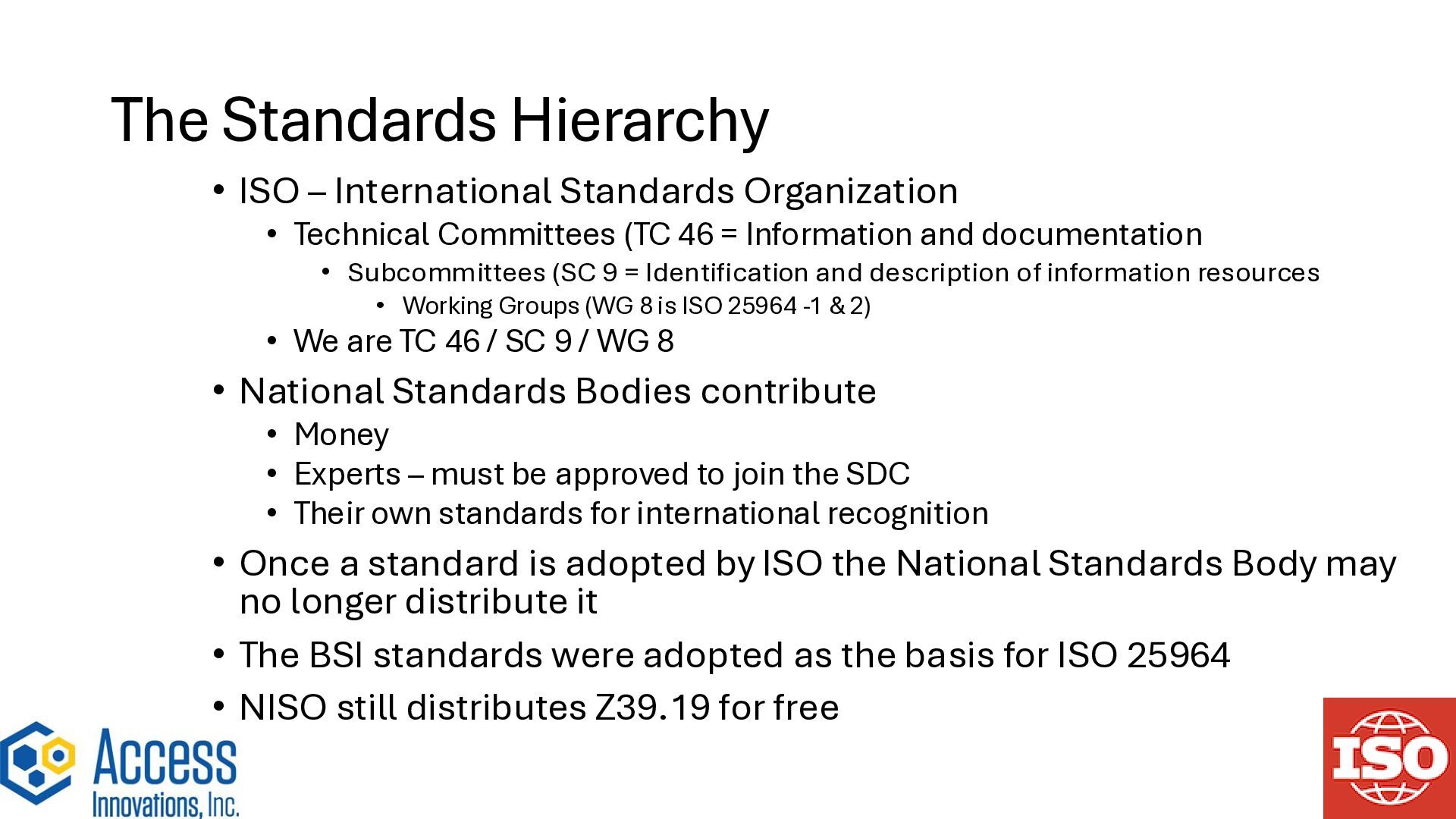
  3. The Standards Hierarchy • ISO – International Standards Organization •

    Technical Committees (TC 46 = Information and documentation • Subcommittees (SC 9 = Identification and description of information resources • Working Groups (WG 8 is ISO 25964 -1 & 2) • We are TC 46 / SC 9 / WG 8 • National Standards Bodies contribute • Money • Experts – must be approved to join the SDC • Their own standards for international recognition • Once a standard is adopted by ISO the National Standards Body may no longer distribute it • The BSI standards were adopted as the basis for ISO 25964 • NISO still distributes Z39.19 for free
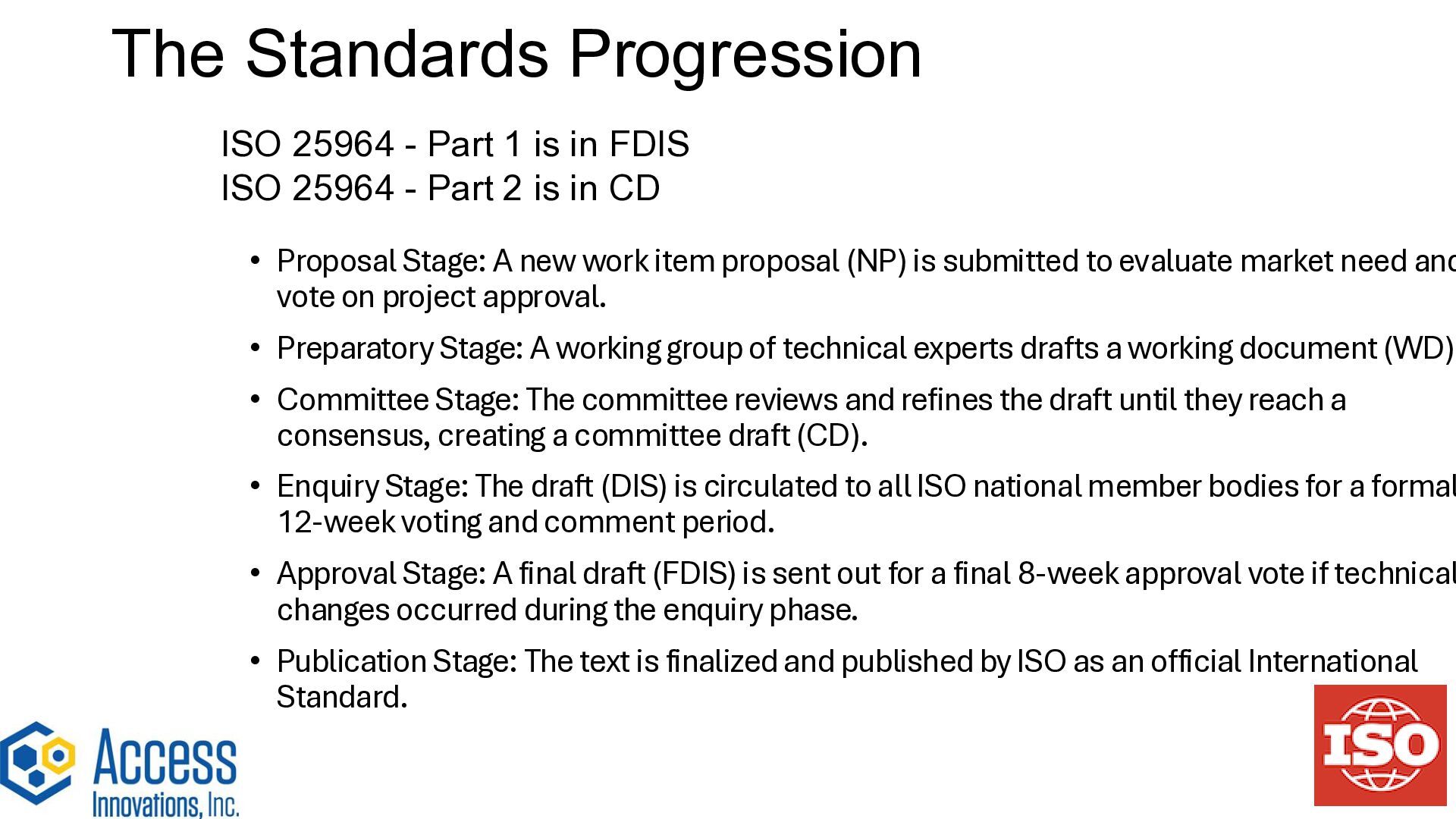
  4. The Standards Progression ISO 25964 - Part 1 is in

    FDIS ISO 25964 - Part 2 is in CD • Proposal Stage: A new work item proposal (NP) is submitted to evaluate market need and vote on project approval. • Preparatory Stage: A working group of technical experts drafts a working document (WD). • Committee Stage: The committee reviews and refines the draft until they reach a consensus, creating a committee draft (CD). • Enquiry Stage: The draft (DIS) is circulated to all ISO national member bodies for a formal 12-week voting and comment period. • Approval Stage: A final draft (FDIS) is sent out for a final 8-week approval vote if technical changes occurred during the enquiry phase. • Publication Stage: The text is finalized and published by ISO as an official International Standard.
  5. What does the convenor do? • Leadership • Build the

    working group • Set group meetings • Guide the discussion so all voices are heard • Appoint subcommittees - Support expert discussions • Lead the project development • Manage and edit the draft • Guiding the group • Attempt to achieve consensus • Work to resolve conflicting views • Steer group agreement • Resolve conflicts prior to voting • Voting must be unanimous unless Fast Tracked
  6. Why Is The ISO 25964 Important For Data? • Before

    building Knowledge graphs, Ontologies, AI systems you need vocabulary control and well tagged data. • Create, manage, and connect /link thesauri, CV, • Ensures consistent indexing and accurate retrieval • Find same terms for same concepts cross varying databases and web apps • Organizes digital content for CMA and DAM • Provides semantic rules & structure to build • Knowledge graphs, Ontologies, Web Navigation • Disambiguate subjects • Hierarchy and Related terms give blueprint for Knowledge graphs
  7. Why Is The ISO 25964 Important For AI? • Clean

    data for models prevents guesses • Ai agents use the structured domain logic instead of guessing using messy Full text • Reduce Hallucinations • Hierarchies guide RAG for facts not probability • Makes AI outputs more traceable and explainable Neuro-Symbolic AI • Supports seamless data exchange • Formats allow direct plug ins to AI Platforms
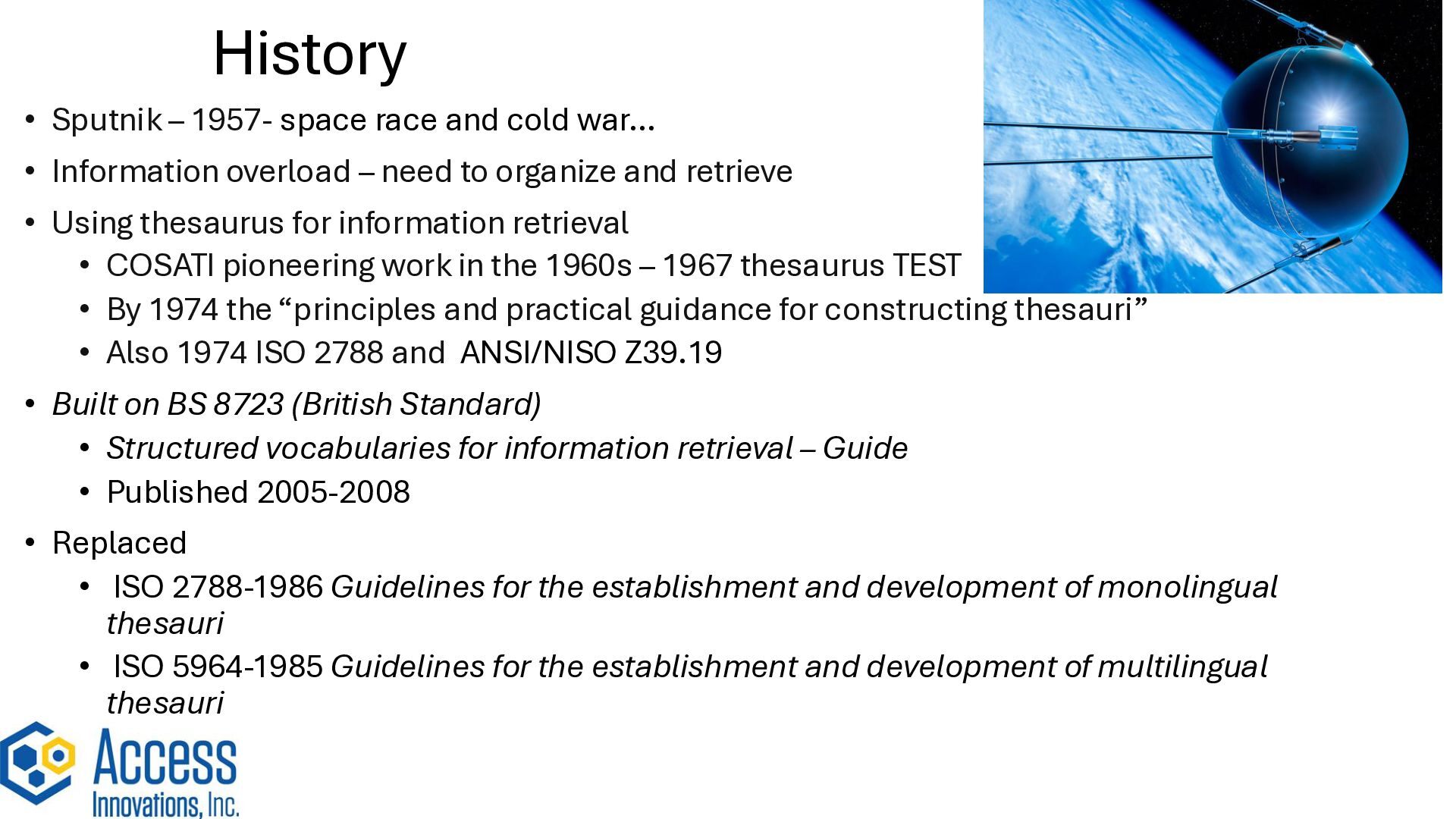
  8. History • Sputnik – 1957- space race and cold war…

    • Information overload – need to organize and retrieve • Using thesaurus for information retrieval • COSATI pioneering work in the 1960s – 1967 thesaurus TEST • By 1974 the “principles and practical guidance for constructing thesauri” • Also 1974 ISO 2788 and ANSI/NISO Z39.19 • Built on BS 8723 (British Standard) • Structured vocabularies for information retrieval – Guide • Published 2005-2008 • Replaced • ISO 2788-1986 Guidelines for the establishment and development of monolingual thesauri • ISO 5964-1985 Guidelines for the establishment and development of multilingual thesauri
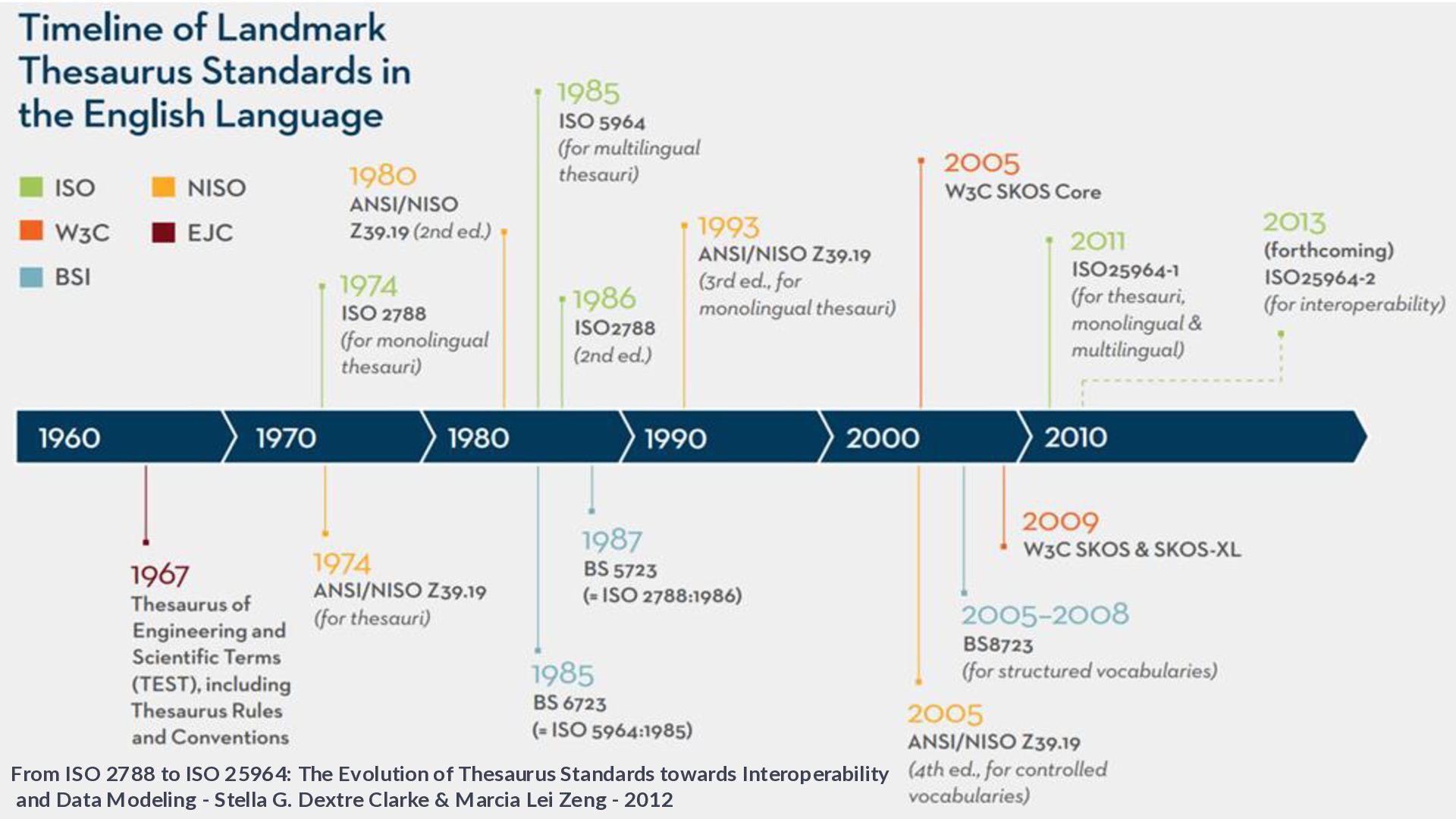
  9. From ISO 2788 to ISO 25964: The Evolution of Thesaurus

    Standards towards Interoperability and Data Modeling - Stella G. Dextre Clarke & Marcia Lei Zeng - 2012
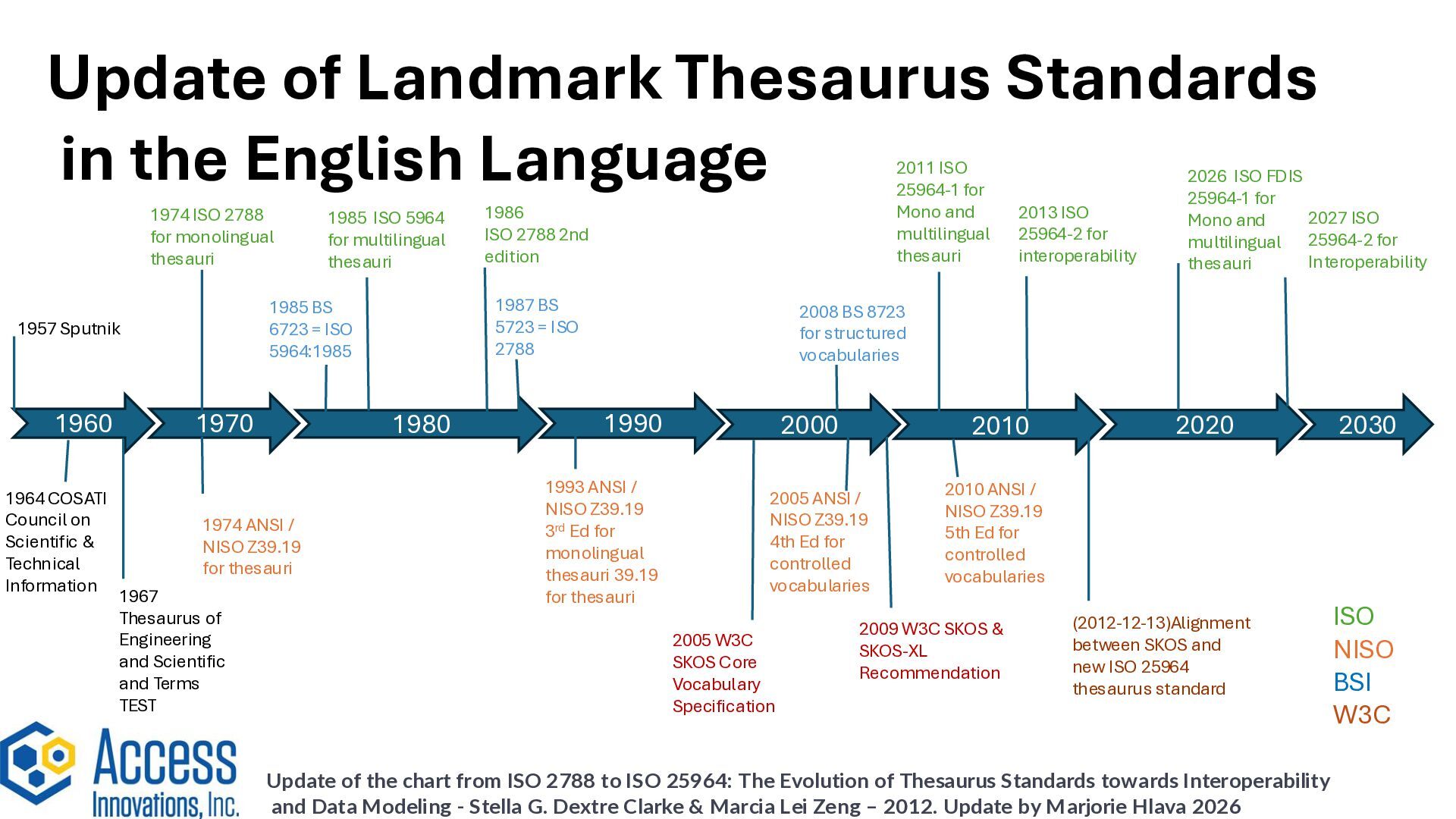
  10. Update of Landmark Thesaurus Standards in the English Language 1974

    ISO 2788 for monolingual thesauri 1964 COSATI Council on Scientific & Technical Information 1970 1980 1974 ANSI / NISO Z39.19 for thesauri 1967 Thesaurus of Engineering and Scientific and Terms TEST 1986 ISO 2788 2nd edition 1987 BS 5723 = ISO 2788 1985 BS 6723 = ISO 5964:1985 1957 Sputnik 1960 1985 ISO 5964 for multilingual thesauri 2011 ISO 25964-1 for Mono and multilingual thesauri 2013 ISO 25964-2 for interoperability 2026 ISO FDIS 25964-1 for 2027 ISO Mono and multilingual 25964-2 for Interoperability thesauri 2008 BS 8723 for structured vocabularies 1990 1993 ANSI / NISO Z39.19 3rd Ed for monolingual thesauri 39.19 for thesauri 2000 2010 2005 ANSI / NISO Z39.19 4th Ed for controlled vocabularies 2010 ANSI / NISO Z39.19 5th Ed for controlled vocabularies 2005 W3C SKOS Core Vocabulary Specification 2009 W3C SKOS & SKOS-XL Recommendation 2020 (2012-12-13)Alignment between SKOS and new ISO 25964 thesaurus standard Update of the chart from ISO 2788 to ISO 25964: The Evolution of Thesaurus Standards towards Interoperability and Data Modeling - Stella G. Dextre Clarke & Marcia Lei Zeng – 2012. Update by Marjorie Hlava 2026 2030 ISO NISO BSI W3C
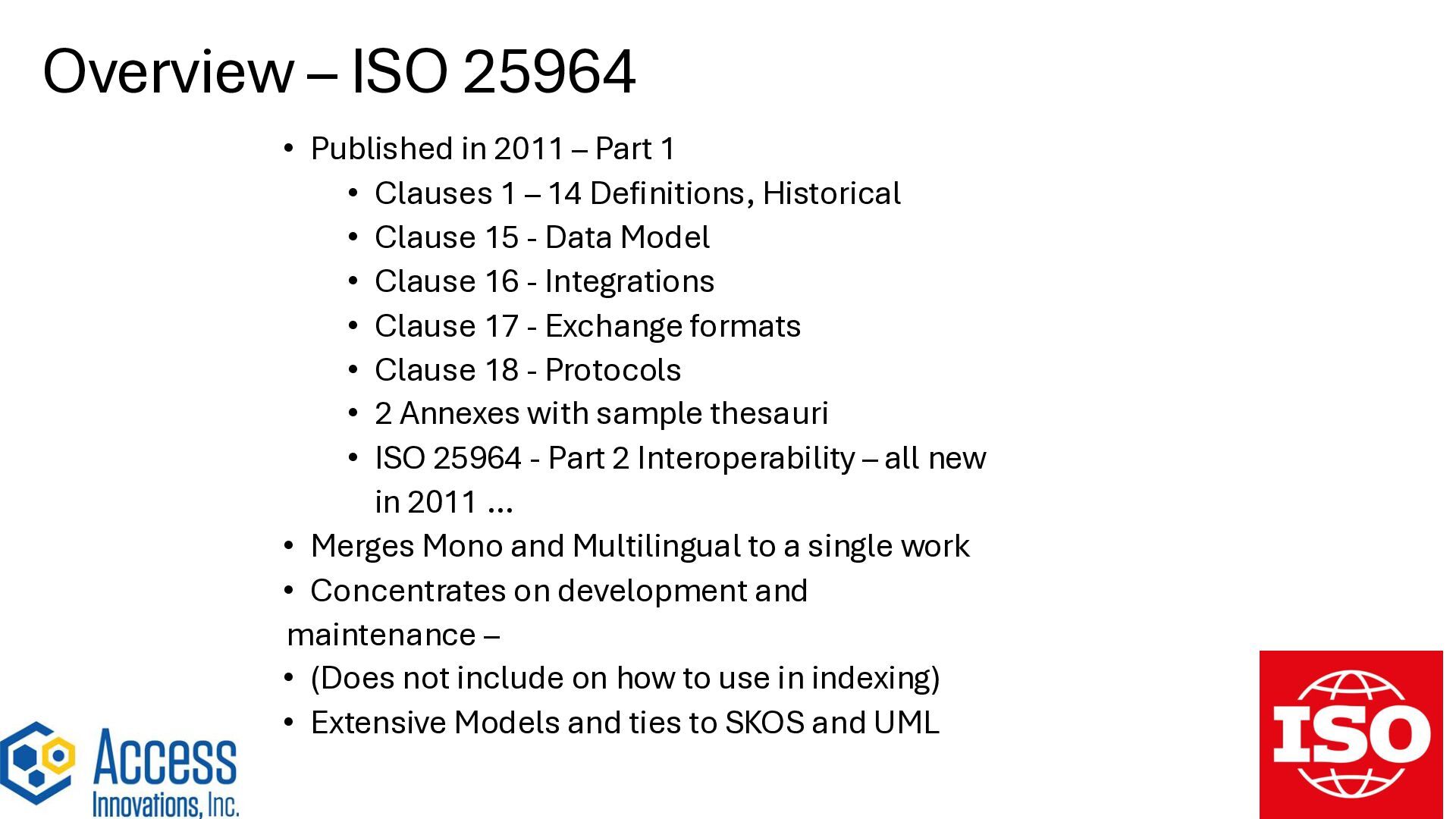
  11. Overview – ISO 25964 • Published in 2011 – Part

    1 • Clauses 1 – 14 Definitions, Historical • Clause 15 - Data Model • Clause 16 - Integrations • Clause 17 - Exchange formats • Clause 18 - Protocols • 2 Annexes with sample thesauri • ISO 25964 - Part 2 Interoperability – all new in 2011 ... • Merges Mono and Multilingual to a single work • Concentrates on development and maintenance – • (Does not include on how to use in indexing) • Extensive Models and ties to SKOS and UML
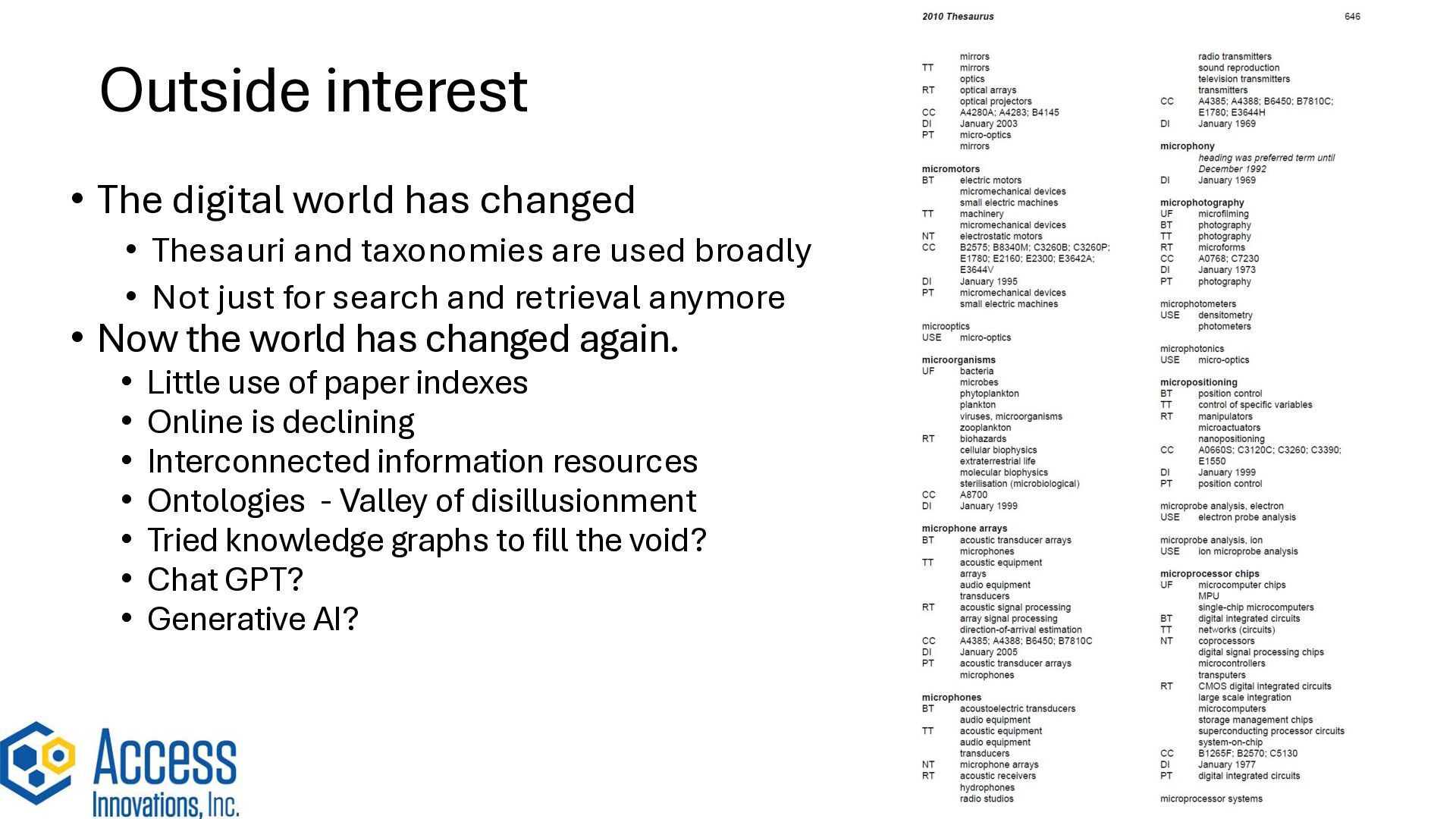
  12. Outside interest • The digital world has changed • Thesauri

    and taxonomies are used broadly • Not just for search and retrieval anymore • Now the world has changed again. • Little use of paper indexes • Online is declining • Interconnected information resources • Ontologies - Valley of disillusionment • Tried knowledge graphs to fill the void? • Chat GPT? • Generative AI?
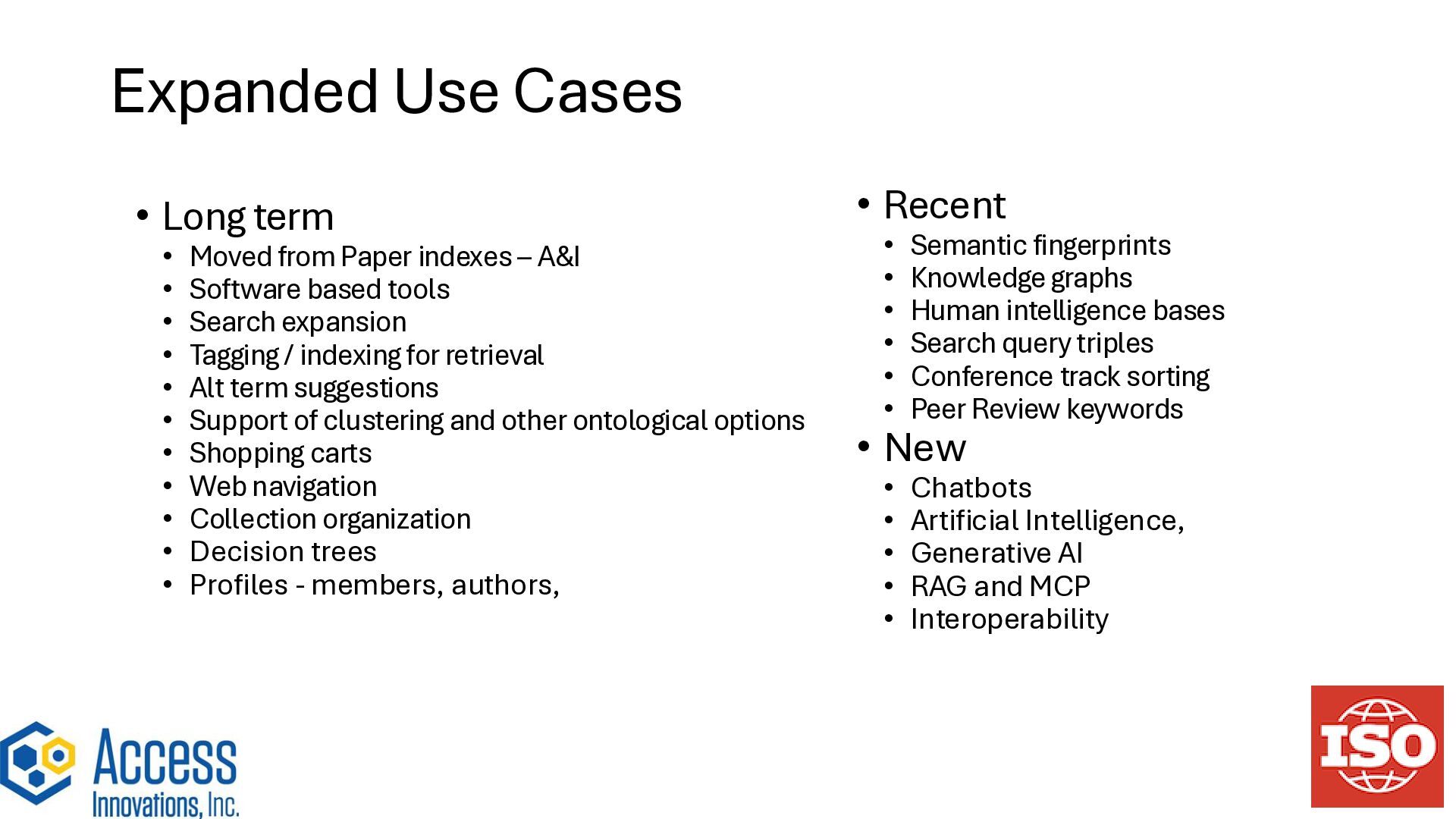
  13. Expanded Use Cases • Long term • Moved from Paper

    indexes – A&I • Software based tools • Search expansion • Tagging / indexing for retrieval • Alt term suggestions • Support of clustering and other ontological options • Shopping carts • Web navigation • Collection organization • Decision trees • Profiles - members, authors, • Recent • Semantic fingerprints • Knowledge graphs • Human intelligence bases • Search query triples • Conference track sorting • Peer Review keywords • New • Chatbots • Artificial Intelligence, • Generative AI • RAG and MCP • Interoperability
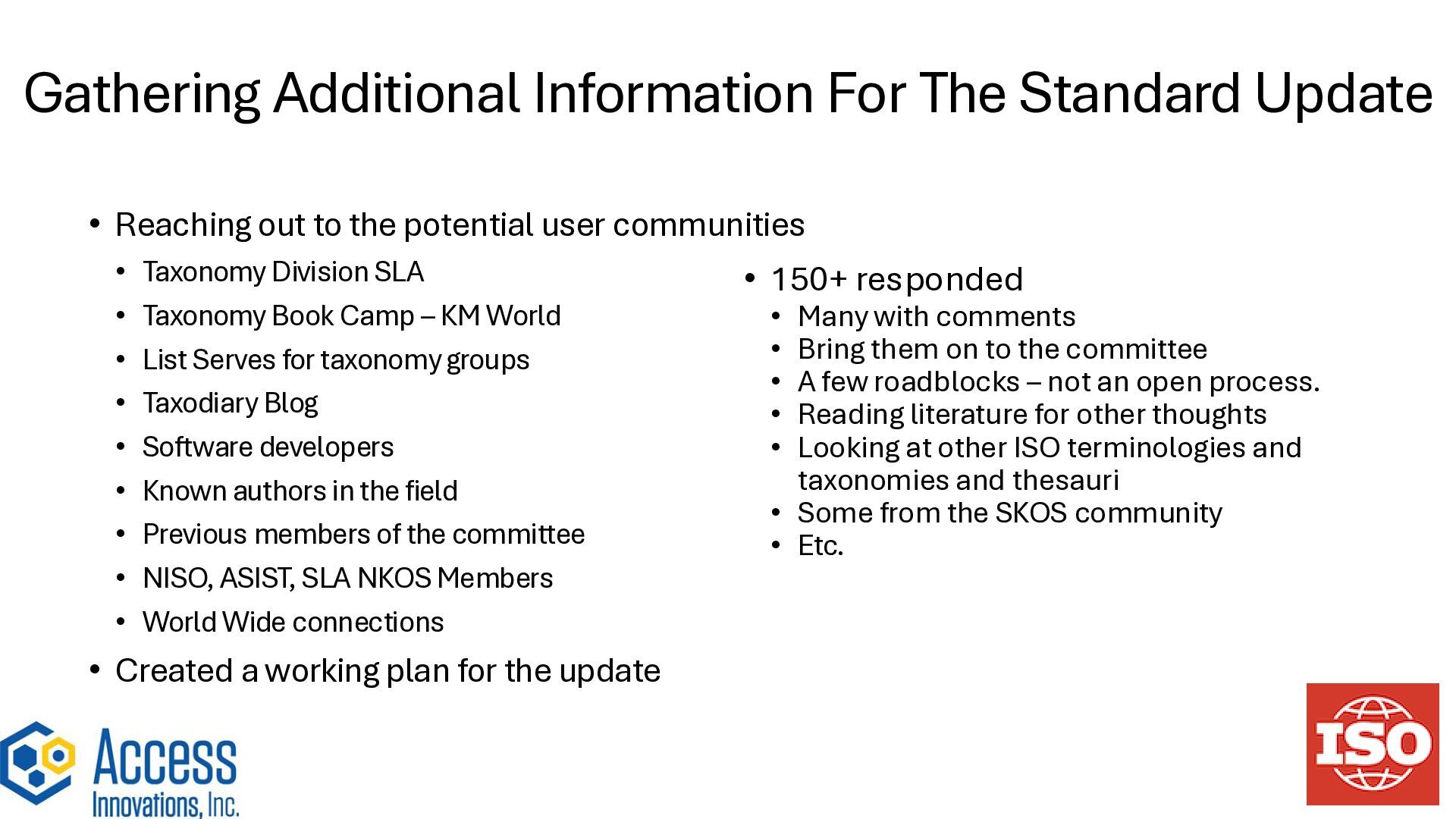
  14. Gathering Additional Information For The Standard Update • Reaching out

    to the potential user communities • Taxonomy Division SLA • Taxonomy Book Camp – KM World • List Serves for taxonomy groups • Taxodiary Blog • Software developers • Known authors in the field • Previous members of the committee • NISO, ASIST, SLA NKOS Members • World Wide connections • Created a working plan for the update • 150+ responded • Many with comments • Bring them on to the committee • A few roadblocks – not an open process. • Reading literature for other thoughts • Looking at other ISO terminologies and taxonomies and thesauri • Some from the SKOS community • Etc.
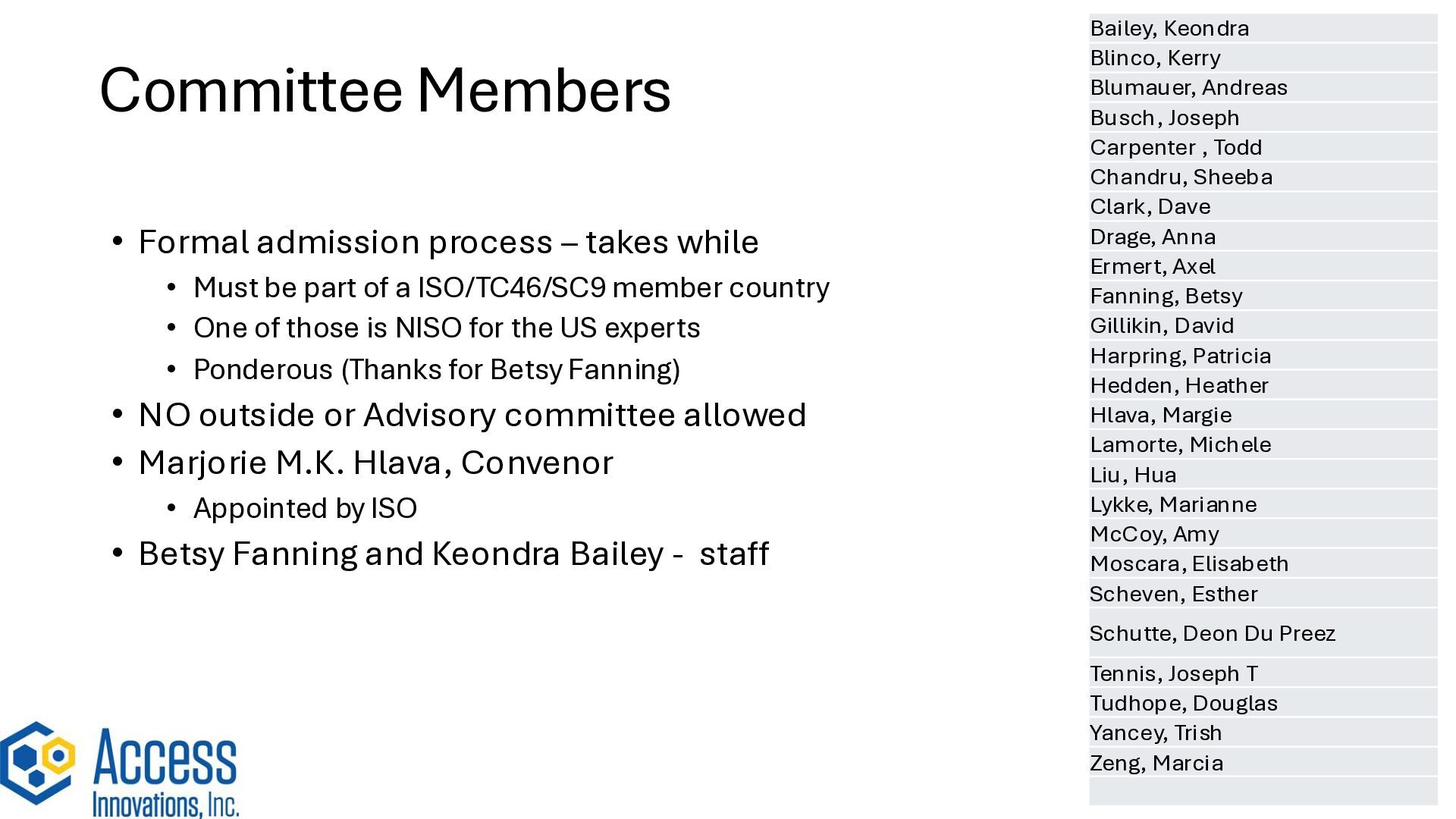
  15. Committee Members • Formal admission process – takes while •

    Must be part of a ISO/TC46/SC9 member country • One of those is NISO for the US experts • Ponderous (Thanks for Betsy Fanning) • NO outside or Advisory committee allowed • Marjorie M.K. Hlava, Convenor • Appointed by ISO • Betsy Fanning and Keondra Bailey - staff Bailey, Keondra Blinco, Kerry Blumauer, Andreas Busch, Joseph Carpenter , Todd Chandru, Sheeba Clark, Dave Drage, Anna Ermert, Axel Fanning, Betsy Gillikin, David Harpring, Patricia Hedden, Heather Hlava, Margie Lamorte, Michele Liu, Hua Lykke, Marianne McCoy, Amy Moscara, Elisabeth Scheven, Esther Schutte, Deon Du Preez Tennis, Joseph T Tudhope, Douglas Yancey, Trish Zeng, Marcia
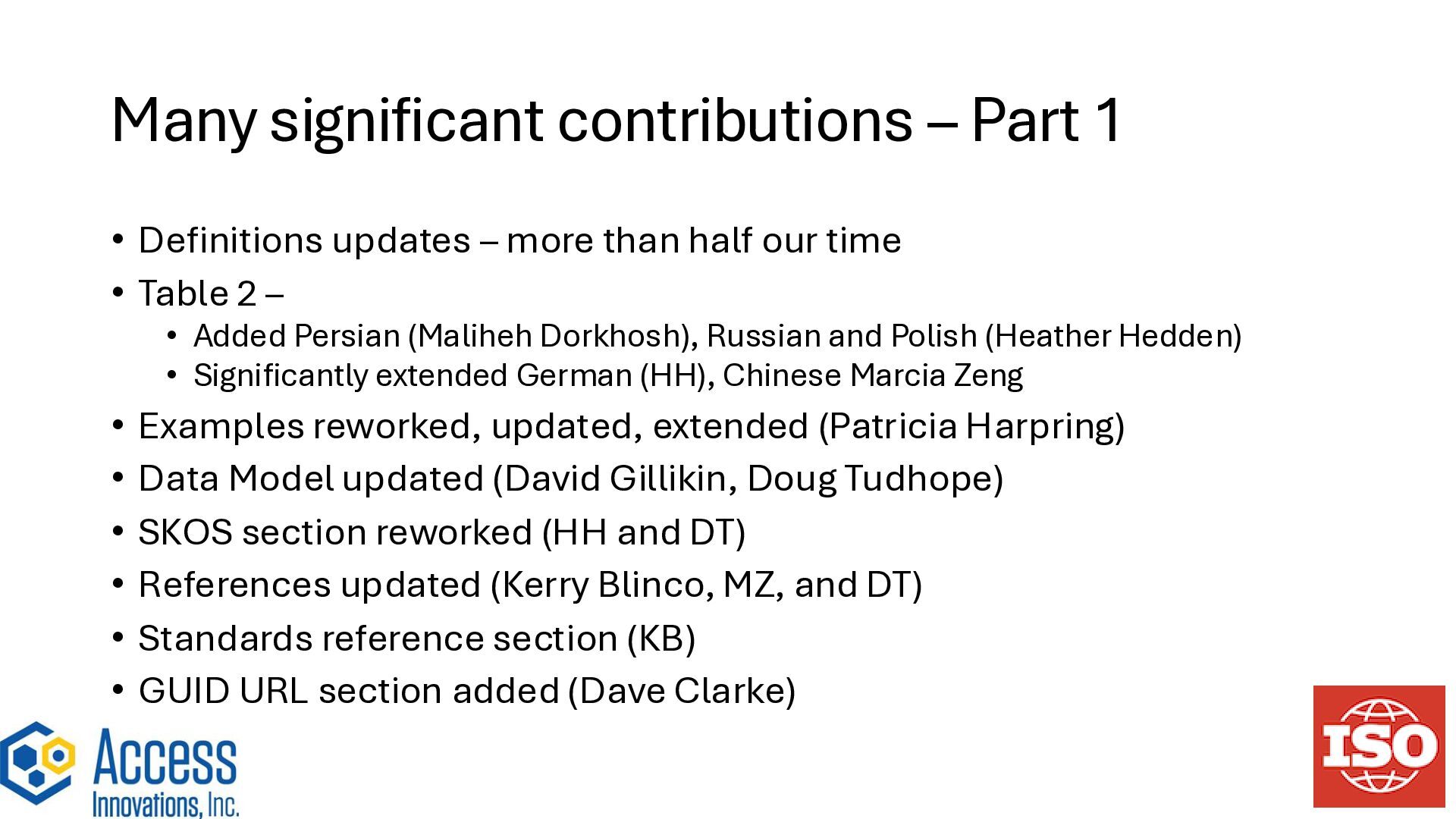
  16. Many significant contributions – Part 1 • Definitions updates –

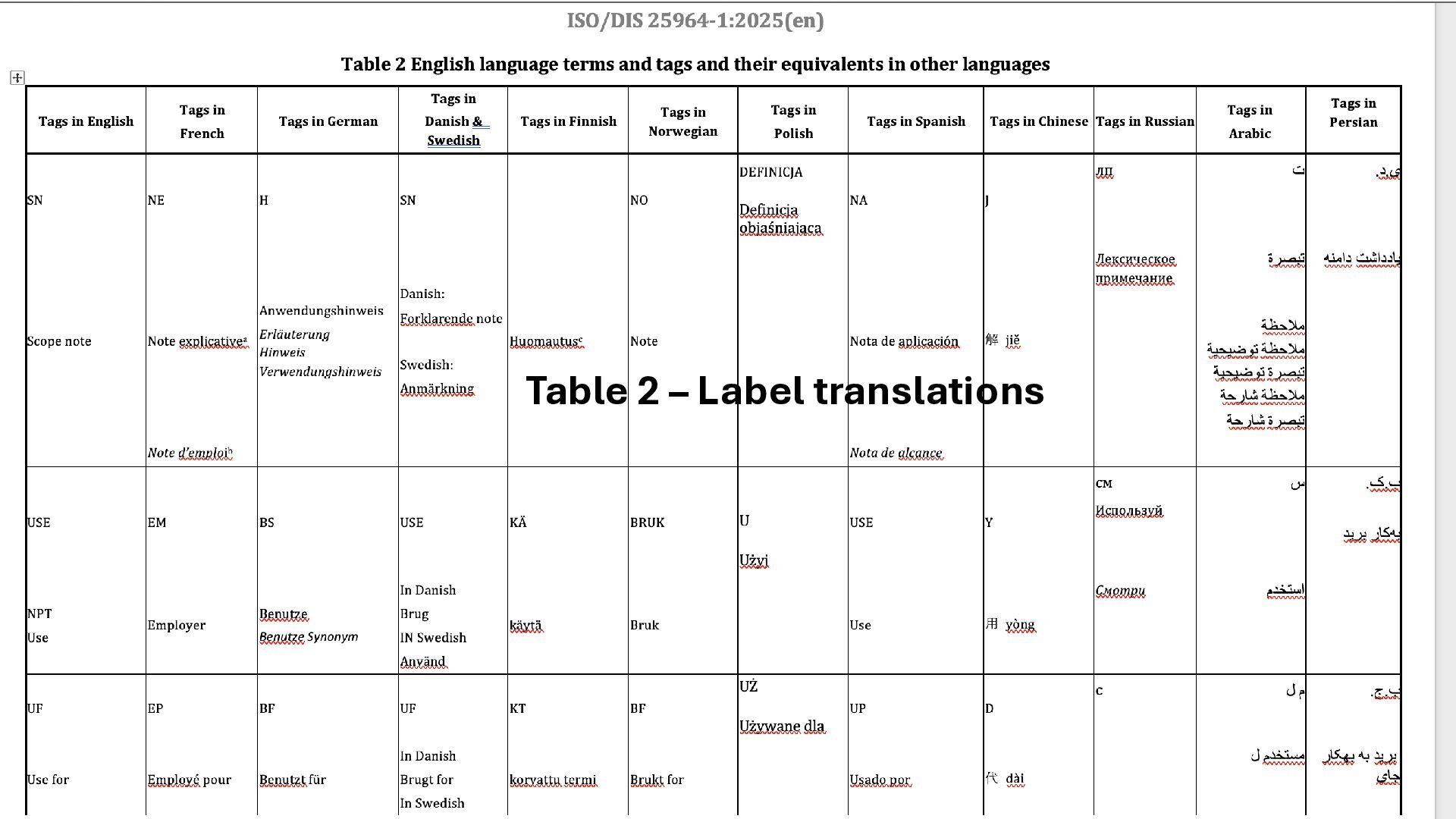
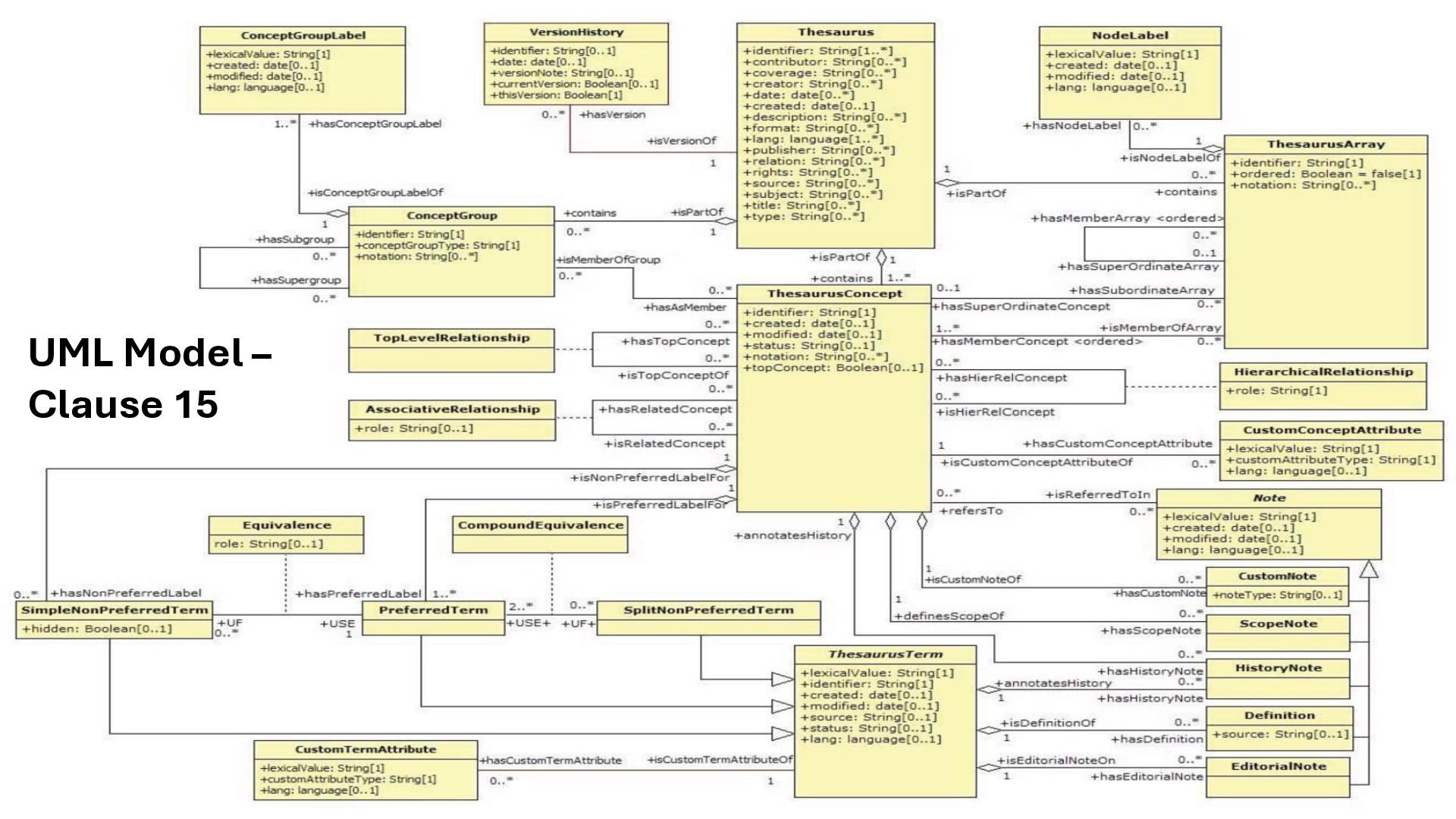
    more than half our time • Table 2 – • Added Persian (Maliheh Dorkhosh), Russian and Polish (Heather Hedden) • Significantly extended German (HH), Chinese Marcia Zeng • Examples reworked, updated, extended (Patricia Harpring) • Data Model updated (David Gillikin, Doug Tudhope) • SKOS section reworked (HH and DT) • References updated (Kerry Blinco, MZ, and DT) • Standards reference section (KB) • GUID URL section added (Dave Clarke)
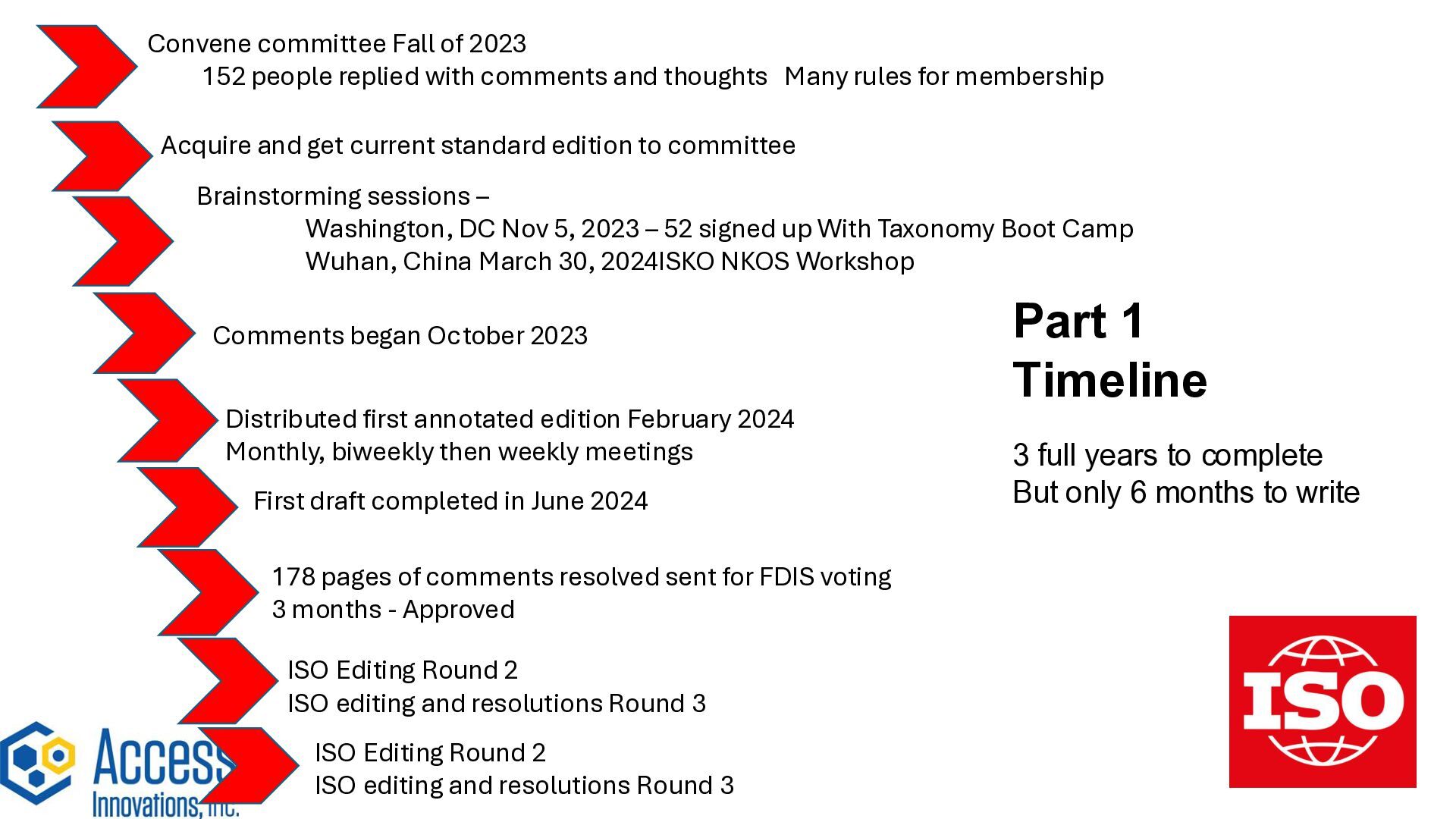
  17. Convene committee Fall of 2023 152 people replied with comments

    and thoughts Many rules for membership Acquire and get current standard edition to committee Brainstorming sessions – Washington, DC Nov 5, 2023 – 52 signed up With Taxonomy Boot Camp Wuhan, China March 30, 2024ISKO NKOS Workshop Comments began October 2023 Distributed first annotated edition February 2024 Monthly, biweekly then weekly meetings First draft completed in June 2024 178 pages of comments resolved sent for FDIS voting 3 months - Approved ISO Editing Round 2 ISO editing and resolutions Round 3 ISO Editing Round 2 ISO editing and resolutions Round 3 Part 1 Timeline 3 full years to complete But only 6 months to write
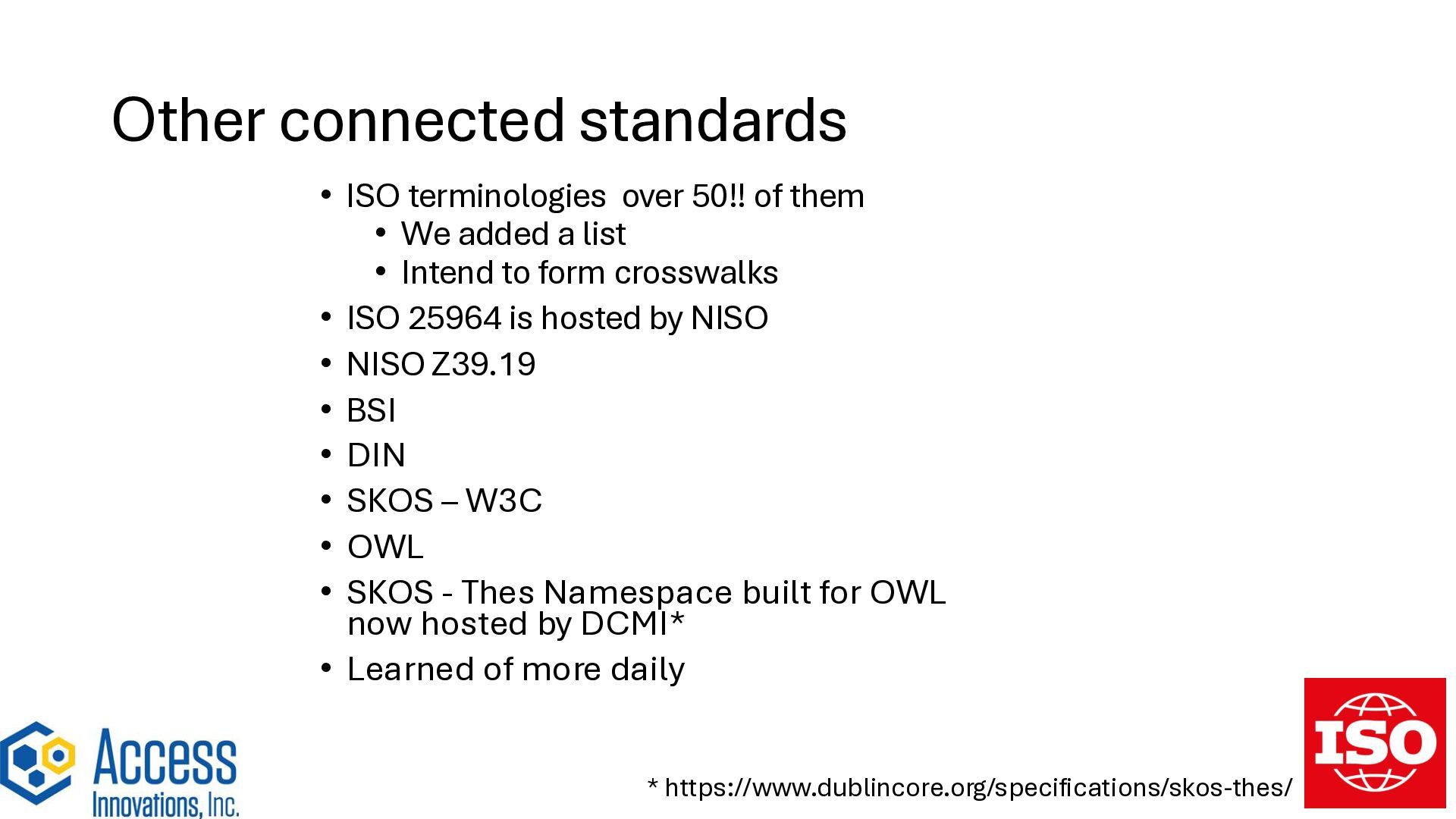
  18. Other connected standards • ISO terminologies over 50!! of them

    • We added a list • Intend to form crosswalks • ISO 25964 is hosted by NISO • NISO Z39.19 • BSI • DIN • SKOS – W3C • OWL • SKOS - Thes Namespace built for OWL now hosted by DCMI* • Learned of more daily * https://www.dublincore.org/specifications/skos-thes/
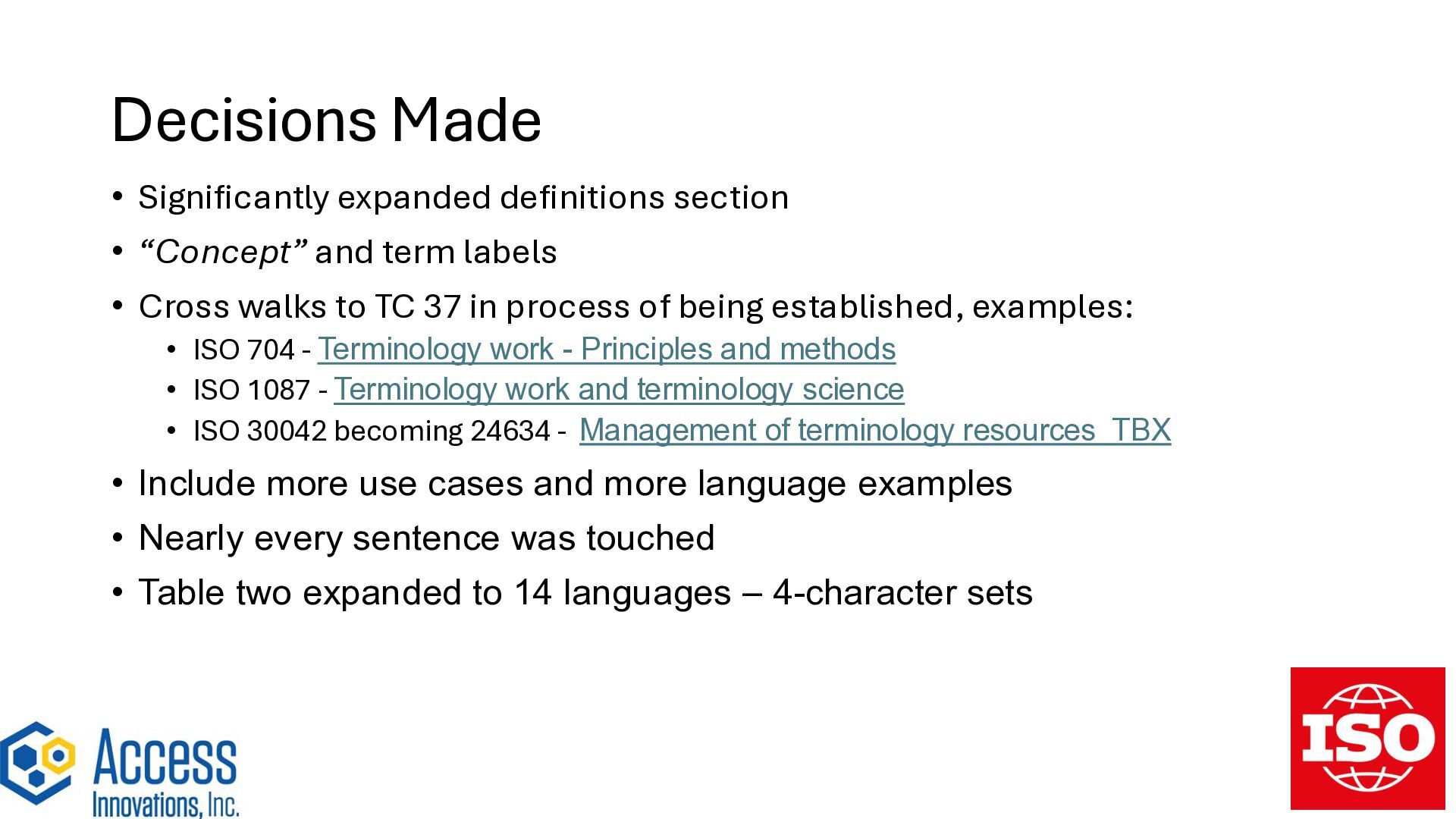
  19. Decisions Made • Significantly expanded definitions section • “Concept” and

    term labels • Cross walks to TC 37 in process of being established, examples: • ISO 704 - Terminology work - Principles and methods • ISO 1087 - Terminology work and terminology science • ISO 30042 becoming 24634 - Management of terminology resources TBX • Include more use cases and more language examples • Nearly every sentence was touched • Table two expanded to 14 languages – 4-character sets
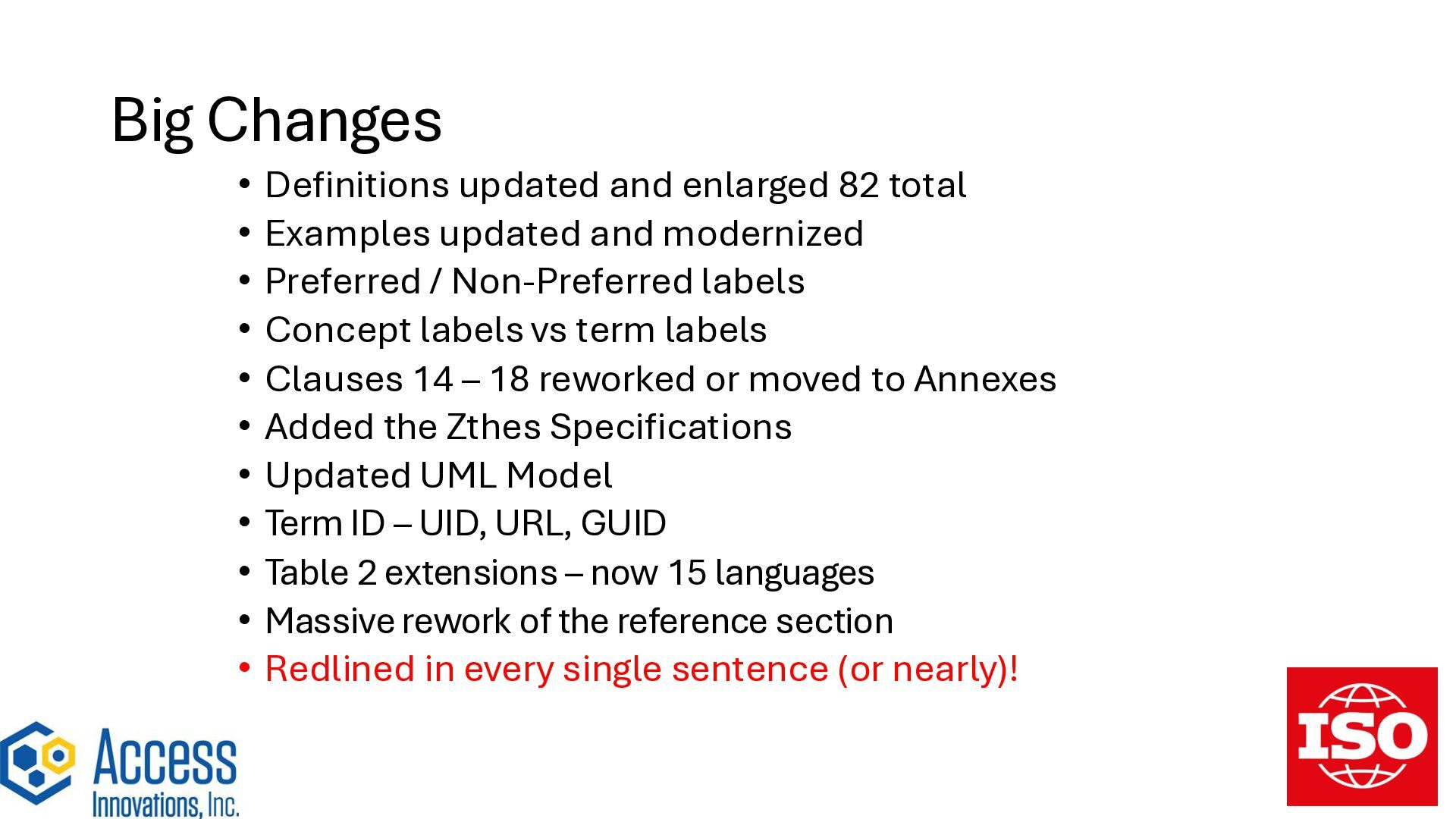
  20. Big Changes • Definitions updated and enlarged 82 total •

    Examples updated and modernized • Preferred / Non-Preferred labels • Concept labels vs term labels • Clauses 14 – 18 reworked or moved to Annexes • Added the Zthes Specifications • Updated UML Model • Term ID – UID, URL, GUID • Table 2 extensions – now 15 languages • Massive rework of the reference section • Redlined in every single sentence (or nearly)!
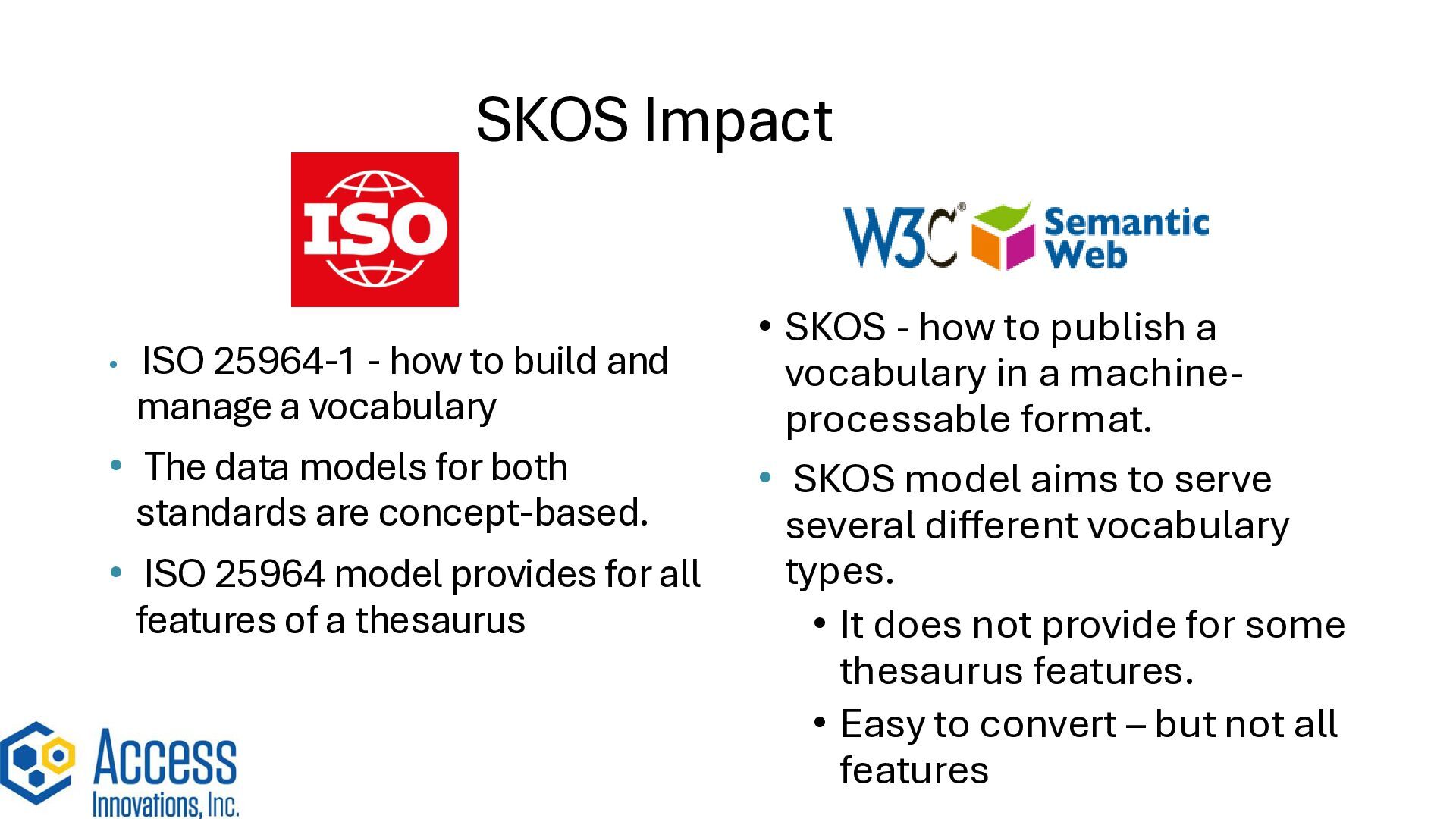
  21. SKOS Impact ISO 25964-1 - how to build and manage

    a vocabulary • The data models for both standards are concept-based. • ISO 25964 model provides for all features of a thesaurus • • SKOS - how to publish a vocabulary in a machineprocessable format. • SKOS model aims to serve several different vocabulary types. • It does not provide for some thesaurus features. • Easy to convert – but not all features
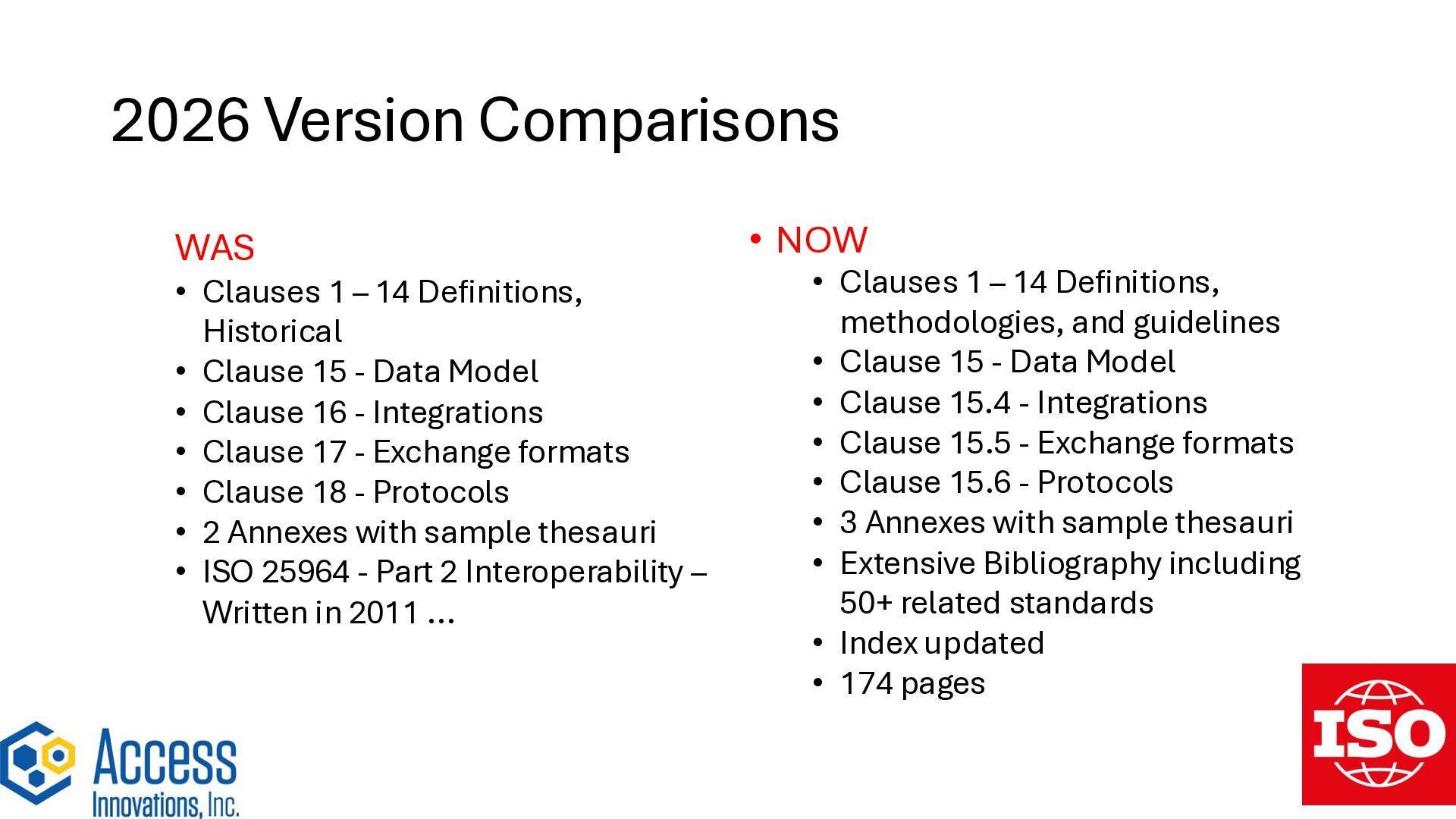
  22. 2026 Version Comparisons WAS • Clauses 1 – 14 Definitions,

    Historical • Clause 15 - Data Model • Clause 16 - Integrations • Clause 17 - Exchange formats • Clause 18 - Protocols • 2 Annexes with sample thesauri • ISO 25964 - Part 2 Interoperability – Written in 2011 ... • NOW • Clauses 1 – 14 Definitions, methodologies, and guidelines • Clause 15 - Data Model • Clause 15.4 - Integrations • Clause 15.5 - Exchange formats • Clause 15.6 - Protocols • 3 Annexes with sample thesauri • Extensive Bibliography including 50+ related standards • Index updated • 174 pages
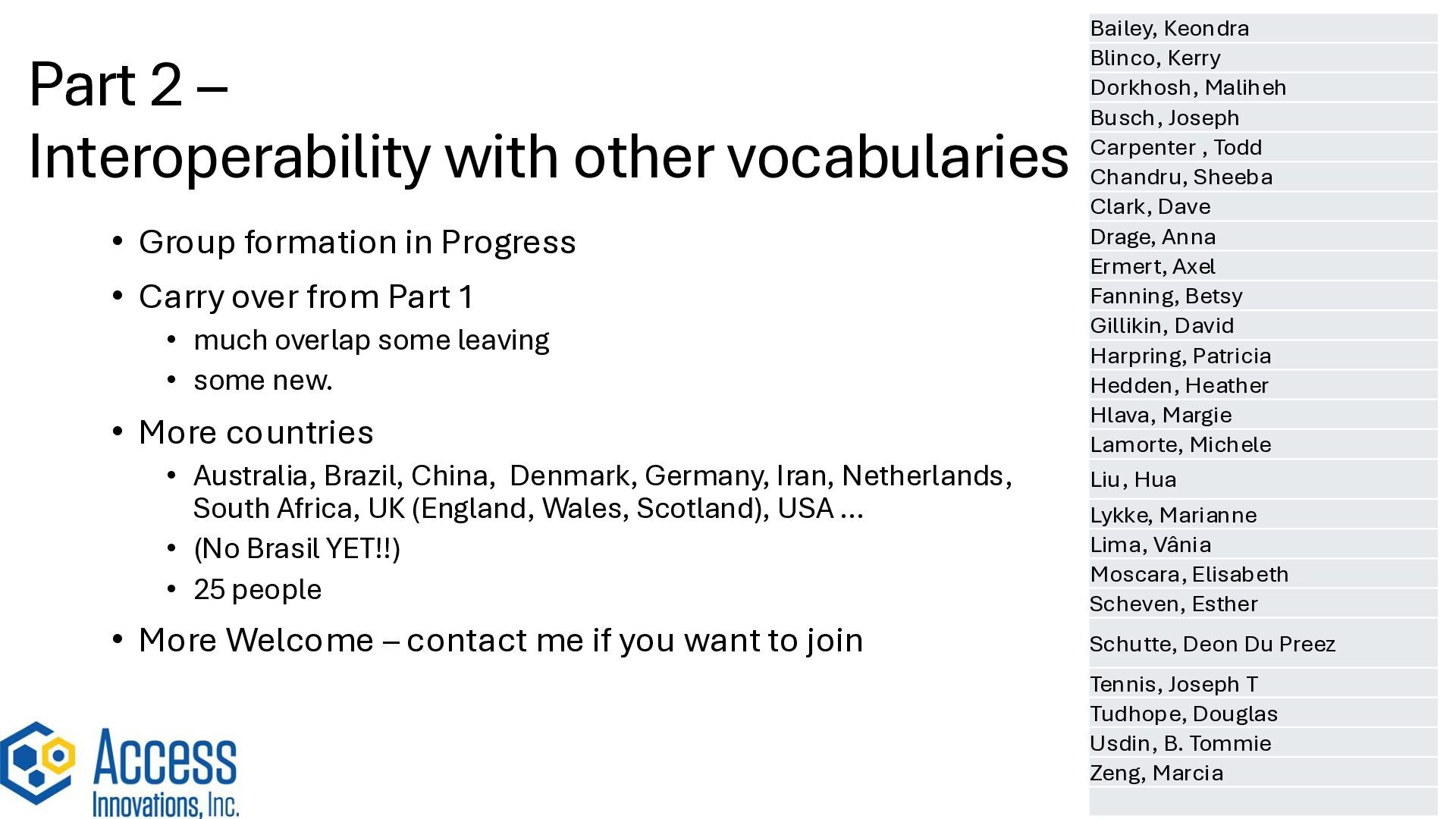
  23. Part 2 – Interoperability with other vocabularies • Group formation

    in Progress • Carry over from Part 1 • much overlap some leaving • some new. • More countries • Australia, Brazil, China, Denmark, Germany, Iran, Netherlands, South Africa, UK (England, Wales, Scotland), USA … • (No Brasil YET!!) • 25 people • More Welcome – contact me if you want to join Bailey, Keondra Blinco, Kerry Dorkhosh, Maliheh Busch, Joseph Carpenter , Todd Chandru, Sheeba Clark, Dave Drage, Anna Ermert, Axel Fanning, Betsy Gillikin, David Harpring, Patricia Hedden, Heather Hlava, Margie Lamorte, Michele Liu, Hua Lykke, Marianne Lima, Vânia Moscara, Elisabeth Scheven, Esther Schutte, Deon Du Preez Tennis, Joseph T Tudhope, Douglas Usdin, B. Tommie Zeng, Marcia
  24. Scope of the update • “minimum of rewriting and attempt

    to keep the score within it’s current bounds.” • Many things are happening • AI in all its variations • Helping keep AI within guardrails • SKOS changes and dominance
  25. Main Work Items – 1 - 2 Definitions and Reviews

    1. Update the Term Definitions • 28 definitions will carry over from previous Part 2 for review. • 89 Definitions total • 60 overlap Part 1 • We have 60 to replace from Part 1 • Abbreviations etc. In Part 2, Table 1 is only about mapping and does not occur in Part 1 - it will be retained. 2. Reviewing all clauses to see ensure • References to Part 1 are current • They reflect current professional thinking
  26. Main Work Items – 3 & 4 – Clause reviews

    3. Review clauses to continue standardizing the language • "term" vs " concept" • "preferred term” usage is appropriate 4. Update Terminology Clause • Latest versions of ISO 704, 1087 and 30042 TBX • Ensure those mentions are still valid • Check references to 25964-1 and update • Remove Part 2 Annex A with its highly detailed comparison of the 25964 data model to (the old) TBX • It is largely superseded by the new references to ISO 704 in revised Part 1 Definitions section • New higher-level discussion in the Part 2 Terminology Clause is now sufficient.
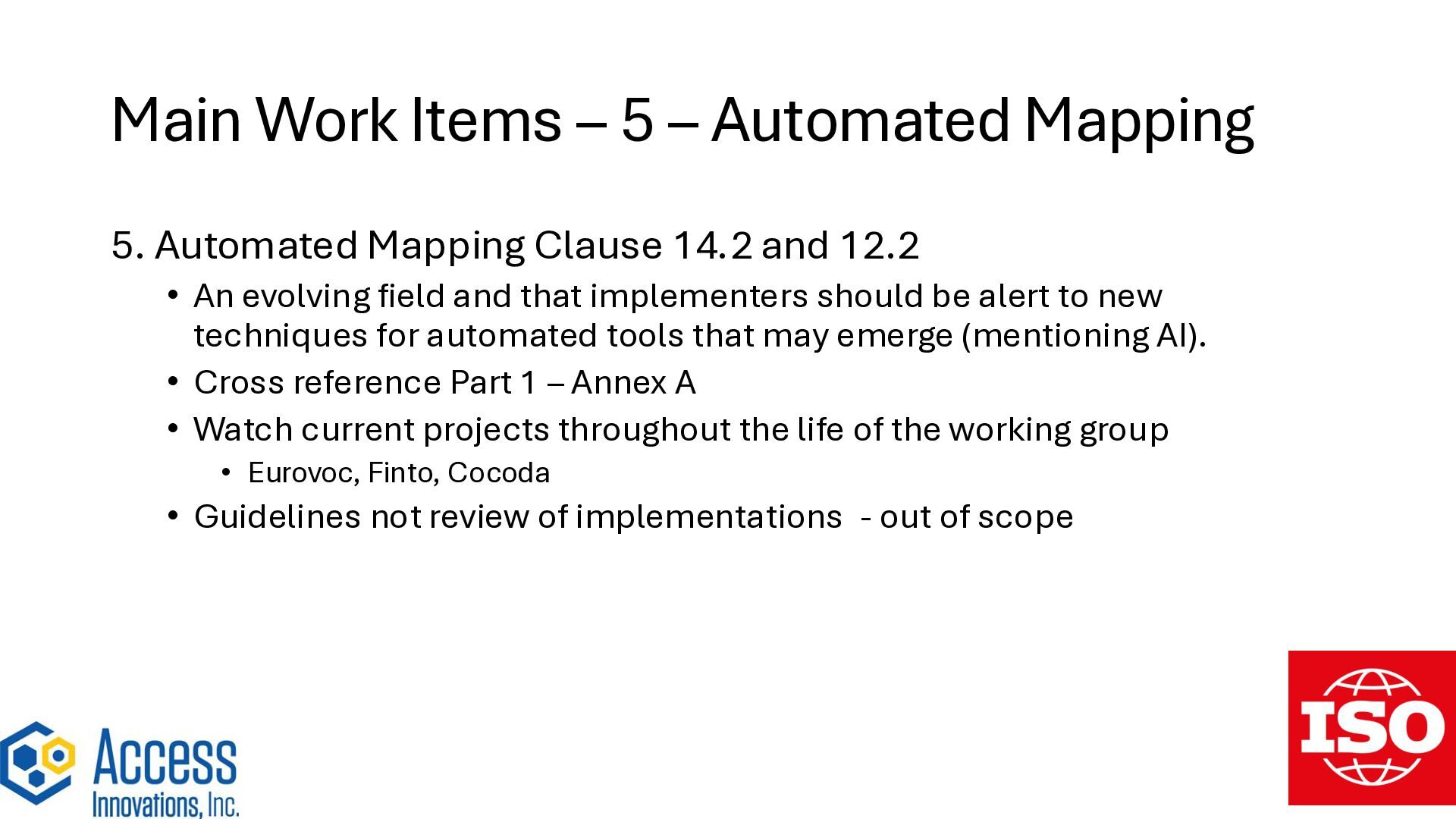
  27. Main Work Items – 5 – Automated Mapping 5. Automated

    Mapping Clause 14.2 and 12.2 • An evolving field and that implementers should be alert to new techniques for automated tools that may emerge (mentioning AI). • Cross reference Part 1 – Annex A • Watch current projects throughout the life of the working group • Eurovoc, Finto, Cocoda • Guidelines not review of implementations - out of scope
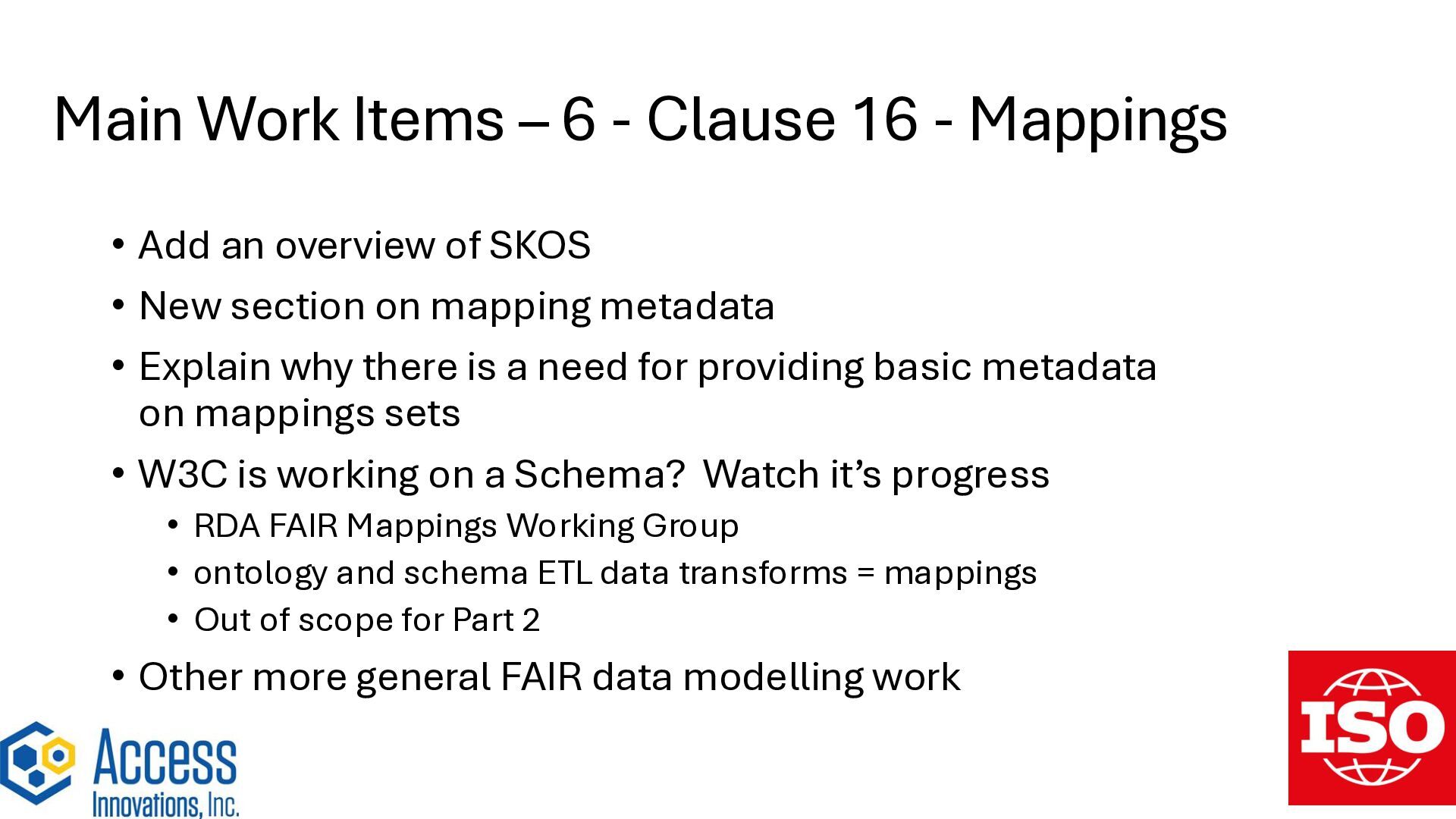
  28. Main Work Items – 6 - Clause 16 - Mappings

    • Add an overview of SKOS • New section on mapping metadata • Explain why there is a need for providing basic metadata on mappings sets • W3C is working on a Schema? Watch it’s progress • RDA FAIR Mappings Working Group • ontology and schema ETL data transforms = mappings • Out of scope for Part 2 • Other more general FAIR data modelling work
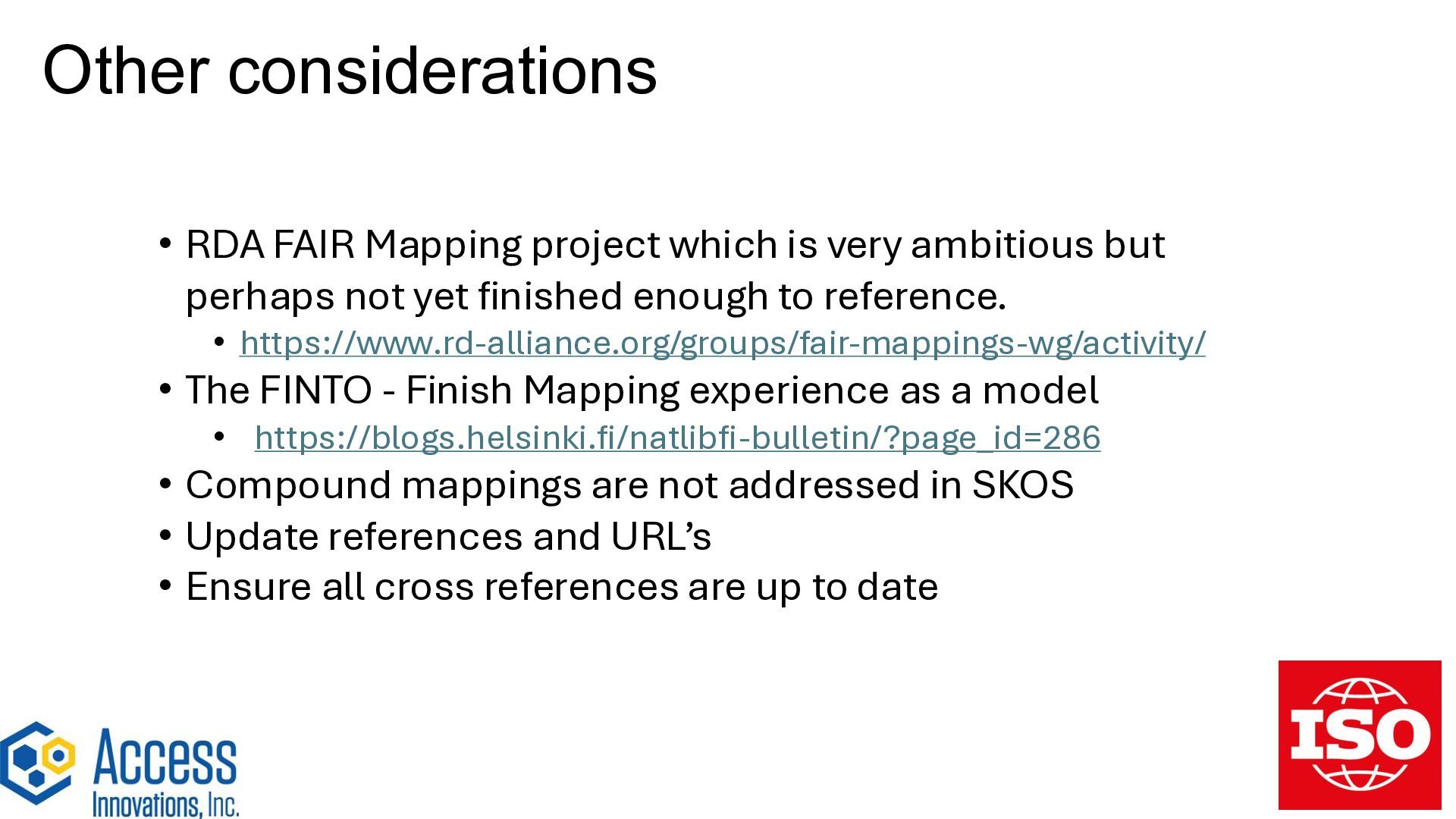
  29. Other considerations • RDA FAIR Mapping project which is very

    ambitious but perhaps not yet finished enough to reference. • https://www.rd-alliance.org/groups/fair-mappings-wg/activity/ • The FINTO - Finish Mapping experience as a model • https://blogs.helsinki.fi/natlibfi-bulletin/?page_id=286 • Compound mappings are not addressed in SKOS • Update references and URL’s • Ensure all cross references are up to date
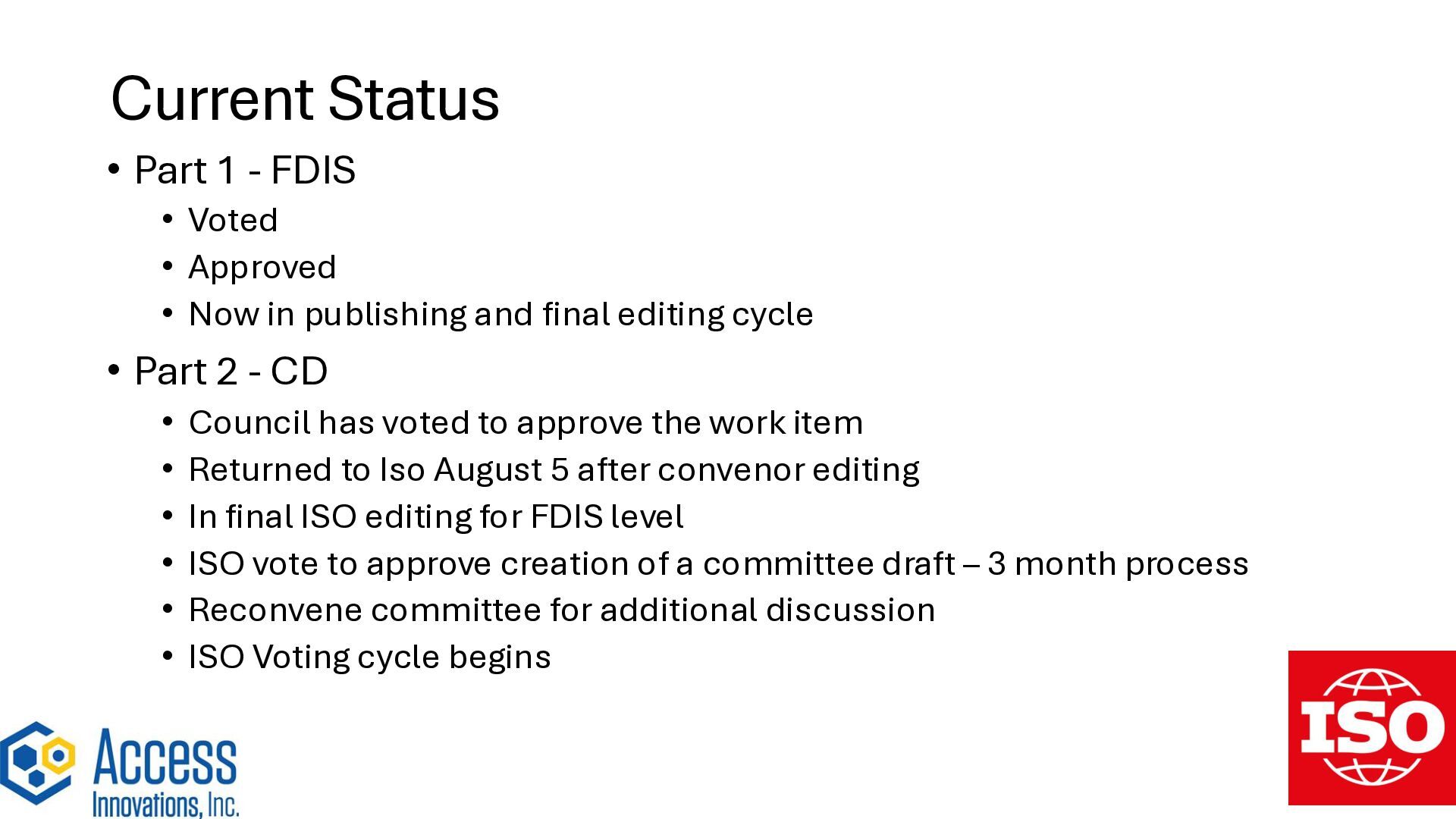
  30. Current Status • Part 1 - FDIS • Voted •

    Approved • Now in publishing and final editing cycle • Part 2 - CD • Council has voted to approve the work item • Returned to Iso August 5 after convenor editing • In final ISO editing for FDIS level • ISO vote to approve creation of a committee draft – 3 month process • Reconvene committee for additional discussion • ISO Voting cycle begins
  31. Questions at the end of the session Want the Slides

    – Contact Me Thank you for your attention Marjorie M.K. Hlava Chief Scientist Access Innovations, Inc. [email protected]