Upgrade to Pro
— share decks privately, control downloads, hide ads and more …
Speaker Deck
Sign up for free
Menu
Search
Features
All features
Private URLs
Password Protection
Custom URLS
Scheduled publishing
Remove Branding
Restrict embedding
Deck Collections
Notes
Features
All features
Private URLs
Password Protection
Custom URLS
Scheduled publishing
Remove Branding
Restrict embedding
Deck Collections
Notes
Explore
Featured decks
Featured speakers
Programming
Technology
Storyboards
Explore
Featured decks
Featured speakers
Programming
Technology
Storyboards
Pricing
Search
Sign in
Sign up for free
Extending Foodcritic with new rules
Search
Andrew Crump
February 04, 2014
Programming
710
2
Share
Embed
Copy iframe code
Copy JS code
Copy link
Start on current slide
Extending Foodcritic with new rules
Config Management Camp, Gent on 4th February 2014
Andrew Crump
February 04, 2014
Transcript
73 slides
Extending foodcritic with new rules #cfgmgmtcamp #getchef
Overview
What is foodcritic?
A lint tool for your cookbooks
47 Built-in Rules
Goal: Identify problems in your cookbooks
file "/var/lib/foo" do owner "root" group "root" mode 644 action
:create end
file "/var/lib/foo" do owner "root" group "root" mode 644 action
:create end
$ foodcritic . FC006: Mode should be quoted or fully
specified when setting file permissions: ./ recipes/default.rb:9
file "/var/lib/foo" do owner "root" group "root" mode "644" action
:create end
Goal: Encourage discussion on the subjective stuff
execute "wget 'http:// example.org/' -Ofoo" do action :run end
$ foodcritic . FC041: Execute resource used to run curl
or wget commands: ./recipes/ default.rb:9
remote_file "foo" do source "http://example.org/" end
Goal: Write your own rules
# Specify rules on # the command line $ foodcritic
-I your_rule.rb . ! # You can also # package your rules # as a gem
How does it work?
Static code analysis
Example: Declaring resources in a loop
# The original recipe %w{foo bar baz}.each do |pkg| package
pkg end
# This is what Chef sees at converge time package[foo]
package[bar] package[baz]
# This is what foodcritic sees %w{foo bar baz}.each do
|pkg| package pkg end
Peter Zotov @whitequark fucking ruby and its fucking parser, how
does it even work?! I *still* have no idea
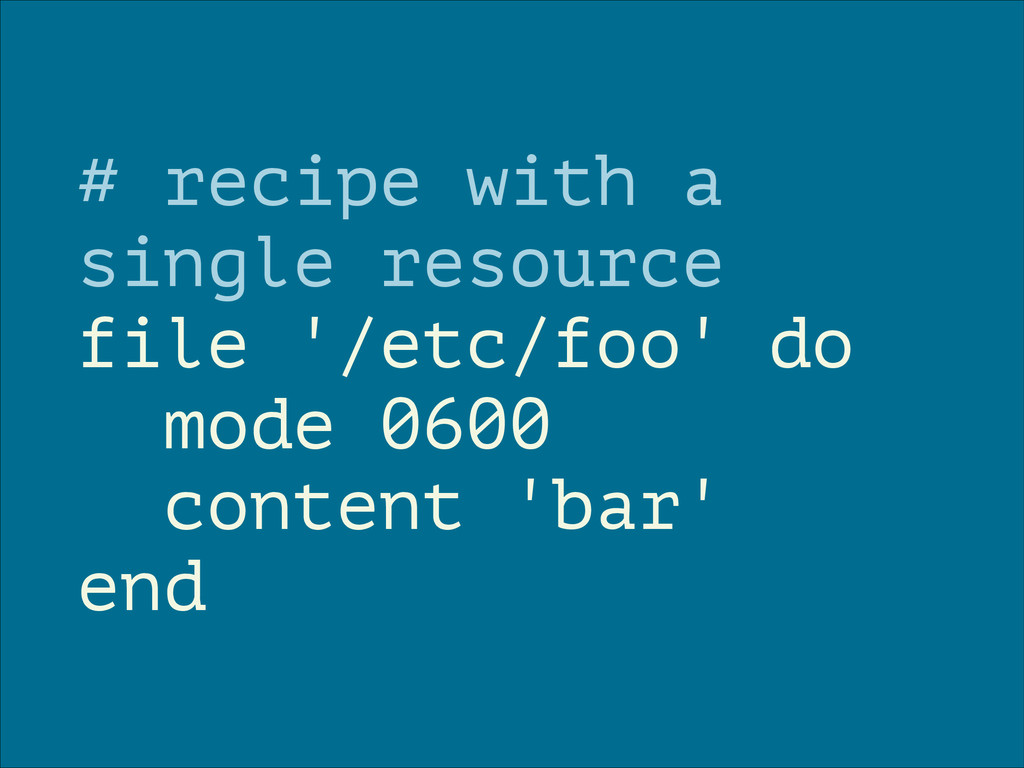
# recipe with a single resource file '/etc/foo' do mode
0600 content 'bar' end
pry> Ripper.sexp(code)
=> [:program, [[:method_add_block, [:command, [:@ident, "file", [2, 0]], [:args_add_block, [[:string_literal,
[:string_content, [:@tstring_content, "/ etc/foo", [2, 6]]]]], false]], [:do_block, nil, [[:command, [:@ident, "mode", [3, 2]], [:args_add_block, [[:@int, "0600", [3, 7]]], false]], [:command, [:@ident, "content", [4, 2]], [:args_add_block, [[:string_literal, [:string_content, [:@tstring_content, "bar", [4, 11]]]]], false]]]]]]]
Those are some deeply nested arrays
Ruby lets us build terse yet powerful expressions
But the path to a node in the tree is
important
<? XML ?> An elegant weapon for a more civilised
age
XPath //method_add_block/ command/ ident[@value="mode"]
ANTLR 4.2 SNAPSHOT "xpath/pattern matching for parse trees"
The structure of a rule
rule "FC123", "Name" do recipe do |ast| # some #
expression end end
cookbook environment library metadata resource role Hooks recipe do |ast|
ast.xpath(..) end
rule "FC123", "Name" do recipe do |ast| # some #expression
end end
Ruby returns the last expression Foodcritic converts the last expression
to matches
Let’s walk through the code for FC006
rule "FC006", "Mode should be quoted or fully specified when
setting file permissions" do
# We pass an array of tags in, common tags
include 'correctness' and 'style' tags %w{correctness files}
recipe do |ast| ast.xpath(%q{a/ long/xpath/string}) end
# any mode identifier // ident[@value='mode']/ ! # we need
to go up one parent::command/ ! # a literal integer descendant::int
# filtering again [ ! # needs to be less
# than five digits # long string-length(@value) < 5
# match 644 not 0644 and not( starts-with(@value, "0") and
string length(@value) = 4 ) ! # stop filtering ]
# choose the line num # to show to the
end # user /ancestor:: method_add_block # do this if the AST # node does not have # a descendant node # with a position
Pry is awesome and is a must for developing FC
rules
Drop a pry binding in your rule and explore pry>
ls pry> a_method() pry> whereami
rule "FC123", "Name" do recipe do |ast| binding.pry end end
pry> ast.xpath( '//do_block/command/ ident')
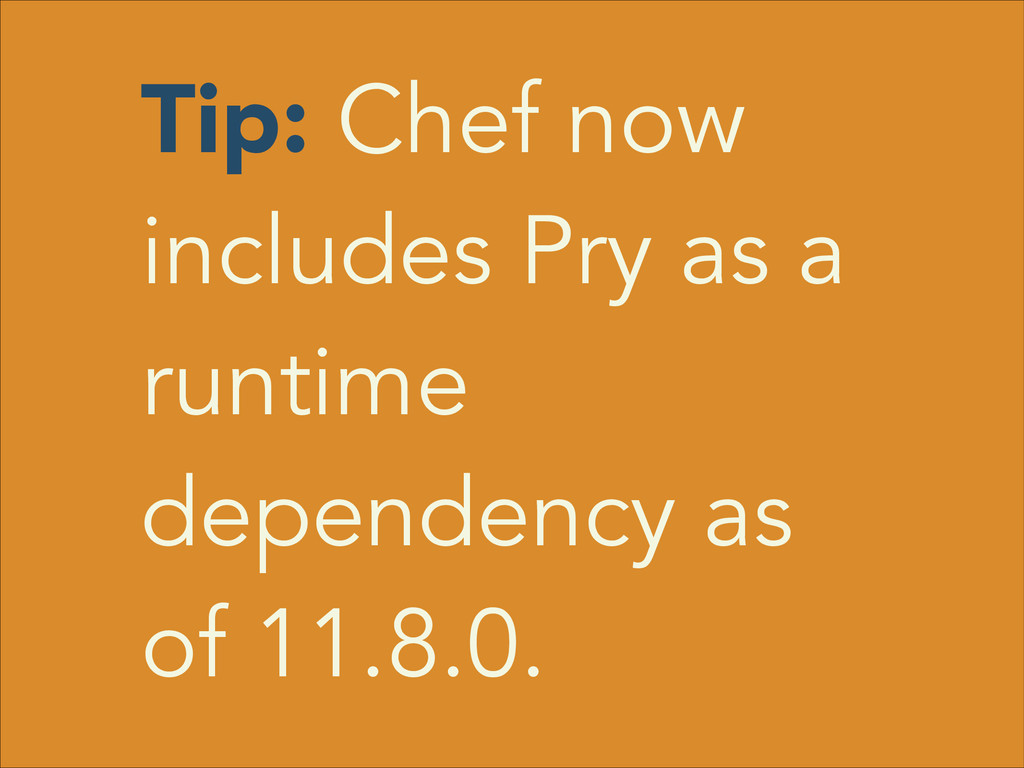
Tip: Chef now includes Pry as a runtime dependency as
of 11.8.0.
ancestor child descendant following parent preceding Axes
XPath expressions can be annoying ! Here’s some I prepared
earlier
attribute_access declared_dependencies find_resources notifications resource_attribute? resources_by_type searches API Foodcritic
all? any? find group_by inject map select Ruby Enumerable
Testing it actually works
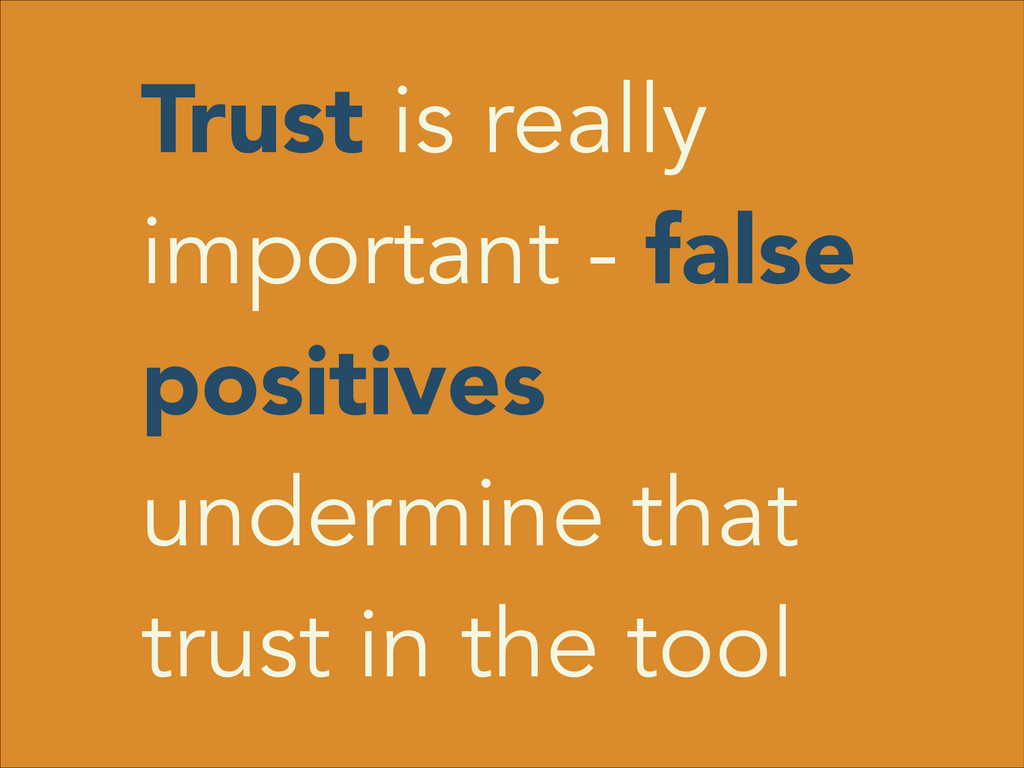
Trust is really important - false positives undermine that trust
in the tool
Foodcritic core rules test against lots of examples
Examples: | environment_name | show_warning | | production | should
not | | pre_production | should not | | production-eu | should not | | production2 | should not | | Production | should not | | EU West | should | | production (eu-west) | should |
Different syntax in recipes results in different AST trees
Different Ruby versions can mean different AST trees 1.9.2, 1.9.3
and 2.0.0
Ok. I have my automated examples passing. I should be
good right?
Ok. I have my automated examples passing. I should be
good right? Nee! Non! No!
Test against a large corpus of real cookbooks
Ideas
Suggest Chef Sugar FC789: Use Chef Sugar to simplify platform
check
Spot duplication across recipes FC678: Compose recipes to reduce duplication
Validate recipe package names FC567: Package not present in distribution
What’s next?
Backlog of issues that could use your help!
Hack Afternoon
Thanks! @acrmp foodcritic.io freenode #chef
Extending foodcritic with new rules #cfgmgmtcamp #getchef
More Decks by Andrew Crump
See All by Andrew Crump
Porting a small project from Go to Rust
acrmp
0
45
Docker and Cloud Foundry
acrmp
0
120
Continuous Delivery with Cloud Foundry
acrmp
1
120
Patterns for treating infrastructure as code
acrmp
1
320
Other Decks in Programming
See All in Programming
Proxmox x Talos Linux x Terraform で実現するなんかいい感じの Kubernetes クラスタ / A Sleek Kubernetes Cluster Powered by Proxmox, Talos Linux, and Terraform
nnaka2992
0
220
プロジェクトコードをキレイキレイしよう!暗黙的な参照を読み解く静的解析
ostk0069
0
220
GraphQL の onError と Nullability のこれから
quramy
0
220
Enforcing Your Architecture with Unit Tests in the AI Era (Swift Connection X)
steliosf
PRO
1
180
Zero-Tap Sign-In対応、結局何をすればいいの?
mitohato14
0
2.3k
地方こそサーバーレス — 10年続けた、顔が見えるチームで確かな基盤を / Serverless Matters Most in Regional Areas — 10 Years of Building Reliable Foundations with Close-Knit Teams
seike460
PRO
2
480
LLM 101
dalinaum
0
500
AIがコードを書いてくれる時代、我々は何を確かめるのか
yosuke_furukawa
PRO
13
6k
AWS CDKを理解するために公式の定義を深掘って解説してみる / Understanding AWS CDK by Digging into Its Official Definition
akihisaikeda
3
310
RaspberryPi 5で軽くはじめるk3sとtailscaleを用いたホームサーバー構築 (1)
nasum
0
350
Lambda durable functionsでHuman in the Loopを楽に…楽に……
har1101
2
330
社内AIエージェント「Askワンバン」における コストチューニングの取り組み
t0yohei
0
170
Featured
See All Featured
Bridging the Design Gap: How Collaborative Modelling removes blockers to flow between stakeholders and teams @FastFlow conf
baasie
0
770
Building an army of robots
kneath
307
47k
What's in a price? How to price your products and services
michaelherold
247
13k
Git: the NoSQL Database
bkeepers
PRO
433
67k
sira's awesome portfolio website redesign presentation
elsirapls
0
510
How STYLIGHT went responsive
nonsquared
100
6.4k
Gemini Prompt Engineering: Practical Techniques for Tangible AI Outcomes
mfonobong
2
640
The Web Performance Landscape in 2024 [PerfNow 2024]
tammyeverts
12
1.4k
エンジニアに許された特別な時間の終わり
watany
109
250k
AI Search: Where Are We & What Can We Do About It?
aleyda
0
8.2k
Bash Introduction
62gerente
615
220k
How to Ace a Technical Interview
jacobian
280
24k