Upgrade to Pro — share decks privately, control downloads, hide ads and more …

Cognitive Ability Tests for Hiring

Sponsored · Your Podcast. Everywhere. Effortlessly. Share. Educate. Inspire. Entertain. You do you. We'll handle the rest. →
Avatar for HireValid HireValid
October 19, 2026

Cognitive Ability Tests for Hiring

Discover how cognitive ability tests help employers evaluate candidates’ reasoning, problem-solving, numerical skills, verbal comprehension, and learning ability. This comprehensive guide by HireValid explores how cognitive assessments predict job performance, interpret raw scores and percentiles, build candidate shortlists, and support fair hiring decisions. Learn about sample question types, role-specific testing, adverse impact, accessibility, and strategies to protect assessments from AI assistance. Designed for HR professionals, recruiters, hiring managers, and business owners, this guide provides practical advice on choosing cognitive ability tests and combining them with skills assessments and structured interviews to improve recruitment outcomes.

Learn more at https://www.hirevalid.com/

Avatar for HireValid

HireValid

October 19, 2026

More Decks by HireValid

Other Decks in Education

Transcript

  1. THE 2026 EMPLOYER GUIDE Cognitive Ability Tests for Hiring What

    they measure, how well they predict job performance, how to read the results and how to use them fairly in the AI era. AI-era hiring needs AI-proof tests. Cognitive, skills and language tests Ranked results in minutes No annual contract hirevalid.com Hire people who can really do the job. Edition: October 2026
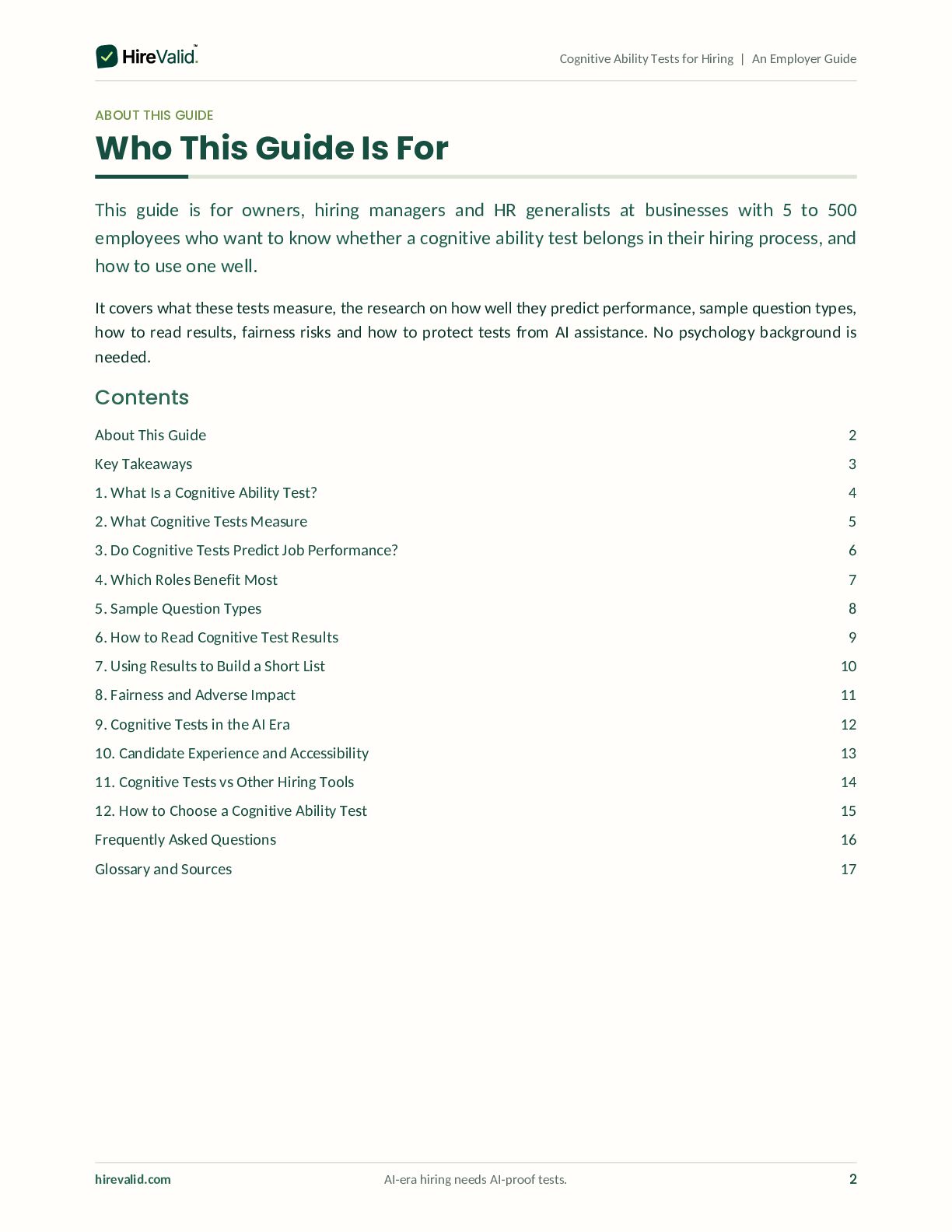
  2. Cognitive Ability Tests for Hiring | An Employer Guide ABOUT

    THIS GUIDE Who This Guide Is For This guide is for owners, hiring managers and HR generalists at businesses with 5 to 500 employees who want to know whether a cognitive ability test belongs in their hiring process, and how to use one well. It covers what these tests measure, the research on how well they predict performance, sample question types, how to read results, fairness risks and how to protect tests from AI assistance. No psychology background is needed. Contents About This Guide 2 Key Takeaways 3 1. What Is a Cognitive Ability Test? 4 2. What Cognitive Tests Measure 5 3. Do Cognitive Tests Predict Job Performance? 6 4. Which Roles Benefit Most 7 5. Sample Question Types 8 6. How to Read Cognitive Test Results 9 7. Using Results to Build a Short List 10 8. Fairness and Adverse Impact 11 9. Cognitive Tests in the AI Era 12 10. Candidate Experience and Accessibility 13 11. Cognitive Tests vs Other Hiring Tools 14 12. How to Choose a Cognitive Ability Test 15 Frequently Asked Questions 16 Glossary and Sources 17 hirevalid.com AI-era hiring needs AI-proof tests. 2
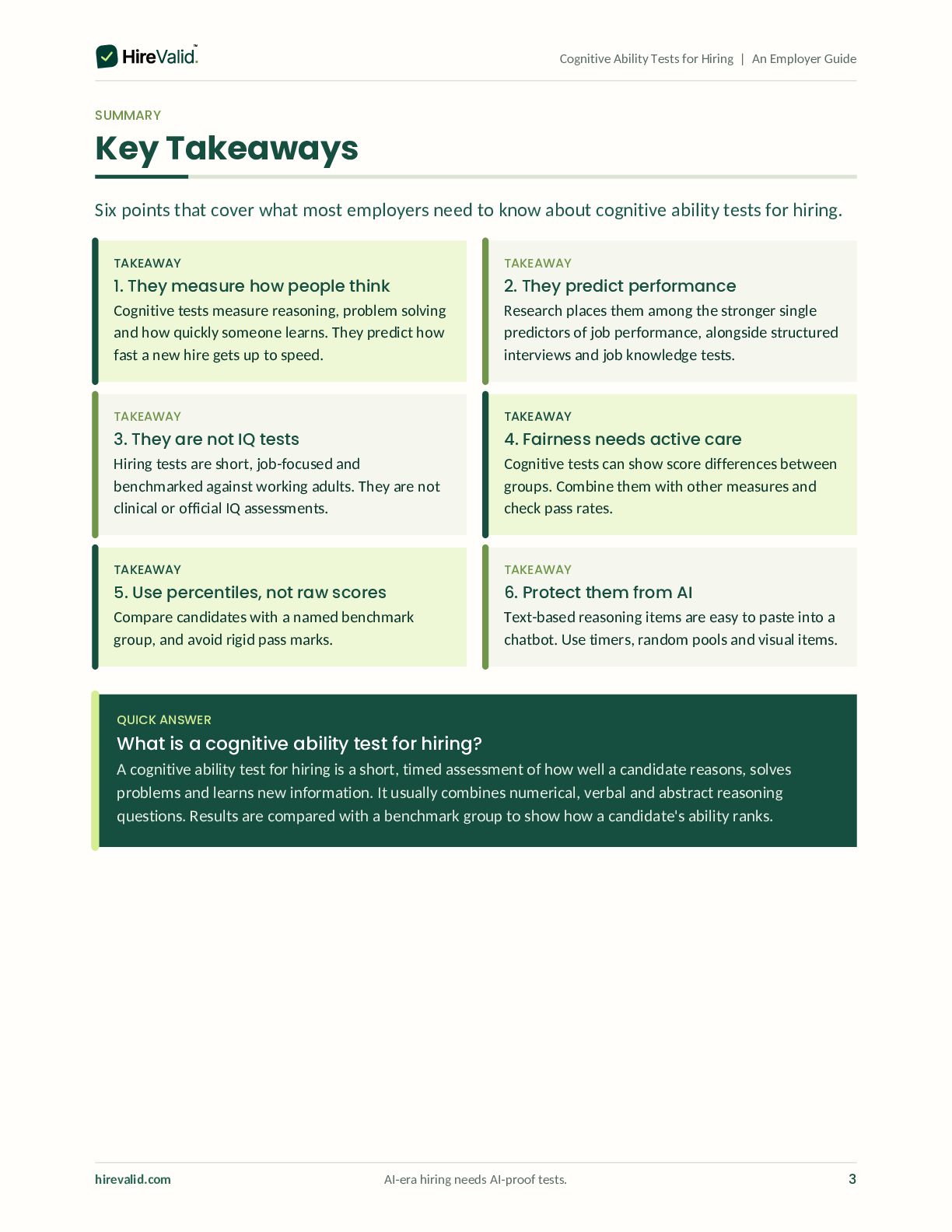
  3. Cognitive Ability Tests for Hiring | An Employer Guide SUMMARY

    Key Takeaways Six points that cover what most employers need to know about cognitive ability tests for hiring. TAKEAWAY TAKEAWAY 1. They measure how people think Cognitive tests measure reasoning, problem solving and how quickly someone learns. They predict how fast a new hire gets up to speed. 2. They predict performance Research places them among the stronger single predictors of job performance, alongside structured interviews and job knowledge tests. TAKEAWAY TAKEAWAY 3. They are not IQ tests Hiring tests are short, job-focused and benchmarked against working adults. They are not clinical or official IQ assessments. 4. Fairness needs active care Cognitive tests can show score differences between groups. Combine them with other measures and check pass rates. TAKEAWAY TAKEAWAY 5. Use percentiles, not raw scores Compare candidates with a named benchmark group, and avoid rigid pass marks. 6. Protect them from AI Text-based reasoning items are easy to paste into a chatbot. Use timers, random pools and visual items. QUICK ANSWER What is a cognitive ability test for hiring? A cognitive ability test for hiring is a short, timed assessment of how well a candidate reasons, solves problems and learns new information. It usually combines numerical, verbal and abstract reasoning questions. Results are compared with a benchmark group to show how a candidate's ability ranks. hirevalid.com AI-era hiring needs AI-proof tests. 3
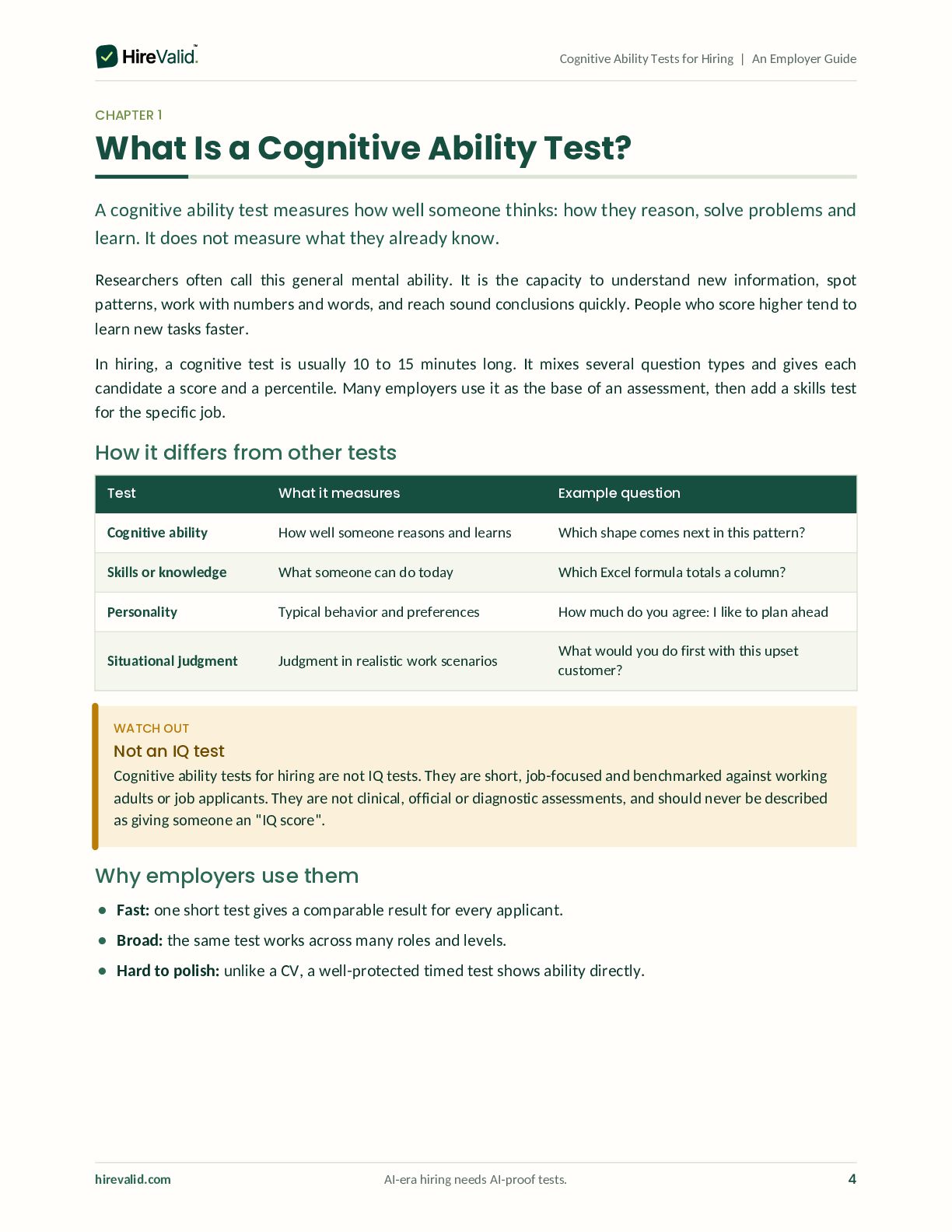
  4. Cognitive Ability Tests for Hiring | An Employer Guide CHAPTER

    1 What Is a Cognitive Ability Test? A cognitive ability test measures how well someone thinks: how they reason, solve problems and learn. It does not measure what they already know. Researchers often call this general mental ability. It is the capacity to understand new information, spot patterns, work with numbers and words, and reach sound conclusions quickly. People who score higher tend to learn new tasks faster. In hiring, a cognitive test is usually 10 to 15 minutes long. It mixes several question types and gives each candidate a score and a percentile. Many employers use it as the base of an assessment, then add a skills test for the specific job. How it differs from other tests Test What it measures Example question Cognitive ability How well someone reasons and learns Which shape comes next in this pattern? Skills or knowledge What someone can do today Which Excel formula totals a column? Personality Typical behavior and preferences How much do you agree: I like to plan ahead Situational judgment Judgment in realistic work scenarios What would you do first with this upset customer? WATCH OUT Not an IQ test Cognitive ability tests for hiring are not IQ tests. They are short, job-focused and benchmarked against working adults or job applicants. They are not clinical, official or diagnostic assessments, and should never be described as giving someone an "IQ score". Why employers use them • Fast: one short test gives a comparable result for every applicant. • Broad: the same test works across many roles and levels. • Hard to polish: unlike a CV, a well-protected timed test shows ability directly. hirevalid.com AI-era hiring needs AI-proof tests. 4
  5. Cognitive Ability Tests for Hiring | An Employer Guide CHAPTER

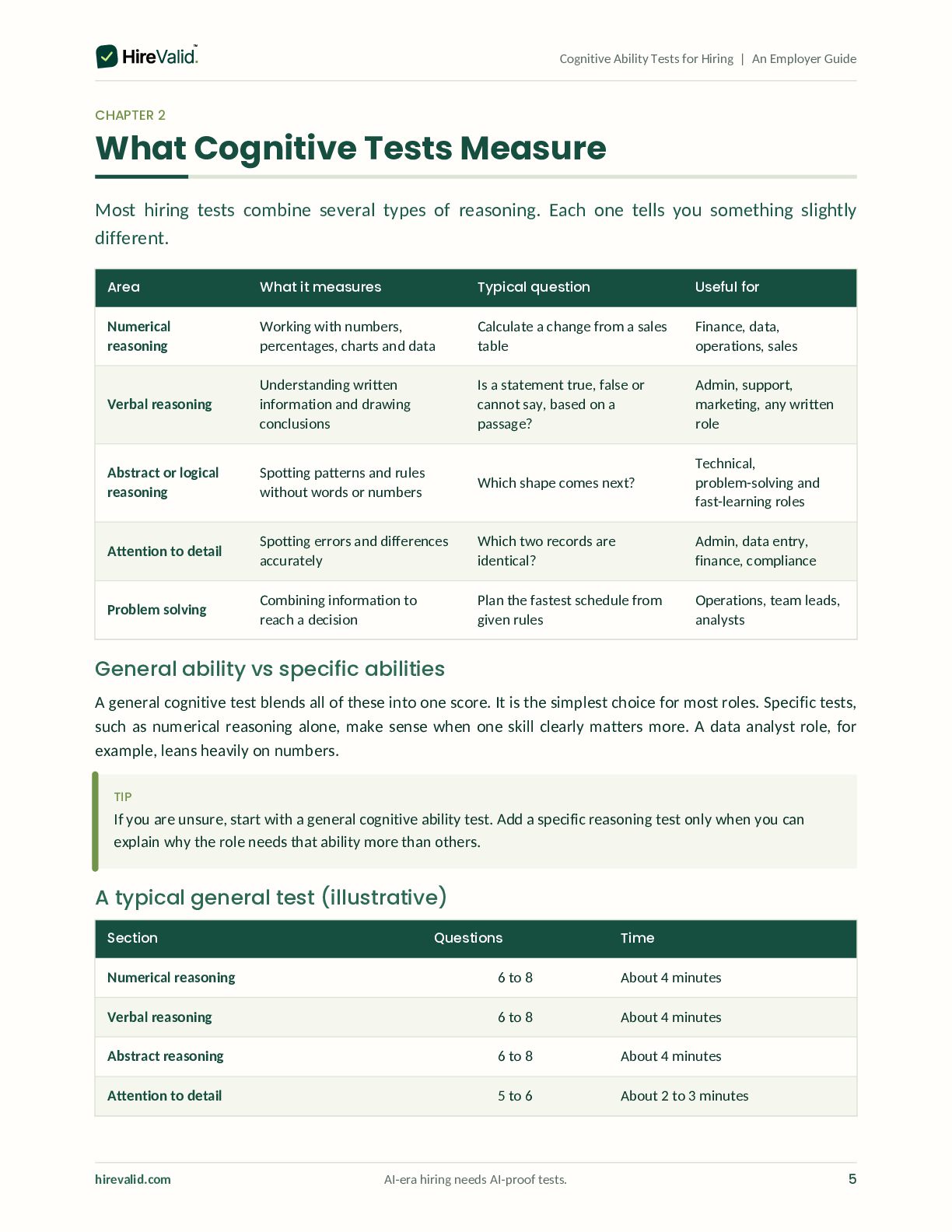
    2 What Cognitive Tests Measure Most hiring tests combine several types of reasoning. Each one tells you something slightly different. Area What it measures Typical question Useful for Numerical reasoning Working with numbers, percentages, charts and data Calculate a change from a sales table Finance, data, operations, sales Verbal reasoning Understanding written information and drawing conclusions Is a statement true, false or cannot say, based on a passage? Admin, support, marketing, any written role Abstract or logical reasoning Spotting patterns and rules without words or numbers Which shape comes next? Technical, problem-solving and fast-learning roles Attention to detail Spotting errors and differences accurately Which two records are identical? Admin, data entry, finance, compliance Problem solving Combining information to reach a decision Plan the fastest schedule from given rules Operations, team leads, analysts General ability vs specific abilities A general cognitive test blends all of these into one score. It is the simplest choice for most roles. Specific tests, such as numerical reasoning alone, make sense when one skill clearly matters more. A data analyst role, for example, leans heavily on numbers. TIP If you are unsure, start with a general cognitive ability test. Add a specific reasoning test only when you can explain why the role needs that ability more than others. A typical general test (illustrative) Section Questions Time Numerical reasoning 6 to 8 About 4 minutes Verbal reasoning 6 to 8 About 4 minutes Abstract reasoning 6 to 8 About 4 minutes Attention to detail 5 to 6 About 2 to 3 minutes hirevalid.com AI-era hiring needs AI-proof tests. 5
  6. Cognitive Ability Tests for Hiring | An Employer Guide CHAPTER

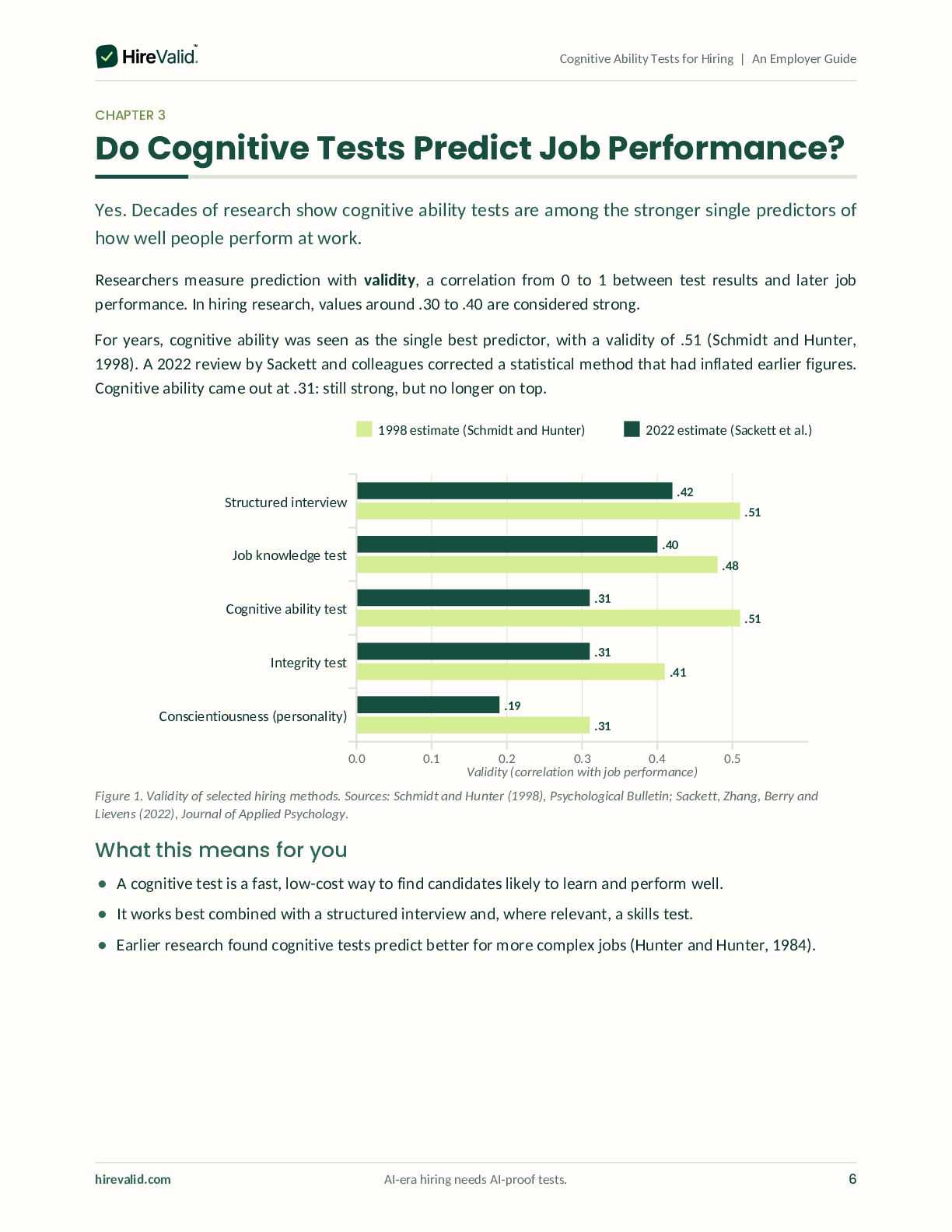
    3 Do Cognitive Tests Predict Job Performance? Yes. Decades of research show cognitive ability tests are among the stronger single predictors of how well people perform at work. Researchers measure prediction with validity, a correlation from 0 to 1 between test results and later job performance. In hiring research, values around .30 to .40 are considered strong. For years, cognitive ability was seen as the single best predictor, with a validity of .51 (Schmidt and Hunter, 1998). A 2022 review by Sackett and colleagues corrected a statistical method that had inflated earlier figures. Cognitive ability came out at .31: still strong, but no longer on top. 1998 estimate (Schmidt and Hunter) 2022 estimate (Sackett et al.) .42 Structured interview .51 .40 Job knowledge test .48 .31 Cognitive ability test .51 .31 Integrity test .41 .19 Conscientiousness (personality) .31 0.0 0.1 0.2 0.3 0.4 Validity (correlation with job performance) 0.5 Figure 1. Validity of selected hiring methods. Sources: Schmidt and Hunter (1998), Psychological Bulletin; Sackett, Zhang, Berry and Lievens (2022), Journal of Applied Psychology. What this means for you • A cognitive test is a fast, low-cost way to find candidates likely to learn and perform well. • It works best combined with a structured interview and, where relevant, a skills test. • Earlier research found cognitive tests predict better for more complex jobs (Hunter and Hunter, 1984). hirevalid.com AI-era hiring needs AI-proof tests. 6
  7. Cognitive Ability Tests for Hiring | An Employer Guide CHAPTER

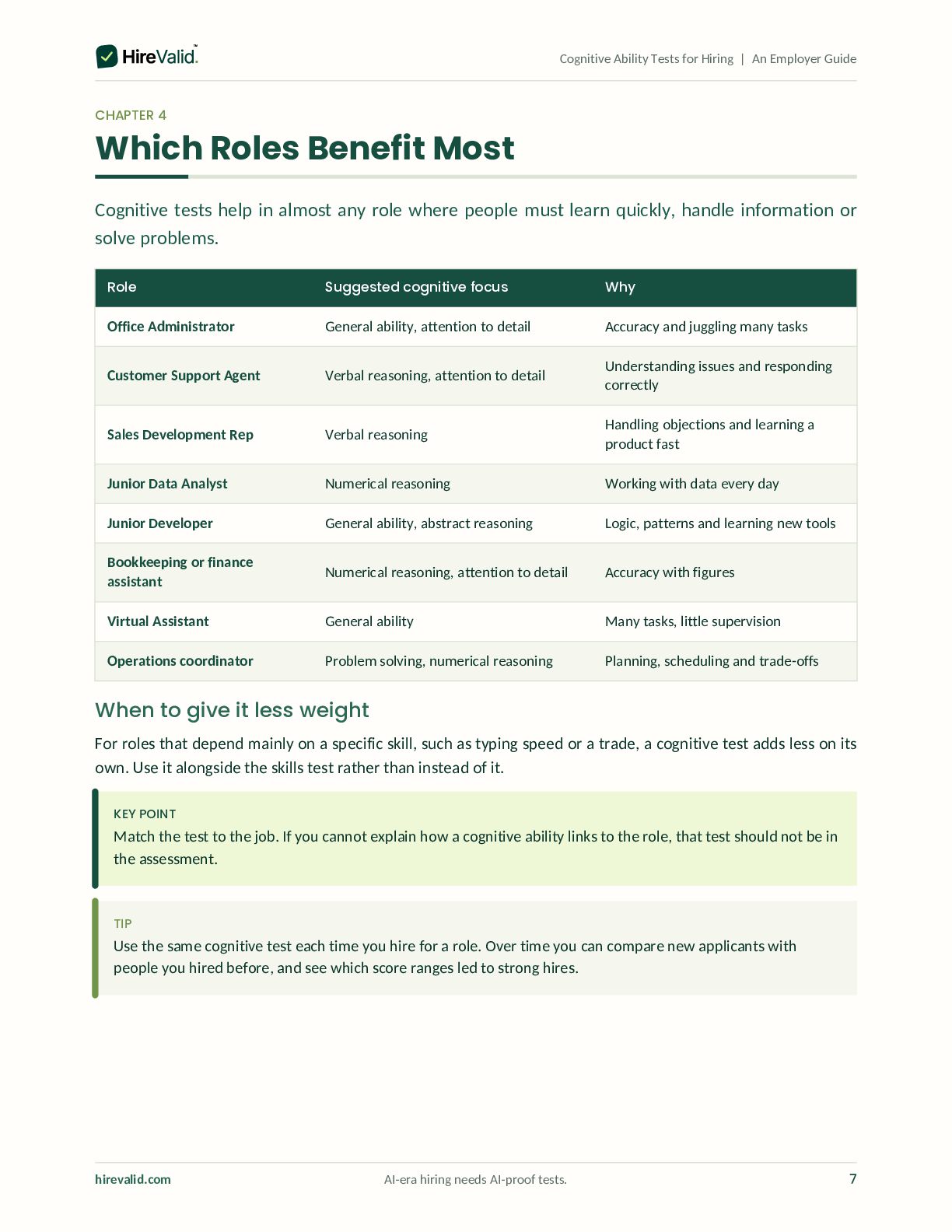
    4 Which Roles Benefit Most Cognitive tests help in almost any role where people must learn quickly, handle information or solve problems. Role Suggested cognitive focus Why Office Administrator General ability, attention to detail Accuracy and juggling many tasks Customer Support Agent Verbal reasoning, attention to detail Understanding issues and responding correctly Sales Development Rep Verbal reasoning Handling objections and learning a product fast Junior Data Analyst Numerical reasoning Working with data every day Junior Developer General ability, abstract reasoning Logic, patterns and learning new tools Bookkeeping or finance assistant Numerical reasoning, attention to detail Accuracy with figures Virtual Assistant General ability Many tasks, little supervision Operations coordinator Problem solving, numerical reasoning Planning, scheduling and trade-offs When to give it less weight For roles that depend mainly on a specific skill, such as typing speed or a trade, a cognitive test adds less on its own. Use it alongside the skills test rather than instead of it. KEY POINT Match the test to the job. If you cannot explain how a cognitive ability links to the role, that test should not be in the assessment. TIP Use the same cognitive test each time you hire for a role. Over time you can compare new applicants with people you hired before, and see which score ranges led to strong hires. hirevalid.com AI-era hiring needs AI-proof tests. 7
  8. Cognitive Ability Tests for Hiring | An Employer Guide CHAPTER

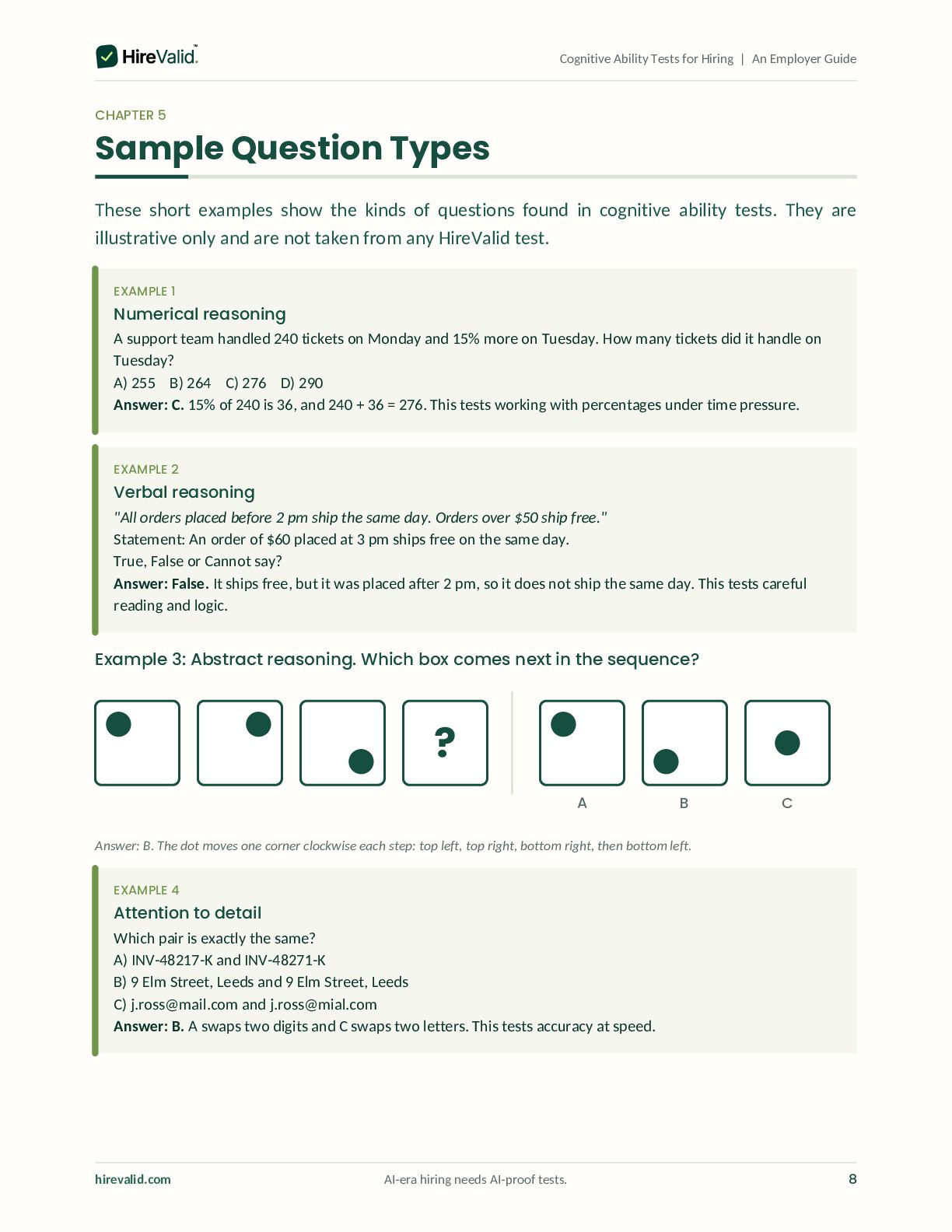
    5 Sample Question Types These short examples show the kinds of questions found in cognitive ability tests. They are illustrative only and are not taken from any HireValid test. EXAMPLE 1 Numerical reasoning A support team handled 240 tickets on Monday and 15% more on Tuesday. How many tickets did it handle on Tuesday? A) 255 B) 264 C) 276 D) 290 Answer: C. 15% of 240 is 36, and 240 + 36 = 276. This tests working with percentages under time pressure. EXAMPLE 2 Verbal reasoning "All orders placed before 2 pm ship the same day. Orders over $50 ship free." Statement: An order of $60 placed at 3 pm ships free on the same day. True, False or Cannot say? Answer: False. It ships free, but it was placed after 2 pm, so it does not ship the same day. This tests careful reading and logic. Example 3: Abstract reasoning. Which box comes next in the sequence? ? A B C Answer: B. The dot moves one corner clockwise each step: top left, top right, bottom right, then bottom left. EXAMPLE 4 Attention to detail Which pair is exactly the same? A) INV-48217-K and INV-48271-K B) 9 Elm Street, Leeds and 9 Elm Street, Leeds C) [email protected] and [email protected] Answer: B. A swaps two digits and C swaps two letters. This tests accuracy at speed. hirevalid.com AI-era hiring needs AI-proof tests. 8
  9. Cognitive Ability Tests for Hiring | An Employer Guide CHAPTER

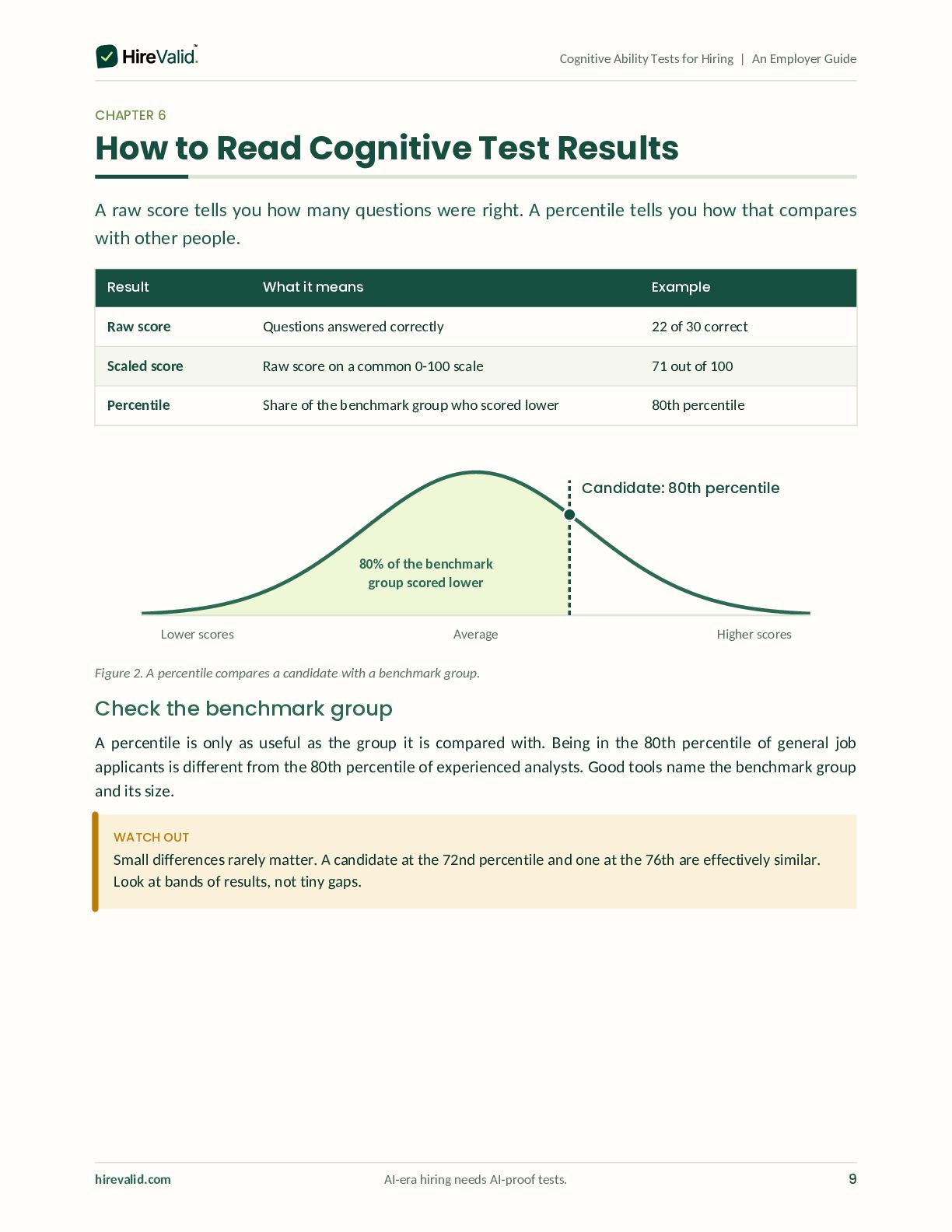
    6 How to Read Cognitive Test Results A raw score tells you how many questions were right. A percentile tells you how that compares with other people. Result What it means Example Raw score Questions answered correctly 22 of 30 correct Scaled score Raw score on a common 0-100 scale 71 out of 100 Percentile Share of the benchmark group who scored lower 80th percentile Candidate: 80th percentile 80% of the benchmark group scored lower Lower scores Average Higher scores Figure 2. A percentile compares a candidate with a benchmark group. Check the benchmark group A percentile is only as useful as the group it is compared with. Being in the 80th percentile of general job applicants is different from the 80th percentile of experienced analysts. Good tools name the benchmark group and its size. WATCH OUT Small differences rarely matter. A candidate at the 72nd percentile and one at the 76th are effectively similar. Look at bands of results, not tiny gaps. hirevalid.com AI-era hiring needs AI-proof tests. 9
  10. Cognitive Ability Tests for Hiring | An Employer Guide CHAPTER

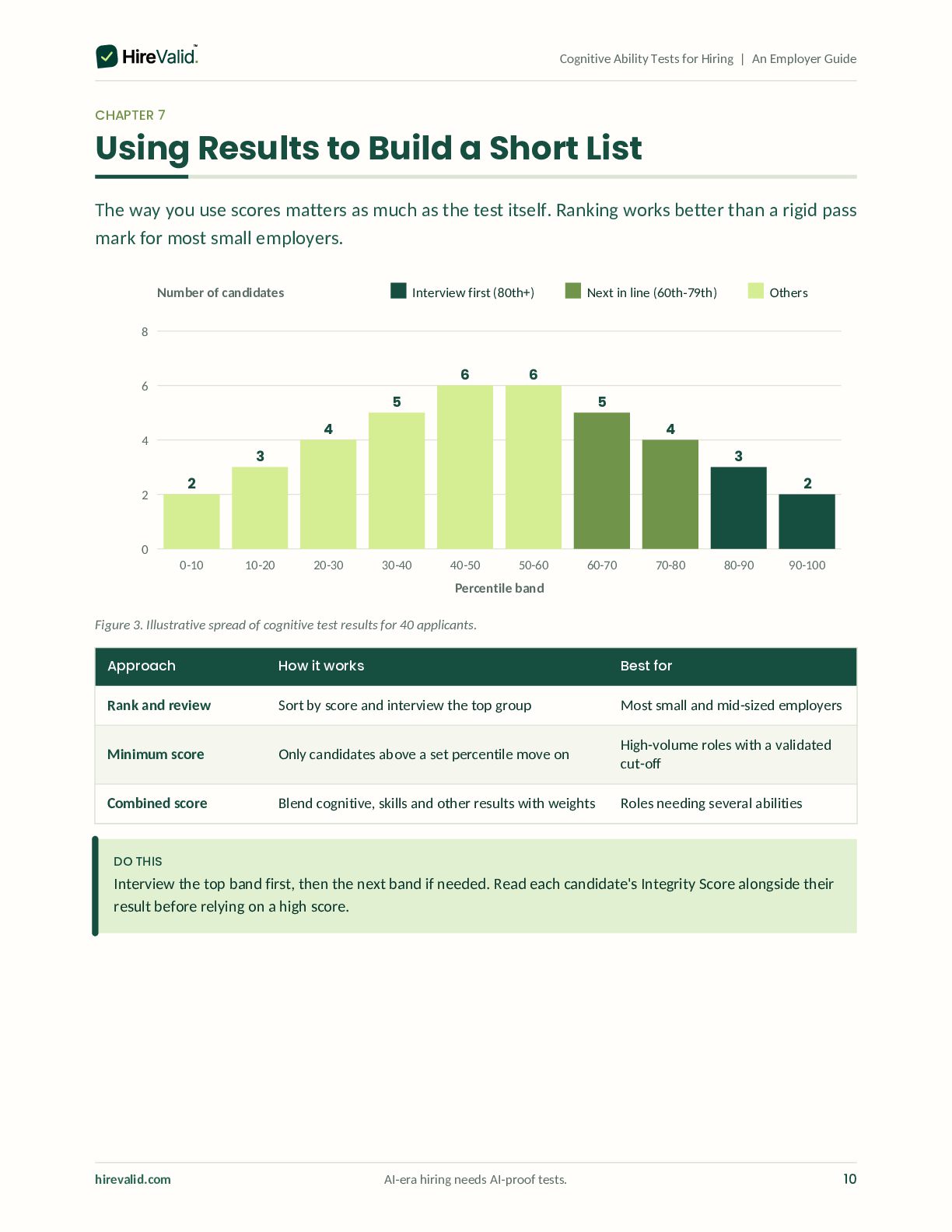
    7 Using Results to Build a Short List The way you use scores matters as much as the test itself. Ranking works better than a rigid pass mark for most small employers. Number of candidates Interview first (80th+) Next in line (60th-79th) Others 8 6 6 5 5 4 4 2 6 4 3 3 2 2 0 0-10 10-20 20-30 30-40 40-50 50-60 60-70 70-80 80-90 90-100 Percentile band Figure 3. Illustrative spread of cognitive test results for 40 applicants. Approach How it works Best for Rank and review Sort by score and interview the top group Most small and mid-sized employers Minimum score Only candidates above a set percentile move on High-volume roles with a validated cut-off Combined score Blend cognitive, skills and other results with weights Roles needing several abilities DO THIS Interview the top band first, then the next band if needed. Read each candidate's Integrity Score alongside their result before relying on a high score. hirevalid.com AI-era hiring needs AI-proof tests. 10
  11. Cognitive Ability Tests for Hiring | An Employer Guide CHAPTER

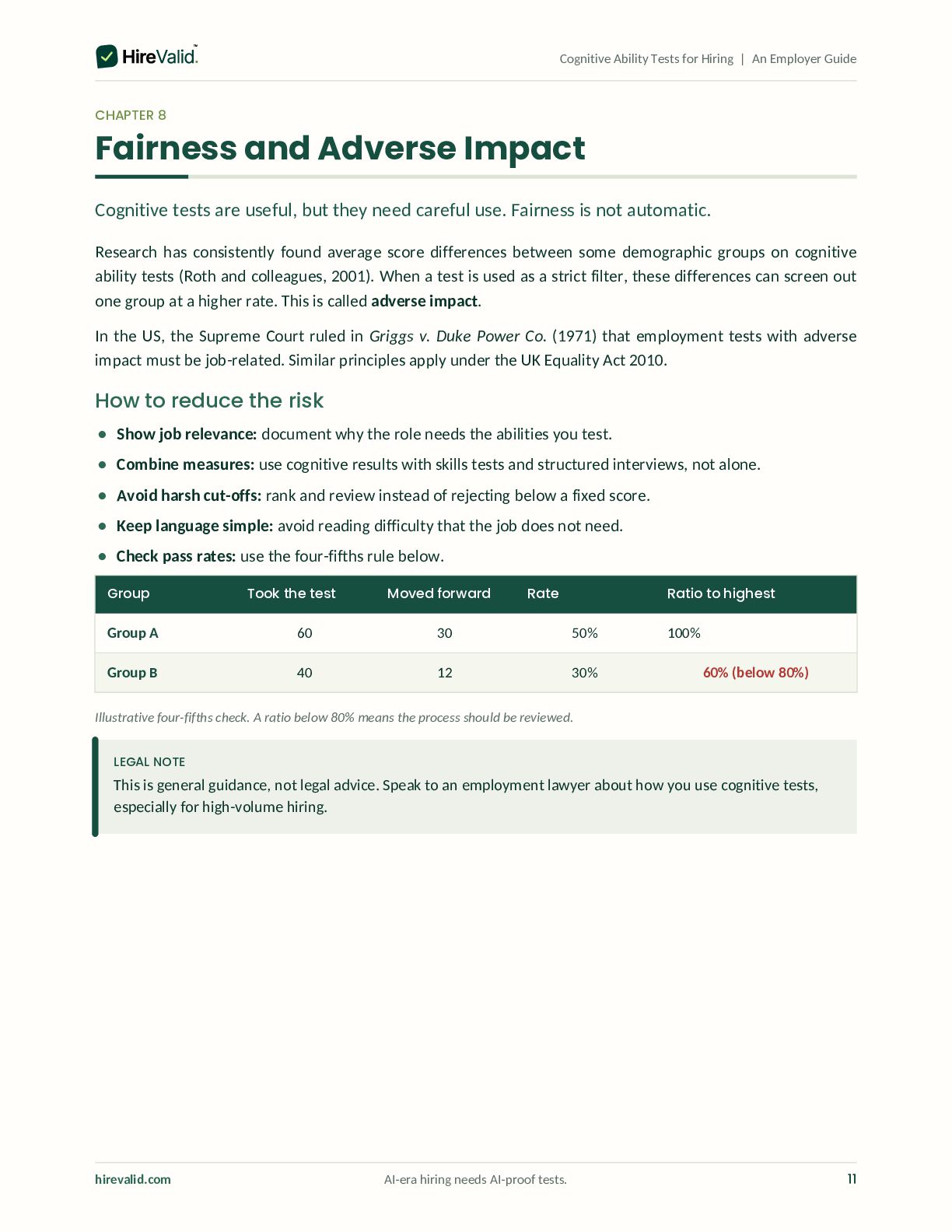
    8 Fairness and Adverse Impact Cognitive tests are useful, but they need careful use. Fairness is not automatic. Research has consistently found average score differences between some demographic groups on cognitive ability tests (Roth and colleagues, 2001). When a test is used as a strict filter, these differences can screen out one group at a higher rate. This is called adverse impact. In the US, the Supreme Court ruled in Griggs v. Duke Power Co. (1971) that employment tests with adverse impact must be job-related. Similar principles apply under the UK Equality Act 2010. How to reduce the risk • Show job relevance: document why the role needs the abilities you test. • Combine measures: use cognitive results with skills tests and structured interviews, not alone. • Avoid harsh cut-offs: rank and review instead of rejecting below a fixed score. • Keep language simple: avoid reading difficulty that the job does not need. • Check pass rates: use the four-fifths rule below. Group Took the test Moved forward Rate Ratio to highest Group A 60 30 50% Group B 40 12 30% 100% 60% (below 80%) Illustrative four-fifths check. A ratio below 80% means the process should be reviewed. LEGAL NOTE This is general guidance, not legal advice. Speak to an employment lawyer about how you use cognitive tests, especially for high-volume hiring. hirevalid.com AI-era hiring needs AI-proof tests. 11
  12. Cognitive Ability Tests for Hiring | An Employer Guide CHAPTER

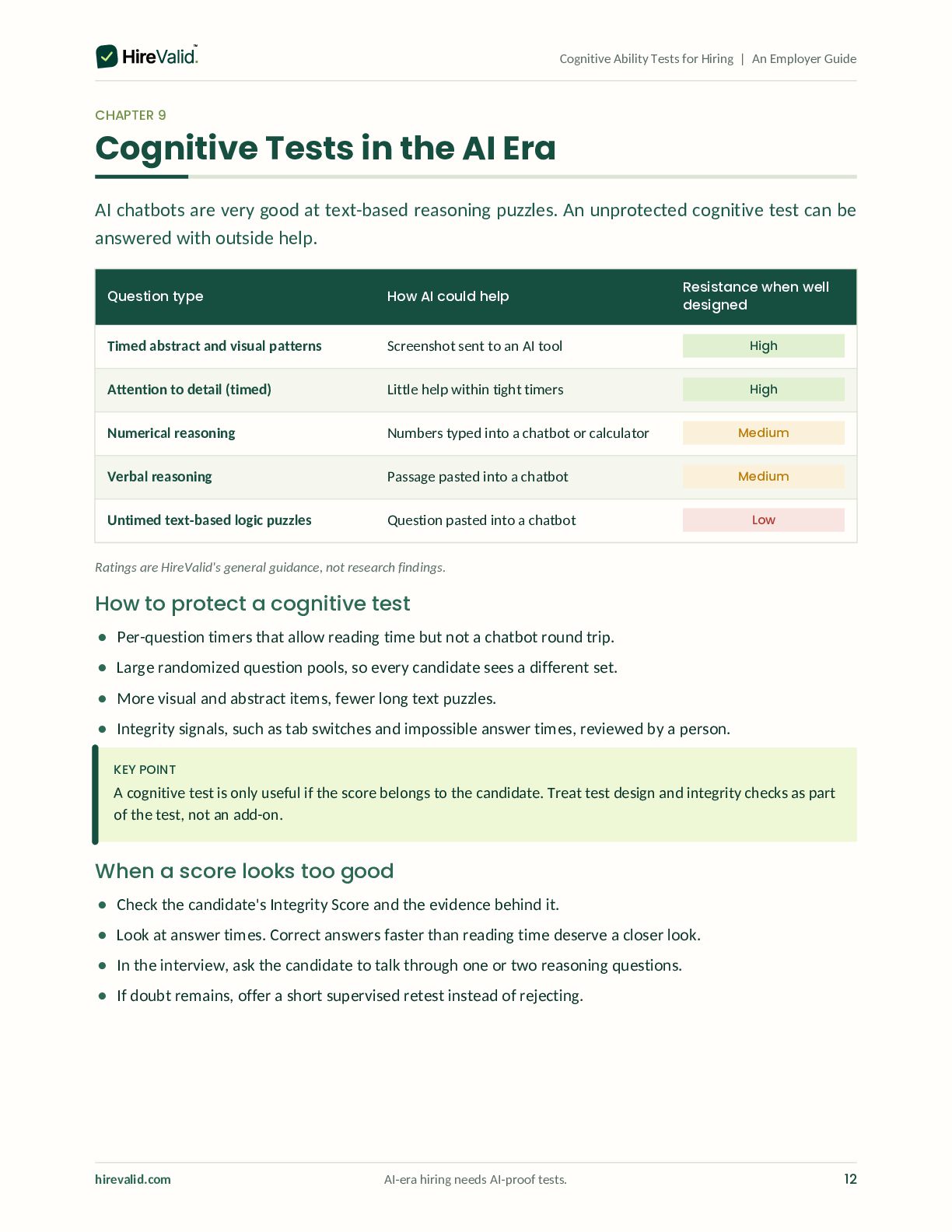
    9 Cognitive Tests in the AI Era AI chatbots are very good at text-based reasoning puzzles. An unprotected cognitive test can be answered with outside help. Resistance when well designed Question type How AI could help Timed abstract and visual patterns Screenshot sent to an AI tool High Attention to detail (timed) Little help within tight timers High Numerical reasoning Numbers typed into a chatbot or calculator Medium Verbal reasoning Passage pasted into a chatbot Medium Untimed text-based logic puzzles Question pasted into a chatbot Low Ratings are HireValid's general guidance, not research findings. How to protect a cognitive test • Per-question timers that allow reading time but not a chatbot round trip. • Large randomized question pools, so every candidate sees a different set. • More visual and abstract items, fewer long text puzzles. • Integrity signals, such as tab switches and impossible answer times, reviewed by a person. KEY POINT A cognitive test is only useful if the score belongs to the candidate. Treat test design and integrity checks as part of the test, not an add-on. When a score looks too good • Check the candidate's Integrity Score and the evidence behind it. • Look at answer times. Correct answers faster than reading time deserve a closer look. • In the interview, ask the candidate to talk through one or two reasoning questions. • If doubt remains, offer a short supervised retest instead of rejecting. hirevalid.com AI-era hiring needs AI-proof tests. 12
  13. Cognitive Ability Tests for Hiring | An Employer Guide CHAPTER

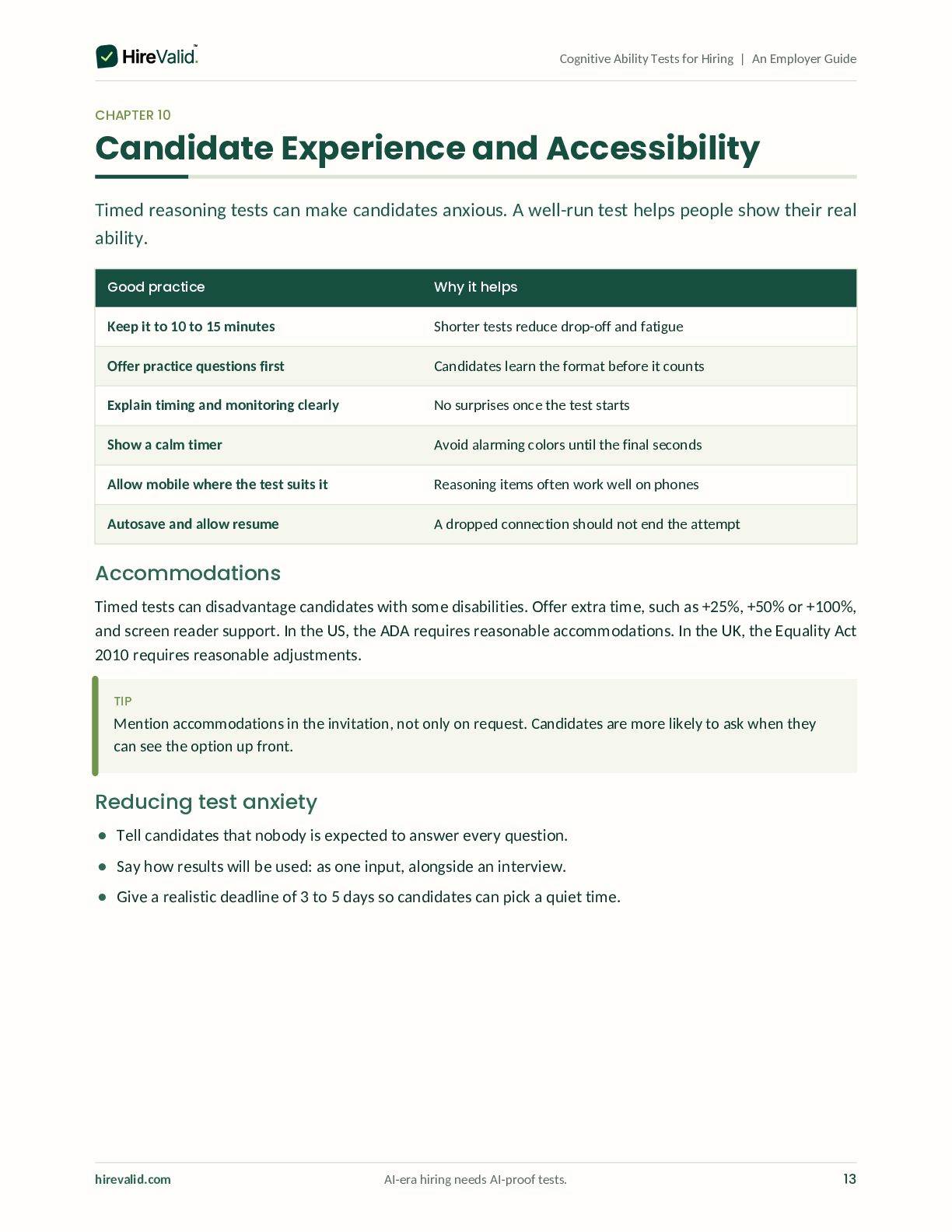
    10 Candidate Experience and Accessibility Timed reasoning tests can make candidates anxious. A well-run test helps people show their real ability. Good practice Why it helps Keep it to 10 to 15 minutes Shorter tests reduce drop-off and fatigue Offer practice questions first Candidates learn the format before it counts Explain timing and monitoring clearly No surprises once the test starts Show a calm timer Avoid alarming colors until the final seconds Allow mobile where the test suits it Reasoning items often work well on phones Autosave and allow resume A dropped connection should not end the attempt Accommodations Timed tests can disadvantage candidates with some disabilities. Offer extra time, such as +25%, +50% or +100%, and screen reader support. In the US, the ADA requires reasonable accommodations. In the UK, the Equality Act 2010 requires reasonable adjustments. TIP Mention accommodations in the invitation, not only on request. Candidates are more likely to ask when they can see the option up front. Reducing test anxiety • Tell candidates that nobody is expected to answer every question. • Say how results will be used: as one input, alongside an interview. • Give a realistic deadline of 3 to 5 days so candidates can pick a quiet time. hirevalid.com AI-era hiring needs AI-proof tests. 13
  14. Cognitive Ability Tests for Hiring | An Employer Guide CHAPTER

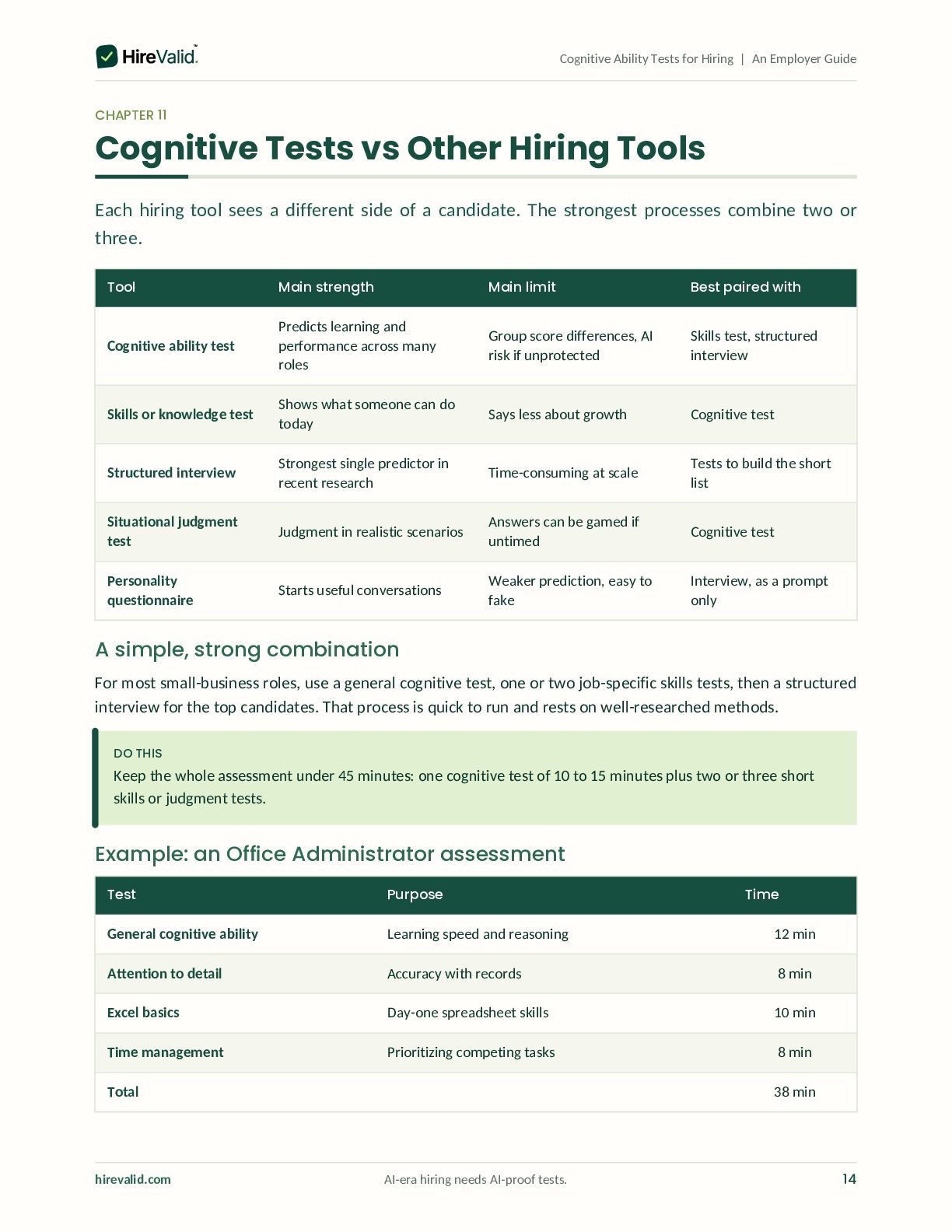
    11 Cognitive Tests vs Other Hiring Tools Each hiring tool sees a different side of a candidate. The strongest processes combine two or three. Tool Main strength Main limit Best paired with Cognitive ability test Predicts learning and performance across many roles Group score differences, AI risk if unprotected Skills test, structured interview Skills or knowledge test Shows what someone can do today Says less about growth Cognitive test Structured interview Strongest single predictor in recent research Time-consuming at scale Tests to build the short list Situational judgment test Judgment in realistic scenarios Answers can be gamed if untimed Cognitive test Personality questionnaire Starts useful conversations Weaker prediction, easy to fake Interview, as a prompt only A simple, strong combination For most small-business roles, use a general cognitive test, one or two job-specific skills tests, then a structured interview for the top candidates. That process is quick to run and rests on well-researched methods. DO THIS Keep the whole assessment under 45 minutes: one cognitive test of 10 to 15 minutes plus two or three short skills or judgment tests. Example: an Office Administrator assessment Test Purpose General cognitive ability Learning speed and reasoning 12 min Attention to detail Accuracy with records 8 min Excel basics Day-one spreadsheet skills 10 min Time management Prioritizing competing tasks 8 min Total hirevalid.com Time 38 min AI-era hiring needs AI-proof tests. 14
  15. Cognitive Ability Tests for Hiring | An Employer Guide CHAPTER

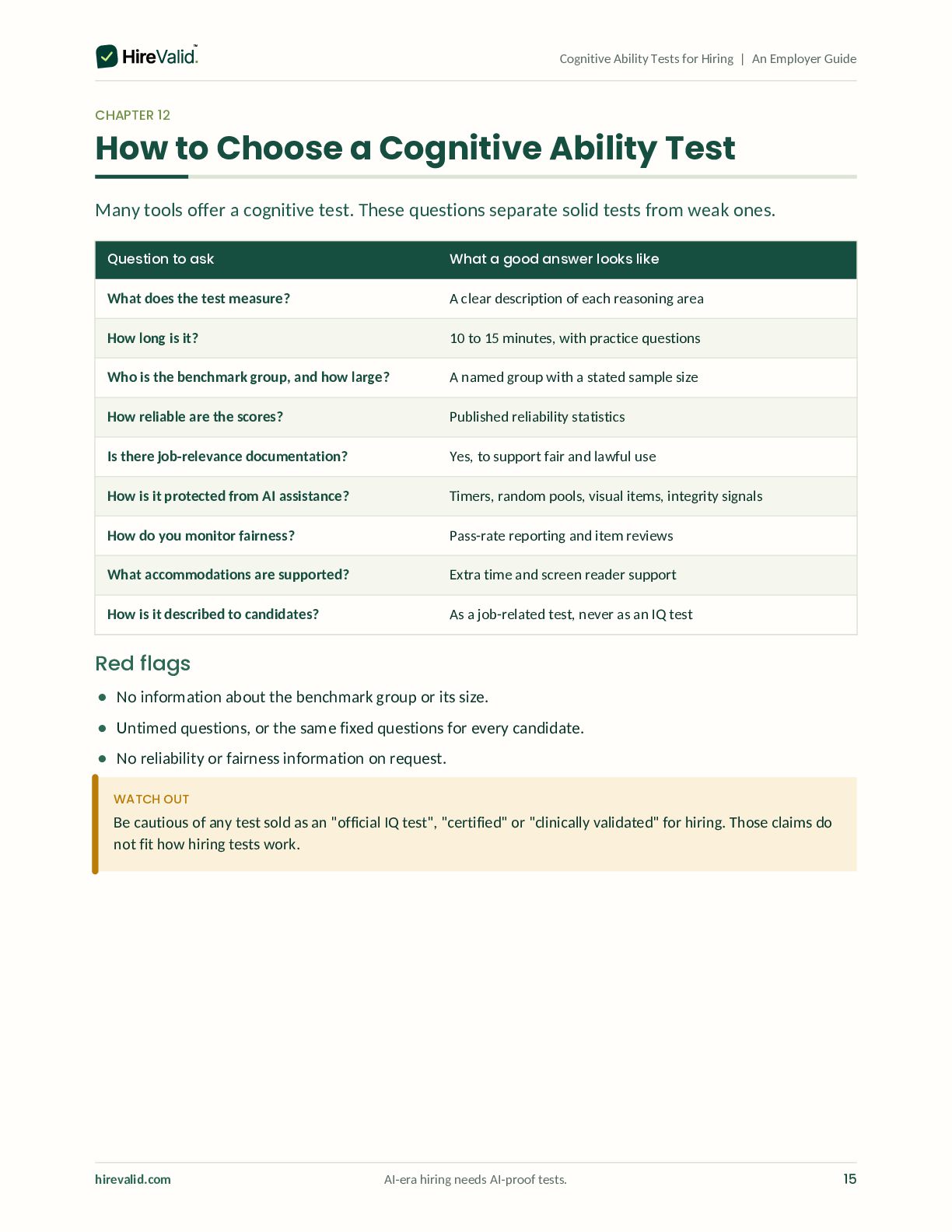
    12 How to Choose a Cognitive Ability Test Many tools offer a cognitive test. These questions separate solid tests from weak ones. Question to ask What a good answer looks like What does the test measure? A clear description of each reasoning area How long is it? 10 to 15 minutes, with practice questions Who is the benchmark group, and how large? A named group with a stated sample size How reliable are the scores? Published reliability statistics Is there job-relevance documentation? Yes, to support fair and lawful use How is it protected from AI assistance? Timers, random pools, visual items, integrity signals How do you monitor fairness? Pass-rate reporting and item reviews What accommodations are supported? Extra time and screen reader support How is it described to candidates? As a job-related test, never as an IQ test Red flags • No information about the benchmark group or its size. • Untimed questions, or the same fixed questions for every candidate. • No reliability or fairness information on request. WATCH OUT Be cautious of any test sold as an "official IQ test", "certified" or "clinically validated" for hiring. Those claims do not fit how hiring tests work. hirevalid.com AI-era hiring needs AI-proof tests. 15
  16. Cognitive Ability Tests for Hiring | An Employer Guide FAQ

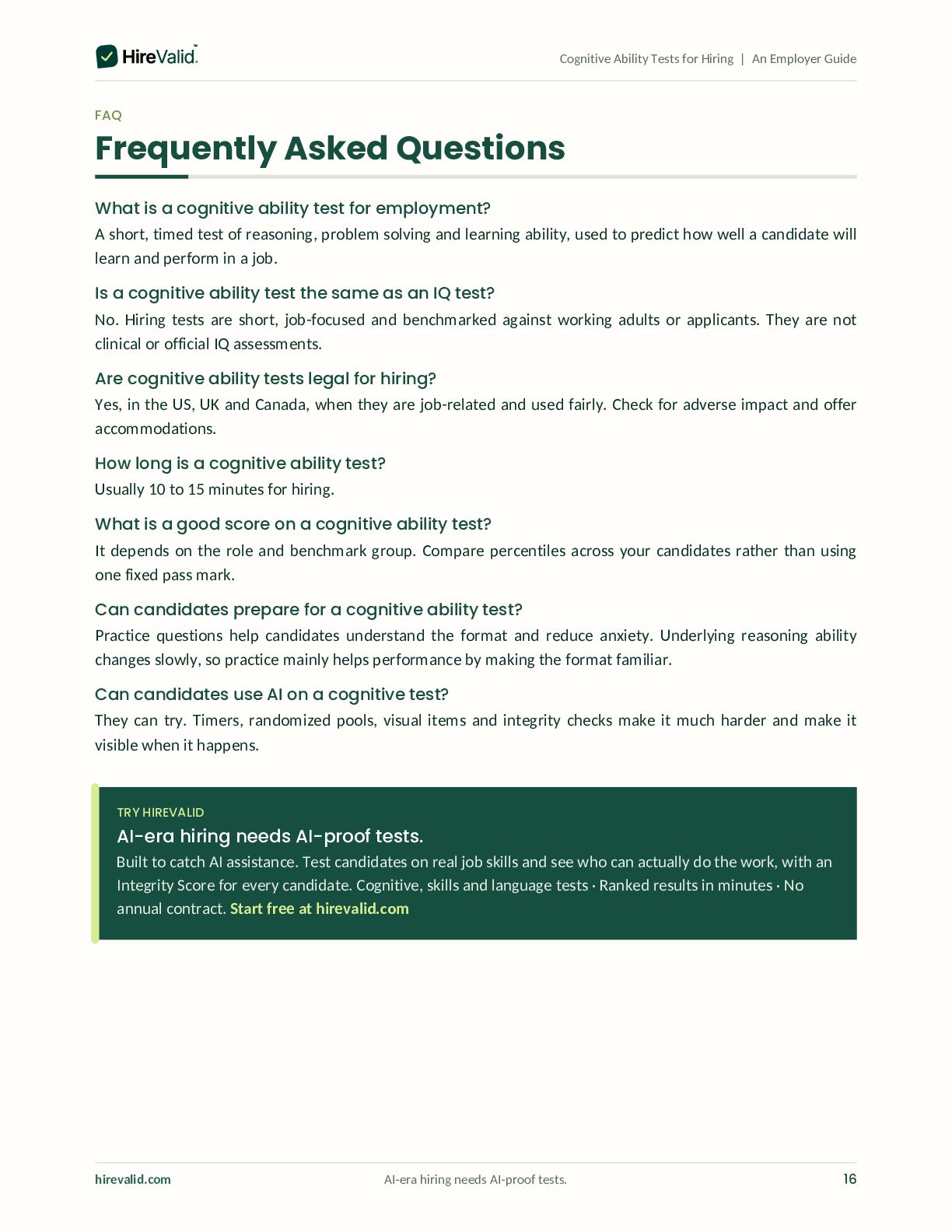
    Frequently Asked Questions What is a cognitive ability test for employment? A short, timed test of reasoning, problem solving and learning ability, used to predict how well a candidate will learn and perform in a job. Is a cognitive ability test the same as an IQ test? No. Hiring tests are short, job-focused and benchmarked against working adults or applicants. They are not clinical or official IQ assessments. Are cognitive ability tests legal for hiring? Yes, in the US, UK and Canada, when they are job-related and used fairly. Check for adverse impact and offer accommodations. How long is a cognitive ability test? Usually 10 to 15 minutes for hiring. What is a good score on a cognitive ability test? It depends on the role and benchmark group. Compare percentiles across your candidates rather than using one fixed pass mark. Can candidates prepare for a cognitive ability test? Practice questions help candidates understand the format and reduce anxiety. Underlying reasoning ability changes slowly, so practice mainly helps performance by making the format familiar. Can candidates use AI on a cognitive test? They can try. Timers, randomized pools, visual items and integrity checks make it much harder and make it visible when it happens. TRY HIREVALID AI-era hiring needs AI-proof tests. Built to catch AI assistance. Test candidates on real job skills and see who can actually do the work, with an Integrity Score for every candidate. Cognitive, skills and language tests · Ranked results in minutes · No annual contract. Start free at hirevalid.com hirevalid.com AI-era hiring needs AI-proof tests. 16
  17. Cognitive Ability Tests for Hiring | An Employer Guide REFERENCE

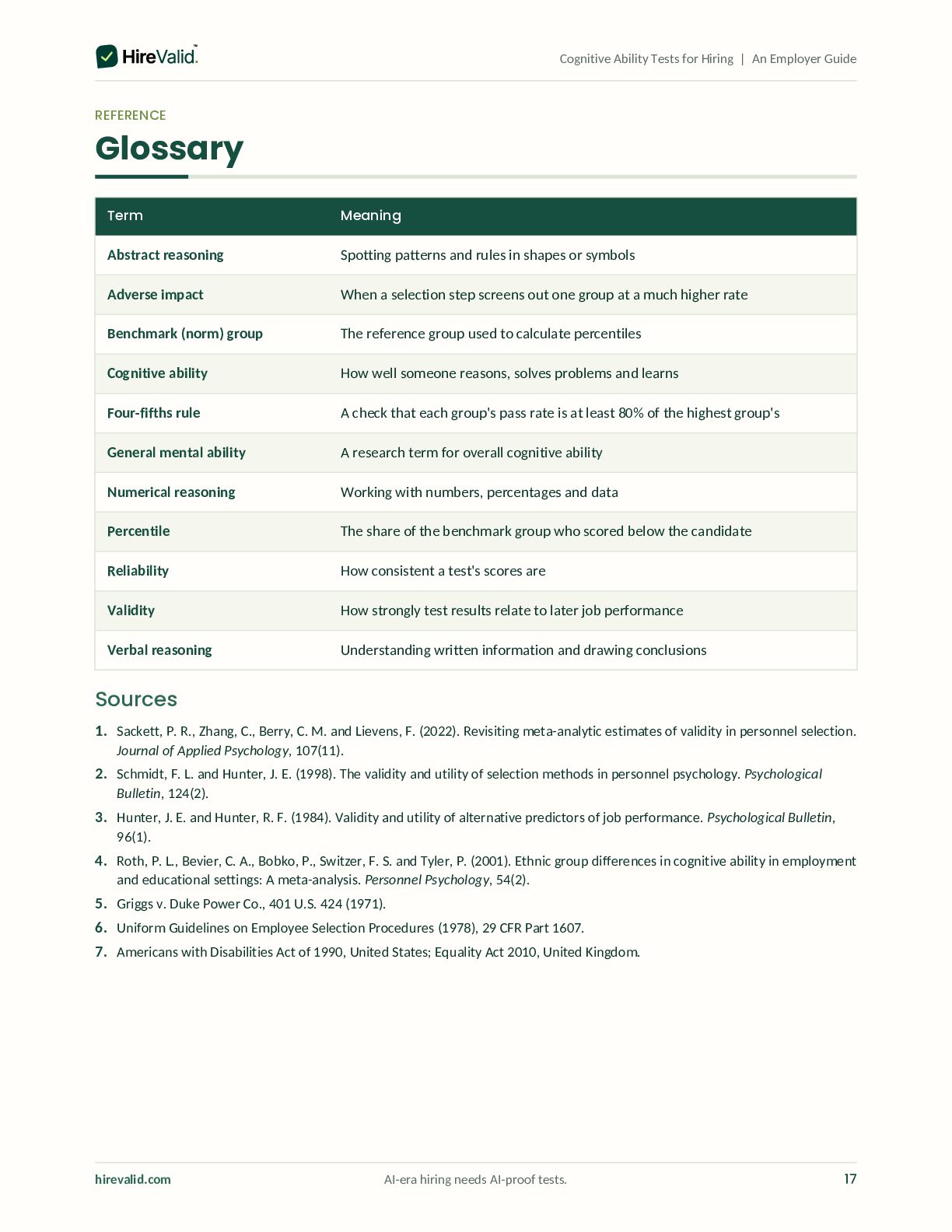
    Glossary Term Meaning Abstract reasoning Spotting patterns and rules in shapes or symbols Adverse impact When a selection step screens out one group at a much higher rate Benchmark (norm) group The reference group used to calculate percentiles Cognitive ability How well someone reasons, solves problems and learns Four-fifths rule A check that each group's pass rate is at least 80% of the highest group's General mental ability A research term for overall cognitive ability Numerical reasoning Working with numbers, percentages and data Percentile The share of the benchmark group who scored below the candidate Reliability How consistent a test's scores are Validity How strongly test results relate to later job performance Verbal reasoning Understanding written information and drawing conclusions Sources 1. Sackett, P. R., Zhang, C., Berry, C. M. and Lievens, F. (2022). Revisiting meta-analytic estimates of validity in personnel selection. Journal of Applied Psychology, 107(11). 2. Schmidt, F. L. and Hunter, J. E. (1998). The validity and utility of selection methods in personnel psychology. Psychological Bulletin, 124(2). 3. Hunter, J. E. and Hunter, R. F. (1984). Validity and utility of alternative predictors of job performance. Psychological Bulletin, 96(1). 4. Roth, P. L., Bevier, C. A., Bobko, P., Switzer, F. S. and Tyler, P. (2001). Ethnic group differences in cognitive ability in employment and educational settings: A meta-analysis. Personnel Psychology, 54(2). 5. Griggs v. Duke Power Co., 401 U.S. 424 (1971). 6. Uniform Guidelines on Employee Selection Procedures (1978), 29 CFR Part 1607. 7. Americans with Disabilities Act of 1990, United States; Equality Act 2010, United Kingdom. hirevalid.com AI-era hiring needs AI-proof tests. 17
  18. ABOUT HIREVALID AI-era hiring needs AI-proof tests. Built to catch

    AI assistance. Test candidates on real job skills and see who can actually do the work, with an Integrity Score for every candidate. Choose tests or a role bundle Cognitive, skills, language and situational judgment tests. Invite candidates with one link Candidates test in the browser. No account needed. See ranked results in minutes Score, percentile and an Integrity Score with evidence. Pay monthly No annual contract. Pause between hiring rounds. Start free at hirevalid.com Monthly plans. Cancel or pause any time. This guide is general information for employers. It is not legal advice. Laws on hiring, testing, data protection and biometric data differ by country and state. Speak to a qualified employment lawyer before making decisions that depend on them. HireValid tests are not official, government-approved or accredited exams, and test results should be one input in a hiring decision, not the only one. Copyright 2026 HireValid. hirevalid.com