Upgrade to Pro — share decks privately, control downloads, hide ads and more …

Silent ROS Community: Let's Start Discussing th...

Avatar for Adolfo Neto Adolfo Neto
September 14, 2026

Silent ROS Community: Let's Start Discussing the Impact of AI Adoption on Public Knowledge Sharing

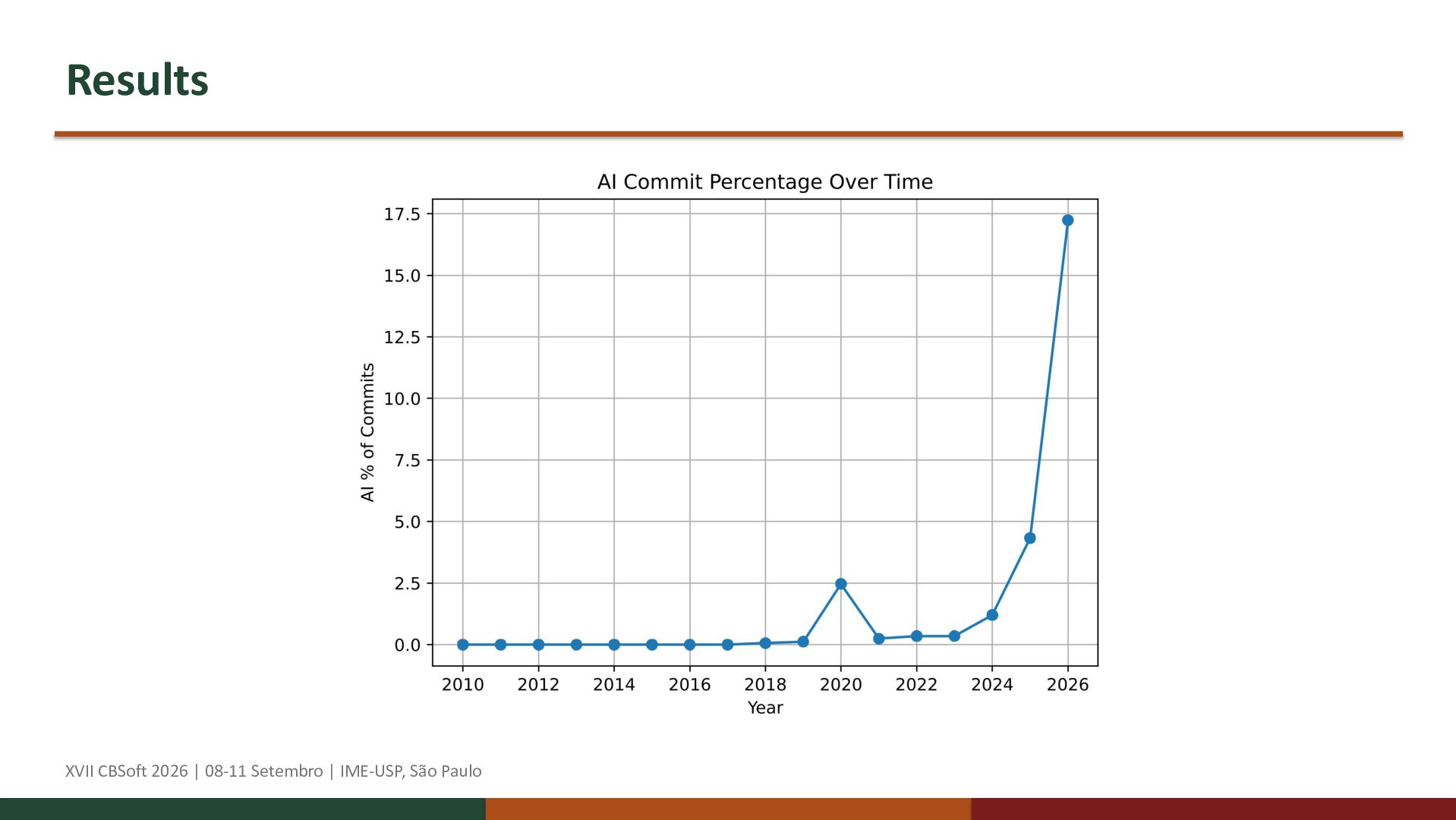
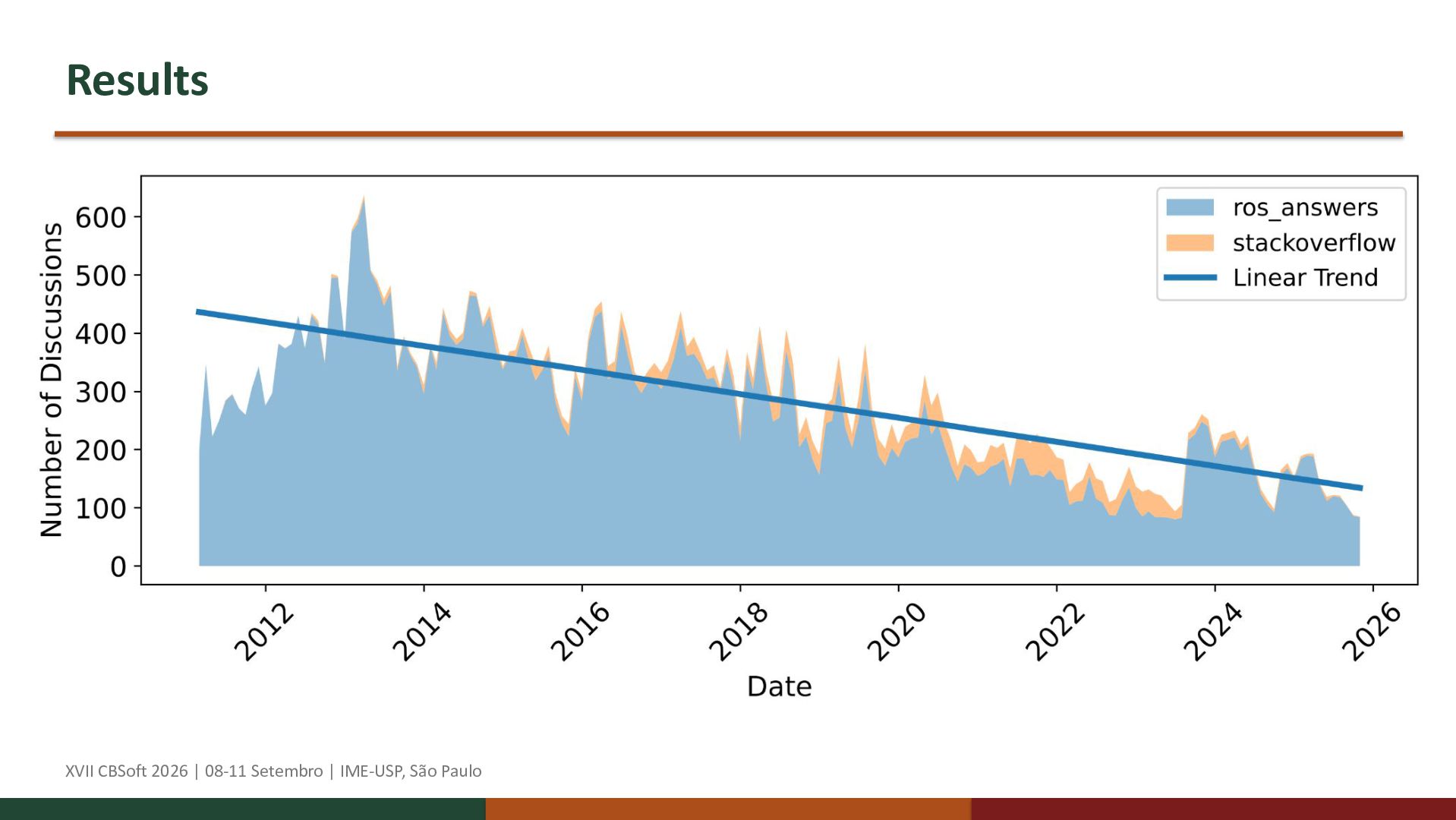
Generative AI tools are increasingly changing how developers solve technical problems, potentially shifting knowledge sharing from public forums to private interactions with AI assistants. While this may improve productivity, it may also reduce the amount of publicly available knowledge in software communities. In this paper, we start investigating how AI adoption may be associated with the decline in public discussions among software developer communities, focusing on a previously active community: the Robotic Operating System (ROS) ecosystem. To estimate periods of AI-assisted development, we analyze popular ROS projects on GitHub and compare them with the evolution of the number of discussions across ROS-related communication channels. We then discuss the potential implications on the rise of AI is contributing to the emergence of “silent communities”, making technical knowledge increasingly private and less accessible to future developers and researchers.

Paper presented at SBES's "Insightful Ideas and Emerging Results Track" https://cbsoft.sbc.org.br/2026/en/symposiums/sbes/ideias/call/

Avatar for Adolfo Neto

Adolfo Neto

September 14, 2026

More Decks by Adolfo Neto

Other Decks in Research

Transcript

  1. Silent ROS Community: Let's Start Discussing the Impact of AI

    Adoption on Public Knowledge Sharing Michel Albonico, Douglas Ferreira de Souza, Adolfo Neto UTFPR XVII CBSoft 2026 | 08-11 Setembro | IME-USP, São Paulo
  2. Risk: The emergence of “silent communities”, where developers increasingly rely

    on private interactions with AI systems instead of public human discussions
  3. Agenda • Introduction • Robot Operating System (ROS) Ecosystem •

    Study Design • Results • Discussion and Future Directions • Conclusion XVII CBSoft 2026 | 08-11 Setembro | IME-USP, São Paulo
  4. Introduction • Debate surrounding AI in software engineering ◦ ethics,

    privacy, authorship, intellectual property, bias, replacement/deskilling • Software communities and public forums (Stack Overflow) ◦ Decline in activity, gradual disappearance ◦ may be of particular concern in niche and highly technical ecosystems, such as for the Robot Operating System (ROS) XVII CBSoft 2026 | 08-11 Setembro | IME-USP, São Paulo
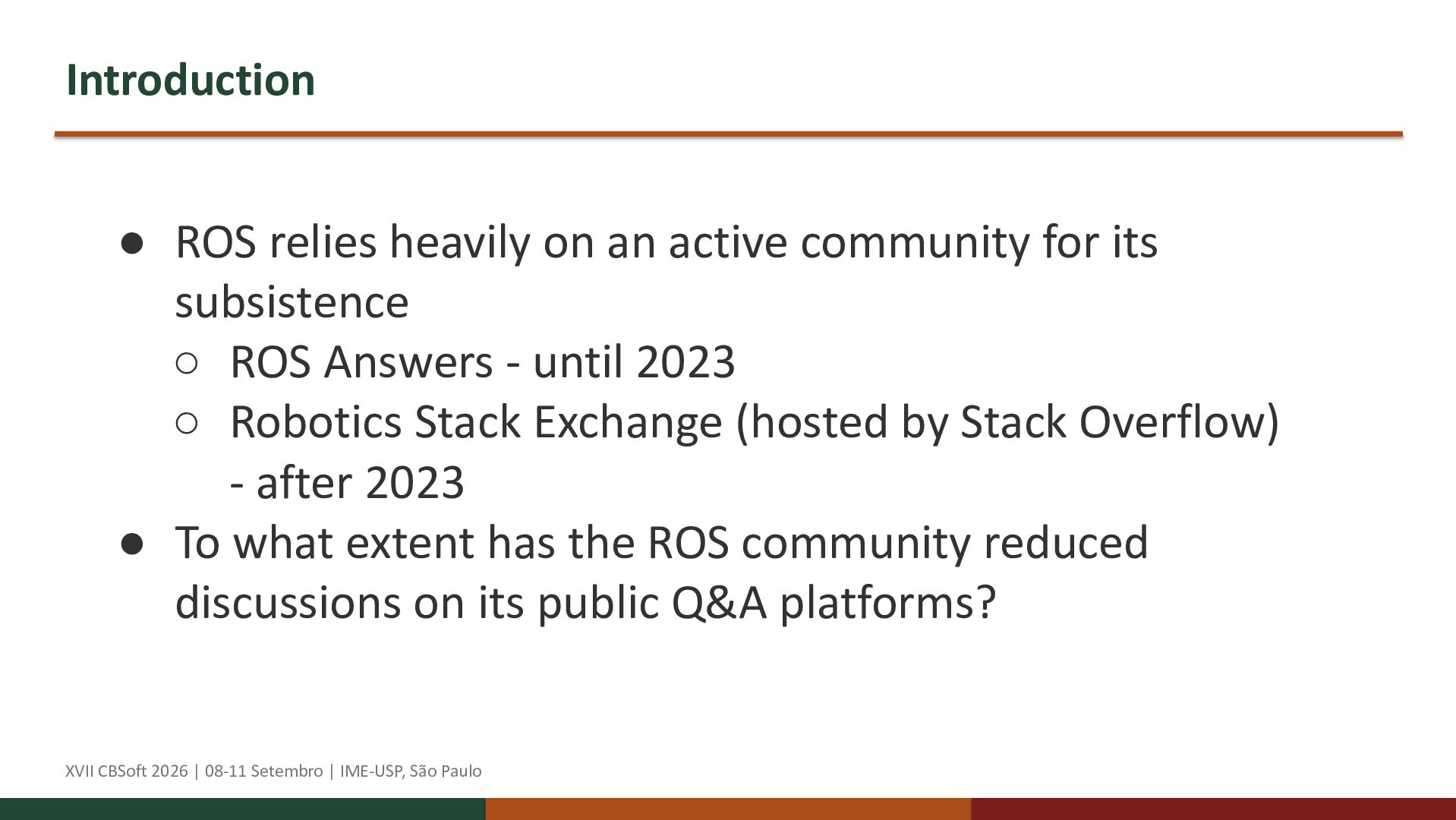
  5. Introduction • ROS relies heavily on an active community for

    its subsistence ◦ ROS Answers - until 2023 ◦ Robotics Stack Exchange (hosted by Stack Overflow) - after 2023 • To what extent has the ROS community reduced discussions on its public Q&A platforms? XVII CBSoft 2026 | 08-11 Setembro | IME-USP, São Paulo
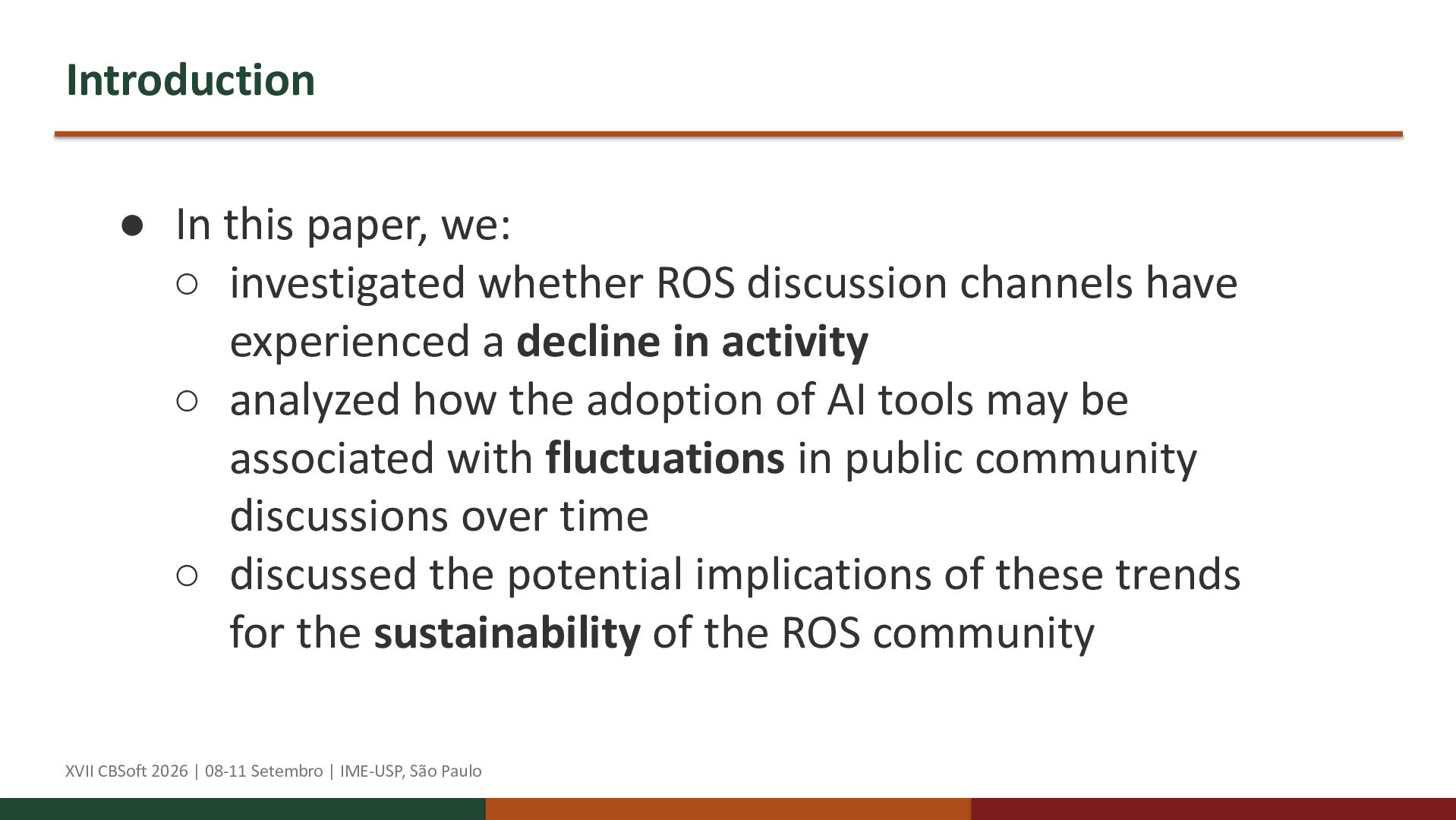
  6. Introduction • In this paper, we: ◦ investigated whether ROS

    discussion channels have experienced a decline in activity ◦ analyzed how the adoption of AI tools may be associated with fluctuations in public community discussions over time ◦ discussed the potential implications of these trends for the sustainability of the ROS community XVII CBSoft 2026 | 08-11 Setembro | IME-USP, São Paulo
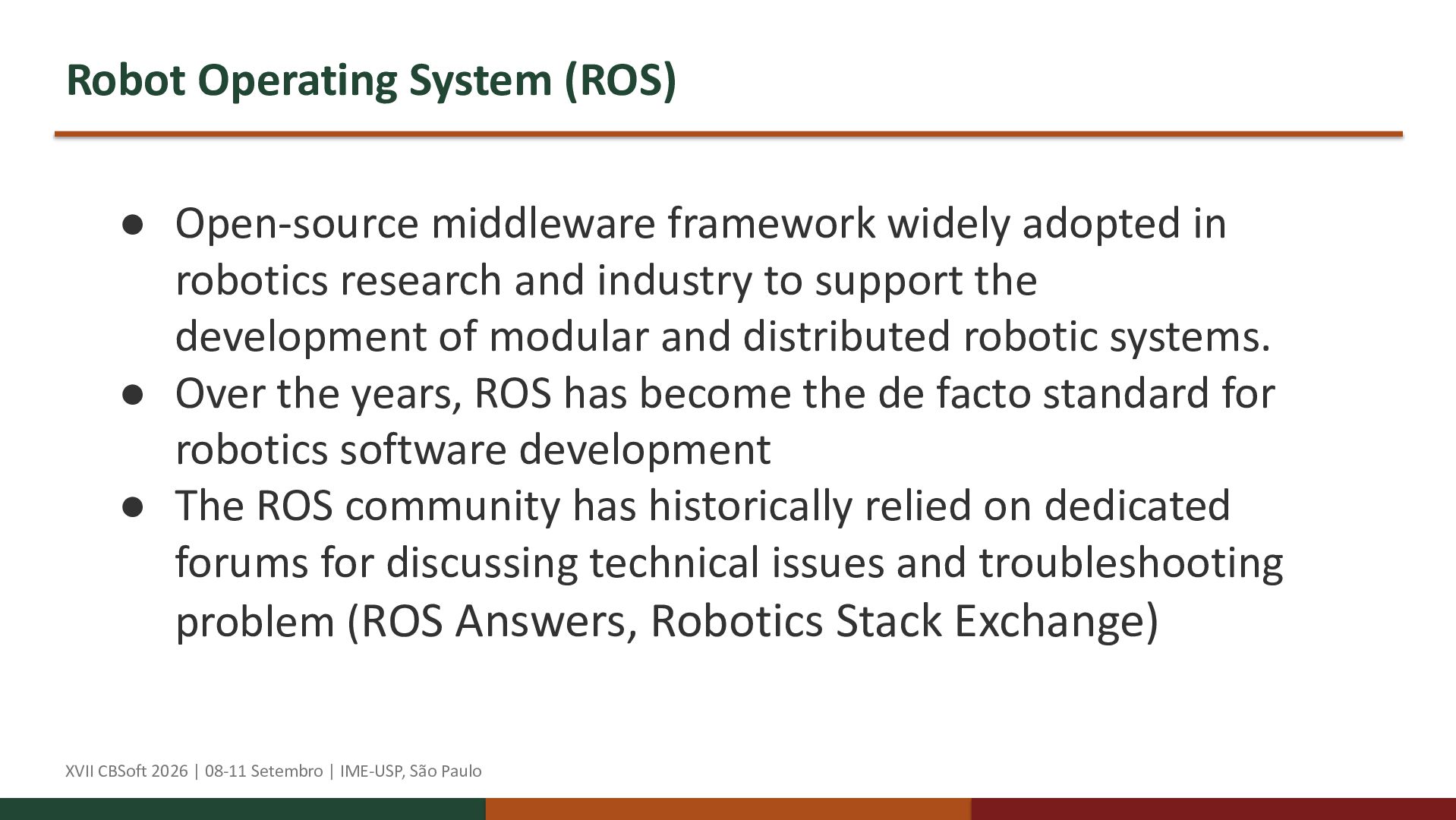
  7. Robot Operating System (ROS) • Open-source middleware framework widely adopted

    in robotics research and industry to support the development of modular and distributed robotic systems. • Over the years, ROS has become the de facto standard for robotics software development • The ROS community has historically relied on dedicated forums for discussing technical issues and troubleshooting problem (ROS Answers, Robotics Stack Exchange) XVII CBSoft 2026 | 08-11 Setembro | IME-USP, São Paulo
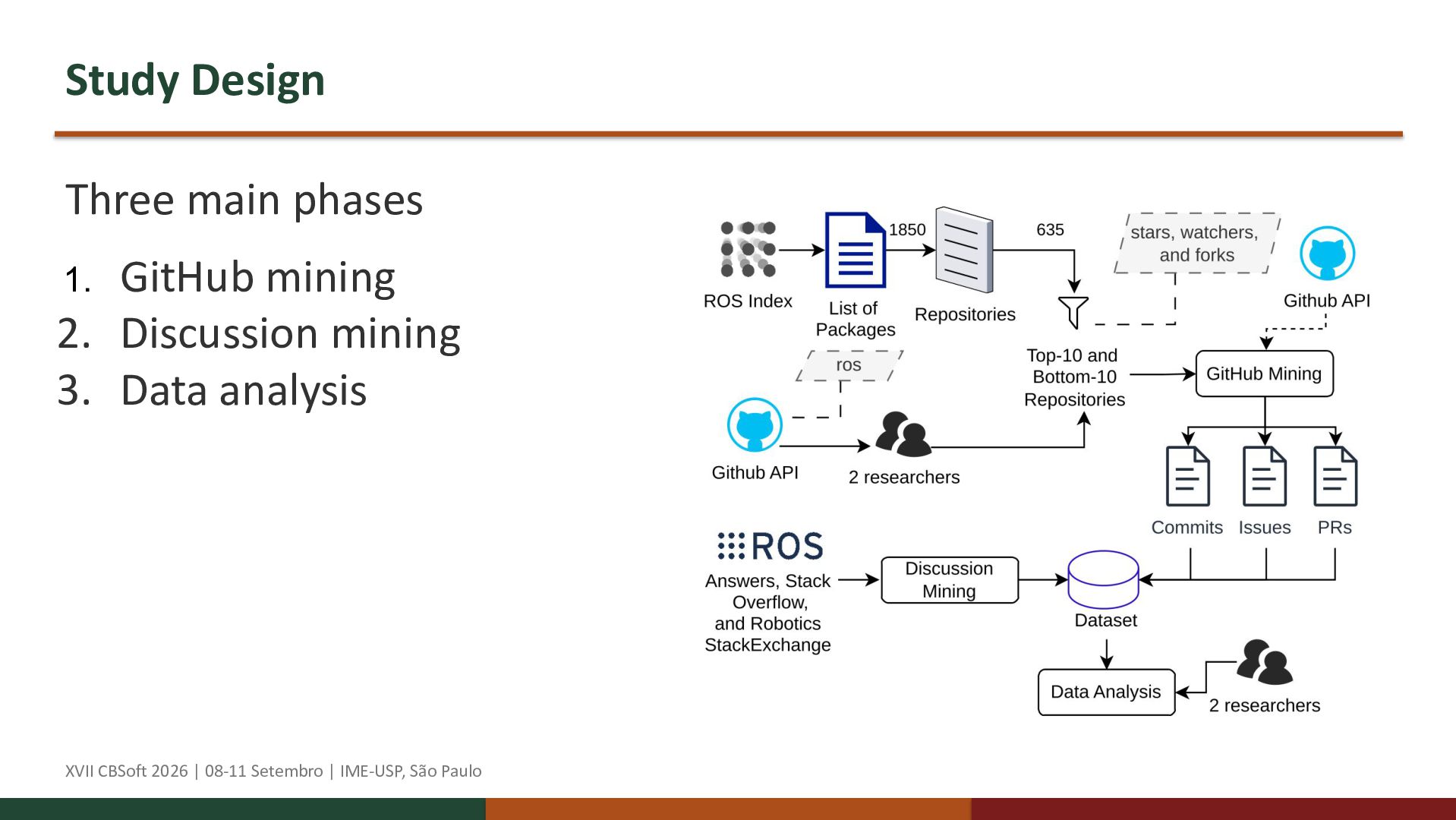
  8. Study Design Three main phases GitHub mining 2. Discussion mining

    3. Data analysis 1. XVII CBSoft 2026 | 08-11 Setembro | IME-USP, São Paulo
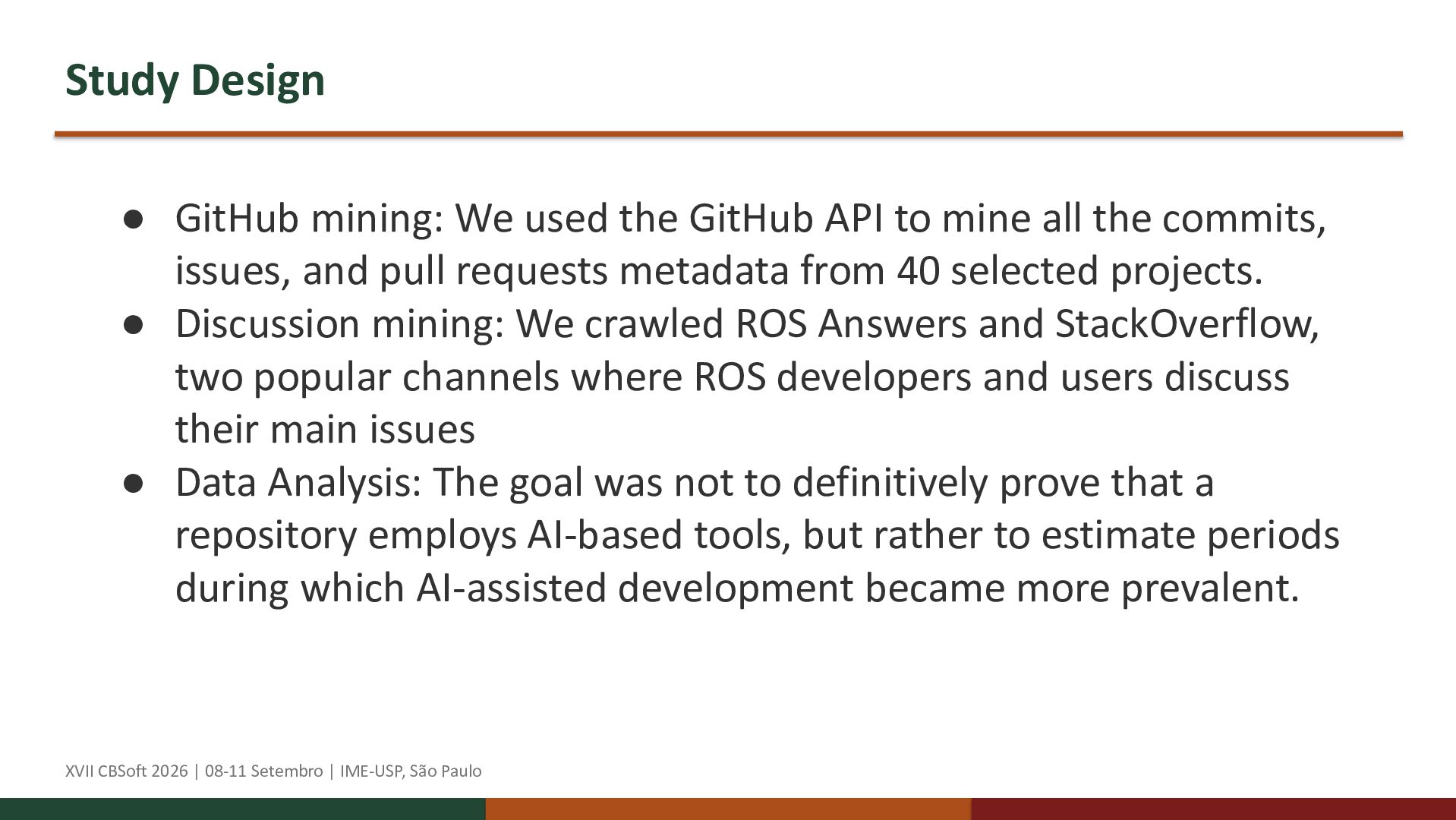
  9. Study Design • GitHub mining: We used the GitHub API

    to mine all the commits, issues, and pull requests metadata from 40 selected projects. • Discussion mining: We crawled ROS Answers and StackOverflow, two popular channels where ROS developers and users discuss their main issues • Data Analysis: The goal was not to definitively prove that a repository employs AI-based tools, but rather to estimate periods during which AI-assisted development became more prevalent. XVII CBSoft 2026 | 08-11 Setembro | IME-USP, São Paulo
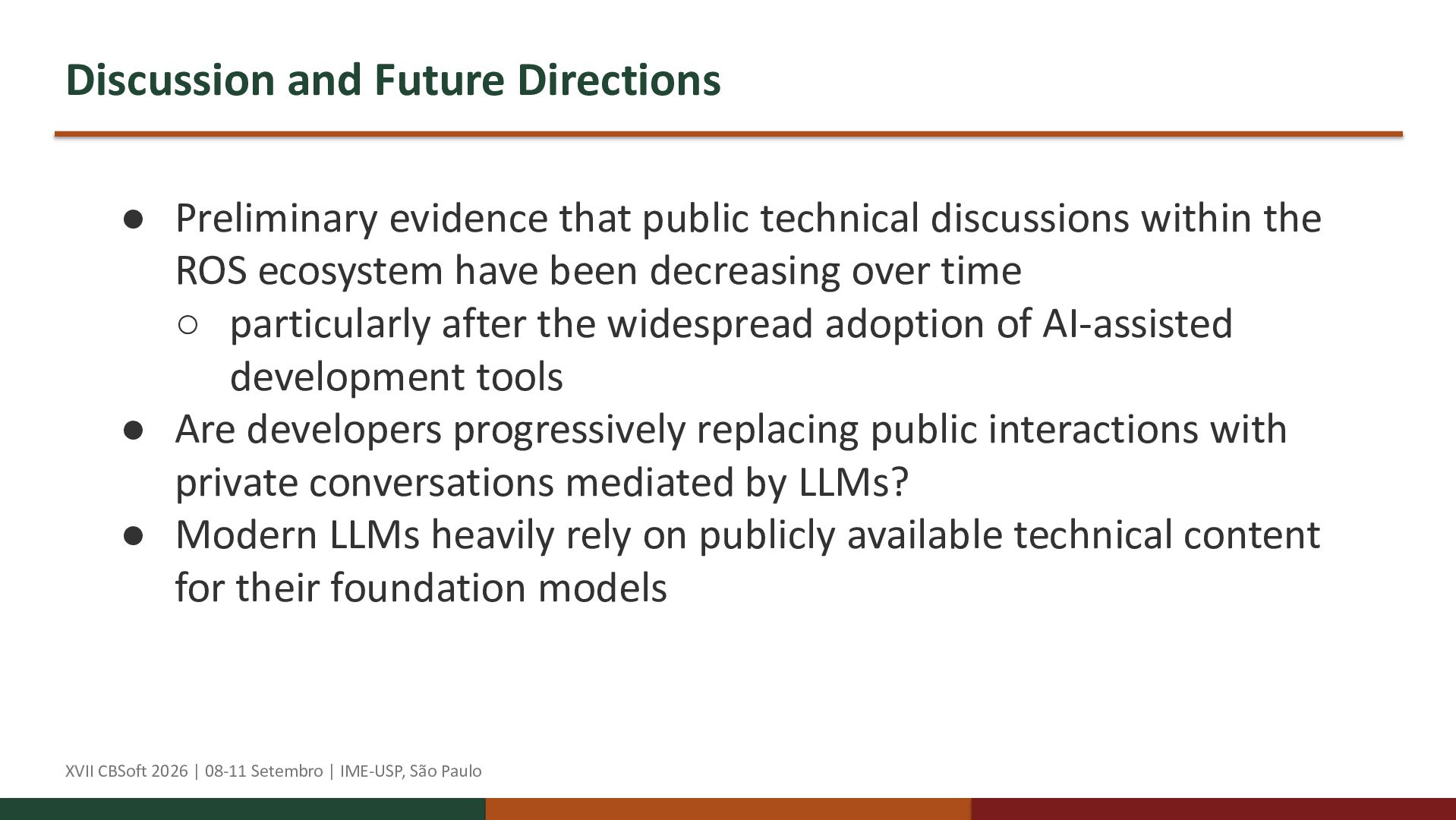
  10. Discussion and Future Directions • Preliminary evidence that public technical

    discussions within the ROS ecosystem have been decreasing over time ◦ particularly after the widespread adoption of AI-assisted development tools • Are developers progressively replacing public interactions with private conversations mediated by LLMs? • Modern LLMs heavily rely on publicly available technical content for their foundation models XVII CBSoft 2026 | 08-11 Setembro | IME-USP, São Paulo
  11. Discussion and Future Directions • Understanding how AI is changing

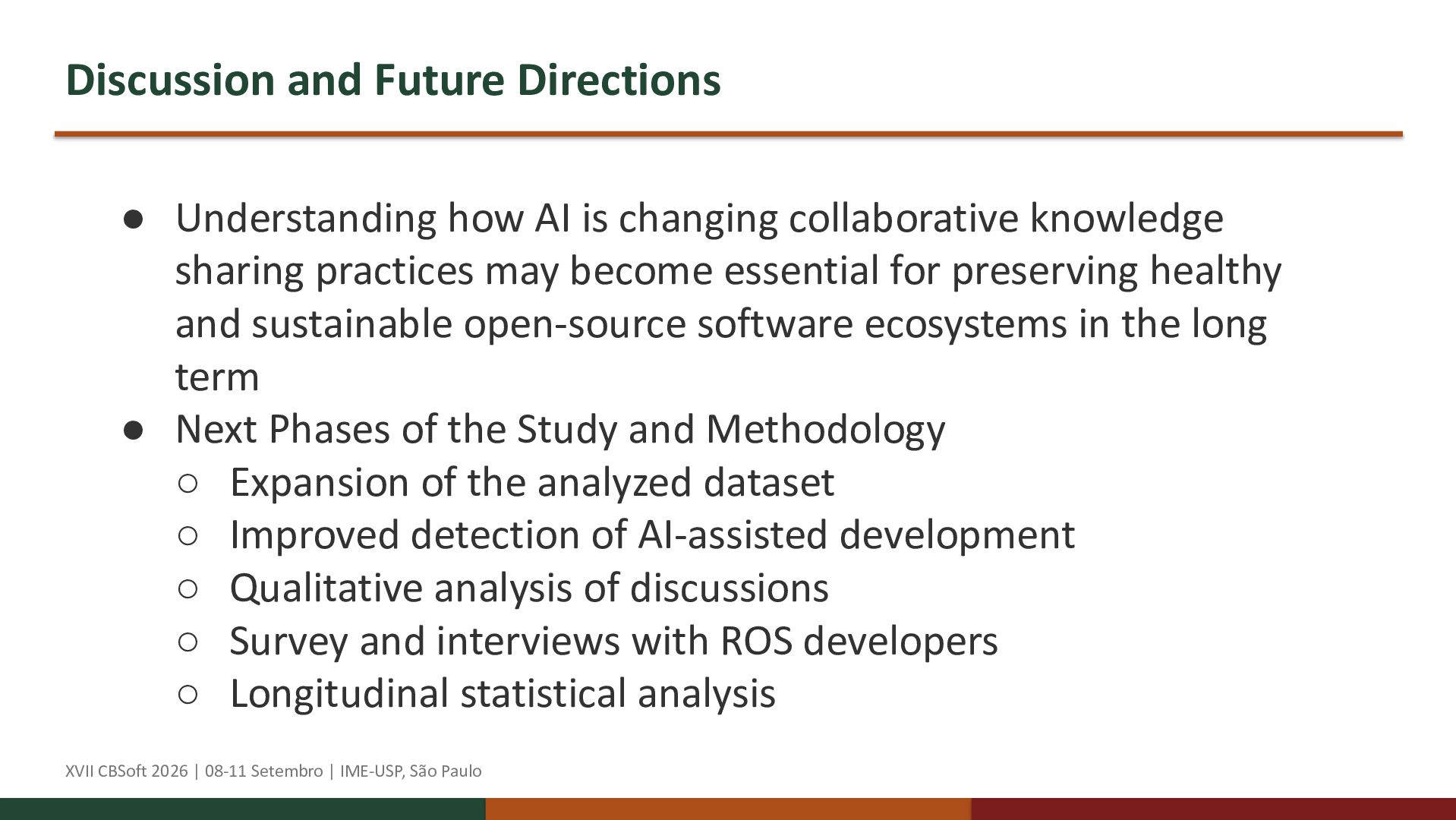
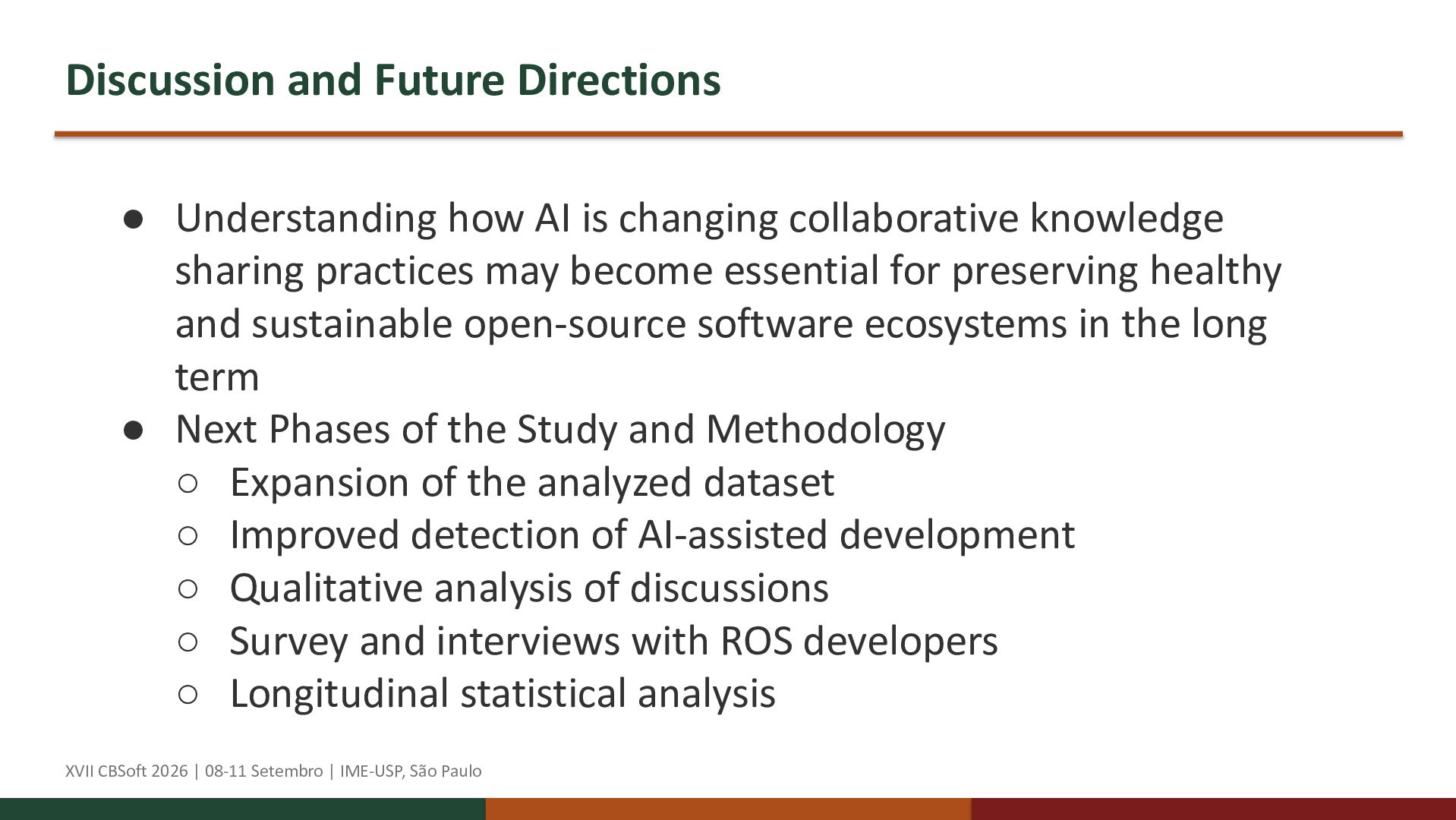
    collaborative knowledge sharing practices may become essential for preserving healthy and sustainable open-source software ecosystems in the long term • Next Phases of the Study and Methodology ◦ Expansion of the analyzed dataset ◦ Improved detection of AI-assisted development ◦ Qualitative analysis of discussions ◦ Survey and interviews with ROS developers ◦ Longitudinal statistical analysis XVII CBSoft 2026 | 08-11 Setembro | IME-USP, São Paulo
  12. Conclusion • This was an initial investigation into the possible

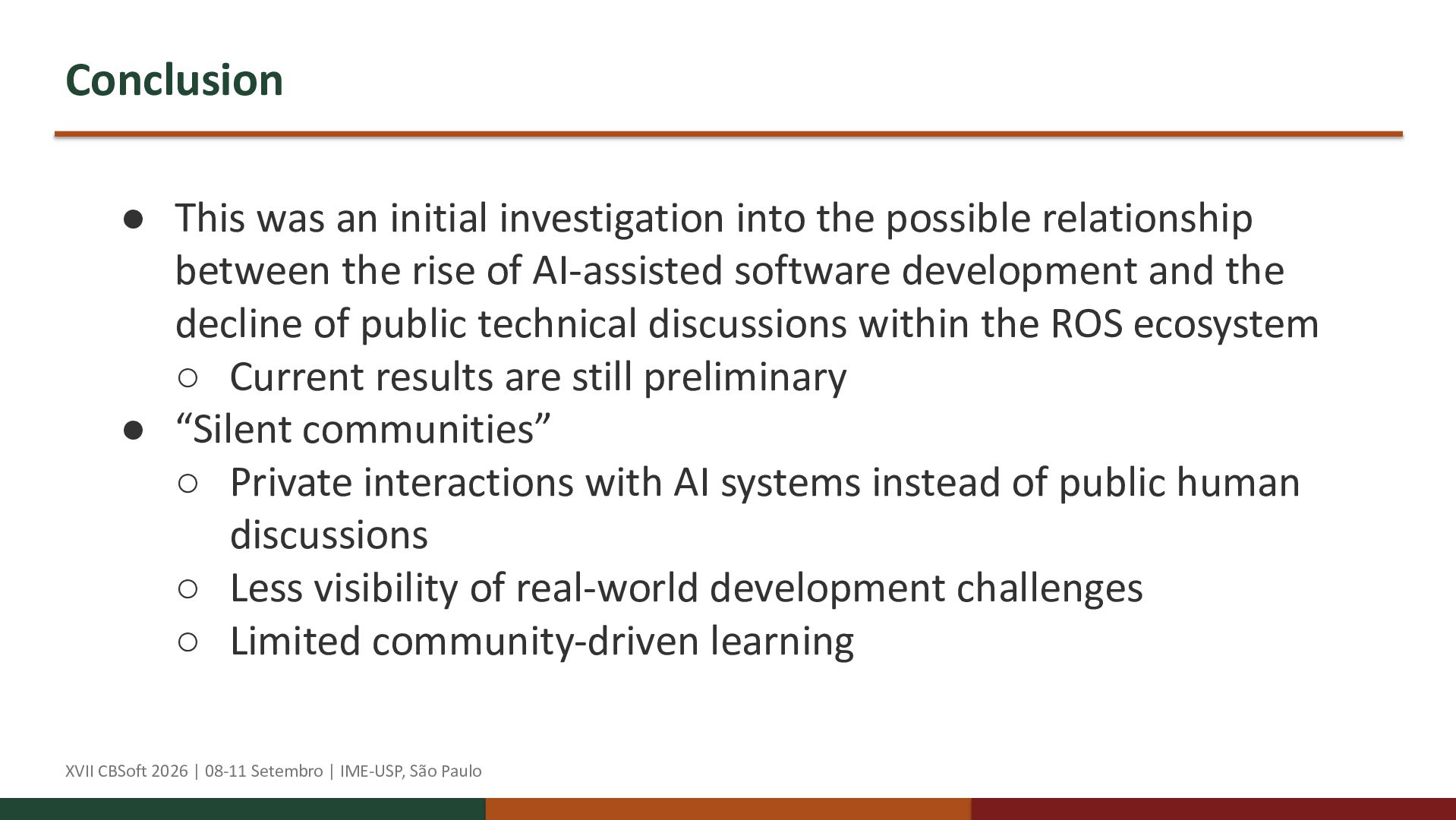
    relationship between the rise of AI-assisted software development and the decline of public technical discussions within the ROS ecosystem ◦ Current results are still preliminary • “Silent communities” ◦ Private interactions with AI systems instead of public human discussions ◦ Less visibility of real-world development challenges ◦ Limited community-driven learning XVII CBSoft 2026 | 08-11 Setembro | IME-USP, São Paulo
  13. Discussion and Future Directions • Understanding how AI is changing

    collaborative knowledge sharing practices may become essential for preserving healthy and sustainable open-source software ecosystems in the long term • Next Phases of the Study and Methodology ◦ Expansion of the analyzed dataset ◦ Improved detection of AI-assisted development ◦ Qualitative analysis of discussions ◦ Survey and interviews with ROS developers ◦ Longitudinal statistical analysis XVII CBSoft 2026 | 08-11 Setembro | IME-USP, São Paulo