Upgrade to Pro — share decks privately, control downloads, hide ads and more …

Audio Gain, Mixing and Evidence: A Short Practi...

Sponsored · Your Podcast. Everywhere. Effortlessly. Share. Educate. Inspire. Entertain. You do you. We'll handle the rest. →
Avatar for kk king kk king
October 08, 2026

Audio Gain, Mixing and Evidence: A Short Practical Lab

An eight-slide practical exercise for inspecting audio gain, mixing and clipping with free tools. It separates signal measurements from claims about psychological effects. Includes learning questions, answers and an Audacity reference. Prepared for the AffirmTone project with AI assistance; no clinical outcomes or participant data are claimed.

Project website: AffirmTone. The exercise does not require this commercial service.

Avatar for kk king

kk king

October 08, 2026

Other Decks in Education

Transcript

  1. 1. A small experiment you can repeat Use a synthetic

    tone and a quiet background to inspect gain, mixing and clipping. This is a teaching exercise, not a clinical experiment. No participants or listening outcomes are reported. Prepared for the AffirmTone project with AI assistance. The exercise can be completed with free audio software; no commercial service is required. AffirmTone project | AI-assisted teaching material | No clinical claims 1/8
  2. 2. Three questions to keep separate - What words does

    a spoken track contain? Review the written script. - What does the audio file contain? Inspect duration, levels and playback. - Does listening cause a psychological change? This exercise does not answer that question. A waveform is evidence about a signal, not proof of a therapeutic effect. AffirmTone project | AI-assisted teaching material | No clinical claims 2/8
  3. 3. Prepare two simple tracks In Audacity, generate a short

    sine tone at a modest amplitude. Use a comfortable playback level. Create a second quiet track, such as generated noise, rather than downloading a sound with unclear permission. Keep the sources separate. Note the sample rate, track duration and the original peak level. Save a project copy before mixing. AffirmTone project | AI-assisted teaching material | No clinical claims 3/8
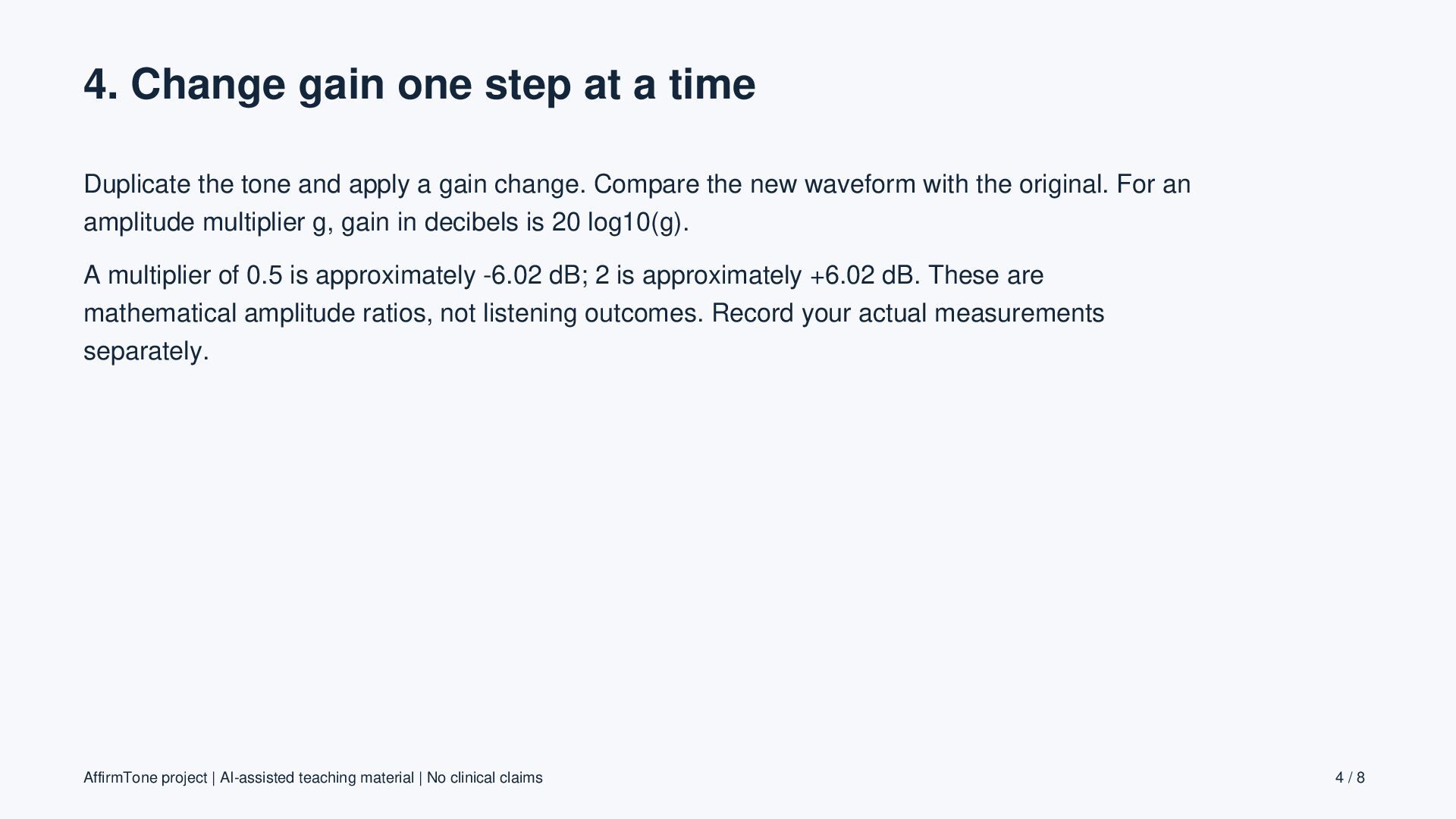
  4. 4. Change gain one step at a time Duplicate the

    tone and apply a gain change. Compare the new waveform with the original. For an amplitude multiplier g, gain in decibels is 20 log10(g). A multiplier of 0.5 is approximately -6.02 dB; 2 is approximately +6.02 dB. These are mathematical amplitude ratios, not listening outcomes. Record your actual measurements separately. AffirmTone project | AI-assisted teaching material | No clinical claims 4/8
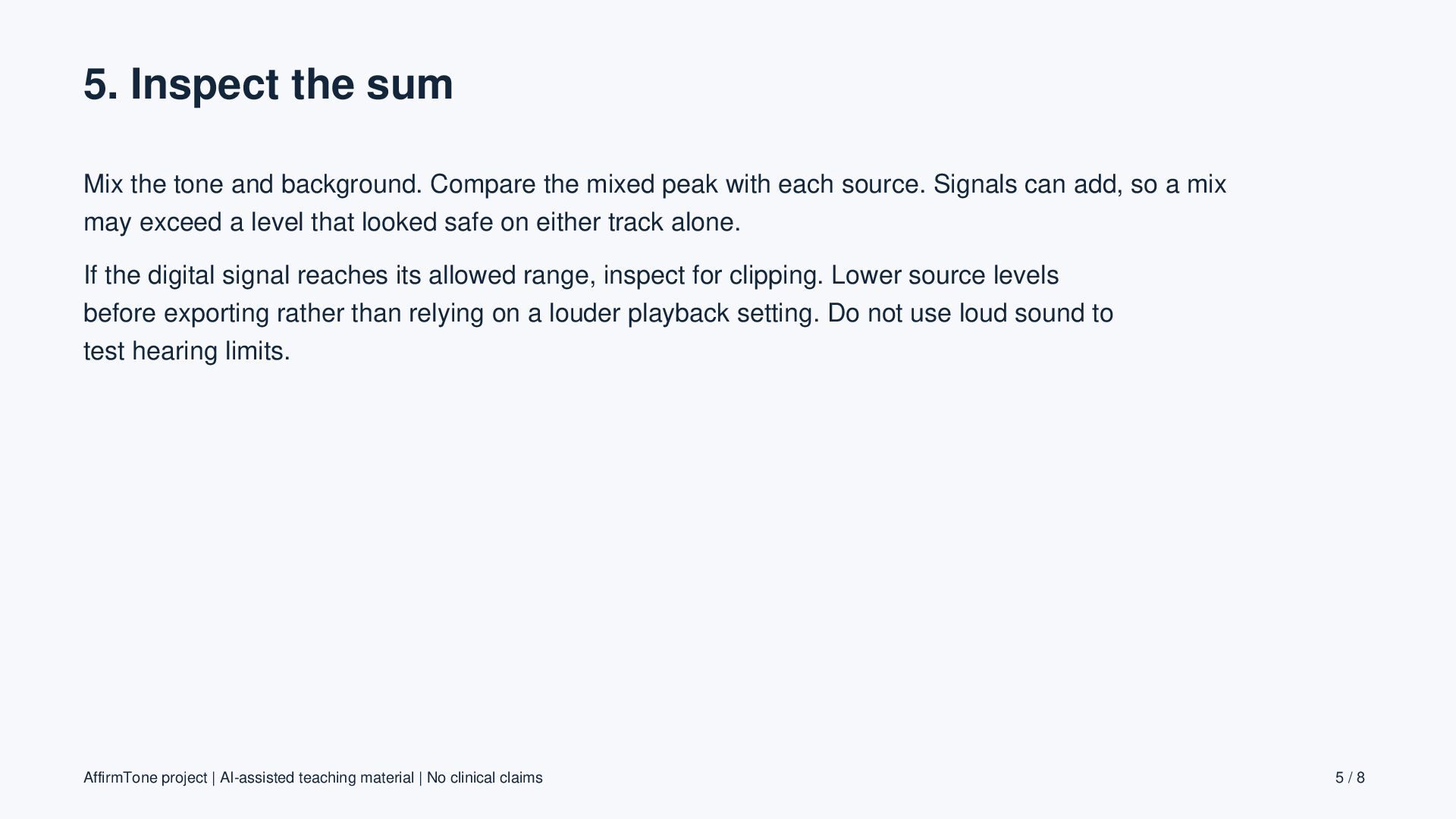
  5. 5. Inspect the sum Mix the tone and background. Compare

    the mixed peak with each source. Signals can add, so a mix may exceed a level that looked safe on either track alone. If the digital signal reaches its allowed range, inspect for clipping. Lower source levels before exporting rather than relying on a louder playback setting. Do not use loud sound to test hearing limits. AffirmTone project | AI-assisted teaching material | No clinical claims 5/8
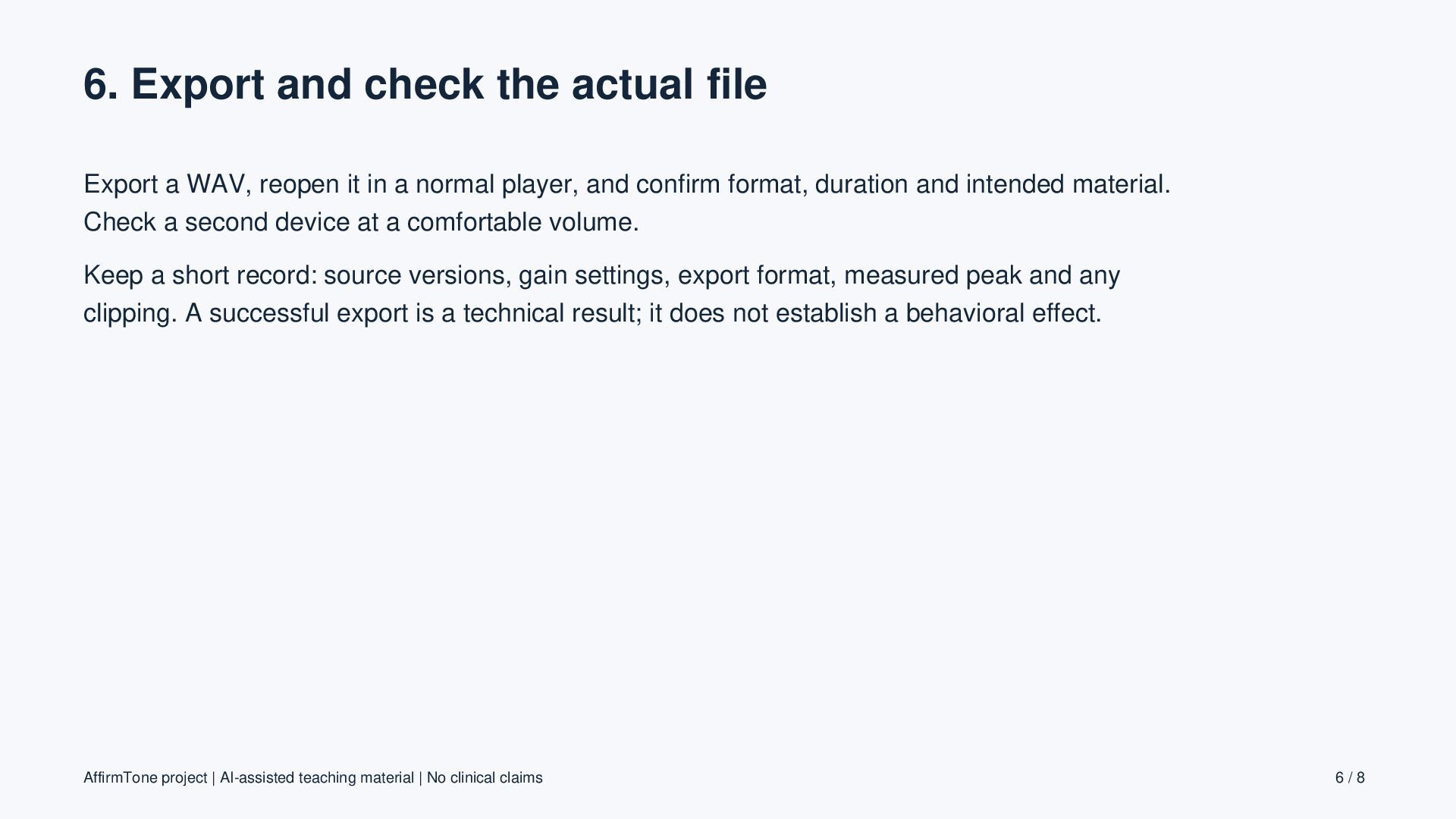
  6. 6. Export and check the actual file Export a WAV,

    reopen it in a normal player, and confirm format, duration and intended material. Check a second device at a comfortable volume. Keep a short record: source versions, gain settings, export format, measured peak and any clipping. A successful export is a technical result; it does not establish a behavioral effect. AffirmTone project | AI-assisted teaching material | No clinical claims 6/8
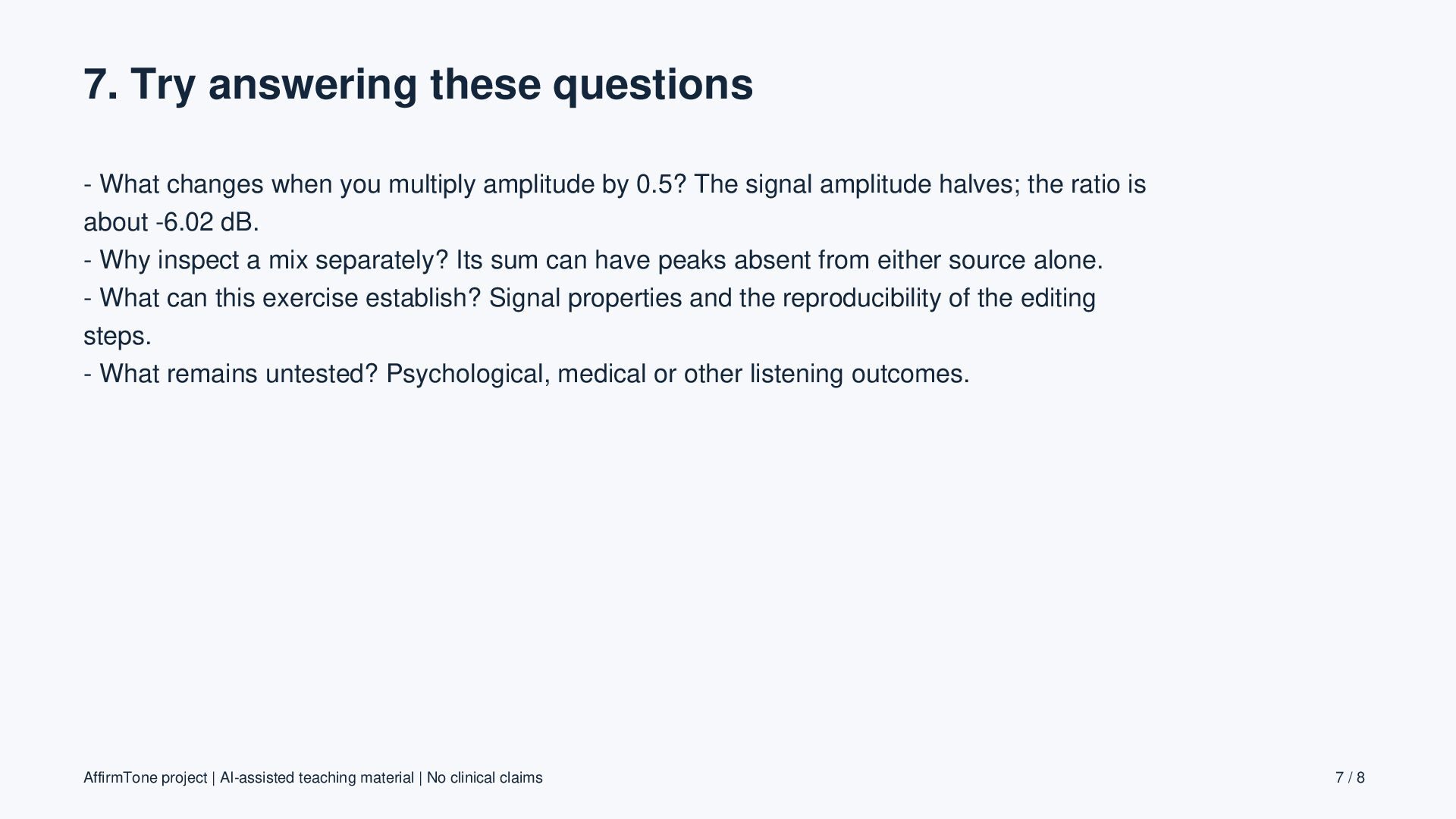
  7. 7. Try answering these questions - What changes when you

    multiply amplitude by 0.5? The signal amplitude halves; the ratio is about -6.02 dB. - Why inspect a mix separately? Its sum can have peaks absent from either source alone. - What can this exercise establish? Signal properties and the reproducibility of the editing steps. - What remains untested? Psychological, medical or other listening outcomes. AffirmTone project | AI-assisted teaching material | No clinical claims 7/8
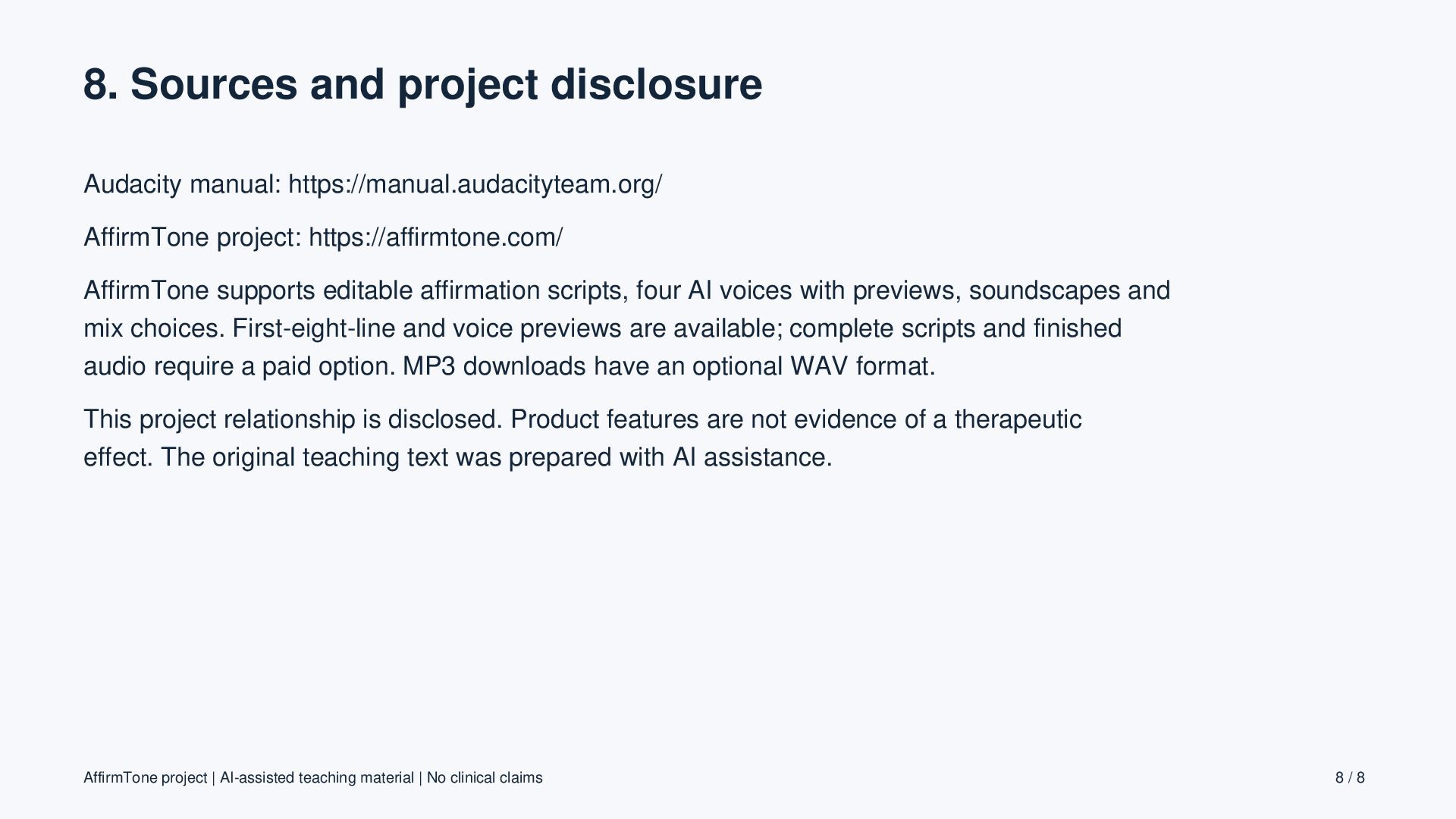
  8. 8. Sources and project disclosure Audacity manual: https://manual.audacityteam.org/ AffirmTone project:

    https://affirmtone.com/ AffirmTone supports editable affirmation scripts, four AI voices with previews, soundscapes and mix choices. First-eight-line and voice previews are available; complete scripts and finished audio require a paid option. MP3 downloads have an optional WAV format. This project relationship is disclosed. Product features are not evidence of a therapeutic effect. The original teaching text was prepared with AI assistance. AffirmTone project | AI-assisted teaching material | No clinical claims 8/8