Upgrade to Pro — share decks privately, control downloads, hide ads and more …

Session 1 & 2 - Mass Communication

Sponsored · Your Podcast. Everywhere. Effortlessly. Share. Educate. Inspire. Entertain. You do you. We'll handle the rest. →

Session 1 & 2 - Mass Communication

Define, Caractheristic and Rules of Mass Communication

More Decks by Ade Putranto Prasetyo Wijiharto Tunggali

Other Decks in Education

Transcript

  1. MASS COMMUNICATION AND NEW MEDIA Define mass communication, scope, and

    characteristics Ade Putranto Prasetyo Wijiharto Tunggali, M.A., C.PR., C.CM [email protected]
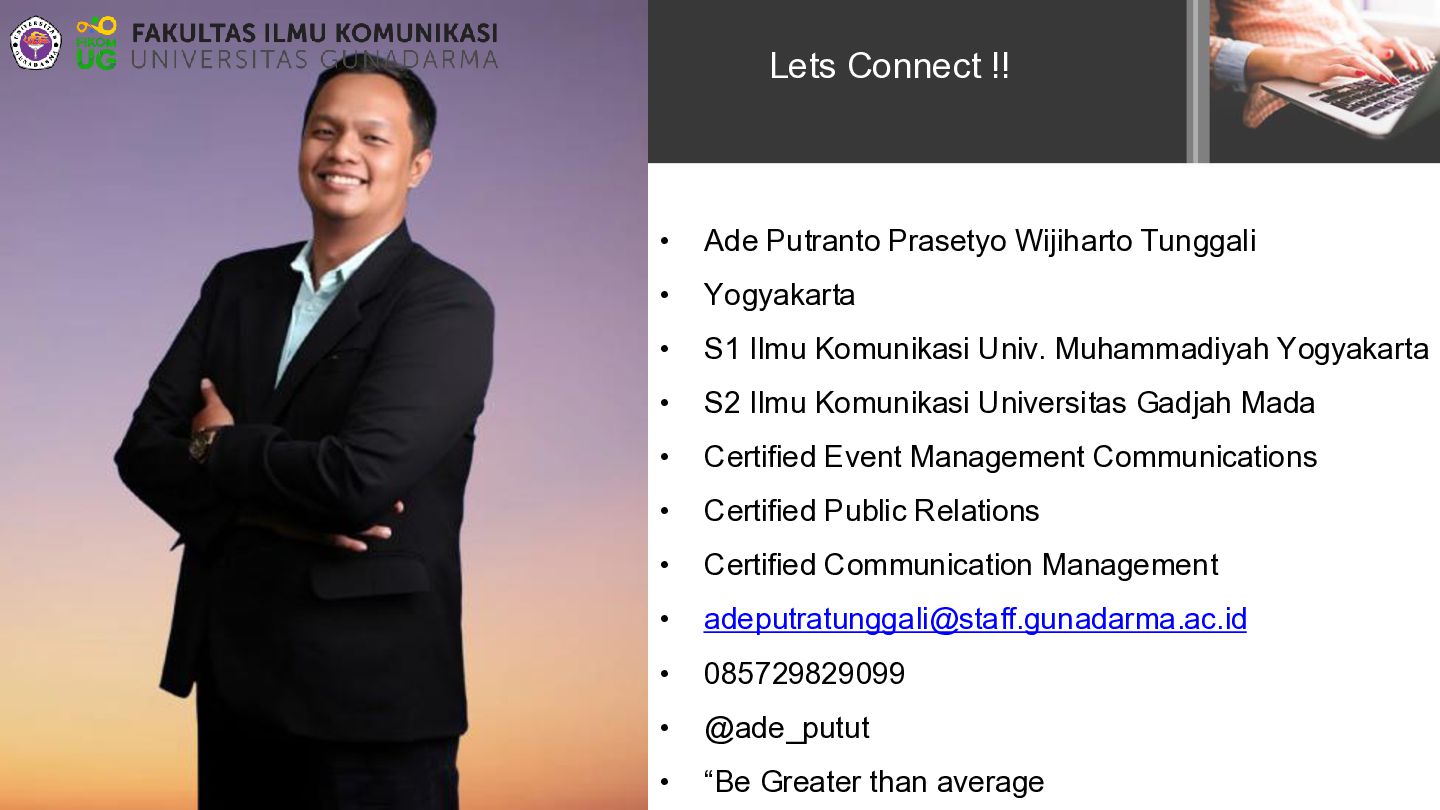
  2. Lets Connect !! • Ade Putranto Prasetyo Wijiharto Tunggali •

    Yogyakarta • S1 Ilmu Komunikasi Univ. Muhammadiyah Yogyakarta • S2 Ilmu Komunikasi Universitas Gadjah Mada • Certified Event Management Communications • Certified Public Relations • Certified Communication Management • [email protected] • 085729829099 • @ade_putut • “Be Greater than average
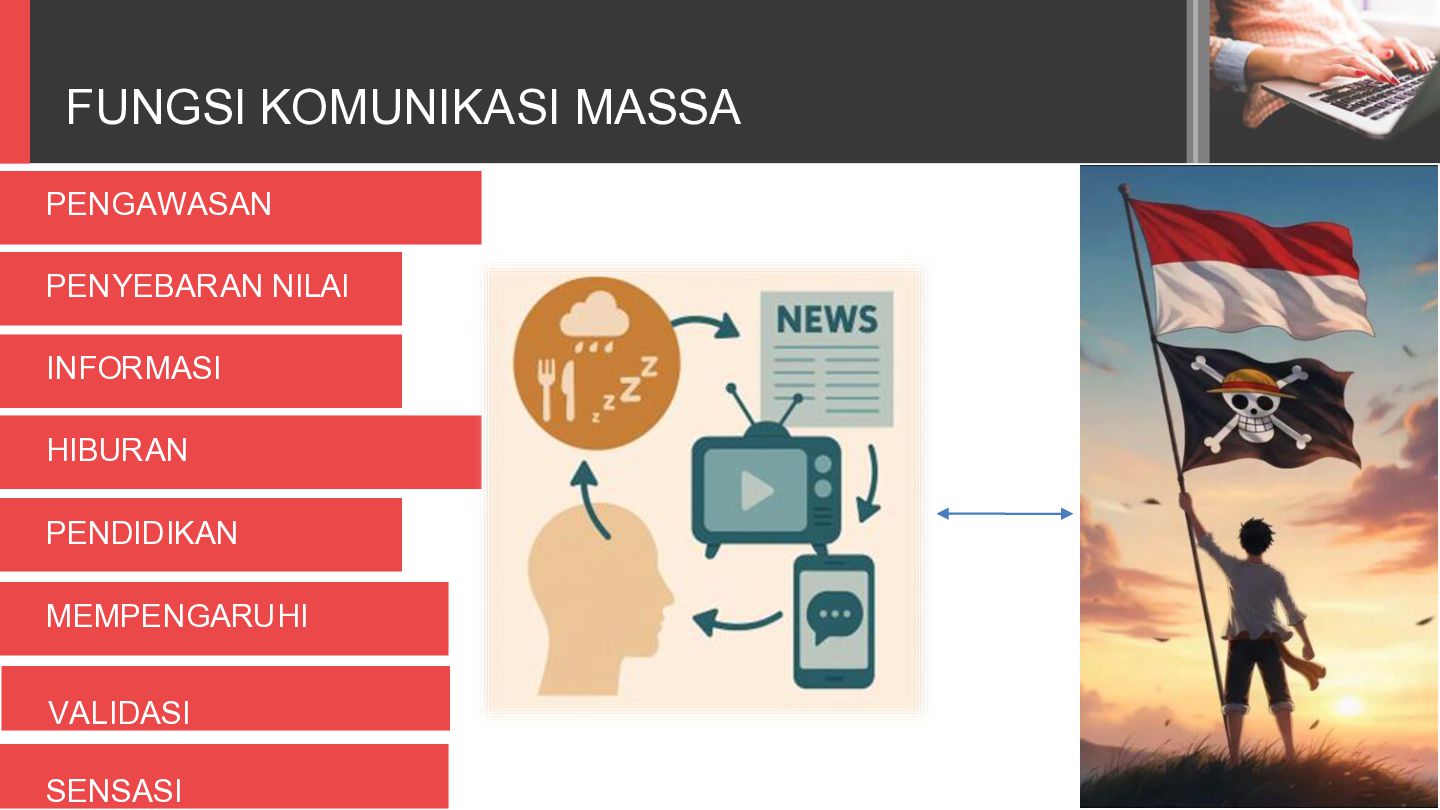
  3. Focus Discussion/Sharing 01 02 03 04 Defining mass communication Defining

    characteristics and functions of mass communication Defining the component of mass communication Defining the process of mass communication
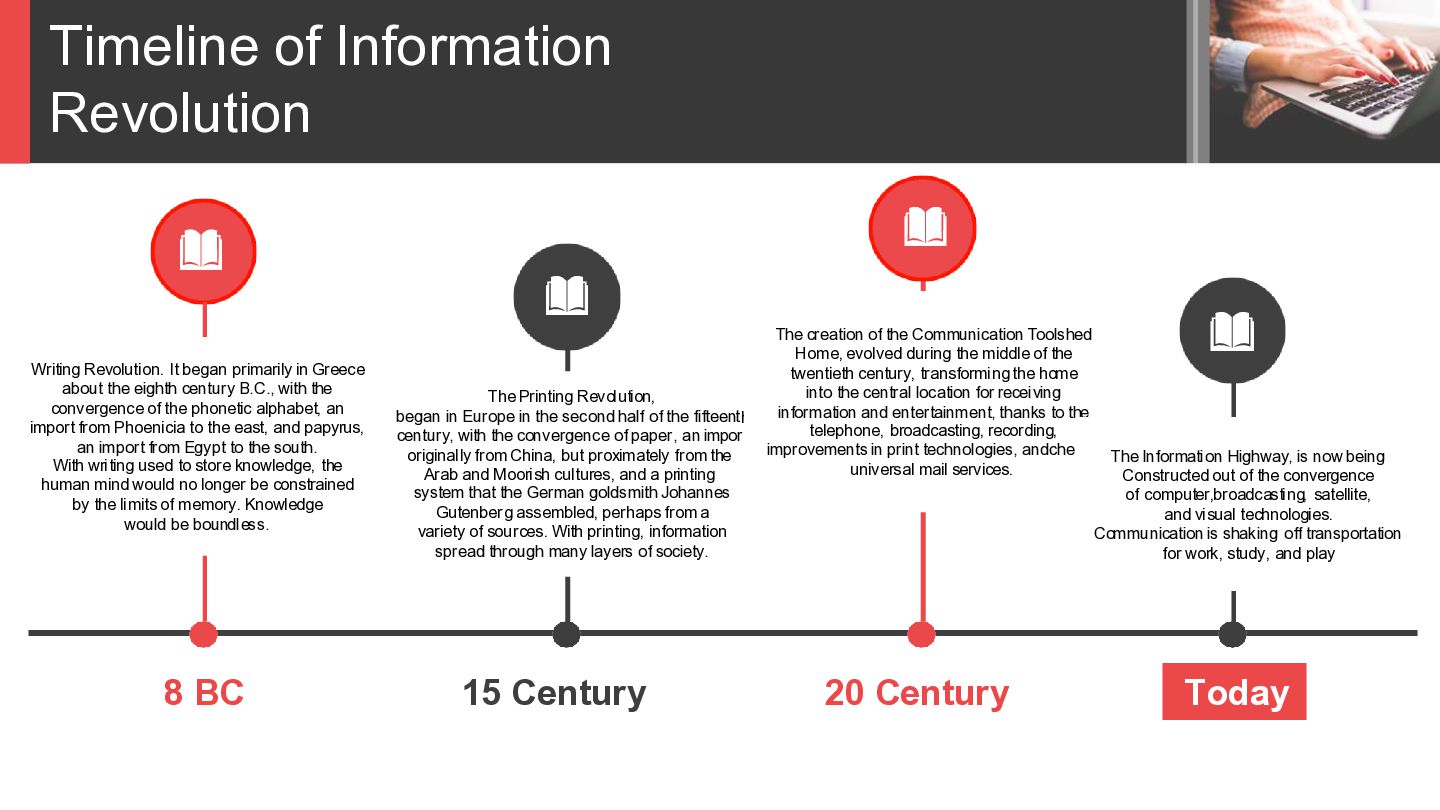
  4. Timeline of Information Revolution Writing Revolution. It began primarily in

    Greece about the eighth century B.C., with the convergence of the phonetic alphabet, an import from Phoenicia to the east, and papyrus, an import from Egypt to the south. With writing used to store knowledge, the human mind would no longer be constrained by the limits of memory. Knowledge would be boundless. 8 BC The Printing Revolution, began in Europe in the second half of the fifteent h century, with the convergence of paper, an impor t originally from China, but proximately from the Arab and Moorish cultures, and a printing system that the German goldsmith Johannes Gutenberg assembled, perhaps from a variety of sources. With printing, information spread through many layers of society. 15 Century The creation of the Communication Toolshed Home, evolved during the middle of the twentieth century, transforming the home into the central location for receiving information and entertainment, thanks to the telephone, broadcasting, recording, improvements in print technologies, andche ap, The Information Highway, is now being universal mail services. Constructed out of the convergence of computer,broadcasting, satellite, and visual technologies. Communication is shaking off transportation for work, study, and play 20 Century Today
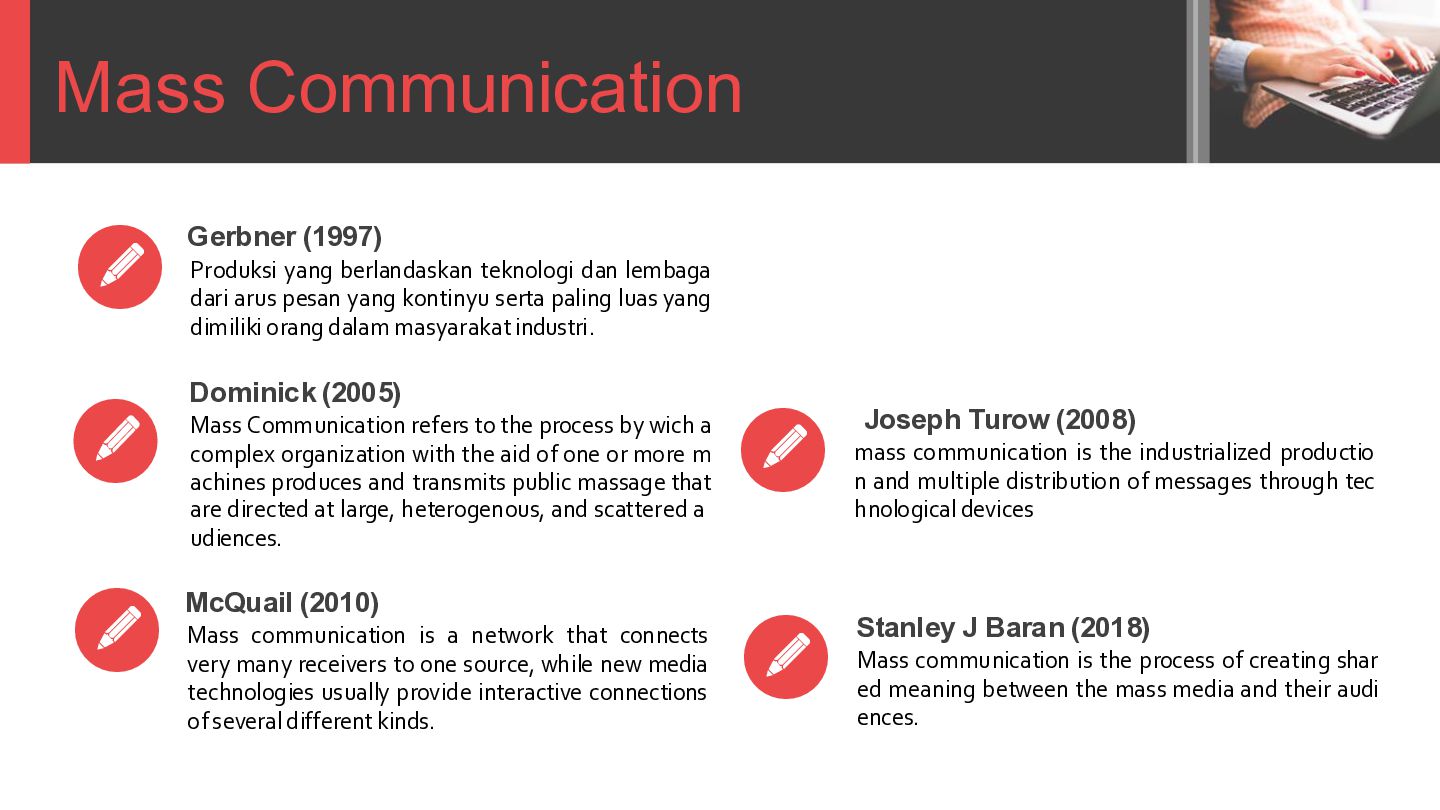
  5. Mass Communication Gerbner (1997) Produksi yang berlandaskan teknologi dan lembaga

    dari arus pesan yang kontinyu serta paling luas yang dimiliki orang dalam masyarakat industri. Dominick (2005) Mass Communication refers to the process by wich a complex organization with the aid of one or more m achines produces and transmits public massage that are directed at large, heterogenous, and scattered a udiences. McQuail (2010) Mass communication is a network that connects very many receivers to one source, while new media technologies usually provide interactive connections of several different kinds. Joseph Turow (2008) mass communication is the industrialized productio n and multiple distribution of messages through tec hnological devices Stanley J Baran (2018) Mass communication is the process of creating shar ed meaning between the mass media and their audi ences.
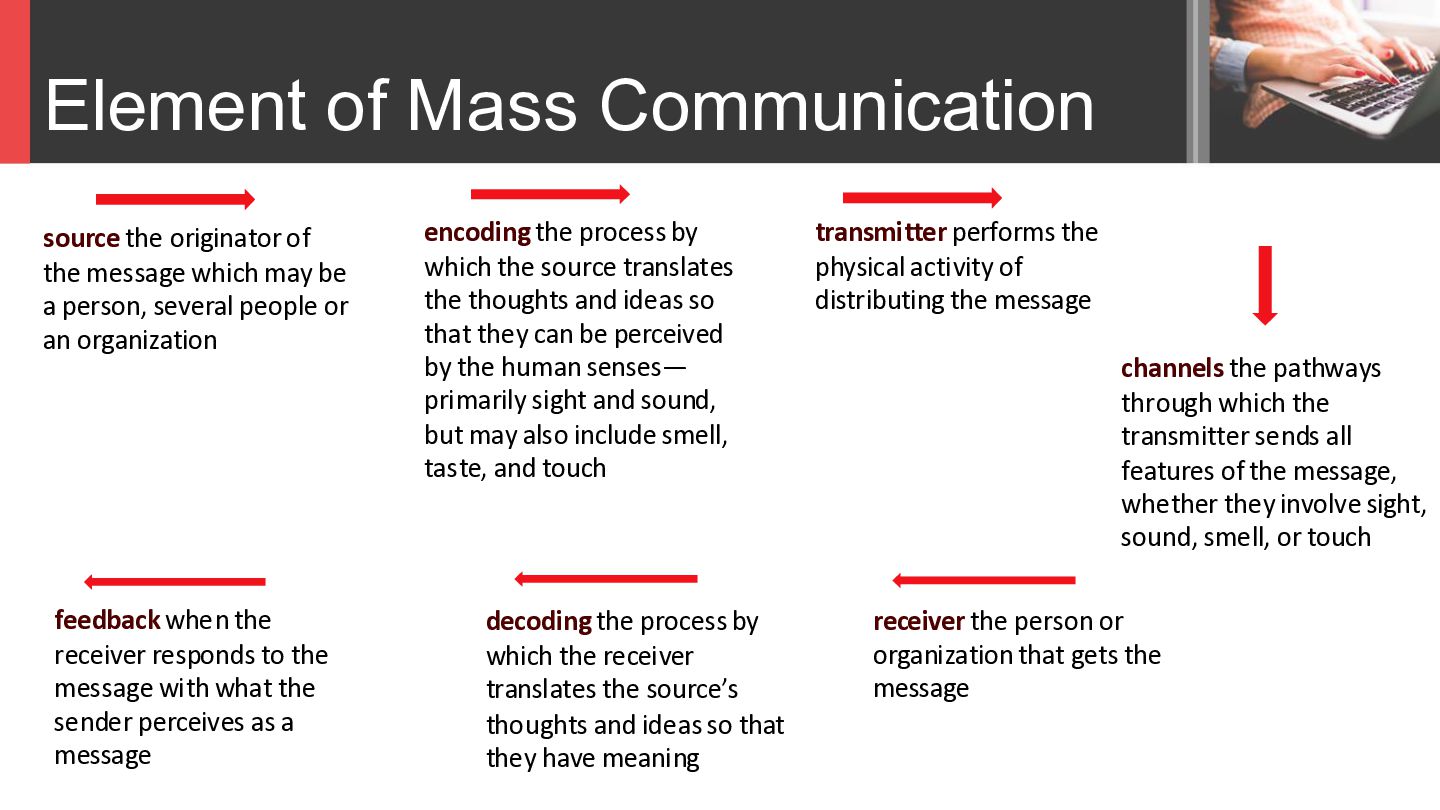
  6. Element of Mass Communication source the originator of the message

    which may be a person, several people or an organization feedback when the receiver responds to the message with what the sender perceives as a message encoding the process by which the source translates the thoughts and ideas so that they can be perceived by the human senses— primarily sight and sound, but may also include smell, taste, and touch decoding the process by which the receiver translates the source’s thoughts and ideas so that they have meaning transmitter performs the physical activity of distributing the message channels the pathways through which the transmitter sends all features of the message, whether they involve sight, sound, smell, or touch receiver the person or organization that gets the message
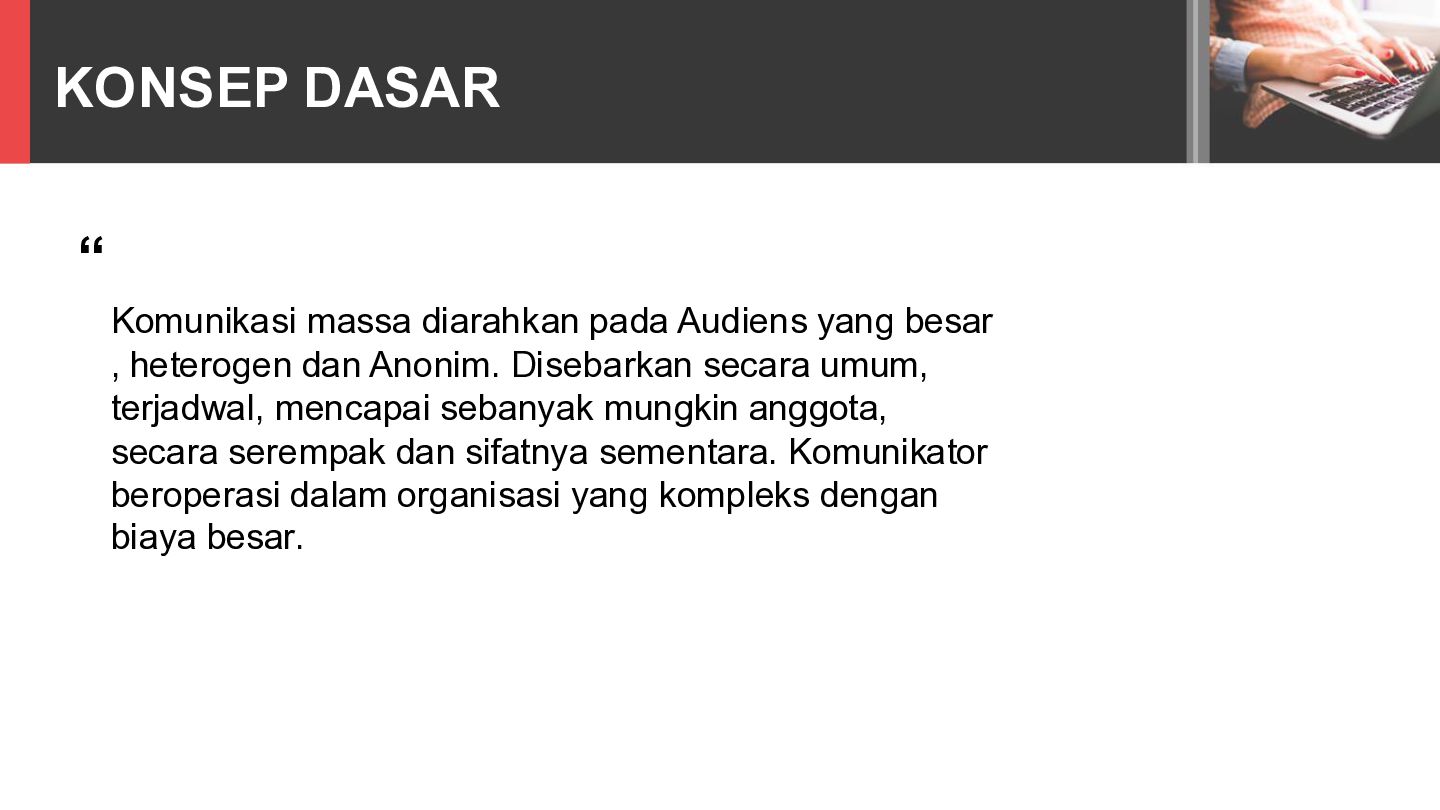
  7. KONSEP DASAR “ Komunikasi massa diarahkan pada Audiens yang besar

    , heterogen dan Anonim. Disebarkan secara umum, terjadwal, mencapai sebanyak mungkin anggota, secara serempak dan sifatnya sementara. Komunikator beroperasi dalam organisasi yang kompleks dengan biaya besar.
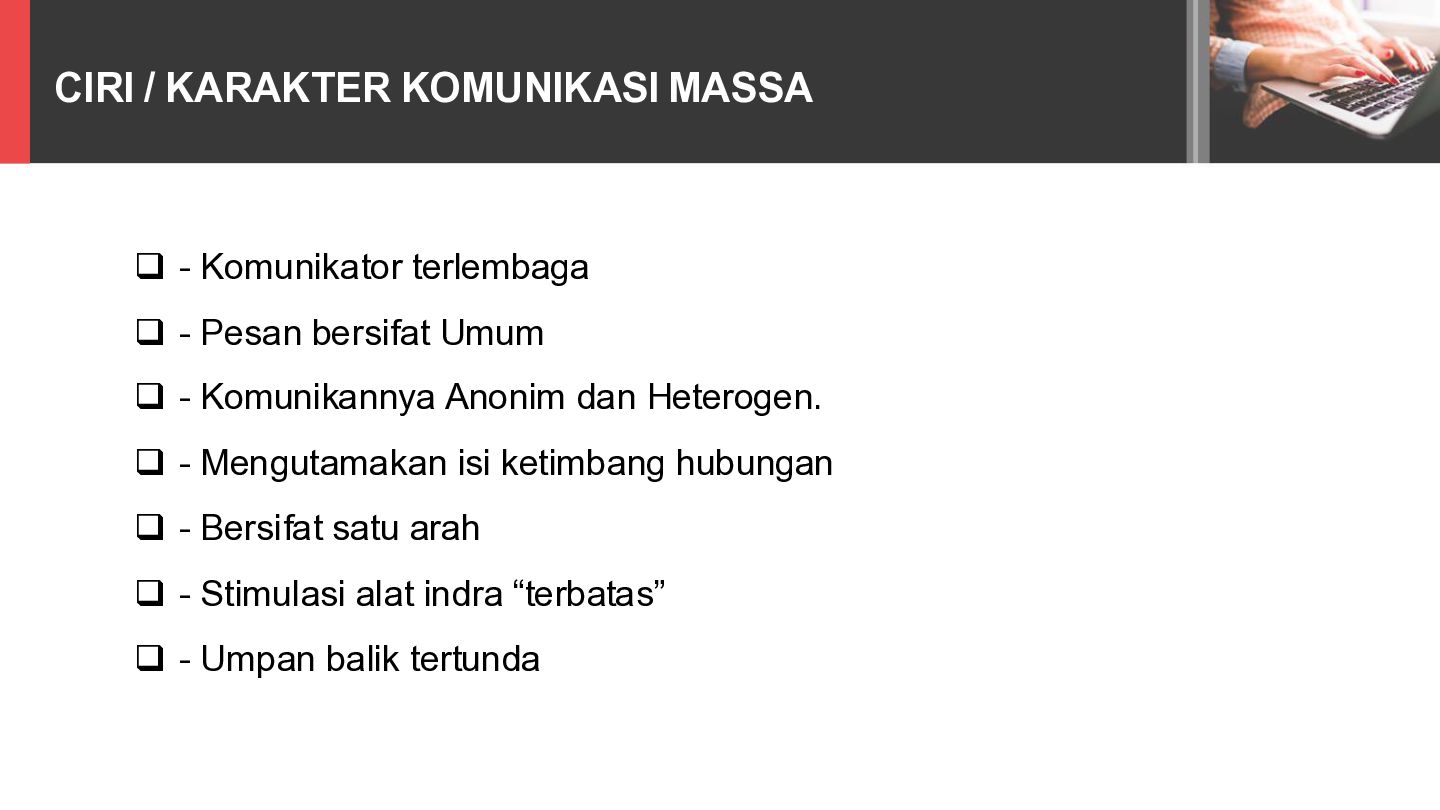
  8. CIRI / KARAKTER KOMUNIKASI MASSA ❑ - Komunikator terlembaga ❑

    - Pesan bersifat Umum ❑ - Komunikannya Anonim dan Heterogen. ❑ - Mengutamakan isi ketimbang hubungan ❑ - Bersifat satu arah ❑ - Stimulasi alat indra “terbatas” ❑ - Umpan balik tertunda
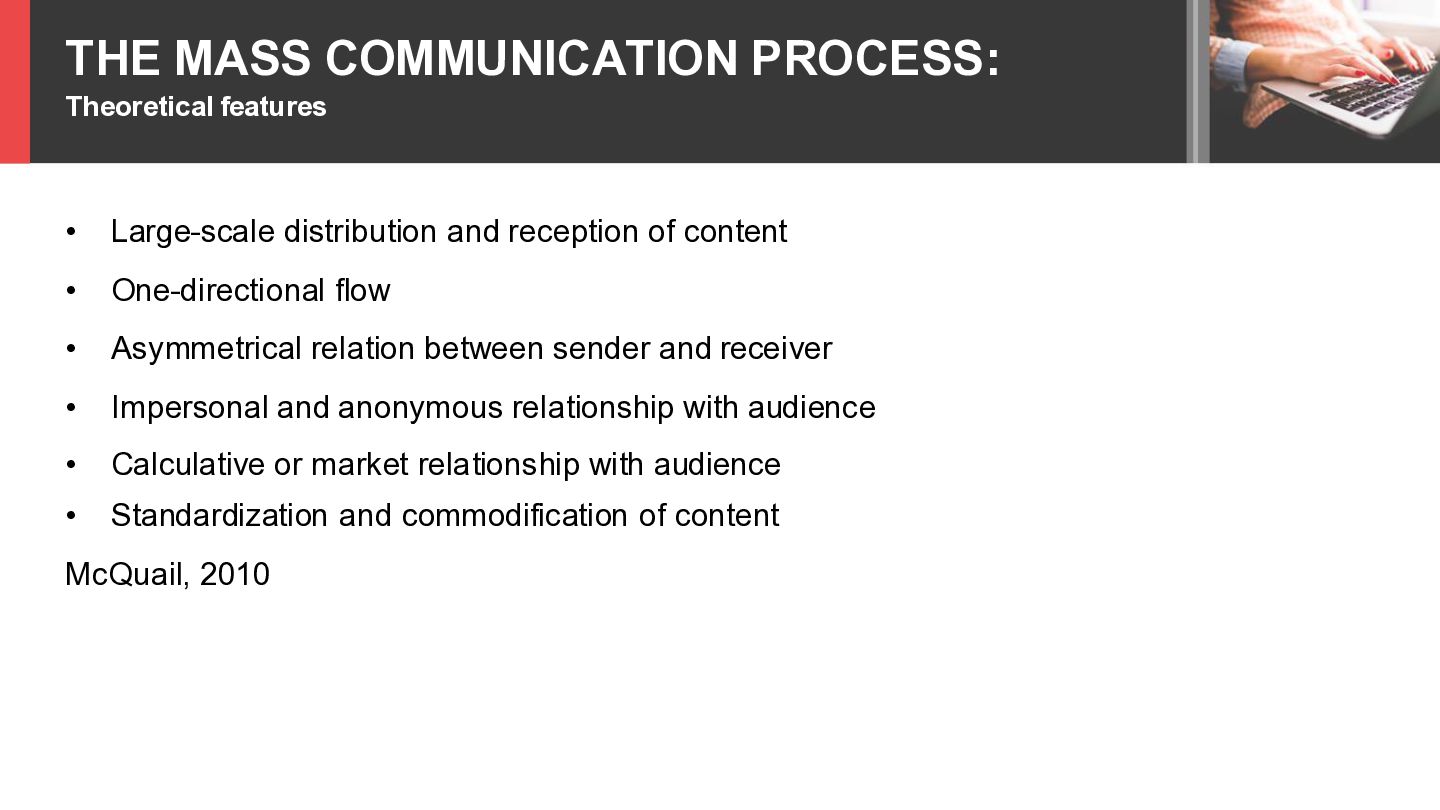
  9. THE MASS COMMUNICATION PROCESS: Theoretical features • Large-scale distribution and

    reception of content • One-directional flow • Asymmetrical relation between sender and receiver • Impersonal and anonymous relationship with audience • Calculative or market relationship with audience • Standardization and commodification of content McQuail, 2010
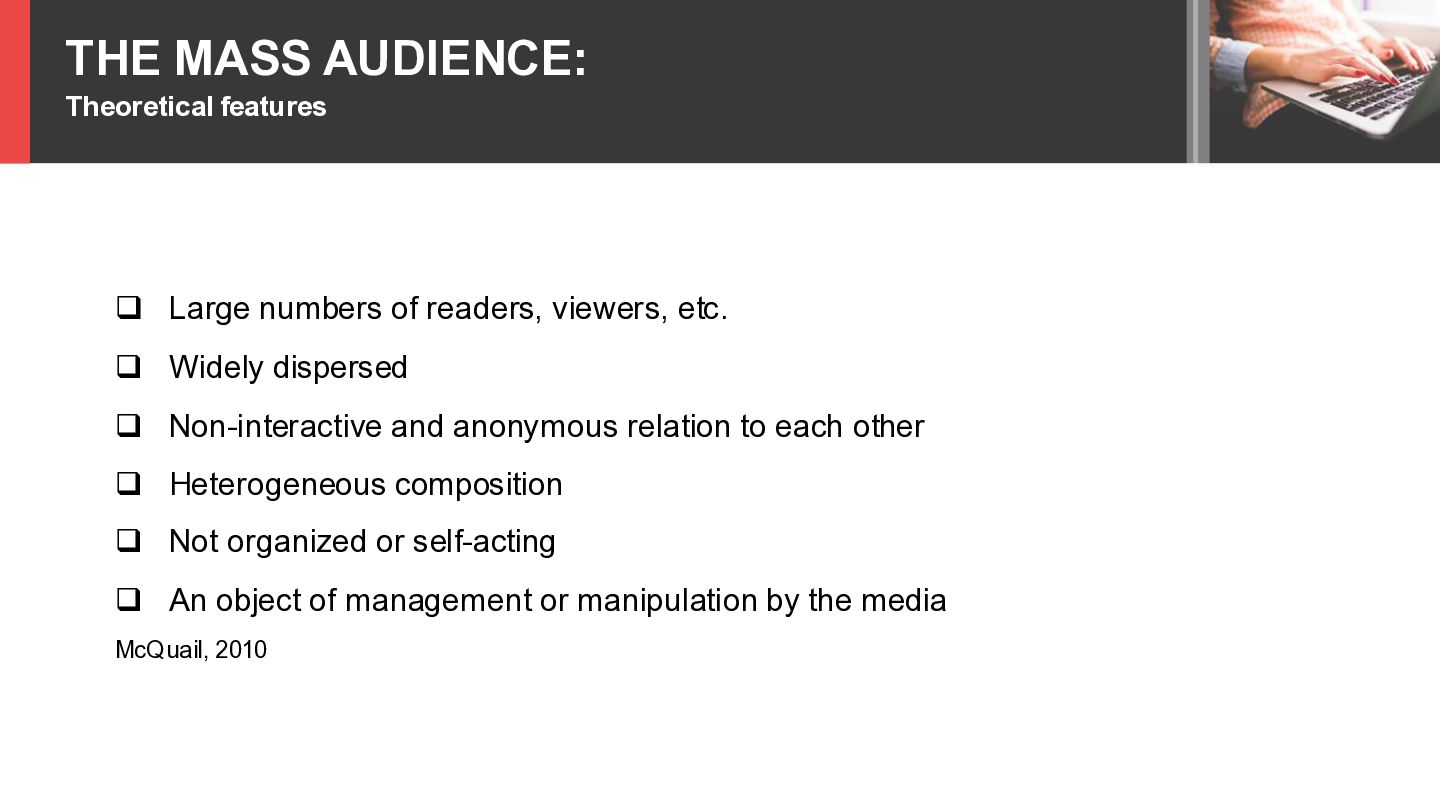
  10. THE MASS AUDIENCE: Theoretical features ❑ Large numbers of readers,

    viewers, etc. ❑ Widely dispersed ❑ Non-interactive and anonymous relation to each other ❑ Heterogeneous composition ❑ Not organized or self-acting ❑ An object of management or manipulation by the media McQuail, 2010
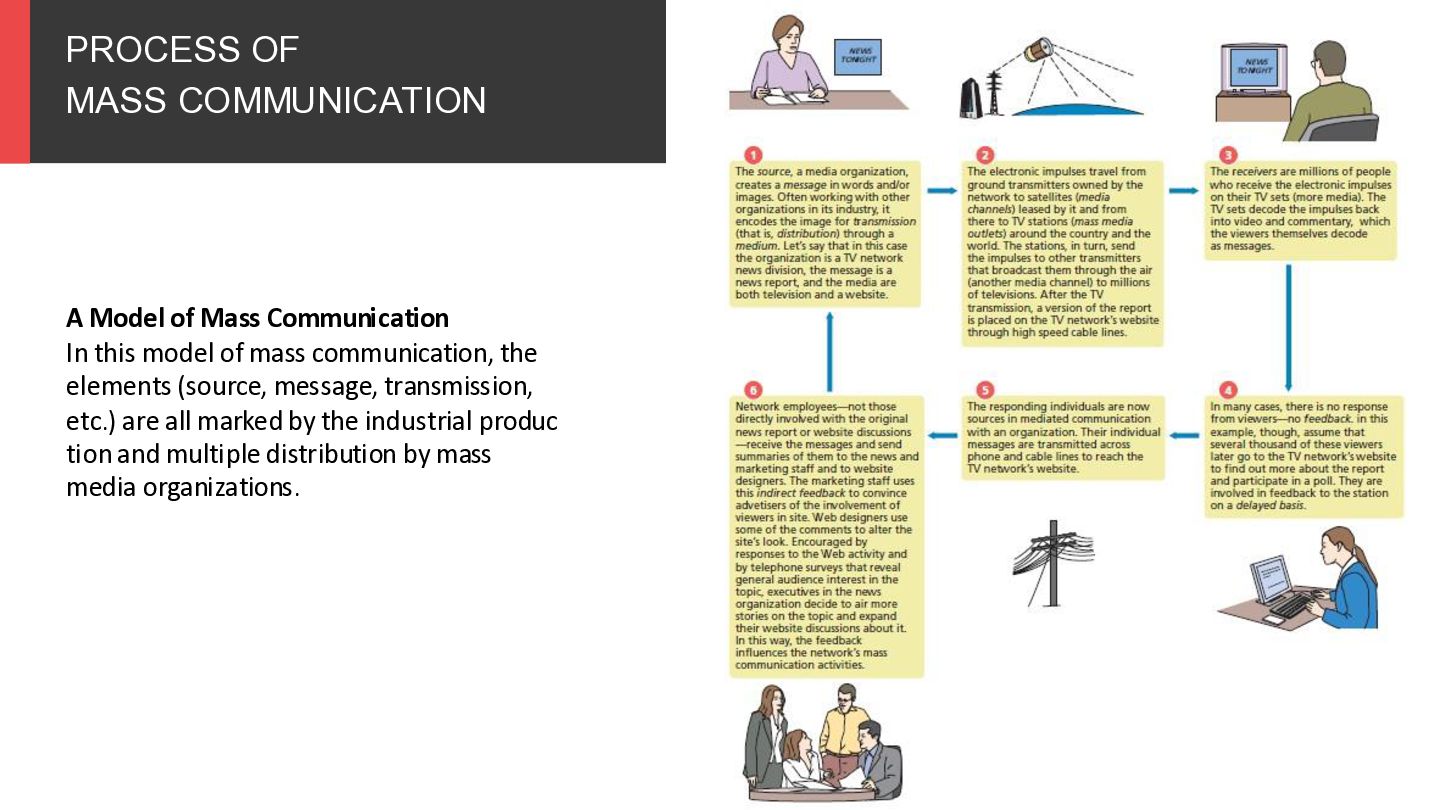
  11. PROCESS OF MASS COMMUNICATION A Model of Mass Communication In

    this model of mass communication, the elements (source, message, transmission, etc.) are all marked by the industrial produc tion and multiple distribution by mass media organizations.
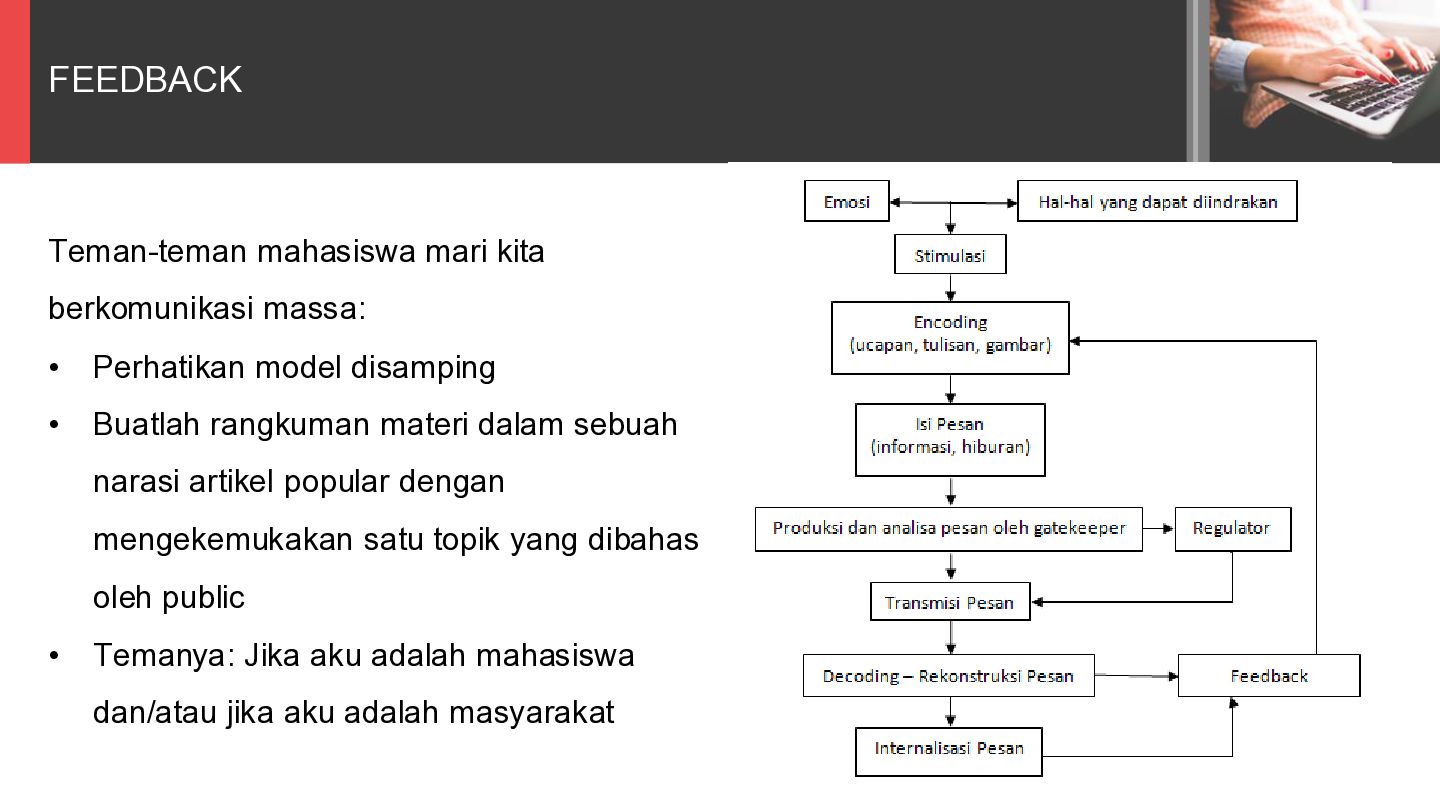
  12. FEEDBACK Teman-teman mahasiswa mari kita berkomunikasi massa: • Perhatikan model

    disamping • Buatlah rangkuman materi dalam sebuah narasi artikel popular dengan mengekemukakan satu topik yang dibahas oleh public • Temanya: Jika aku adalah mahasiswa dan/atau jika aku adalah masyarakat