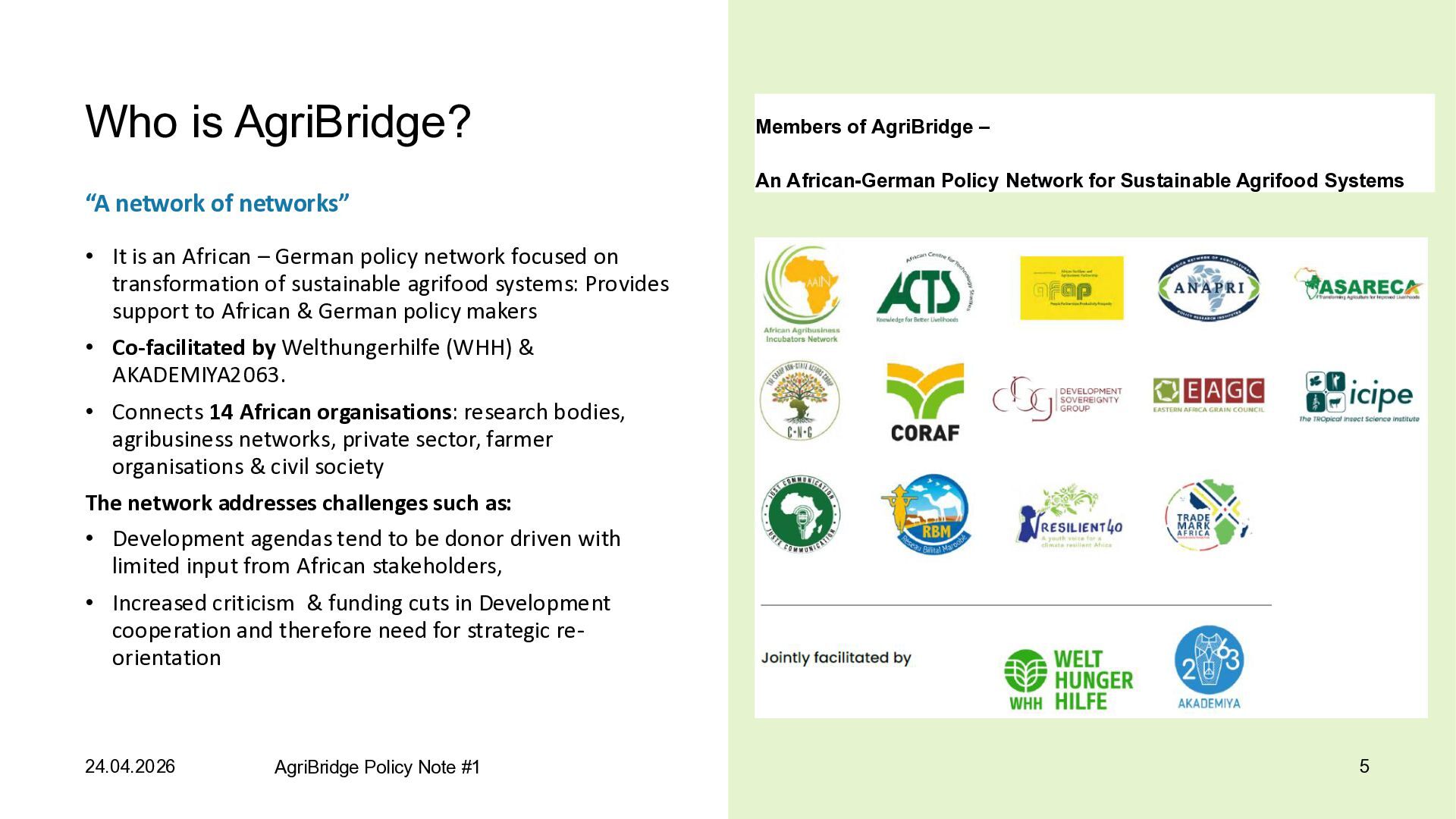
an African – German policy network focused on transformation of sustainable agrifood systems: Provides support to African & German policy makers • Co-facilitated by Welthungerhilfe (WHH) & AKADEMIYA2063. • Connects 14 African organisations: research bodies, agribusiness networks, private sector, farmer organisations & civil society The network addresses challenges such as: • Development agendas tend to be donor driven with limited input from African stakeholders, • Increased criticism & funding cuts in Development cooperation and therefore need for strategic re- orientation 24.04.2026 AgriBridge Policy Note #1 5 Members of AgriBridge – An African-German Policy Network for Sustainable Agrifood Systems
voices of African agrifood stakeholders & links them with German political decision makers • Produces evidence-based policy briefs on: • Rethinking development cooperation, financing agrifood & climate resilient approaches designed to foster constructive dialogue & strengthen decision making aligned with the CAAPD Kampala & German development policy 24.04.2026 AgriBridge Policy Note #1 6 Members of AgriBridge – An African-German Policy Network for Sustainable Agrifood Systems
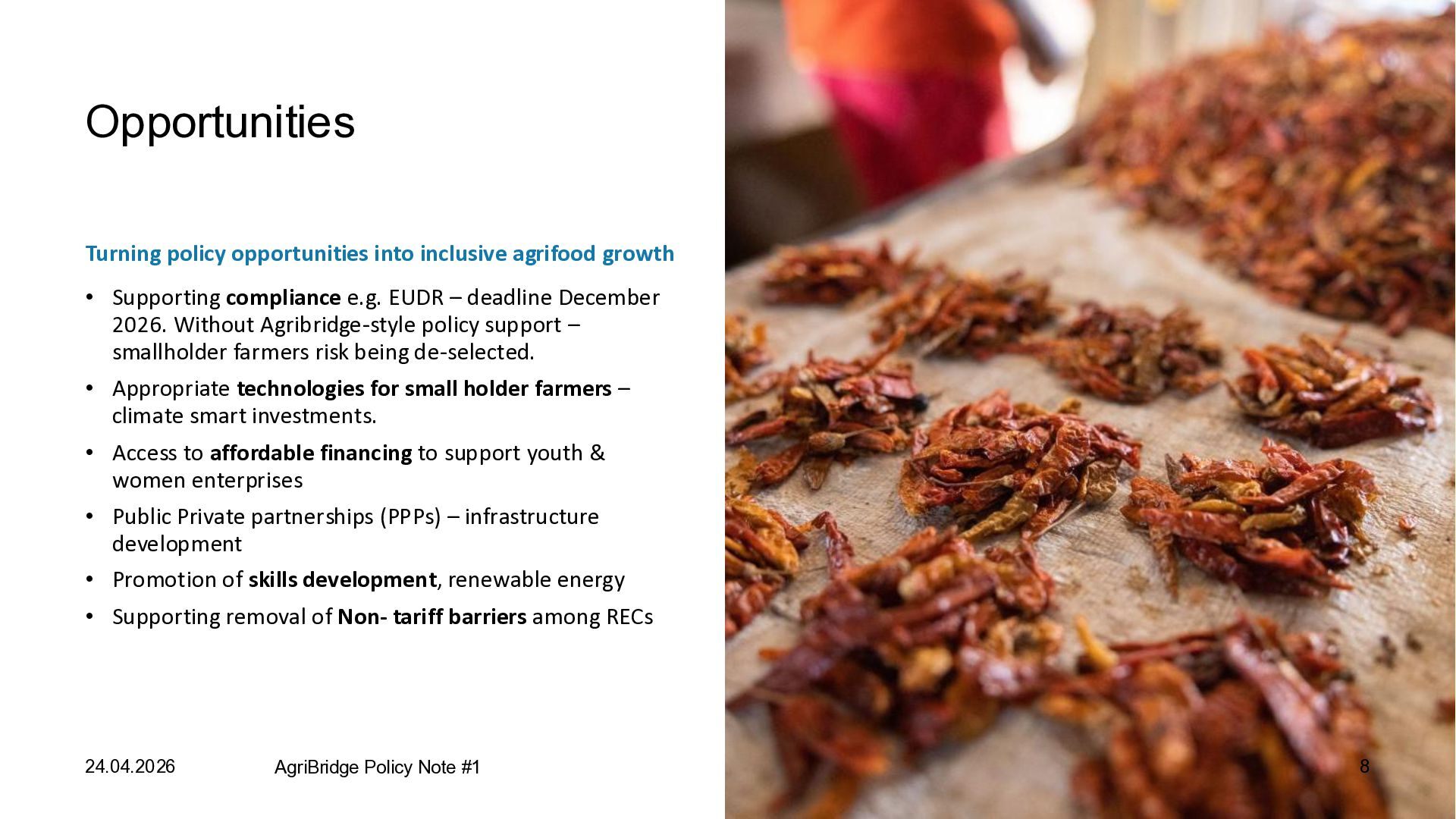
compliance e.g. EUDR – deadline December 2026. Without Agribridge-style policy support – smallholder farmers risk being de-selected. • Appropriate technologies for small holder farmers – climate smart investments. • Access to affordable financing to support youth & women enterprises • Public Private partnerships (PPPs) – infrastructure development • Promotion of skills development, renewable energy • Supporting removal of Non- tariff barriers among RECs 24.04.2026 AgriBridge Policy Note #1 8
SADC has highest trade volumes, EAC re-established in 1999 is the most successfully integrated bloc (free movement & common market protocols). • Intra-Africa trade remains at 20%. Need to strengthen the capacities of RECs & AfCFTA secretariat. • AfCFTA in action – African Cocoa Exchange & supporting AU flagships initiatives like CAAPs (Côte d’Ivoire and Ghana common agro-industrial park model – cocoa & rice). • Promoting inclusive trade and growth to access affordable finance (25% interest –prohibitive bank loans), appropriate technology, tailored skills development (TVETs, Incubation & Acceleration), digital tools for youth, women & SMEs (digital identities). • Case Study from Uganda: Targeted Value Chain Investment as a Win–Win Strategy: Uganda’s Coffee Transformation Uganda coffee exports in 2025 (8.7 million 60-kilo bags = US$ 2.5 billion – Germany market share 9.8% =852,600 bags) 24.04.2026 AgriBridge Policy Note #1 9 2. Support smallholders, women, youth, and SMEs
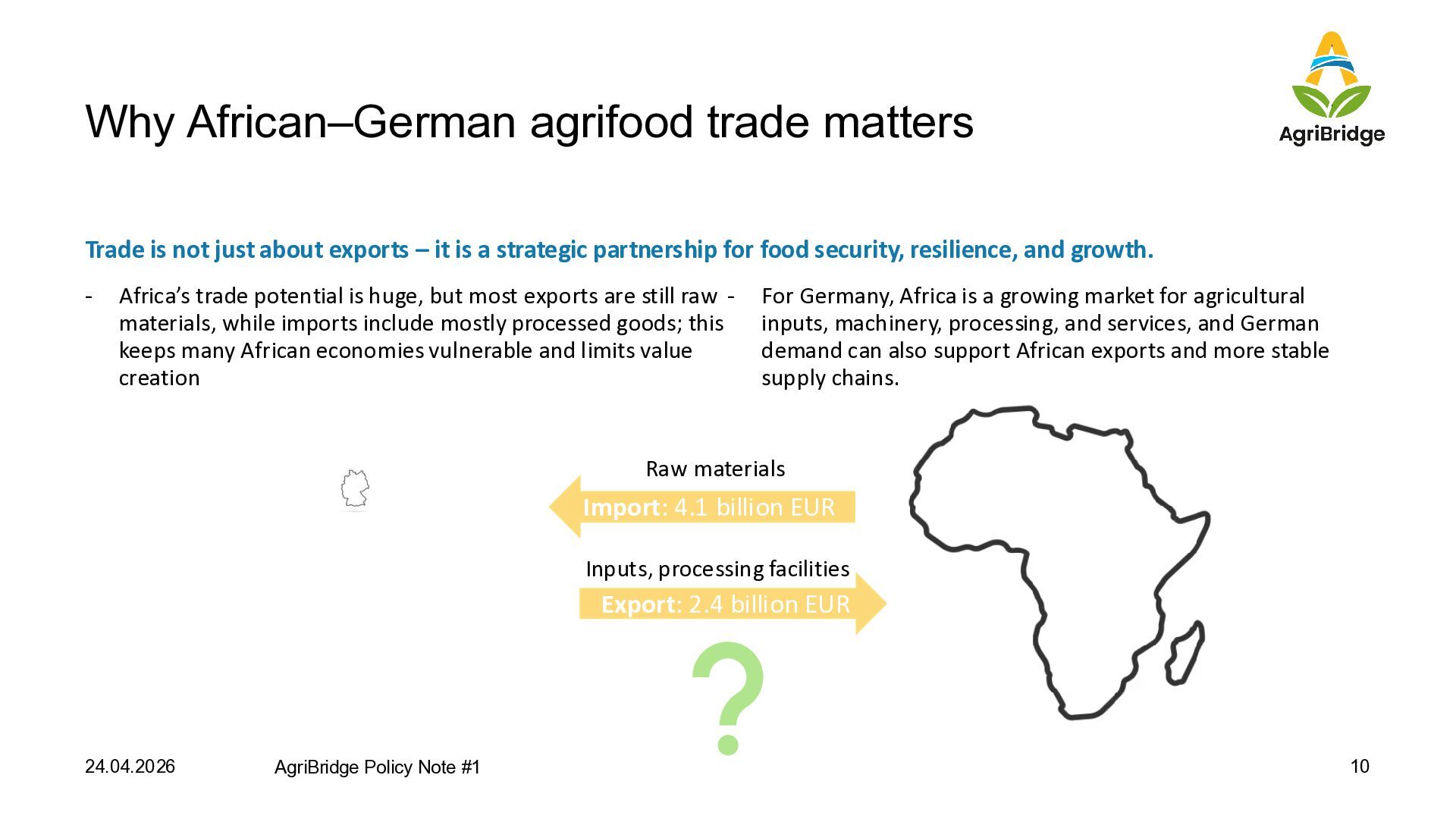
exports – it is a strategic partnership for food security, resilience, and growth. - Africa’s trade potential is huge, but most exports are still raw materials, while imports include mostly processed goods; this keeps many African economies vulnerable and limits value creation - For Germany, Africa is a growing market for agricultural inputs, machinery, processing, and services, and German demand can also support African exports and more stable supply chains. 24.04.2026 AgriBridge Policy Note #1 10 Export: 2.4 billion EUR Import: 4.1 billion EUR Raw materials Inputs, processing facilities
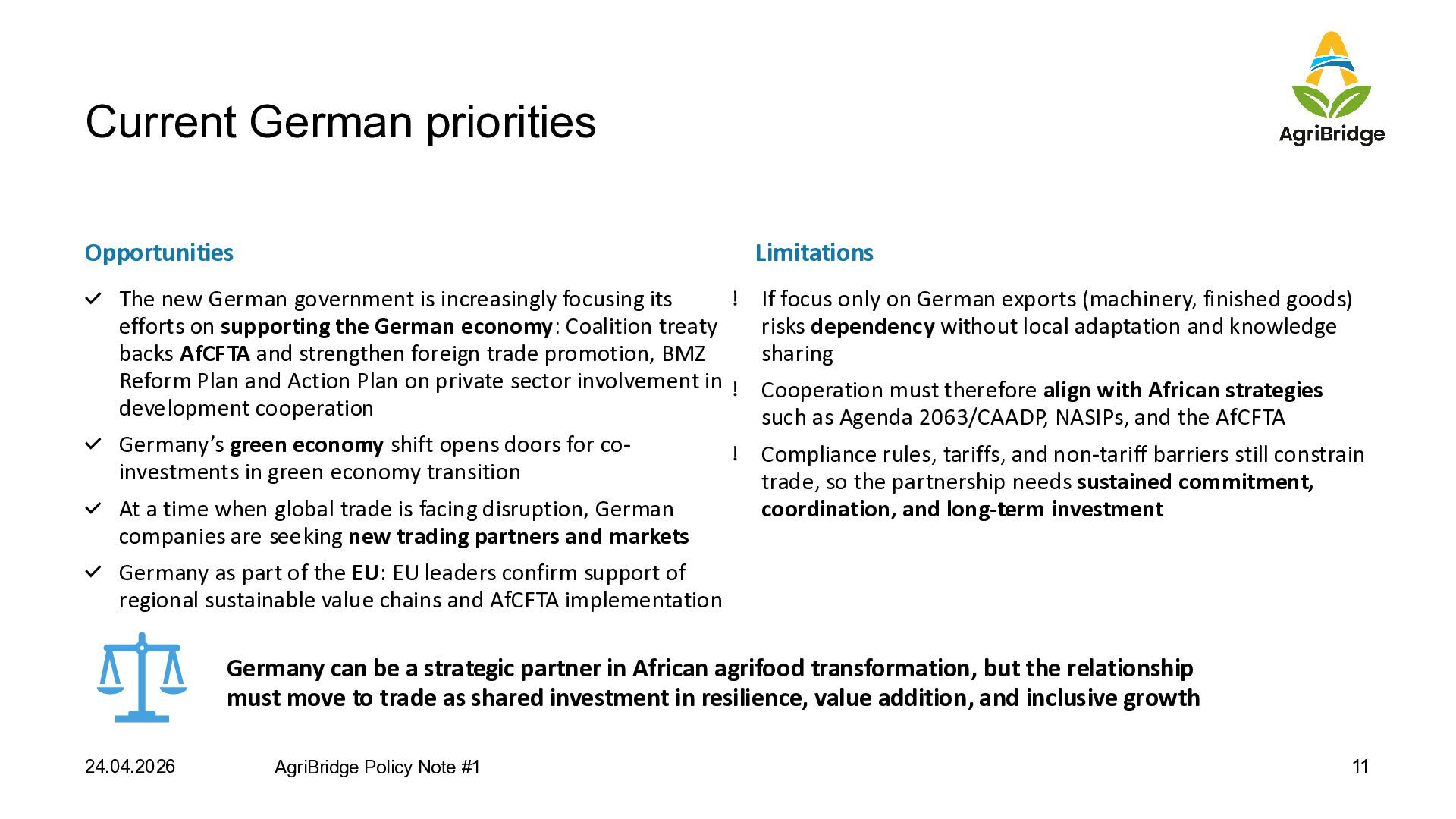
focusing its efforts on supporting the German economy: Coalition treaty backs AfCFTA and strengthen foreign trade promotion, BMZ Reform Plan and Action Plan on private sector involvement in development cooperation Germany’s green economy shift opens doors for co- investments in green economy transition At a time when global trade is facing disruption, German companies are seeking new trading partners and markets Germany as part of the EU: EU leaders confirm support of regional sustainable value chains and AfCFTA implementation If focus only on German exports (machinery, finished goods) risks dependency without local adaptation and knowledge sharing Cooperation must therefore align with African strategies such as Agenda 2063/CAADP, NASIPs, and the AfCFTA Compliance rules, tariffs, and non-tariff barriers still constrain trade, so the partnership needs sustained commitment, coordination, and long-term investment 24.04.2026 AgriBridge Policy Note #1 11 Limitations Germany can be a strategic partner in African agrifood transformation, but the relationship must move to trade as shared investment in resilience, value addition, and inclusive growth
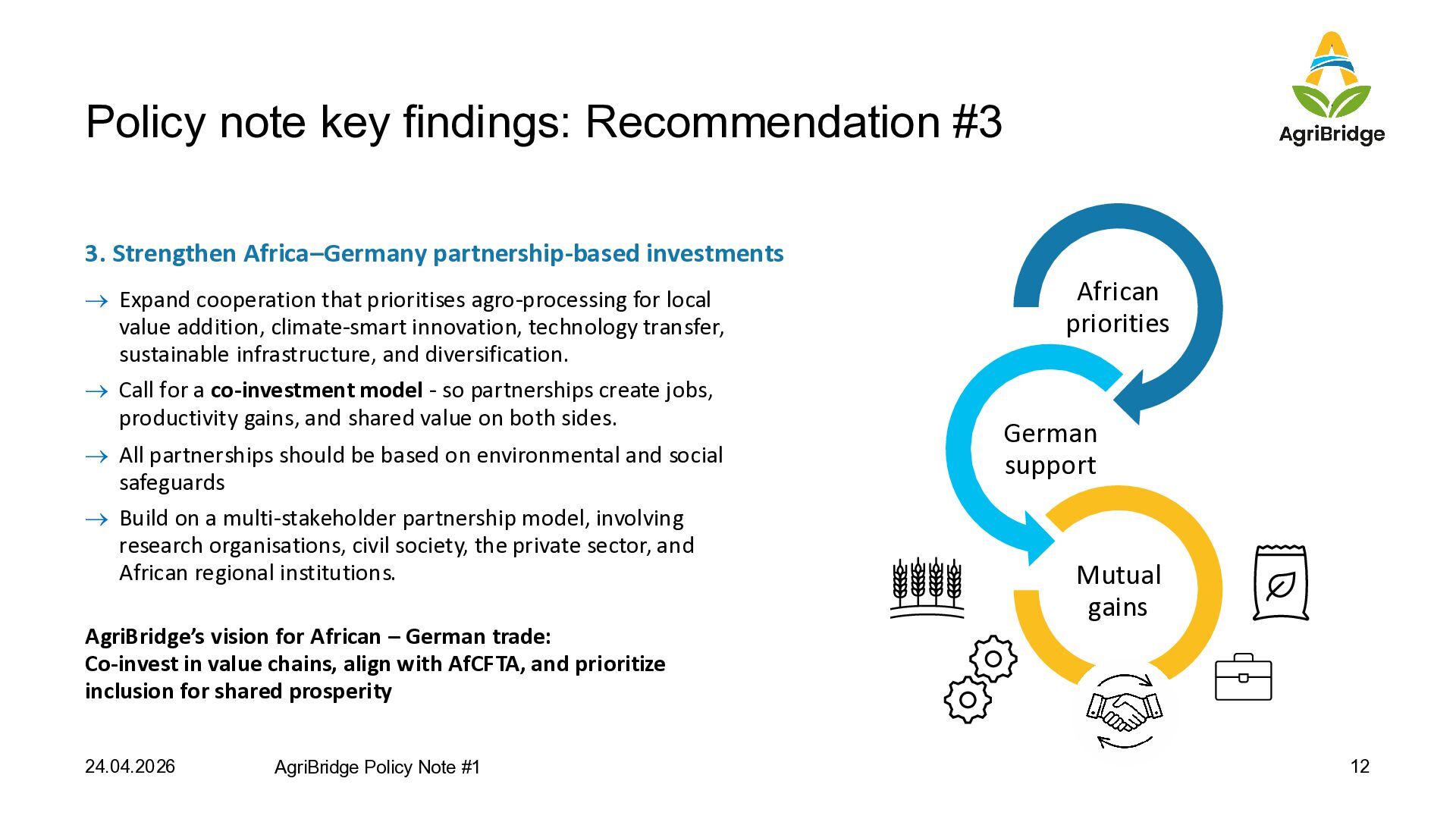
investments → Expand cooperation that prioritises agro-processing for local value addition, climate-smart innovation, technology transfer, sustainable infrastructure, and diversification. → Call for a co-investment model - so partnerships create jobs, productivity gains, and shared value on both sides. → All partnerships should be based on environmental and social safeguards → Build on a multi-stakeholder partnership model, involving research organisations, civil society, the private sector, and African regional institutions. AgriBridge’s vision for African – German trade: Co-invest in value chains, align with AfCFTA, and prioritize inclusion for shared prosperity 24.04.2026 AgriBridge Policy Note #1 12 African priorities German support Mutual gains


 akademiya2063
 michaelherold
 rkendrick25
 takai
takai
 rasagy
 jonoalderson
 inesmontani
 marcoroth
 khoart
 marktimemedia
 shlominoach
 hannesfritz
 rakko
rakko