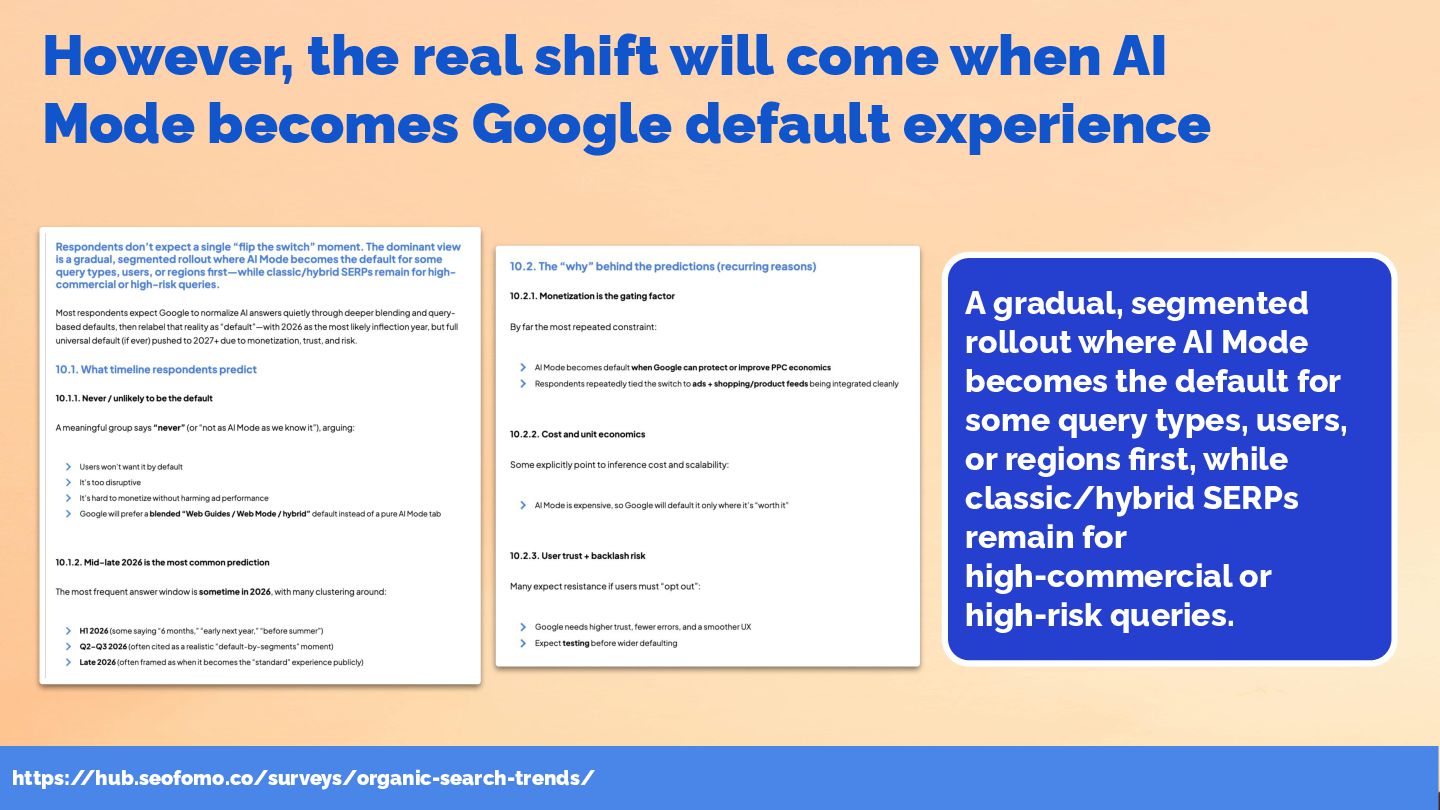
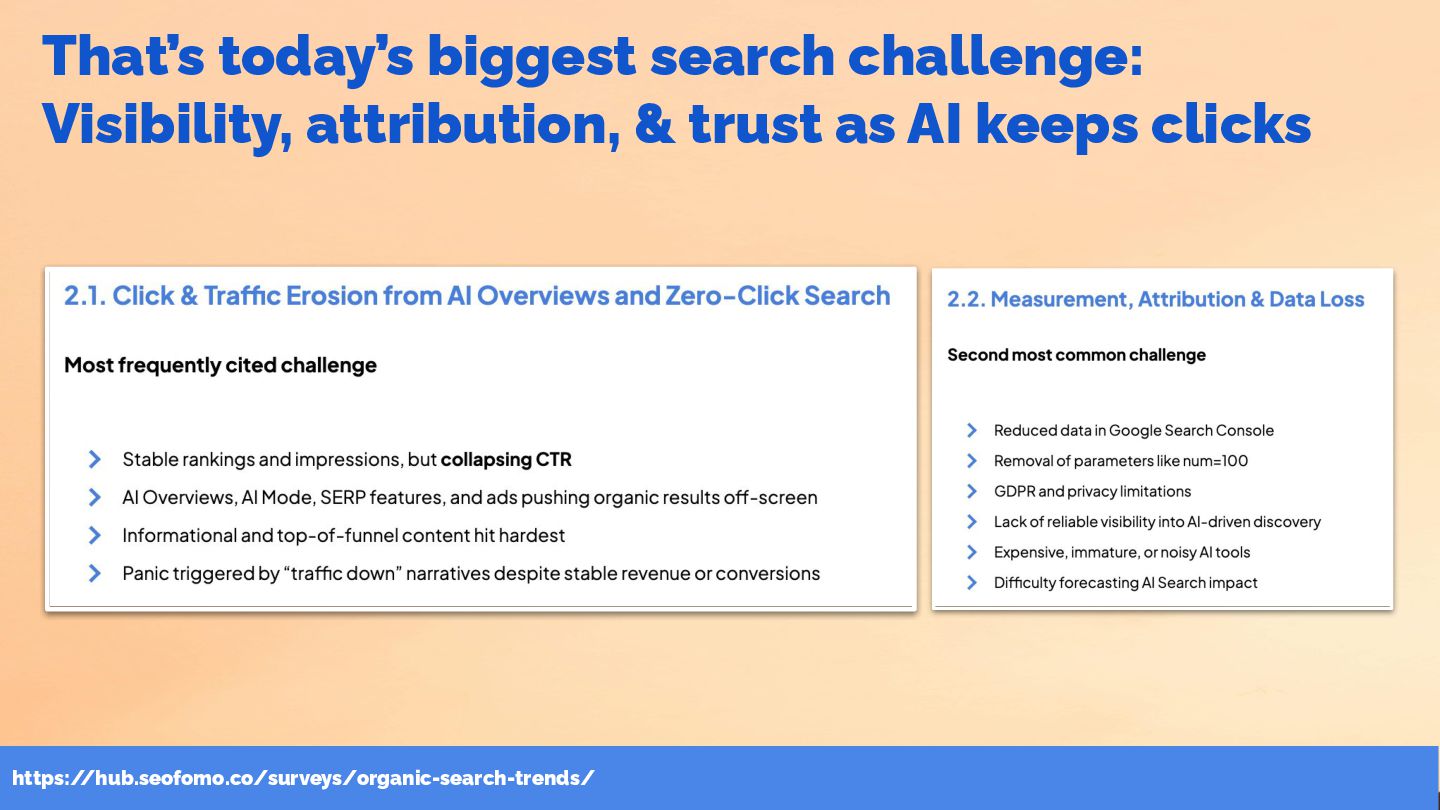
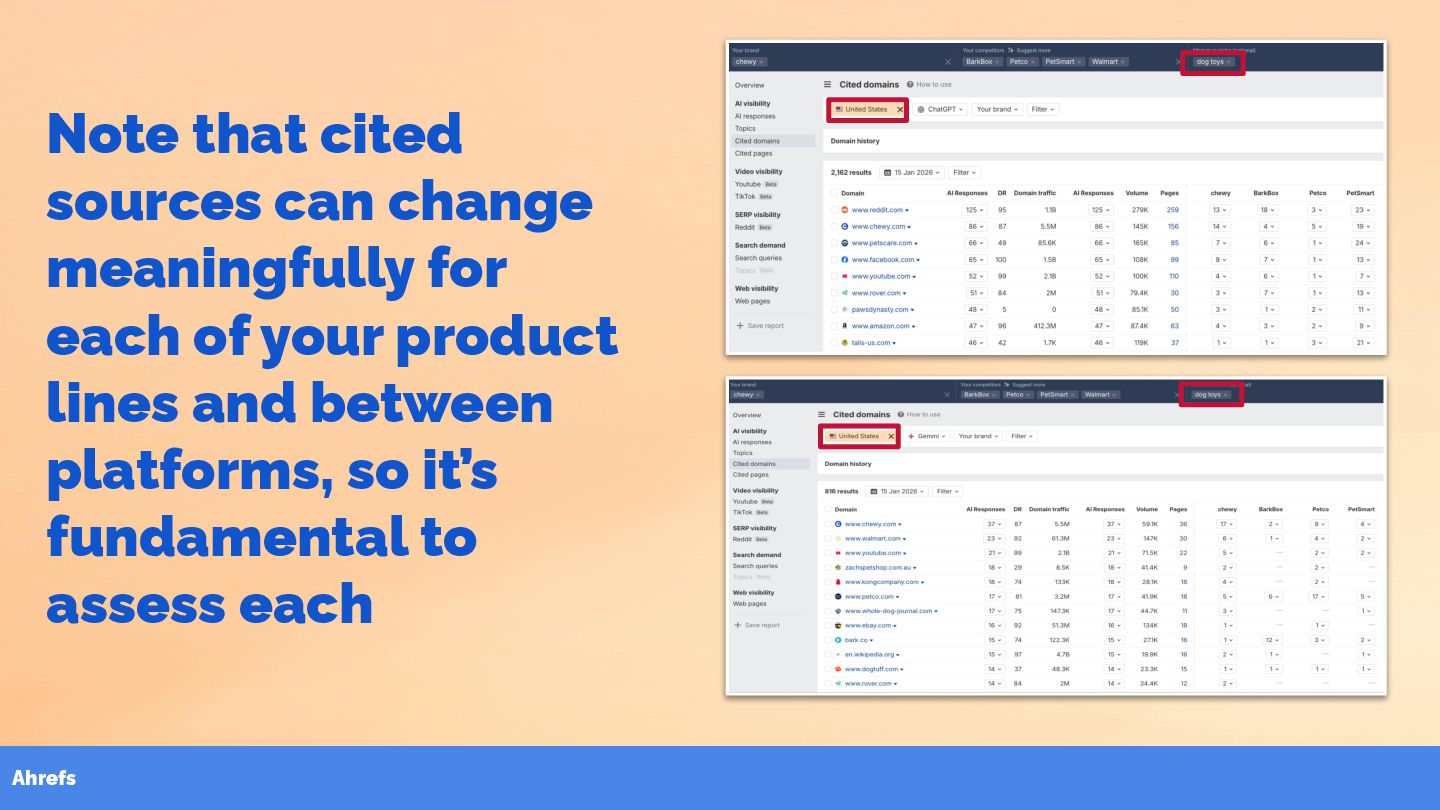
Google default experience https:/ /hub.seofomo.co/surveys/organic-search-trends/ A gradual, segmented rollout where AI Mode becomes the default for some query types, users, or regions first, while classic/hybrid SERPs remain for high-commercial or high-risk queries.
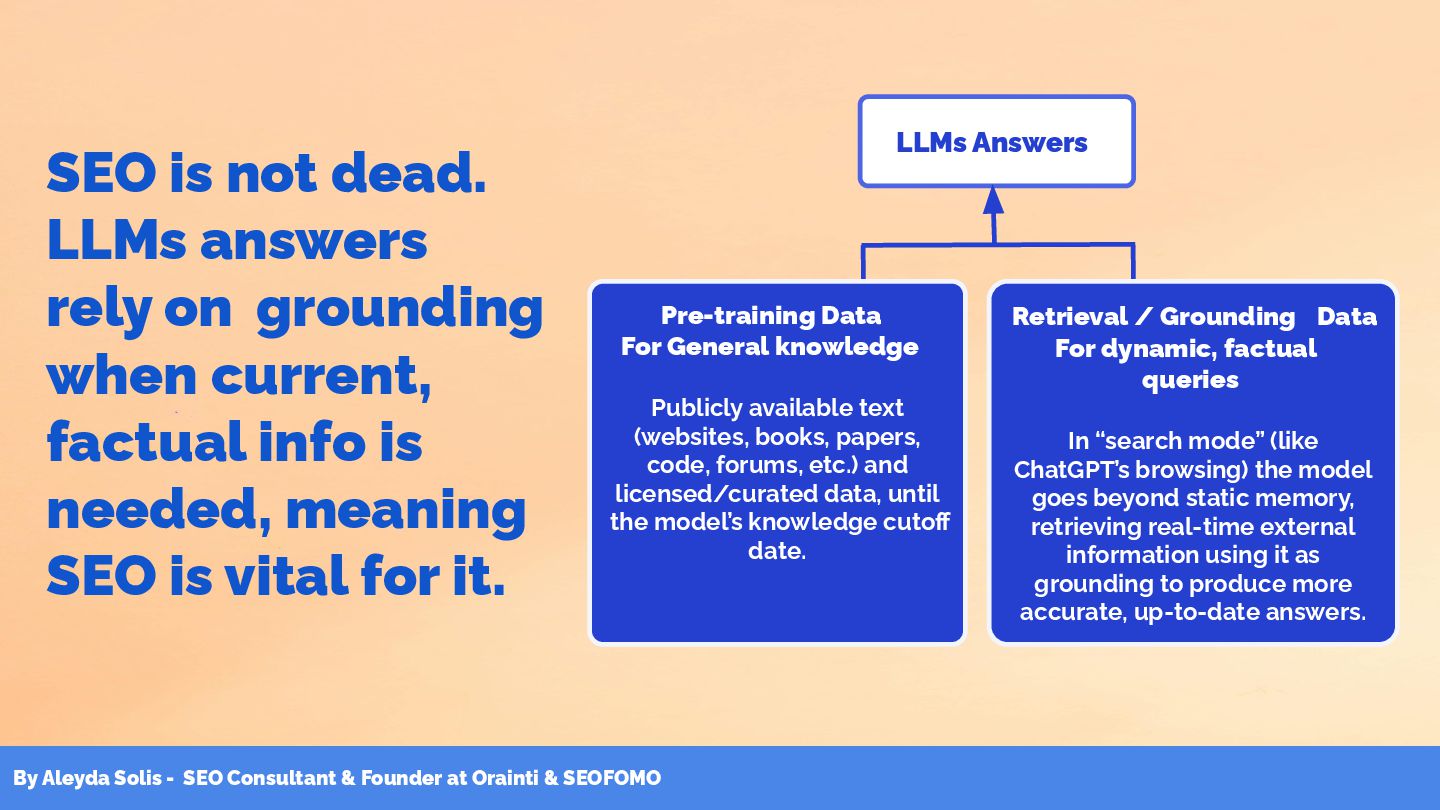
current, factual info is needed, meaning SEO is vital for it. LLMs Answers Retrieval / Grounding Data For dynamic, factual queries In “search mode” (like ChatGPT’s browsing) the model goes beyond static memory, retrieving real-time external information using it as grounding to produce more accurate, up-to-date answers. Pre-training Data For General knowledge Publicly available text (websites, books, papers, code, forums, etc.) and licensed/curated data, until the model’s knowledge cutoff date. By Aleyda Solis - SEO Consultant & Founder at Orainti & SEOFOMO
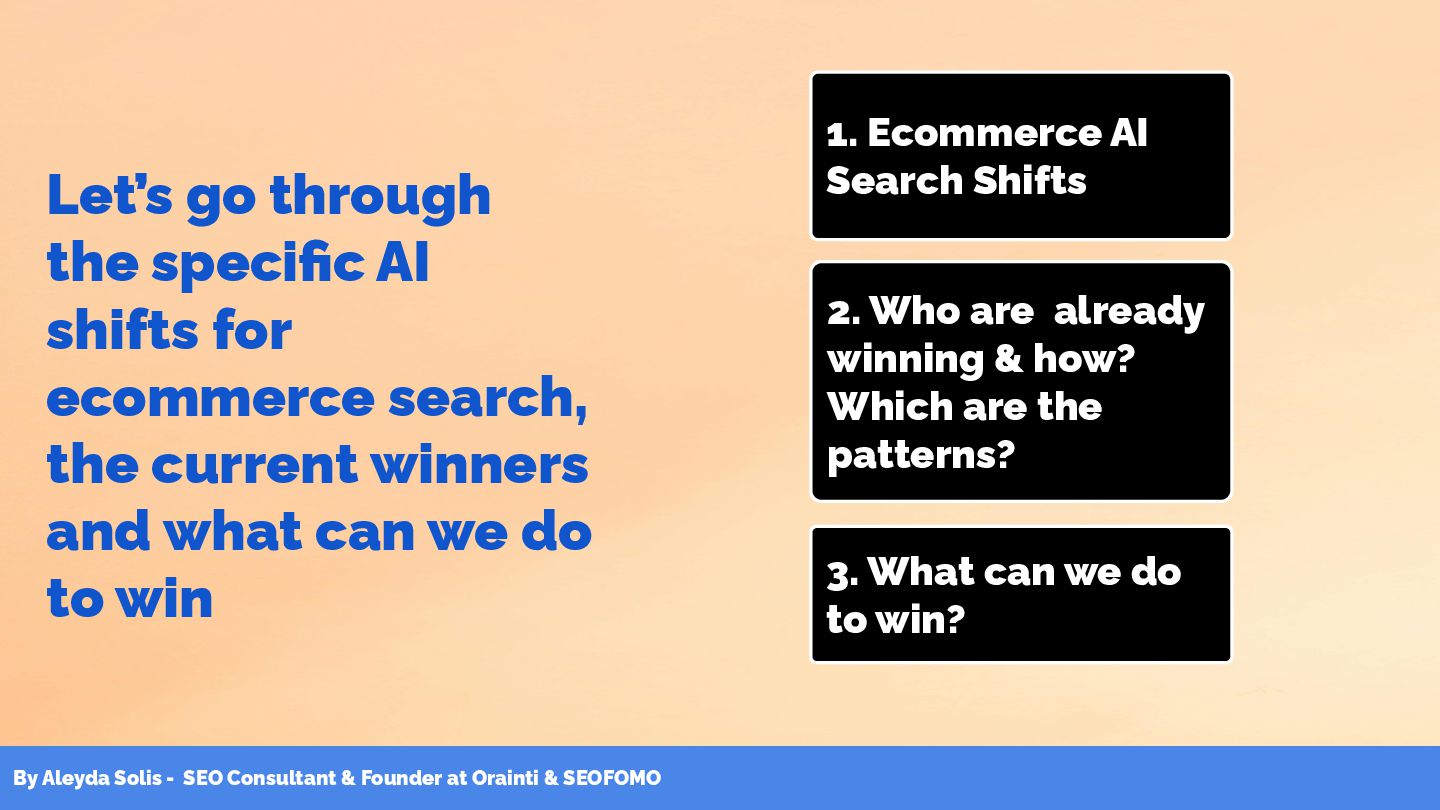
& SEOFOMO 1. Ecommerce AI Search Shifts 3. What can we do to win? 2. Who are already winning & how? Which are the patterns? Let’s go through the specific AI shifts for ecommerce search, the current winners and what can we do to win
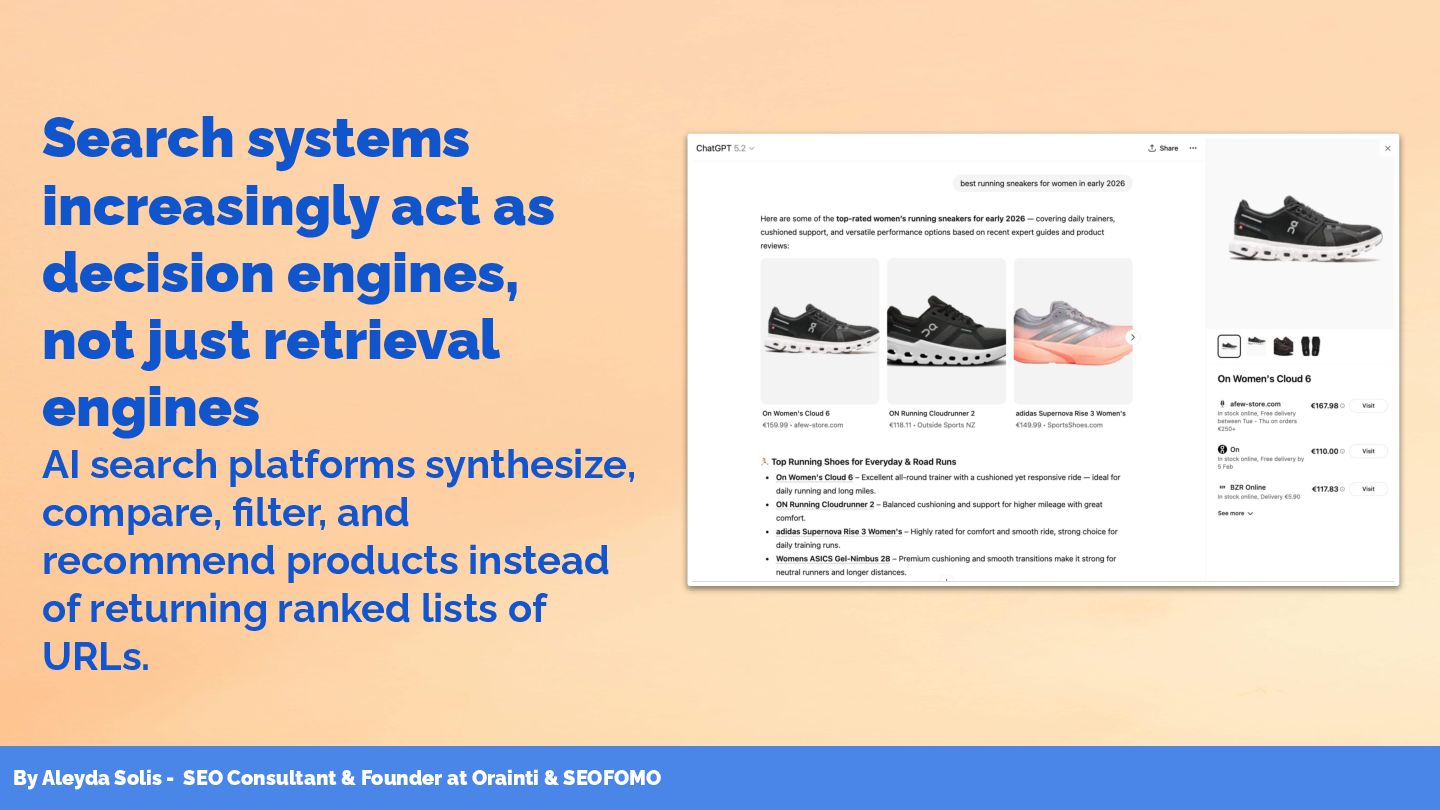
& SEOFOMO Search systems increasingly act as decision engines, not just retrieval engines AI search platforms synthesize, compare, filter, and recommend products instead of returning ranked lists of URLs.
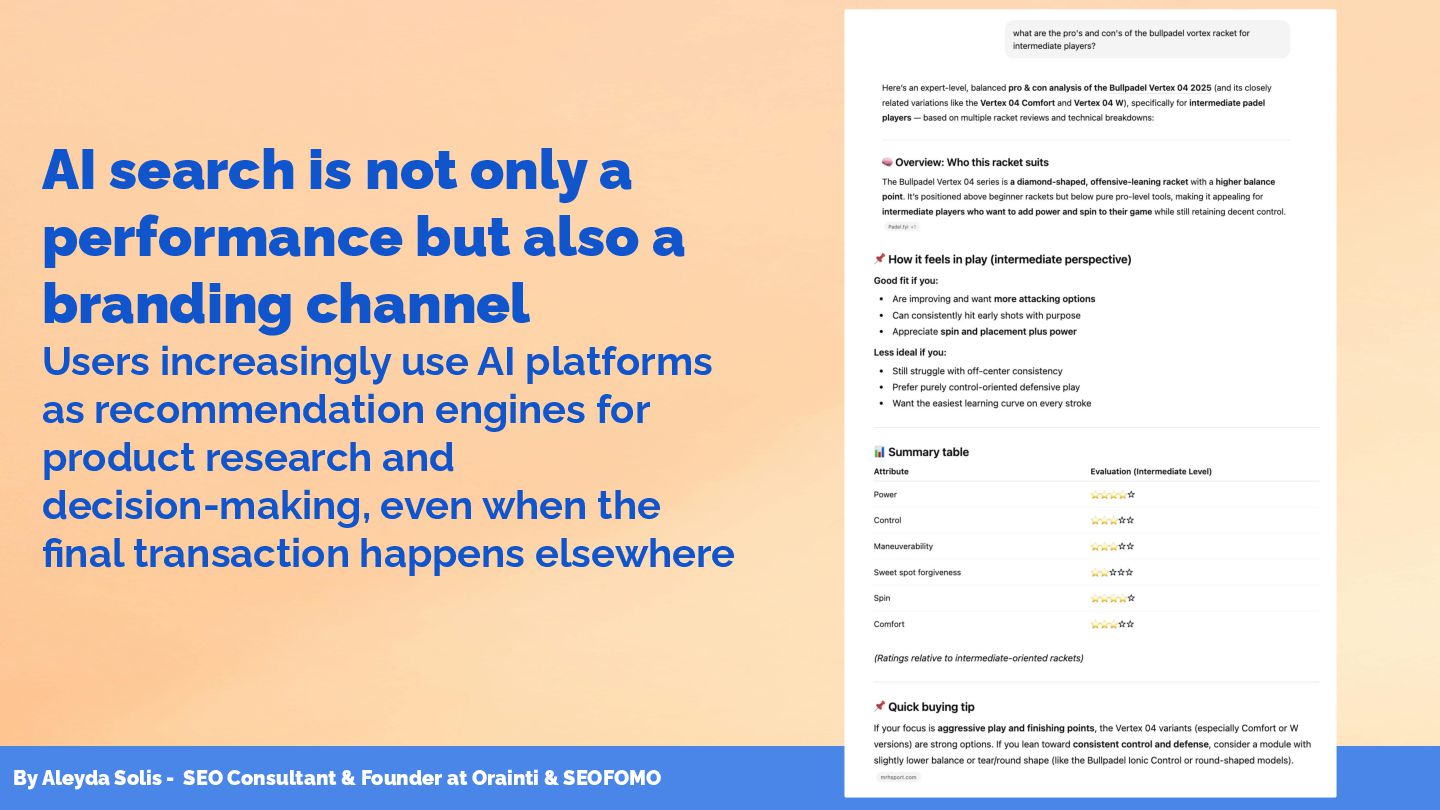
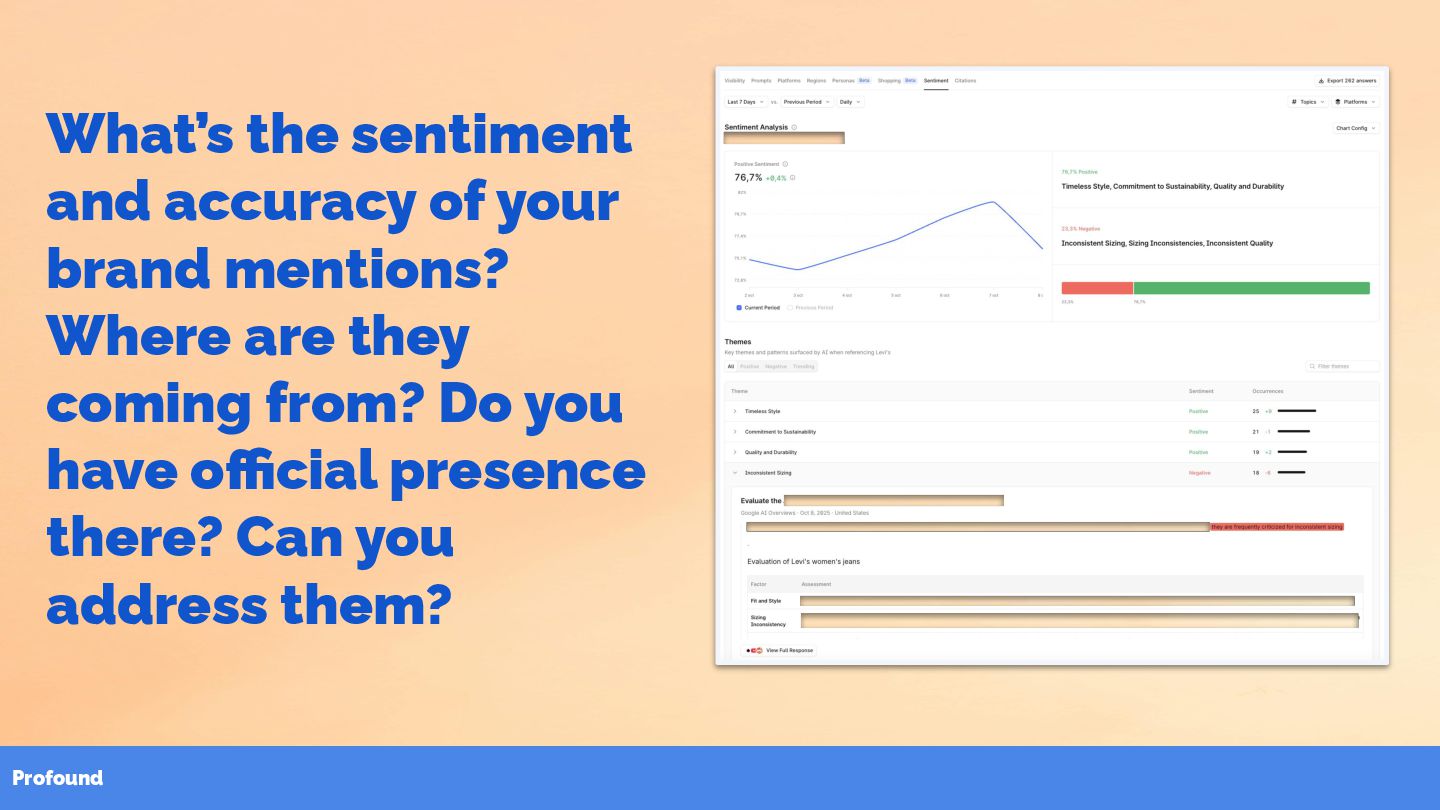
& SEOFOMO AI search is not only a performance but also a branding channel Users increasingly use AI platforms as recommendation engines for product research and decision-making, even when the final transaction happens elsewhere
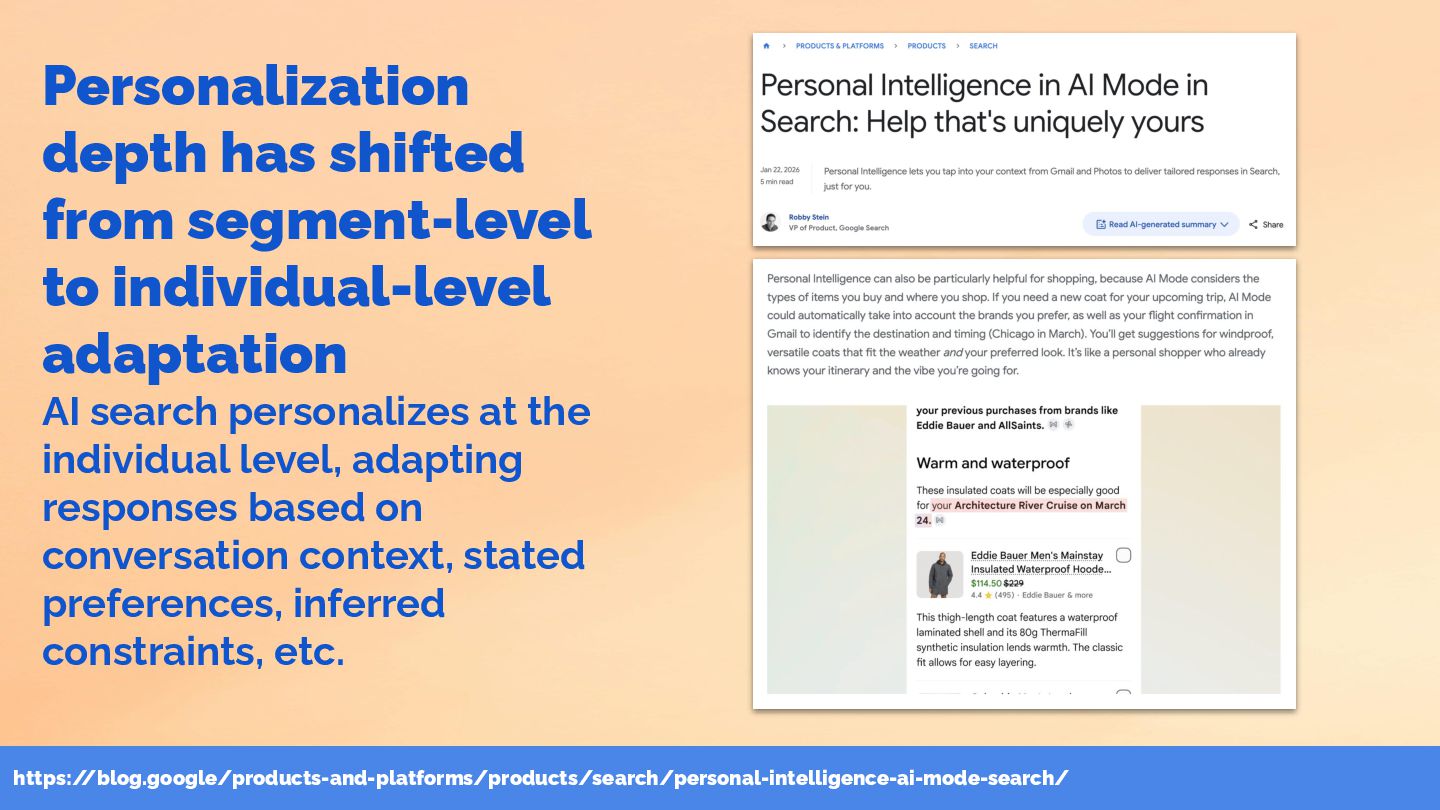
search personalizes at the individual level, adapting responses based on conversation context, stated preferences, inferred constraints, etc. https:/ /blog.google/products-and-platforms/products/search/personal-intelligence-ai-mode-search/
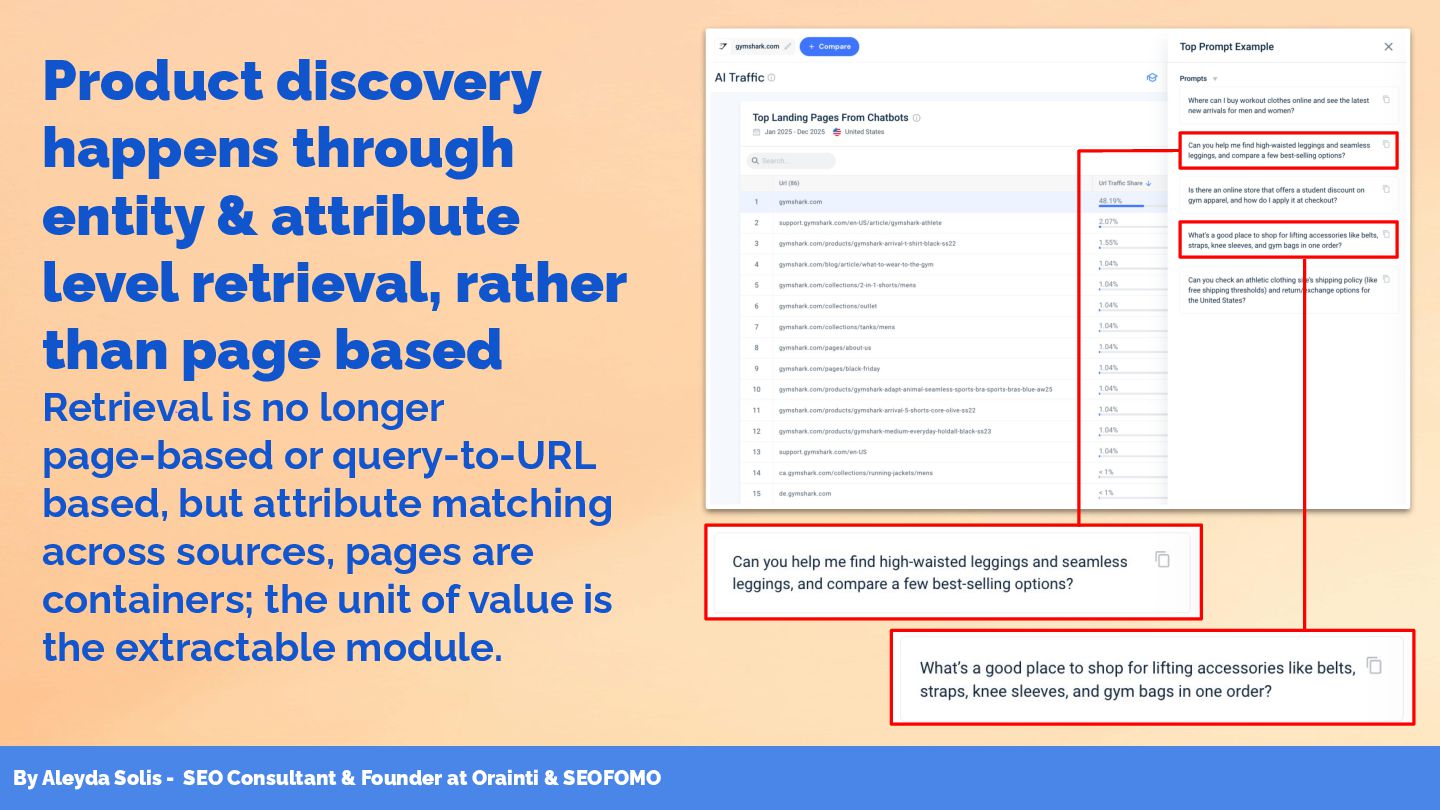
& SEOFOMO Product discovery happens through entity & attribute level retrieval, rather than page based Retrieval is no longer page-based or query-to-URL based, but attribute matching across sources, pages are containers; the unit of value is the extractable module.
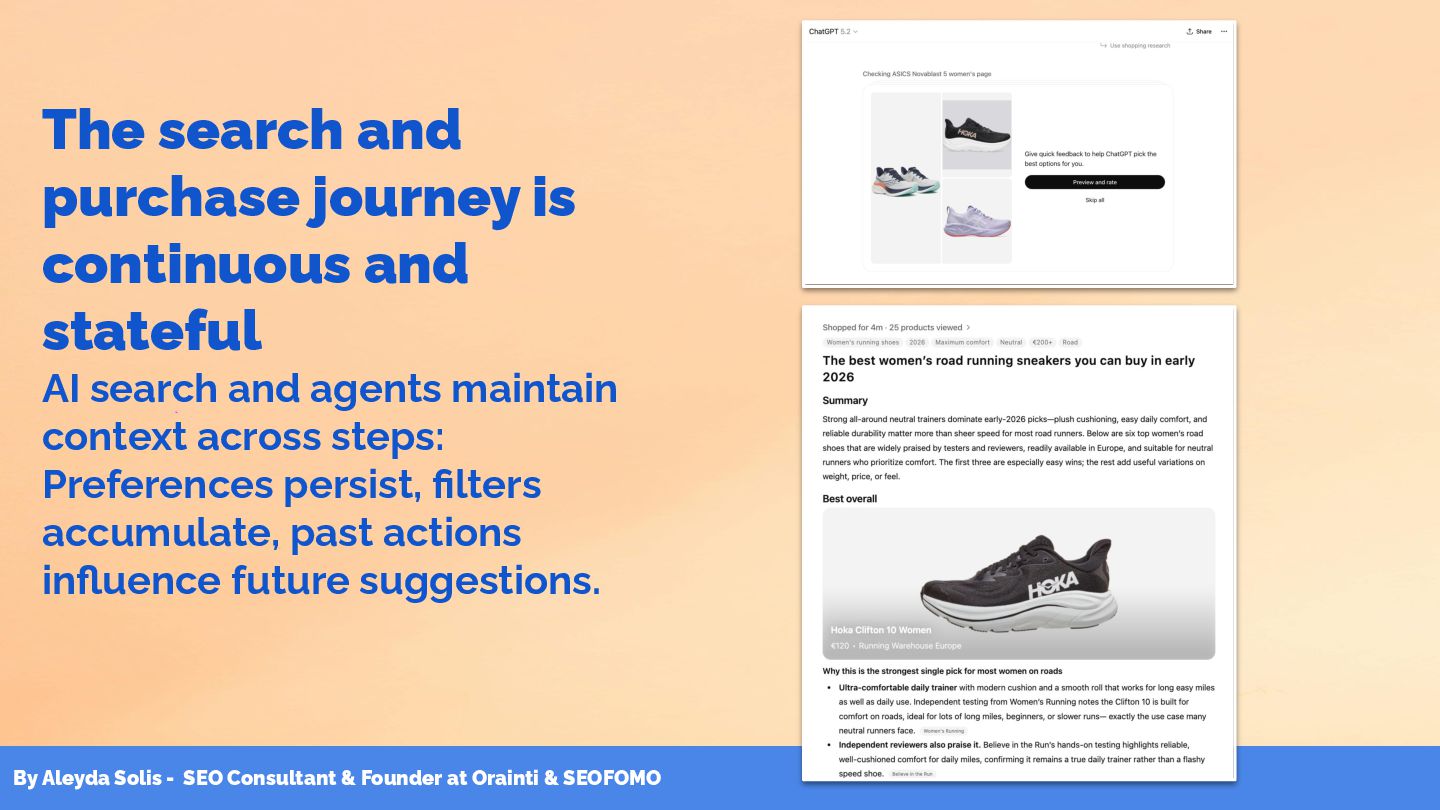
& SEOFOMO The search and purchase journey is continuous and stateful AI search and agents maintain context across steps: Preferences persist, filters accumulate, past actions influence future suggestions.
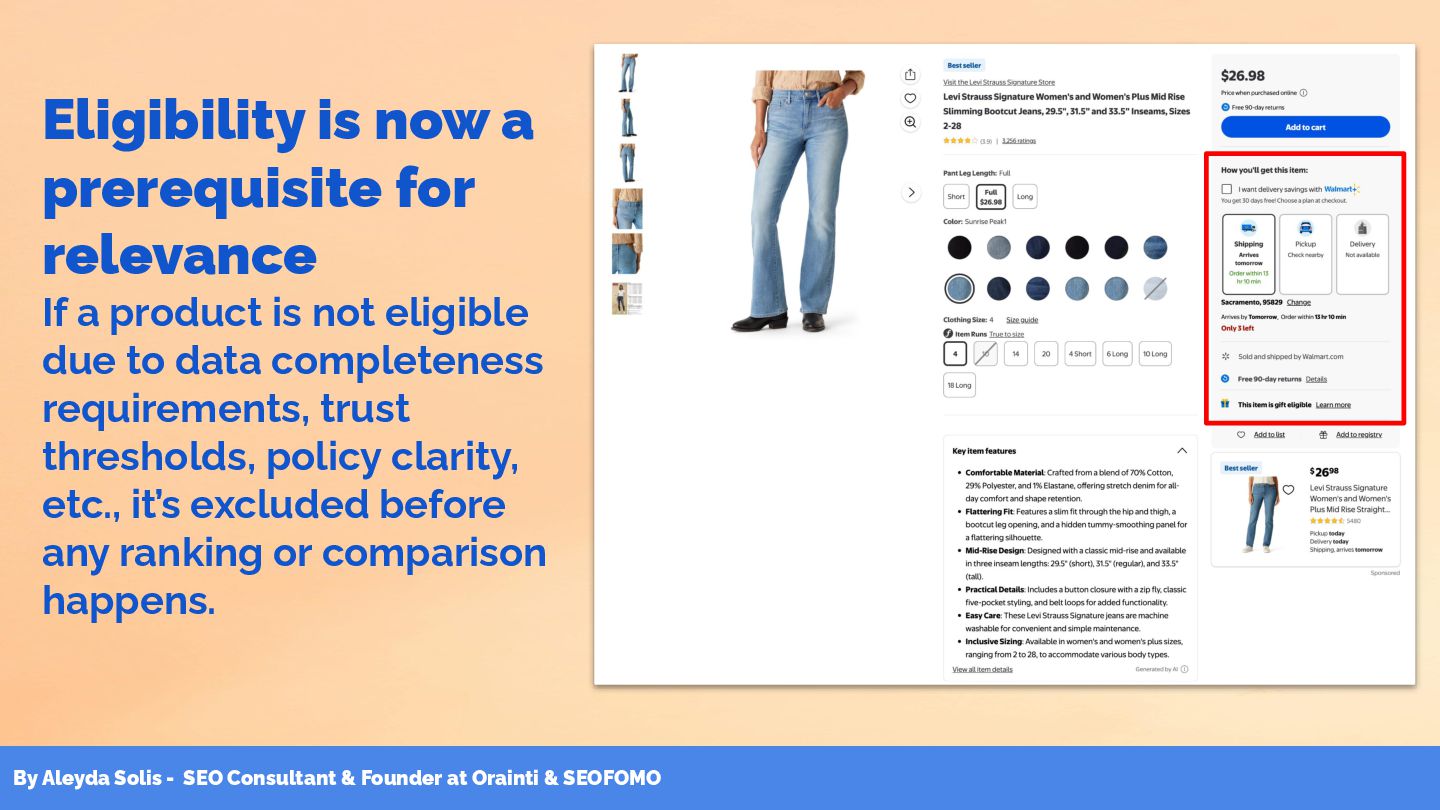
& SEOFOMO Eligibility is now a prerequisite for relevance If a product is not eligible due to data completeness requirements, trust thresholds, policy clarity, etc., it’s excluded before any ranking or comparison happens.
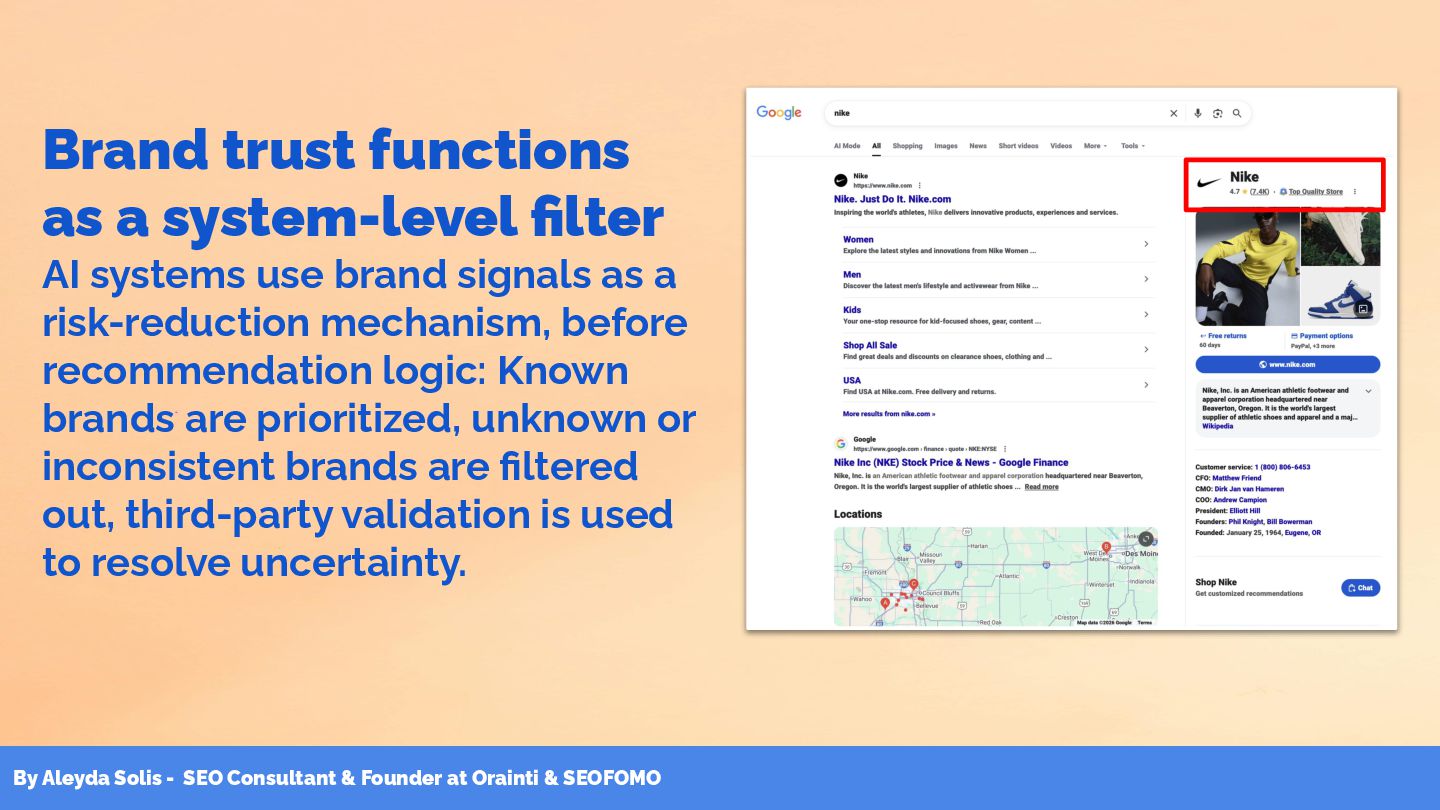
& SEOFOMO Brand trust functions as a system-level filter AI systems use brand signals as a risk-reduction mechanism, before recommendation logic: Known brands are prioritized, unknown or inconsistent brands are filtered out, third-party validation is used to resolve uncertainty.
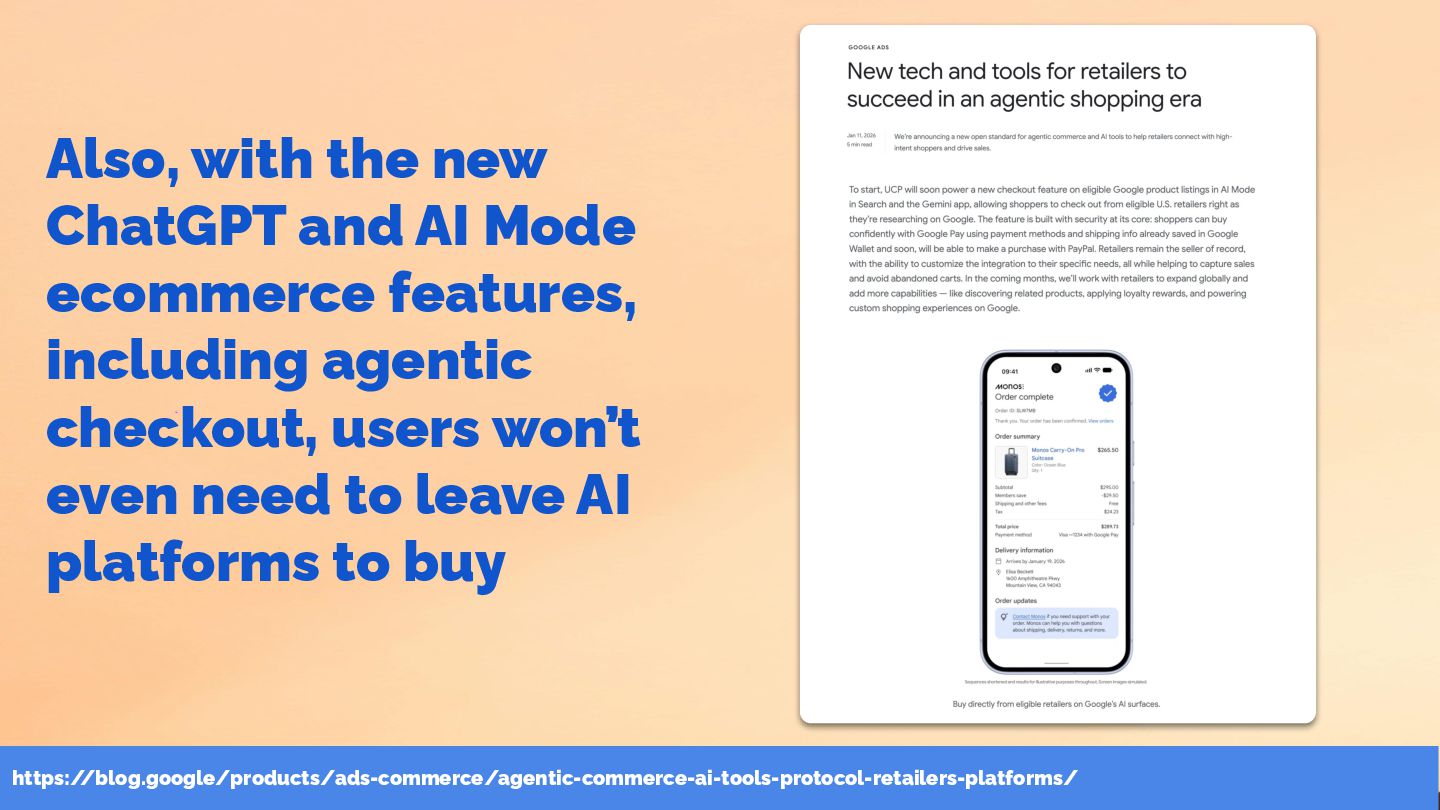
& SEOFOMO Transactions are becoming native to the AI search interface AI search platforms can now initiate checkout, complete orders, without sending users to the merchant site for every step.
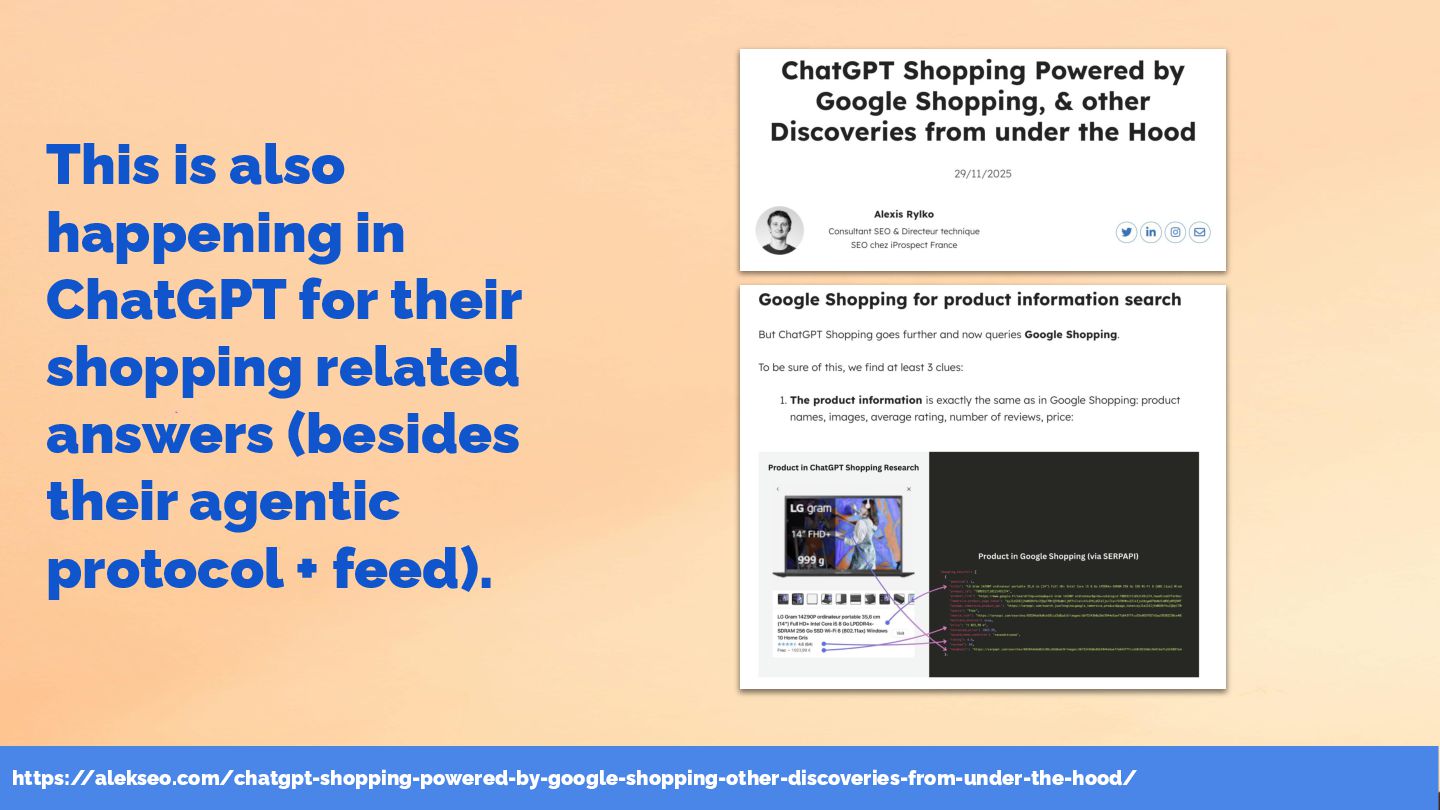
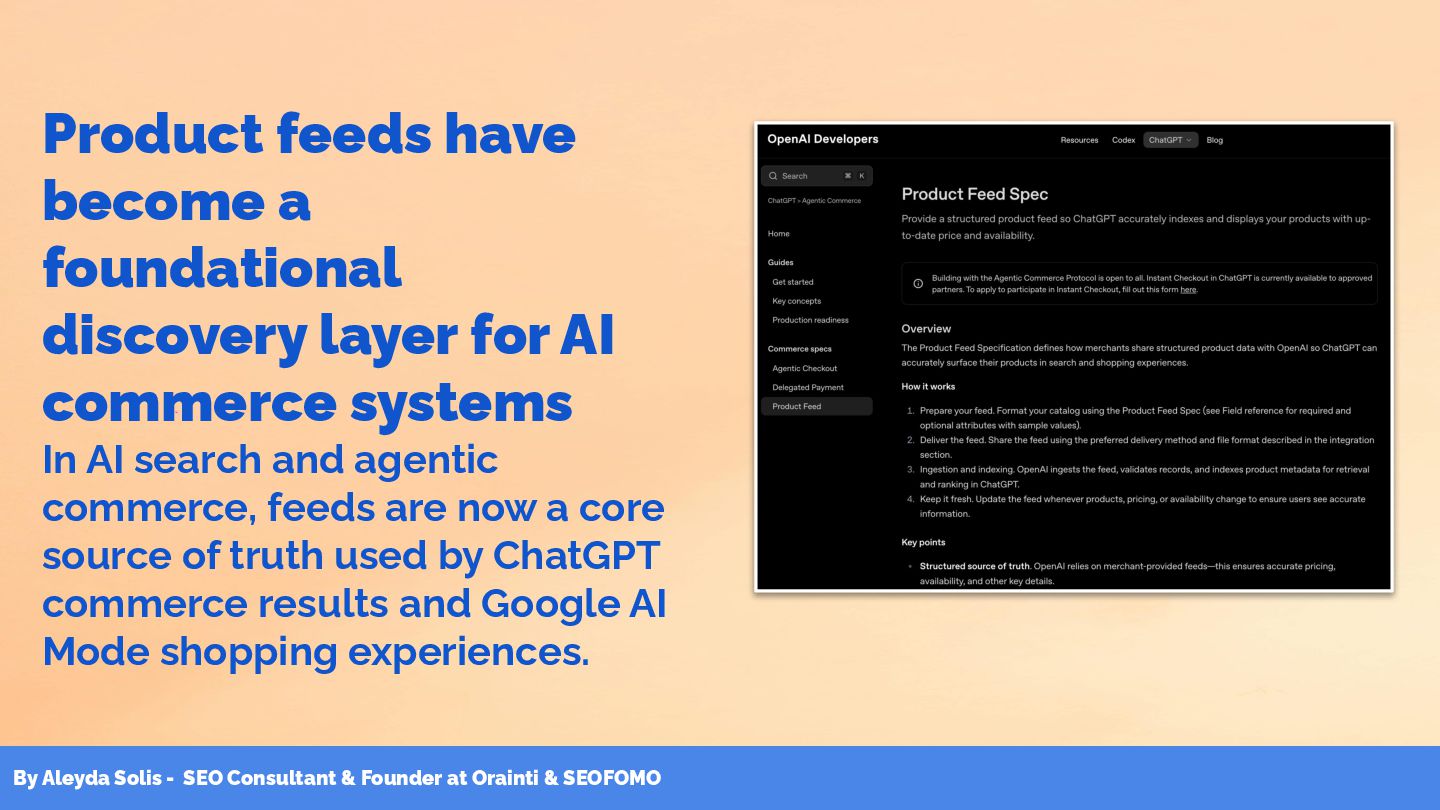
& SEOFOMO Product feeds have become a foundational discovery layer for AI commerce systems In AI search and agentic commerce, feeds are now a core source of truth used by ChatGPT commerce results and Google AI Mode shopping experiences.
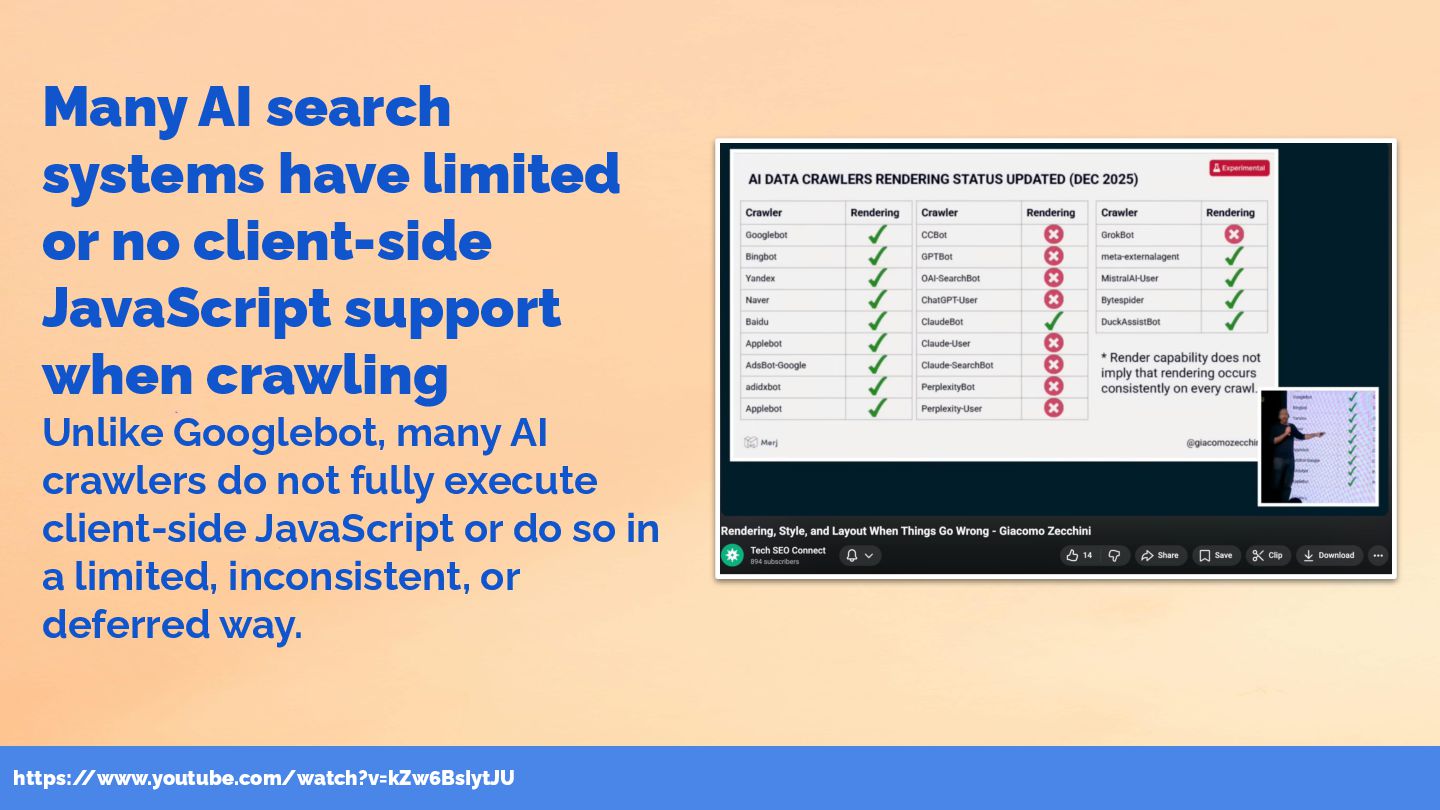
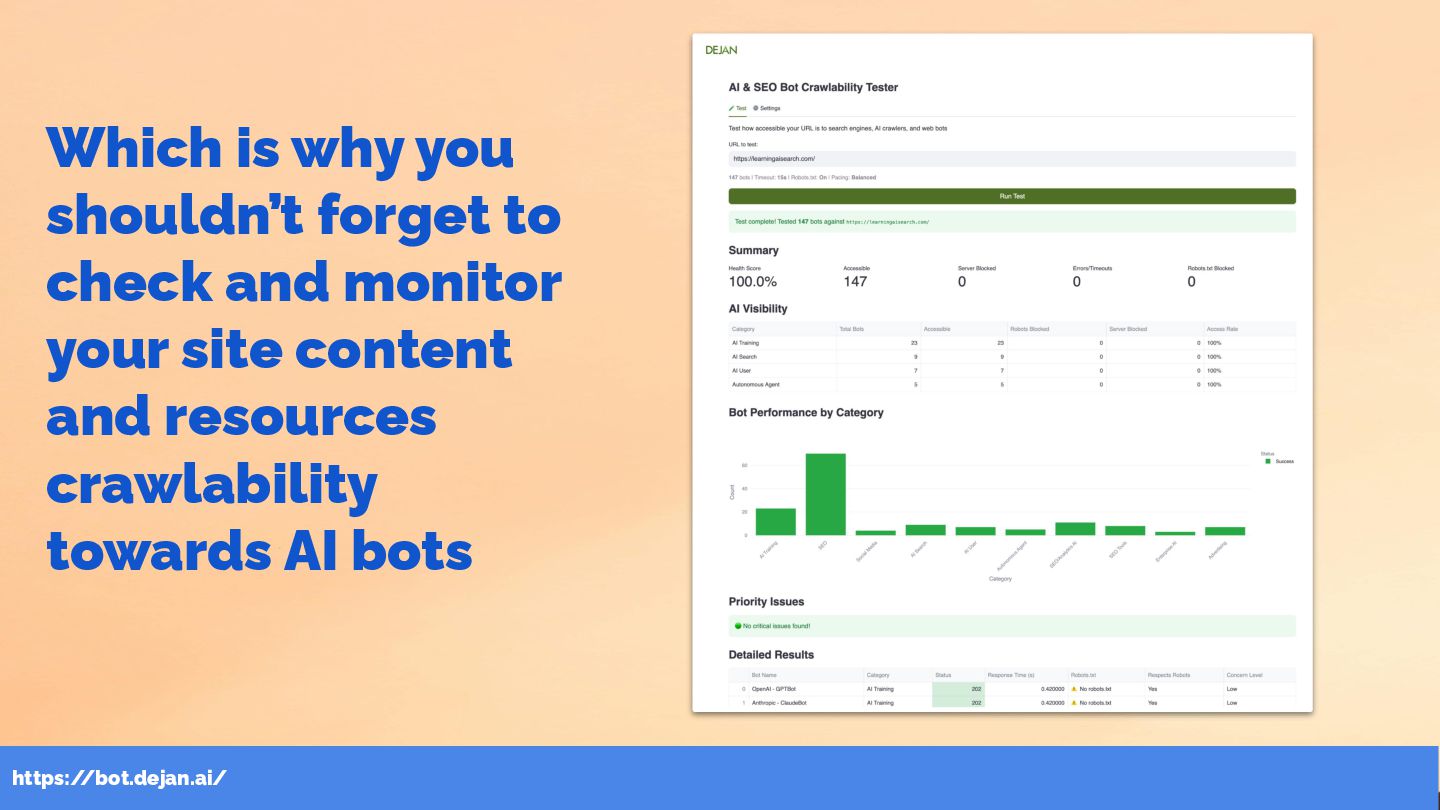
client-side JavaScript support when crawling Unlike Googlebot, many AI crawlers do not fully execute client-side JavaScript or do so in a limited, inconsistent, or deferred way.
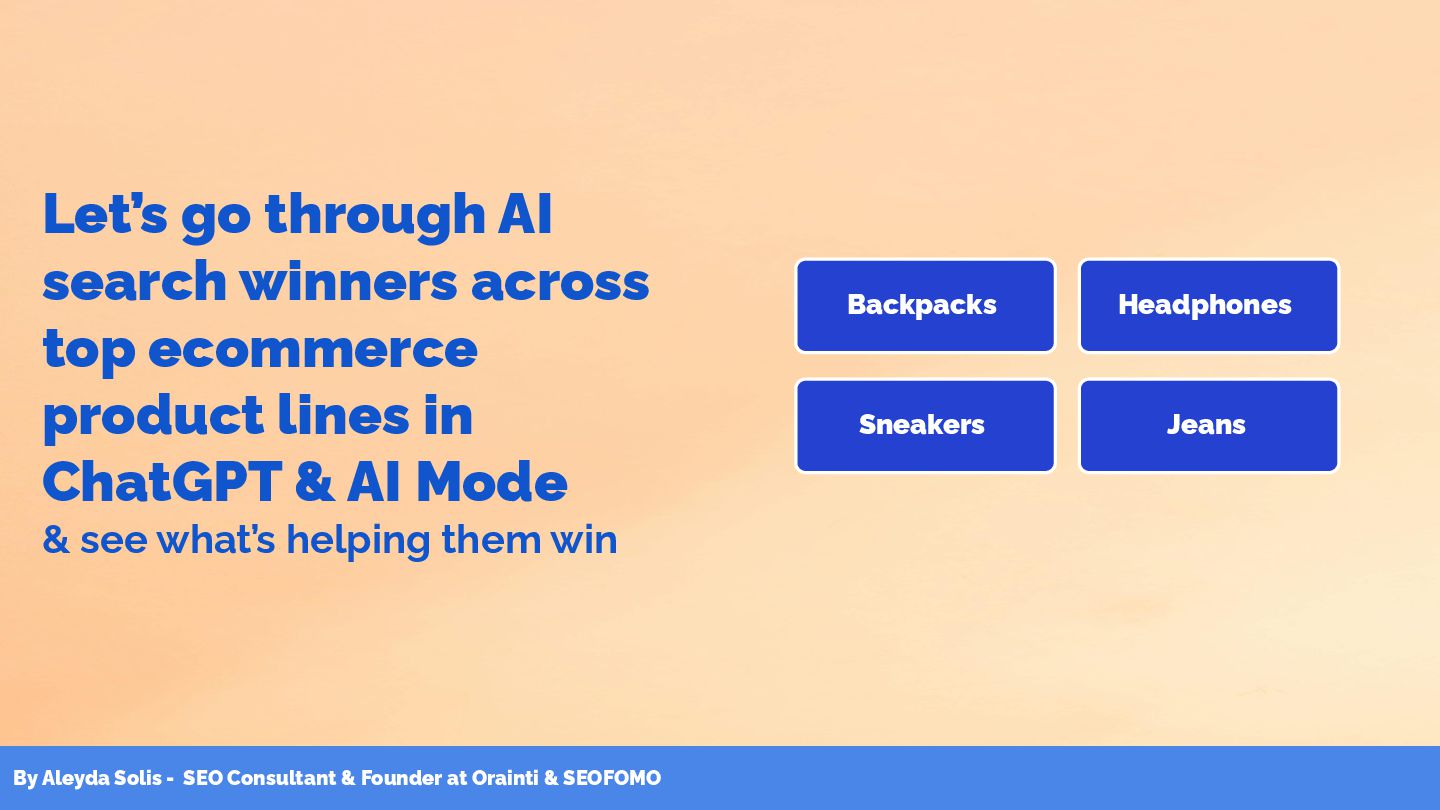
Orainti & SEOFOMO Let’s go through AI search winners across top ecommerce product lines in ChatGPT & AI Mode & see what’s helping them win Headphones Sneakers Jeans
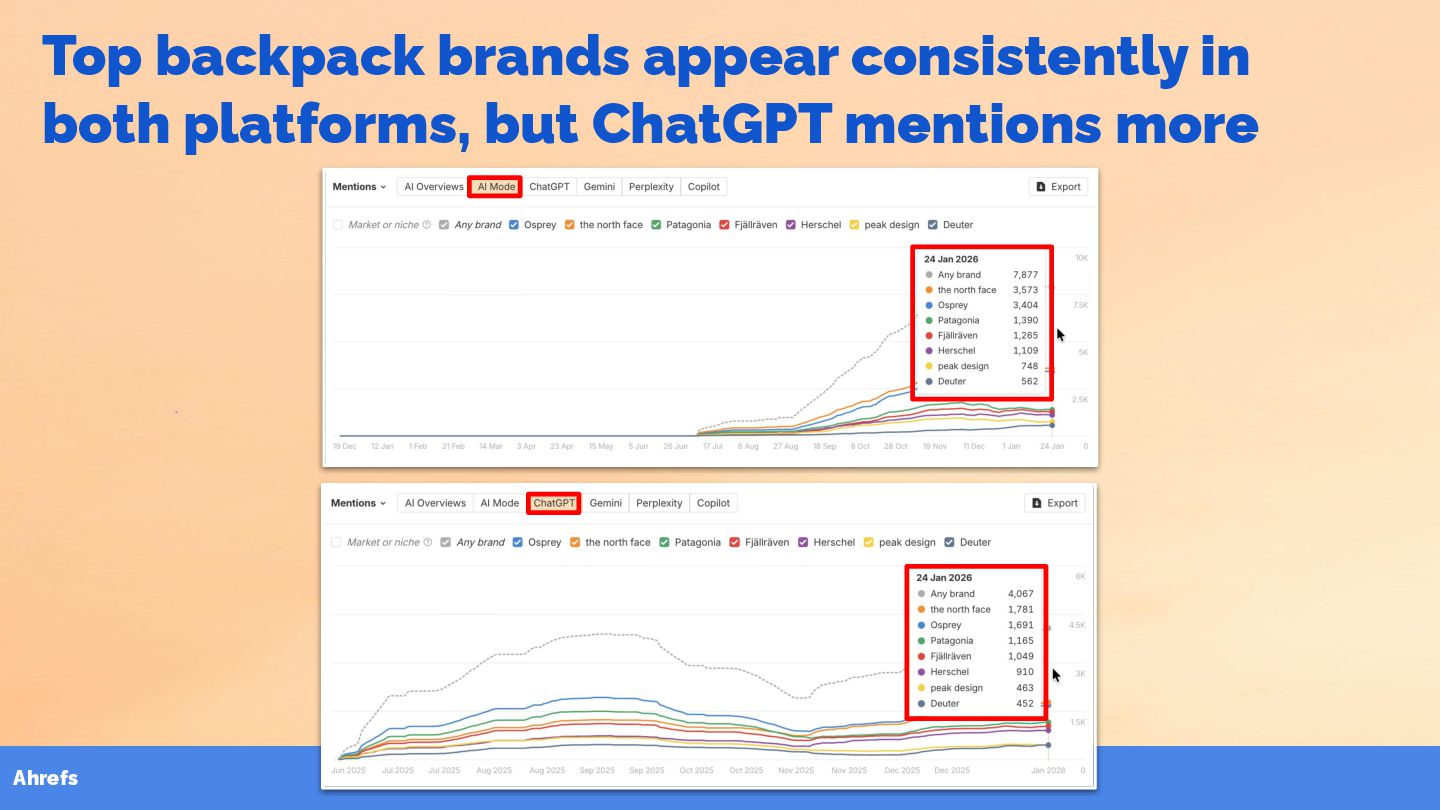
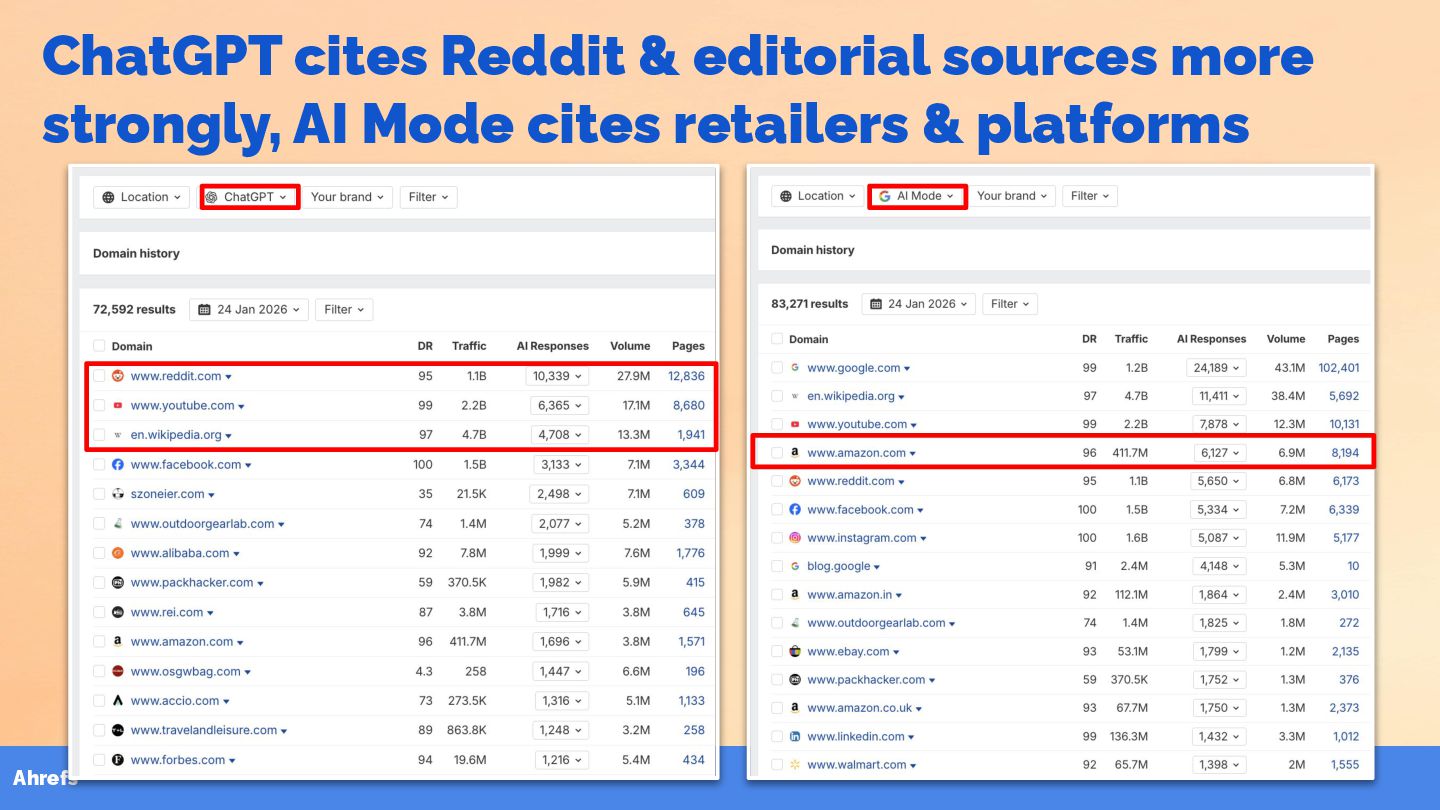
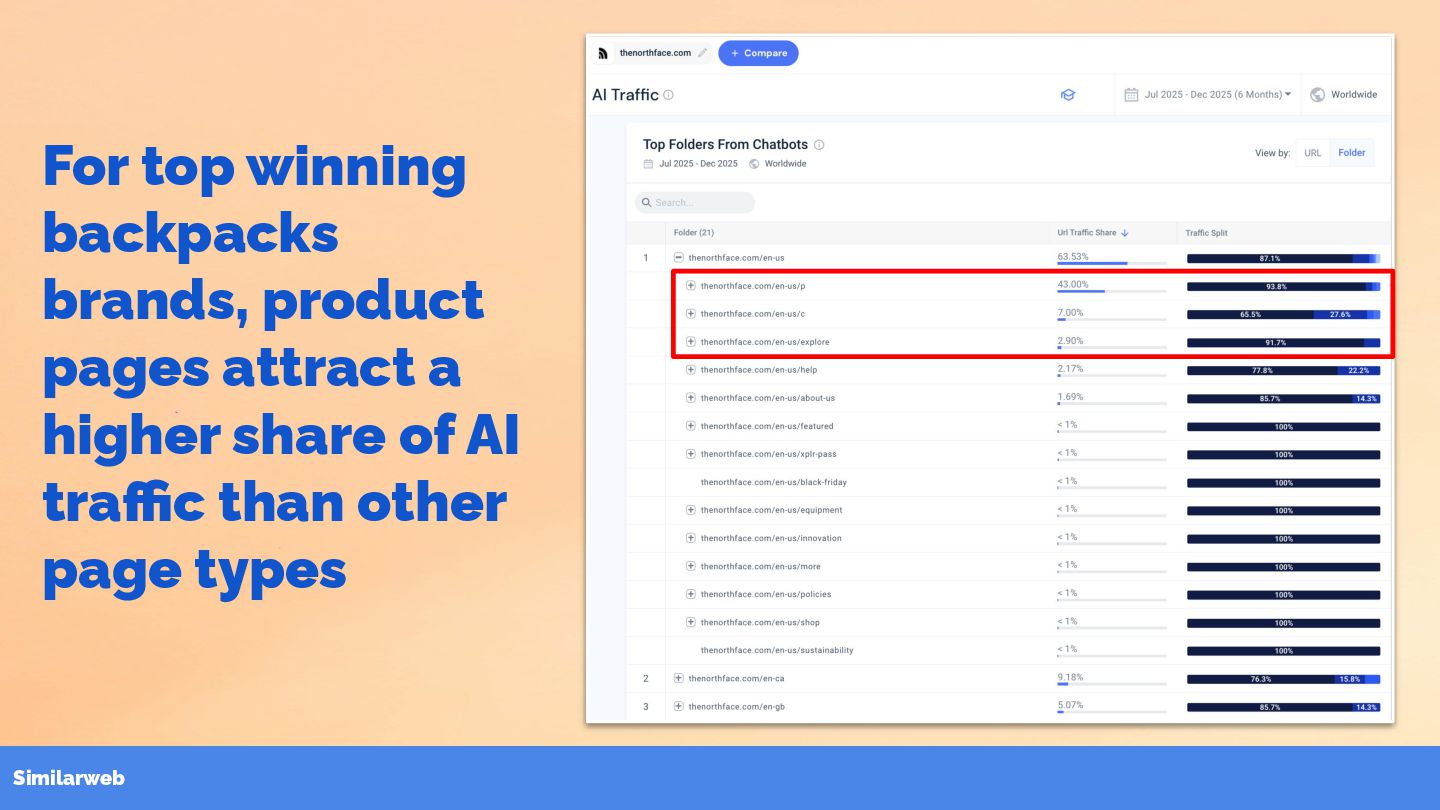
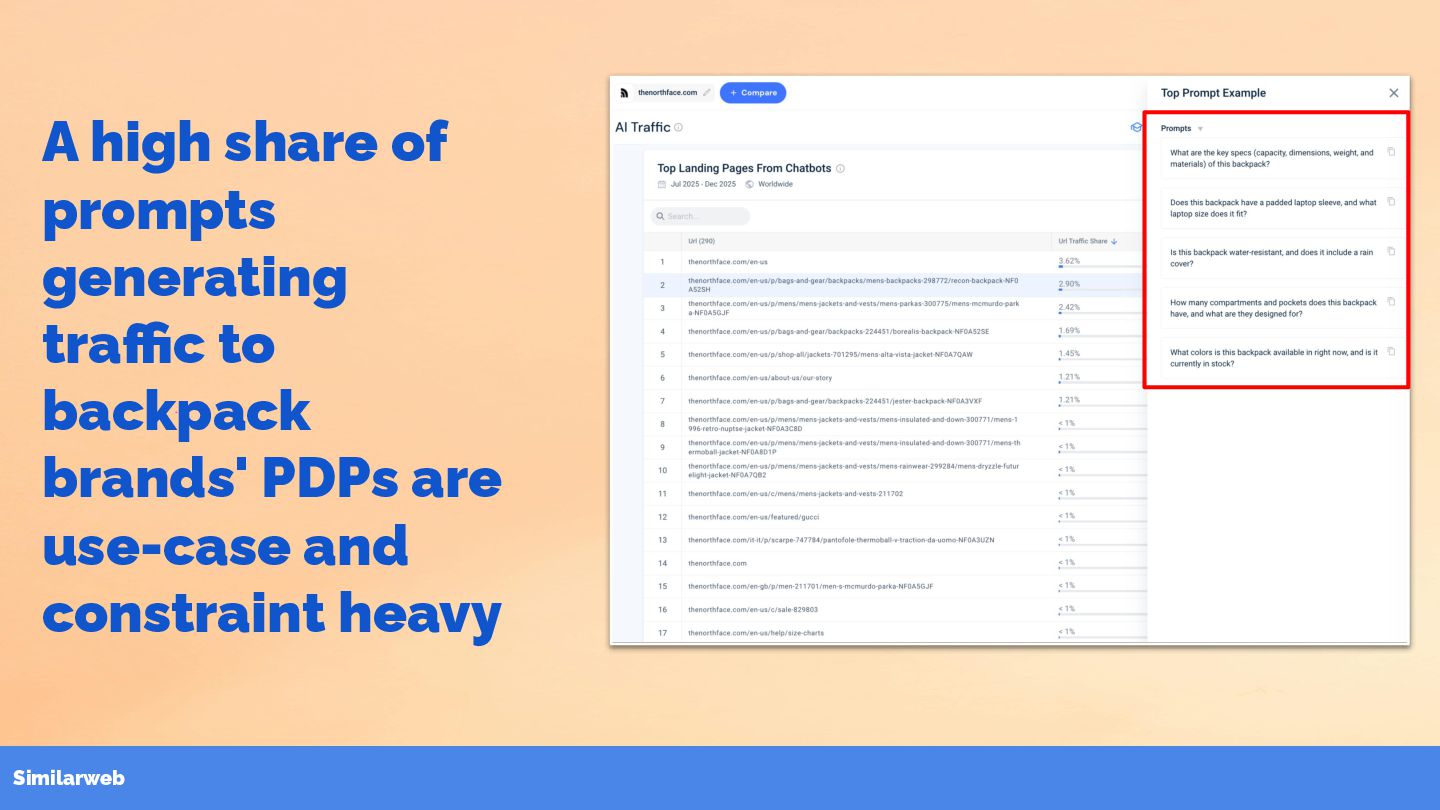
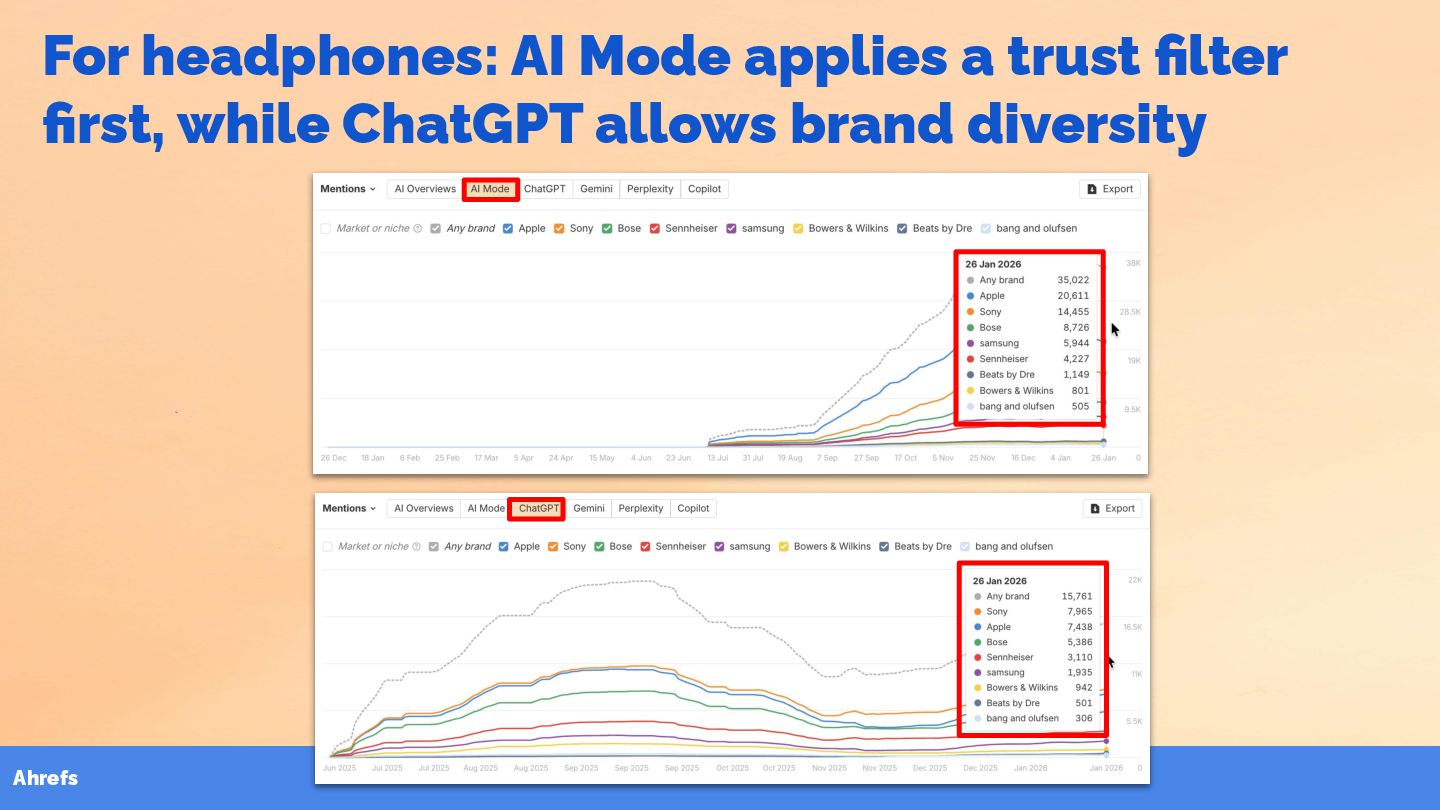
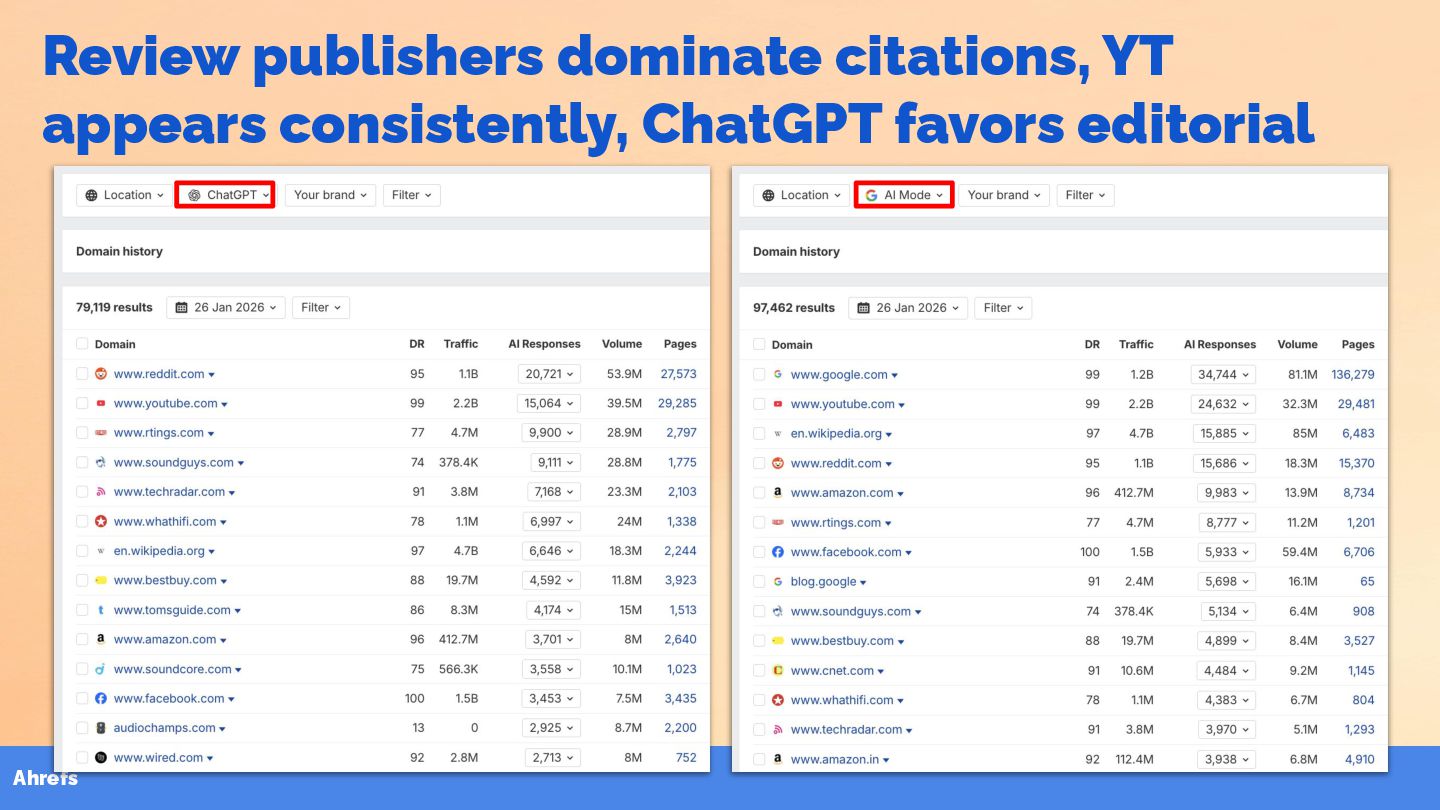
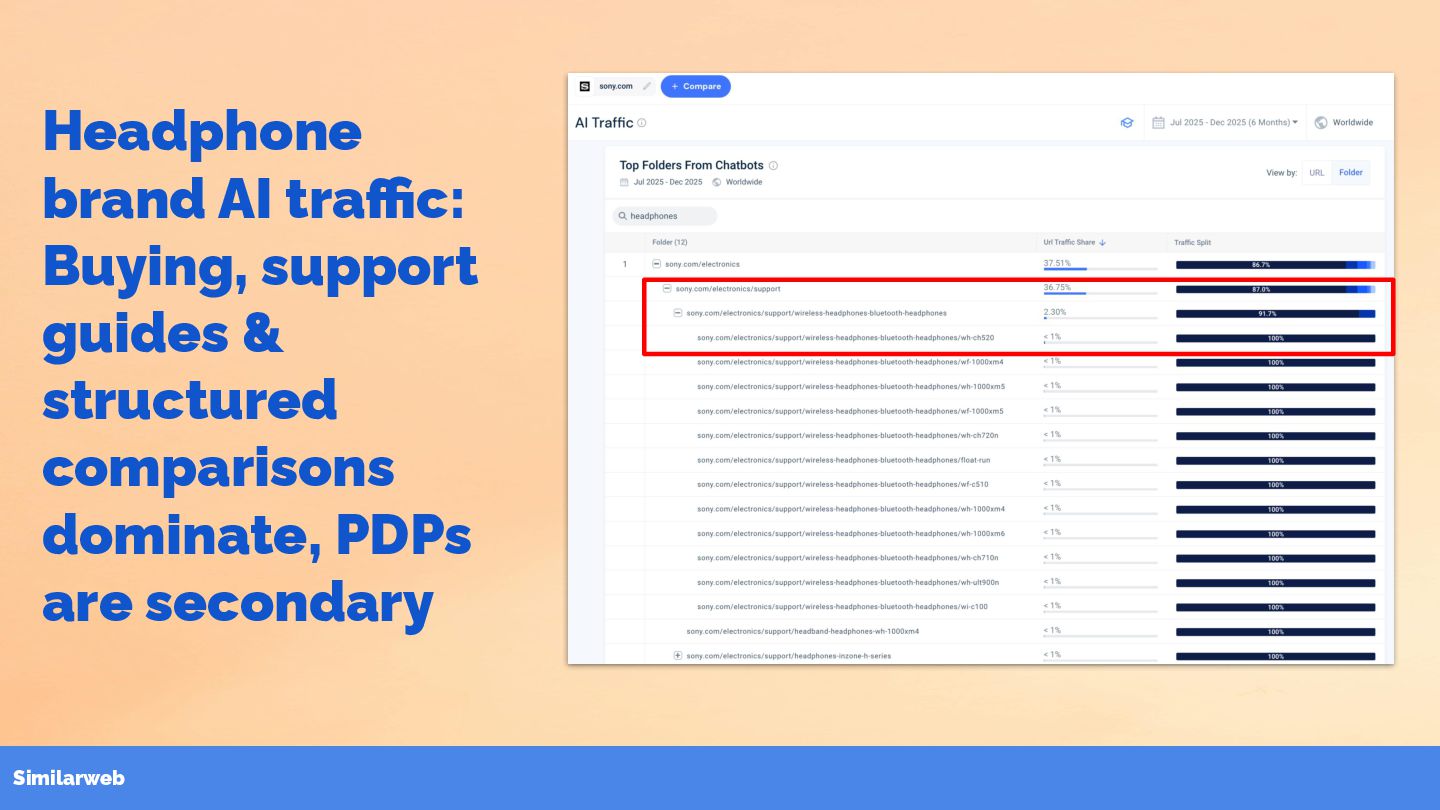
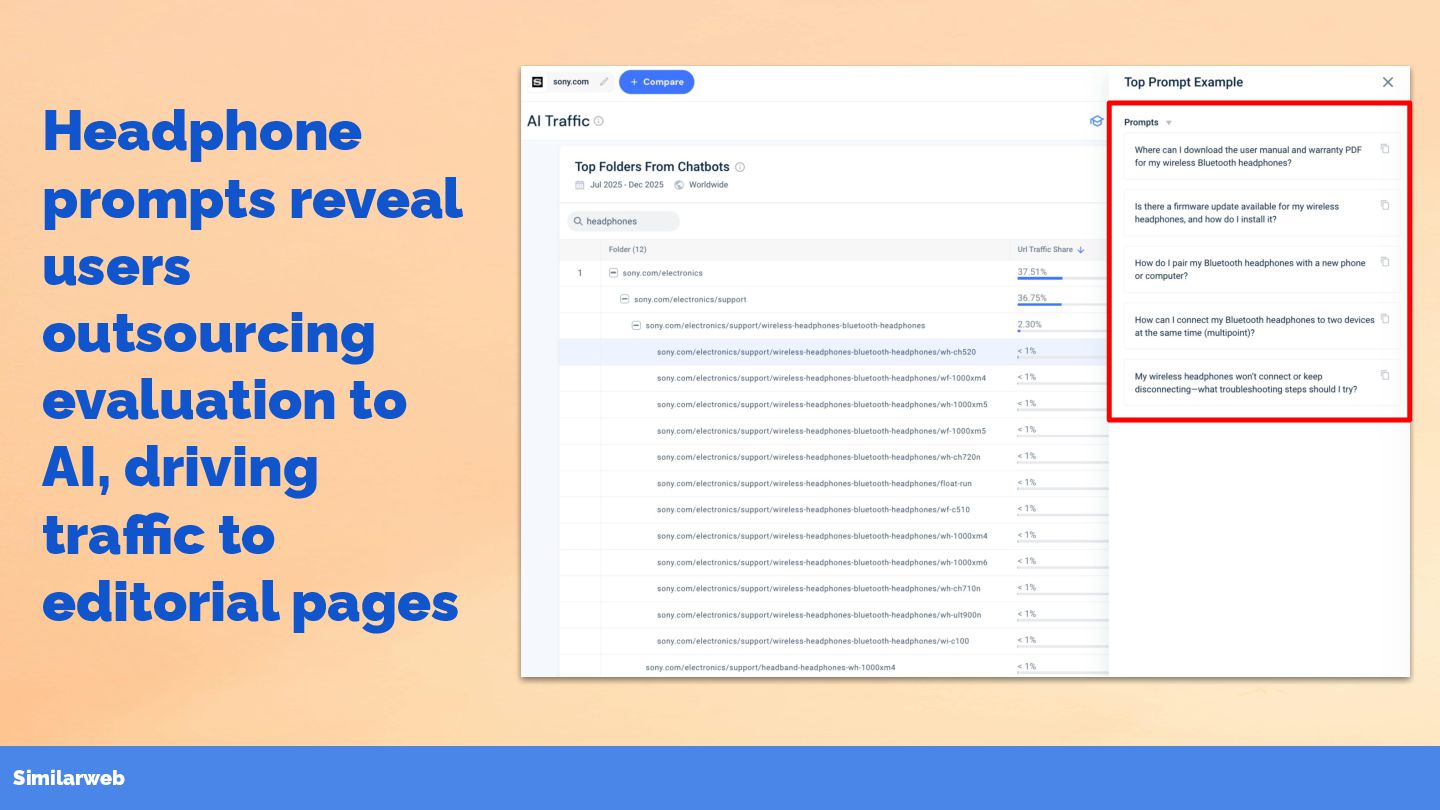
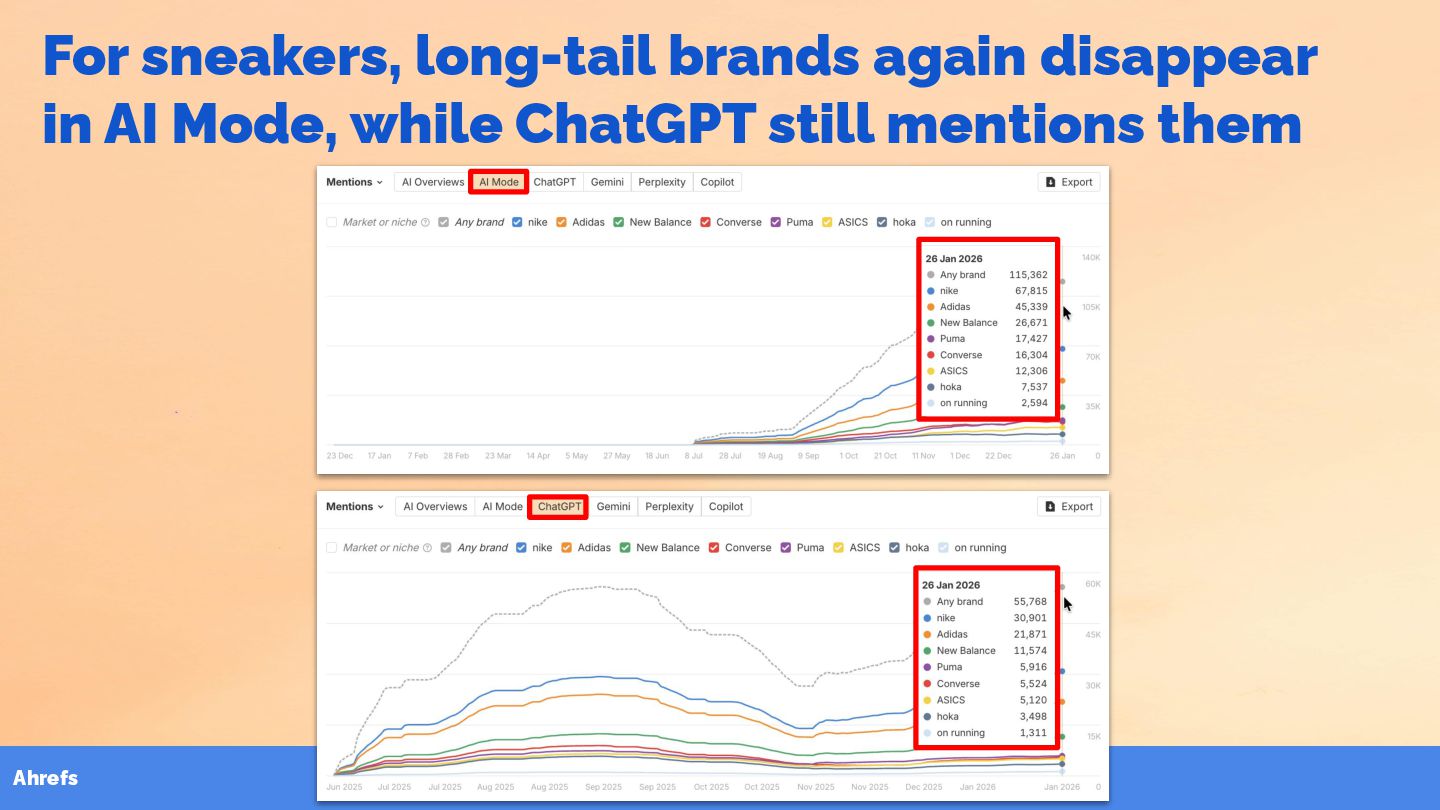
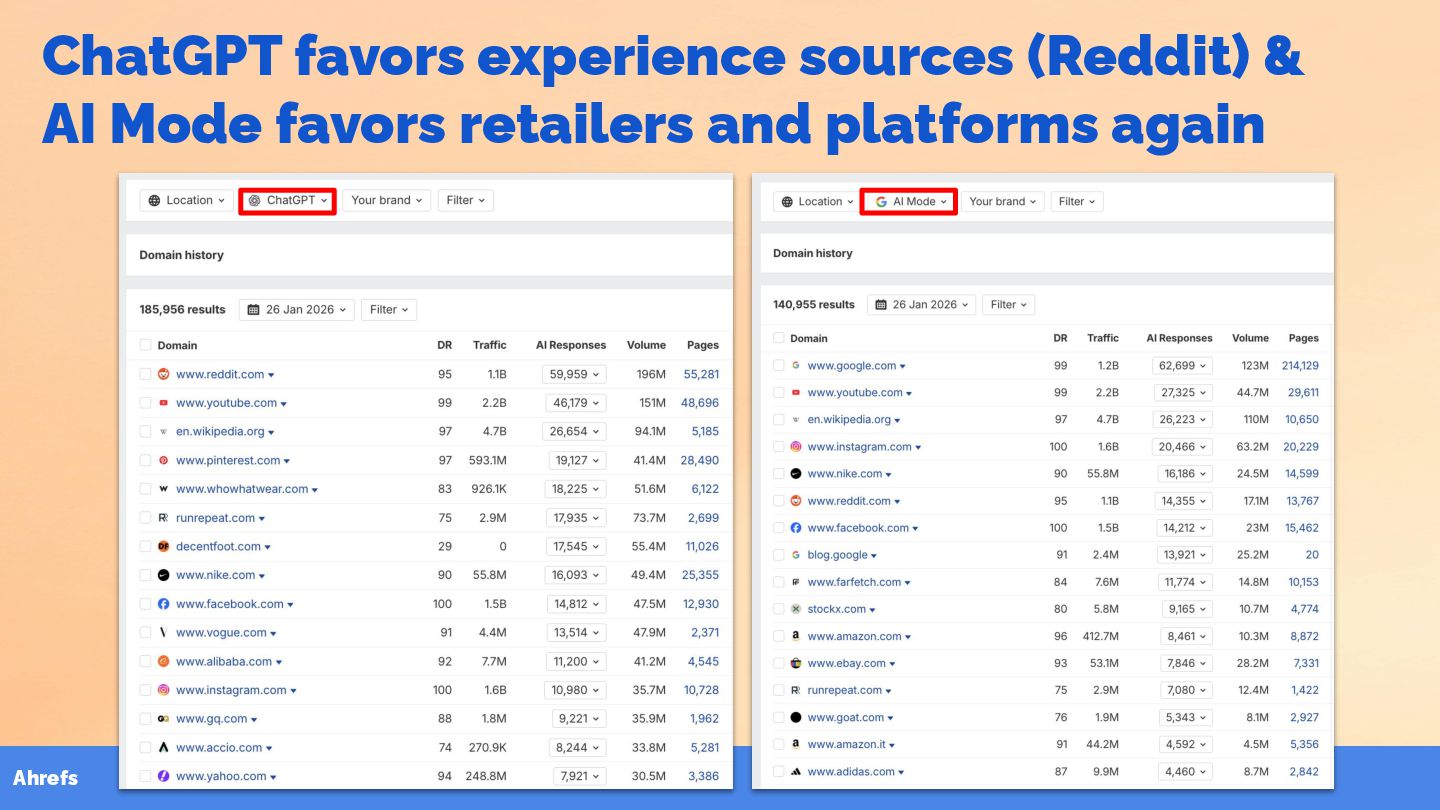
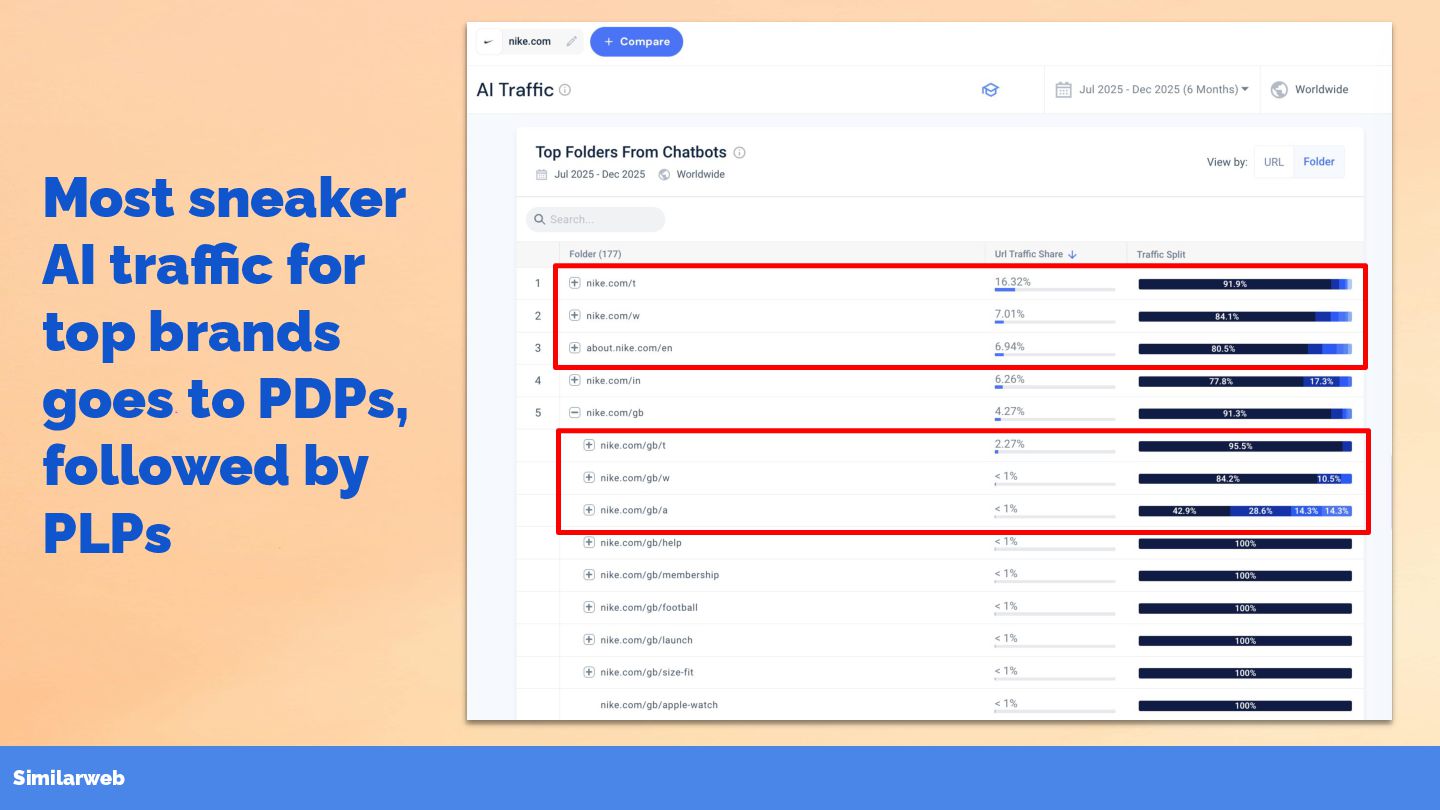
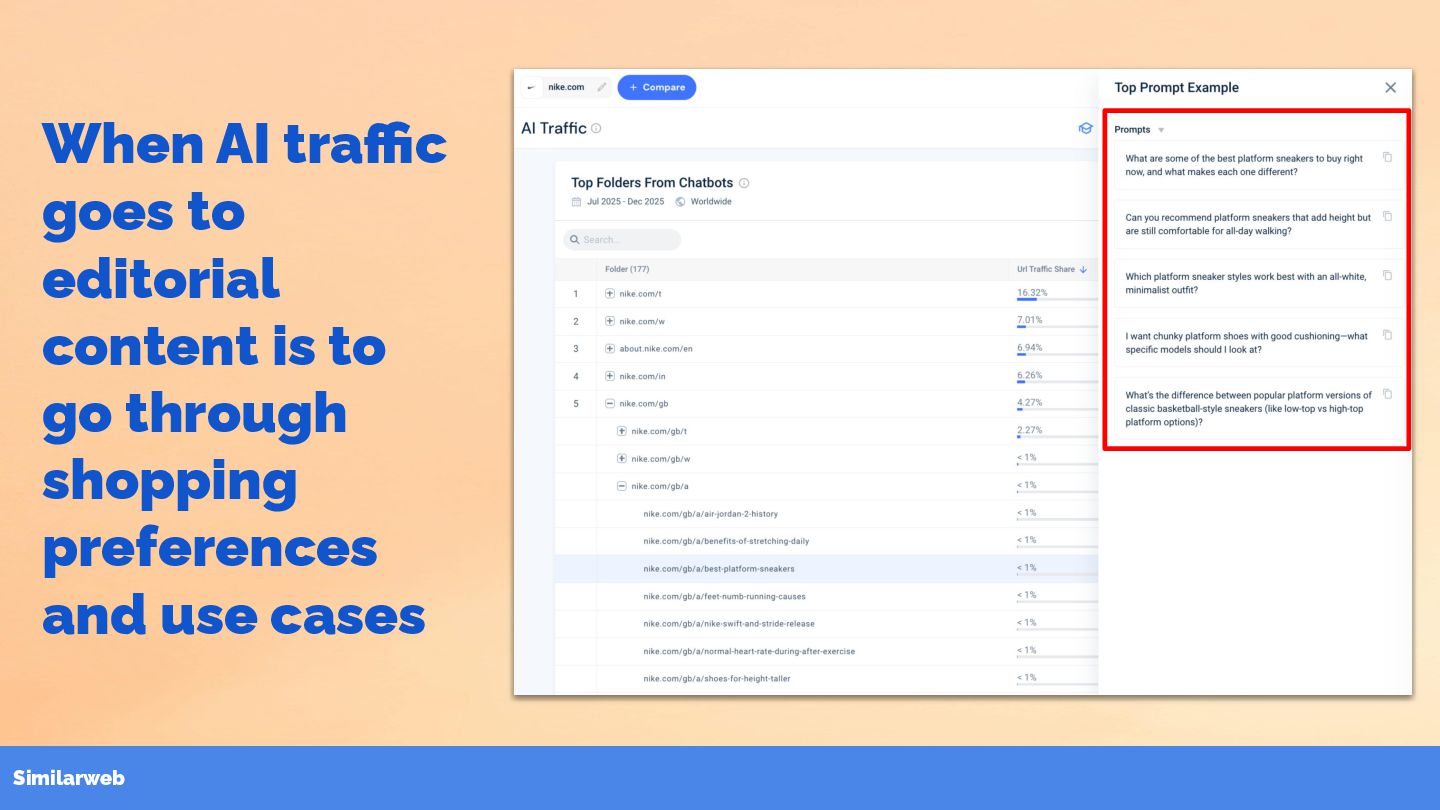
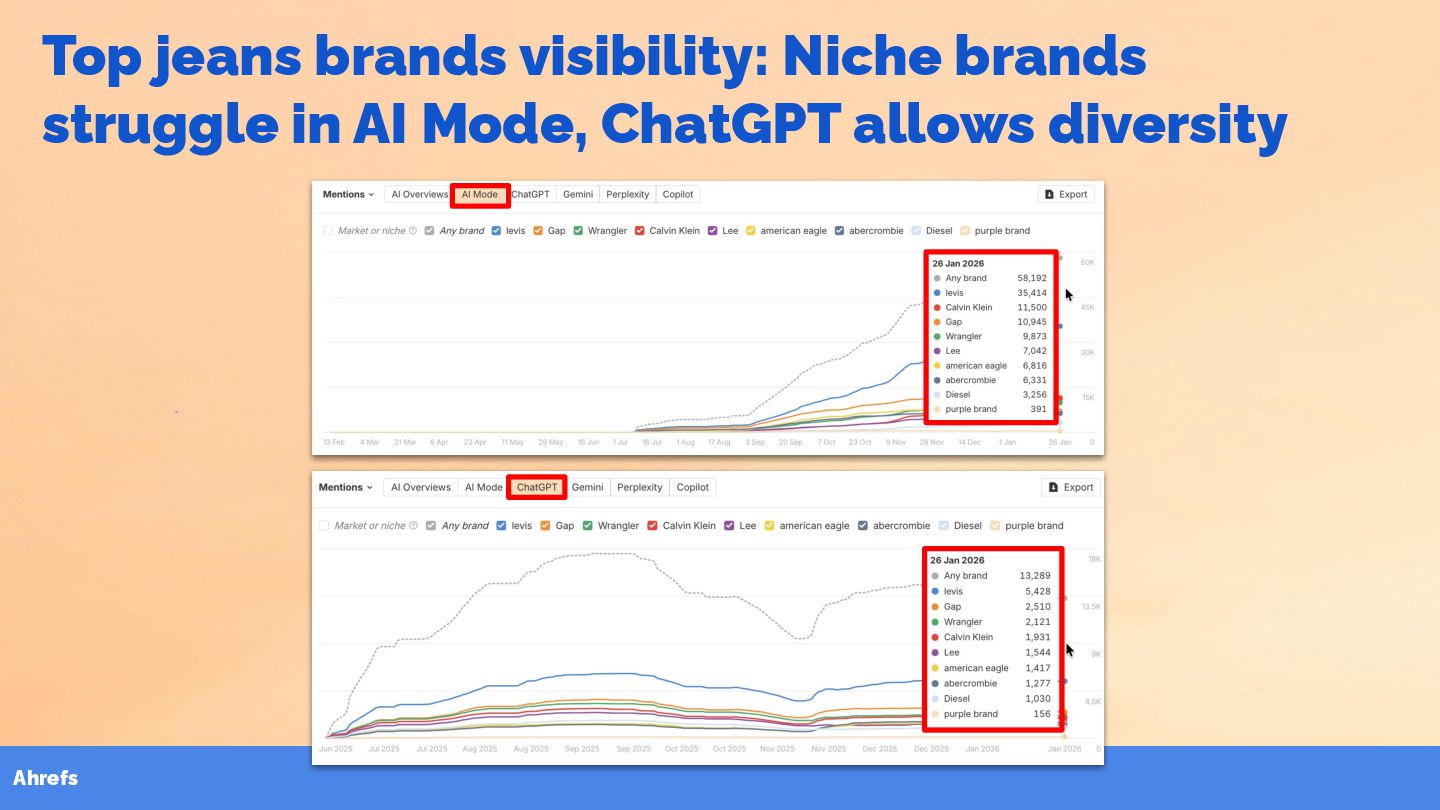
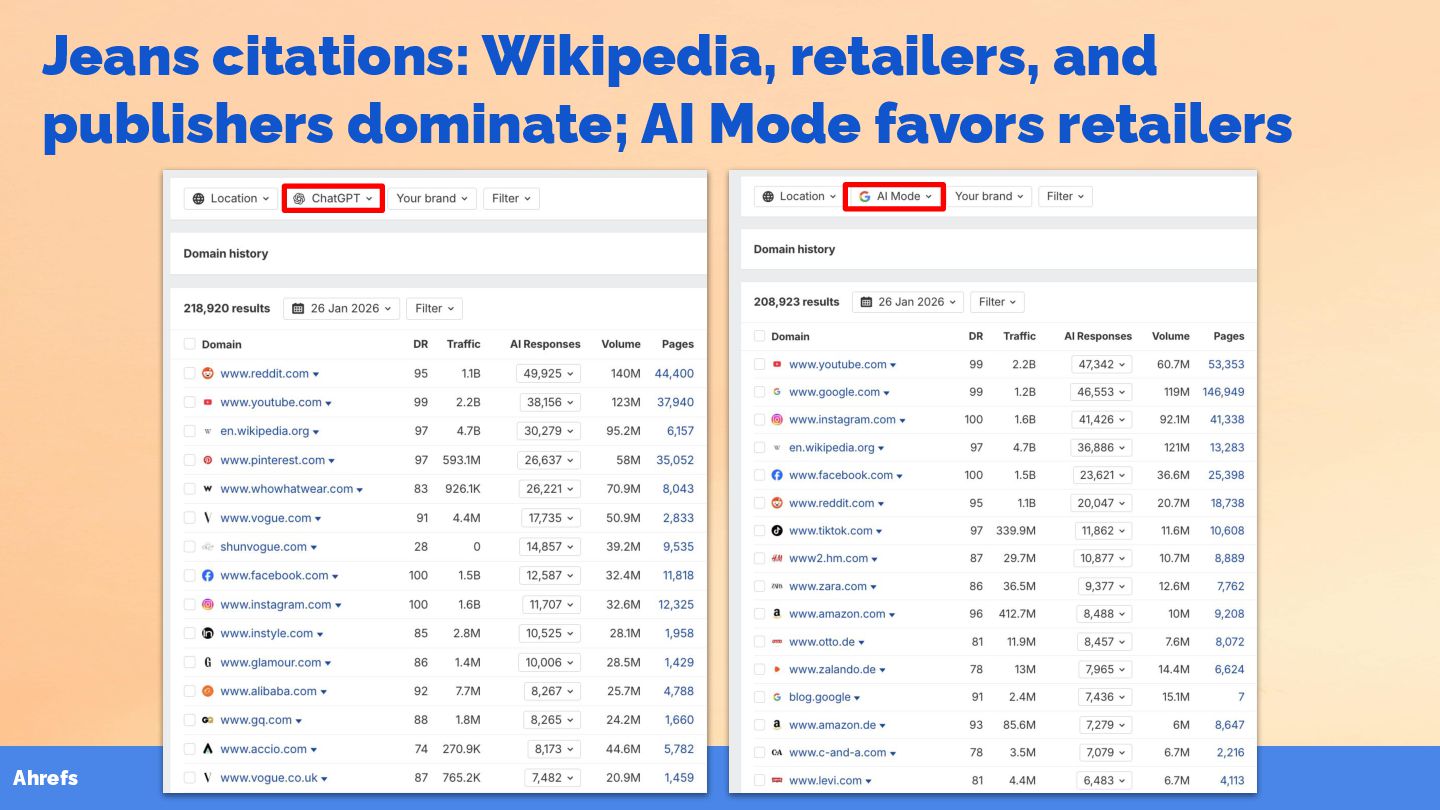
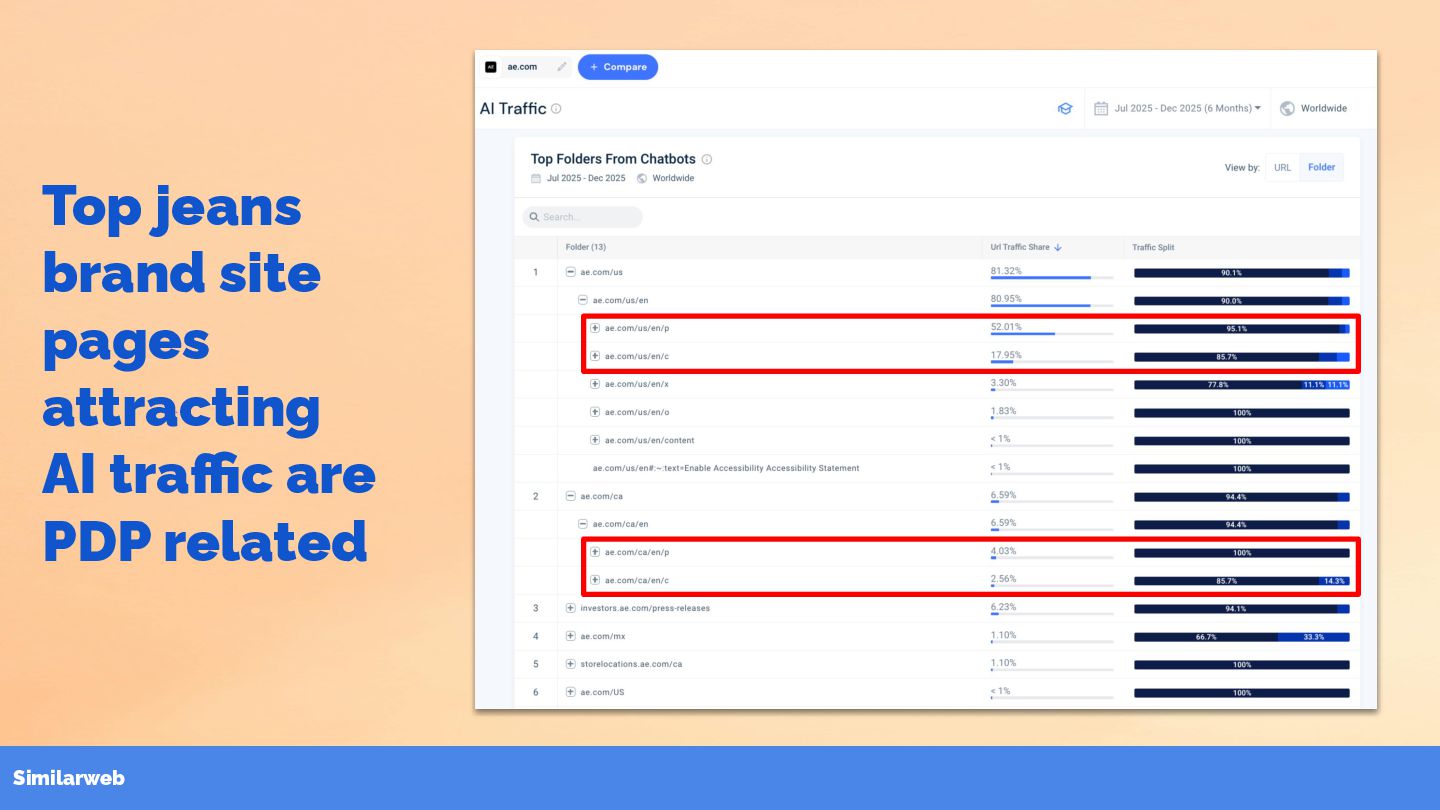
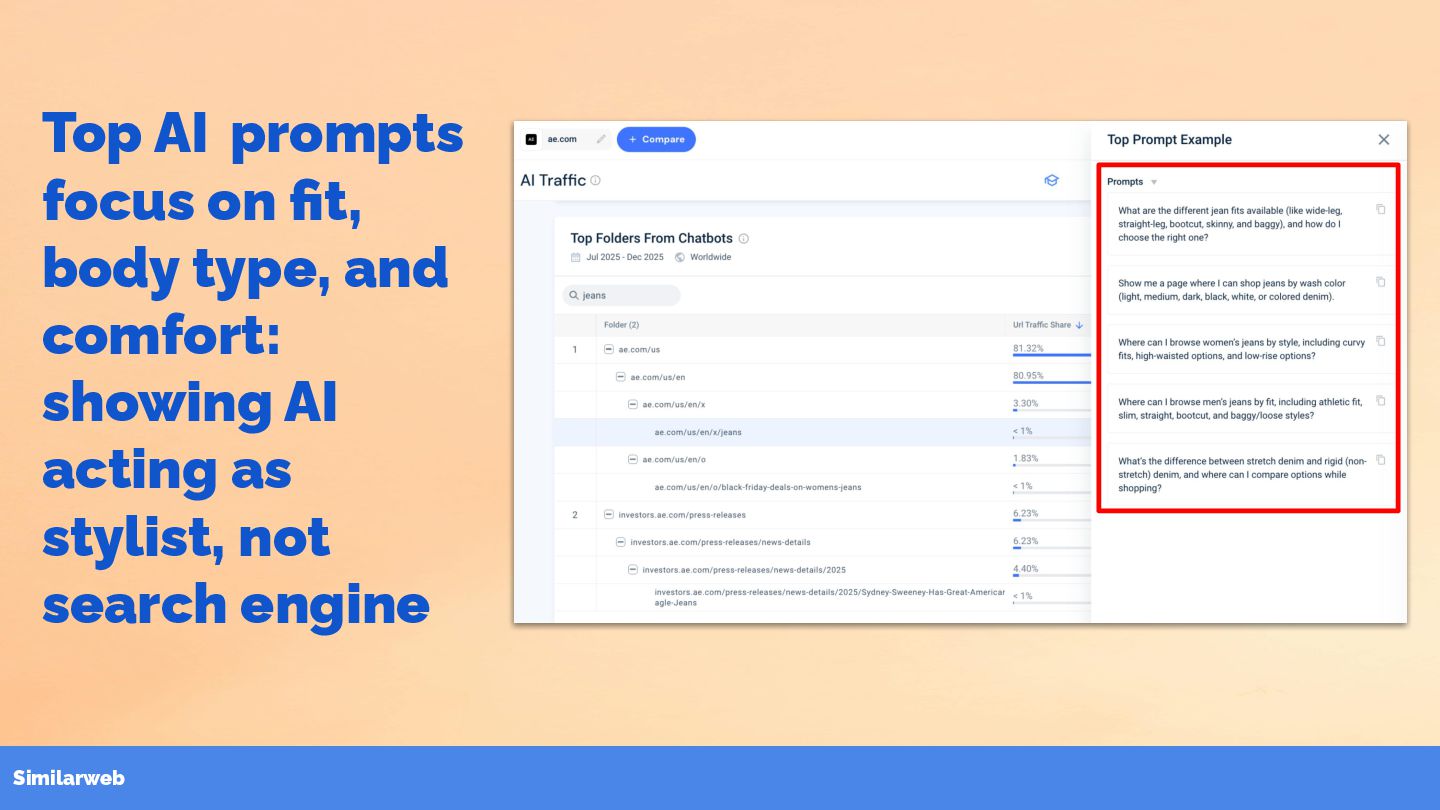
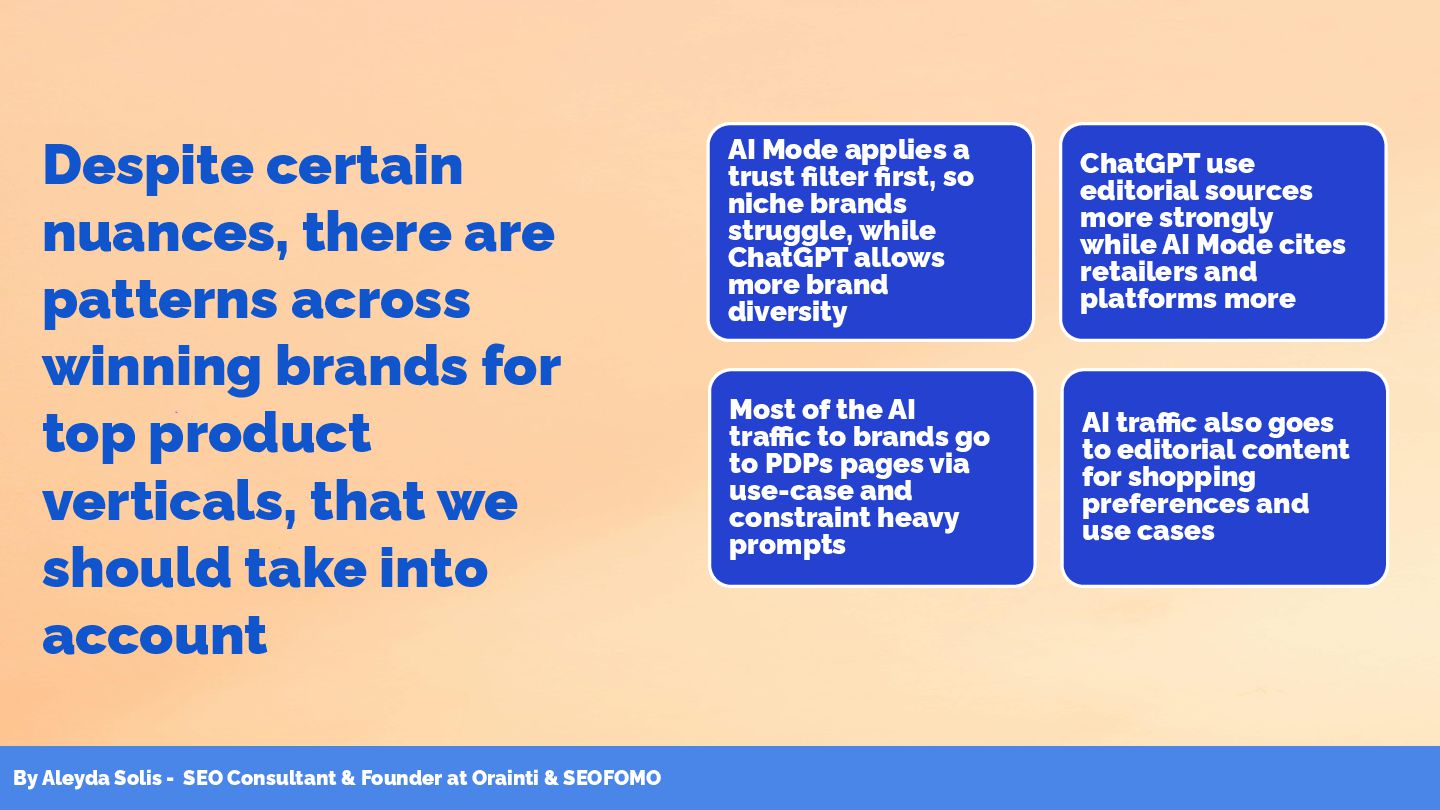
& SEOFOMO Despite certain nuances, there are patterns across winning brands for top product verticals, that we should take into account AI Mode applies a trust filter first, so niche brands struggle, while ChatGPT allows more brand diversity ChatGPT use editorial sources more strongly while AI Mode cites retailers and platforms more Most of the AI traffic to brands go to PDPs pages via use-case and constraint heavy prompts AI traffic also goes to editorial content for shopping preferences and use cases
& SEOFOMO 3. What can we do to win with these ecommerce shifts & patterns in AI search? By Aleyda Solis - SEO Consultant & Founder at Orainti & SEOFOMO
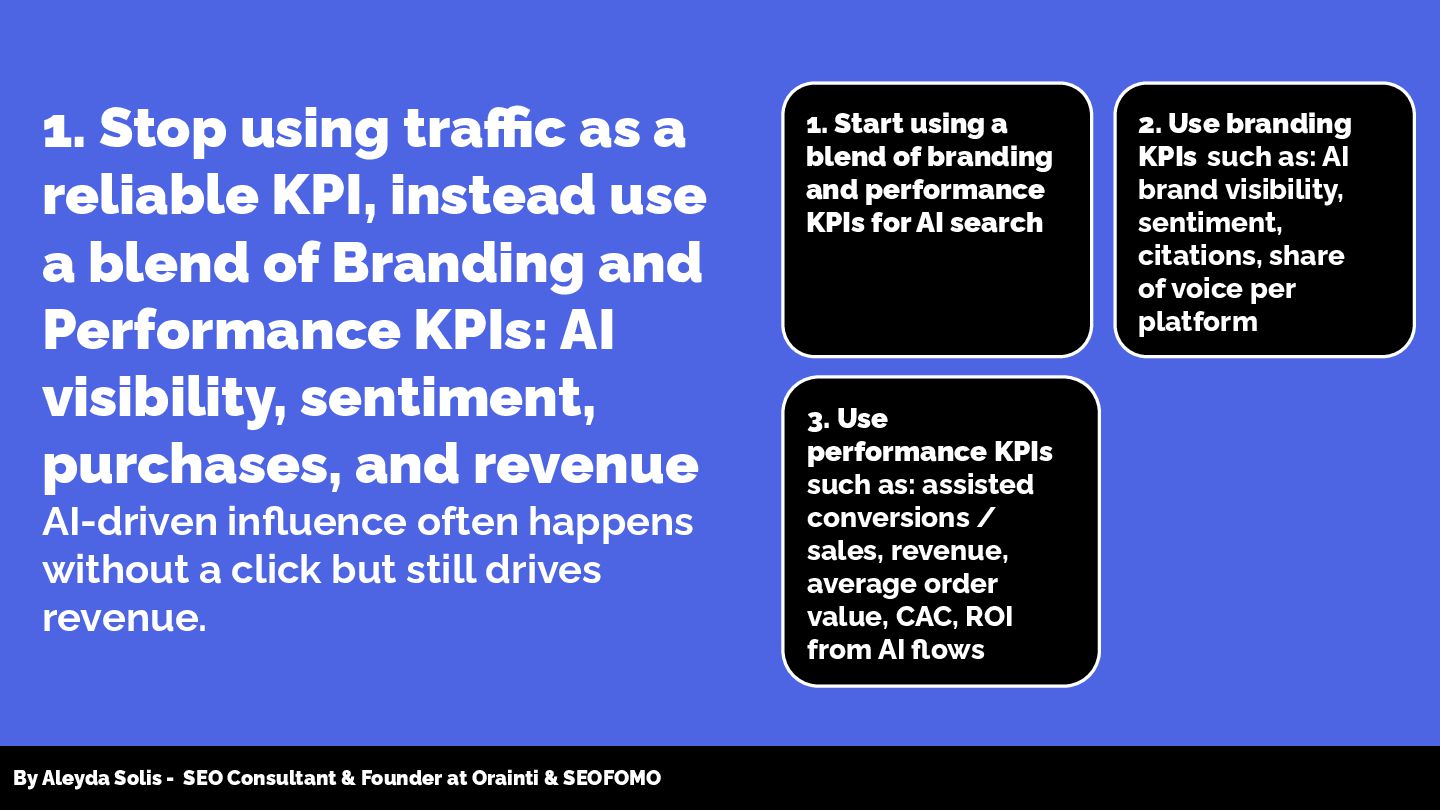
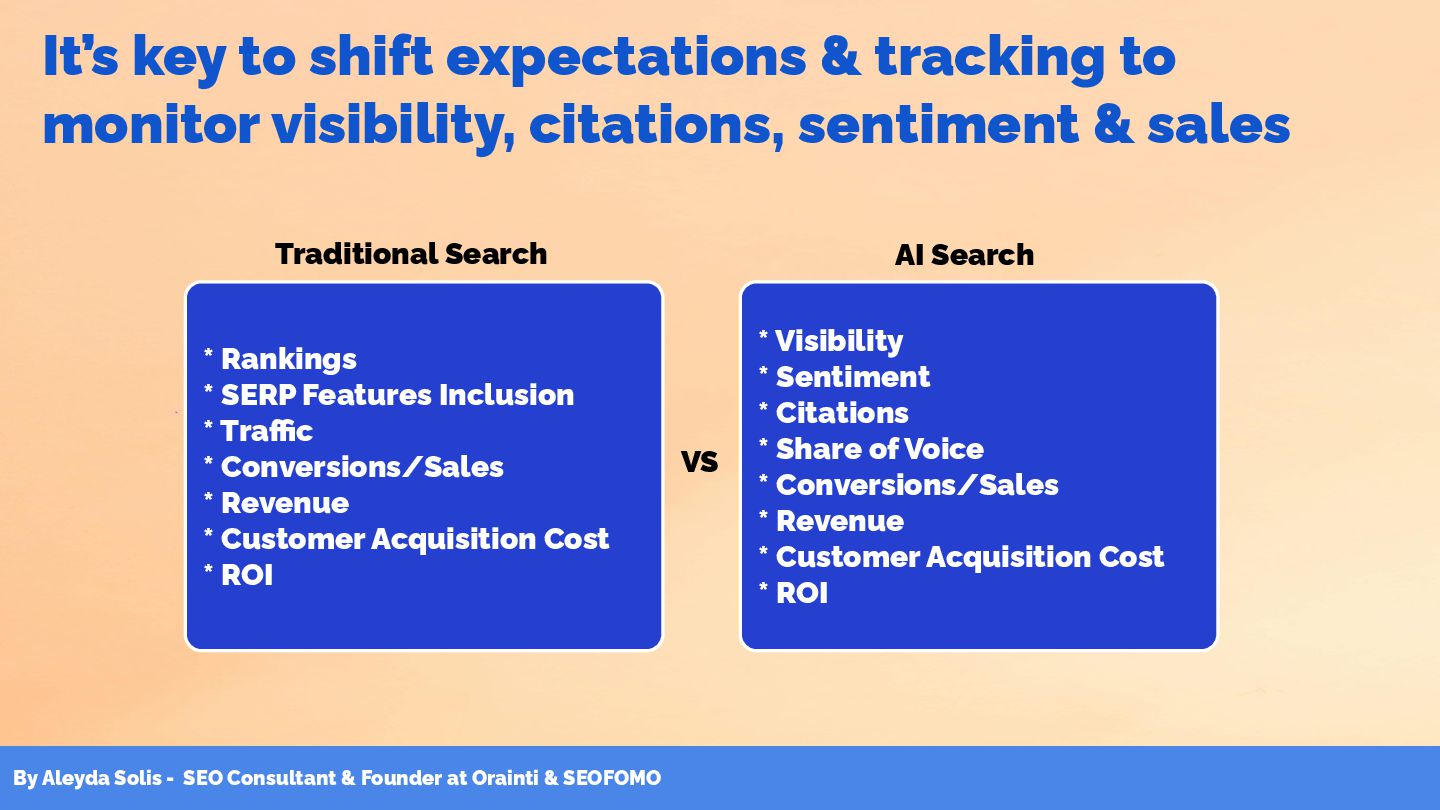
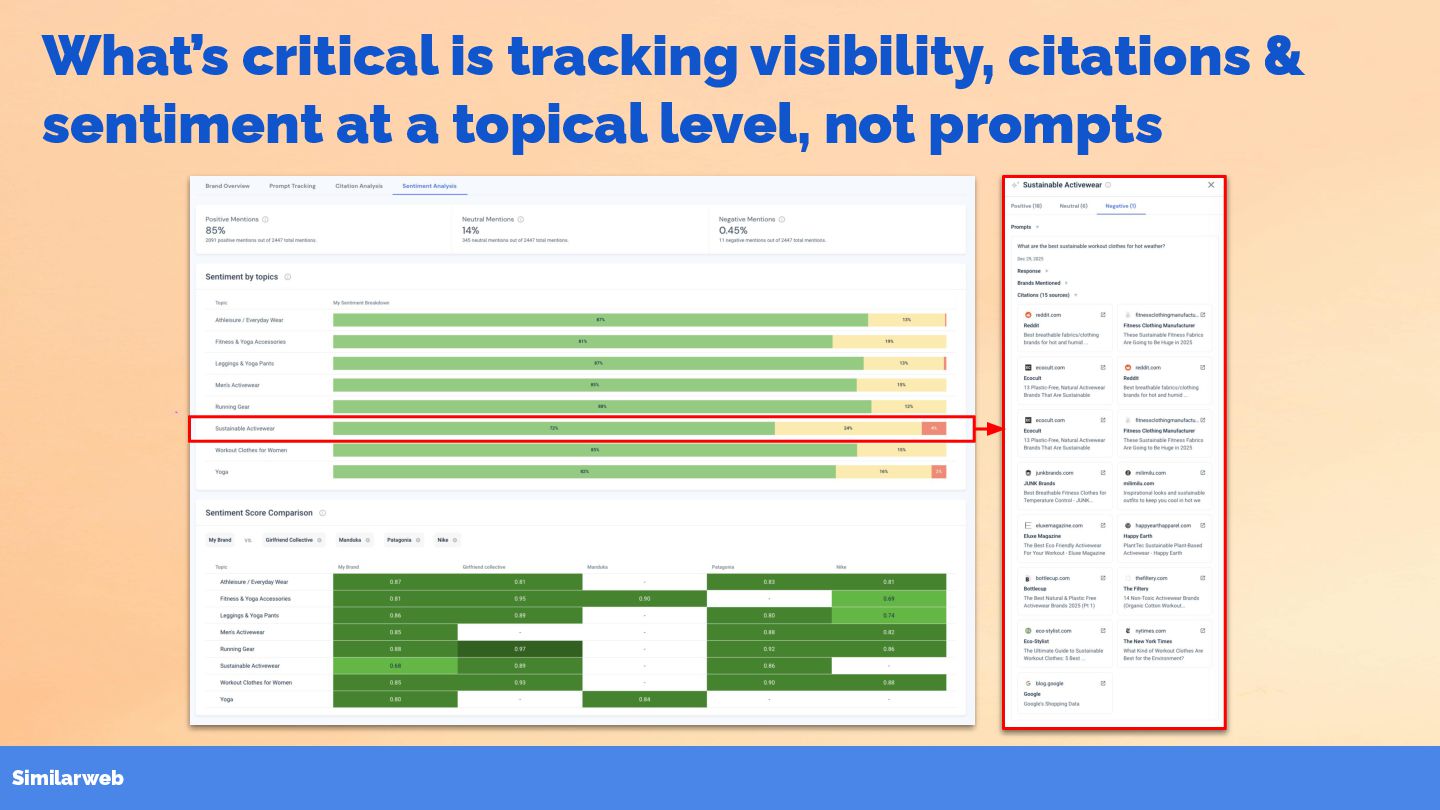
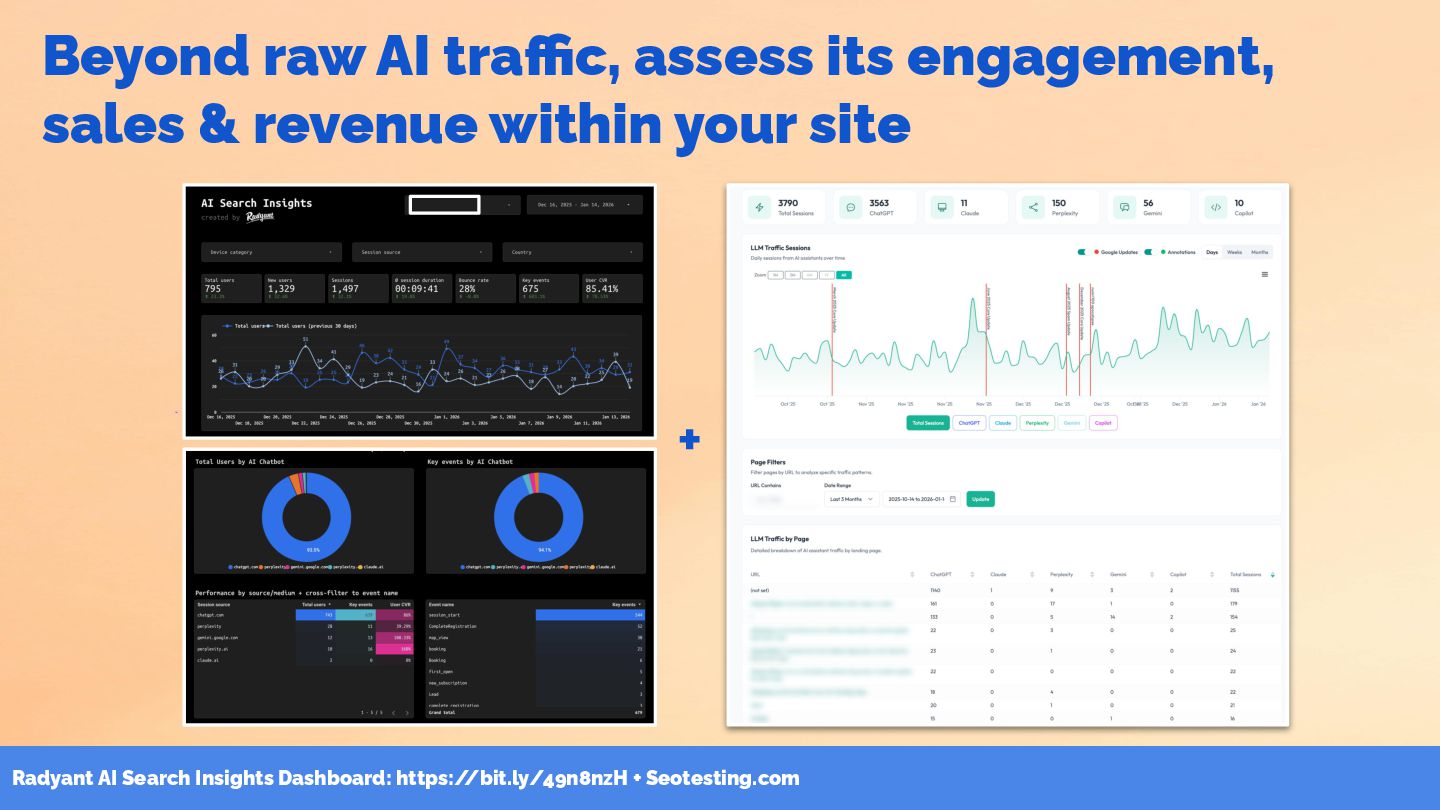
& SEOFOMO 1. Stop using traffic as a reliable KPI, instead use a blend of Branding and Performance KPIs: AI visibility, sentiment, purchases, and revenue AI-driven influence often happens without a click but still drives revenue. 1. Start using a blend of branding and performance KPIs for AI search 2. Use branding KPIs such as: AI brand visibility, sentiment, citations, share of voice per platform 3. Use performance KPIs such as: assisted conversions / sales, revenue, average order value, CAC, ROI from AI flows
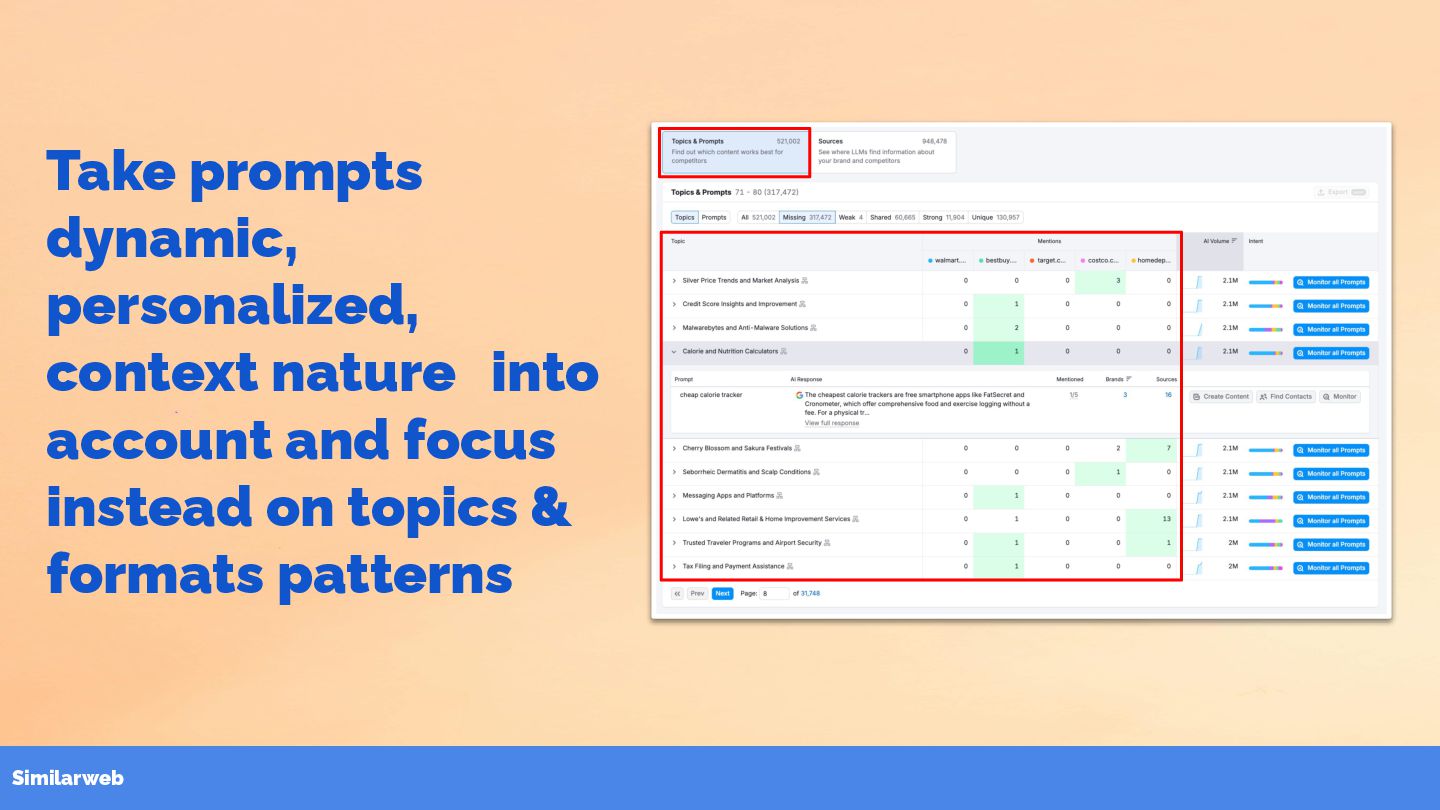
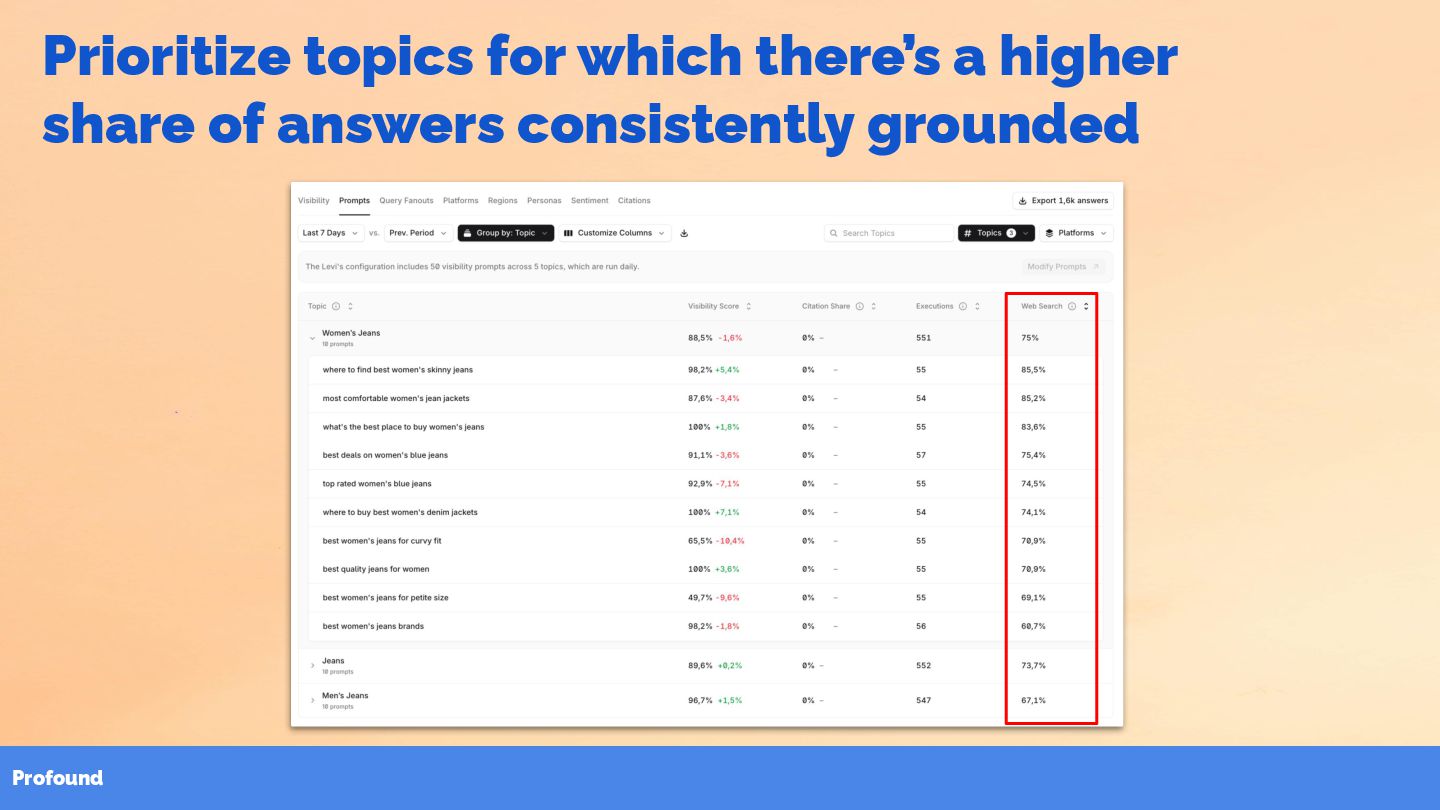
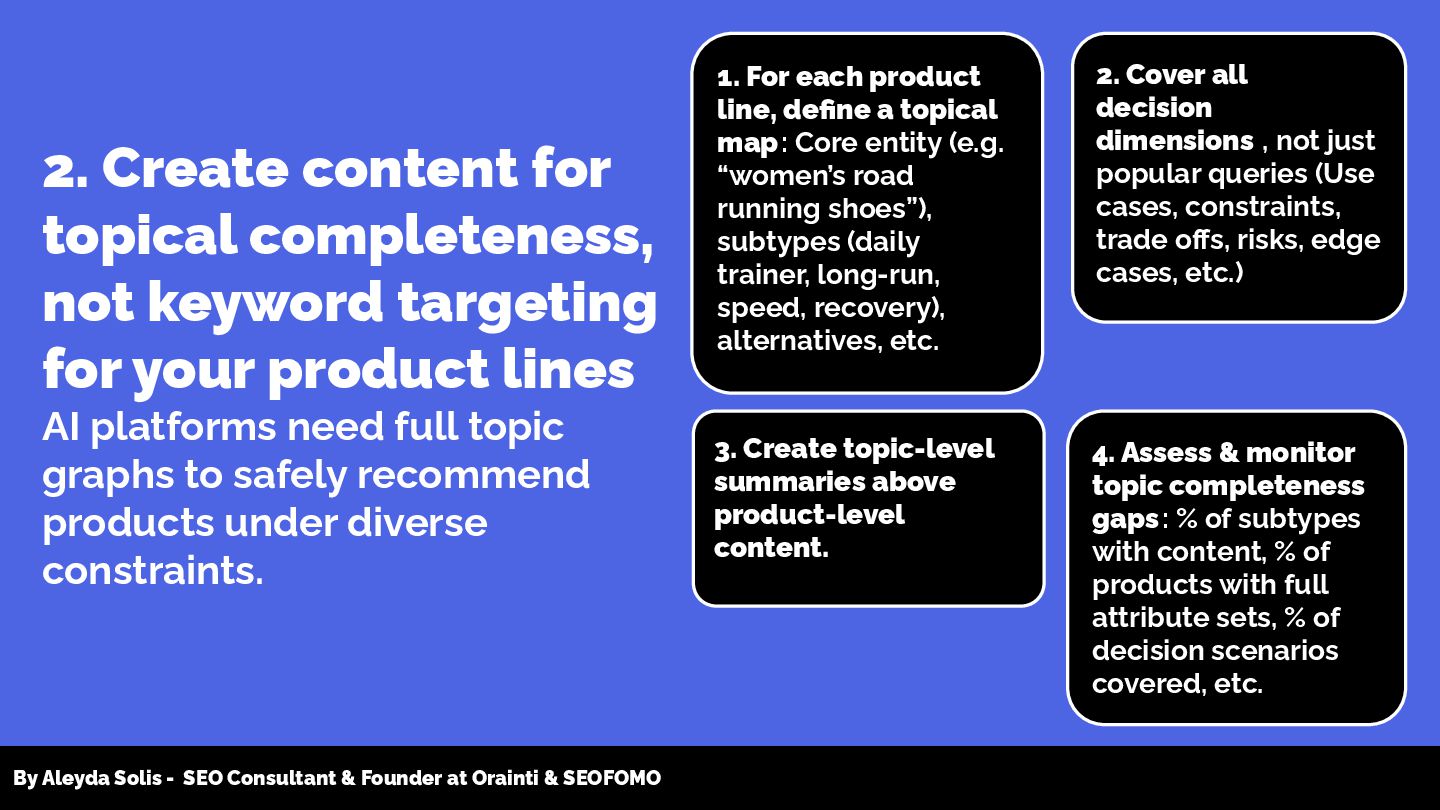
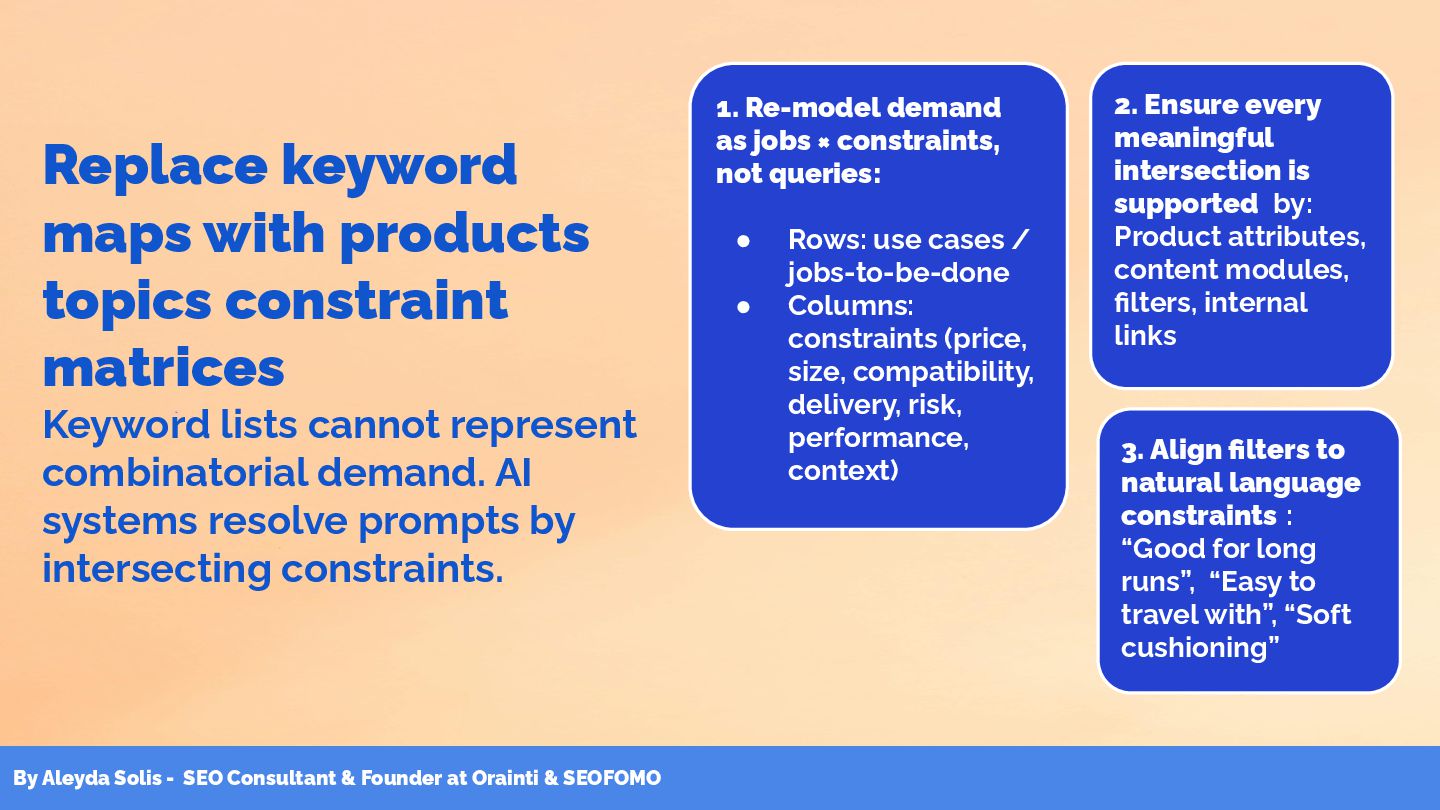
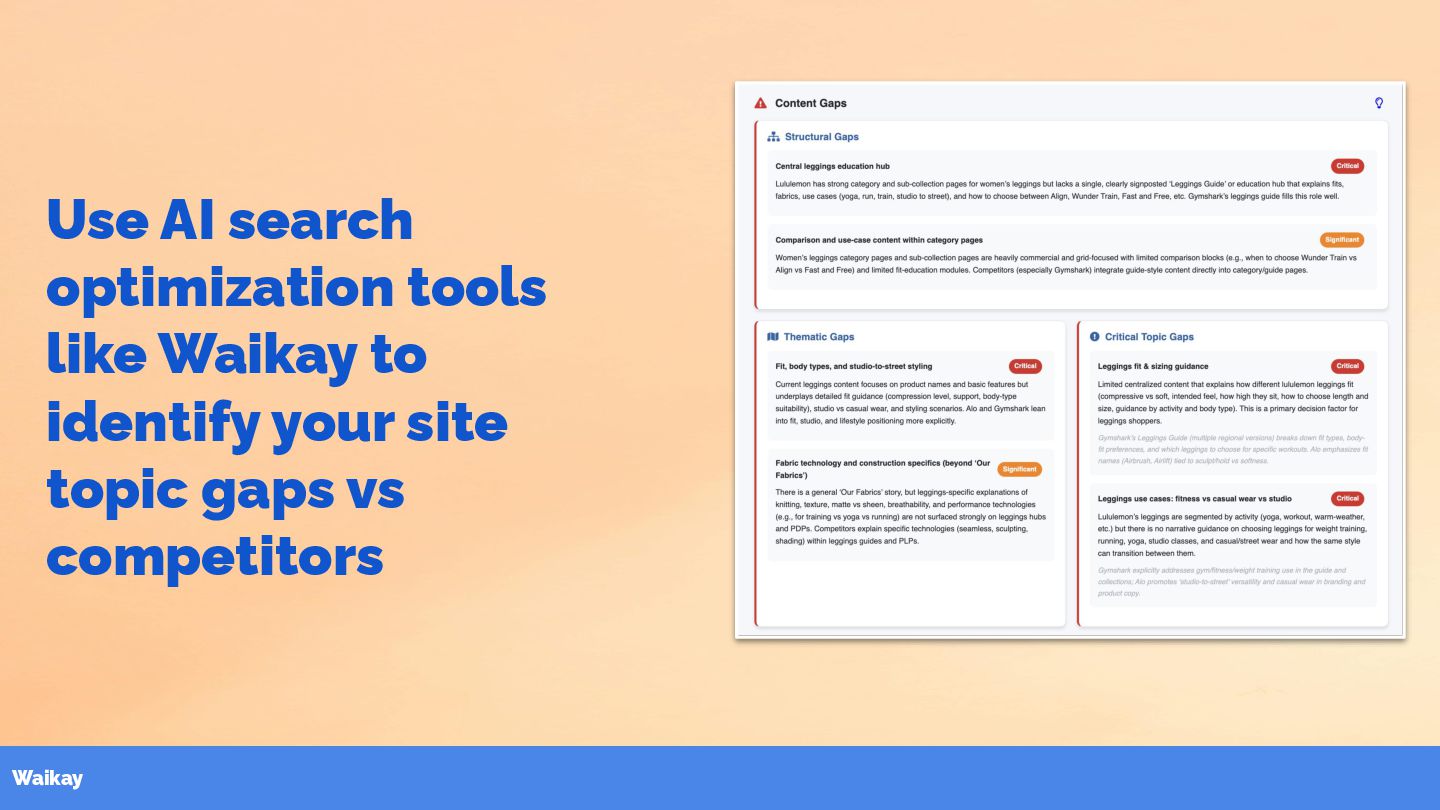
& SEOFOMO 2. Create content for topical completeness, not keyword targeting for your product lines AI platforms need full topic graphs to safely recommend products under diverse constraints. 1. For each product line, define a topical map: Core entity (e.g. “women’s road running shoes”), subtypes (daily trainer, long-run, speed, recovery), alternatives, etc. 2. Cover all decision dimensions , not just popular queries (Use cases, constraints, trade offs, risks, edge cases, etc.) 3. Create topic-level summaries above product-level content. 4. Assess & monitor topic completeness gaps: % of subtypes with content, % of products with full attribute sets, % of decision scenarios covered, etc.
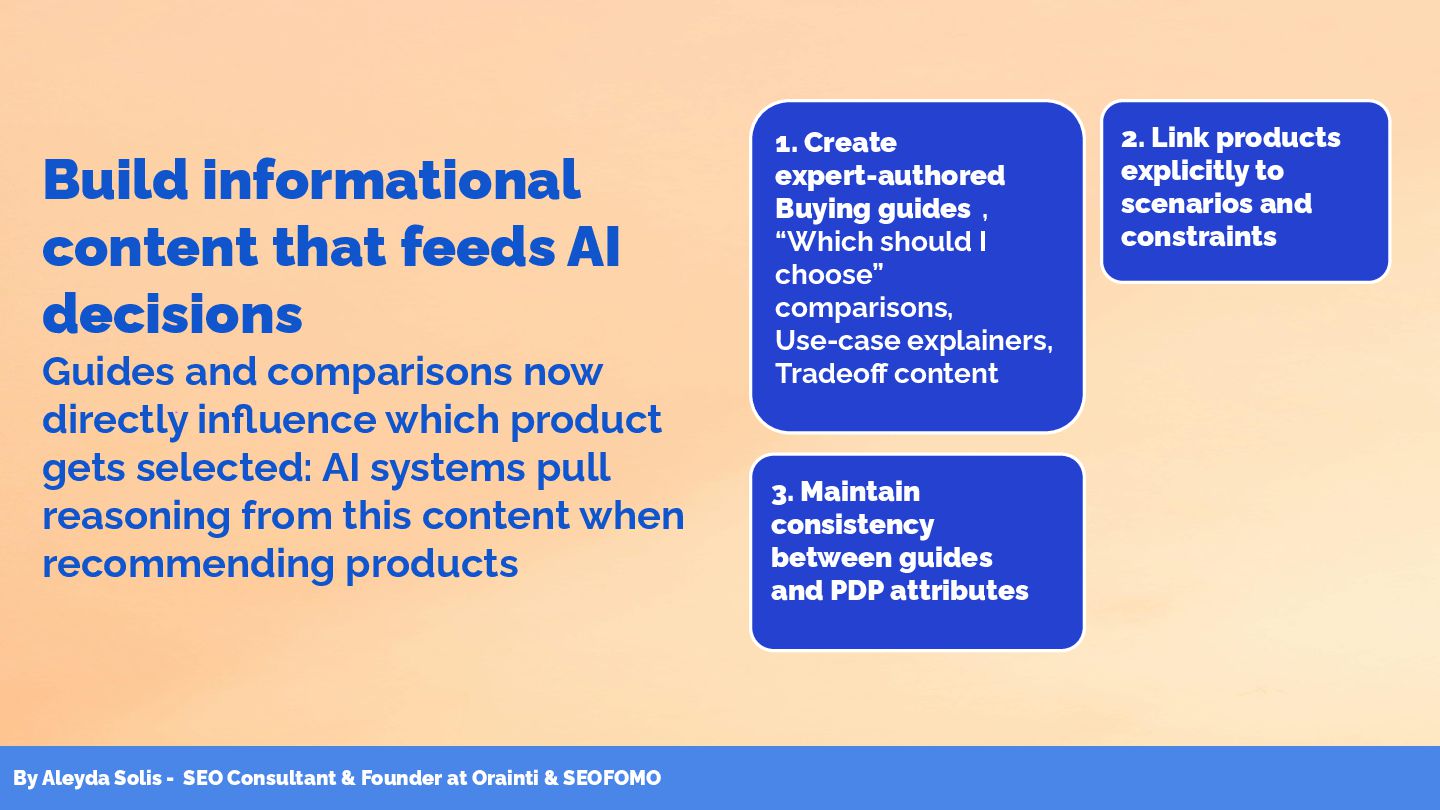
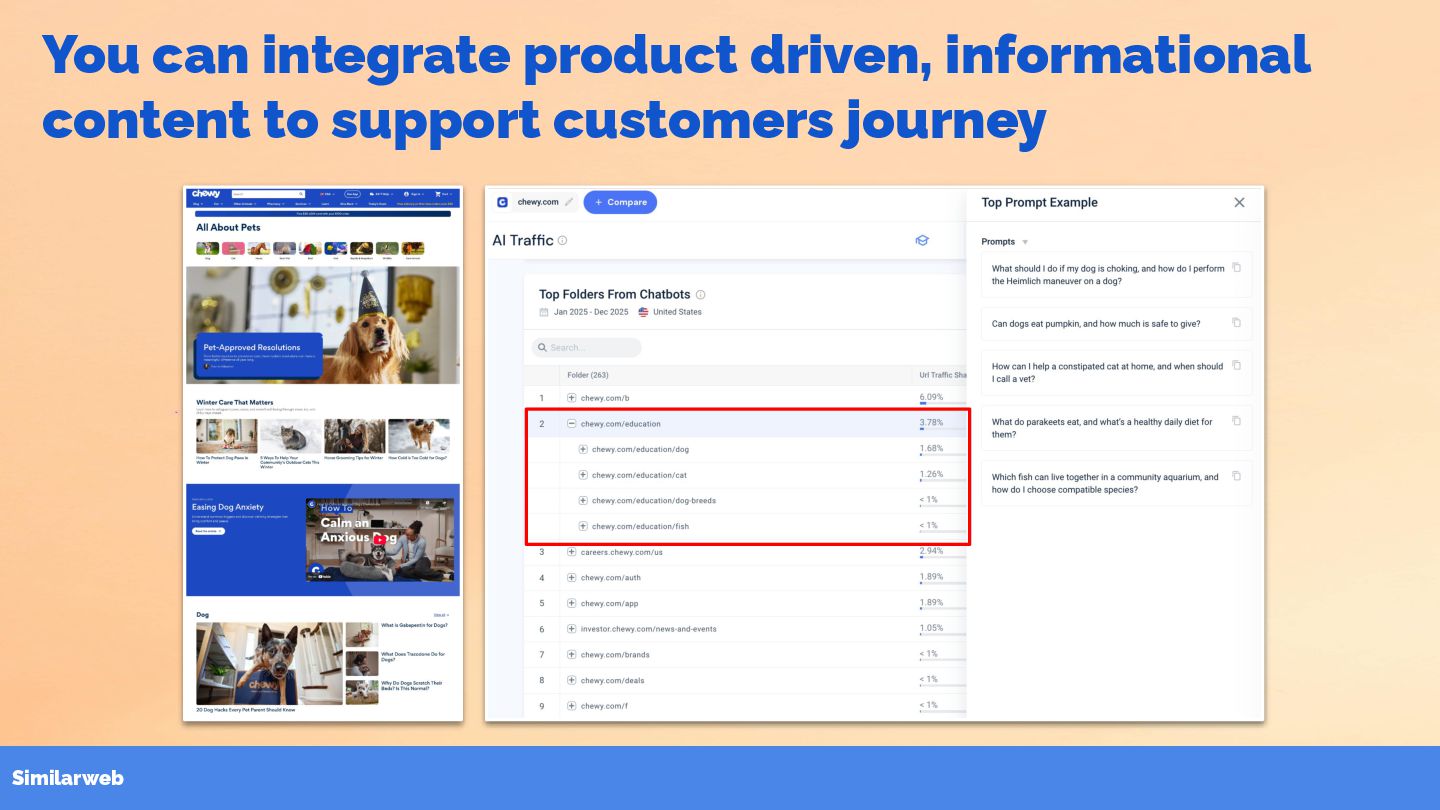
& SEOFOMO Build informational content that feeds AI decisions Guides and comparisons now directly influence which product gets selected: AI systems pull reasoning from this content when recommending products 1. Create expert-authored Buying guides , “Which should I choose” comparisons, Use-case explainers, Tradeoff content 2. Link products explicitly to scenarios and constraints 3. Maintain consistency between guides and PDP attributes
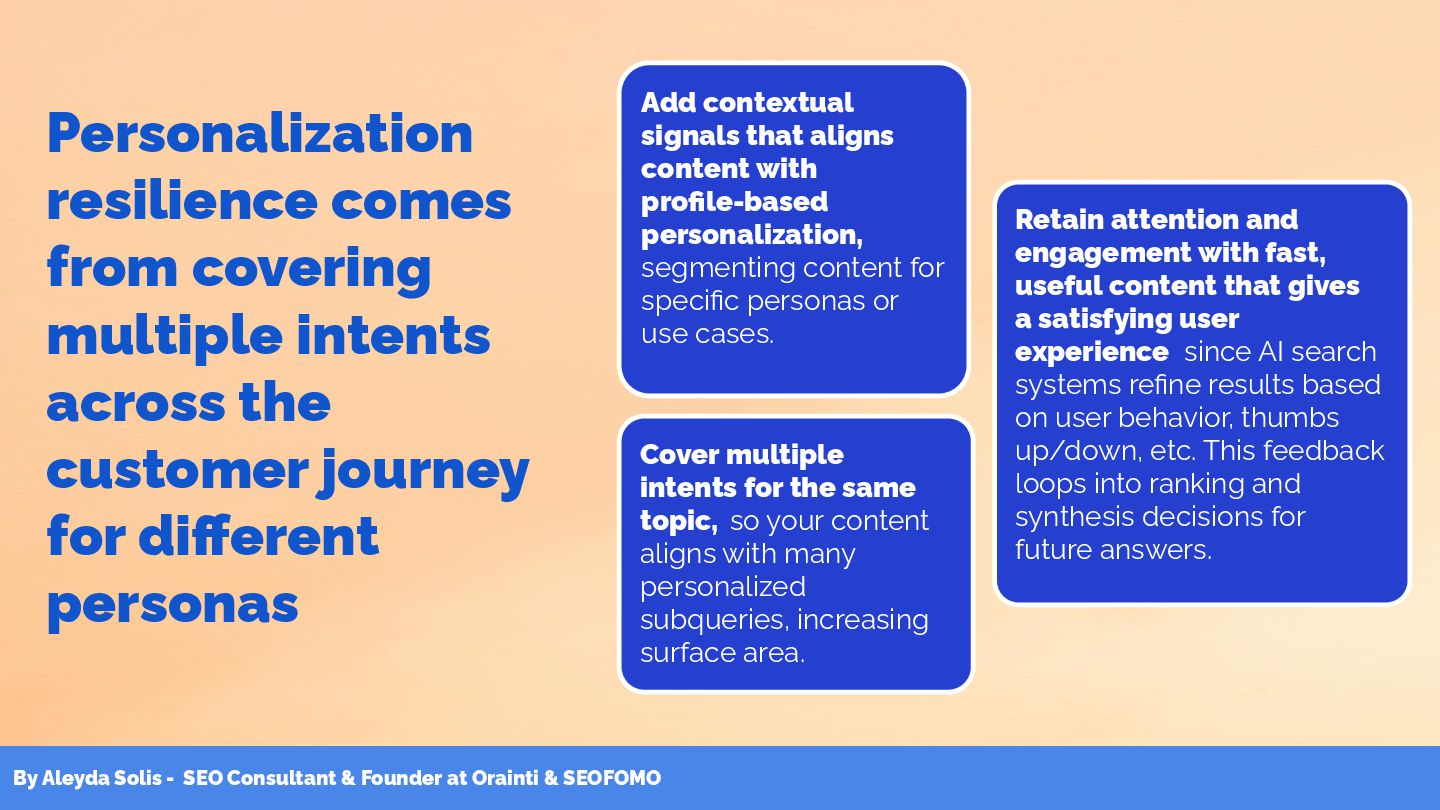
journey for different personas Cover multiple intents for the same topic, so your content aligns with many personalized subqueries, increasing surface area. Add contextual signals that aligns content with profile-based personalization, segmenting content for specific personas or use cases. Retain attention and engagement with fast, useful content that gives a satisfying user experience since AI search systems refine results based on user behavior, thumbs up/down, etc. This feedback loops into ranking and synthesis decisions for future answers. By Aleyda Solis - SEO Consultant & Founder at Orainti & SEOFOMO
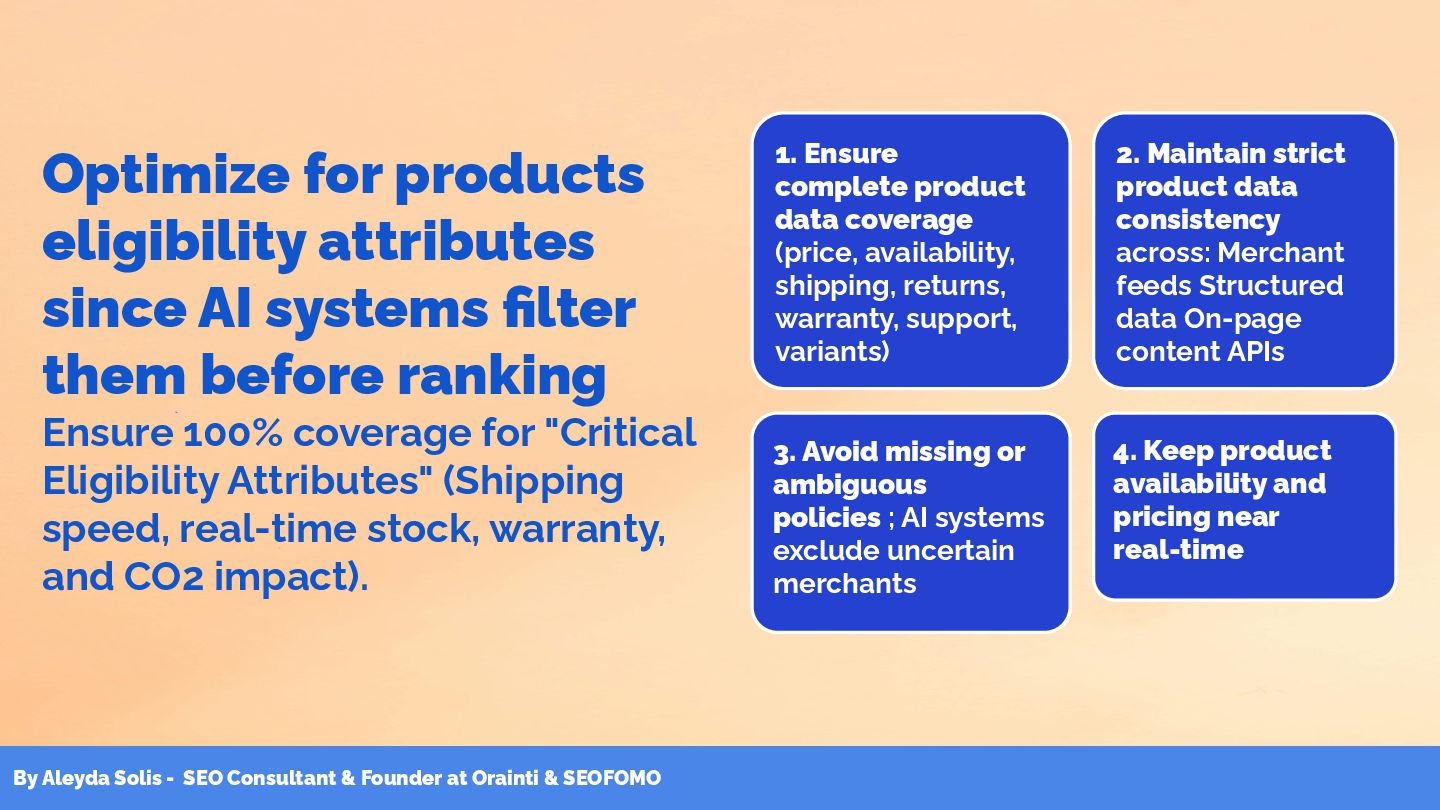
& SEOFOMO Optimize for products eligibility attributes since AI systems filter them before ranking Ensure 100% coverage for "Critical Eligibility Attributes" (Shipping speed, real-time stock, warranty, and CO2 impact). 1. Ensure complete product data coverage (price, availability, shipping, returns, warranty, support, variants) 2. Maintain strict product data consistency across: Merchant feeds Structured data On-page content APIs 3. Avoid missing or ambiguous policies ; AI systems exclude uncertain merchants 4. Keep product availability and pricing near real-time
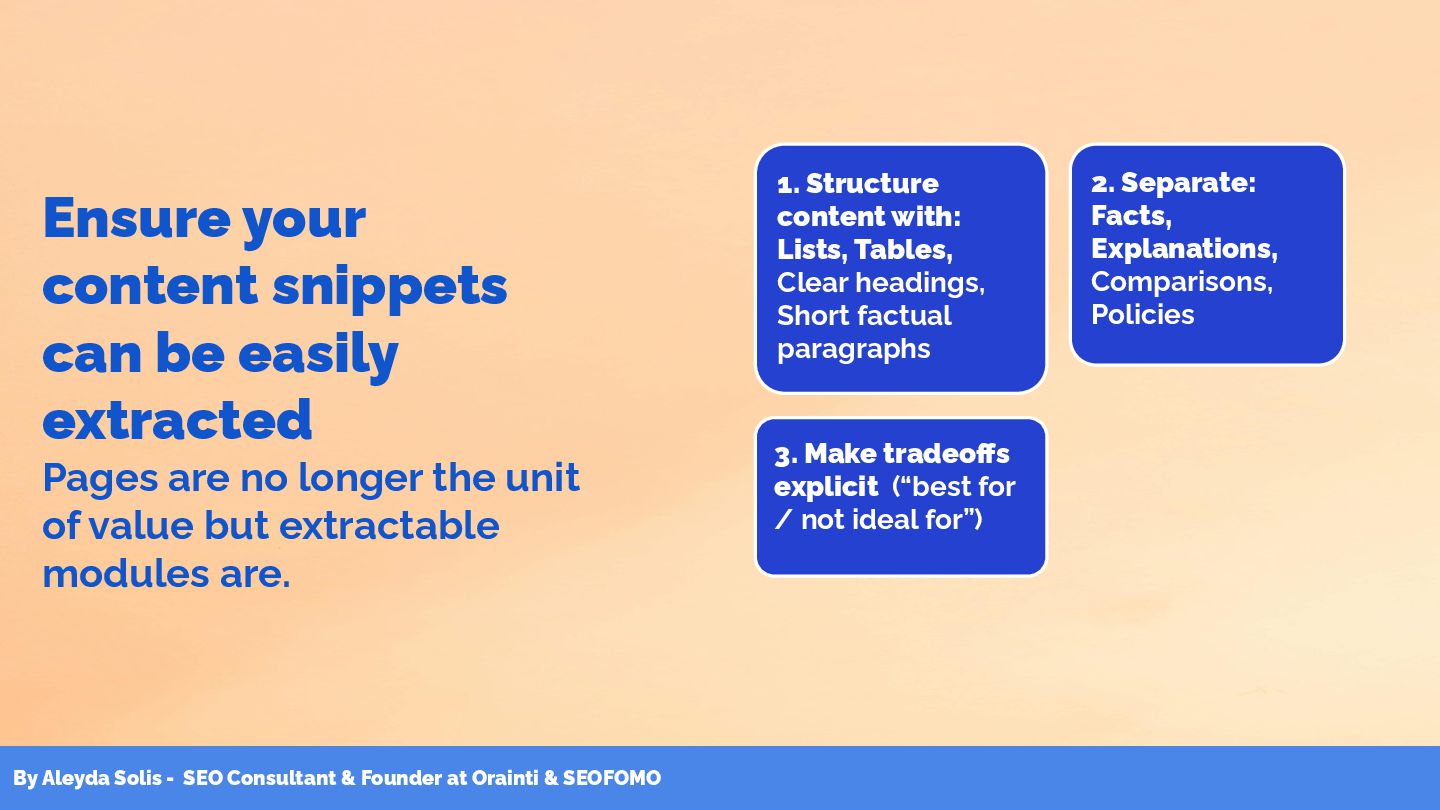
& SEOFOMO Ensure your content snippets can be easily extracted Pages are no longer the unit of value but extractable modules are. 1. Structure content with: Lists, Tables, Clear headings, Short factual paragraphs 2. Separate: Facts, Explanations, Comparisons, Policies 3. Make tradeoffs explicit (“best for / not ideal for”)
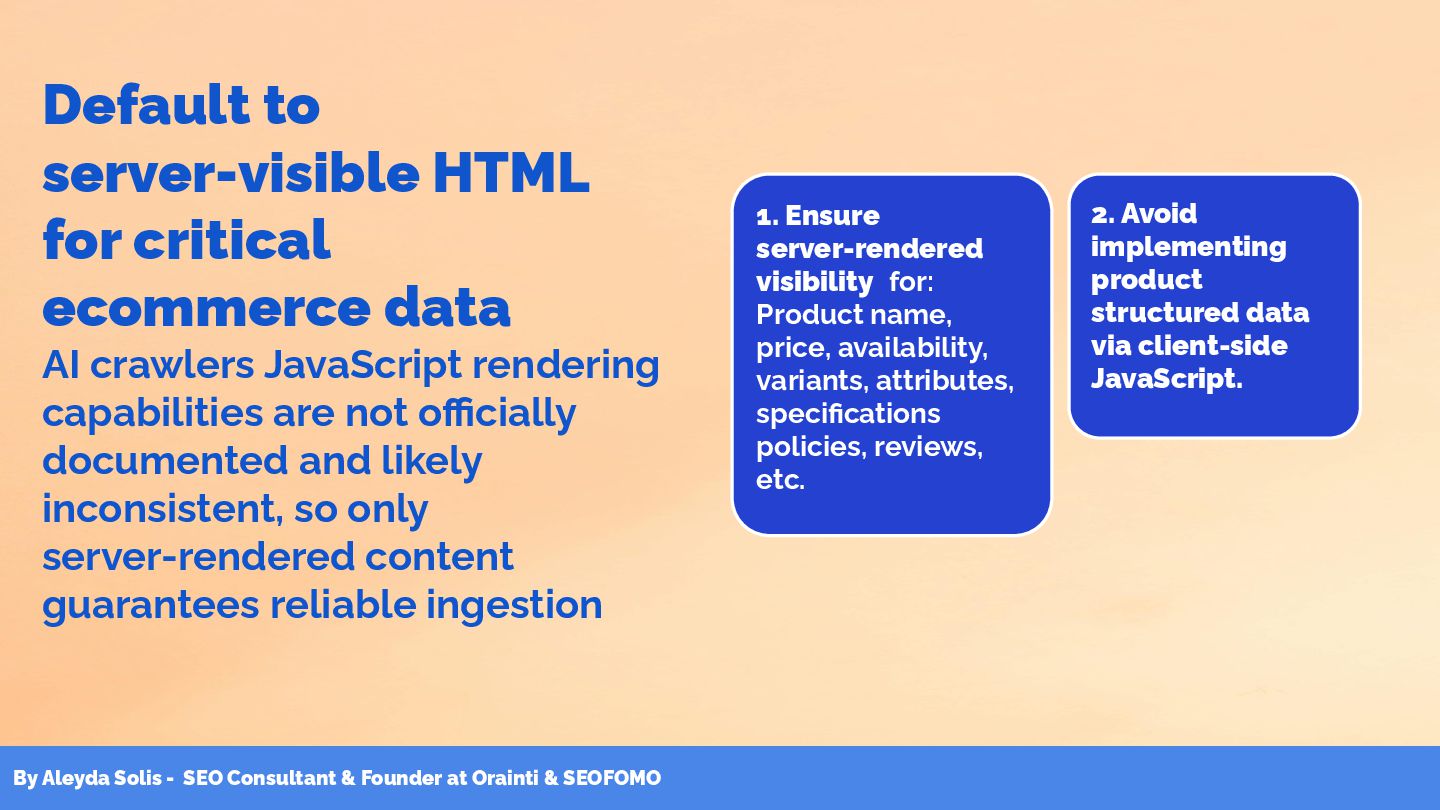
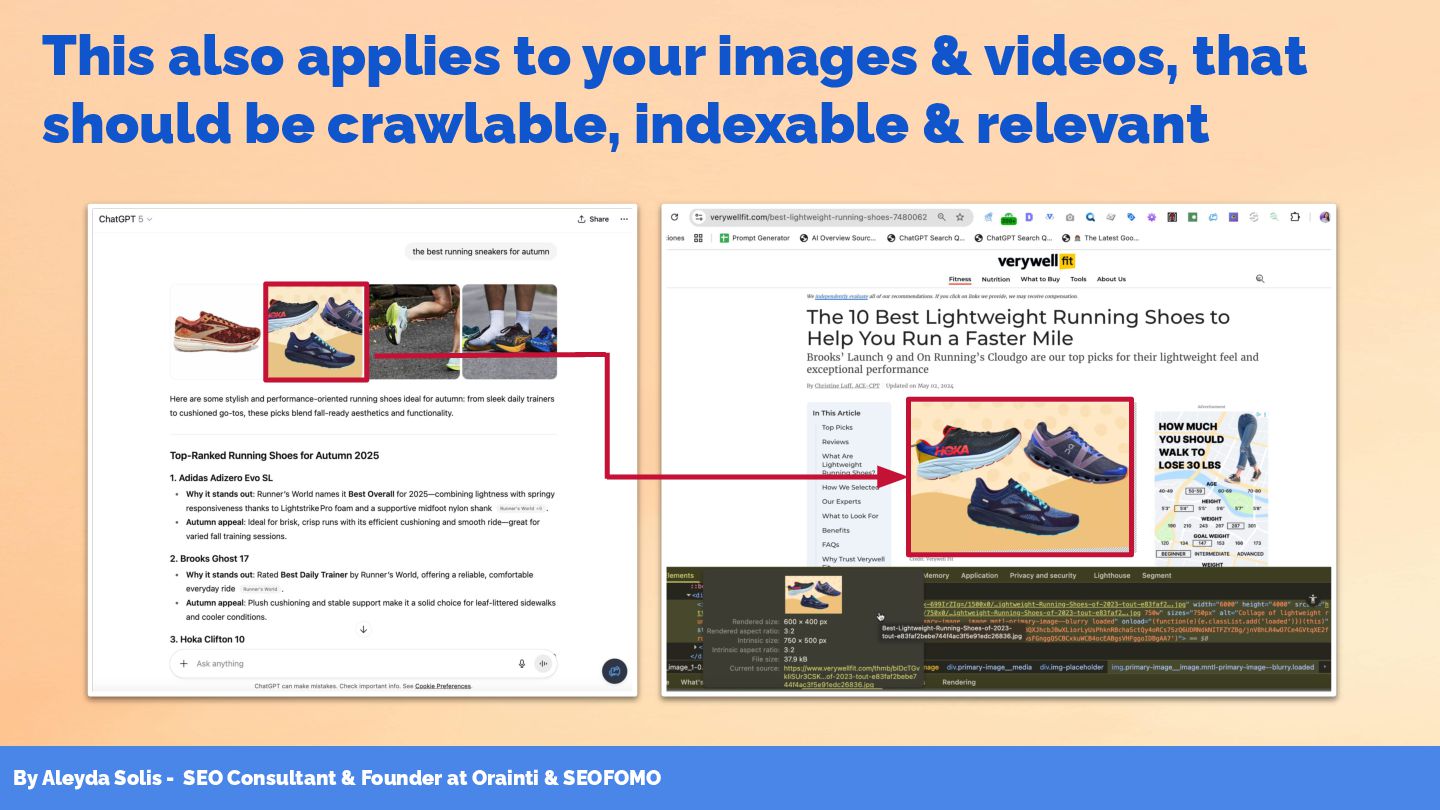
& SEOFOMO Default to server-visible HTML for critical ecommerce data AI crawlers JavaScript rendering capabilities are not officially documented and likely inconsistent, so only server-rendered content guarantees reliable ingestion 1. Ensure server-rendered visibility for: Product name, price, availability, variants, attributes, specifications policies, reviews, etc. 2. Avoid implementing product structured data via client-side JavaScript.
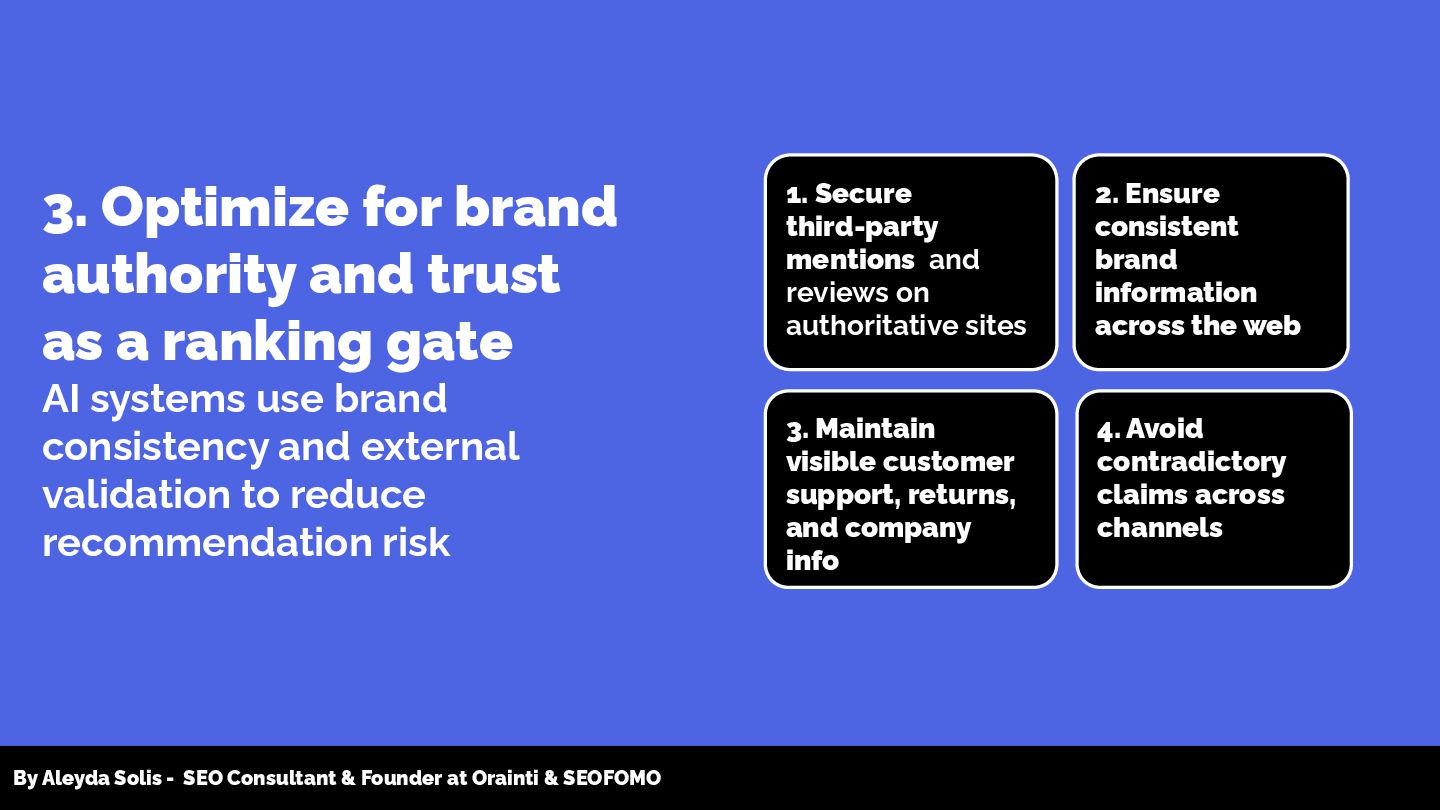
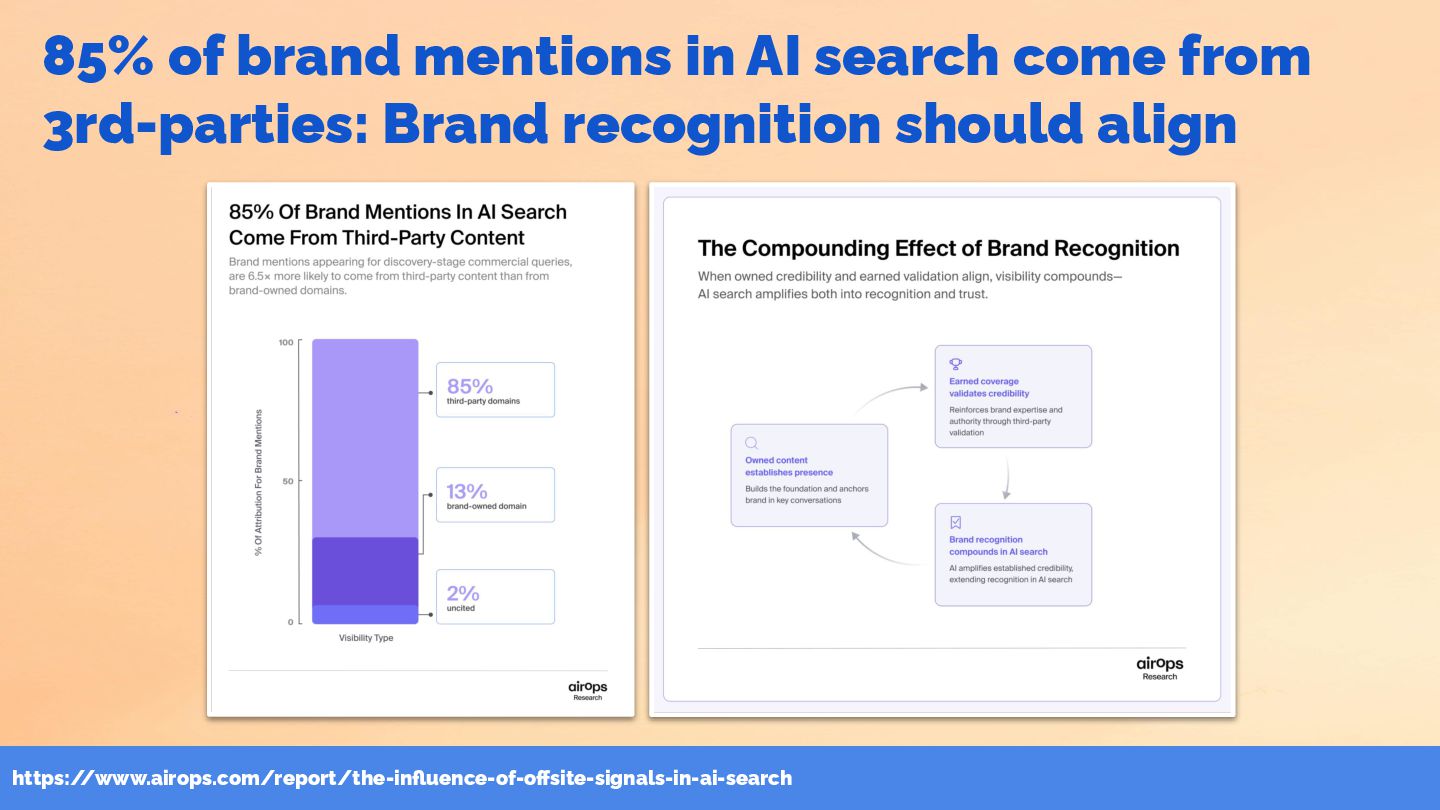
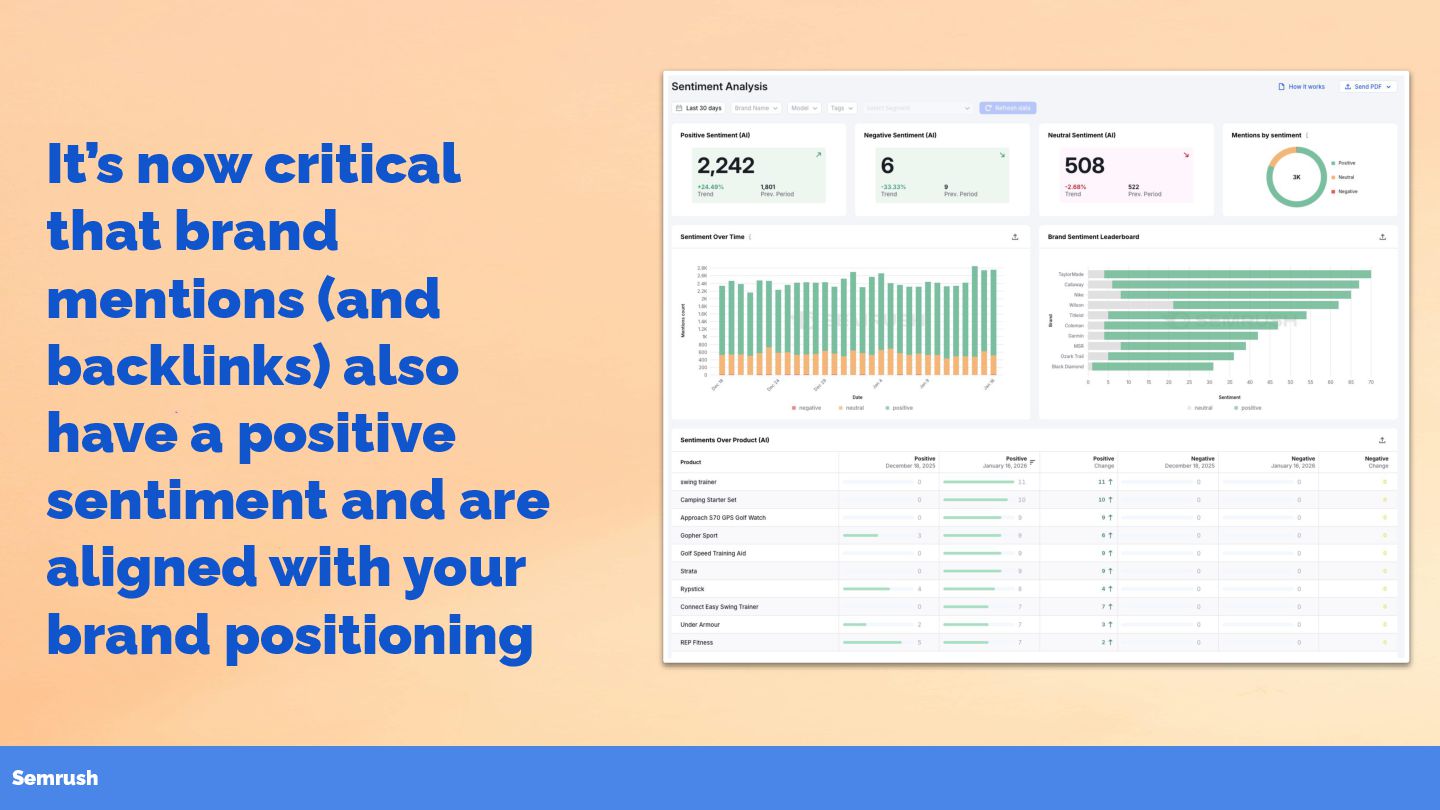
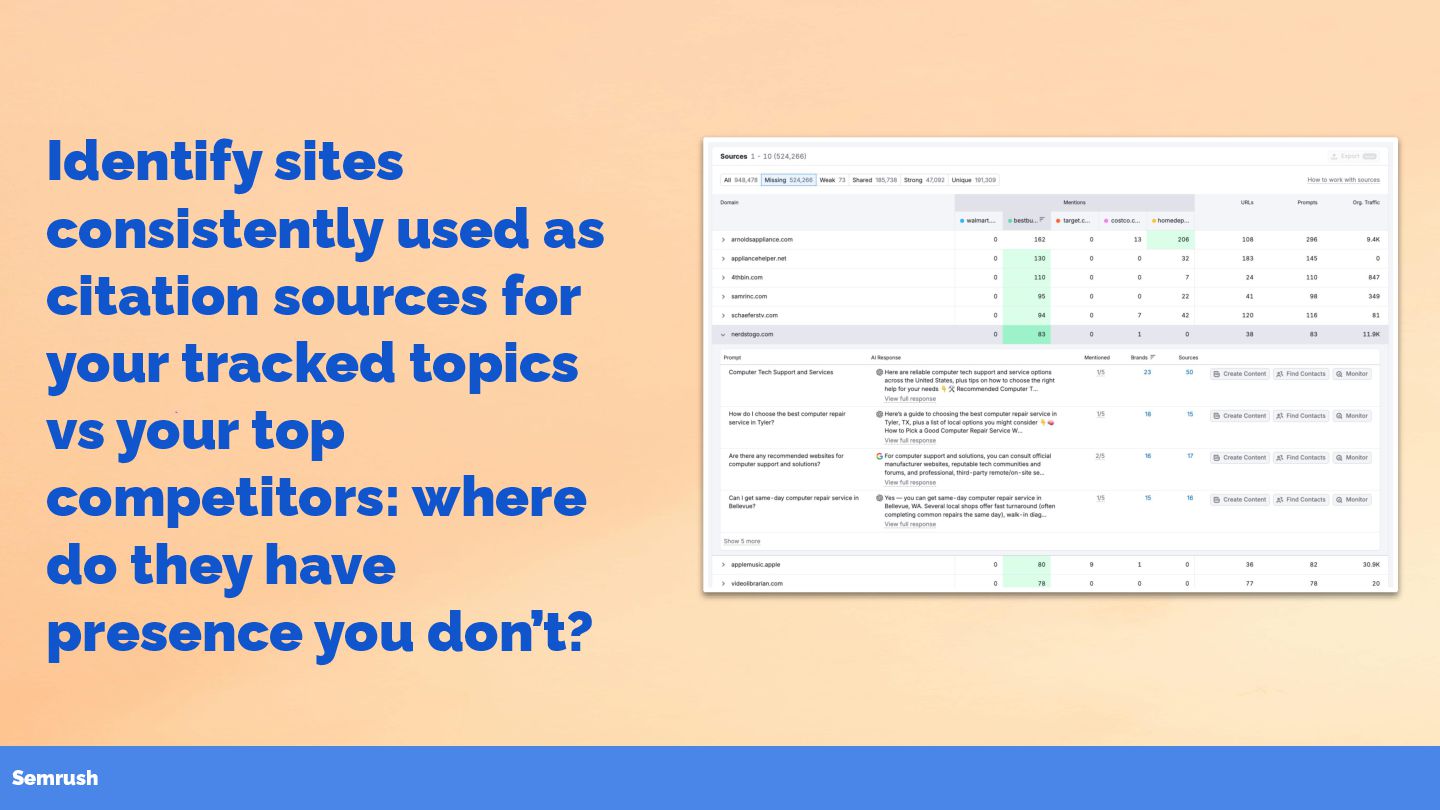
& SEOFOMO 3. Optimize for brand authority and trust as a ranking gate AI systems use brand consistency and external validation to reduce recommendation risk 1. Secure third-party mentions and reviews on authoritative sites 2. Ensure consistent brand information across the web 3. Maintain visible customer support, returns, and company info 4. Avoid contradictory claims across channels
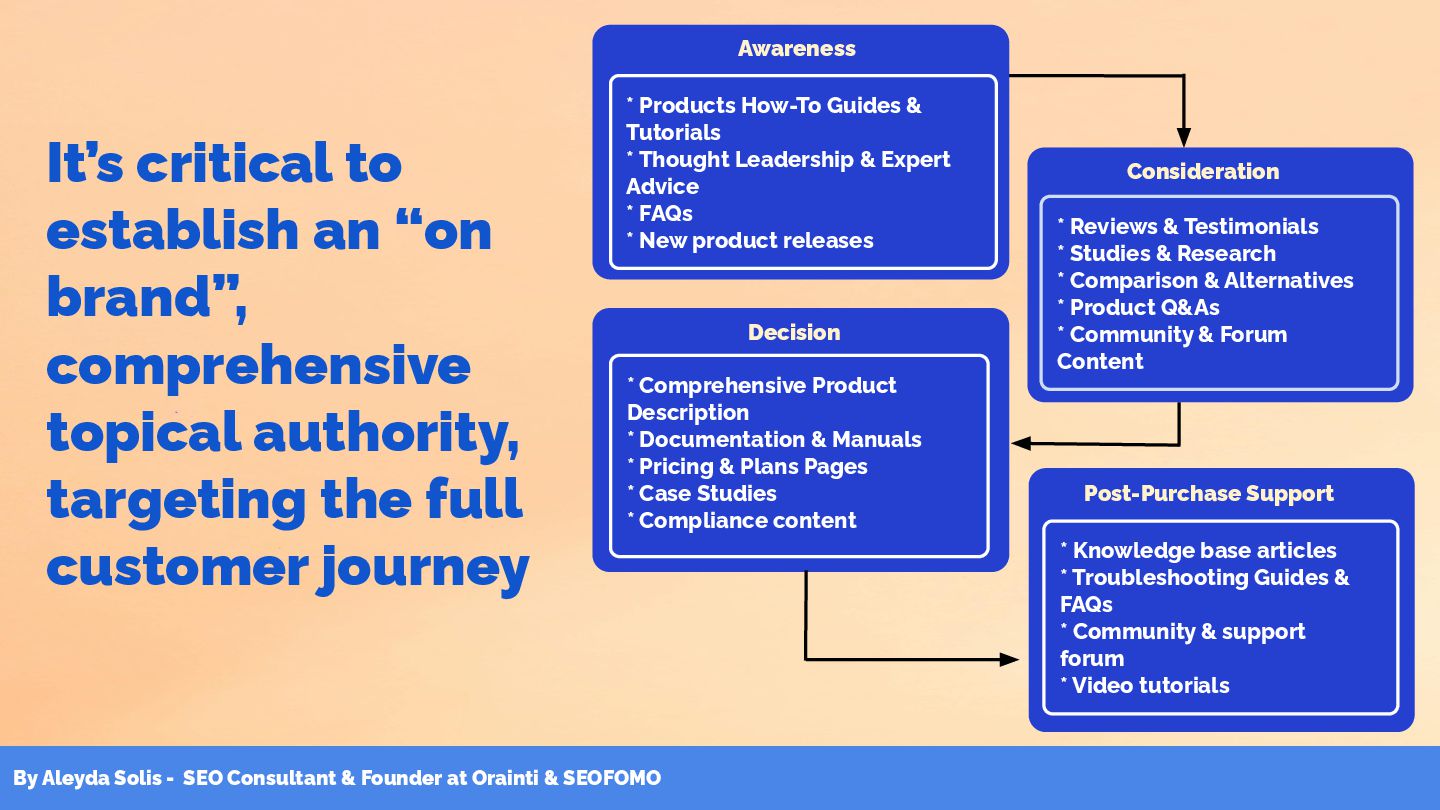
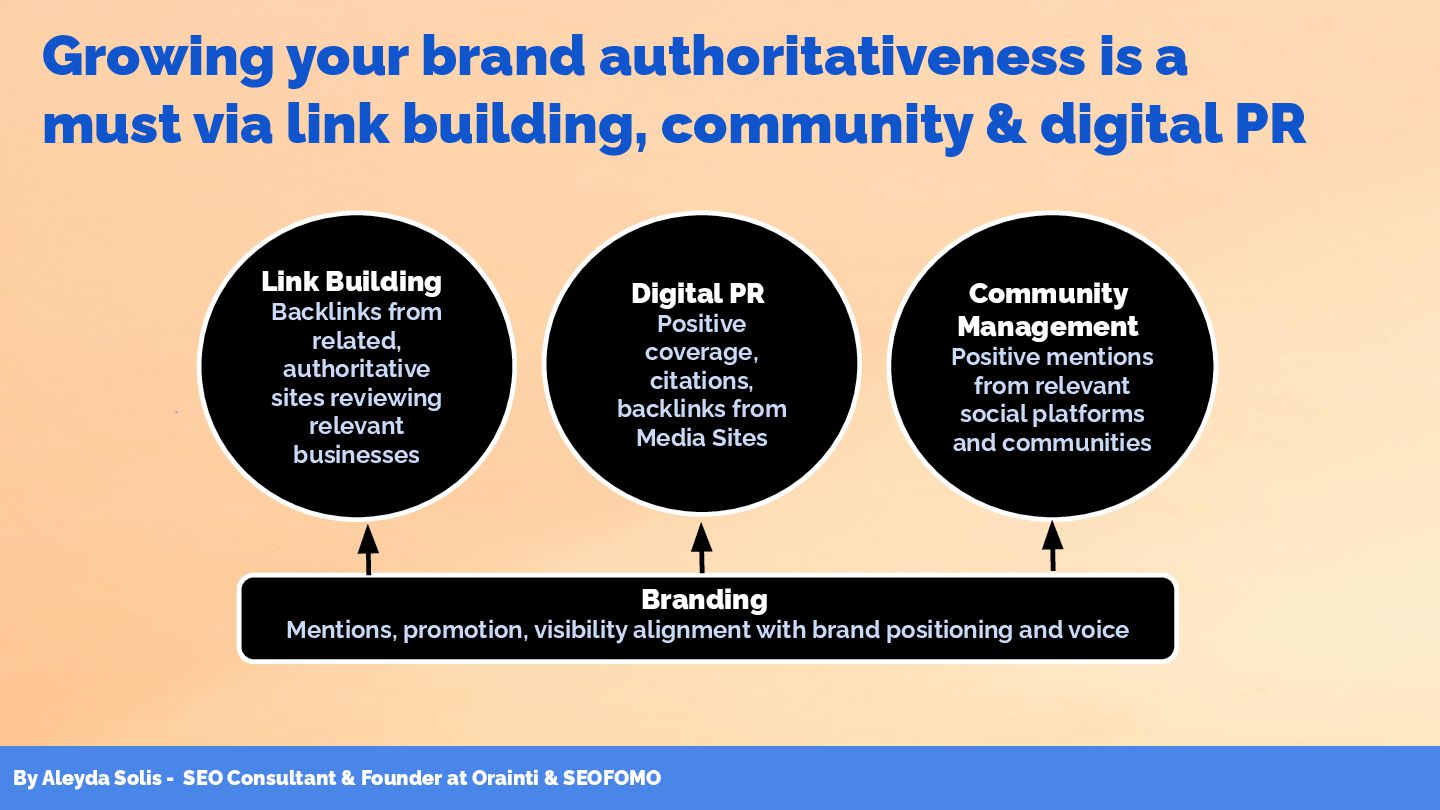
community & digital PR Digital PR Positive coverage, citations, backlinks from Media Sites Community Management Positive mentions from relevant social platforms and communities Link Building Backlinks from related, authoritative sites reviewing relevant businesses Branding Mentions, promotion, visibility alignment with brand positioning and voice By Aleyda Solis - SEO Consultant & Founder at Orainti & SEOFOMO
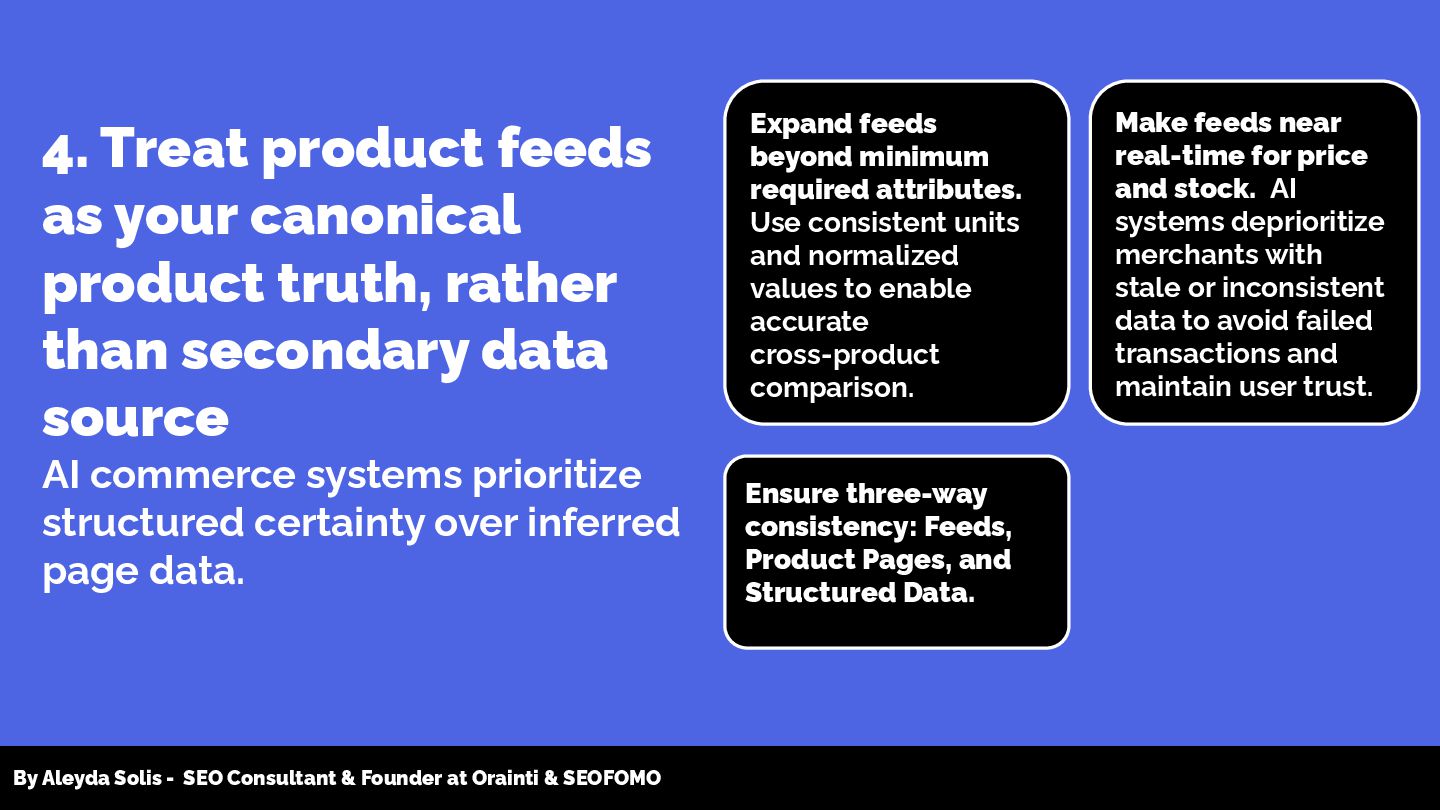
& SEOFOMO 4. Treat product feeds as your canonical product truth, rather than secondary data source AI commerce systems prioritize structured certainty over inferred page data. Make feeds near real-time for price and stock. AI systems deprioritize merchants with stale or inconsistent data to avoid failed transactions and maintain user trust. Ensure three-way consistency: Feeds, Product Pages, and Structured Data. Expand feeds beyond minimum required attributes. Use consistent units and normalized values to enable accurate cross-product comparison.
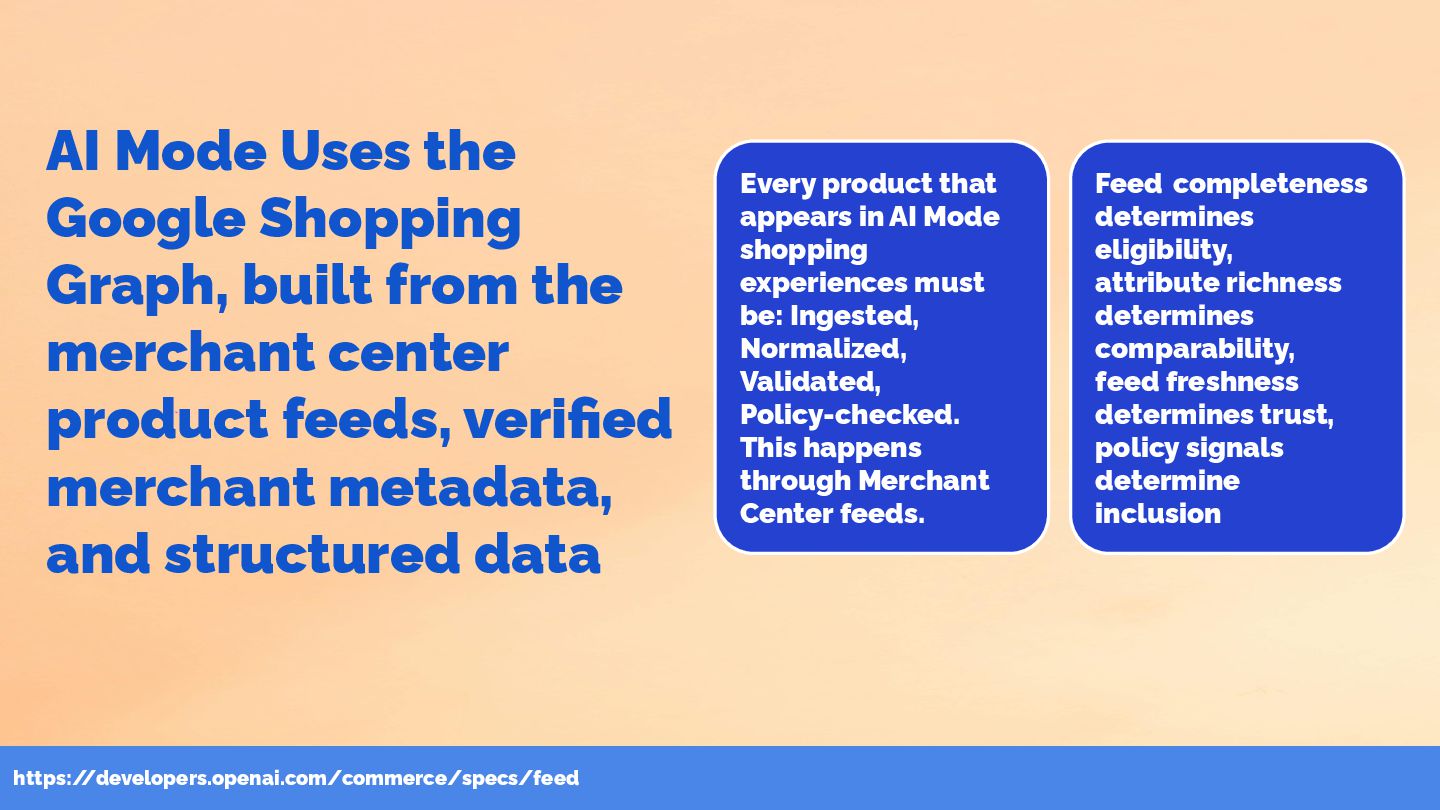
from the merchant center product feeds, verified merchant metadata, and structured data Every product that appears in AI Mode shopping experiences must be: Ingested, Normalized, Validated, Policy-checked. This happens through Merchant Center feeds. Feed completeness determines eligibility, attribute richness determines comparability, feed freshness determines trust, policy signals determine inclusion
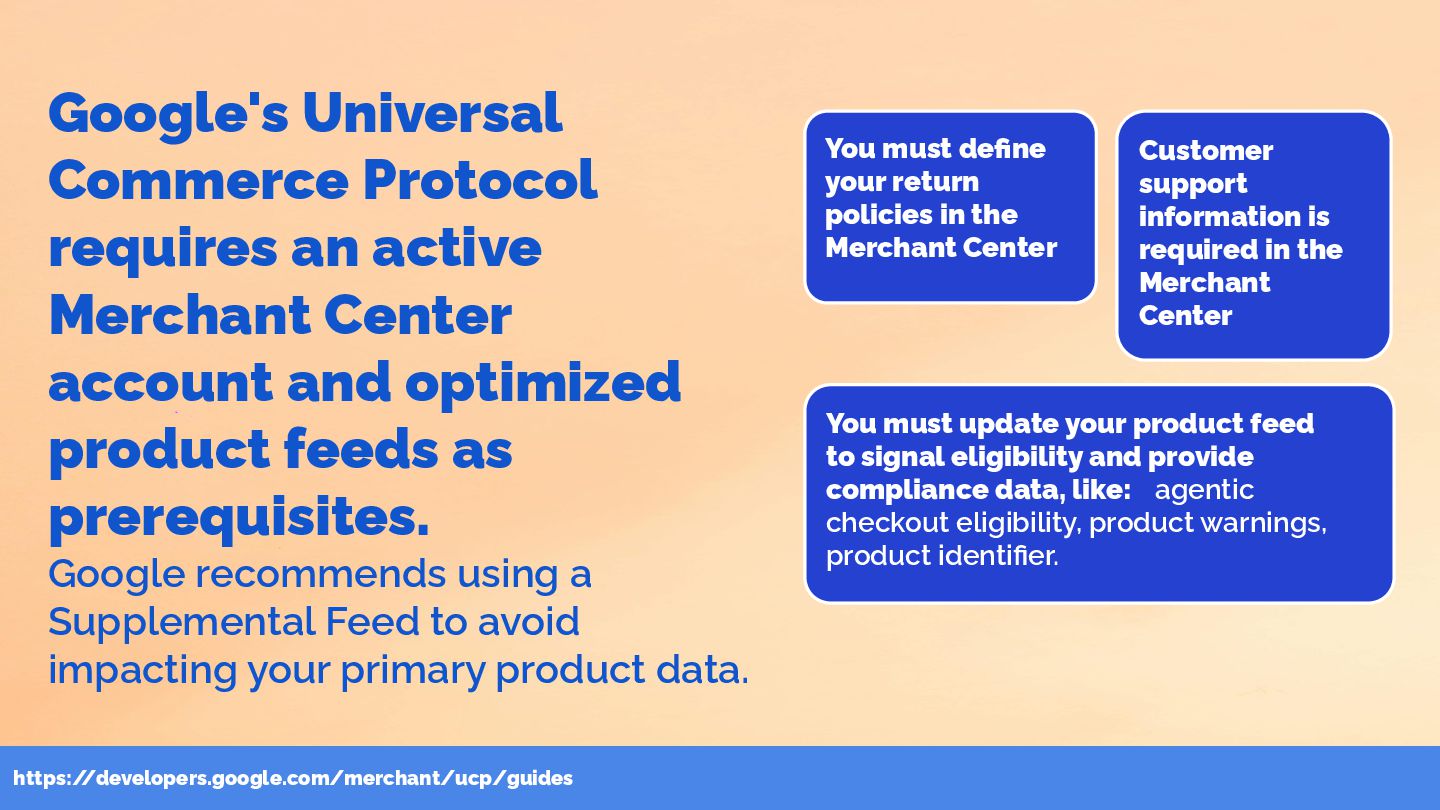
Center account and optimized product feeds as prerequisites. Google recommends using a Supplemental Feed to avoid impacting your primary product data. You must define your return policies in the Merchant Center Customer support information is required in the Merchant Center You must update your product feed to signal eligibility and provide compliance data, like: agentic checkout eligibility, product warnings, product identifier.
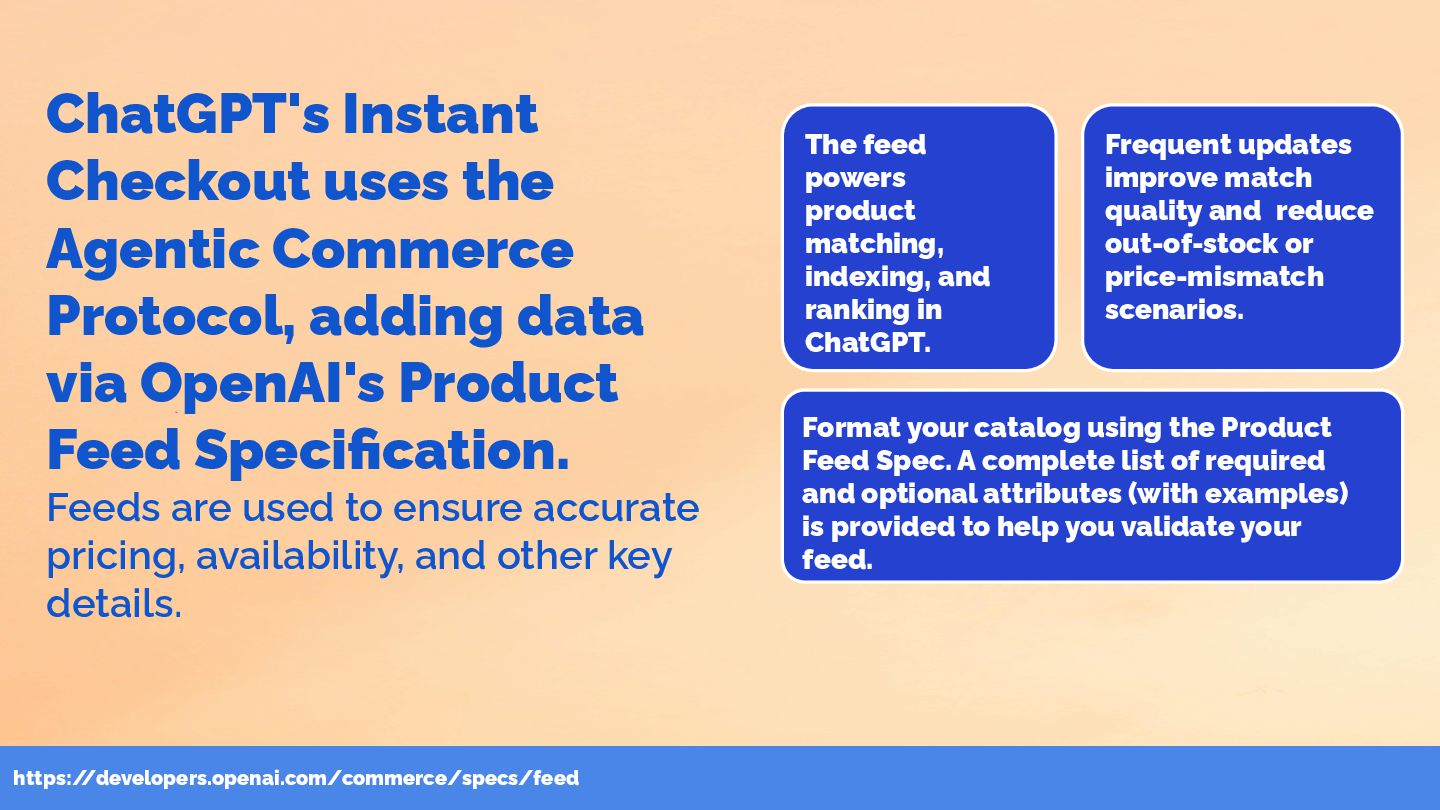
adding data via OpenAI's Product Feed Specification. Feeds are used to ensure accurate pricing, availability, and other key details. The feed powers product matching, indexing, and ranking in ChatGPT. Frequent updates improve match quality and reduce out-of-stock or price-mismatch scenarios. Format your catalog using the Product Feed Spec. A complete list of required and optional attributes (with examples) is provided to help you validate your feed.
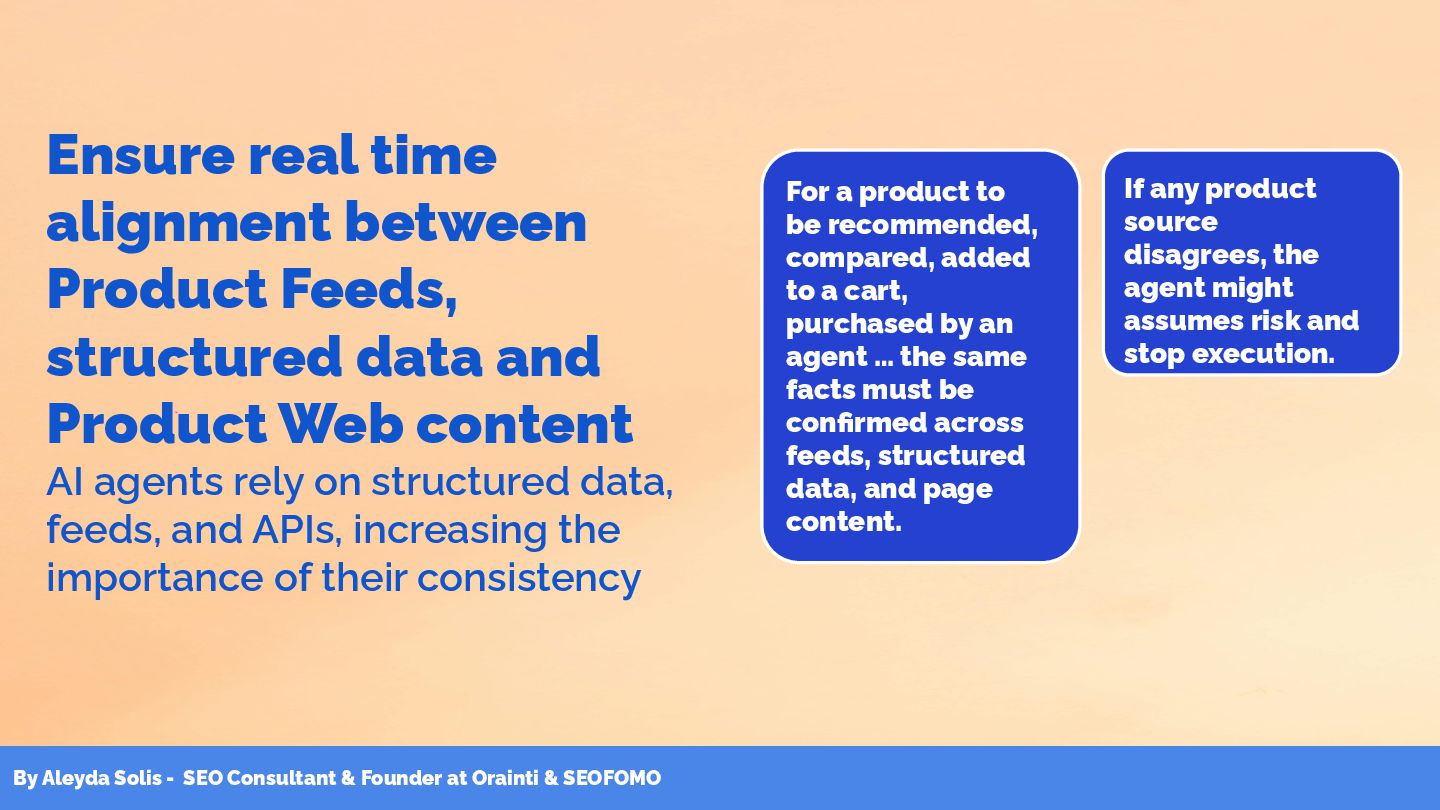
& SEOFOMO Ensure real time alignment between Product Feeds, structured data and Product Web content AI agents rely on structured data, feeds, and APIs, increasing the importance of their consistency For a product to be recommended, compared, added to a cart, purchased by an agent … the same facts must be confirmed across feeds, structured data, and page content. If any product source disagrees, the agent might assumes risk and stop execution.
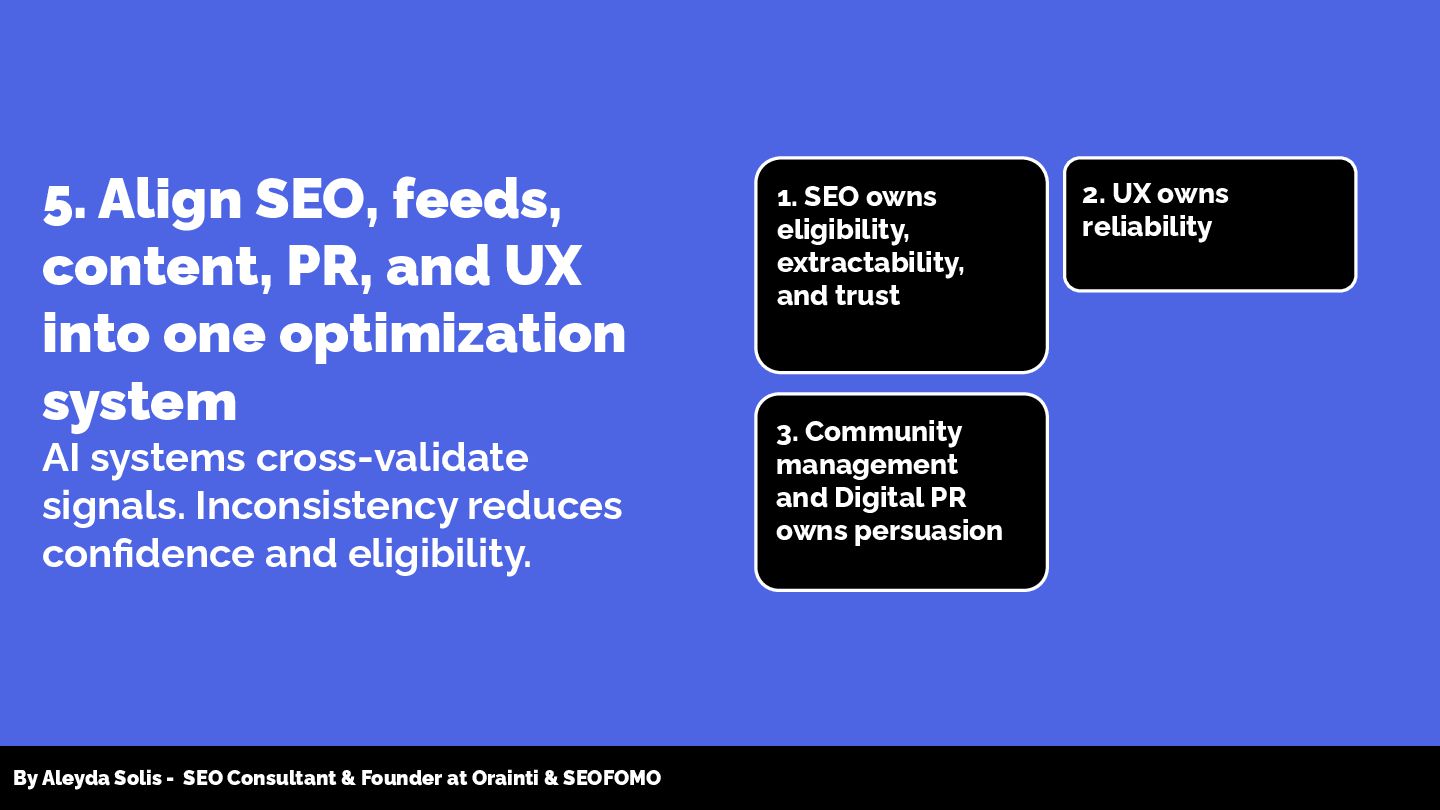
& SEOFOMO 5. Align SEO, feeds, content, PR, and UX into one optimization system AI systems cross-validate signals. Inconsistency reduces confidence and eligibility. 1. SEO owns eligibility, extractability, and trust 2. UX owns reliability 3. Community management and Digital PR owns persuasion
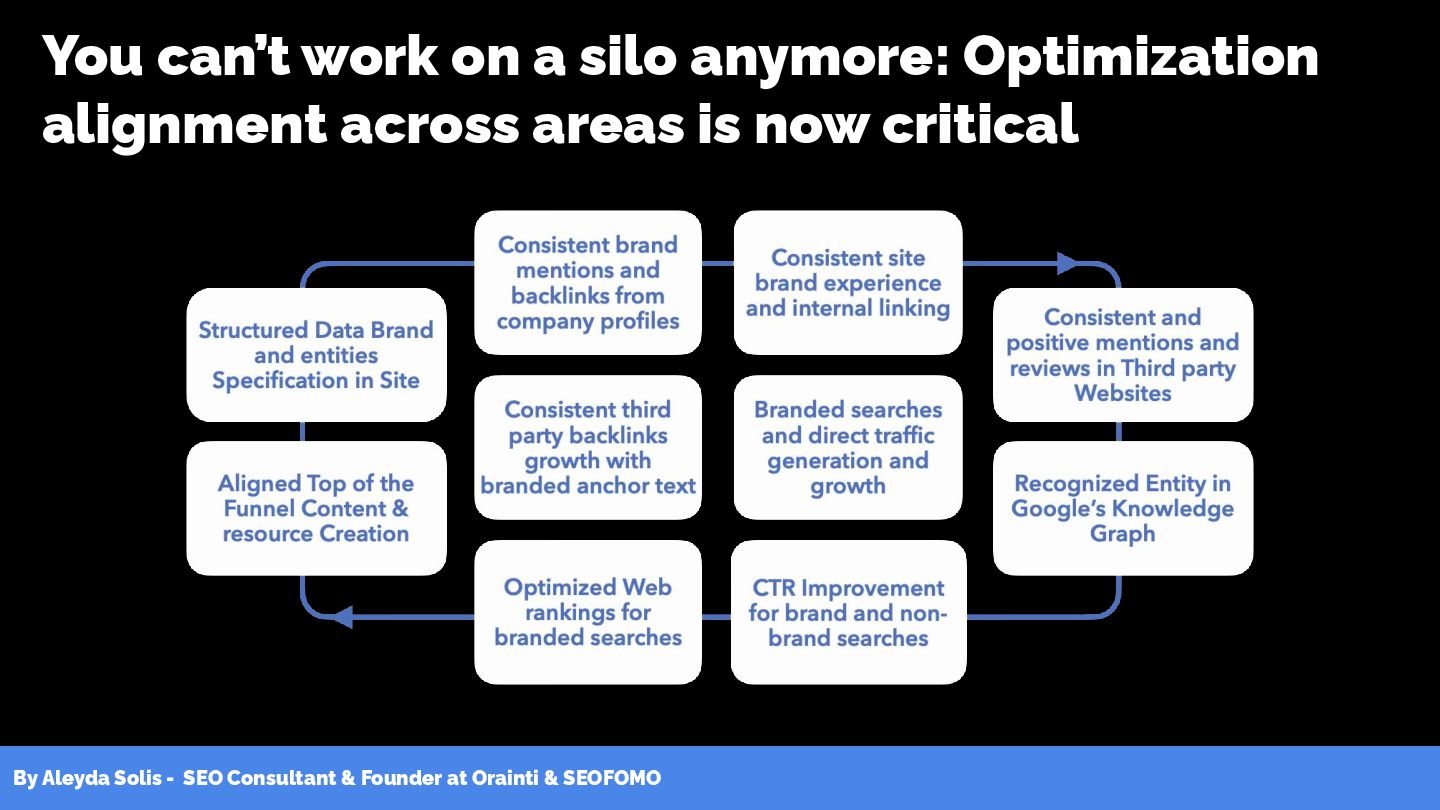
& SEOFOMO By Aleyda Solis - SEO Consultant & Founder at Orainti & SEOFOMO You can’t work on a silo anymore: Optimization alignment across areas is now critical
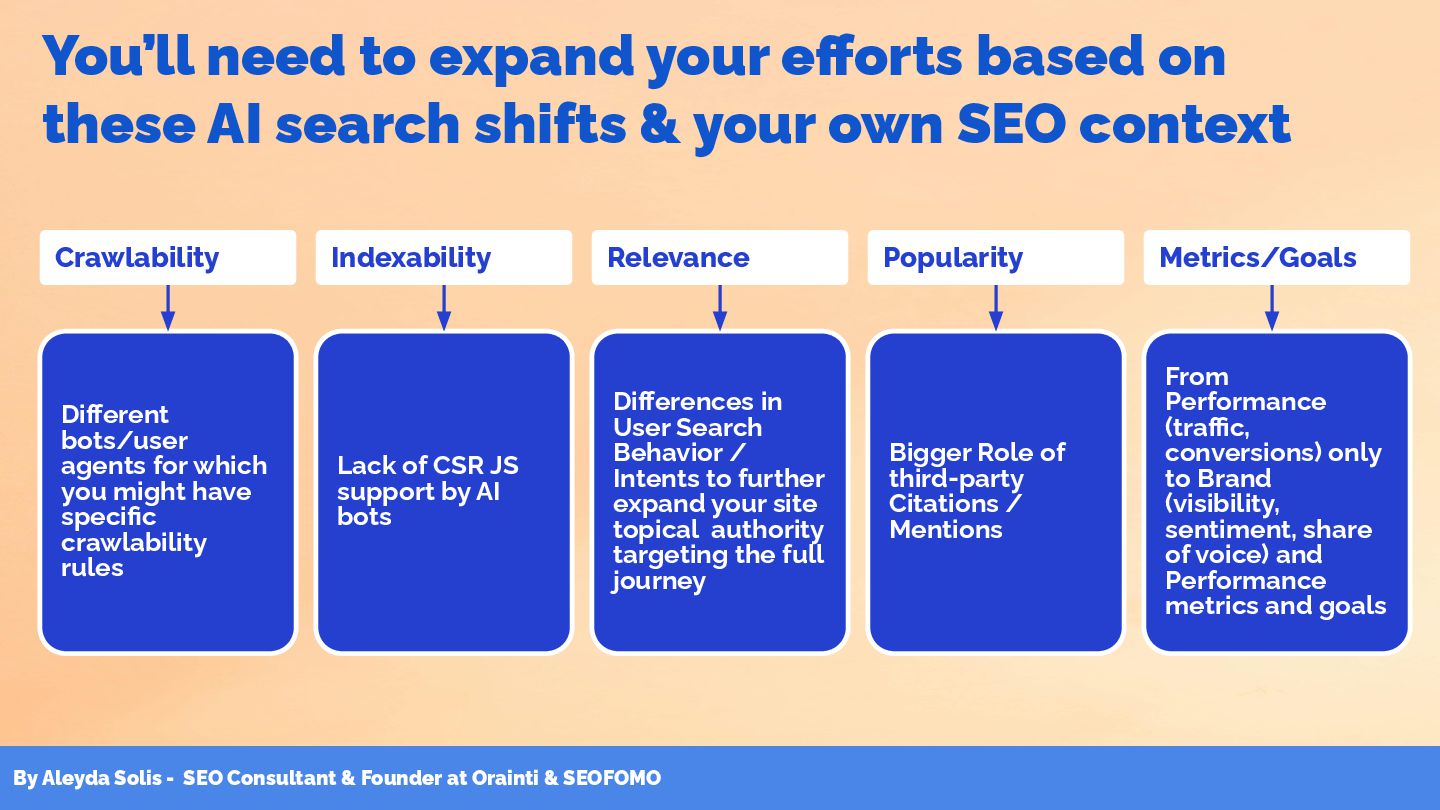
search shifts & your own SEO context Differences in User Search Behavior / Intents to further expand your site topical authority targeting the full journey Bigger Role of third-party Citations / Mentions Different bots/user agents for which you might have specific crawlability rules Lack of CSR JS support by AI bots From Performance (traffic, conversions) only to Brand (visibility, sentiment, share of voice) and Performance metrics and goals Crawlability Indexability Relevance Popularity Metrics/Goals By Aleyda Solis - SEO Consultant & Founder at Orainti & SEOFOMO
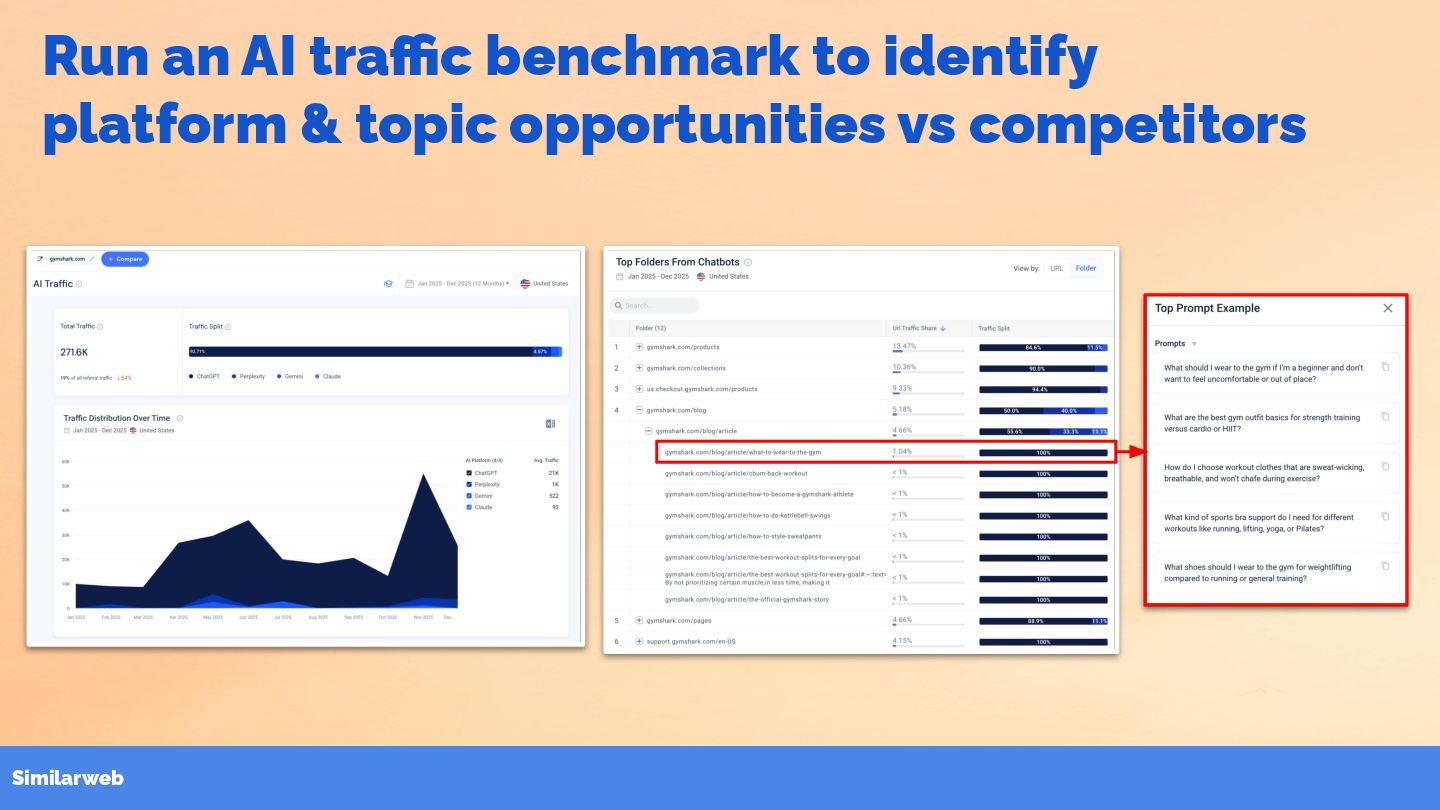
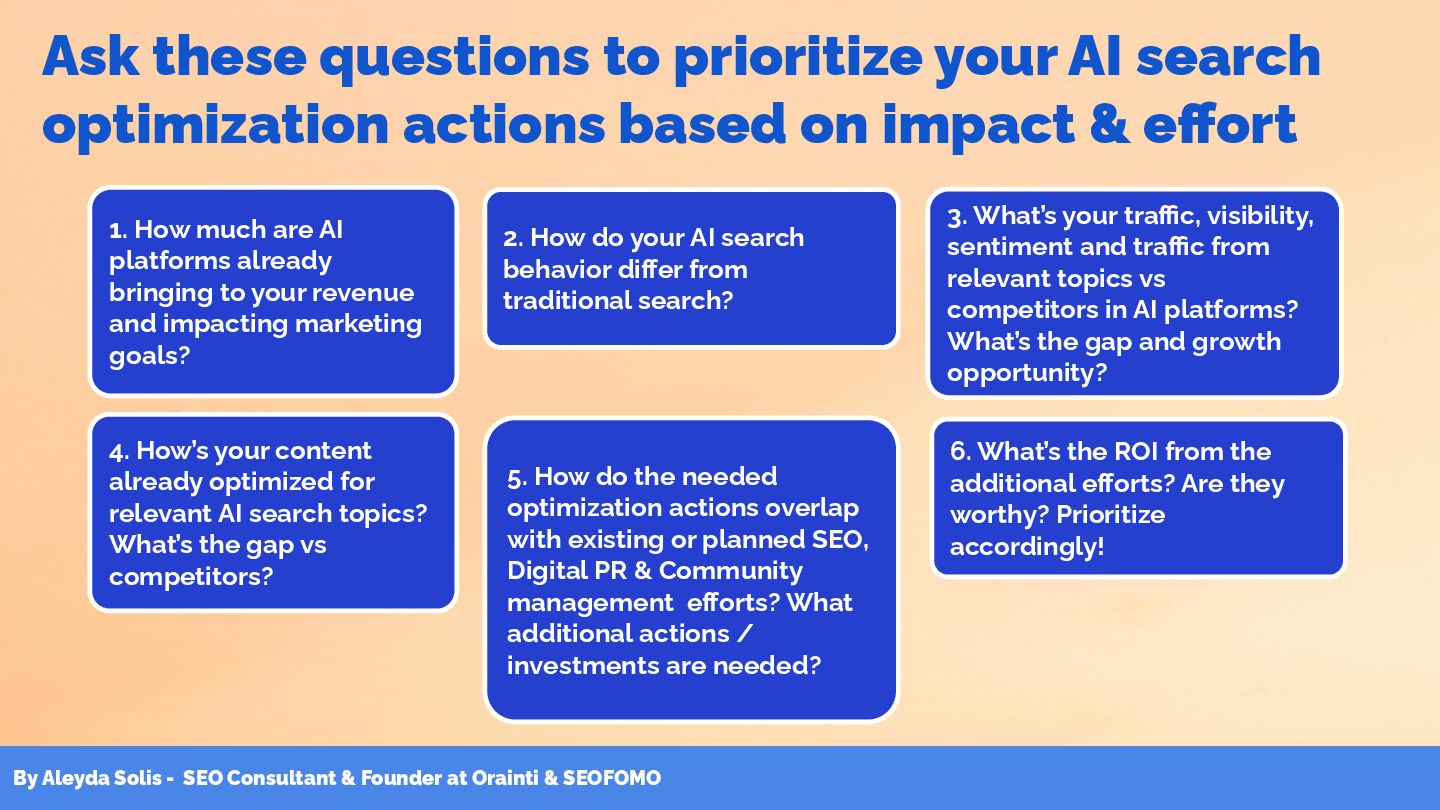
revenue and impacting marketing goals? 2. How do your AI search behavior differ from traditional search? 3. What’s your traffic, visibility, sentiment and traffic from relevant topics vs competitors in AI platforms? What’s the gap and growth opportunity? 4. How’s your content already optimized for relevant AI search topics? What’s the gap vs competitors? 5. How do the needed optimization actions overlap with existing or planned SEO, Digital PR & Community management efforts? What additional actions / investments are needed? 6. What’s the ROI from the additional efforts? Are they worthy? Prioritize accordingly! Ask these questions to prioritize your AI search optimization actions based on impact & effort By Aleyda Solis - SEO Consultant & Founder at Orainti & SEOFOMO
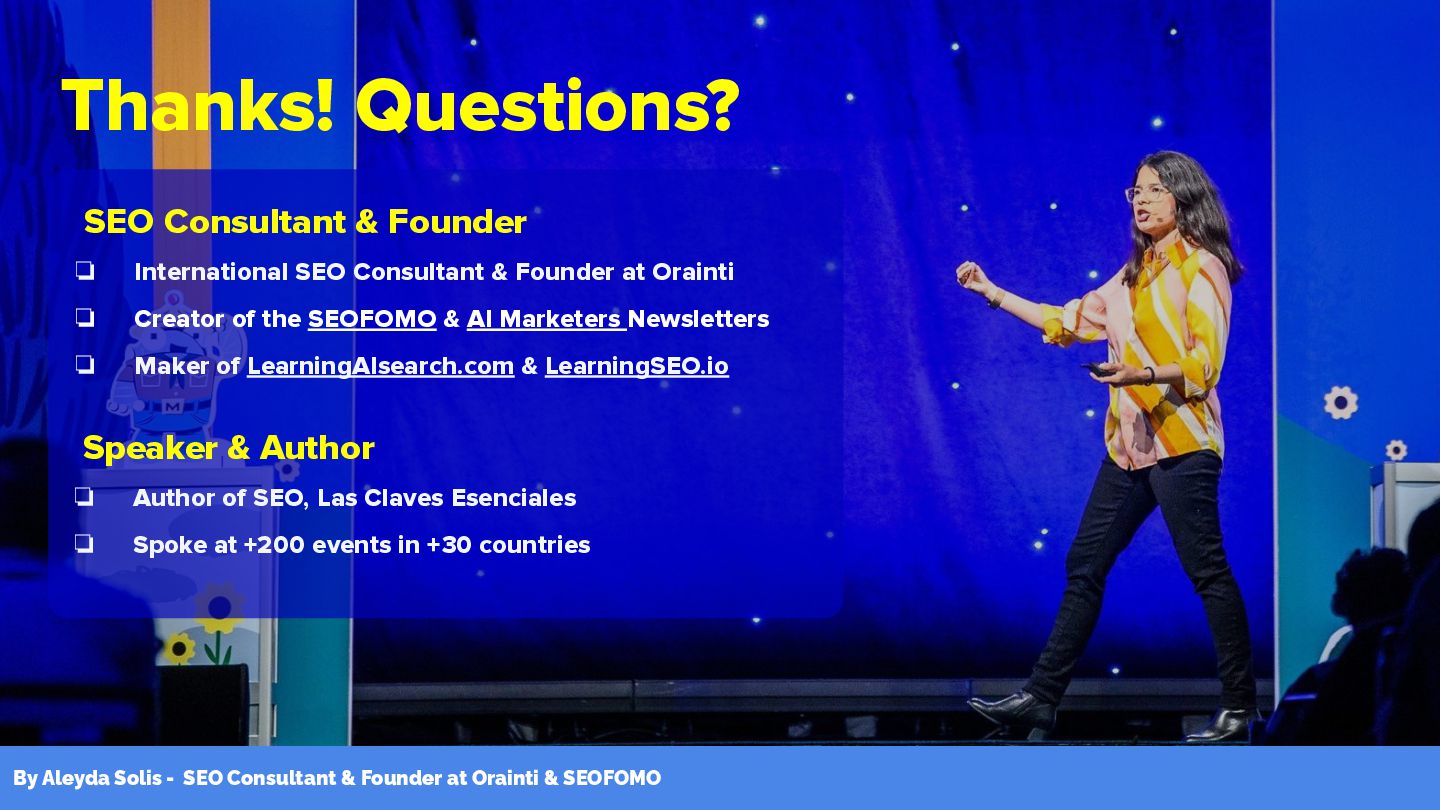
& Founder at Orainti ❏ Creator of the SEOFOMO & AI Marketers Newsletters ❏ Maker of LearningAIsearch.com & LearningSEO.io Speaker & Author ❏ Author of SEO, Las Claves Esenciales ❏ Spoke at +200 events in +30 countries By Aleyda Solis - SEO Consultant & Founder at Orainti & SEOFOMO


 aleyda
.png) samanyougarg
samanyougarg
 gurzu
gurzu
 speedyindexteam
 sarosaro
 kizawa2020
 samtorres
 decabbit
 davetheseo
 guaca
guaca
 zjchahalis
 thekraken
 minecr
 frankvandijk
 tessaabrams
 akademiya2063
 tamaranovitovic
.png) helenjbeal
helenjbeal
 tammyeverts
 aki_iinuma
 codingconduct
 skoyamalab