Share
Maniffesto Ynni Cymunedol Cymru | Community Energy Wales Manifesto
The Community Energy Wales Manifesto 2026 outlines a strategic vision to build a fair, democratic, and community-led energy transition in Wales. It argues that top-down net-zero strategies are creating local tensions and repeating a history of extractive economics. The document advocates for a systemic shift toward local ownership, statutory wealth redistribution, and a right to local energy markets to ensure that citizens directly benefit from the clean energy revolution.
Mae Maniffesto Cymunedau Ynni Cymru 2026 yn amlinellu gweledigaeth strategol ar gyfer adeiladu pontio ynni teg, democrataidd ac arweiniad‑cymuned yng Nghymru. Mae’n dadlau bod strategaethau sero‑net o’r top i lawr yn creu tensiynau lleol ac yn ailadrodd hanes o economi echdynnu. Mae’r ddogfen yn galw am newid systemig tuag at berchnogaeth leol, ailddosbarthu cyfoeth statudol, a hawl i farchnadoedd ynni lleol er mwyn sicrhau bod dinasyddion yn elwa’n uniongyrchol o’r chwyldro ynni glân.

Alun Gruffudd
Transcript
24 slides
-
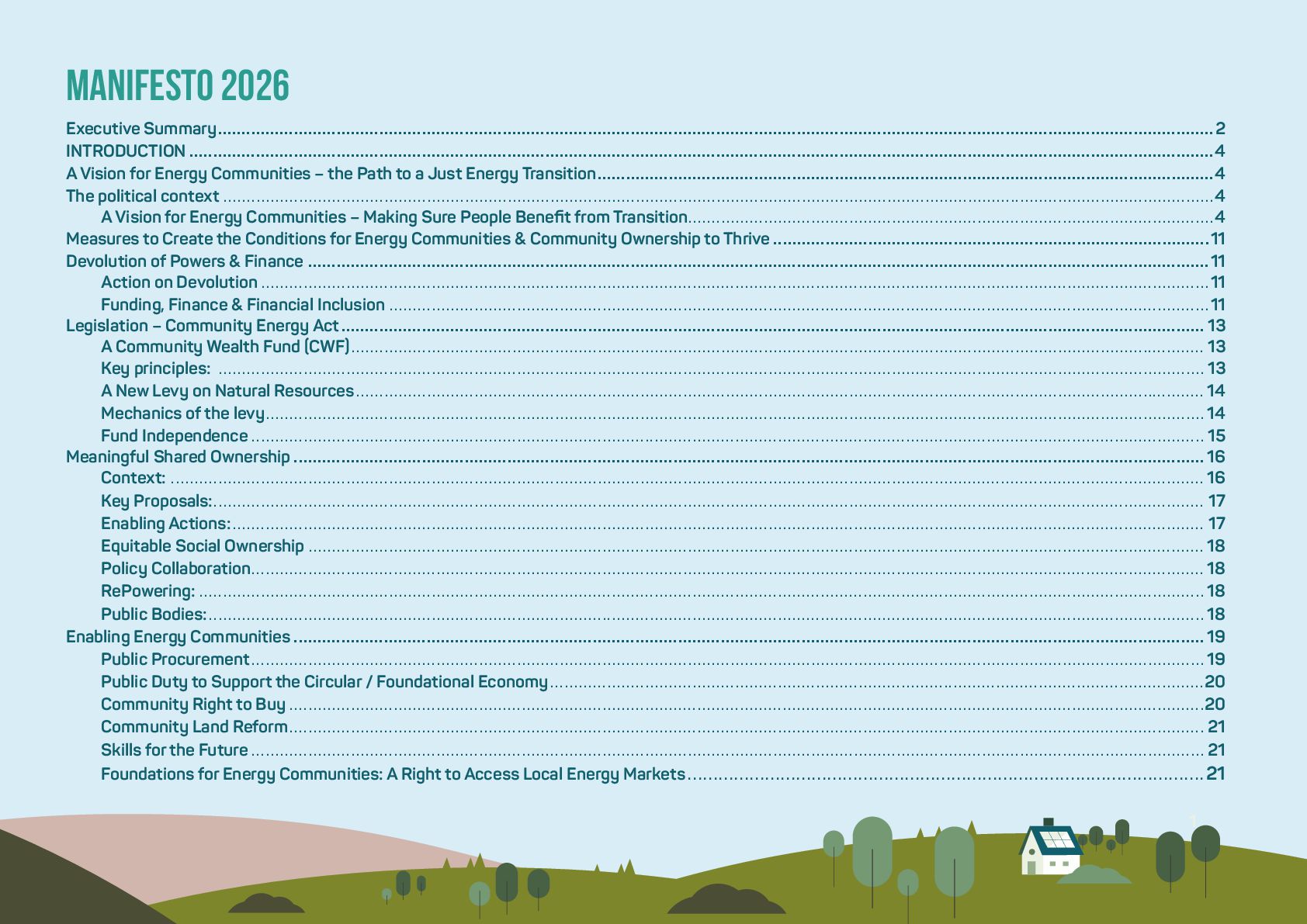
MANIFESTO 2026 Executive Summary...................................................................................................................................................................................................................2 INTRODUCTION.........................................................................................................................................................................................................................4 A Vision for Energy Communities
– the Path to a Just Energy Transition...................................................................................................................................4 The political context..................................................................................................................................................................................................................4 A Vision for Energy Communities – Making Sure People Benefit from Transition...............................................................................................................4 Measures to Create the Conditions for Energy Communities & Community Ownership to Thrive.............................................................................................11 Devolution of Powers & Finance...............................................................................................................................................................................................11 Action on Devolution.........................................................................................................................................................................................................11 Funding, Finance & Financial Inclusion..............................................................................................................................................................................11 Legislation – Community Energy Act....................................................................................................................................................................................... 13 A Community Wealth Fund (CWF)..................................................................................................................................................................................... 13 Key principles: ................................................................................................................................................................................................................. 13 A New Levy on Natural Resources.................................................................................................................................................................................... 14 Mechanics of the levy....................................................................................................................................................................................................... 14 Fund Independence.......................................................................................................................................................................................................... 15 Meaningful Shared Ownership................................................................................................................................................................................................. 16 Context:........................................................................................................................................................................................................................... 16 Key Proposals:.................................................................................................................................................................................................................. 17 Enabling Actions:.............................................................................................................................................................................................................. 17 Equitable Social Ownership.............................................................................................................................................................................................. 18 Policy Collaboration.......................................................................................................................................................................................................... 18 RePowering:..................................................................................................................................................................................................................... 18 Public Bodies:................................................................................................................................................................................................................... 18 Enabling Energy Communities................................................................................................................................................................................................. 19 Public Procurement.......................................................................................................................................................................................................... 19 Public Duty to Support the Circular / Foundational Economy...........................................................................................................................................20 Community Right to Buy..................................................................................................................................................................................................20 Community Land Reform.................................................................................................................................................................................................. 21 Skills for the Future.......................................................................................................................................................................................................... 21 Foundations for Energy Communities: A Right to Access Local Energy Markets.....................................................................................................21 1 -
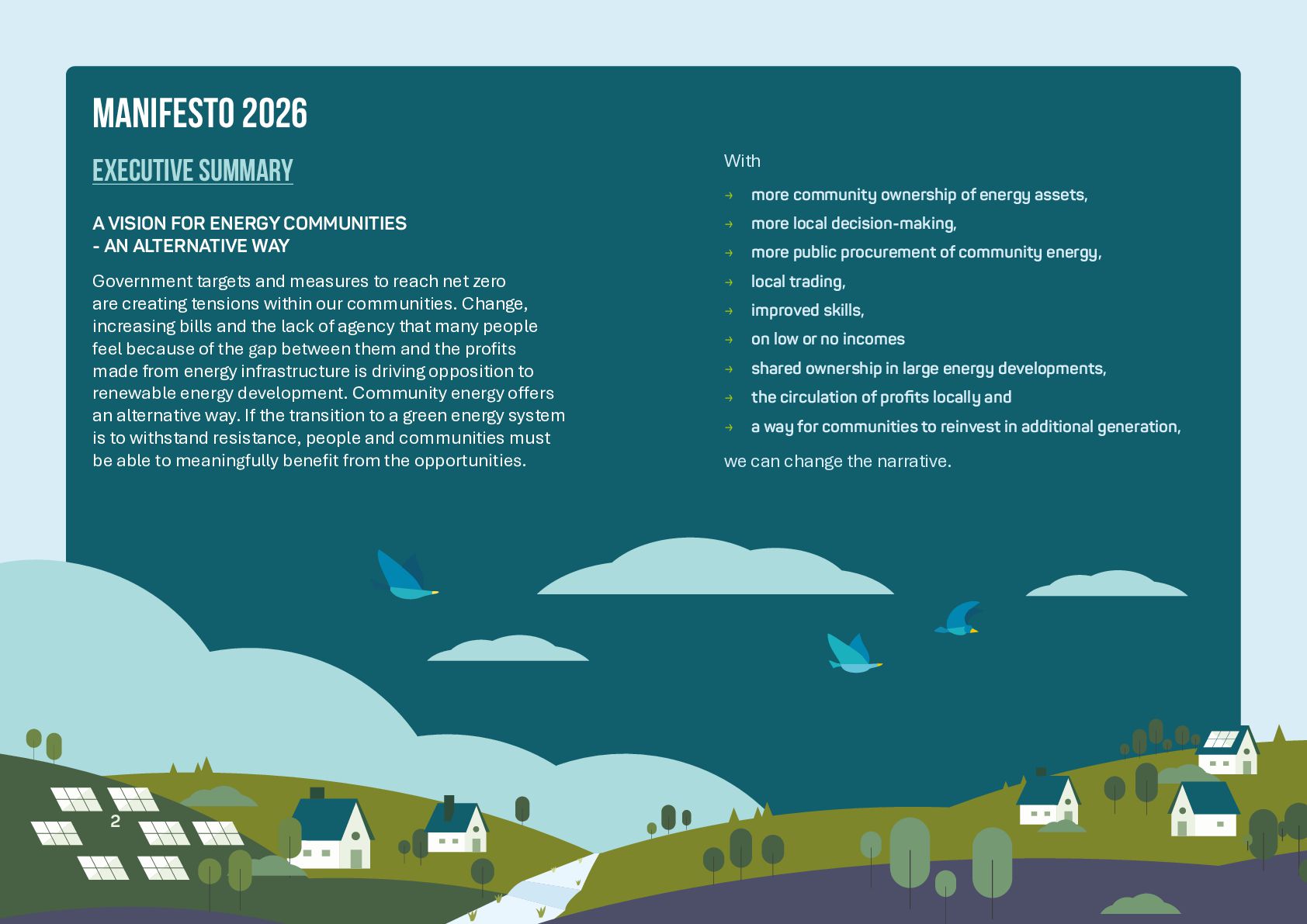
MANIFESTO 2026 Executive Summary With → more community ownership of
energy assets, A VISION FOR ENERGY COMMUNITIES - AN ALTERNATIVE WAY → more local decision-making, → more public procurement of community energy, Government targets and measures to reach net zero are creating tensions within our communities. Change, increasing bills and the lack of agency that many people feel because of the gap between them and the profits made from energy infrastructure is driving opposition to renewable energy development. Community energy offers an alternative way. If the transition to a green energy system is to withstand resistance, people and communities must be able to meaningfully benefit from the opportunities. → local trading, → improved skills, → on low or no incomes → shared ownership in large energy developments, → the circulation of profits locally and → a way for communities to reinvest in additional generation, 2 we can change the narrative. -
1. Introduce a Community Energy Act. This will include the
creation of: a. a Community Wealth Fund, b. a Natural Resources Levy and c. meaningful shared ownership. 2. Act on devolution: a) Implement the Comisiwn recommendation on energy and ensure that the powers needed to build energy communities are devolved. b) Devolve the Crown Estate. Funds raised from this, the Natural Resources Levy and private or community investors will contribute to an independent Community Wealth Fund to fund new community wealth-building ventures. 3. Funding & Finance – while the Community Wealth Fund is being established, make shared ownership loan and grant finance available to support capacity building. 4. Work with the UK Government on its review of the wind industry’s ‘community benefits’ packages. The funds contributed should be mandatory, cover all technologies and the amount raised doubled (and any non-renewable development, quadrupled), with a ‘natural resources levy’ top-sliced to contribute to the Community Wealth Fund. 5. Set up a working group to investigate ways to include everyone who wants to be involved in the ownership of community shares, using the Community Wealth Fund to subsidise shared ownership. Use the Community Energy Act to implement its findings. 6. Measures to favour public service procurement contracts for community-owned businesses. 7. A public duty to support the circular / foundational / cooperative economy. 8. Legislate for Community Right to Buy. 9. Legislate for Community Land Reform. 10. Addressing the skills gap by creating 5,000 professional apprenticeships. 11. Work with the UK Government to establish a Right to Access Local Energy Markets. 3 -
INTRODUCTION a Vision for Energy Communities – the Path to
a Just Energy Transition The political context Throughout Wales, hydro projects, wind turbines and solar panels are generating green energy. All these projects are tackling climate change, and there is momentum behind renewables that is building. Community energy is a part of that momentum, but what sets us apart from the rest of the energy sector is our aspiration and track record of building long-term wealth within our communities, using our assets to solve local problems, and placing control in the hands of local people. Confidence in private companies, institutions, and governments to do right by their communities is at an all-time low. We know that green energy is growing, and with that growth comes change. Change can lead to fear and apprehension. The changes to our landscape, the way we live our lives and to our economy are already causing anxiety to many people, leading to resistance and opposition to green energy projects. People feel a lack of agency and a lack of control over the way the energy transition and the changes that come with it are being made. This leads many to see the green energy revolution as happening to them – or being done to them – rather than something that they are a part of. Questions around who is paying (during an energy-driven cost-ofliving crisis) and who is gaining from these changes, foreground the political debate on decarbonisation. The profits of many of the companies and consultants driving the energy transition continue to be eye-watering, while household bills remain over-inflated. These tensions are especially felt in Wales because of our history, which has left a legacy of deep poverty and poor health in communities which should have benefitted from past industry. These are bitter memories passed from one generation to the next, and are now being repeated. Profits from previous energy revolutions left the country via the age-old extractive economic model. If this failed model drives the next energy revolution – on top of the severe cuts to public services and public infrastructure – Welsh communities will be exploited and marginalised yet again. People too often feel unable to navigate these tensions and changes or to see an alternative. 4 -
Community energy offers an alternative way. Community energy belongs to
the people. People are in control, and people retain the profits within their communities, instead of them leaking out and ending up in the hands of the super-wealthy. Community energy provides for energy independence and community independence. It enables a bolder and faster-paced climate action to benefit people, nature, planet and the economy. It enables all people to ‘do the right thing’ for future generations. The opportunities associated with a new energy system are vast and innumerable. The transition to a green energy system will be one of the largest shifts in economic terms since the industrial revolution. If the green transition is to withstand resistance, people and communities must be able to benefit from these opportunities. Communities often want and deserve a stake in this change, but it’s not easy to get it. There are barriers between communities, private developers and the market, with no real control over how locally produced energy is used. There is limited understanding about how our complex energy system works or how it could be different. With greater control comes responsibility. Agency over energy assets means communities taking responsibility over our future. The opportunity is there to be taken, but it’s not going to be done for us. We must do it ourselves, and we must start now. Fear of changes that come with energy transition can be overcome with positive messages about the benefits of community-owned energy assets operating in a fair market. A different future is possible, a future where people have control, ownership and a say over the energy generated near to them and its use. 5 -
A Vision for Energy Communities – Making Sure People Benefit
from the Transition Energy communities are grassroots or community-based initiatives where people collectively participate in the production, distribution, and/or consumption of energy, usually renewable. Energy communities aim to democratise energy systems by involving individuals and local groups in decision-making and the distribution of benefits, contrasting with centralised, corporate-controlled energy models. What we have now Ecopower, Belgium Ecopower in Belgium is an energy co-operative that has been operating since 1991 and has over 65,000 community members. 55,000 of these members have Ecopower as their energy supplier – meaning their homes are powered by 100% community-owned renewable energy. The money raised from this activity has allowed them to install 75 MW of capacity across wind, hydro and solar technologies. 6 Energy Local Energy users are connected to their Energy Local club which provides them with information about what is being generated locally and when. This information encourages electricity use when demand is low, because it can be provided at a lower cost. It also leads to more efficient use of the energy grid. There are 18 energy local clubs operating across Wales. Smart and Fair Neighbourhood Trials Project LEO (Local Energy Oxfordshire) The Smart and Fair Neighbourhood Trials are a key part of Project LEO, a £40 million smart local energy system programme led by Scottish and Southern Energy Networks, the University of Oxford, and the Low Carbon Hub. These trials engaged over 350 households across Oxfordshire to test how solar PV, battery storage, electric vehicles and demand-side response can work together. The trials demonstrated that participants could shift their electricity use to align with local solar generation, reducing peak grid demand by up to 20%. In the Rose Hill trial, 19 flats increased consumption by about 30% during peak solar hours across 13 demand response events to maximise renewable energy use. As this project is led by a consortium including SSEN and the University of Oxford, the project is an example of local energy as opposed to community energy. Community-owned energy communities can learn from these trials, however. -
ReFLEX Orkney ReFLEX Orkney is a pioneering £28.5 million project
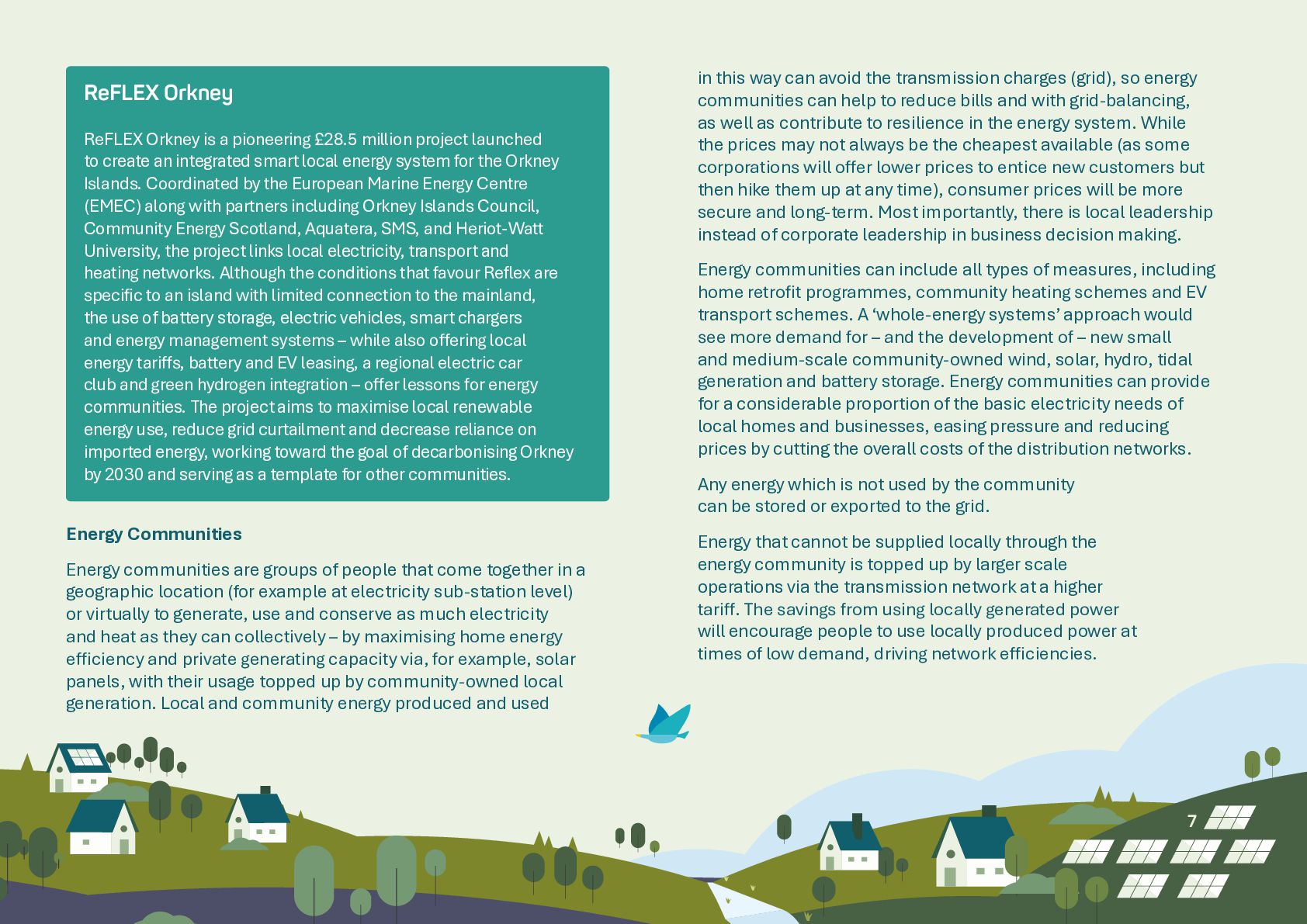
launched to create an integrated smart local energy system for the Orkney Islands. Coordinated by the European Marine Energy Centre (EMEC) along with partners including Orkney Islands Council, Community Energy Scotland, Aquatera, SMS, and Heriot-Watt University, the project links local electricity, transport and heating networks. Although the conditions that favour Reflex are specific to an island with limited connection to the mainland, the use of battery storage, electric vehicles, smart chargers and energy management systems – while also offering local energy tariffs, battery and EV leasing, a regional electric car club and green hydrogen integration – offer lessons for energy communities. The project aims to maximise local renewable energy use, reduce grid curtailment and decrease reliance on imported energy, working toward the goal of decarbonising Orkney by 2030 and serving as a template for other communities. Energy Communities Energy communities are groups of people that come together in a geographic location (for example at electricity sub-station level) or virtually to generate, use and conserve as much electricity and heat as they can collectively – by maximising home energy efficiency and private generating capacity via, for example, solar panels, with their usage topped up by community-owned local generation. Local and community energy produced and used in this way can avoid the transmission charges (grid), so energy communities can help to reduce bills and with grid-balancing, as well as contribute to resilience in the energy system. While the prices may not always be the cheapest available (as some corporations will offer lower prices to entice new customers but then hike them up at any time), consumer prices will be more secure and long-term. Most importantly, there is local leadership instead of corporate leadership in business decision making. Energy communities can include all types of measures, including home retrofit programmes, community heating schemes and EV transport schemes. A ‘whole-energy systems’ approach would see more demand for – and the development of – new small and medium-scale community-owned wind, solar, hydro, tidal generation and battery storage. Energy communities can provide for a considerable proportion of the basic electricity needs of local homes and businesses, easing pressure and reducing prices by cutting the overall costs of the distribution networks. Any energy which is not used by the community can be stored or exported to the grid. Energy that cannot be supplied locally through the energy community is topped up by larger scale operations via the transmission network at a higher tariff. The savings from using locally generated power will encourage people to use locally produced power at times of low demand, driving network efficiencies. 7 -
Local Energy Our Vision for an Energy Community Energy provided
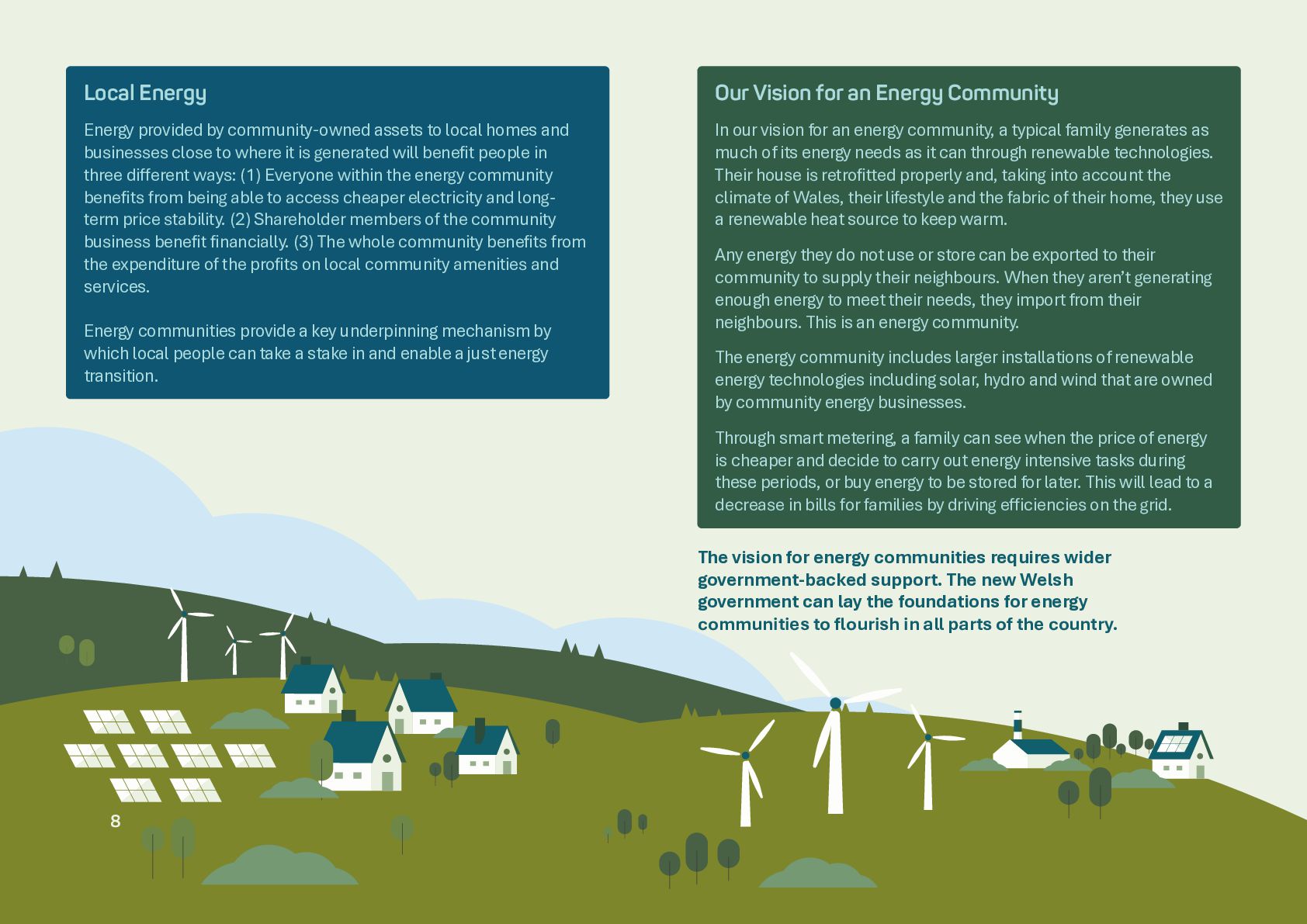
by community-owned assets to local homes and businesses close to where it is generated will benefit people in three different ways: (1) Everyone within the energy community benefits from being able to access cheaper electricity and longterm price stability. (2) Shareholder members of the community business benefit financially. (3) The whole community benefits from the expenditure of the profits on local community amenities and services. In our vision for an energy community, a typical family generates as much of its energy needs as it can through renewable technologies. Their house is retrofitted properly and, taking into account the climate of Wales, their lifestyle and the fabric of their home, they use a renewable heat source to keep warm. Energy communities provide a key underpinning mechanism by which local people can take a stake in and enable a just energy transition. Any energy they do not use or store can be exported to their community to supply their neighbours. When they aren’t generating enough energy to meet their needs, they import from their neighbours. This is an energy community. The energy community includes larger installations of renewable energy technologies including solar, hydro and wind that are owned by community energy businesses. Through smart metering, a family can see when the price of energy is cheaper and decide to carry out energy intensive tasks during these periods, or buy energy to be stored for later. This will lead to a decrease in bills for families by driving efficiencies on the grid. The vision for energy communities requires wider government-backed support. The new Welsh government can lay the foundations for energy communities to flourish in all parts of the country. 8 -
Government Action Required for Energy Communities → All new private
commercial renewable energy projects will also be mandated to offer to share ownership with a local community partner, with a suggested minimum community share of 30%. Shared ownership will become a natural part of our energy system and the usual way of doing business in Wales. This builds on the work of the Institute of Welsh Affairs report ‘Sharing power, spreading wealth’. → Public sector anchor organisations (councils, health boards, universities, prisons, housing associations, etc.) will be mandated to take a community wealth building approach. This means prioritising, where possible and within procurement legislation, the purchase of community-sourced energy in their procurement, and making assets (e.g. land, buildings) available to develop or codevelop joint projects with communities. This is in line with the recommendations in the 2025 Wellbeing & Future Generations Commissioner’s Report. By purchasing from communityowned assets, these public sector organisations will be actively supporting the circular and foundational economy and the building of more community-owned assets, strengthening and increasing the independence and resilience of communities. → All government supported schemes (e.g. ECO4, EcoFlex, retrofit) should align with the energy communities model. All anti-poverty initiatives should be joined up and aligned with community energy and energy communities. → Welsh Government must work with the UK Government to bring in long-term price mechanisms for community energy underpinned with a price guarantee. → Welsh Government must push for the mandating of suppliers to facilitate energy communities by providing balancing, settlement and billing services without passing on any additional costs to consumers. → Developing skills: growing the community energy sector with Paying for investment A new levy on natural resources to reflect the fact that renewable energy relies on the wind that blows, rain that falls, and sun that shines on the place where generators are located should be introduced by the new government. While these resources aren’t commodities to be owned as such by anyone, it shouldn’t be private developers that become the sole beneficiary of these resources. We propose that a share of the benefit from their use should be place-based, linked to that location, along the same lines that landowners receive rental income for the use of the land and access, termed a ‘levy on natural resources’. → → All new energy projects not contributing to ‘energy communities’ should pay a new levy on the natural resources they extract from Wales into a Community Wealth Fund. The Community Wealth Fund, modelled on Norway’s fossil-fuel based Sovereign Wealth Fund, will support the start-up of new energy community initiatives to help realise the vision for energy communities to be supported and enabled everywhere. All private renewable energy developers would be mandated to pay this levy alongside existing community benefits funds, which should also be mandated. They would contribute roughly double to what is currently contributed to community benefits funds. For any non-renewable energy developments, contributions will be roughly quadrupled. 9 -
energy communities will enable communities to capitalise on their own
natural resources, whilst boosting demand for skilled workers. The community energy sector already holds a wealth of skills and expertise, including experience of good public sector collaboration where robust systems have been tested and shown to work well. More apprenticeships to meet this growing demand, and courses which help to embed the skills needed alongside principles of community ownership, community energy and cooperative working across the range of relevant disciplines will enable young people to enter these better, local, skilled work opportunities. → New grid investment benefits communities: Welsh Government should work with the UK Government to fast-track applications and reduce all planning hurdles for community energy grid connections, and with the System Network Operator (NESO) and the Distribution Network Operators (DNOs) to give priority to ‘ready’ community projects. This can be achieved by adding ‘community’ as a ‘needed’ characteristic in grid queue management. All investment from both public and private sources in grid upgrades and new grid infrastructure should offer shared ownership to local communities and large new grid developments must be mandated to provide a minimum amount of capacity to local and community-owned projects to connect. → A plan for repowering: Community Energy Wales and Community Energy Scotland are working together to develop expertise in repowering and refurbishing renewable technologies. As the first round of renewable energy projects from the turn of the millennium reach the end of their original lifespan, measures should be taken to ensure the maximisation of ownership opportunities for communities from repowering these projects. Creating the conditions for energy communities to flourish 10 will require government and other financial support for community energy start-ups, shared ownership financing, investment in apprenticeships and skills and repowering. Over time, capital investment will come from the Community Wealth Fund. It will also require revenue funding to build human capital or capacity in the sector. There are numerous barriers in the way of communities taking on this challenge. Community Energy Wales has worked with our members to identify the barriers and to find solutions. Here, we outline what the next Welsh Government needs to do to back the people of Wales and give communities the power to take control of our energy future. -
Measures to Create the Conditions for Energy Communities & Community
Ownership to Thrive Devolution of Powers & Finance Community Energy Wales asks candidates and political parties standing for the 2026 Senedd election to commit to: → enabling the people of Wales to become owners of as many energy assets as possible and to set targets to grow community and public ownership and → supporting all measures that grow the community energy sector and help build energy communities over the course of the 2026-2030 Welsh Government. for the devolution of The Crown Estate, which should become the responsibility of the devolved government of Wales as it is in Scotland.” Revenue raised in Wales from the devolved Crown Estate can be used to capitalise the Community Wealth Fund. Every single one of the twenty-two Welsh Local Authorities has voted to support the devolution of The Crown Estate, demonstrating that public opinion favours devolution and making it clear that the next Welsh Government would be expected to press the case for it immediately. → The Comisiwn recommendation should be acted upon with no further delay. → Welsh Government should press for the immediate devolution of the Crown Estate. Funding, Finance & Financial Inclusion Action on Devolution The powers required to implement our vision for energy communities are held by different levels of government. Decisions as to what further powers should be devolved should be taken following the implementation of the recommendation relating to energy in the 2023 Independent Comisiwn Report on the Constitutional Future of Wales: “Recommendation 8: The Welsh and UK governments should establish an expert group to advise urgently on how the devolution settlement and inter-governmental engagement in relation to energy could be reformed, to prepare for rapid technical innovation in energy generation and distribution, and to ensure that Wales can maximise its contribution to net zero and to the local generation of renewable energy. The remit of the group should include advising on the options One major barrier to the expansion of community energy is funding. Investment in community energy is investment to save, and for communities to thrive. The community energy sector urgently requires Welsh Government support through the following measures: → Consider how Welsh pension funds, private and public investment (including philanthropic donations and match funding) can best help support shared and full community ownership. → Provide a transparent system of start-up grants and low-interest loans for capacity building. The playing field must be levelled through the provision of revenue funding to recruit and retain staff support in grassroots community energy organisations at the same funding level, matching the total sums granted to other 11 -
local energy programmes (i.e. Ynni Cymru, the Welsh Government Energy
Service & Trydan Gwyrdd Cymru). This includes revenue for shared ownership development and for capacity to fully participate in and help facilitate the implementation of the regional and local energy planning processes (RESPs & LAEPs). → Provide Community Energy Wales & YnNi Teg with additional core funding to expand its community engagement and new starter / development services. This will create new community energy groups to develop more projects. Focus for this work should be on areas with high numbers of people on low or no incomes and people not currently engaged with community energy. This is essential to build the pipeline we need in place to take advantages of barriers being removed and to maximise what Wales can receive in investment from the UK Government’s Local Power Plan and Great British (GB) Energy. Focus will be on developing a pipeline of projects, with some projects completed early (‘quick wins’) and others taking more time to develop. This will allow the long-term approach required to empower the geographic areas furthest away from community energy ownership and include those not currently engaged with community energy. → Provide a guarantee fund for the community energy sector to reduce the cost of debt and provide security for lenders (similar to the way such a fund works for CDFIs and the British Business Bank). → Use its networks and official channels to help promote community share offers. → Establish a fund to help community enterprises pay for grid connections and shared ownership of grid infrastructure (until a sustainable Community Wealth Fund that would overcome this is established). All loan funding to be recycled for further investment. → Ensure Natural Resources Wales costs (e.g. extraction licenses, rent, wayleaves) are not a barrier. 12 → Work with the UK Government on its review of ‘community benefits funds’ to top slice a ‘natural resources levy’ for contributions to the Community Wealth Fund and legislate to implement if necessary. → Work with the UK Government to establish a Community Contract for Difference (CfD) to provide for a viable price floor for all community owned renewable projects and an enhanced Smart Export Guarantee (SEG). Introduce a requirement on energy suppliers to offer a minimum SEG price for surplus energy from primarily behind the meter installations for 25 years. Smart Export Guarantee The Smart Export Guarantee (SEG) is a government scheme that allows individuals and businesses generating their own renewable electricity, such as from solar panels, to receive payments for the excess electricity they export back to the grid. → Provide for everyone living in Wales, who has the time and wants to contribute, to be given the opportunity to participate in local community energy projects. Although the whole community benefits from community energy projects and energy communities, shareholders will benefit financially from modest dividends as well as being decision makers on the basis of one member, one vote. No-one should be excluded from the democratising power of community energy. The new Welsh government must establish a working group to consider how people who cannot afford to buy community ownership shares can be included in community ownership. shares can be included in community ownership. A portion of the Community Wealth Fund will subsidise the ownership of community energy shares for those on low or no incomes who want them. Commit to legislation if necessary. Long term, everyone in Wales should be given the opportunity to participate in and benefit from the democratising potential of distributed community-owned energy. -
Legislation – Community Energy Act Key principles: A Community Energy
Act (Wales) will provide for a Welsh Community Wealth Fund and a new levy on natural resources, meaningful shared ownership, the implementation of any necessary legal measures arising from the recommendations from the working group on “energy ownership for all” to include everyone in community energy ownership and the devolved measures arising out of the UK Government’s GB Energy work. → A new levy on natural resources and Crown Estate profits should contribute to the Community Wealth Fund. Other sources of finance, such as philanthropic donations and donations from the surpluses of community energy businesses, can also contribute. → The CWF provides low cost / interest-free loans to new community business (not just energy) that will grow the community ownership asset base. → Decisions about funding allocations should be made without government involvement. Decision-makers should be prepared to take risks while only supporting businesses with a good potential to be viable. → Lessons should be learned from the rolling out of the tourism tax for geographic equity in the allocation of resources. → Funds can be used to match fund community business surpluses or share raises. → Not all loans will be repaid. Those that are will be recycled back into new loans. → A percentage of the funds, we suggest 10%, will be ringfenced to support “ownership for all”. A Community Wealth Fund (CWF) For community ownership to grow and for constituted groups to be able to operate as self-sustaining businesses in the medium to longterm, a source of dependable finance is required both for new startup organisations and for the expansion of existing organisations. In the short term, the community wealth-building sector will continue to rely on grants and loans from government, the private sector and other funders. With a viable business model (energy communities) and a Community Wealth Fund (CWF) for capital investment, the community energy sector, as well as the wider community business sector, should be able to grow and become self-sustaining. 13 -
What is a Community-Owned Business? A community-owned business is like
any other business, but under community ownership. This means that members of the business can vote to decide how to best spend the money generated from selling services or goods on the principle of one member, one vote. Community-owned businesses must use their profits to benefit their local communities. This can include donating to a local charity, providing funding to set up new community businesses or using the money to buy further assets. A New Levy on Natural Resources Traditional community benefit funds provided to communities within a small radius of energy developments are under review. They do not compensate the community for the extraction of the natural resources from that area. The wind industry-agreed figure of £5,000 per megawatt for onshore wind was determined in 2012. It has not increased in line with inflation, and while many of the funds provide for and support good works and community ventures, the model does not reflect what communities could reasonably expect from large-scale renewable energy developments in their local areas. Funds are regularly criticised as being ‘bribes’ and eligibility boundaries are questioned. 14 If benefit funds are placed on a statutory footing, widened to cover all energy technologies (including off-shore technologies), and increased (doubled in value for renewable energy and quadrupled for non-renewable energy), half of the funds could be a top sliced ‘levy on natural resources’ to compensate for extraction and to help support more community ownership through reinvestment in additional assets. Similar ideas have been explored in the Institute of Welsh Affairs report ‘Sharing power, spreading wealth’. Mechanics of the levy The new statutory levy will include all energy technologies (not just onshore wind), both renewable and non-renewable. A new community benefit regime for all new projects may be more usefully expressed as a percentage of revenue (or profit) plus capacity, rather than as a figure in pounds per megawatts of capacity. For transparency and fairness (especially if based on profit), a mechanism and overseeing authority will be needed to ensure energy developers use a consistent model for calculating said profits. -
Fund Independence Communities themselves should determine how the Community Wealth
Fund is invested. An independent funding board, appointed through the Public Appointments process, led by the WCVA and comprising of community representatives such as Cwmpas, Ynni Cymunedol Cymru | Community Energy Wales, Building Communities Trust, community councils, Cymunedoli and others as appropriate, will be working alongside partners with regulatory competence, for example the Development Bank of Wales. Fund eligibility should be in line with Welsh Government priorities for community ownership and development, but with full decision-making delegated to the Fund Board. Use of the Fund in this way should be seen as an investment in the future wealth of Wales. It will help secure Wales’s land and land-based assets within local, democratically accountable, not-for-profit organisations who will use the wealth generated to support community empowerment and resilience. The resources and revenue will stay with the people of Wales. The Community Wealth Fund will receive bids from community businesses for full or partial grants or affordable or interest-free financing, the format of which could vary (repayable investment/ blended investment/bridging loans/loan guarantees, etc.) depending on the economic circumstances of communities and the business model of their proposed scheme. Good governance and financial viability will guide and drive decisions. Once The Crown Estate is devolved to Wales and the income from the Welsh share of the profit is realised in Wales, funds raised should go into the Community Wealth Fund. At least 10% of the Community Wealth Fund should be ringfenced to subsidise the purchase of shares in community ownership ventures for people on low incomes and in fuel poverty. At least 20% of the fund should be ringfenced to be allocated to those geographic areas where large corporate-owned energy or other extractive developments are located. A Welsh community wealth building fund – a version of Norway’s Sovereign Wealth Fund – will help to create resilience and real independence for Welsh communities over the long term. 15 -
Meaningful Shared Ownership Context: Despite Welsh Government’s ambition for all
private energy developments to be jointly owned with communities, only three such developments (at time of writing, September 2025) had shared ownership agreements in place at the time of application. This is out of the 30 renewable energy projects entering the Planning Inspectorate Development Wales (PEDW) process since 2020. The existing voluntary guidance is not delivering the stated policy objective. Shared Ownership Projects The three onshore wind projects with signed Memoranda of Understanding (MOU) in place with community energy at time of application to PEDW → RWE Alwen Forest RWE is working with Community Energy Wales to develop a shared ownership scheme for a wind farm adjacent to Llyn Brenig and the Alwen Reservoir. → RWE Pen March RWE is working with Caerphilly and Merthyr County Borough Councils to develop a shared ownership scheme to the northeast of Merthyr. → Coriolis ESB Y Bryn Coriolis, ESB and Awel Aman Tawe are working on a joint venture 130 MW wind farm named Y Bryn northeast of Port Talbot. 16 -
Key Proposals: → For shared ownership to be meaningful, we
recommend that the Welsh Government: → a. Allow community businesses (as defined on page 14) to buy into the stake later using low-interest loans, overcoming delays caused by negotiation and funding challenges, with repayments recycled into future community investments. Works with the UK Government to activate powers under the Infrastructure Act 2015 to mandate shared ownership in law. Legislate to require all developers to offer a minimum 30% community stake in new renewable energy projects above 5 MW. Legislation should include planning revisions and repowering proposals. → Ensures that offers are made early in the development process and are transparent, fairly priced and backed by binding legal agreements. Empower communities to decide what form of shared ownership works for them, rather than the developer deciding (revenue share, split site or the optimal joint venture). → Includes provisions that ensure the community stake is protected if the project is sold, with a right of first refusal for communities to expand their stake. Enabling Actions: Communities often lack the upfront capital and time required to fully understand the potential benefits of shared ownership or how to make it work for their area. To support participation, the Welsh Government should work with the UK Government’s GB Energy investment body to: Create a public finance model—delivered via GB Energy and overseen in Wales by Trydan Gwyrdd Cymru — to secure a 30% community stake early in the development process of all new projects. This will: a. Enable public bodies to temporarily ‘warehouse’ stakes in projects until communities are ready to take them on. This model de-risks investment, prevents inflated valuations, and boosts long-term community returns while supporting developers and accelerating project delivery. → Many communities do not have the resources to engage. To overcome this, Welsh Government must: a. Establish a national public register of all renewable developments and shared ownership opportunities, updated in real time. b. Fund and support Community Energy Wales and YnNi Teg to provide properly resourced outreach, community engagement, technical advice and partnership-building across Wales. c. Ensure support reaches those areas with high numbers of households on low or no incomes, to build an inclusive energy transition. 17 -
Equitable Social Ownership Shared ownership must prioritise those most affected
by development, while also ensuring that no opportunity is wasted. We recommend: → Mandating that the shared ownership offer is made first to local communities. → If not fully taken up locally, the remaining stake should be offered to qualifying community organisations across Wales. → As a last resort, allow public or regional bodies to temporarily hold the stake to ensure community benefit is retained. Policy Collaboration To coordinate delivery and ensure accountability, the Welsh Government should work with the UK Government to: → → Positively weight shared ownership in relevant government support schemes. Shared ownership could be incentivised by making it a condition for receiving Contracts for Difference (CfDs) and offering uplift payments for projects with confirmed shared ownership agreements. The uplift could be scaled based on the size of the community stake and applied across the whole project, strengthening the financial model for participating community groups. Make community ownership a material consideration within the planning and consenting process, with a hierarchy from fully community owned, through different percentages of shared ownership, with the least weighting given to wholly privately-owned developments. The Welsh and UK Governments should work together to ensure a coordinated approach across planning and consenting policies and frameworks. 18 Contracts for Difference A Contracts for Difference is a financial mechanism used by the UK government to support low-carbon electricity generation. It provides price stability for renewable energy producers by guaranteeing a fixed price for electricity. If the market price is below the fixed price, the generator receives a top-up payment. If the market price is above the fixed price, the generator repays the excess to the government. Repowering: Welsh Government should investigate the potential of bringing private sector projects wholly into community ownership by the end of the first project/planning lifecycle, or at the point of repowering. The Community Wealth Fund could be deployed to bring finance to purchase projects ready for repowering, and this should be supported by legislation mandating a community right to buy projects at the point of repowering. Public Bodies: Projects led by public bodies will meet the ‘local’ definition in terms of Welsh Government policy and targets for ‘local and community ownership’. However, the ambition for shared ownership ‘delivering better projects together’ goes beyond simply meeting this local definition. There is a risk of such projects being sold at a late stage of development, with no proper provisions in place to secure a community stake. -
Trydan Gwyrdd Cymru’s projects present an opportunity to set a
gold standard, proving that developer obstacles to shared ownership can be overcome. This is an opportunity for Welsh Government to ‘walk the talk’. All Trydan Gwyrdd Cymru projects should be brought into legally binding joint venture agreements with community counterparties, ideally at the point of signing leases or, at the latest, prior to projects formally entering the consenting process. This should be enacted as soon as possible after May 2026. Shared ownership could be a fantastic opportunity for all if the measures proposed above are put in place. Enabling Energy Communities Public Procurement Following the principles developed in Preston, England, there should be a duty on all Welsh Government funded public bodies to favour the procurement of community energy by unbundling contracts and using social clauses where possible, through direct wire, PPAs and any other local trading mechanisms that become available in the future. Targets should be set to increase the proportion of energy procured by the public, social housing and utilities sectors from community and publicly owned sources. This will provide long-term price stability for public bodies and certainty for community energy providers. A Power Purchase Agreement (PPA) is a long-term contract between an energy generator and a buyer. It defines the terms for the sale of energy, including price and duration. PPAs provide financial certainty for developers by guaranteeing revenue, while buyers secure stable energy costs and access to clean energy. 19 -
Public Duty to Support the Circular / Foundational Economy Community
Right to Buy The next Welsh Government should legislate for a duty to be placed on public bodies to prioritise financial and all forms of other support for the circular, co-operative and foundational economies, including energy communities. Public support for business models which extract value from Wales, its economy and Welsh communities should be disincentivised. This law should also include a public bodies test that would align all future government support with this and all other principles of the Well-being of Future Generations Act. A new right in law would make it easier for communities to buy assets like land and buildings, bringing them into community ownership. In Scotland, this right has been introduced under the Land Reform (Scotland) Act 2003. Communities can register a ‘community interest’ in land, buildings or renewable energy projects and gain the first option to purchase them when they are offered for sale. Private sector owners of renewable energy projects should be mandated to offer their projects for purchase by the community at the point of repowering. ↘ Case Study CAMBRIAN VILLAGE & DŴR CYMRU PARTNERSHIP Cambrian Village Trust (CVT), home to Cambrian United FC in the Rhondda Valley, is generating and selling its own electricity, generating an annual turnover of £30,000. Their clubhouse and café are both powered entirely by their hydro generator via a direct wire connection that cost £12,000 to install. Due to subsequent bill savings, CVT had saved £12,000 within 6 months of installation. CVT originally sold their excess electricity to the National Grid for approximately 7p per kilowatt-hour (kWh). However, CVT have secured a Power Purchase Agreement (PPA), selling excess energy to Dŵr Cymru for approximately 12p per kWh. The income generated goes back into the local community to provide much-needed services and improves the long term resilience of CVT. 20 ↘ Case Study BENGAL DRAGONS Gwyrdd Bangla is a renewable energy initiative led by the Bengal Dragons Foundation, designed to decarbonise and empower Muslim communities across Wales by aligning climate justice, community engagement and clean energy through the lens of faith. The project has installed solar PV and battery storage systems at seven mosques across south Wales. The next phase of the project will include a pilot of the Virtual Power Plant (VPP) model, an exciting innovation in community-based energy sharing. In short, this VPP will provide solar battery storage at no cost to members of the community – all operated by a remote AI software platform to drive efficiencies – with any surplus generated traded for additional revenue to the project. -
Community Land Reform To support all communities to access, manage
and own land for the wellbeing of present and future generations, nature and biodiversity, community energy, recreation and local food production. Skills for the Future Over the course of the parliament, the new Welsh Government should consider how it can embed the skills needed for a community-led just energy transition. To start, 5,000 new modern apprenticeship places will be created to include a mix of craft skills, technician and professional qualifications across the community development and community business and engineering spectrum, leading to professional qualifications, including NVQ Levels 4 & 5. This will require introducing related topics in the school curriculum followed by a network of courses in the further and higher education sectors throughout the country with linked work experience opportunities. Foundations for Energy Communities: A Right to Access Local Energy Markets Our vision for energy communities would be driven by the establishment of a right in law for everyone to have access to local energy markets and participate in an energy community. Everyone should have the right to be able to have stable energy prices and be able to reduce their bills by using local generation and consumption data to balance usage. This would build on the work started by Energy Local and the Power for People campaign and would align with Ynni Cymru’s funding for Smart Local Energy Systems. Welsh and UK Governments should work together to enact such a right. ↘ Case Study Egni Coop & Pembrokeshire County Council partnership Egni, Wales’s first rooftop solar energy co-operative, has partnered with Pembrokeshire County Council to install solar panels on council-owned schools and leisure centres. This includes 6 schools, installed in 2020, and a further 20 schools and leisure centre on which 1MW of solar PVs was installed in 2023-24. The solar panels prevent the emission of approximately 200 tonnes of carbon dioxide per year and will save approximately £180,000 annually in energy costs. Profits Egni generates are reinvested to fund further projects. This model offers a triple win: → The council makes progress towards net zero commitments, lowering costs, at zero capital cost. → Schools receive excellent educational support on renewable energy and climate change through Egni’s ‘We are Energy Warriors’ programme. → Local people have the opportunity to invest via Egni’s co-op share offer, investing their money and getting a fair rate of return. 21
 alun
 ivry_presentationmaterials
 shumpei3
 koji_kawamura
 _awache
 oidfj
 azukiazusa1
 oracle4engineer
 takaha4k
 akihiro0038
 ren8k
 bengo4com
 miu_crescent
 addyosmani
 paigeccino
 axbom
 aleyda
 bermonpainter
 baasie
 cargoodrich
 colly
 iamctodd
 marktimemedia
 pedronauck
 katiecoart