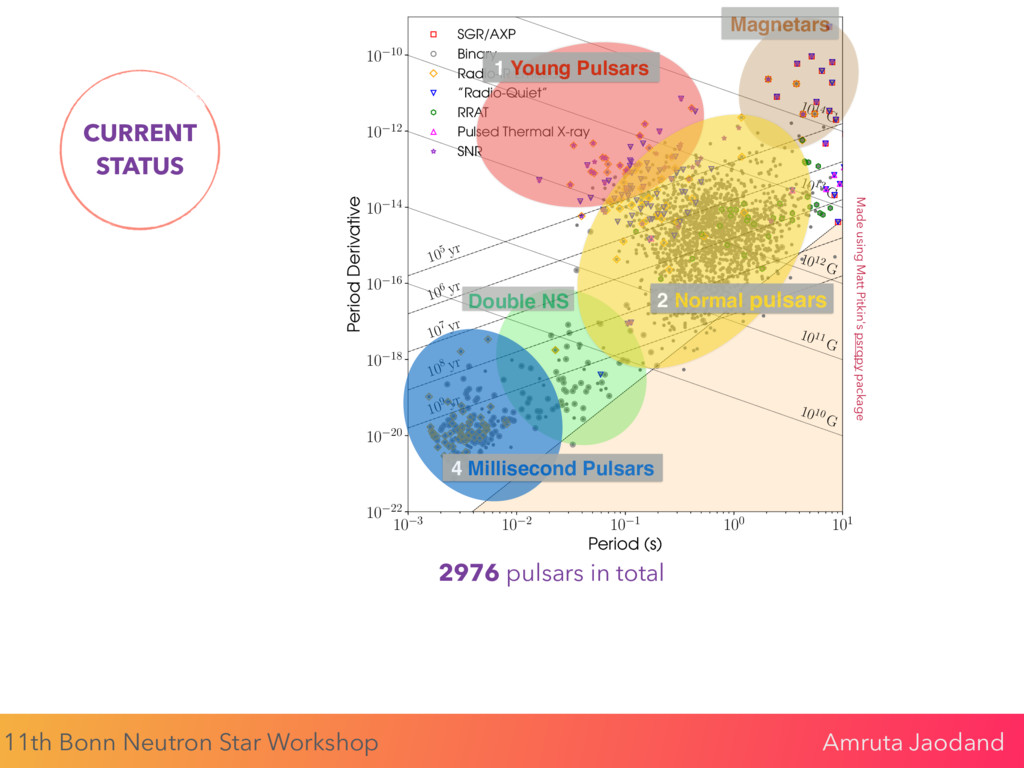
Invited review talk about current status of recycled millisecond pulsars (P_spin <10 ms) presented at the 11th Neutron Star Bonn Workshop on 11/12/2017.
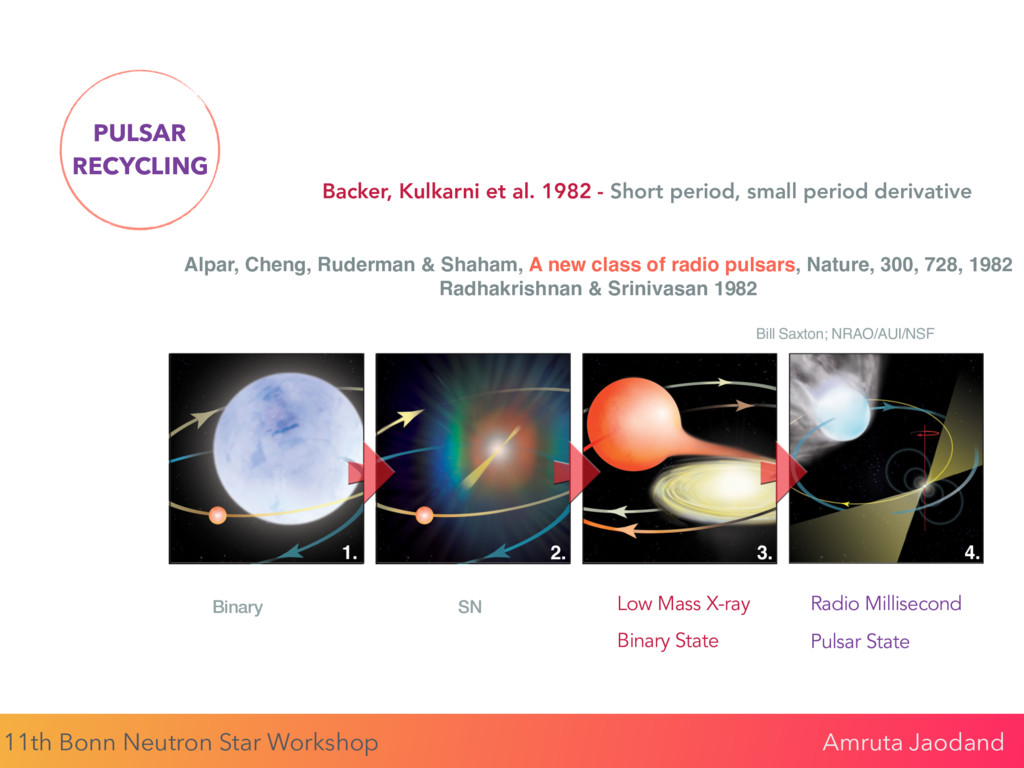
SN Low Mass X-ray Binary State Bill Saxton; NRAO/AUI/NSF Radio Millisecond Pulsar State Backer, Kulkarni et al. 1982 - Short period, small period derivative Alpar, Cheng, Ruderman & Shaham, A new class of radio pulsars, Nature, 300, 728, 1982 Radhakrishnan & Srinivasan 1982
yr 106 yr 107 yr 108 yr 109 yr 1010G 1011G 1012G 1013G 1014G 10 3 10 2 10 1 100 101 Period (s) 10 22 10 20 10 18 10 16 10 14 10 12 10 10 Period Derivative SGR/AXP Binary Radio-IR Emission ”Radio-Quiet” RRAT Pulsed Thermal X-ray SNR 1 Young Pulsars Double NS Magnetars 2 Normal pulsars 4 Millisecond Pulsars 2976 pulsars in total Made using Matt Pitkin's psrqpy package
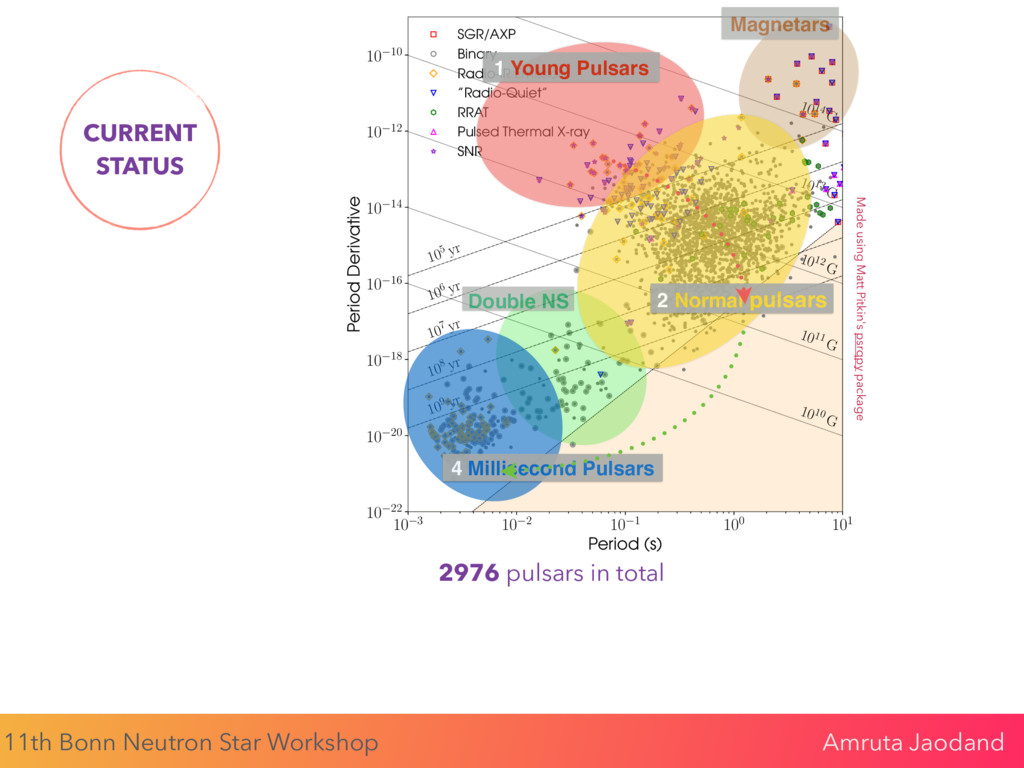
yr 106 yr 107 yr 108 yr 109 yr 1010G 1011G 1012G 1013G 1014G 10 3 10 2 10 1 100 101 Period (s) 10 22 10 20 10 18 10 16 10 14 10 12 10 10 Period Derivative SGR/AXP Binary Radio-IR Emission ”Radio-Quiet” RRAT Pulsed Thermal X-ray SNR 1 Young Pulsars Double NS Magnetars 2 Normal pulsars 4 Millisecond Pulsars 2976 pulsars in total Made using Matt Pitkin's psrqpy package
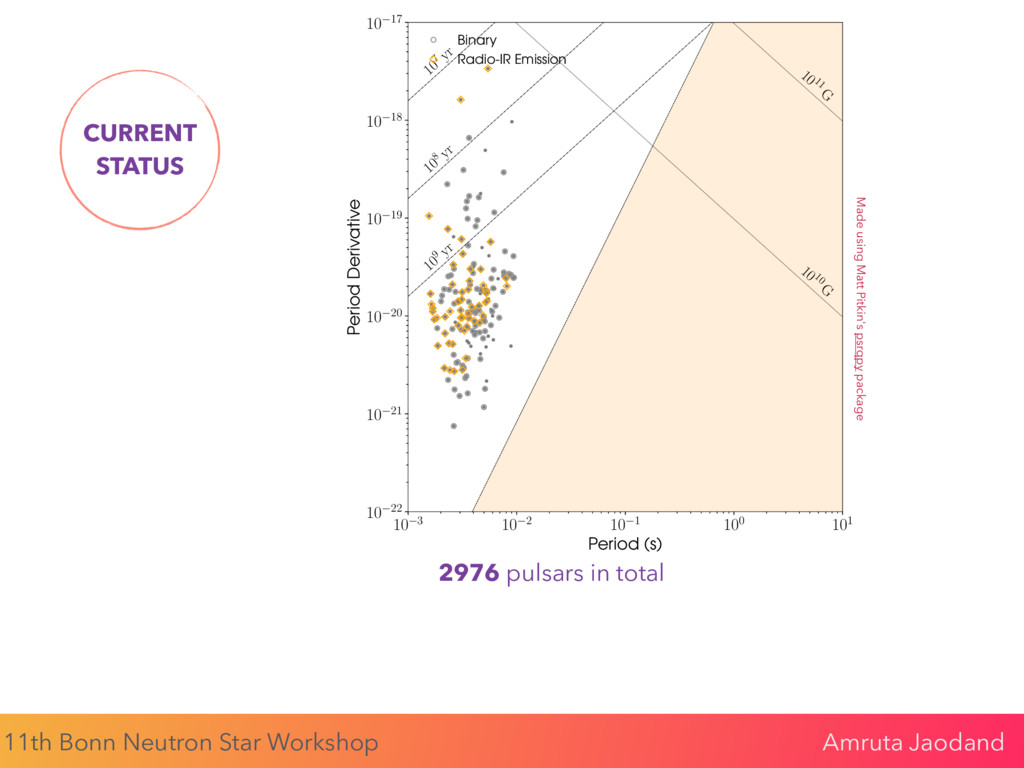
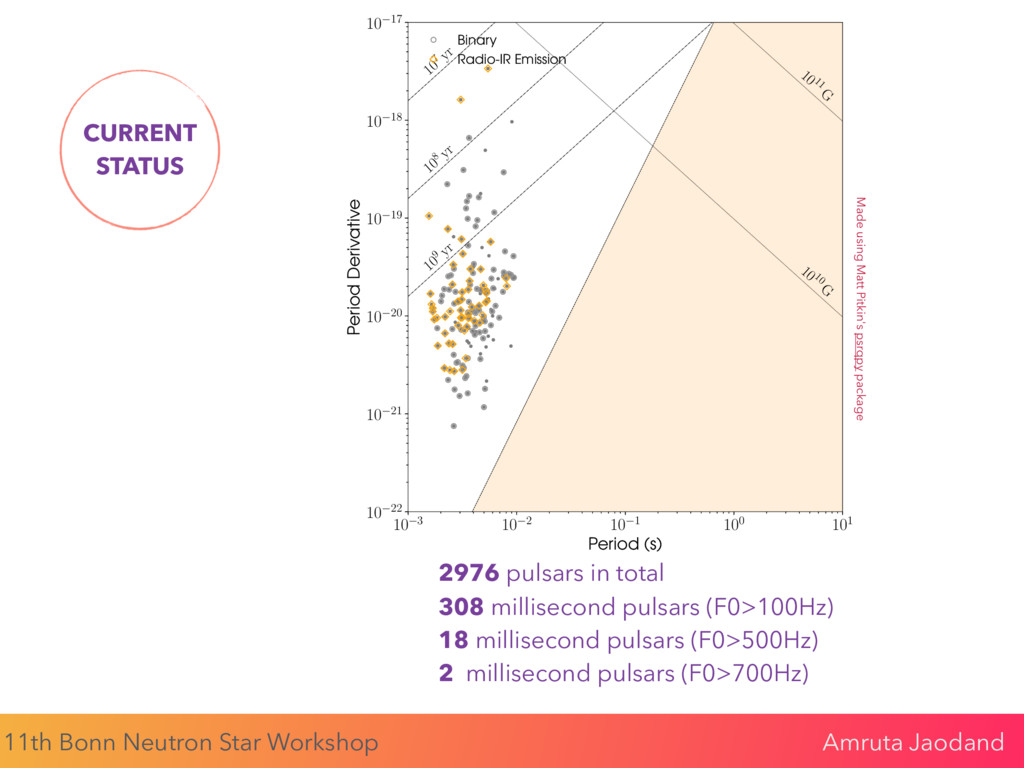
yr 106 yr 107 yr 108 yr 109 yr 1010G 1011G 1012G 1013G 1014G 10 3 10 2 10 1 100 101 Period (s) 10 22 10 20 10 18 10 16 10 14 10 12 10 10 Period Derivative SGR/AXP Binary Radio-IR Emission ”Radio-Quiet” RRAT Pulsed Thermal X-ray SNR 1 Young Pulsars Double NS Magnetars 2 Normal pulsars 4 Millisecond Pulsars 10 7 yr 10 8 yr 10 9 yr 10 10 G 10 11 G 10 3 10 2 10 1 100 101 Period (s) 10 22 10 21 10 20 10 19 10 18 10 17 Period Derivative Binary Radio-IR Emission 2976 pulsars in total Made using Matt Pitkin's psrqpy package
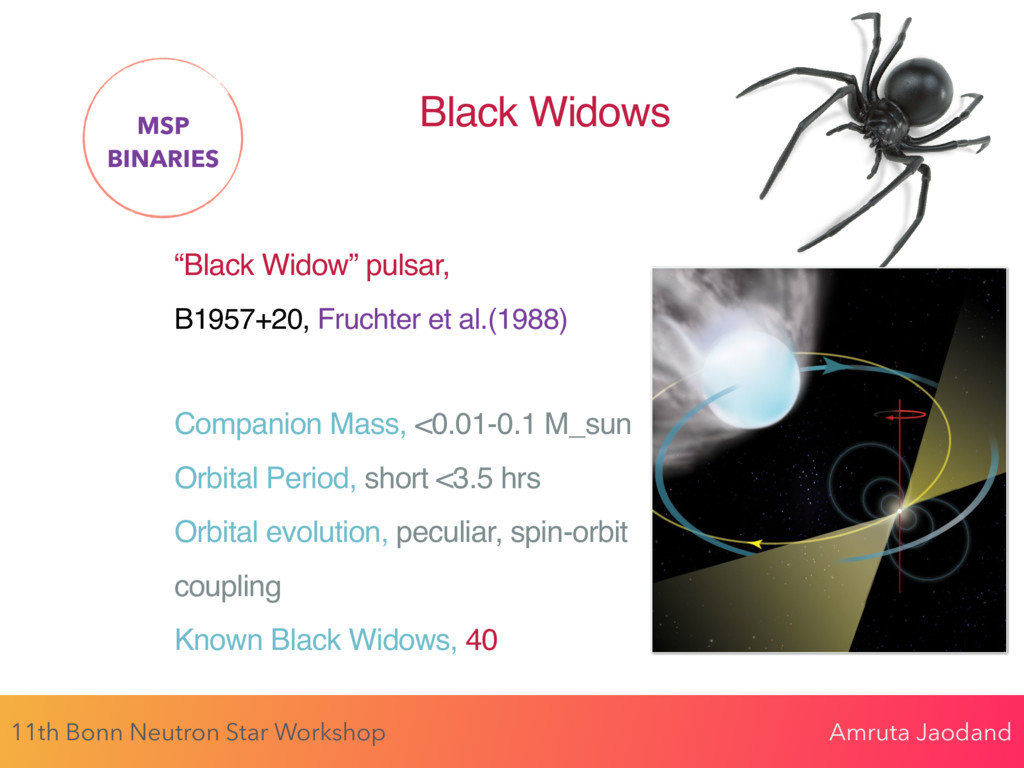
MSP BINARIES Black Widows “Black Widow” pulsar, B1957+20, Fruchter et al.(1988) Companion Mass, <0.01-0.1 M_sun Orbital Period, short <3.5 hrs Orbital evolution, peculiar, spin-orbit coupling Known Black Widows, 40
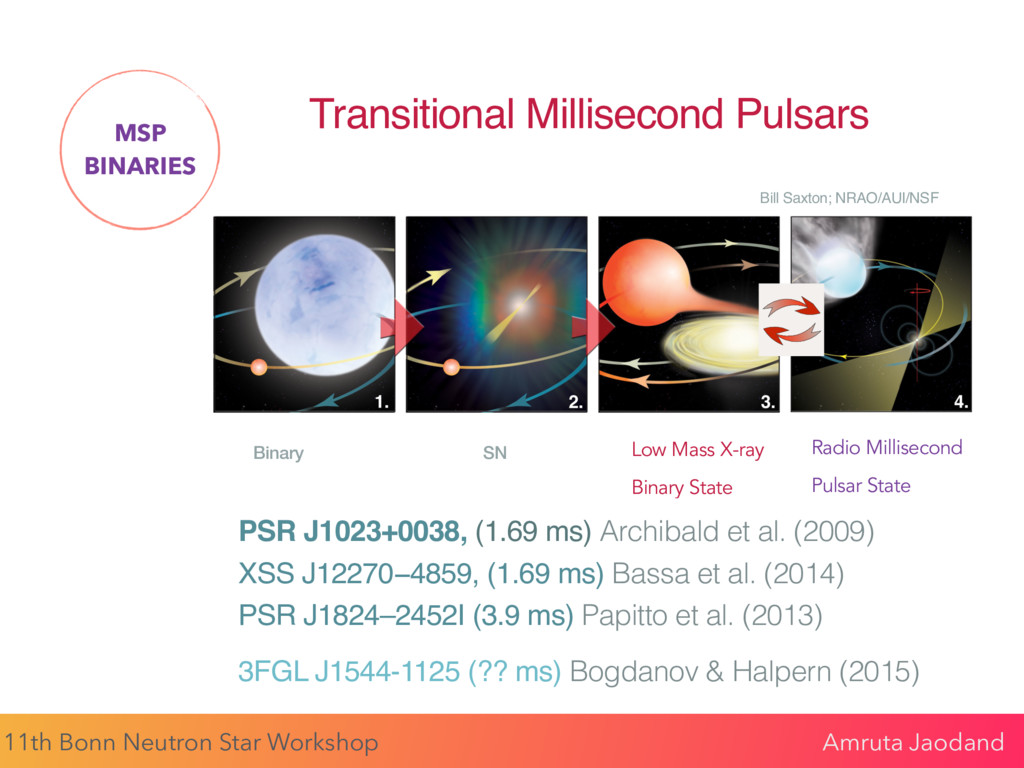
J1023+0038, (1.69 ms) Archibald et al. (2009) XSS J12270−4859, (1.69 ms) Bassa et al. (2014) PSR J1824–2452I (3.9 ms) Papitto et al. (2013) 3FGL J1544-1125 (?? ms) Bogdanov & Halpern (2015) Transitional Millisecond Pulsars Binary SN Low Mass X-ray Binary State Bill Saxton; NRAO/AUI/NSF Radio Millisecond Pulsar State
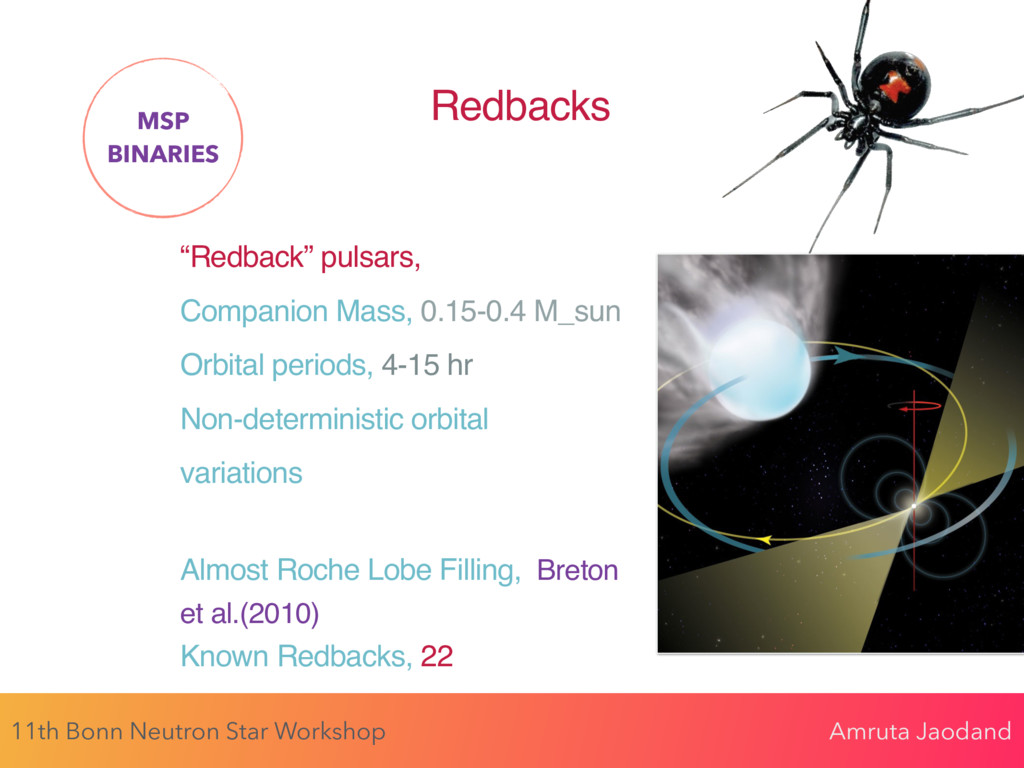
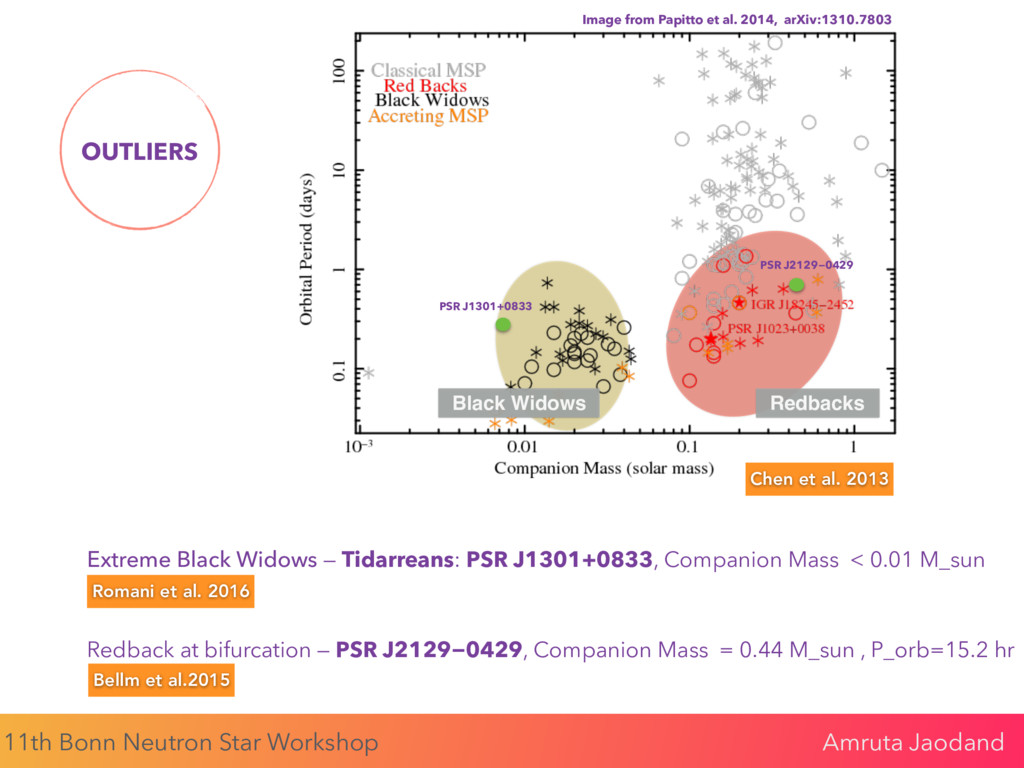
from Papitto et al. 2014, arXiv:1310.7803 Black Widows Chen et al. 2013 PSR J2129−0429 PSR J1301+0833 Extreme Black Widows — Tidarreans: PSR J1301+0833, Companion Mass < 0.01 M_sun Redback at bifurcation — PSR J2129−0429, Companion Mass = 0.44 M_sun , P_orb=15.2 hr Romani et al. 2016 Bellm et al.2015
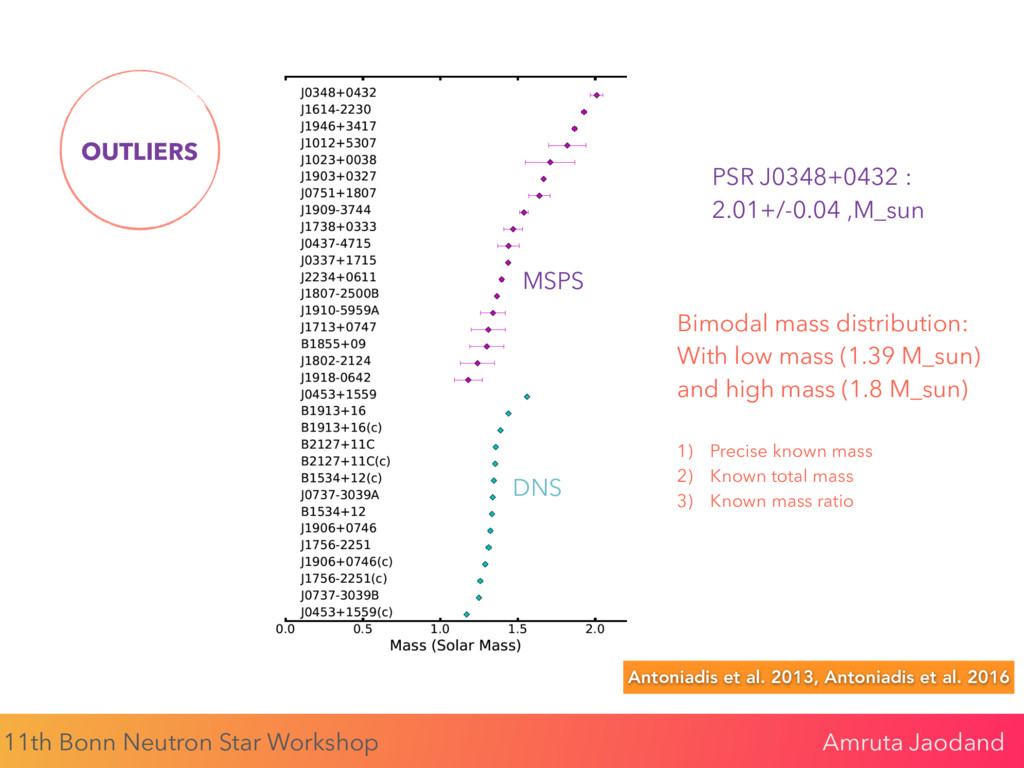
al. 2013, Antoniadis et al. 2016 Bimodal mass distribution: With low mass (1.39 M_sun) and high mass (1.8 M_sun) 1) Precise known mass 2) Known total mass 3) Known mass ratio PSR J0348+0432 : 2.01+/-0.04 ,M_sun MSPS DNS
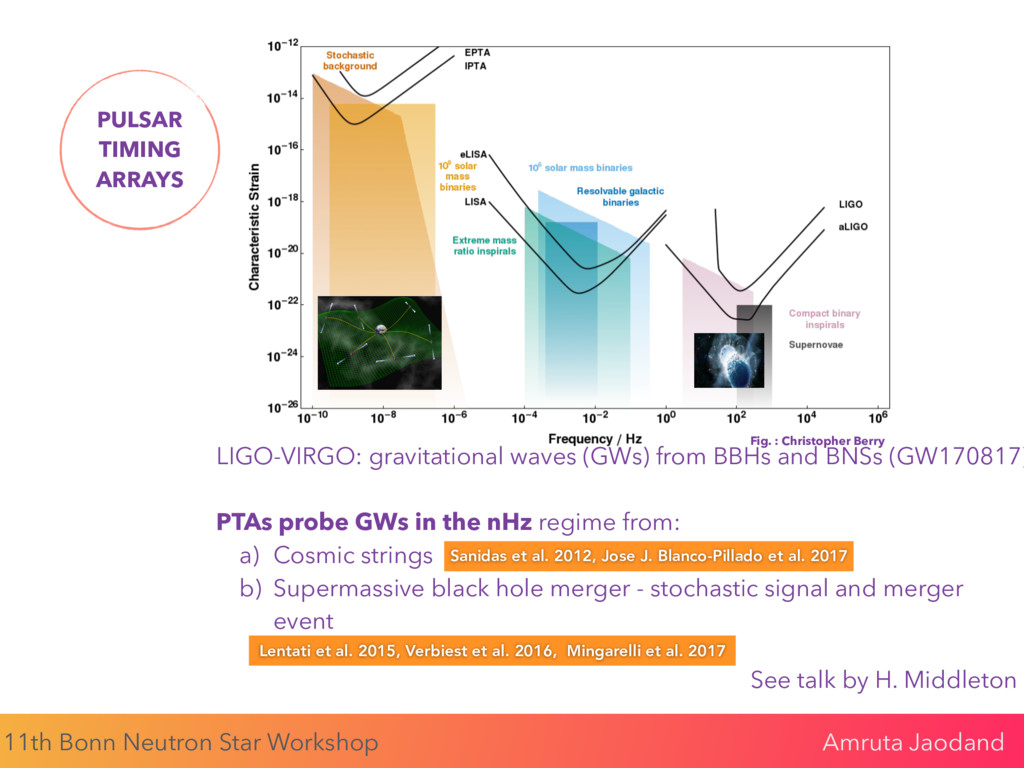
LIGO-VIRGO: gravitational waves (GWs) from BBHs and BNSs (GW170817) PTAs probe GWs in the nHz regime from: a) Cosmic strings b) Supermassive black hole merger - stochastic signal and merger event Sanidas et al. 2012, Jose J. Blanco-Pillado et al. 2017 Lentati et al. 2015, Verbiest et al. 2016, Mingarelli et al. 2017 Fig. : Christopher Berry See talk by H. Middleton
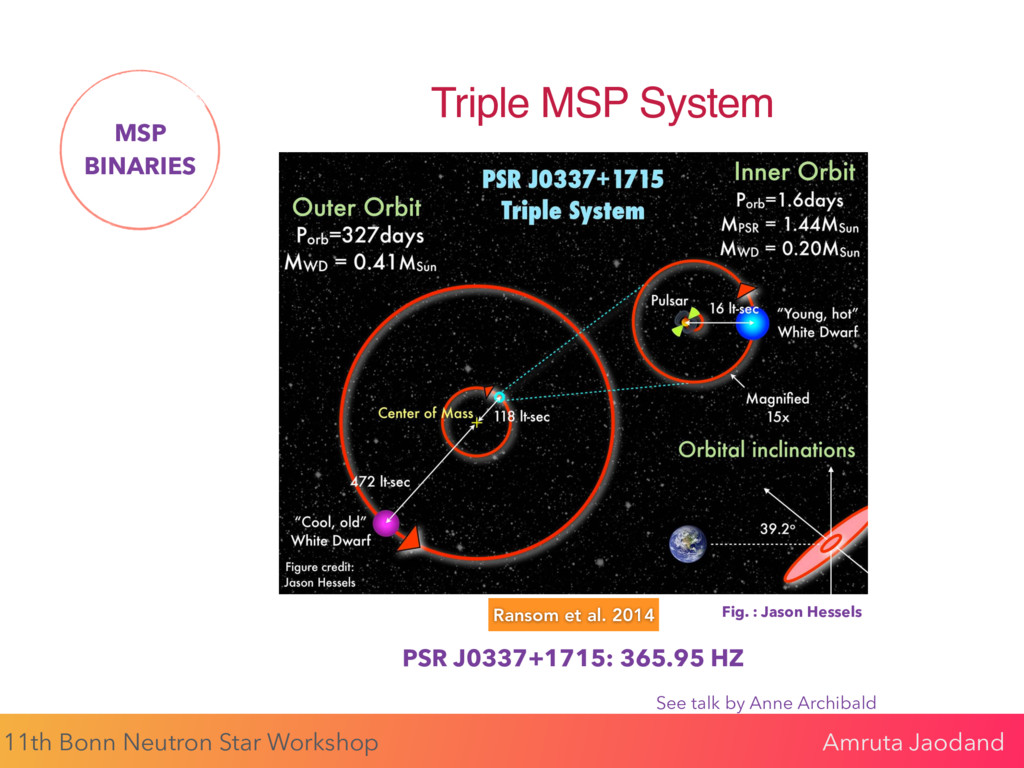
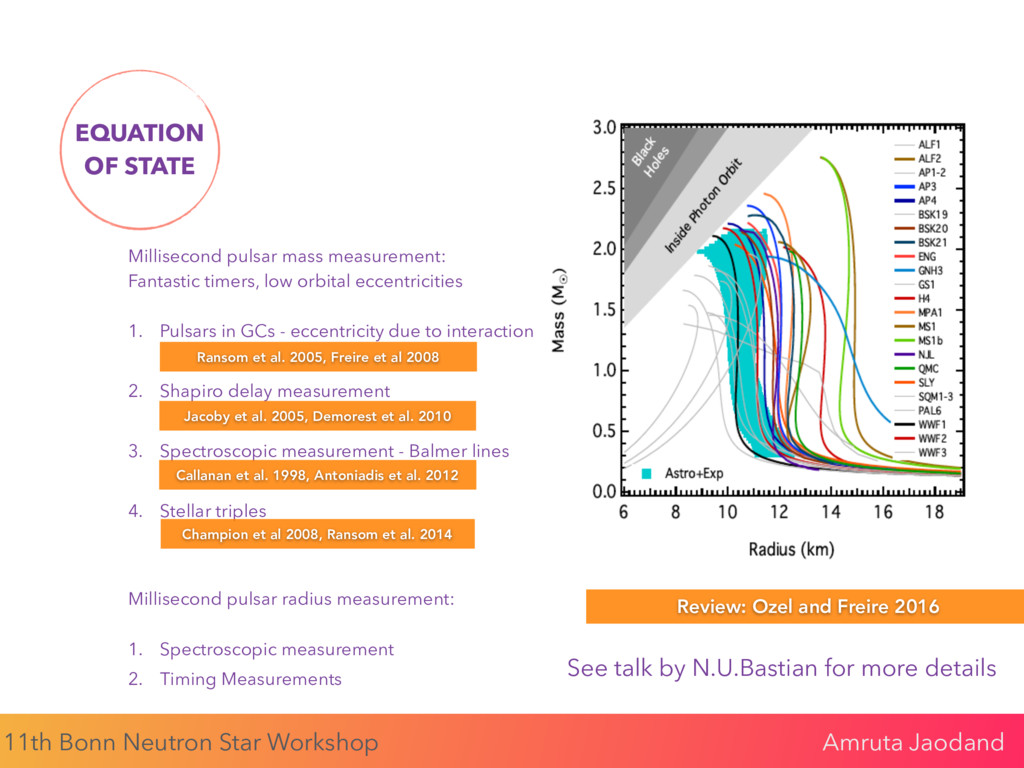
Review: Ozel and Freire 2016 Millisecond pulsar mass measurement: Fantastic timers, low orbital eccentricities 1. Pulsars in GCs - eccentricity due to interaction 2. Shapiro delay measurement 3. Spectroscopic measurement - Balmer lines 4. Stellar triples Ransom et al. 2005, Freire et al 2008 Jacoby et al. 2005, Demorest et al. 2010 Callanan et al. 1998, Antoniadis et al. 2012 Champion et al 2008, Ransom et al. 2014 Millisecond pulsar radius measurement: 1. Spectroscopic measurement 2. Timing Measurements See talk by N.U.Bastian for more details
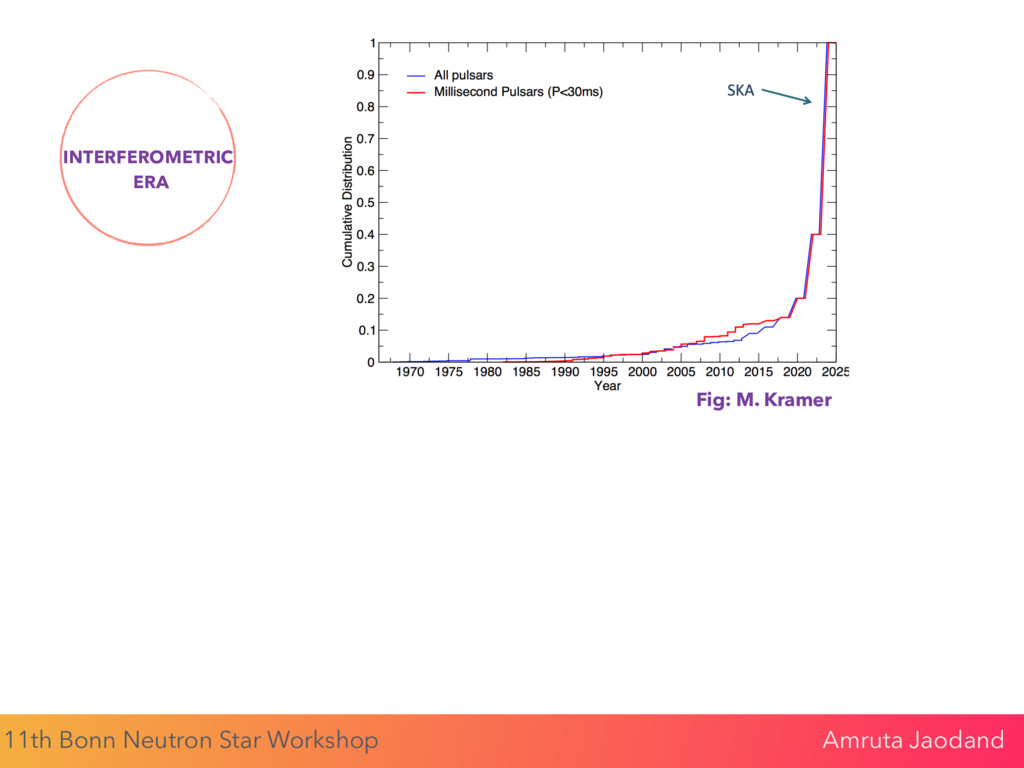
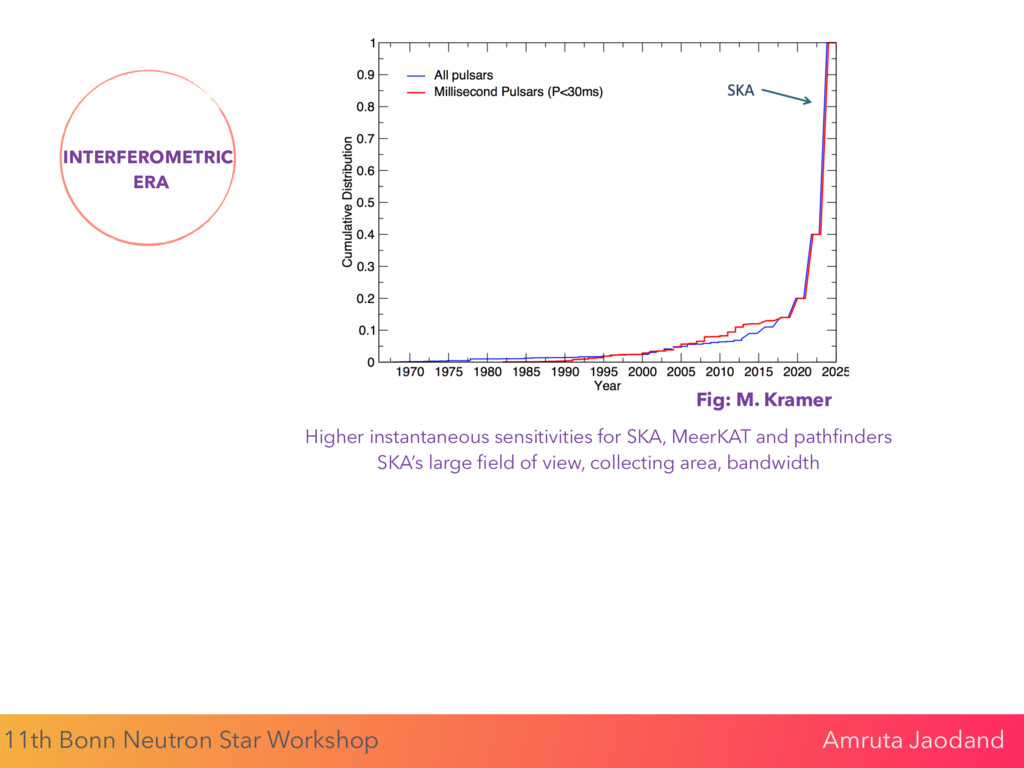
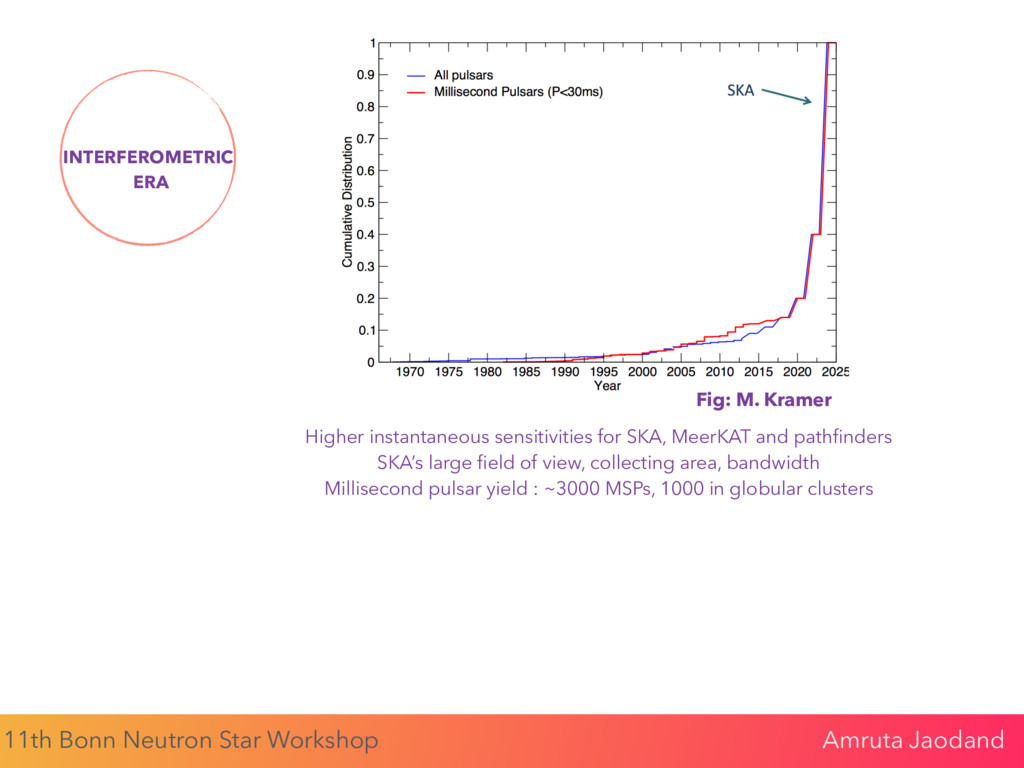
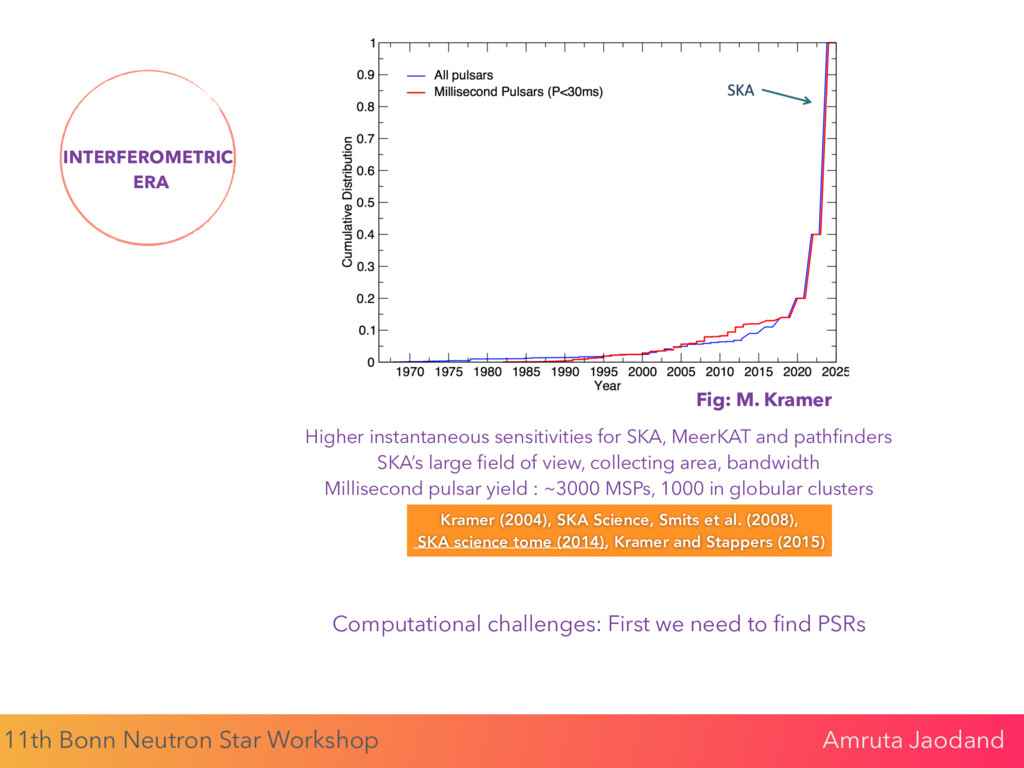
instantaneous sensitivities for SKA, MeerKAT and pathfinders SKA’s large field of view, collecting area, bandwidth Millisecond pulsar yield : ~3000 MSPs, 1000 in globular clusters Fig: M. Kramer
instantaneous sensitivities for SKA, MeerKAT and pathfinders SKA’s large field of view, collecting area, bandwidth Millisecond pulsar yield : ~3000 MSPs, 1000 in globular clusters Kramer (2004), SKA Science, Smits et al. (2008), Fig: M. Kramer
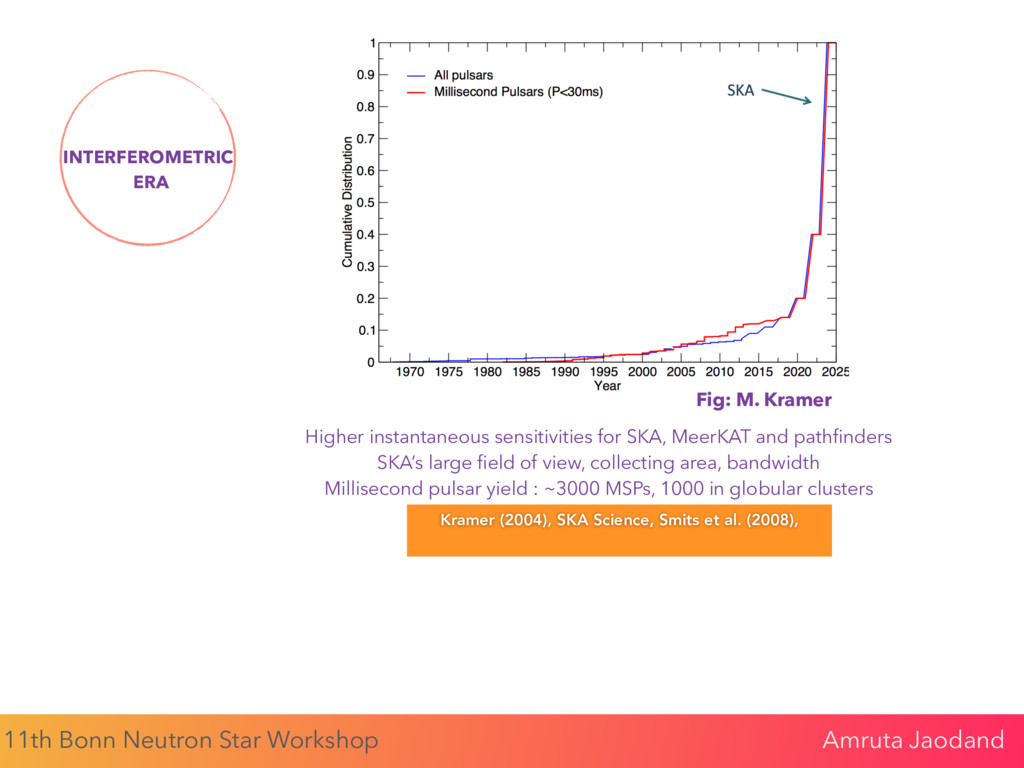
instantaneous sensitivities for SKA, MeerKAT and pathfinders SKA’s large field of view, collecting area, bandwidth Millisecond pulsar yield : ~3000 MSPs, 1000 in globular clusters Kramer (2004), SKA Science, Smits et al. (2008), SKA science tome (2014), Kramer and Stappers (2015) Fig: M. Kramer
instantaneous sensitivities for SKA, MeerKAT and pathfinders SKA’s large field of view, collecting area, bandwidth Millisecond pulsar yield : ~3000 MSPs, 1000 in globular clusters Kramer (2004), SKA Science, Smits et al. (2008), SKA science tome (2014), Kramer and Stappers (2015) Computational challenges: First we need to find PSRs Fig: M. Kramer
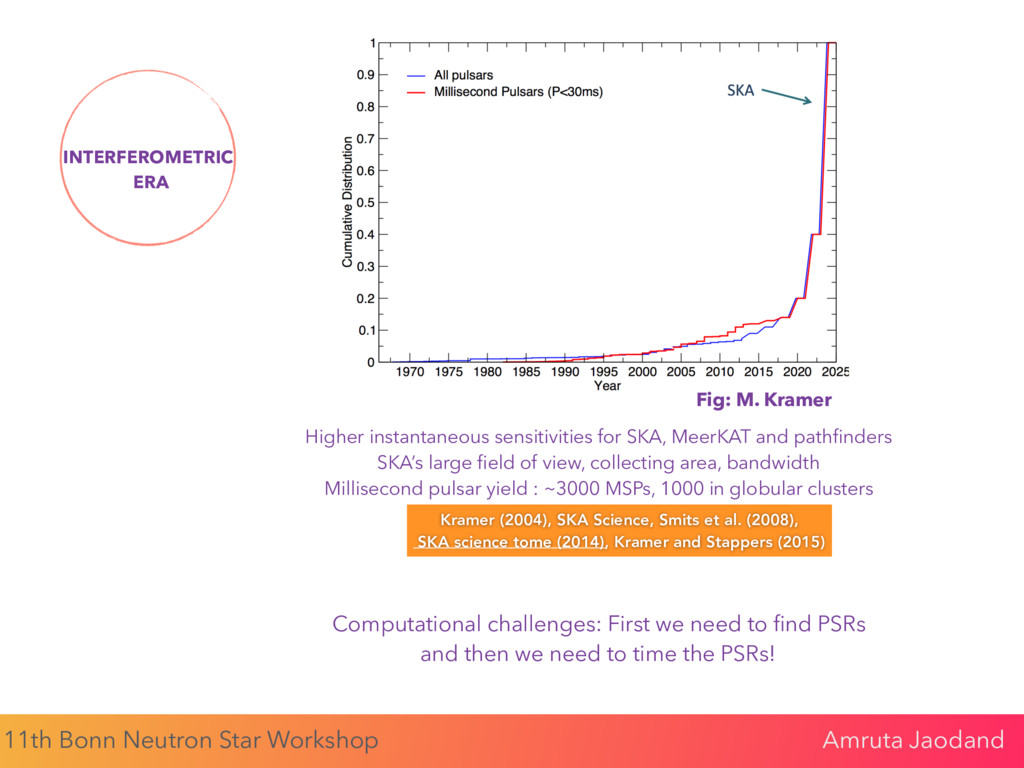
instantaneous sensitivities for SKA, MeerKAT and pathfinders SKA’s large field of view, collecting area, bandwidth Millisecond pulsar yield : ~3000 MSPs, 1000 in globular clusters Kramer (2004), SKA Science, Smits et al. (2008), SKA science tome (2014), Kramer and Stappers (2015) Computational challenges: First we need to find PSRs and then we need to time the PSRs! Fig: M. Kramer
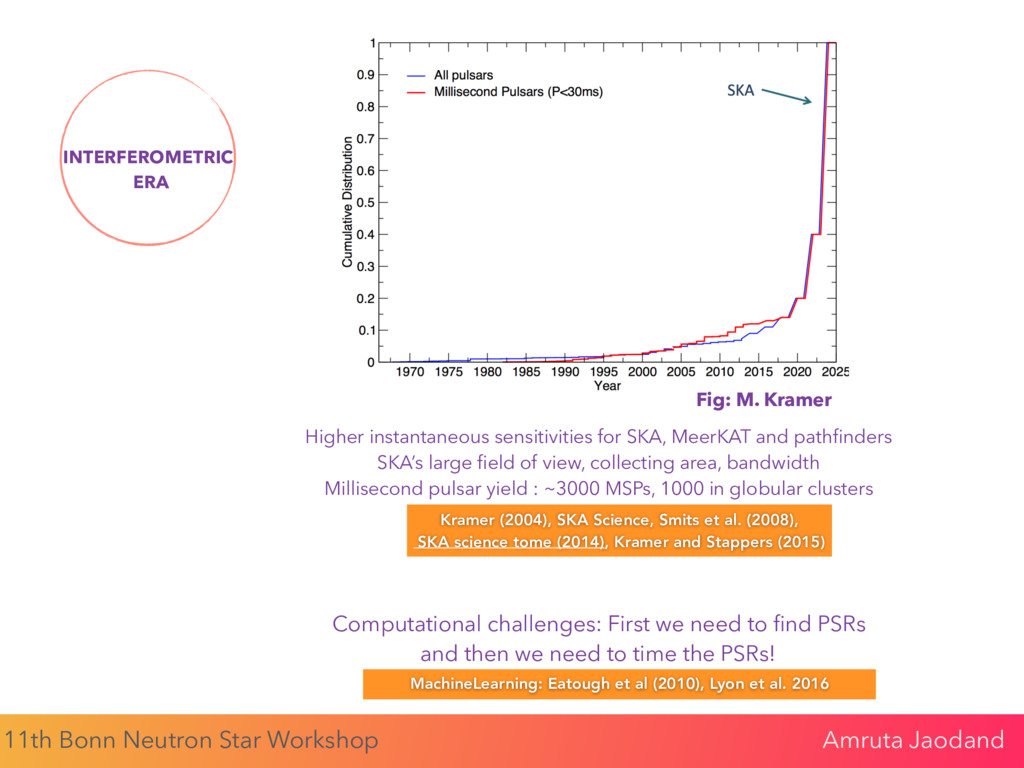
instantaneous sensitivities for SKA, MeerKAT and pathfinders SKA’s large field of view, collecting area, bandwidth Millisecond pulsar yield : ~3000 MSPs, 1000 in globular clusters Kramer (2004), SKA Science, Smits et al. (2008), SKA science tome (2014), Kramer and Stappers (2015) Computational challenges: First we need to find PSRs and then we need to time the PSRs! MachineLearning: Eatough et al (2010), Lyon et al. 2016 Fig: M. Kramer
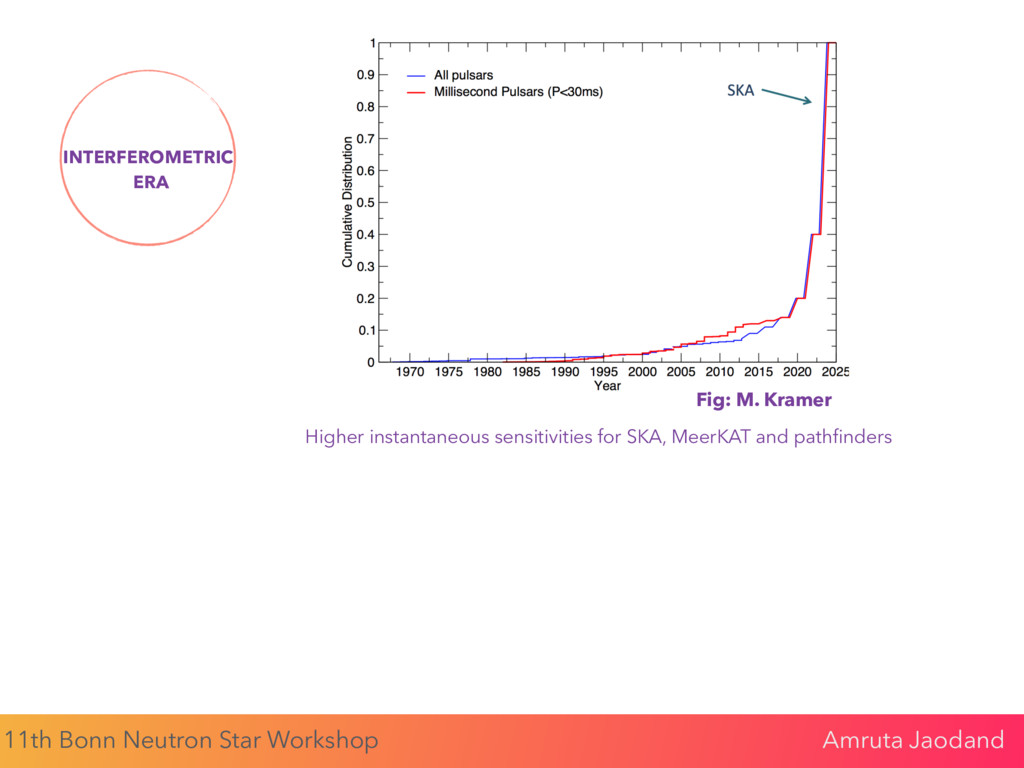
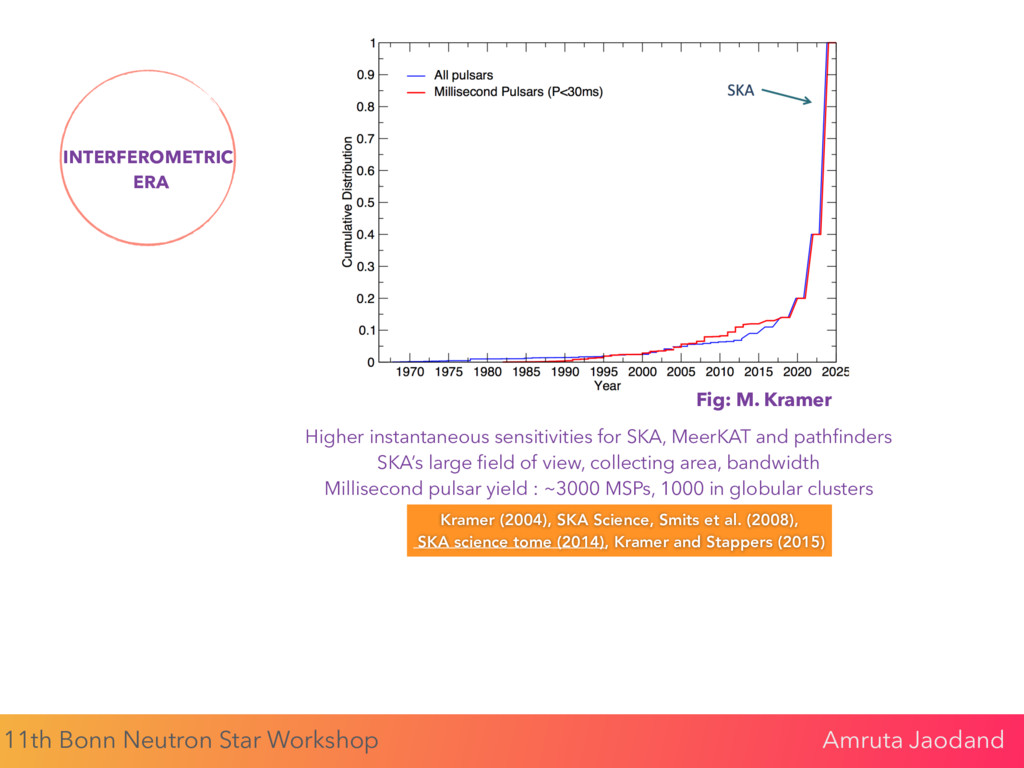
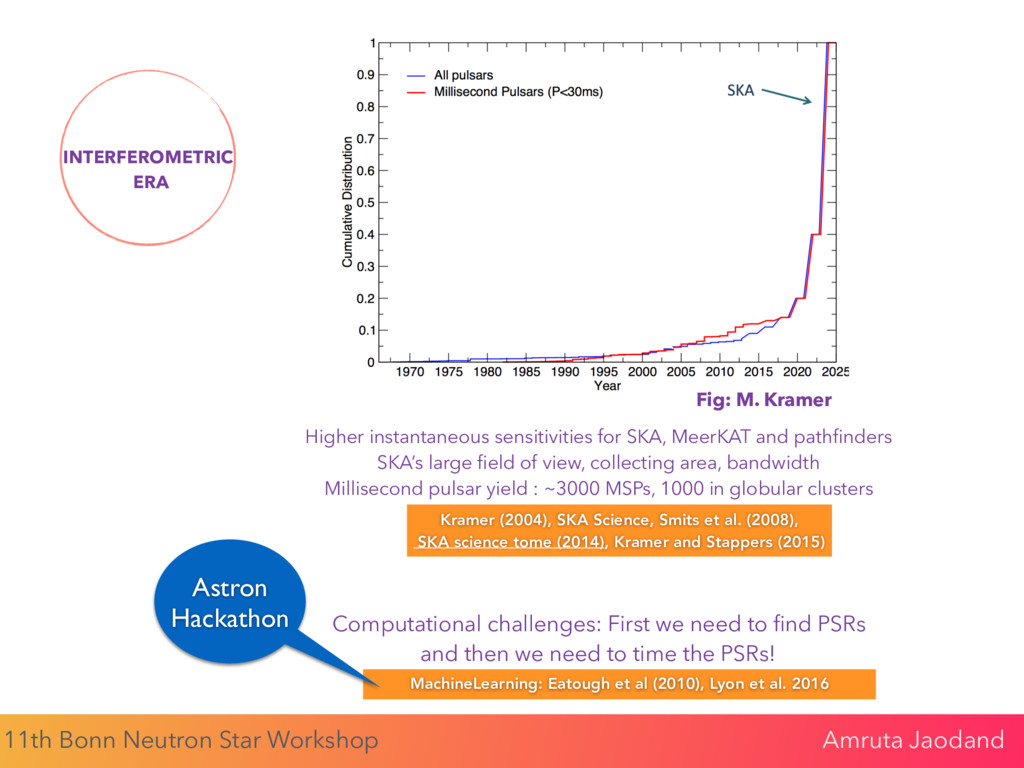
instantaneous sensitivities for SKA, MeerKAT and pathfinders SKA’s large field of view, collecting area, bandwidth Millisecond pulsar yield : ~3000 MSPs, 1000 in globular clusters Kramer (2004), SKA Science, Smits et al. (2008), SKA science tome (2014), Kramer and Stappers (2015) Computational challenges: First we need to find PSRs and then we need to time the PSRs! MachineLearning: Eatough et al (2010), Lyon et al. 2016 Fig: M. Kramer Astron Hackathon
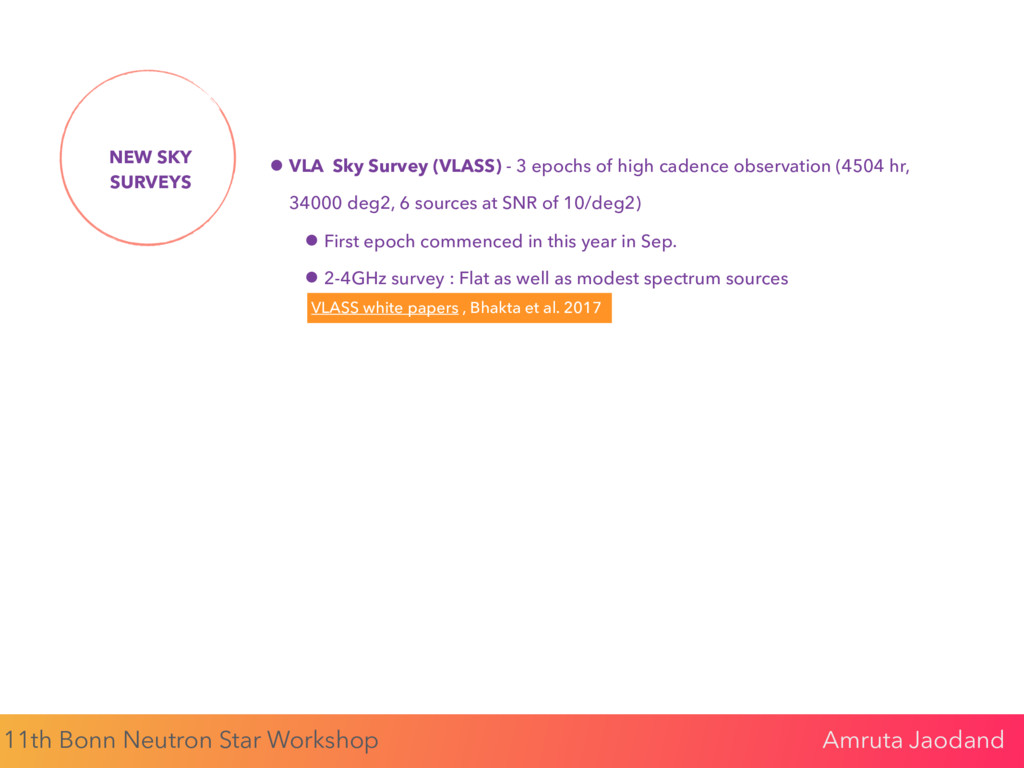
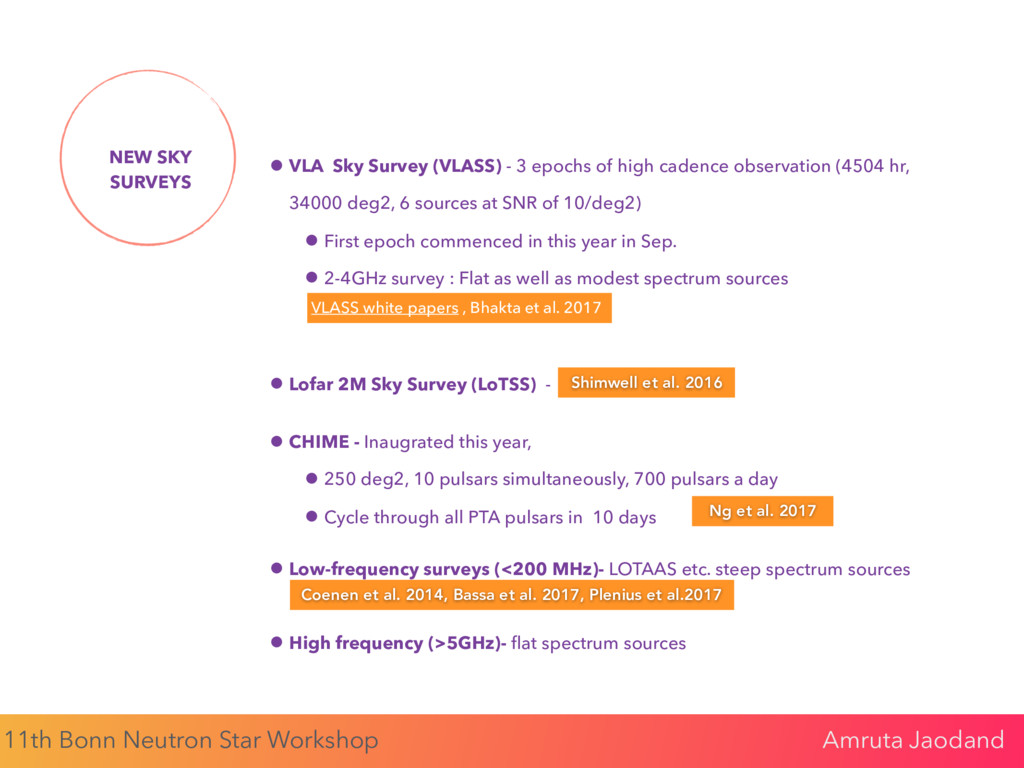
•VLA Sky Survey (VLASS) - 3 epochs of high cadence observation (4504 hr, 34000 deg2, 6 sources at SNR of 10/deg2) •First epoch commenced in this year in Sep. •2-4GHz survey : Flat as well as modest spectrum sources VLASS white papers , Bhakta et al. 2017
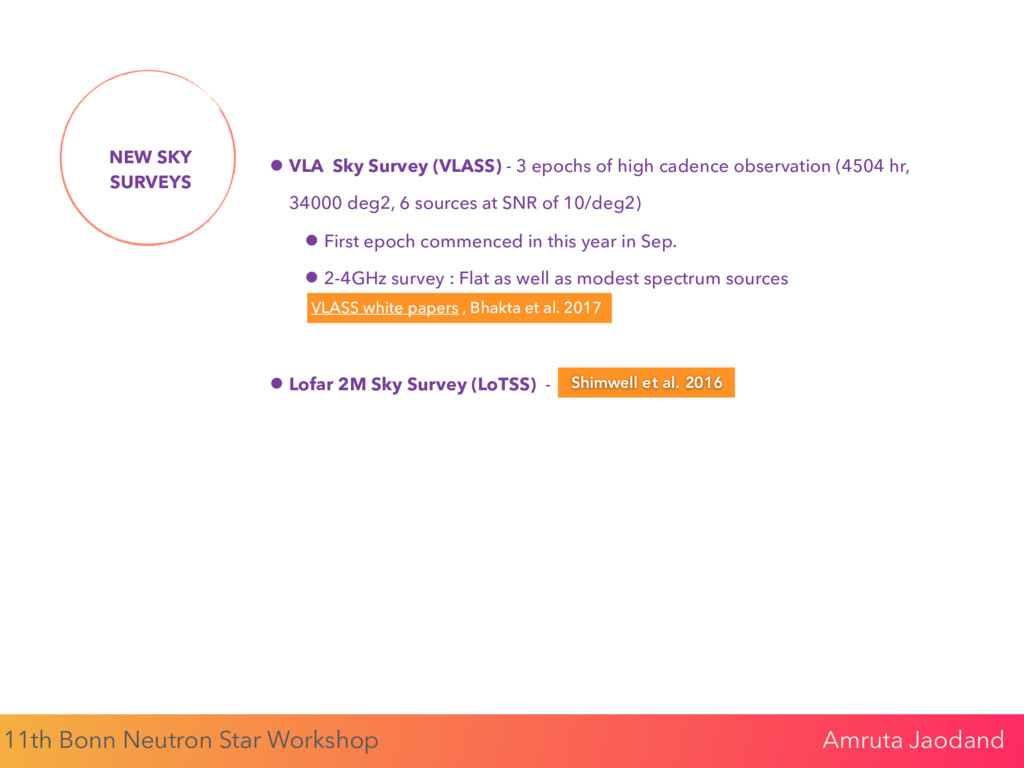
•VLA Sky Survey (VLASS) - 3 epochs of high cadence observation (4504 hr, 34000 deg2, 6 sources at SNR of 10/deg2) •First epoch commenced in this year in Sep. •2-4GHz survey : Flat as well as modest spectrum sources VLASS white papers , Bhakta et al. 2017 •Lofar 2M Sky Survey (LoTSS) - Shimwell et al. 2016
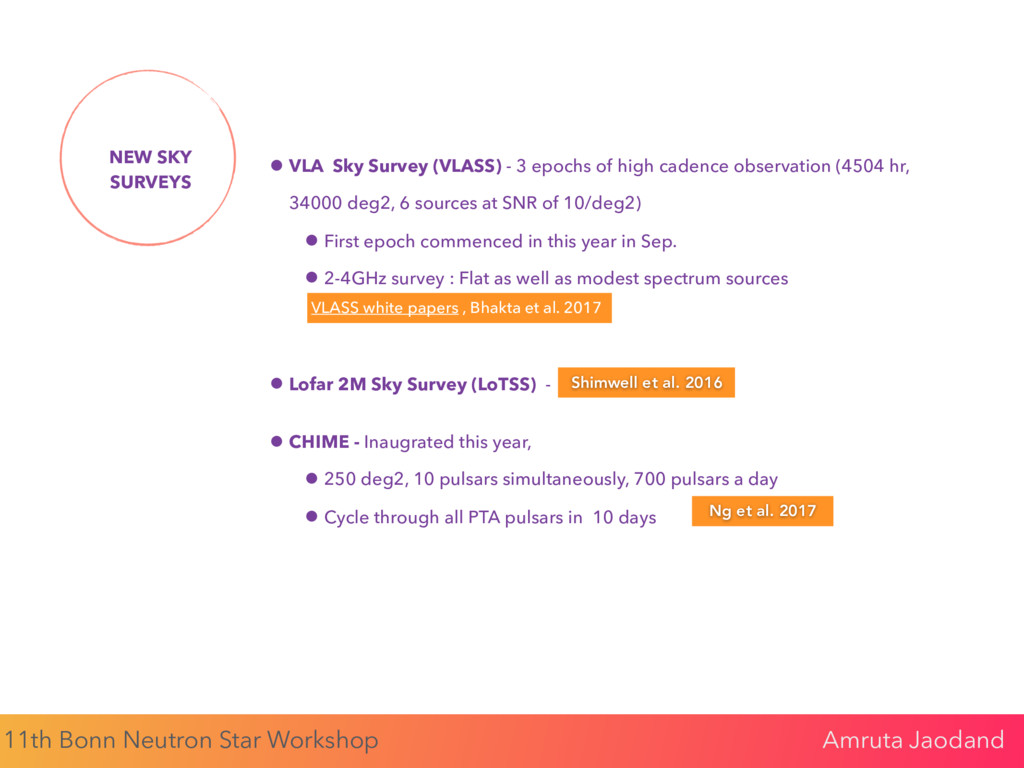
•VLA Sky Survey (VLASS) - 3 epochs of high cadence observation (4504 hr, 34000 deg2, 6 sources at SNR of 10/deg2) •First epoch commenced in this year in Sep. •2-4GHz survey : Flat as well as modest spectrum sources VLASS white papers , Bhakta et al. 2017 •Lofar 2M Sky Survey (LoTSS) - Shimwell et al. 2016 •CHIME - Inaugrated this year, •250 deg2, 10 pulsars simultaneously, 700 pulsars a day •Cycle through all PTA pulsars in 10 days Ng et al. 2017
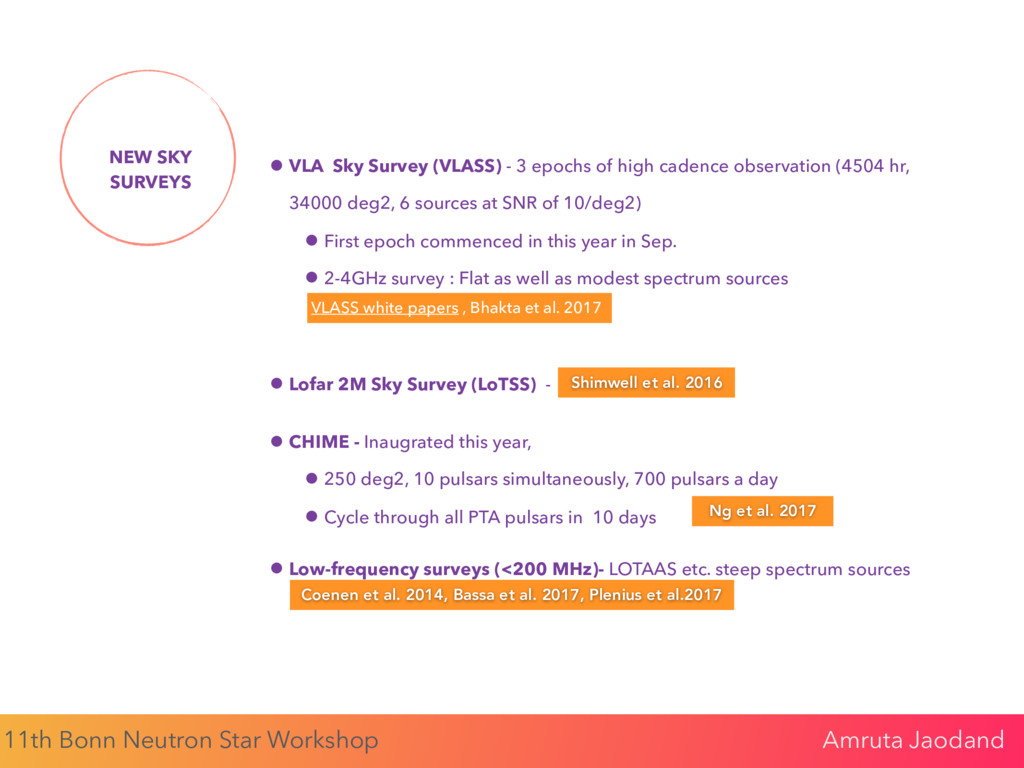
•VLA Sky Survey (VLASS) - 3 epochs of high cadence observation (4504 hr, 34000 deg2, 6 sources at SNR of 10/deg2) •First epoch commenced in this year in Sep. •2-4GHz survey : Flat as well as modest spectrum sources VLASS white papers , Bhakta et al. 2017 •Lofar 2M Sky Survey (LoTSS) - Shimwell et al. 2016 •CHIME - Inaugrated this year, •250 deg2, 10 pulsars simultaneously, 700 pulsars a day •Cycle through all PTA pulsars in 10 days Ng et al. 2017 •Low-frequency surveys (<200 MHz)- LOTAAS etc. steep spectrum sources Coenen et al. 2014, Bassa et al. 2017, Plenius et al.2017
•VLA Sky Survey (VLASS) - 3 epochs of high cadence observation (4504 hr, 34000 deg2, 6 sources at SNR of 10/deg2) •First epoch commenced in this year in Sep. •2-4GHz survey : Flat as well as modest spectrum sources VLASS white papers , Bhakta et al. 2017 •Lofar 2M Sky Survey (LoTSS) - Shimwell et al. 2016 •CHIME - Inaugrated this year, •250 deg2, 10 pulsars simultaneously, 700 pulsars a day •Cycle through all PTA pulsars in 10 days Ng et al. 2017 •High frequency (>5GHz)- flat spectrum sources •Low-frequency surveys (<200 MHz)- LOTAAS etc. steep spectrum sources Coenen et al. 2014, Bassa et al. 2017, Plenius et al.2017
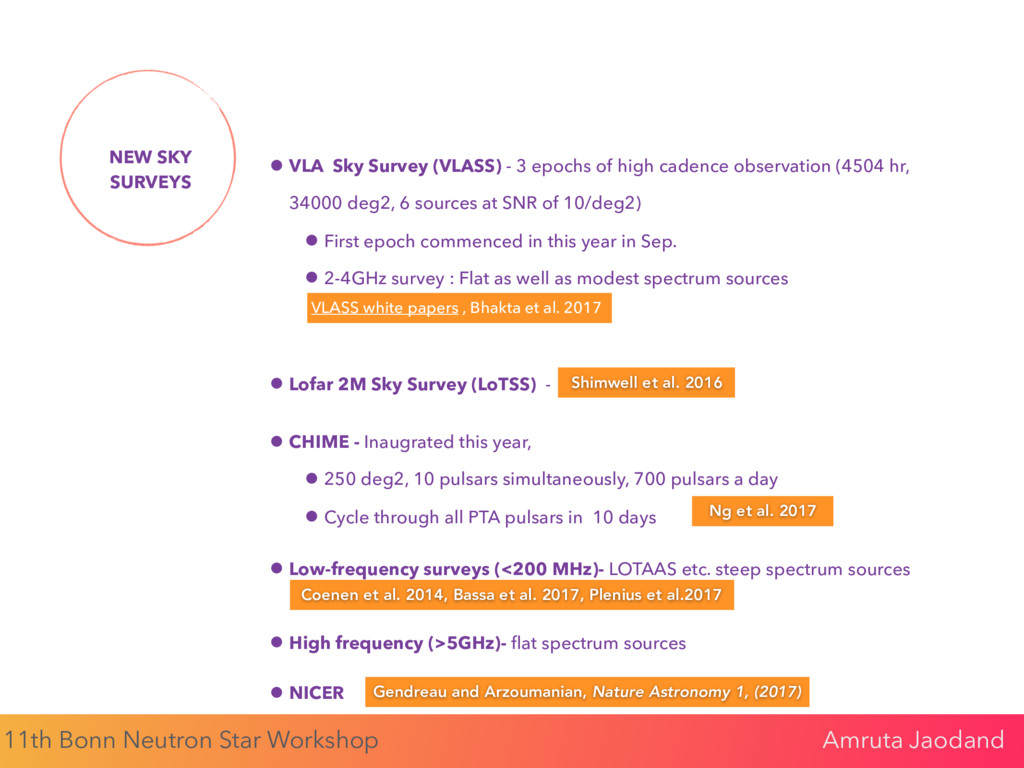
•VLA Sky Survey (VLASS) - 3 epochs of high cadence observation (4504 hr, 34000 deg2, 6 sources at SNR of 10/deg2) •First epoch commenced in this year in Sep. •2-4GHz survey : Flat as well as modest spectrum sources VLASS white papers , Bhakta et al. 2017 •Lofar 2M Sky Survey (LoTSS) - Shimwell et al. 2016 •CHIME - Inaugrated this year, •250 deg2, 10 pulsars simultaneously, 700 pulsars a day •Cycle through all PTA pulsars in 10 days Ng et al. 2017 •High frequency (>5GHz)- flat spectrum sources •Low-frequency surveys (<200 MHz)- LOTAAS etc. steep spectrum sources Coenen et al. 2014, Bassa et al. 2017, Plenius et al.2017 •NICER Gendreau and Arzoumanian, Nature Astronomy 1, (2017)
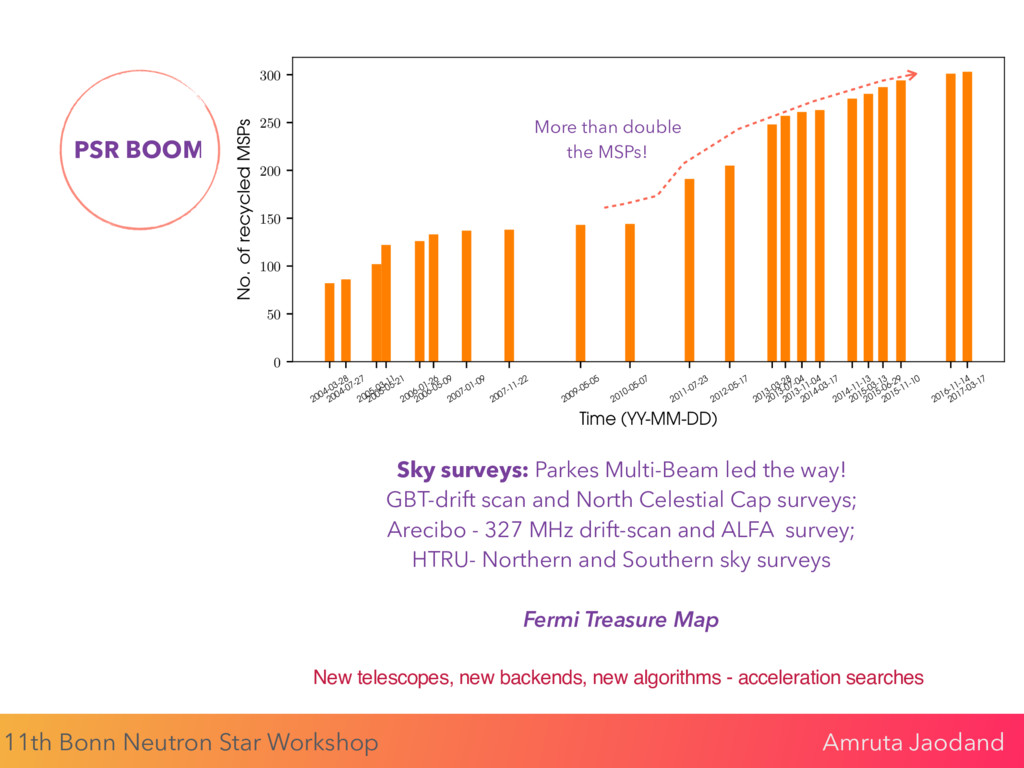
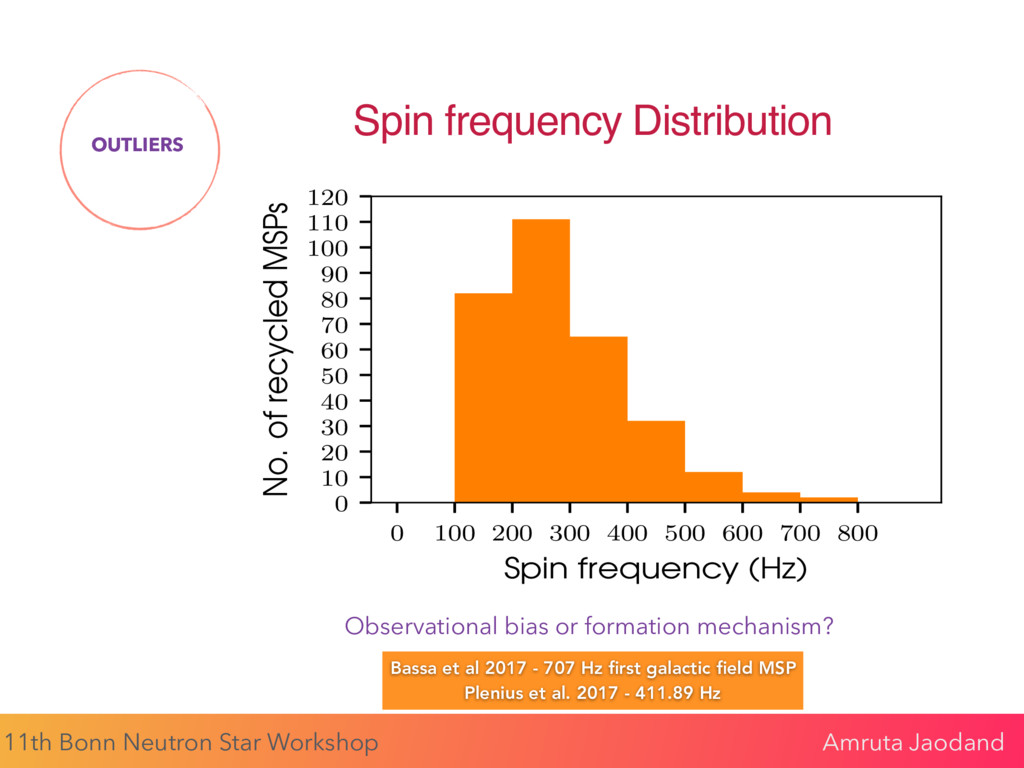
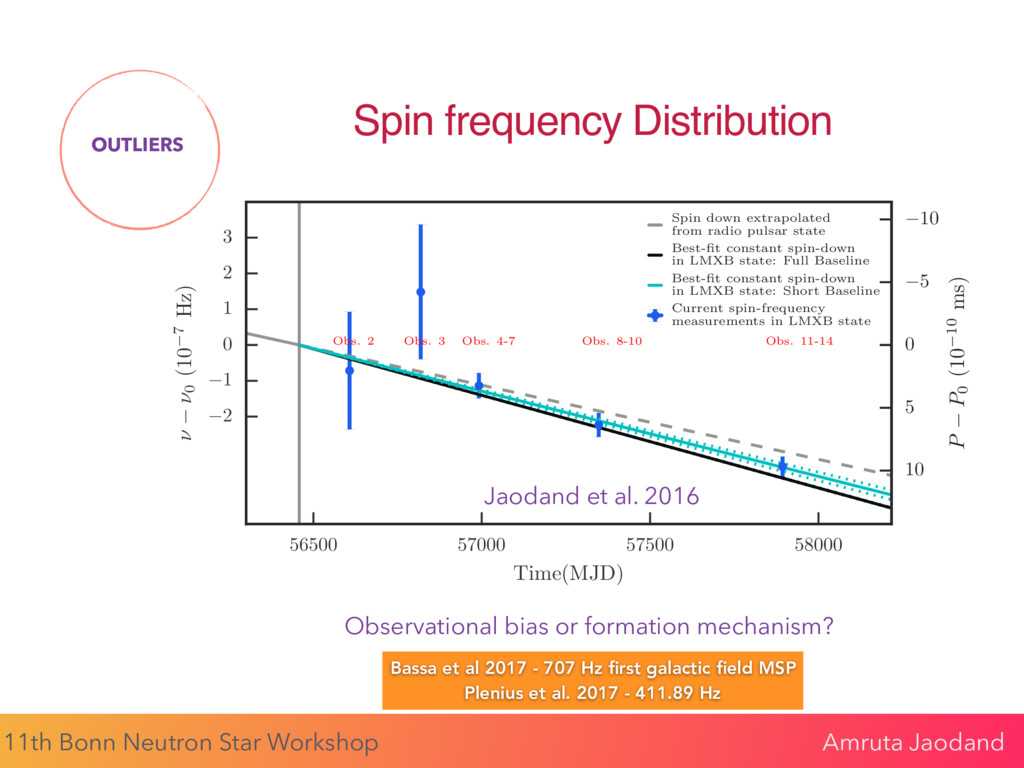
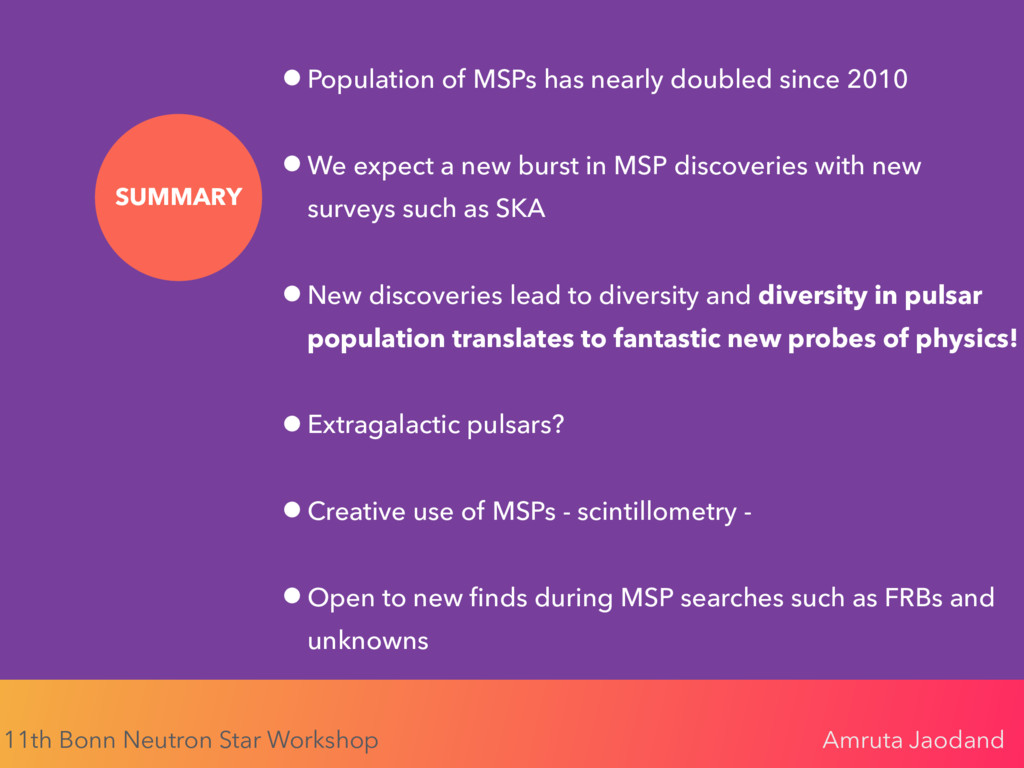
MSPs has nearly doubled since 2010 •We expect a new burst in MSP discoveries with new surveys such as SKA •New discoveries lead to diversity and diversity in pulsar population translates to fantastic new probes of physics! •Extragalactic pulsars? •Creative use of MSPs - scintillometry - •Open to new finds during MSP searches such as FRBs and unknowns


 satocos135
 taka88
 neutron63zf
 trycycle
 brainpadpr
 institutdelelevage
 xleitix
 naokimuroki
 martinlippert
 rakko
 gurzu
 jonoalderson
 hannesfritz
 bluesmoon
 leimatthew05
 khoart
 aleyda
 jnunemaker
 cassininazir
 nonsquared
 bcantrill