Upgrade to Pro — share decks privately, control downloads, hide ads and more …

Ankylosing Spondylitis

Sponsored · Your Podcast. Everywhere. Effortlessly. Share. Educate. Inspire. Entertain. You do you. We'll handle the rest.

Ankylosing Spondylitis

Avatar for Charles Holtzkampf

Charles Holtzkampf

February 11, 2026
Tweet

Other Decks in Research

Transcript

  1. Research-Based Patient Guide Understanding Your Ankylosing Spondylitis Triggers A comprehensive

    guide to the 5 key levers that may drive your AS symptoms—based on current research and designed for safe self- experimentation Evidence-Based Actionable Experiments Clinical Context
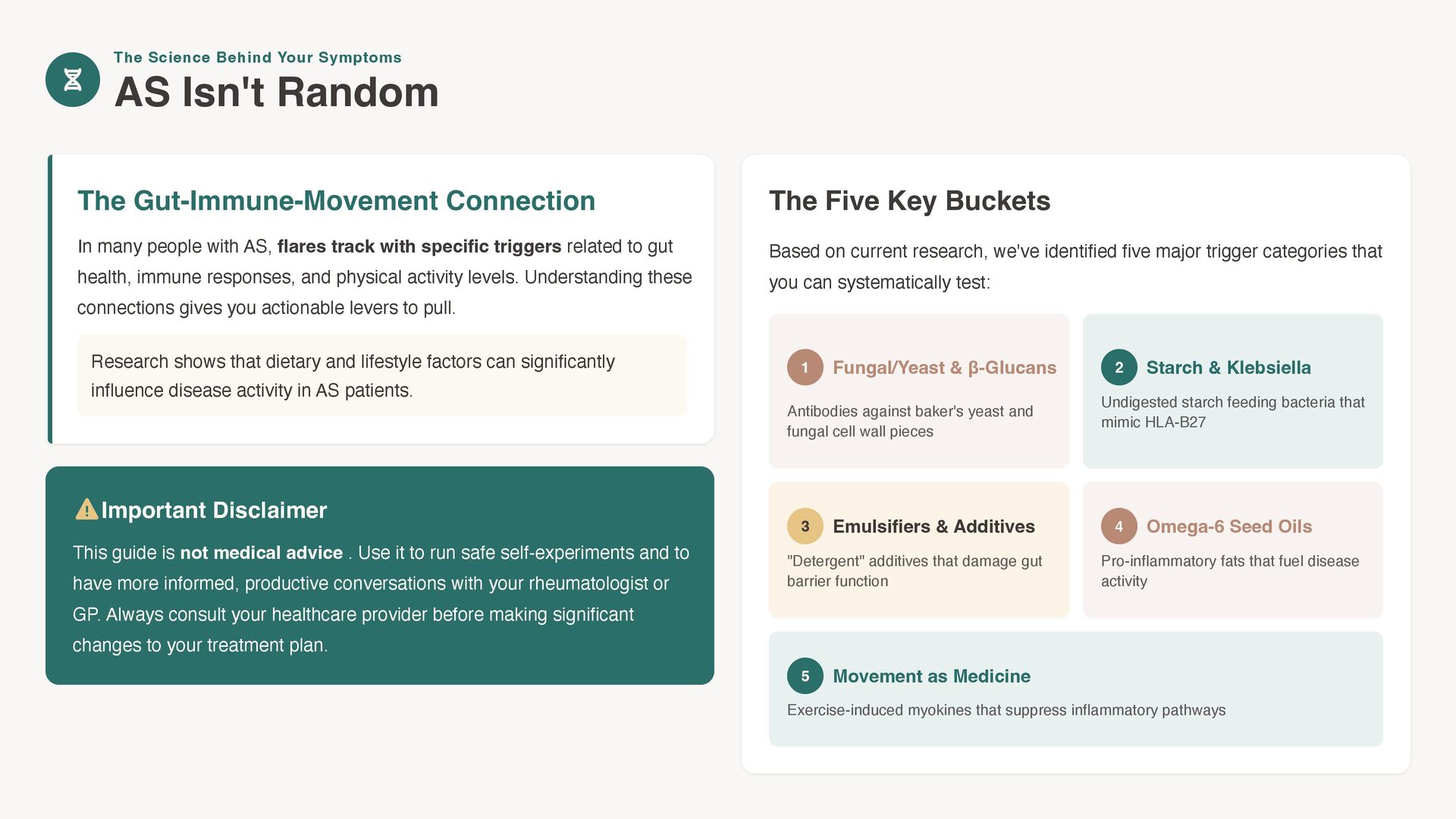
  2. The Science Behind Your Symptoms AS Isn't Random The Gut-Immune-Movement

    Connection In many people with AS, flares track with specific triggers related to gut health, immune responses, and physical activity levels. Understanding these connections gives you actionable levers to pull. Research shows that dietary and lifestyle factors can significantly influence disease activity in AS patients. Important Disclaimer This guide is not medical advice . Use it to run safe self-experiments and to have more informed, productive conversations with your rheumatologist or GP. Always consult your healthcare provider before making significant changes to your treatment plan. The Five Key Buckets Based on current research, we've identified five major trigger categories that you can systematically test: 1 Fungal/Yeast & β-Glucans Antibodies against baker's yeast and fungal cell wall pieces 2 Starch & Klebsiella Undigested starch feeding bacteria that mimic HLA-B27 3 Emulsifiers & Additives "Detergent" additives that damage gut barrier function 4 Omega-6 Seed Oils Pro-inflammatory fats that fuel disease activity 5 Movement as Medicine Exercise-induced myokines that suppress inflammatory pathways
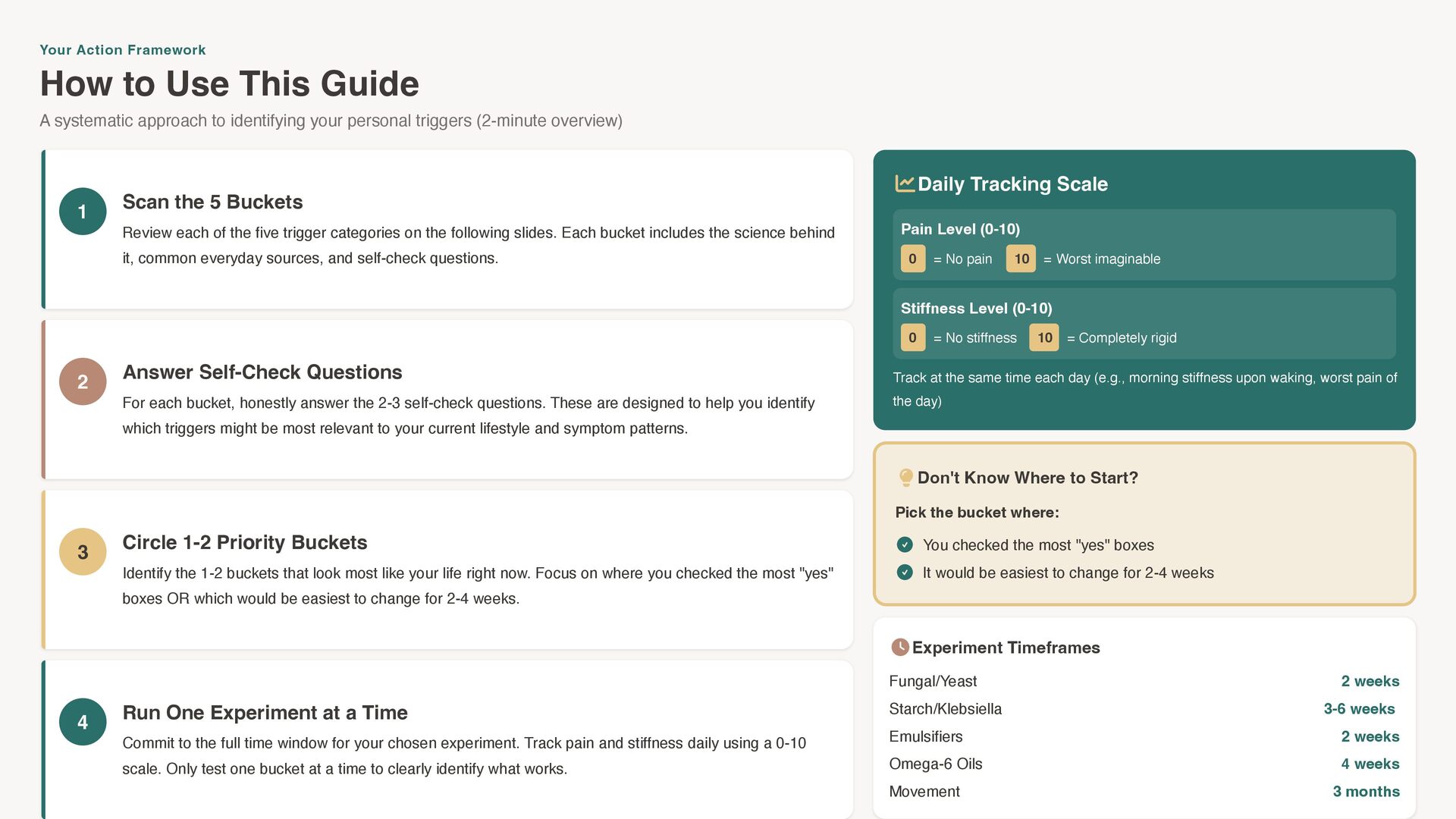
  3. Your Action Framework How to Use This Guide A systematic

    approach to identifying your personal triggers (2-minute overview) 1 Scan the 5 Buckets Review each of the five trigger categories on the following slides. Each bucket includes the science behind it, common everyday sources, and self-check questions. 2 Answer Self-Check Questions For each bucket, honestly answer the 2-3 self-check questions. These are designed to help you identify which triggers might be most relevant to your current lifestyle and symptom patterns. 3 Circle 1-2 Priority Buckets Identify the 1-2 buckets that look most like your life right now. Focus on where you checked the most "yes" boxes OR which would be easiest to change for 2-4 weeks. 4 Run One Experiment at a Time Commit to the full time window for your chosen experiment. Track pain and stiffness daily using a 0-10 scale. Only test one bucket at a time to clearly identify what works. Daily Tracking Scale Pain Level (0-10) 0 = No pain 10 = Worst imaginable Stiffness Level (0-10) 0 = No stiffness 10 = Completely rigid Track at the same time each day (e.g., morning stiffness upon waking, worst pain of the day) Don't Know Where to Start? Pick the bucket where: You checked the most "yes" boxes It would be easiest to change for 2-4 weeks Experiment Timeframes Fungal/Yeast 2 weeks Starch/Klebsiella 3-6 weeks Emulsifiers 2 weeks Omega-6 Oils 4 weeks Movement 3 months
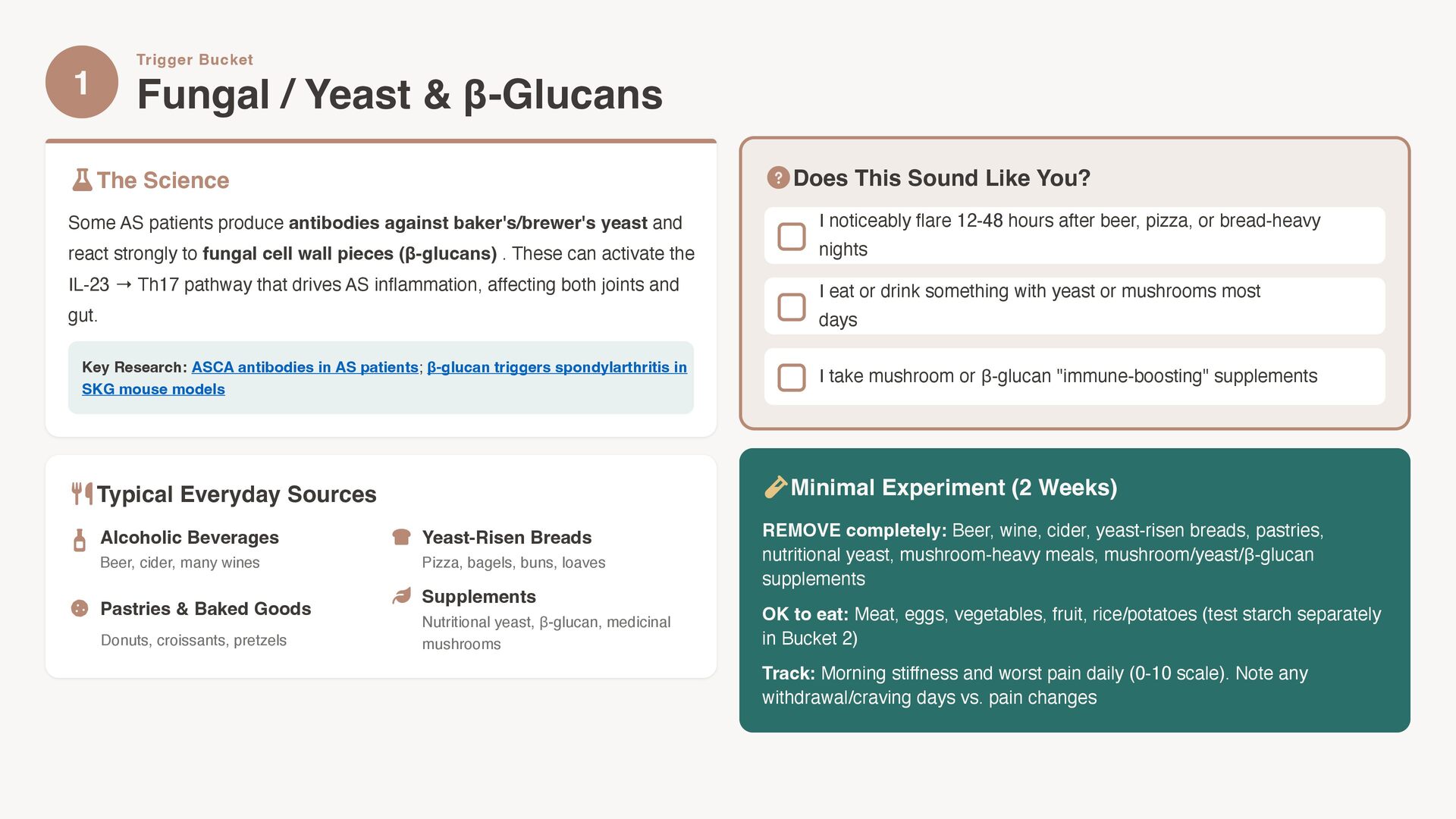
  4. 1 Trigger Bucket Fungal / Yeast & β-Glucans The Science

    Some AS patients produce antibodies against baker's/brewer's yeast and react strongly to fungal cell wall pieces (β-glucans) . These can activate the IL-23 → Th17 pathway that drives AS inflammation, affecting both joints and gut. Key Research: ASCA antibodies in AS patients; β-glucan triggers spondylarthritis in SKG mouse models Typical Everyday Sources Alcoholic Beverages Beer, cider, many wines Yeast-Risen Breads Pizza, bagels, buns, loaves Pastries & Baked Goods Donuts, croissants, pretzels Supplements Nutritional yeast, β-glucan, medicinal mushrooms Does This Sound Like You? I noticeably flare 12-48 hours after beer, pizza, or bread-heavy nights I eat or drink something with yeast or mushrooms most days I take mushroom or β-glucan "immune-boosting" supplements Minimal Experiment (2 Weeks) REMOVE completely: Beer, wine, cider, yeast-risen breads, pastries, nutritional yeast, mushroom-heavy meals, mushroom/yeast/β-glucan supplements OK to eat: Meat, eggs, vegetables, fruit, rice/potatoes (test starch separately in Bucket 2) Track: Morning stiffness and worst pain daily (0-10 scale). Note any withdrawal/craving days vs. pain changes
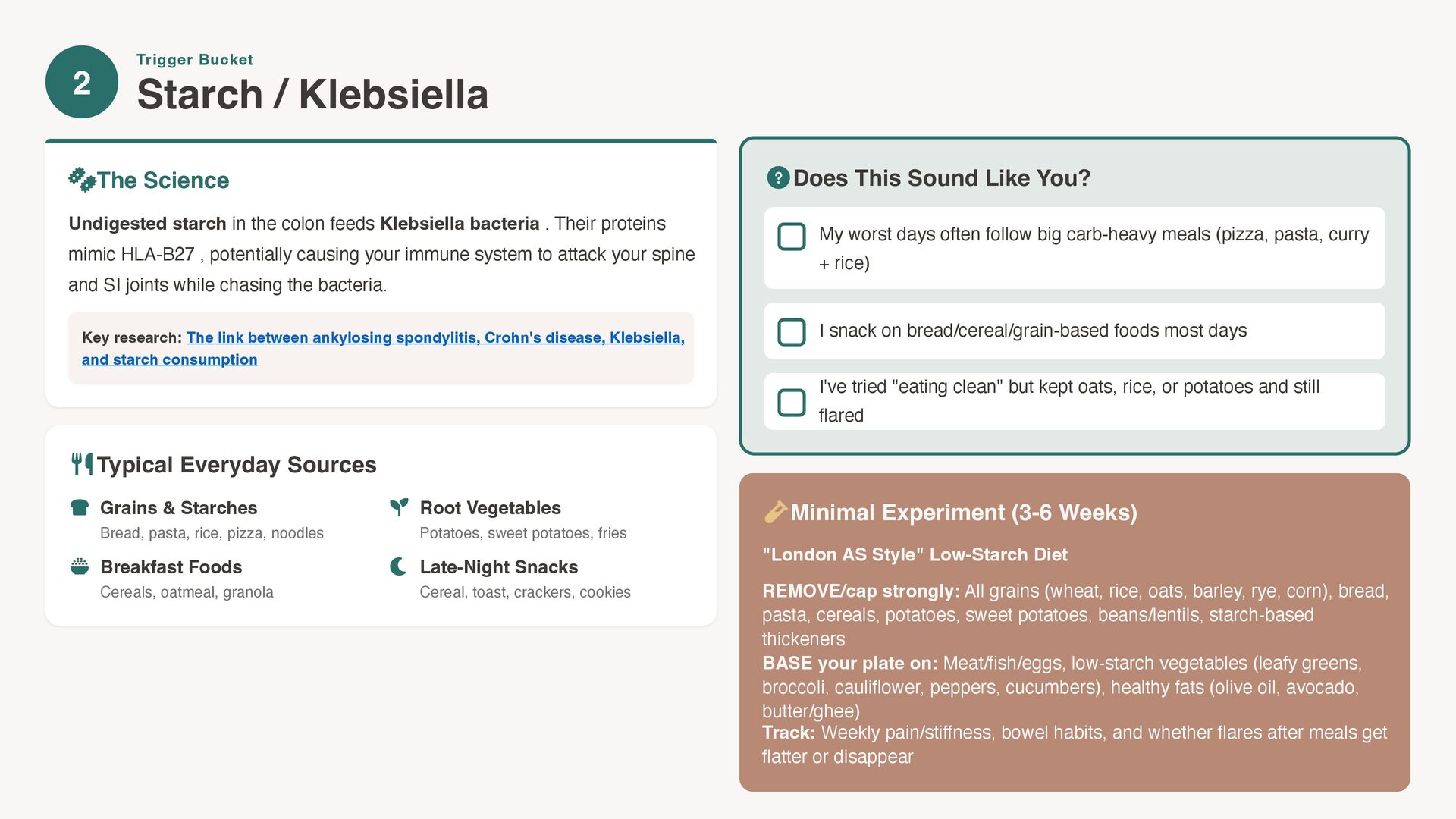
  5. 2 Trigger Bucket Starch / Klebsiella The Science Undigested starch

    in the colon feeds Klebsiella bacteria . Their proteins mimic HLA-B27 , potentially causing your immune system to attack your spine and SI joints while chasing the bacteria. Key research: The link between ankylosing spondylitis, Crohn's disease, Klebsiella, and starch consumption Typical Everyday Sources Grains & Starches Bread, pasta, rice, pizza, noodles Breakfast Foods Cereals, oatmeal, granola Root Vegetables Potatoes, sweet potatoes, fries Late-Night Snacks Cereal, toast, crackers, cookies Does This Sound Like You? My worst days often follow big carb-heavy meals (pizza, pasta, curry + rice) I snack on bread/cereal/grain-based foods most days I've tried "eating clean" but kept oats, rice, or potatoes and still flared Minimal Experiment (3-6 Weeks) "London AS Style" Low-Starch Diet REMOVE/cap strongly: All grains (wheat, rice, oats, barley, rye, corn), bread, pasta, cereals, potatoes, sweet potatoes, beans/lentils, starch-based thickeners BASE your plate on: Meat/fish/eggs, low-starch vegetables (leafy greens, broccoli, cauliflower, peppers, cucumbers), healthy fats (olive oil, avocado, butter/ghee) Track: Weekly pain/stiffness, bowel habits, and whether flares after meals get flatter or disappear
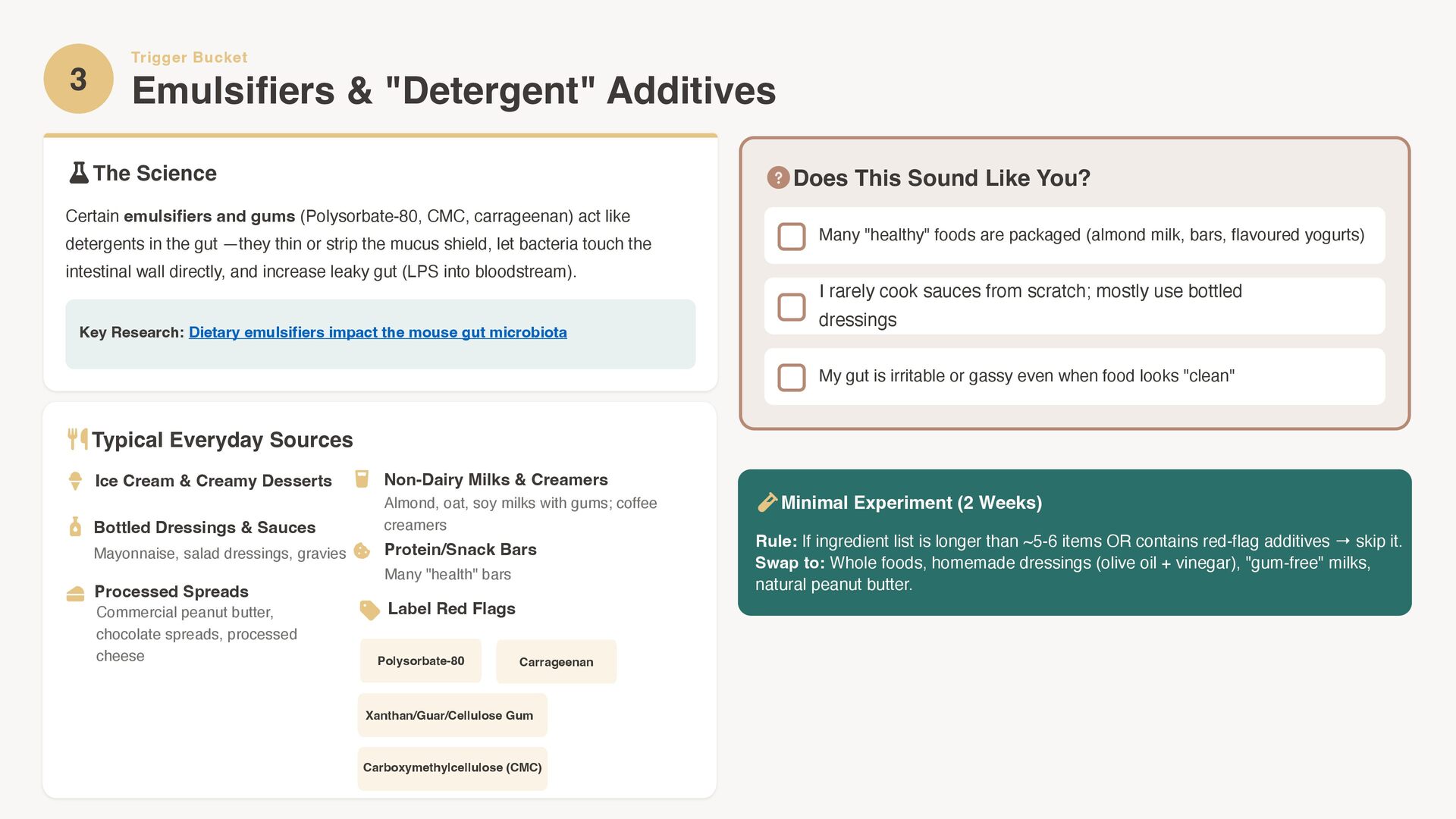
  6. 3 Trigger Bucket Emulsifiers & "Detergent" Additives The Science Certain

    emulsifiers and gums (Polysorbate-80, CMC, carrageenan) act like detergents in the gut —they thin or strip the mucus shield, let bacteria touch the intestinal wall directly, and increase leaky gut (LPS into bloodstream). Key Research: Dietary emulsifiers impact the mouse gut microbiota Typical Everyday Sources Ice Cream & Creamy Desserts Non-Dairy Milks & Creamers Almond, oat, soy milks with gums; coffee creamers Bottled Dressings & Sauces Mayonnaise, salad dressings, gravies Protein/Snack Bars Many "health" bars Processed Spreads Commercial peanut butter, chocolate spreads, processed cheese Minimal Experiment (2 Weeks) Rule: If ingredient list is longer than ~5-6 items OR contains red-flag additives → skip it. Swap to: Whole foods, homemade dressings (olive oil + vinegar), "gum-free" milks, natural peanut butter. Polysorbate-80 Carrageenan Xanthan/Guar/Cellulose Gum Does This Sound Like You? Many "healthy" foods are packaged (almond milk, bars, flavoured yogurts) I rarely cook sauces from scratch; mostly use bottled dressings My gut is irritable or gassy even when food looks "clean" Label Red Flags Carboxymethylcellulose (CMC)
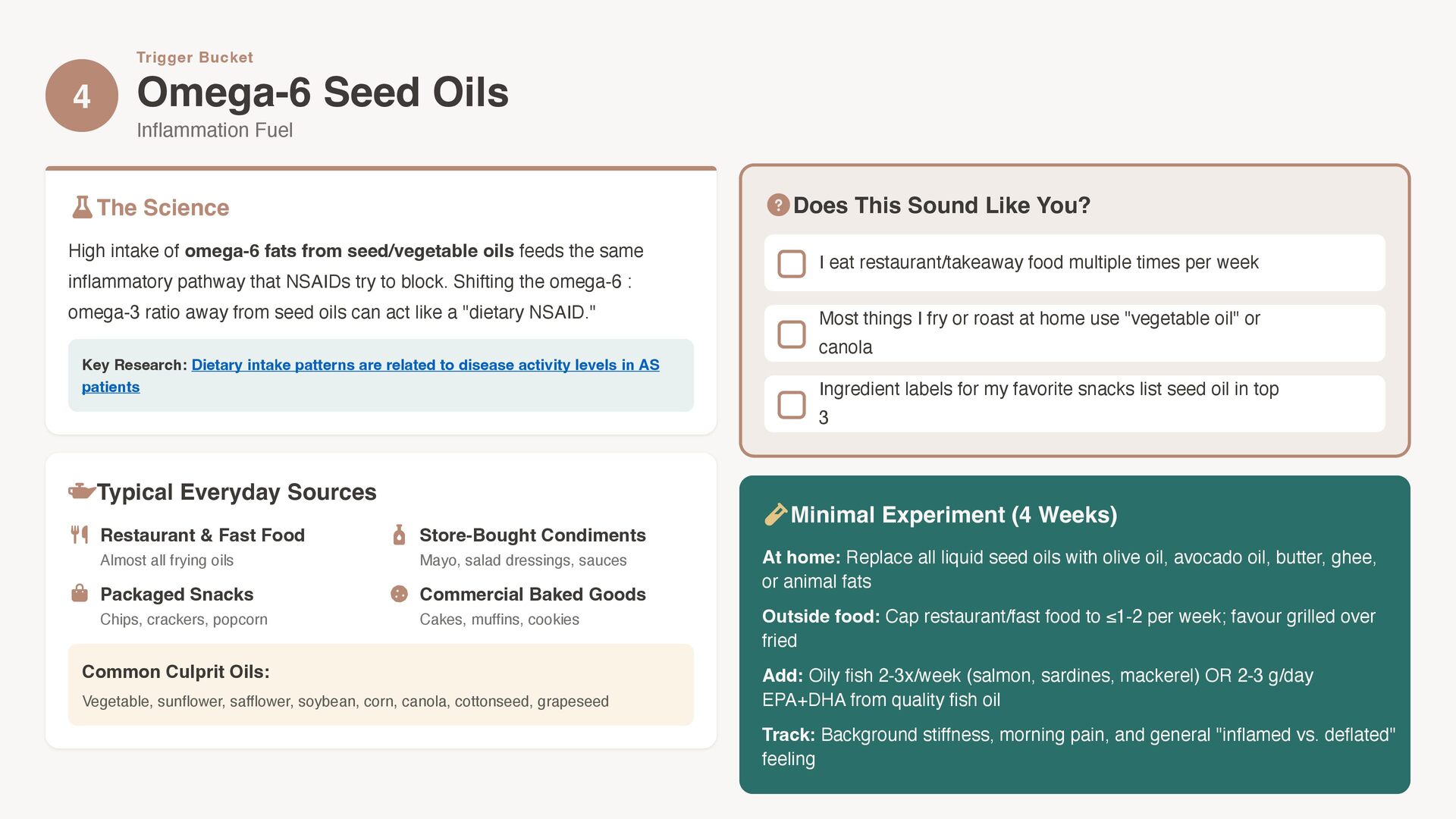
  7. 4 Trigger Bucket Omega-6 Seed Oils Inflammation Fuel The Science

    High intake of omega-6 fats from seed/vegetable oils feeds the same inflammatory pathway that NSAIDs try to block. Shifting the omega-6 : omega-3 ratio away from seed oils can act like a "dietary NSAID." Key Research: Dietary intake patterns are related to disease activity levels in AS patients Typical Everyday Sources Restaurant & Fast Food Almost all frying oils Packaged Snacks Chips, crackers, popcorn Store-Bought Condiments Mayo, salad dressings, sauces Commercial Baked Goods Cakes, muffins, cookies Common Culprit Oils: Vegetable, sunflower, safflower, soybean, corn, canola, cottonseed, grapeseed Does This Sound Like You? I eat restaurant/takeaway food multiple times per week Most things I fry or roast at home use "vegetable oil" or canola Ingredient labels for my favorite snacks list seed oil in top 3 Minimal Experiment (4 Weeks) At home: Replace all liquid seed oils with olive oil, avocado oil, butter, ghee, or animal fats Outside food: Cap restaurant/fast food to ≤1-2 per week; favour grilled over fried Add: Oily fish 2-3x/week (salmon, sardines, mackerel) OR 2-3 g/day EPA+DHA from quality fish oil Track: Background stiffness, morning pain, and general "inflamed vs. deflated" feeling
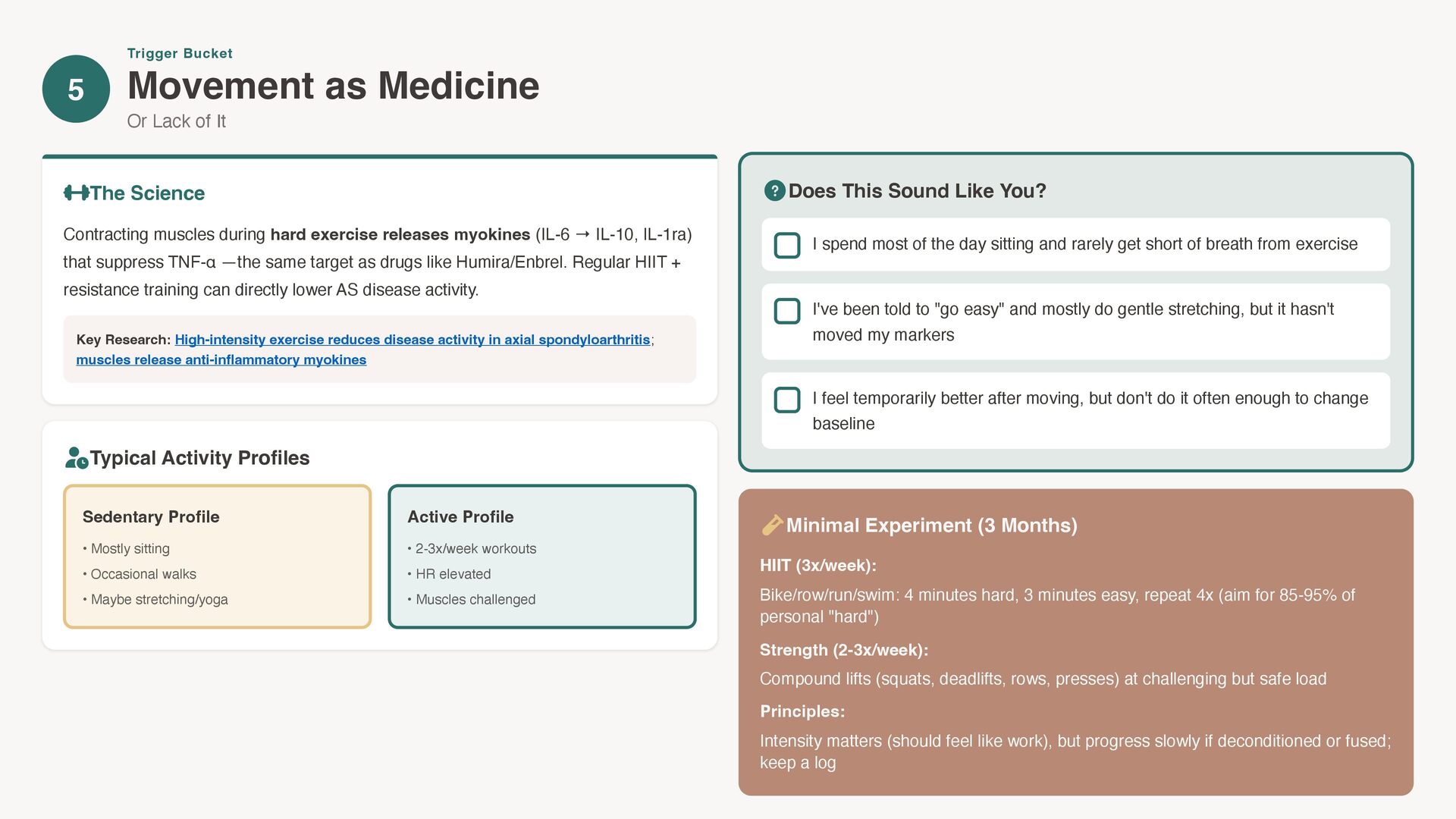
  8. 5 Trigger Bucket Movement as Medicine Or Lack of It

    The Science Contracting muscles during hard exercise releases myokines (IL-6 → IL-10, IL-1ra) that suppress TNF-α —the same target as drugs like Humira/Enbrel. Regular HIIT + resistance training can directly lower AS disease activity. Key Research: High-intensity exercise reduces disease activity in axial spondyloarthritis; muscles release anti-inflammatory myokines Typical Activity Profiles Sedentary Profile • Mostly sitting • Occasional walks • Maybe stretching/yoga Active Profile • 2-3x/week workouts • HR elevated • Muscles challenged Does This Sound Like You? I spend most of the day sitting and rarely get short of breath from exercise I've been told to "go easy" and mostly do gentle stretching, but it hasn't moved my markers I feel temporarily better after moving, but don't do it often enough to change baseline Minimal Experiment (3 Months) HIIT (3x/week): Bike/row/run/swim: 4 minutes hard, 3 minutes easy, repeat 4x (aim for 85-95% of personal "hard") Strength (2-3x/week): Compound lifts (squats, deadlifts, rows, presses) at challenging but safe load Principles: Intensity matters (should feel like work), but progress slowly if deconditioned or fused; keep a log
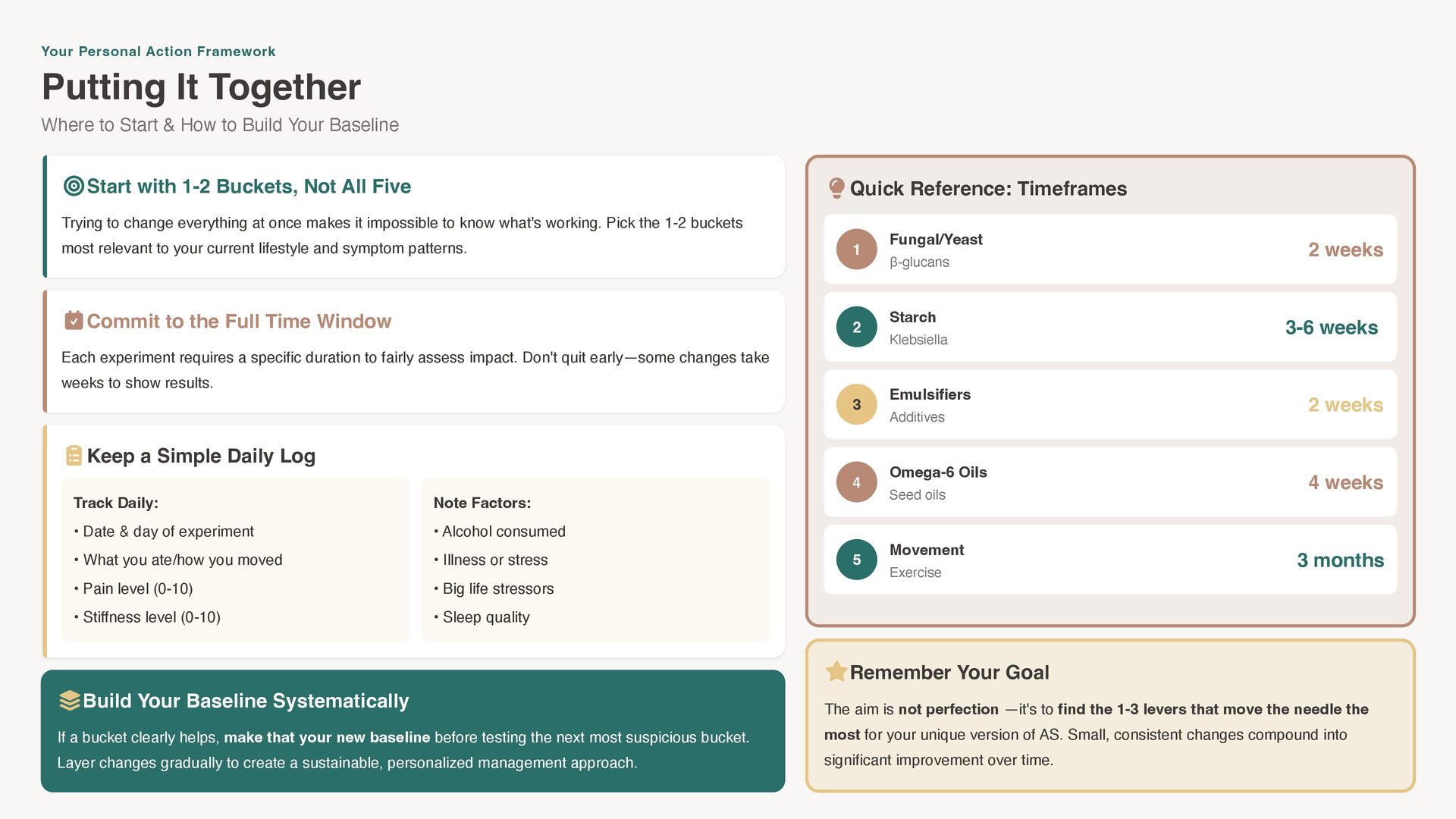
  9. Your Personal Action Framework Putting It Together Where to Start

    & How to Build Your Baseline Start with 1-2 Buckets, Not All Five Trying to change everything at once makes it impossible to know what's working. Pick the 1-2 buckets most relevant to your current lifestyle and symptom patterns. Commit to the Full Time Window Each experiment requires a specific duration to fairly assess impact. Don't quit early—some changes take weeks to show results. Keep a Simple Daily Log Track Daily: • Date & day of experiment • What you ate/how you moved • Pain level (0-10) • Stiffness level (0-10) Note Factors: • Alcohol consumed • Illness or stress • Big life stressors • Sleep quality Build Your Baseline Systematically If a bucket clearly helps, make that your new baseline before testing the next most suspicious bucket. Layer changes gradually to create a sustainable, personalized management approach. Quick Reference: Timeframes 1 Fungal/Yeast β-glucans 2 weeks 2 Starch Klebsiella 3-6 weeks 3 Emulsifiers Additives 2 weeks 4 Omega-6 Oils Seed oils 4 weeks 5 Movement Exercise 3 months Remember Your Goal The aim is not perfection —it's to find the 1-3 levers that move the needle the most for your unique version of AS. Small, consistent changes compound into significant improvement over time.
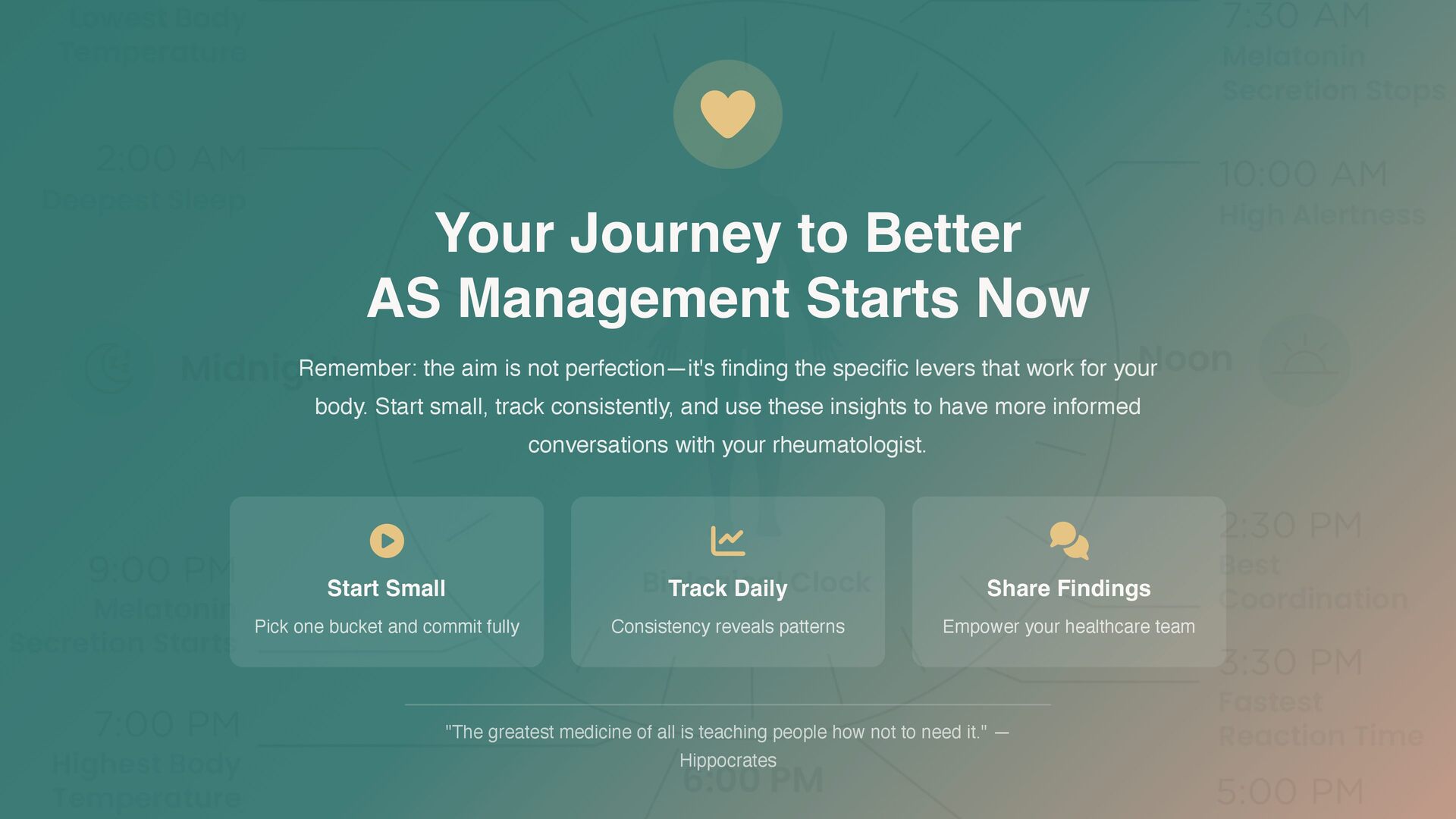
  10. Your Journey to Better AS Management Starts Now Remember: the

    aim is not perfection—it's finding the specific levers that work for your body. Start small, track consistently, and use these insights to have more informed conversations with your rheumatologist. Start Small Pick one bucket and commit fully Track Daily Consistency reveals patterns Share Findings Empower your healthcare team "The greatest medicine of all is teaching people how not to need it." — Hippocrates