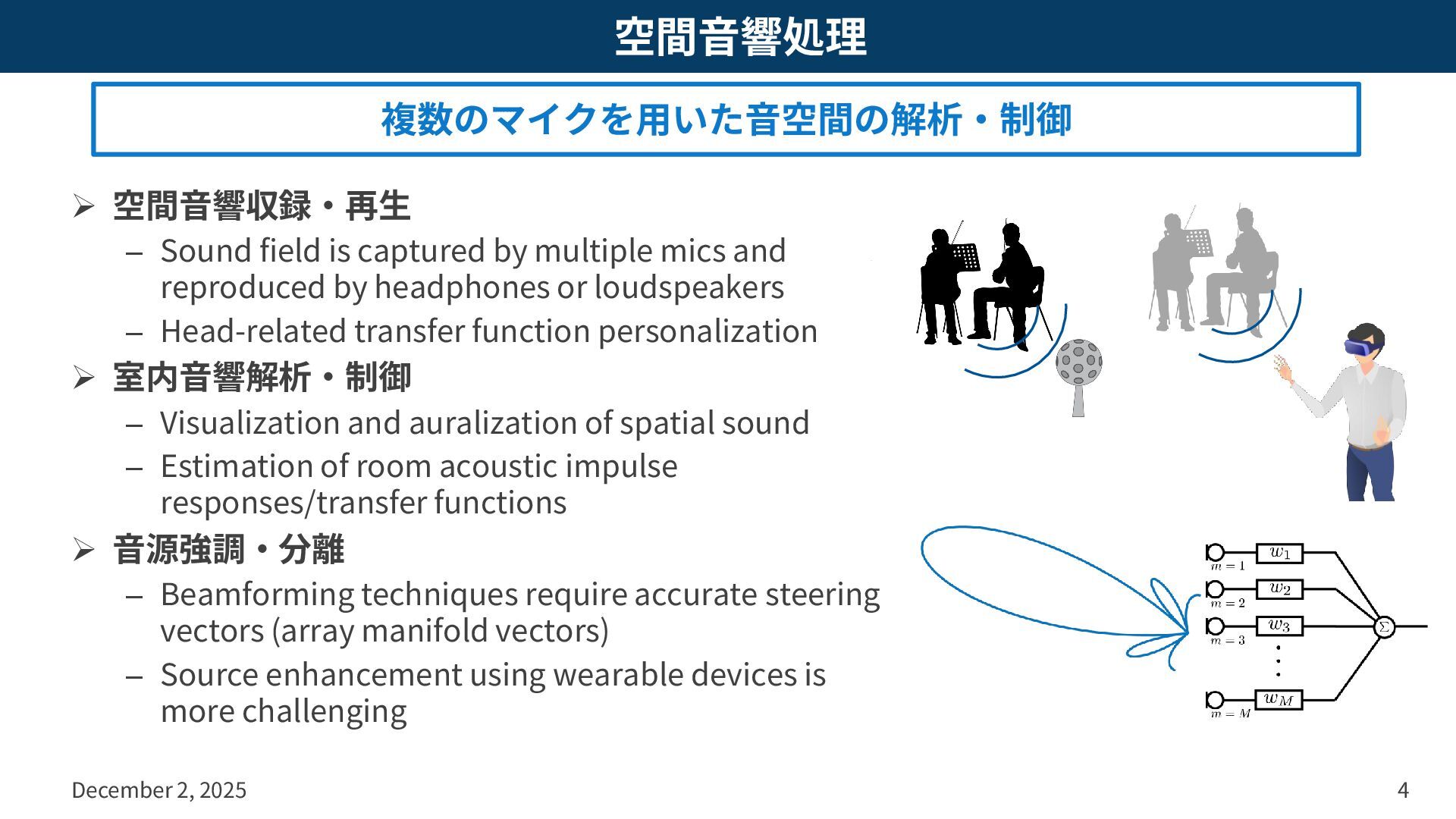
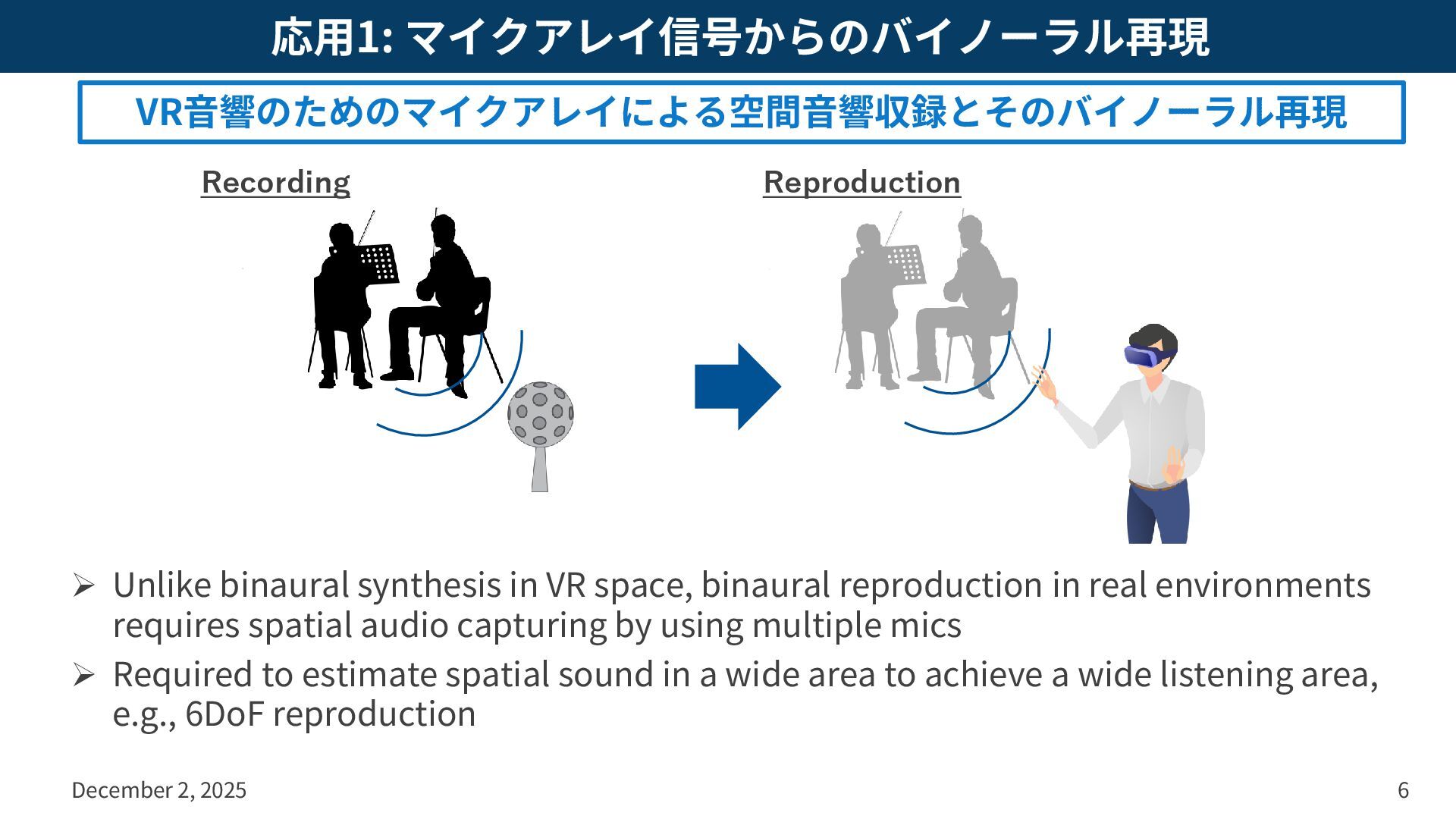
mics and reproduced by headphones or loudspeakers – Head-related transfer function personalization ➢ 室内音響解析・制御 – Visualization and auralization of spatial sound – Estimation of room acoustic impulse responses/transfer functions ➢ 音源強調・分離 – Beamforming techniques require accurate steering vectors (array manifold vectors) – Source enhancement using wearable devices is more challenging December 2, 2025 4 複数のマイクを用いた音空間の解析・制御
Unlike binaural synthesis in VR space, binaural reproduction in real environments requires spatial audio capturing by using multiple mics ➢ Required to estimate spatial sound in a wide area to achieve a wide listening area, e.g., 6DoF reproduction
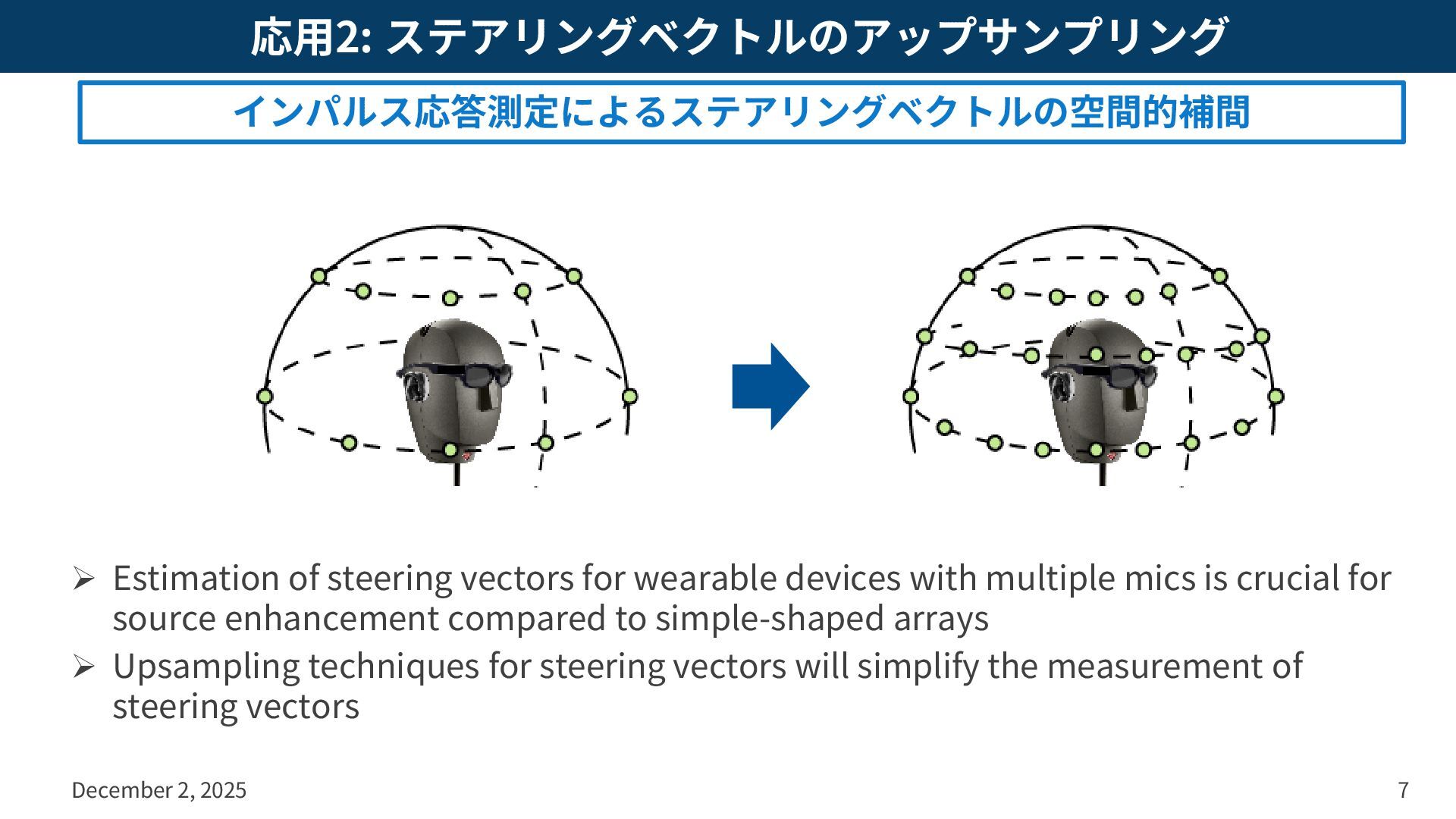
with multiple mics is crucial for source enhancement compared to simple-shaped arrays ➢ Upsampling techniques for steering vectors will simplify the measurement of steering vectors December 2, 2025 7 インパルス応答測定によるステアリングベクトルの空間的補間
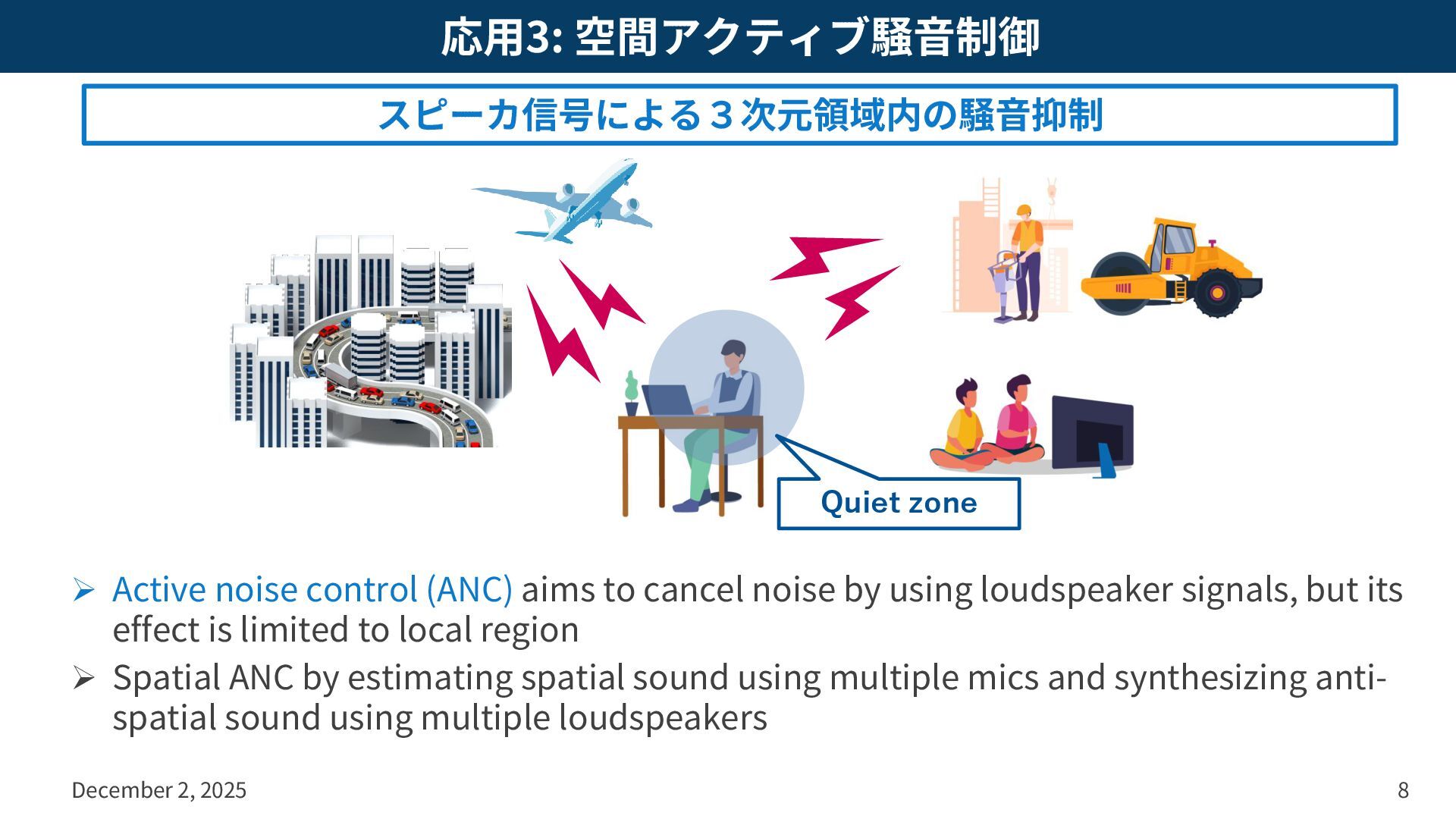
noise by using loudspeaker signals, but its effect is limited to local region ➢ Spatial ANC by estimating spatial sound using multiple mics and synthesizing anti- spatial sound using multiple loudspeakers December 2, 2025 8 スピーカ信号による3次元領域内の騒音抑制 Quiet zone
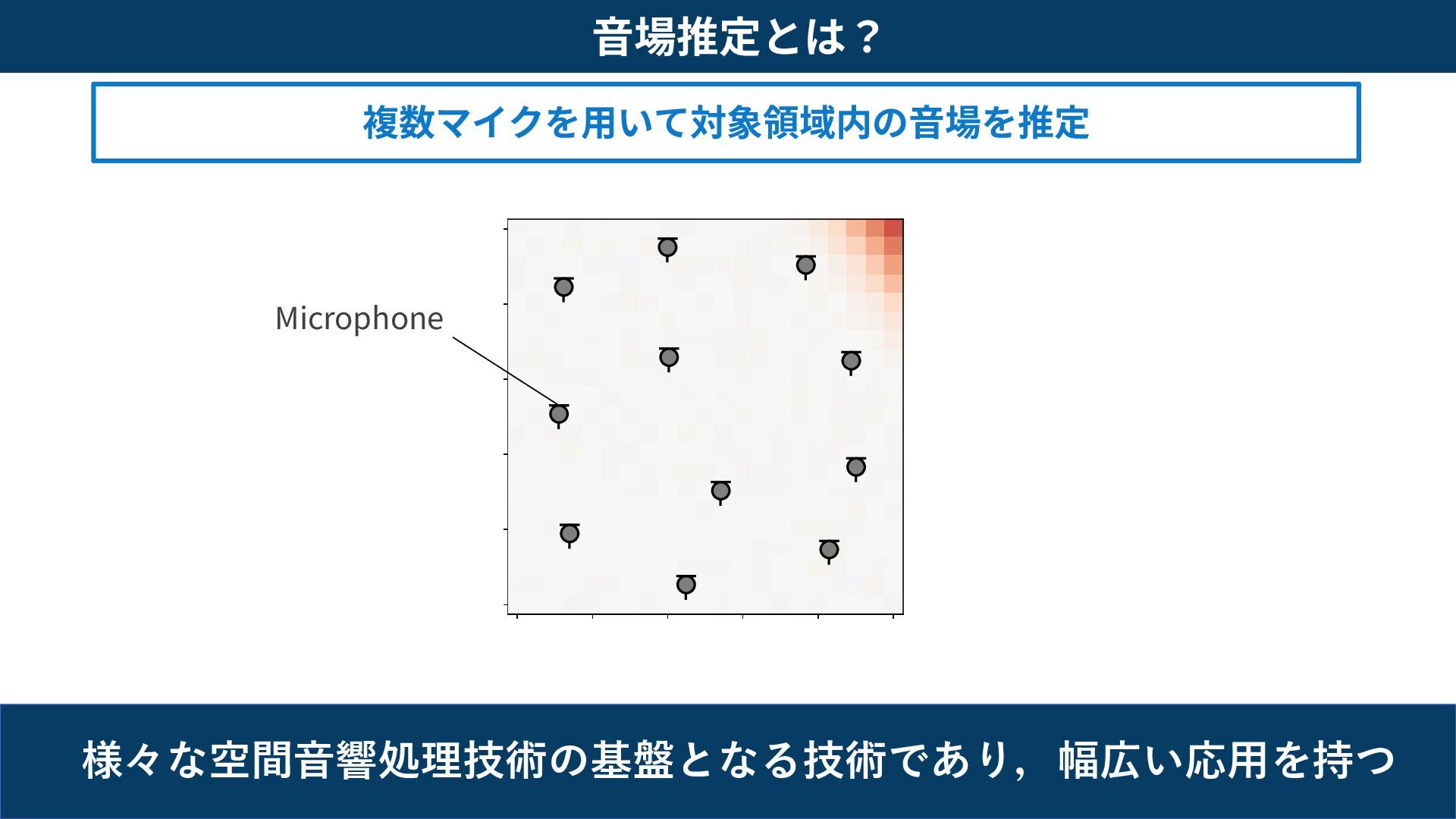
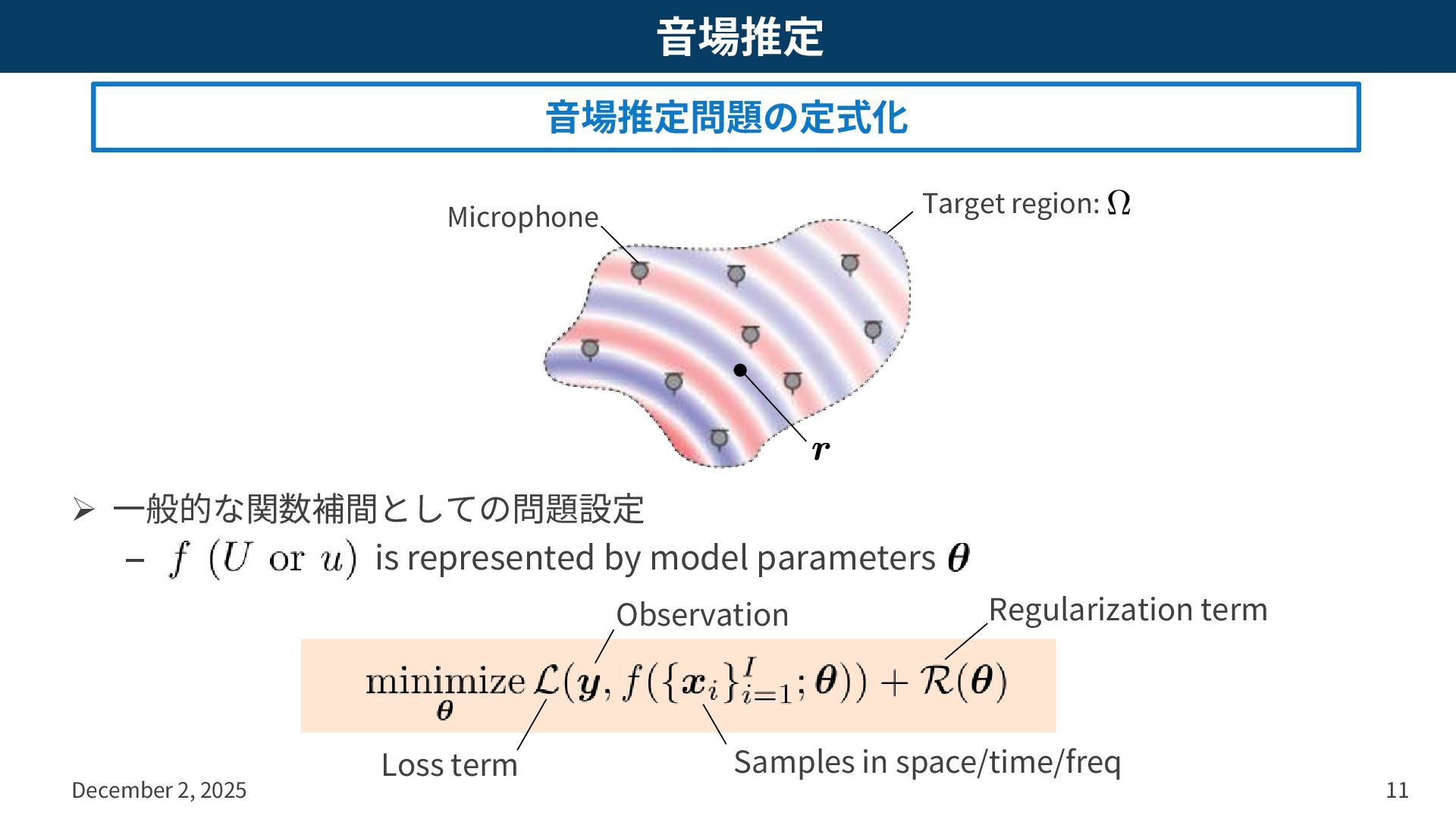
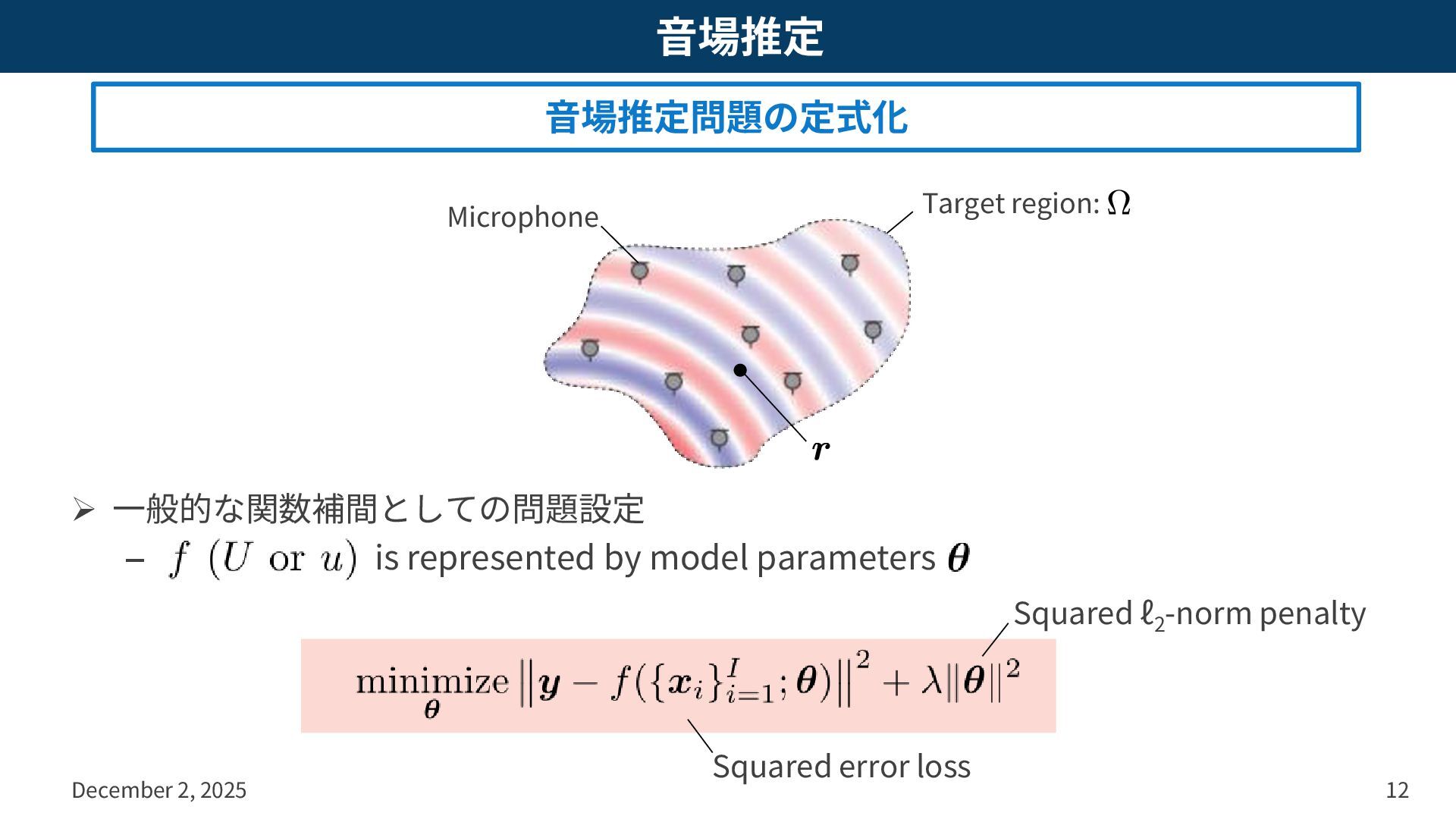
2, 2025 11 Formulation of sound field estimation problem Loss term Regularization term 音場推定問題の定式化 Microphone Target region: Observation Samples in space/time/freq
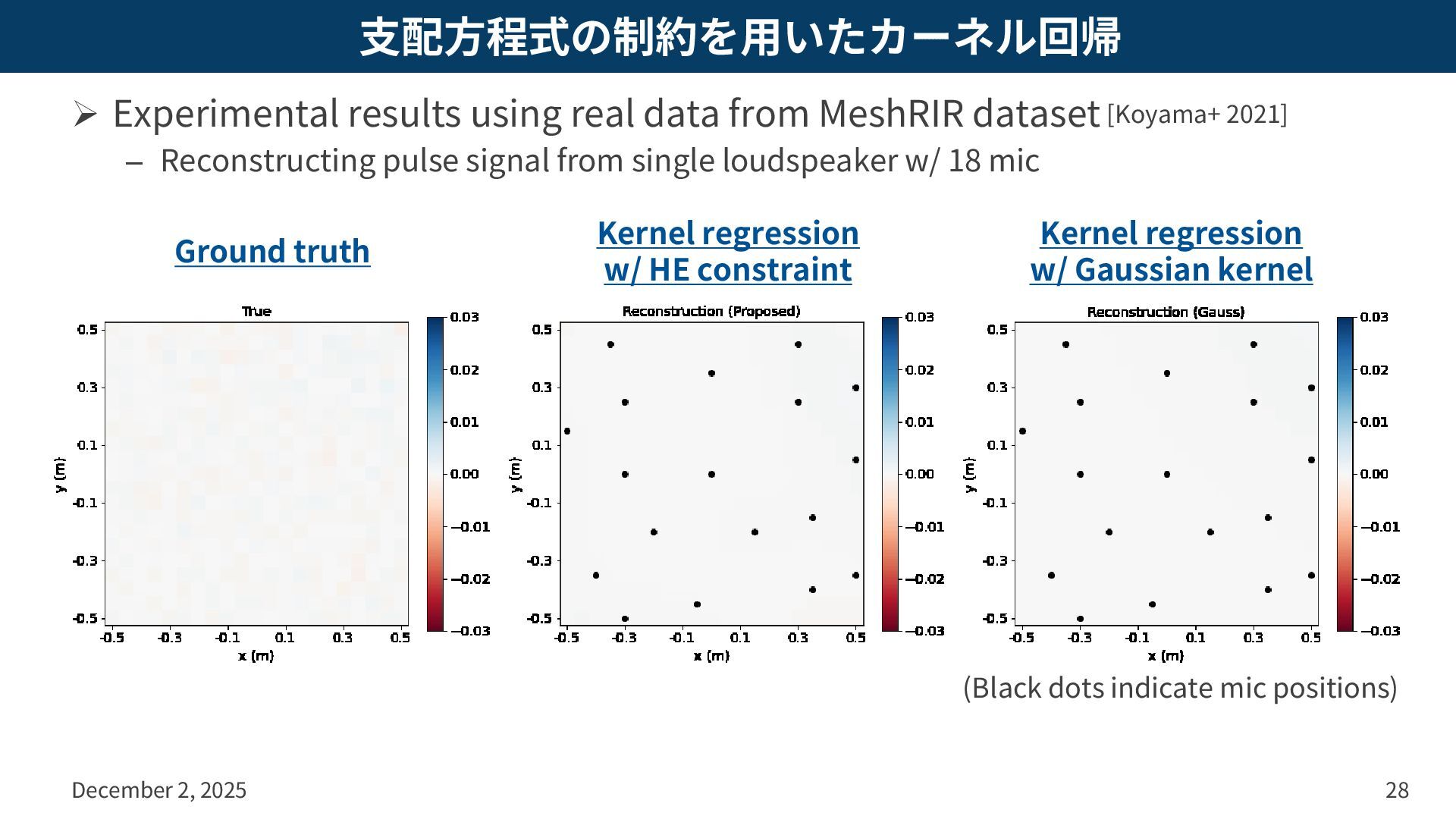
– Reconstructing pulse signal from single loudspeaker w/ 18 mic December 2, 2025 28 Ground truth Kernel regression w/ HE constraint Kernel regression w/ Gaussian kernel (Black dots indicate mic positions) [Koyama+ 2021]
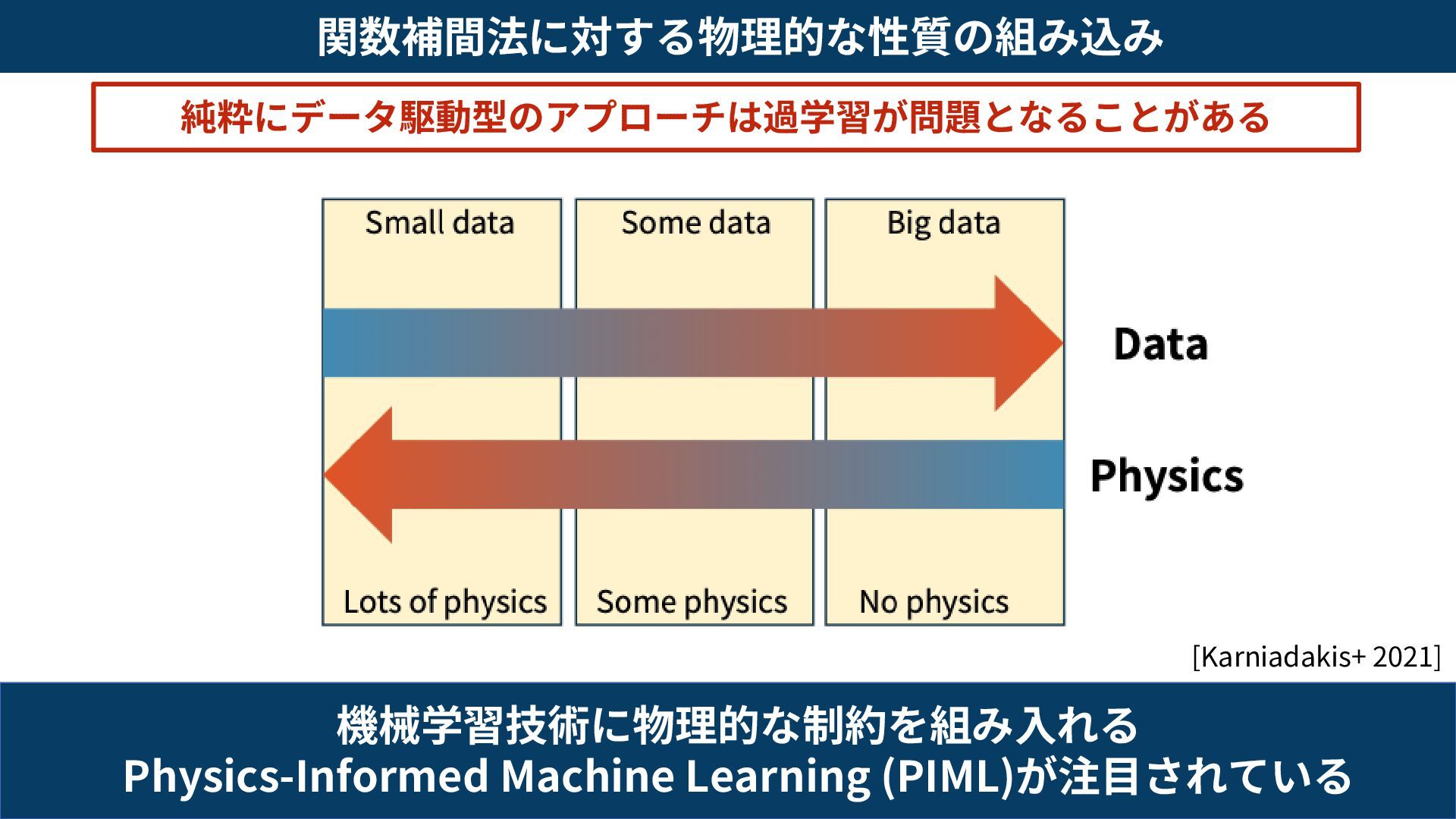
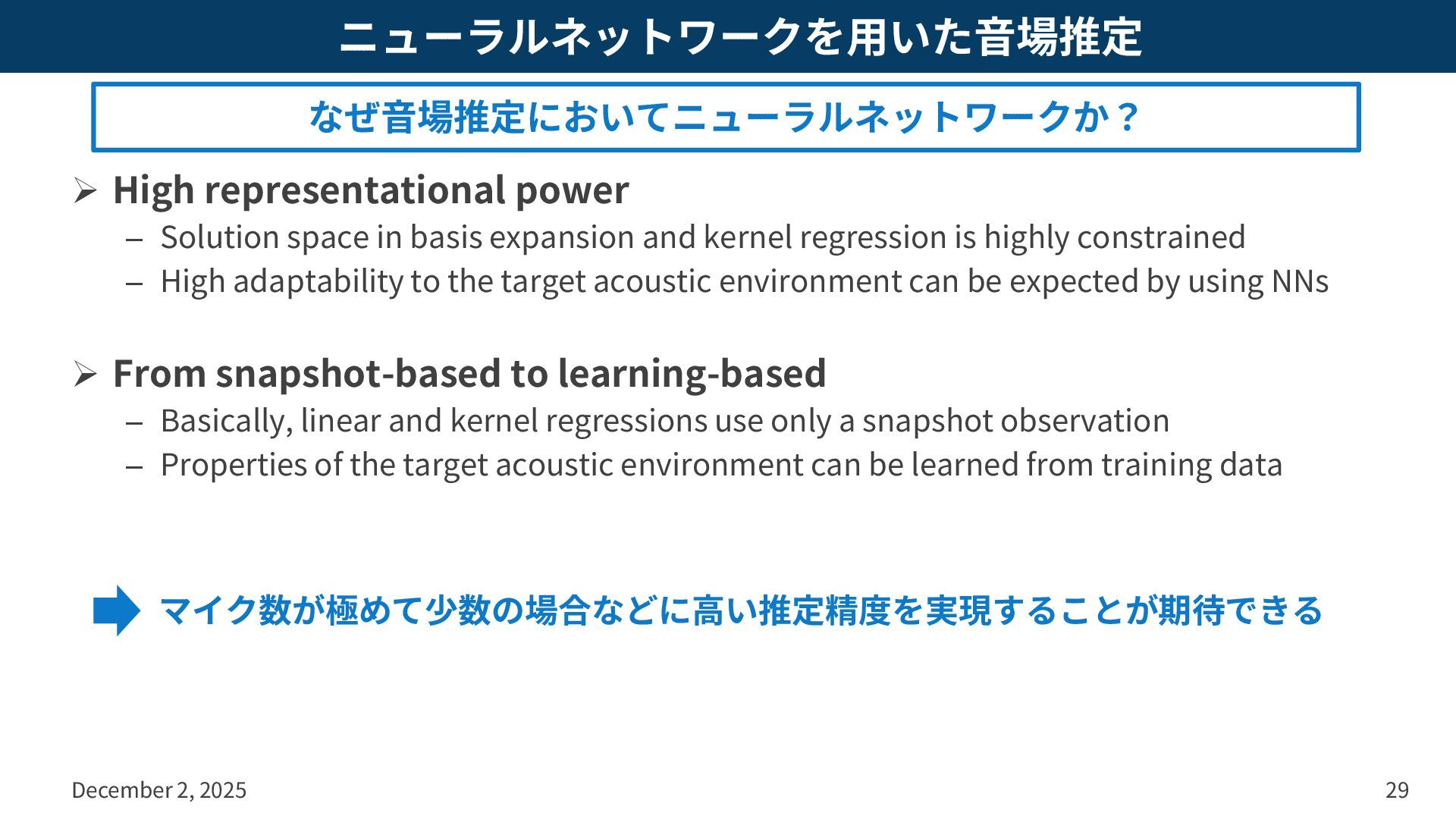
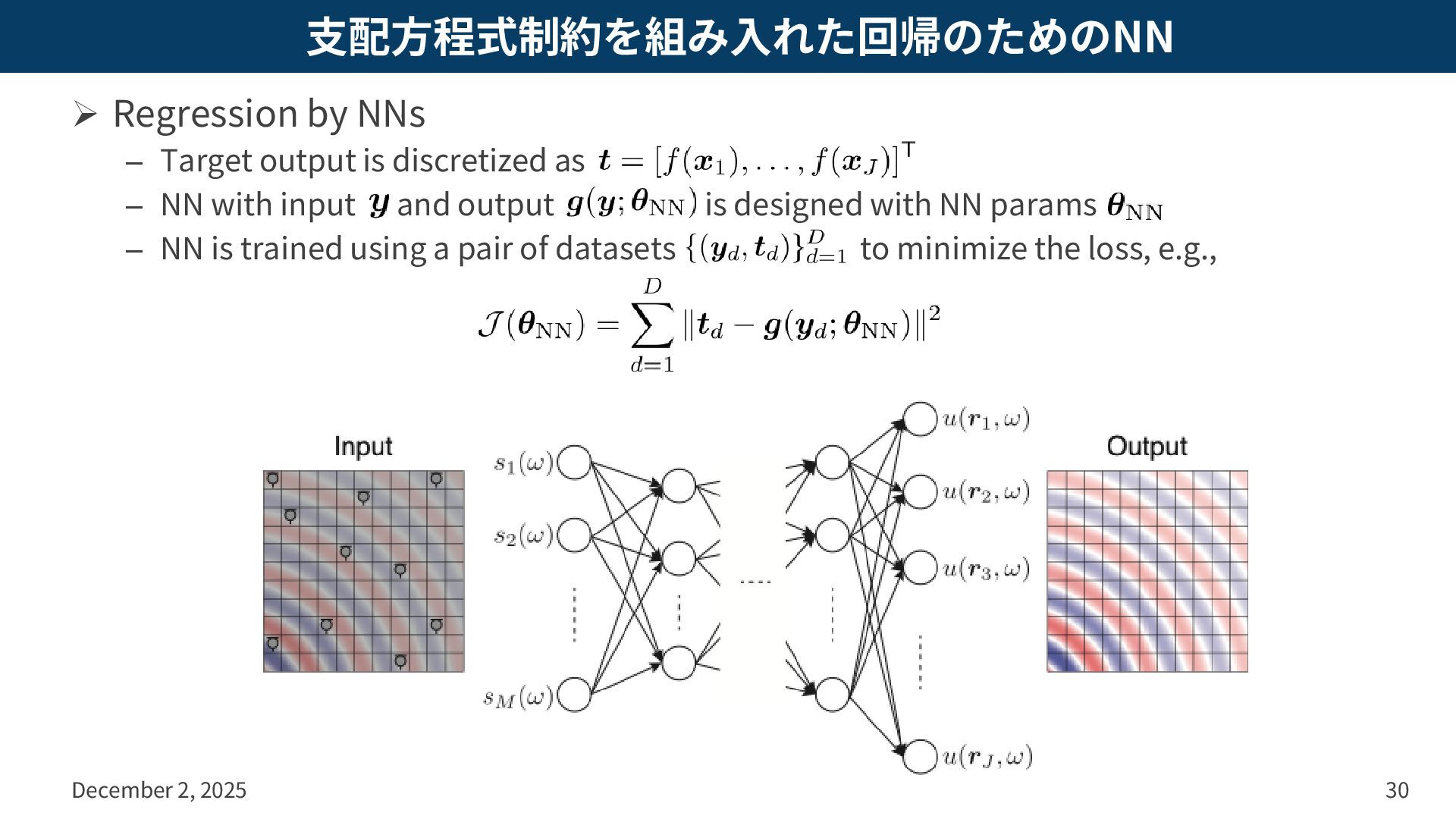
expansion and kernel regression is highly constrained – High adaptability to the target acoustic environment can be expected by using NNs ➢ From snapshot-based to learning-based – Basically, linear and kernel regressions use only a snapshot observation – Properties of the target acoustic environment can be learned from training data December 2, 2025 29 なぜ音場推定においてニューラルネットワークか? マイク数が極めて少数の場合などに高い推定精度を実現することが期待できる
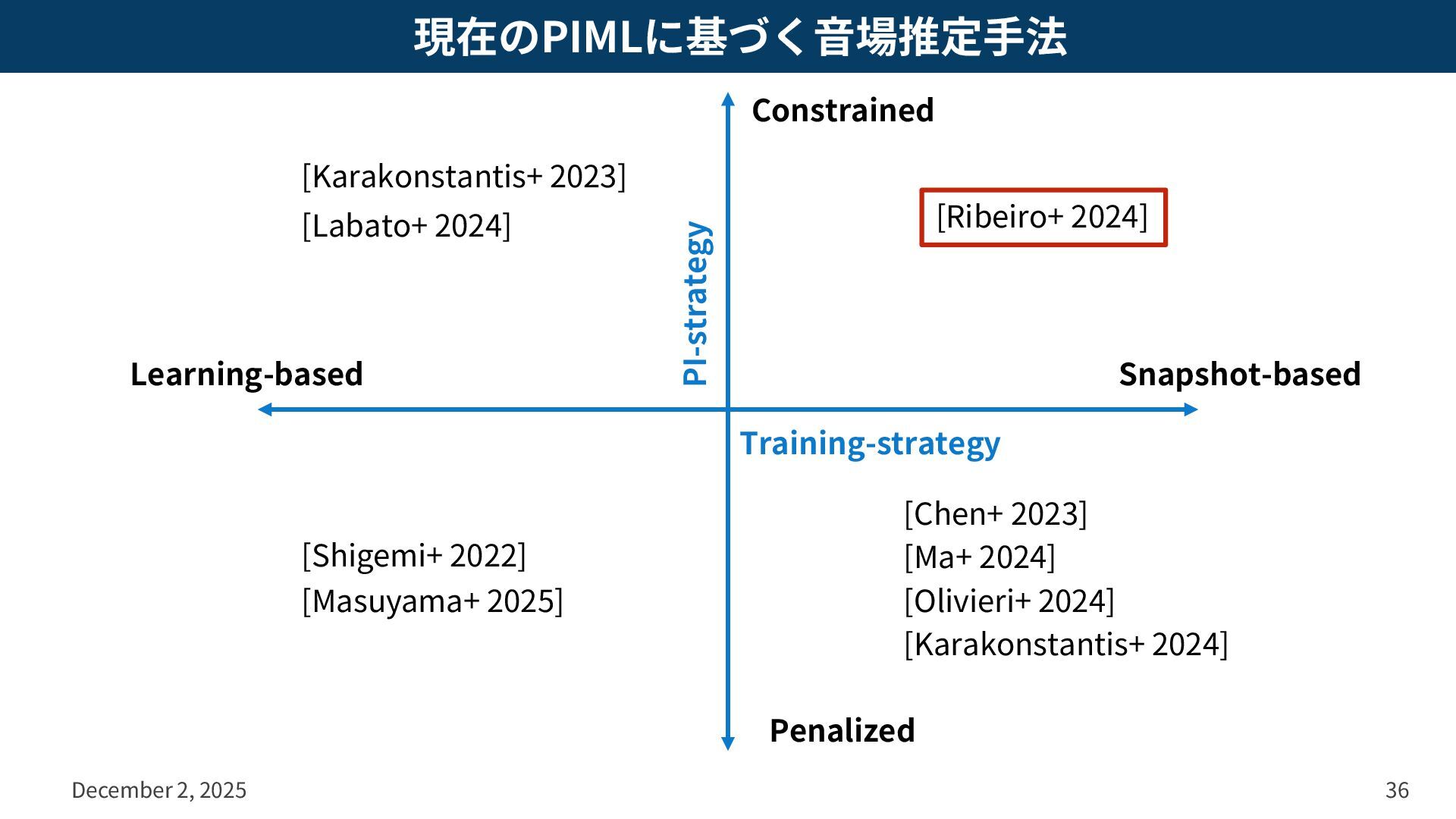
basis expansion – Continuous function can be reconstructed by using estimated expansion coefs – Can be regarded as physics-constrained neural network (PCNN) [Karakonstantis+ 2023, Lobato+ 2024] ➢ (近似的な)PDE lossの導入 – Loss function evaluating deviation from governing PDEs: PDE loss – Because of discrete output values, PDE loss is computed by finite difference or interpolation – In [Shigemi+ 2022], physics-informed convolutional neural network (PICNN) using bi- cubic spline interpolation is proposed December 2, 2025 31 どのようにNNに支配方程式の制約を組み入れるか?
used to implicity represent a continuous function – NN with input and output is designed with NN params – NN is trained for approximaging by using training data December 2, 2025 32
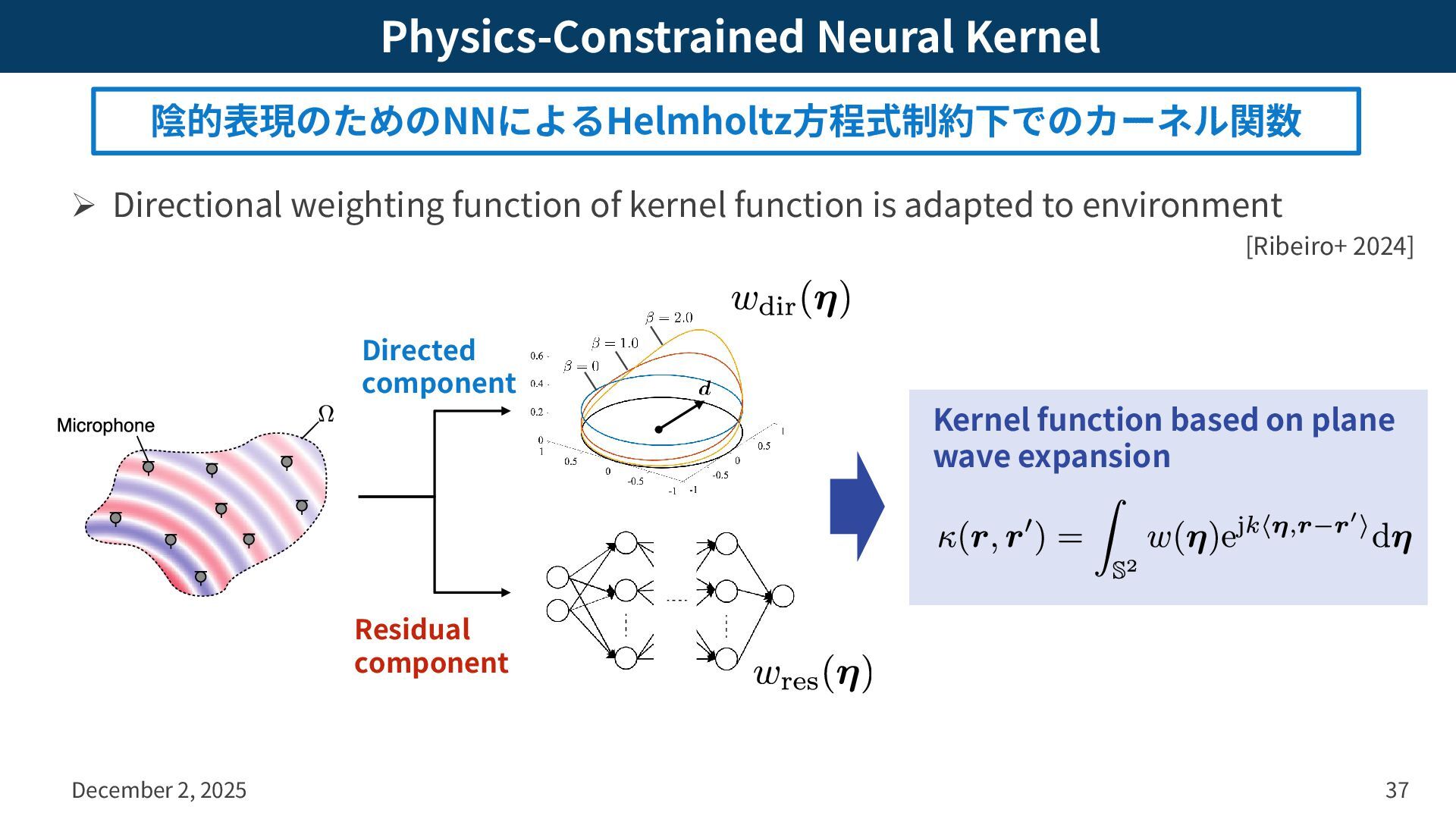
is adapted to environment December 2, 2025 37 陰的表現のためのNNによるHelmholtz方程式制約下でのカーネル関数 Directed component Residual component Kernel function based on plane wave expansion [Ribeiro+ 2024]
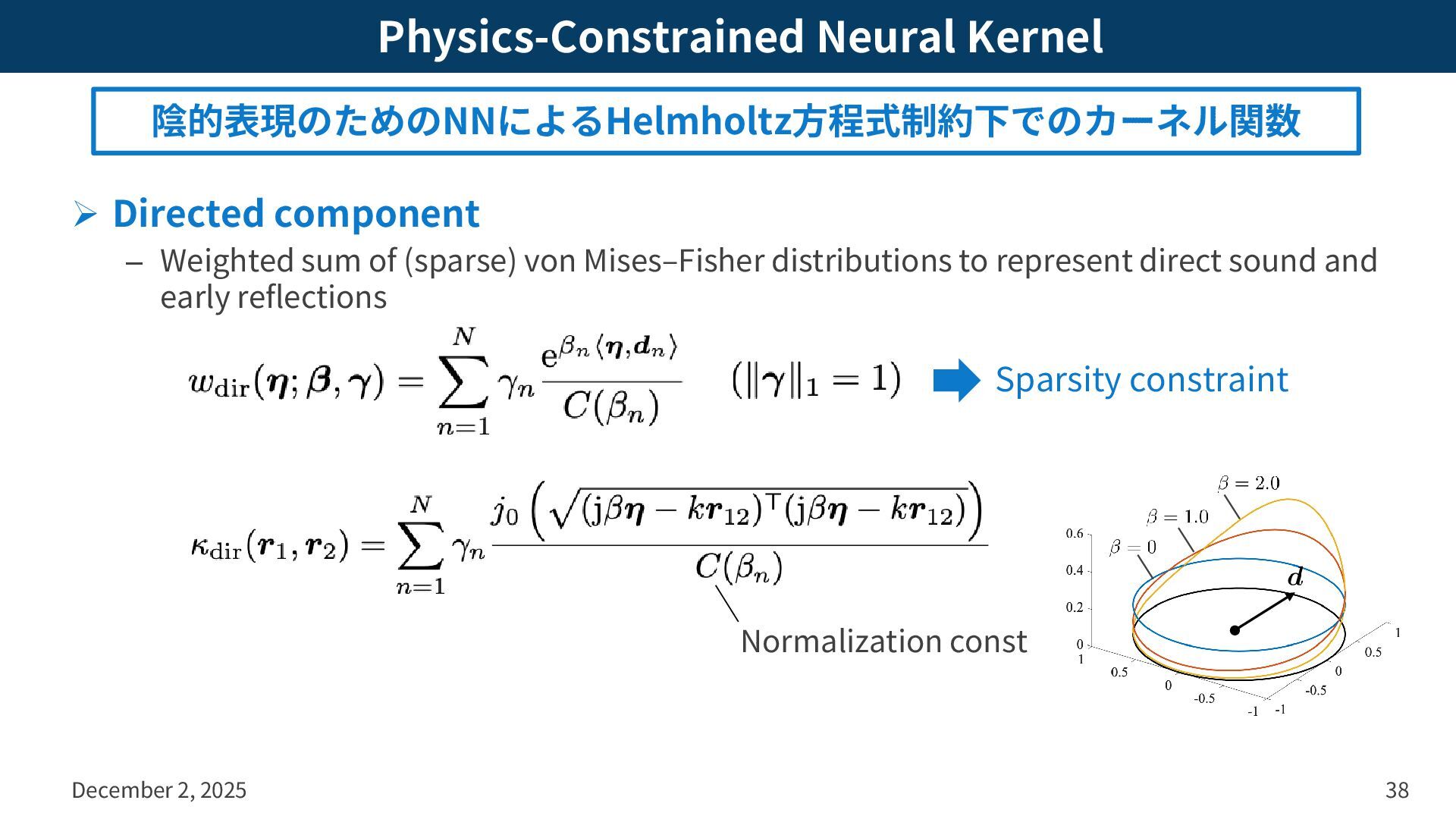
(sparse) von Mises–Fisher distributions to represent direct sound and early reflections December 2, 2025 38 Sparsity constraint Normalization const 陰的表現のためのNNによるHelmholtz方程式制約下でのカーネル関数
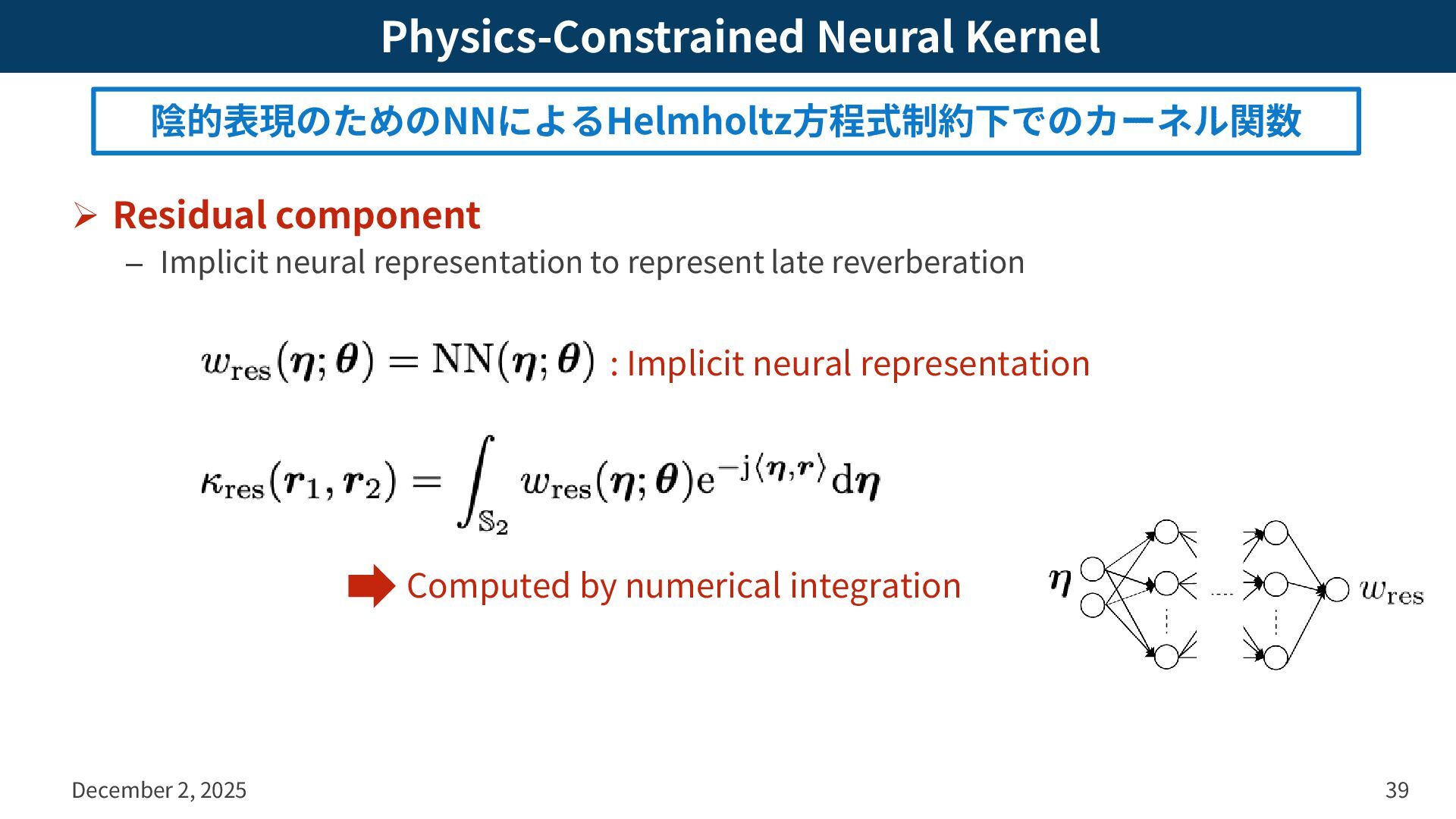
to represent late reverberation December 2, 2025 39 Computed by numerical integration : Implicit neural representation 陰的表現のためのNNによるHelmholtz方程式制約下でのカーネル関数
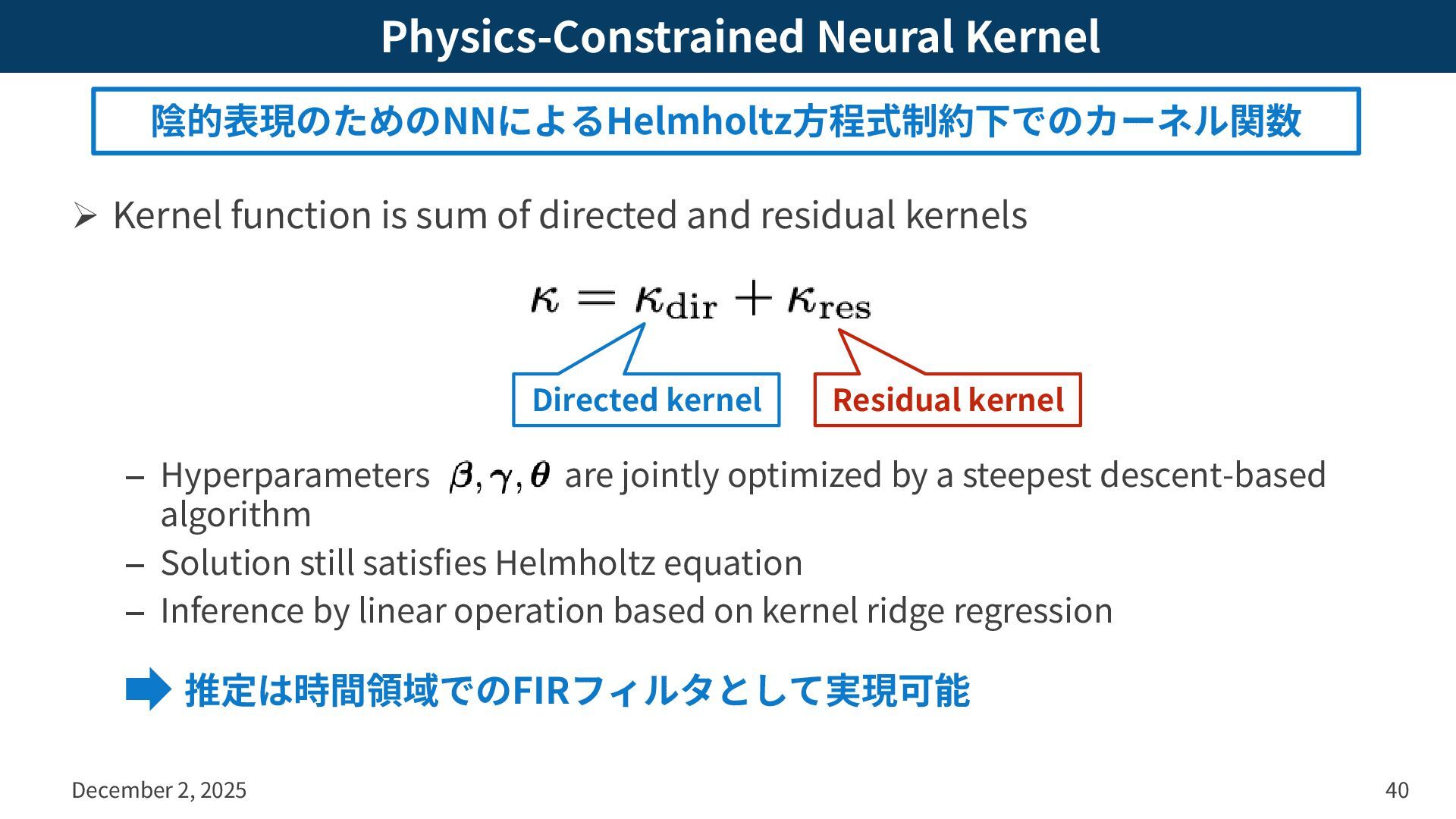
and residual kernels – Hyperparameters are jointly optimized by a steepest descent-based algorithm – Solution still satisfies Helmholtz equation – Inference by linear operation based on kernel ridge regression December 2, 2025 40 Directed kernel Residual kernel 推定は時間領域でのFIRフィルタとして実現可能 陰的表現のためのNNによるHelmholtz方程式制約下でのカーネル関数
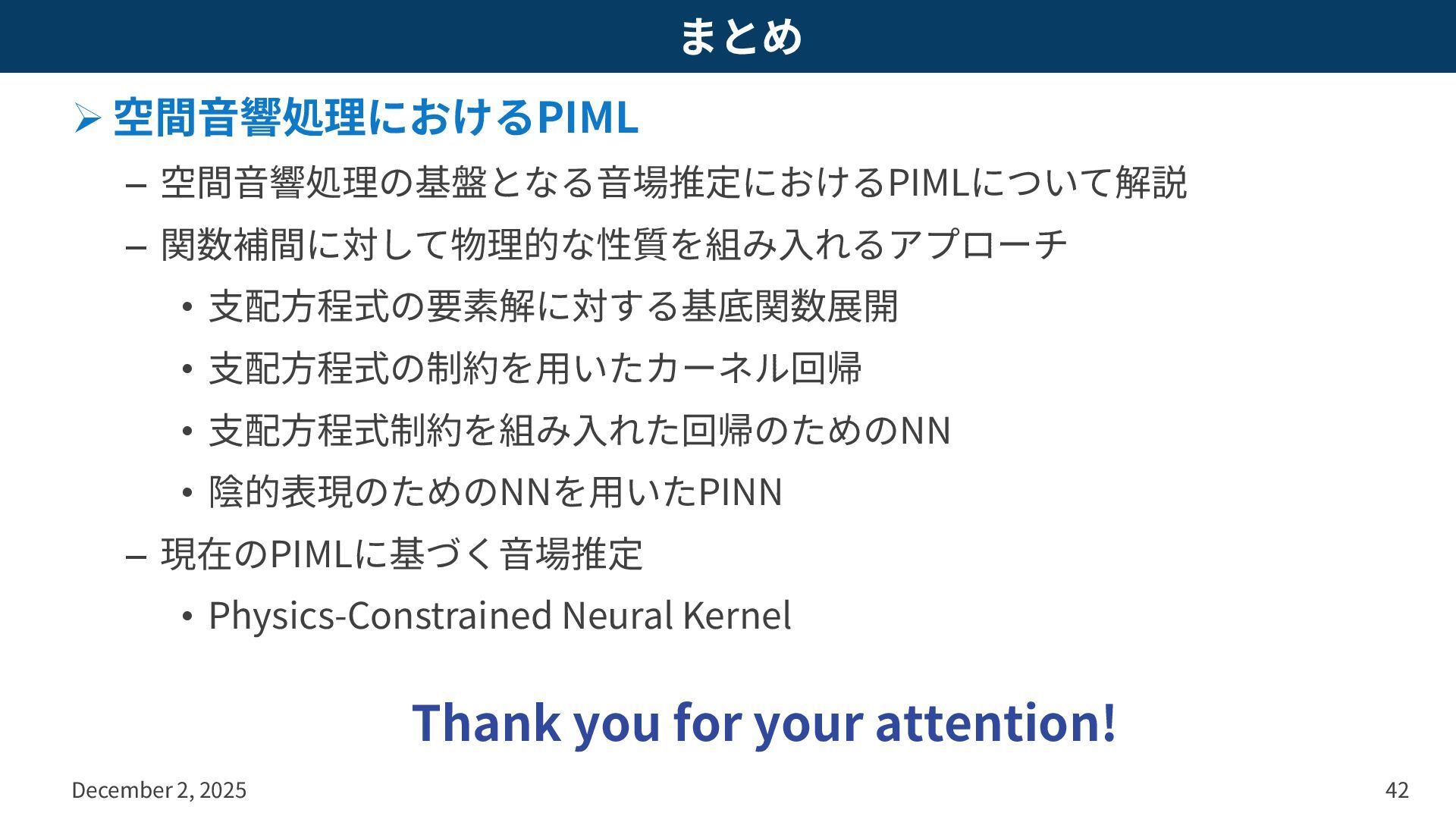
支配方程式の制約を用いたカーネル回帰 • 支配方程式制約を組み入れた回帰のためのNN • 陰的表現のためのNNを用いたPINN – 現在のPIMLに基づく音場推定 • Physics-Constrained Neural Kernel December 2, 2025 42 Thank you for your attention!


 skoyamalab
 ftakahashi
 fkske
fkske
 ontheslope
 koide3
 shunk031
 stktu
stktu
 institutdelelevage
 enochan
 casualconc
 yukako_nakano
 productmarketing
 skipperchong
 rasmusluckow
 lynnandtonic
 tamaranovitovic
 reverentgeek
 sarafernandez
 colly
colly
 eileencodes
 tomoyanonymous
 rocio
rocio
 trishagee

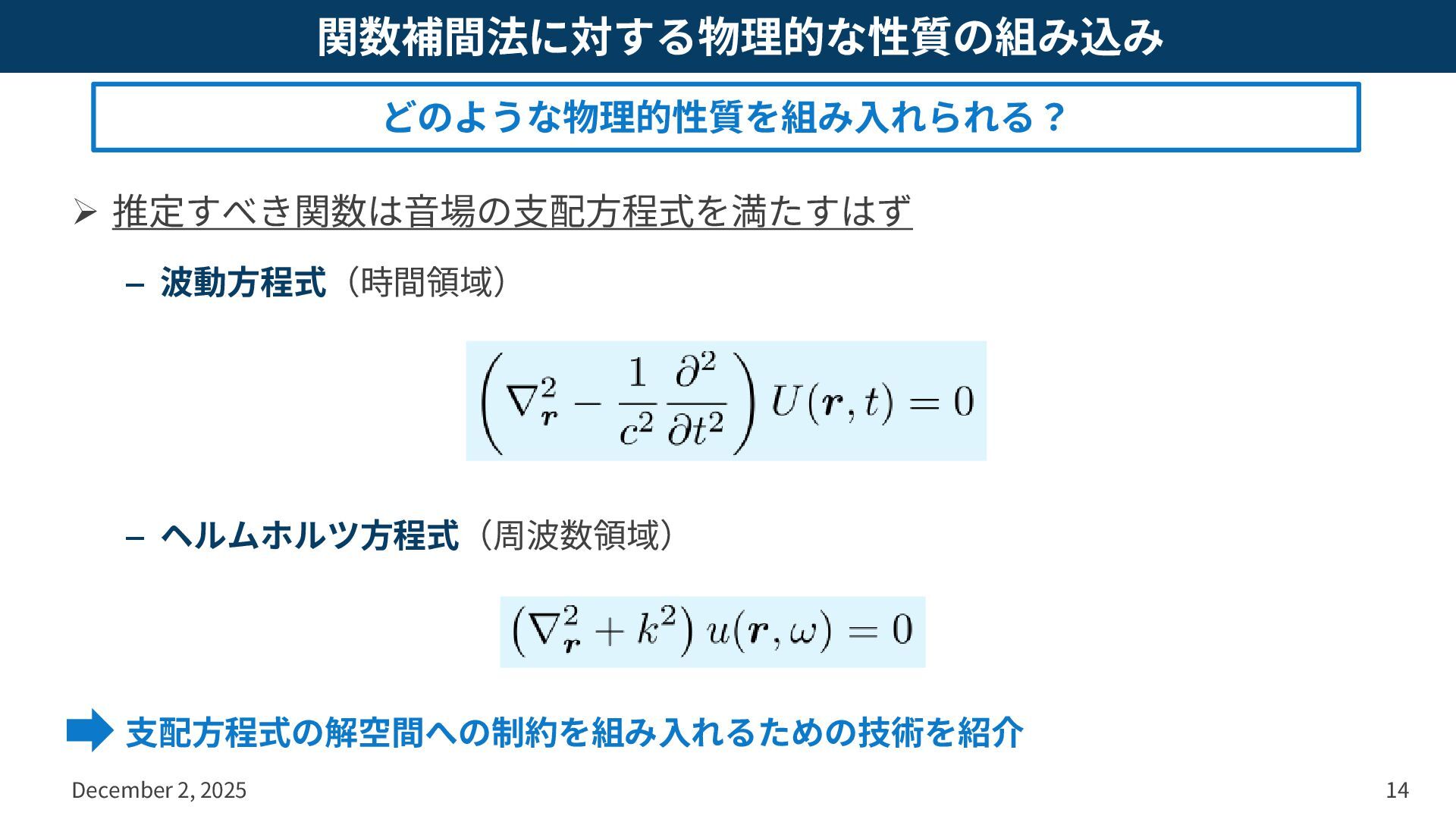
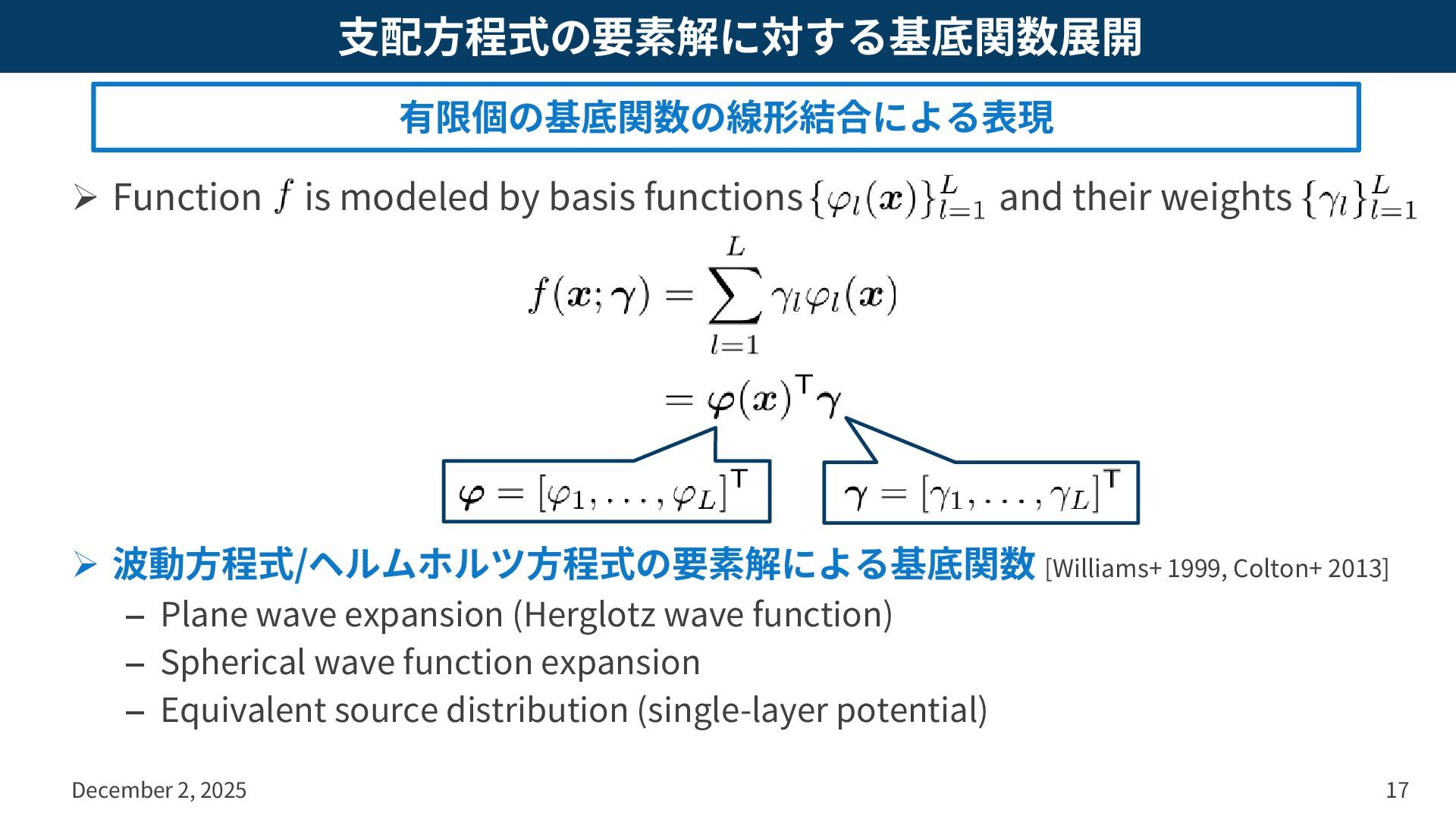
![ニューラルネットワーク以前の音場推定法 ➢ 物理的な制約を陽に用いた手法が提案されてきた歴史がある – 基底関数展開に基づく方法 [Williams+ 1999, Colton+ 2013] •](https://files.speakerdeck.com/presentations/90511426bf124f9891f012c1601ac1bd/slide_13.jpg)
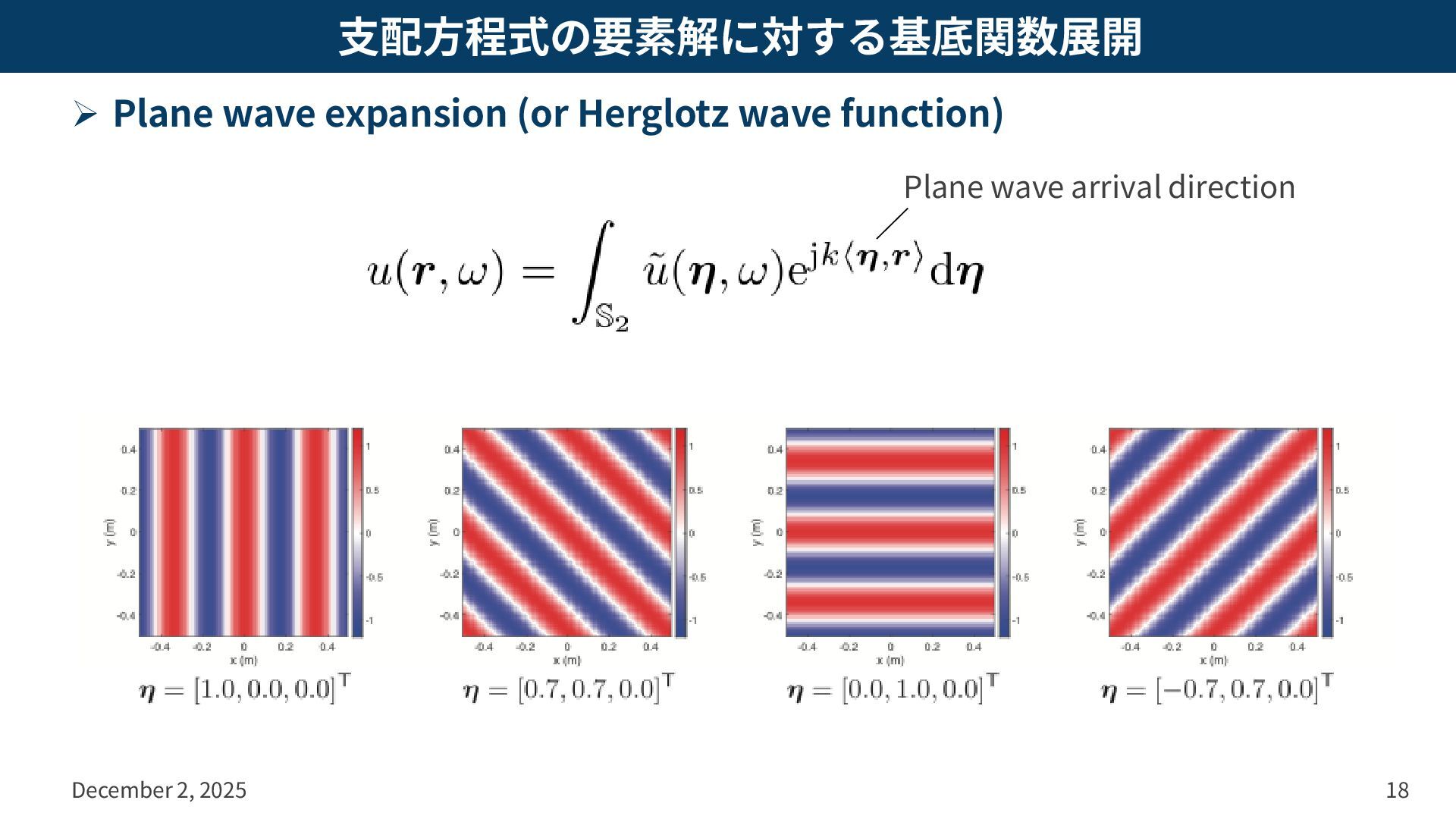
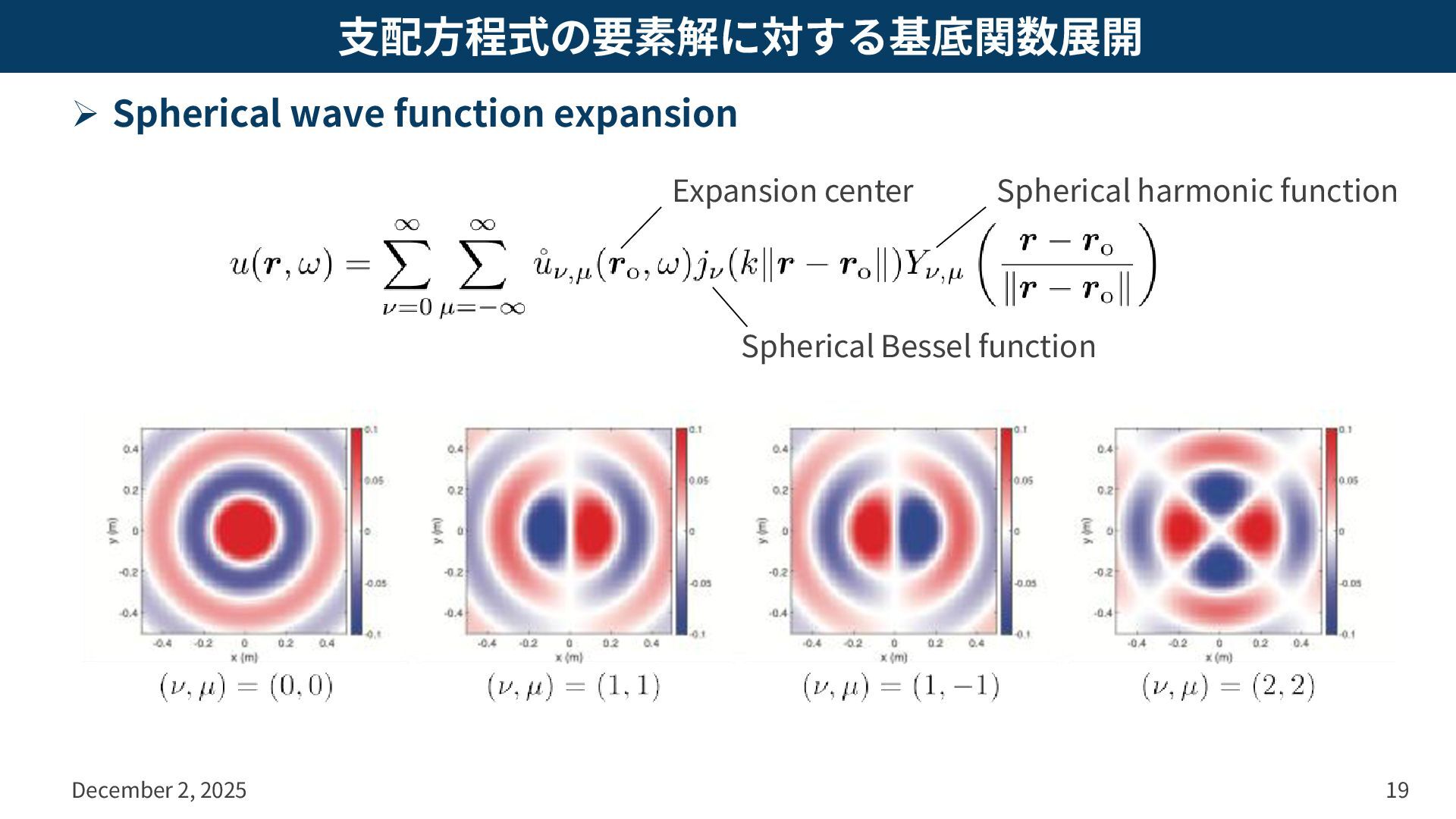
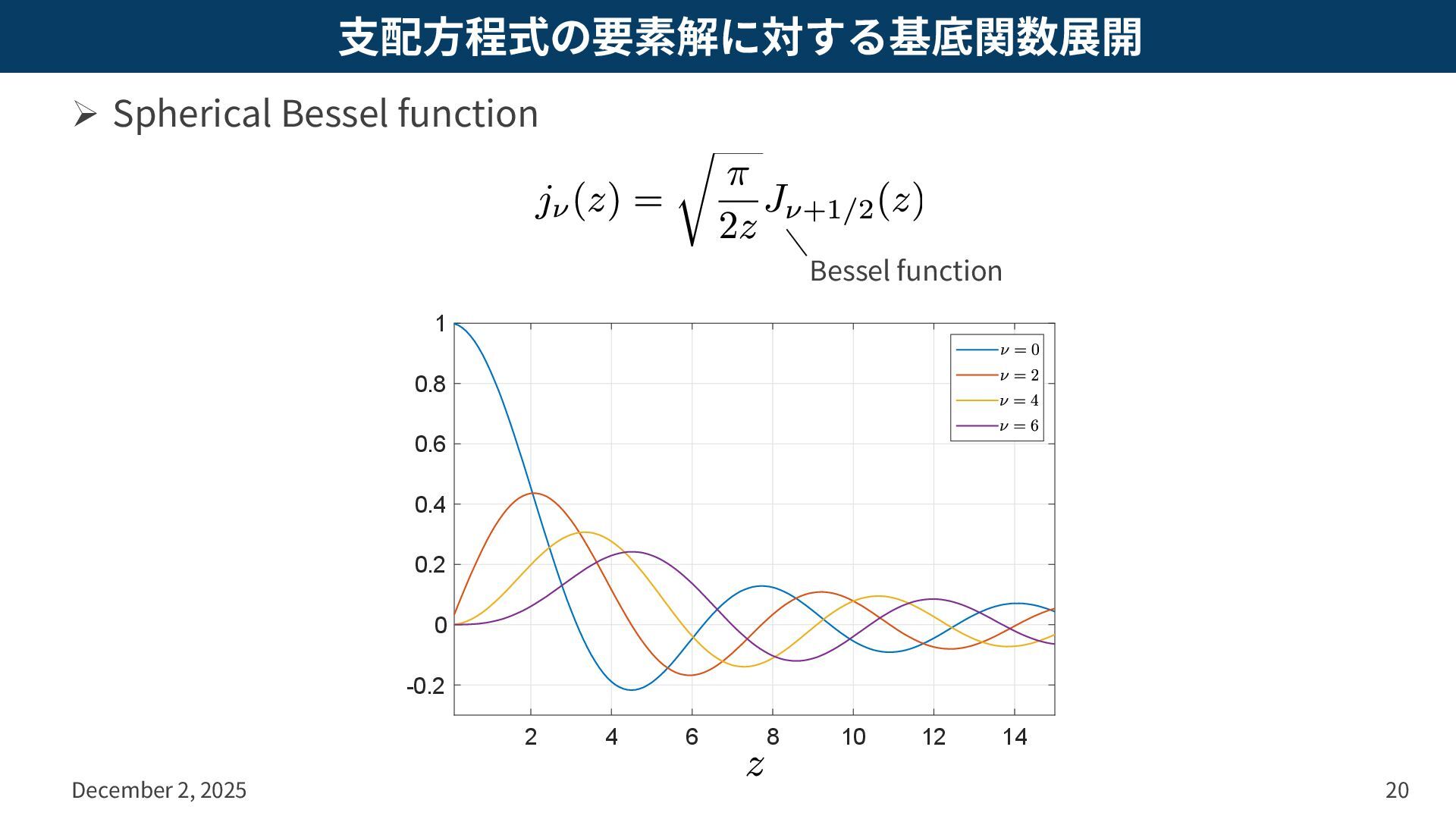
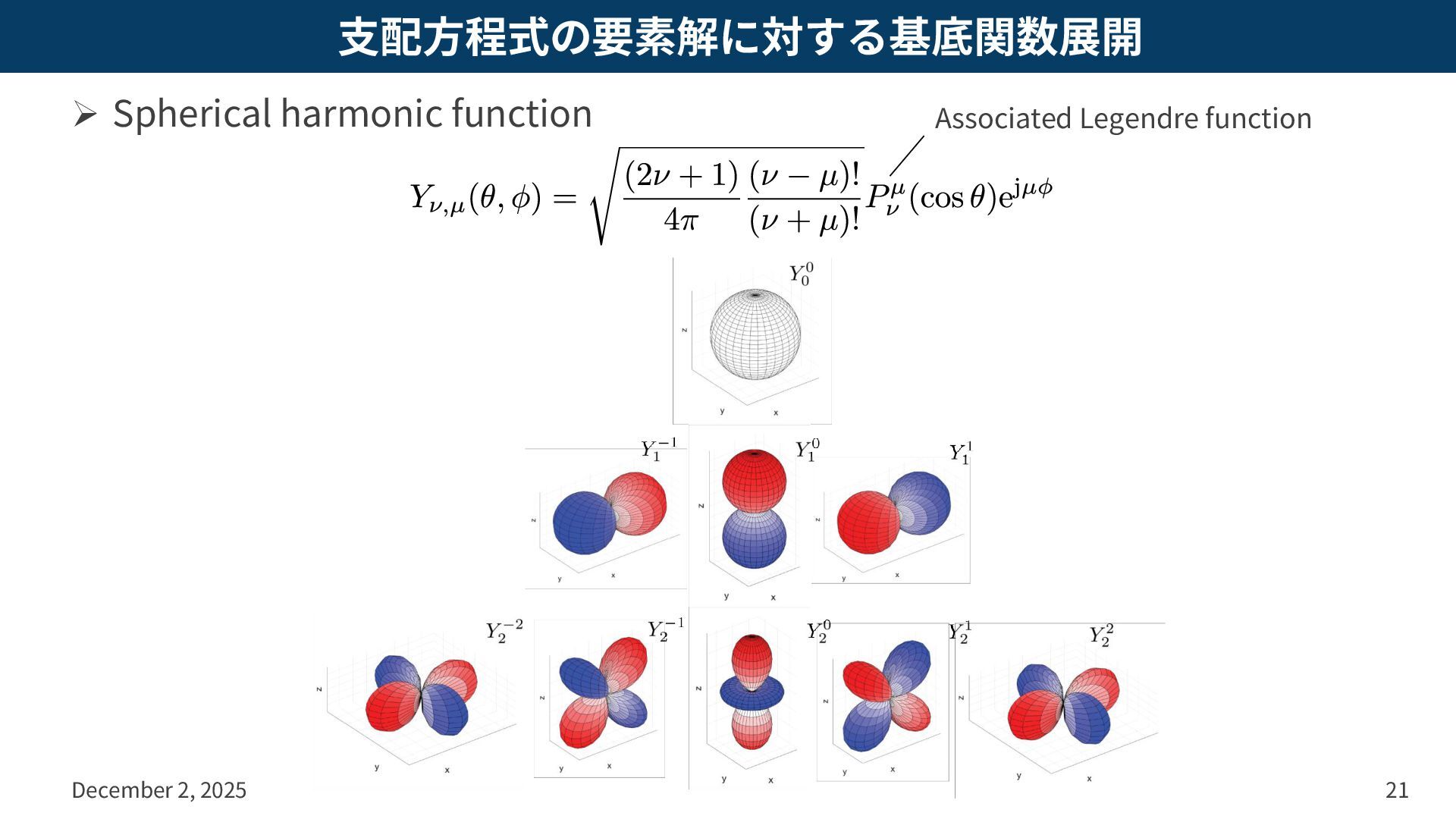
![陰的表現のためのNNを用いたPINN ➢ Implicit neural representation [Sitzmann+ 2020] – NNs are](https://files.speakerdeck.com/presentations/90511426bf124f9891f012c1601ac1bd/slide_29.jpg)
![陰的表現のためのNNを用いたPINN ➢ Physics-informed neural network (PINN) [Raissi+ 2019] – Implicit](https://files.speakerdeck.com/presentations/90511426bf124f9891f012c1601ac1bd/slide_30.jpg)
![陰的表現のためのNNを用いたPINN ➢ Physics-informed neural network (PINN) [Raissi+ 2019] – Case](https://files.speakerdeck.com/presentations/90511426bf124f9891f012c1601ac1bd/slide_31.jpg)
![陰的表現のためのNNを用いたPINN ➢ PINNを用いた時間領域RIRの再構成 [Pezzoli+ 2023] – RIRs measured by lnear](https://files.speakerdeck.com/presentations/90511426bf124f9891f012c1601ac1bd/slide_32.jpg)