Share
Embed
Faster than C#: efficient implementation of dynamic languages on .NET
ICOOOLPS 2009, Genova, Italy
Antonio Cuni
July 06, 2009
Transcript
31 slides
-
Faster than C#: efficient implementation of dynamic languages on .NET
Antonio Cuni Davide Ancona Armin Rigo ICOOOLPS@ECOOP 2009 - Genova, Italy July 6, 2009 A. Cuni, D. Ancona, A. Rigo (icooolps 09) Efficient dynamic languages on .NET July 6, 2009 1 / 22 -
Introduction Dynamic languages are nice e.g., Python so are .NET
and the JVM Problem: slow! Solution: make them faster :-) We concentrate our efforts on .NET A. Cuni, D. Ancona, A. Rigo (icooolps 09) Efficient dynamic languages on .NET July 6, 2009 2 / 22 -
State of the art IronPython Jython JRuby, Groovy, ... Self
Javascript: TraceMonkey, V8 ... A. Cuni, D. Ancona, A. Rigo (icooolps 09) Efficient dynamic languages on .NET July 6, 2009 3 / 22 -
State of the art IronPython Jython JRuby, Groovy, ... Self
Javascript: TraceMonkey, V8 ... A. Cuni, D. Ancona, A. Rigo (icooolps 09) Efficient dynamic languages on .NET July 6, 2009 3 / 22 -
Why so slow? Hard to compile efficiently Lack of type
information at compile-time VMs not optimized to run them .NET is a multi-language VM? Sure, as long as the language is C# JVM is in a better shape, but still heavily optimized for Java A. Cuni, D. Ancona, A. Rigo (icooolps 09) Efficient dynamic languages on .NET July 6, 2009 4 / 22 -
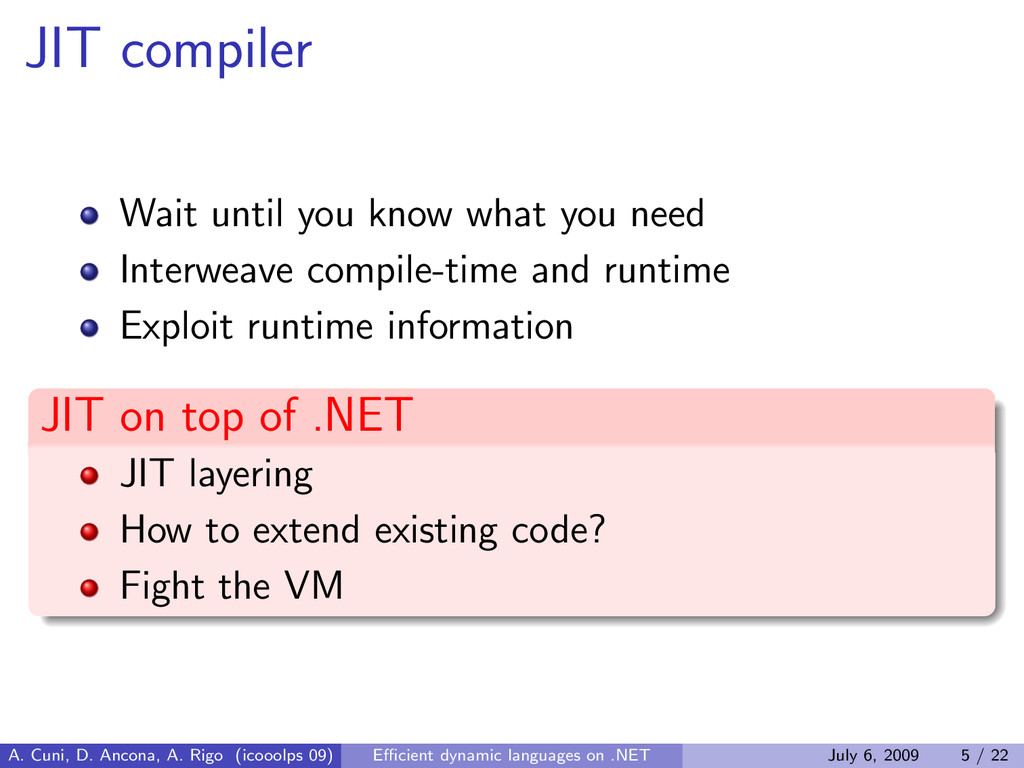
JIT compiler Wait until you know what you need Interweave
compile-time and runtime Exploit runtime information JIT on top of .NET JIT layering How to extend existing code? Fight the VM A. Cuni, D. Ancona, A. Rigo (icooolps 09) Efficient dynamic languages on .NET July 6, 2009 5 / 22 -
JIT compiler Wait until you know what you need Interweave
compile-time and runtime Exploit runtime information JIT on top of .NET JIT layering How to extend existing code? Fight the VM A. Cuni, D. Ancona, A. Rigo (icooolps 09) Efficient dynamic languages on .NET July 6, 2009 5 / 22 -
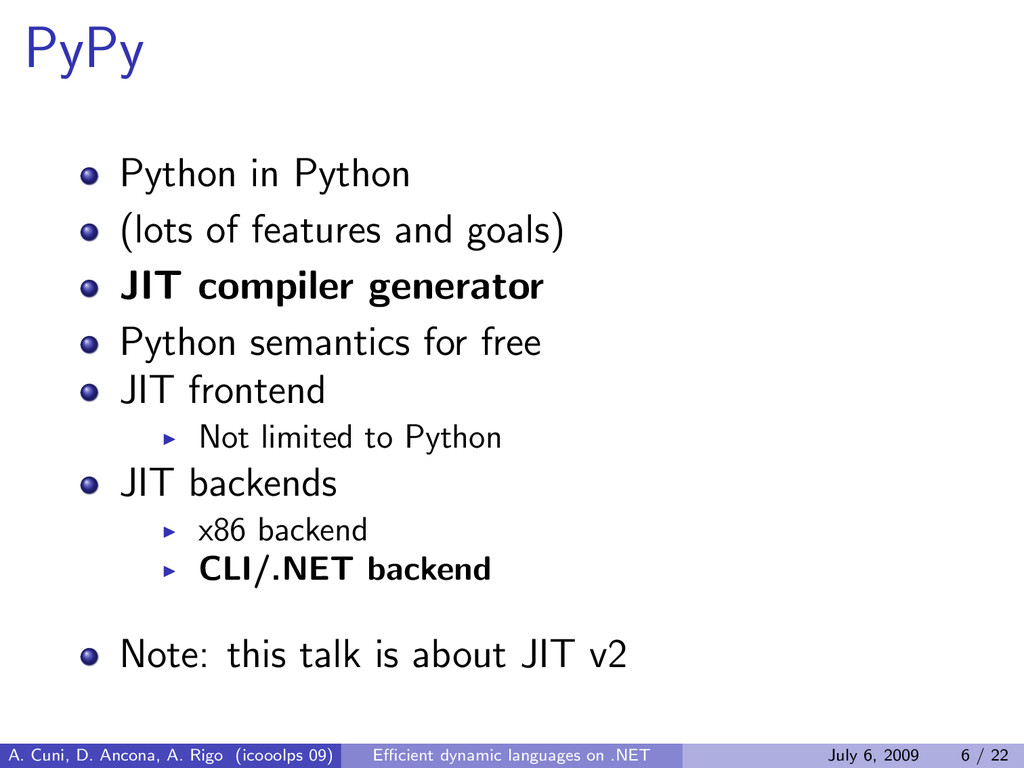
PyPy Python in Python (lots of features and goals) JIT
compiler generator Python semantics for free JIT frontend Not limited to Python JIT backends x86 backend CLI/.NET backend Note: this talk is about JIT v2 A. Cuni, D. Ancona, A. Rigo (icooolps 09) Efficient dynamic languages on .NET July 6, 2009 6 / 22 -
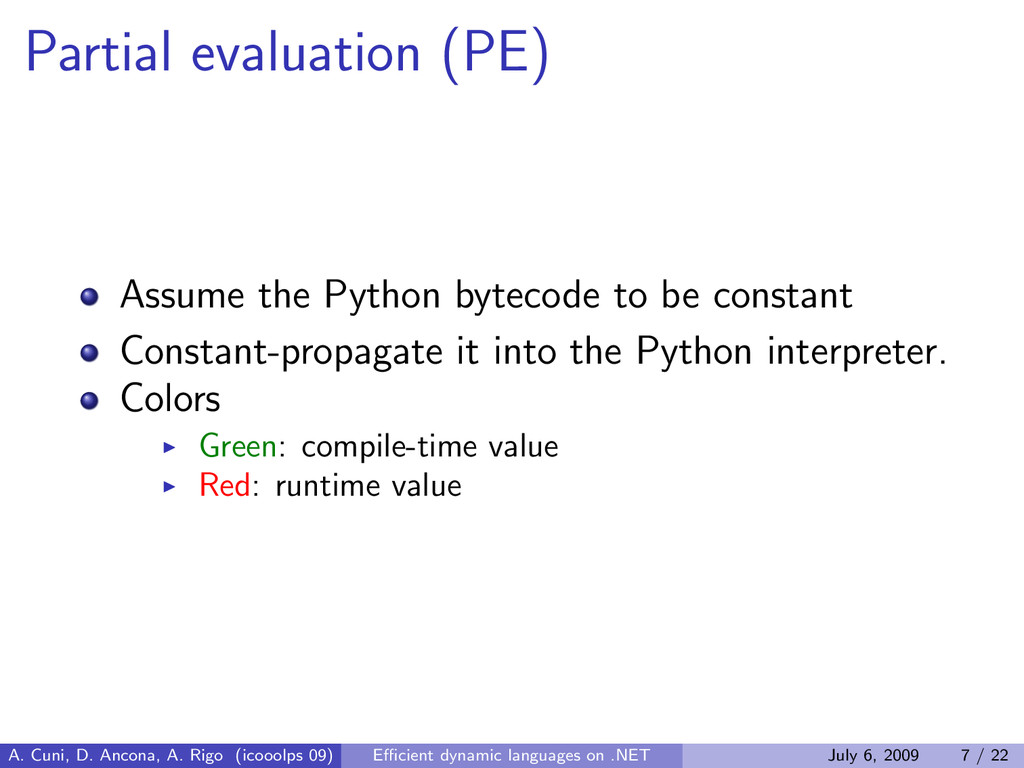
Partial evaluation (PE) Assume the Python bytecode to be constant
Constant-propagate it into the Python interpreter. Colors Green: compile-time value Red: runtime value A. Cuni, D. Ancona, A. Rigo (icooolps 09) Efficient dynamic languages on .NET July 6, 2009 7 / 22 -
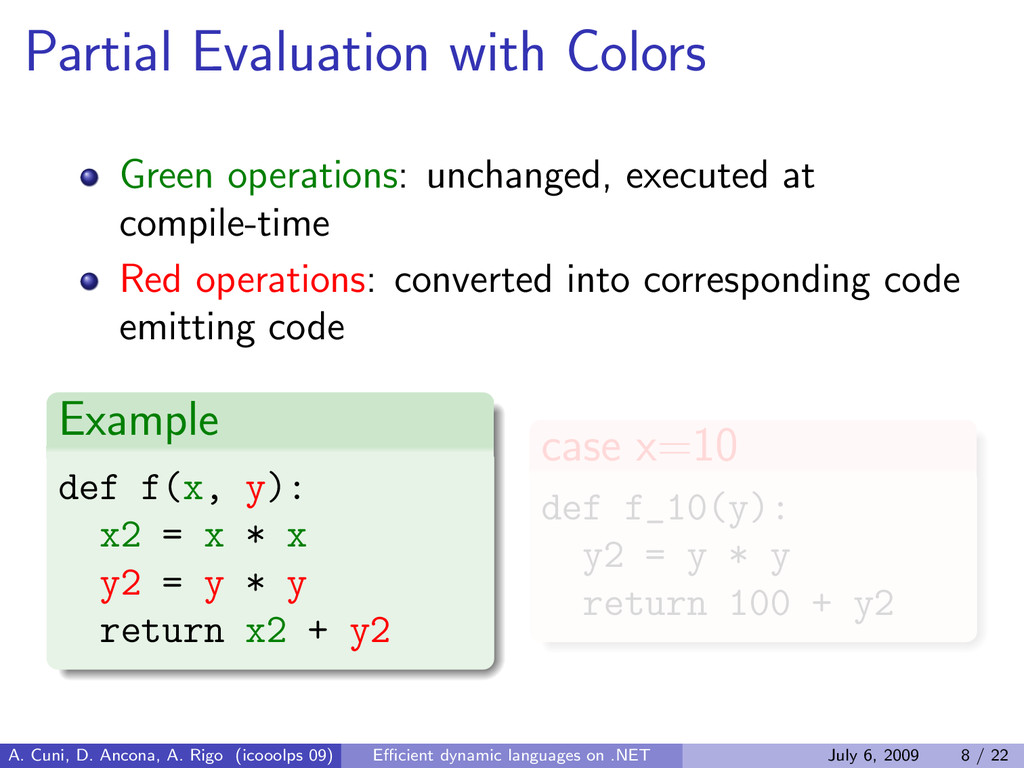
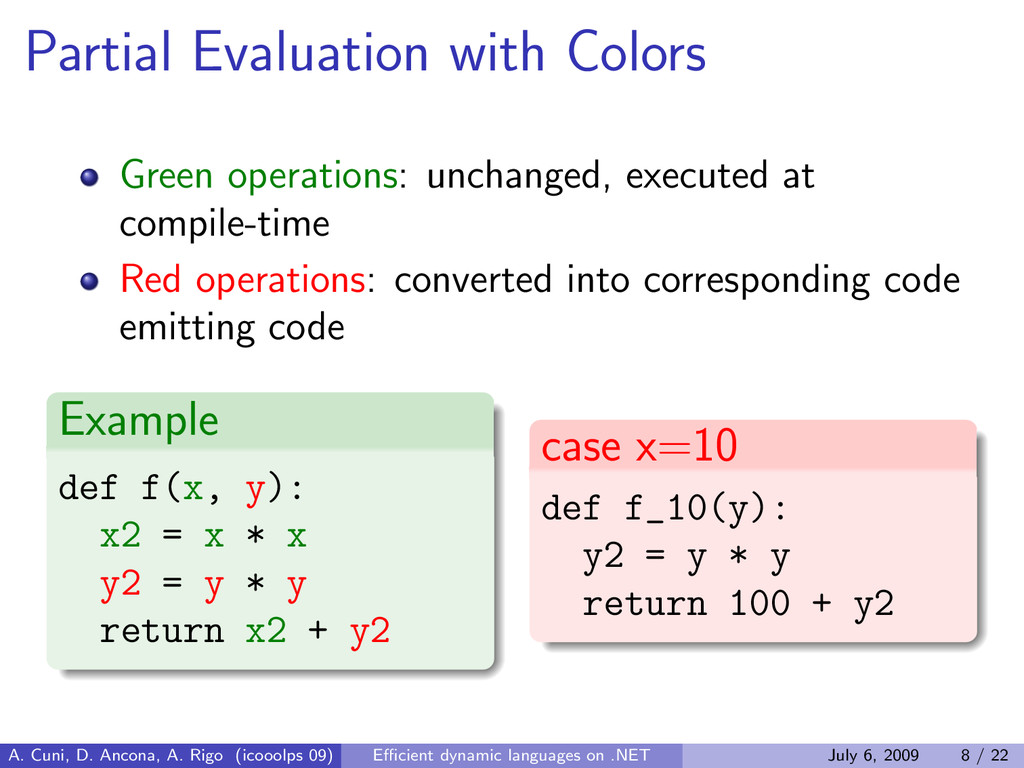
Partial Evaluation with Colors Green operations: unchanged, executed at compile-time
Red operations: converted into corresponding code emitting code Example def f(x, y): x2 = x * x y2 = y * y return x2 + y2 case x=10 def f_10(y): y2 = y * y return 100 + y2 A. Cuni, D. Ancona, A. Rigo (icooolps 09) Efficient dynamic languages on .NET July 6, 2009 8 / 22 -
Challenges A shortcoming of PE is that in many cases
not much can be really assumed constant at compile-time: poor results Effective dynamic compilation requires feedback of runtime information into compile-time For a dynamic language: types are a primary example A. Cuni, D. Ancona, A. Rigo (icooolps 09) Efficient dynamic languages on .NET July 6, 2009 9 / 22 -
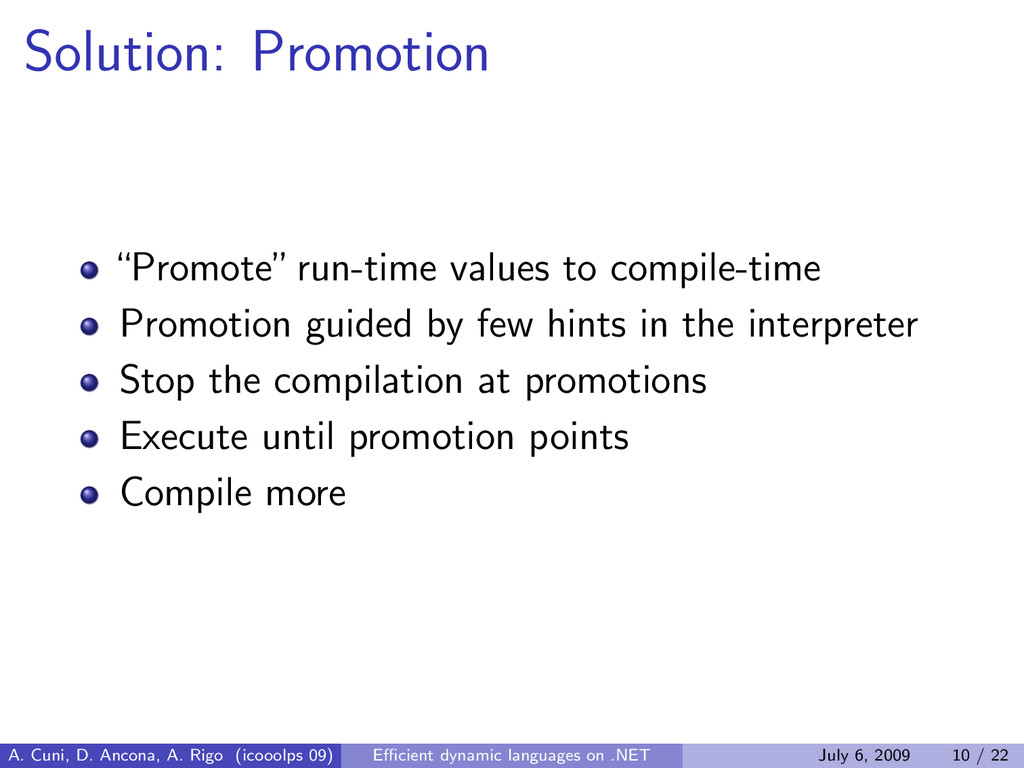
Solution: Promotion “Promote”run-time values to compile-time Promotion guided by few
hints in the interpreter Stop the compilation at promotions Execute until promotion points Compile more A. Cuni, D. Ancona, A. Rigo (icooolps 09) Efficient dynamic languages on .NET July 6, 2009 10 / 22 -
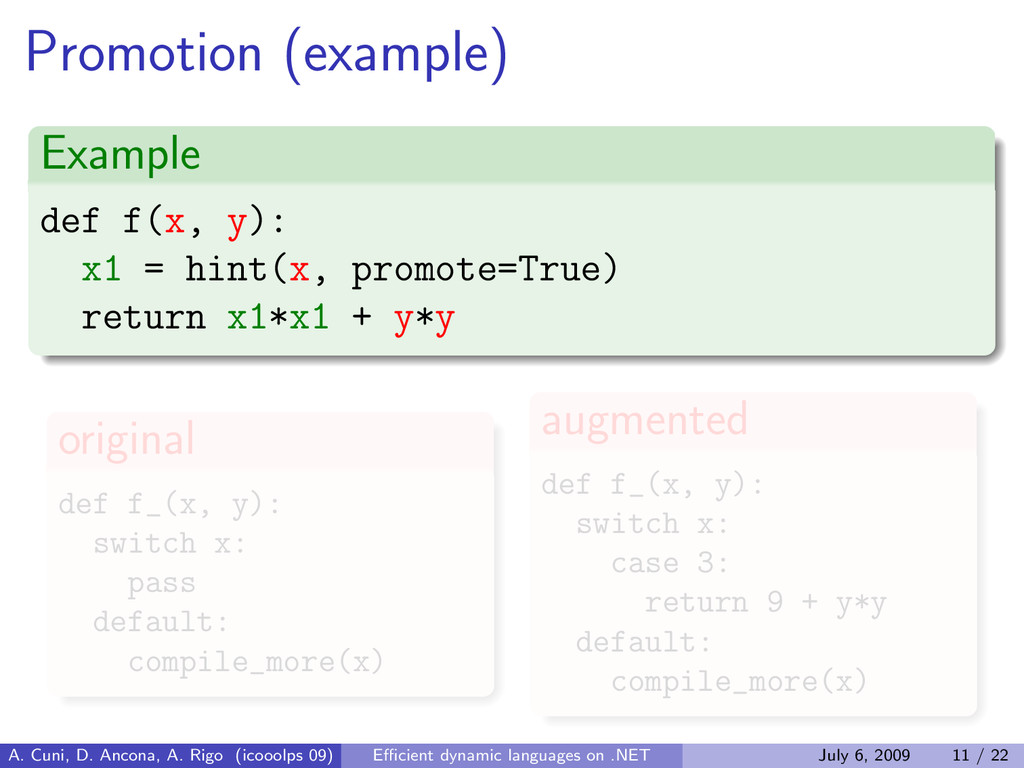
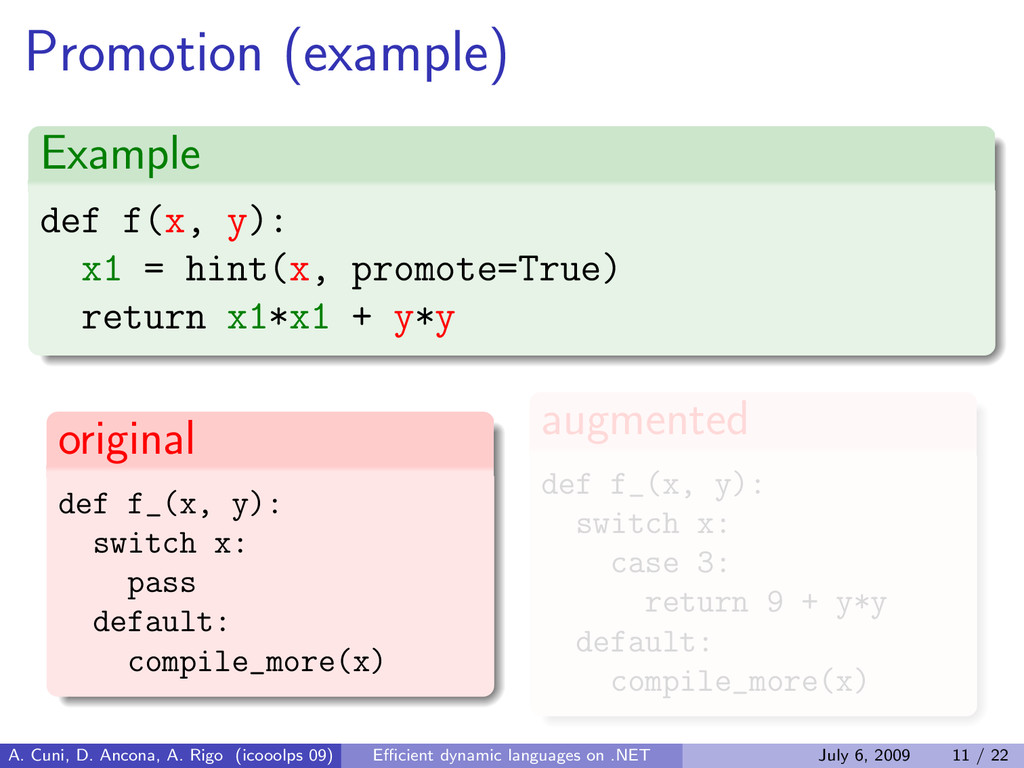
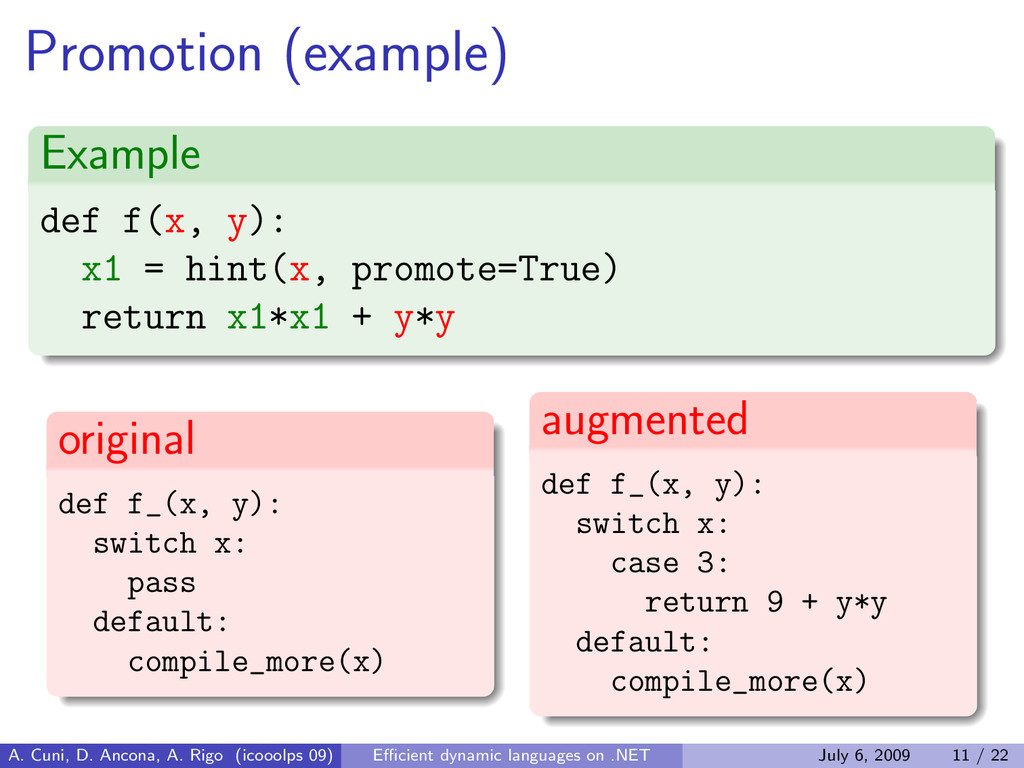
Promotion (example) Example def f(x, y): x1 = hint(x, promote=True)
return x1*x1 + y*y original def f_(x, y): switch x: pass default: compile_more(x) augmented def f_(x, y): switch x: case 3: return 9 + y*y default: compile_more(x) A. Cuni, D. Ancona, A. Rigo (icooolps 09) Efficient dynamic languages on .NET July 6, 2009 11 / 22 -
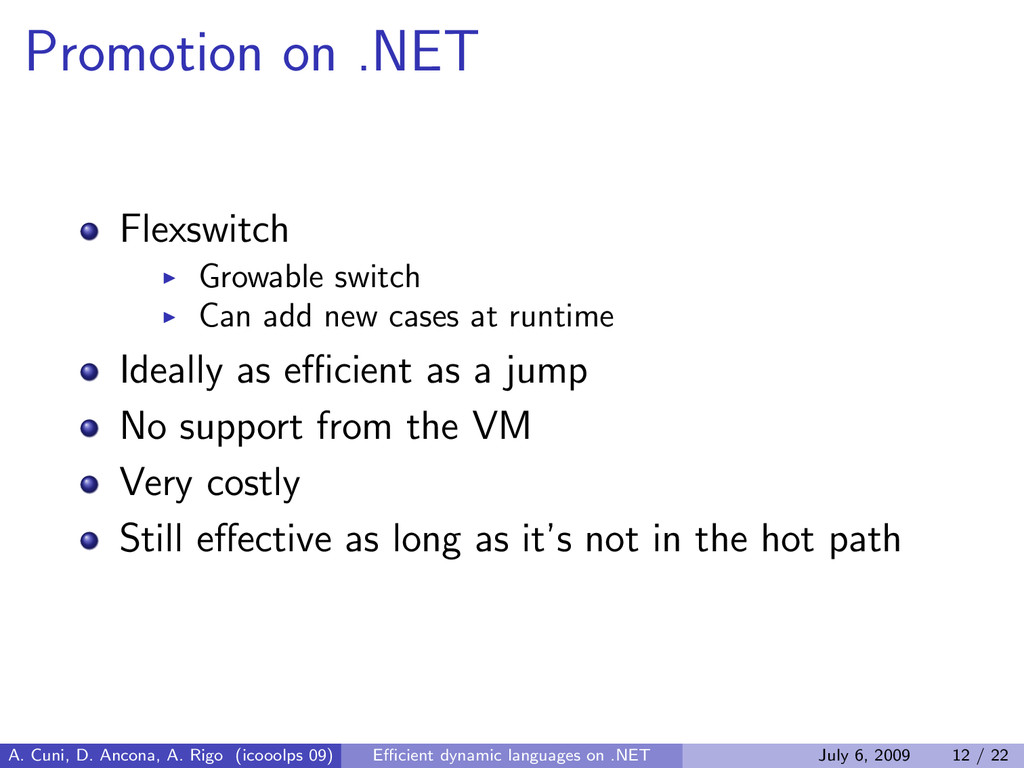
Promotion on .NET Flexswitch Growable switch Can add new cases
at runtime Ideally as efficient as a jump No support from the VM Very costly Still effective as long as it’s not in the hot path A. Cuni, D. Ancona, A. Rigo (icooolps 09) Efficient dynamic languages on .NET July 6, 2009 12 / 22 -
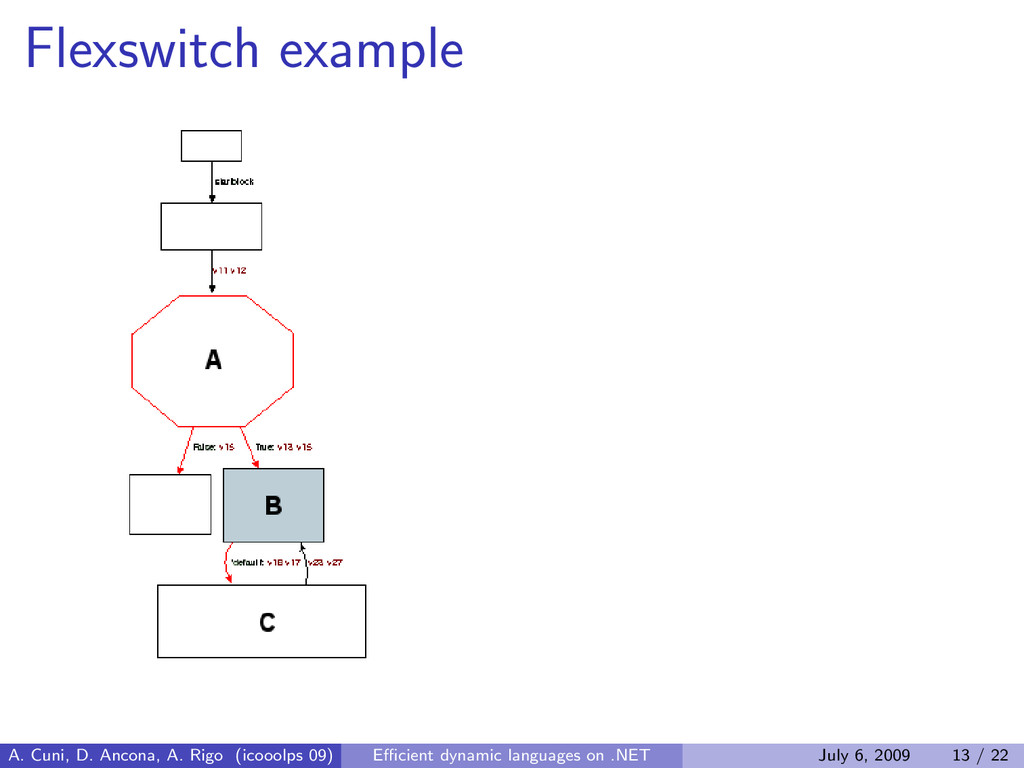
Flexswitch example A. Cuni, D. Ancona, A. Rigo (icooolps 09)
Efficient dynamic languages on .NET July 6, 2009 13 / 22 -
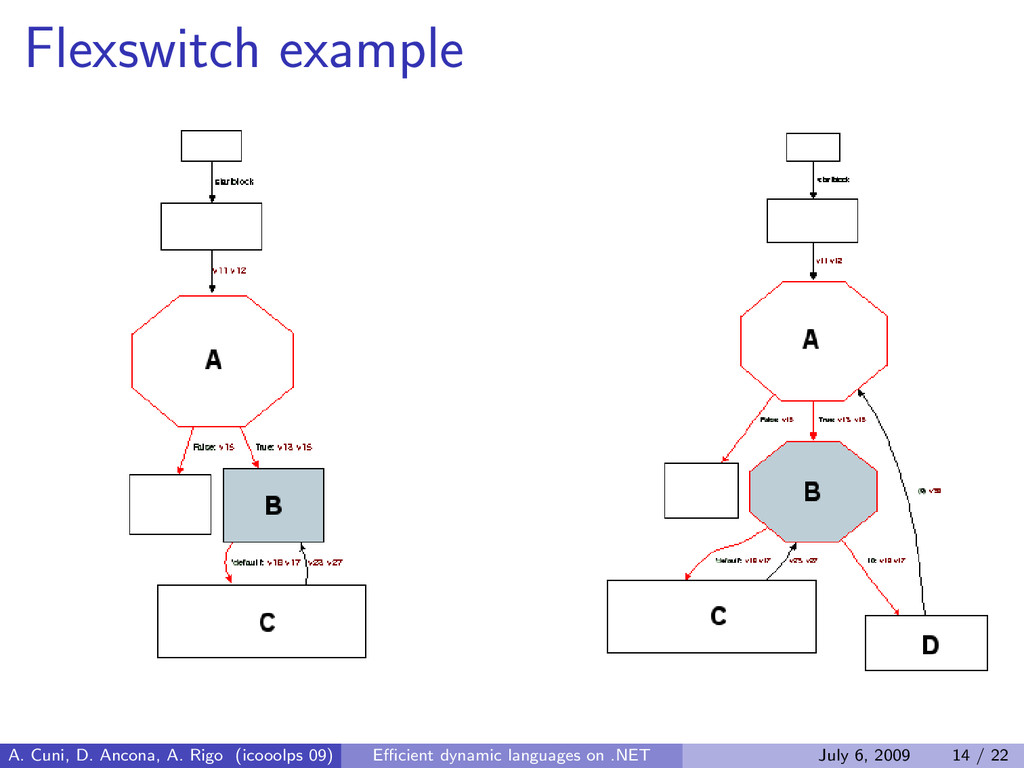
Flexswitch example A. Cuni, D. Ancona, A. Rigo (icooolps 09)
Efficient dynamic languages on .NET July 6, 2009 14 / 22 -
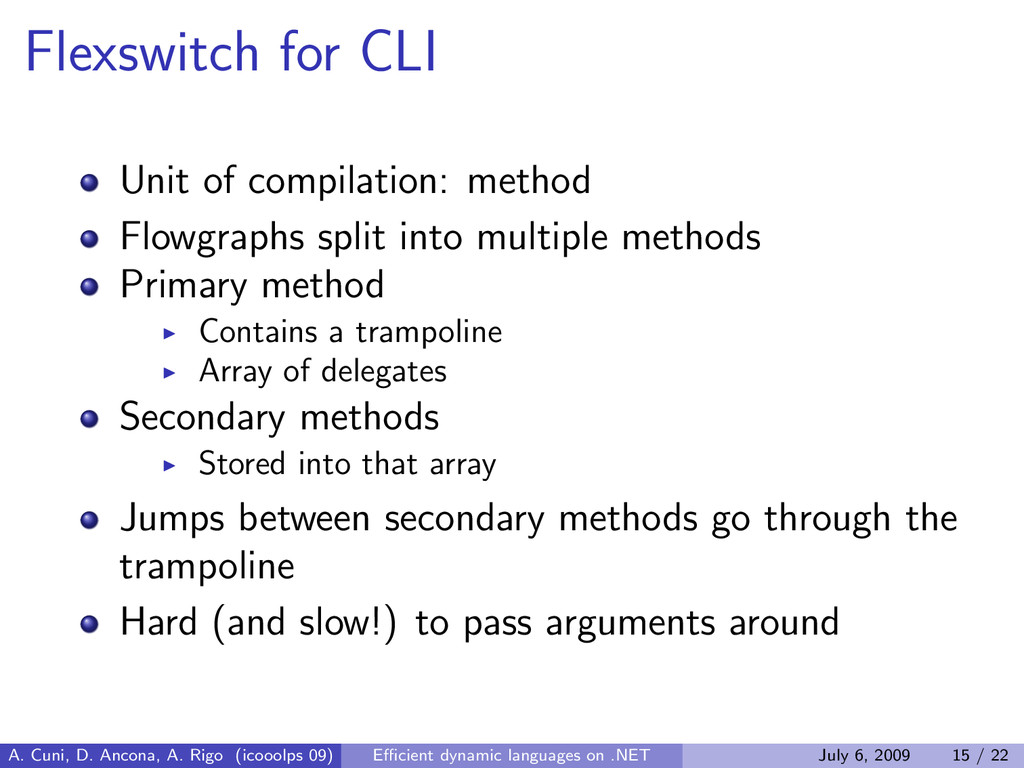
Flexswitch for CLI Unit of compilation: method Flowgraphs split into
multiple methods Primary method Contains a trampoline Array of delegates Secondary methods Stored into that array Jumps between secondary methods go through the trampoline Hard (and slow!) to pass arguments around A. Cuni, D. Ancona, A. Rigo (icooolps 09) Efficient dynamic languages on .NET July 6, 2009 15 / 22 -
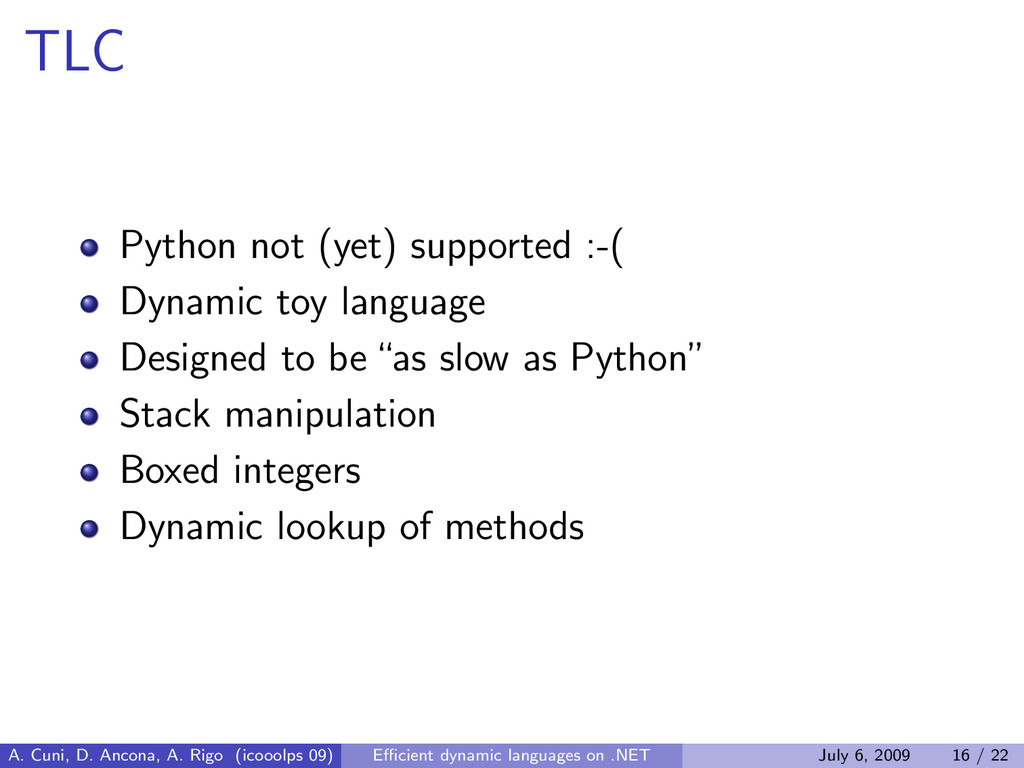
TLC Python not (yet) supported :-( Dynamic toy language Designed
to be“as slow as Python” Stack manipulation Boxed integers Dynamic lookup of methods A. Cuni, D. Ancona, A. Rigo (icooolps 09) Efficient dynamic languages on .NET July 6, 2009 16 / 22 -
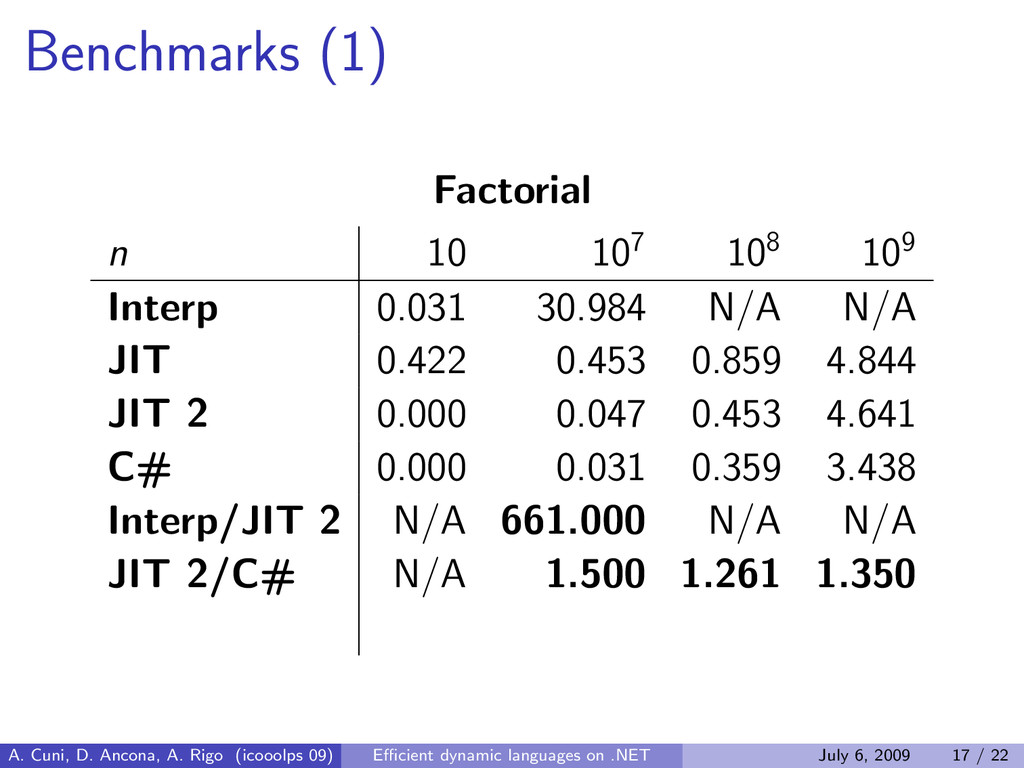
Benchmarks (1) Factorial n 10 107 108 109 Interp 0.031
30.984 N/A N/A JIT 0.422 0.453 0.859 4.844 JIT 2 0.000 0.047 0.453 4.641 C# 0.000 0.031 0.359 3.438 Interp/JIT 2 N/A 661.000 N/A N/A JIT 2/C# N/A 1.500 1.261 1.350 A. Cuni, D. Ancona, A. Rigo (icooolps 09) Efficient dynamic languages on .NET July 6, 2009 17 / 22 -
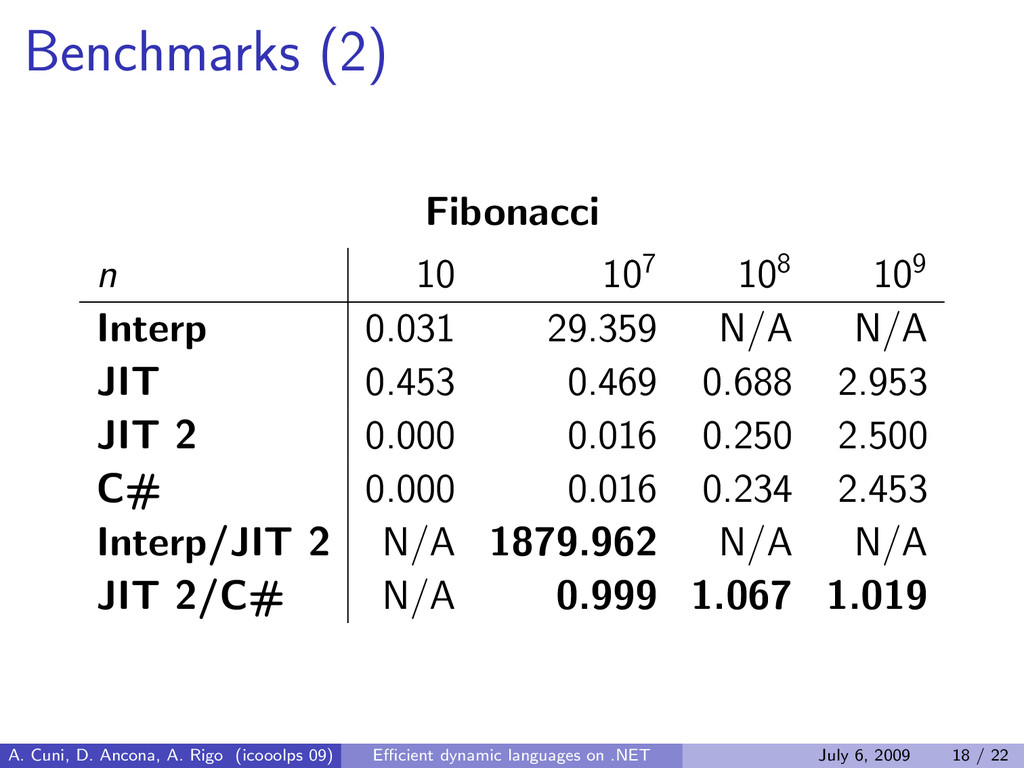
Benchmarks (2) Fibonacci n 10 107 108 109 Interp 0.031
29.359 N/A N/A JIT 0.453 0.469 0.688 2.953 JIT 2 0.000 0.016 0.250 2.500 C# 0.000 0.016 0.234 2.453 Interp/JIT 2 N/A 1879.962 N/A N/A JIT 2/C# N/A 0.999 1.067 1.019 A. Cuni, D. Ancona, A. Rigo (icooolps 09) Efficient dynamic languages on .NET July 6, 2009 18 / 22 -
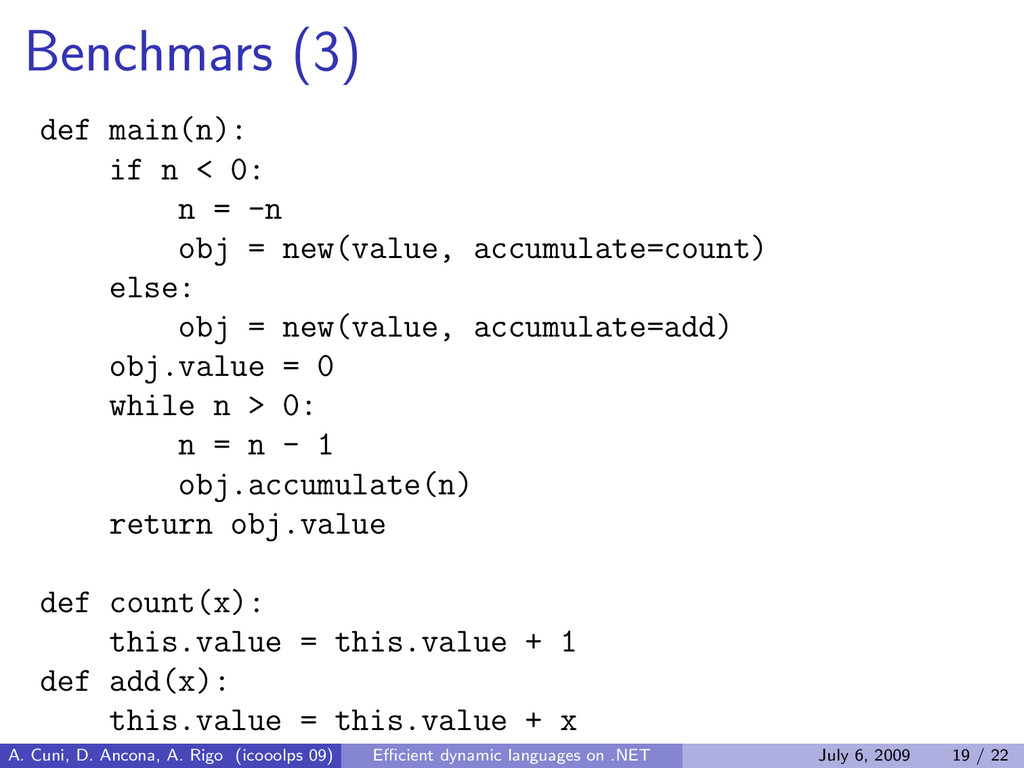
Benchmars (3) def main(n): if n < 0: n =
-n obj = new(value, accumulate=count) else: obj = new(value, accumulate=add) obj.value = 0 while n > 0: n = n - 1 obj.accumulate(n) return obj.value def count(x): this.value = this.value + 1 def add(x): this.value = this.value + x A. Cuni, D. Ancona, A. Rigo (icooolps 09) Efficient dynamic languages on .NET July 6, 2009 19 / 22 -
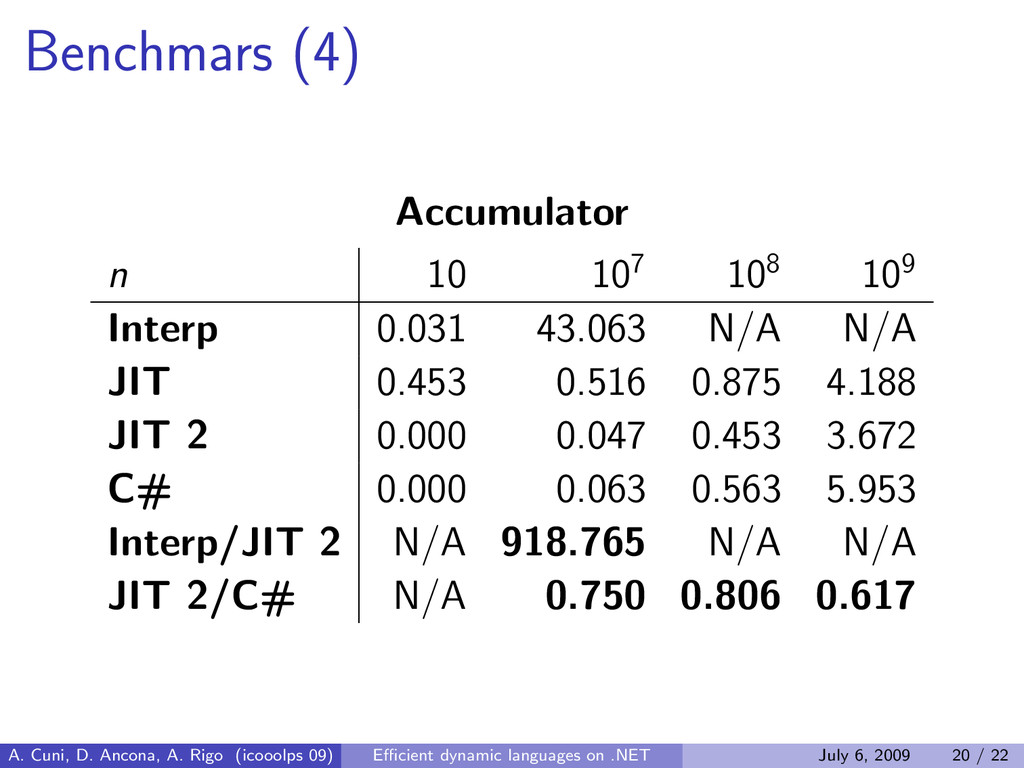
Benchmars (4) Accumulator n 10 107 108 109 Interp 0.031
43.063 N/A N/A JIT 0.453 0.516 0.875 4.188 JIT 2 0.000 0.047 0.453 3.672 C# 0.000 0.063 0.563 5.953 Interp/JIT 2 N/A 918.765 N/A N/A JIT 2/C# N/A 0.750 0.806 0.617 A. Cuni, D. Ancona, A. Rigo (icooolps 09) Efficient dynamic languages on .NET July 6, 2009 20 / 22 -
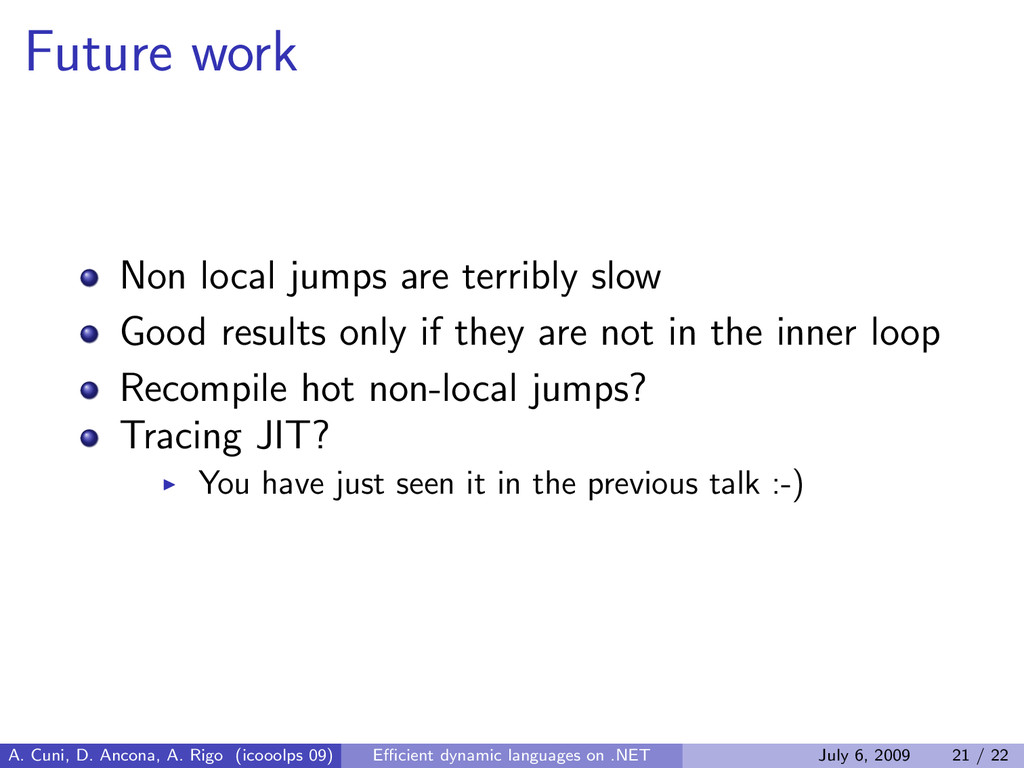
Future work Non local jumps are terribly slow Good results
only if they are not in the inner loop Recompile hot non-local jumps? Tracing JIT? You have just seen it in the previous talk :-) A. Cuni, D. Ancona, A. Rigo (icooolps 09) Efficient dynamic languages on .NET July 6, 2009 21 / 22 -
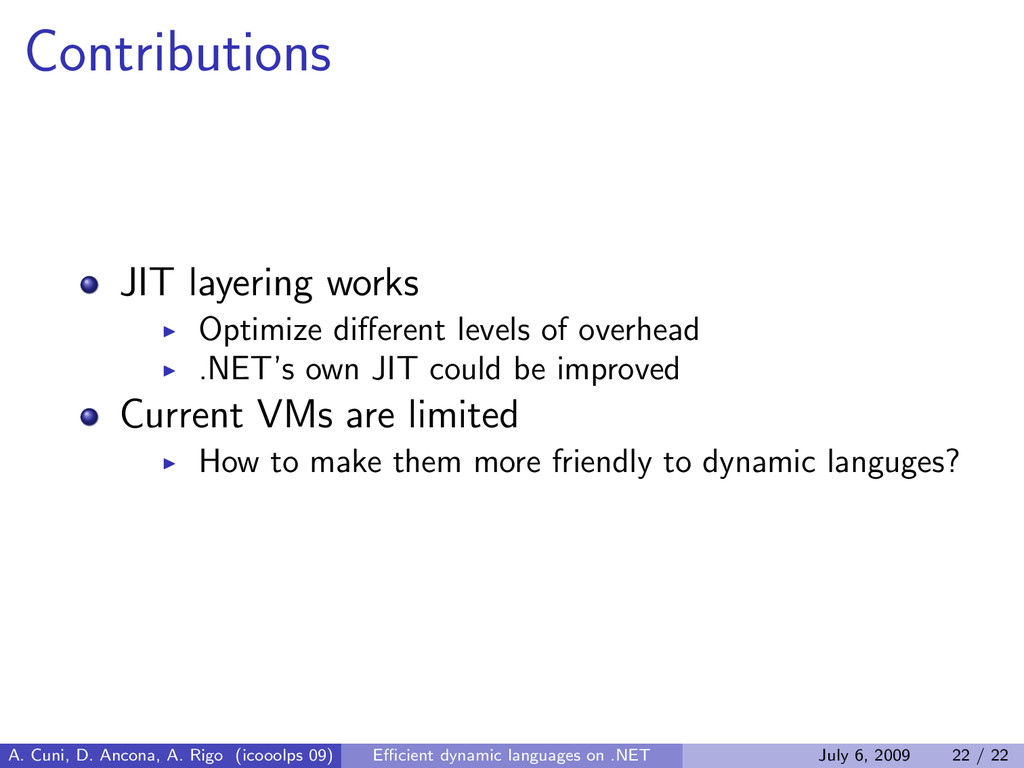
Contributions JIT layering works Optimize different levels of overhead .NET’s
own JIT could be improved Current VMs are limited How to make them more friendly to dynamic languges? A. Cuni, D. Ancona, A. Rigo (icooolps 09) Efficient dynamic languages on .NET July 6, 2009 22 / 22