Share
Embed
ShepherdingProgressReport (Public)
argyi
August 06, 2021
Transcript
23 slides
-
Progress Report Distributed Fault-Tolerant Shepherding with Multiple Shepherds Aiyi LI
Wakamiya Lab [email protected] 1 July 9th, 2021 -
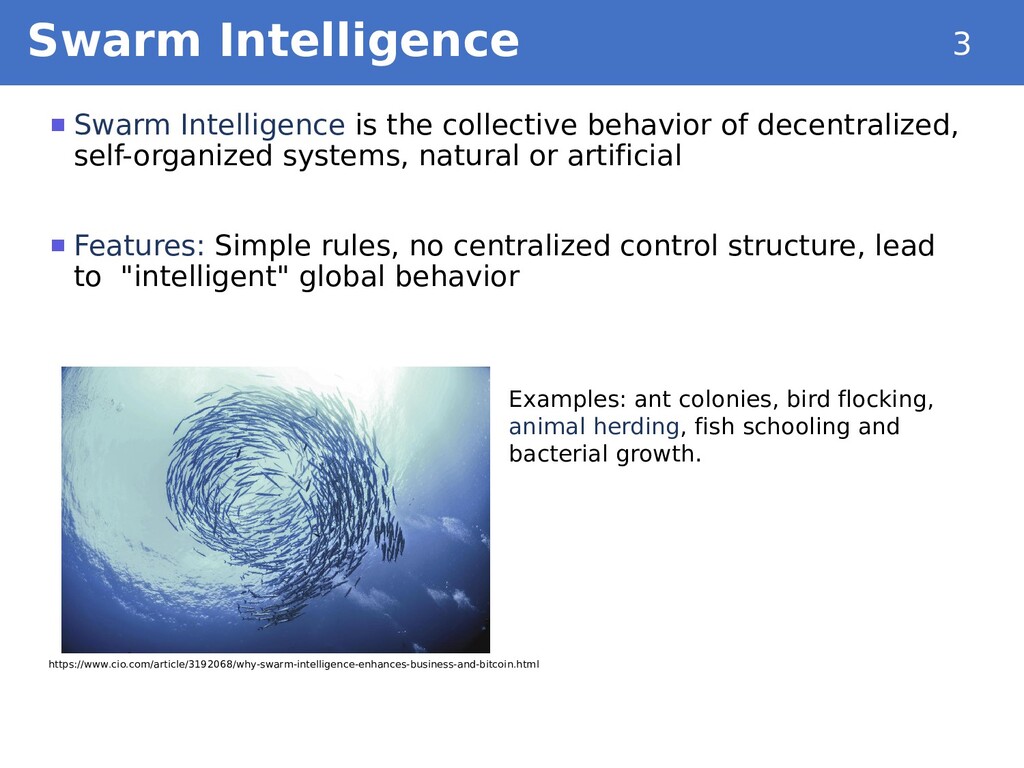
Swarm Intelligence is the collective behavior of decentralized, self-organized systems,
natural or artificial Features: Simple rules, no centralized control structure, lead to "intelligent" global behavior Swarm Intelligence 3 https://www.cio.com/article/3192068/why-swarm-intelligence-enhances-business-and-bitcoin.html Examples: ant colonies, bird flocking, animal herding, fish schooling and bacterial growth. -
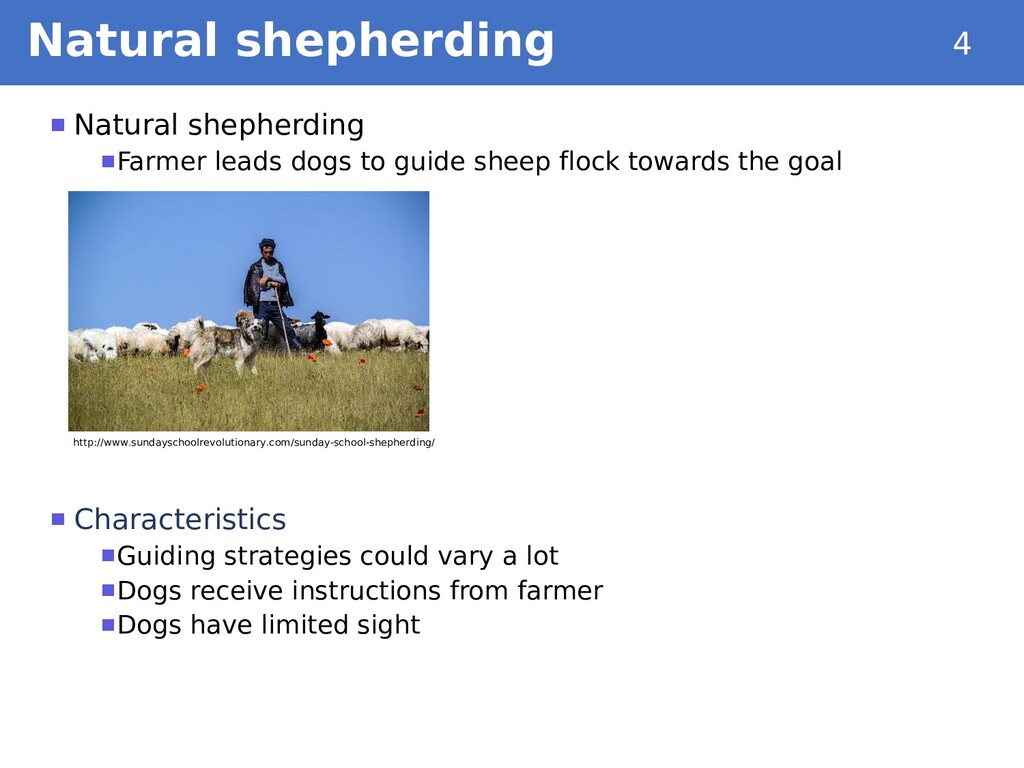
Natural shepherding Farmer leads dogs to guide sheep flock towards
the goal Characteristics Guiding strategies could vary a lot Dogs receive instructions from farmer Dogs have limited sight Natural shepherding 4 http://www.sundayschoolrevolutionary.com/sunday-school-shepherding/ -
Problem: Shepherds interact with a manageable number of entities, which
in turn exercise control over a sheep flock Concept: The shepherding concept provides a biologically inspired framework for multi-agent guidance and human- swarm teaming Shepherding problem 5 References: Abbass, Hussein & Hunjet, Robert. (2021). Shepherding UxVs for Human-Swarm Teaming An Artificial Intelligence Approach to Unmanned X Vehicles: An Artificial Intelligence Approach to Unmanned X Vehicles. 10.1007/978-3-030-60898-9. -
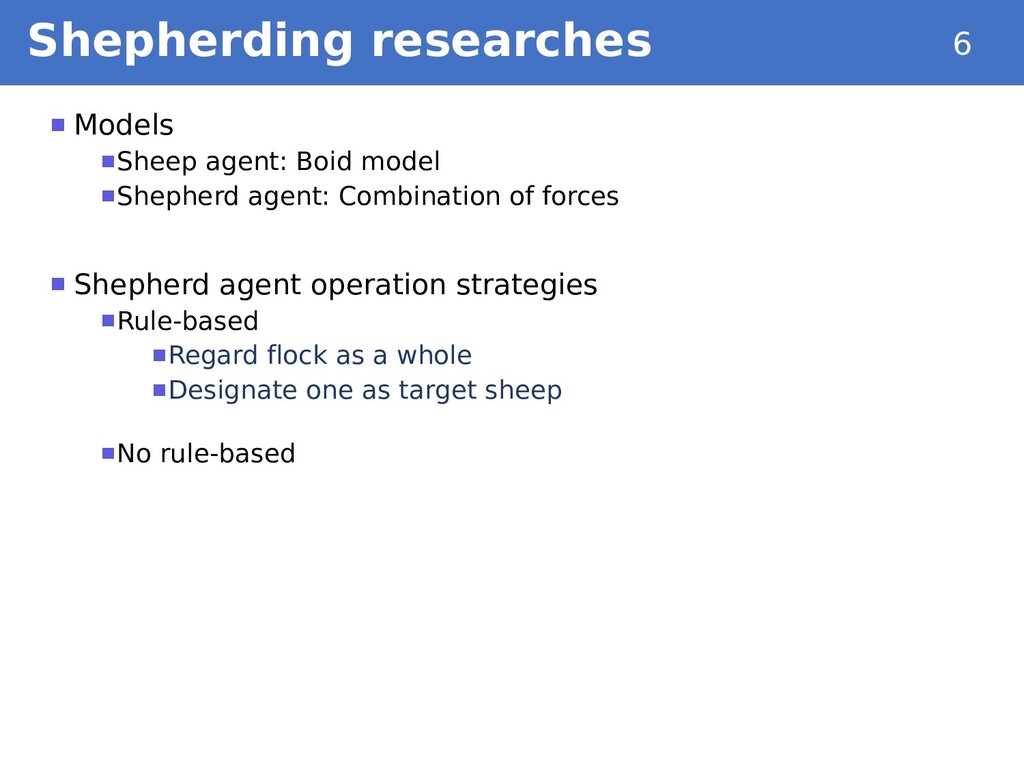
Models Sheep agent: Boid model Shepherd agent: Combination of forces
Shepherd agent operation strategies Rule-based Regard flock as a whole Designate one as target sheep No rule-based Shepherding researches 6 -
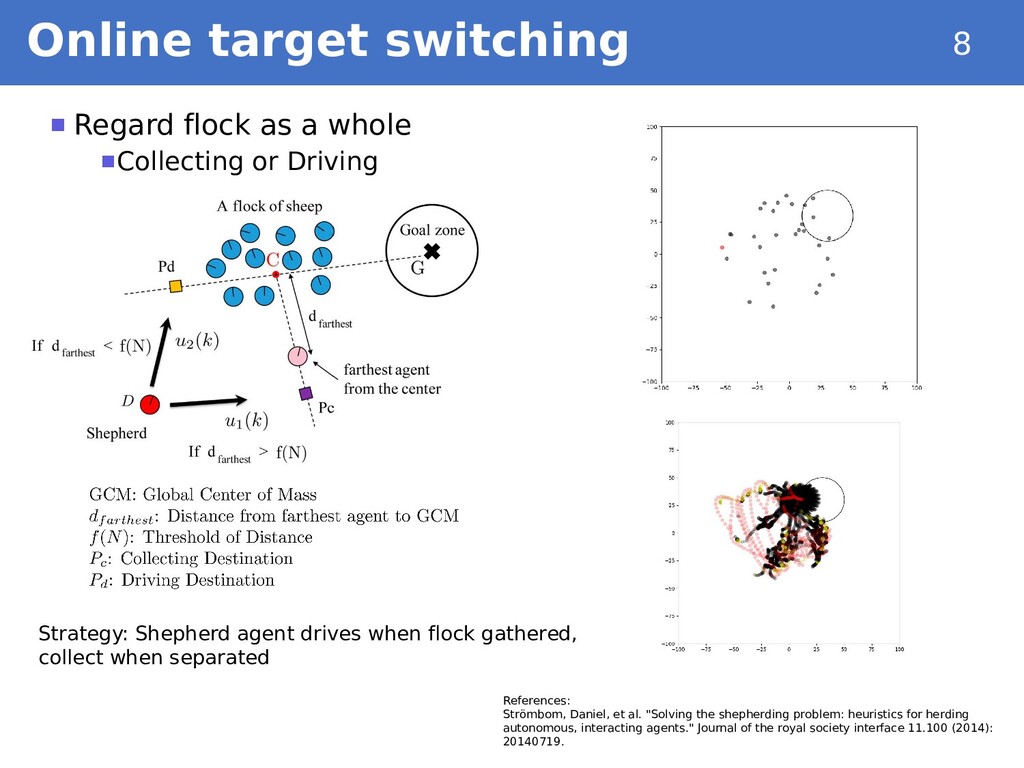
Regard flock as a whole Collecting or Driving Online target
switching 8 References: Strömbom, Daniel, et al. "Solving the shepherding problem: heuristics for herding autonomous, interacting agents." Journal of the royal society interface 11.100 (2014): 20140719. Strategy: Shepherd agent drives when flock gathered, collect when separated -
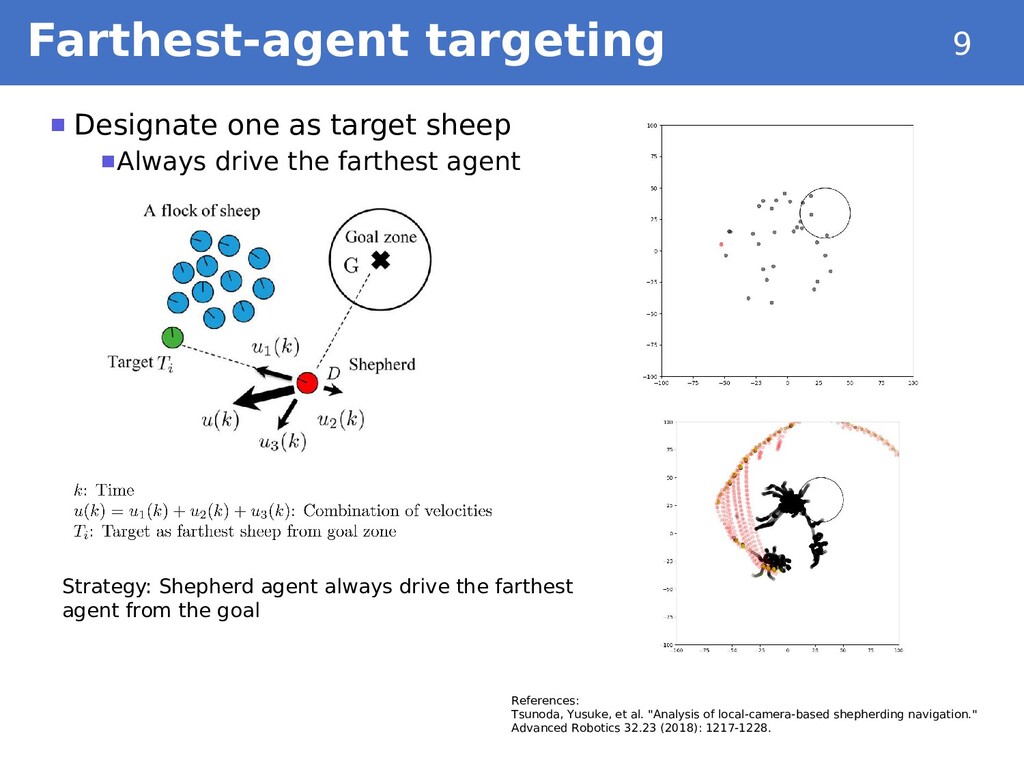
Designate one as target sheep Always drive the farthest agent
Farthest-agent targeting 9 References: Tsunoda, Yusuke, et al. "Analysis of local-camera-based shepherding navigation." Advanced Robotics 32.23 (2018): 1217-1228. Strategy: Shepherd agent always drive the farthest agent from the goal -
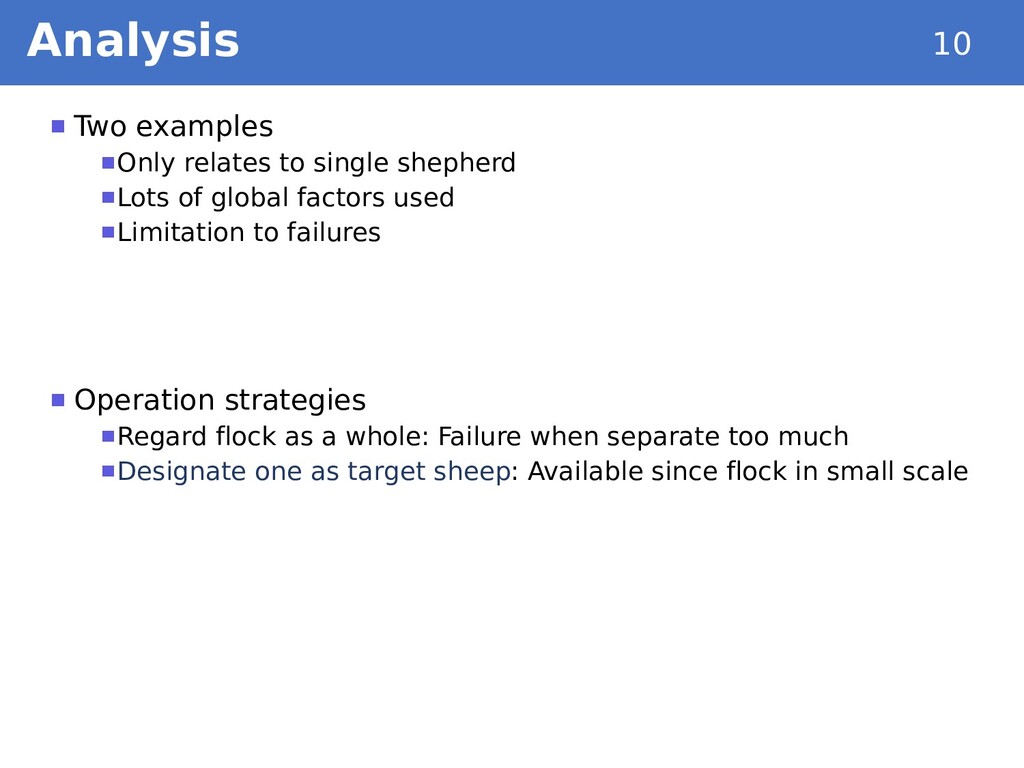
Two examples Only relates to single shepherd Lots of global
factors used Limitation to failures Operation strategies Regard flock as a whole: Failure when separate too much Designate one as target sheep: Available since flock in small scale Analysis 10 -
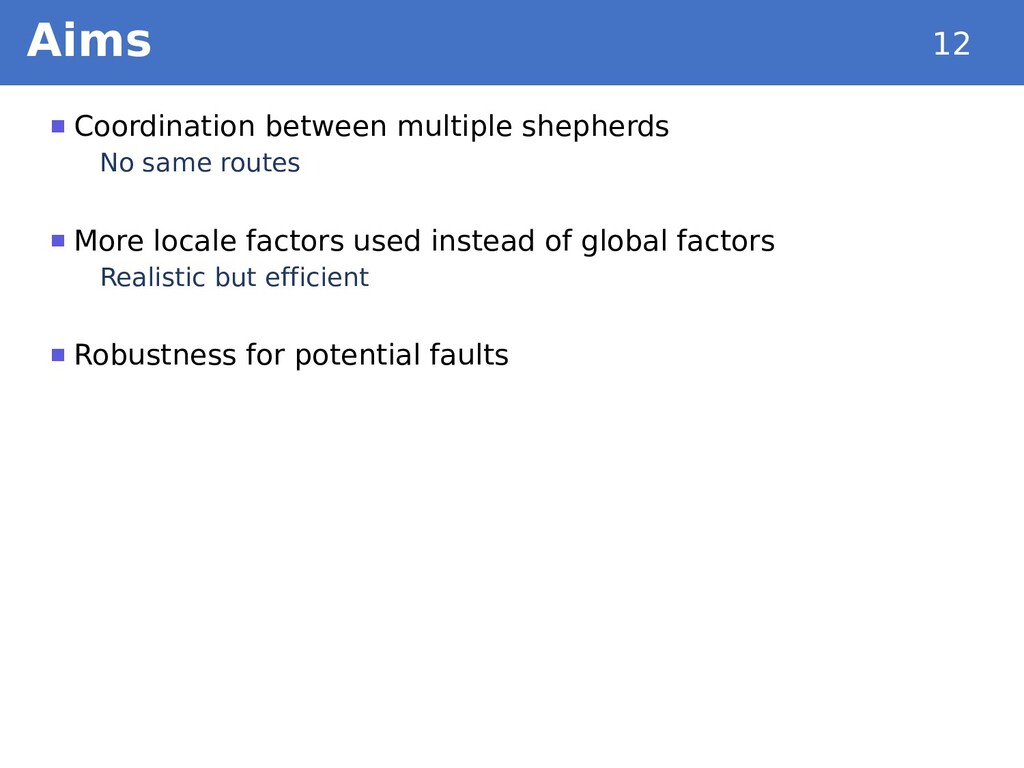
Coordination between multiple shepherds No same routes More locale factors
used instead of global factors Realistic but efficient Robustness for potential faults Aims 12 -
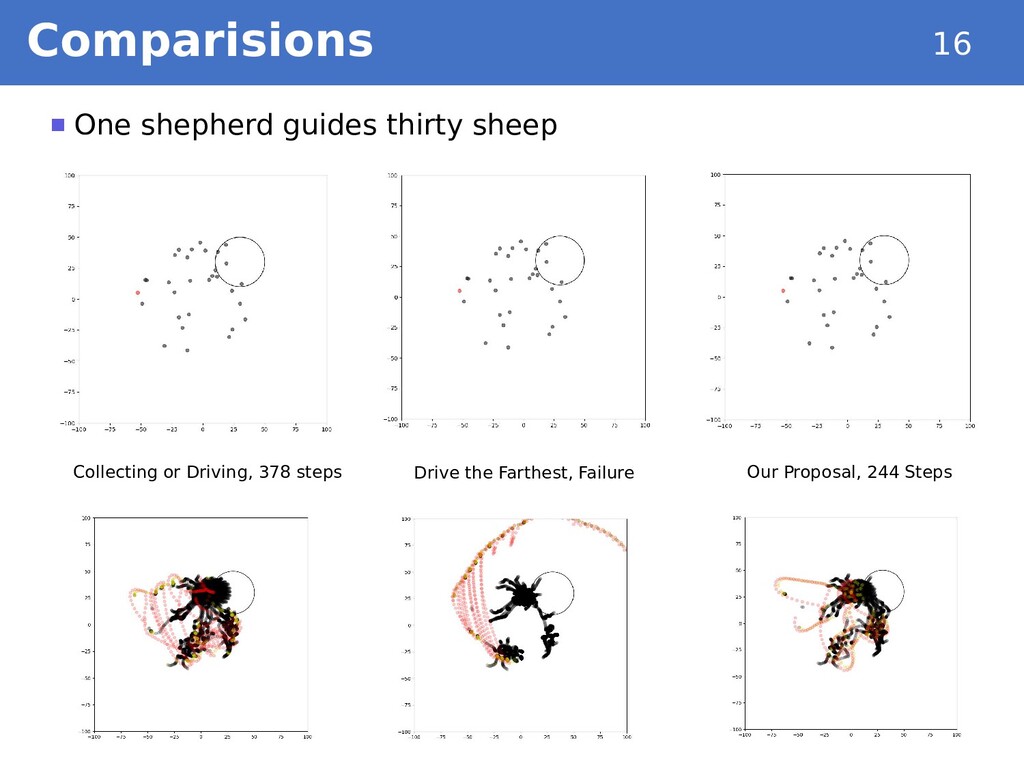
One shepherd guides thirty sheep Comparisions 16 Collecting or Driving,
378 steps Drive the Farthest, Failure Our Proposal, 244 Steps -
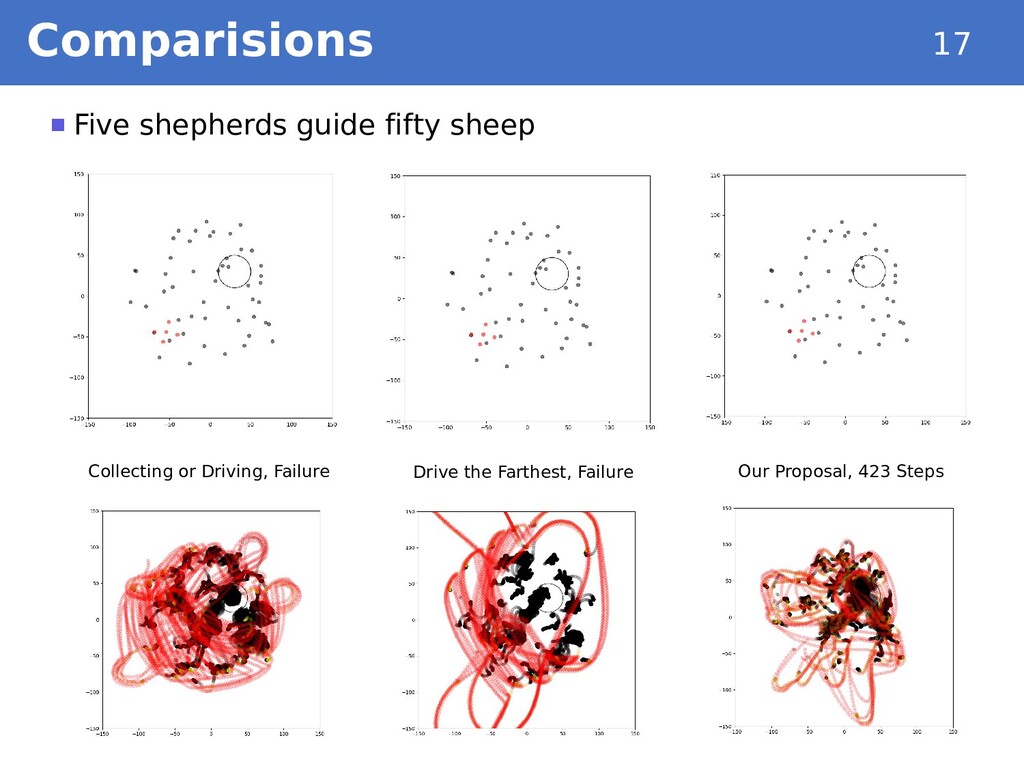
Five shepherds guide fifty sheep Comparisions 17 Our Proposal, 423
Steps Collecting or Driving, Failure Drive the Farthest, Failure -
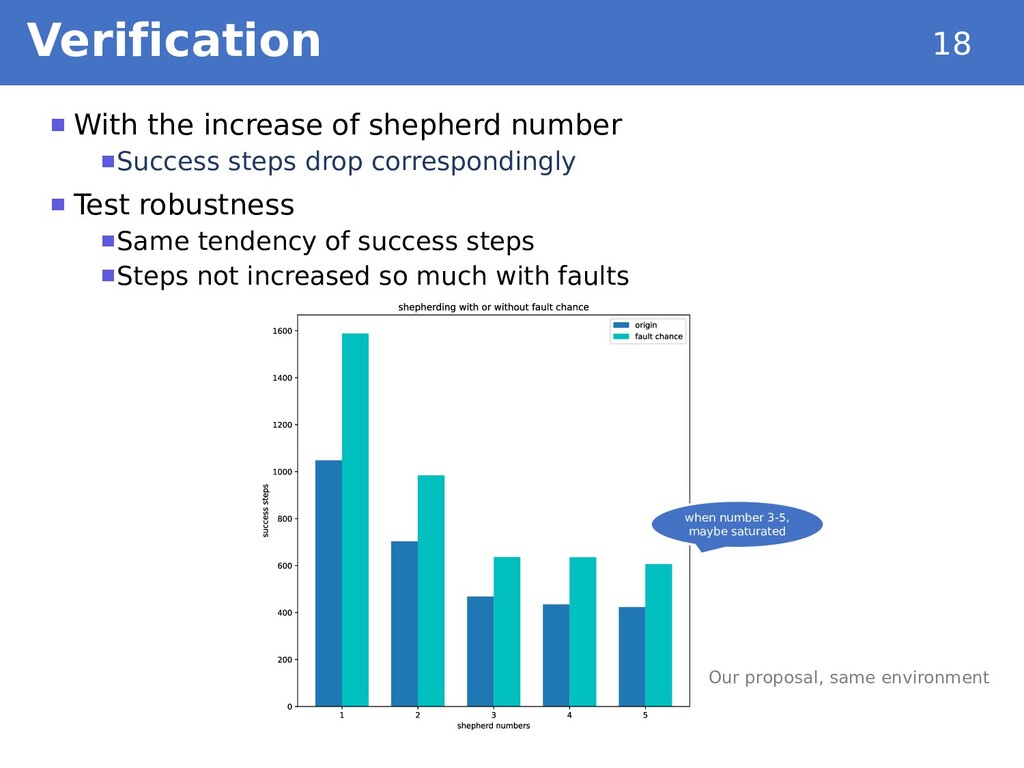
With the increase of shepherd number Success steps drop correspondingly
Test robustness Same tendency of success steps Steps not increased so much with faults Verification 18 when number 3-5, maybe saturated Our proposal, same environment -
Better performance compared to other two methodologies Coordination and robustness
at the expectancy Conclusions 20 -
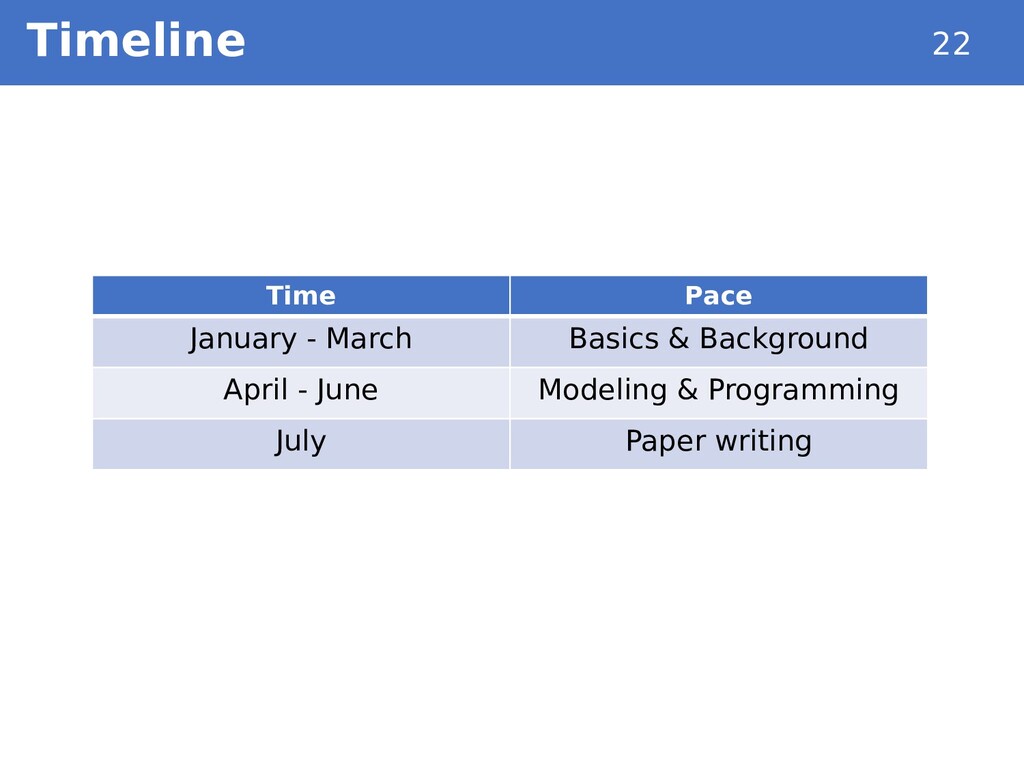
Timeline 22 Time Pace January - March Basics & Background
April - June Modeling & Programming July Paper writing -
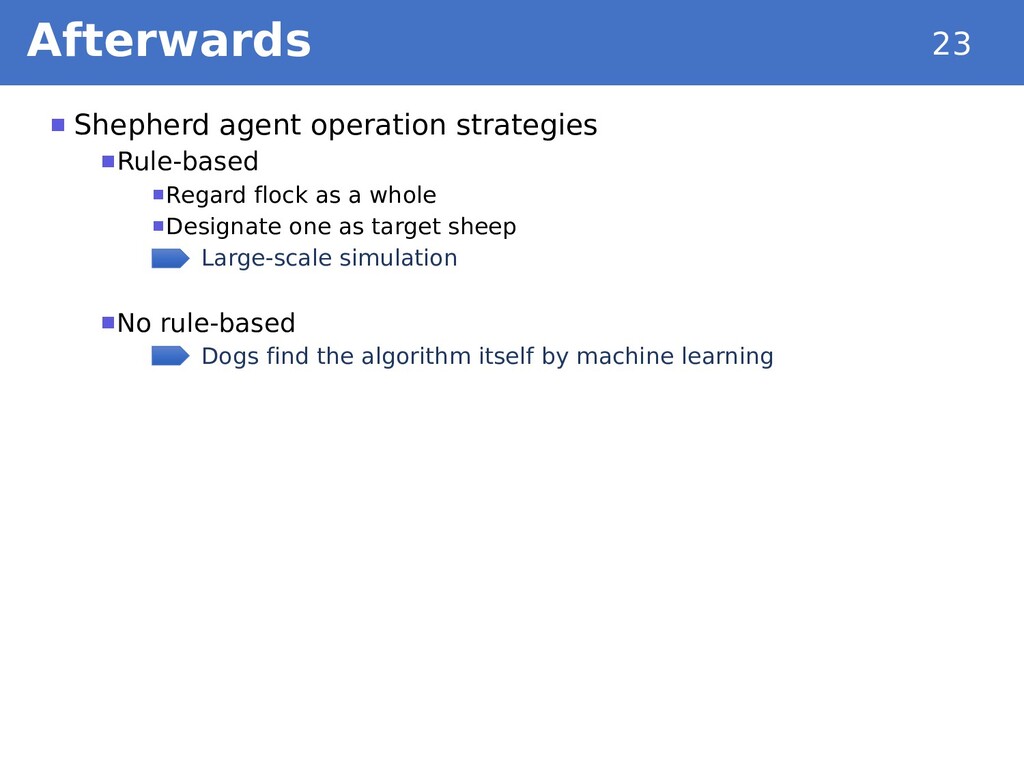
Shepherd agent operation strategies Rule-based Regard flock as a whole
Designate one as target sheep Large-scale simulation No rule-based Dogs find the algorithm itself by machine learning Afterwards 23