Share
Embed
Transcript
14 slides
-
2nd Progress Report Selection of My Shepherding Research Method Aiyi
LI Wakamiya Lab [email protected] 1 August 6th, 2021 -
Explain more with my research background and the reason for
picking up that specific method “Related works” section in paper draft Motivation 2 -
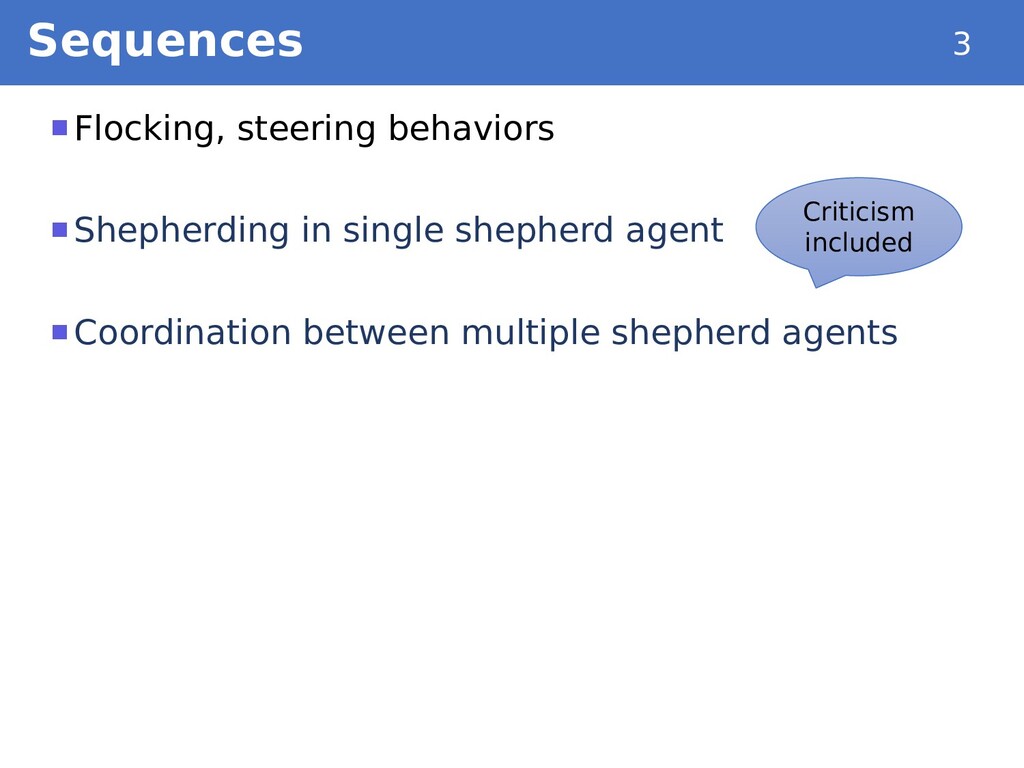
Flocking, steering behaviors Shepherding in single shepherd agent Coordination between
multiple shepherd agents Sequences 3 Criticism included -
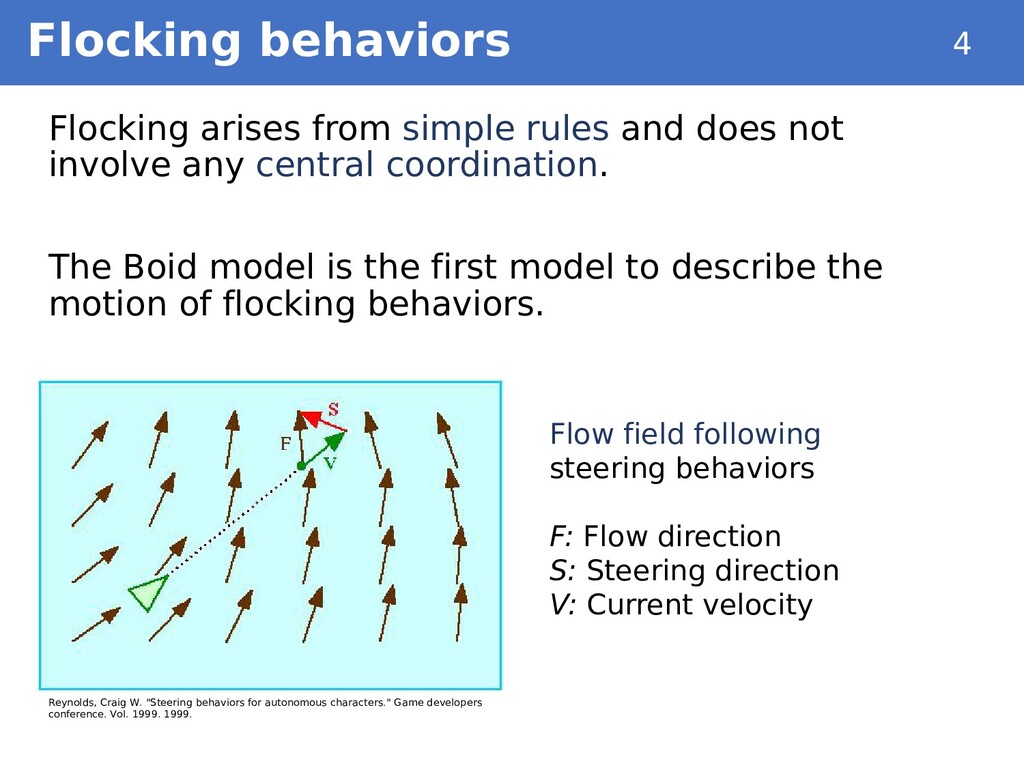
Flocking arises from simple rules and does not involve any
central coordination. The Boid model is the first model to describe the motion of flocking behaviors. Flocking behaviors 4 Flow field following steering behaviors F: Flow direction S: Steering direction V: Current velocity Reynolds, Craig W. "Steering behaviors for autonomous characters." Game developers conference. Vol. 1999. 1999. -
Steering the whole flock Driving the target sheep agent (Instead
of flock) Single shepherd agent 6 -
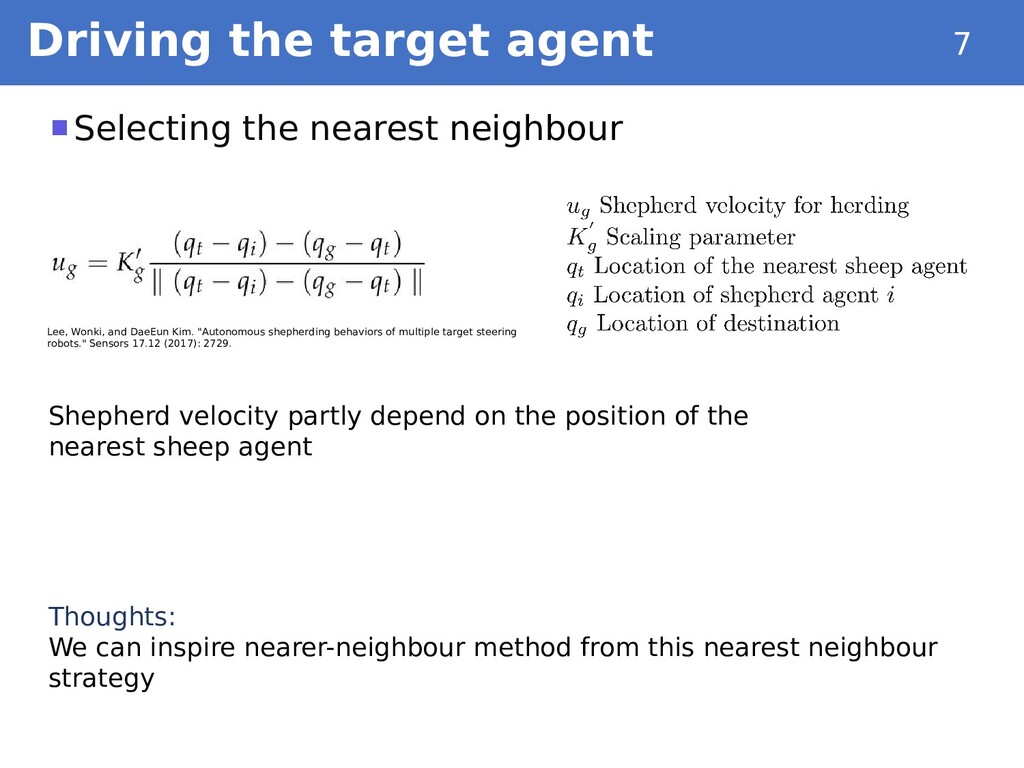
Selecting the nearest neighbour Driving the target agent 7 Lee,
Wonki, and DaeEun Kim. "Autonomous shepherding behaviors of multiple target steering robots." Sensors 17.12 (2017): 2729. Thoughts: We can inspire nearer-neighbour method from this nearest neighbour strategy Shepherd velocity partly depend on the position of the nearest sheep agent -
Defects for single agent Success is not ensured when conditions
complicated Difficulties for multiple agents Coordination between shepherds From single to multiple agents 8 -
Obeyed to outer instructions Moving together in a queue-like shape
Behaving separately but with messages transferred Multiple shepherd agents 10 -
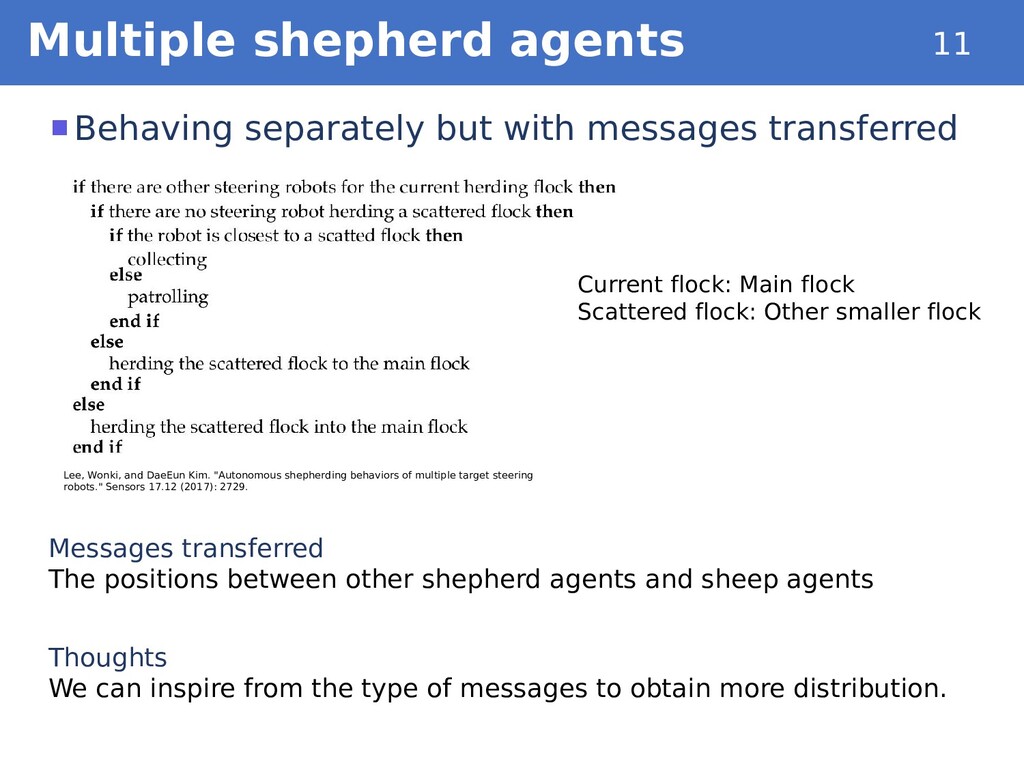
Behaving separately but with messages transferred Multiple shepherd agents 11
Lee, Wonki, and DaeEun Kim. "Autonomous shepherding behaviors of multiple target steering robots." Sensors 17.12 (2017): 2729. Current flock: Main flock Scattered flock: Other smaller flock Messages transferred The positions between other shepherd agents and sheep agents Thoughts We can inspire from the type of messages to obtain more distribution. -
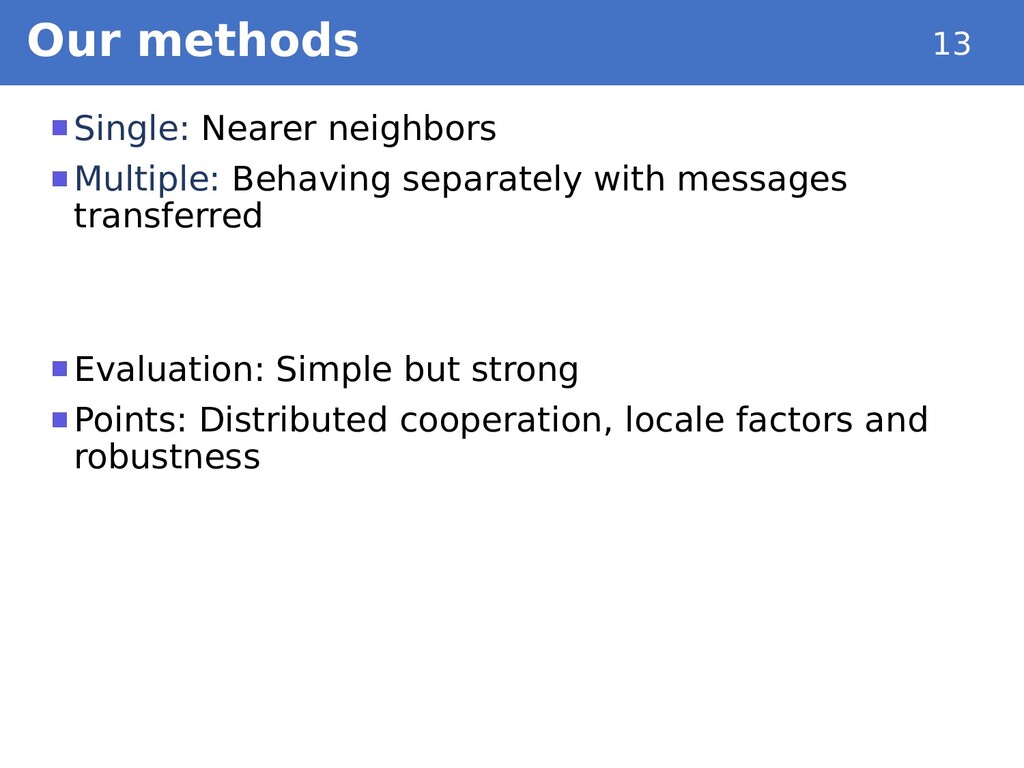
Single: Nearer neighbors Multiple: Behaving separately with messages transferred Evaluation:
Simple but strong Points: Distributed cooperation, locale factors and robustness Our methods 13 -
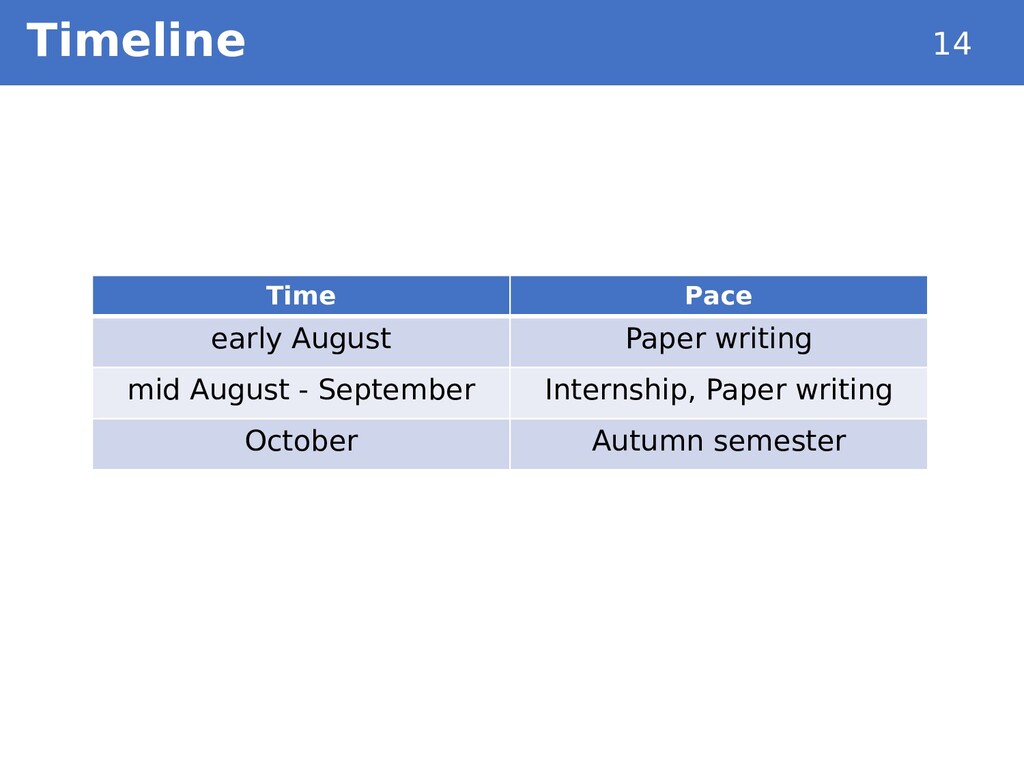
Timeline 14 Time Pace early August Paper writing mid August
- September Internship, Paper writing October Autumn semester