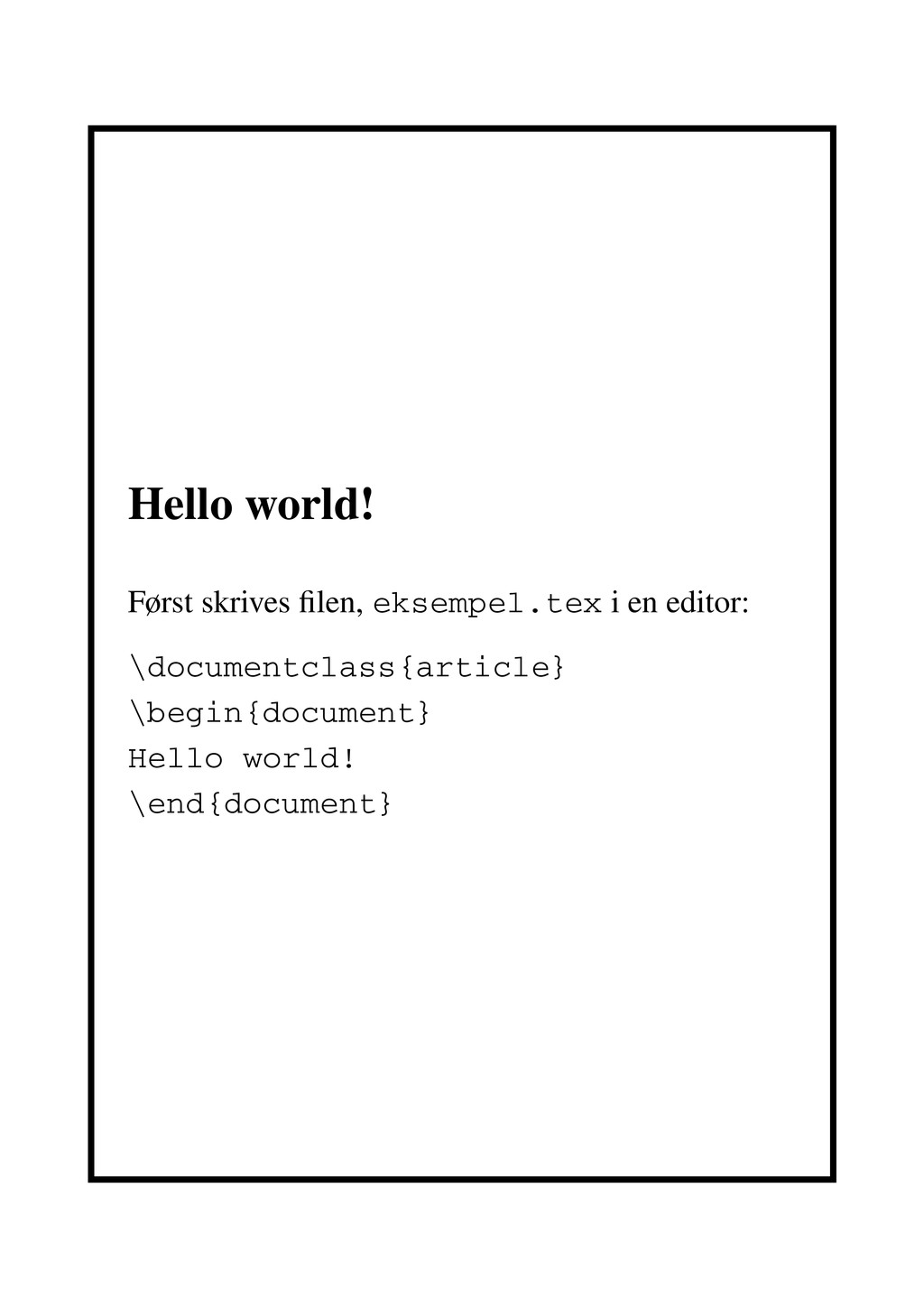
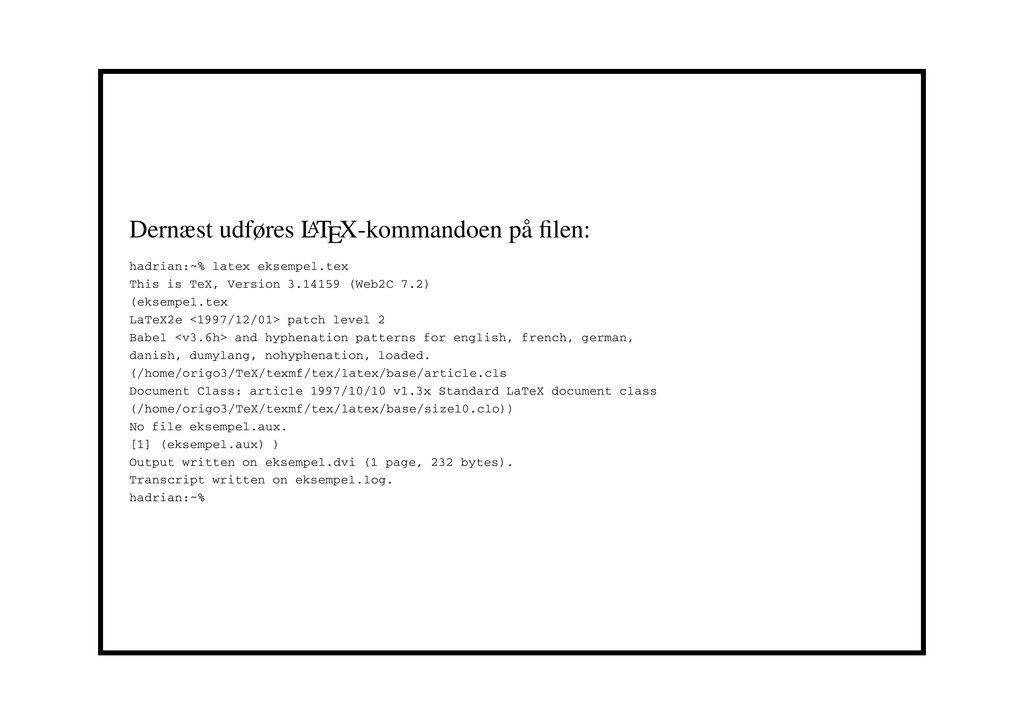
This is TeX, Version 3.14159 (Web2C 7.2) (eksempel.tex LaTeX2e <1997/12/01> patch level 2 Babel <v3.6h> and hyphenation patterns for english, french, german, danish, dumylang, nohyphenation, loaded. (/home/origo3/TeX/texmf/tex/latex/base/article.cls Document Class: article 1997/10/10 v1.3x Standard LaTeX document class (/home/origo3/TeX/texmf/tex/latex/base/size10.clo)) No file eksempel.aux. [1] (eksempel.aux) ) Output written on eksempel.dvi (1 page, 232 bytes). Transcript written on eksempel.log. hadrian:~%
an Emperor, who was so excessively fond of new clothes, that he spent all his money in dress. He did not trouble himself in the least about his soldiers; nor did he care to go either to the theatre or the chase, except for the opportunities then afforded him for displaying his new clothes. He had a different suit for each hour of the day; and as of any other king or emperor, one is accustomed to say, ‘‘he is sitting in council,’’ it was always said of him, ‘‘The Emperor is sitting in his wardrobe.’’ Time passed merrily in the large town which was his capital; strangers arrived every day at the court. One day, two rogues, calling themselves weavers, made their appearance. They gave out that they knew how to weave stuffs of the most beautiful colors and elaborate patterns, the clothes manufactured from which should have the wonderful property of remaining invisible to everyone who was unfit for the office he held, or who was extraordinarily simple in character. ‘‘These must, indeed, be splendid clothes!’’ thought the Emperor. ‘‘Had I such a suit, I might at once find out what men in my realms are unfit for their office, and also be able to distinguish the wise from the foolish! This stuff must be woven for me immediately.’’ And he caused large sums of money to be given to both the weavers in order that they might begin their work directly. \end{document}
Emperor’s New Clothes} \author{Hans Christian Andersen} \begin{document} \maketitle \section{F\o{}rste afsnit} Many years ago, there was an Emperor, who was so excessively fond of new clothes, that he spent all his money in dress. He did not trouble himself in the least about his soldiers; nor did he care to go either to the theatre or the chase, except for the opportunities then afforded him for displaying his new clothes. He had a different suit for each hour of the day; and as of any other king or emperor, one is accustomed to say, ‘‘he is sitting in council,’’ it was always said of him, ‘‘The Emperor is sitting in his wardrobe.’’ \subsection{F\o{}rste underafsnit} Time passed merrily in the large town which was his capital; strangers arrived every day at the court. One day, two rogues, calling themselves weavers, made their appearance. They gave out that they knew how to weave stuffs of the most beautiful colors and elaborate patterns, the clothes manufactured from which should have the wonderful property of remaining invisible to everyone who was unfit for the office he held, or who was extraordinarily simple in character. \subsection{Andet underafsnit} ‘‘These must, indeed, be splendid clothes!’’ thought the Emperor. ‘‘Had I such a suit, I might at once find out what men in my realms are unfit for their office, and also be able to distinguish the wise from the foolish! This stuff must be woven for me immediately.’’ And he caused large sums of money to be given to both the weavers in order that they might begin their work directly. \end{document}
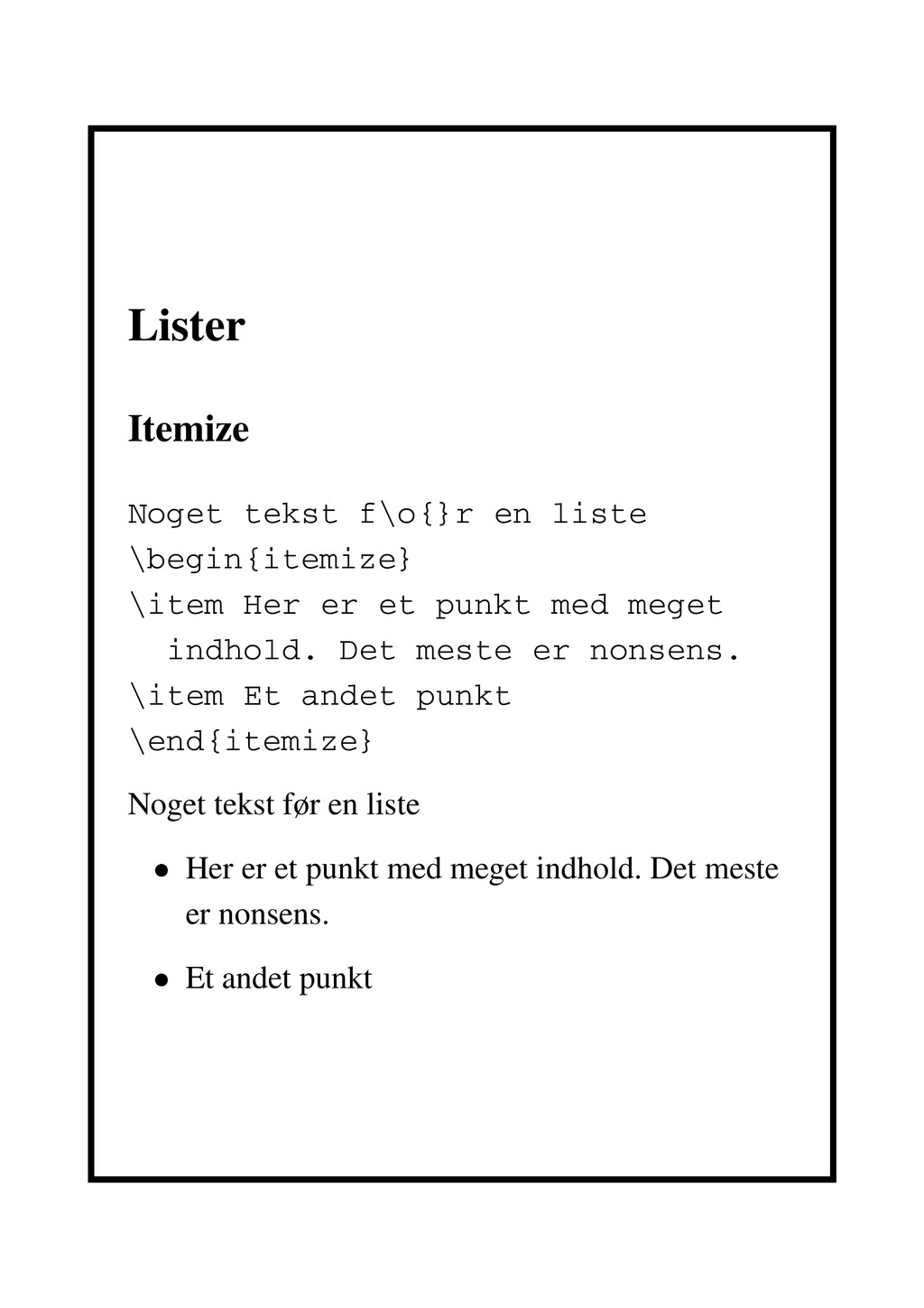
er et punkt med meget indhold. Det meste er nonsens. \item Et andet punkt \end{itemize} Noget tekst før en liste ¯ Her er et punkt med meget indhold. Det meste er nonsens. ¯ Et andet punkt
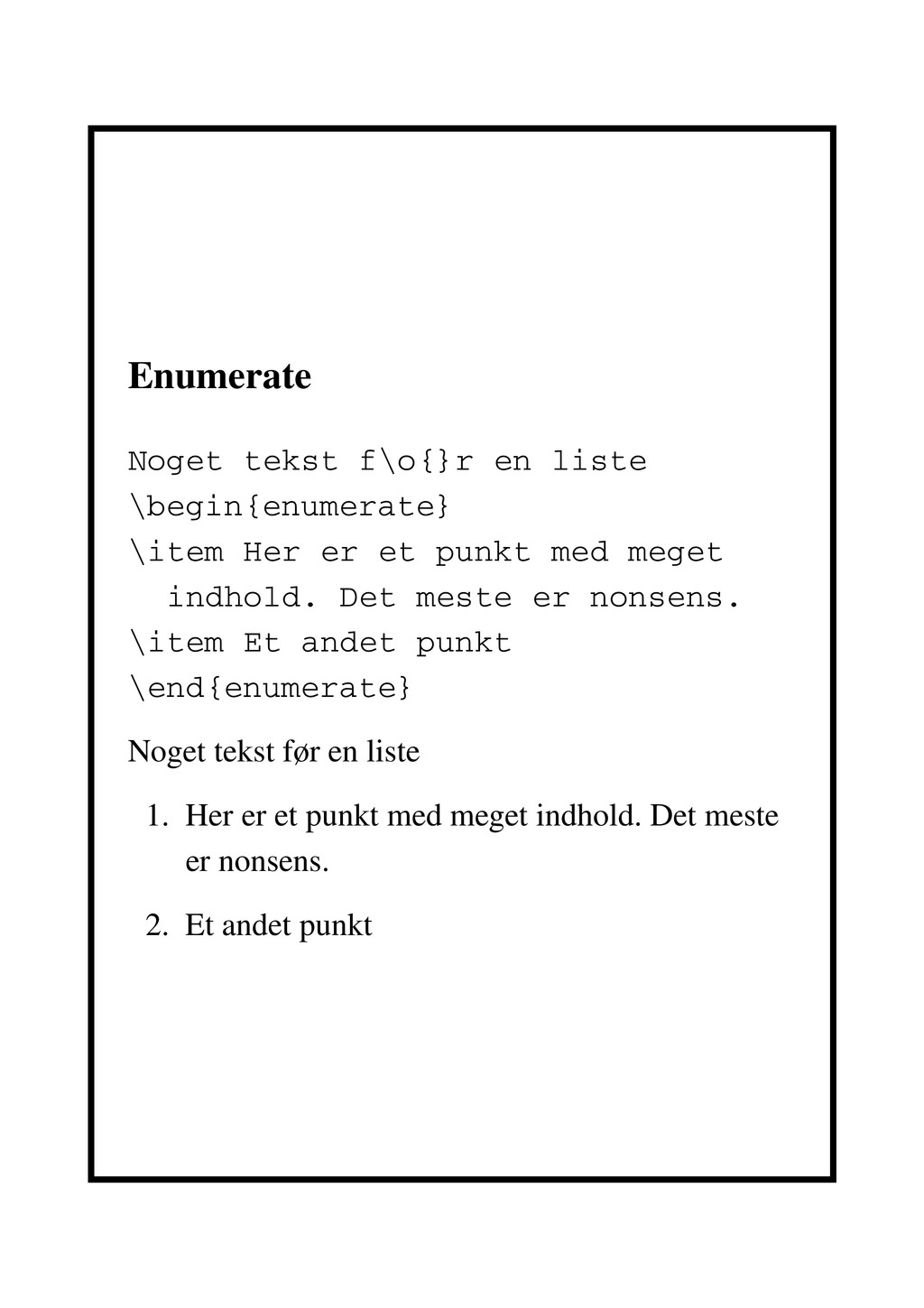
et punkt med meget indhold. Det meste er nonsens. \item Et andet punkt \end{enumerate} Noget tekst før en liste 1. Her er et punkt med meget indhold. Det meste er nonsens. 2. Et andet punkt
et punkt med meget indhold. Det meste er nonsens. \item[Ko] Et andet punkt \end{description} Noget tekst før en liste Hest Her er et punkt med meget indhold. Det meste er nonsens. Ko Et andet punkt
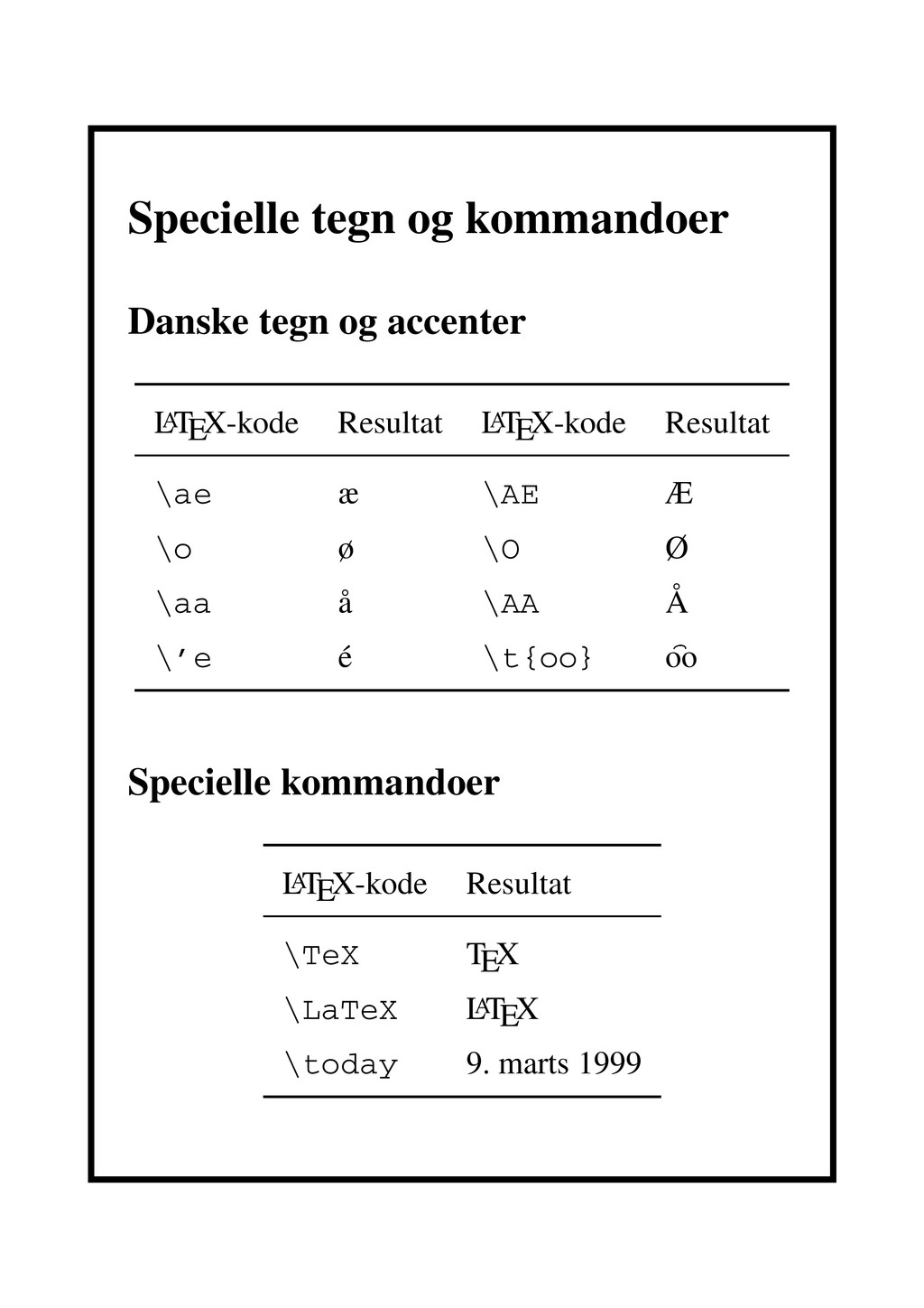
TEX-kode Resultat L A TEX-kode Resultat \ae æ \AE Æ \o ø \O Ø \aa å \AA Å \’e é \t{oo} oo Specielle kommandoer L A TEX-kode Resultat \TeX TEX \LaTeX L A TEX \today 9. marts 1999
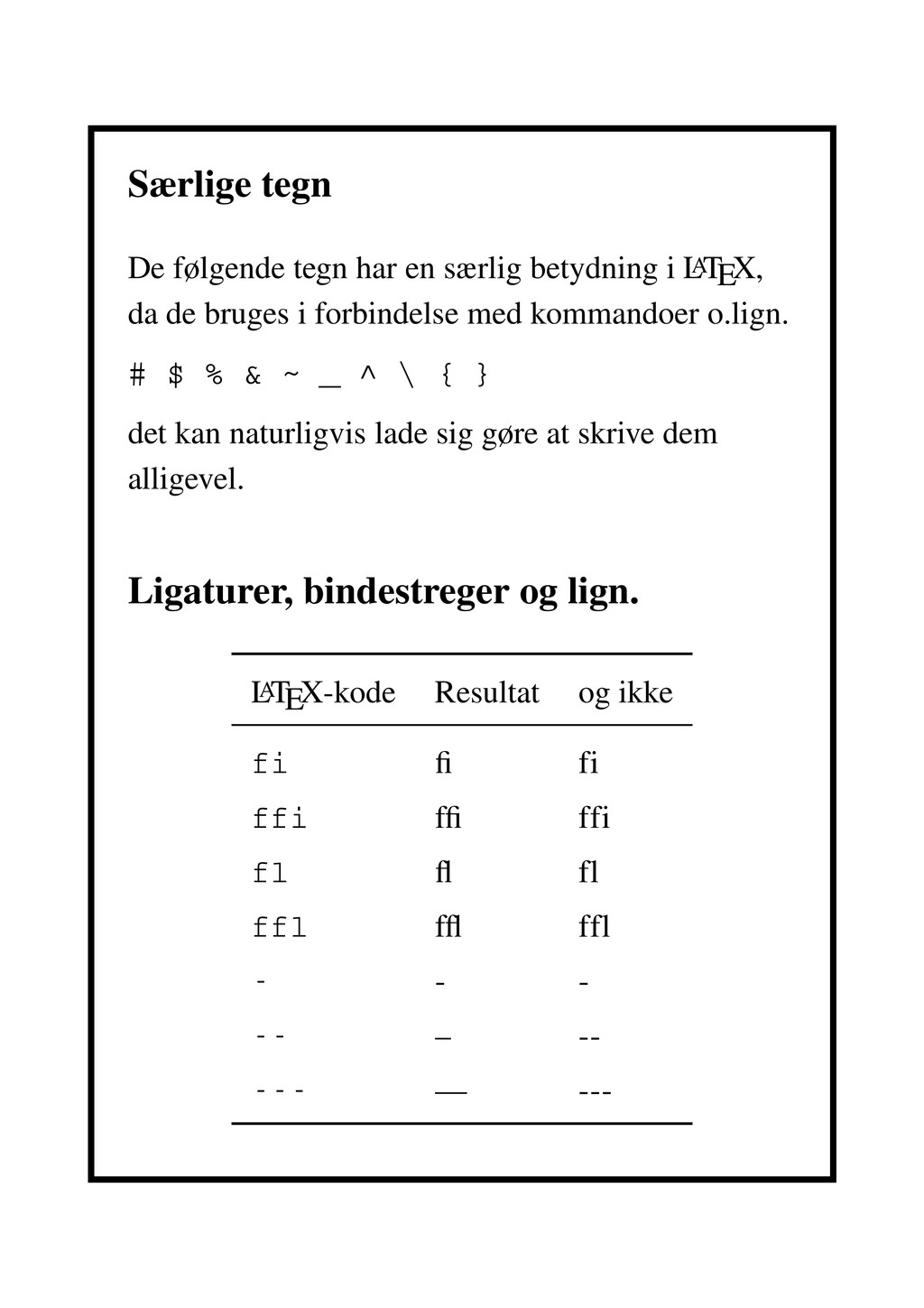
L A TEX, da de bruges i forbindelse med kommandoer o.lign. # $ % & ~ _ ^ \ { } det kan naturligvis lade sig gøre at skrive dem alligevel. Ligaturer, bindestreger og lign. L A TEX-kode Resultat og ikke fi fi fi ffi ffi ffi fl fl fl ffl ffl ffl - - - -- – -- --- — ---
¯ skrive æ, ø og å direkte i L A TEX-koden (så er det nemmere at lave stavekontrol på teksten). ¯ ord med specielle tegn bliver delt. ¯ der foretages danske orddelinger ¯ et utal af andre ting tilpasses danske forhold (fx \today, 9. marts 1999 vs. March 9, 1999).
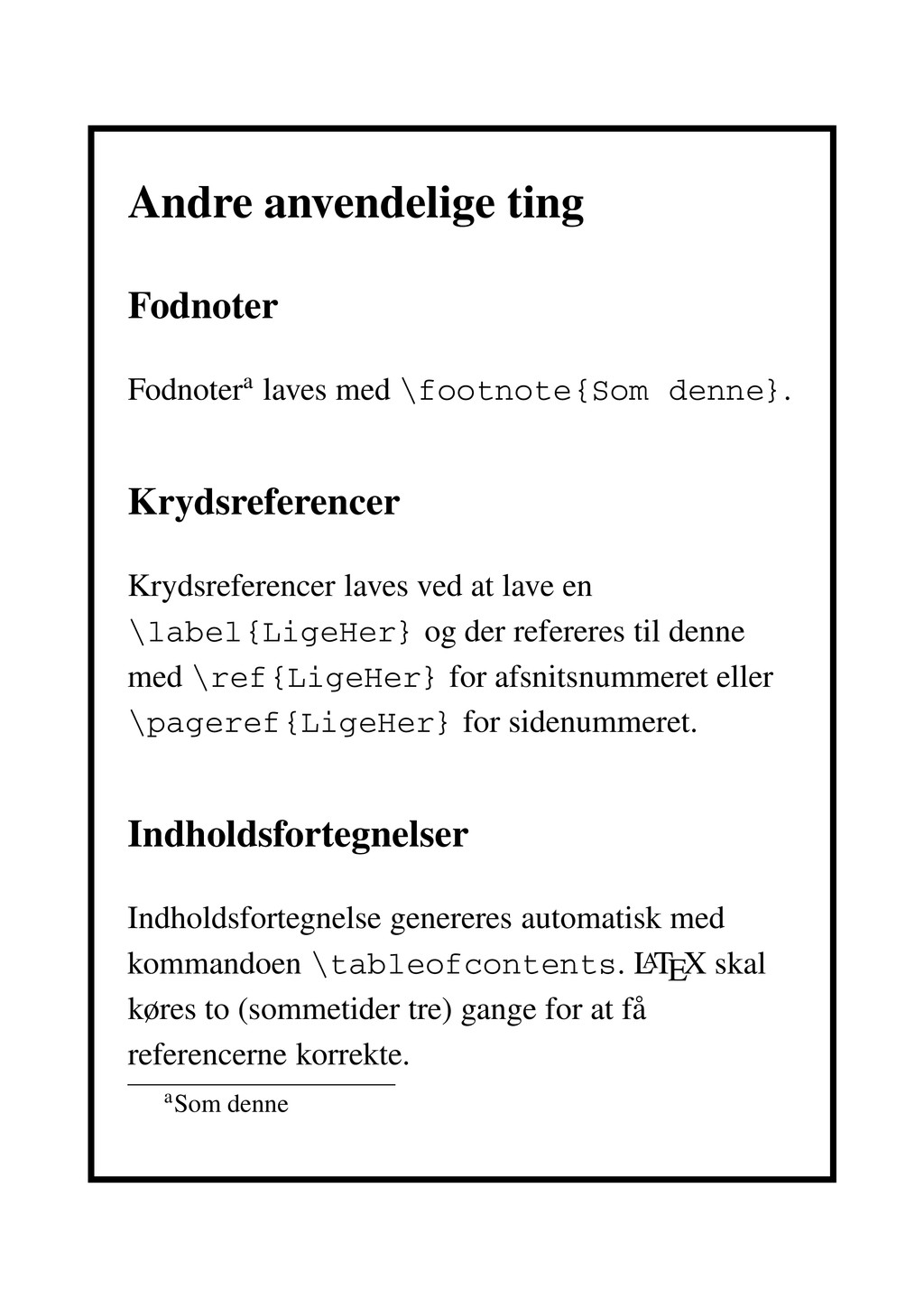
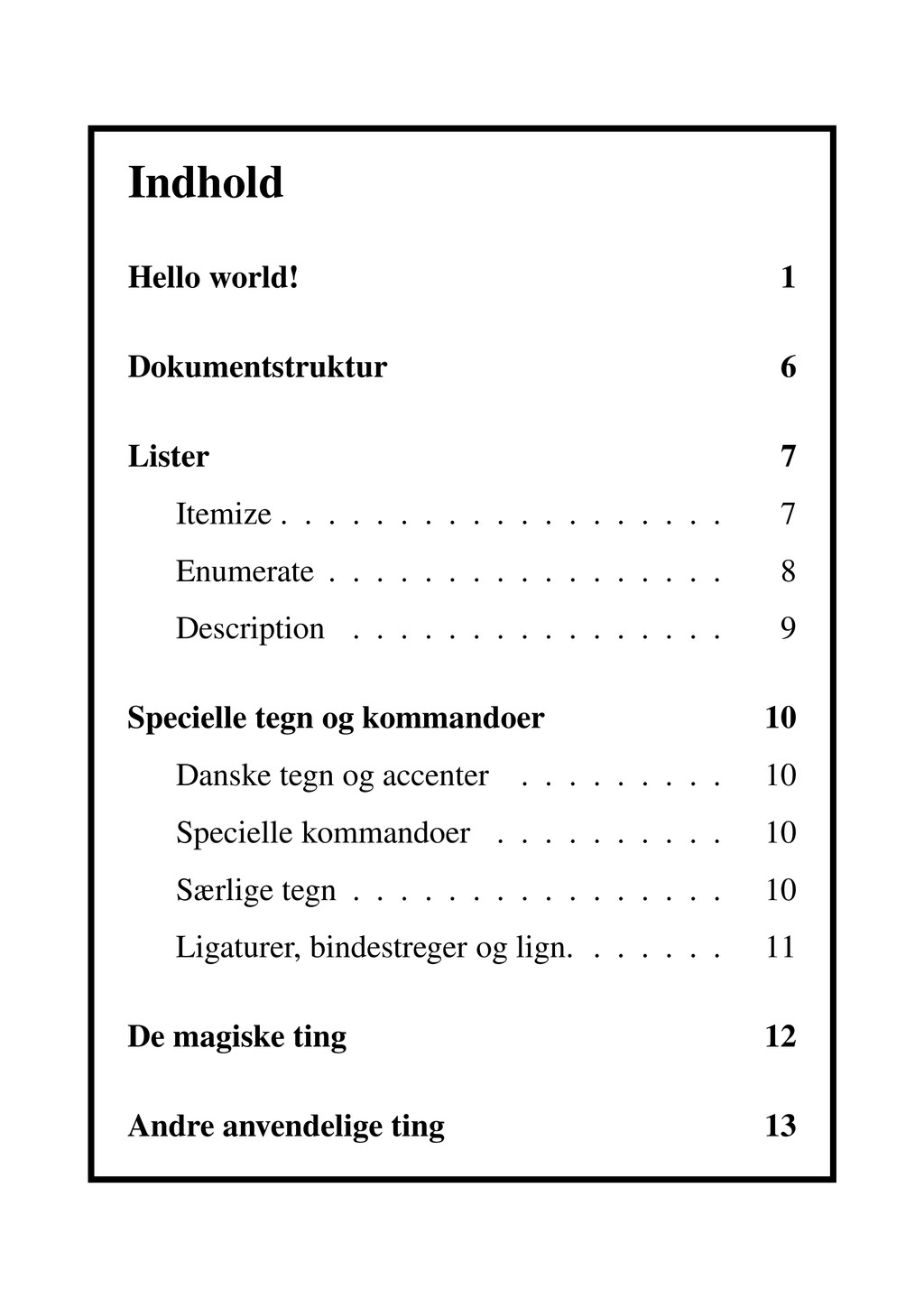
Krydsreferencer laves ved at lave en \label{LigeHer} og der refereres til denne med \ref{LigeHer} for afsnitsnummeret eller \pageref{LigeHer} for sidenummeret. Indholdsfortegnelser Indholdsfortegnelse genereres automatisk med kommandoen \tableofcontents. L A TEX skal køres to (sommetider tre) gange for at få referencerne korrekte. aSom denne
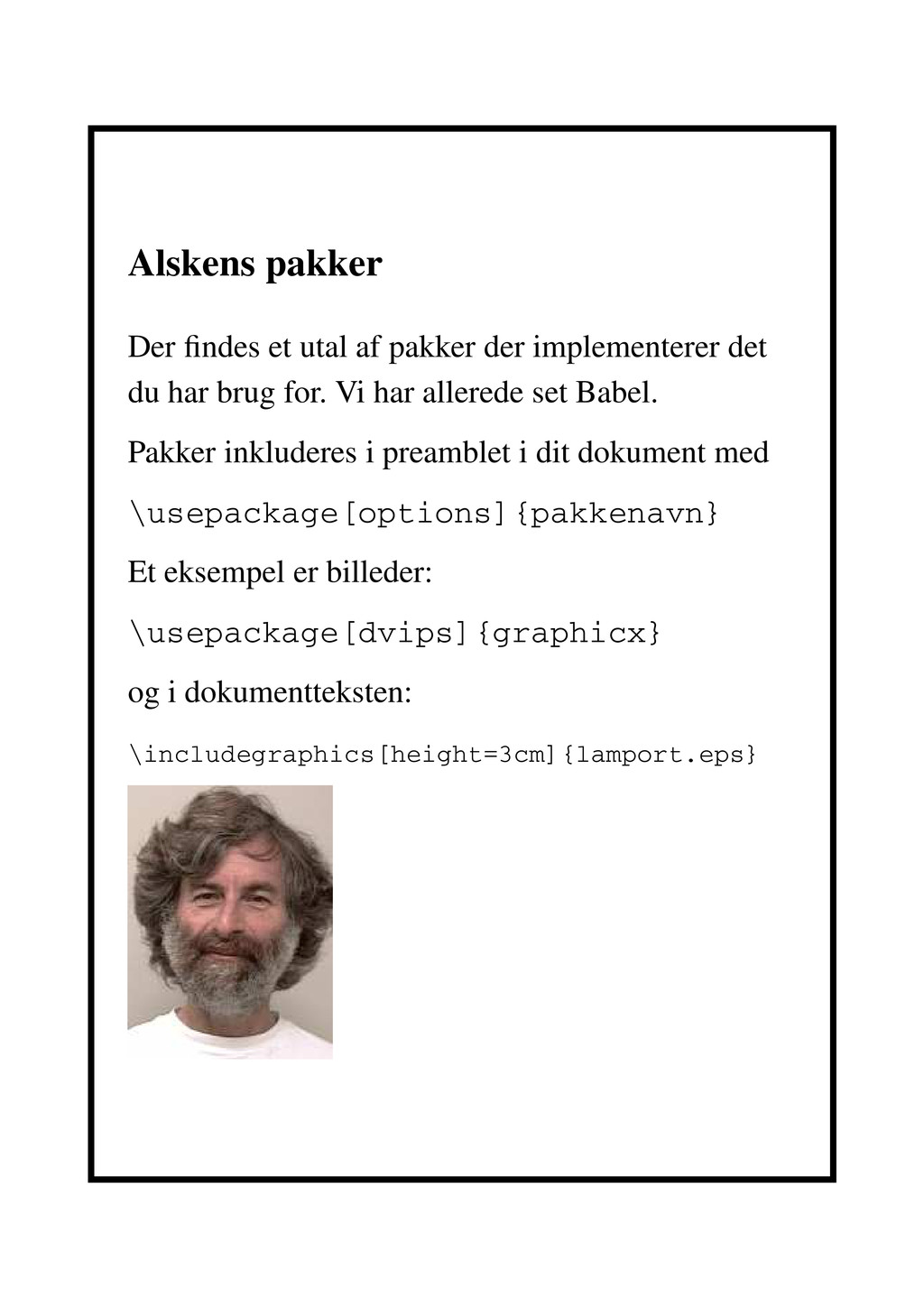
det du har brug for. Vi har allerede set Babel. Pakker inkluderes i preamblet i dit dokument med \usepackage[options]{pakkenavn} Et eksempel er billeder: \usepackage[dvips]{graphicx} og i dokumentteksten: \includegraphics[height=3cm]{lamport.eps}
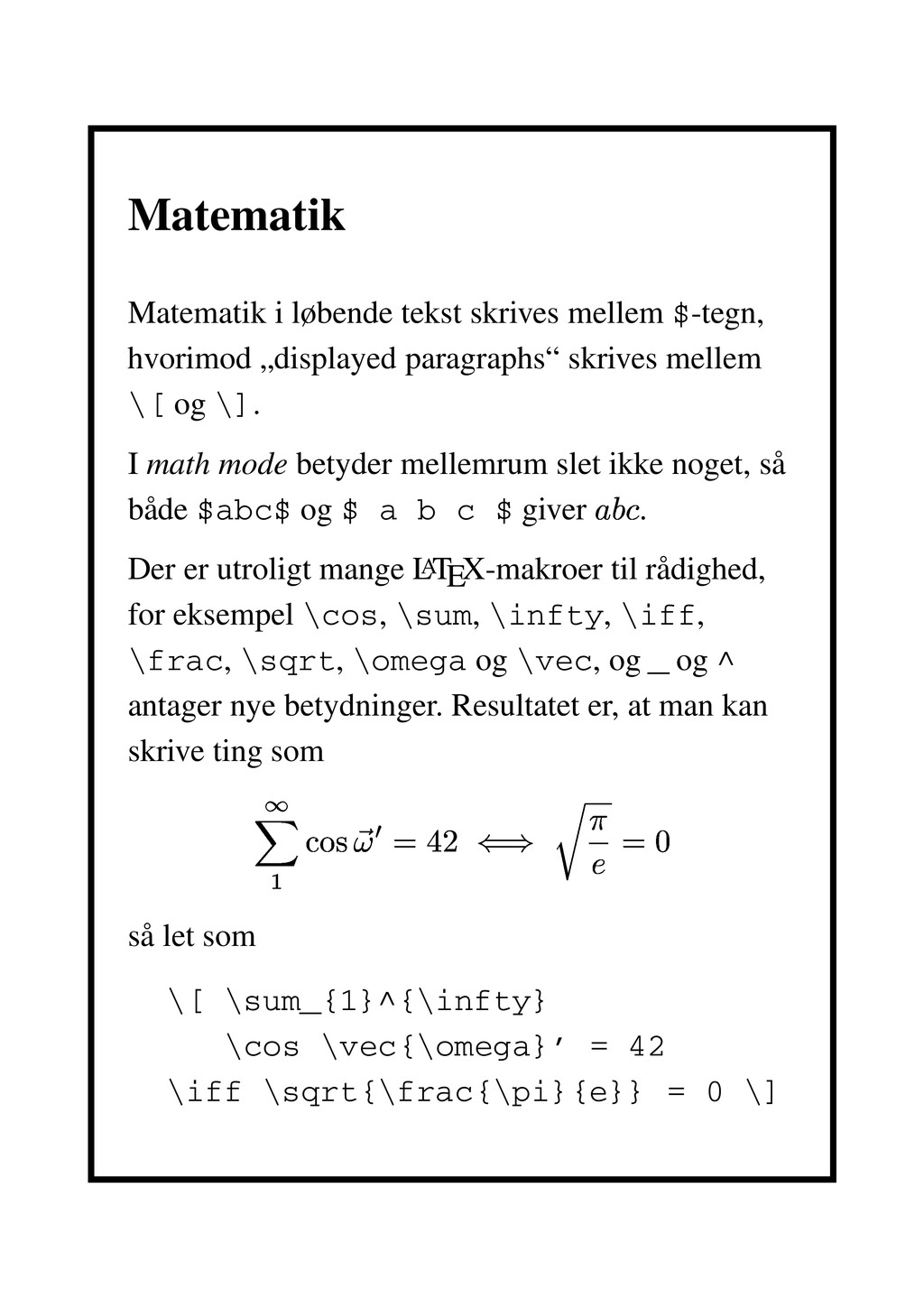
paragraphs“ skrives mellem \[ og \]. I math mode betyder mellemrum slet ikke noget, så både $abc$ og $ a b c $ giver . Der er utroligt mange L A TEX-makroer til rådighed, for eksempel \cos, \sum, \infty, \iff, \frac, \sqrt, \omega og \vec, og _ og ^ antager nye betydninger. Resultatet er, at man kan skrive ting som ½ ½ Ó× ¼ ¾ ´µ Ö ¼ så let som \[ \sum_{1}^{\infty} \cos \vec{\omega}’ = 42 \iff \sqrt{\frac{\pi}{e}} = 0 \]
Short Introduction To L A TEX2 (CTAN:info/lshort/english/). ¯ Leslie Lamport: L A TEX: A Documentation Preparation System (ISBN: 0201529831). ¯ CTAN – Comprehensive TEX Archive Network (Mirror http://sunsite.auc.dk/pub/tex/ctan). ¯ DK-TUG hjemmeside og mailliste (http://sunsite.auc.dk/dk-tug/).


 arnested
 naruoga
 mkdev10
 makocchi
 grimoh
 iotengineer22
 baseballyama
 vivion
 sansantech
 persolserverworks
 colopl
 yut0naga1_fa
 letsgokoyo
 mfonobong
 aleyda
 cassininazir
 dugsong
 baasie
 geshan
 wjessup
 inesmontani
 marcoroth
 morganepeng
 lfama
lfama
![Udvidet eksempel, eks2.tex: \documentclass[a4paper,12pt]{article} \begin{document} Many years ago, there was](https://files.speakerdeck.com/presentations/50004413100c37000104b0d5/slide_2.jpg)
![Titler, forfatter, afsnit, m.m. . . . (eks3.tex): \documentclass[a4paper,12pt]{article} \title{The](https://files.speakerdeck.com/presentations/50004413100c37000104b0d5/slide_3.jpg)

![Description Noget tekst f\o{}r en liste \begin{description} \item[Hest] Her er](https://files.speakerdeck.com/presentations/50004413100c37000104b0d5/slide_8.jpg)
![De magiske ting \documentclass[a4paper,12pt,danish]{article} \usepackage{babel} \usepackage[T1]{fontenc} \usepackage[latin1]{inputenc} Herefter kan du](https://files.speakerdeck.com/presentations/50004413100c37000104b0d5/slide_11.jpg)