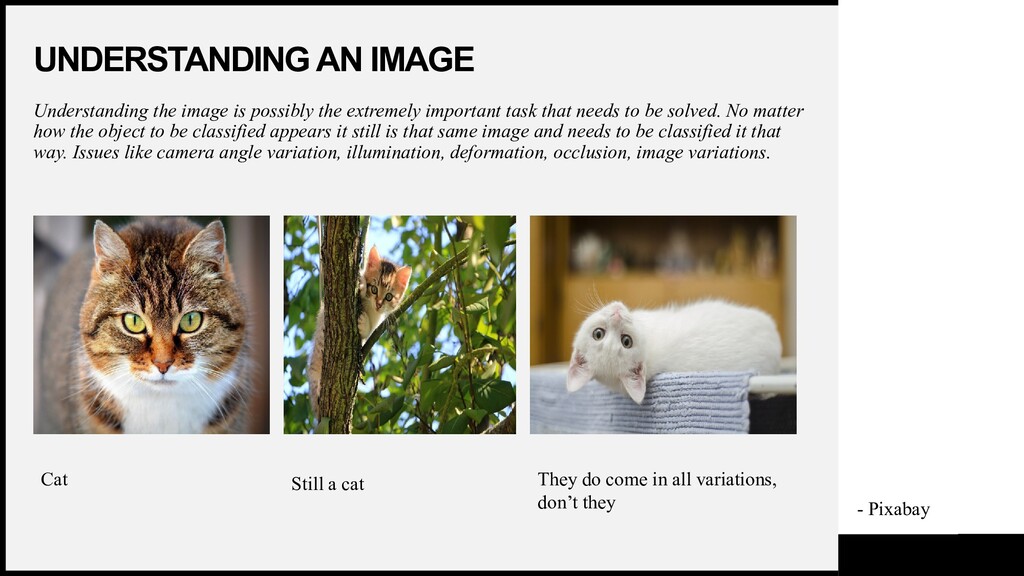
possibly the extremely important task that needs to be solved. No matter how the object to be classified appears it still is that same image and needs to be classified it that way. Issues like camera angle variation, illumination, deformation, occlusion, image variations. 4 - Pixabay Cat Still a cat They do come in all variations, don’t they
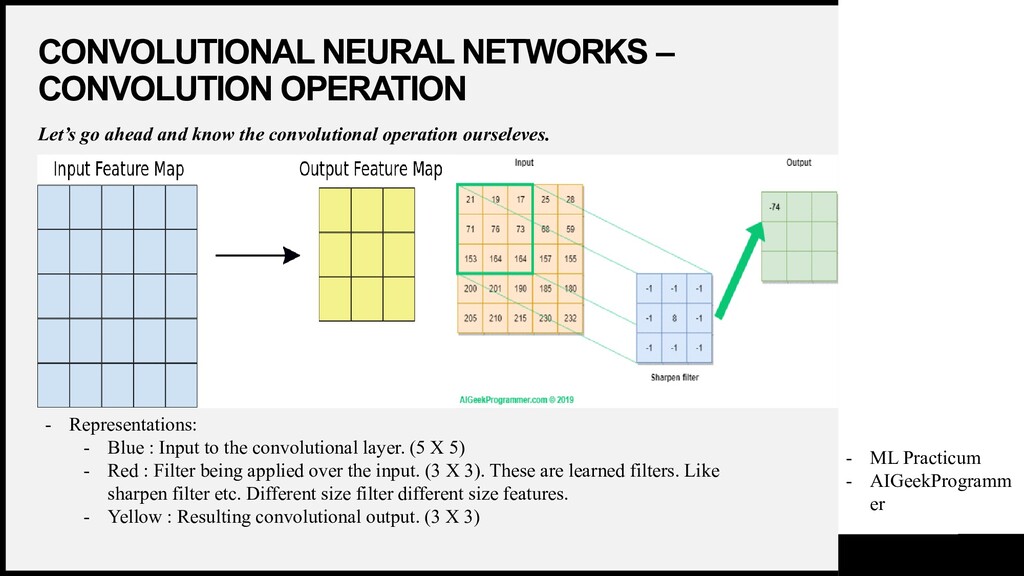
go ahead and know the convolutional operation ourseleves. 6 - Representations: - Blue : Input to the convolutional layer. (5 X 5) - Red : Filter being applied over the input. (3 X 3). These are learned filters. Like sharpen filter etc. Different size filter different size features. - Yellow : Resulting convolutional output. (3 X 3) - ML Practicum - AIGeekProgramm er
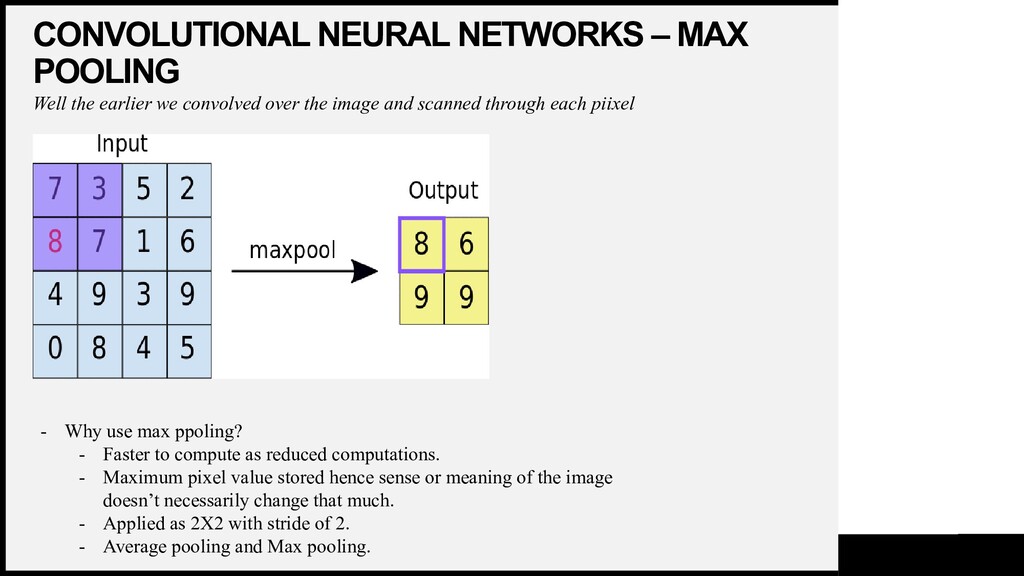
the earlier we convolved over the image and scanned through each piixel 7 - Why use max ppoling? - Faster to compute as reduced computations. - Maximum pixel value stored hence sense or meaning of the image doesn’t necessarily change that much. - Applied as 2X2 with stride of 2. - Average pooling and Max pooling.
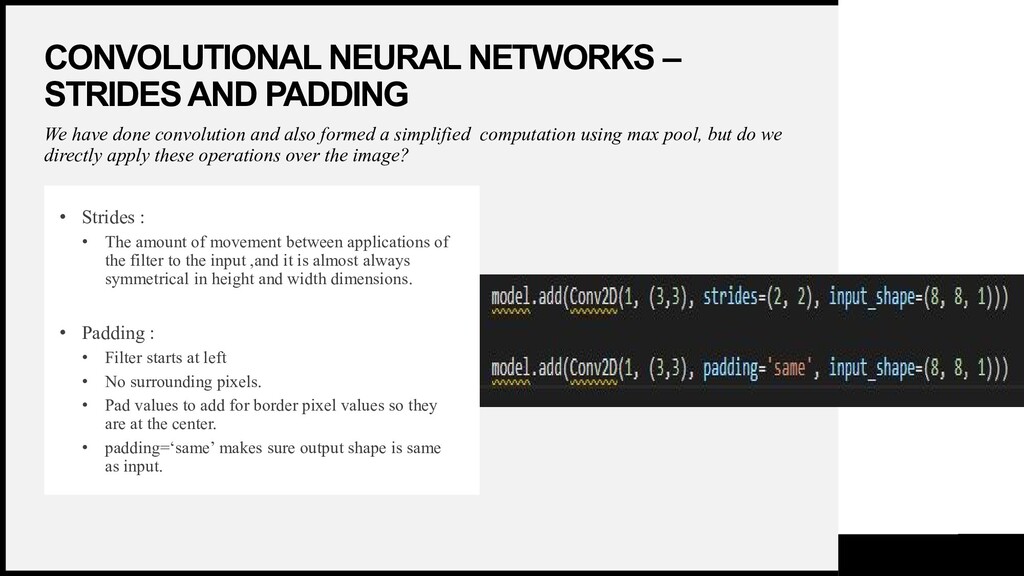
We have done convolution and also formed a simplified computation using max pool, but do we directly apply these operations over the image? • Strides : • The amount of movement between applications of the filter to the input ,and it is almost always symmetrical in height and width dimensions. • Padding : • Filter starts at left • No surrounding pixels. • Pad values to add for border pixel values so they are at the center. • padding=‘same’ makes sure output shape is same as input. 8
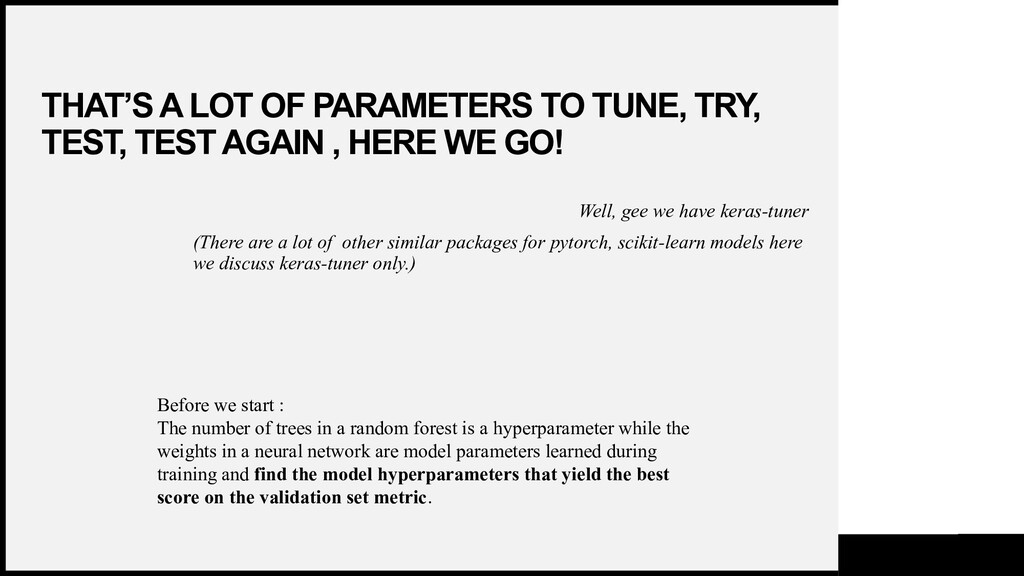
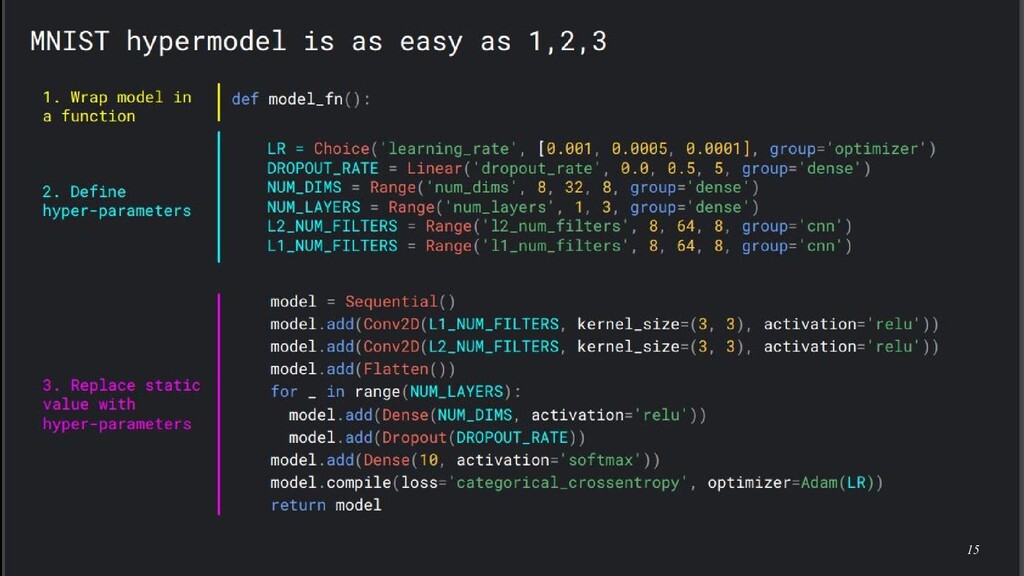
TRY, TEST, TEST AGAIN , HERE WE GO! Well, gee we have keras-tuner (There are a lot of other similar packages for pytorch, scikit-learn models here we discuss keras-tuner only.) 10 Before we start : The number of trees in a random forest is a hyperparameter while the weights in a neural network are model parameters learned during training and find the model hyperparameters that yield the best score on the validation set metric.
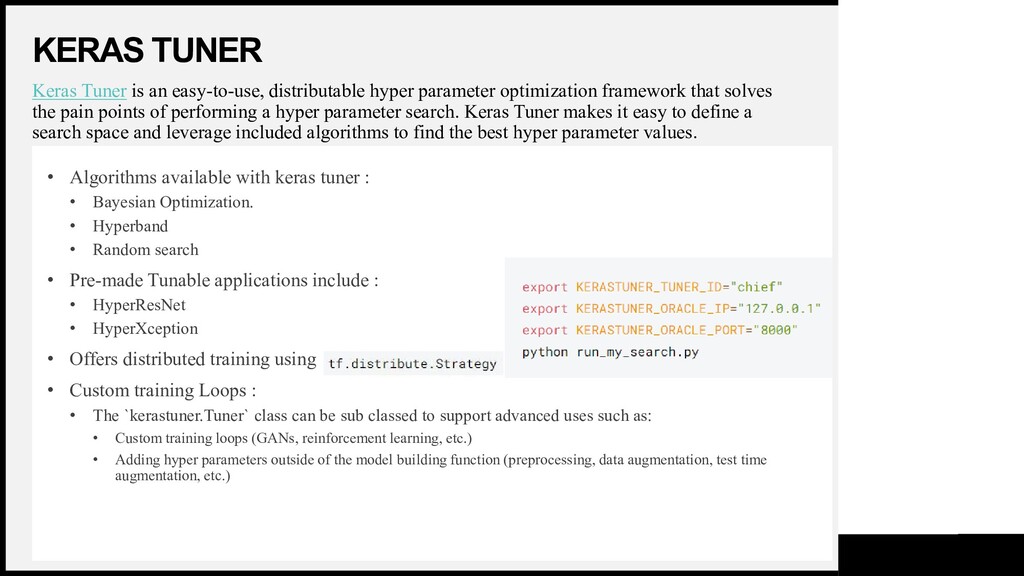
distributable hyper parameter optimization framework that solves the pain points of performing a hyper parameter search. Keras Tuner makes it easy to define a search space and leverage included algorithms to find the best hyper parameter values. • Algorithms available with keras tuner : • Bayesian Optimization. • Hyperband • Random search • Pre-made Tunable applications include : • HyperResNet • HyperXception • Offers distributed training using • Custom training Loops : • The `kerastuner.Tuner` class can be sub classed to support advanced uses such as: • Custom training loops (GANs, reinforcement learning, etc.) • Adding hyper parameters outside of the model building function (preprocessing, data augmentation, test time augmentation, etc.) 11
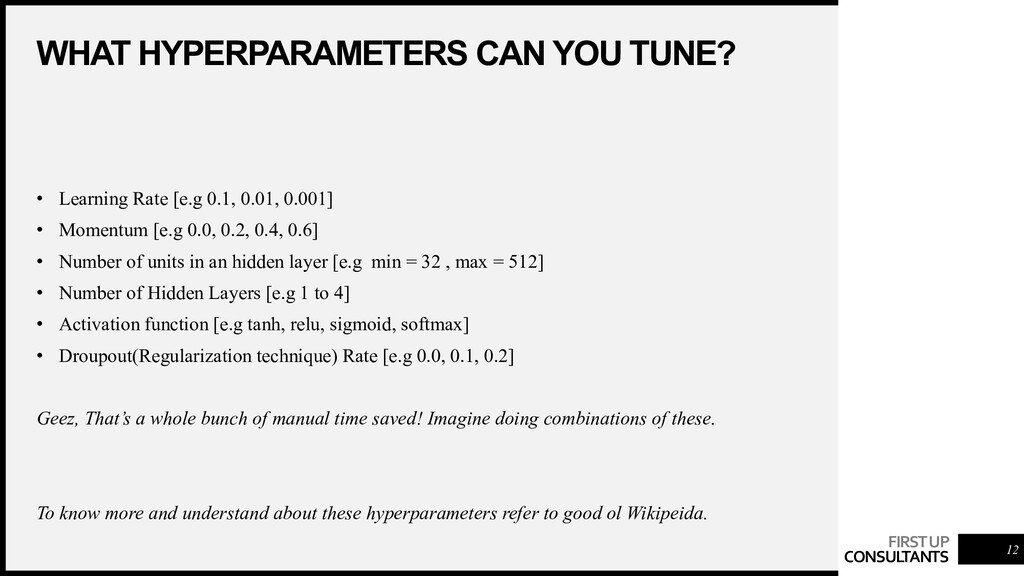
Rate [e.g 0.1, 0.01, 0.001] • Momentum [e.g 0.0, 0.2, 0.4, 0.6] • Number of units in an hidden layer [e.g min = 32 , max = 512] • Number of Hidden Layers [e.g 1 to 4] • Activation function [e.g tanh, relu, sigmoid, softmax] • Droupout(Regularization technique) Rate [e.g 0.0, 0.1, 0.2] Geez, That’s a whole bunch of manual time saved! Imagine doing combinations of these. To know more and understand about these hyperparameters refer to good ol Wikipeida. 12
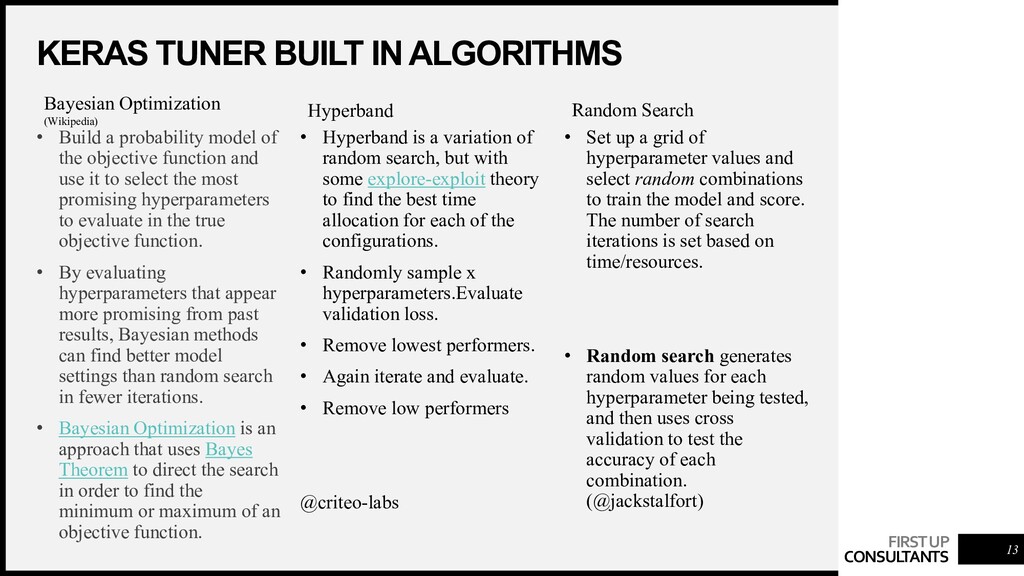
a probability model of the objective function and use it to select the most promising hyperparameters to evaluate in the true objective function. • By evaluating hyperparameters that appear more promising from past results, Bayesian methods can find better model settings than random search in fewer iterations. • Bayesian Optimization is an approach that uses Bayes Theorem to direct the search in order to find the minimum or maximum of an objective function. • Hyperband is a variation of random search, but with some explore-exploit theory to find the best time allocation for each of the configurations. • Randomly sample x hyperparameters.Evaluate validation loss. • Remove lowest performers. • Again iterate and evaluate. • Remove low performers @criteo-labs • Set up a grid of hyperparameter values and select random combinations to train the model and score. The number of search iterations is set based on time/resources. • Random search generates random values for each hyperparameter being tested, and then uses cross validation to test the accuracy of each combination. (@jackstalfort) 13 Bayesian Optimization (Wikipedia) Hyperband Random Search
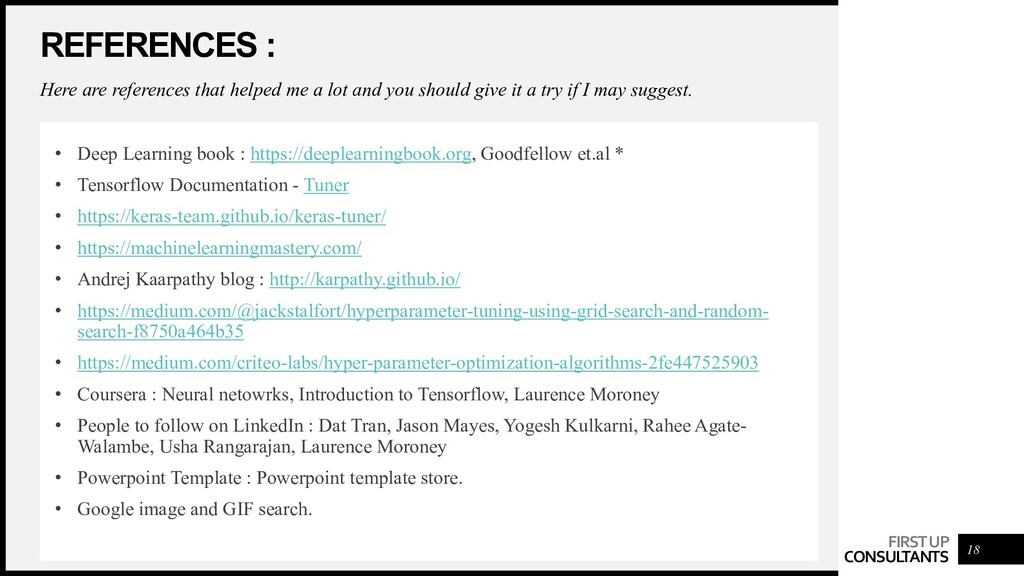
me a lot and you should give it a try if I may suggest. • Deep Learning book : https://deeplearningbook.org, Goodfellow et.al * • Tensorflow Documentation - Tuner • https://keras-team.github.io/keras-tuner/ • https://machinelearningmastery.com/ • Andrej Kaarpathy blog : http://karpathy.github.io/ • https://medium.com/@jackstalfort/hyperparameter-tuning-using-grid-search-and-random- search-f8750a464b35 • https://medium.com/criteo-labs/hyper-parameter-optimization-algorithms-2fe447525903 • Coursera : Neural netowrks, Introduction to Tensorflow, Laurence Moroney • People to follow on LinkedIn : Dat Tran, Jason Mayes, Yogesh Kulkarni, Rahee Agate- Walambe, Usha Rangarajan, Laurence Moroney • Powerpoint Template : Powerpoint template store. • Google image and GIF search. 18


 ashwinphadke12
 hollycummins
 prota
prota
 suneo3476
 tmikov2023
 moro
moro
 eed3si9n
 findyinc
 tomokon
 hschwentner
 skydoves
 texmeijin
 panda728
 codingconduct
 palkan
 quramy
 twada
twada
 tammyeverts
 lara
lara
 apolaine
 bcantrill
 sugarenia
 skoyamalab
 techseoconnect
 jonoalderson