Upgrade to Pro — share decks privately, control downloads, hide ads and more …

Quantum Computing and Quantum Logic Gates

Avatar for Vishnu Vishnu
July 02, 2021

Quantum Computing and Quantum Logic Gates

A Brief history of Quantum Computing.
Moore's Law/Observation
Where are we going with this? What's the future gonna be like?
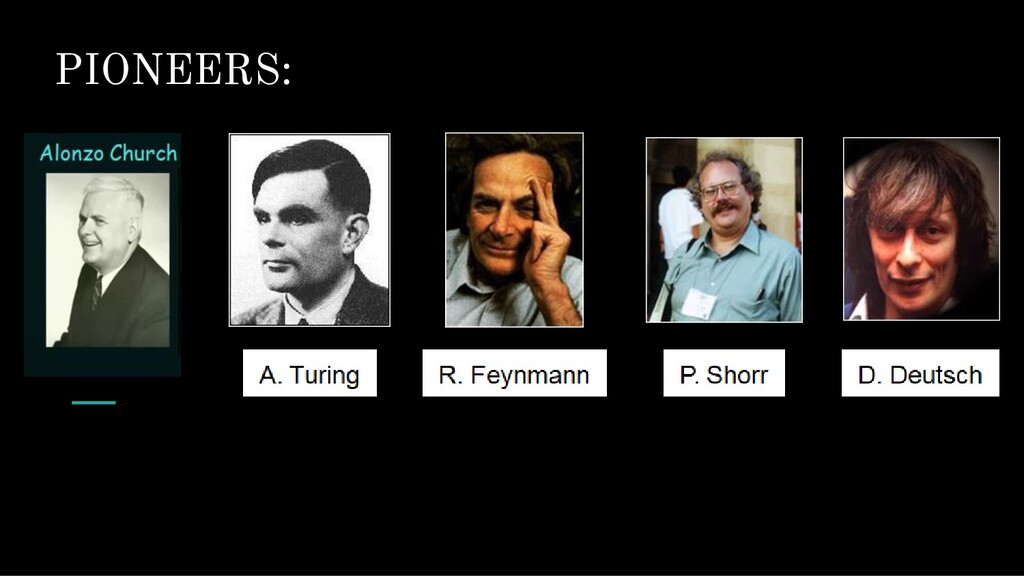
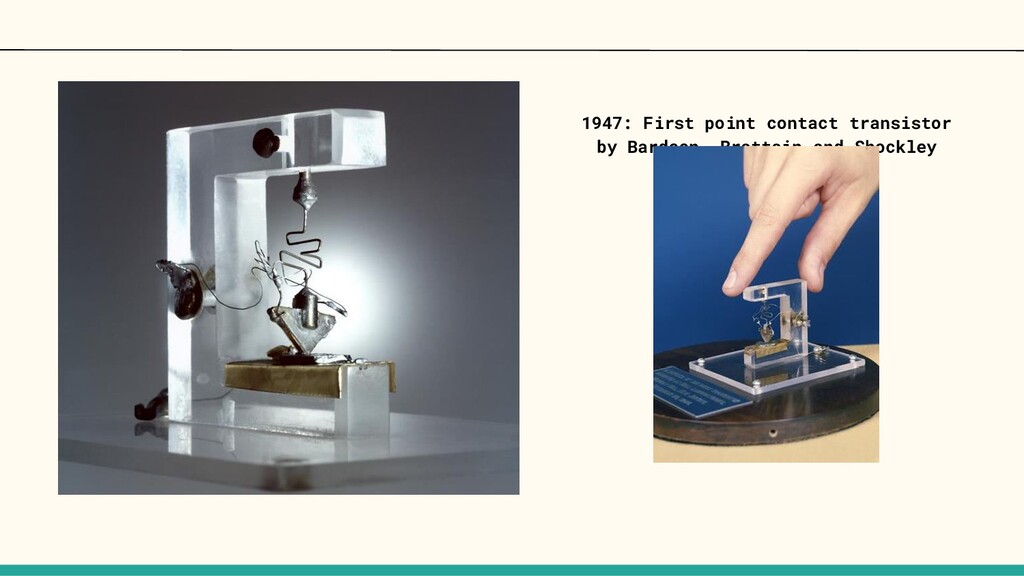
Pioneers.
Superposition, Entanglement, Decoherence, Qubits, Bits, Power of Quantum Computing, Quantum Logic Gates, Candidates for quantum computing, IBM's quantum experience, Use Cases, Quantum Algorithms, Useful links

Avatar for Vishnu

Vishnu

July 02, 2021

Other Decks in Education

Transcript

  1. Quantum Logic Gates This was my Technical Seminar paper. I

    hope this presentation gives you a basic clear picture about quantum computing! Make sure to refer those links at the end of this presentation. They are valuable if you want to dive in deep. Let’s connect! Follow me on: https://github.com/atkumarvishnu https://twitter.com/CleanScripting
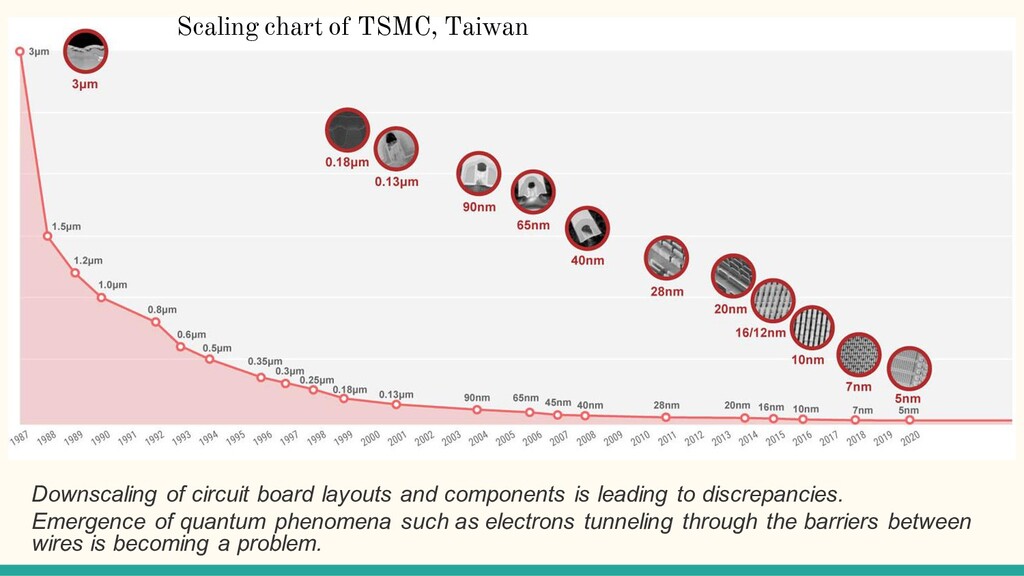
  2. Downscaling of circuit board layouts and components is leading to

    discrepancies. Emergence of quantum phenomena such as electrons tunneling through the barriers between wires is becoming a problem. Scaling chart of TSMC, Taiwan
  3. Despite giving us the most spectacular wave of technological innovation

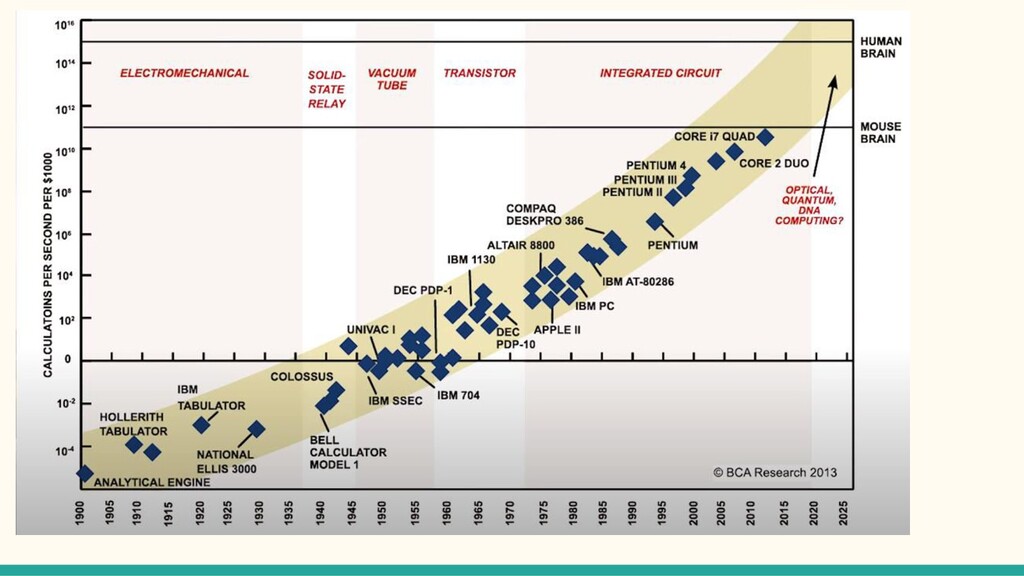
    in human history, there are certain computational problems that the digital revolution still can’t seem to solve. Some of these problems are holding back key scientific breakthroughs, and even the global economy. Although conventional computers have been doubling in power and processing speed nearly every 2-3 years for decades, they still don’t seem to be getting any closer to solving these persistent problems. If we ask any computer scientist, and they’ll probably give us the same answer: today’s digital, conventional computers are built on a classical, and very limited, model of computing. In the long run, to efficiently solve the world’s most persistent computing problems, we’re going to have to turn to an entirely new and more capable computer architecture: the quantum computer.
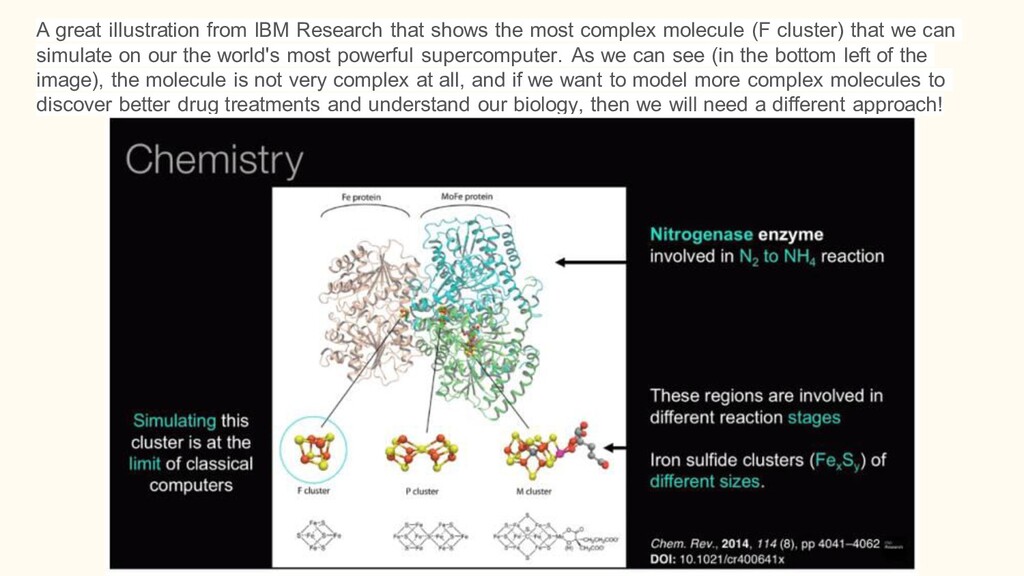
  4. A great illustration from IBM Research that shows the most

    complex molecule (F cluster) that we can simulate on our the world's most powerful supercomputer. As we can see (in the bottom left of the image), the molecule is not very complex at all, and if we want to model more complex molecules to discover better drug treatments and understand our biology, then we will need a different approach!
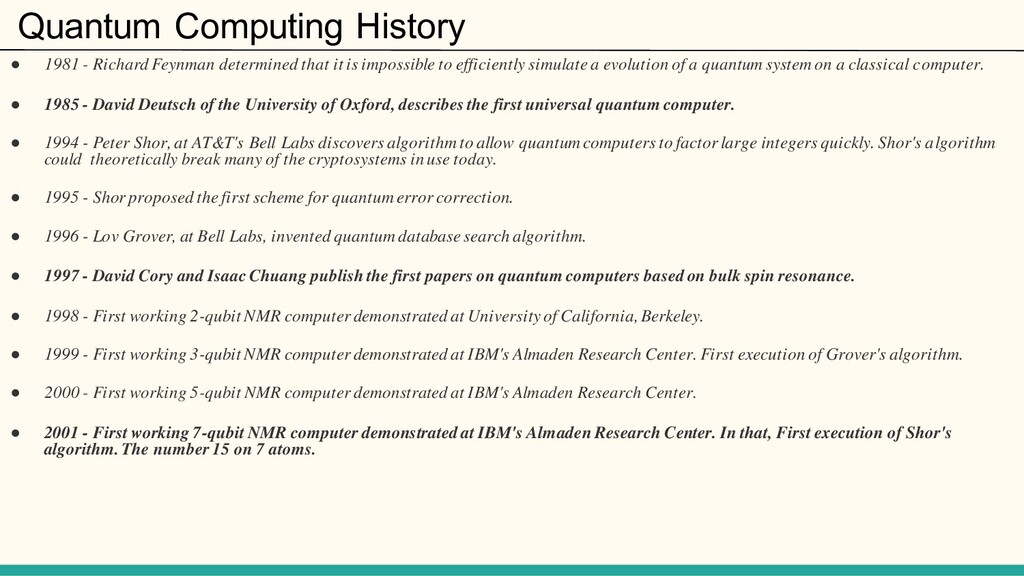
  5. Quantum Computing History • 1981 - Richard Feynman determined that

    it is impossible to efficiently simulate a evolution of a quantum system on a classical computer. • 1985 - David Deutsch of the University of Oxford, describes the first universal quantum computer. • 1994 - Peter Shor, at AT&T's Bell Labs discovers algorithm to allow quantum computers to factor large integers quickly. Shor's algorithm could theoretically break many of the cryptosystems in use today. • 1995 - Shor proposed the first scheme for quantum error correction. • 1996 - Lov Grover, at Bell Labs, invented quantum database search algorithm. • 1997 - David Cory and Isaac Chuang publish the first papers on quantum computers based on bulk spin resonance. • 1998 - First working 2-qubit NMR computer demonstrated at University of California, Berkeley. • 1999 - First working 3-qubit NMR computer demonstrated at IBM's Almaden Research Center. First execution of Grover's algorithm. • 2000 - First working 5-qubit NMR computer demonstrated at IBM's Almaden Research Center. • 2001 - First working 7-qubit NMR computer demonstrated at IBM's Almaden Research Center. In that, First execution of Shor's algorithm. The number 15 on 7 atoms.
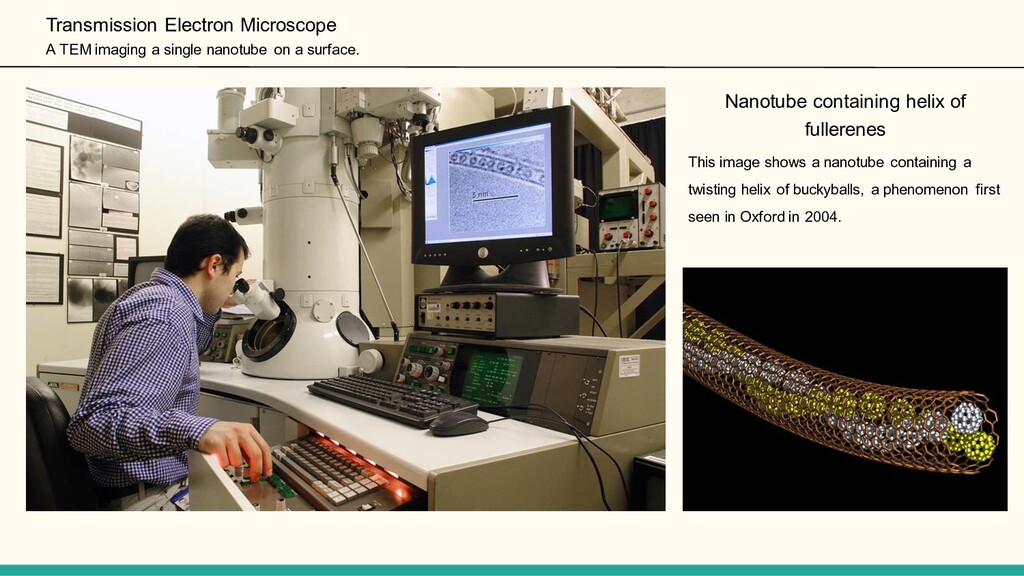
  6. Transmission Electron Microscope A TEM imaging a single nanotube on

    a surface. Nanotube containing helix of fullerenes This image shows a nanotube containing a twisting helix of buckyballs, a phenomenon first seen in Oxford in 2004.
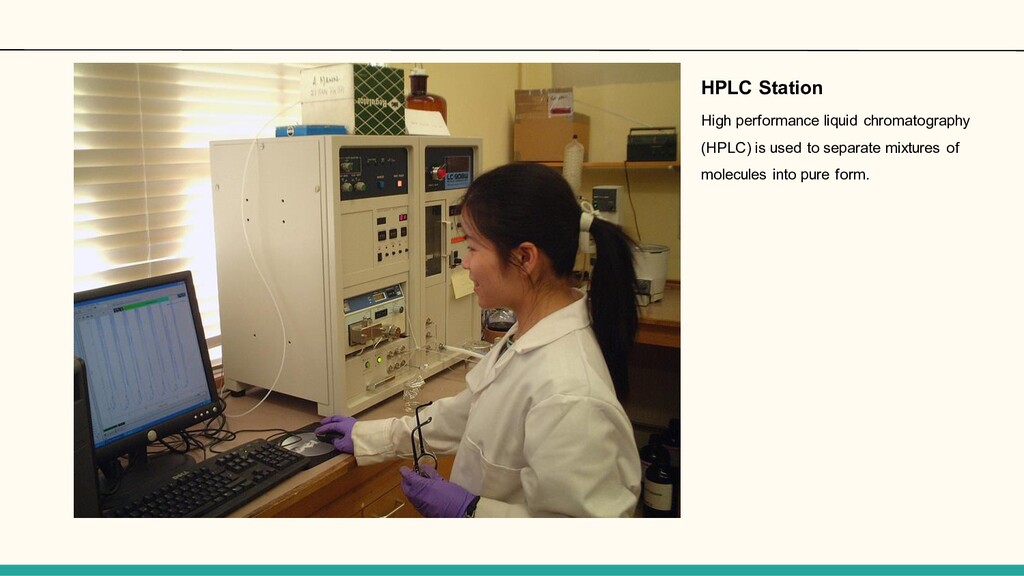
  7. HPLC Station High performance liquid chromatography (HPLC) is used to

    separate mixtures of molecules into pure form.
  8. Quantum Computer Conventional computers are strictly digital and rely purely

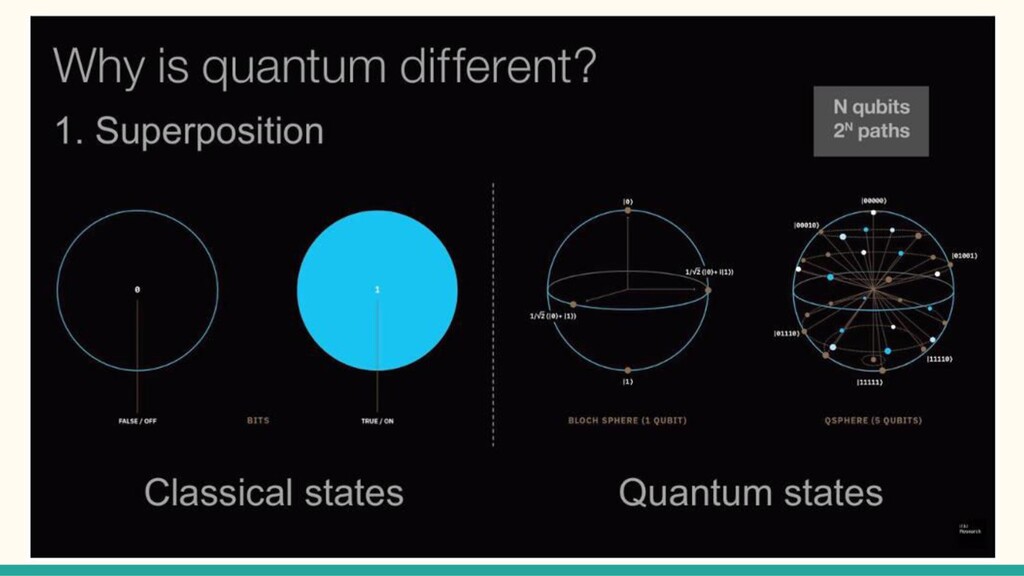
    on classical computing principles and properties. Quantum computers, on the other hand, are strictly quantum. Accordingly, they rely on quantum principles and properties — most importantly superposition and entanglement — that makes all the difference in their capacity to solve big problems. Quantum computers are devices that manipulate quantum bits, or qubits. But instead of using a transistor to perform this function, quantum computers directly encode this information onto elementary particles like electrons and photons, or even entire atoms. SO??? WHY IS QUANTUM DIFFERENT???????
  9. Superposition To make sense out of superposition, let’s consider the

    simplest possible system: A two-state system. An classical two-state system is like an ON/OFF switch that is always in one state (ON) or another (OFF). Yet a two-state quantum system is something else entirely. Whenever we measure its state, we will find that it is indeed either ON or OFF, just like a classical system. But between measurements, a quantum system can be in a superposition of both on and off states at the same time. Generally speaking, physicists maintain that it’s meaningless to talk about a quantum system’s state, such as its spin, prior to measurement. Some even say that the very act of measuring a quantum system causes it to collapse. Although it’s probably impossible to visualize, but this mysterious phenomenon is not only real but it gives rise to a new dimension of problem-solving power that paves the way for the quantum computer. How superposition is even possible is beyond the scope of this seminar, but it has been proven to be true. If we want to understand what gives rise to superposition then we are going to first need to understand the idea of Wave/Particle Duality.
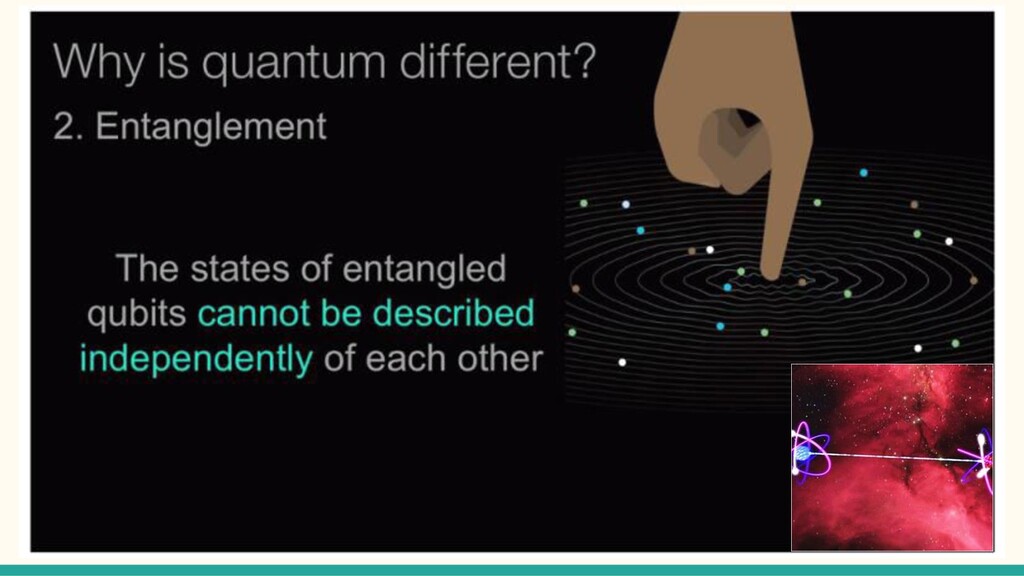
  10. Entanglement The next property of quantum mechanics which we need

    to create a quantum computer. It is known that once two quantum systems interact with one another, they become entangled. From then on, the state of one system will give us precise information about the state of the other system, no matter how far the two are from one another. The two systems can be light years apart and still give us precise and instantaneous information about each other. Let’s illustrate this with a concrete example (because this even caused Einstein to be puzzled about how this could be possible). Suppose we have two electrons, A and B. Once we have them interact in just the right way, their spins will automatically get entangled. From then on, if A’s spin is Up, B’s spin will be Down, except that this holds true even we take A and B to opposite ends of the Earth (or the galaxy). Despite the thousands of miles (or light years) between them, it’s been proven that if we measure A to have spin Up, we will know instantly that B’s spin is Down.
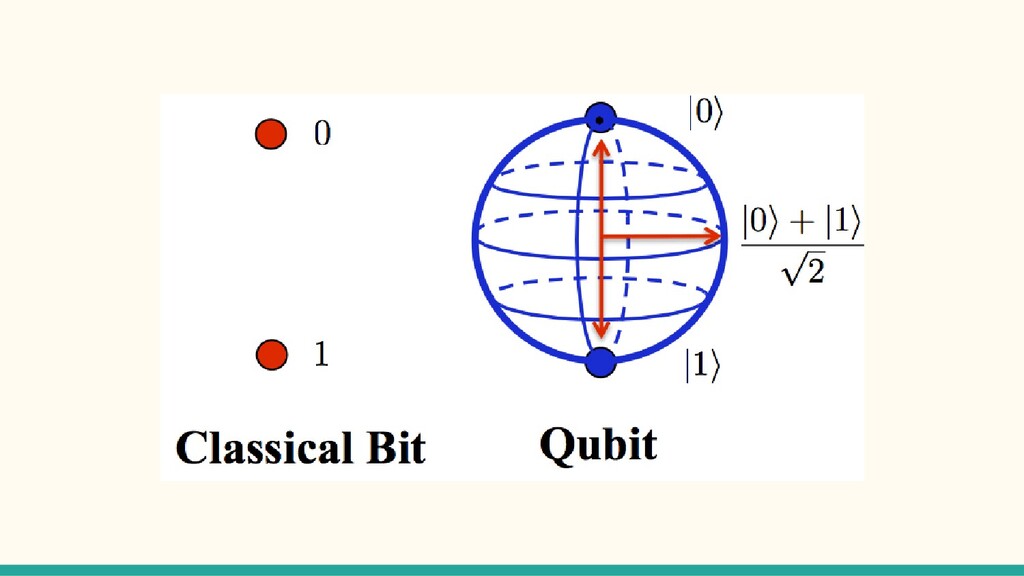
  11. What is a Qubit? Qubit is the basis of quantum

    computing. It is a 2 level quantum mechanical systems. It is quite similar to classical bits, classical bits can have any two values i.e., 0 and 1, but a Qubit can have values 0, 1 and anything in between that. When we put a Qubit in a state between 0 and 1, this is called Superposition. Superposition means when we measure the qubit, it will collapse in the state 0 or 1, with a certain probability, depending on the superposition. Many different particles can be a Qubits. One example is a Photon. Photon carries it’s information about it’s superposition and it’s polarization. For example: the photon can be horizontally polarized or vertically polarized or anywhere in between, Other examples are : Josephson junctions(superconducting qubits) in superconducting systems, trapped ions, nitrogen-vacancy centers(NV centers) in diamond. Qubits can also be entangled after which their states depend on one another.
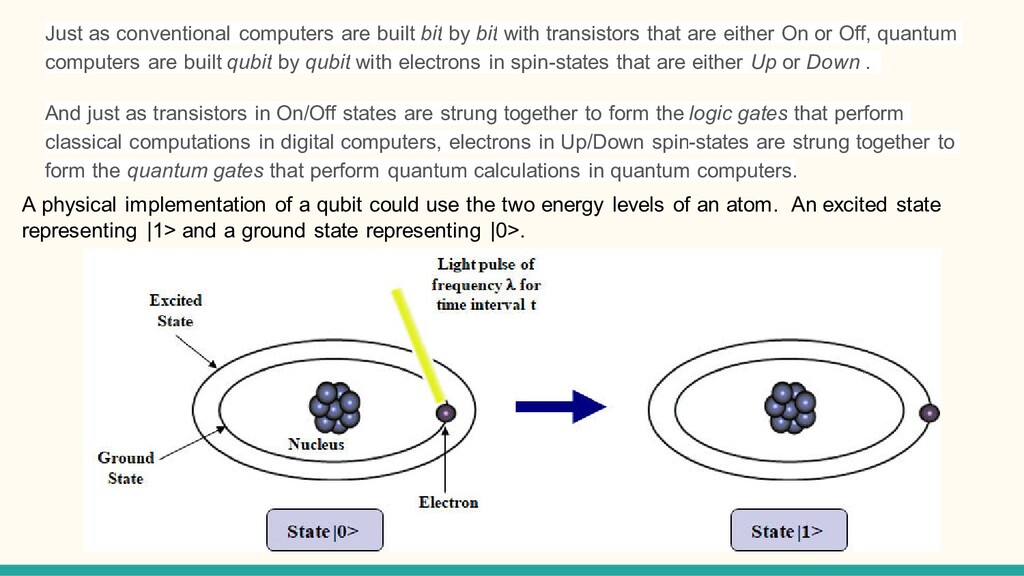
  12. Just as conventional computers are built bit by bit with

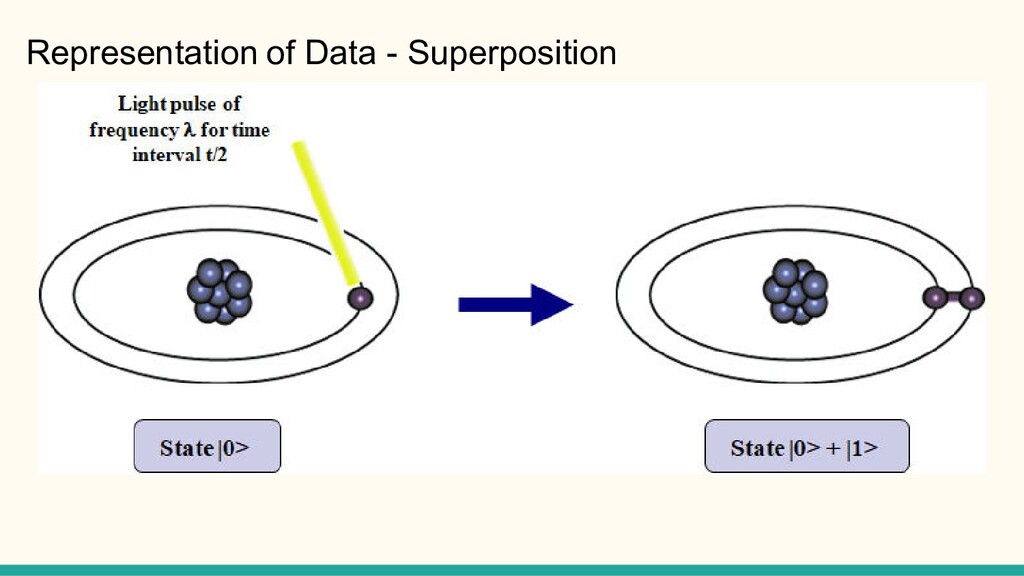
    transistors that are either On or Off, quantum computers are built qubit by qubit with electrons in spin-states that are either Up or Down . And just as transistors in On/Off states are strung together to form the logic gates that perform classical computations in digital computers, electrons in Up/Down spin-states are strung together to form the quantum gates that perform quantum calculations in quantum computers. A physical implementation of a qubit could use the two energy levels of an atom. An excited state representing |1> and a ground state representing |0>.
  13. Enormous Quantum Power Example: A 64-bit computer can perform manipulation

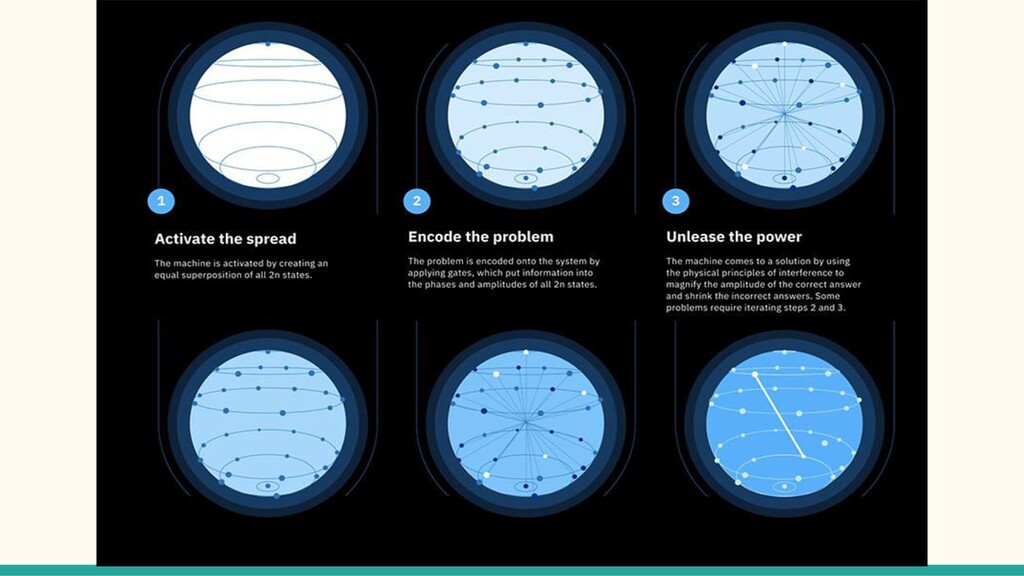
    on 64-bit binary numbers at a time. A 64-qubit quantum computer operates in a space of 264 dimensions, or roughly 16,000,000,000,000,000,000 (16*1018) numbers to specify the state of the quantum system. Using cleverly crafted quantum algorithms and “quantum gates”, the computation can happen in this enormous space in parallel – it is as if all of the answers were being evaluated simultaneously, and the quantum system freezes out the right answer from this vast space. It also means we double the power with every added qubit. To double the power of a digital computer 32 bits -> 64 bits To double the power of a quantum computer 32 qubits -> 33 qubits
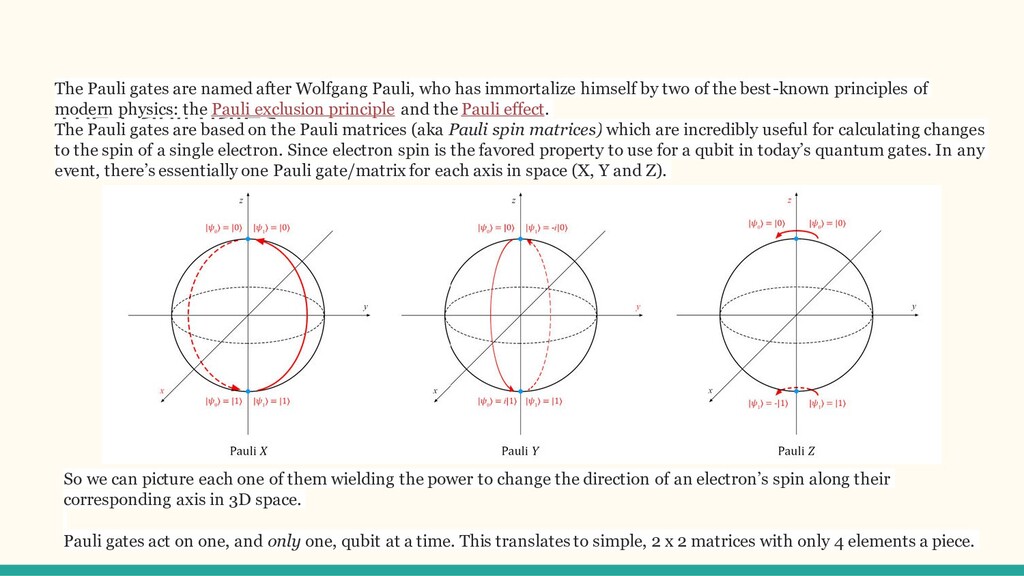
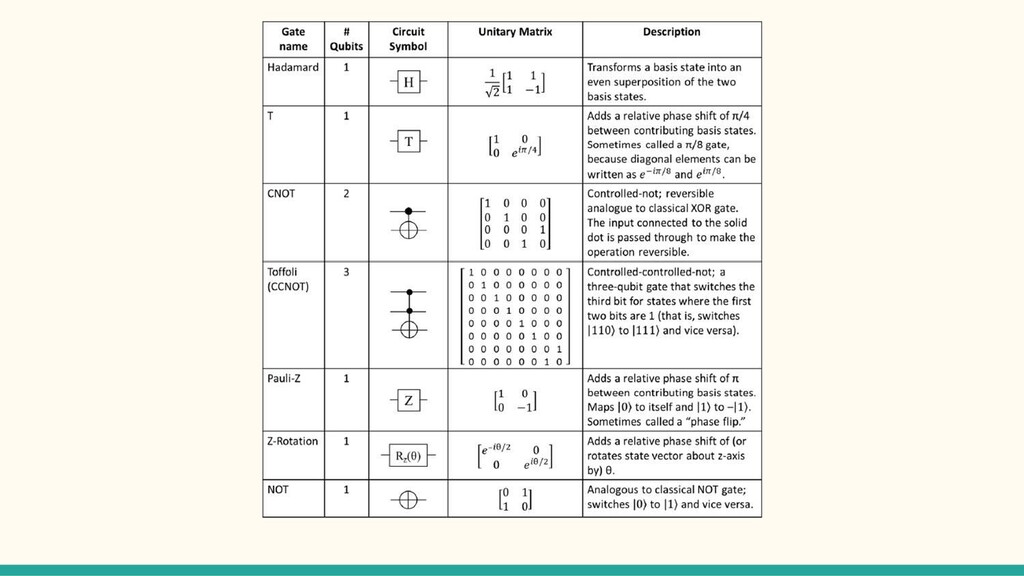
  14. The Pauli gates The Pauli gates are named after Wolfgang

    Pauli, who has immortalize himself by two of the best-known principles of modern physics: the Pauli exclusion principle and the Pauli effect. The Pauli gates are based on the Pauli matrices (aka Pauli spin matrices) which are incredibly useful for calculating changes to the spin of a single electron. Since electron spin is the favored property to use for a qubit in today’s quantum gates. In any event, there’s essentially one Pauli gate/matrix for each axis in space (X, Y and Z). So we can picture each one of them wielding the power to change the direction of an electron’s spin along their corresponding axis in 3D space. Pauli gates act on one, and only one, qubit at a time. This translates to simple, 2 x 2 matrices with only 4 elements a piece.
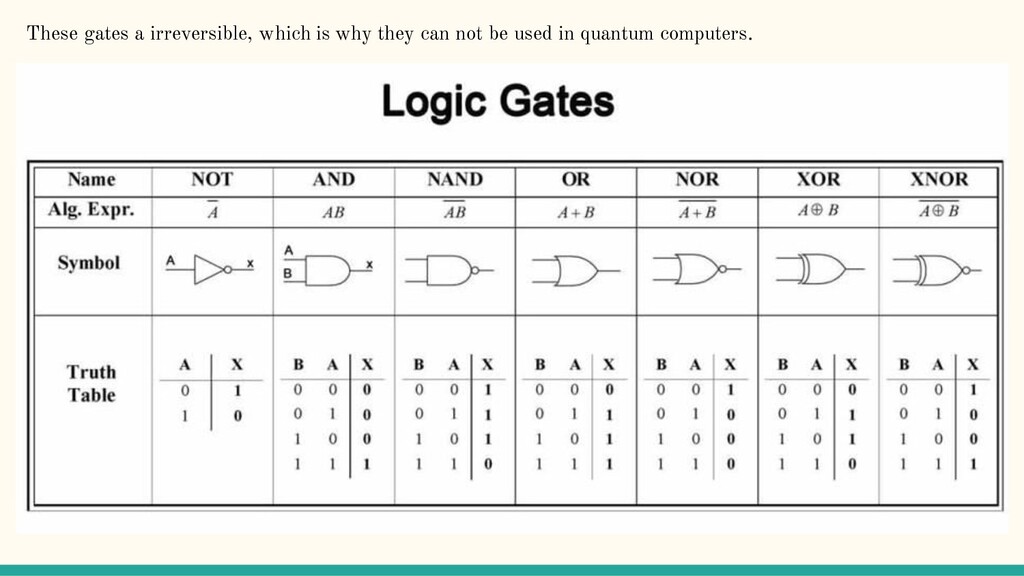
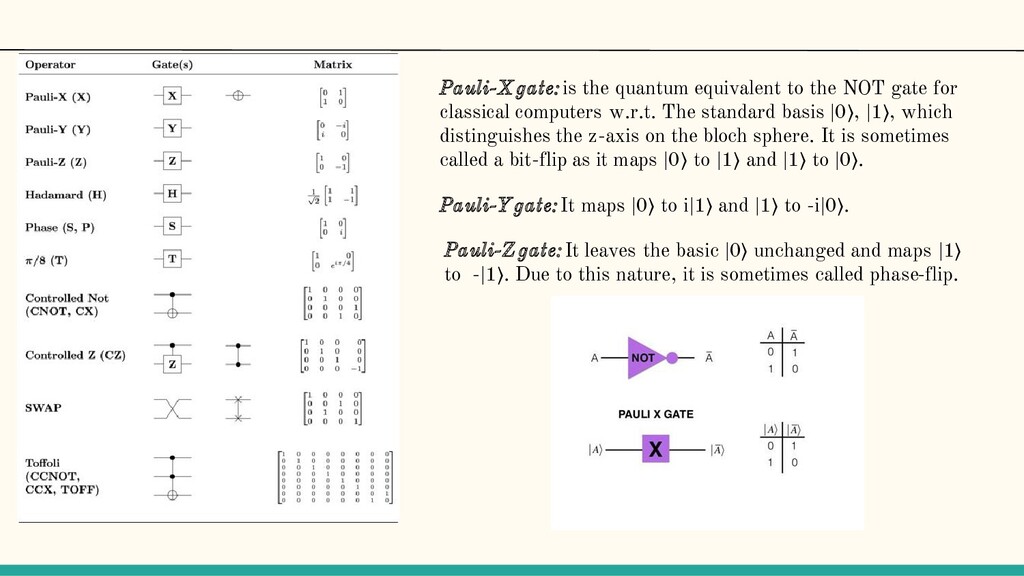
  15. Pauli-X gate: is the quantum equivalent to the NOT gate

    for classical computers w.r.t. The standard basis |0〉, |1〉, which distinguishes the z-axis on the bloch sphere. It is sometimes called a bit-flip as it maps |0〉 to |1〉 and |1〉 to |0〉. Pauli-Y gate: It maps |0〉 to i|1〉 and |1〉 to -i|0〉. Pauli-Z gate: It leaves the basic |0〉 unchanged and maps |1〉 to -|1〉. Due to this nature, it is sometimes called phase-flip.
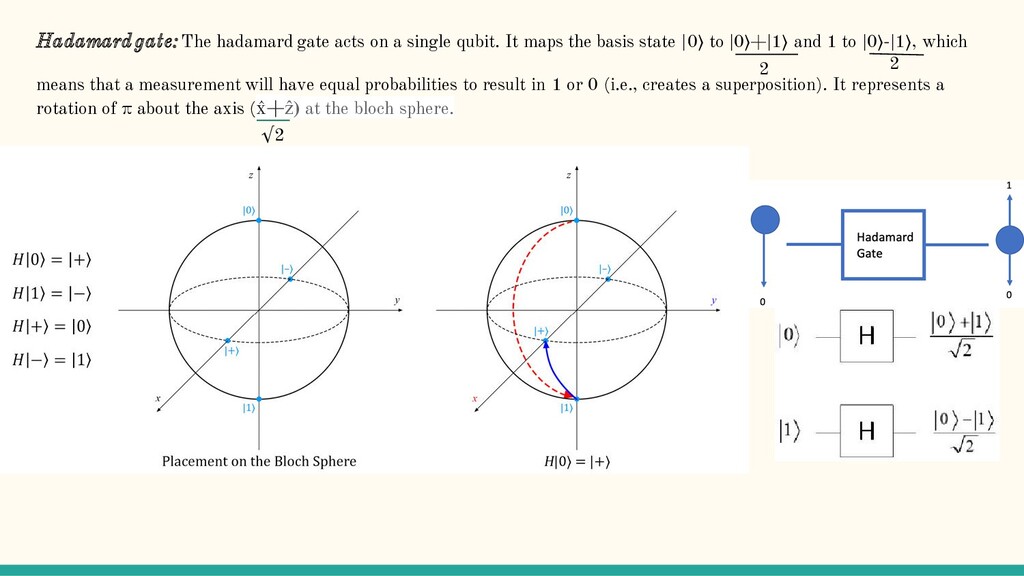
  16. Hadamard gate: The hadamard gate acts on a single qubit.

    It maps the basis state |0〉 to |0〉+|1〉 and 1 to |0〉-|1〉, which means that a measurement will have equal probabilities to result in 1 or 0 (i.e., creates a superposition). It represents a rotation of π about the axis (x̂+ẑ) at the bloch sphere. 2 2 √2
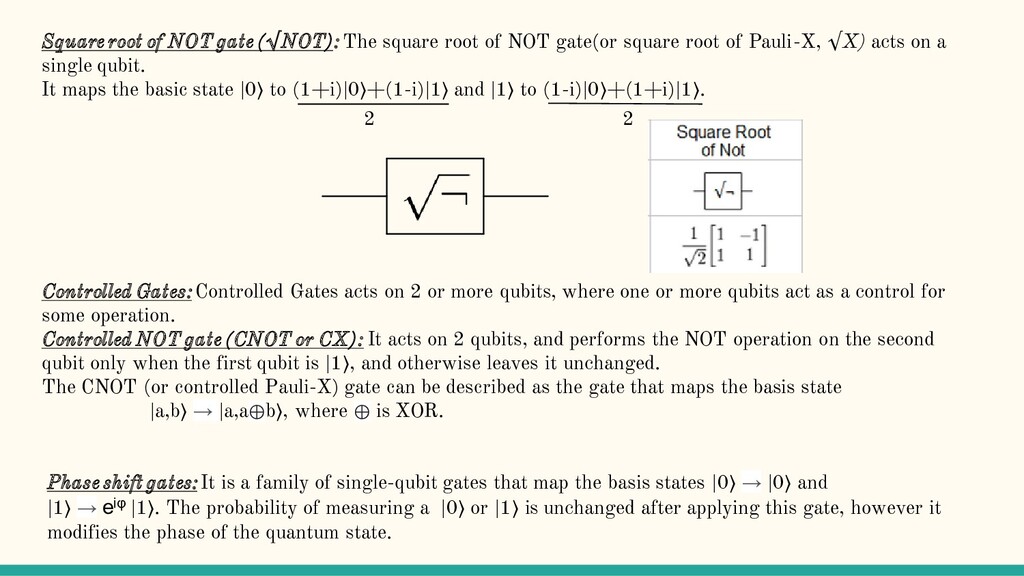
  17. Square root of NOT gate (√NOT): The square root of

    NOT gate(or square root of Pauli-X, √X) acts on a single qubit. It maps the basic state |0〉 to (1+i)|0〉+(1-i)|1〉 and |1〉 to (1-i)|0〉+(1+i)|1〉. 2 2 Controlled Gates: Controlled Gates acts on 2 or more qubits, where one or more qubits act as a control for some operation. Controlled NOT gate (CNOT or CX): It acts on 2 qubits, and performs the NOT operation on the second qubit only when the first qubit is |1〉, and otherwise leaves it unchanged. The CNOT (or controlled Pauli-X) gate can be described as the gate that maps the basis state |a,b〉 → |a,a⊕b〉, where ⊕ is XOR. Phase shift gates: It is a family of single-qubit gates that map the basis states |0〉 → |0〉 and |1〉 → eiφ |1〉. The probability of measuring a |0〉 or |1〉 is unchanged after applying this gate, however it modifies the phase of the quantum state.
  18. Swap gates: The swap gates swap two qubits. Square root

    of swap gate: The √SWAP gate performs half-way of a two-qubit swap. It is universal such that any form of many-qubit gate can be constructed from only √SWAP and single qubit gates. Toffoli (CCNOT) gate: The toffoli gate, named after Tommaso Toffoli; also called CCNOT gate or Deutsch gate D(π/2); is a 3-bit gate, which is universal for classical computation but not for quantum computation. The quantum Toffoli gate is the same gate, defined for 3-qubits. If we limit ourselves to only accepting input qubits that are |0〉 and |1〉, then if the first two bits are in the state |1〉, then it applies a Pauli-X (or NOT) on the third bit, else it does nothing. It is an example of a controlled gate. The Toffoli gate is universal when combined with the single qubit Hadamard gate. The Toffoli gate is related to the classical AND(^) and XOR() operations as it performs the mapping |a,b,c〉 → |a,b,c⊕(a^b)〉 on states in the computational basis.
  19. Rotation operator gates: The Rotation operator gates Rₓ(θ), Rᵧ(θ), and

    Rz(θ) are the analog rotation matrices in three Cartesian axes on the axes of the Bloch Sphere. The Rotation matrices are related to the pauli matrices in the following way: Rₓ(π) = -iX, Rᵧ(π) = -iY, and Rz(π) = -iZ. UNIVERSAL QUANTUM GATES: A set of universal quantum gates is any set of gates to which any operation possible on a quantum computer can be reduced, i.e., any other unitary operations can be expressed as a finite sequence of gates from the set. The Rotation operators Rₓ(θ), Rᵧ(θ), and Rz(θ) , the phase shift gate P(φ) and the CNOT form a widely used universal set of quantum gates. A common universal gate set is the Clifford + T gate set, which is composed of the CNOT, H, S, and T gates. The clifford set alone is not universal and can be efficiently simulated classically by the Gottesman-Knill Theorem. The Toffoli gate forms a set of universal gates for reversible logic circuits. A two-gate set of universal quantum gates containing a Toffoli gate can be constructed by adding the Hadamard gate to the set. A single-gate set of universal quantum gates can also be formulated using the three-qubit Deutsch gate. A universal logic gate for reversible classical computing, the Toffoli gate, is reducible to the Deutsch gate, thus showing that all reversible classical logic operations can be performed on a universal quantum computer.
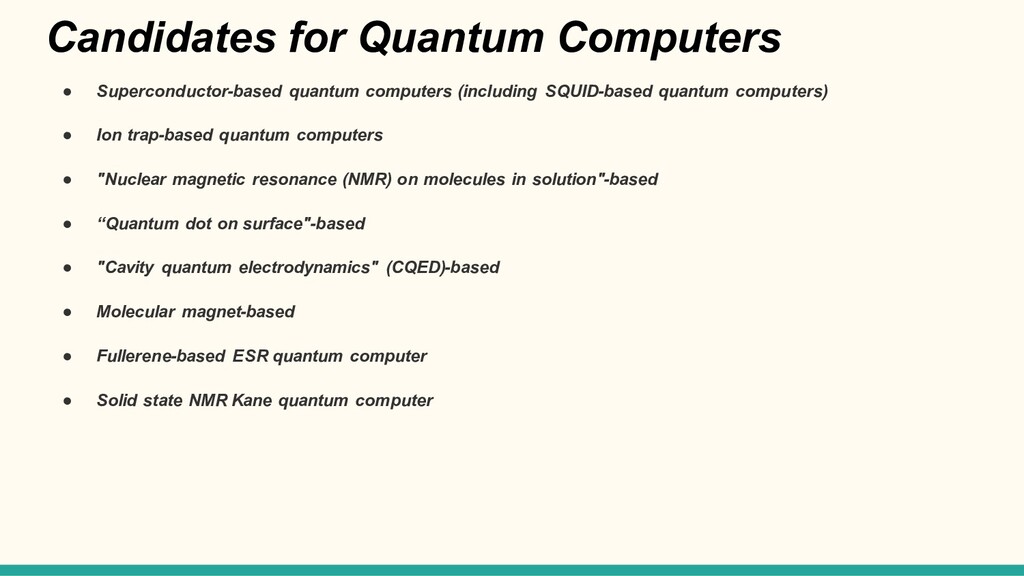
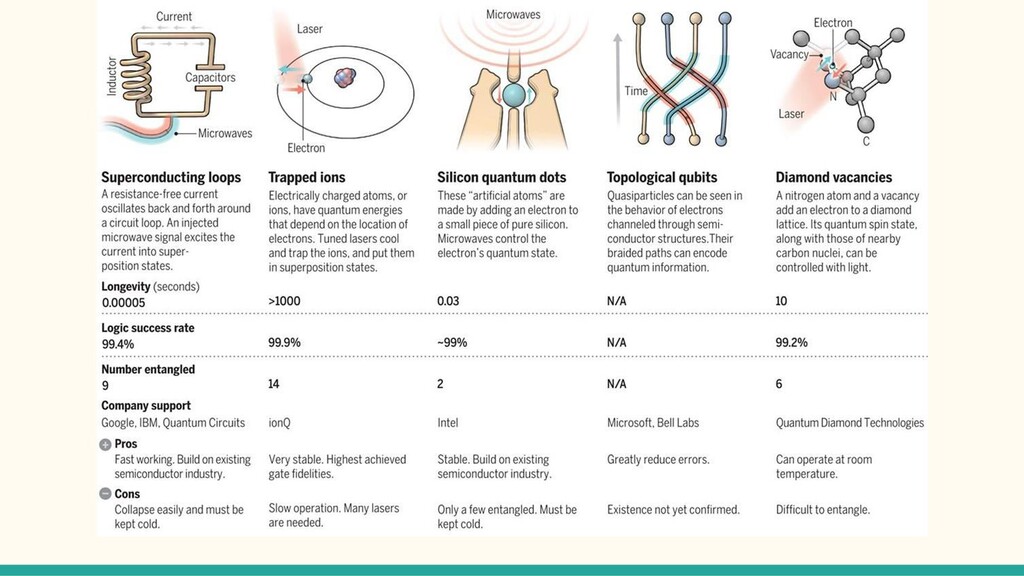
  20. Candidates for Quantum Computers • Superconductor-based quantum computers (including SQUID-based

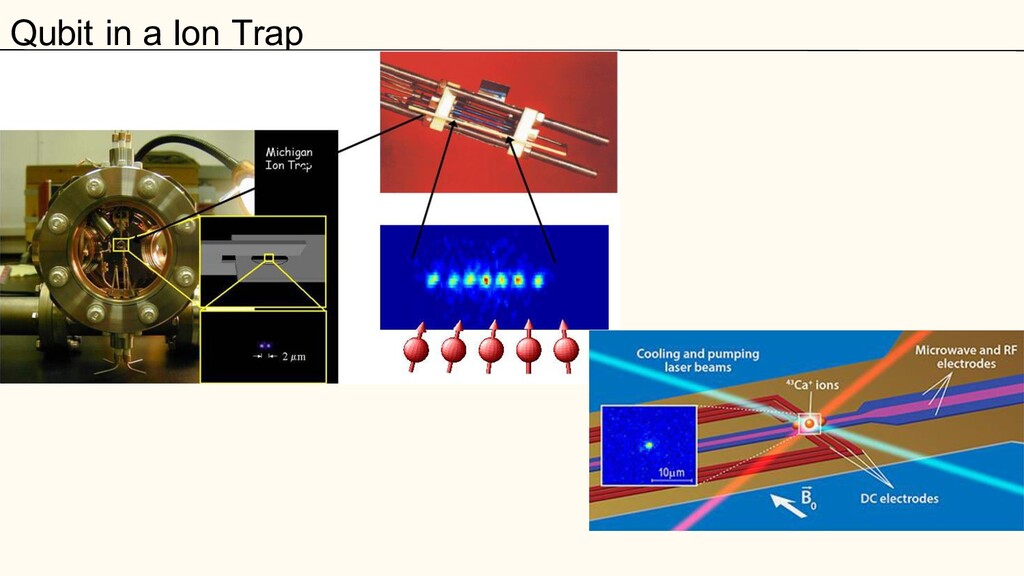
    quantum computers) • Ion trap-based quantum computers • "Nuclear magnetic resonance (NMR) on molecules in solution"-based • “Quantum dot on surface"-based • "Cavity quantum electrodynamics" (CQED)-based • Molecular magnet-based • Fullerene-based ESR quantum computer • Solid state NMR Kane quantum computer
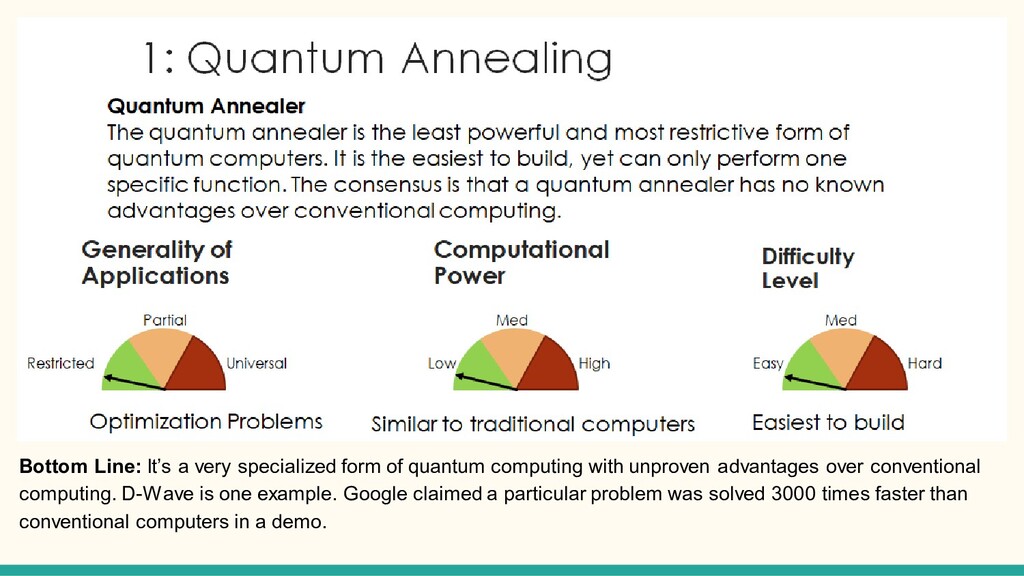
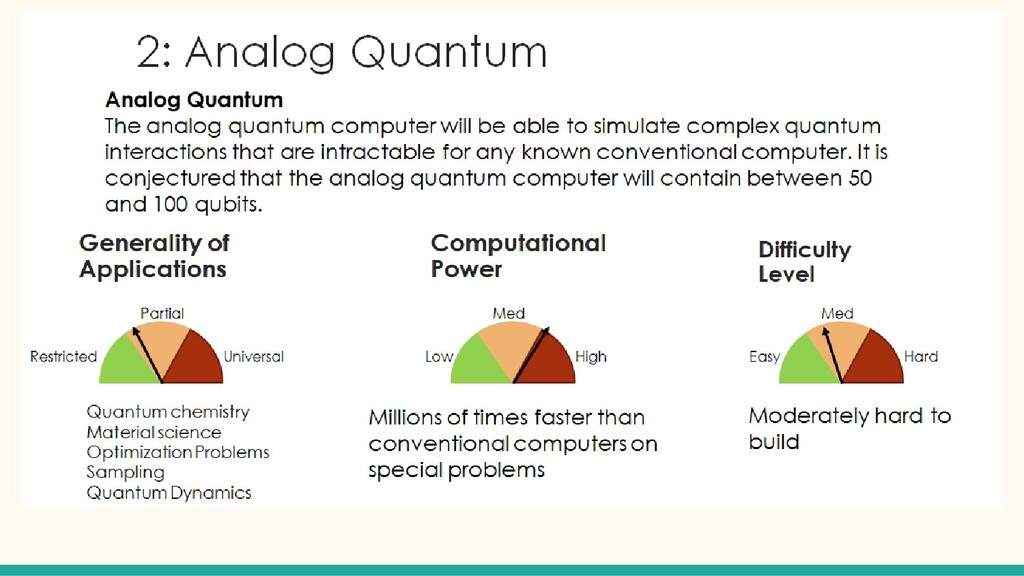
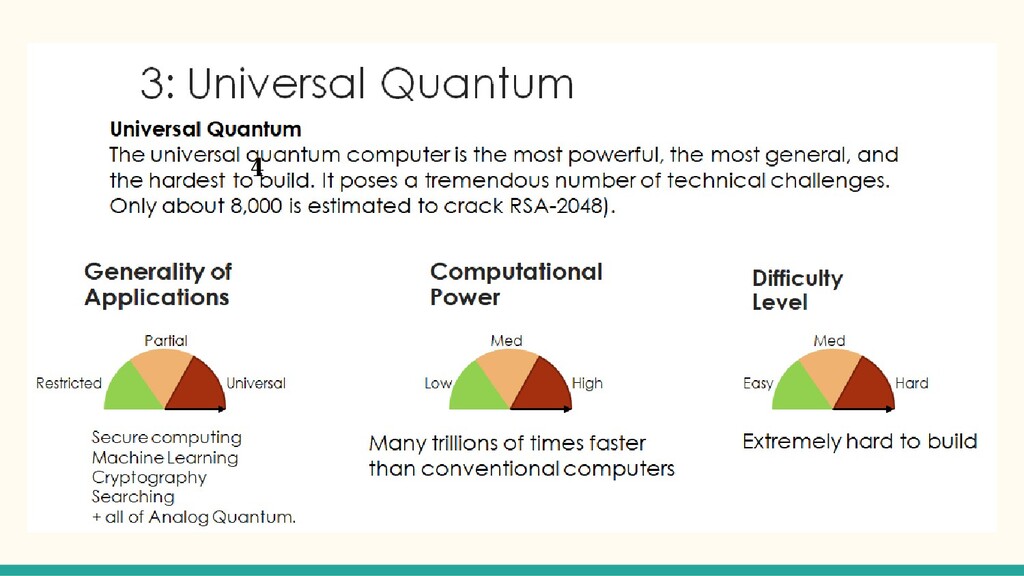
  21. 3 types of quantum computers 1.Quantum Annealing computer 2. Analog

    Quantum Computers 3.Universal Quantum Computer
  22. Bottom Line: It’s a very specialized form of quantum computing

    with unproven advantages over conventional computing. D-Wave is one example. Google claimed a particular problem was solved 3000 times faster than conventional computers in a demo.
  23. 4

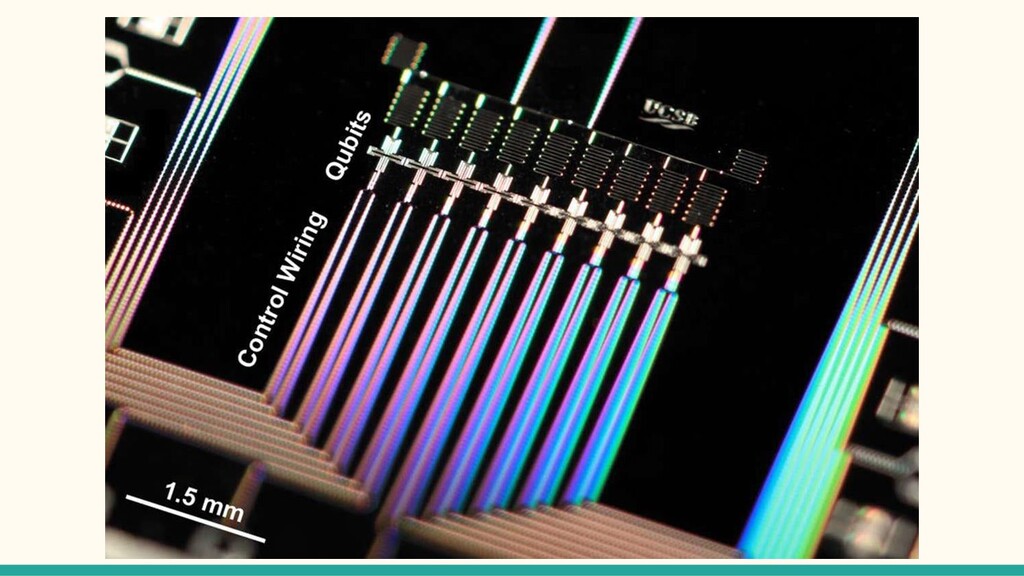
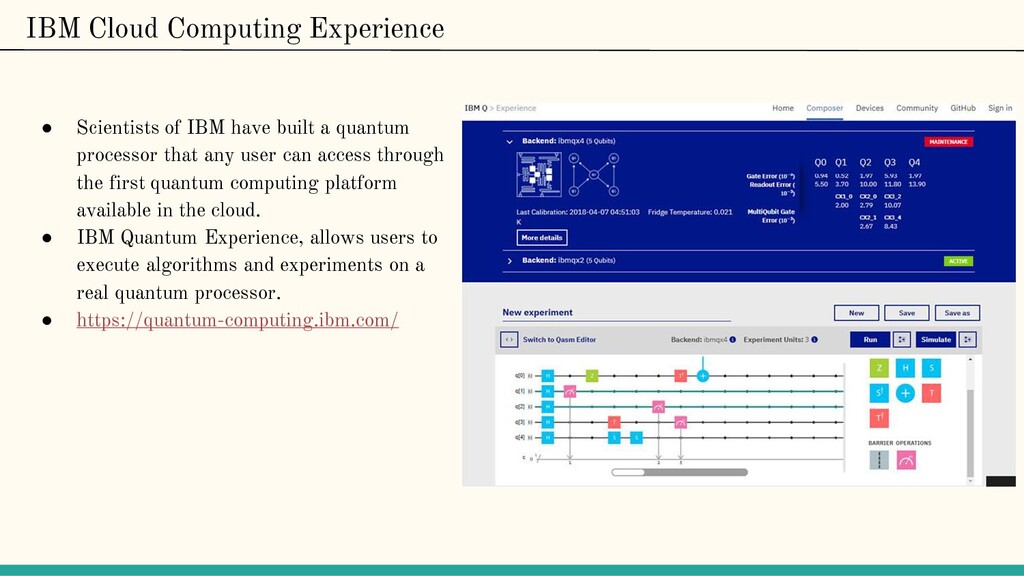
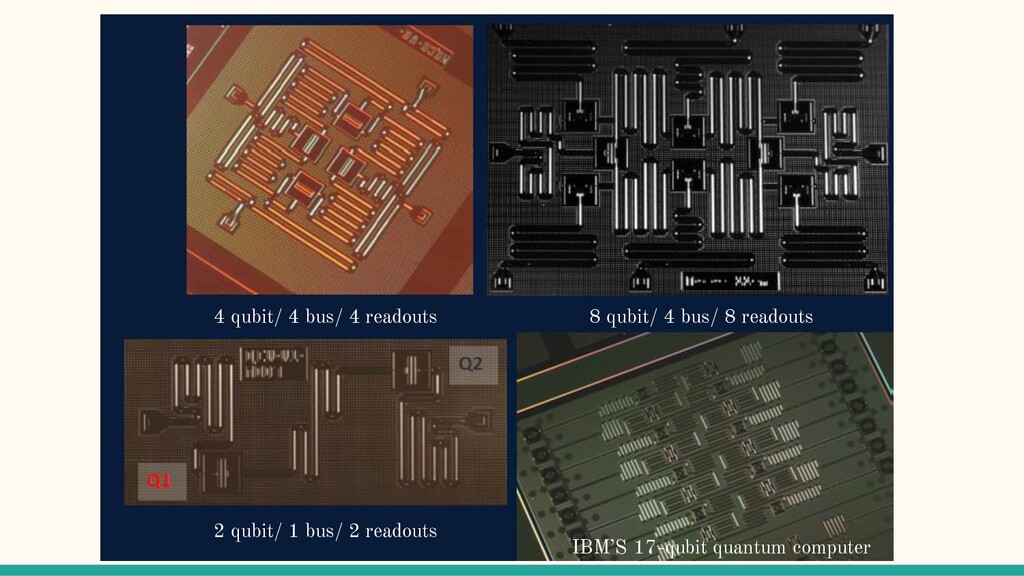
  24. IBM Cloud Computing Experience • Scientists of IBM have built

    a quantum processor that any user can access through the first quantum computing platform available in the cloud. • IBM Quantum Experience, allows users to execute algorithms and experiments on a real quantum processor. • https://quantum-computing.ibm.com/
  25. 4 qubit/ 4 bus/ 4 readouts 8 qubit/ 4 bus/

    8 readouts 2 qubit/ 1 bus/ 2 readouts IBM’S 17-qubit quantum computer
  26. Where are we today? The world’s leading experimental computer scientists

    are still struggling to build a quantum computer “chip” with more than a handful of qubits. Just to give a sense of how early we are in the history of quantum computing, it was a big deal when recently IBM unveiled the largest quantum computer in the world with an astonishing 50 qubits. Nonetheless, it’s a start, and if anything like Moore’s law applies to quantum computers, we should get into the hundreds in a few years, and the thousands in a few more. We don’t need a billion qubits to outperform a conventional computer in some key categories, such as prime categorization, molecular modeling and optimization problems that no conventional computer can do today. As of right now, nearly every quantum computer is a multi-million dollar project. We generally find them in R&D departments at large IT companies like IBM, or in the experimental physics wing of large research universities, like MIT.
  27. The primary reason that quantum computers haven’t gone mainstream yet

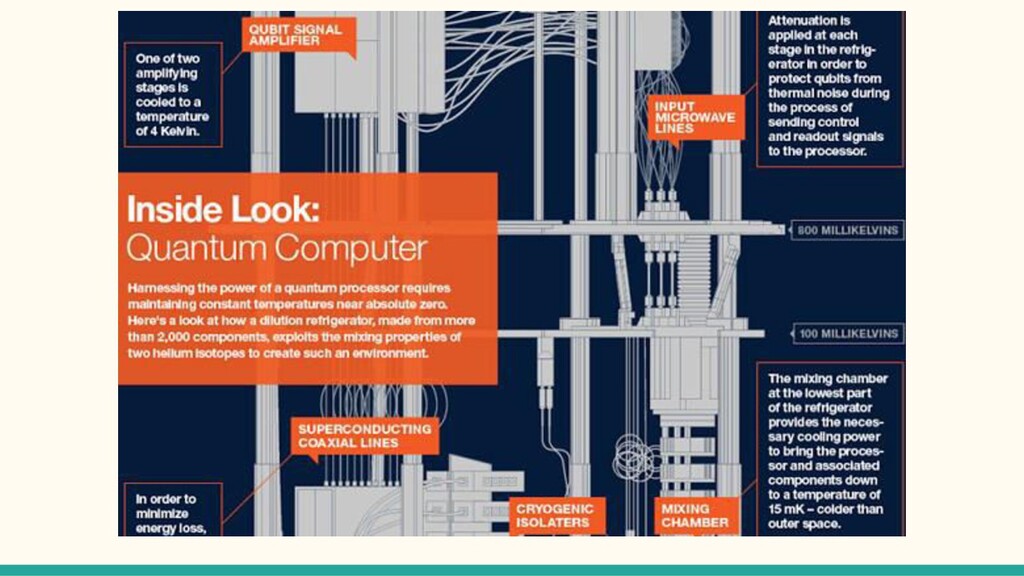
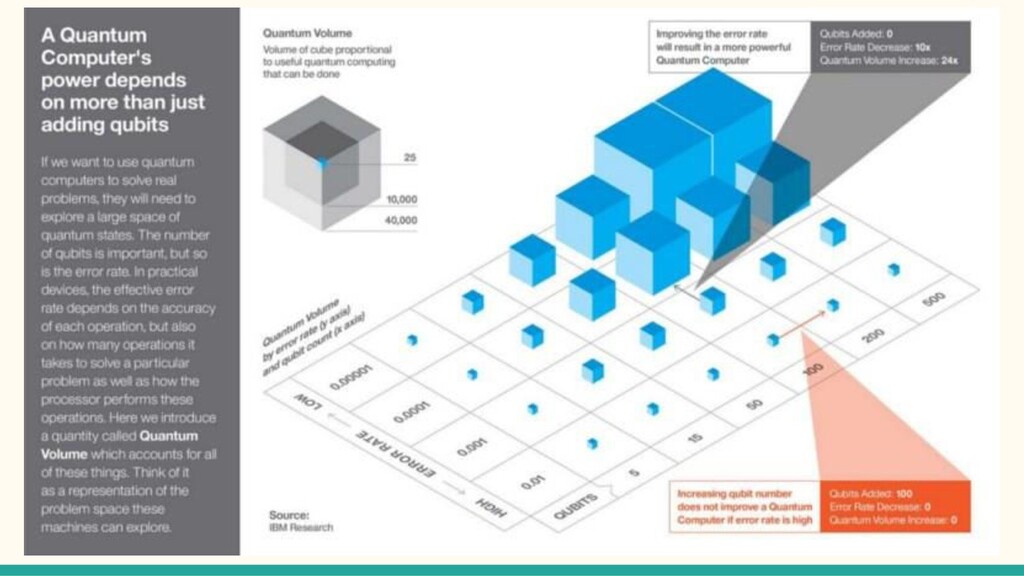
    is because we still are struggling with high error rates and low numbers of qubits. As we address these two problems together, we will rapidly increase what IBM calls each computers “quantum volume,” it’s a way of visualizing the sheer quantity of useful calculations a quantum computer can perform. They have to be super-cooled to a temperature just a little bit above absolute zero (which is colder than intergalactic space), and experimenters need to use microwaves of a precise frequency to communicate with each qubit in the computer individually. Now we can say that it won’t scale this way. But neither did the vacuum tubes of the earliest conventional computers, so we should not judge the first generation of quantum computers so harshly. Roadblocks awaiting Breakthrough
  28. USE CASES: DEPT OF TCE, CMR INSTITUTE OF TECHNOLOGY, #132,

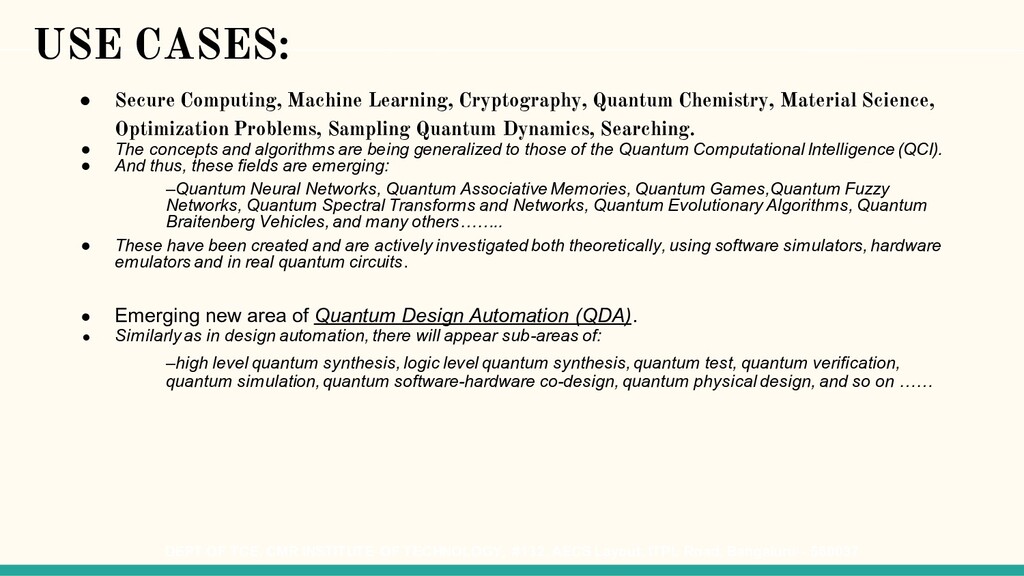
    AECS Layout, ITPL Road, Bengaluru - 560037 • Secure Computing, Machine Learning, Cryptography, Quantum Chemistry, Material Science, Optimization Problems, Sampling Quantum Dynamics, Searching. • The concepts and algorithms are being generalized to those of the Quantum Computational Intelligence (QCI). • And thus, these fields are emerging: –Quantum Neural Networks, Quantum Associative Memories, Quantum Games,Quantum Fuzzy Networks, Quantum Spectral Transforms and Networks, Quantum Evolutionary Algorithms, Quantum Braitenberg Vehicles, and many others…….. • These have been created and are actively investigated both theoretically, using software simulators, hardware emulators and in real quantum circuits. • Emerging new area of Quantum Design Automation (QDA). • Similarly as in design automation, there will appear sub-areas of: –high level quantum synthesis, logic level quantum synthesis, quantum test, quantum verification, quantum simulation, quantum software-hardware co-design, quantum physical design, and so on ……
  29. Quantum Algorithms • SHOR’S ALGORITHM: Integer Factorization - It produces

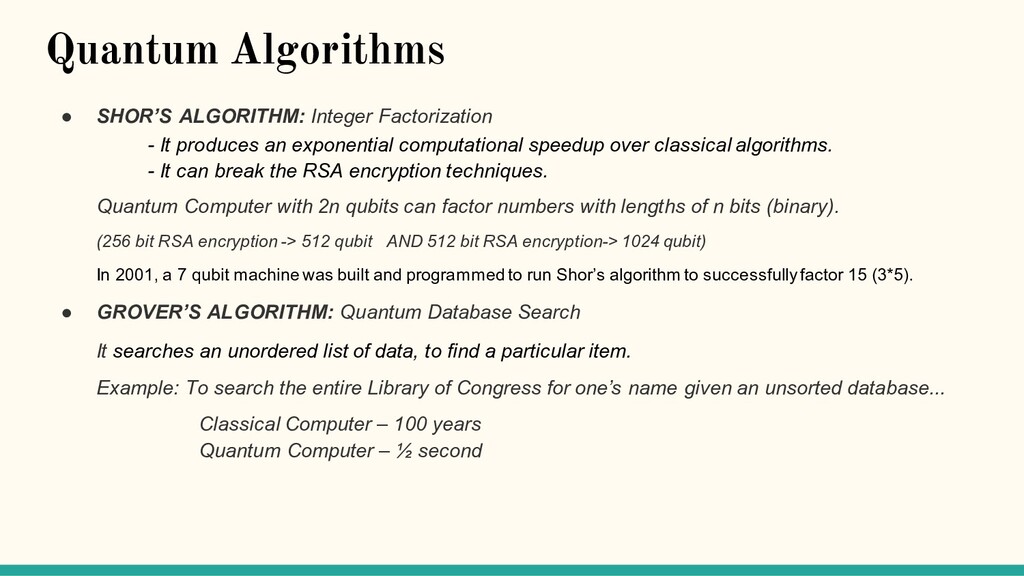
    an exponential computational speedup over classical algorithms. - It can break the RSA encryption techniques. Quantum Computer with 2n qubits can factor numbers with lengths of n bits (binary). (256 bit RSA encryption -> 512 qubit AND 512 bit RSA encryption-> 1024 qubit) In 2001, a 7 qubit machine was built and programmed to run Shor’s algorithm to successfully factor 15 (3*5). • GROVER’S ALGORITHM: Quantum Database Search It searches an unordered list of data, to find a particular item. Example: To search the entire Library of Congress for one’s name given an unsorted database... Classical Computer – 100 years Quantum Computer – ½ second
  30. No Explanations till date! Although we know that quantum computers

    can easily do things that no conventional computer can do, we don’t really know how they do it. The first-generation of quantum computers already exists, and we still don’t know their inner functions, we have to keep in mind the word quantum. We’ve been using quantum mechanics to solve problems for a century now, and we still don’t really know how it works. Quantum computing, as a member of the quantum family, is the same. Michael Nielsen (who wrote the book on the subject), has argued that any explanation of quantum computing is destined to miss the mark. After all, according to Nielsen, if there was a straightforward explanation for how a quantum computer works (that is, something you could visualize), then it could be simulated on a conventional computer. But if it could be simulated on a conventional computer, then it couldn’t be an accurate model of a quantum computer, because a quantum computer by definition does what no conventional computer can do. According to Nielsen, what quantum computers, like all quantum systems, are really doing behind the scenes is entirely out of our reach. We see the input, and the output, and what happens in between is sealed in mystery.
  31. Limitations A recent Quanta Magazine article pointed out, that today’s

    quantum computers aren’t ready. Before they can compete with classical computers with billions of times as many logic gates, they will need to face a few of their own demons. The most deadly problem is decoherence. Right now, quantum decoherence will destroy the quantum computation in just “a few microseconds.” However, the faster the quantum gates perform their operations, the more likely the quantum algorithm will beat the decoherence. Alongside speed, another important factor is the sheer number of operations performed by quantum gates to complete a calculation. This is known as a computation depth. By this logic, as the quantum computers gets faster, its calculations will get deeper, and the countdown-to- decoherence will get longer.
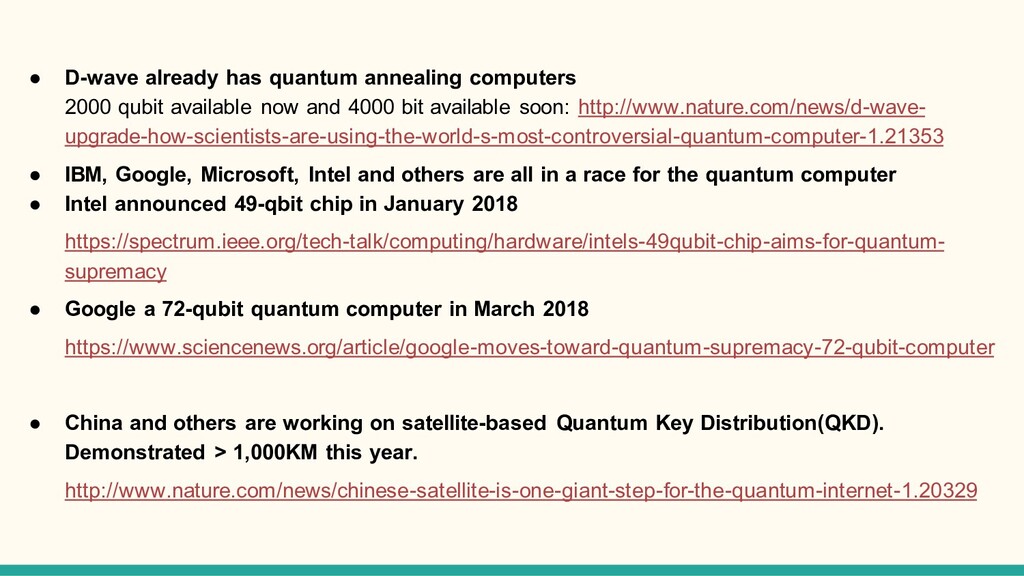
  32. • D-wave already has quantum annealing computers 2000 qubit available

    now and 4000 bit available soon: http://www.nature.com/news/d-wave- upgrade-how-scientists-are-using-the-world-s-most-controversial-quantum-computer-1.21353 • IBM, Google, Microsoft, Intel and others are all in a race for the quantum computer • Intel announced 49-qbit chip in January 2018 https://spectrum.ieee.org/tech-talk/computing/hardware/intels-49qubit-chip-aims-for-quantum- supremacy • Google a 72-qubit quantum computer in March 2018 https://www.sciencenews.org/article/google-moves-toward-quantum-supremacy-72-qubit-computer • China and others are working on satellite-based Quantum Key Distribution(QKD). Demonstrated > 1,000KM this year. http://www.nature.com/news/chinese-satellite-is-one-giant-step-for-the-quantum-internet-1.20329
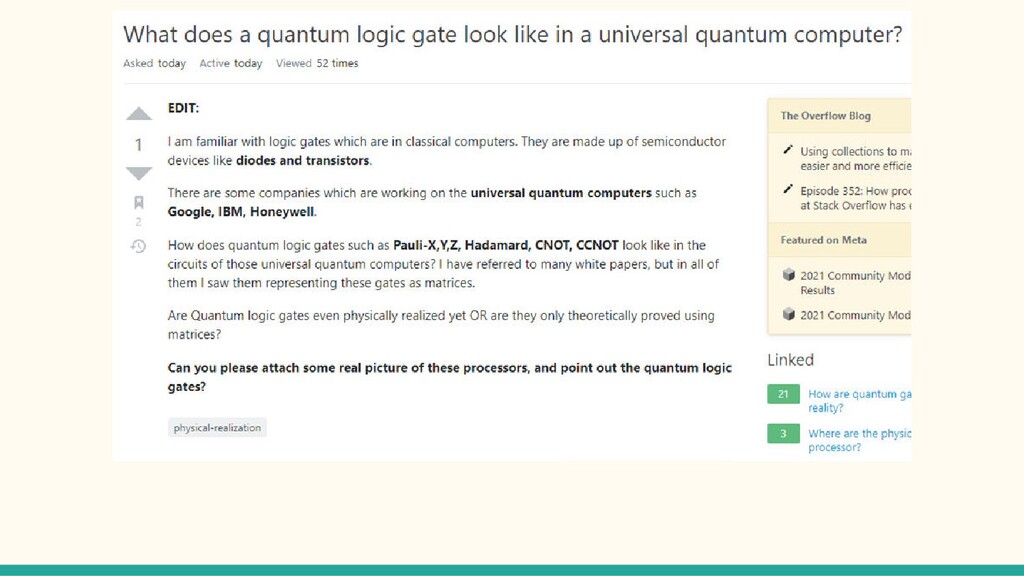
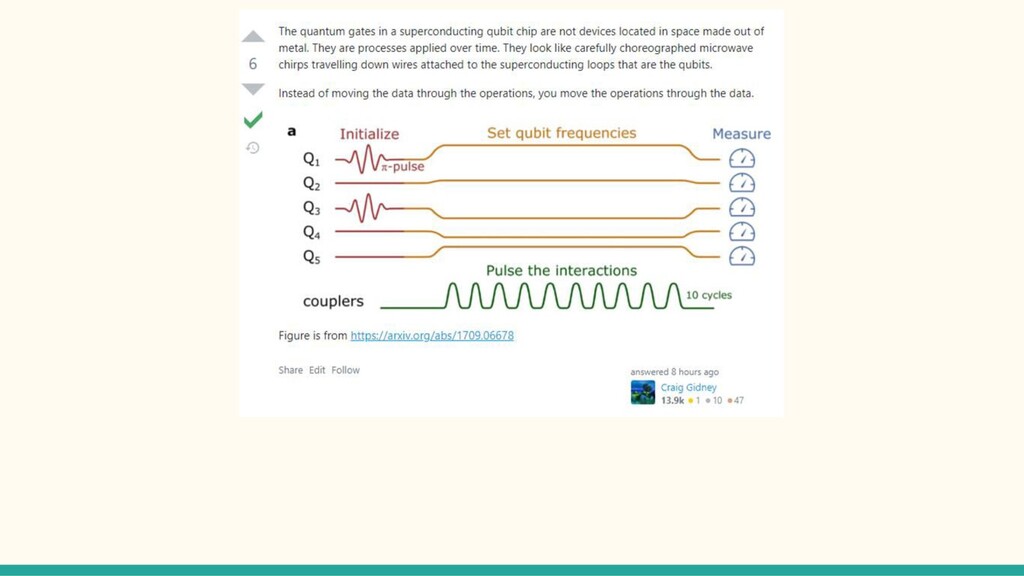
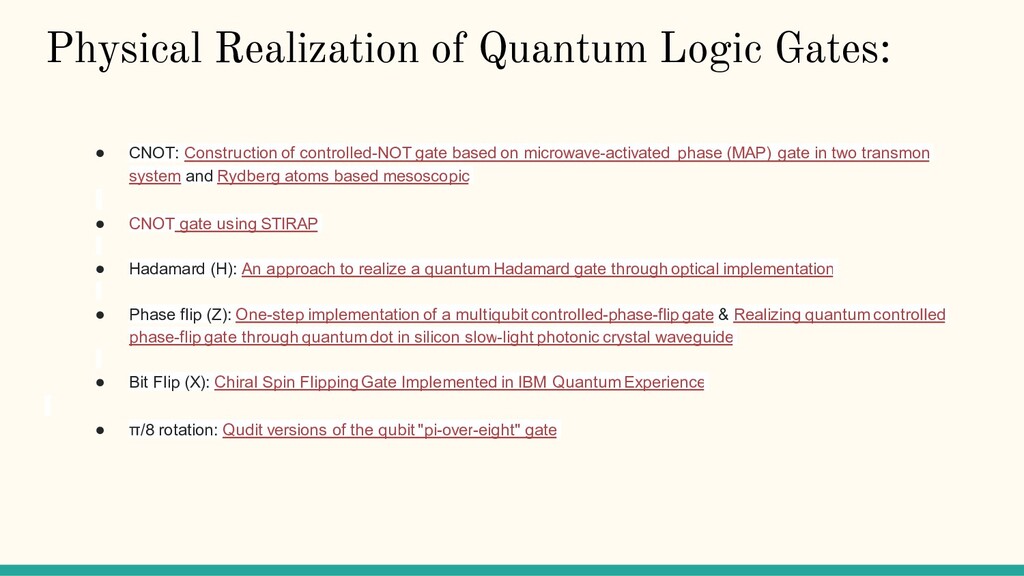
  33. Physical Realization of Quantum Logic Gates: • CNOT: Construction of

    controlled-NOT gate based on microwave-activated phase (MAP) gate in two transmon system and Rydberg atoms based mesoscopic • CNOT gate using STIRAP • Hadamard (H): An approach to realize a quantum Hadamard gate through optical implementation • Phase flip (Z): One-step implementation of a multiqubit controlled-phase-flip gate & Realizing quantum controlled phase-flip gate through quantum dot in silicon slow-light photonic crystal waveguide • Bit Flip (X): Chiral Spin Flipping Gate Implemented in IBM Quantum Experience • π/8 rotation: Qudit versions of the qubit "pi-over-eight" gate