Share
Embed
Kotlin: Next Level of Android Development (DevFest Bauchi)
I gave a talk on Kotlin Next level of Android Development at DevFest Bauchi
Umar Saidu Auna
November 23, 2019
Transcript
89 slides
-
otlin: Next level of Android Development November 23, 2019 Umar
Saidu Auna, @umarauna Bauchi -
History Statically typed programming language, and runs on the JVM.
Kotlin was developed by JetBrains (Makers of IntelliJ) -
History Statically typed programming language, and runs on the JVM.
Kotlin was developed by JetBrains (Makers of IntelliJ) First commit dates back to 2010, but was first publicly seen around 2011. -
History - Why did Google make it official? Awesome features
- nullable types, concise, data classes, etc. Great community support There was an overwhelming request for Kotlin official support on Android -
What is Kotlin Kotlin is an expression-oriented language, it is
also JVM based language developed by JetBrains as described before, a company known for the creation of IntelliJ IDEA, a powerful IDE for Java development. In Kotlin everything is an Object. -
What is Kotlin Kotlin is an expression-oriented language, it is
also JVM based language developed by JetBrains as described before, a company known for the creation of IntelliJ IDEA, a powerful IDE for Java development. In Kotlin everything is an Object. Kotlin is very intuitive and easy to learn for Java developers (give it 10 days trials and you wont regret). -
What is Kotlin Kotlin is an expression-oriented language, it is
also JVM based language developed by JetBrains as described before, a company known for the creation of IntelliJ IDEA, a powerful IDE for Java development. In Kotlin everything is an Object. Kotlin is very intuitive and easy to learn for Java developers (give it 10 days trials and you wont regret) . Its more expressive & safer -
What is Kotlin Kotlin is an expression-oriented language, it is
also JVM based language developed by JetBrains as described before, a company known for the creation of IntelliJ IDEA, a powerful IDE for Java development. In Kotlin everything is an Object. Kotlin is very intuitive and easy to learn for Java developers (give it 10 days trials and you wont regret). Its more expressive & safer Its highly interoperable -
“In Kotlin, everything is an object (reference type), we don’t
find primitives types as the ones we can use in Java……...” -
Null Safety - nullable types and non-nullable types Tony Hoare,
one of the creators of the programming language ALGOL. Protects against NullPointerException the $1,000,000,000 mistake -
Null Safety - nullable types and non-nullable types Tony Hoare,
one of the creators of the programming language ALGOL. Protects against NullPointerException the $1,000,000,000 mistake // compiler error var name: String A non-nullable object can’t be null name = null -
Null Safety - nullable types and non-nullable types Tony Hoare,
one of the creators of the programming language ALGOL. Protects against NullPointerException the $1,000,000,000 mistake // compiler error var name: String A non-nullable object can’t be null name = null // compiler error Specify a nullable object by using “?” var name: String? val length = name.length Kotlin ensures that you don’t mistakenly operate on nullable objects -
Null Safety - Accessing properties in a nullable object 1.
Checking for null types // handle non-null case and null case var name: String? = null val length = if (name != null) name.length else 0 -
Null Safety - Accessing properties in a nullable object 2.
Making safe calls using “?.” //use ?. to make safe call var name: String? ... val length = name?.length Use ?. to safely access a property/method on a nullable object If name happens to be null, the value of length is 0 (inferred integer). length would be null if it were of another type. -
Null Safety - Accessing properties in a nullable object 3.
Making use of the “?:” elvis operator //use elvis operator var name: String? val length = name?.length ?: 0 This reads as “if name is not null, use name.length else use 0 Elvis Presley. His hairstyle resembles a Question Mark -
Null Safety - Accessing properties in a nullable object 4.
Making use of the “!!” assertion operator //use elvis operator var name: String? = null val length = name!!.length This reads as “if name is not null, use name.length else throw a null pointer exception” -
Null Safety - Accessing properties in a nullable object 4.
Making use of the “!!” assertion operator //use elvis operator var name: String? = null val length = name!!.length This reads as “if name is not null, use name.length else throw a null pointer exception” Be very careful with this operator!!! -
Null Safety - NPE free! You can only have the
NullPointerException in Kotlin if: 1. You explicitly throw a NPE 2. You make use of the !! operator 3. An external Java code causes the NPE. -
String Interpolation / template in Kotlin fun hello(name: String) {
println("Hello, $name") } -
String Interpolation in Java + Kotlin void hello(String name) {
System.out.println("Hello, " + name); } -
Immutability Kotlin helps developers to be intentional about immutability. Immutability
simply means that things you create can’t be changed. We need immutability because it: • helps us with thread safety - no synchronization issues • is good for value objects - objects that simply hold value, POJOs etc. • helps debugging threaded applications without losing your hair -
Immutability How does it work in Java? • Immutability in
Java? final classes private fields no setters • Immutability in Kotlin? Guess? -
Immutability How does Kotlin help? var vs val // compiler
error: val cannot be reassigned val name = "Umar" name = name.toUpperCase() // works fine var name = "Umar" name = name.toUpperCase() -
Immutability How does Kotlin help? Immutable and Mutable collections //
immutable collection val unchangeableHobbies = listOf("coding", "hiking") unchangeableHobbies.add() // add method doesn’t exist // mutable collection val changeableHobbies = mutableListOf("reading", "running") changeableHobbies.add("travelling") // you can add -
Immutability In Java vs Kotlin public final class ImmutableClassJava {
private final String name; private final int age; public ImmutableClassJava(String name, int age) { this.name = name; this.age = age; } // no setters public String getName() { return name; } public int getAge() { return age; } } class ImmutableClassJava(val name: String, val age: Int) • Class is final by default • val implies that the parameters are final as well (values can’t be assigned) -
Functions // function sample fun sampleFunc() { // code goes
here } A function is declared using the “fun” keyword -
Functions // function sample fun sampleFunc() { // code goes
here } // function with param fun sampleFuncWithParam(param: String) { // code goes here } A function is declared using the “fun” keyword Method parameters use the “name:Type” notation -
Functions // function sample fun sampleFunc() { // code goes
here } // function with param fun sampleFuncWithParam(param: String) { // code goes here } // func with param and return type fun capitalize(param: String): String { return param.toUpperCase() } A function is declared using the “fun” keyword Method parameters use the “name:Type” notation Return types are specified after the method definition. -
Functions - infix functions // infix function infix fun Int.times(x:
Int): Int { return this * x } We can use the function as an arithmetic operator, i.e., using it without writing dots and parentheses. -
Functions - infix functions // infix function infix fun Int.times(x:
Int): Int { return this * x } // usage fun useInfix() { val product = 2 times 5 println(product) } We can use the function as an arithmetic operator, i.e., using it without writing dots and parentheses. -
Functions - extension functions // extension function fun Int.square(): Int
{ return this * this } Extension function is a member function of a class that is defined outside the class -
Functions - extension functions // extension function fun Int.square(): Int
{ return this * this } fun useExtension() { val square = 2.square() println(square) } Extension function is a member function of a class that is defined outside the class -
Conciseness in Kotlin public void doSomething() { // do something
} fun doSomething(): Unit { // do same thing } -
Conciseness in Kotlin public void doSomething() { // do something
} fun doSomething(): Unit { // do same thing } -
Conciseness in Kotlin public void doSomething() { // do something
} fun doSomething() { // do same thing } -
Conciseness in Kotlin public String getName() { return name; }
fun getName(): String { return name } -
Conciseness in Kotlin public String getName() { return name; }
fun getName() { return name } -
Conciseness in Kotlin public String getName() { return name; }
fun getName() = name -
Class in Java vs Data Class in Kotlin public class
Person { private String name; String getName () { return name; } void setName (String name) { this.name = name; } @Override public String toString () { return "Person{" + "name='" + name + '\'' + '}'; } } data class Person(val name: String) -
Class in Java vs Regular Class in Kotlin public class
Person { private String name; String getName () { return name; } void setName (String name) { this.name = name; } public int getNameLength () { return name.length } } class Person(name: String) { var name: String get() = name set(name) { this.name = name } fun getNameLength(): int { return name.length } } -
Class in Java vs Regular Class in Kotlin public class
Person { private String name; String getName () { return name; } void setName (String name) { this.name = name; } public int getNameLength () { return name.length } } class Person(name: String) { var name: String get() = name set(name) { this.name = name } fun getNameLength() = name.length } -
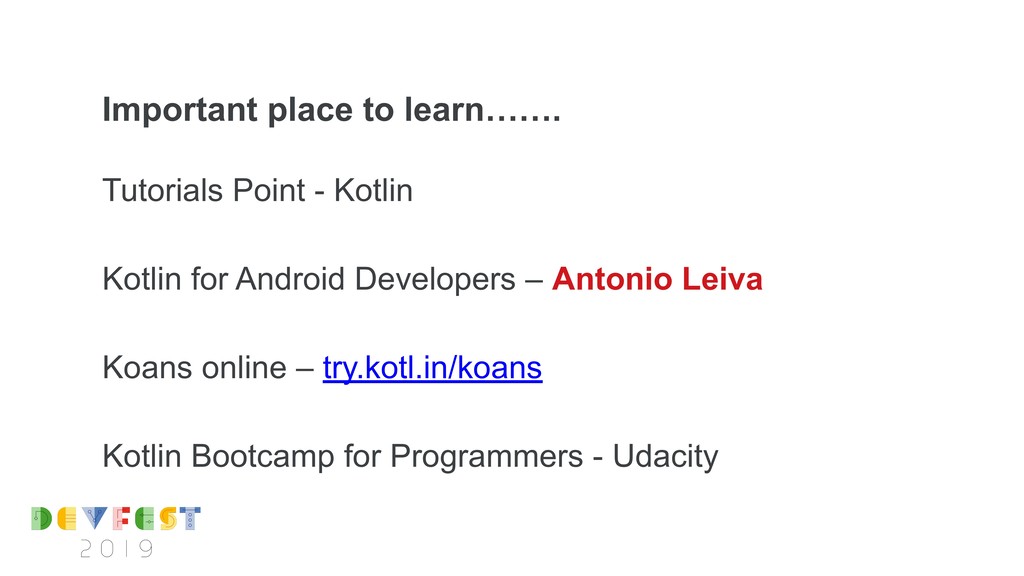
Important place to learn……. Tutorials Point - Kotlin Kotlin for
Android Developers – Antonio Leiva -
Important place to learn……. Tutorials Point - Kotlin Kotlin for
Android Developers – Antonio Leiva Koans online – try.kotl.in/koans -
Important place to learn……. Tutorials Point - Kotlin Kotlin for
Android Developers – Antonio Leiva Koans online – try.kotl.in/koans Kotlin Bootcamp for Programmers - Udacity -
Important place to learn……. Tutorials Point - Kotlin Kotlin for
Android Developers – Antonio Leiva Koans online – try.kotl.in/koans Kotlin Bootcamp for Programmers - Udacity https://developer.android.com/kotlin/learn -
Summary • Interoperable with Java (100%) • Reduces Boilerplate code
• Object-Oriented and procedural • Safety code • No Semicolon • Expands your skillset • Perfect Support with Android Studio & Gradle • Very easy to get started with Android Development -
Kotlin Android Extension it includes a view binder. The plugin
automatically creates a set of properties that give direct access to all the views in the XML. -
Finally 1 You have 3 Options.. Decide Kotlin is not
For you and continue with Java -
Finally 1 You have 3 Options.. Decide Kotlin is not
For you and continue with Java Try to learn everything on your own 2 -
Finally 1 You have 3 Options.. Decide Kotlin is not
For you and continue with Java 3 Go and learn on MOOC websites Try to learn everything on your own 2