Upgrade to Pro — share decks privately, control downloads, hide ads and more …

Fleet Technician Wrench Time: What to Measure a...

Avatar for AUTOsist AUTOsist
October 15, 2026

Fleet Technician Wrench Time: What to Measure and Where Productive Hours Go

Fleet technician wrench time measures how much of a technician’s working day is spent directly repairing, servicing, diagnosing, or inspecting vehicles.

This presentation explains how wrench time is calculated, why it is different from utilization and efficiency, and where non-wrench hours often go, including parts retrieval, approvals, travel, paperwork, training, and waiting for assignments.

It also covers how to classify delay categories, why the denominator matters, what benchmark ranges can and cannot tell you, and how even a small improvement in wrench time can create meaningful shop capacity when quality and PM compliance remain strong.

Read the full guide:
https://autosist.com/blog/fleet-technician-wrench-time/

Avatar for AUTOsist

AUTOsist

October 15, 2026

Other Decks in Technology

Transcript

  1. Shop Productivity WHAT WRENCH TIME ACTUALLY MEASURES? Fleet technician wrench

    time is the percentage of working hours spent directly repairing, servicing, diagnosing, or inspecting vehicles. Technicians also spend necessary time searching for parts, waiting for approvals, moving between assignments, preparing tools, and completing paperwork. autosist.com (888)-316-5877 Follow Us @autosist
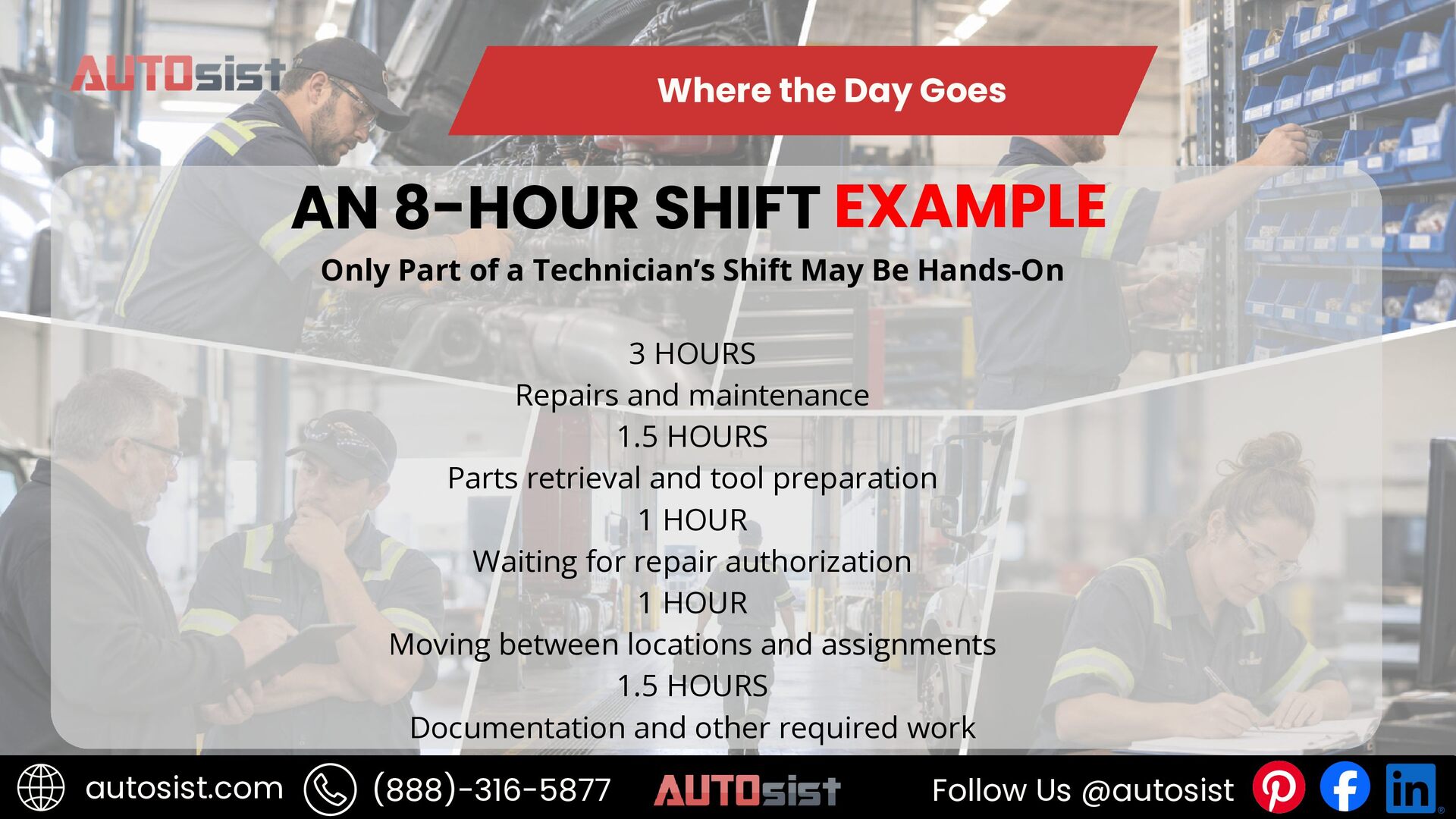
  2. Where the Day Goes AN 8-HOUR SHIFT EXAMPLE Only Part

    of a Technician’s Shift May Be Hands-On 3 HOURS Repairs and maintenance 1.5 HOURS Parts retrieval and tool preparation 1 HOUR Waiting for repair authorization 1 HOUR Moving between locations and assignments 1.5 HOURS Documentation and other required work autosist.com (888)-316-5877 Follow Us @autosist
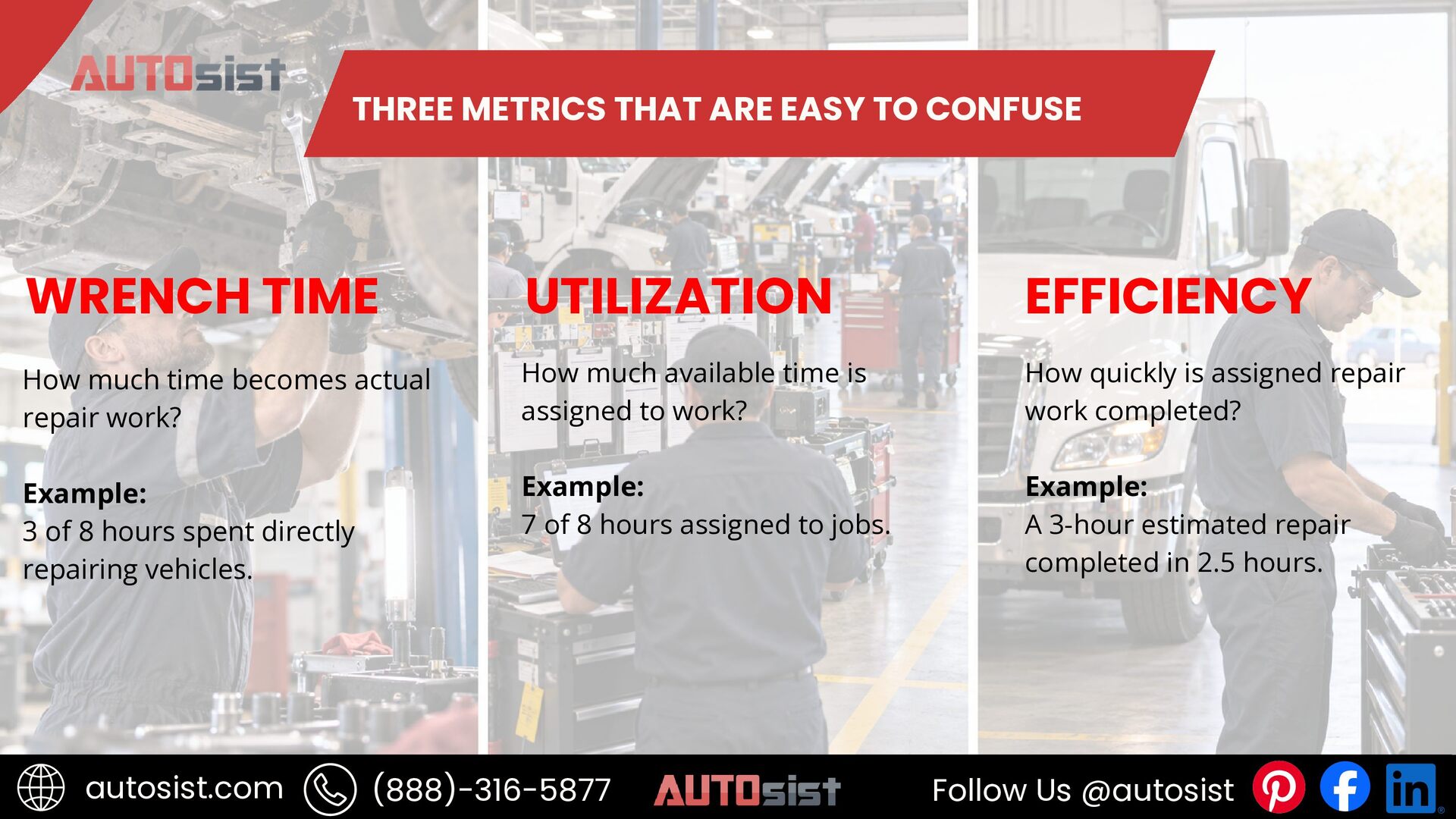
  3. THREE METRICS THAT ARE EASY TO CONFUSE WRENCH TIME UTILIZATION

    EFFICIENCY How much time becomes actual repair work? How much available time is assigned to work? How quickly is assigned repair work completed? Example: 3 of 8 hours spent directly repairing vehicles. Example: 7 of 8 hours assigned to jobs. Example: A 3-hour estimated repair completed in 2.5 hours. autosist.com (888)-316-5877 Follow Us @autosist
  4. THE FORMULA AND THE DENOMINATOR BASIC FORMULA Wrench Time %

    = Hands-On Repair Hours ÷ Working Hours × 100 Example: 24 repair hours across 80 paid hours 30% wrench time YOUR DENOMINATOR MATTERS The same 24 repair hours produce: 30% using 80 paid hours 33.3% using 72 available hours 40% using 60 scheduled maintenance hours autosist.com (888)-316-5877 Follow Us @autosist
  5. WHAT TO LOG AS NON-WRENCH TIME? A Percentage Alone Does

    Not Tell You What to Fix Instead of recording only “productive” and “nonproductive” time, classify where the remaining hours actually go. Useful delay categories include: Parts searches and retrieval Waiting for approvals Meetings and training Waiting for the next assignment autosist.com (888)-316-5877 Follow Us @autosist
  6. WHAT IS A GOOD WRENCH TIME? TYPICAL RANGE Practitioner literature

    commonly reports approximately: 25%–35% for a typical maintenance workforce. STRONGER PLANNING Some maintenance organizations report approximately: 55% or higher with stronger planning and scheduling. Note : These figures come from maintenance practitioner literature, not a fleet-specific national standard. Your most useful benchmark is your own consistently measured trend across comparable work and operating conditions. autosist.com (888)-316-5877 Follow Us @autosist
  7. SMALL IMPROVEMENTS CREATE CAPACITY Consider an eight-technician shop working ten-hour

    shifts, five days per week. At 31% wrench time: 80 daily labor hours create 24.8 productive repair hours At 41% wrench time: The same payroll creates 32.8 productive repair hours That is: +8 productive hours per day +40 productive hours per week Equivalent to the measured repair capacity of approximately one additional 40-hour technician. autosist.com (888)-316-5877 Follow Us @autosist
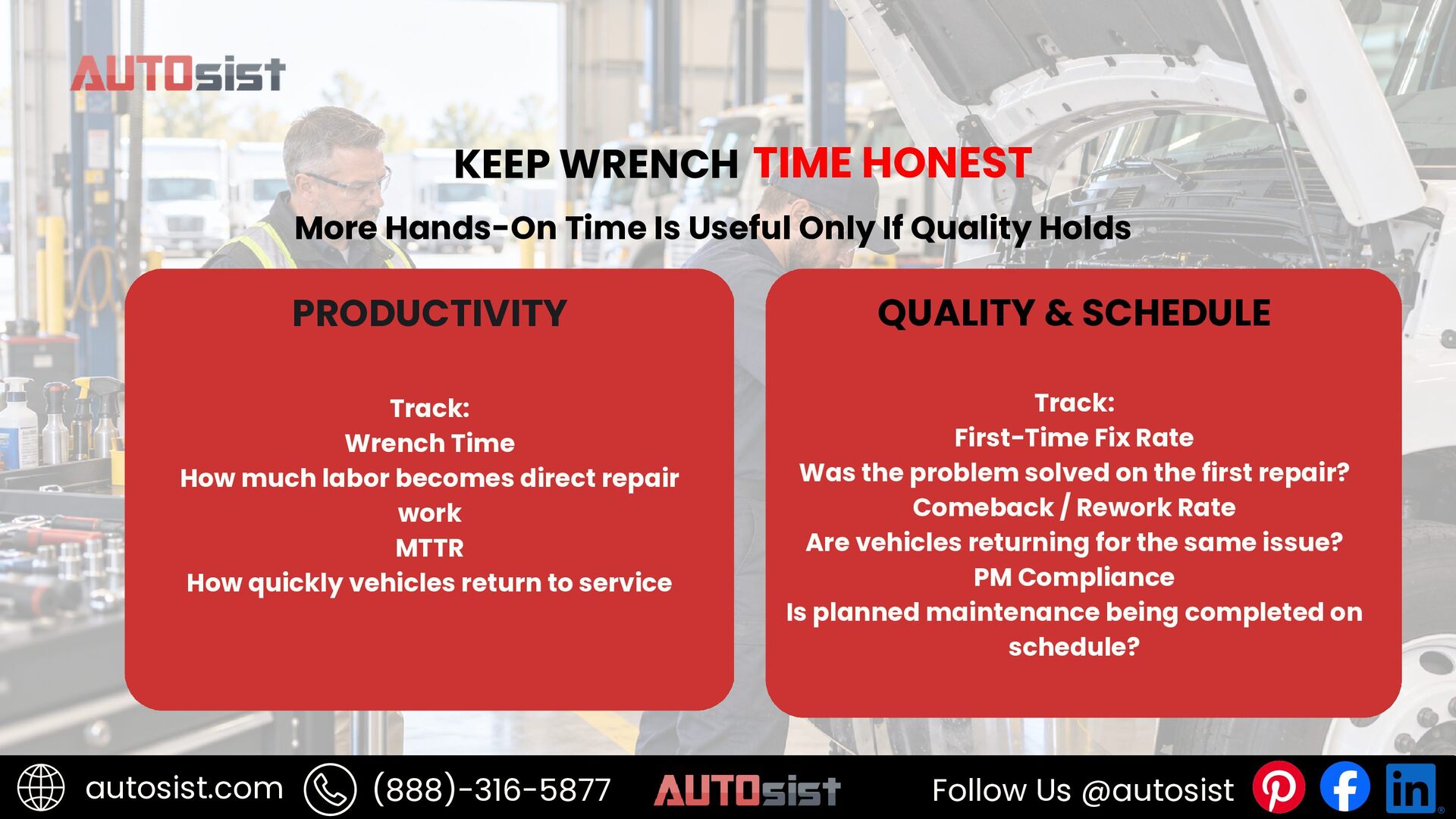
  8. KEEP WRENCH TIME HONEST More Hands-On Time Is Useful Only

    If Quality Holds PRODUCTIVITY QUALITY & SCHEDULE Track: Wrench Time How much labor becomes direct repair work MTTR How quickly vehicles return to service Track: First-Time Fix Rate Was the problem solved on the first repair? Comeback / Rework Rate Are vehicles returning for the same issue? PM Compliance Is planned maintenance being completed on schedule? autosist.com (888)-316-5877 Follow Us @autosist
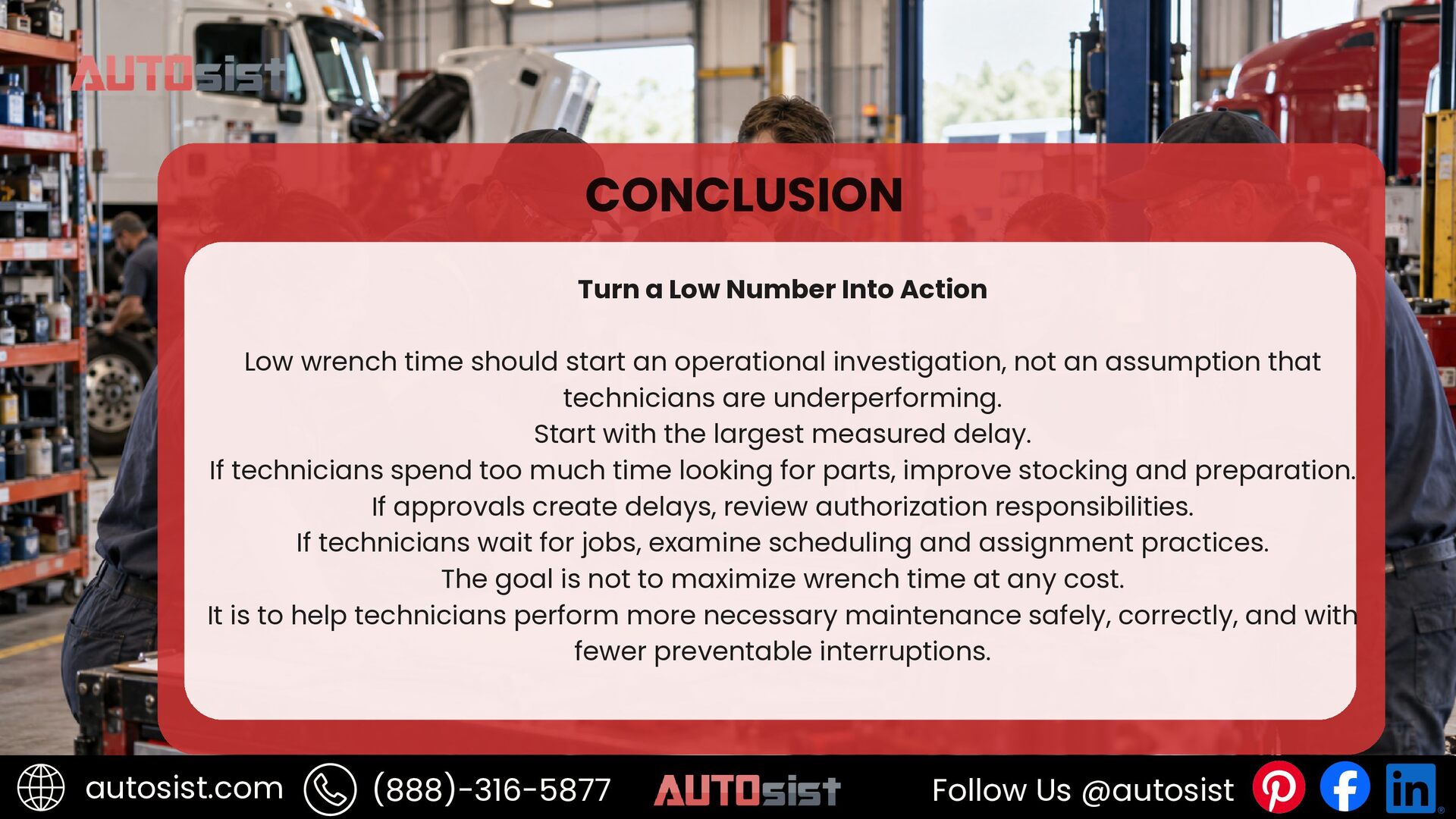
  9. CONCLUSION Turn a Low Number Into Action Low wrench time

    should start an operational investigation, not an assumption that technicians are underperforming. Start with the largest measured delay. If technicians spend too much time looking for parts, improve stocking and preparation. If approvals create delays, review authorization responsibilities. If technicians wait for jobs, examine scheduling and assignment practices. The goal is not to maximize wrench time at any cost. It is to help technicians perform more necessary maintenance safely, correctly, and with fewer preventable interruptions. autosist.com (888)-316-5877 Follow Us @autosist