Upgrade to Pro — share decks privately, control downloads, hide ads and more …

One Size Does Not Fit All

Avatar for Bailey Hanna Bailey Hanna
September 12, 2022

One Size Does Not Fit All

“So, what’s your testing process like at *insert company name here*?”. We’ve all been asked this question. It comes up all the time when you tell someone that you work in testing and who you work for. People want to know what your cookie cutter process is for testing at your company; either out of genuine curiosity, a search to find a fit for their skills or to find issues in it that they think you could solve by changing “just one thing”.
What happens when the answer is “we don’t have one.”? In the tech industry things are changing every single day, and every individual has their own skills and experiences that they bring to the table, so why would we have one specific process for our entire organization?
In this talk, we will discuss what it looks like to have a constantly evolving test process within a company, and to have multiple teams within a development org working with different processes and workflows. We will discuss how we all stay on the same track, how we discuss our successes (and our failures), and how we use individual and team strengths to have an organic, and changing process that still keeps us all moving forward and working together.

Avatar for Bailey Hanna

Bailey Hanna

September 12, 2022
Tweet

More Decks by Bailey Hanna

Other Decks in Technology

Transcript

  1. @baileyhanna What are we going to talk about? • What

    are individual team processes • Benefits/Risks to individual processes • Determining if individual processes are a good fit • How to evolve to individual processes • Maintaining cohesion among teams with individual processes
  2. Individual processes are created, utilized & maintained by teams instead

    of a process prescribed at an organizational level
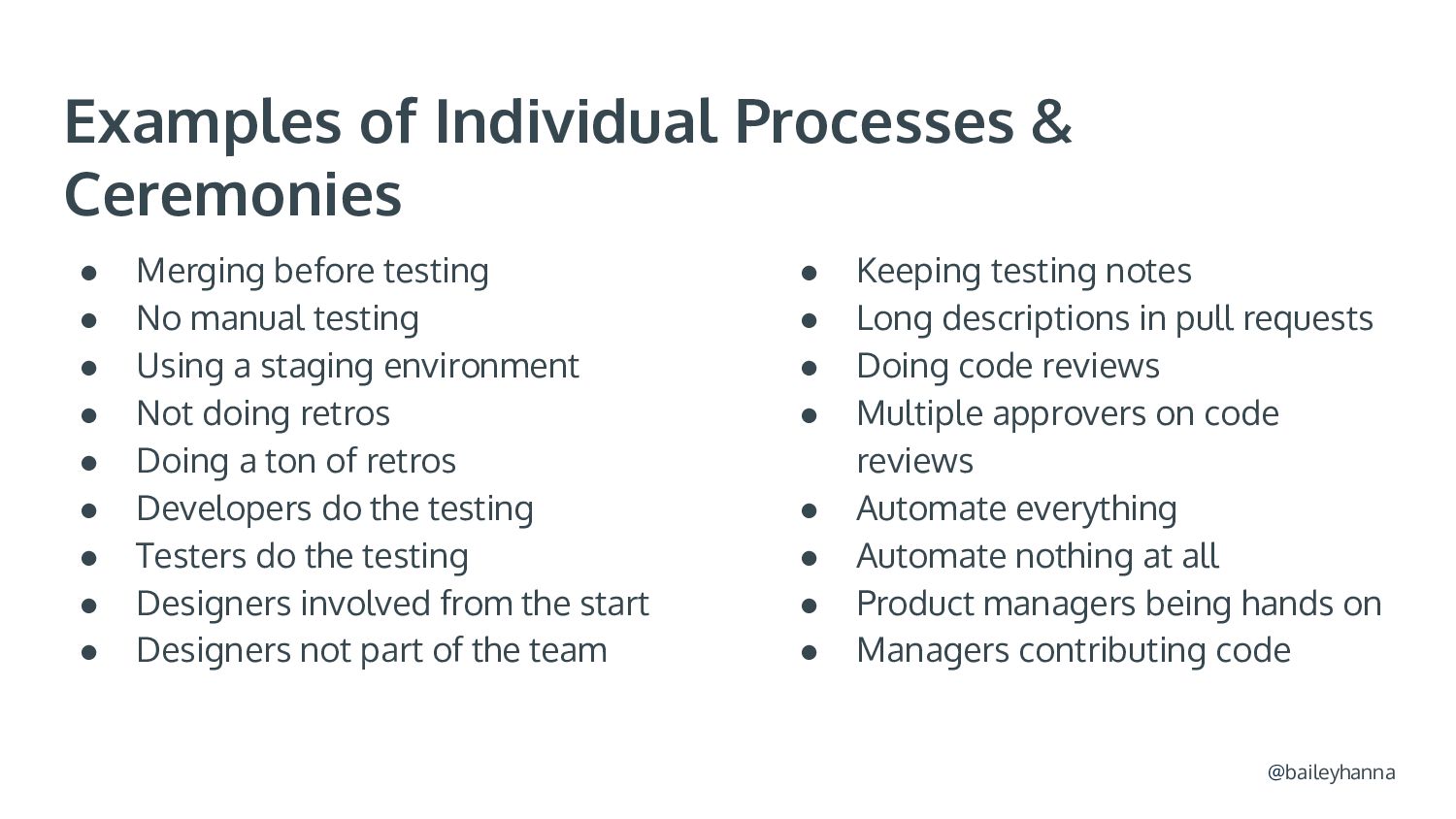
  3. @baileyhanna Examples of Individual Processes & Ceremonies • Merging before

    testing • No manual testing • Using a staging environment • Not doing retros • Doing a ton of retros • Developers do the testing • Testers do the testing • Designers involved from the start • Designers not part of the team • Keeping testing notes • Long descriptions in pull requests • Doing code reviews • Multiple approvers on code reviews • Automate everything • Automate nothing at all • Product managers being hands on • Managers contributing code
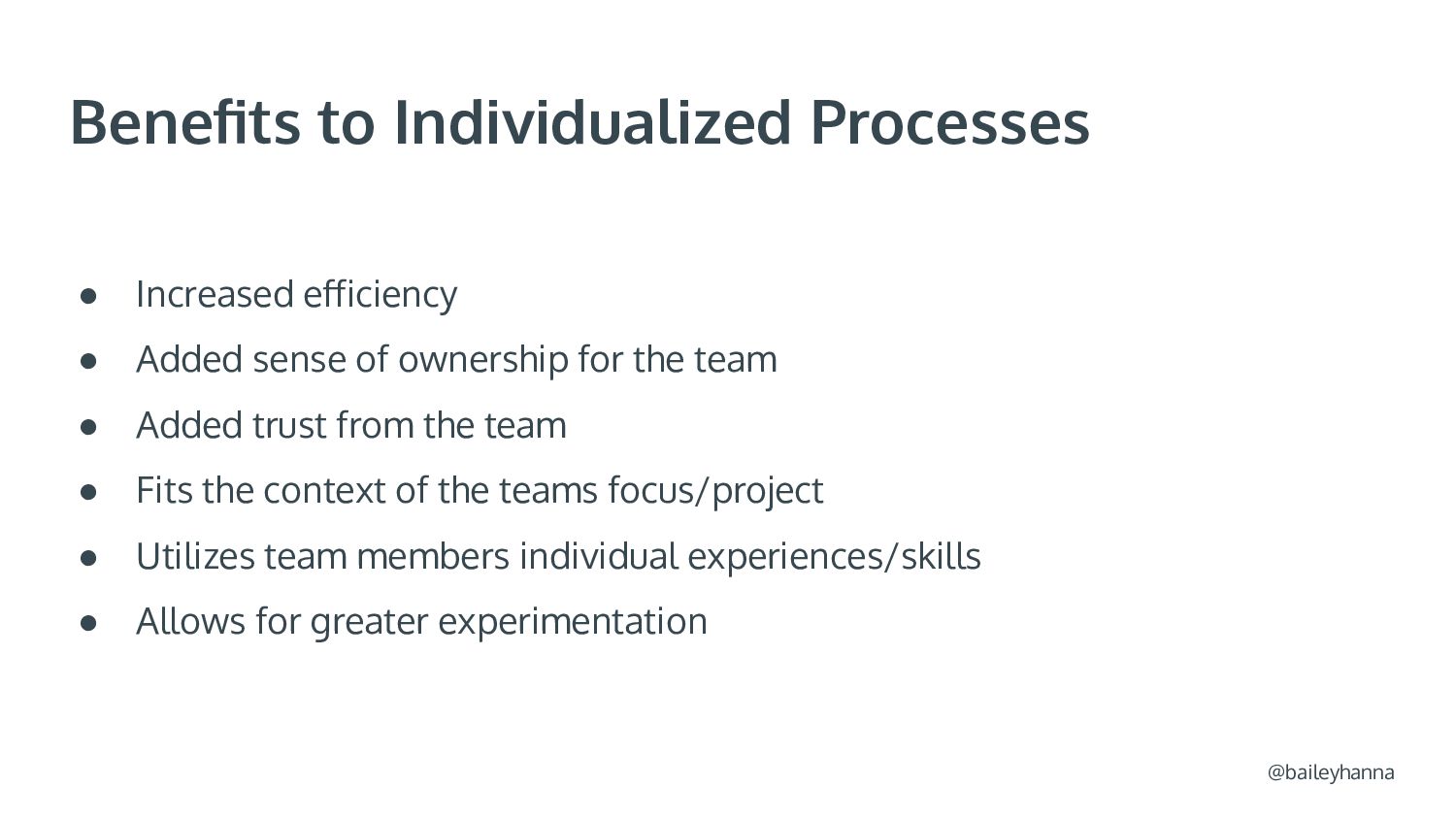
  4. @baileyhanna Benefits to Individualized Processes • Increased efficiency • Added

    sense of ownership for the team • Added trust from the team • Fits the context of the teams focus/project • Utilizes team members individual experiences/skills • Allows for greater experimentation
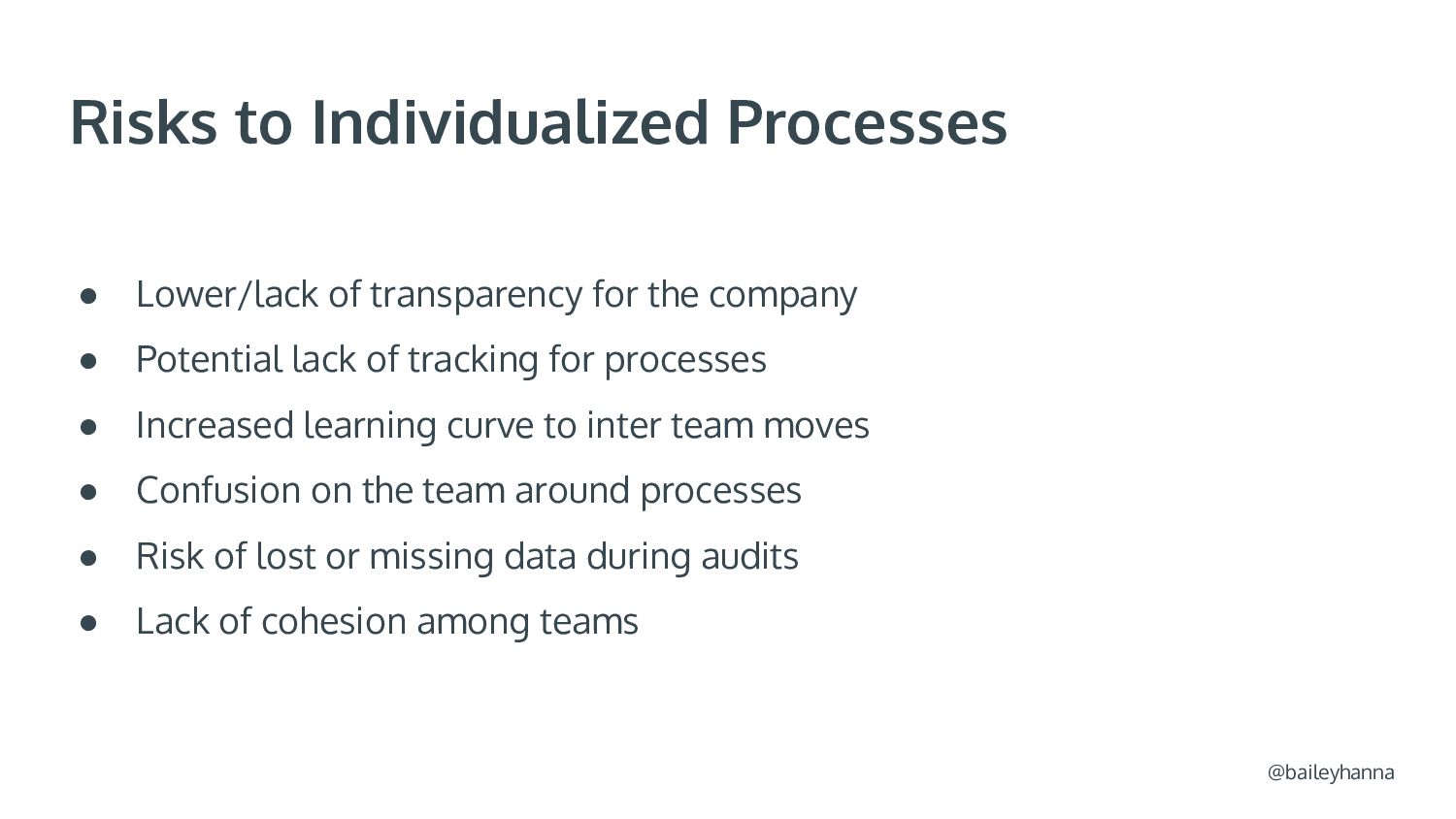
  5. @baileyhanna Risks to Individualized Processes • Lower/lack of transparency for

    the company • Potential lack of tracking for processes • Increased learning curve to inter team moves • Confusion on the team around processes • Risk of lost or missing data during audits • Lack of cohesion among teams
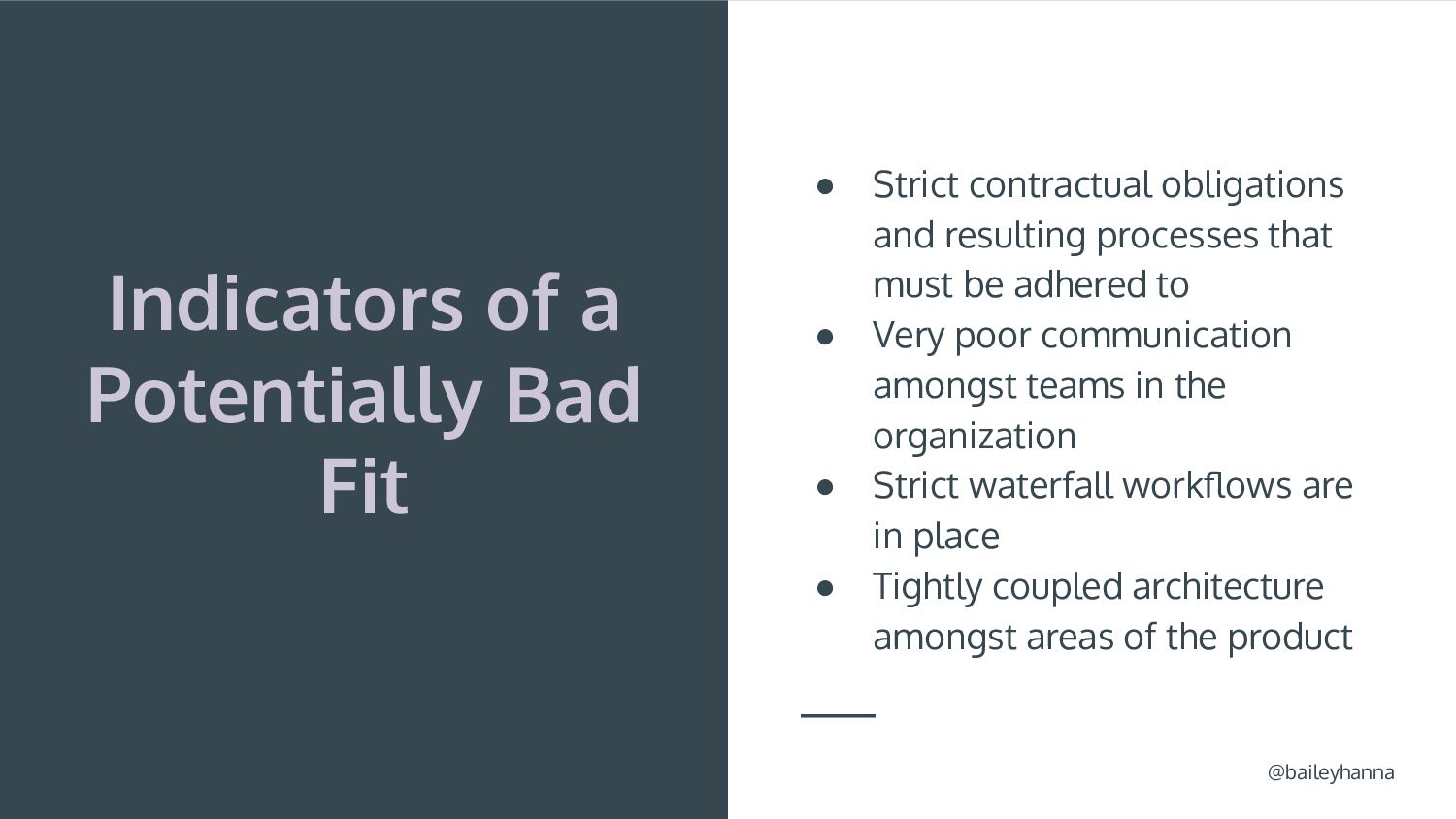
  6. @baileyhanna Indicators of a Potentially Bad Fit • Strict contractual

    obligations and resulting processes that must be adhered to • Very poor communication amongst teams in the organization • Strict waterfall workflows are in place • Tightly coupled architecture amongst areas of the product
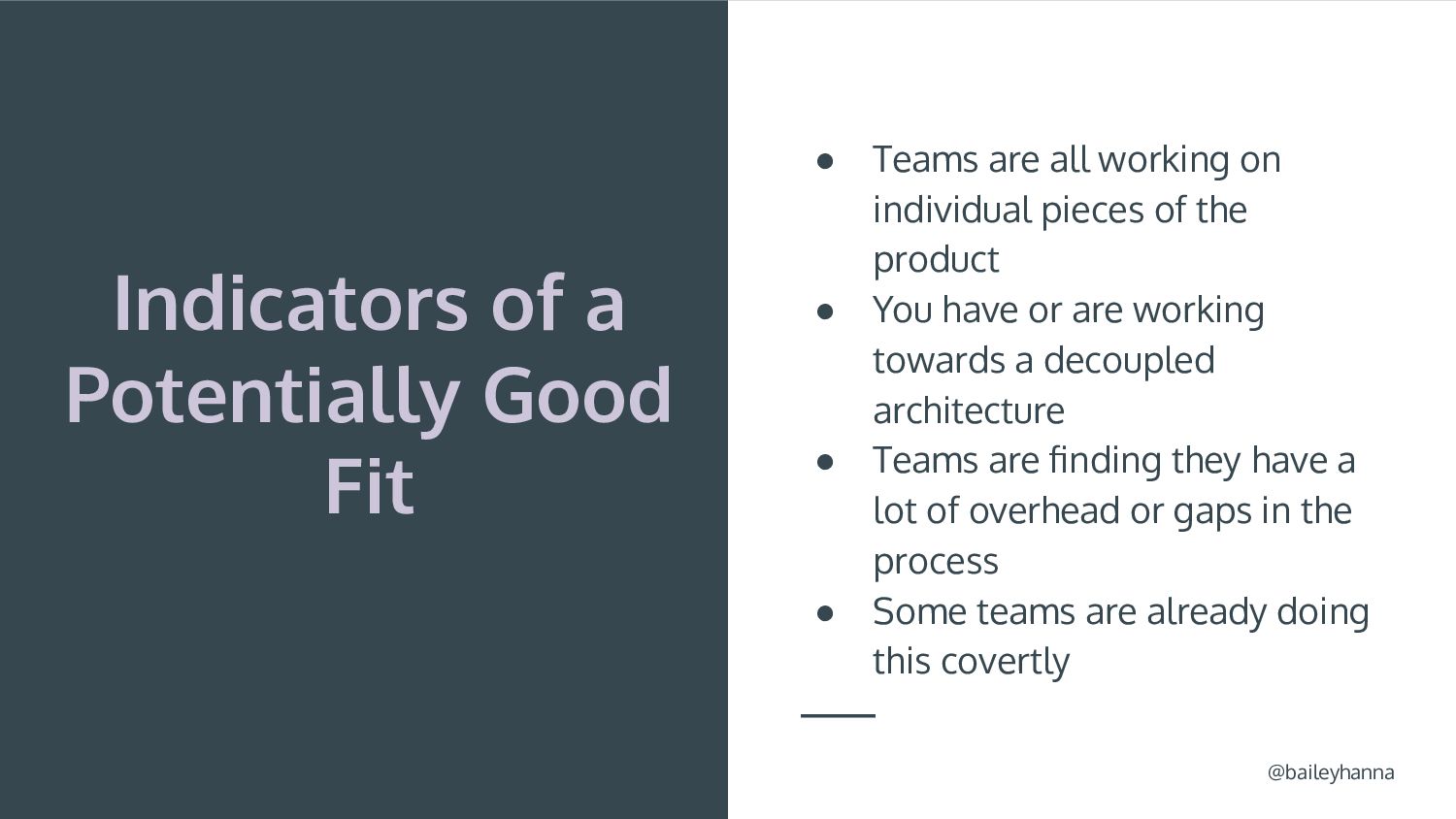
  7. @baileyhanna Indicators of a Potentially Good Fit • Teams are

    all working on individual pieces of the product • You have or are working towards a decoupled architecture • Teams are finding they have a lot of overhead or gaps in the process • Some teams are already doing this covertly
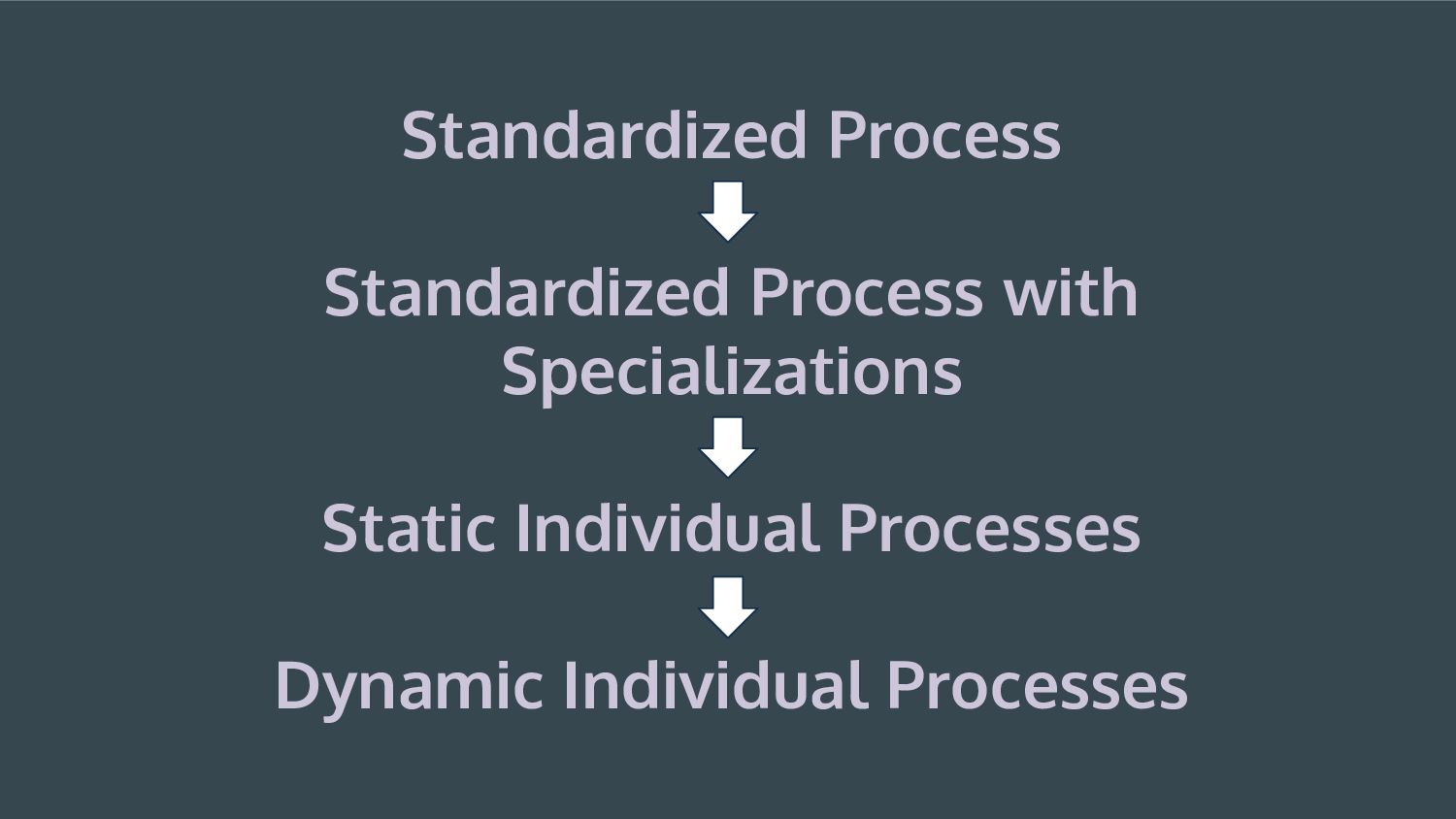
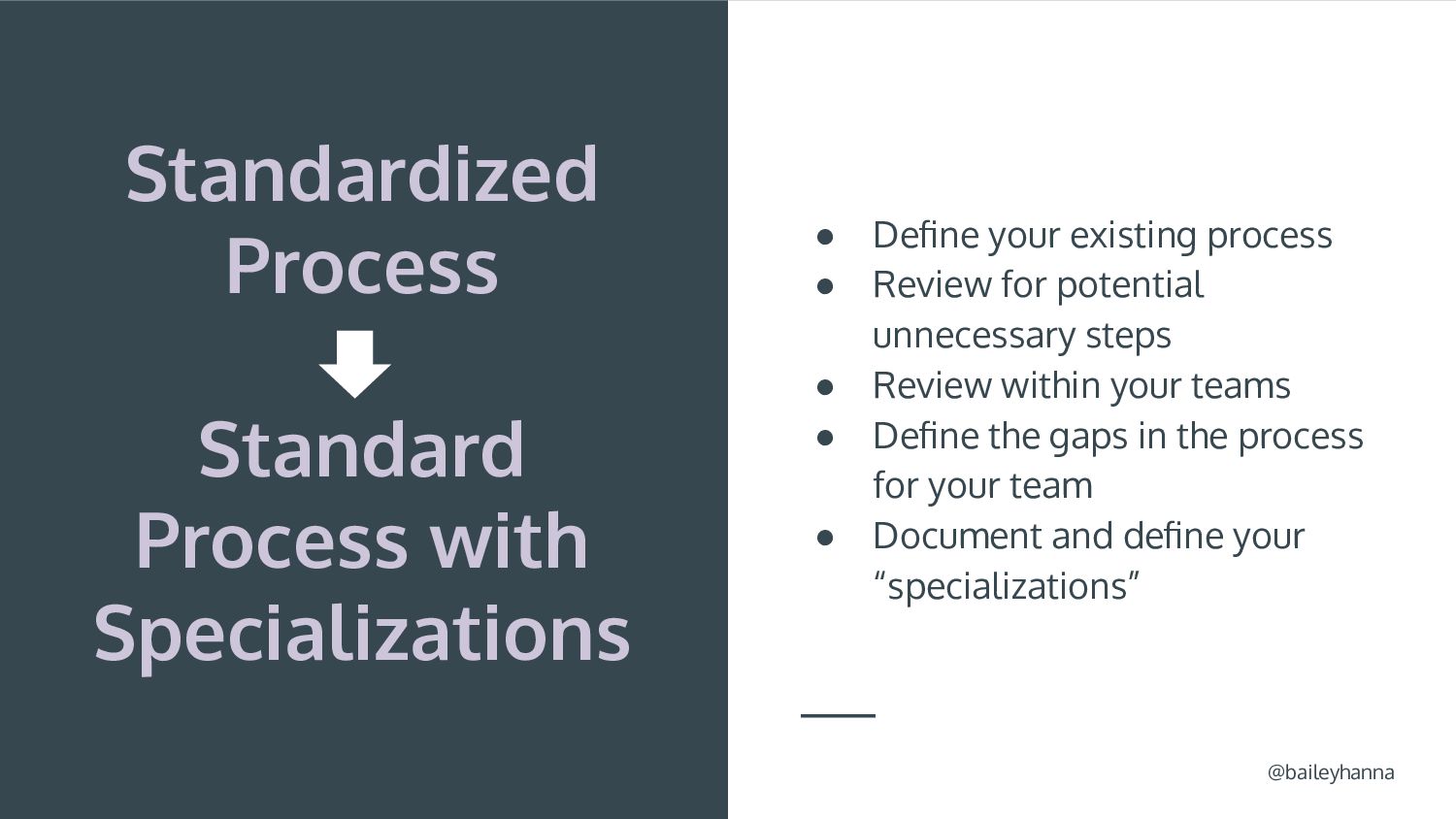
  8. @baileyhanna Standardized Process Standard Process with Specializations • Define your

    existing process • Review for potential unnecessary steps • Review within your teams • Define the gaps in the process for your team • Document and define your “specializations”
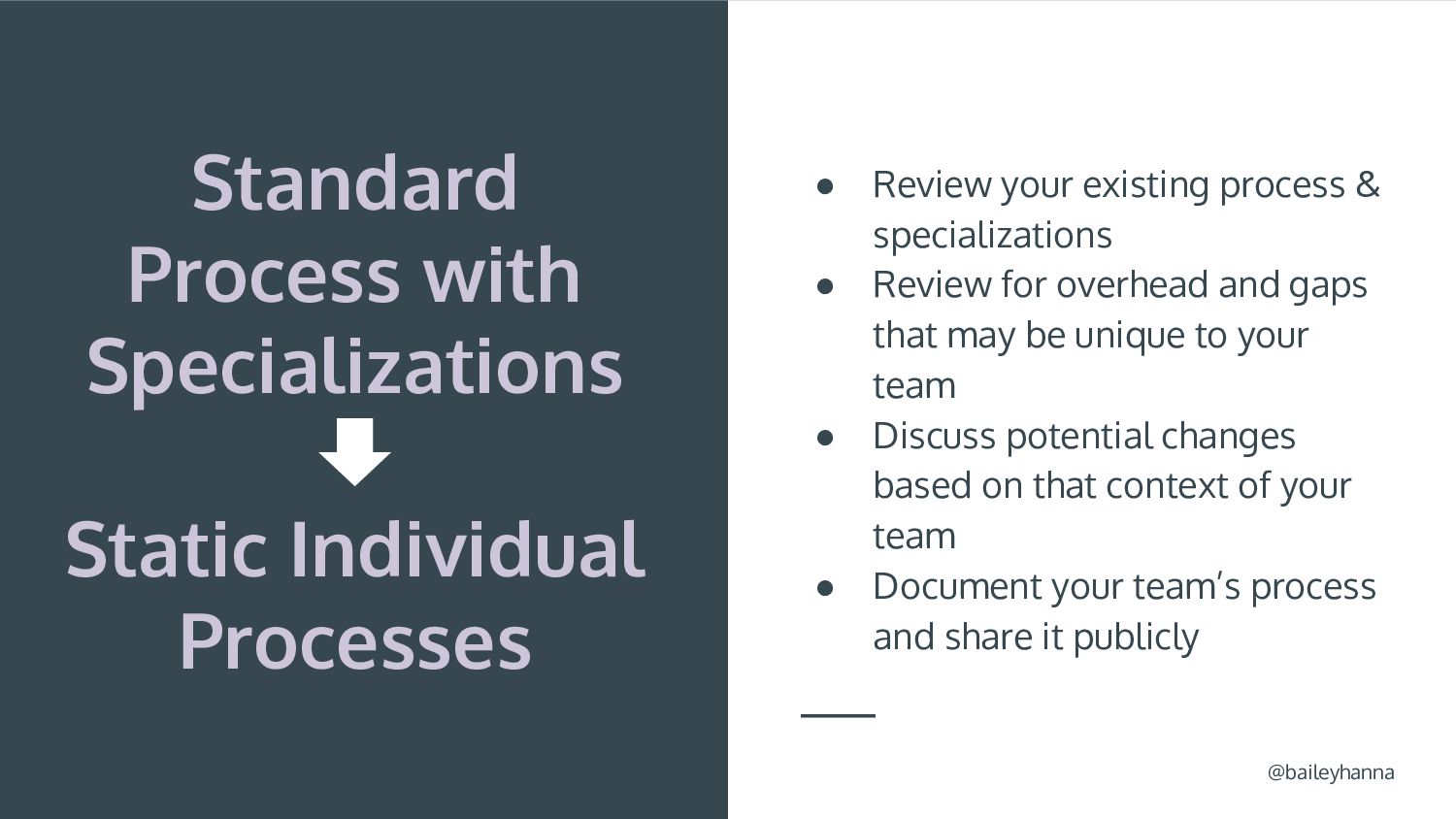
  9. @baileyhanna Standard Process with Specializations Static Individual Processes • Review

    your existing process & specializations • Review for overhead and gaps that may be unique to your team • Discuss potential changes based on that context of your team • Document your team’s process and share it publicly
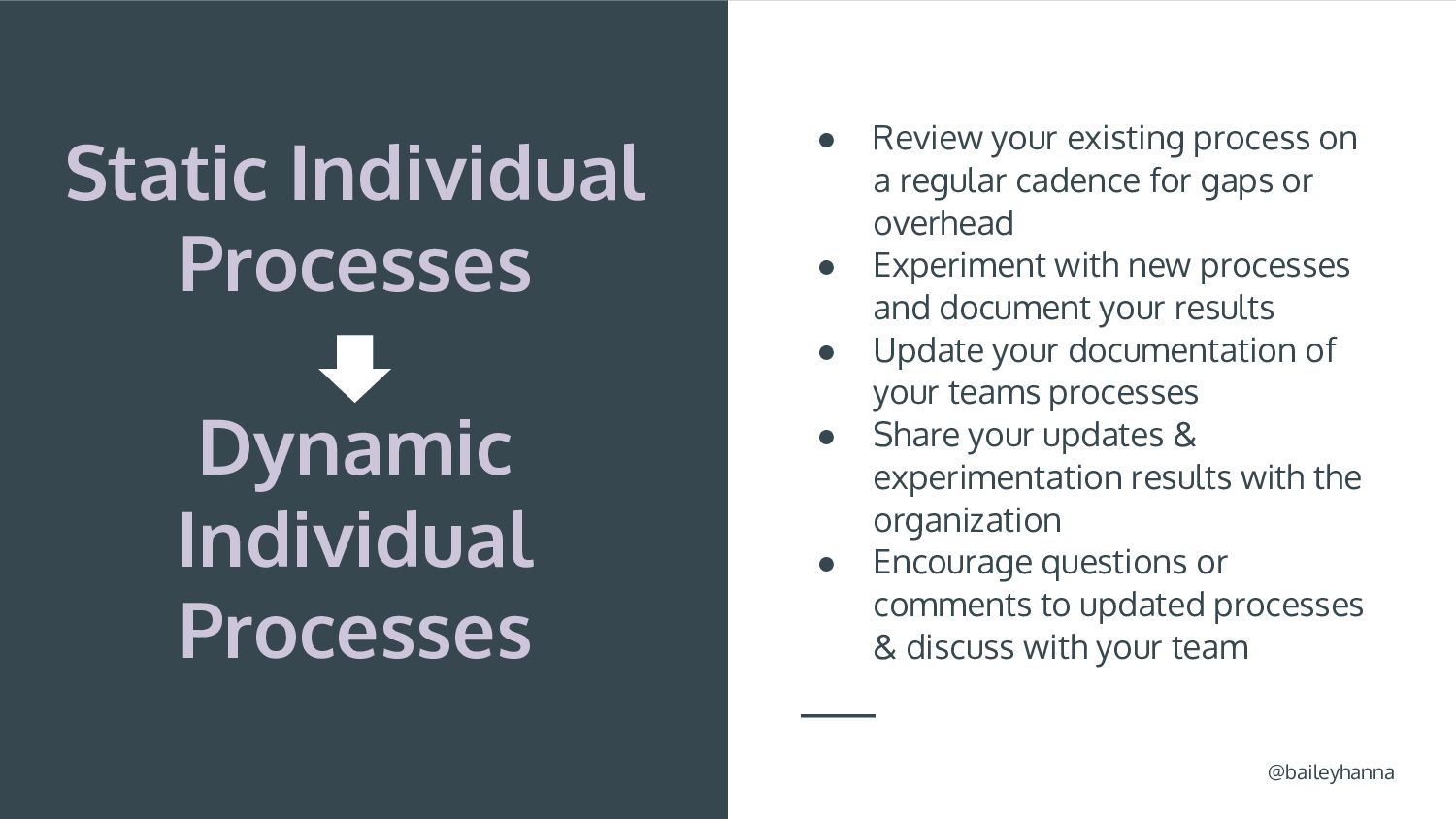
  10. @baileyhanna Static Individual Processes Dynamic Individual Processes • Review your

    existing process on a regular cadence for gaps or overhead • Experiment with new processes and document your results • Update your documentation of your teams processes • Share your updates & experimentation results with the organization • Encourage questions or comments to updated processes & discuss with your team
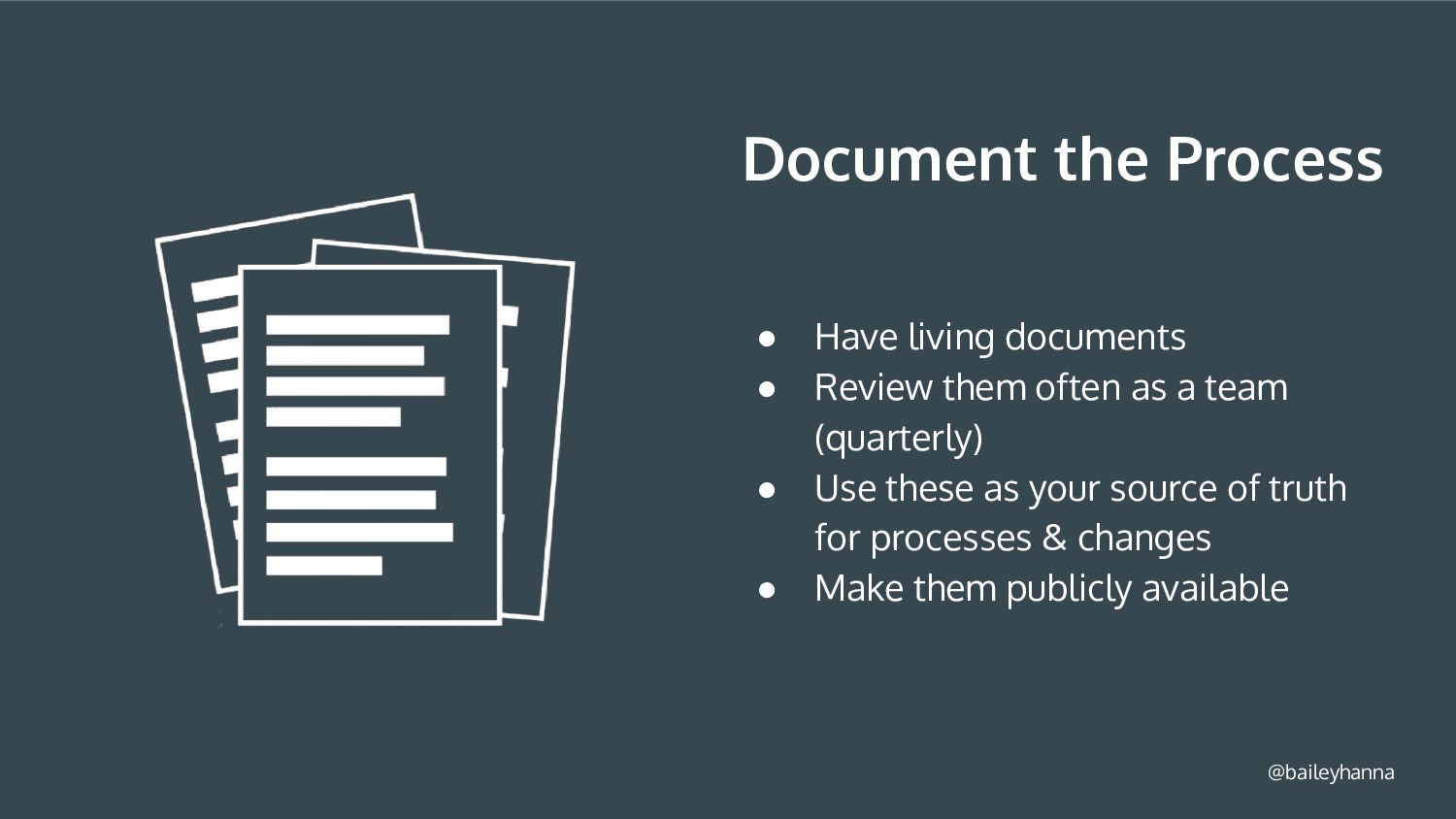
  11. @baileyhanna Document the Process • Have living documents • Review

    them often as a team (quarterly) • Use these as your source of truth for processes & changes • Make them publicly available
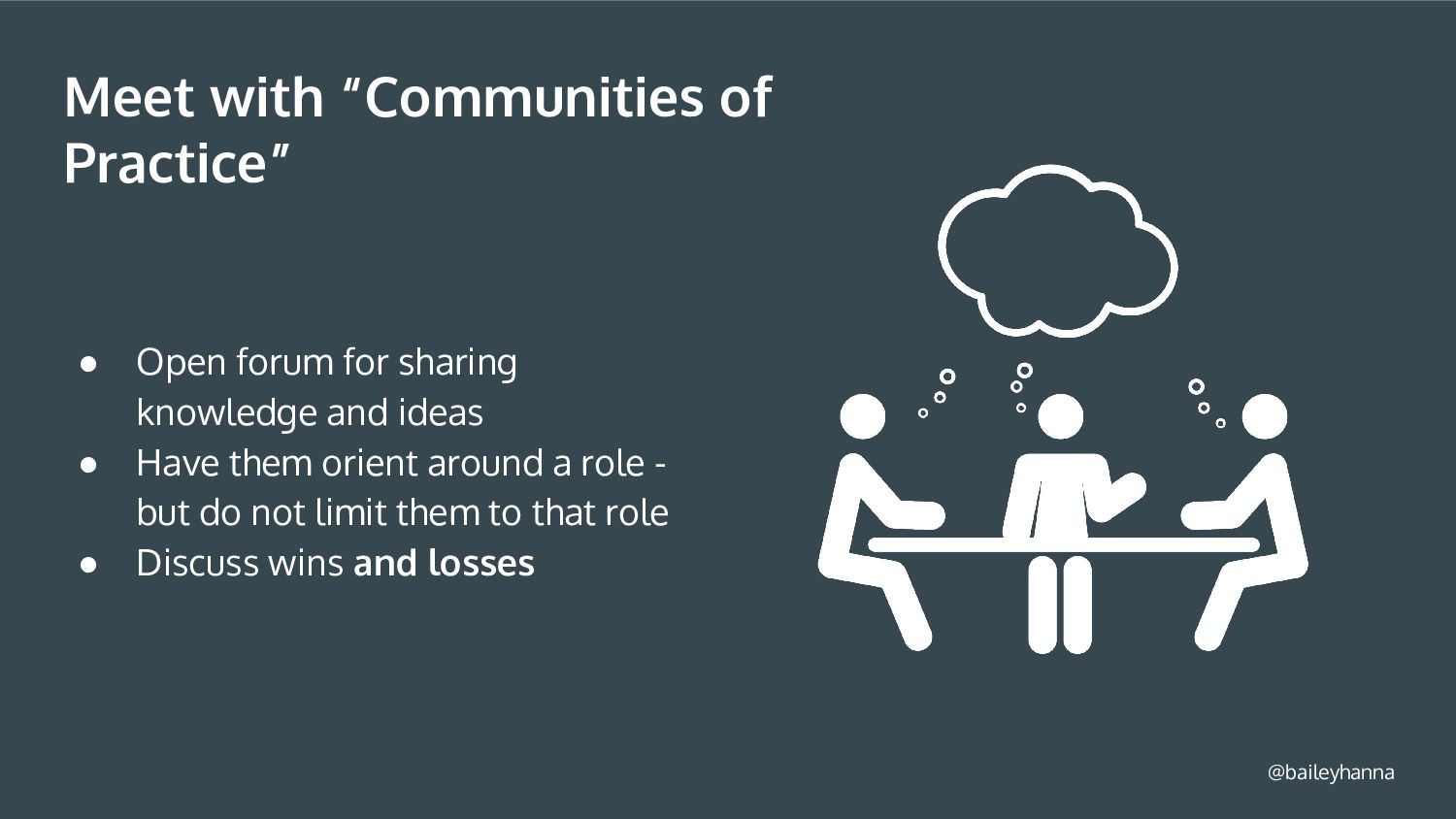
  12. @baileyhanna Meet with “Communities of Practice” • Open forum for

    sharing knowledge and ideas • Have them orient around a role - but do not limit them to that role • Discuss wins and losses
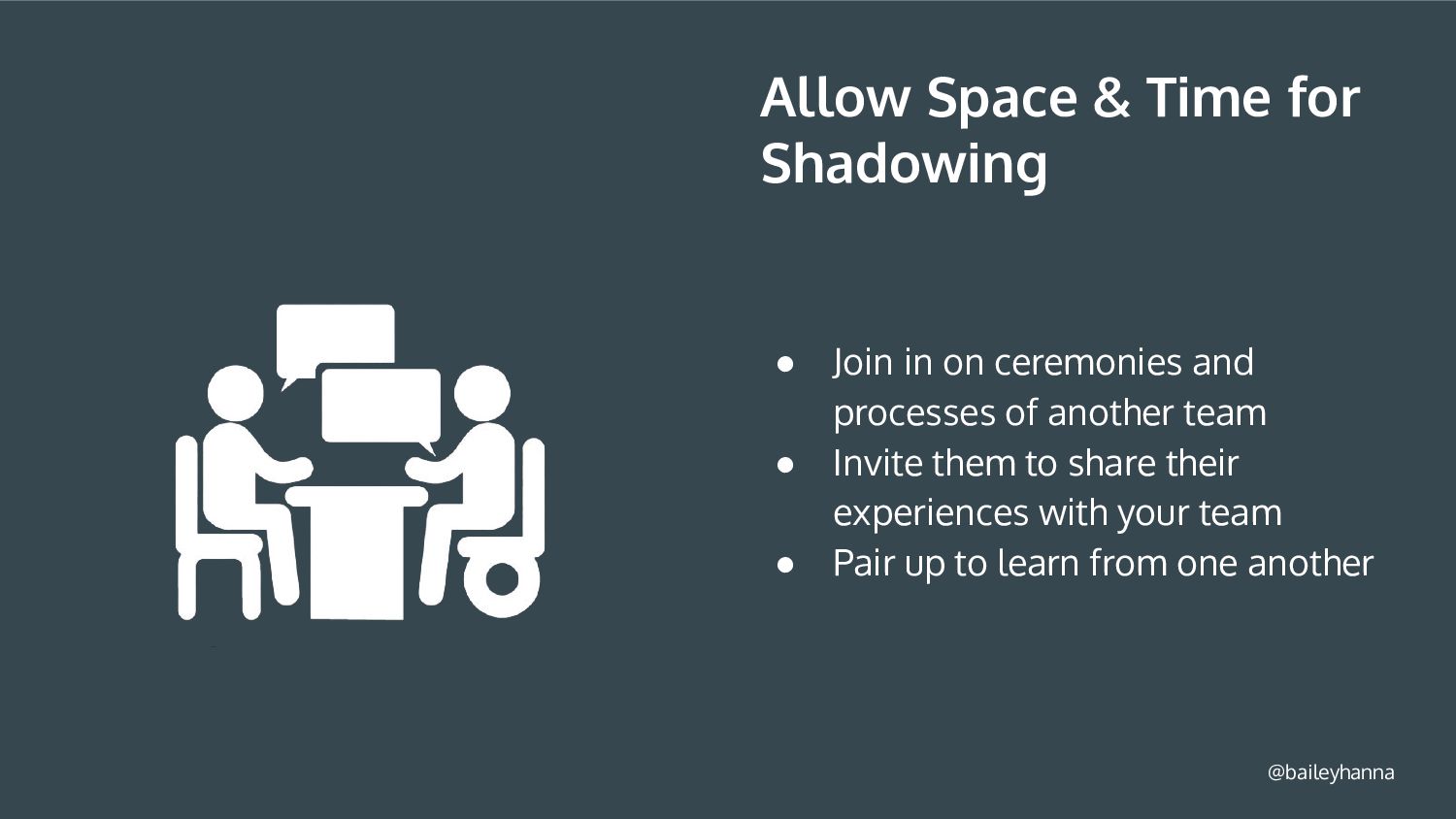
  13. @baileyhanna Allow Space & Time for Shadowing • Join in

    on ceremonies and processes of another team • Invite them to share their experiences with your team • Pair up to learn from one another
  14. Individualized process can reduce overhead, fill in gaps & increase

    the efficiency of teams; but they require work!
  15. @baileyhanna Next steps for working towards individual processes 1. Determine

    what your current org processes are 2. Determine if individual processes are a good fit 3. Iteratively work towards them 4. Work to maintain cohesion among the teams in your organization 5. Share your experiences!