Upgrade to Pro — share decks privately, control downloads, hide ads and more …

Zoetrope - "I'm a little IoT pot" - Ben Howes -...

Avatar for Ben Howes Ben Howes
November 17, 2015

Zoetrope - "I'm a little IoT pot" - Ben Howes - 17/11/15

A web version of a talk given at SW mobile group at Just Eat's Bristol office.

Starts with a bit of a moan about remote controlled kettles not being IoT, some ideas to make it "more IoT" (though not more useful).

The second and closing part has some ideas on how mobile app developers have a play in IoT development.

Avatar for Ben Howes

Ben Howes

November 17, 2015

Other Decks in Technology

Transcript

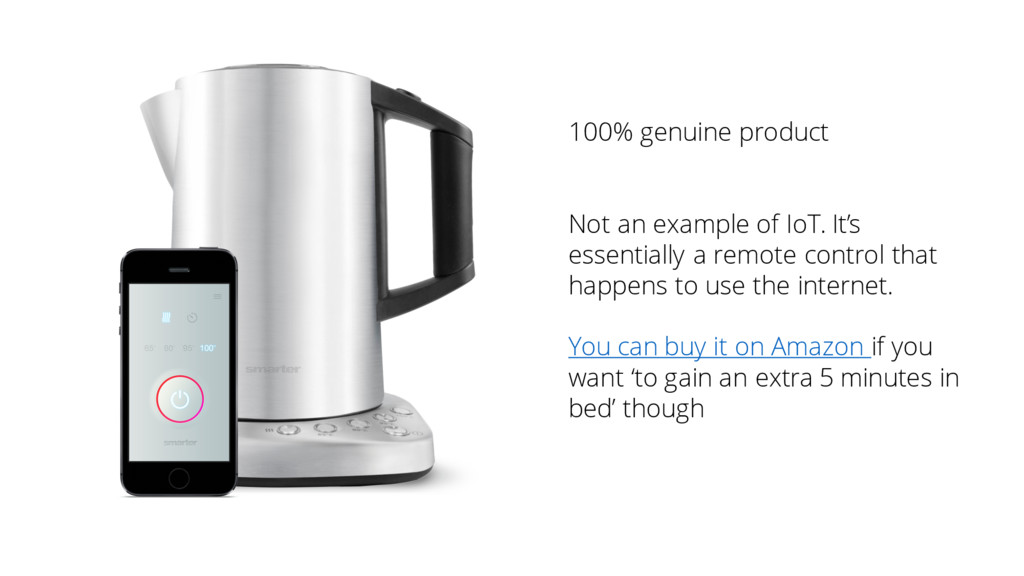
  1. 100% genuine product Not an example of IoT. It’s essentially

    a remote control that happens to use the internet. You can buy it on Amazon if you want ‘to gain an extra 5 minutes in bed’ though
  2. How to make this IoT? Making this into an IoT

    device would mean that it would need to be part of a bigger system with other component parts.
  3. Sensing Track energy usage – next gen of smart meters

    - Water level and boiling info could allow logging the energy consumed for smart metering purposes. - The next generation of smart meters are not going to be about how much energy your home consumes.
  4. Integration Allow other programs/services to use the kettle Integration with

    other products with web-hooks or other IoT protocols like MQTT which would allow a level of automation. – e.g. when you pull up on your drive, turning off your car engine could trigger the kettle.
  5. Return on Investment? I’m not arguing that my suggestions make

    this device all that much more useful. Just going some of the way to explaining the difference between ‘connected’ and IoT where the kettle forms part of a bigger dynamic system. Domestic IoT is generally quite difficult to value in terms of ROI. Mainly going to be sold on the ‘cool’ factor for quite some time.
  6. 1. Connectivity Of course for a lot of IoT devices,

    many will be directly connected to the web – however others, such as particularly low cost sensors tend to operate in one of 2 ways: 1.Mesh network with a connected gateway – like a home network connected to the internet via a broadband gateway. 2.Some other exotic protocol which uses the ionosphere etc. 3.Individual sensors use another device, such as a phone for spurious connectivity. This might use iBeacons, as shown on next slide.
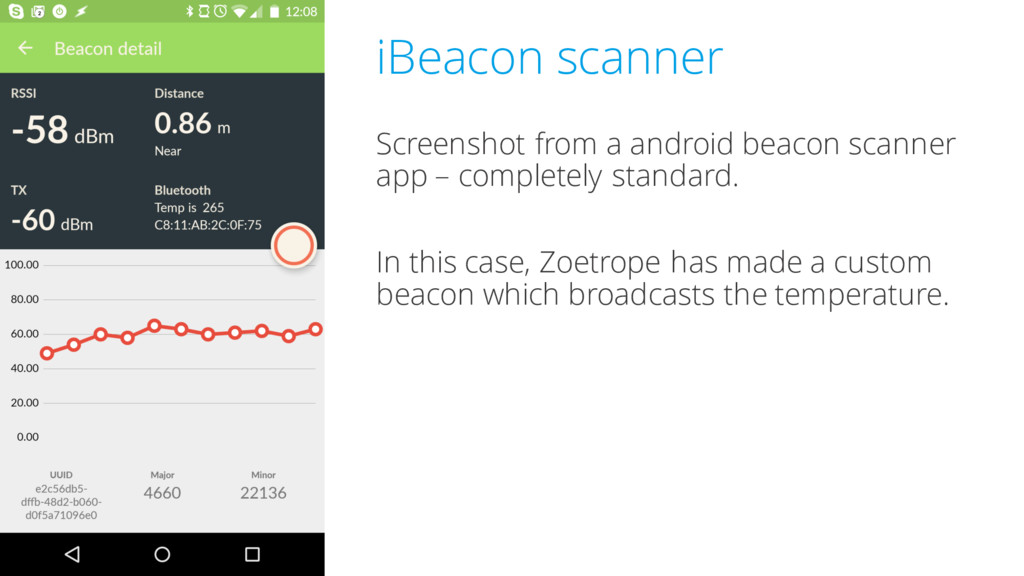
  7. iBeacon scanner Screenshot from a android beacon scanner app –

    completely standard. In this case, Zoetrope has made a custom beacon which broadcasts the temperature.
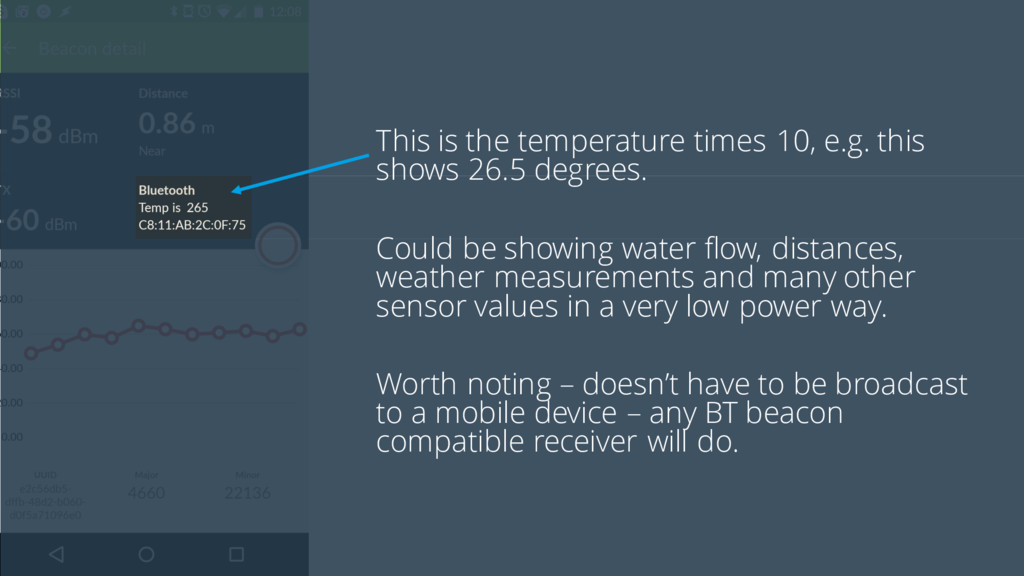
  8. This is the temperature times 10, e.g. this shows 26.5

    degrees. Could be showing water flow, distances, weather measurements and many other sensor values in a very low power way. Worth noting – doesn’t have to be broadcast to a mobile device – any BT beacon compatible receiver will do.
  9. 2. Protocols HTTP is still a big part of the

    IoT eco system, I suspect it probably will be for quite some time. MQTT and COAP are two other protocols which are seeing fairly widespread adoption in the IoT space, especi ally MQTT. MQTT is a messing protocol which is a really simple protocol for passing messages to from a source to a set of subscribers – it’s a completely different paradigm to HTTP, much more like a reliable version of websockets with a few more features. MQTT is already a great choice for messaging data between servers and apps, or device to device. I strongly suspect we’ll see a lot more of MQTT in the broader mobile space – Facebook messenger and some other apps already use it for lower latency and power usage than HTTP or web-sockets. Recommend looking through: More information about COAP
  10. 3. Interfaces Many of the frameworks I’m talking about today

    also provide some sort of UI framework for mobile. I really can’t imagine you’re all crying out for more UI frameworks. What I will say though is that IoT for the most part should be fairly low on the UI side, other than for configuration and notifications because most of the advantage of IoT is that it doesn’t need much fancy UI. The biggest challenge in this area is how to make configurations which allow many different devices to have user configured interconnections…
  11. 4. standards Google Brillo/Weave: Made specifically for app developers –

    Device manifests allow for arbitrary configuration. Very keen to see google Brillo in the wild. Apple homekit: Apples equivalent is very much targeted at home use. Ultimately very similar to the others. Literally 10’s if not 100’s of others. Too many to talk about. Includes IBM, Oracle and many other household names. This is something that’s a big problem for Zoetrope at the moment because we’re spoilt for choice and lots of platforms have different benefits. Can only suggest to developers that adequate research is done before embarking on a project. We’ve tended to go for open source solutions leveraging more mature markets – e.g. apache spark/cassandra, since we are confident they won’t be abandoned in a year.