Share
Embed
Gender Diversity Analysis in the Python Interpreter
PyConES 2017, Cáceres.
Daniel Izquierdo Cortázar
Bitergia
September 24, 2017
Transcript
36 slides
-
Gender-diversity analysis of technical contributions (In the Python Interpreter) Daniel
Izquierdo Cortázar @dizquierdo dizquierdo at bitergia dot com https://speakerdeck.com/bitergia PyConES, Cáceres 2017 -
/me CDO in Bitergia, the software development analytics company Lately
involved in understanding the gender diversity in some OSS communities (OpenStack gender report) Involved in some analytics dashboards: OPNFV, Wikimedia, Eclipse... Disclaimer: not involved in any Python working group, own analysis and interest, I may have missed some stuff... -
Motivation Diversity matters I felt a lack of a quantitative
approach in the WOO related talks (Women of OpenStack) (Tokyo and Austin) Produced some numbers that gained some attention In the end this is all about transparency and improvement We need data to make decisions Diversity is a challenge in any OSS project -
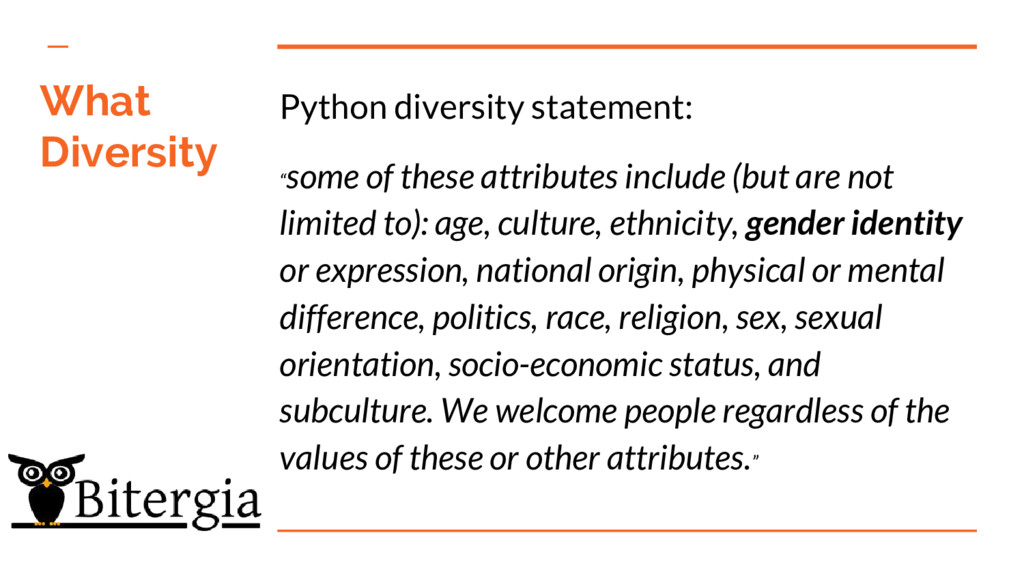
What Diversity Python diversity statement: “ some of these attributes
include (but are not limited to): age, culture, ethnicity, gender identity or expression, national origin, physical or mental difference, politics, race, religion, sex, sexual orientation, socio-economic status, and subculture. We welcome people regardless of the values of these or other attributes.” -
Context FOSS Survey in 2013: - http://floss2013.libresoft.es/results.en.html - 11% of
women answered the survey The Industry Gender Gap by the World Economic Forum. - 5% for CEOs, 21% for Mid-level roles, 32% of Junior roles -
Context 11% [330 devs] 10% [340 devs] 8% [71 devs]
More data at speakderdeck.com/bitergia -
Summary Conclusions not representative, but: - Women represent around 30%/40%
of the workforce in tech companies. - And between 10% and 20% if focused on tech teams. - OpenStack: 11% of the population - Linux Kernel shows a 10% of the population - Hadoop ecosystem around 8%. - What about some projects in the Python ecosystem? -
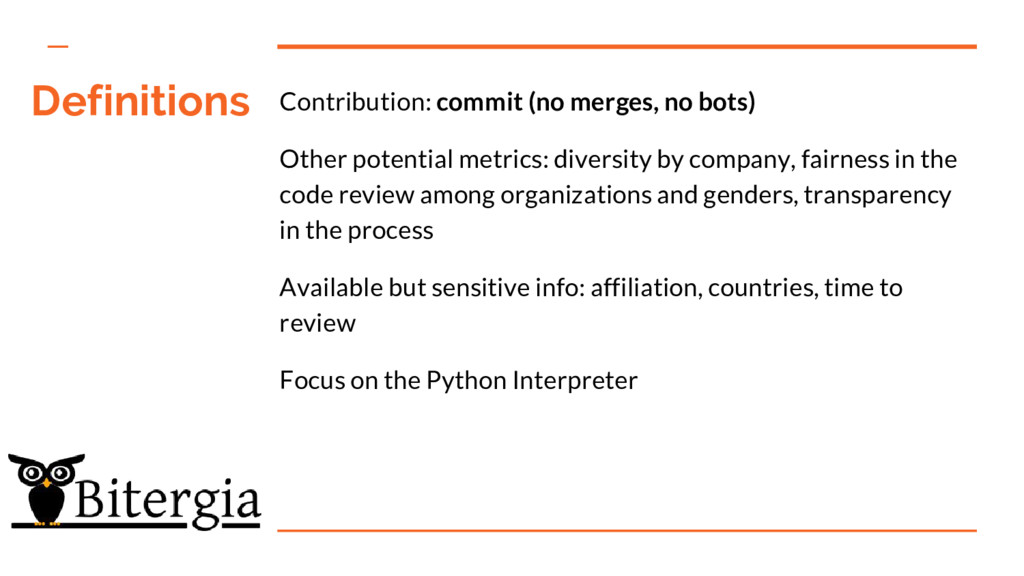
Definitions Contribution: commit (no merges, no bots) Other potential metrics:
diversity by company, fairness in the code review among organizations and genders, transparency in the process Available but sensitive info: affiliation, countries, time to review Focus on the Python Interpreter -
Arch. Original Data Sources Mining Tools Perceval Info Enrich. Genderize.io
Pandas Manual work Viz ElasticSearch + Kibana -
Arch. Original Data Sources • Git • ~ 50 repositories:
• > 130K commits • > 1.1K developers • GitHub Org: (github.com/python) -
Arch. Mining Tools Perceval • Produces JSON documents from the
usual data sources in OSS • Part of the GrimoireLab toolchain • https://grimoirelab.github.io • Founder of the CHAOSS group (https://chaoss.community) -
Arch. Info Enrich. Genderize.io Pandas Manual work • Genderize.io: name
database • Pandas: data analysis lib. • Ceres library (dicortazar/ceres @ github) • Manual work: -
Arch. Viz ElasticSearch + Kibana • ElasticSearch: Schemaless db •
Kibana: works great with ES • This tandem helps a lot to verify info • Drill down capabilities • Extra info available (but not displayed) -
Activity/ Population Women activity (all history): > 1.5K commits (1.2%
of the activity) 50 developers (4% of the population) -
Activity/ Population Women activity (last year): ~350 commits (4.3% of
the activity) 23 developers (3.75% of the population) -
Women Activity • Real activity by women starts in 2012
and then growing -
The most Diverse repos • Interesting to look for the
best practices and learn from those • This may be biased by external factors I’m not aware of (eg: version control system migrations…) VS All Contributors: Cpython Typeshed Mypy Peps Devguide Planet Pythondotorg Asyncio Psf-chef Typing -
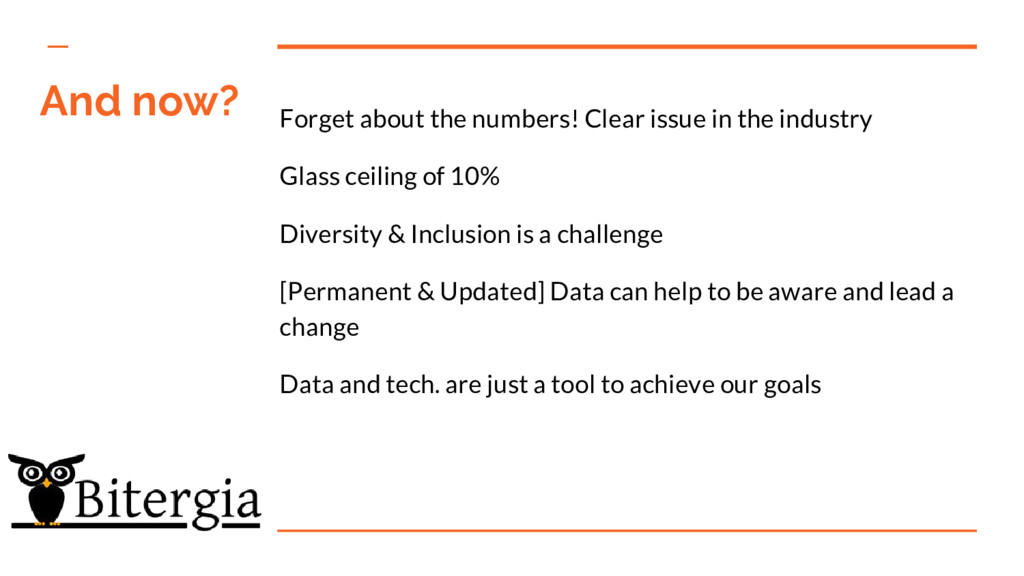
And now? Forget about the numbers! Clear issue in the
industry Glass ceiling of 10% Diversity & Inclusion is a challenge [Permanent & Updated] Data can help to be aware and lead a change Data and tech. are just a tool to achieve our goals -
Some Steps Outreachy Specific tracks about diversity: • Diversity empowerment
summit (LA, Prague) Working groups: Women of OpenStack, PyLadies, Django Girls, Women in Open Source What about data? • OpenStack Gender-Diversity Report (Intel & Bitergia) ◦ goo.gl/8H9qr7 -
How to? Cross Foundations Initiative Can we learn from others?
Recommendations from OpenStack • Policies impact study • Collaboration with PTLs • Bring women to key positions • Keep supporting the WOO group • Enforce the CoC • Documentation, onboarding process and mentoring as a baseline for any project -
Open Questions Are people from the PSF, ASF or OpenStack
talking together? Other Initiatives within the PSF? Companies are the ones bringing a big % of women -
Further Work Sensitive info: dashboard’s private Extra analysis: time to
merge fairness, companies women %, previous Outreachy follow ups, quarterly reports, updated data, specific policies ROI and others. This [hopefully] helps to have a better picture Other minorities analysis could be done Gender diversity is not binary -
Conclusion Room for improvement of the dataset This provides some
initial numbers about the current status Hopefully useful for the Python ecosystem I’d love to learn about Python initiatives -
Gender-diversity analysis of technical contributions (In the Python Interpreter) Daniel
Izquierdo Cortázar @dizquierdo dizquierdo at bitergia dot com https://speakerdeck.com/bitergia PyConES, Cáceres 2017