Upgrade to Pro — share decks privately, control downloads, hide ads and more …

SustainabilityReport2025_EN.pdf

Avatar for Booost Booost
April 01, 2026
12

 SustainabilityReport2025_EN.pdf

Avatar for Booost

Booost

April 01, 2026
Tweet

Transcript

  1. © Booost, Inc. - All rights reserved. Confidential 1 Together,

    we create a Sustainable NET-ZERO future. As a technology partner, we accelerate SX and GX for sustainability and Net Zero leaders to address humanity’s greatest challenge—climate change. Sustainability Report 2025
  2. © Booost, Inc. - All rights reserved. Confidential 2 Confidential

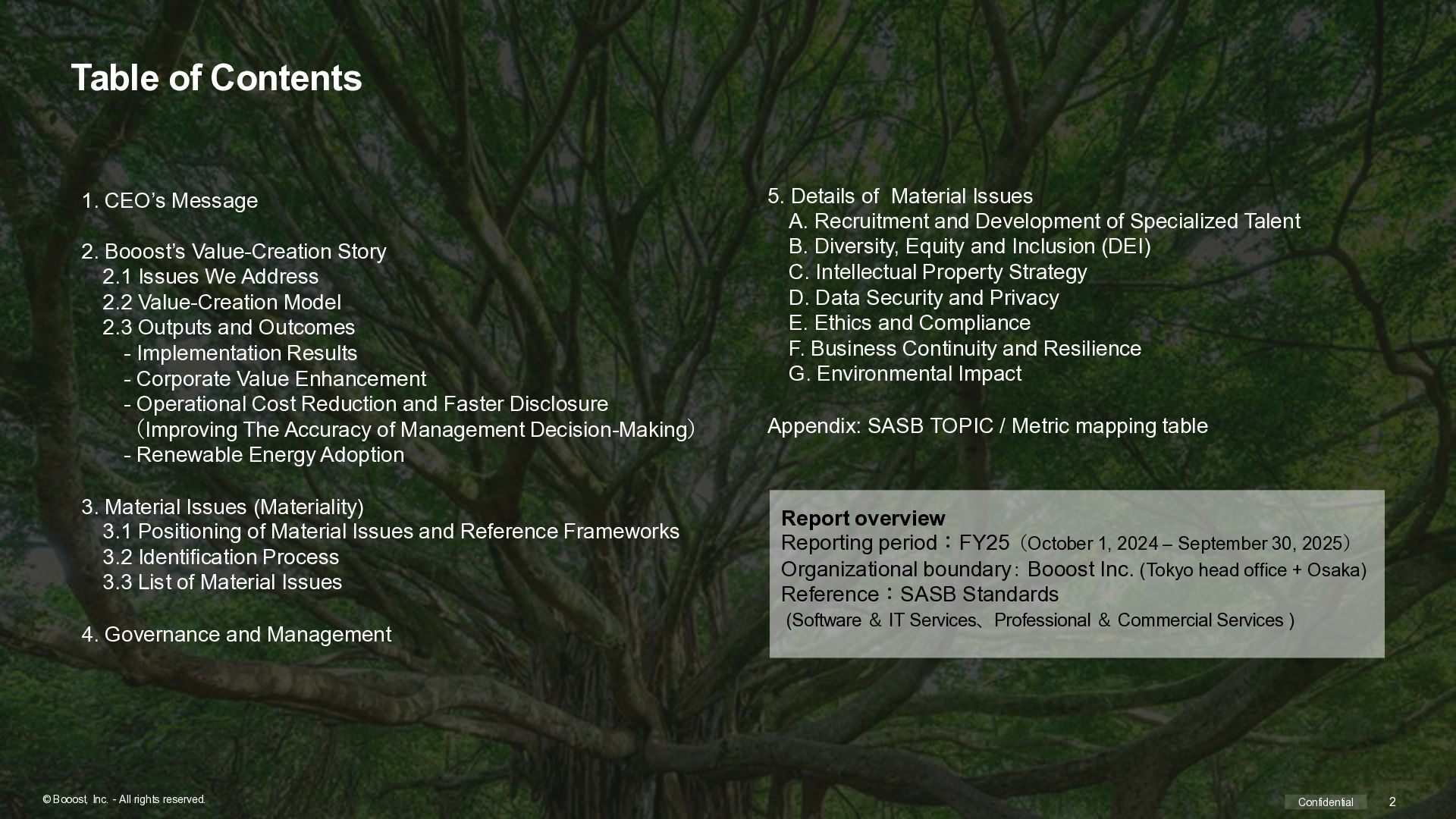
    2 © Booost, Inc. - All rights reserved. Table of Contents 5. Details of Material Issues A. Recruitment and Development of Specialized Talent B. Diversity, Equity and Inclusion (DEI) C. Intellectual Property Strategy D. Data Security and Privacy E. Ethics and Compliance F. Business Continuity and Resilience G. Environmental Impact Appendix: SASB TOPIC / Metric mapping table 1. CEO’s Message 2. Booost’s Value-Creation Story 2.1 Issues We Address 2.2 Value-Creation Model 2.3 Outputs and Outcomes - Implementation Results - Corporate Value Enhancement - Operational Cost Reduction and Faster Disclosure (Improving The Accuracy of Management Decision-Making) - Renewable Energy Adoption 3. Material Issues (Materiality) 3.1 Positioning of Material Issues and Reference Frameworks 3.2 Identification Process 3.3 List of Material Issues 4. Governance and Management Report overview Reporting period:FY25(October 1, 2024 – September 30, 2025) Organizational boundary: Booost Inc. (Tokyo head office + Osaka) Reference:SASB Standards (Software & IT Services、Professional & Commercial Services )
  3. © Booost, Inc. - All rights reserved. Confidential 3 1

    CEO’s Message Sustainability drives Scalability ― Making sustainability an engine for corporate growth
  4. © Booost, Inc. - All rights reserved. Confidential 4 CEO’s

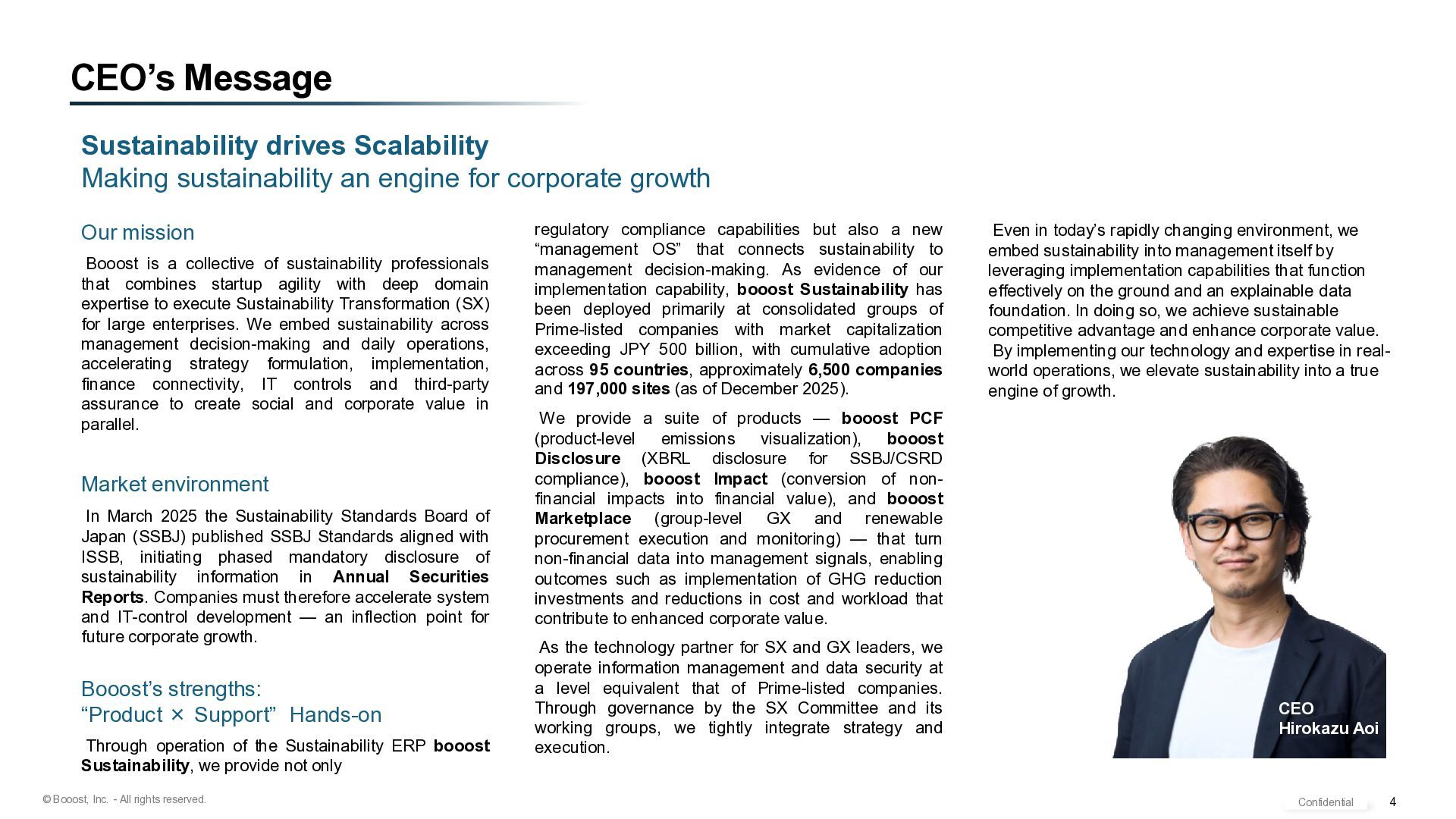
    Message regulatory compliance capabilities but also a new “management OS” that connects sustainability to management decision-making. As evidence of our implementation capability, booost Sustainability has been deployed primarily at consolidated groups of Prime-listed companies with market capitalization exceeding JPY 500 billion, with cumulative adoption across 95 countries, approximately 6,500 companies and 197,000 sites (as of December 2025). We provide a suite of products — booost PCF (product-level emissions visualization), booost Disclosure (XBRL disclosure for SSBJ/CSRD compliance), booost Impact (conversion of non- financial impacts into financial value), and booost Marketplace (group-level GX and renewable procurement execution and monitoring) — that turn non-financial data into management signals, enabling outcomes such as implementation of GHG reduction investments and reductions in cost and workload that contribute to enhanced corporate value. As the technology partner for SX and GX leaders, we operate information management and data security at a level equivalent that of Prime-listed companies. Through governance by the SX Committee and its working groups, we tightly integrate strategy and execution. Our mission Booost is a collective of sustainability professionals that combines startup agility with deep domain expertise to execute Sustainability Transformation (SX) for large enterprises. We embed sustainability across management decision-making and daily operations, accelerating strategy formulation, implementation, finance connectivity, IT controls and third-party assurance to create social and corporate value in parallel. Market environment In March 2025 the Sustainability Standards Board of Japan (SSBJ) published SSBJ Standards aligned with ISSB, initiating phased mandatory disclosure of sustainability information in Annual Securities Reports. Companies must therefore accelerate system and IT-control development — an inflection point for future corporate growth. Booost’s strengths: “Product × Support” Hands-on Through operation of the Sustainability ERP booost Sustainability, we provide not only Sustainability drives Scalability Making sustainability an engine for corporate growth Even in today’s rapidly changing environment, we embed sustainability into management itself by leveraging implementation capabilities that function effectively on the ground and an explainable data foundation. In doing so, we achieve sustainable competitive advantage and enhance corporate value. By implementing our technology and expertise in real- world operations, we elevate sustainability into a true engine of growth. CEO Hirokazu Aoi
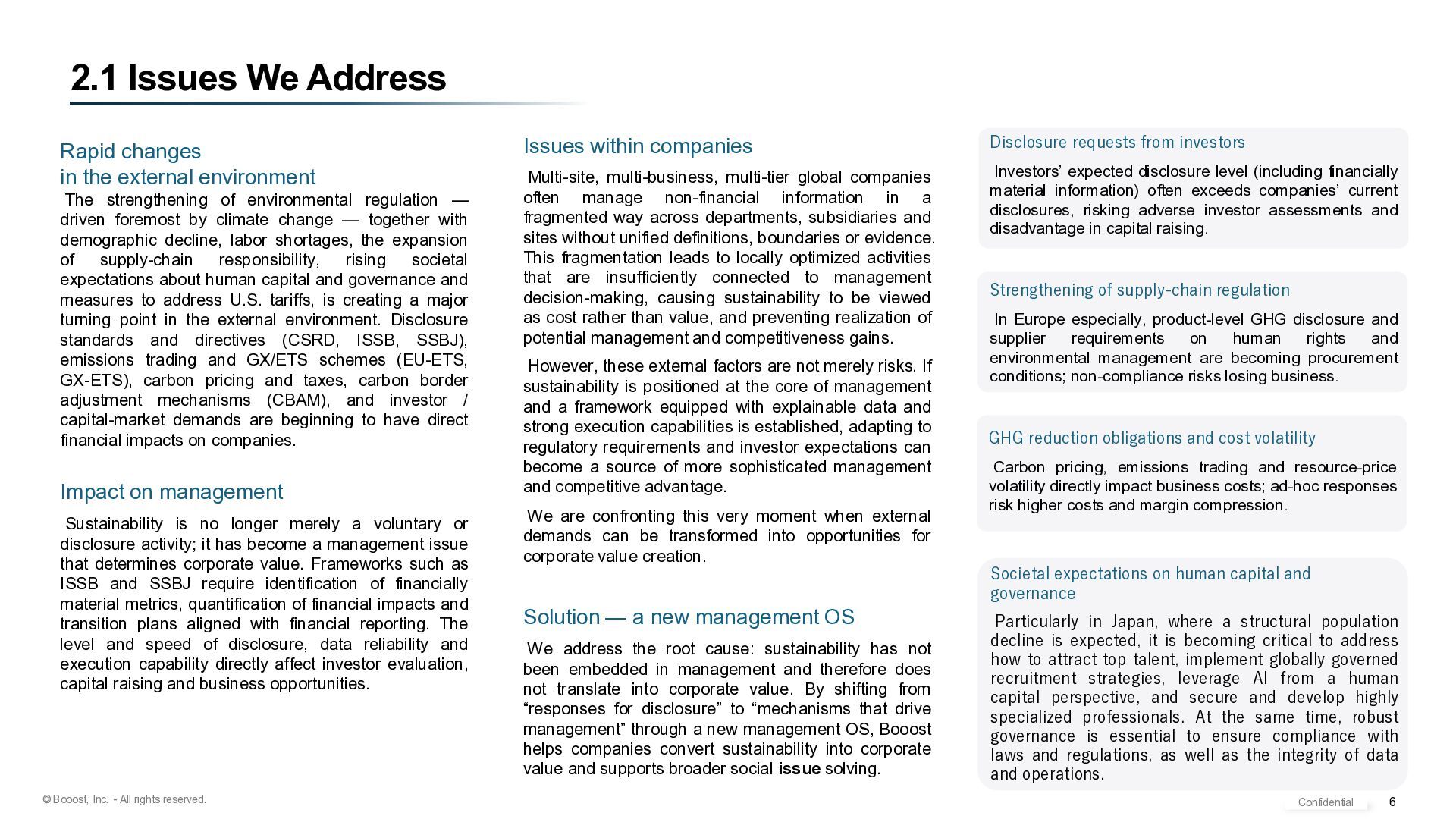
  5. © Booost, Inc. - All rights reserved. Confidential 6 2.1

    Issues We Address Disclosure requests from investors Investors’ expected disclosure level (including financially material information) often exceeds companies’ current disclosures, risking adverse investor assessments and disadvantage in capital raising. Issues within companies Multi-site, multi-business, multi-tier global companies often manage non-financial information in a fragmented way across departments, subsidiaries and sites without unified definitions, boundaries or evidence. This fragmentation leads to locally optimized activities that are insufficiently connected to management decision-making, causing sustainability to be viewed as cost rather than value, and preventing realization of potential management and competitiveness gains. However, these external factors are not merely risks. If sustainability is positioned at the core of management and a framework equipped with explainable data and strong execution capabilities is established, adapting to regulatory requirements and investor expectations can become a source of more sophisticated management and competitive advantage. We are confronting this very moment when external demands can be transformed into opportunities for corporate value creation. Solution — a new management OS We address the root cause: sustainability has not been embedded in management and therefore does not translate into corporate value. By shifting from “responses for disclosure” to “mechanisms that drive management” through a new management OS, Booost helps companies convert sustainability into corporate value and supports broader social issue solving. Rapid changes in the external environment The strengthening of environmental regulation — driven foremost by climate change — together with demographic decline, labor shortages, the expansion of supply-chain responsibility, rising societal expectations about human capital and governance and measures to address U.S. tariffs, is creating a major turning point in the external environment. Disclosure standards and directives (CSRD, ISSB, SSBJ), emissions trading and GX/ETS schemes (EU-ETS, GX-ETS), carbon pricing and taxes, carbon border adjustment mechanisms (CBAM), and investor / capital-market demands are beginning to have direct financial impacts on companies. Impact on management Sustainability is no longer merely a voluntary or disclosure activity; it has become a management issue that determines corporate value. Frameworks such as ISSB and SSBJ require identification of financially material metrics, quantification of financial impacts and transition plans aligned with financial reporting. The level and speed of disclosure, data reliability and execution capability directly affect investor evaluation, capital raising and business opportunities. Strengthening of supply-chain regulation In Europe especially, product-level GHG disclosure and supplier requirements on human rights and environmental management are becoming procurement conditions; non-compliance risks losing business. GHG reduction obligations and cost volatility Carbon pricing, emissions trading and resource-price volatility directly impact business costs; ad-hoc responses risk higher costs and margin compression. Societal expectations on human capital and governance Particularly in Japan, where a structural population decline is expected, it is becoming critical to address how to attract top talent, implement globally governed recruitment strategies, leverage AI from a human capital perspective, and secure and develop highly specialized professionals. At the same time, robust governance is essential to ensure compliance with laws and regulations, as well as the integrity of data and operations.
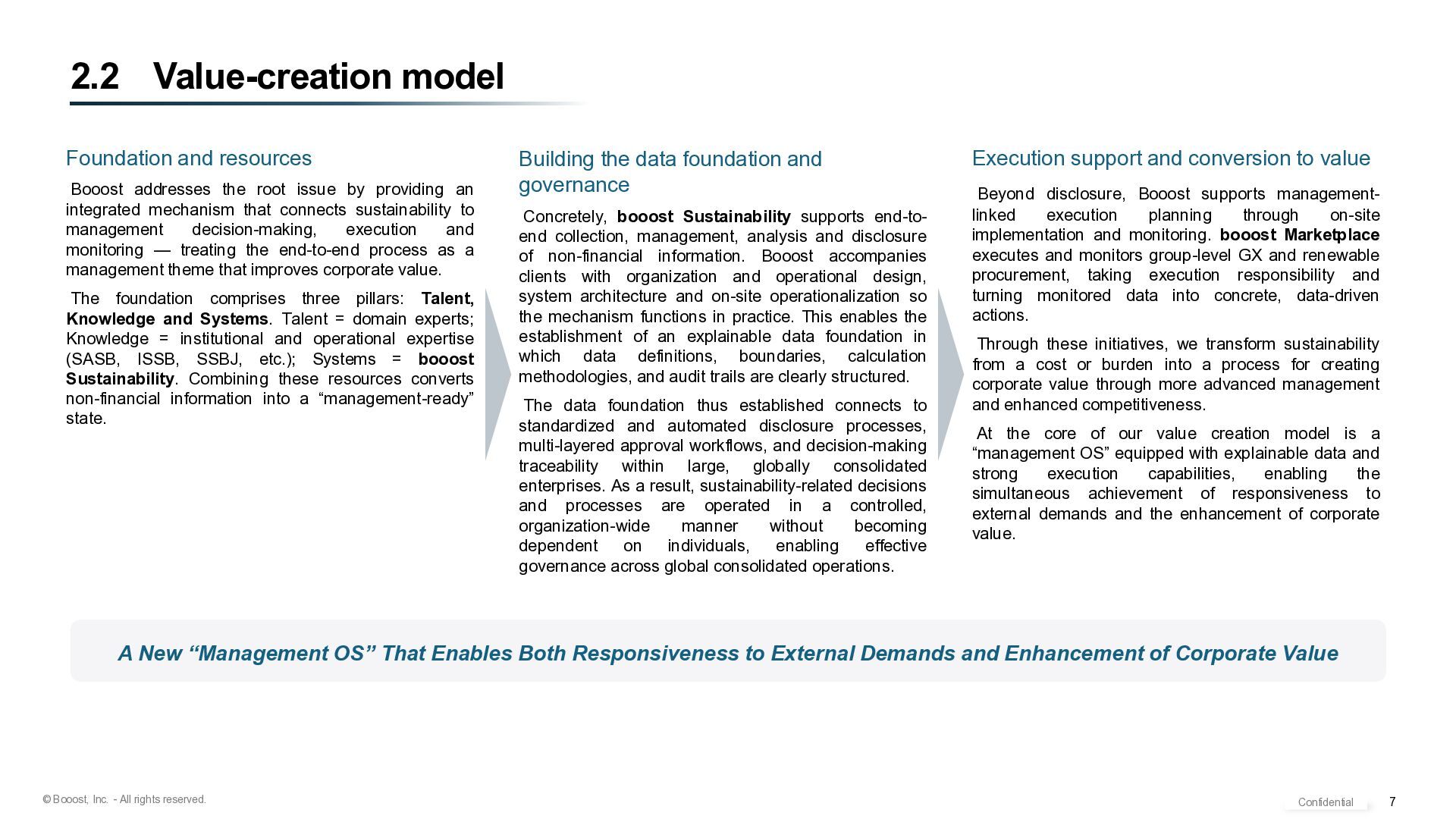
  6. © Booost, Inc. - All rights reserved. Confidential 7 2.2

    Value-creation model Building the data foundation and governance Concretely, booost Sustainability supports end-to- end collection, management, analysis and disclosure of non-financial information. Booost accompanies clients with organization and operational design, system architecture and on-site operationalization so the mechanism functions in practice. This enables the establishment of an explainable data foundation in which data definitions, boundaries, calculation methodologies, and audit trails are clearly structured. The data foundation thus established connects to standardized and automated disclosure processes, multi-layered approval workflows, and decision-making traceability within large, globally consolidated enterprises. As a result, sustainability-related decisions and processes are operated in a controlled, organization-wide manner without becoming dependent on individuals, enabling effective governance across global consolidated operations. Foundation and resources Booost addresses the root issue by providing an integrated mechanism that connects sustainability to management decision-making, execution and monitoring — treating the end-to-end process as a management theme that improves corporate value. The foundation comprises three pillars: Talent, Knowledge and Systems. Talent = domain experts; Knowledge = institutional and operational expertise (SASB, ISSB, SSBJ, etc.); Systems = booost Sustainability. Combining these resources converts non-financial information into a “management-ready” state. Execution support and conversion to value Beyond disclosure, Booost supports management- linked execution planning through on-site implementation and monitoring. booost Marketplace executes and monitors group-level GX and renewable procurement, taking execution responsibility and turning monitored data into concrete, data-driven actions. Through these initiatives, we transform sustainability from a cost or burden into a process for creating corporate value through more advanced management and enhanced competitiveness. At the core of our value creation model is a “management OS” equipped with explainable data and strong execution capabilities, enabling the simultaneous achievement of responsiveness to external demands and the enhancement of corporate value. A New “Management OS” That Enables Both Responsiveness to External Demands and Enhancement of Corporate Value
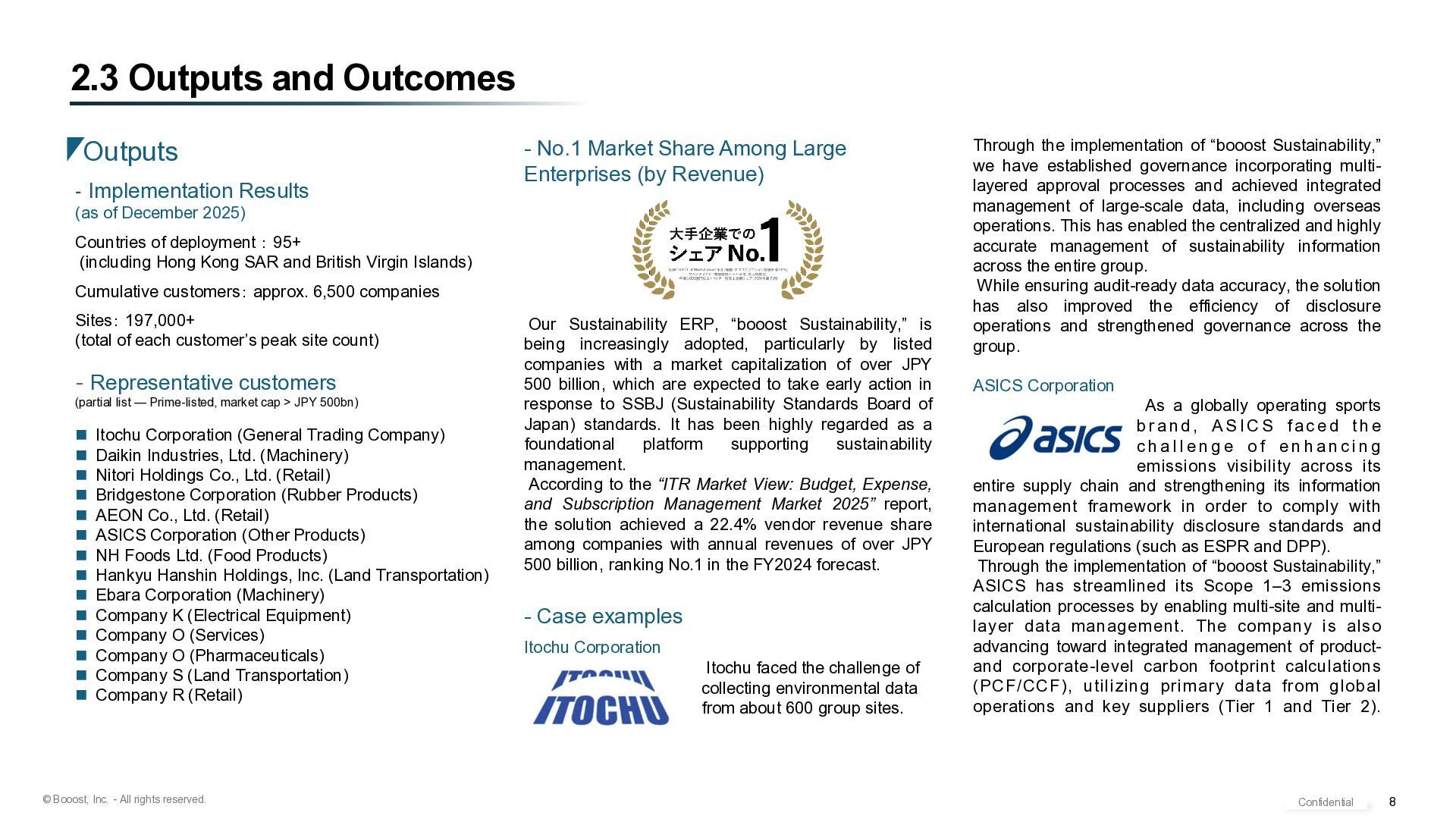
  7. © Booost, Inc. - All rights reserved. Confidential 8 Outputs

    ‐ Implementation Results (as of December 2025) Countries of deployment : 95+ (including Hong Kong SAR and British Virgin Islands) Cumulative customers: approx. 6,500 companies Sites: 197,000+ (total of each customer’s peak site count) - Representative customers (partial list — Prime-listed, market cap > JPY 500bn) ◼ Itochu Corporation (General Trading Company) ◼ Daikin Industries, Ltd. (Machinery) ◼ Nitori Holdings Co., Ltd. (Retail) ◼ Bridgestone Corporation (Rubber Products) ◼ AEON Co., Ltd. (Retail) ◼ ASICS Corporation (Other Products) ◼ NH Foods Ltd. (Food Products) ◼ Hankyu Hanshin Holdings, Inc. (Land Transportation) ◼ Ebara Corporation (Machinery) ◼ Company K (Electrical Equipment) ◼ Company O (Services) ◼ Company O (Pharmaceuticals) ◼ Company S (Land Transportation) ◼ Company R (Retail) Through the implementation of “booost Sustainability,” we have established governance incorporating multi- layered approval processes and achieved integrated management of large-scale data, including overseas operations. This has enabled the centralized and highly accurate management of sustainability information across the entire group. While ensuring audit-ready data accuracy, the solution has also improved the efficiency of disclosure operations and strengthened governance across the group. ASICS Corporation As a globally operating sports b r a n d , A S I C S f a c e d t h e c h a l l e n g e o f e n h a n c i n g emissions visibility across its entire supply chain and strengthening its information management framework in order to comply with international sustainability disclosure standards and European regulations (such as ESPR and DPP). Through the implementation of “booost Sustainability,” ASICS has streamlined its Scope 1–3 emissions calculation processes by enabling multi-site and multi- layer data management. The company is also advancing toward integrated management of product- and corporate-level carbon footprint calculations (PCF/CCF), utilizing primary data from global operations and key suppliers (Tier 1 and Tier 2). 2.3 Outputs and Outcomes - No.1 Market Share Among Large Enterprises (by Revenue) Our Sustainability ERP, “booost Sustainability,” is being increasingly adopted, particularly by listed companies with a market capitalization of over JPY 500 billion, which are expected to take early action in response to SSBJ (Sustainability Standards Board of Japan) standards. It has been highly regarded as a foundational platform supporting sustainability management. According to the “ITR Market View: Budget, Expense, and Subscription Management Market 2025” report, the solution achieved a 22.4% vendor revenue share among companies with annual revenues of over JPY 500 billion, ranking No.1 in the FY2024 forecast. - Case examples Itochu Corporation Itochu faced the challenge of collecting environmental data from about 600 group sites.
  8. © Booost, Inc. - All rights reserved. Confidential 9 This

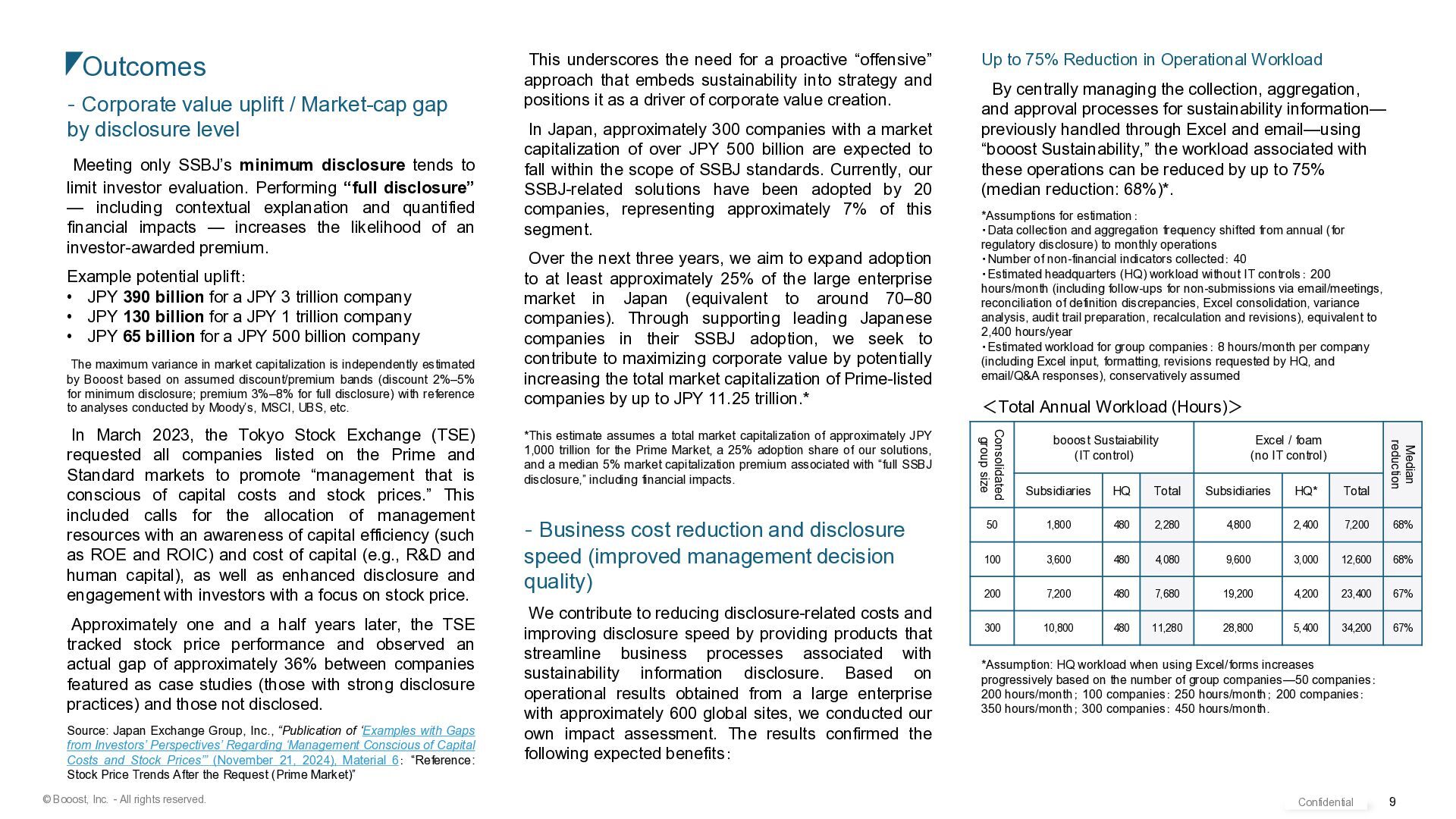
    underscores the need for a proactive “offensive” approach that embeds sustainability into strategy and positions it as a driver of corporate value creation. In Japan, approximately 300 companies with a market capitalization of over JPY 500 billion are expected to fall within the scope of SSBJ standards. Currently, our SSBJ-related solutions have been adopted by 20 companies, representing approximately 7% of this segment. Over the next three years, we aim to expand adoption to at least approximately 25% of the large enterprise market in Japan (equivalent to around 70–80 companies). Through supporting leading Japanese companies in their SSBJ adoption, we seek to contribute to maximizing corporate value by potentially increasing the total market capitalization of Prime-listed companies by up to JPY 11.25 trillion.* *This estimate assumes a total market capitalization of approximately JPY 1,000 trillion for the Prime Market, a 25% adoption share of our solutions, and a median 5% market capitalization premium associated with “full SSBJ disclosure,” including financial impacts. - Business cost reduction and disclosure speed (improved management decision quality) We contribute to reducing disclosure-related costs and improving disclosure speed by providing products that streamline business processes associated with sustainability information disclosure. Based on operational results obtained from a large enterprise with approximately 600 global sites, we conducted our own impact assessment. The results confirmed the following expected benefits: Up to 75% Reduction in Operational Workload By centrally managing the collection, aggregation, and approval processes for sustainability information— previously handled through Excel and email—using “booost Sustainability,” the workload associated with these operations can be reduced by up to 75% (median reduction: 68%)*. *Assumptions for estimation: ・Data collection and aggregation frequency shifted from annual (for regulatory disclosure) to monthly operations ・Number of non-financial indicators collected: 40 ・Estimated headquarters (HQ) workload without IT controls: 200 hours/month (including follow-ups for non-submissions via email/meetings, reconciliation of definition discrepancies, Excel consolidation, variance analysis, audit trail preparation, recalculation and revisions), equivalent to 2,400 hours/year ・Estimated workload for group companies: 8 hours/month per company (including Excel input, formatting, revisions requested by HQ, and email/Q&A responses), conservatively assumed <Total Annual Workload (Hours)> *Assumption: HQ workload when using Excel/forms increases progressively based on the number of group companies—50 companies: 200 hours/month; 100 companies: 250 hours/month; 200 companies: 350 hours/month; 300 companies: 450 hours/month. Outcomes - Corporate value uplift / Market-cap gap by disclosure level Meeting only SSBJ’s minimum disclosure tends to limit investor evaluation. Performing “full disclosure” — including contextual explanation and quantified financial impacts — increases the likelihood of an investor-awarded premium. Example potential uplift: • JPY 390 billion for a JPY 3 trillion company • JPY 130 billion for a JPY 1 trillion company • JPY 65 billion for a JPY 500 billion company The maximum variance in market capitalization is independently estimated by Booost based on assumed discount/premium bands (discount 2%–5% for minimum disclosure; premium 3%–8% for full disclosure) with reference to analyses conducted by Moody’s, MSCI, UBS, etc. In March 2023, the Tokyo Stock Exchange (TSE) requested all companies listed on the Prime and Standard markets to promote “management that is conscious of capital costs and stock prices.” This included calls for the allocation of management resources with an awareness of capital efficiency (such as ROE and ROIC) and cost of capital (e.g., R&D and human capital), as well as enhanced disclosure and engagement with investors with a focus on stock price. Approximately one and a half years later, the TSE tracked stock price performance and observed an actual gap of approximately 36% between companies featured as case studies (those with strong disclosure practices) and those not disclosed. Source: Japan Exchange Group, Inc., “Publication of ‘Examples with Gaps from Investors’ Perspectives’ Regarding ‘Management Conscious of Capital Costs and Stock Prices’” (November 21, 2024), Material 6: “Reference: Stock Price Trends After the Request (Prime Market)” Consolidated group size booost Sustaiability (IT control) Excel / foam (no IT control) Median reduction Subsidiaries HQ Total Subsidiaries HQ* Total 50 1,800 480 2,280 4,800 2,400 7,200 68% 100 3,600 480 4,080 9,600 3,000 12,600 68% 200 7,200 480 7,680 19,200 4,200 23,400 67% 300 10,800 480 11,280 28,800 5,400 34,200 67%
  9. © Booost, Inc. - All rights reserved. Confidential 10 <Lead-time

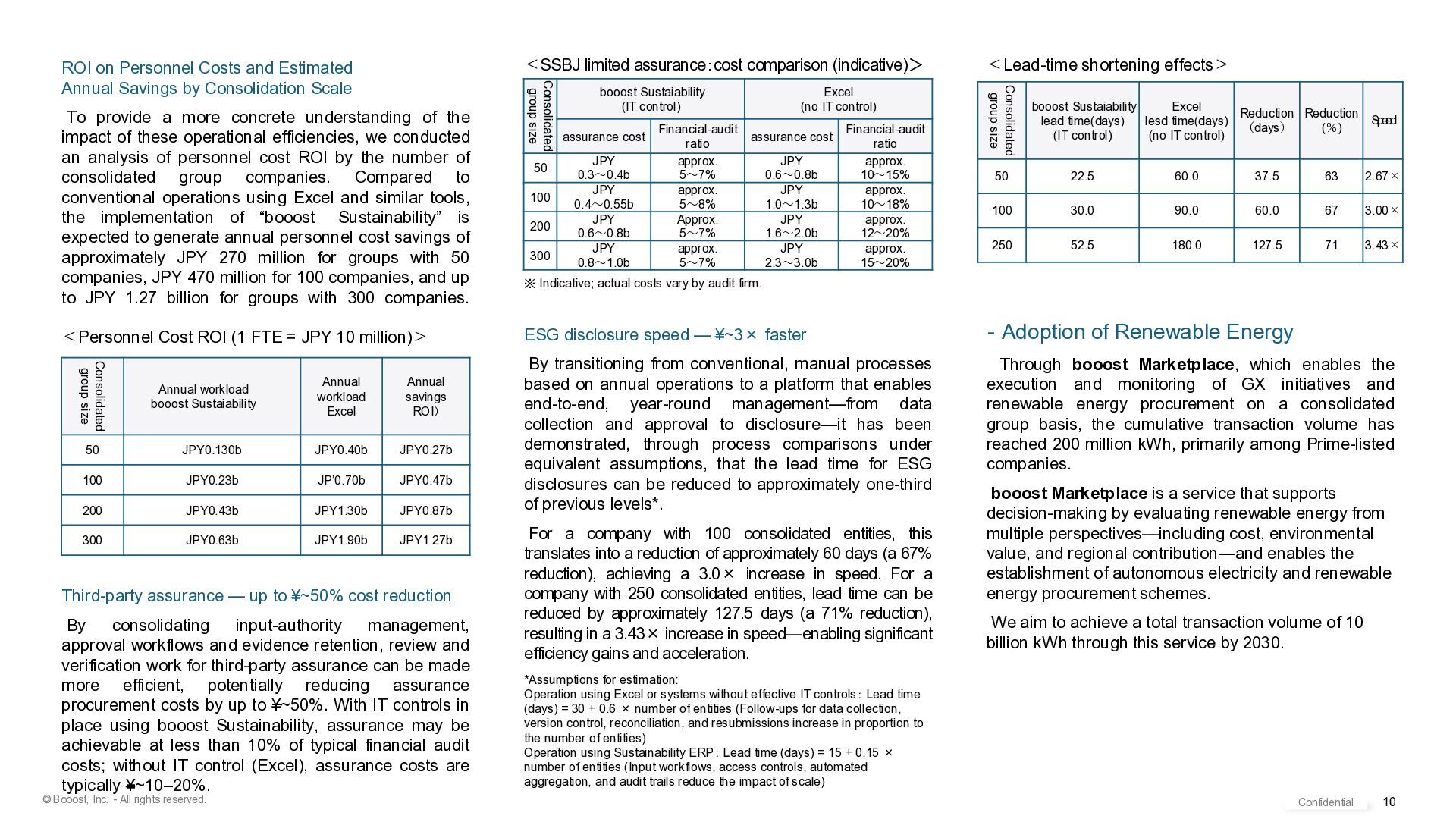
    shortening effects> - Adoption of Renewable Energy Through booost Marketplace, which enables the execution and monitoring of GX initiatives and renewable energy procurement on a consolidated group basis, the cumulative transaction volume has reached 200 million kWh, primarily among Prime-listed companies. booost Marketplace is a service that supports decision-making by evaluating renewable energy from multiple perspectives—including cost, environmental value, and regional contribution—and enables the establishment of autonomous electricity and renewable energy procurement schemes. We aim to achieve a total transaction volume of 10 billion kWh through this service by 2030. <SSBJ limited assurance:cost comparison (indicative)> ※ Indicative; actual costs vary by audit firm. ESG disclosure speed — ¥~3× faster By transitioning from conventional, manual processes based on annual operations to a platform that enables end-to-end, year-round management—from data collection and approval to disclosure—it has been demonstrated, through process comparisons under equivalent assumptions, that the lead time for ESG disclosures can be reduced to approximately one-third of previous levels*. For a company with 100 consolidated entities, this translates into a reduction of approximately 60 days (a 67% reduction), achieving a 3.0× increase in speed. For a company with 250 consolidated entities, lead time can be reduced by approximately 127.5 days (a 71% reduction), resulting in a 3.43× increase in speed—enabling significant efficiency gains and acceleration. *Assumptions for estimation: Operation using Excel or systems without effective IT controls: Lead time (days) = 30 + 0.6 × number of entities (Follow-ups for data collection, version control, reconciliation, and resubmissions increase in proportion to the number of entities) Operation using Sustainability ERP: Lead time (days) = 15 + 0.15 × number of entities (Input workflows, access controls, automated aggregation, and audit trails reduce the impact of scale) Consolidated group size booost Sustaiability (IT control) Excel (no IT control) assurance cost Financial-audit ratio assurance cost Financial-audit ratio 50 JPY 0.3〜0.4b approx. 5〜7% JPY 0.6〜0.8b approx. 10〜15% 100 JPY 0.4〜0.55b approx. 5〜8% JPY 1.0〜1.3b approx. 10〜18% 200 JPY 0.6〜0.8b Approx. 5〜7% JPY 1.6〜2.0b approx. 12〜20% 300 JPY 0.8〜1.0b approx. 5〜7% JPY 2.3〜3.0b approx. 15〜20% Consolidated group size booost Sustaiability lead time(days) (IT control) Excel lesd time(days) (no IT control) Reduction (days) Reduction (%) Speed 50 22.5 60.0 37.5 63 2.67× 100 30.0 90.0 60.0 67 3.00× 250 52.5 180.0 127.5 71 3.43× ROI on Personnel Costs and Estimated Annual Savings by Consolidation Scale To provide a more concrete understanding of the impact of these operational efficiencies, we conducted an analysis of personnel cost ROI by the number of consolidated group companies. Compared to conventional operations using Excel and similar tools, the implementation of “booost Sustainability” is expected to generate annual personnel cost savings of approximately JPY 270 million for groups with 50 companies, JPY 470 million for 100 companies, and up to JPY 1.27 billion for groups with 300 companies. <Personnel Cost ROI (1 FTE = JPY 10 million)> Third-party assurance — up to ¥~50% cost reduction By consolidating input-authority management, approval workflows and evidence retention, review and verification work for third-party assurance can be made more efficient, potentially reducing assurance procurement costs by up to ¥~50%. With IT controls in place using booost Sustainability, assurance may be achievable at less than 10% of typical financial audit costs; without IT control (Excel), assurance costs are typically ¥~10–20%. Consolidated group size Annual workload booost Sustaiability Annual workload Excel Annual savings ROI) 50 JPY0.130b JPY0.40b JPY0.27b 100 JPY0.23b JP’0.70b JPY0.47b 200 JPY0.43b JPY1.30b JPY0.87b 300 JPY0.63b JPY1.90b JPY1.27b
  10. © Booost, Inc. - All rights reserved. Confidential 12 Since

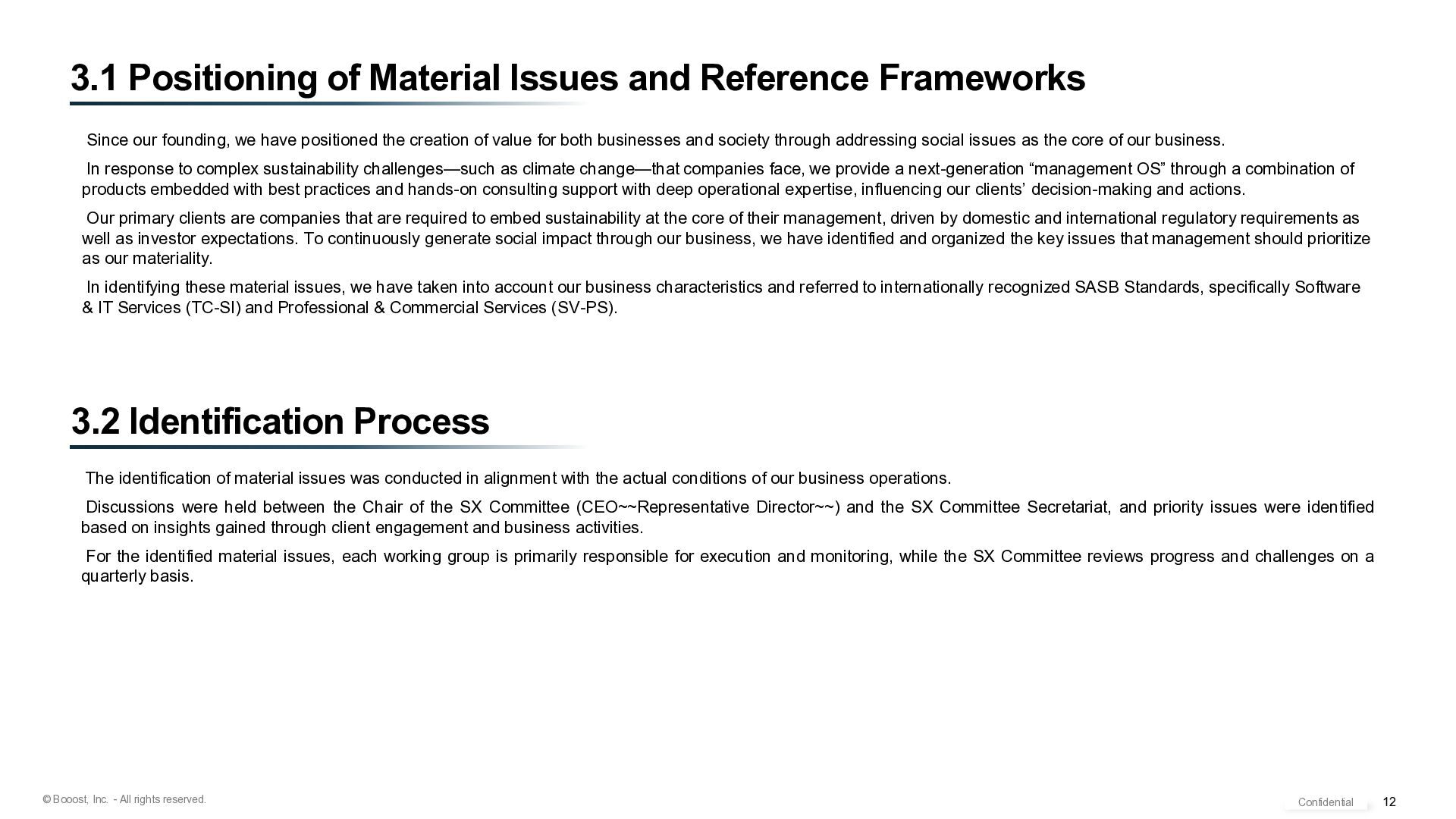
    our founding, we have positioned the creation of value for both businesses and society through addressing social issues as the core of our business. In response to complex sustainability challenges—such as climate change—that companies face, we provide a next-generation “management OS” through a combination of products embedded with best practices and hands-on consulting support with deep operational expertise, influencing our clients’ decision-making and actions. Our primary clients are companies that are required to embed sustainability at the core of their management, driven by domestic and international regulatory requirements as well as investor expectations. To continuously generate social impact through our business, we have identified and organized the key issues that management should prioritize as our materiality. In identifying these material issues, we have taken into account our business characteristics and referred to internationally recognized SASB Standards, specifically Software & IT Services (TC-SI) and Professional & Commercial Services (SV-PS). 3.1 Positioning of Material Issues and Reference Frameworks 3.2 Identification Process The identification of material issues was conducted in alignment with the actual conditions of our business operations. Discussions were held between the Chair of the SX Committee (CEO~~Representative Director~~) and the SX Committee Secretariat, and priority issues were identified based on insights gained through client engagement and business activities. For the identified material issues, each working group is primarily responsible for execution and monitoring, while the SX Committee reviews progress and challenges on a quarterly basis.
  11. © Booost, Inc. - All rights reserved. Confidential 13 Material

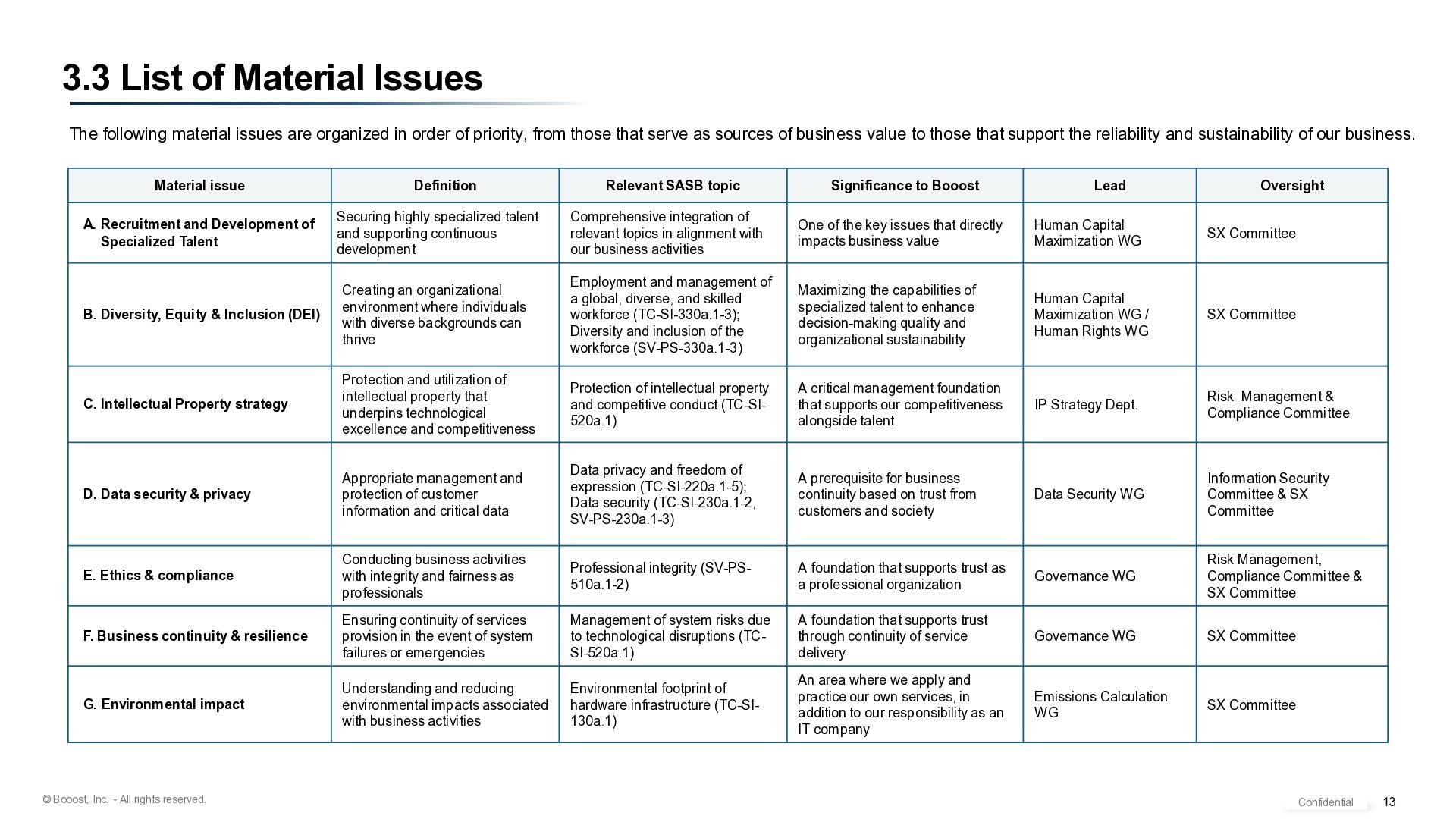
    issue Definition Relevant SASB topic Significance to Booost Lead Oversight A. Recruitment and Development of Specialized Talent Securing highly specialized talent and supporting continuous development Comprehensive integration of relevant topics in alignment with our business activities One of the key issues that directly impacts business value Human Capital Maximization WG SX Committee B. Diversity, Equity & Inclusion (DEI) Creating an organizational environment where individuals with diverse backgrounds can thrive Employment and management of a global, diverse, and skilled workforce (TC-SI-330a.1-3); Diversity and inclusion of the workforce (SV-PS-330a.1-3) Maximizing the capabilities of specialized talent to enhance decision-making quality and organizational sustainability Human Capital Maximization WG / Human Rights WG SX Committee C. Intellectual Property strategy Protection and utilization of intellectual property that underpins technological excellence and competitiveness Protection of intellectual property and competitive conduct (TC-SI- 520a.1) A critical management foundation that supports our competitiveness alongside talent IP Strategy Dept. Risk Management & Compliance Committee D. Data security & privacy Appropriate management and protection of customer information and critical data Data privacy and freedom of expression (TC-SI-220a.1-5); Data security (TC-SI-230a.1-2, SV-PS-230a.1-3) A prerequisite for business continuity based on trust from customers and society Data Security WG Information Security Committee & SX Committee E. Ethics & compliance Conducting business activities with integrity and fairness as professionals Professional integrity (SV-PS- 510a.1-2) A foundation that supports trust as a professional organization Governance WG Risk Management, Compliance Committee & SX Committee F. Business continuity & resilience Ensuring continuity of services provision in the event of system failures or emergencies Management of system risks due to technological disruptions (TC- SI-520a.1) A foundation that supports trust through continuity of service delivery Governance WG SX Committee G. Environmental impact Understanding and reducing environmental impacts associated with business activities Environmental footprint of hardware infrastructure (TC-SI- 130a.1) An area where we apply and practice our own services, in addition to our responsibility as an IT company Emissions Calculation WG SX Committee 3.3 List of Material Issues The following material issues are organized in order of priority, from those that serve as sources of business value to those that support the reliability and sustainability of our business.
  12. © Booost, Inc. - All rights reserved. Confidential 15 Governance

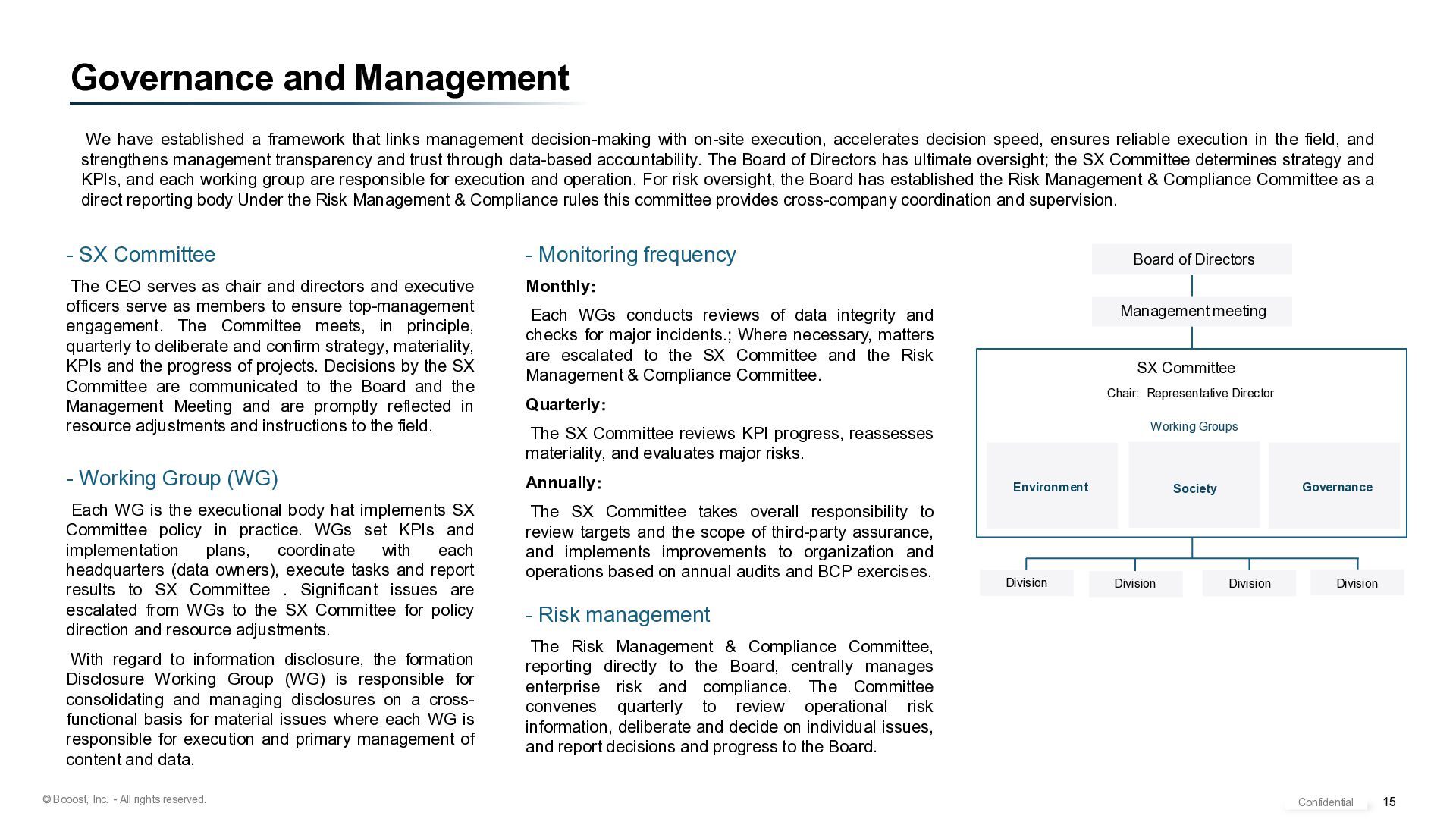
    and Management - SX Committee The CEO serves as chair and directors and executive officers serve as members to ensure top-management engagement. The Committee meets, in principle, quarterly to deliberate and confirm strategy, materiality, KPIs and the progress of projects. Decisions by the SX Committee are communicated to the Board and the Management Meeting and are promptly reflected in resource adjustments and instructions to the field. - Working Group (WG) Each WG is the executional body hat implements SX Committee policy in practice. WGs set KPIs and implementation plans, coordinate with each headquarters (data owners), execute tasks and report results to SX Committee . Significant issues are escalated from WGs to the SX Committee for policy direction and resource adjustments. With regard to information disclosure, the formation Disclosure Working Group (WG) is responsible for consolidating and managing disclosures on a cross- functional basis for material issues where each WG is responsible for execution and primary management of content and data. - Monitoring frequency Monthly: Each WGs conducts reviews of data integrity and checks for major incidents.; Where necessary, matters are escalated to the SX Committee and the Risk Management & Compliance Committee. Quarterly: The SX Committee reviews KPI progress, reassesses materiality, and evaluates major risks. Annually: The SX Committee takes overall responsibility to review targets and the scope of third-party assurance, and implements improvements to organization and operations based on annual audits and BCP exercises. - Risk management The Risk Management & Compliance Committee, reporting directly to the Board, centrally manages enterprise risk and compliance. The Committee convenes quarterly to review operational risk information, deliberate and decide on individual issues, and report decisions and progress to the Board. SX Committee Chair: Representative Director Working Groups Governance Board of Directors Management meeting Society Environment Division We have established a framework that links management decision-making with on-site execution, accelerates decision speed, ensures reliable execution in the field, and strengthens management transparency and trust through data-based accountability. The Board of Directors has ultimate oversight; the SX Committee determines strategy and KPIs, and each working group are responsible for execution and operation. For risk oversight, the Board has established the Risk Management & Compliance Committee as a direct reporting body Under the Risk Management & Compliance rules this committee provides cross-company coordination and supervision. Division Division Division
  13. © Booost, Inc. - All rights reserved. Confidential 17 A.

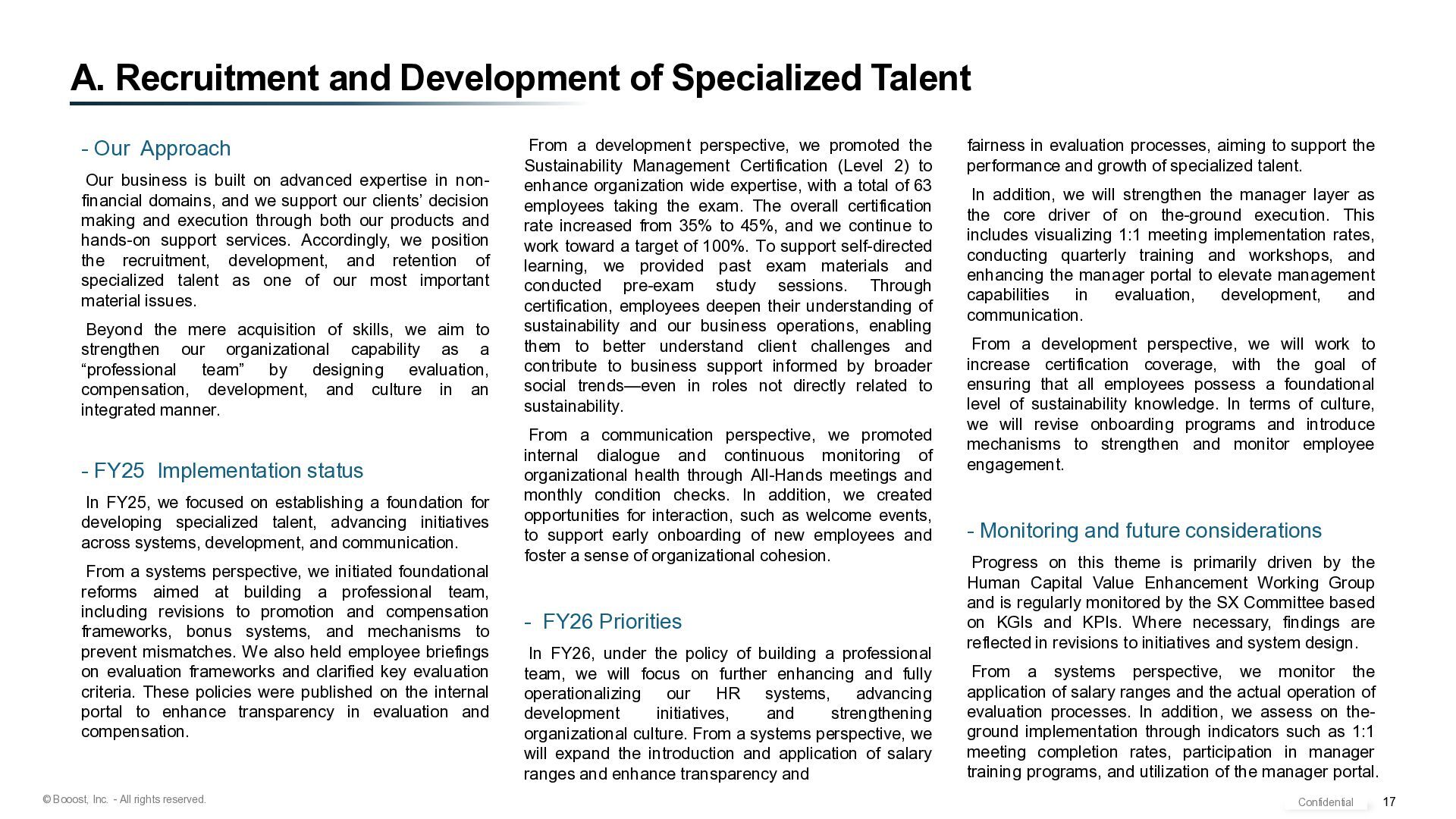
    Recruitment and Development of Specialized Talent - Our Approach Our business is built on advanced expertise in non- financial domains, and we support our clients’ decision making and execution through both our products and hands-on support services. Accordingly, we position the recruitment, development, and retention of specialized talent as one of our most important material issues. Beyond the mere acquisition of skills, we aim to strengthen our organizational capability as a “professional team” by designing evaluation, compensation, development, and culture in an integrated manner. - FY25 Implementation status In FY25, we focused on establishing a foundation for developing specialized talent, advancing initiatives across systems, development, and communication. From a systems perspective, we initiated foundational reforms aimed at building a professional team, including revisions to promotion and compensation frameworks, bonus systems, and mechanisms to prevent mismatches. We also held employee briefings on evaluation frameworks and clarified key evaluation criteria. These policies were published on the internal portal to enhance transparency in evaluation and compensation. fairness in evaluation processes, aiming to support the performance and growth of specialized talent. In addition, we will strengthen the manager layer as the core driver of on the-ground execution. This includes visualizing 1:1 meeting implementation rates, conducting quarterly training and workshops, and enhancing the manager portal to elevate management capabilities in evaluation, development, and communication. From a development perspective, we will work to increase certification coverage, with the goal of ensuring that all employees possess a foundational level of sustainability knowledge. In terms of culture, we will revise onboarding programs and introduce mechanisms to strengthen and monitor employee engagement. - Monitoring and future considerations Progress on this theme is primarily driven by the Human Capital Value Enhancement Working Group and is regularly monitored by the SX Committee based on KGIs and KPIs. Where necessary, findings are reflected in revisions to initiatives and system design. From a systems perspective, we monitor the application of salary ranges and the actual operation of evaluation processes. In addition, we assess on the- ground implementation through indicators such as 1:1 meeting completion rates, participation in manager training programs, and utilization of the manager portal. From a development perspective, we promoted the Sustainability Management Certification (Level 2) to enhance organization wide expertise, with a total of 63 employees taking the exam. The overall certification rate increased from 35% to 45%, and we continue to work toward a target of 100%. To support self-directed learning, we provided past exam materials and conducted pre-exam study sessions. Through certification, employees deepen their understanding of sustainability and our business operations, enabling them to better understand client challenges and contribute to business support informed by broader social trends—even in roles not directly related to sustainability. From a communication perspective, we promoted internal dialogue and continuous monitoring of organizational health through All-Hands meetings and monthly condition checks. In addition, we created opportunities for interaction, such as welcome events, to support early onboarding of new employees and foster a sense of organizational cohesion. - FY26 Priorities In FY26, under the policy of building a professional team, we will focus on further enhancing and fully operationalizing our HR systems, advancing development initiatives, and strengthening organizational culture. From a systems perspective, we will expand the introduction and application of salary ranges and enhance transparency and
  14. © Booost, Inc. - All rights reserved. Confidential 18 A.

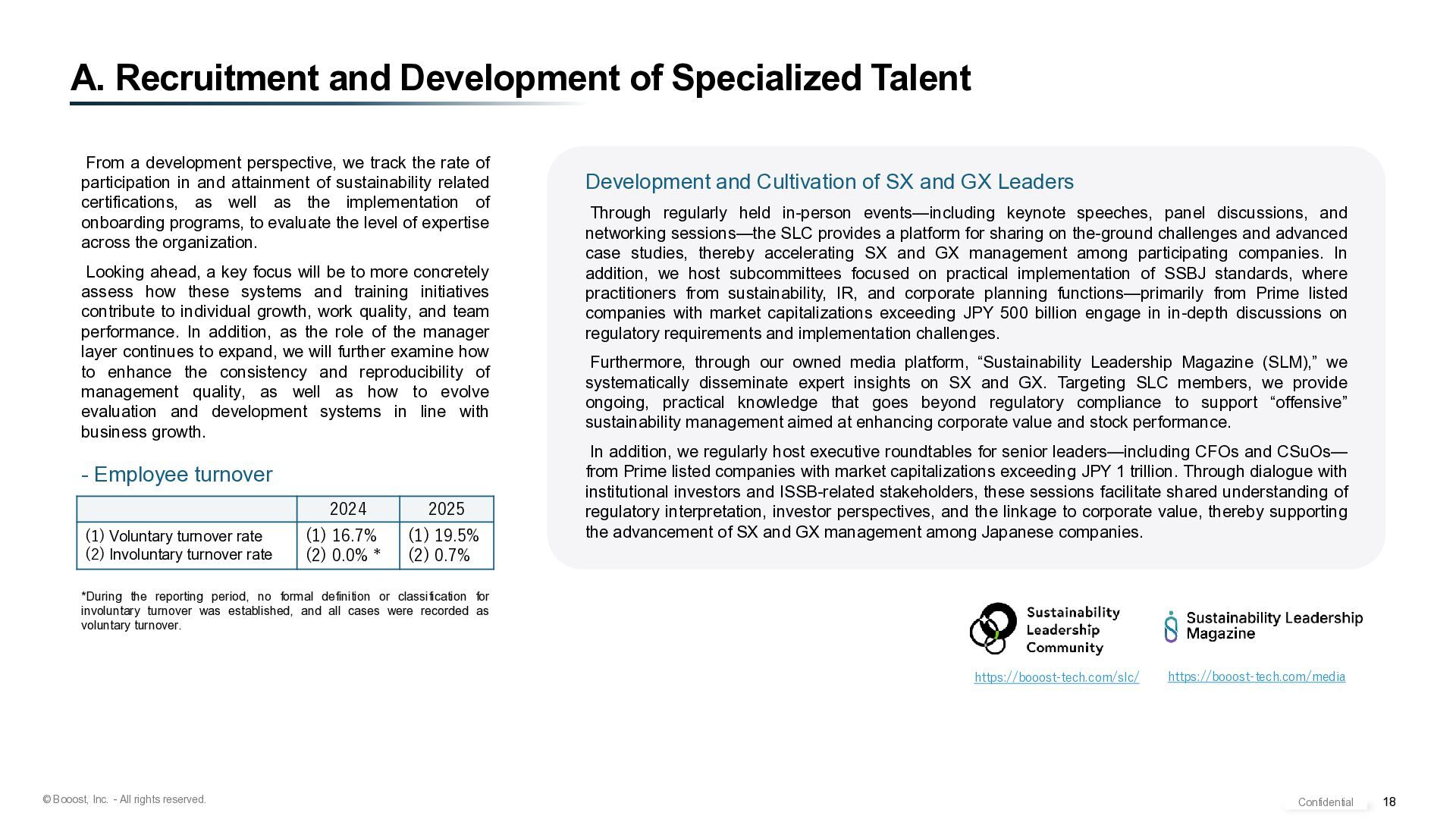
    Recruitment and Development of Specialized Talent From a development perspective, we track the rate of participation in and attainment of sustainability related certifications, as well as the implementation of onboarding programs, to evaluate the level of expertise across the organization. Looking ahead, a key focus will be to more concretely assess how these systems and training initiatives contribute to individual growth, work quality, and team performance. In addition, as the role of the manager layer continues to expand, we will further examine how to enhance the consistency and reproducibility of management quality, as well as how to evolve evaluation and development systems in line with business growth. - Employee turnover *During the reporting period, no formal definition or classification for involuntary turnover was established, and all cases were recorded as voluntary turnover. 2024 2025 (1) Voluntary turnover rate (2) Involuntary turnover rate (1) 16.7% (2) 0.0% * (1) 19.5% (2) 0.7% Development and Cultivation of SX and GX Leaders Through regularly held in-person events—including keynote speeches, panel discussions, and networking sessions—the SLC provides a platform for sharing on the-ground challenges and advanced case studies, thereby accelerating SX and GX management among participating companies. In addition, we host subcommittees focused on practical implementation of SSBJ standards, where practitioners from sustainability, IR, and corporate planning functions—primarily from Prime listed companies with market capitalizations exceeding JPY 500 billion engage in in-depth discussions on regulatory requirements and implementation challenges. Furthermore, through our owned media platform, “Sustainability Leadership Magazine (SLM),” we systematically disseminate expert insights on SX and GX. Targeting SLC members, we provide ongoing, practical knowledge that goes beyond regulatory compliance to support “offensive” sustainability management aimed at enhancing corporate value and stock performance. In addition, we regularly host executive roundtables for senior leaders—including CFOs and CSuOs— from Prime listed companies with market capitalizations exceeding JPY 1 trillion. Through dialogue with institutional investors and ISSB-related stakeholders, these sessions facilitate shared understanding of regulatory interpretation, investor perspectives, and the linkage to corporate value, thereby supporting the advancement of SX and GX management among Japanese companies. https://booost-tech.com/media https://booost-tech.com/slc/
  15. © Booost, Inc. - All rights reserved. Confidential 19 B.

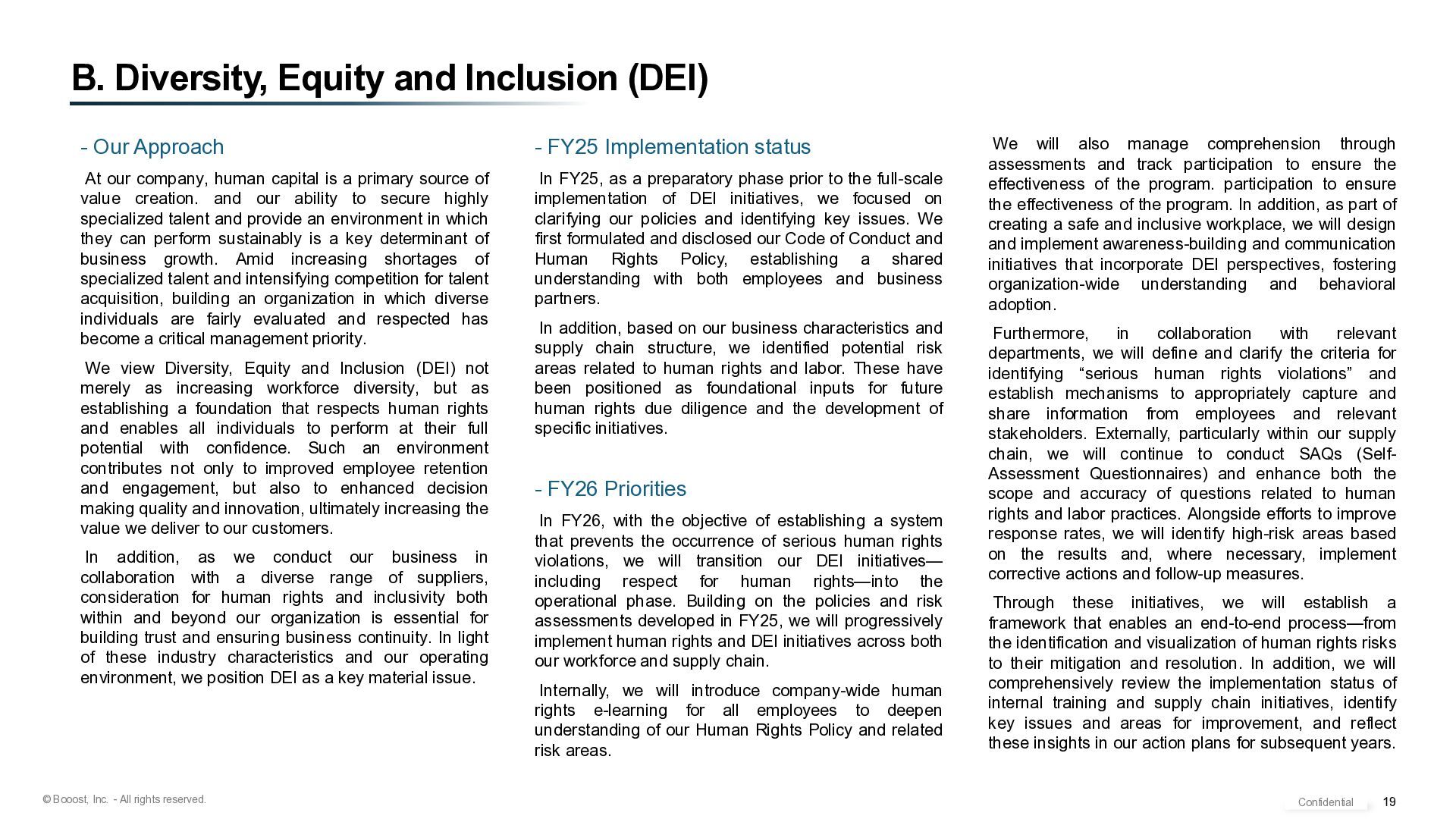
    Diversity, Equity and Inclusion (DEI) - Our Approach At our company, human capital is a primary source of value creation. and our ability to secure highly specialized talent and provide an environment in which they can perform sustainably is a key determinant of business growth. Amid increasing shortages of specialized talent and intensifying competition for talent acquisition, building an organization in which diverse individuals are fairly evaluated and respected has become a critical management priority. We view Diversity, Equity and Inclusion (DEI) not merely as increasing workforce diversity, but as establishing a foundation that respects human rights and enables all individuals to perform at their full potential with confidence. Such an environment contributes not only to improved employee retention and engagement, but also to enhanced decision making quality and innovation, ultimately increasing the value we deliver to our customers. In addition, as we conduct our business in collaboration with a diverse range of suppliers, consideration for human rights and inclusivity both within and beyond our organization is essential for building trust and ensuring business continuity. In light of these industry characteristics and our operating environment, we position DEI as a key material issue. - FY25 Implementation status In FY25, as a preparatory phase prior to the full-scale implementation of DEI initiatives, we focused on clarifying our policies and identifying key issues. We first formulated and disclosed our Code of Conduct and Human Rights Policy, establishing a shared understanding with both employees and business partners. In addition, based on our business characteristics and supply chain structure, we identified potential risk areas related to human rights and labor. These have been positioned as foundational inputs for future human rights due diligence and the development of specific initiatives. - FY26 Priorities In FY26, with the objective of establishing a system that prevents the occurrence of serious human rights violations, we will transition our DEI initiatives— including respect for human rights—into the operational phase. Building on the policies and risk assessments developed in FY25, we will progressively implement human rights and DEI initiatives across both our workforce and supply chain. Internally, we will introduce company-wide human rights e-learning for all employees to deepen understanding of our Human Rights Policy and related risk areas. We will also manage comprehension through assessments and track participation to ensure the effectiveness of the program. participation to ensure the effectiveness of the program. In addition, as part of creating a safe and inclusive workplace, we will design and implement awareness-building and communication initiatives that incorporate DEI perspectives, fostering organization-wide understanding and behavioral adoption. Furthermore, in collaboration with relevant departments, we will define and clarify the criteria for identifying “serious human rights violations” and establish mechanisms to appropriately capture and share information from employees and relevant stakeholders. Externally, particularly within our supply chain, we will continue to conduct SAQs (Self- Assessment Questionnaires) and enhance both the scope and accuracy of questions related to human rights and labor practices. Alongside efforts to improve response rates, we will identify high-risk areas based on the results and, where necessary, implement corrective actions and follow-up measures. Through these initiatives, we will establish a framework that enables an end-to-end process—from the identification and visualization of human rights risks to their mitigation and resolution. In addition, we will comprehensively review the implementation status of internal training and supply chain initiatives, identify key issues and areas for improvement, and reflect these insights in our action plans for subsequent years.
  16. © Booost, Inc. - All rights reserved. Confidential 20 B.

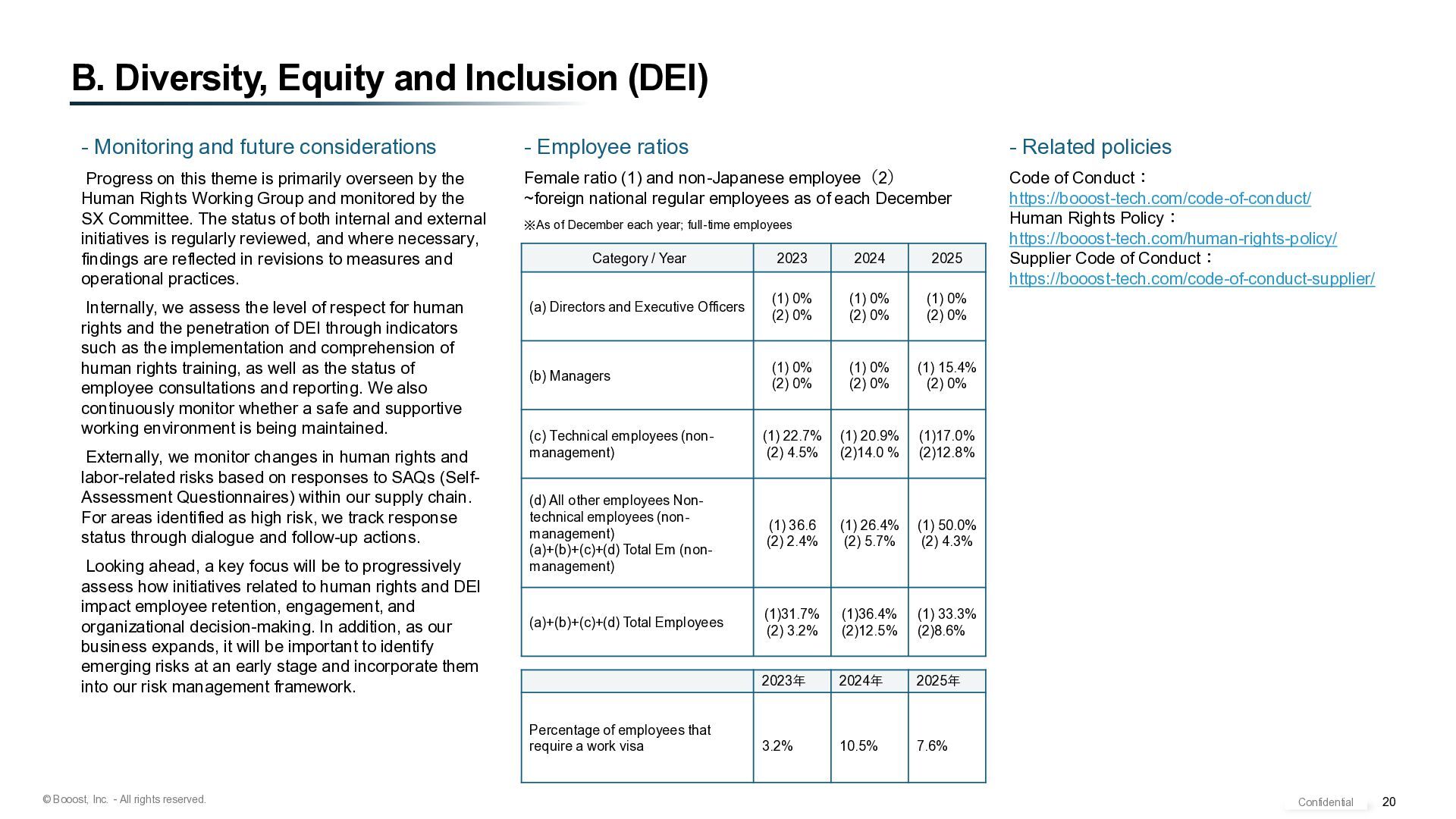
    Diversity, Equity and Inclusion (DEI) - Monitoring and future considerations Progress on this theme is primarily overseen by the Human Rights Working Group and monitored by the SX Committee. The status of both internal and external initiatives is regularly reviewed, and where necessary, findings are reflected in revisions to measures and operational practices. Internally, we assess the level of respect for human rights and the penetration of DEI through indicators such as the implementation and comprehension of human rights training, as well as the status of employee consultations and reporting. We also continuously monitor whether a safe and supportive working environment is being maintained. Externally, we monitor changes in human rights and labor-related risks based on responses to SAQs (Self- Assessment Questionnaires) within our supply chain. For areas identified as high risk, we track response status through dialogue and follow-up actions. Looking ahead, a key focus will be to progressively assess how initiatives related to human rights and DEI impact employee retention, engagement, and organizational decision-making. In addition, as our business expands, it will be important to identify emerging risks at an early stage and incorporate them into our risk management framework. - Employee ratios Female ratio (1) and non-Japanese employee(2) ~foreign national regular employees as of each December ※As of December each year; full-time employees 2023年 2024年 2025年 Percentage of employees that require a work visa 3.2% 10.5% 7.6% Category / Year 2023 2024 2025 (a) Directors and Executive Officers (1) 0% (2) 0% (1) 0% (2) 0% (1) 0% (2) 0% (b) Managers (1) 0% (2) 0% (1) 0% (2) 0% (1) 15.4% (2) 0% (c) Technical employees (non- management) (1) 22.7% (2) 4.5% (1) 20.9% (2)14.0 % (1)17.0% (2)12.8% (d) All other employees Non- technical employees (non- management) (a)+(b)+(c)+(d) Total Em (non- management) (1) 36.6 (2) 2.4% (1) 26.4% (2) 5.7% (1) 50.0% (2) 4.3% (a)+(b)+(c)+(d) Total Employees (1)31.7% (2) 3.2% (1)36.4% (2)12.5% (1) 33.3% (2)8.6% - Related policies Code of Conduct: https://booost-tech.com/code-of-conduct/ Human Rights Policy: https://booost-tech.com/human-rights-policy/ Supplier Code of Conduct: https://booost-tech.com/code-of-conduct-supplier/
  17. © Booost, Inc. - All rights reserved. Confidential 21 C.

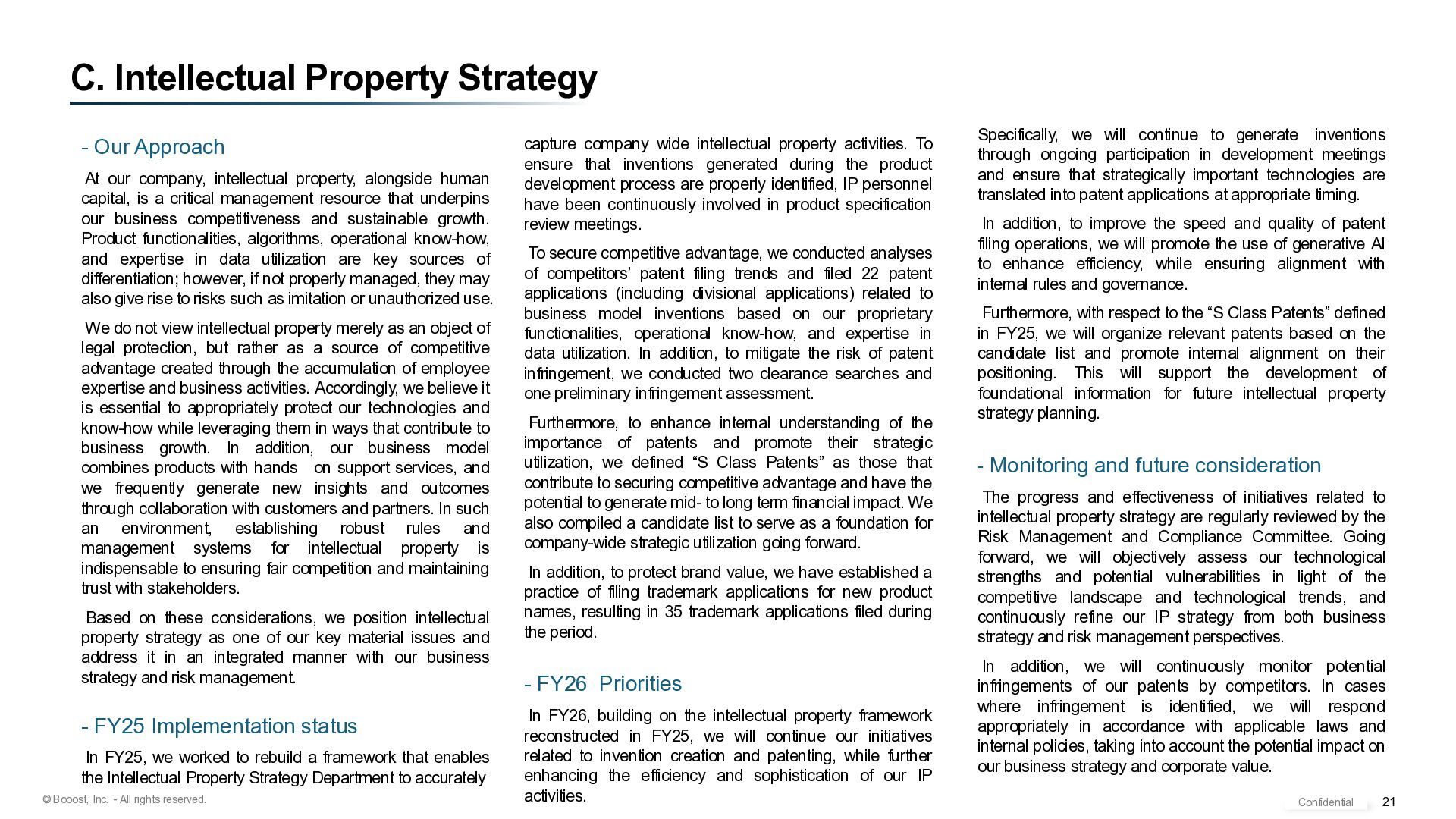
    Intellectual Property Strategy - Our Approach At our company, intellectual property, alongside human capital, is a critical management resource that underpins our business competitiveness and sustainable growth. Product functionalities, algorithms, operational know-how, and expertise in data utilization are key sources of differentiation; however, if not properly managed, they may also give rise to risks such as imitation or unauthorized use. We do not view intellectual property merely as an object of legal protection, but rather as a source of competitive advantage created through the accumulation of employee expertise and business activities. Accordingly, we believe it is essential to appropriately protect our technologies and know-how while leveraging them in ways that contribute to business growth. In addition, our business model combines products with hands on support services, and we frequently generate new insights and outcomes through collaboration with customers and partners. In such an environment, establishing robust rules and management systems for intellectual property is indispensable to ensuring fair competition and maintaining trust with stakeholders. Based on these considerations, we position intellectual property strategy as one of our key material issues and address it in an integrated manner with our business strategy and risk management. - FY25 Implementation status In FY25, we worked to rebuild a framework that enables the Intellectual Property Strategy Department to accurately capture company wide intellectual property activities. To ensure that inventions generated during the product development process are properly identified, IP personnel have been continuously involved in product specification review meetings. To secure competitive advantage, we conducted analyses of competitors’ patent filing trends and filed 22 patent applications (including divisional applications) related to business model inventions based on our proprietary functionalities, operational know-how, and expertise in data utilization. In addition, to mitigate the risk of patent infringement, we conducted two clearance searches and one preliminary infringement assessment. Furthermore, to enhance internal understanding of the importance of patents and promote their strategic utilization, we defined “S Class Patents” as those that contribute to securing competitive advantage and have the potential to generate mid- to long term financial impact. We also compiled a candidate list to serve as a foundation for company-wide strategic utilization going forward. In addition, to protect brand value, we have established a practice of filing trademark applications for new product names, resulting in 35 trademark applications filed during the period. - FY26 Priorities In FY26, building on the intellectual property framework reconstructed in FY25, we will continue our initiatives related to invention creation and patenting, while further enhancing the efficiency and sophistication of our IP activities. Specifically, we will continue to generate inventions through ongoing participation in development meetings and ensure that strategically important technologies are translated into patent applications at appropriate timing. In addition, to improve the speed and quality of patent filing operations, we will promote the use of generative AI to enhance efficiency, while ensuring alignment with internal rules and governance. Furthermore, with respect to the “S Class Patents” defined in FY25, we will organize relevant patents based on the candidate list and promote internal alignment on their positioning. This will support the development of foundational information for future intellectual property strategy planning. ‐ Monitoring and future consideration The progress and effectiveness of initiatives related to intellectual property strategy are regularly reviewed by the Risk Management and Compliance Committee. Going forward, we will objectively assess our technological strengths and potential vulnerabilities in light of the competitive landscape and technological trends, and continuously refine our IP strategy from both business strategy and risk management perspectives. In addition, we will continuously monitor potential infringements of our patents by competitors. In cases where infringement is identified, we will respond appropriately in accordance with applicable laws and internal policies, taking into account the potential impact on our business strategy and corporate value.
  18. © Booost, Inc. - All rights reserved. Confidential 22 D.

    Data Security and Privacy - Our Approach Ensuring data security and privacy is a fundamental prerequisite for our business. As a provider of a management OS for non-financial information, we handle a significant volume of sensitive data, including our customers non-financial data. Accordingly, we position data security and privacy not merely as an IT risk management issue, but as a core management foundation that underpins business reliability and growth, and we are committed to protecting our information assets. Furthermore, in light of evolving business conditions— including strengthening regulations, increasingly sophisticated cyberattacks, and the advancement of AI utilization—security risks continue to change. Against this backdrop, we recognize the importance of maintaining an appropriate governance framework and pursuing continuous improvement. - FY25 Implementation status We operate an Information Security Management System (ISMS) certified by a third party in accordance with JIS Q 27001:2023 (ISO/IEC 27001:2022), and manage data security risks through identification, assessment, and control in line with internationally recognized standards. In FY25, we focused on rebuilding the foundation to further enhance data security and privacy management. We successfully completed the audit for obtaining the SOC 2 report, and for ISMS, we completed the surveillance audit under the revised standard, confirming the continuous improvement of our information security management framework. In addition, we established an Information Security Committee to promote awareness and facilitate information across departments. From a technical perspective, we implemented a system to centrally visualize and analyze cloud configurations, access permissions, and vulnerabilities. This enables early identification of misconfigurations, excessive access privileges, and potential vulnerabilities, and supports timely remediation based on risk severity. Through these initiatives, we have strengthened our ability to mitigate security risks associated with increased cloud usage and to protect customer information and operational data. Furthermore, we conducted third-party web application vulnerability assessments to identify and address risks from an objective perspective. - FY26 priorities In FY26, building on the initiatives implemented in FY25, we will continue to operate and enhance our data security and privacy management framework. Through the ongoing operation of the SOC 2 Type 1 and Type 2 reports obtained, we will verify whether controls are functioning effectively in actual operations and continuously implement necessary improvements. In addition, to strengthen our incident response capabilities, we will establish a CSIRT (Computer Security Incident Response Team) framework. This includes conducting a comprehensive review of security operations, clarifying roles and responsibilities, and developing incident response processes, as well as implementing training and exercises to ensure prompt and effective response in the event of incidents. From a technical perspective, we will further enhance our intrusion detection and monitoring capabilities. Furthermore, in light of the advancement of AI utilization, we will also examine and address newly emerging security risks. Through these initiatives we aim to establish a framework that enables end-to-end management of the entire incident lifecycle—from prevention and detection to response and recurrence prevention. - Monitoring and consideration Progress on this theme is primarily driven by the Data Security Working Group and is regularly monitored by the SX Committee and the Risk Management and Compliance Committee. The effectiveness of our management framework is assessed through the results and follow-up actions of audits such as SOC 2, ISMS, and Privacy Mark.
  19. © Booost, Inc. - All rights reserved. Confidential 23 D.

    Data Security and Privacy In addition, based on the outcomes of incident response training and tabletop exercises, we identify and address operational challenges. Looking ahead, key considerations include how to balance the increasing operational burden and costs associated with more advanced security measures, and how to proactively identify risks in response to business expansion and evolving technological environments. As company-wide AI utilization advances, we are also developing internal policies governing the use of AI. Furthermore, fostering a security-aware culture—where each employee contributes to the organization’s overall resilience, rather than relying solely on specialized functions— remains an ongoing priority. During the reporting period, there were no monetary losses resulting from legal proceedings related to user privacy, no requests from law enforcement authorities concerning user data, and no incidents of data breaches. In addition, we do not currently engage in data-driven business activities using customer data (such as third- party provision, sale, or sharing). We do not intentionally use user information for purposes other than the primary purposes defined in our privacy policy, including service provision, operation, and improvement. - Related policies Privacy Policy: https://booost-tech.com/privacy/ Terms of Use: https://booost-tech.com/terms/ Information Security Policy: https://booost-tech.com/security-policy
  20. © Booost, Inc. - All rights reserved. Confidential 24 E.

    Ethics and compliance - Our Approach For our company, ethics and compliance are the foundation that underpins trust from customers and society, and a prerequisite for business continuity. Given our role in supporting clients’ management with a high level of expertise, we are expected not only to comply with laws and regulations but also to act and make decisions based on a strong sense of ethics. We view ethics and compliance not merely as the establishment of rules and policies, but as a foundation for maintaining and enhancing organizational integrity as professionals. We believe that each employee’s commitment to fair and ethical conduct leads to the building of trust with clients and contributes to the long- term enhancement of corporate value. - FY25 implementation status At our company, we have established a compliance manual and related policies, which are operated as guidelines for employee conduct. In FY25, we continued to position ethics and compliance as a fundamental prerequisite for business operations, ensuring that they are embedded in the daily actions and decision-making of each employee. In day-to-day operations, we conduct risk management that encompasses compliance, fraud prevention, and harassment prevention, while providing ongoing training and awareness initiatives to support appropriate decision- making by employees. Regarding our internal whistleblowing system, we will continue to operate existing mechanisms effectively, maintain an environment in which employees can raise concerns with confidence, and implement ongoing reviews and improvements as necessary. Through these initiatives, we will maintain and strengthen ethics and compliance as a shared foundation across the entire organization - Monitoring and consideration This initiative is subject to continuous monitoring by the Risk Management and Compliance Committee and the SX Committee. We assess the level of understanding and effectiveness in practice through indicators such as the implementation status of employee risk training, survey results, and the operation of the internal whistleblowing system.. Looking ahead, a key consideration will be to continuously identify how ethics and compliance risks evolve in line with business expansion and organizational growth, and to further develop our initiatives accordingly. During the reporting period, there were no monetary losses (such as fines or penalties) resulting from legal proceedings related to anti-competitive behavior or professional integrity. Through these efforts, we maintain a shared organizational understanding of legal compliance and ethical conduct, rather than relying solely on individual responsibility. In addition, we operate an internal whistleblowing system that enables employees to report concerns or issues with confidence, thereby ensuring early identification and response to ethics and compliance-related matters. To maintain the effectiveness of this system, we continuously review its operation and implement improvements as necessary. Through these initiatives, we ensure that ethics and compliance are not treated as isolated measures or temporary responses, but are consistently and naturally practiced as part of our daily business operations. - FY26 priorities In FY26, we will continue to prioritize maintaining and further enhancing a state in which ethics and compliance are not limited to rule adherence, but are naturally embedded in daily decision-making and behavior. Specifically, through the operation of our risk management framework, we will continuously identify and manage ethical risks, including compliance, fraud prevention, and harassment prevention. We will also enhance employee risk education through regular training sessions and surveys, ensuring that understanding goes beyond a formal level and translates into practical application in the workplace.
  21. © Booost, Inc. - All rights reserved. Confidential 25 F.

    Business Continuity and Resilience - Our Approach Our products and services serve as a foundation for our customers’ sustainability management and decision-making, and their stability and reliability are directly linked to our business value. Operational disruptions caused by system failures, cyber incidents, or natural disasters may impact our customers’ operations and social credibility through reduced data availability, processing delays, or service outages. Accordingly, we position business continuity and resilience—including technology-related risks—as a key material issue. We aim not only to prevent incidents but also to establish a framework that enables rapid detection, response, and recovery in the event of disruptions, thereby ensuring business continuity and fulfilling our responsibilities to our customers. - FY25 implementation status In FY25, while building on our existing operations and response practices, we positioned this period as a phase for more clearly organizing our approach to risks related to business continuity. In preparation for events such as natural disasters and system failures, we further clarified command and reporting lines as well as communication structures, and renewed management- and department-level alignment on key business continuity considerations. In parallel, we continued to strengthen the practical aspects of stable system operations and incident response in coordination with our information security and risk management initiatives. - FY26 Priorities In FY26, we position our efforts on business continuity and resilience as a phase of further enhancement aligned with our growth stage. Based on existing operations and accumulated knowledge, we will further clarify response processes and roles within our Business Continuity Plan (BCP), taking into account scenarios such as natural disasters, system failures, and cyber incidents. In parallel, for technology-related risks, we will strengthen our ability to visualize the scope of impact and potential effects on customers in the event of disruptions, enabling more rapid decision-making and recovery. Through these initiatives, we aim to enhance resilience in tandem with business expansion and to continue providing a reliable and trusted foundation for our customers. - Monitoring and consideration These initiatives are continuously monitored within our risk management framework. We regularly review system performance, the occurrence of incidents and disruptions, and the response processes through to recovery, and use these insights to drive operational improvements. Looking ahead, a key consideration will be to continuously assess how risk scenarios evolve in line with business expansion and increasing product sophistication. In addition, it remains important not to treat incidents or business disruptions as isolated events, but to systematically incorporate their impact on customers and the lessons learned into future design and operational improvements. These initiatives are continuously monitored within our risk management framework. We regularly review system performance, the occurrence of incidents and disruptions, and the response processes through to recovery, and use these insights to drive operational improvements. Looking ahead, a key consideration will be to continuously assess how risk scenarios evolve in line with business expansion and increasing product sophistication. In addition, it remains important not to treat incidents or business disruptions as isolated events, but to systematically incorporate their impact on customers and the lessons learned into future design and operational improvements.
  22. © Booost, Inc. - All rights reserved. Confidential 26 G.

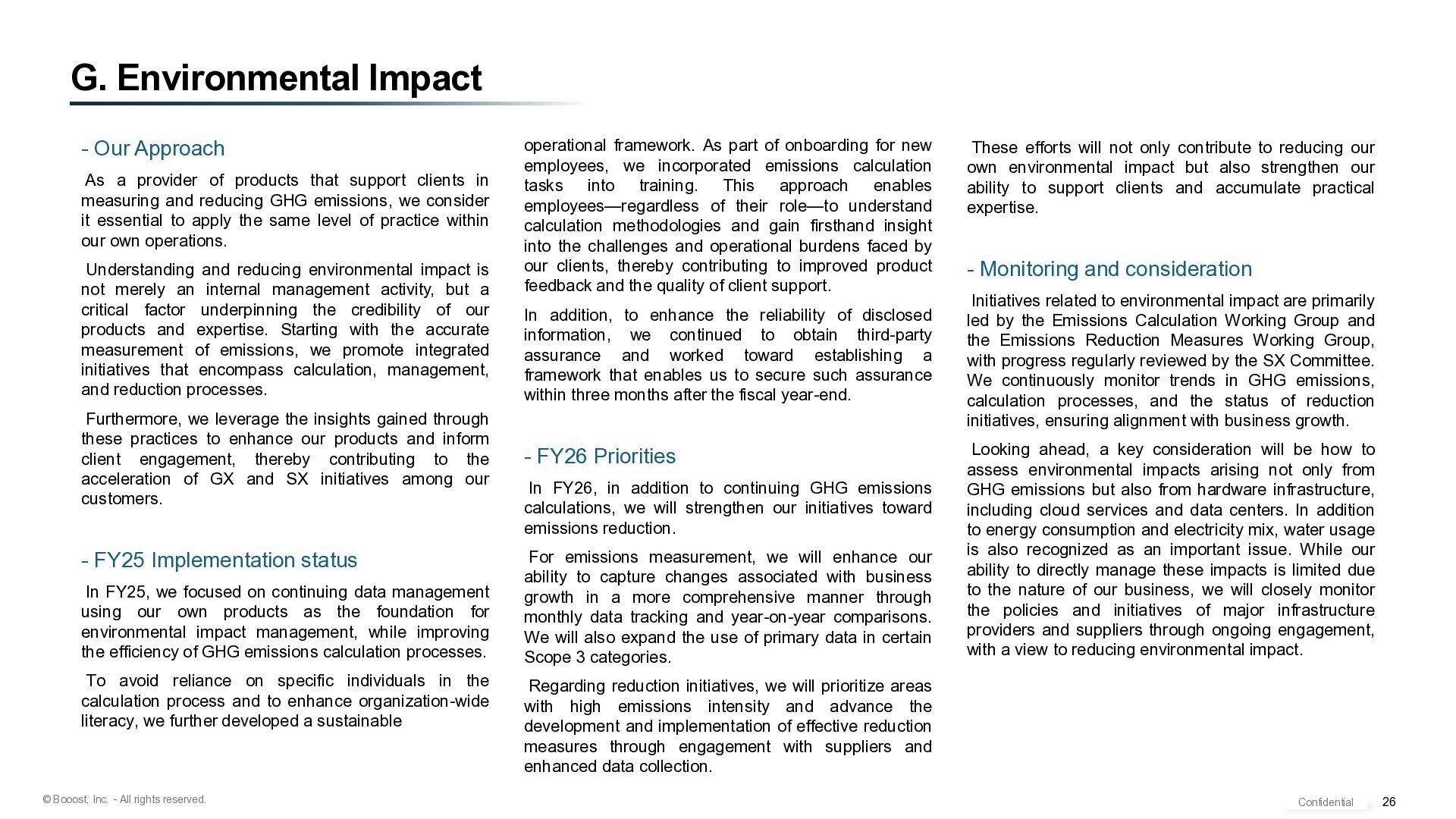
    Environmental Impact - Our Approach As a provider of products that support clients in measuring and reducing GHG emissions, we consider it essential to apply the same level of practice within our own operations. Understanding and reducing environmental impact is not merely an internal management activity, but a critical factor underpinning the credibility of our products and expertise. Starting with the accurate measurement of emissions, we promote integrated initiatives that encompass calculation, management, and reduction processes. Furthermore, we leverage the insights gained through these practices to enhance our products and inform client engagement, thereby contributing to the acceleration of GX and SX initiatives among our customers. - FY25 Implementation status In FY25, we focused on continuing data management using our own products as the foundation for environmental impact management, while improving the efficiency of GHG emissions calculation processes. To avoid reliance on specific individuals in the calculation process and to enhance organization-wide literacy, we further developed a sustainable These efforts will not only contribute to reducing our own environmental impact but also strengthen our ability to support clients and accumulate practical expertise. - Monitoring and consideration Initiatives related to environmental impact are primarily led by the Emissions Calculation Working Group and the Emissions Reduction Measures Working Group, with progress regularly reviewed by the SX Committee. We continuously monitor trends in GHG emissions, calculation processes, and the status of reduction initiatives, ensuring alignment with business growth. Looking ahead, a key consideration will be how to assess environmental impacts arising not only from GHG emissions but also from hardware infrastructure, including cloud services and data centers. In addition to energy consumption and electricity mix, water usage is also recognized as an important issue. While our ability to directly manage these impacts is limited due to the nature of our business, we will closely monitor the policies and initiatives of major infrastructure providers and suppliers through ongoing engagement, with a view to reducing environmental impact. operational framework. As part of onboarding for new employees, we incorporated emissions calculation tasks into training. This approach enables employees—regardless of their role—to understand calculation methodologies and gain firsthand insight into the challenges and operational burdens faced by our clients, thereby contributing to improved product feedback and the quality of client support. In addition, to enhance the reliability of disclosed information, we continued to obtain third-party assurance and worked toward establishing a framework that enables us to secure such assurance within three months after the fiscal year-end. - FY26 Priorities In FY26, in addition to continuing GHG emissions calculations, we will strengthen our initiatives toward emissions reduction. For emissions measurement, we will enhance our ability to capture changes associated with business growth in a more comprehensive manner through monthly data tracking and year-on-year comparisons. We will also expand the use of primary data in certain Scope 3 categories. Regarding reduction initiatives, we will prioritize areas with high emissions intensity and advance the development and implementation of effective reduction measures through engagement with suppliers and enhanced data collection.
  23. © Booost, Inc. - All rights reserved. Confidential 27 G.

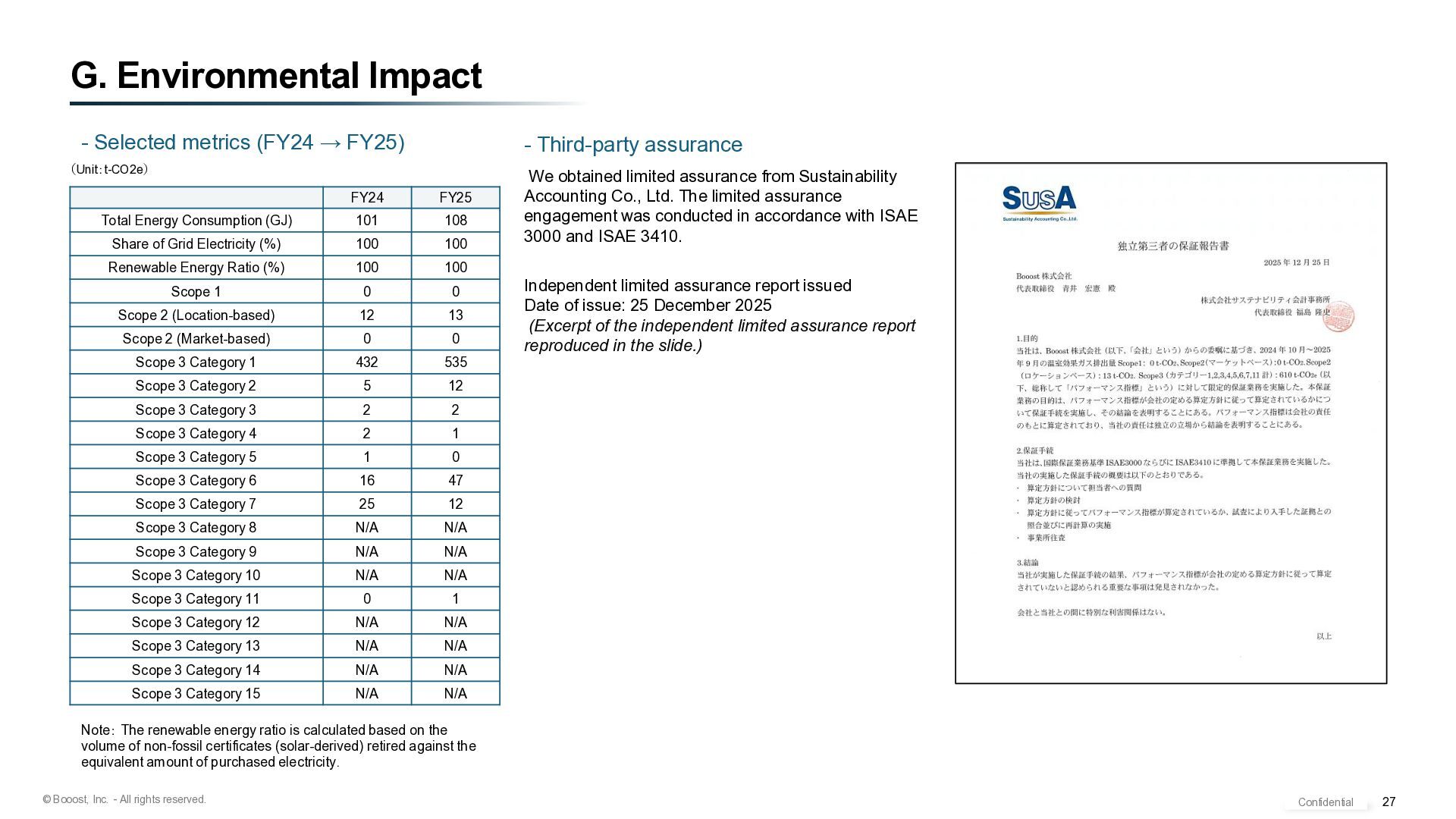
    Environmental Impact FY24 FY25 Total Energy Consumption (GJ) 101 108 Share of Grid Electricity (%) 100 100 Renewable Energy Ratio (%) 100 100 Scope 1 0 0 Scope 2 (Location-based) 12 13 Scope 2 (Market-based) 0 0 Scope 3 Category 1 432 535 Scope 3 Category 2 5 12 Scope 3 Category 3 2 2 Scope 3 Category 4 2 1 Scope 3 Category 5 1 0 Scope 3 Category 6 16 47 Scope 3 Category 7 25 12 Scope 3 Category 8 N/A N/A Scope 3 Category 9 N/A N/A Scope 3 Category 10 N/A N/A Scope 3 Category 11 0 1 Scope 3 Category 12 N/A N/A Scope 3 Category 13 N/A N/A Scope 3 Category 14 N/A N/A Scope 3 Category 15 N/A N/A Note: The renewable energy ratio is calculated based on the volume of non-fossil certificates (solar-derived) retired against the equivalent amount of purchased electricity. (Unit:t-CO2e) - Selected metrics (FY24 → FY25) - Third-party assurance We obtained limited assurance from Sustainability Accounting Co., Ltd. The limited assurance engagement was conducted in accordance with ISAE 3000 and ISAE 3410. Independent limited assurance report issued Date of issue: 25 December 2025 (Excerpt of the independent limited assurance report reproduced in the slide.)
  24. © Booost, Inc. - All rights reserved. Confidential 29 SASB

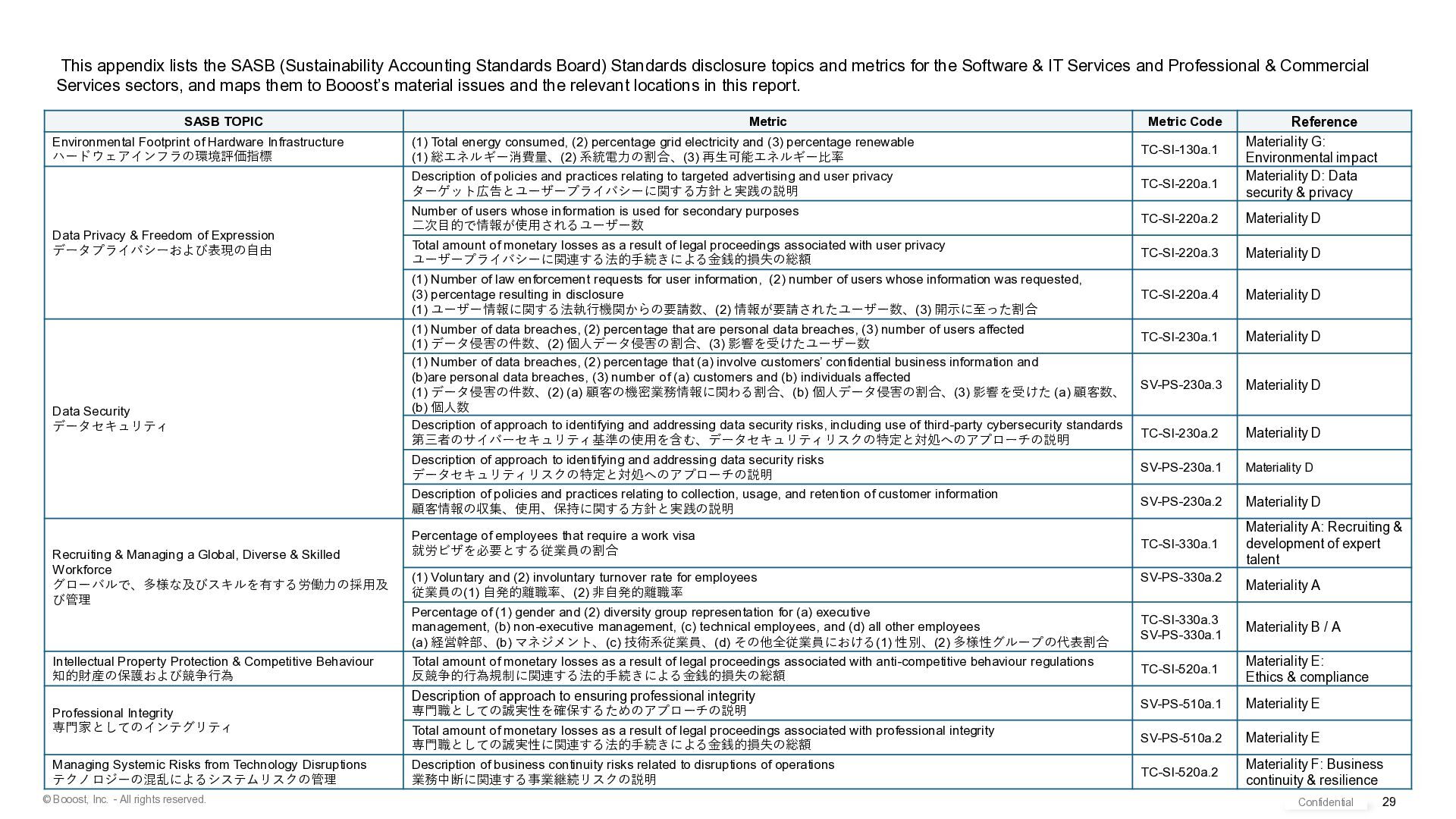
    TOPIC Metric Metric Code Reference Environmental Footprint of Hardware Infrastructure ハードウェアインフラの環境評価指標 (1) Total energy consumed, (2) percentage grid electricity and (3) percentage renewable (1) 総エネルギー消費量、(2) 系統電力の割合、(3) 再生可能エネルギー比率 TC-SI-130a.1 Materiality G: Environmental impact Data Privacy & Freedom of Expression データプライバシーおよび表現の自由 Description of policies and practices relating to targeted advertising and user privacy ターゲット広告とユーザープライバシーに関する方針と実践の説明 TC-SI-220a.1 Materiality D: Data security & privacy Number of users whose information is used for secondary purposes 二次目的で情報が使用されるユーザー数 TC-SI-220a.2 Materiality D Total amount of monetary losses as a result of legal proceedings associated with user privacy ユーザープライバシーに関連する法的手続きによる金銭的損失の総額 TC-SI-220a.3 Materiality D (1) Number of law enforcement requests for user information, (2) number of users whose information was requested, (3) percentage resulting in disclosure (1) ユーザー情報に関する法執行機関からの要請数、(2) 情報が要請されたユーザー数、(3) 開示に至った割合 TC-SI-220a.4 Materiality D Data Security データセキュリティ (1) Number of data breaches, (2) percentage that are personal data breaches, (3) number of users affected (1) データ侵害の件数、(2) 個人データ侵害の割合、(3) 影響を受けたユーザー数 TC-SI-230a.1 Materiality D (1) Number of data breaches, (2) percentage that (a) involve customers’ confidential business information and (b)are personal data breaches, (3) number of (a) customers and (b) individuals affected (1) データ侵害の件数、(2) (a) 顧客の機密業務情報に関わる割合、(b) 個人データ侵害の割合、(3) 影響を受けた (a) 顧客数、 (b) 個人数 SV-PS-230a.3 Materiality D Description of approach to identifying and addressing data security risks, including use of third-party cybersecurity standards 第三者のサイバーセキュリティ基準の使用を含む、データセキュリティリスクの特定と対処へのアプローチの説明 TC-SI-230a.2 Materiality D Description of approach to identifying and addressing data security risks データセキュリティリスクの特定と対処へのアプローチの説明 SV-PS-230a.1 Materiality D Description of policies and practices relating to collection, usage, and retention of customer information 顧客情報の収集、使用、保持に関する方針と実践の説明 SV-PS-230a.2 Materiality D Recruiting & Managing a Global, Diverse & Skilled Workforce グローバルで、多様な及びスキルを有する労働力の採用及 び管理 Percentage of employees that require a work visa 就労ビザを必要とする従業員の割合 TC-SI-330a.1 Materiality A: Recruiting & development of expert talent (1) Voluntary and (2) involuntary turnover rate for employees 従業員の(1) 自発的離職率、(2) 非自発的離職率 SV-PS-330a.2 Materiality A Percentage of (1) gender and (2) diversity group representation for (a) executive management, (b) non-executive management, (c) technical employees, and (d) all other employees (a) 経営幹部、(b) マネジメント、(c) 技術系従業員、(d) その他全従業員における(1) 性別、(2) 多様性グループの代表割合 TC-SI-330a.3 SV-PS-330a.1 Materiality B / A Intellectual Property Protection & Competitive Behaviour 知的財産の保護および競争行為 Total amount of monetary losses as a result of legal proceedings associated with anti-competitive behaviour regulations 反競争的行為規制に関連する法的手続きによる金銭的損失の総額 TC-SI-520a.1 Materiality E: Ethics & compliance Professional Integrity 専門家としてのインテグリティ Description of approach to ensuring professional integrity 専門職としての誠実性を確保するためのアプローチの説明 SV-PS-510a.1 Materiality E Total amount of monetary losses as a result of legal proceedings associated with professional integrity 専門職としての誠実性に関連する法的手続きによる金銭的損失の総額 SV-PS-510a.2 Materiality E Managing Systemic Risks from Technology Disruptions テクノロジーの混乱によるシステムリスクの管理 Description of business continuity risks related to disruptions of operations 業務中断に関連する事業継続リスクの説明 TC-SI-520a.2 Materiality F: Business continuity & resilience This appendix lists the SASB (Sustainability Accounting Standards Board) Standards disclosure topics and metrics for the Software & IT Services and Professional & Commercial Services sectors, and maps them to Booost’s material issues and the relevant locations in this report.