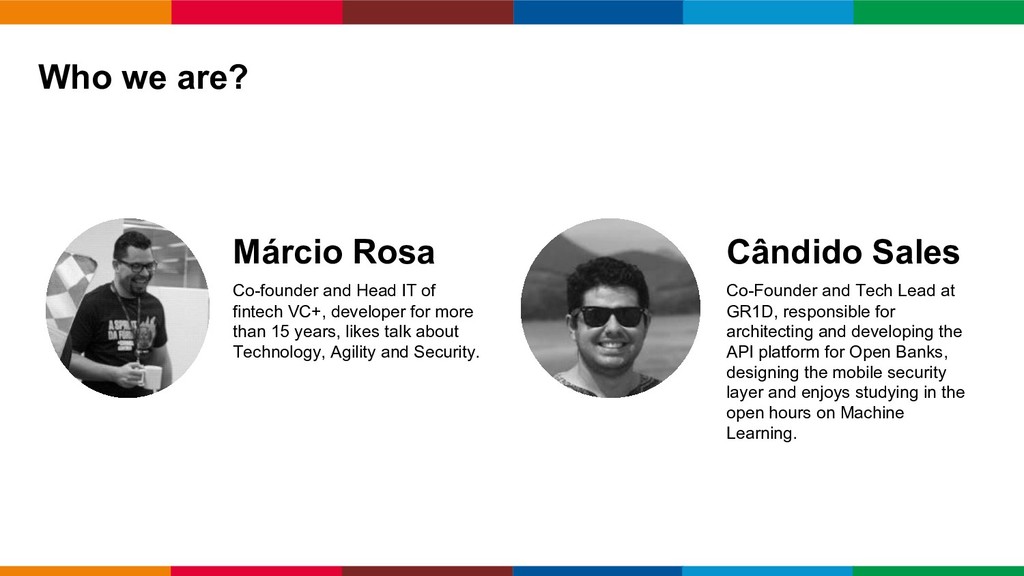
for architecting and developing the API platform for Open Banks, designing the mobile security layer and enjoys studying in the open hours on Machine Learning. Márcio Rosa Co-founder and Head IT of fintech VC+, developer for more than 15 years, likes talk about Technology, Agility and Security. Who we are?
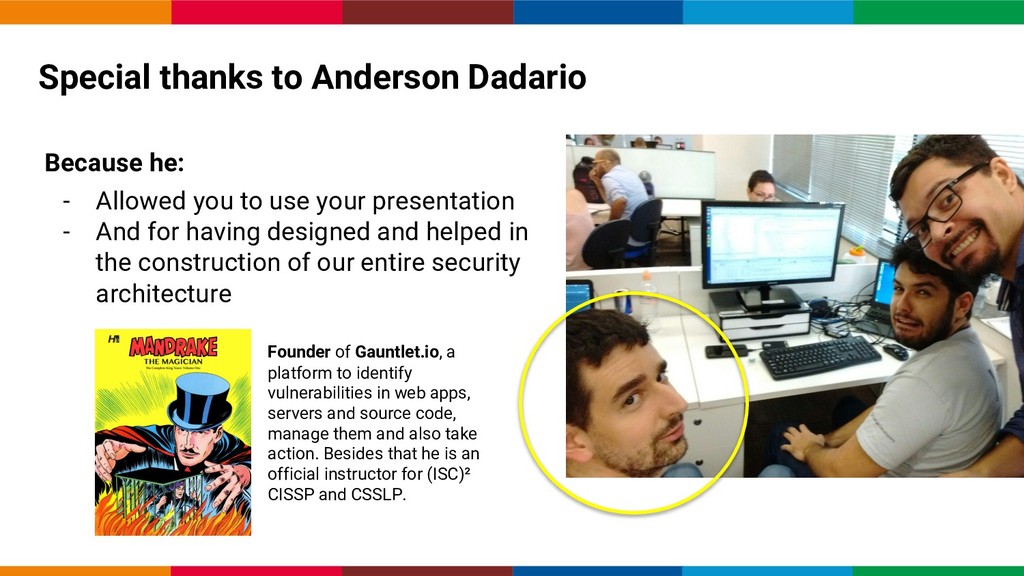
- And for having designed and helped in the construction of our entire security architecture Special thanks to Anderson Dadario Founder of Gauntlet.io, a platform to identify vulnerabilities in web apps, servers and source code, manage them and also take action. Besides that he is an official instructor for (ISC)² CISSP and CSSLP.
that has the challenge of facilitating people's daily lives by bringing together several means of payment on the same platform, allowing the user to make their payments as they wish in a simple and easy way, for physical and online retails, through their smartphone. a company
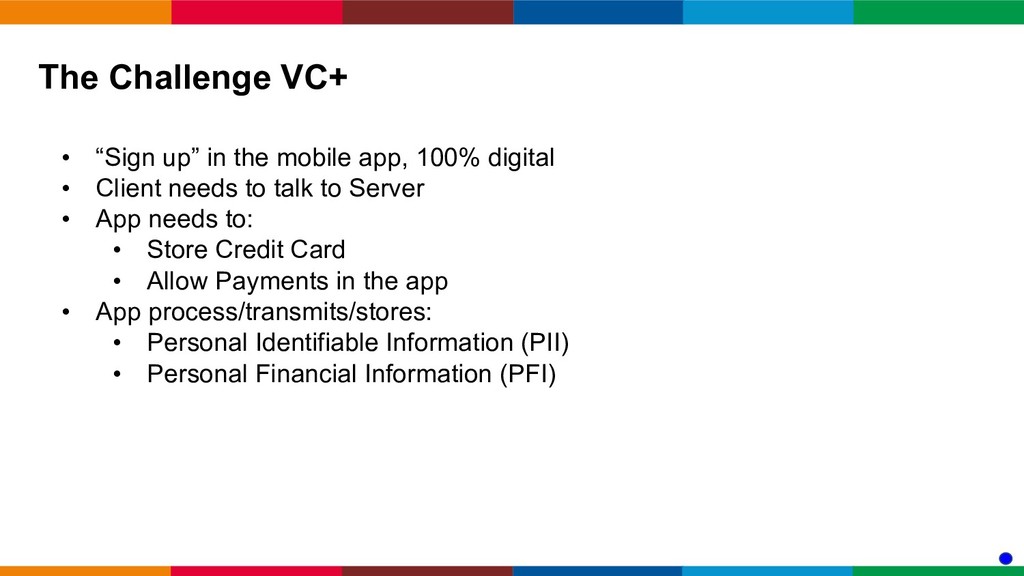
• Client needs to talk to Server • App needs to: • Store Credit Card • Allow Payments in the app • App process/transmits/stores: • Personal Identifiable Information (PII) • Personal Financial Information (PFI) The Challenge VC+
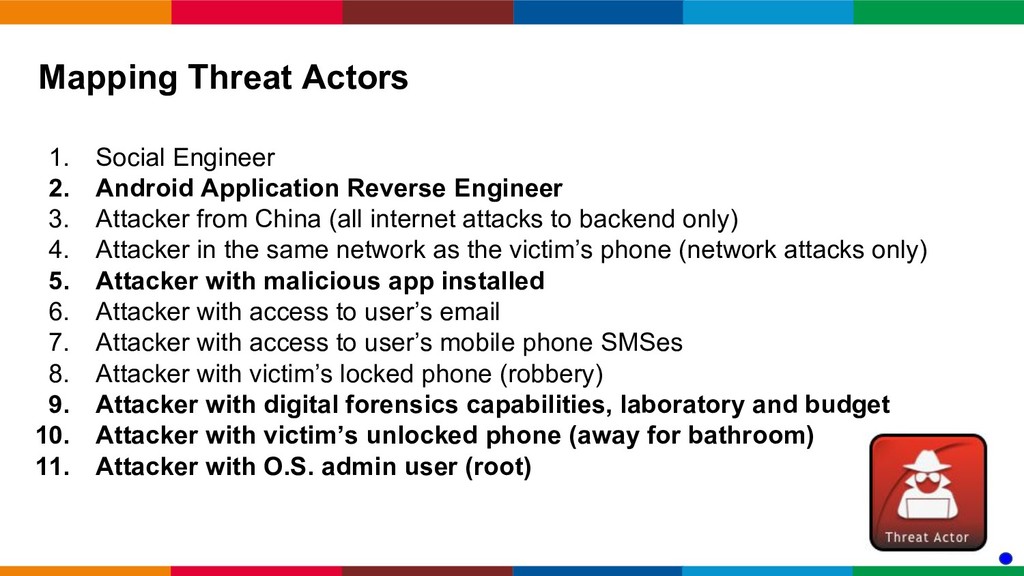
Attacker from China (all internet attacks to backend only) 4. Attacker in the same network as the victim’s phone (network attacks only) 5. Attacker with malicious app installed 6. Attacker with access to user’s email 7. Attacker with access to user’s mobile phone SMSes 8. Attacker with victim’s locked phone (robbery) 9. Attacker with digital forensics capabilities, laboratory and budget 10. Attacker with victim’s unlocked phone (away for bathroom) 11. Attacker with O.S. admin user (root) Mapping Threat Actors
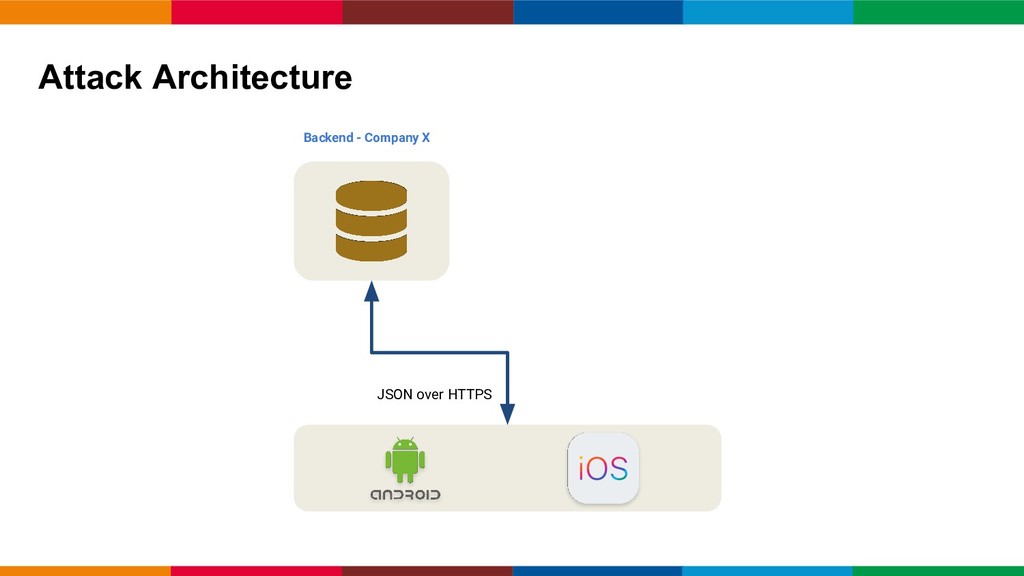
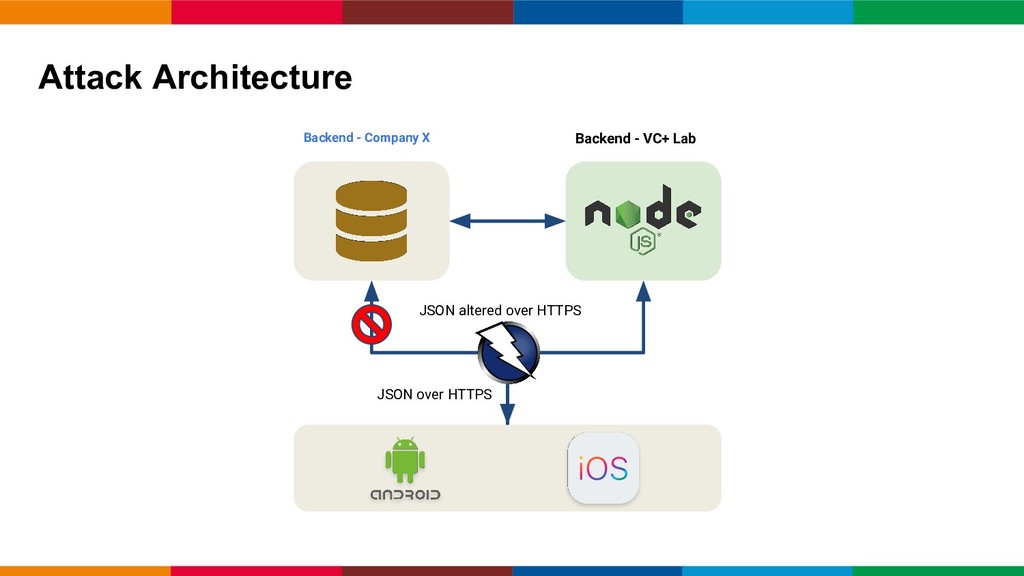
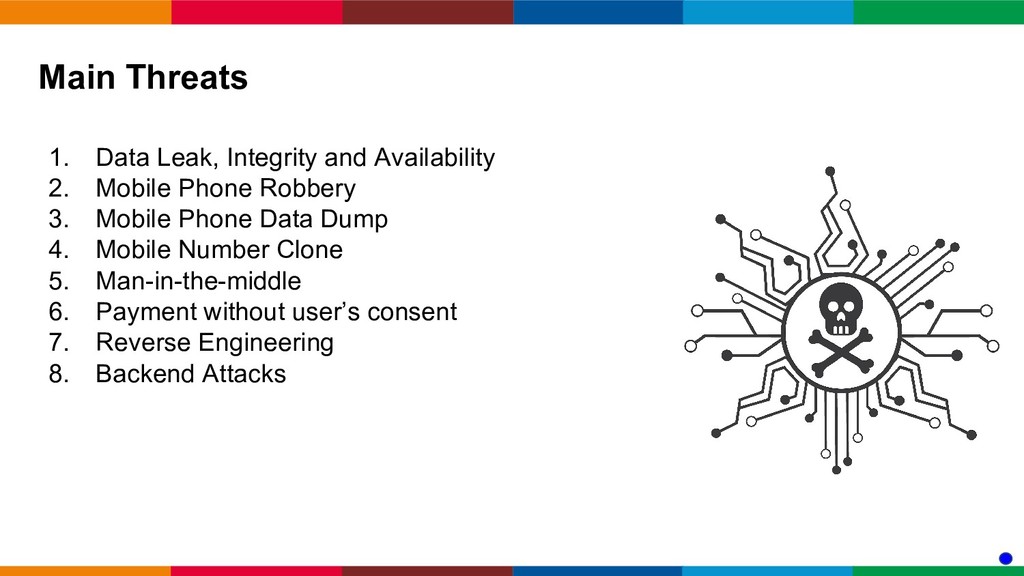
Robbery 3. Mobile Phone Data Dump 4. Mobile Number Clone 5. Man-in-the-middle 6. Payment without user’s consent 7. Reverse Engineering 8. Backend Attacks Main Threats
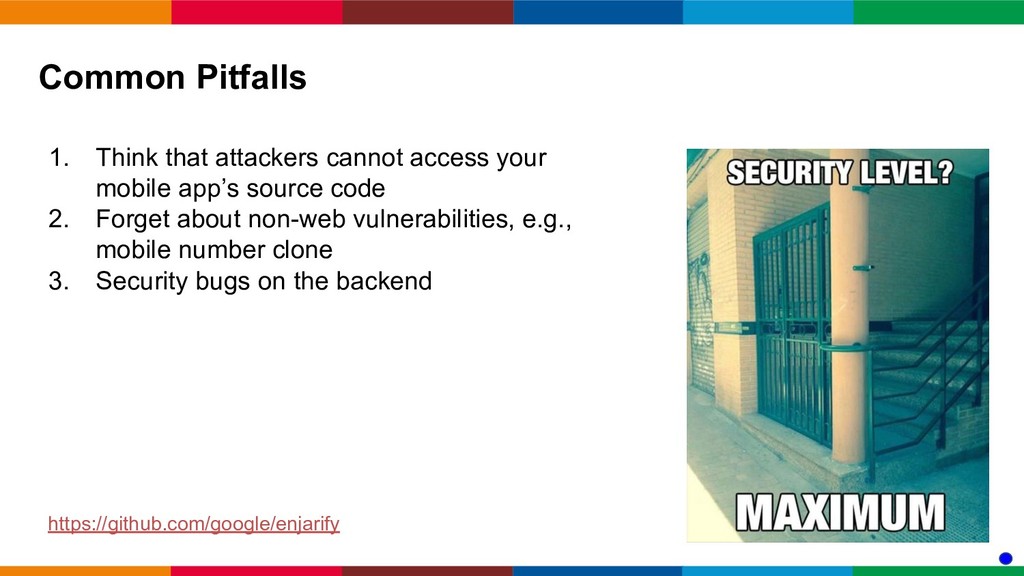
source code 2. Forget about non-web vulnerabilities, e.g., mobile number clone 3. Security bugs on the backend Common Pitfalls https://github.com/google/enjarify
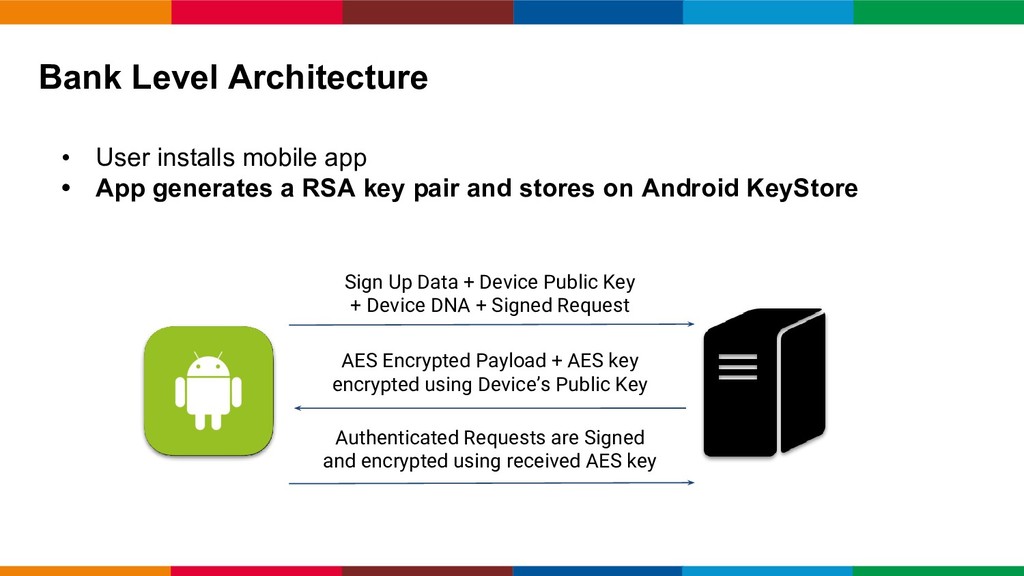
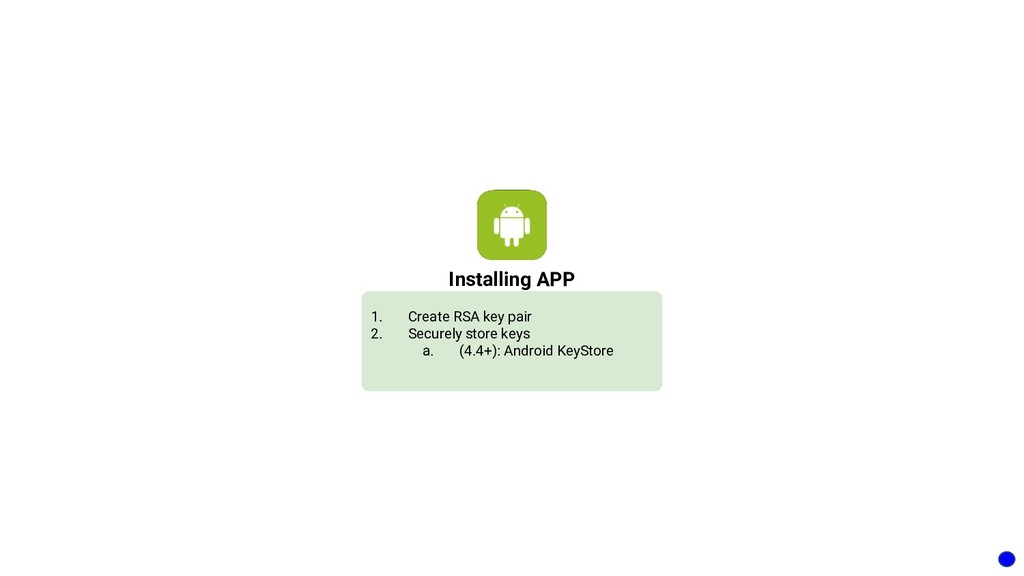
RSA key pair and stores on Android KeyStore Sign Up Data + Device Public Key + Device DNA + Signed Request AES Encrypted Payload + AES key encrypted using Device’s Public Key Authenticated Requests are Signed and encrypted using received AES key Bank Level Architecture
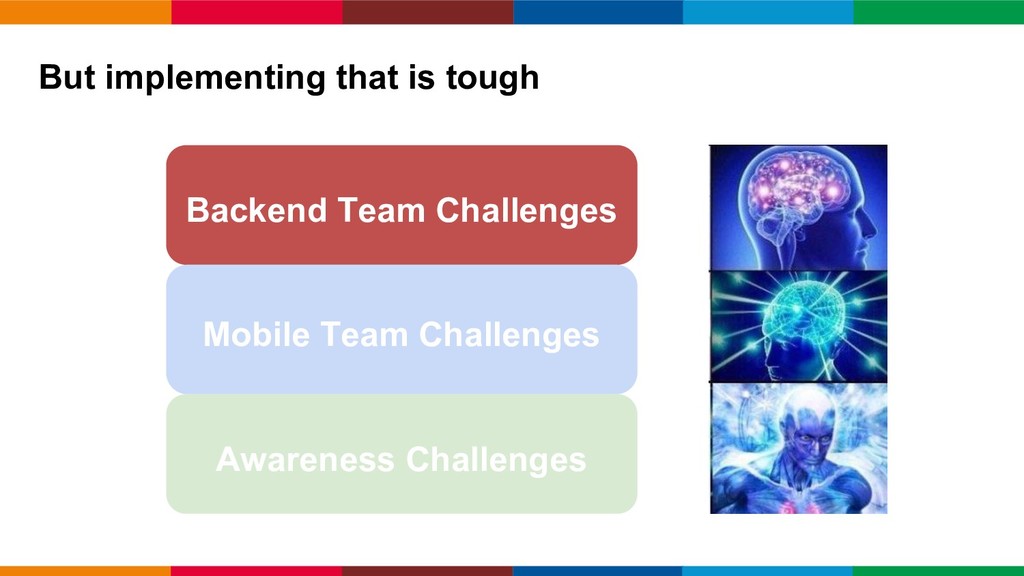
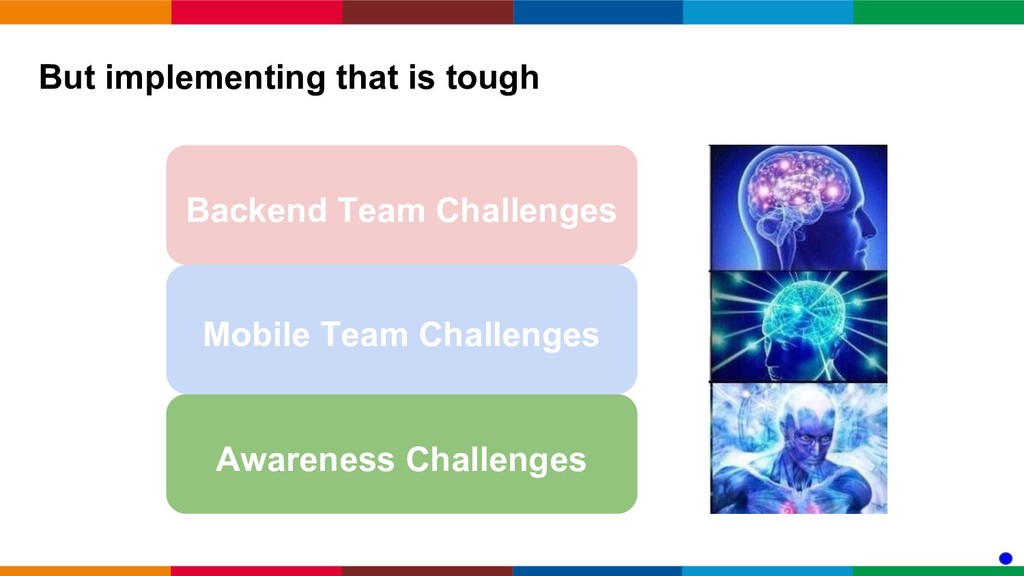
• It should abstract cryptography • Lots of validations are required • validate request signature • decrypt AES payload • identify whether device is register / is trusted • validate session token • then we consider it a legitimate request • On top of all validations, performance is a must! • Find reliable JWT library as JWT specification has some drawbacks; • Libsodium is too heavy as a dependency to be used as a secure PRNG, but there aren’t better alternatives from what we’ve researched. Backend Challenges
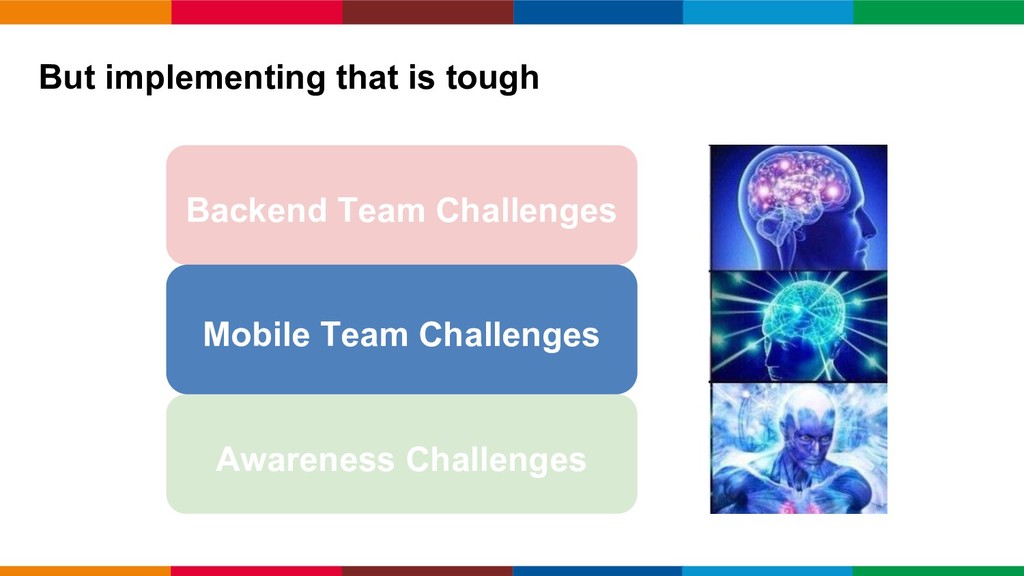
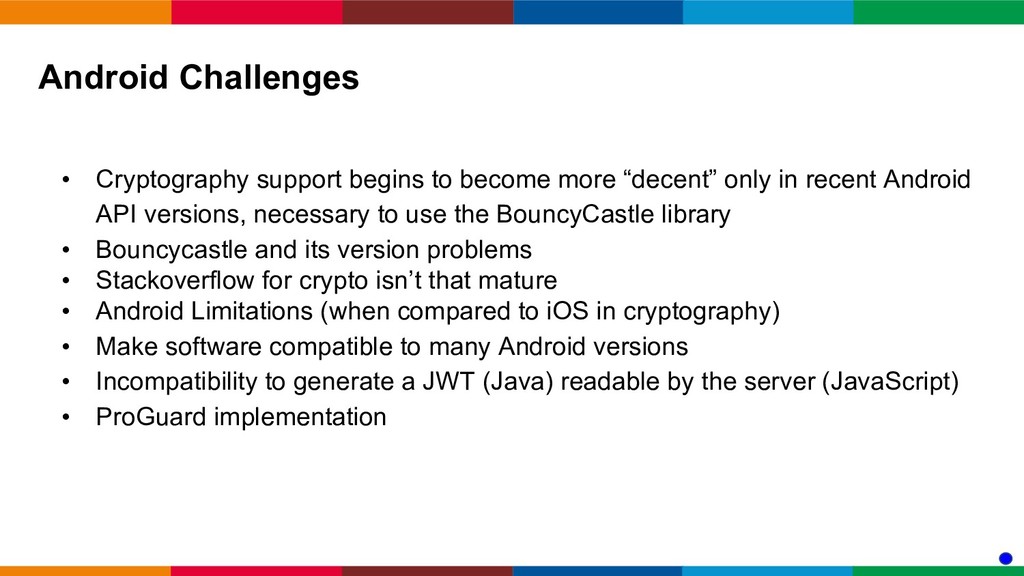
in recent Android API versions, necessary to use the BouncyCastle library • Bouncycastle and its version problems • Stackoverflow for crypto isn’t that mature • Android Limitations (when compared to iOS in cryptography) • Make software compatible to many Android versions • Incompatibility to generate a JWT (Java) readable by the server (JavaScript) • ProGuard implementation Android Challenges
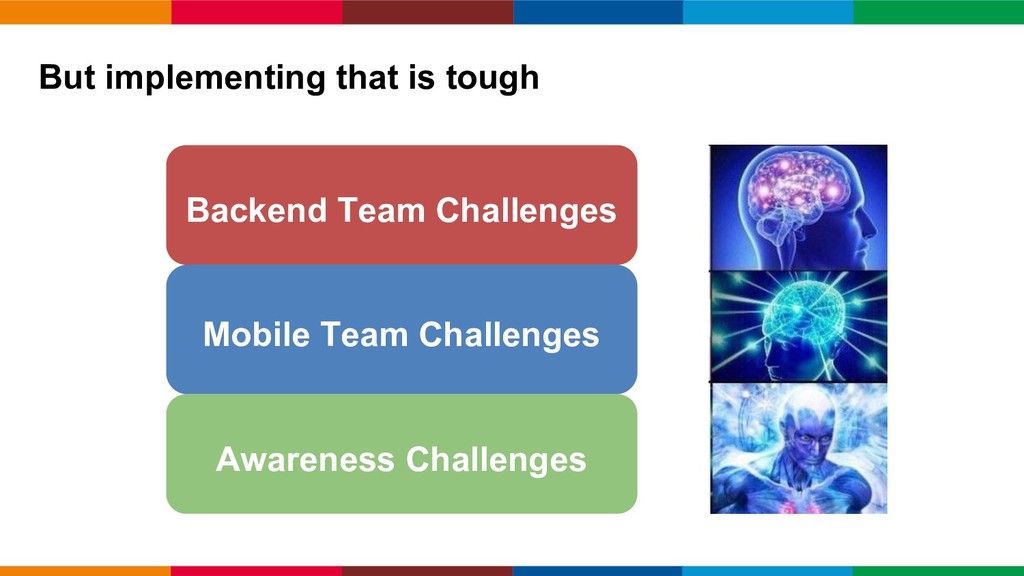
let alone developers understand such topic (nothing new in here, but it’s really a problem); • Topics like (a)symmetric cryptography, request signature, AEAD, IV, Key and PRNG usually take days to be understood; • In addition, the difficulty of programmers to understand in practice the creation of encrypted streams. Awareness / education Challenges
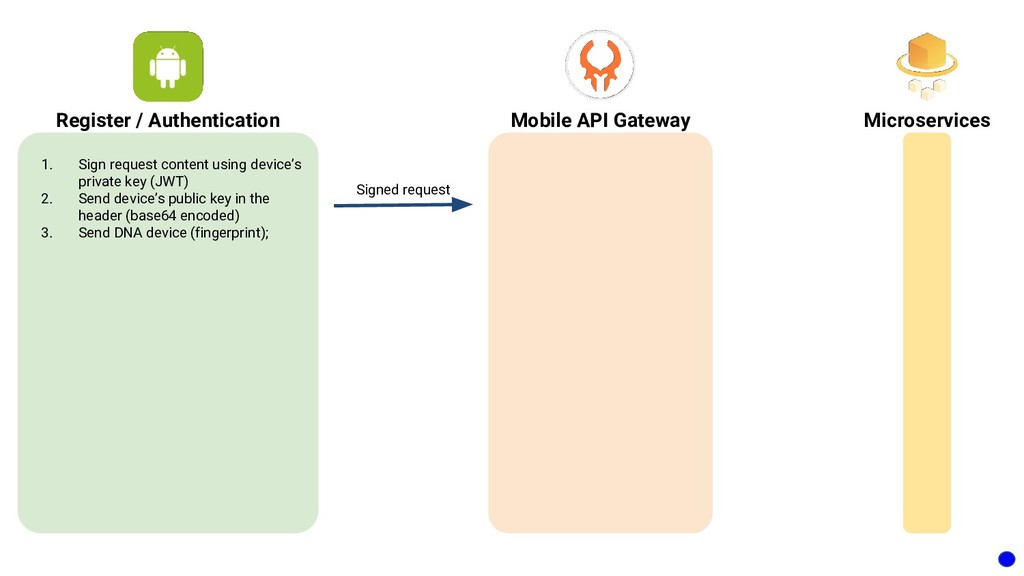
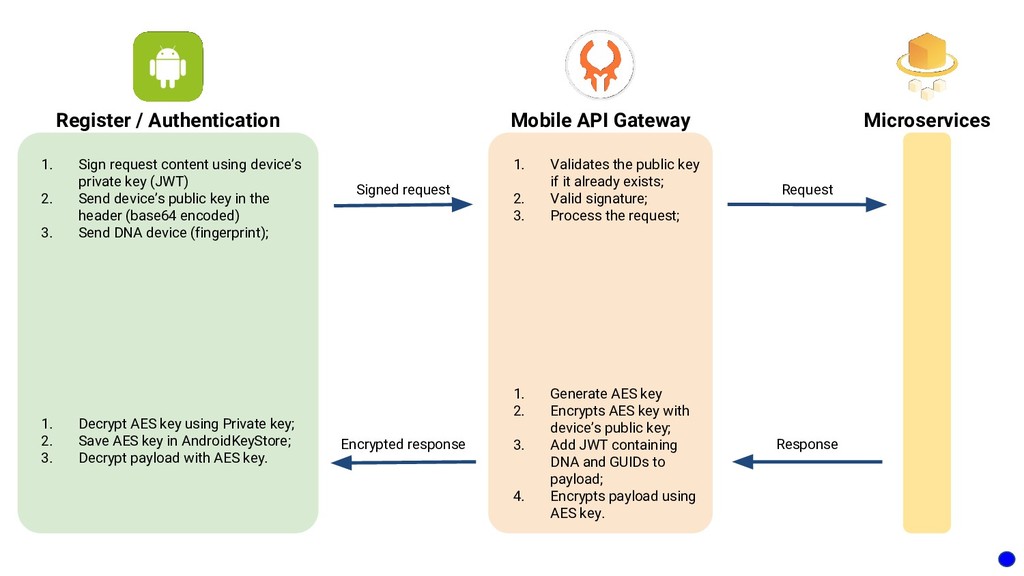
2. Send device’s public key in the header (base64 encoded) 3. Send DNA device (fingerprint); Register / Authentication Mobile API Gateway Signed request Microservices
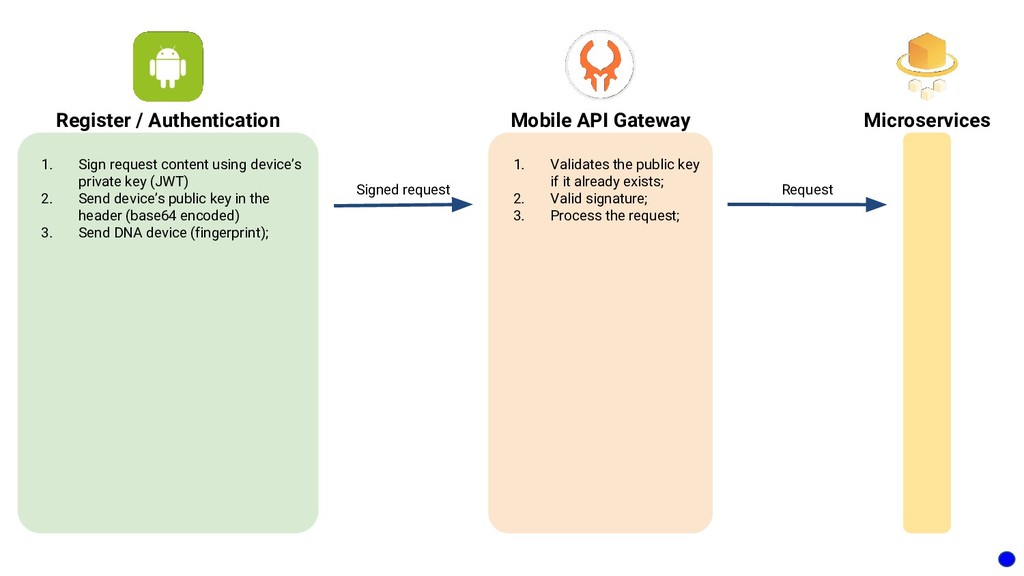
2. Send device’s public key in the header (base64 encoded) 3. Send DNA device (fingerprint); Register / Authentication Mobile API Gateway 1. Validates the public key if it already exists; 2. Valid signature; 3. Process the request; Request Signed request Microservices
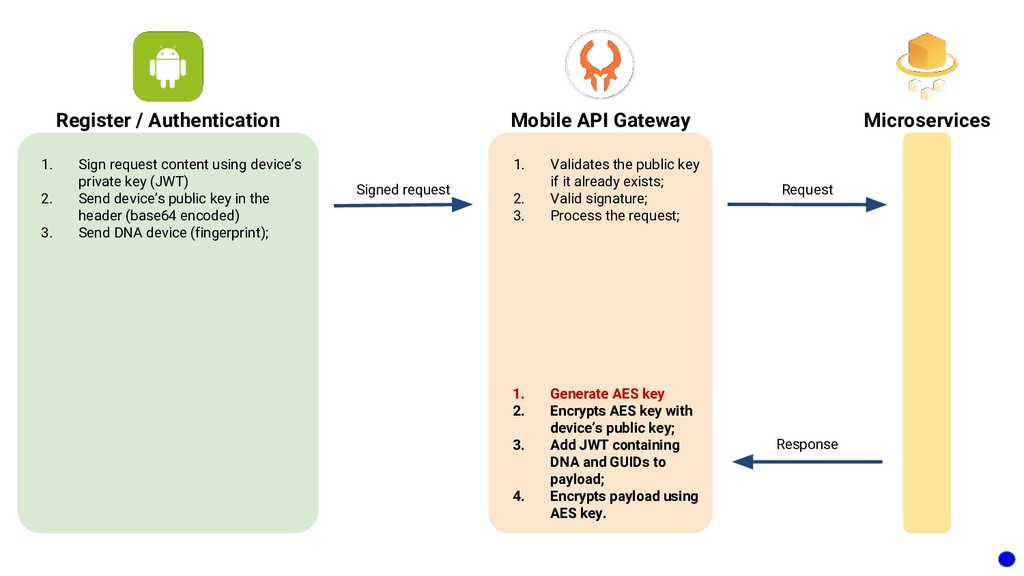
2. Send device’s public key in the header (base64 encoded) 3. Send DNA device (fingerprint); Register / Authentication Mobile API Gateway 1. Validates the public key if it already exists; 2. Valid signature; 3. Process the request; Request Response Signed request 1. Generate AES key 2. Encrypts AES key with device’s public key; 3. Add JWT containing DNA and GUIDs to payload; 4. Encrypts payload using AES key. Microservices
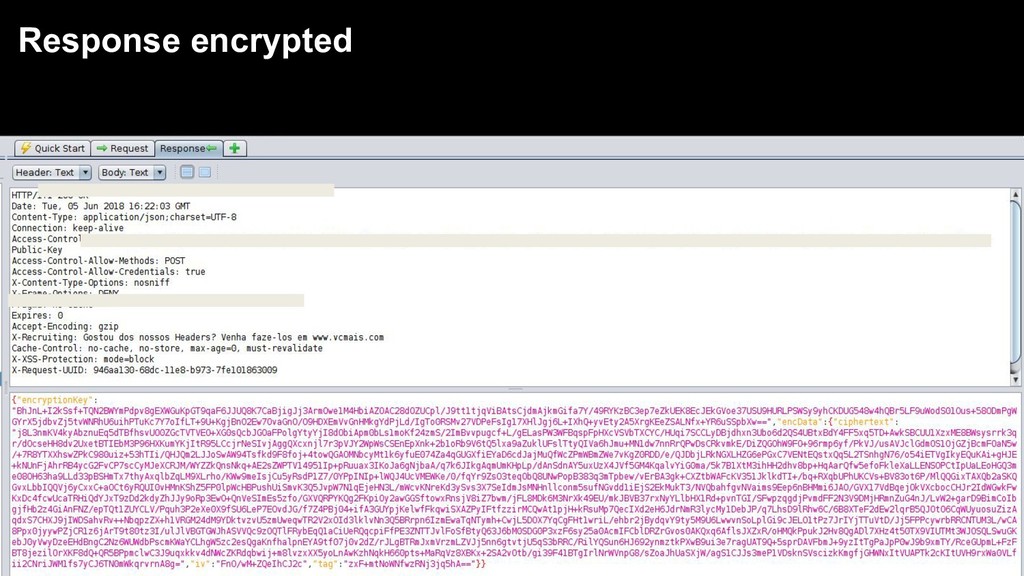
2. Send device’s public key in the header (base64 encoded) 3. Send DNA device (fingerprint); Register / Authentication Mobile API Gateway 1. Validates the public key if it already exists; 2. Valid signature; 3. Process the request; Request Response Signed request Encrypted response 1. Generate AES key 2. Encrypts AES key with device’s public key; 3. Add JWT containing DNA and GUIDs to payload; 4. Encrypts payload using AES key. 1. Decrypt AES key using Private key; 2. Save AES key in AndroidKeyStore; 3. Decrypt payload with AES key. Microservices
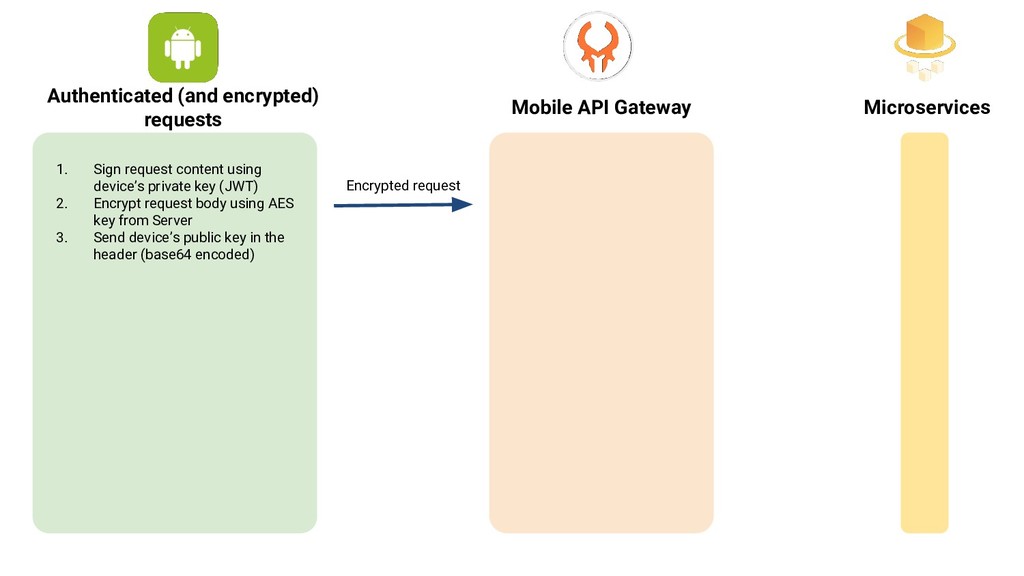
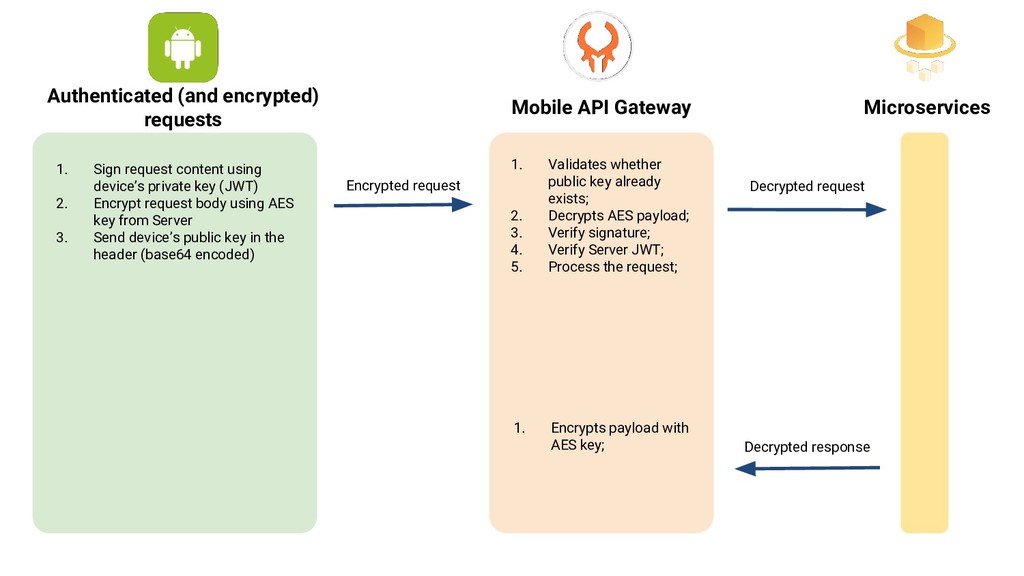
2. Encrypt request body using AES key from Server 3. Send device’s public key in the header (base64 encoded) Authenticated (and encrypted) requests Microservices Mobile API Gateway Encrypted request
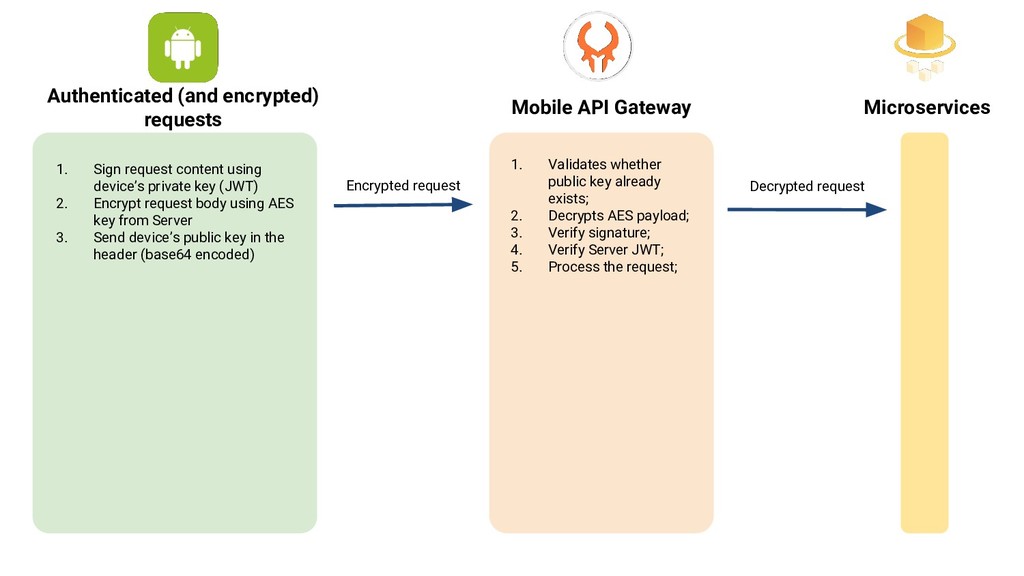
2. Encrypt request body using AES key from Server 3. Send device’s public key in the header (base64 encoded) Authenticated (and encrypted) requests Encrypted request Microservices Mobile API Gateway 1. Validates whether public key already exists; 2. Decrypts AES payload; 3. Verify signature; 4. Verify Server JWT; 5. Process the request; Decrypted request
2. Encrypt request body using AES key from Server 3. Send device’s public key in the header (base64 encoded) Authenticated (and encrypted) requests 1. Validates whether public key already exists; 2. Decrypts AES payload; 3. Verify signature; 4. Verify Server JWT; 5. Process the request; Decrypted request Decrypted response Encrypted request 1. Encrypts payload with AES key; Microservices Mobile API Gateway
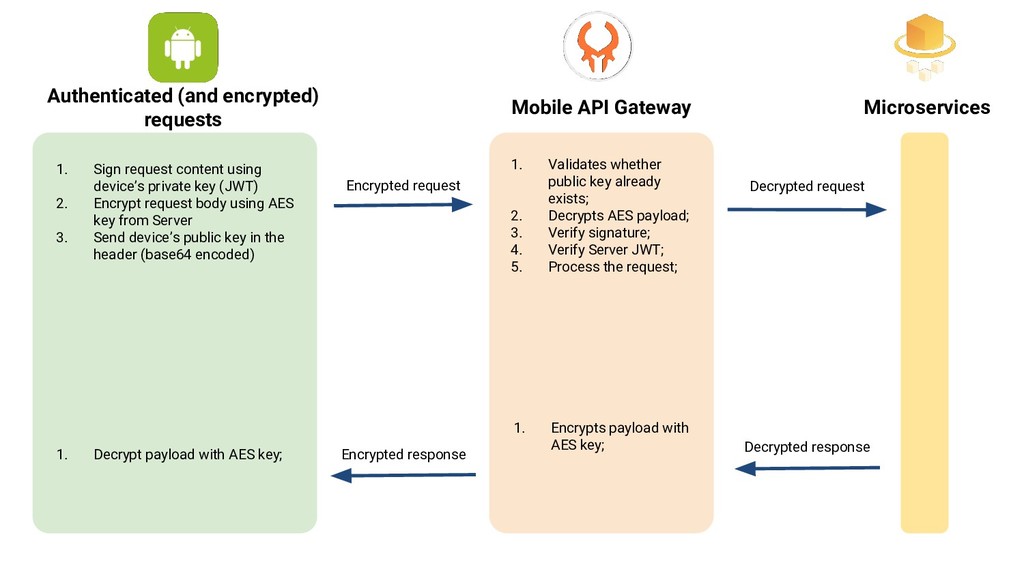
2. Encrypt request body using AES key from Server 3. Send device’s public key in the header (base64 encoded) Authenticated (and encrypted) requests 1. Validates whether public key already exists; 2. Decrypts AES payload; 3. Verify signature; 4. Verify Server JWT; 5. Process the request; Decrypted request Decrypted response Encrypted request Encrypted response 1. Encrypts payload with AES key; 1. Decrypt payload with AES key; Microservices Mobile API Gateway
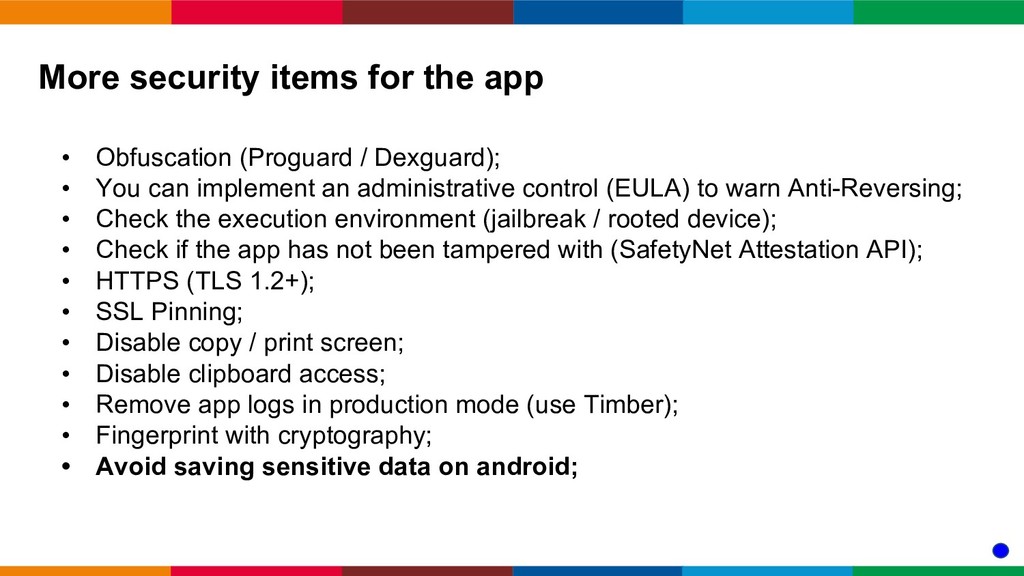
an administrative control (EULA) to warn Anti-Reversing; • Check the execution environment (jailbreak / rooted device); • Check if the app has not been tampered with (SafetyNet Attestation API); • HTTPS (TLS 1.2+); • SSL Pinning; • Disable copy / print screen; • Disable clipboard access; • Remove app logs in production mode (use Timber); • Fingerprint with cryptography; • Avoid saving sensitive data on android; More security items for the app
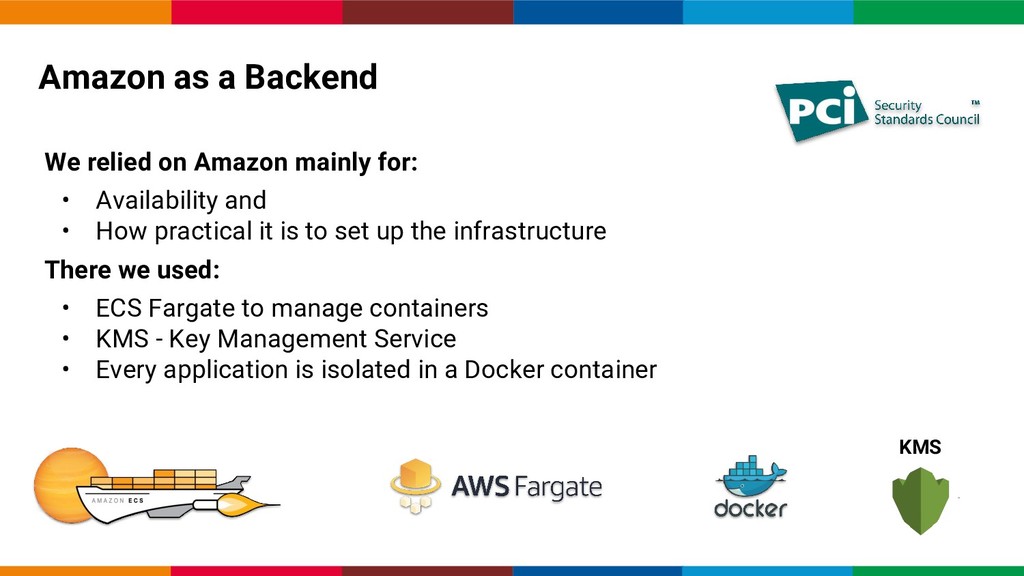
• How practical it is to set up the infrastructure There we used: • ECS Fargate to manage containers • KMS - Key Management Service • Every application is isolated in a Docker container Amazon as a Backend KMS


 candidosales
 takahashim
 taketakekaho
 kaminashi
 prog893
 colopl
 stomk
stomk
 y0hgi
y0hgi
 techtekt
 ivry_presentationmaterials
 willnet
 iktakahiro
 yahonda
 destraynor
 jmmastey
 sabderemane
 aemeredith
 brettharned
 axbom
axbom
 pwiseman
 bkeepers
 nmsamuel
 bluesmoon
 orderedlist
 mkilby