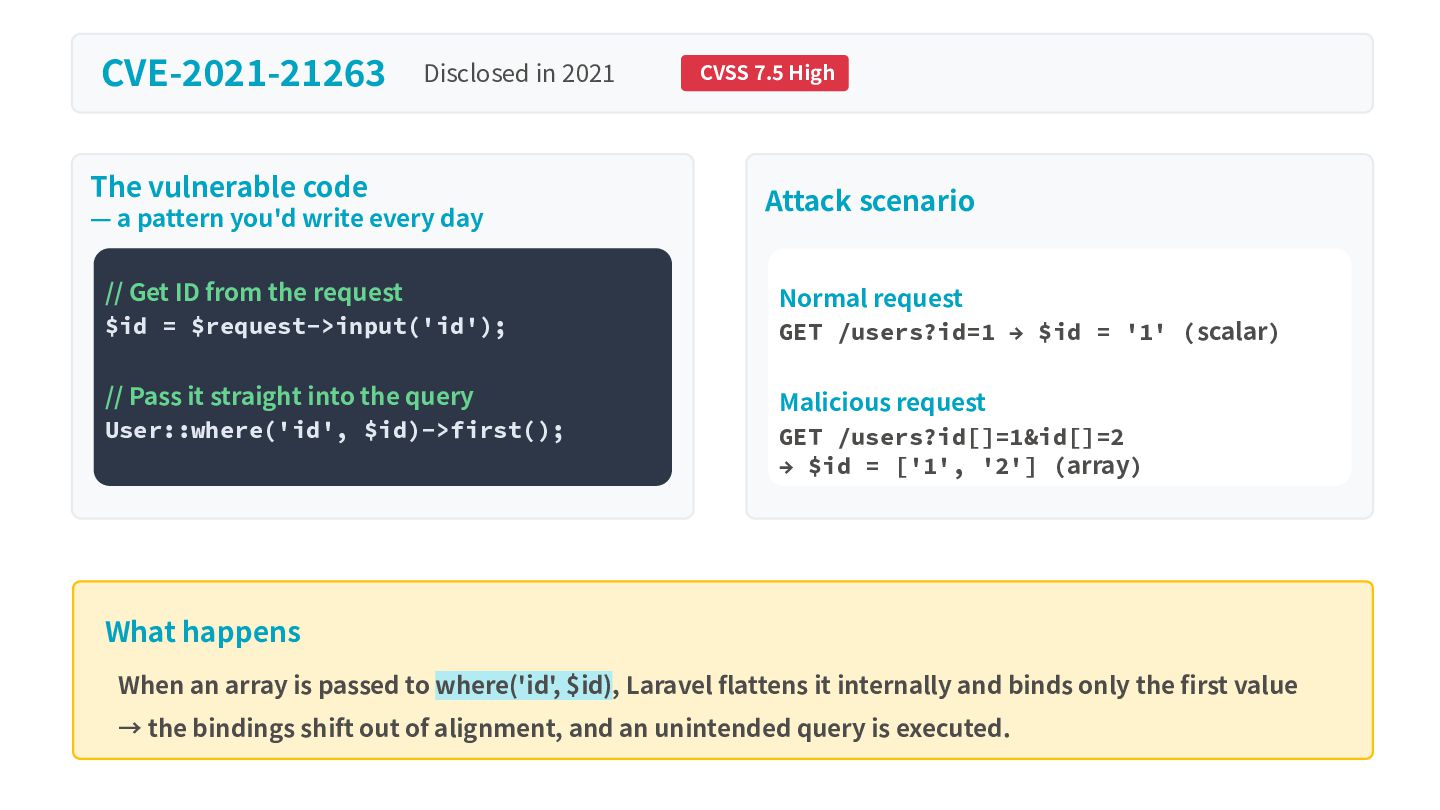
— a pattern you'd write every day // Get ID from the request $id = $request->input('id'); // Pass it straight into the query User::where('id', $id)->first(); What happens When an array is passed to where('id', $id), Laravel flattens it internally and binds only the first value → the bindings shift out of alignment, and an unintended query is executed. Attack scenario Normal request GET /users?id=1 → $id = '1' (scalar) Malicious request GET /users?id[]=1&id[]=2 → $id = ['1', '2'] (array)
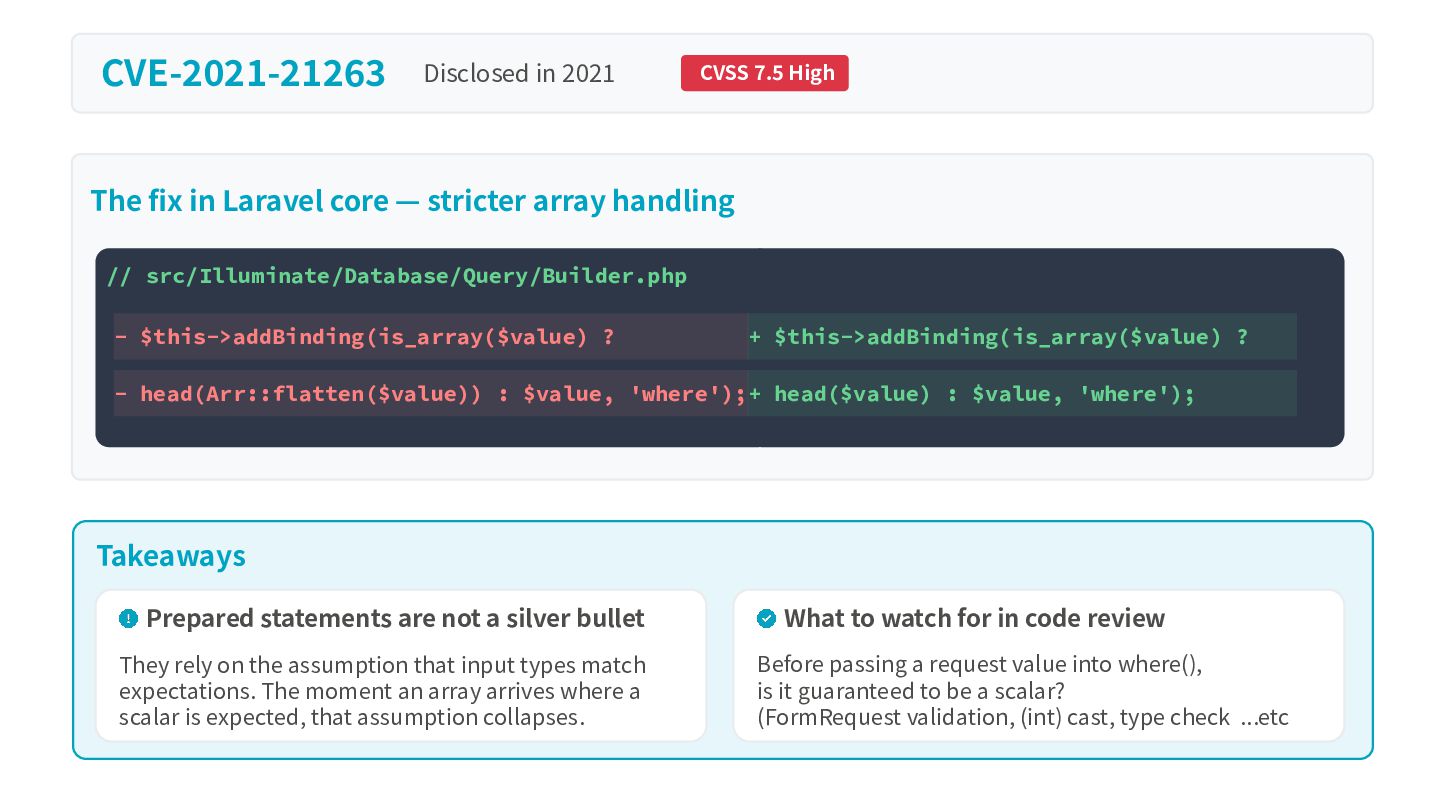
src/Illuminate/Database/Query/Builder.php - $this->addBinding(is_array($value) ? Takeaways - head(Arr::flatten($value)) : $value, 'where'); + $this->addBinding(is_array($value) ? + head($value) : $value, 'where'); Prepared statements are not a silver bullet They rely on the assumption that input types match expectations. The moment an array arrives where a scalar is expected, that assumption collapses. What to watch for in code review Before passing a request value into where(), is it guaranteed to be a scalar? (FormRequest validation, (int) cast, type check ...etc CVE-2021-21263 Disclosed in 2021 CVSS 7.5 High
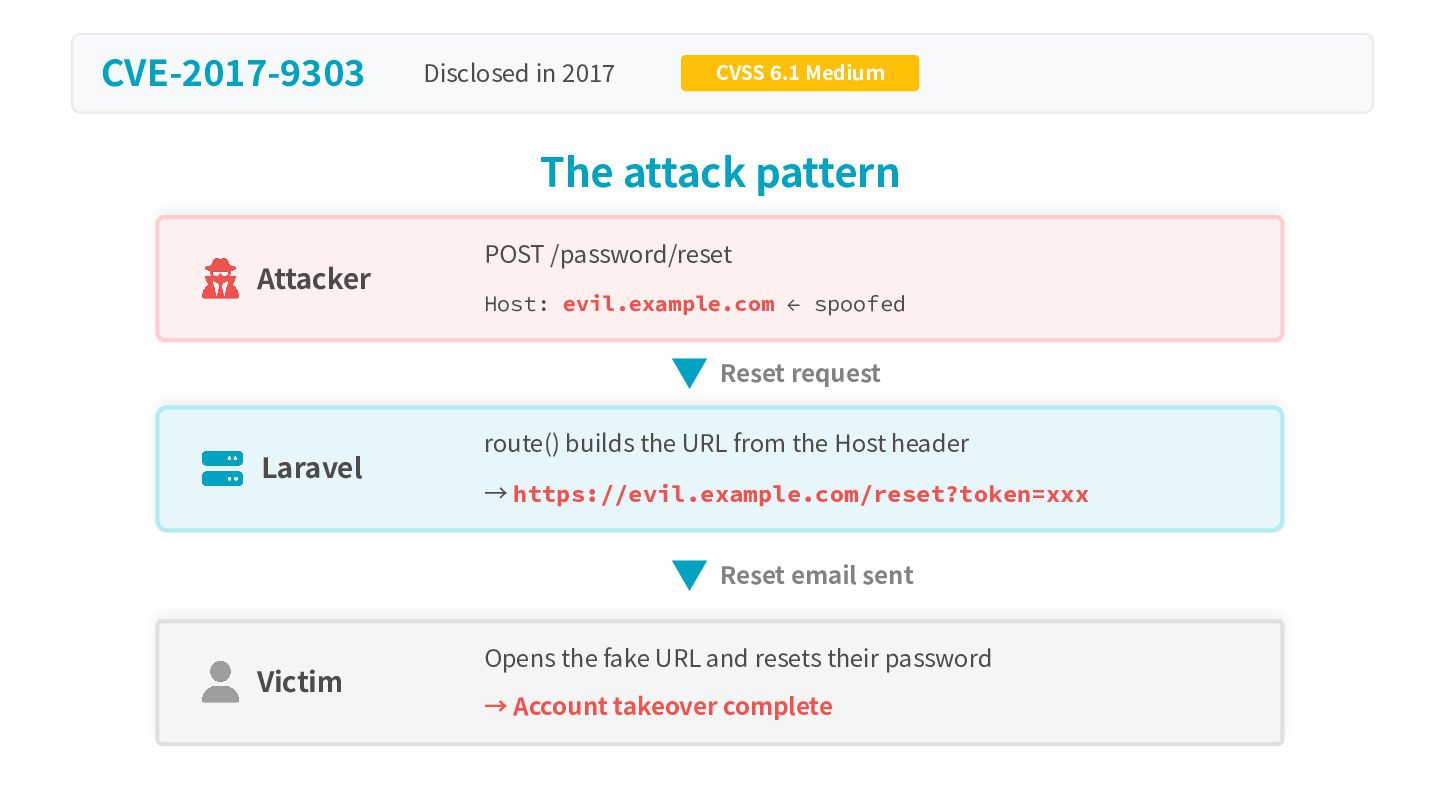
route() builds the URL from the Host header → https://evil.example.com/reset?token=xxx Reset email sent Victim Opens the fake URL and resets their password → Account takeover complete The attack pattern CVE-2017-9303 Disclosed in 2017 CVSS 6.1 Medium
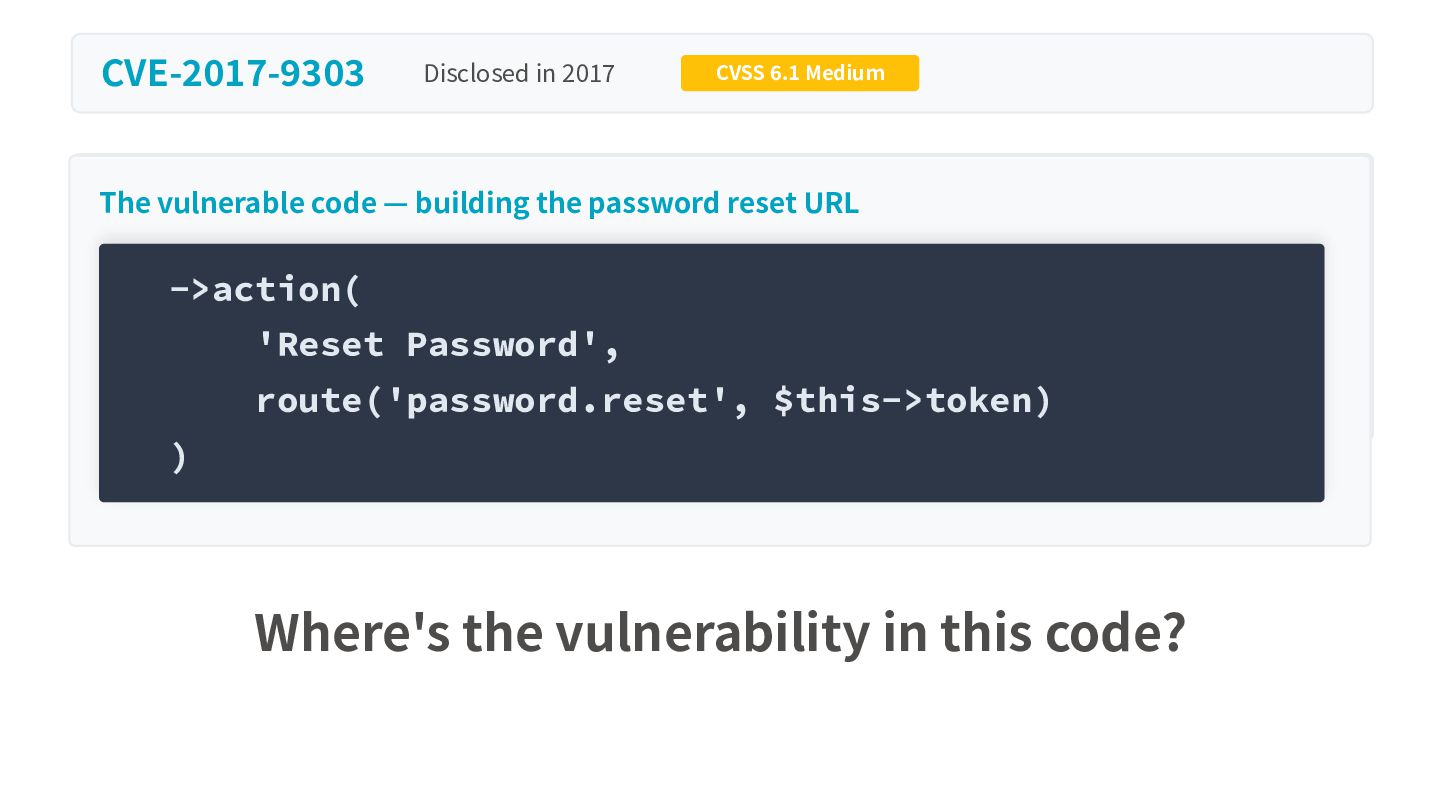
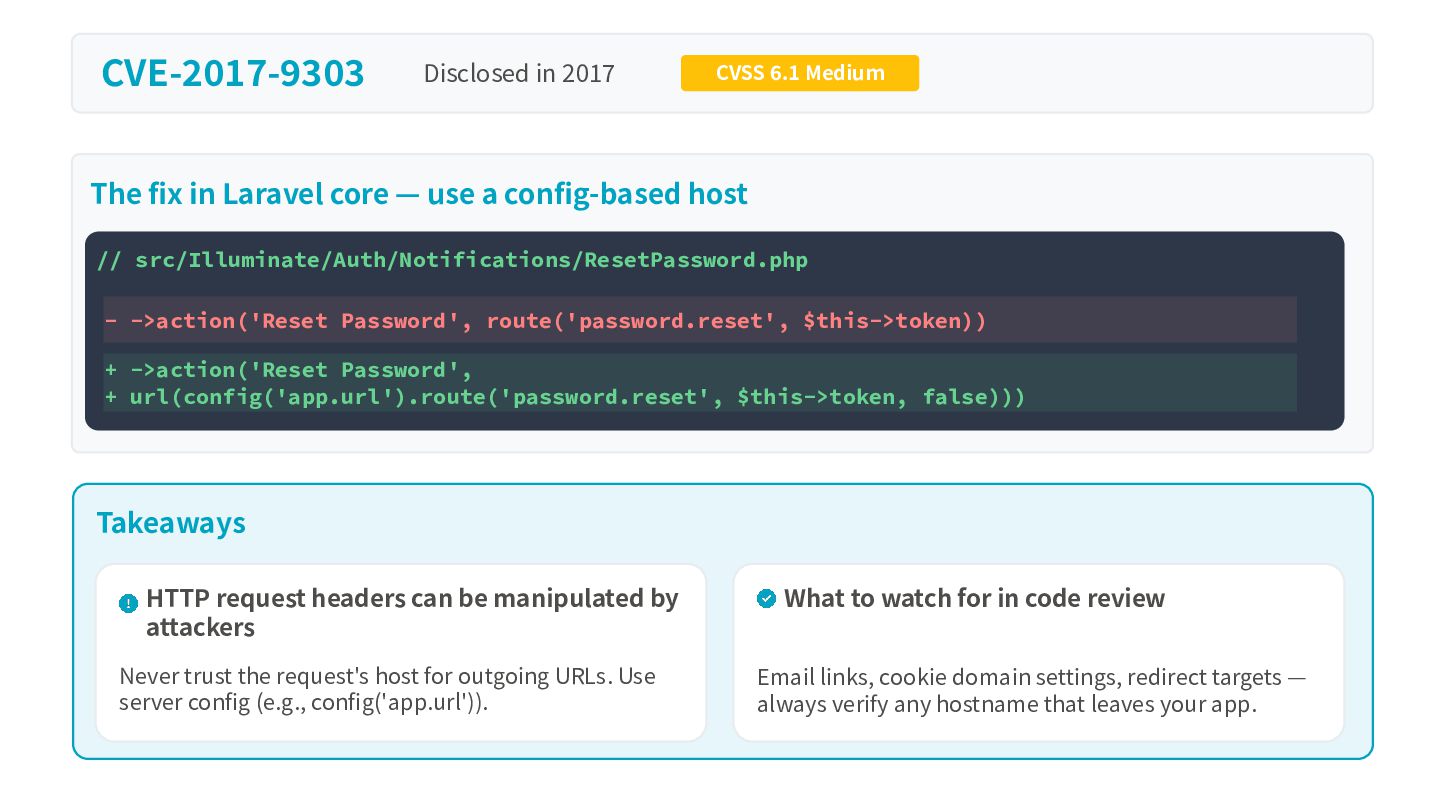
- ->action('Reset Password', route('password.reset', $this->token)) Takeaways + ->action('Reset Password', + url(config('app.url').route('password.reset', $this->token, false))) HTTP request headers can be manipulated by attackers Never trust the request's host for outgoing URLs. Use server config (e.g., config('app.url')). What to watch for in code review Email links, cookie domain settings, redirect targets — always verify any hostname that leaves your app. // src/Illuminate/Auth/Notifications/ResetPassword.php CVE-2017-9303 Disclosed in 2017 CVSS 6.1 Medium
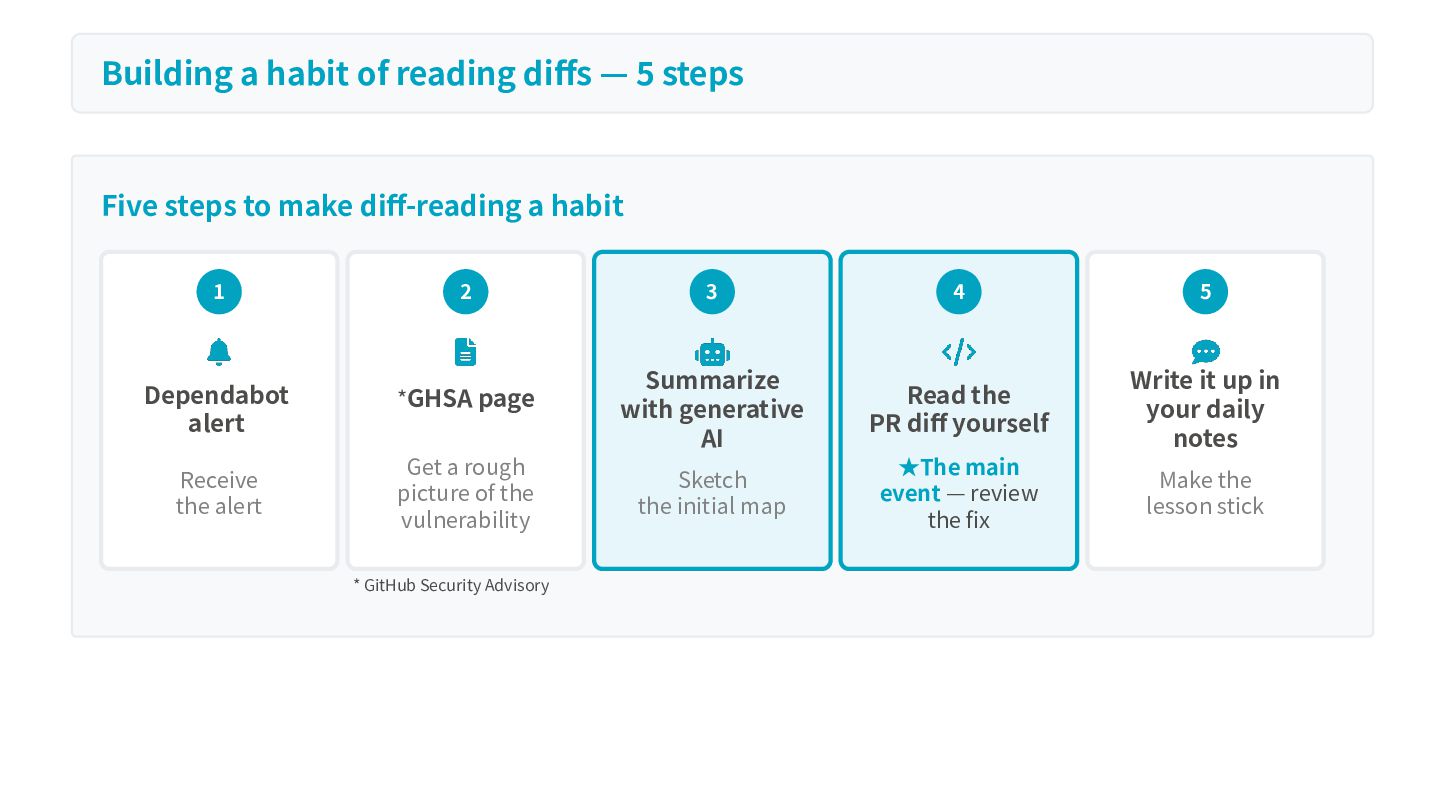
a habit 1 Dependabot alert Receive the alert 2 *GHSA page Get a rough picture of the vulnerability 3 Summarize with generative AI Sketch the initial map 4 Read the PR diff yourself ★The main event — review the fix 5 Write it up in your daily notes Make the lesson stick Building a habit of reading diffs — 5 steps * GitHub Security Advisory
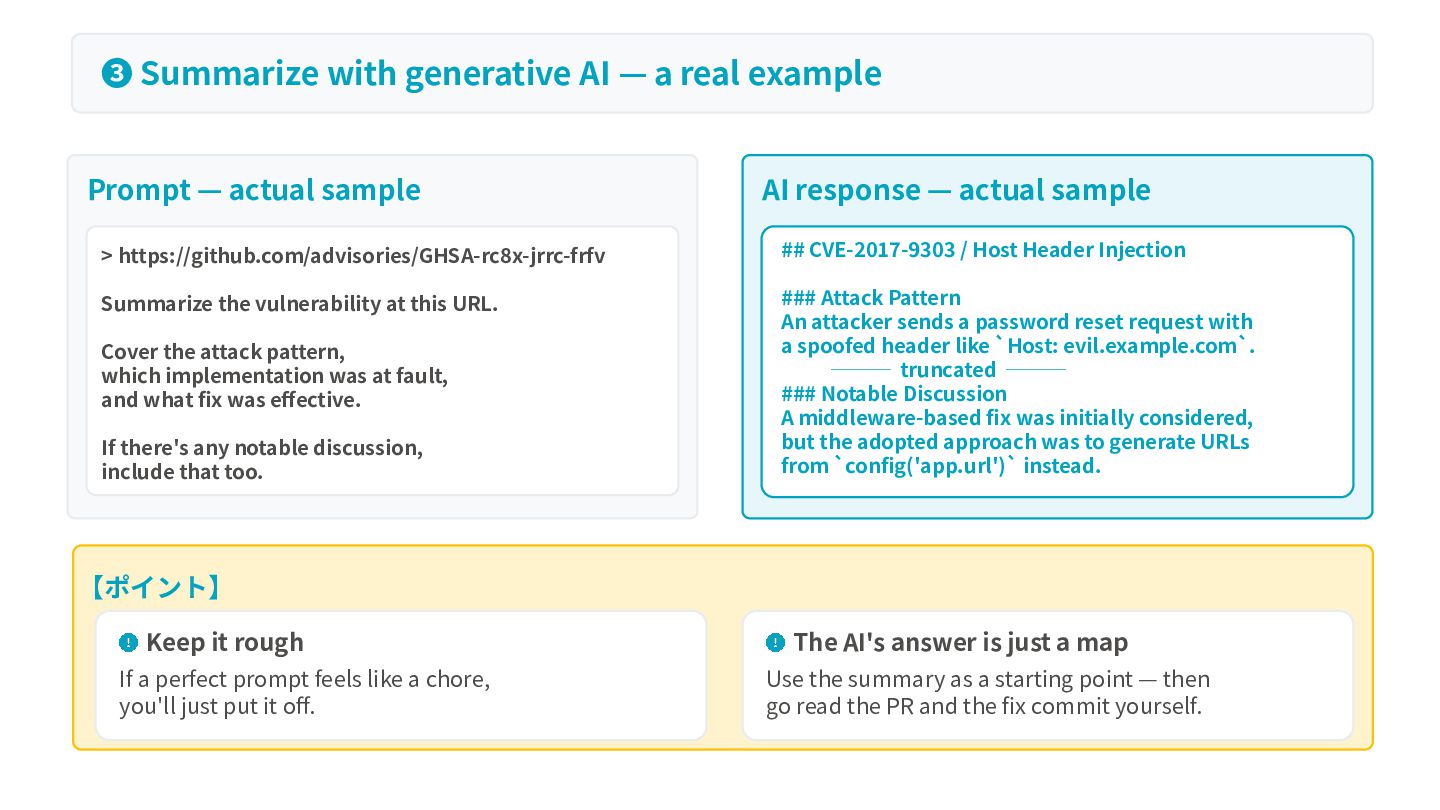
this URL. Cover the attack pattern, which implementation was at fault, and what fix was effective. If there's any notable discussion, include that too. AI response — actual sample ## CVE-2017-9303 / Host Header Injection ### Attack Pattern An attacker sends a password reset request with a spoofed header like `Host: evil.example.com`. ─── truncated ─── ### Notable Discussion A middleware-based fix was initially considered, but the adopted approach was to generate URLs from `config('app.url')` instead. ❸ Summarize with generative AI — a real example 【ポイント】 Keep it rough If a perfect prompt feels like a chore, you'll just put it off. The AI's answer is just a map Use the summary as a starting point — then go read the PR and the fix commit yourself.
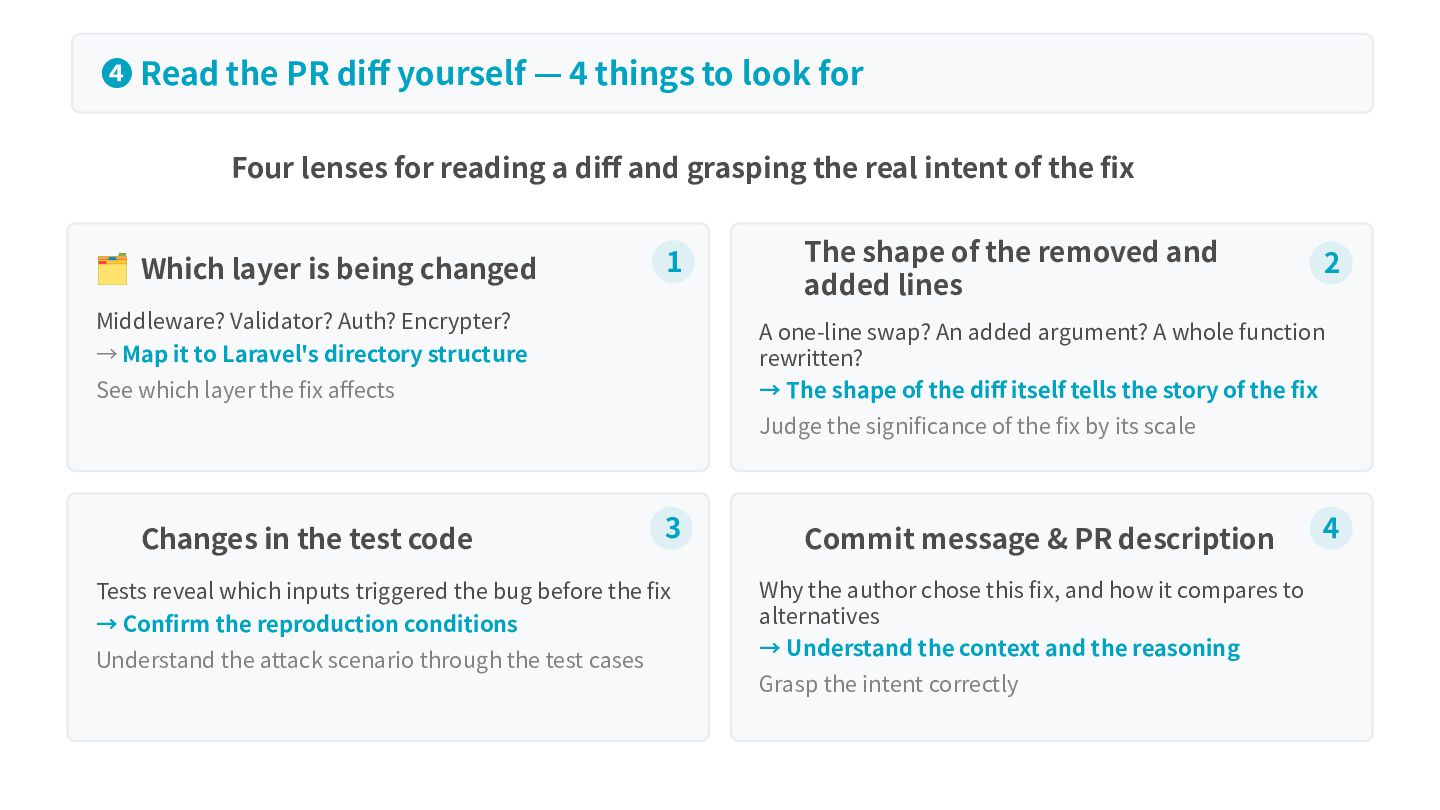
intent of the fix 🗂 Which layer is being changed 1 Middleware? Validator? Auth? Encrypter? → Map it to Laravel's directory structure See which layer the fix affects The shape of the removed and added lines A one-line swap? An added argument? A whole function rewritten? → The shape of the diff itself tells the story of the fix Judge the significance of the fix by its scale Changes in the test code Tests reveal which inputs triggered the bug before the fix → Confirm the reproduction conditions Understand the attack scenario through the test cases Commit message & PR description Why the author chose this fix, and how it compares to alternatives → Understand the context and the reasoning Grasp the intent correctly ❹ Read the PR diff yourself — 4 things to look for 2 3 4
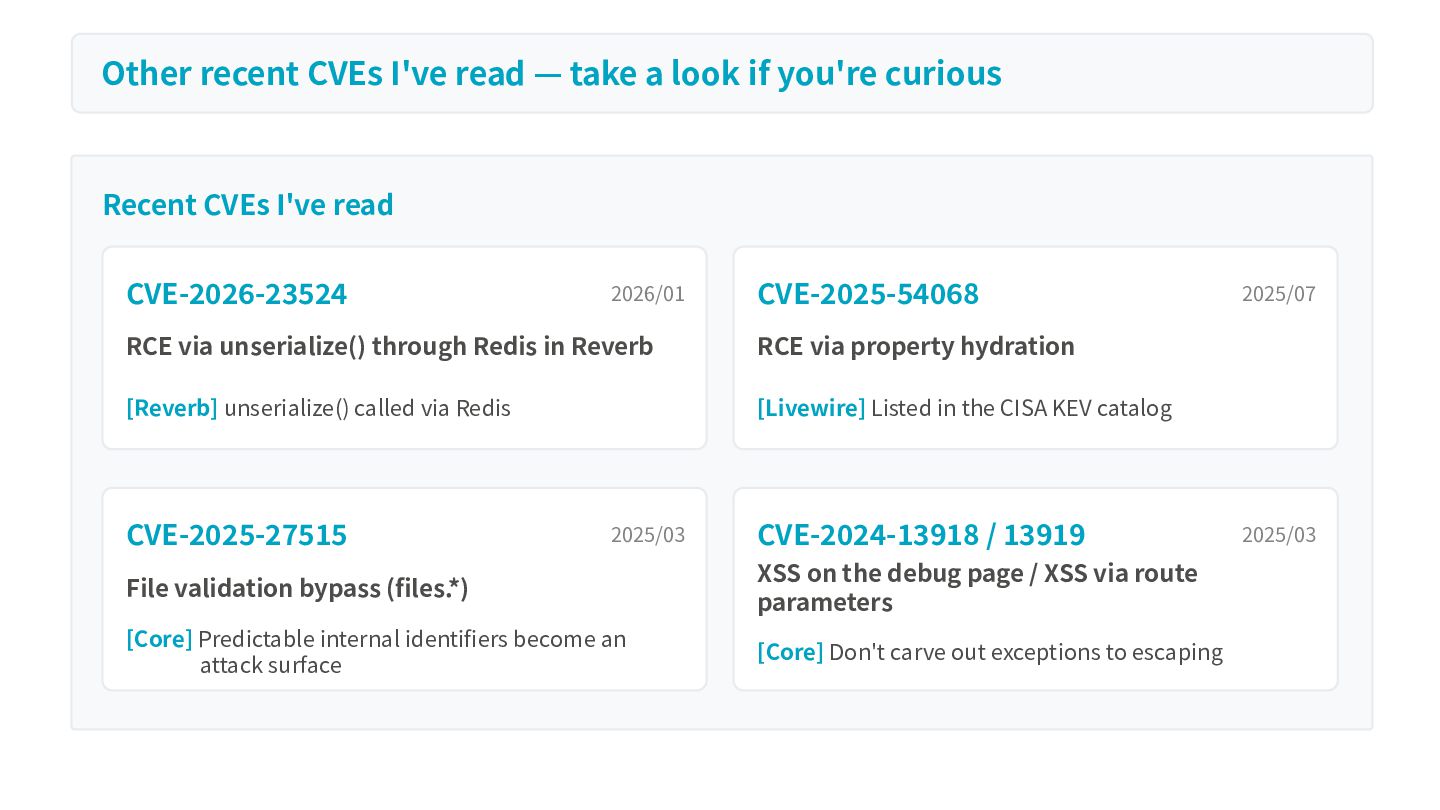
Redis in Reverb [Reverb] unserialize() called via Redis Other recent CVEs I've read — take a look if you're curious CVE-2025-54068 2025/07 RCE via property hydration [Livewire] Listed in the CISA KEV catalog CVE-2025-27515 2025/03 File validation bypass (files.*) [Core] Predictable internal identifiers become an attack surface CVE-2024-13918 / 13919 2025/03 XSS on the debug page / XSS via route parameters [Core] Don't carve out exceptions to escaping


 codmoninc
 livesense
 fespinoza
 tetsuya28
 masakane55
 470715
.png) jmdc_presentation
jmdc_presentation
 sudoakiy
 hlum
hlum
 baseballyama
.png) codatum
codatum
 kairim0
 pauli
pauli
 axbom
axbom
 elsirapls
 rkendrick25
 jnunemaker
 greggifford
 notwaldorf
 bluesmoon
 sarafernandez
 smashingmag
 mayatellez
 aemeredith
 katarinadahlin

![?id[]=1&id[]=2 SQL Binding Misalignment Vulnerability CVE-2021-21263 / Disclosed in 2021](https://files.speakerdeck.com/presentations/4167a18fc47c4a3ea484ae74a6736c22/slide_1.jpg)