action – Also: subscriber of Claude Code • Principal consultant at Thoughtworks (2015-2023) • Tech reviewer of Brazilian edition of GOPL (2016) • Instructional designer at Oficina Turing • Co-founder of Garoa Hacker Clube, a hackerspace in São Paulo, Brasil (since 2010)
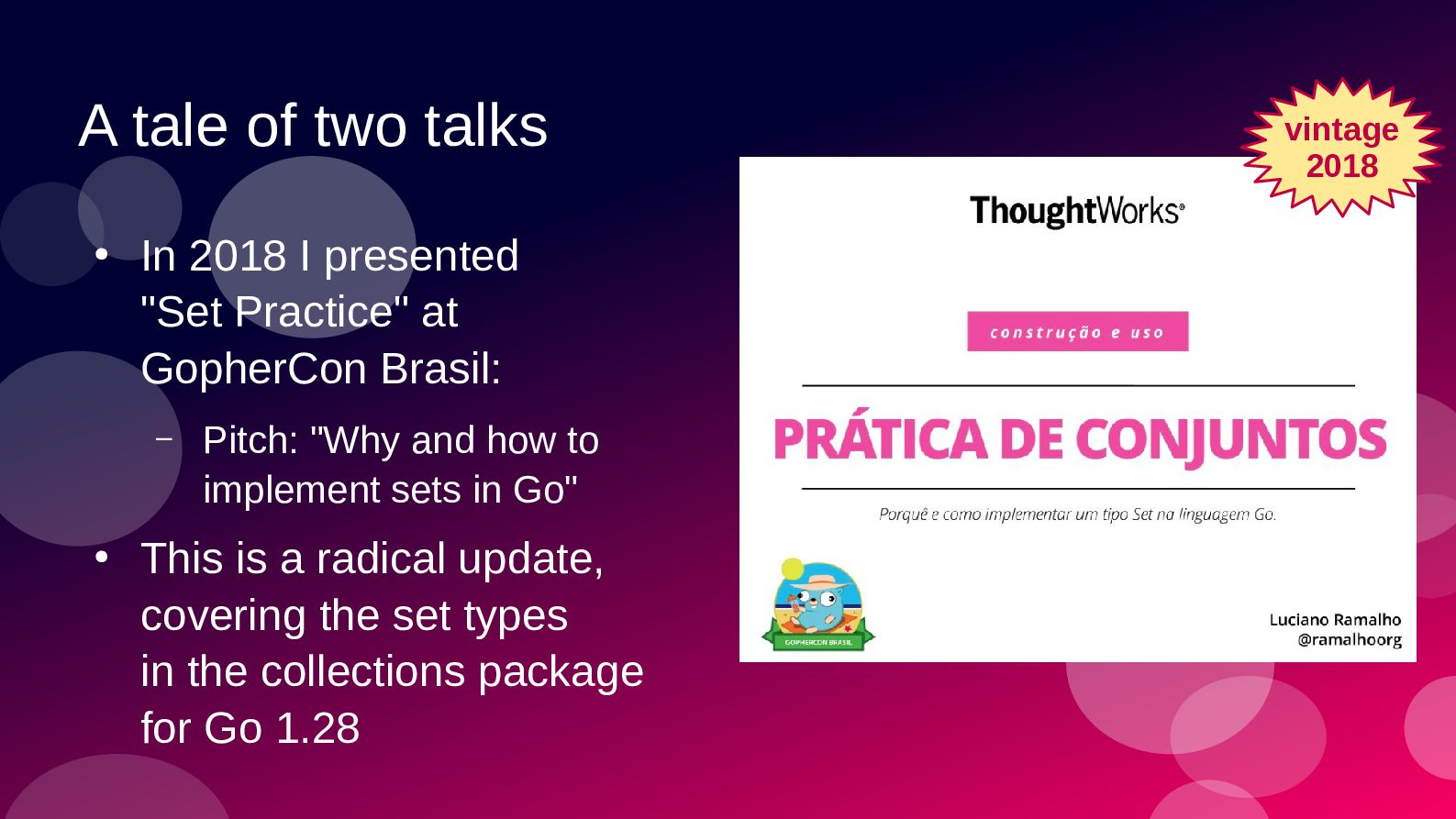
"Set Practice" at GopherCon Brasil: – • Pitch: "Why and how to implement sets in Go" This is a radical update, covering the set types in the collections package for Go 1.28 vintage 2018
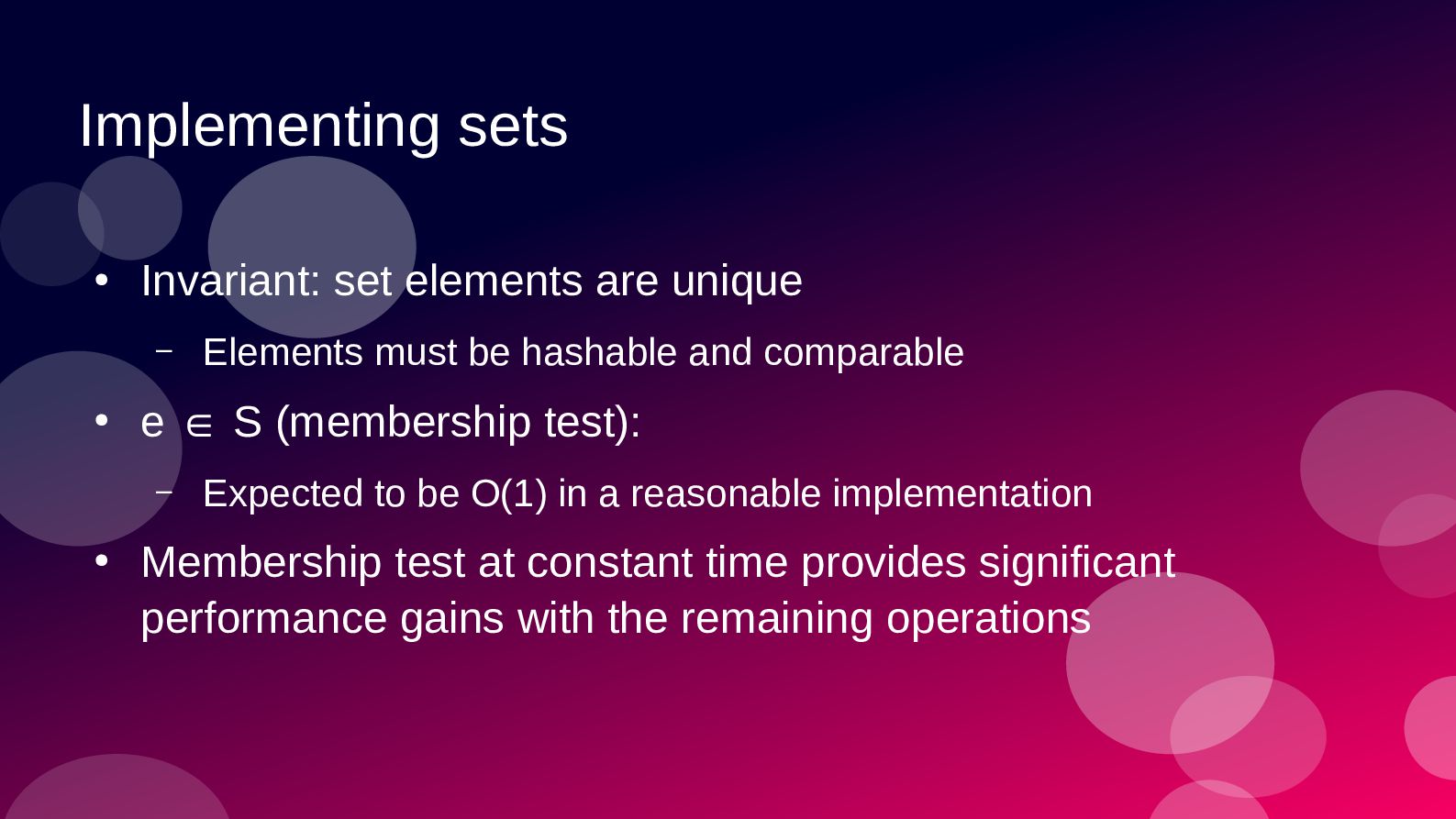
e ∈ S (membership test): – • Elements must be hashable and comparable Expected to be O(1) in a reasonable implementation Membership test at constant time provides significant performance gains with the remaining operations
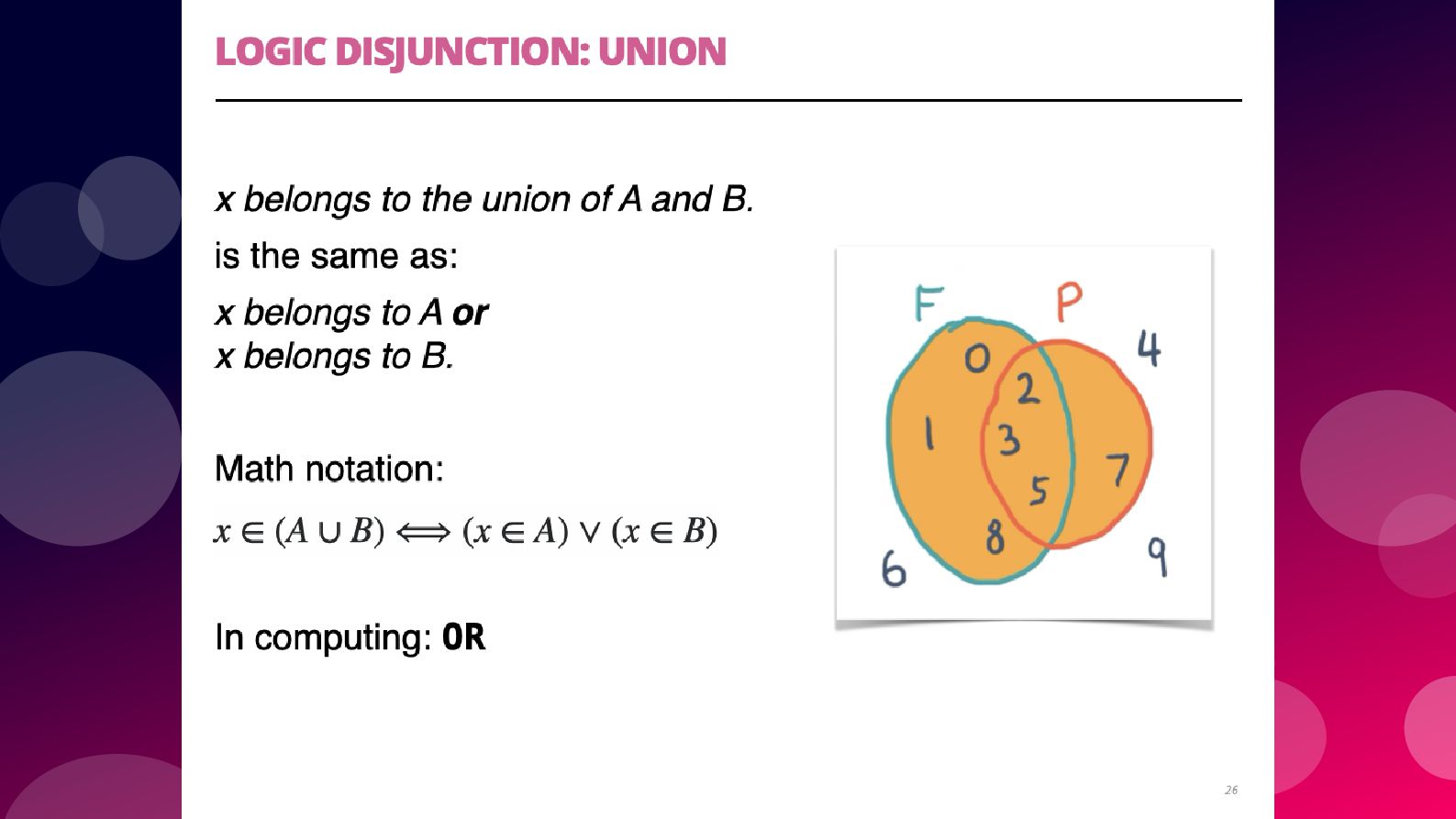
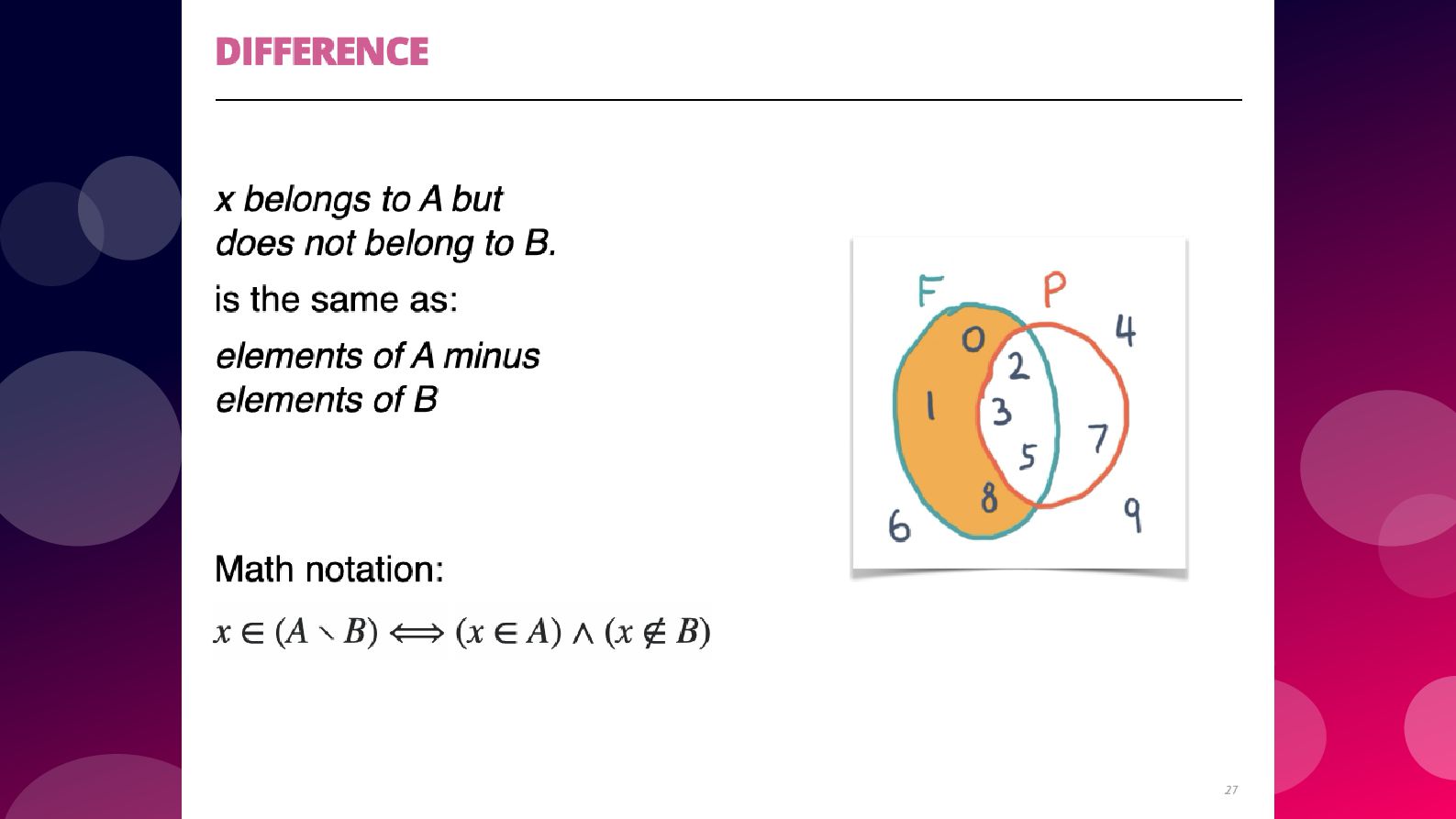
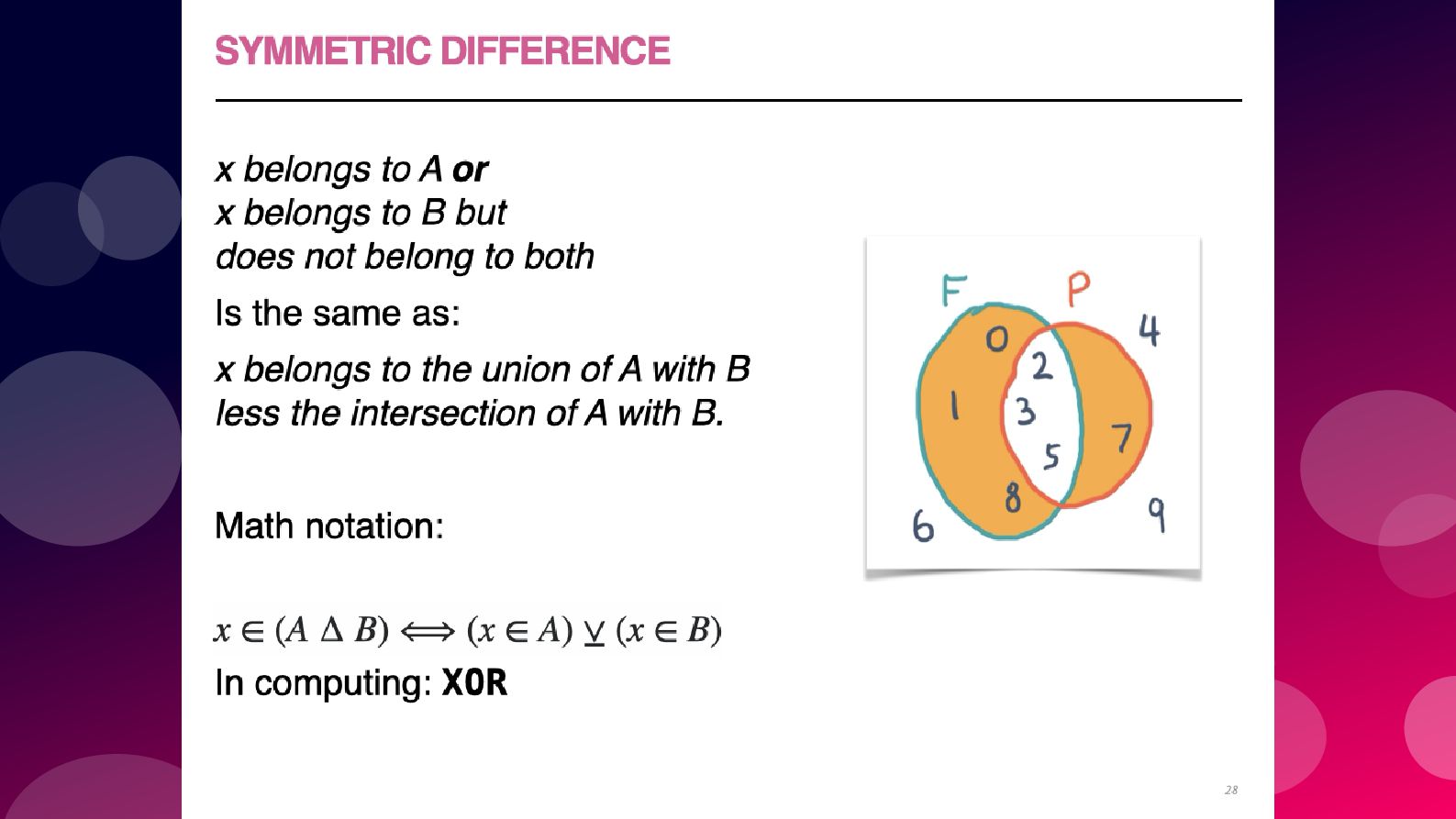
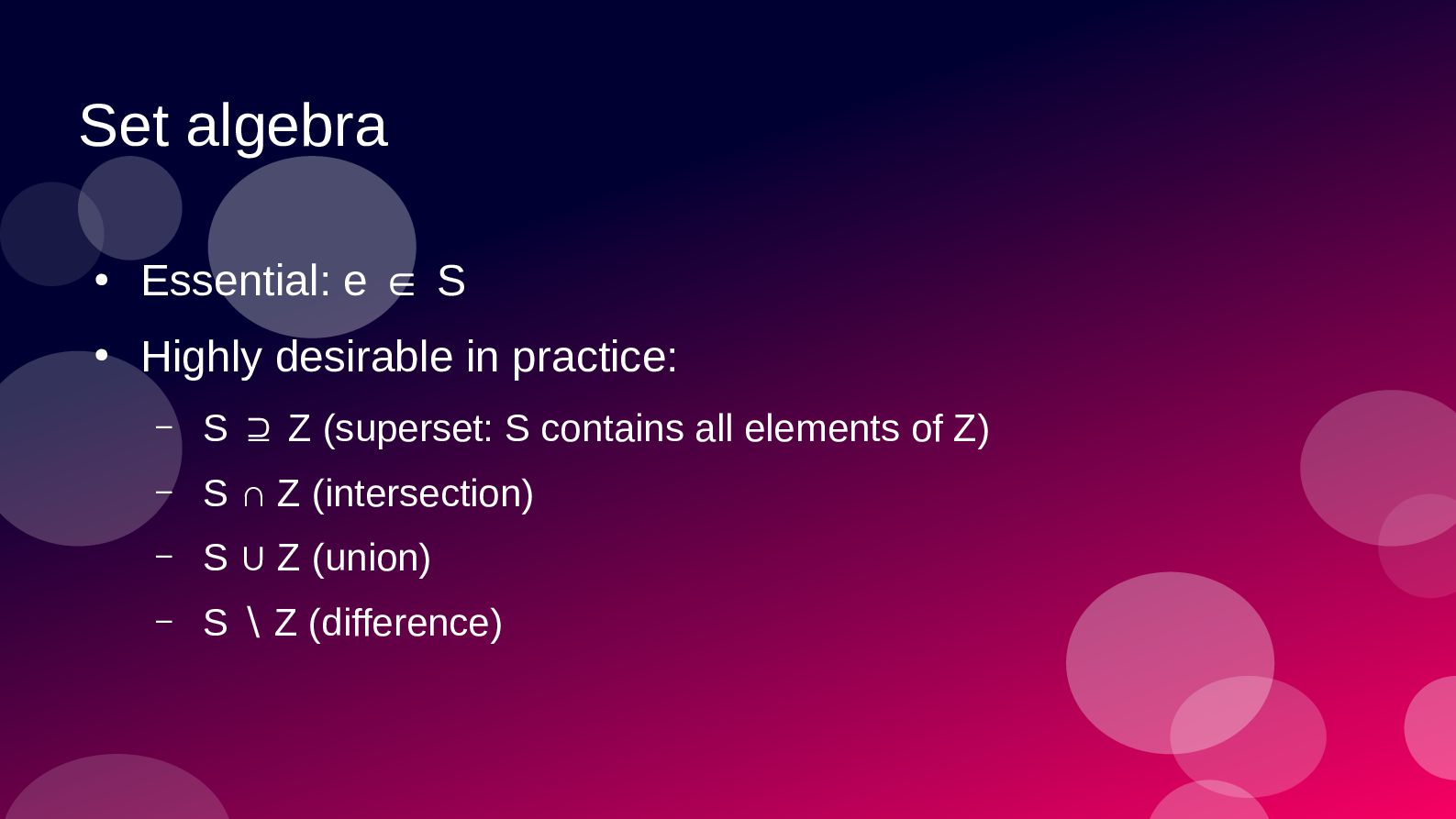
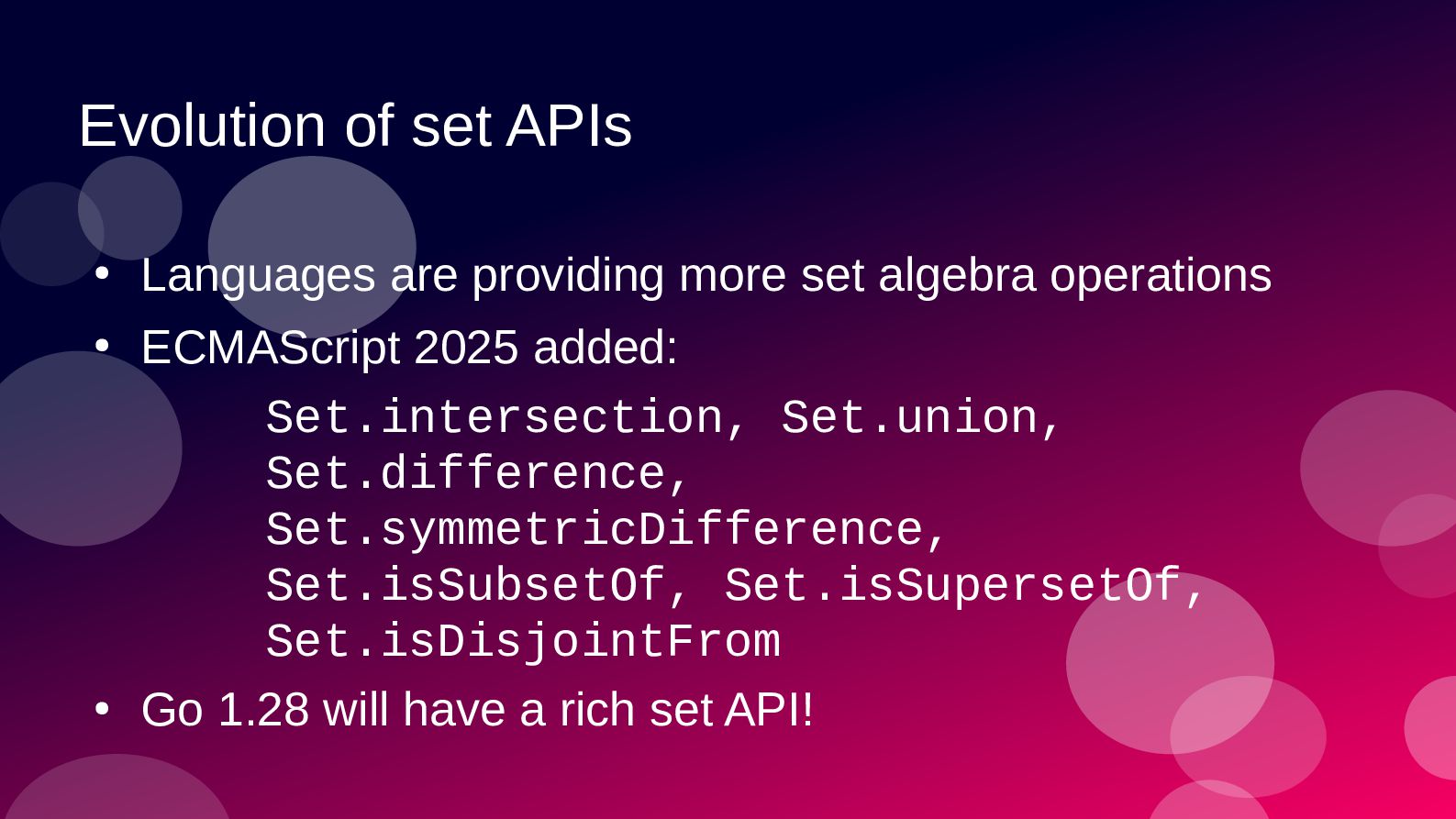
algebra operations ECMAScript 2025 added: Set.intersection, Set.union, Set.difference, Set.symmetricDifference, Set.isSubsetOf, Set.isSupersetOf, Set.isDisjointFrom • Go 1.28 will have a rich set API! •
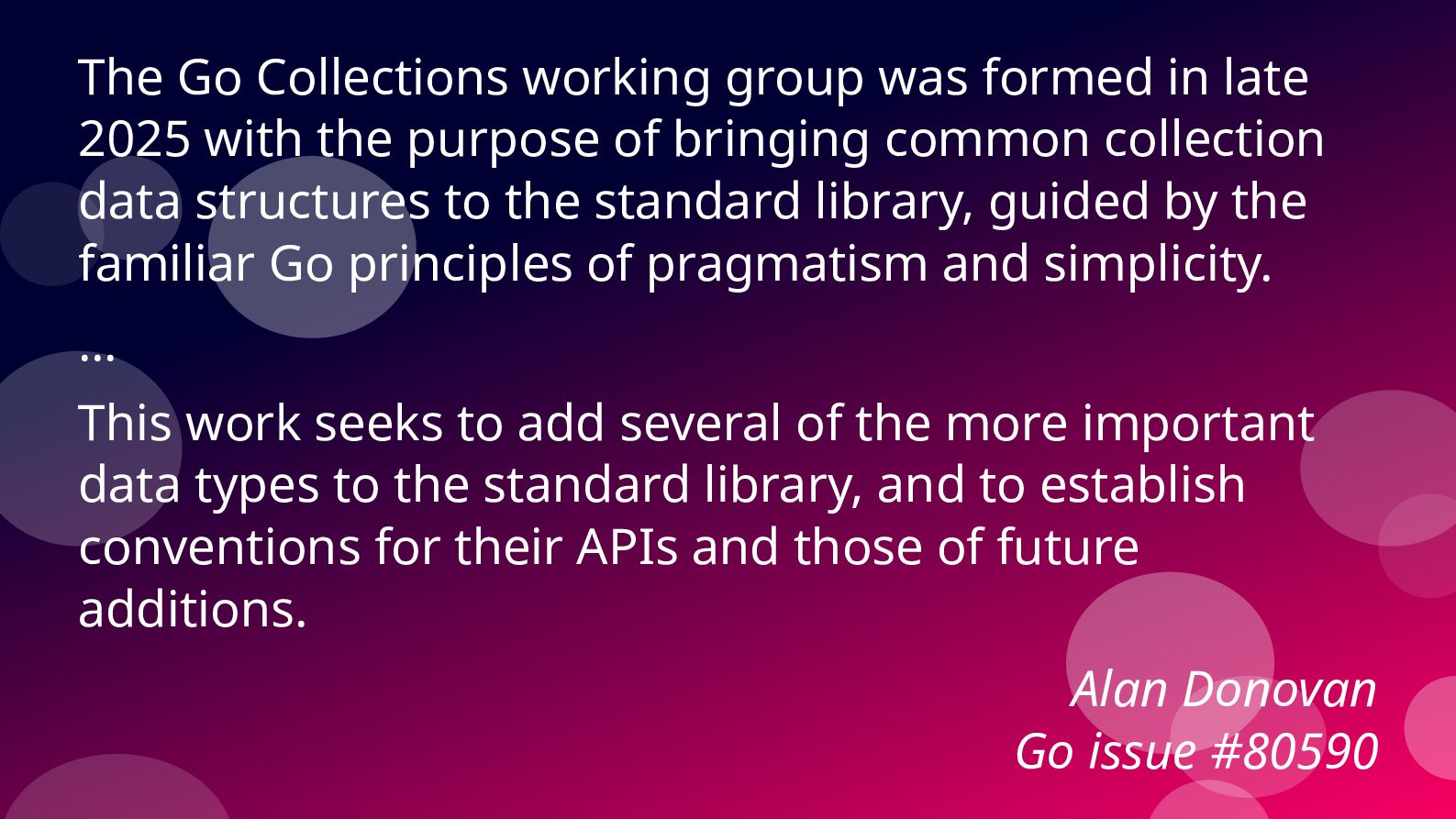
with the purpose of bringing common collection data structures to the standard library, guided by the familiar Go principles of pragmatism and simplicity. … This work seeks to add several of the more important data types to the standard library, and to establish conventions for their APIs and those of future additions. Alan Donovan Go issue #80590
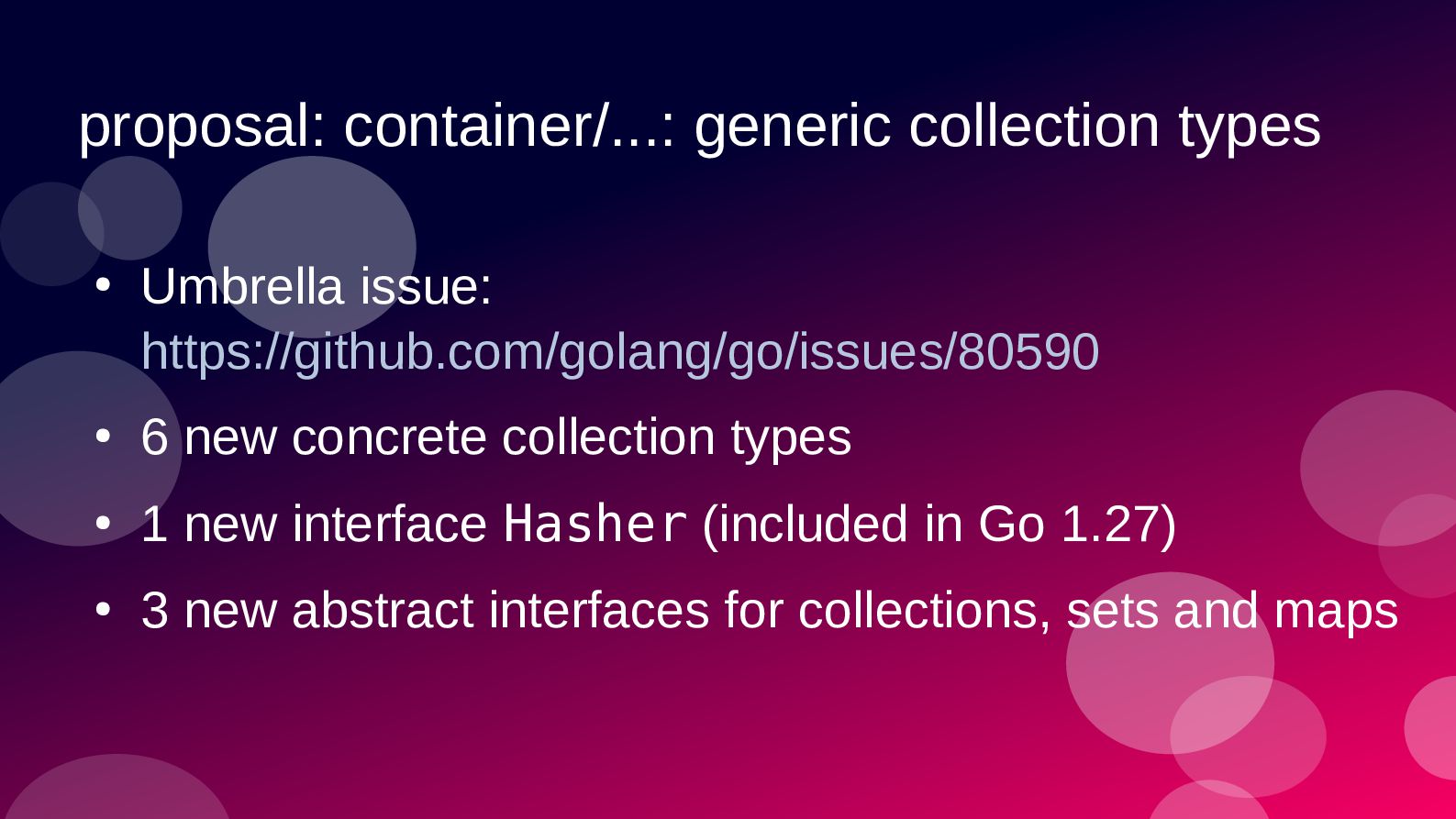
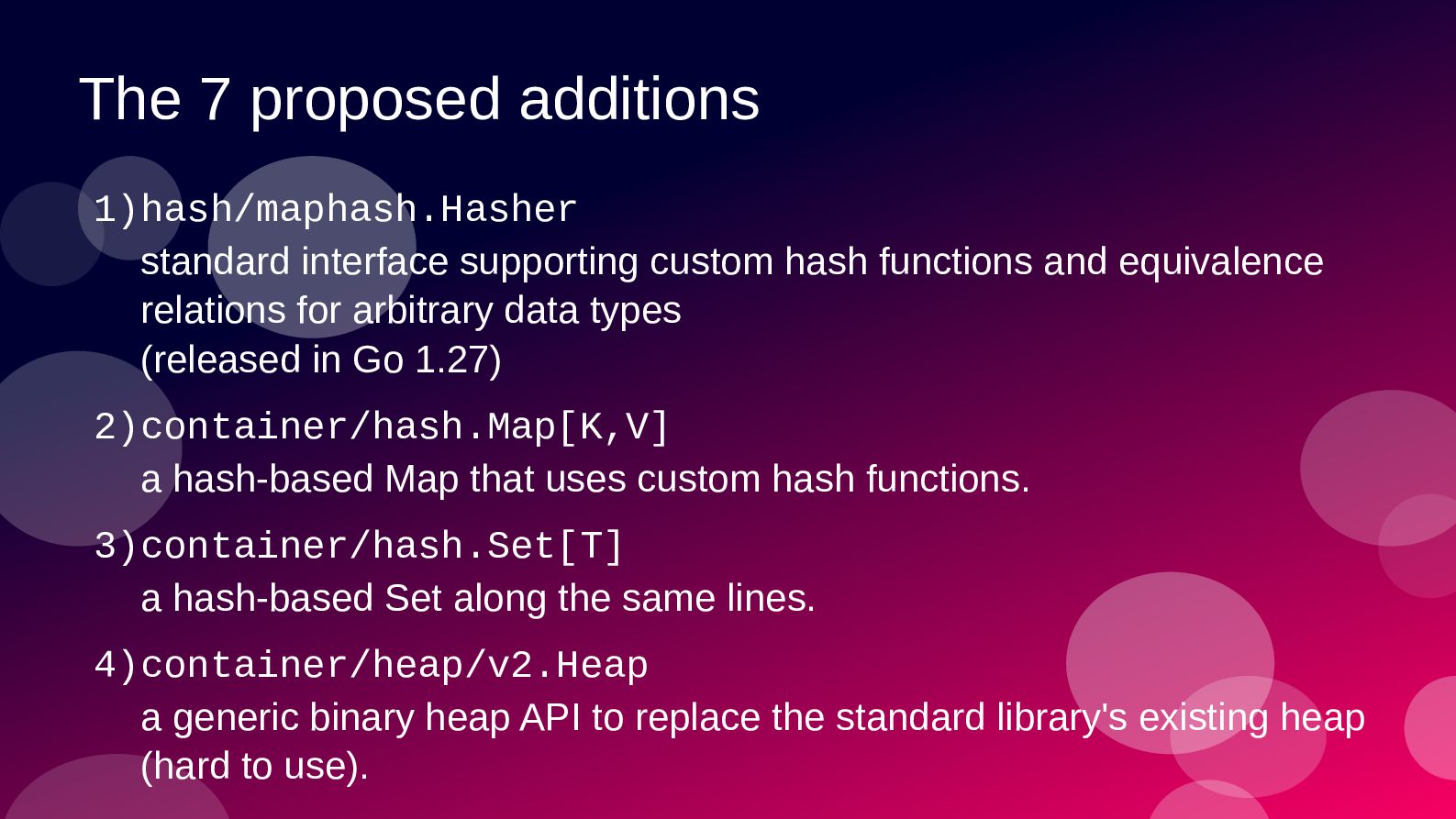
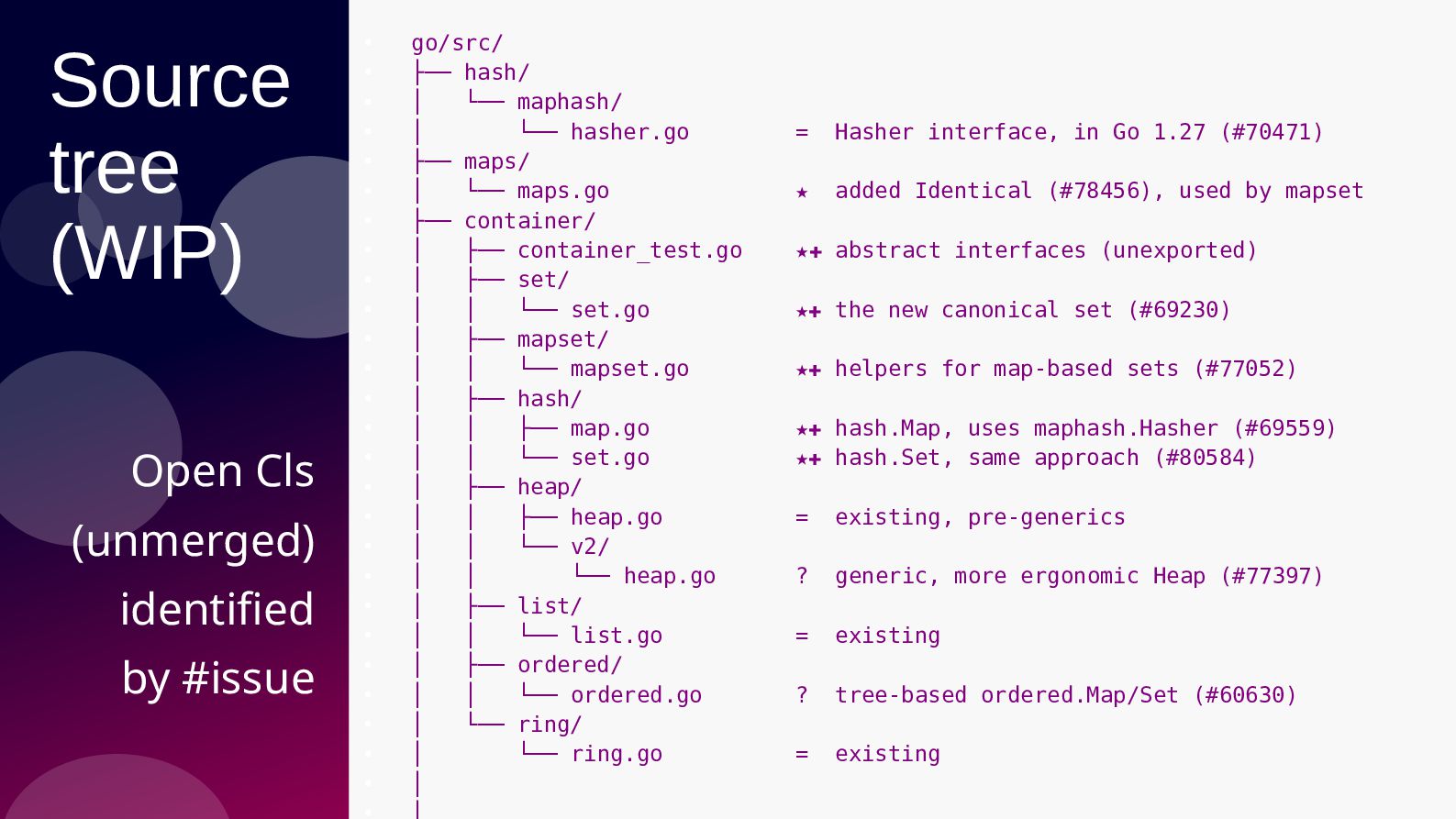
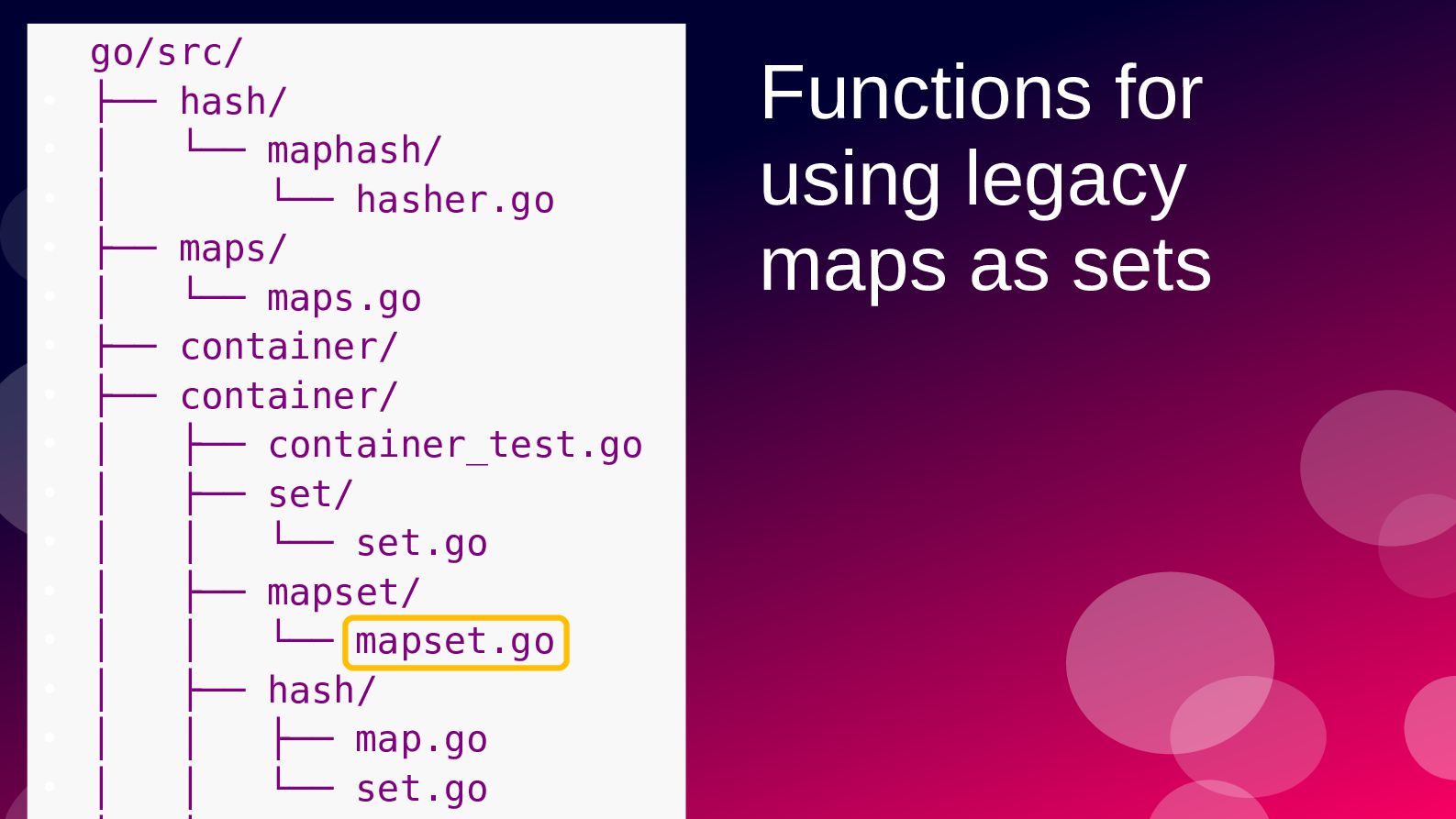
functions and equivalence relations for arbitrary data types (released in Go 1.27) 2)container/hash.Map[K,V] a hash-based Map that uses custom hash functions. 3)container/hash.Set[T] a hash-based Set along the same lines. 4)container/heap/v2.Heap a generic binary heap API to replace the standard library's existing heap (hard to use).
usual set operations such as Union and Intersection. We expect it to become the standard set in most new Go APIs. 6)container/mapset helper functions (Union, Intersection, and so on) for manipulating legacy sets as sets in existing code whose API cannot be changed. set.Set wraps this API. 7)container/ordered.Map[K,V] a map that preserves insertion order
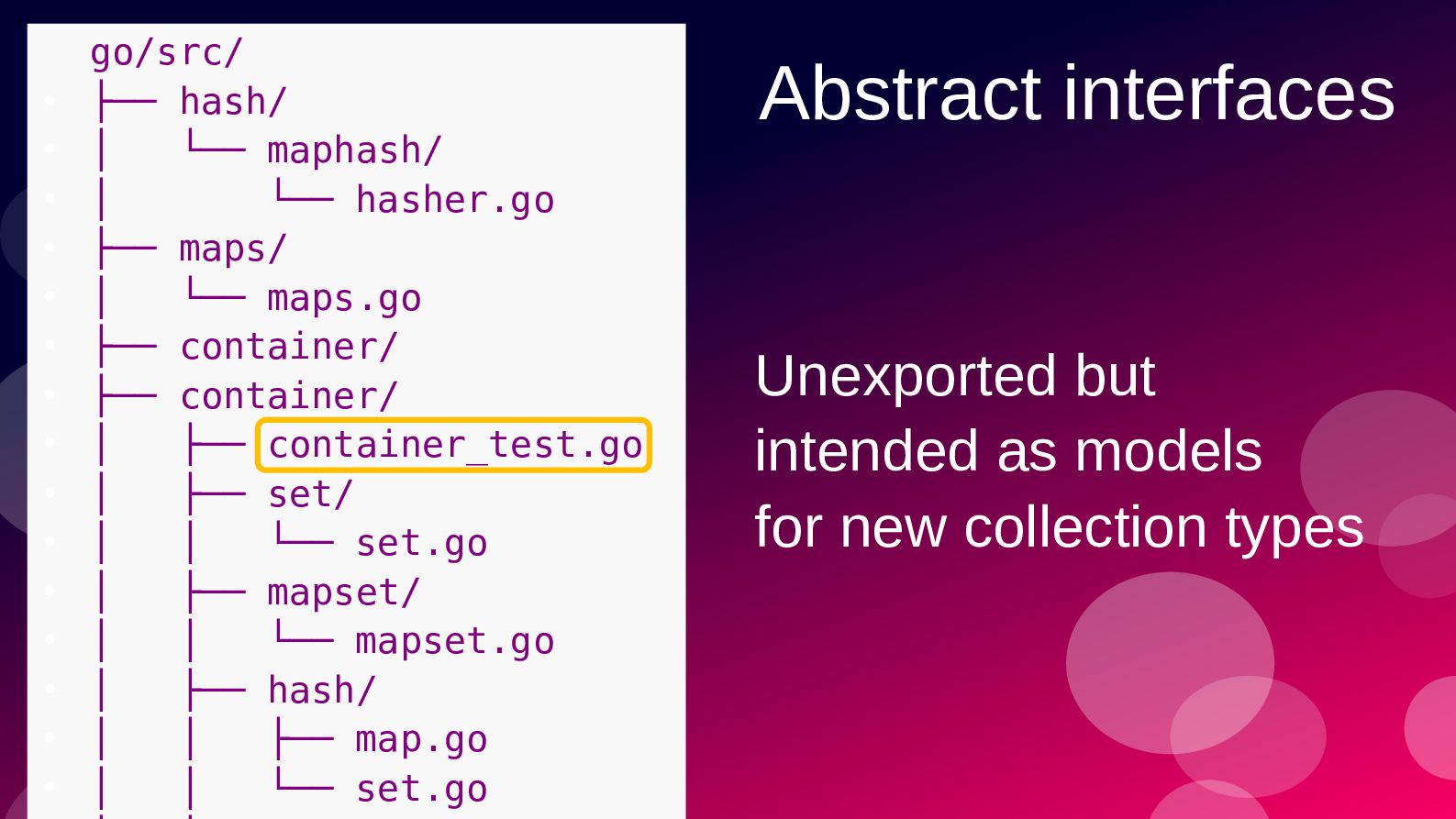
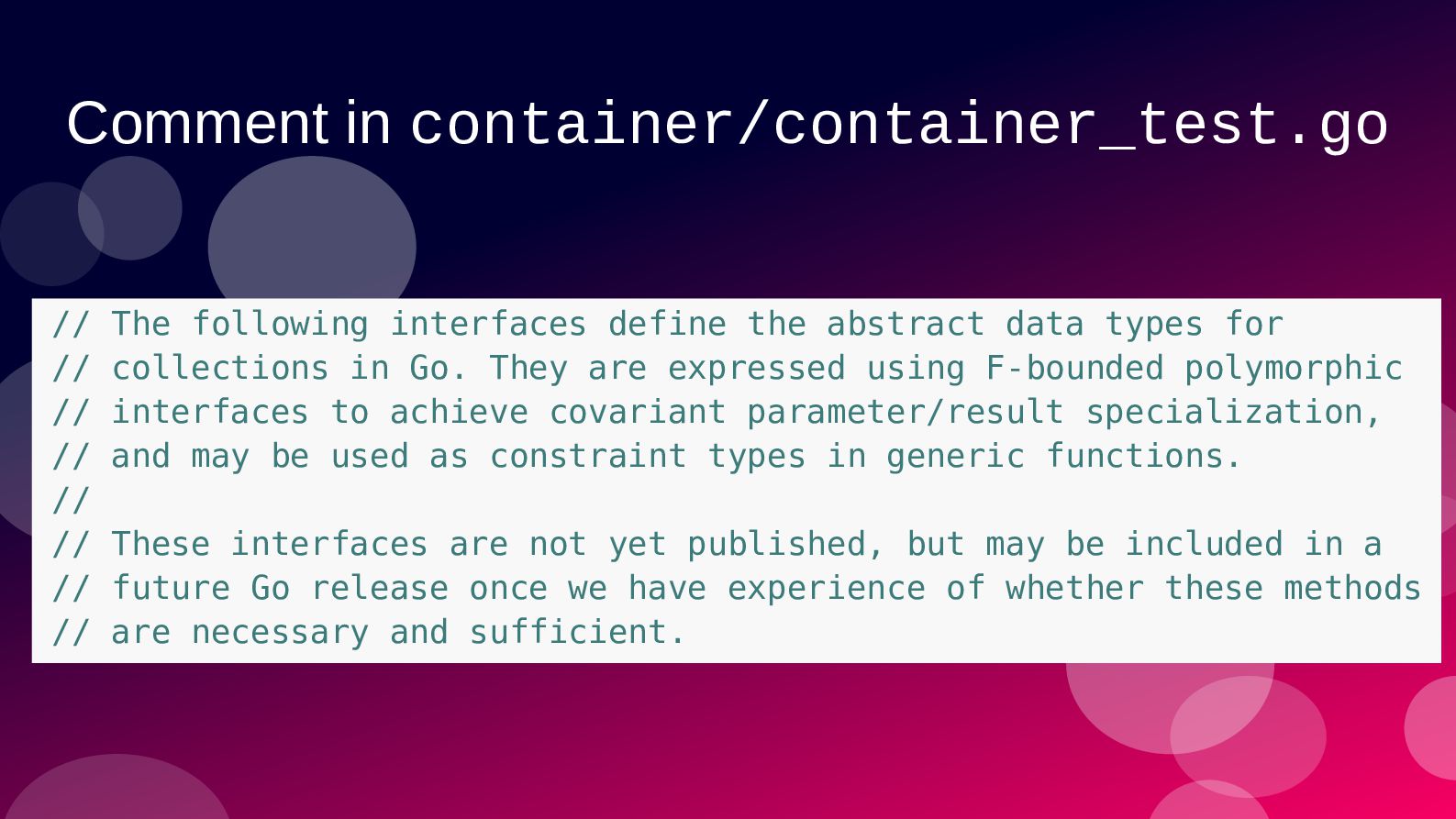
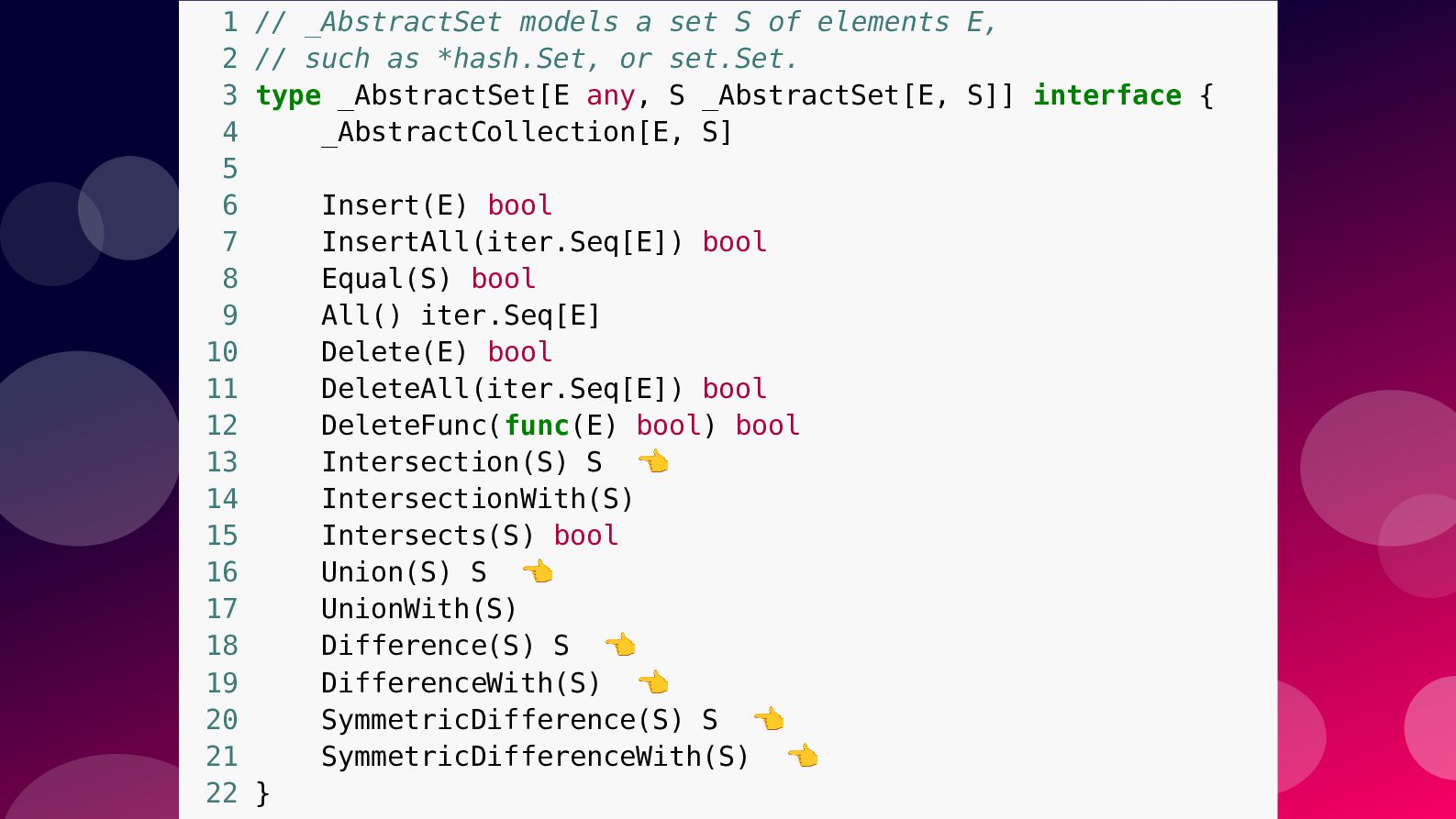
data types for // collections in Go. They are expressed using F-bounded polymorphic // interfaces to achieve covariant parameter/result specialization, // and may be used as constraint types in generic functions. // // These interfaces are not yet published, but may be included in a // future Go release once we have experience of whether these methods // are necessary and sufficient.
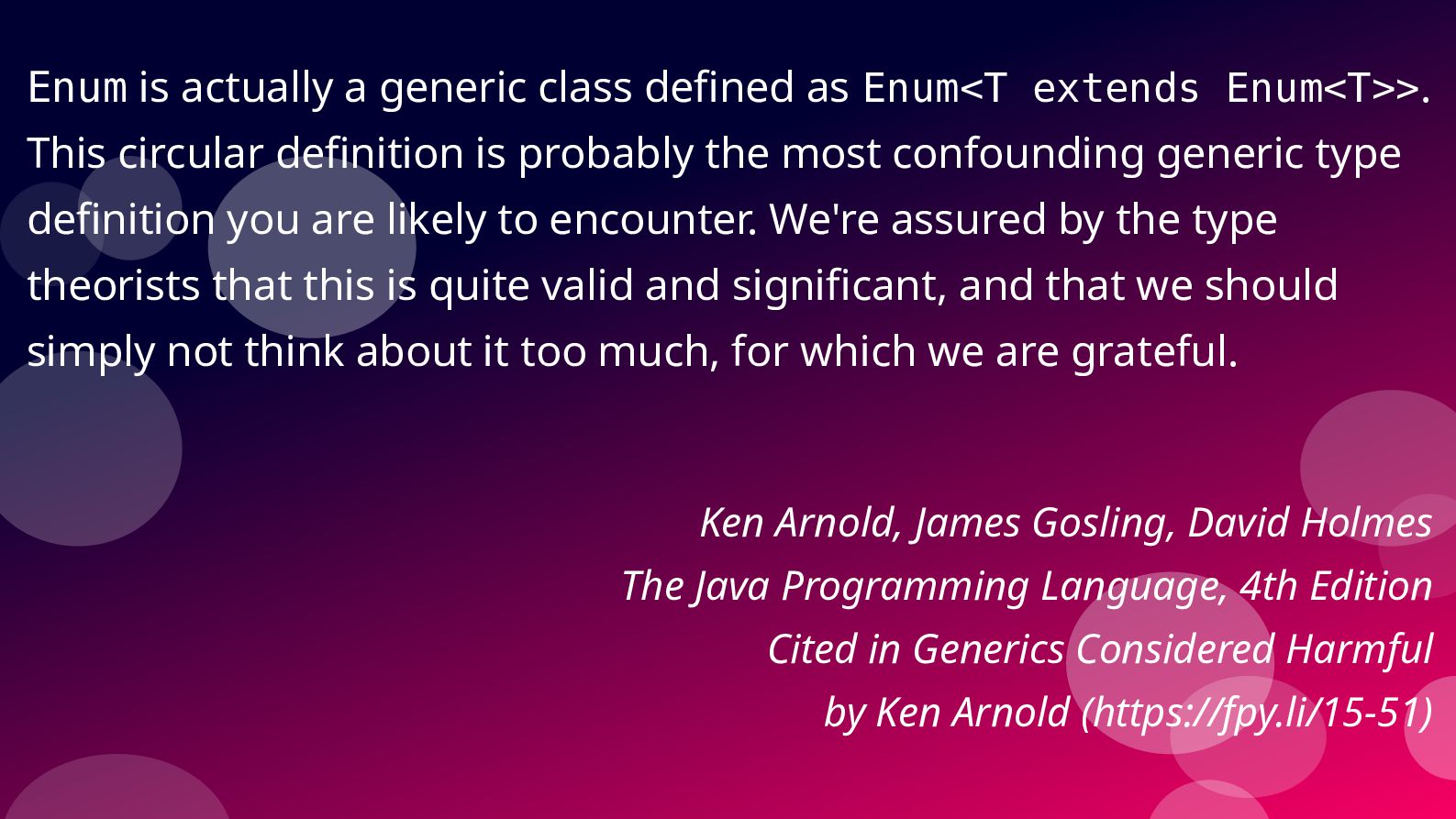
Enum<T>>. This circular definition is probably the most confounding generic type definition you are likely to encounter. We're assured by the type theorists that this is quite valid and significant, and that we should simply not think about it too much, for which we are grateful. Ken Arnold, James Gosling, David Holmes The Java Programming Language, 4th Edition Cited in Generics Considered Harmful by Ken Arnold (https://fpy.li/15-51)
Java – How a self-referential type bound solves a real inheritance problem, why Java's own Enum uses the same trick, and what it all means in practice. – By Pradeep Samuel – Published March 9, 2026 https://www.fbounded.com/blog/f-bounded-polymorphism/
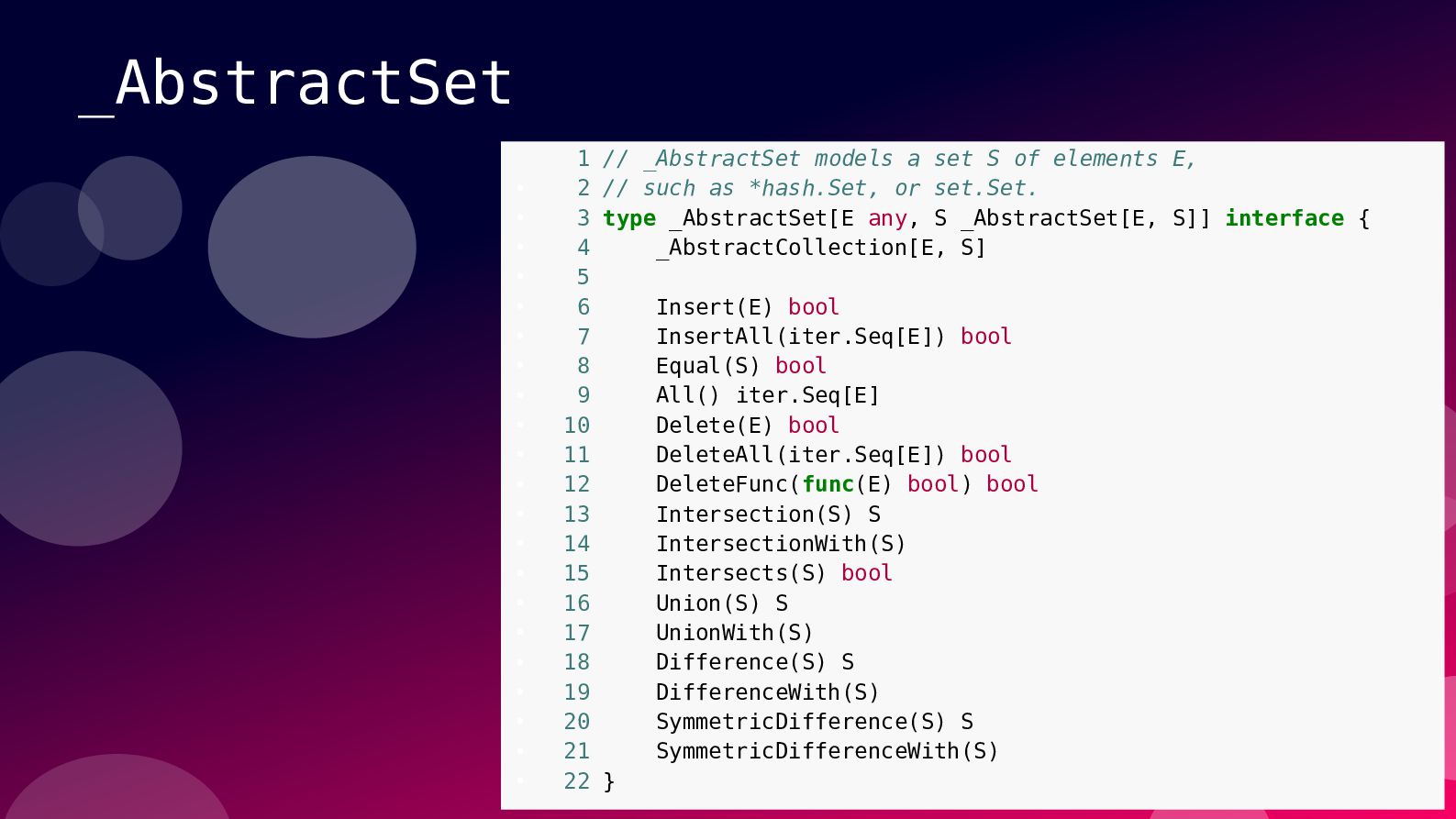
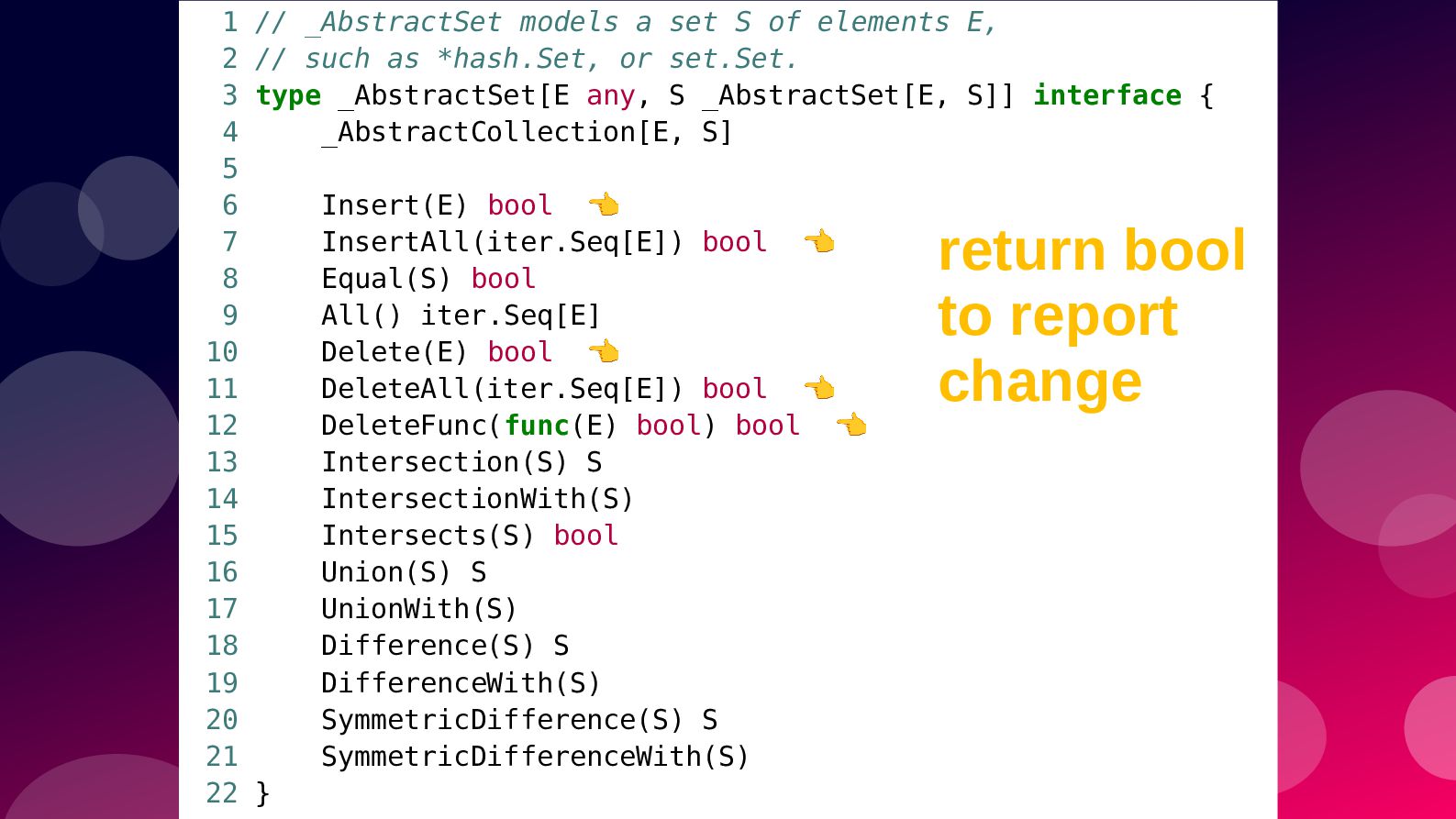
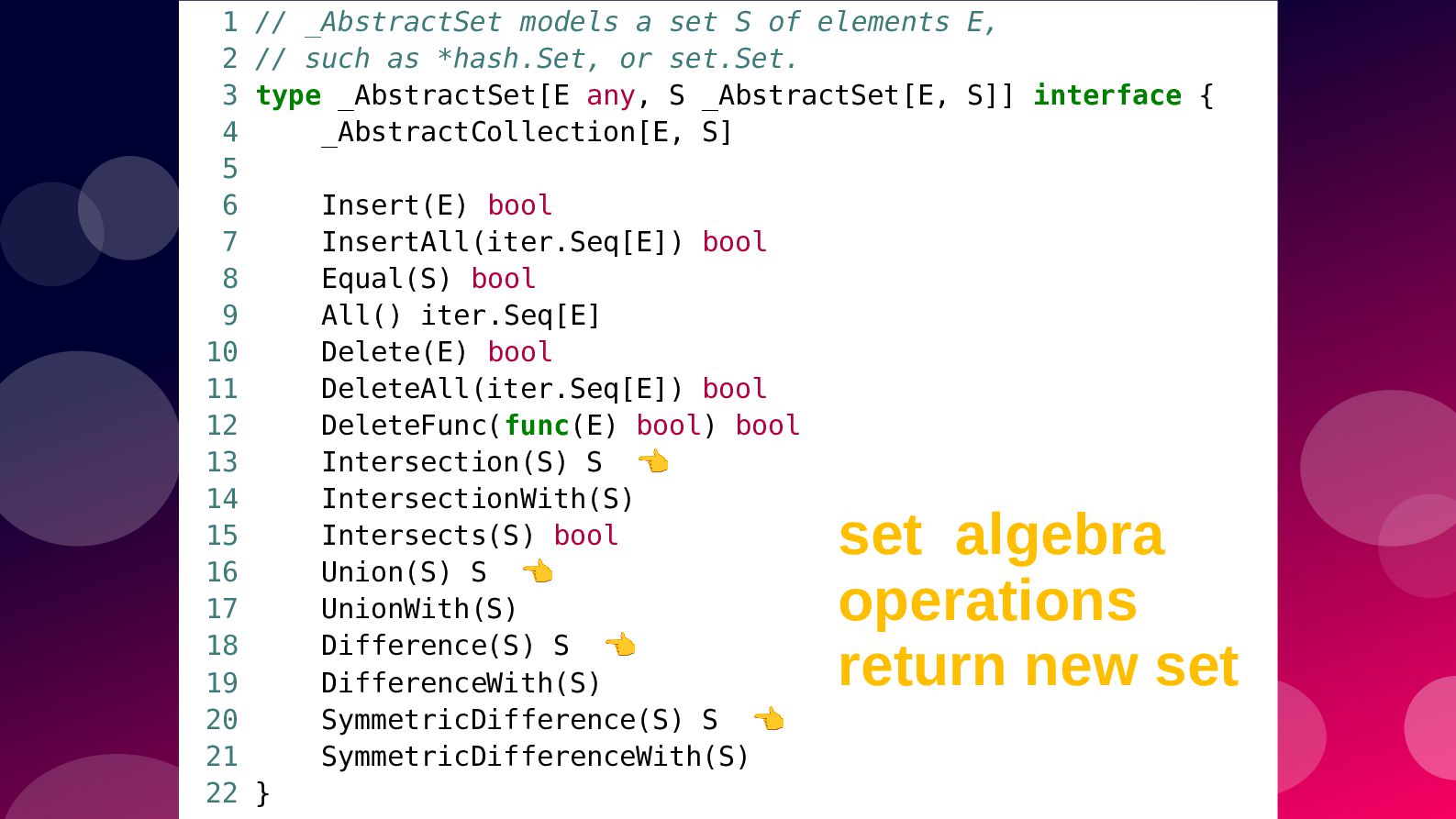
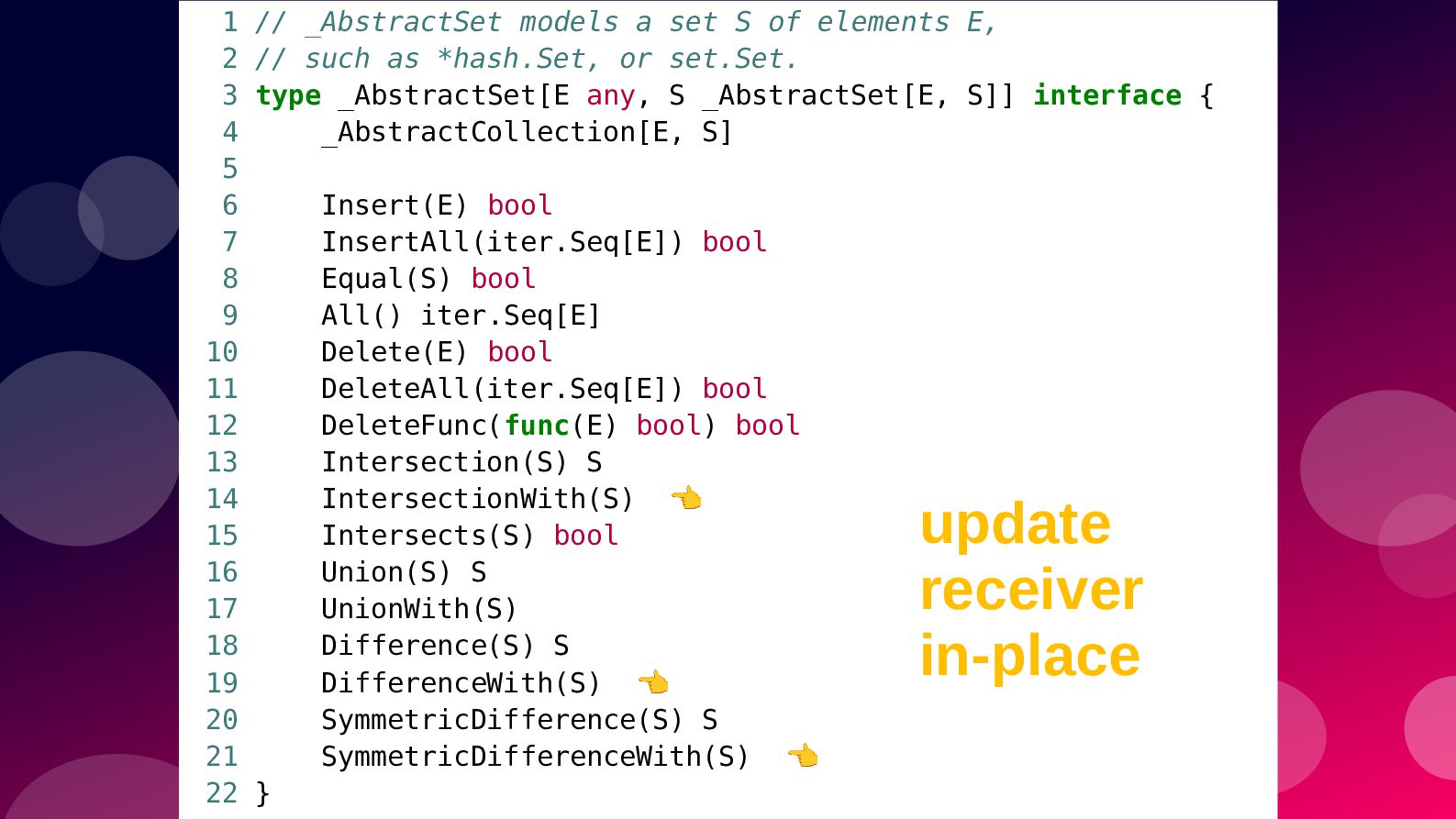
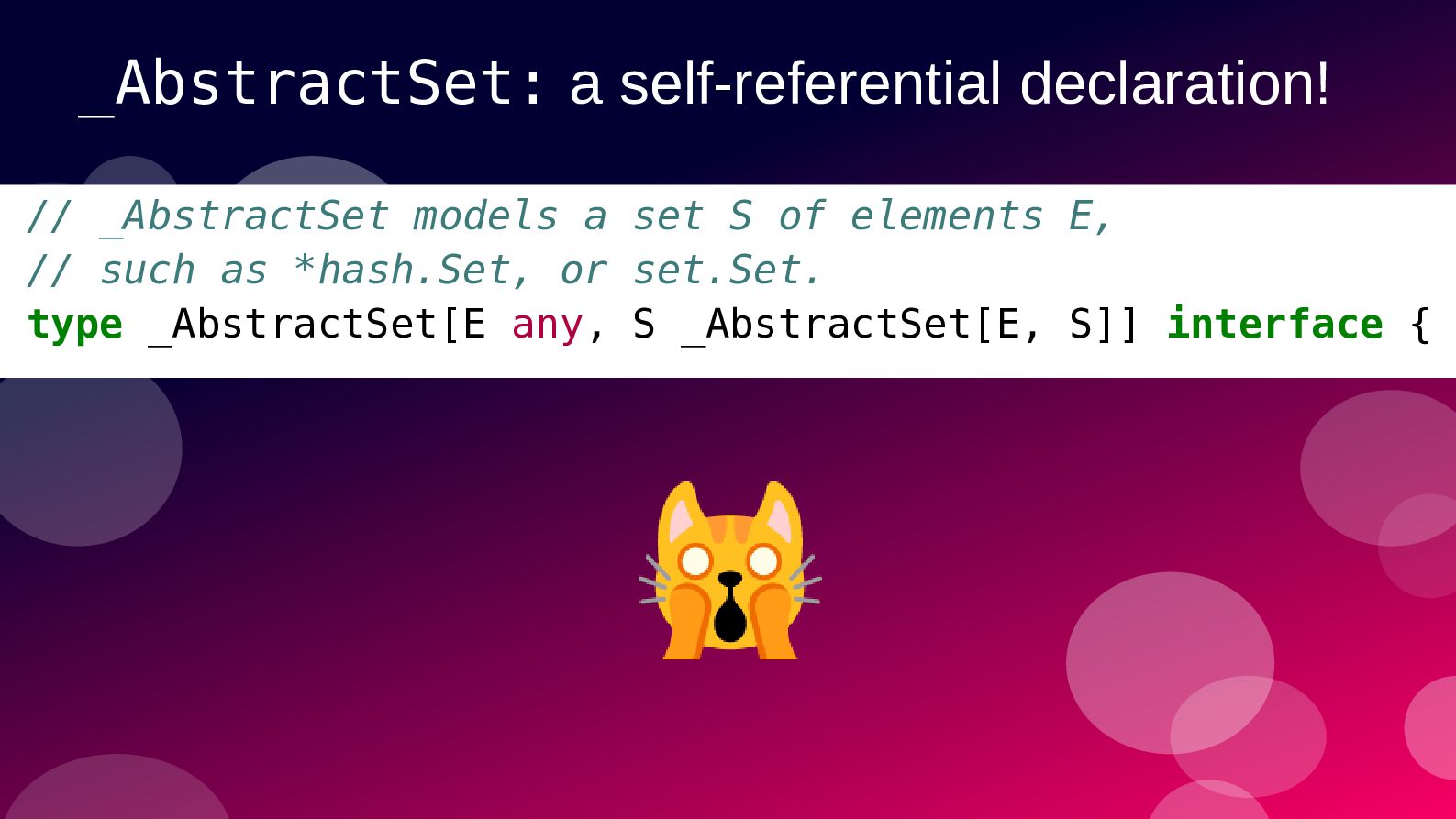
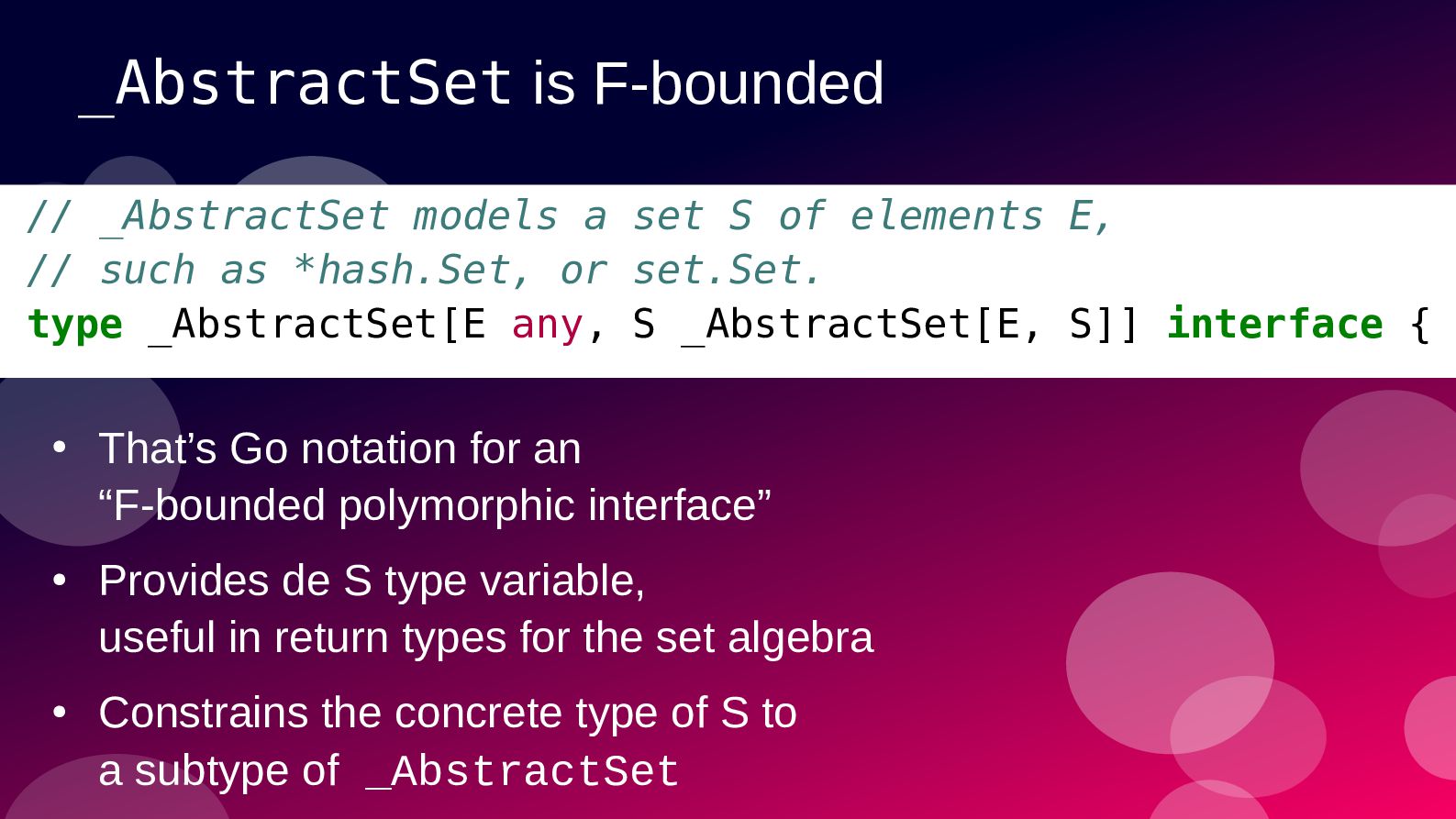
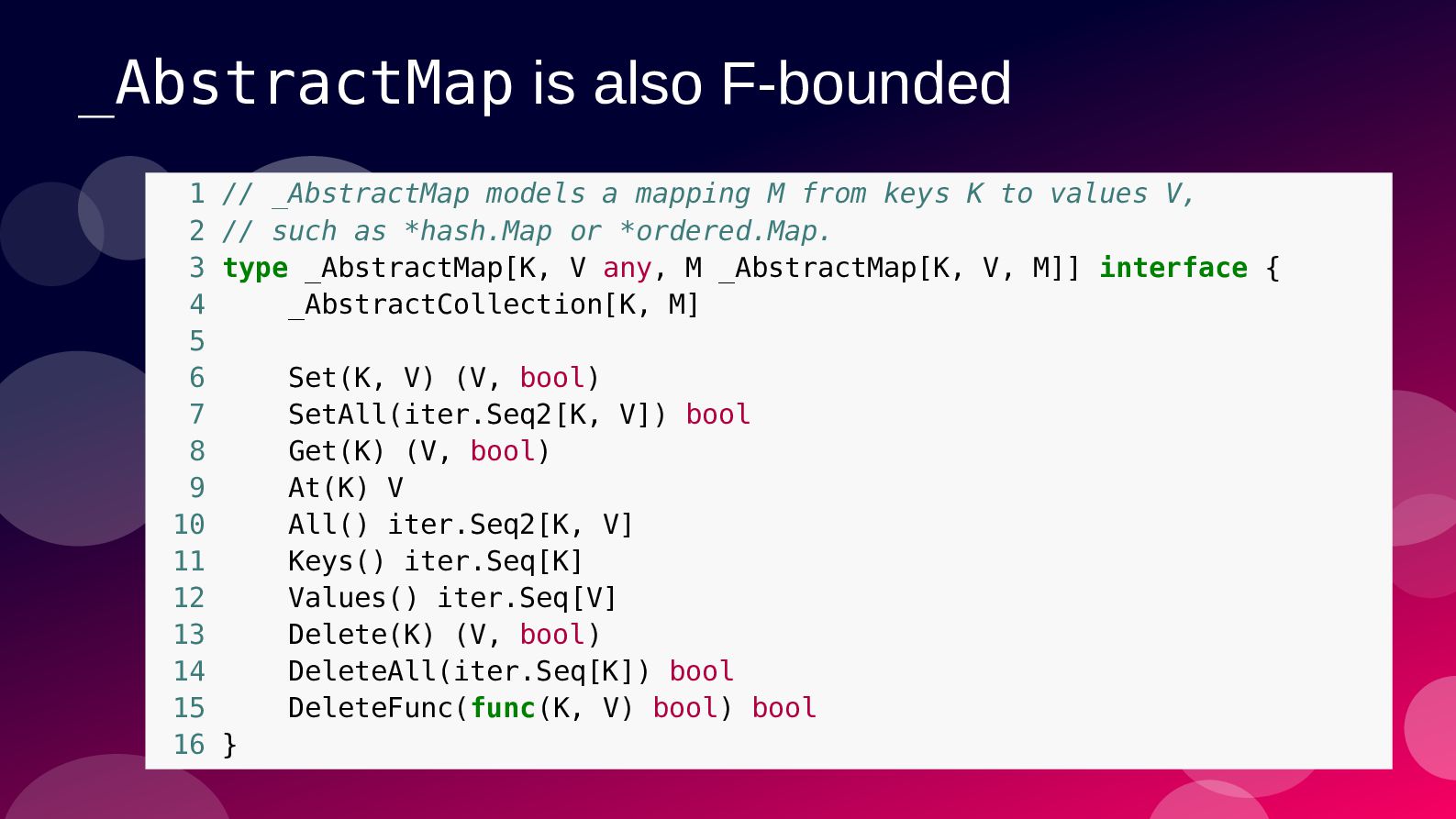
elements E, // such as *hash.Set, or set.Set. type _AbstractSet[E any, S _AbstractSet[E, S]] interface { • • • That’s Go notation for an “F-bounded polymorphic interface” Provides de S type variable, useful in return types for the set algebra Constrains the concrete type of S to a subtype of _AbstractSet
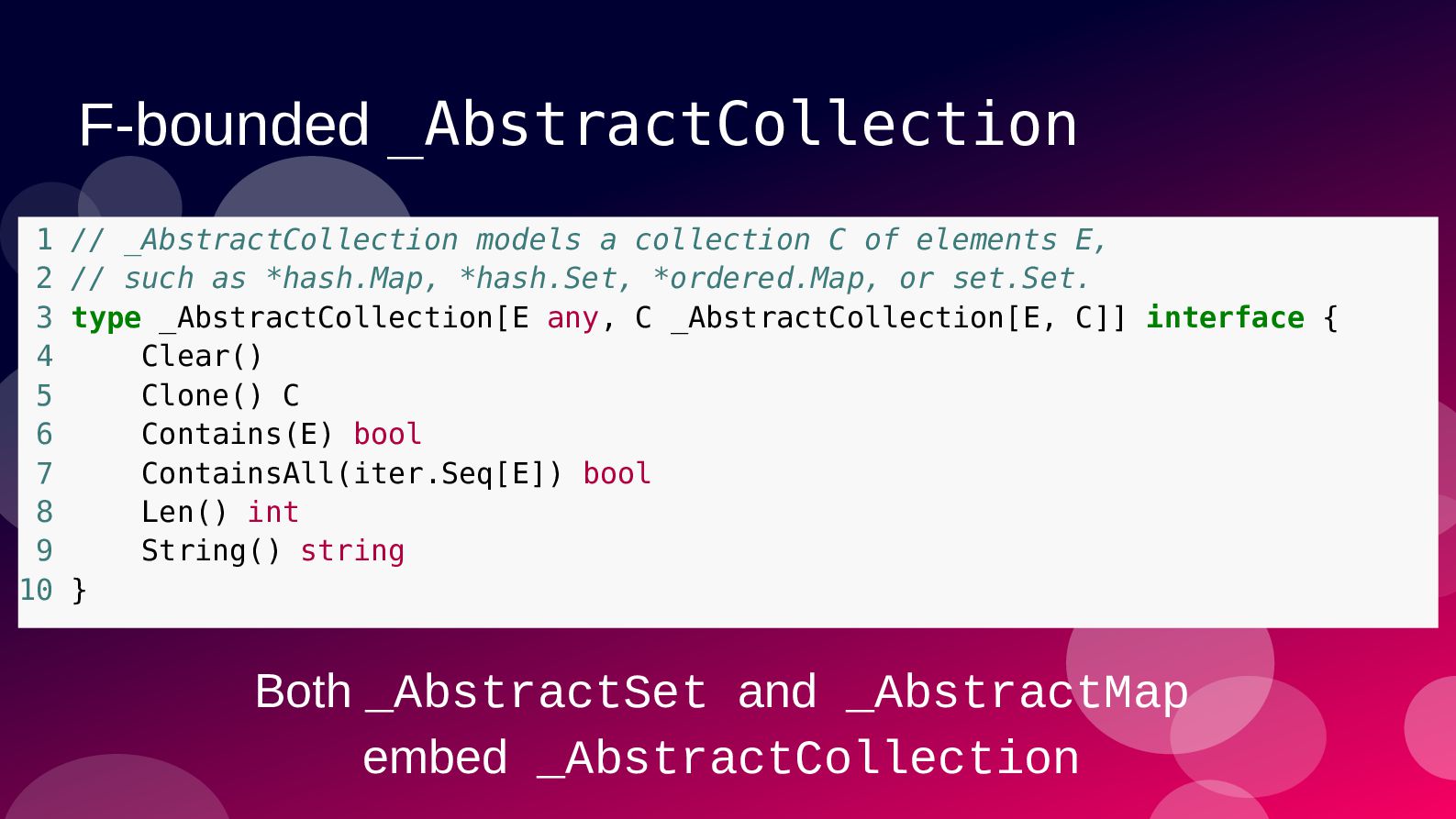
elements E, 2 // such as *hash.Map, *hash.Set, *ordered.Map, or set.Set. 3 type _AbstractCollection[E any, C _AbstractCollection[E, C]] interface { 4 Clear() 5 Clone() C 6 Contains(E) bool 7 ContainsAll(iter.Seq[E]) bool 8 Len() int 9 String() string 10 } Both _AbstractSet and _AbstractMap embed _AbstractCollection
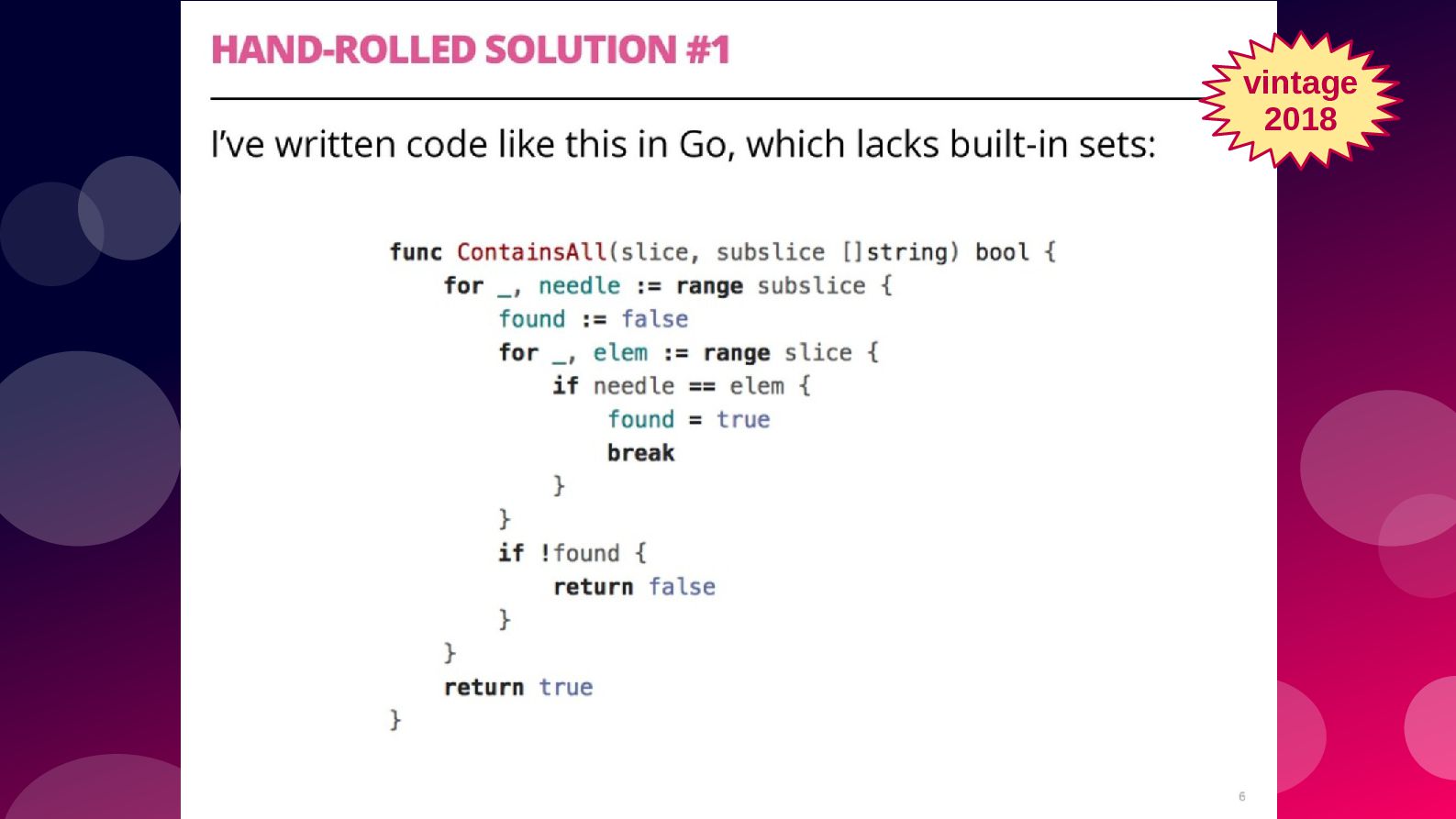
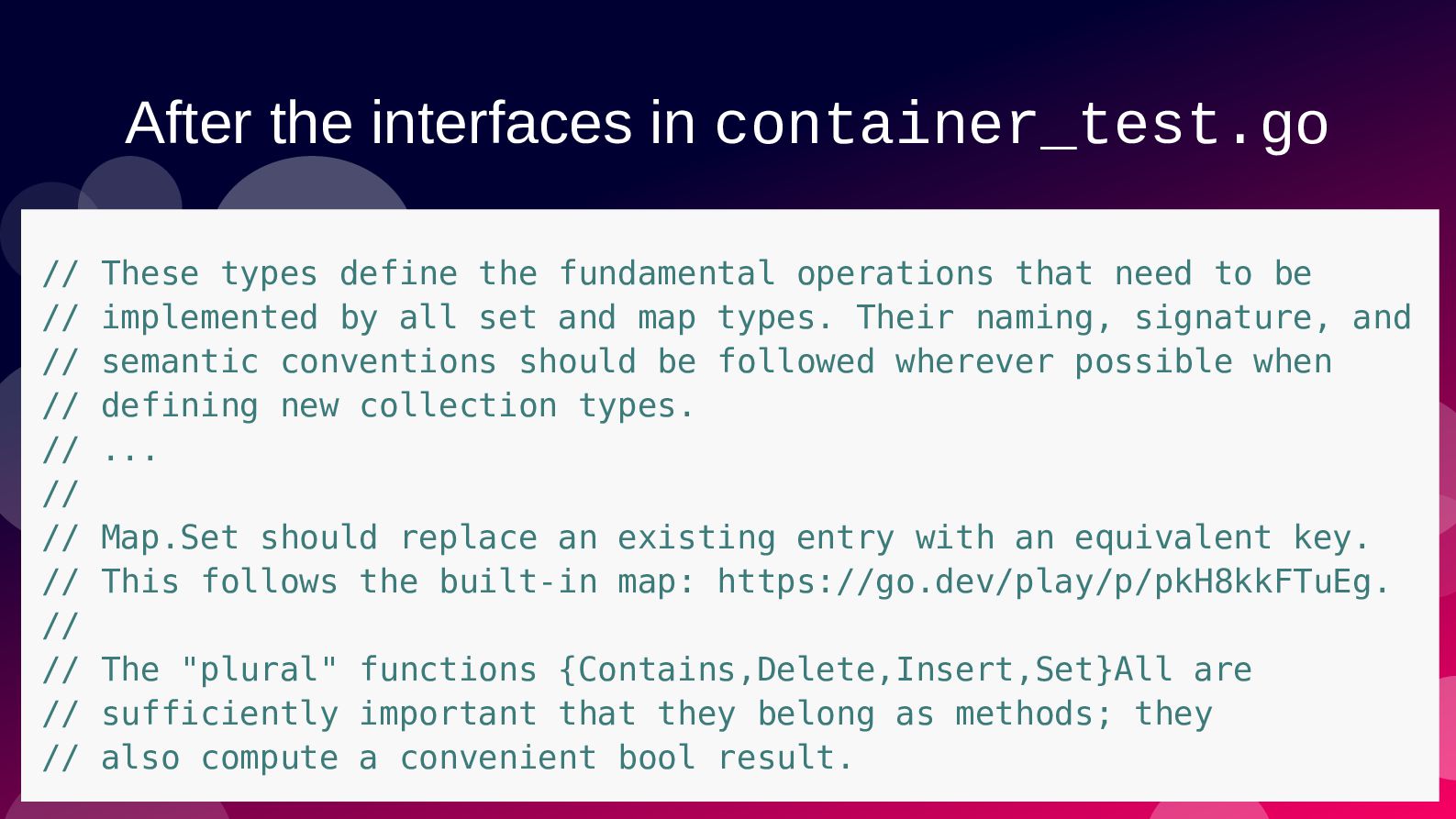
fundamental operations that need to be // implemented by all set and map types. Their naming, signature, and // semantic conventions should be followed wherever possible when // defining new collection types. // ... // // Map.Set should replace an existing entry with an equivalent key. // This follows the built-in map: https://go.dev/play/p/pkH8kkFTuEg. // // The "plural" functions {Contains,Delete,Insert,Set}All are // sufficiently important that they belong as methods; they // also compute a convenient bool result.
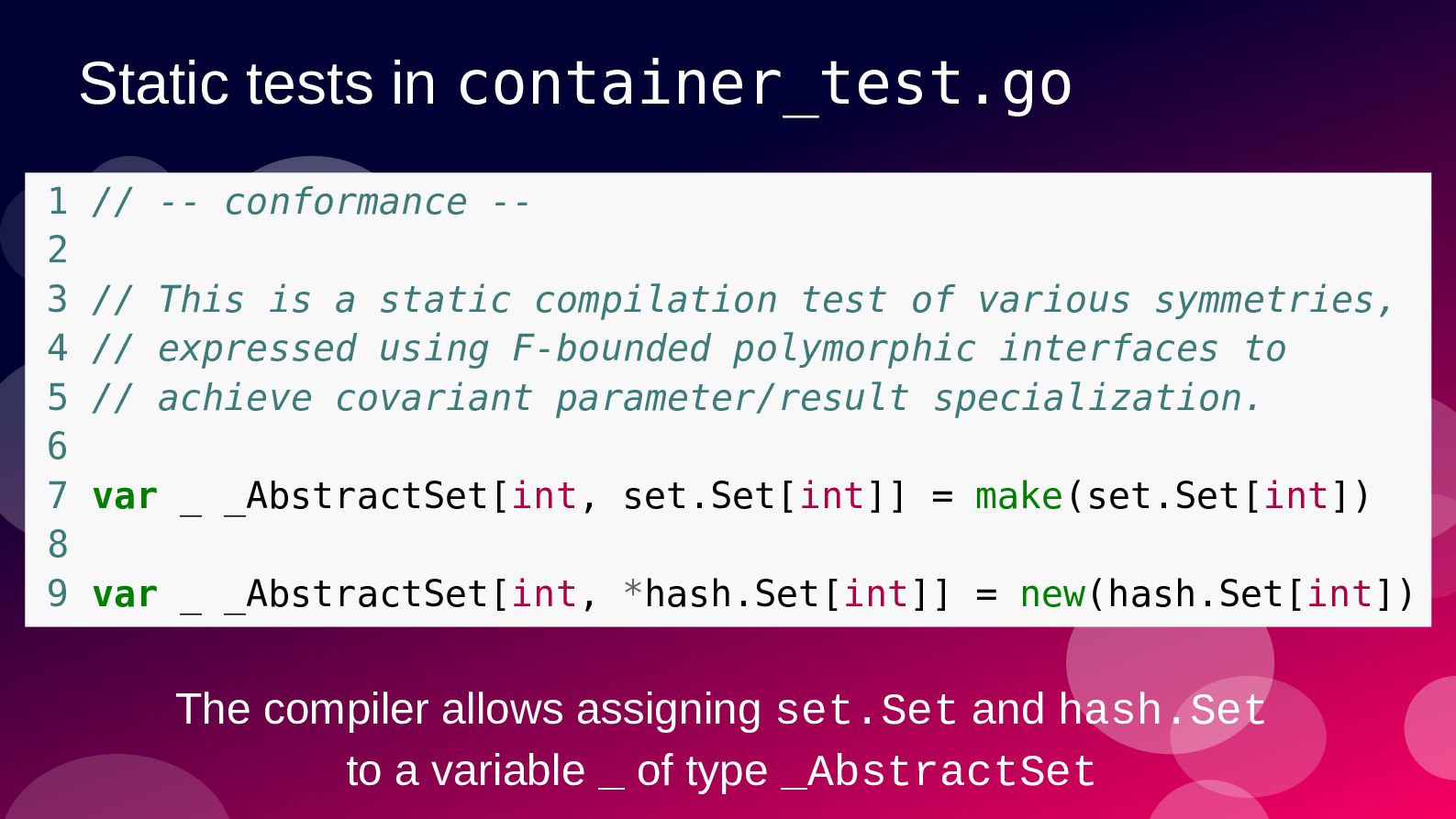
// This is a static compilation test of various symmetries, 4 // expressed using F-bounded polymorphic interfaces to 5 // achieve covariant parameter/result specialization. 6 7 var _ _AbstractSet[int, set.Set[int]] = make(set.Set[int]) 8 9 var _ _AbstractSet[int, *hash.Set[int]] = new(hash.Set[int]) The compiler allows assigning set.Set and hash.Set to a variable _ of type _AbstractSet
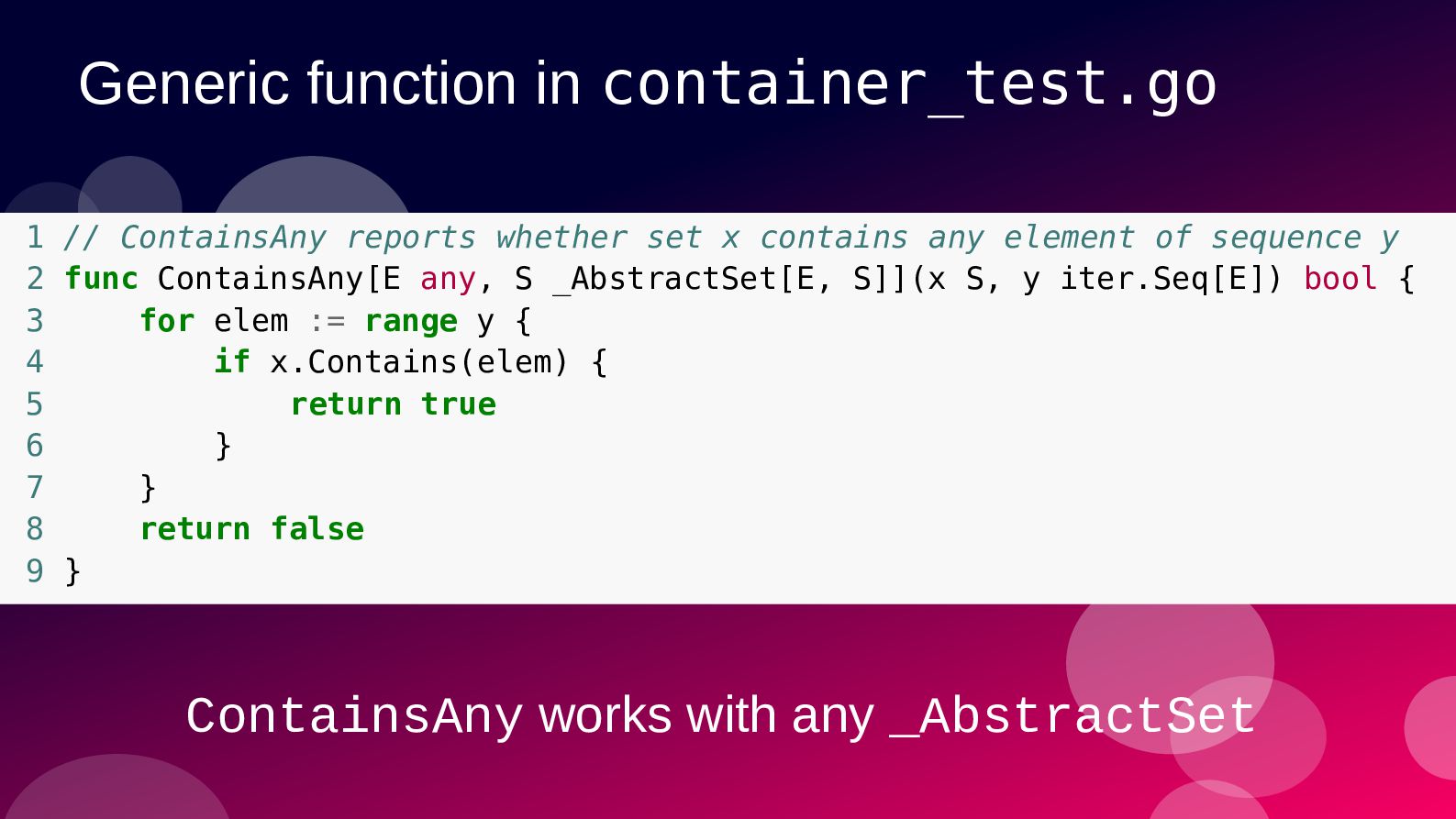
x contains any element of sequence y 2 func ContainsAny[E any, S _AbstractSet[E, S]](x S, y iter.Seq[E]) bool { 3 for elem := range y { 4 if x.Contains(elem) { 5 return true 6 } 7 } 8 return false 9 } ContainsAny works with any _AbstractSet
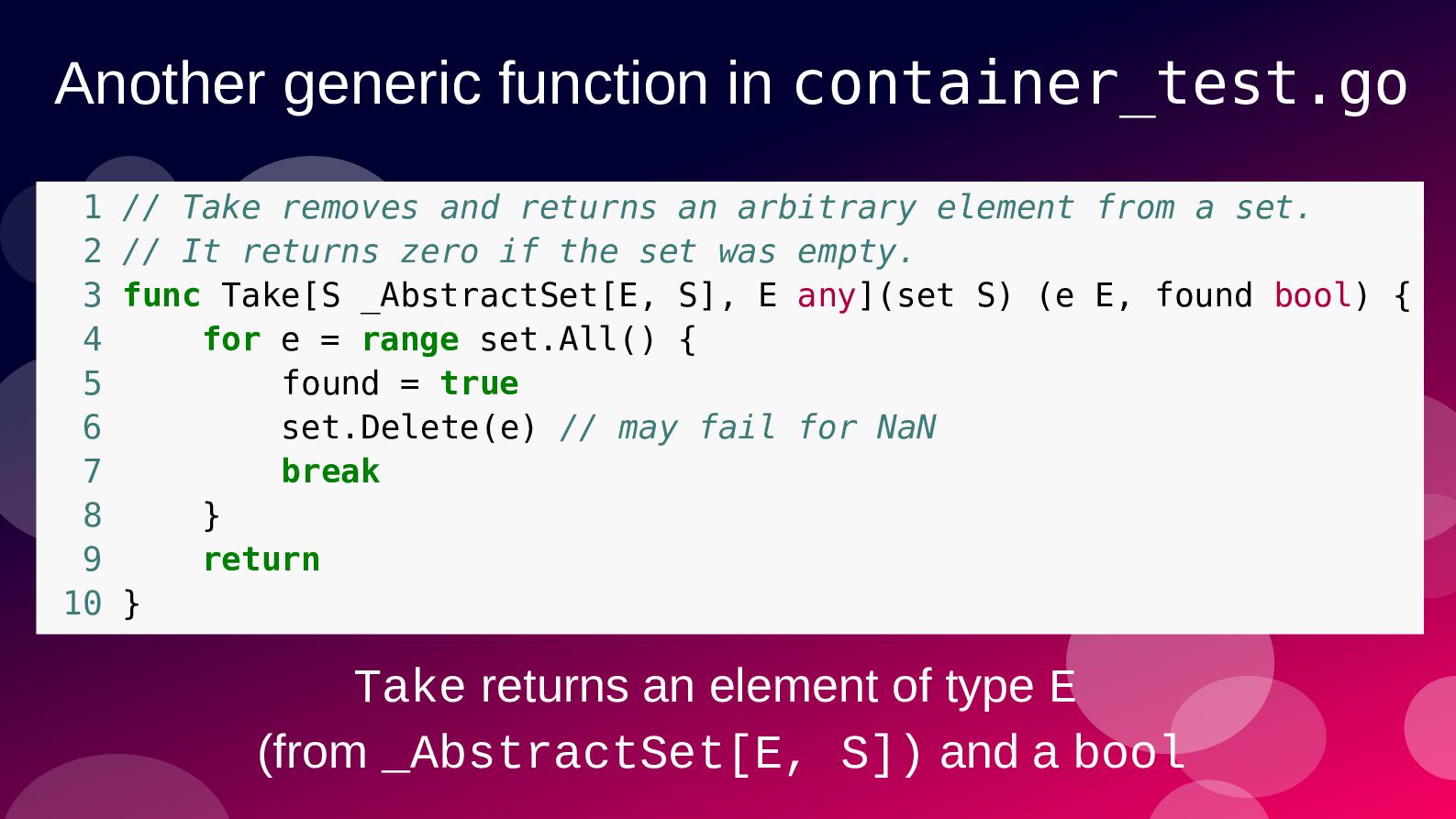
returns an arbitrary element from a set. 2 // It returns zero if the set was empty. 3 func Take[S _AbstractSet[E, S], E any](set S) (e E, found bool) { 4 for e = range set.All() { 5 found = true 6 set.Delete(e) // may fail for NaN 7 break 8 } 9 return 10 } Take returns an element of type E (from _AbstractSet[E, S]) and a bool
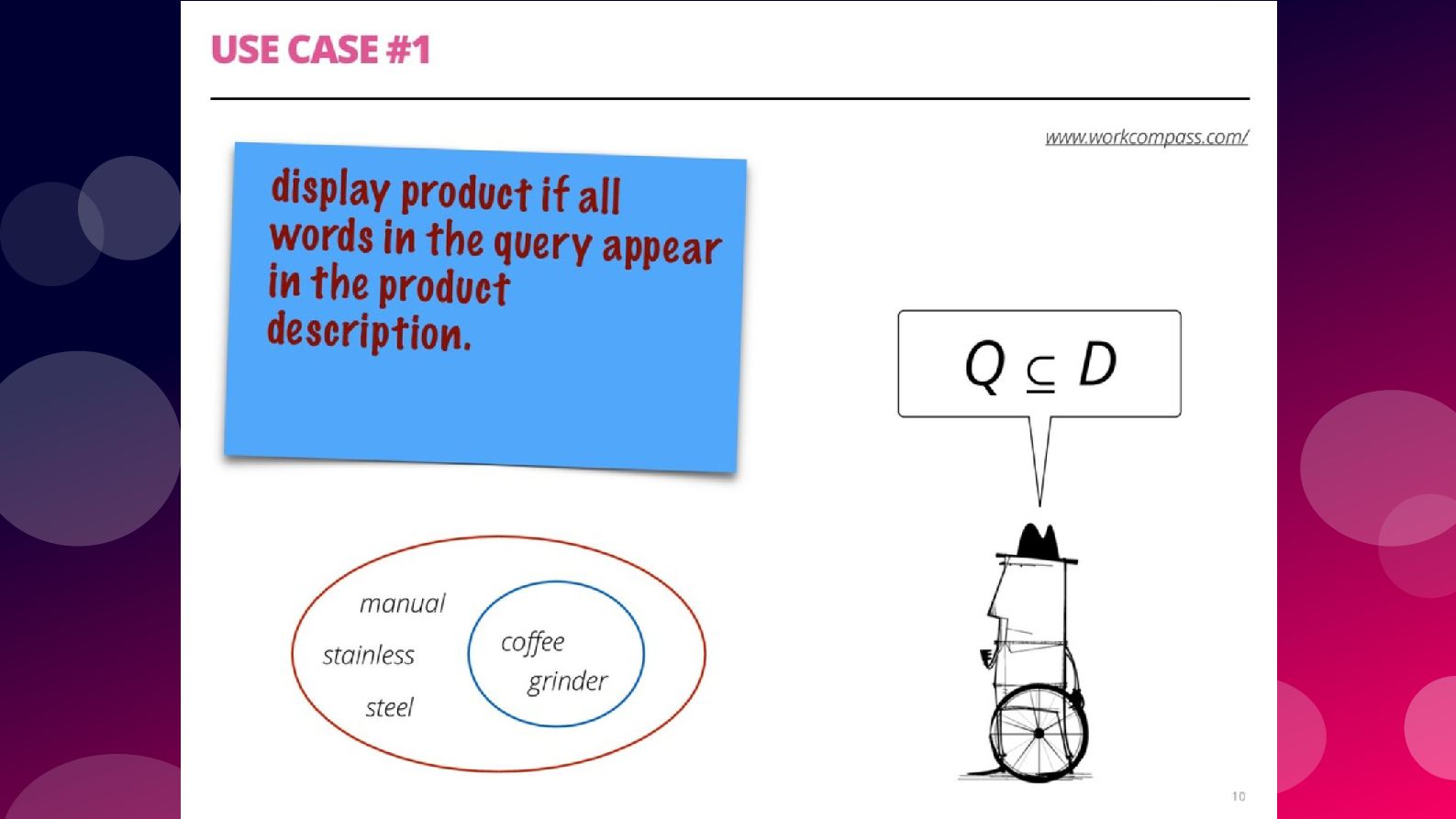
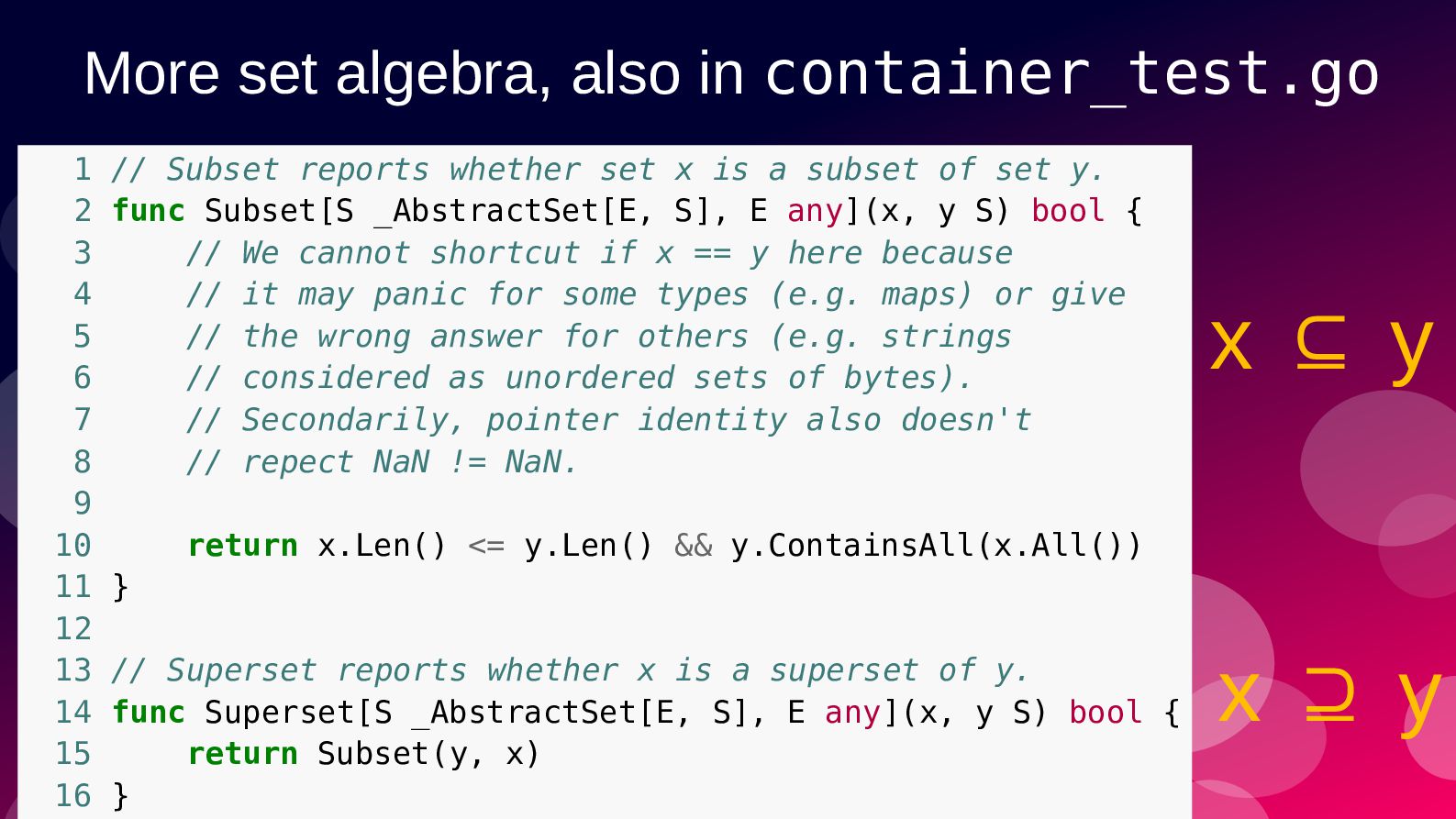
whether set x is a subset of set y. 2 func Subset[S _AbstractSet[E, S], E any](x, y S) bool { 3 // We cannot shortcut if x == y here because 4 // it may panic for some types (e.g. maps) or give 5 // the wrong answer for others (e.g. strings 6 // considered as unordered sets of bytes). 7 // Secondarily, pointer identity also doesn't 8 // repect NaN != NaN. 9 10 return x.Len() <= y.Len() && y.ContainsAll(x.All()) 11 } 12 13 // Superset reports whether x is a superset of y. 14 func Superset[S _AbstractSet[E, S], E any](x, y S) bool { 15 return Subset(y, x) 16 } x⊆y x⊇y
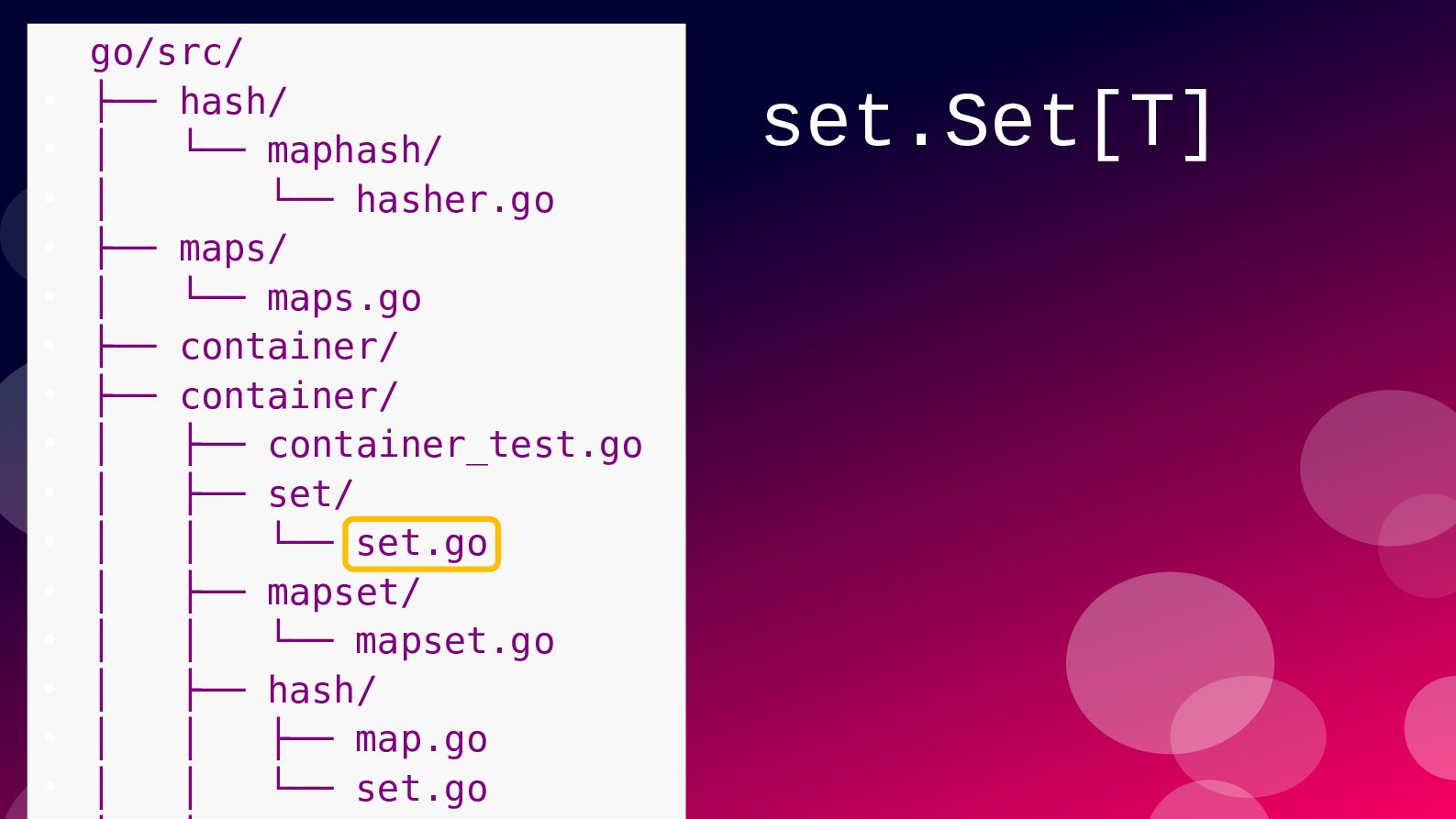
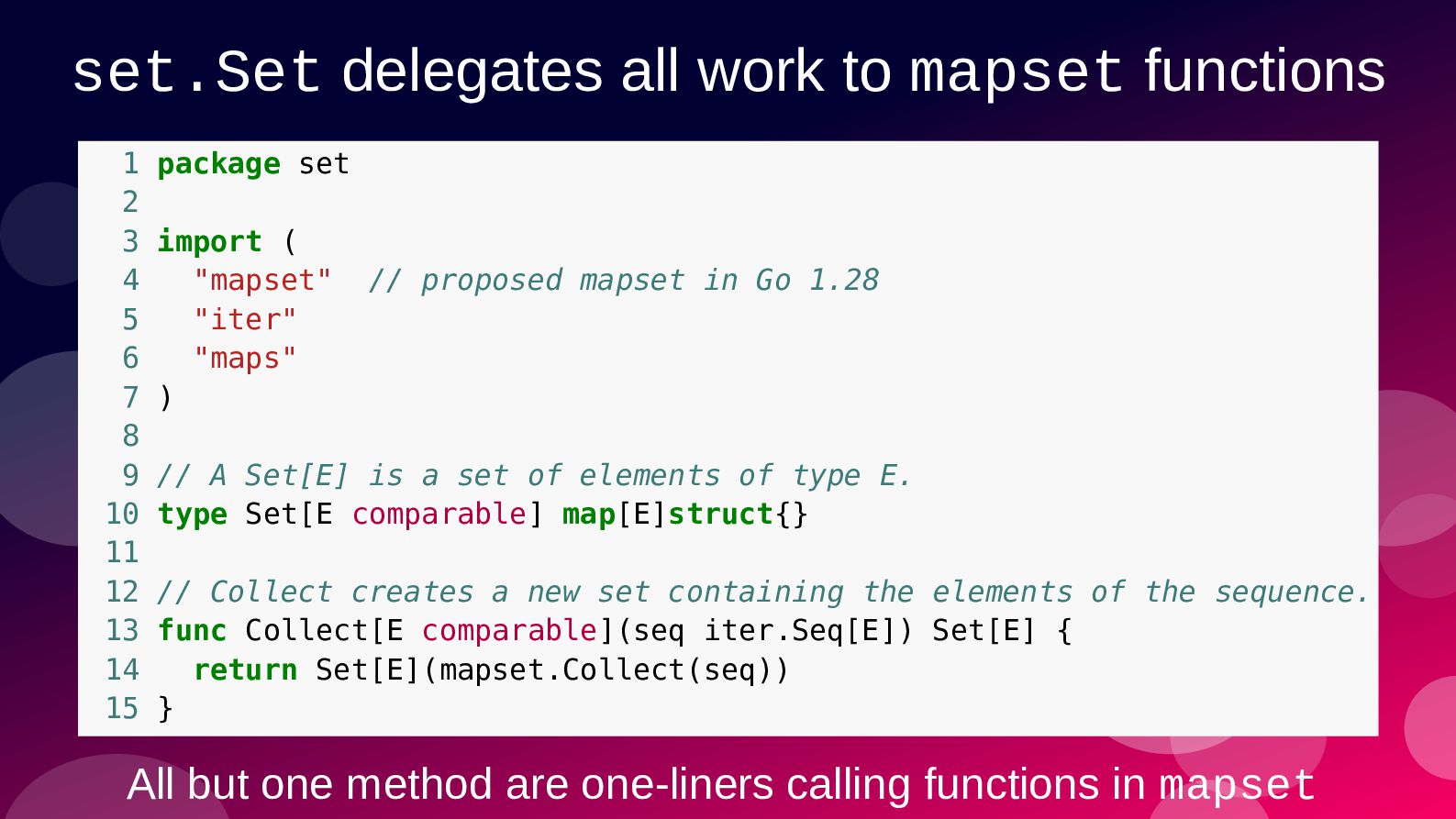
2 3 import ( 4 "mapset" // proposed mapset in Go 1.28 5 "iter" 6 "maps" 7 ) 8 9 // A Set[E] is a set of elements of type E. 10 type Set[E comparable] map[E]struct{} 11 12 // Collect creates a new set containing the elements of the sequence. 13 func Collect[E comparable](seq iter.Seq[E]) Set[E] { 14 return Set[E](mapset.Collect(seq)) 15 } All but one method are one-liners calling functions in mapset
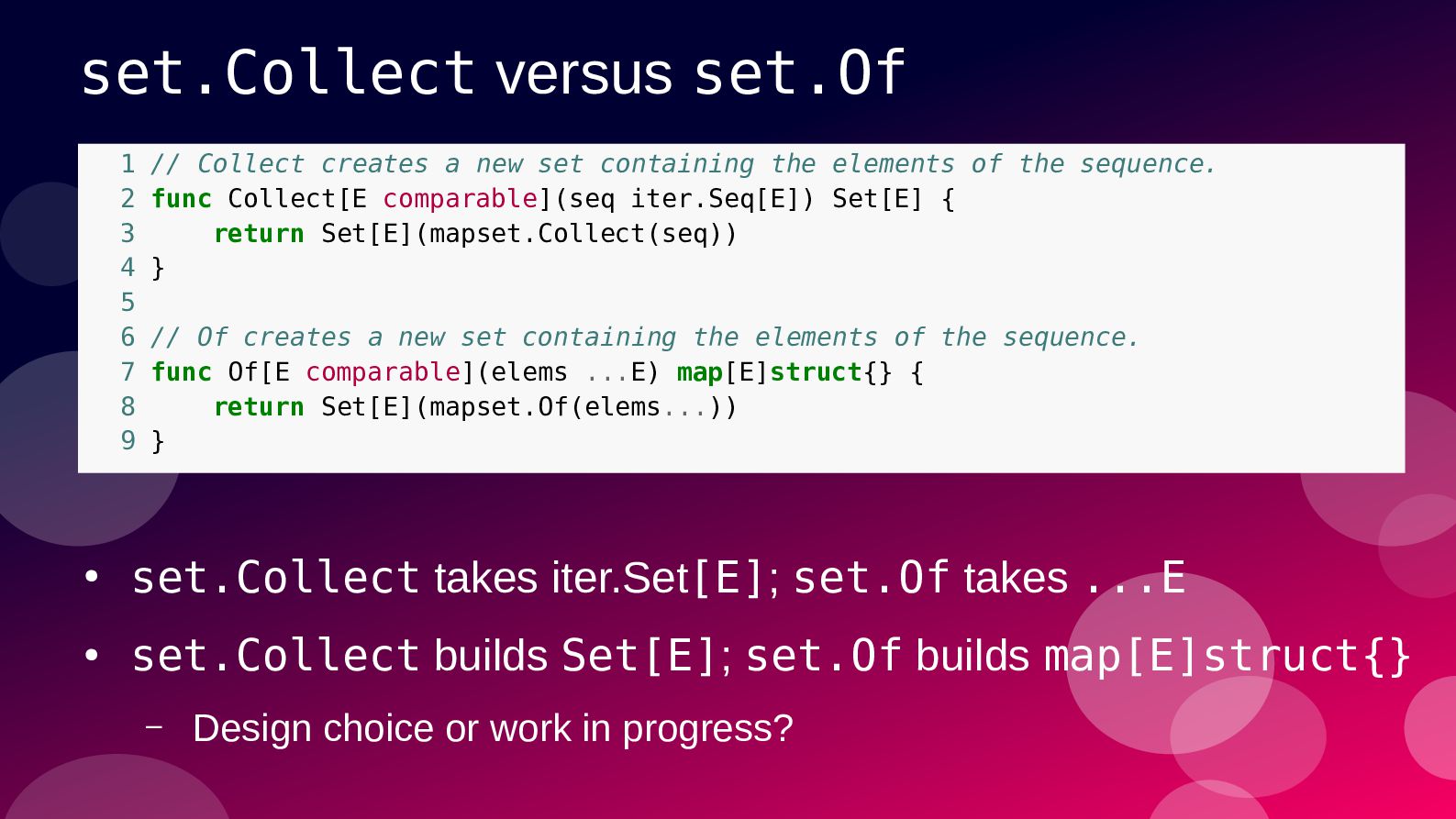
containing the elements of the sequence. 2 func Collect[E comparable](seq iter.Seq[E]) Set[E] { 3 return Set[E](mapset.Collect(seq)) 4 } 5 6 // Of creates a new set containing the elements of the sequence. 7 func Of[E comparable](elems ...E) map[E]struct{} { 8 return Set[E](mapset.Of(elems...)) 9 } • set.Collect takes iter.Set[E]; set.Of takes ...E • set.Collect builds Set[E]; set.Of builds map[E]struct{} – Design choice or work in progress?
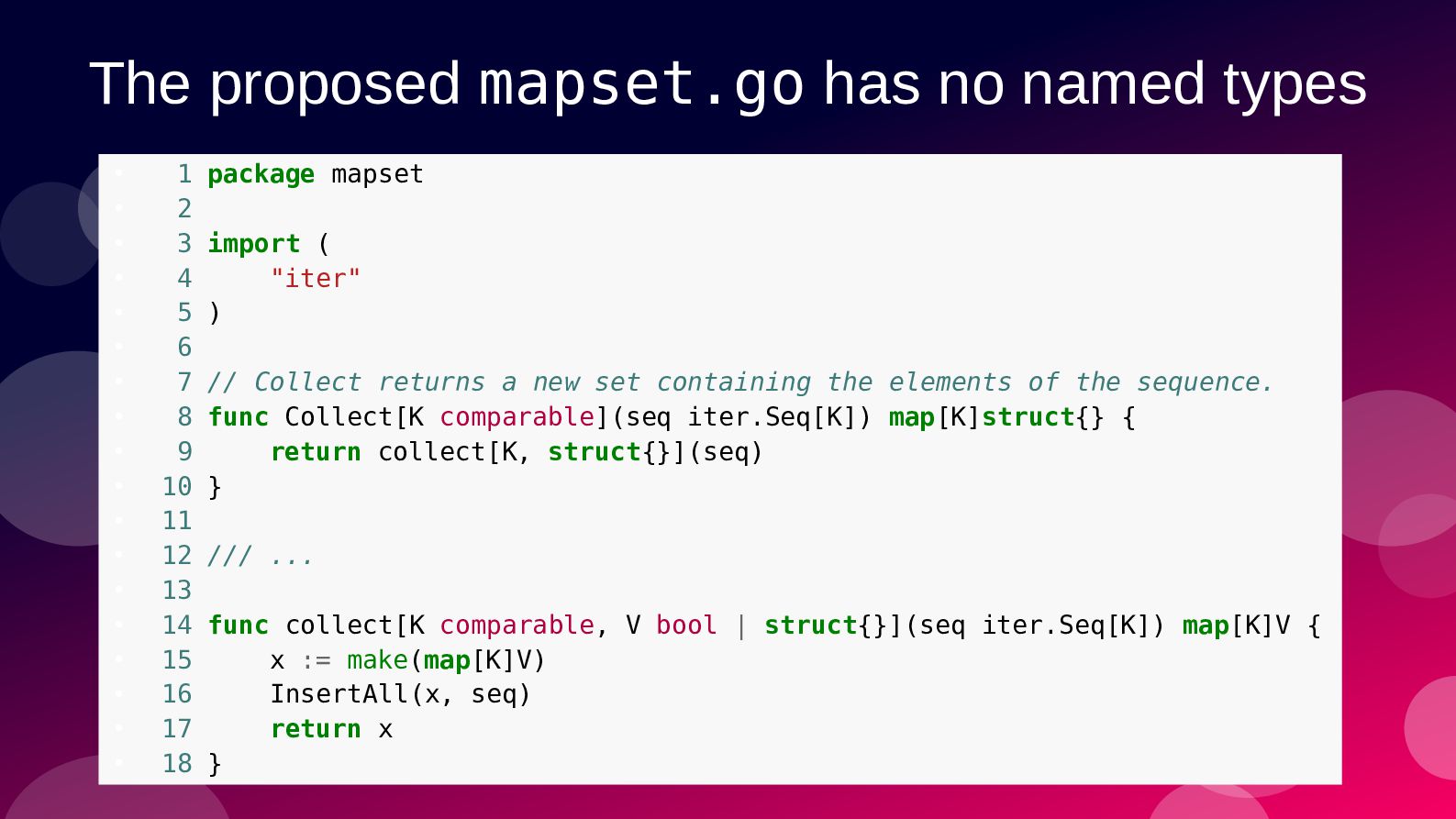
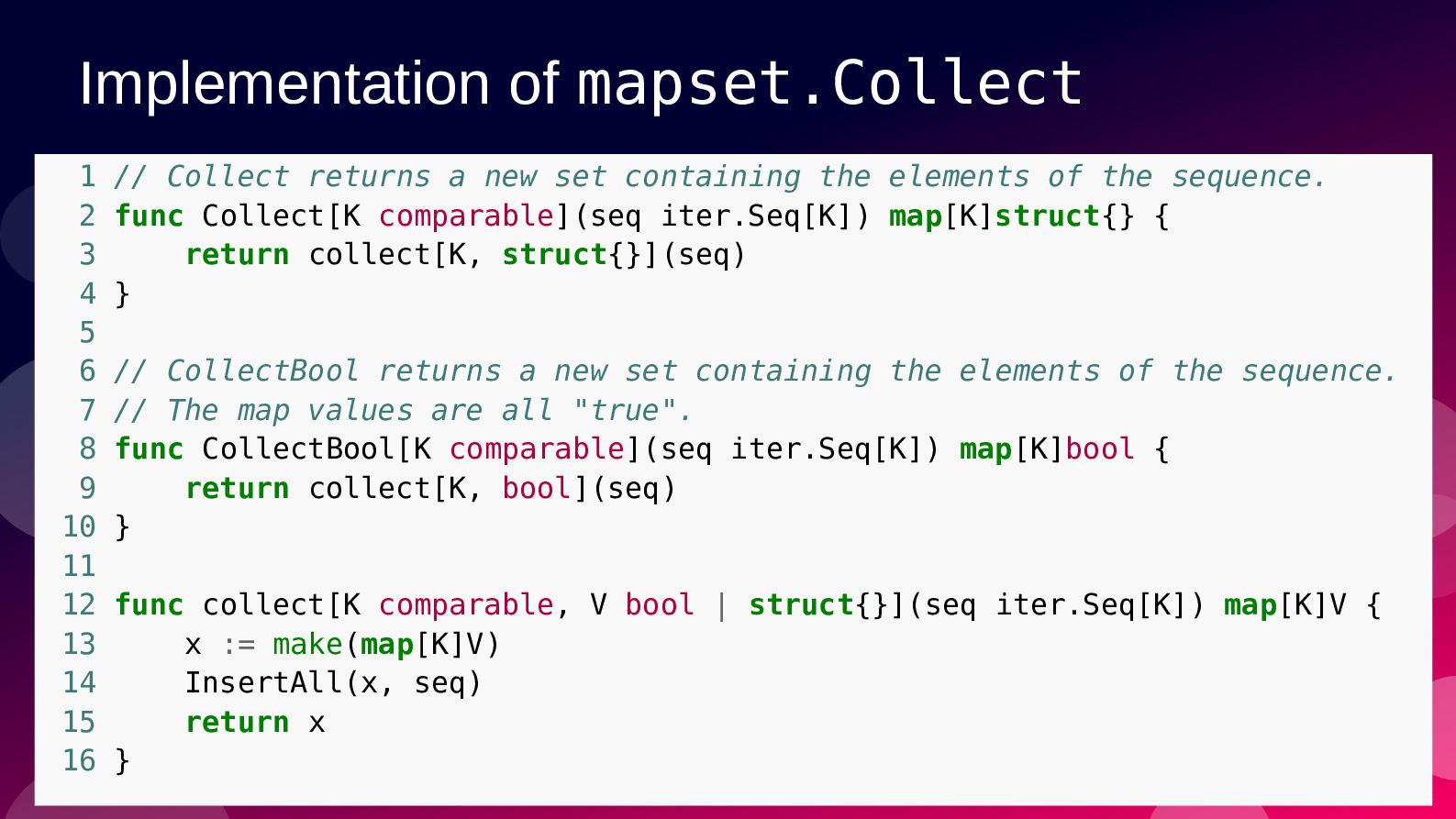
containing the elements of the sequence. 2 func Collect[K comparable](seq iter.Seq[K]) map[K]struct{} { 3 return collect[K, struct{}](seq) 4 } 5 6 // CollectBool returns a new set containing the elements of the sequence. 7 // The map values are all "true". 8 func CollectBool[K comparable](seq iter.Seq[K]) map[K]bool { 9 return collect[K, bool](seq) 10 } 11 12 func collect[K comparable, V bool | struct{}](seq iter.Seq[K]) map[K]V { 13 x := make(map[K]V) 14 InsertAll(x, seq) 15 return x 16 }
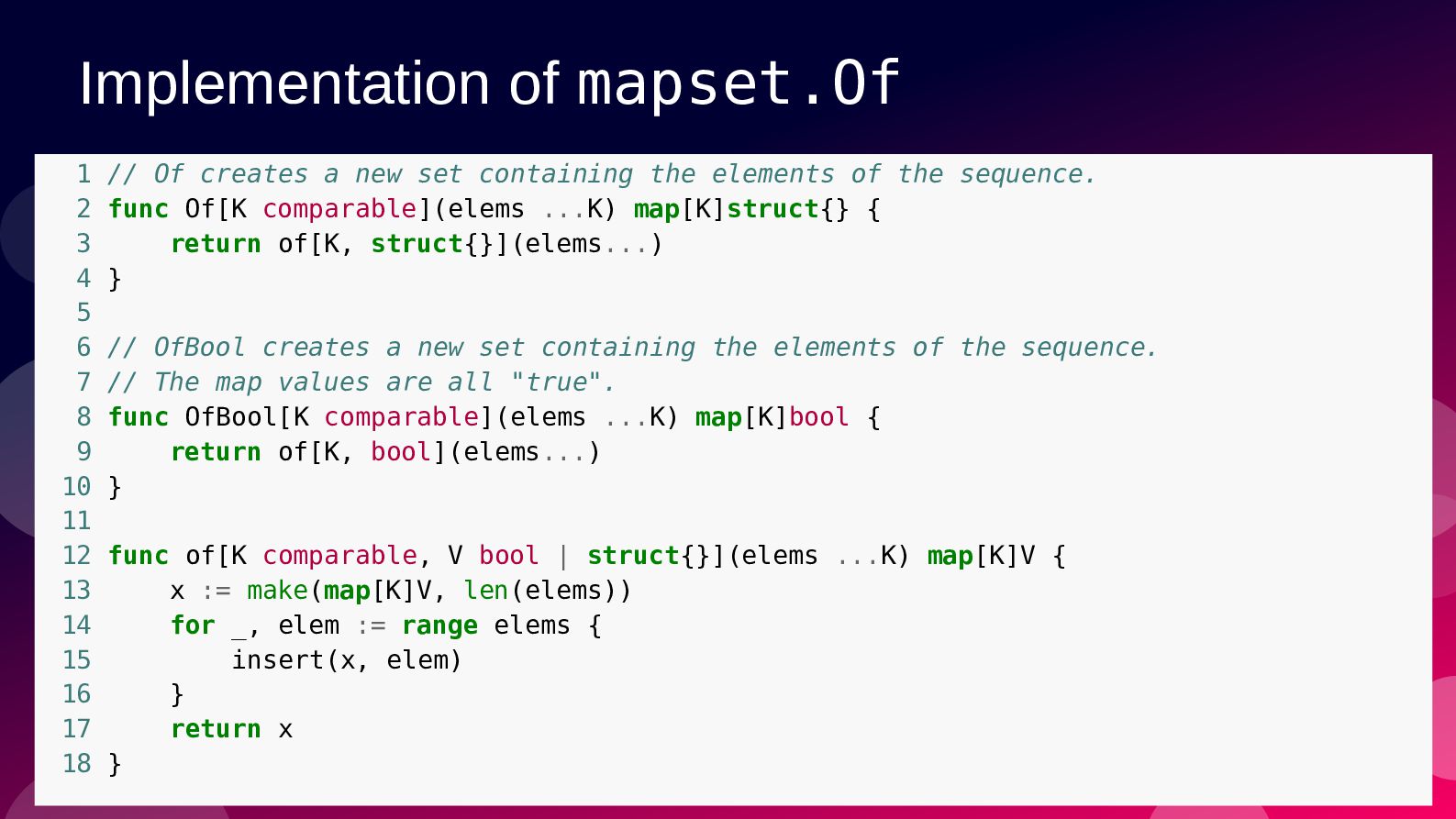
containing the elements of the sequence. 2 func Of[K comparable](elems ...K) map[K]struct{} { 3 return of[K, struct{}](elems...) 4 } 5 6 // OfBool creates a new set containing the elements of the sequence. 7 // The map values are all "true". 8 func OfBool[K comparable](elems ...K) map[K]bool { 9 return of[K, bool](elems...) 10 } 11 12 func of[K comparable, V bool | struct{}](elems ...K) map[K]V { 13 x := make(map[K]V, len(elems)) 14 for _, elem := range elems { 15 insert(x, elem) 16 } 17 return x 18 }
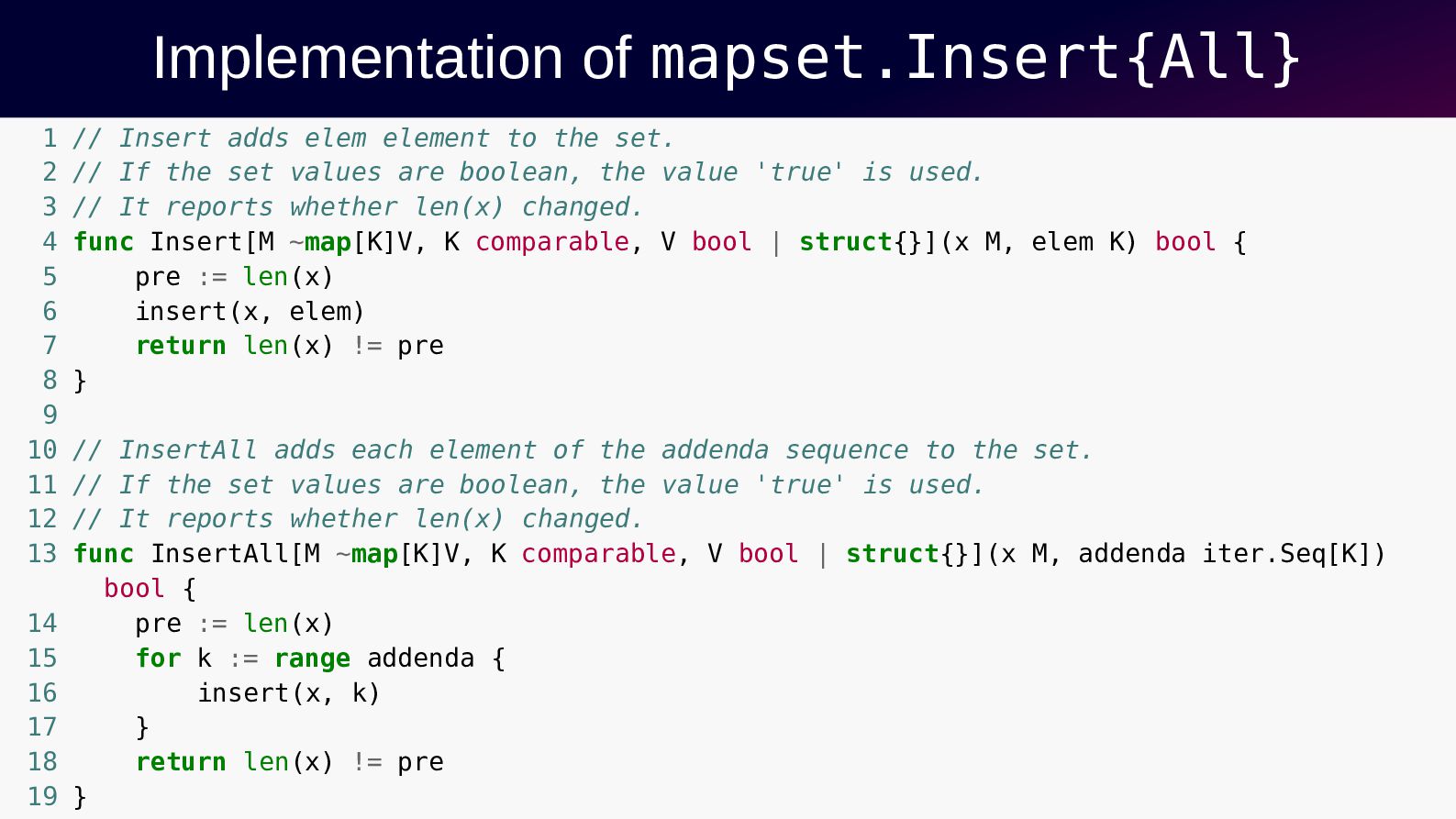
the set. 2 // If the set values are boolean, the value 'true' is used. 3 // It reports whether len(x) changed. 4 func Insert[M ~map[K]V, K comparable, V bool | struct{}](x M, elem K) bool { 5 pre := len(x) 6 insert(x, elem) 7 return len(x) != pre 8 } 9 10 // InsertAll adds each element of the addenda sequence to the set. 11 // If the set values are boolean, the value 'true' is used. 12 // It reports whether len(x) changed. 13 func InsertAll[M ~map[K]V, K comparable, V bool | struct{}](x M, addenda iter.Seq[K]) bool { 14 pre := len(x) 15 for k := range addenda { 16 insert(x, k) 17 } 18 return len(x) != pre 19 }
bool | struct{}](m M, k K) { 2 // Choose the distinguished "present" value (true or struct{}{}). 3 // This compiles to a load from .rodata. 4 var present V 5 if _, ok := any(present).(bool); ok { 6 present = any(true).(V) 7 } 8 9 // This is the canonical insertion operation. 10 // All maps created by this API use only the 11 // distinguished 'present' value for the result type. 12 m[k] = present 13 }
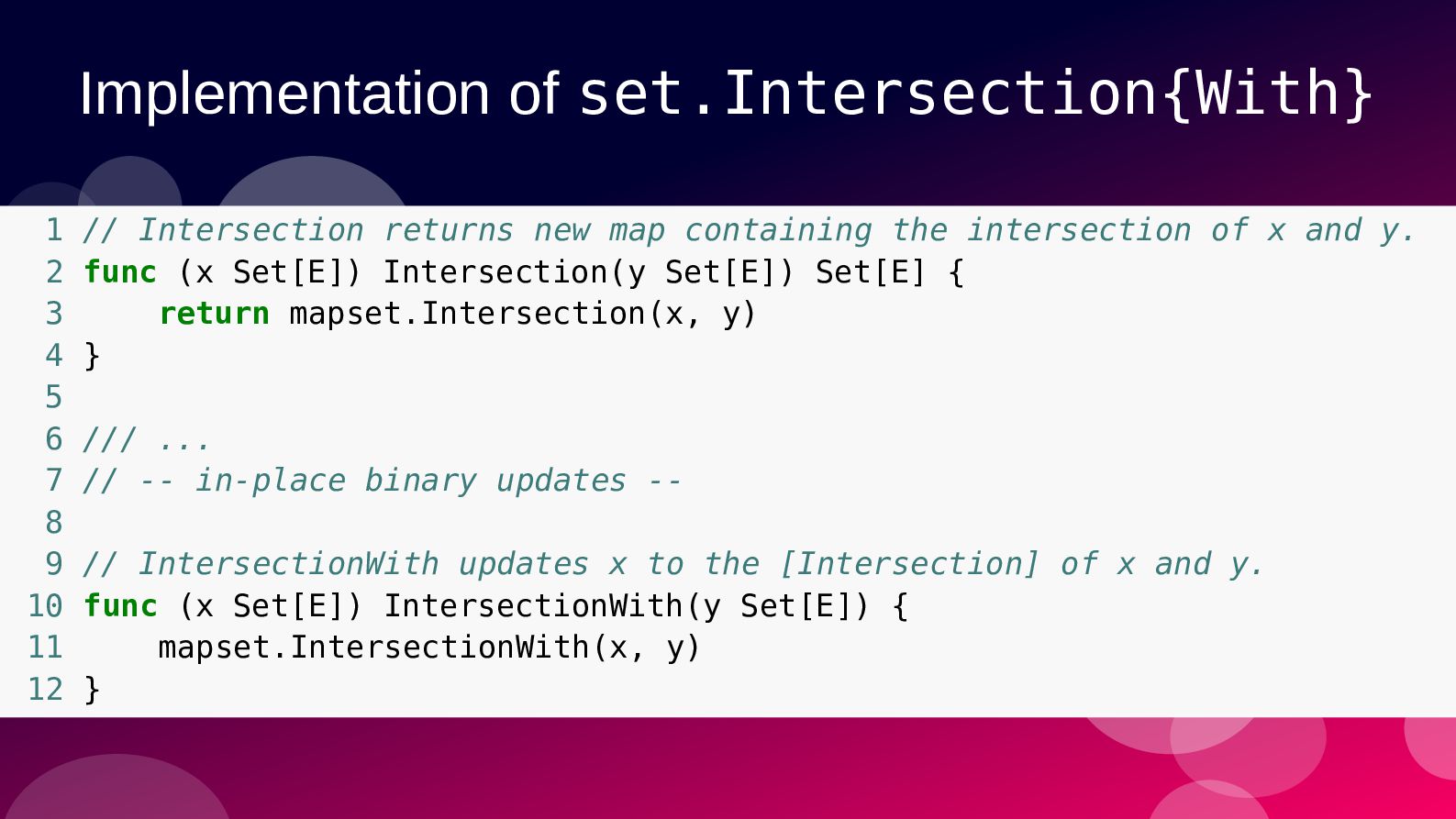
the intersection of x and y. 2 func (x Set[E]) Intersection(y Set[E]) Set[E] { 3 return mapset.Intersection(x, y) 4 } 5 6 /// ... 7 // -- in-place binary updates -8 9 // IntersectionWith updates x to the [Intersection] of x and y. 10 func (x Set[E]) IntersectionWith(y Set[E]) { 11 mapset.IntersectionWith(x, y) 12 }
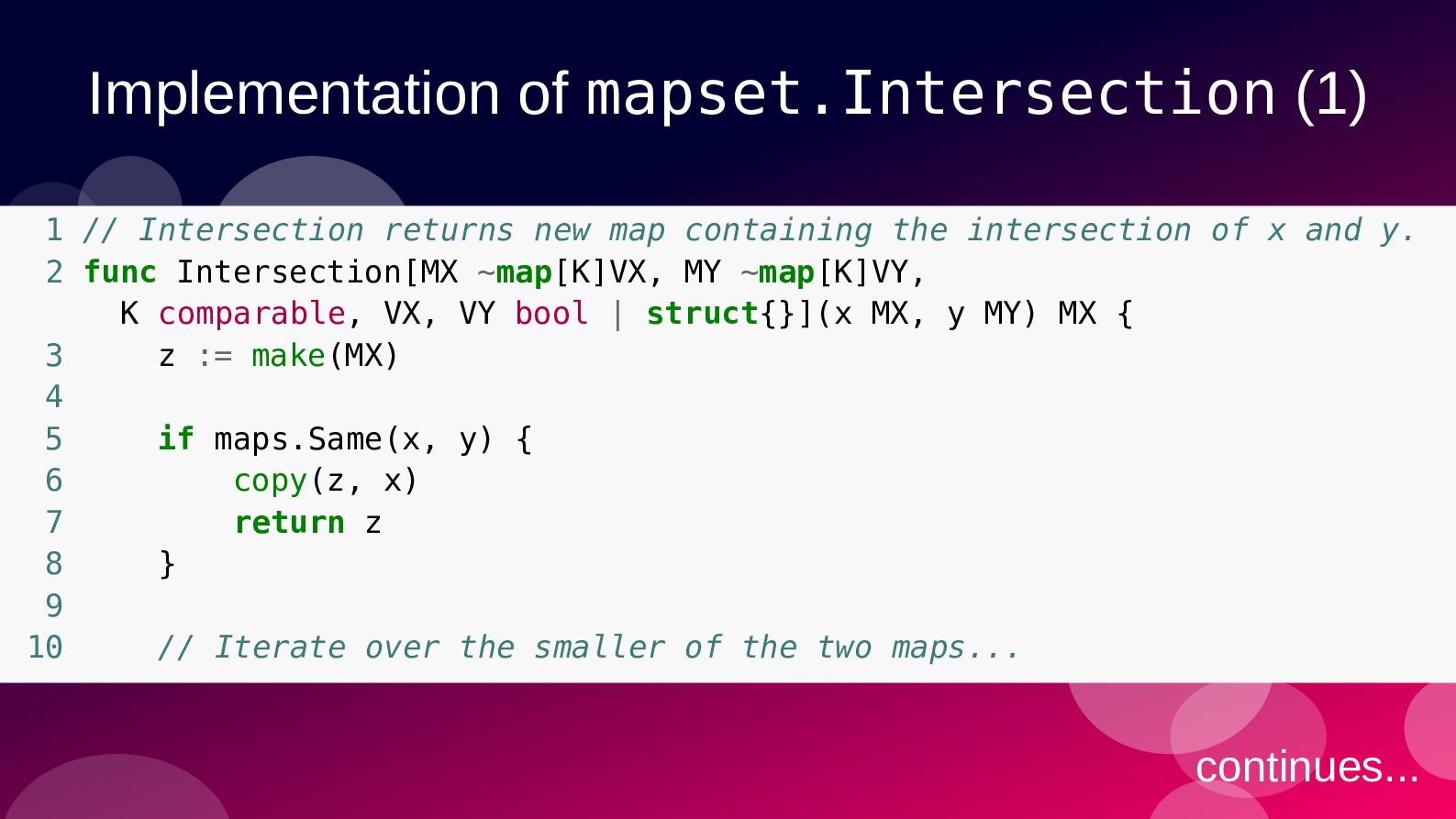
containing the intersection of x and y. 2 func Intersection[MX ~map[K]VX, MY ~map[K]VY, K comparable, VX, VY bool | struct{}](x MX, y MY) MX { 3 z := make(MX) 4 5 if maps.Same(x, y) { 6 copy(z, x) 7 return z 8 } 9 10 // Iterate over the smaller of the two maps... continues...
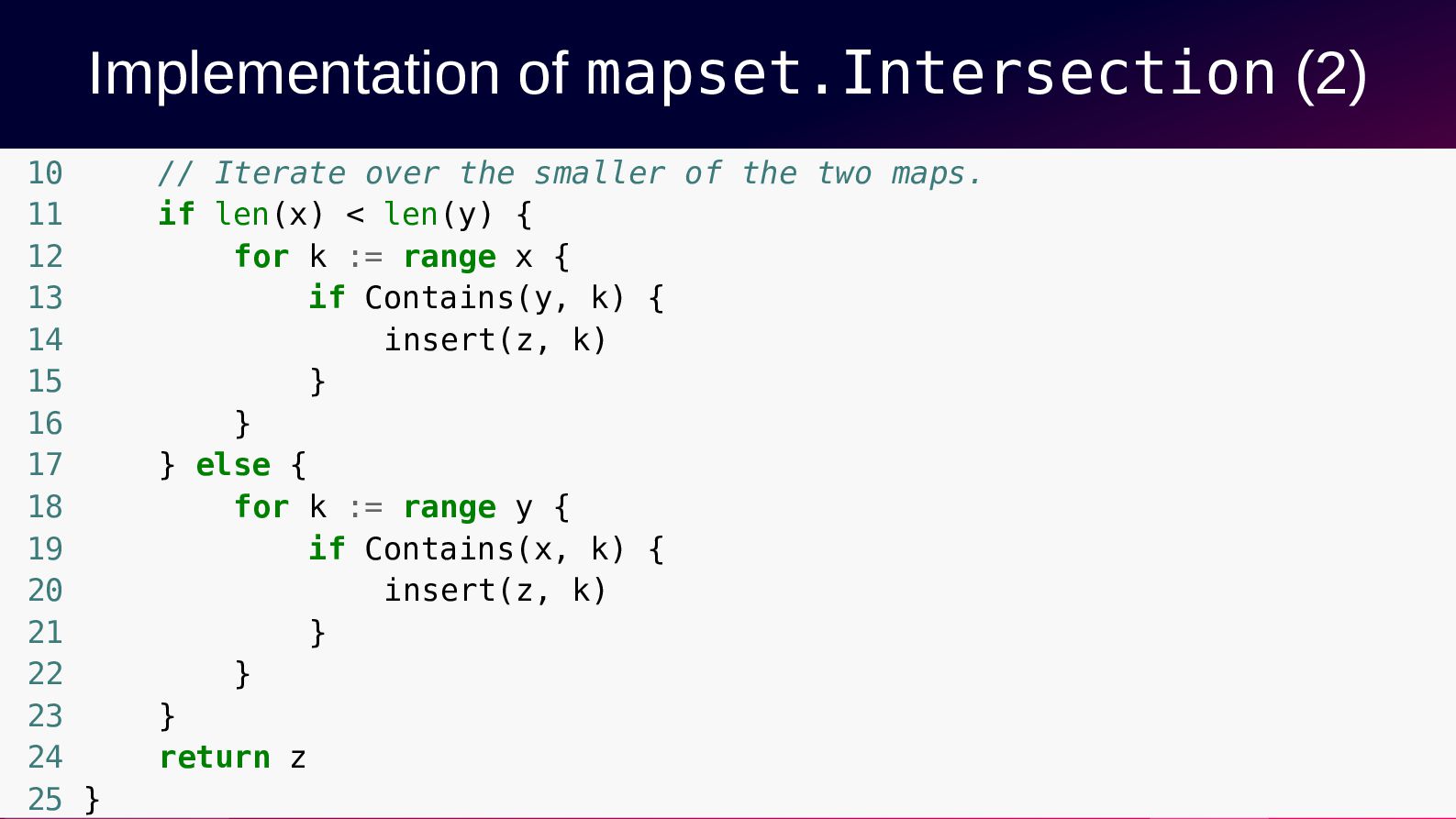
16 17 18 19 20 21 22 23 24 25 } // Iterate over the smaller of the two maps. if len(x) < len(y) { for k := range x { if Contains(y, k) { insert(z, k) } } } else { for k := range y { if Contains(x, k) { insert(z, k) } } } return z
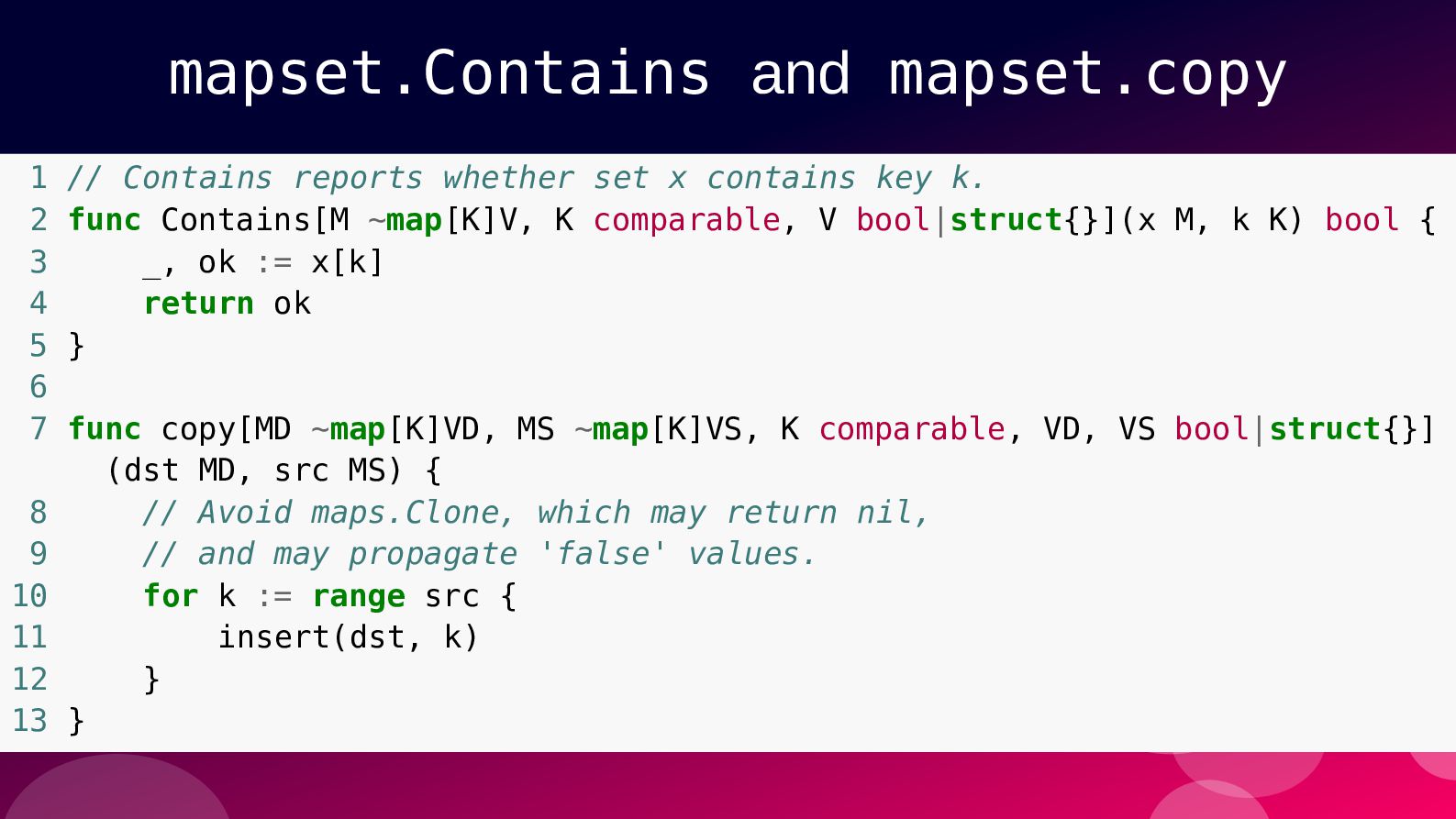
contains key k. 2 func Contains[M ~map[K]V, K comparable, V bool|struct{}](x M, k K) bool { 3 _, ok := x[k] 4 return ok 5 } 6 7 func copy[MD ~map[K]VD, MS ~map[K]VS, K comparable, VD, VS bool|struct{}] (dst MD, src MS) { 8 // Avoid maps.Clone, which may return nil, 9 // and may propagate 'false' values. 10 for k := range src { 11 insert(dst, k) 12 } 13 }
x and y. 2 func IntersectionWith[M ~map[K]V, K comparable, V bool|struct{}](x, y M) { 3 if maps.Same(x, y) { 4 return // x ∩ x = x 5 } 6 for k := range x { 7 if !Contains(y, k) { 8 delete(x, k) 9 } 10 } 11 }
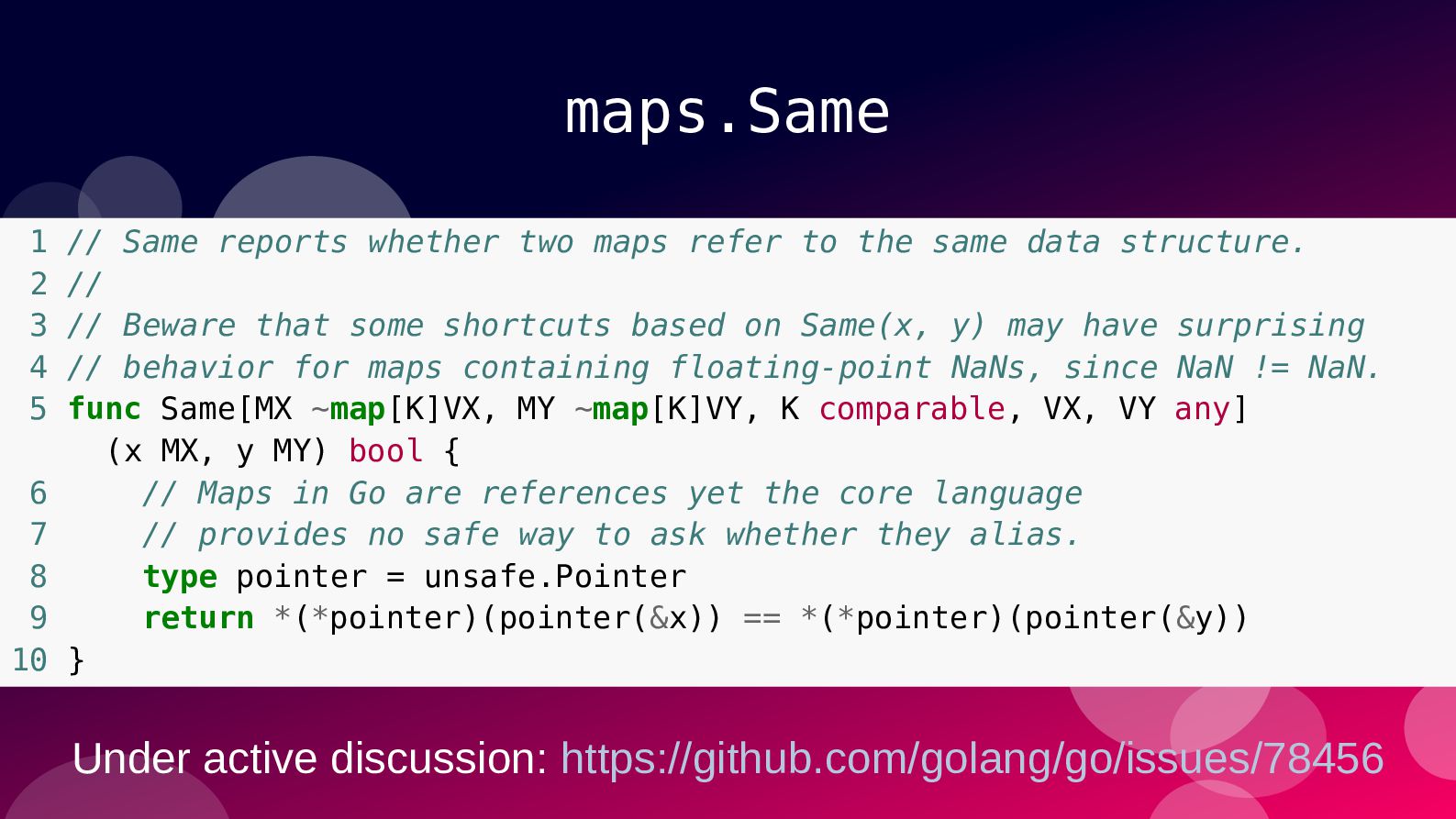
the same data structure. 2 // 3 // Beware that some shortcuts based on Same(x, y) may have surprising 4 // behavior for maps containing floating-point NaNs, since NaN != NaN. 5 func Same[MX ~map[K]VX, MY ~map[K]VY, K comparable, VX, VY any] (x MX, y MY) bool { 6 // Maps in Go are references yet the core language 7 // provides no safe way to ask whether they alias. 8 type pointer = unsafe.Pointer 9 return *(*pointer)(pointer(&x)) == *(*pointer)(pointer(&y)) 10 } Under active discussion: https://github.com/golang/go/issues/78456
support == and a built-in hash function. – • This also limits the values in set.Set[V] The upcoming container/hash.Map[K,V] and container/hash.Set[V] support custom equality tests and hash functions – Examples: a set of big.Int, or a map with case-insentitive string keys
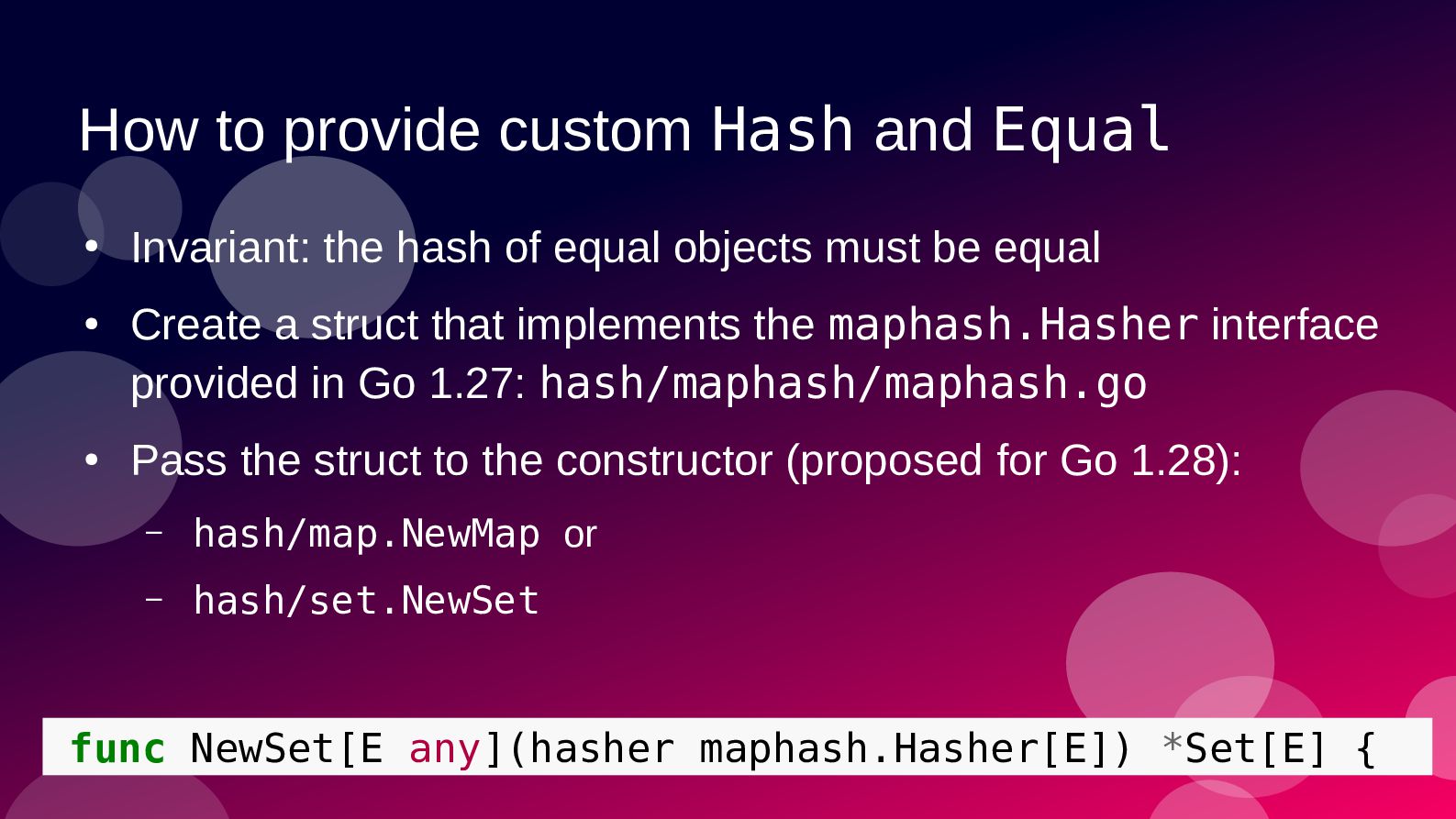
Invariant: the hash of equal objects must be equal Create a struct that implements the maphash.Hasher interface provided in Go 1.27: hash/maphash/maphash.go Pass the struct to the constructor (proposed for Go 1.28): – hash/map.NewMap or – hash/set.NewSet func NewSet[E any](hasher maphash.Hasher[E]) *Set[E] {
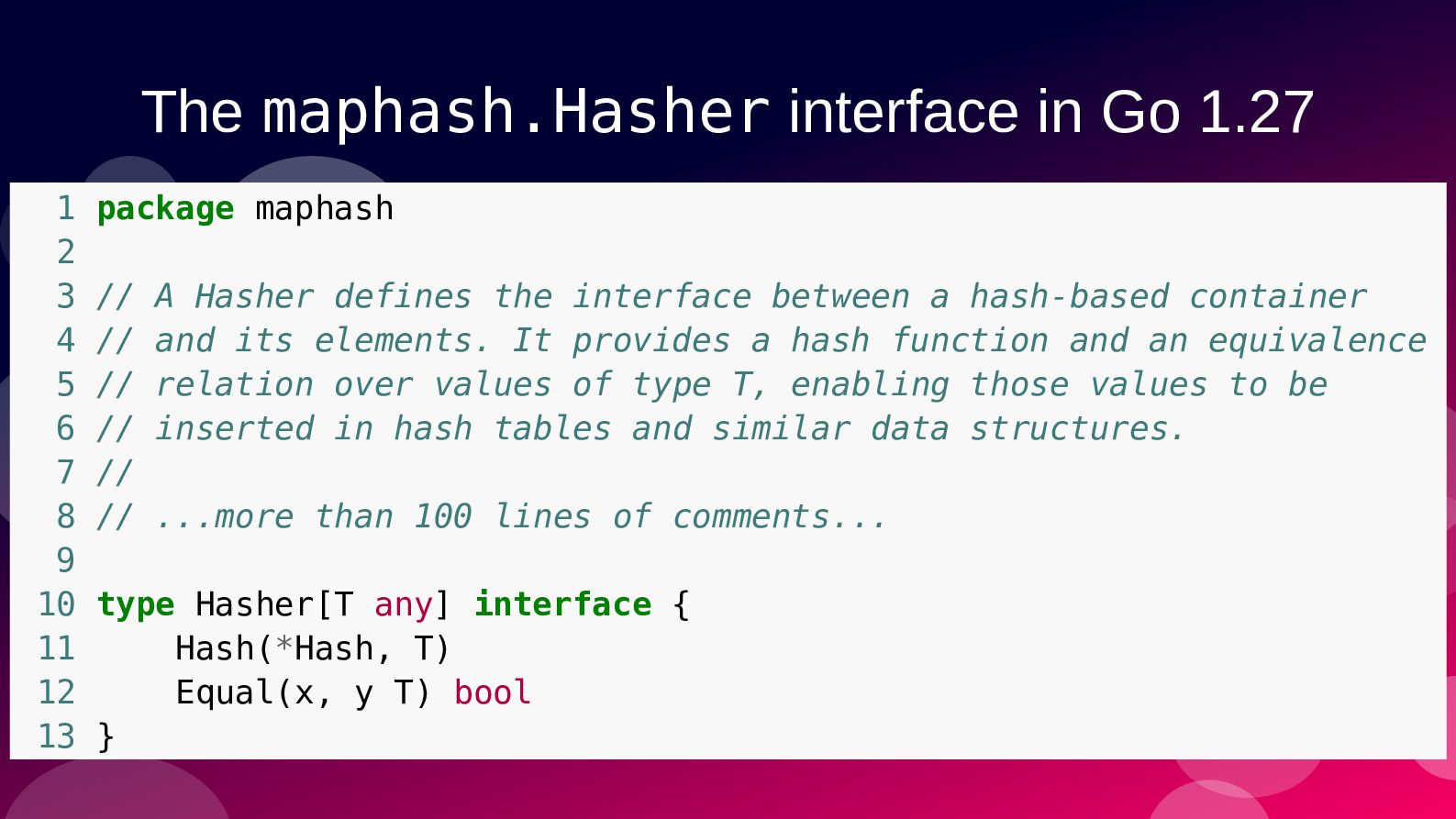
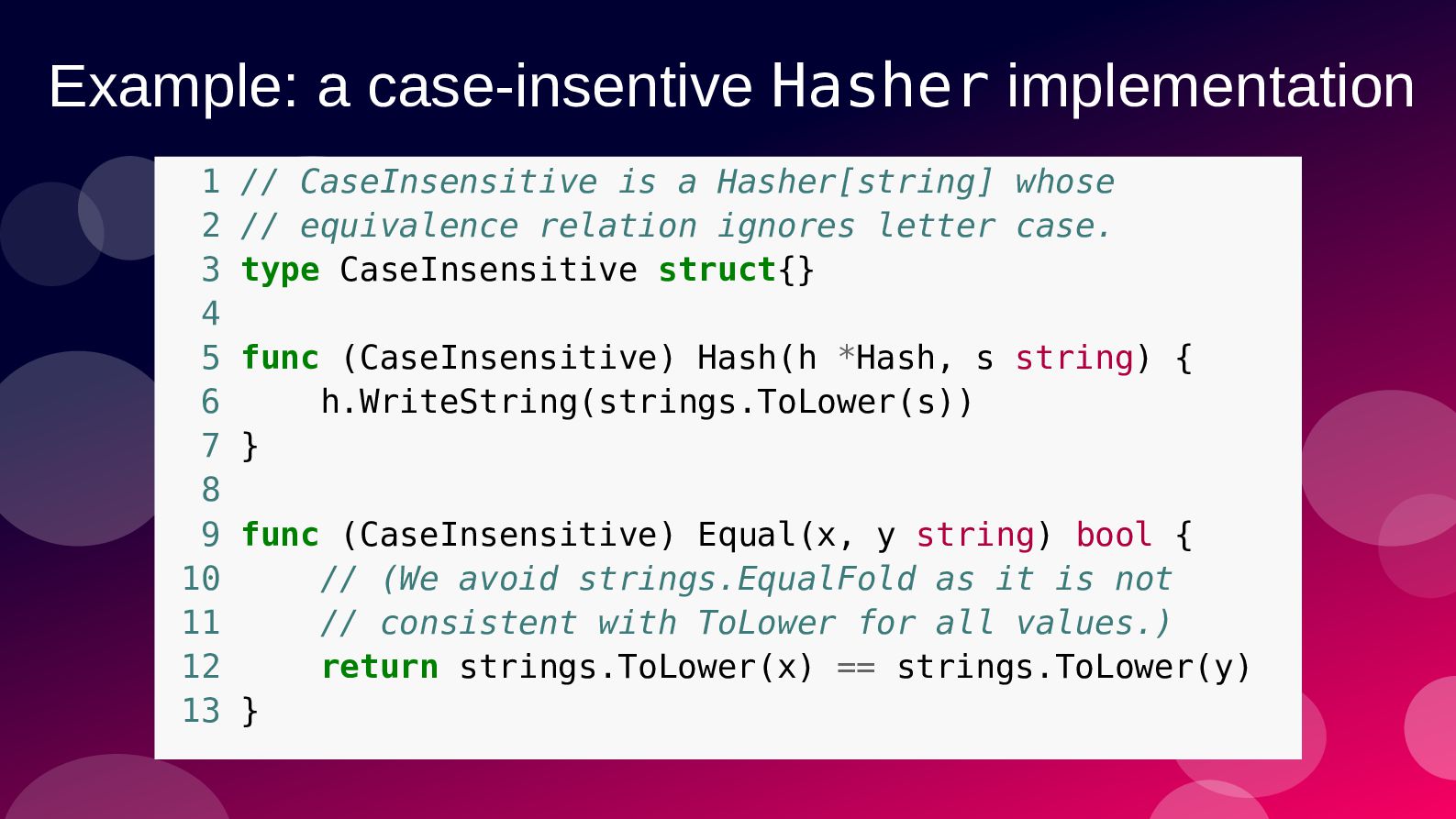
3 // A Hasher defines the interface between a hash-based container 4 // and its elements. It provides a hash function and an equivalence 5 // relation over values of type T, enabling those values to be 6 // inserted in hash tables and similar data structures. 7 // 8 // ...more than 100 lines of comments... 9 10 type Hasher[T any] interface { 11 Hash(*Hash, T) 12 Equal(x, y T) bool 13 }
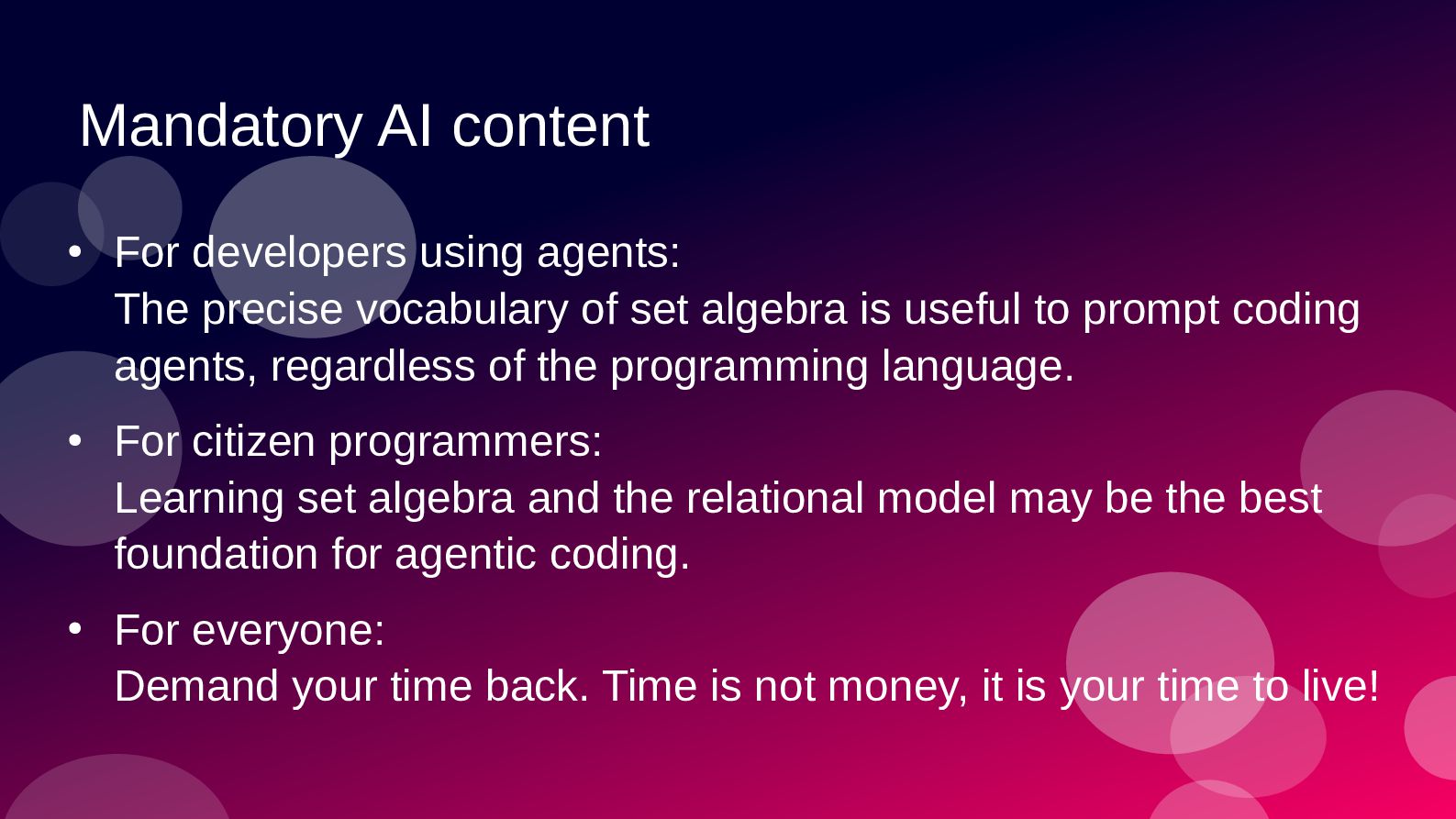
The precise vocabulary of set algebra is useful to prompt coding agents, regardless of the programming language. For citizen programmers: Learning set algebra and the relational model may be the best foundation for agentic coding. For everyone: Demand your time back. Time is not money, it is your time to live!
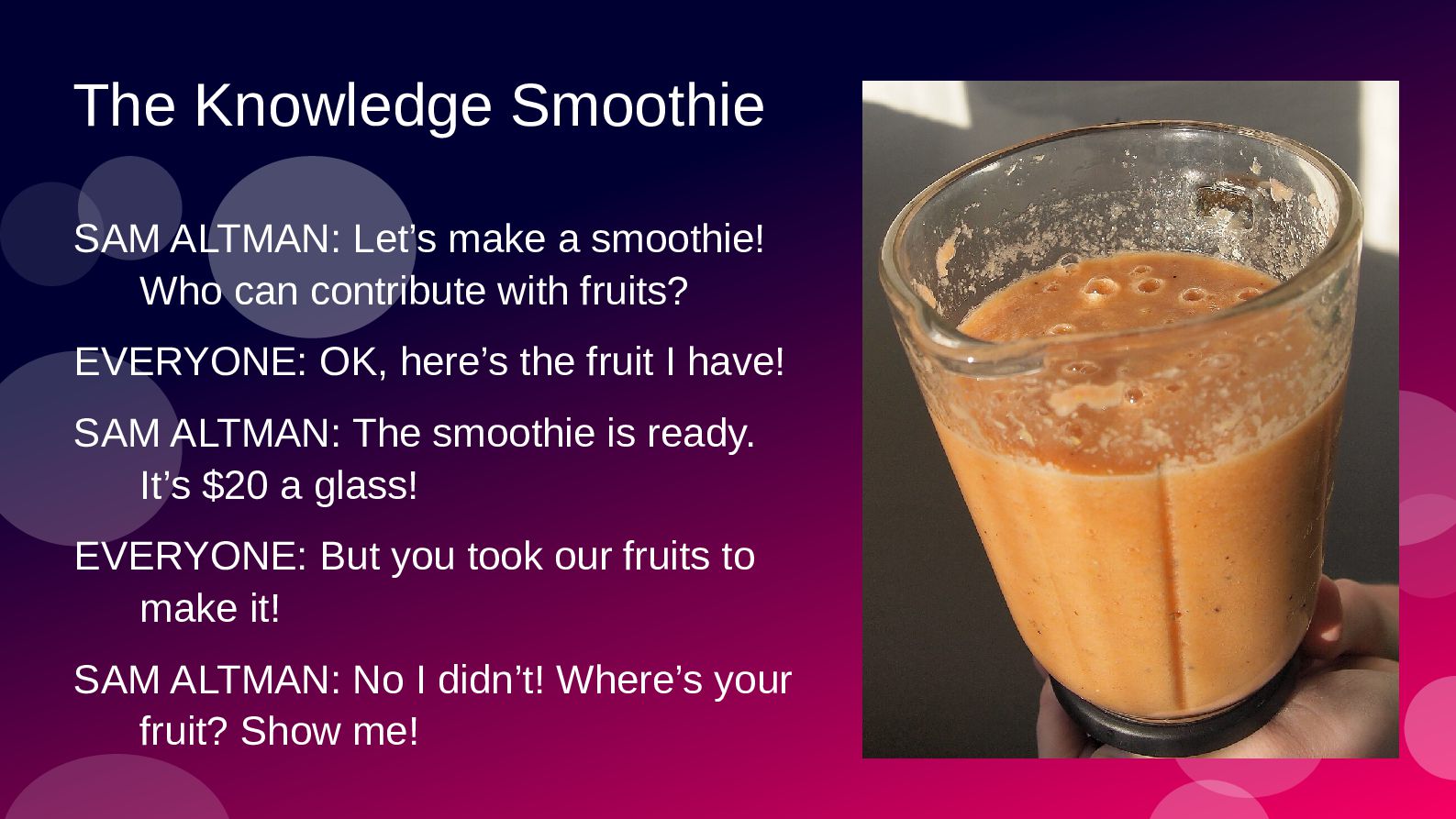
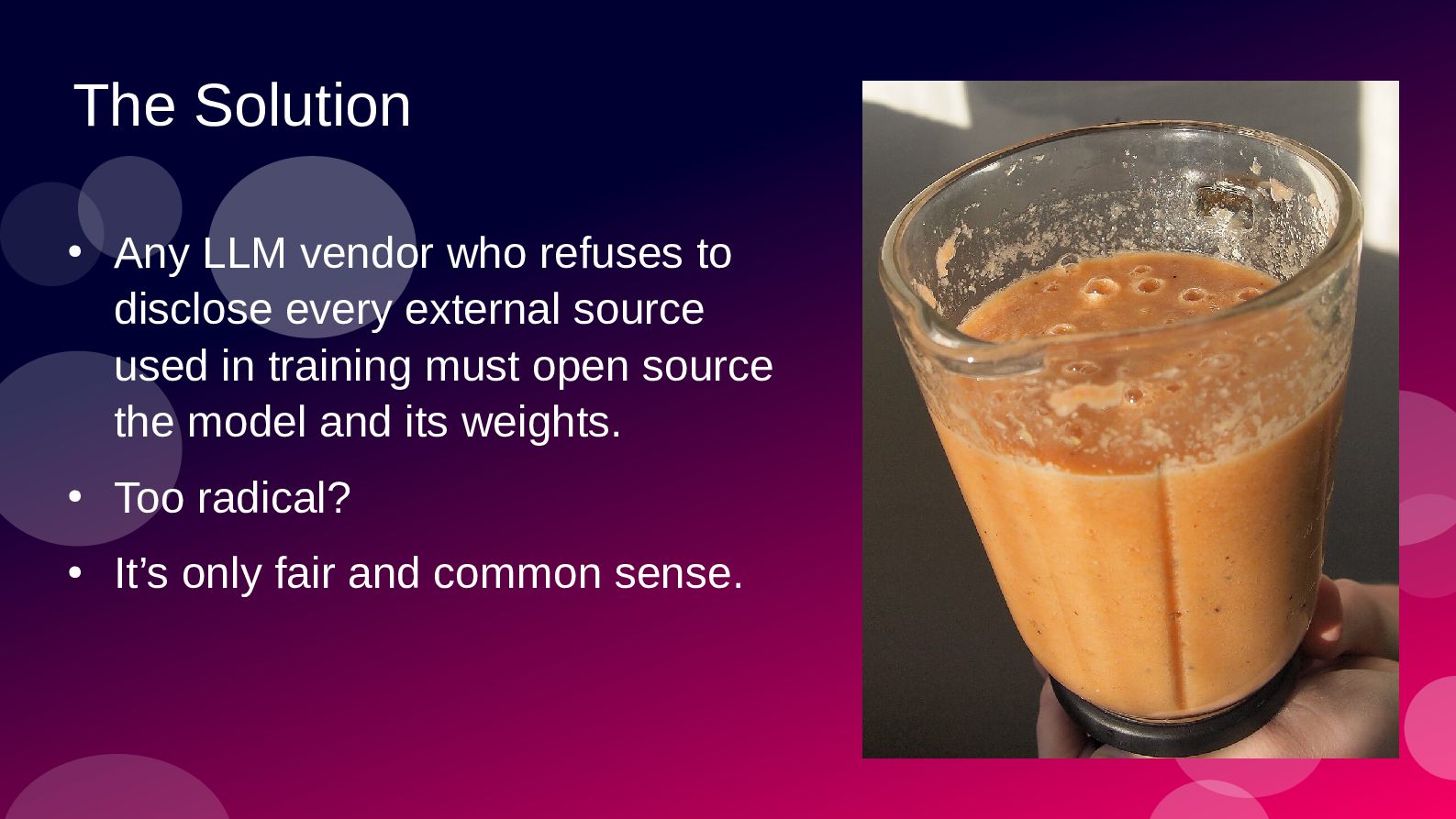
can contribute with fruits? EVERYONE: OK, here’s the fruit I have! SAM ALTMAN: The smoothie is ready. It’s $20 a glass! EVERYONE: But you took our fruits to make it! SAM ALTMAN: No I didn’t! Where’s your fruit? Show me!
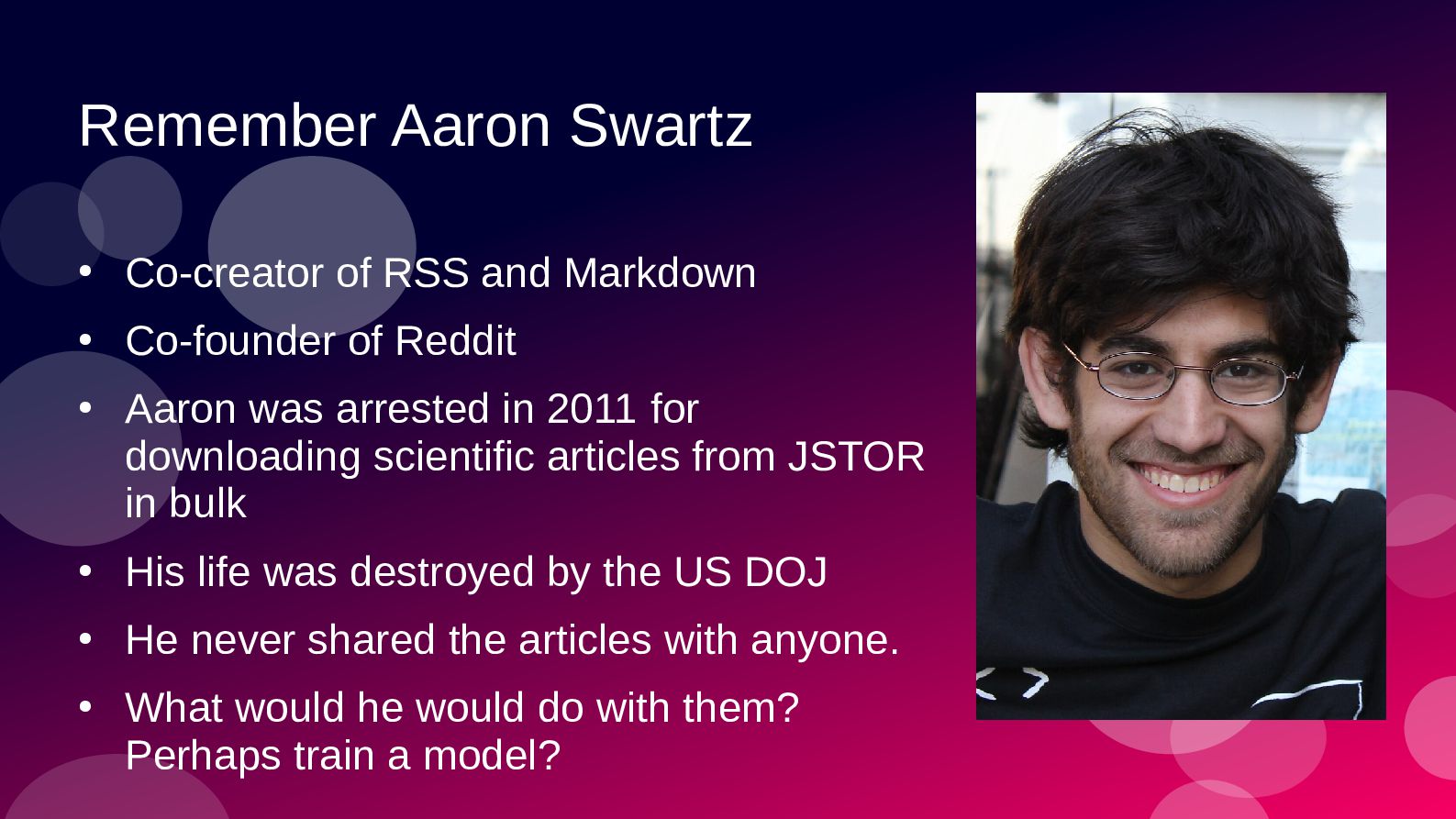
Co-founder of Reddit • Aaron was arrested in 2011 for downloading scientific articles from JSTOR in bulk • His life was destroyed by the US DOJ • He never shared the articles with anyone. • What would he would do with them? Perhaps train a model?
to common data processing tasks. Sets and other collections in the upcoming Go 1.28 are a foundation for the design of generic collections. • New maps and sets based on Hasher are more flexible. • The Go source code shown here is unmerged and may change! These slides: https://speakerdeck.com/ramalho/sets-in-go


 ramalho
 mkdev10
 vivion
 shumei_ito
 maimyyym
 mtpooh
 naruoga
 yokawasa
 tsuchikazu
 kairim0
 hlum
hlum
 ufried
 shuta13
 baasie
 skipperchong
 akihiro_kokubo
 portentint
 inesmontani
 techseoconnect
 chriscoyier
 livdayseo
 leimatthew05
 lfama
lfama
 marcoroth
 ipullrank
![Sets in Go: past, present and future Luciano Ramalho [email protected]](https://files.speakerdeck.com/presentations/a9378143ba97450f982b5bf6ec0defce/slide_0.jpg)
![The 7 proposed additions 5)container/set.Set[T] transparently represented as map[T]struct{}, supporting](https://files.speakerdeck.com/presentations/a9378143ba97450f982b5bf6ec0defce/slide_34.jpg)
![Implementation of set.Set[T]](https://files.speakerdeck.com/presentations/a9378143ba97450f982b5bf6ec0defce/slide_54.jpg)
![Implementation of mapset.insert 1 func insert[M ~map[K]V, K comparable, V](https://files.speakerdeck.com/presentations/a9378143ba97450f982b5bf6ec0defce/slide_63.jpg)
![mapset.IntersectionWith 1 // IntersectionWith updates x to the [Intersection] of](https://files.speakerdeck.com/presentations/a9378143ba97450f982b5bf6ec0defce/slide_68.jpg)
![About hash.Set[T]](https://files.speakerdeck.com/presentations/a9378143ba97450f982b5bf6ec0defce/slide_70.jpg)
![Why hash.Map[K,V] and hash.Set[V] • Native maps require keys to](https://files.speakerdeck.com/presentations/a9378143ba97450f982b5bf6ec0defce/slide_71.jpg)