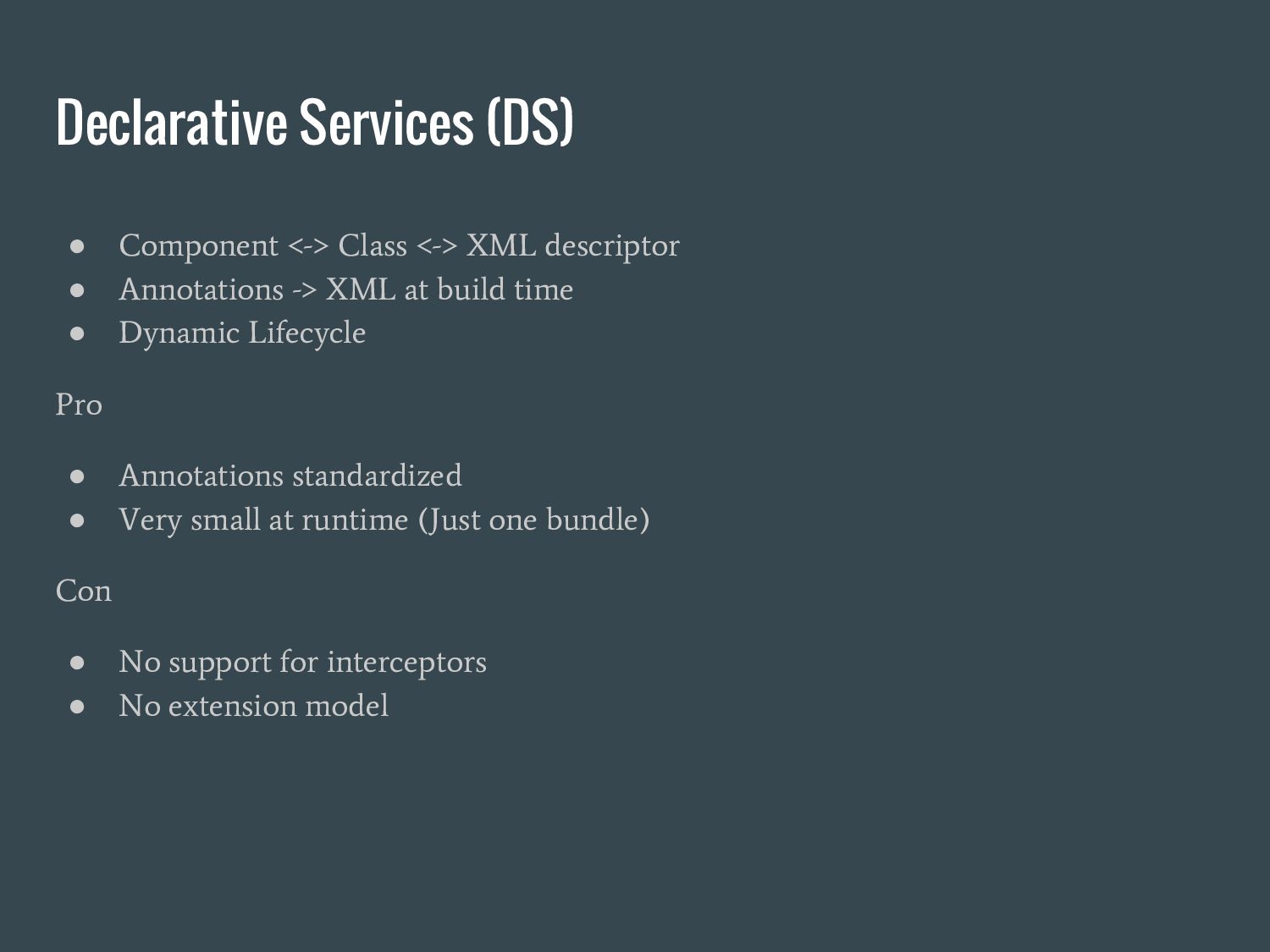
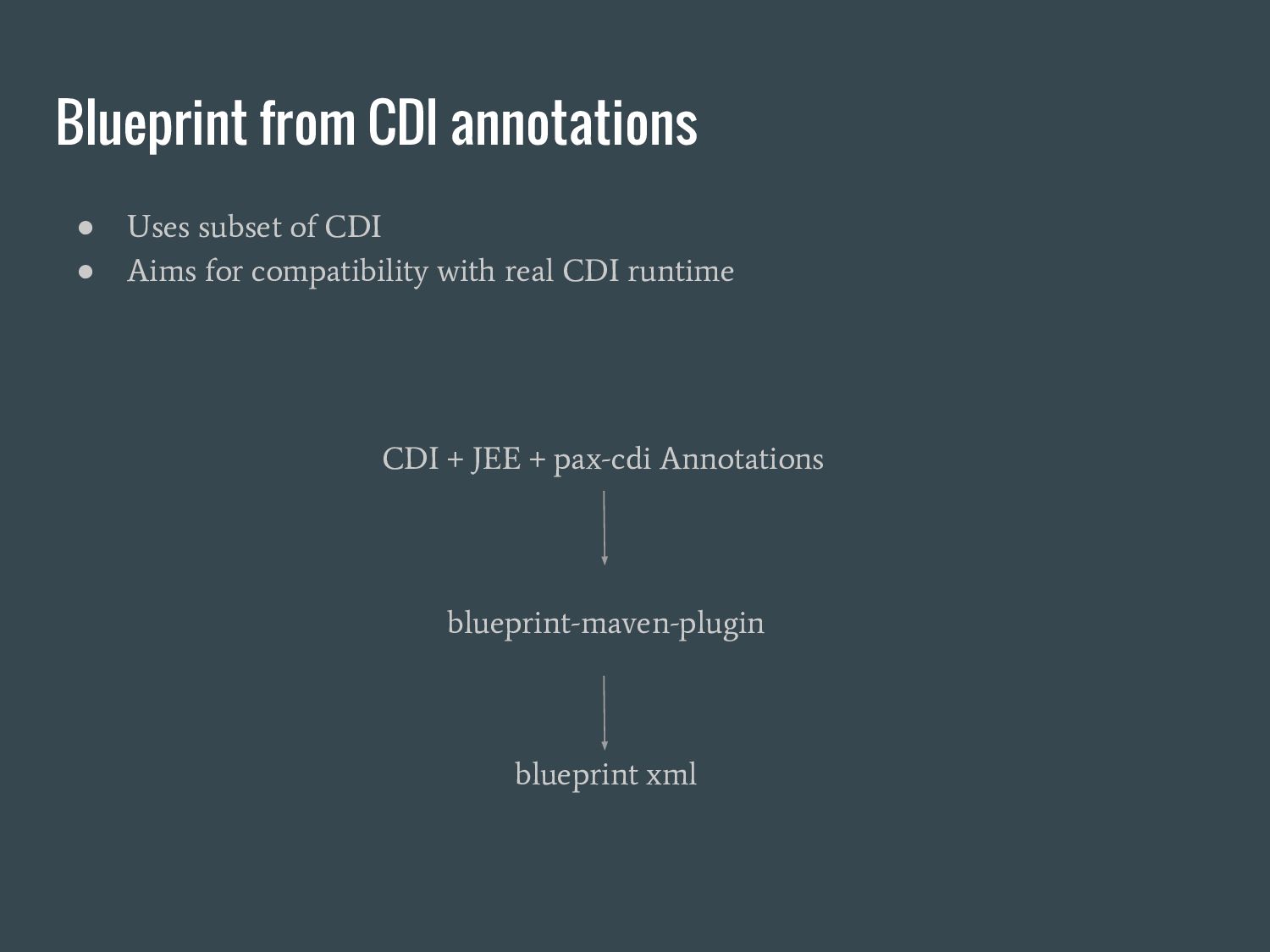
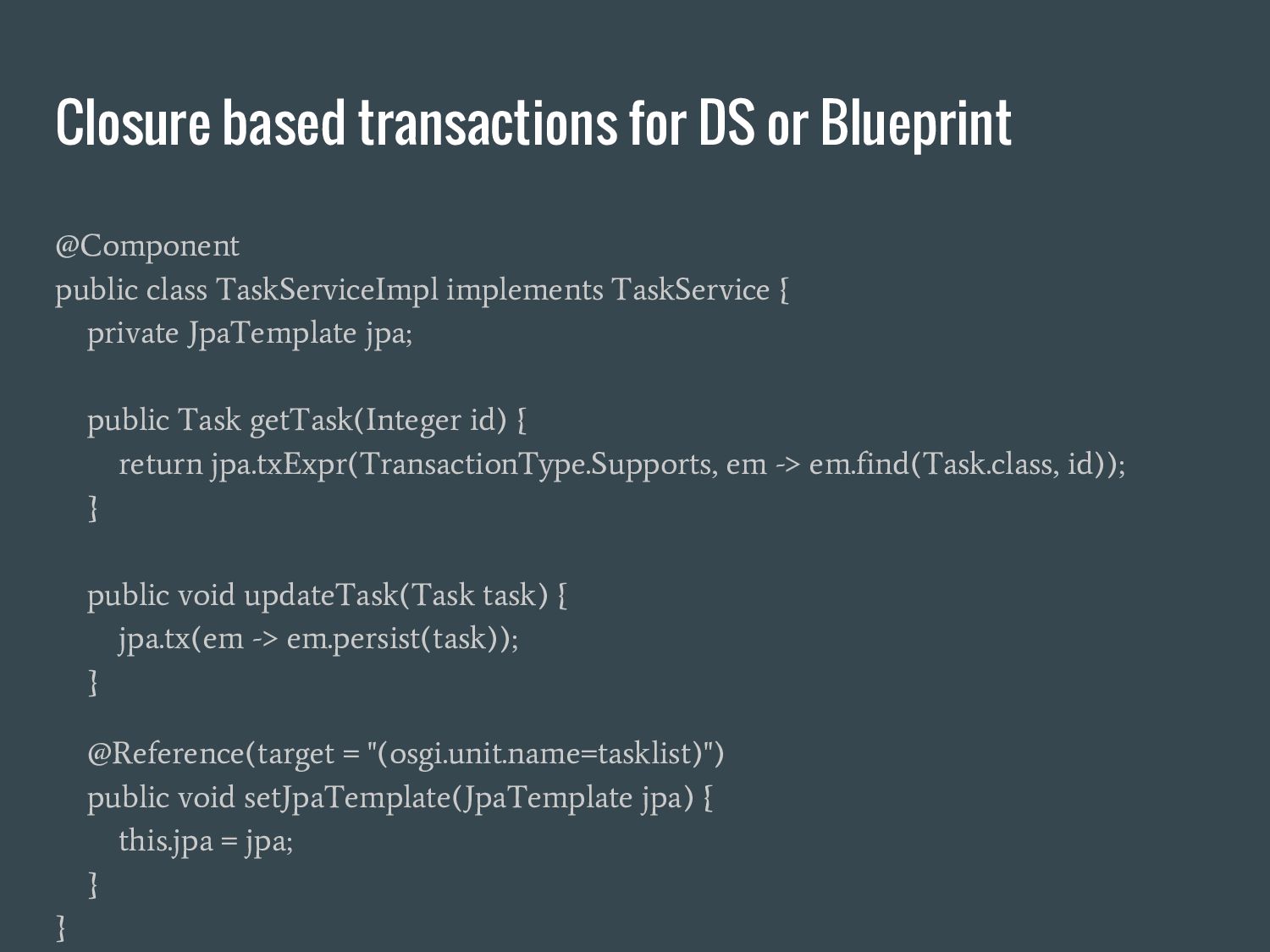
• Annotations -> XML at build time • Dynamic Lifecycle Pro • Annotations standardized • Very small at runtime (Just one bundle) Con • No support for interceptors • No extension model
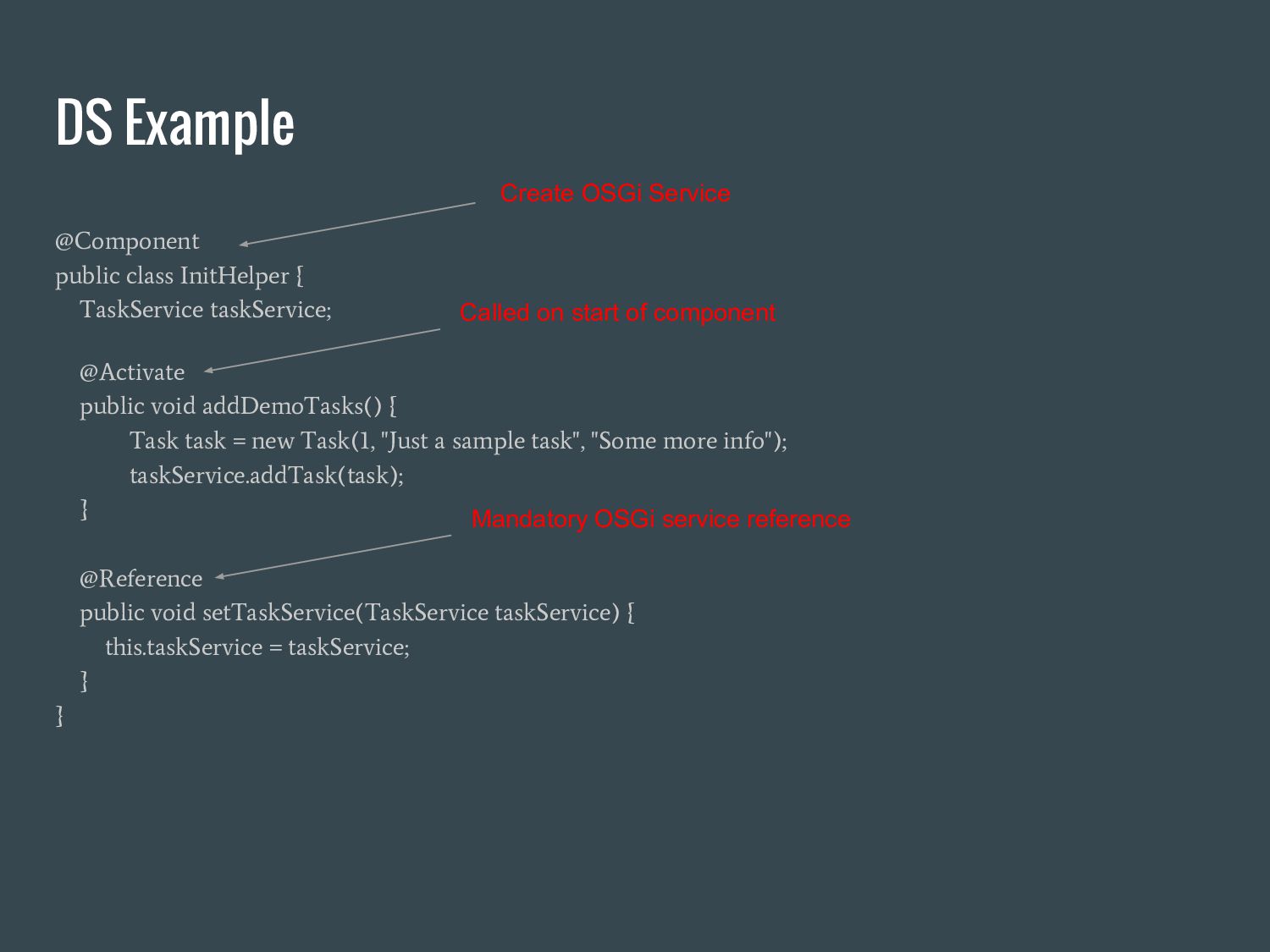
public void addDemoTasks() { Task task = new Task(1, "Just a sample task", "Some more info"); taskService.addTask(task); } @Reference public void setTaskService(TaskService taskService) { this.taskService = taskService; } } Create OSGi Service Called on start of component Mandatory OSGi service reference
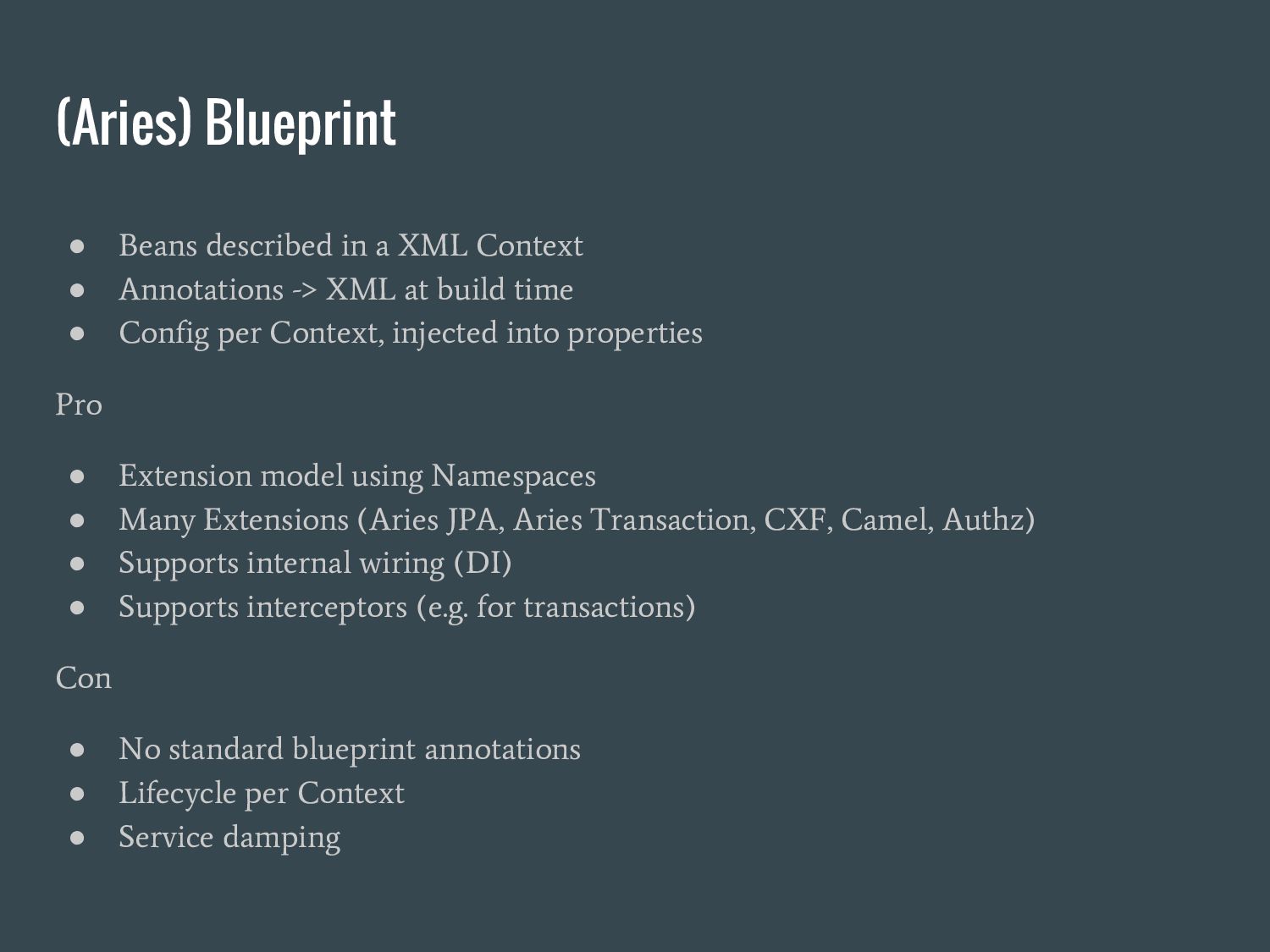
Annotations -> XML at build time • Config per Context, injected into properties Pro • Extension model using Namespaces • Many Extensions (Aries JPA, Aries Transaction, CXF, Camel, Authz) • Supports internal wiring (DI) • Supports interceptors (e.g. for transactions) Con • No standard blueprint annotations • Lifecycle per Context • Service damping
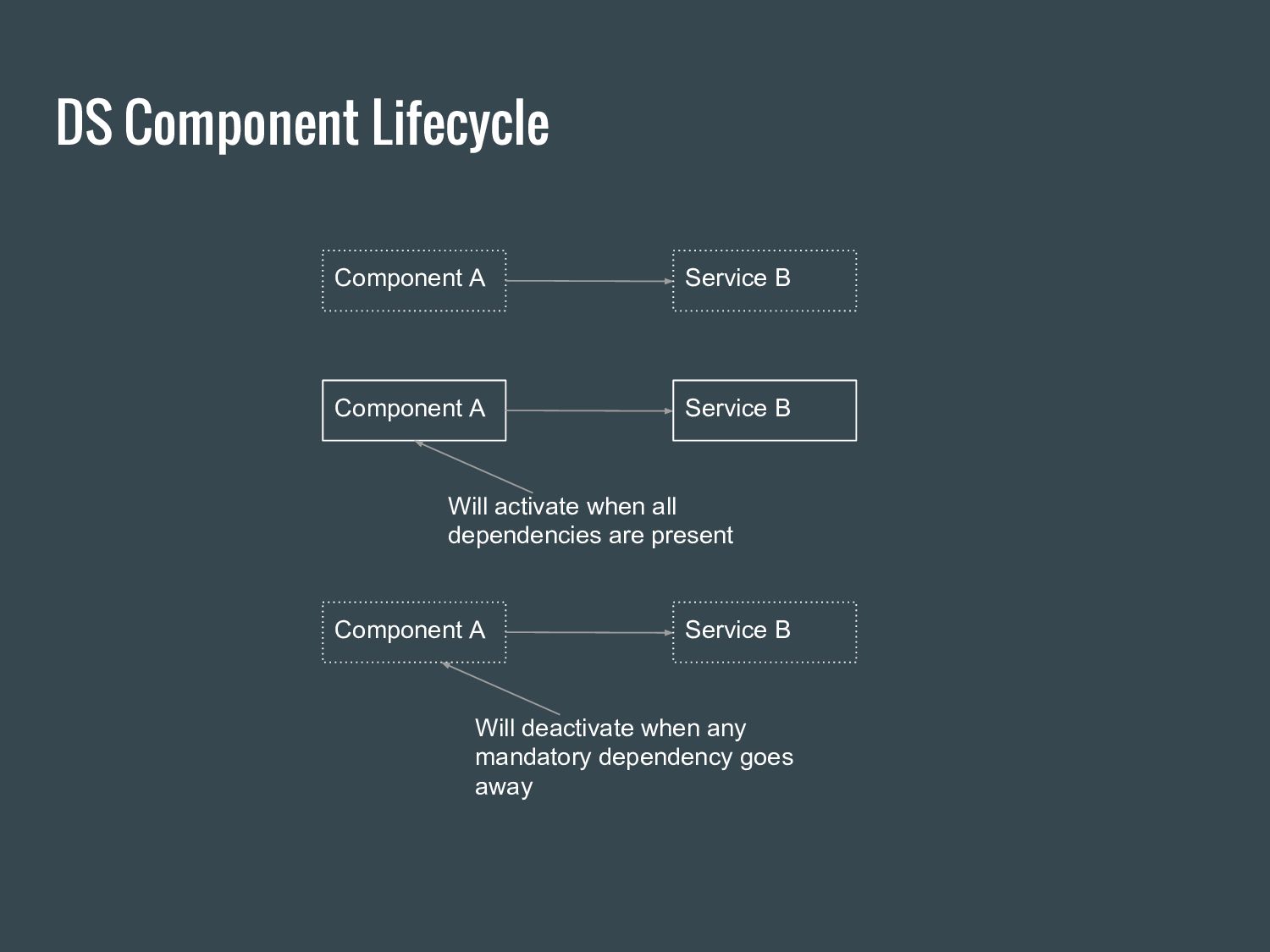
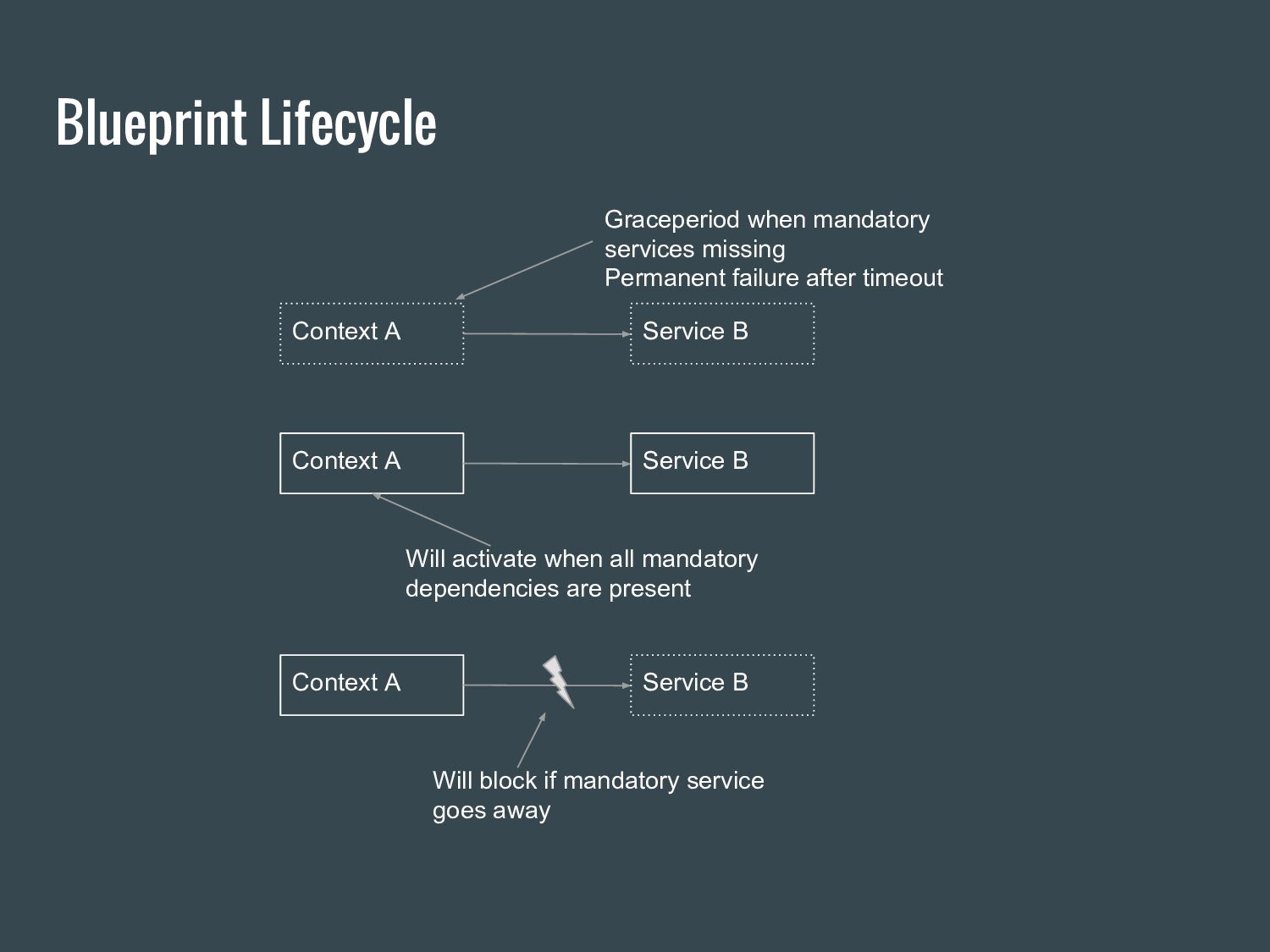
Will activate when all mandatory dependencies are present Context A Service B Will block if mandatory service goes away Graceperiod when mandatory services missing Permanent failure after timeout
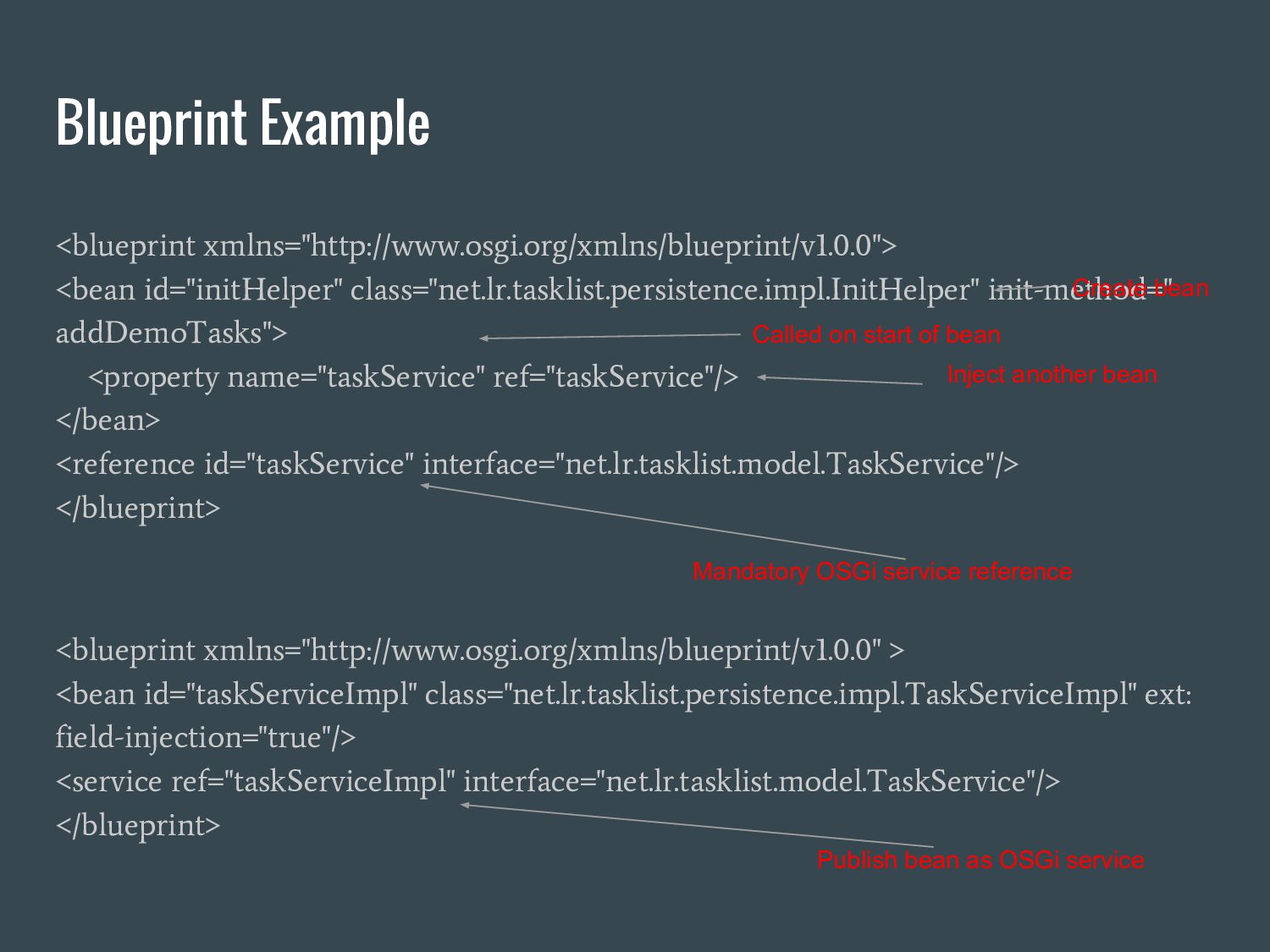
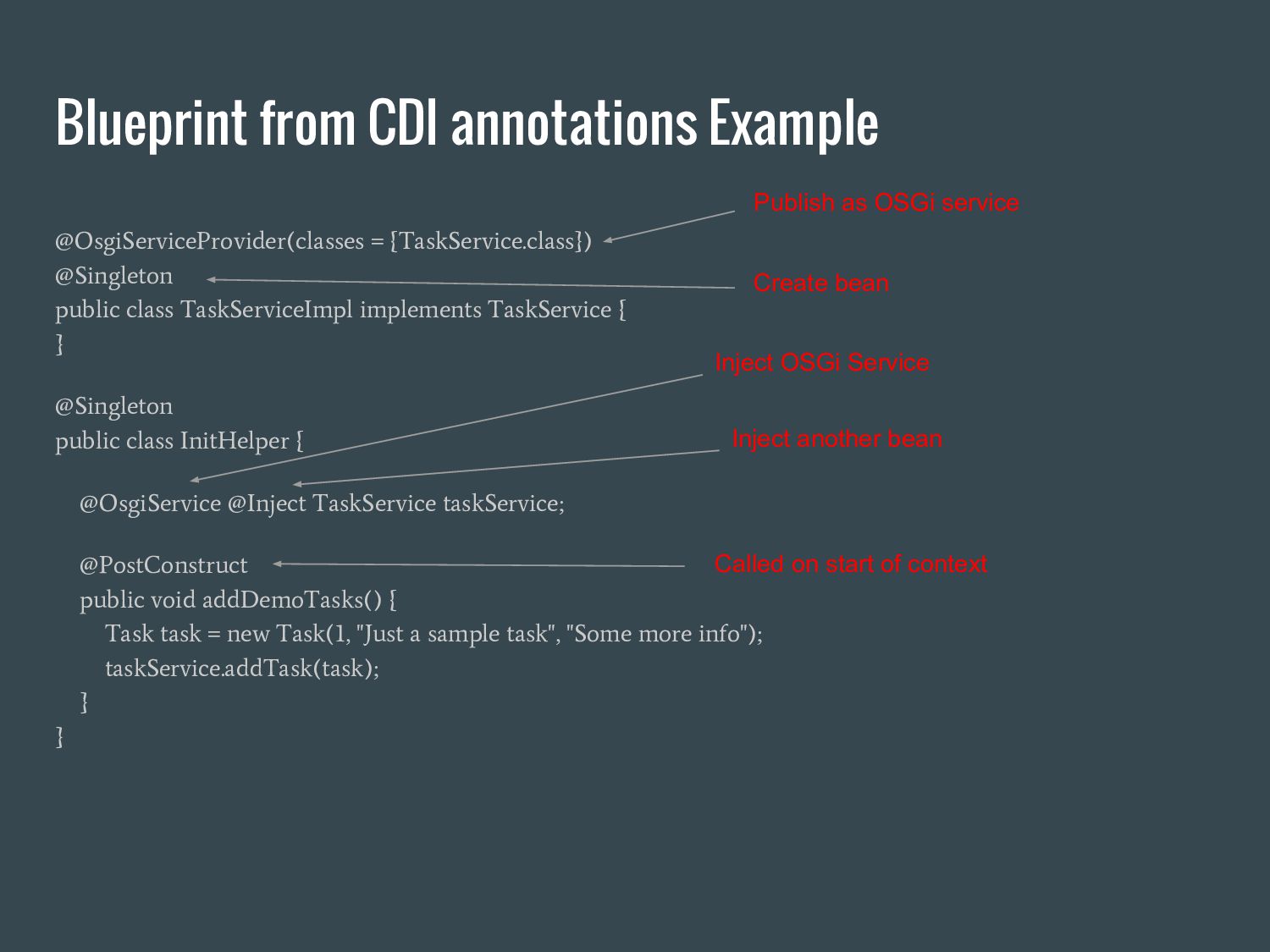
class TaskServiceImpl implements TaskService { } @Singleton public class InitHelper { @OsgiService @Inject TaskService taskService; @PostConstruct public void addDemoTasks() { Task task = new Task(1, "Just a sample task", "Some more info"); taskService.addTask(task); } } Create bean Inject OSGi Service Publish as OSGi service Inject another bean Called on start of context
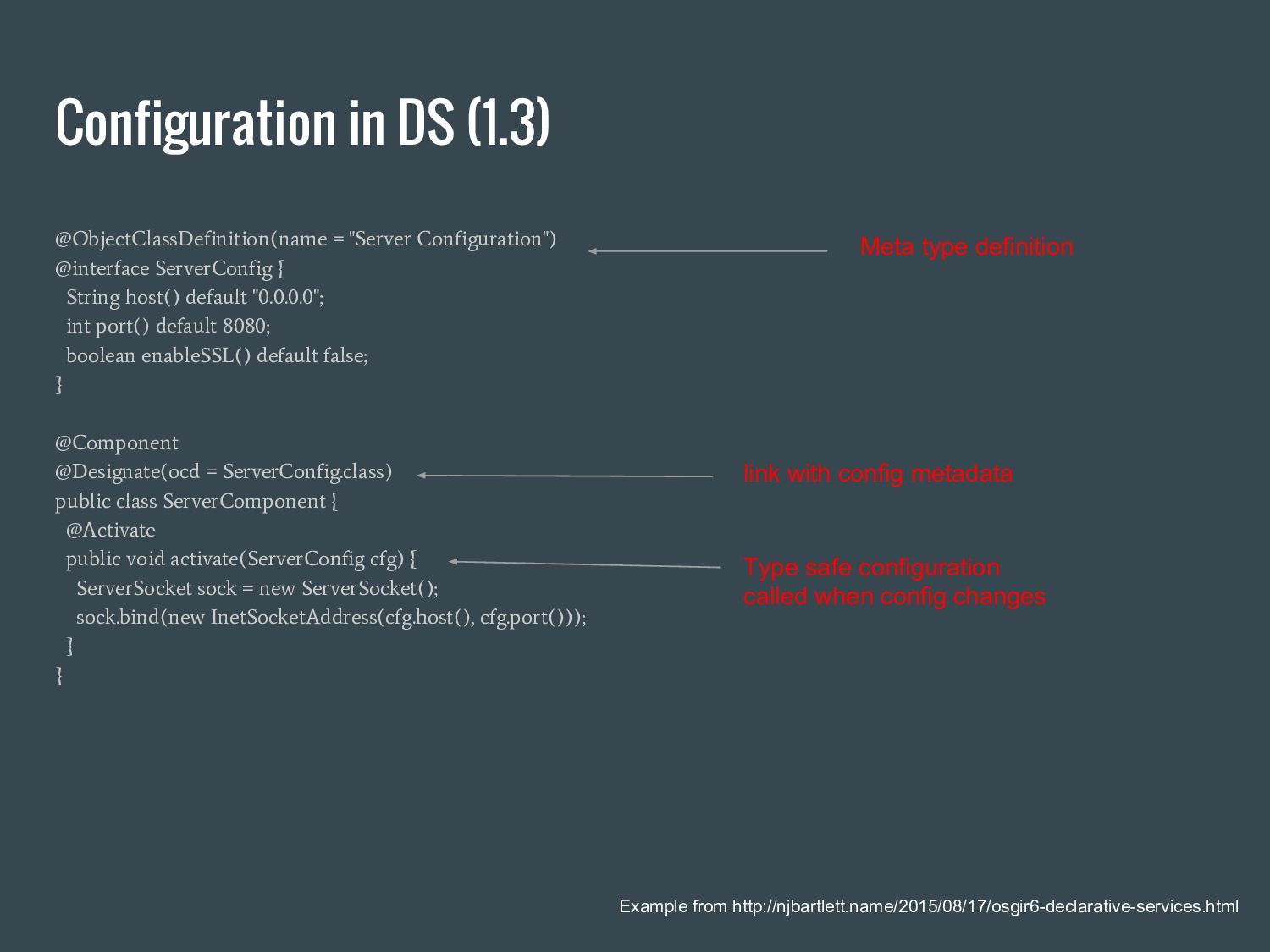
{ String host() default "0.0.0.0"; int port() default 8080; boolean enableSSL() default false; } @Component @Designate(ocd = ServerConfig.class) public class ServerComponent { @Activate public void activate(ServerConfig cfg) { ServerSocket sock = new ServerSocket(); sock.bind(new InetSocketAddress(cfg.host(), cfg.port())); } } Meta type definition Type safe configuration called when config changes link with config metadata Example from http://njbartlett.name/2015/08/17/osgir6-declarative-services.html
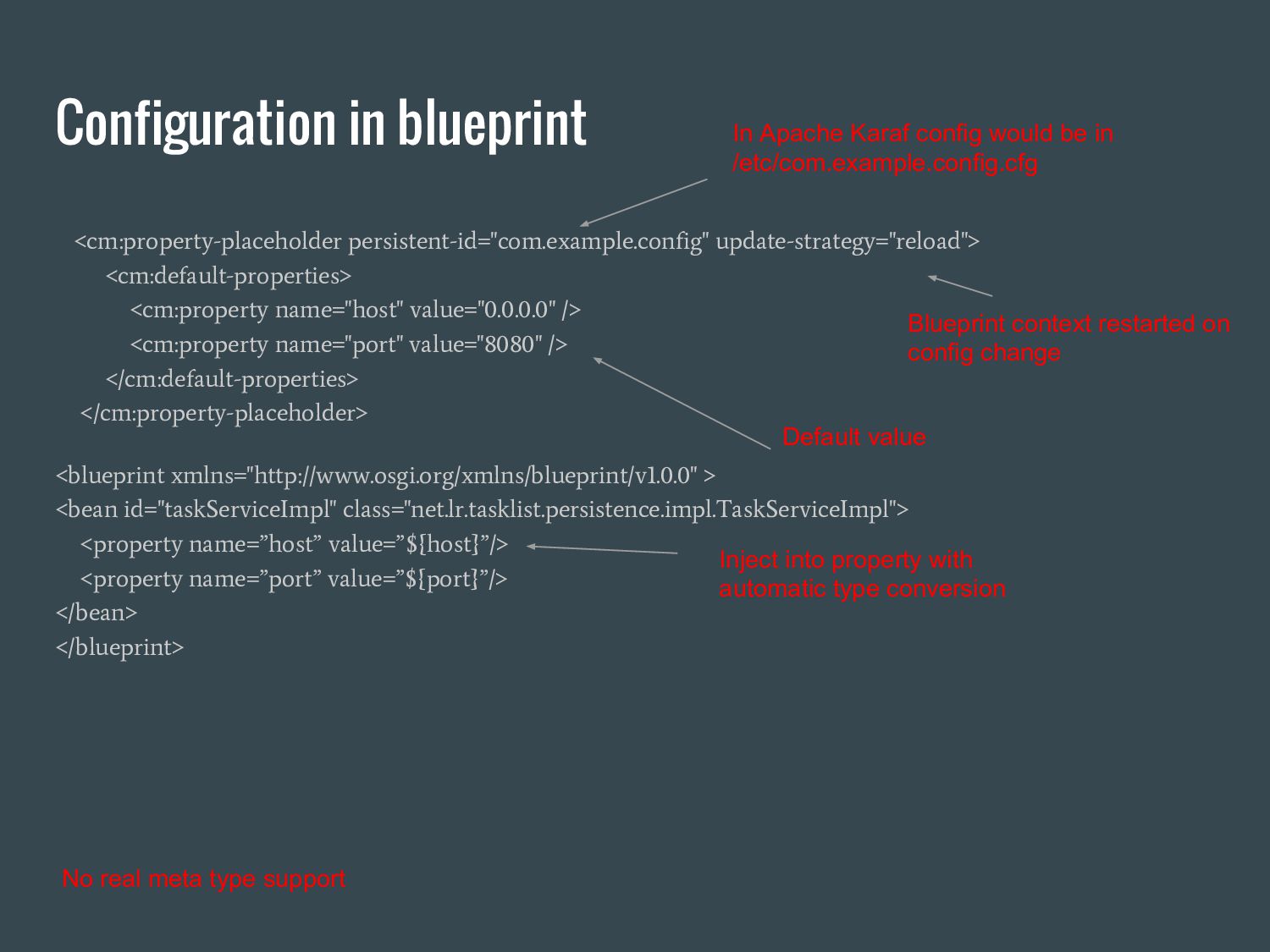
/> <cm:property name="port" value="8080" /> </cm:default-properties> </cm:property-placeholder> <blueprint xmlns="http://www.osgi.org/xmlns/blueprint/v1.0.0" > <bean id="taskServiceImpl" class="net.lr.tasklist.persistence.impl.TaskServiceImpl"> <property name=”host” value=”${host}”/> <property name=”port” value=”${port}”/> </bean> </blueprint> Default value In Apache Karaf config would be in /etc/com.example.config.cfg Blueprint context restarted on config change Inject into property with automatic type conversion No real meta type support
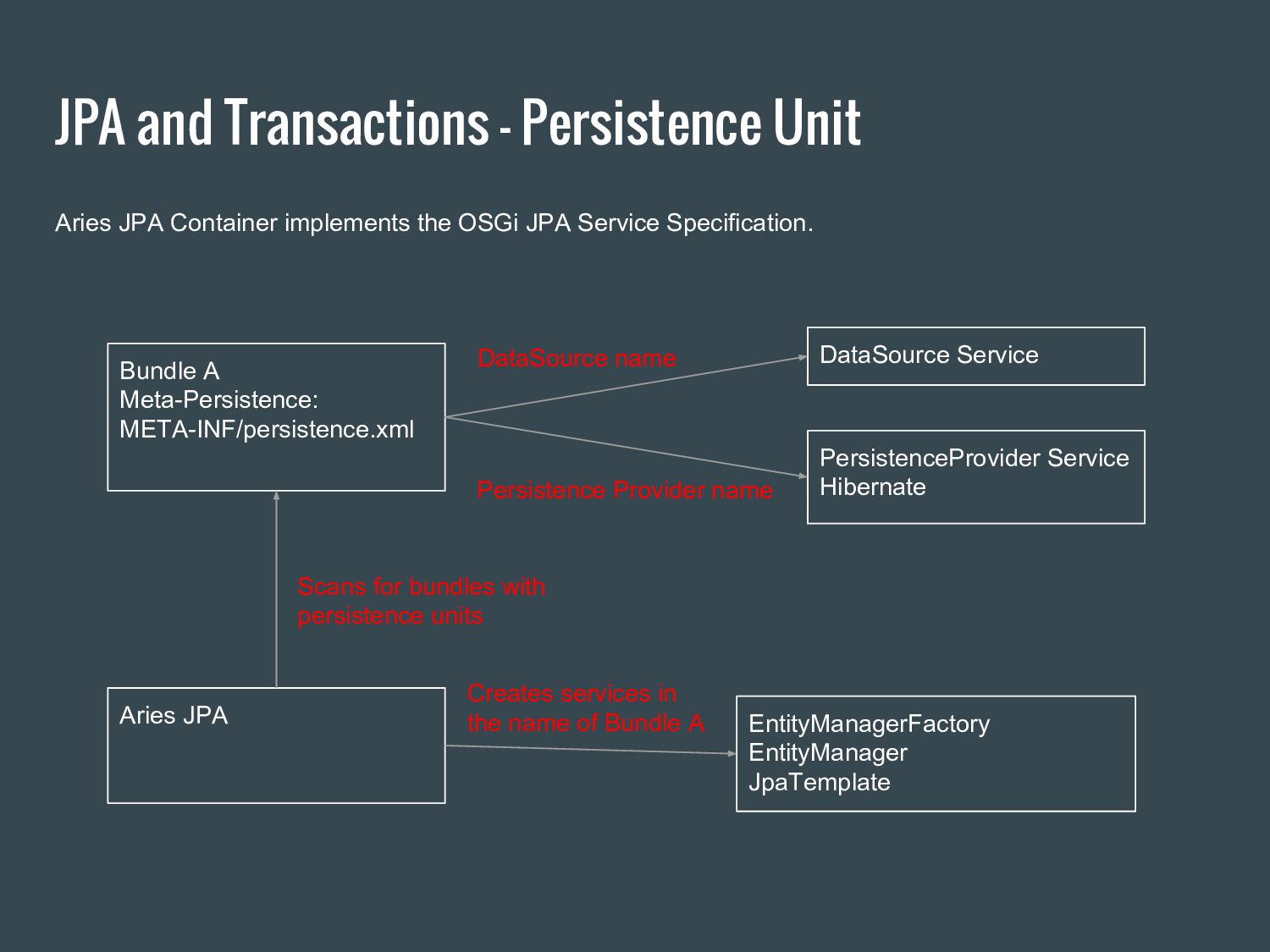
Aries JPA Scans for bundles with persistence units DataSource Service DataSource name EntityManagerFactory EntityManager JpaTemplate Creates services in the name of Bundle A Persistence Provider name PersistenceProvider Service Hibernate Aries JPA Container implements the OSGi JPA Service Specification.
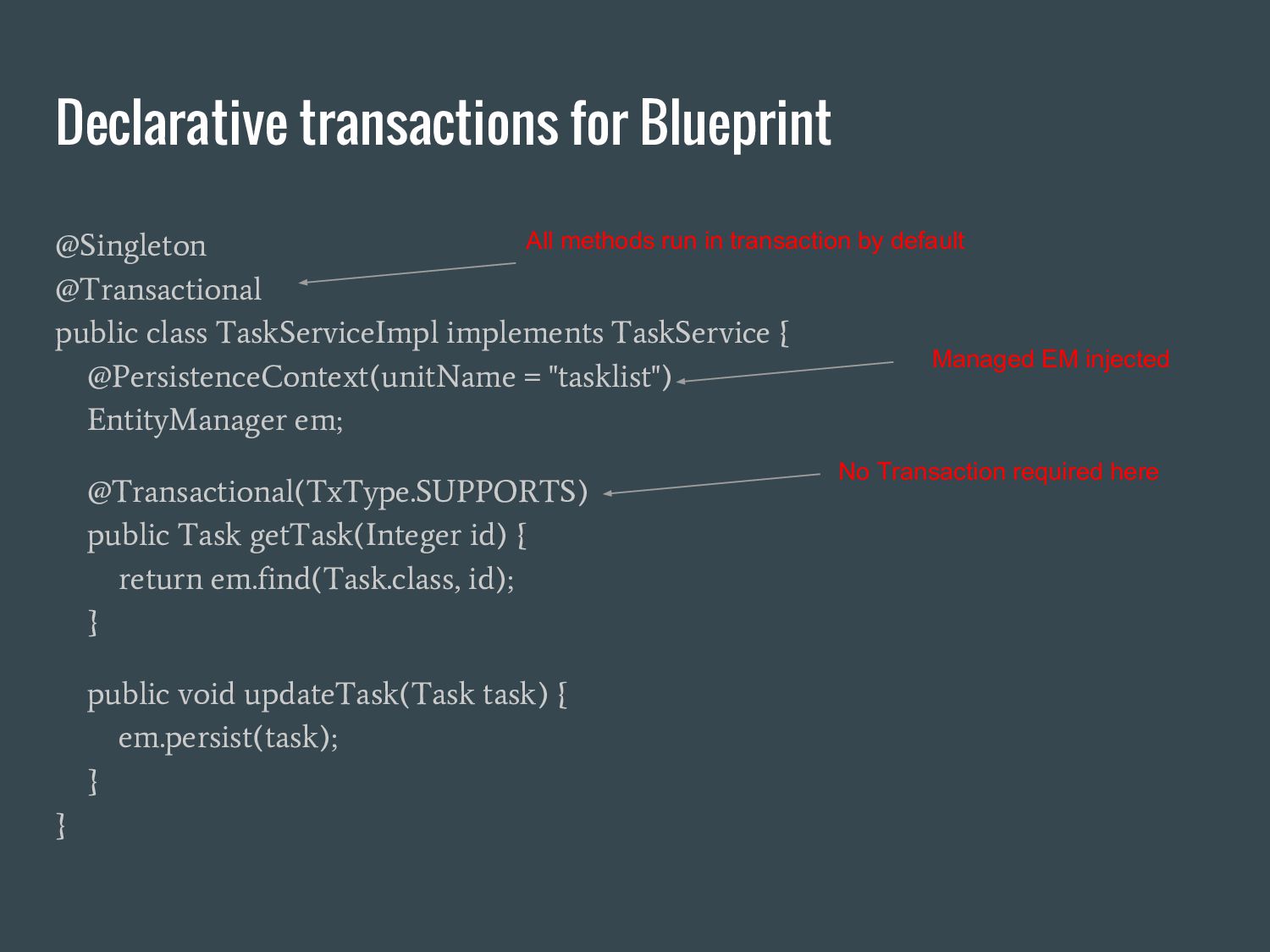
TaskService { @PersistenceContext(unitName = "tasklist") EntityManager em; @Transactional(TxType.SUPPORTS) public Task getTask(Integer id) { return em.find(Task.class, id); } public void updateTask(Task task) { em.persist(task); } } All methods run in transaction by default Managed EM injected No Transaction required here
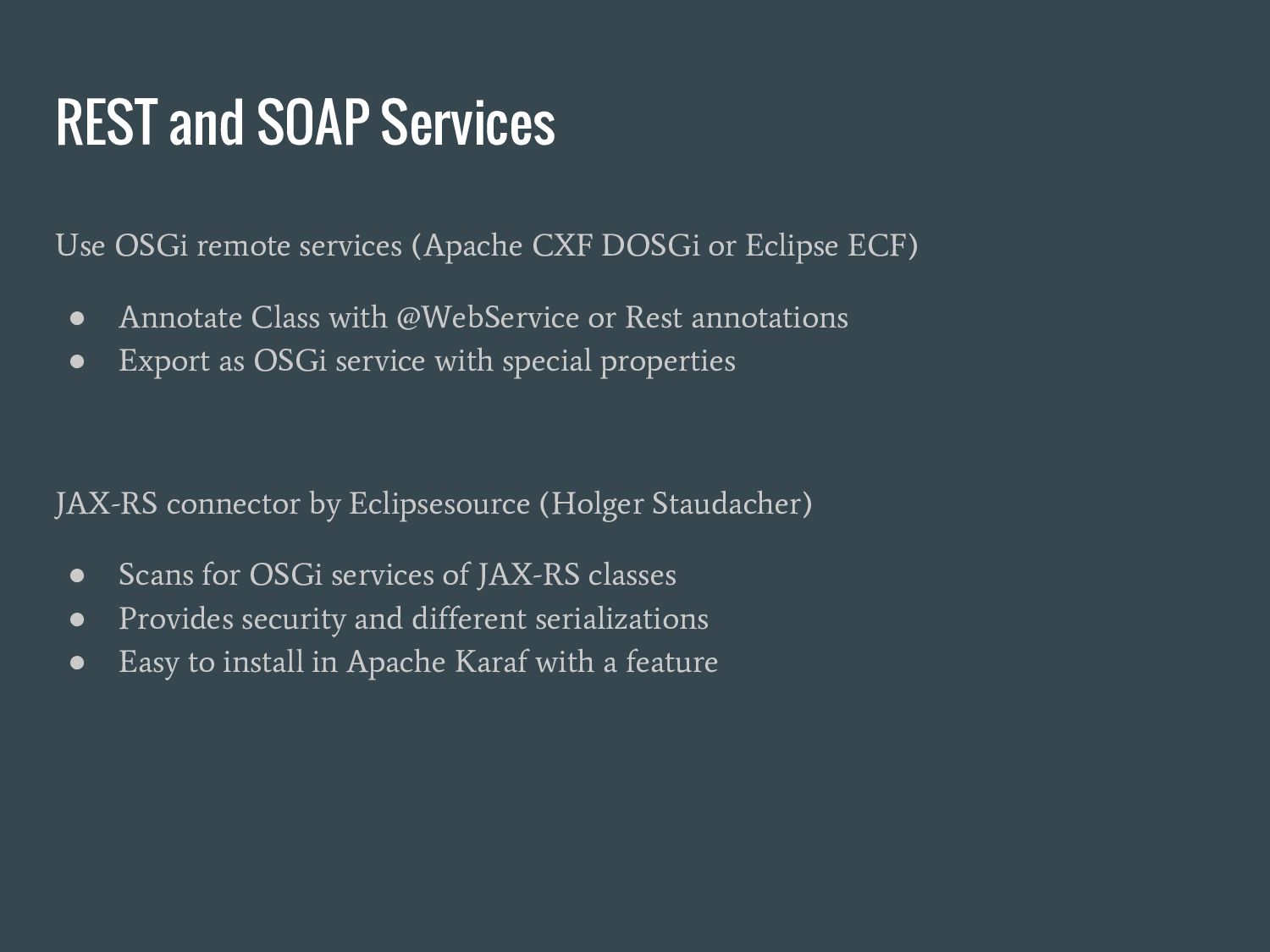
DOSGi or Eclipse ECF) • Annotate Class with @WebService or Rest annotations • Export as OSGi service with special properties JAX-RS connector by Eclipsesource (Holger Staudacher) • Scans for OSGi services of JAX-RS classes • Provides security and different serializations • Easy to install in Apache Karaf with a feature
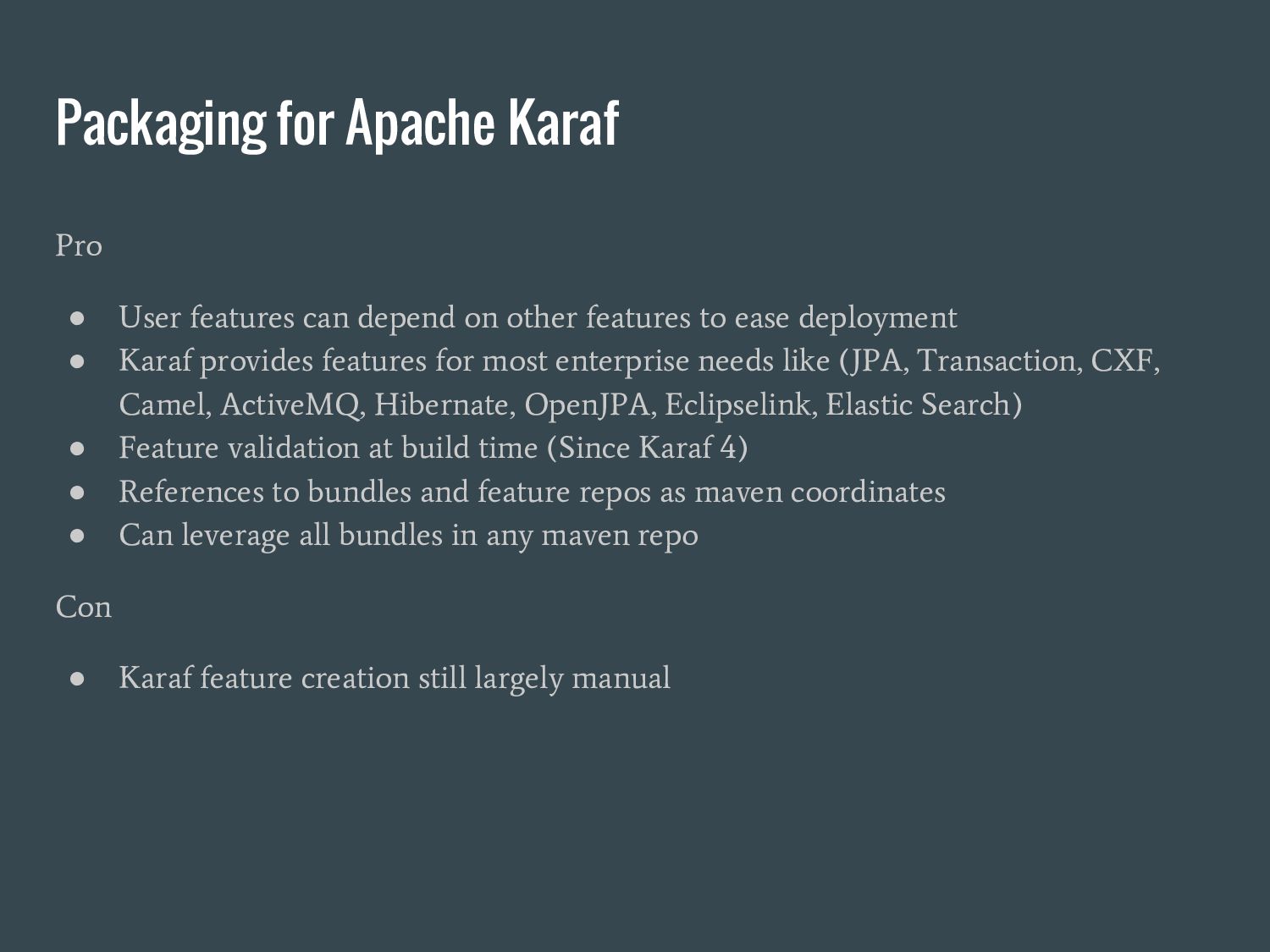
on other features to ease deployment • Karaf provides features for most enterprise needs like (JPA, Transaction, CXF, Camel, ActiveMQ, Hibernate, OpenJPA, Eclipselink, Elastic Search) • Feature validation at build time (Since Karaf 4) • References to bundles and feature repos as maven coordinates • Can leverage all bundles in any maven repo Con • Karaf feature creation still largely manual
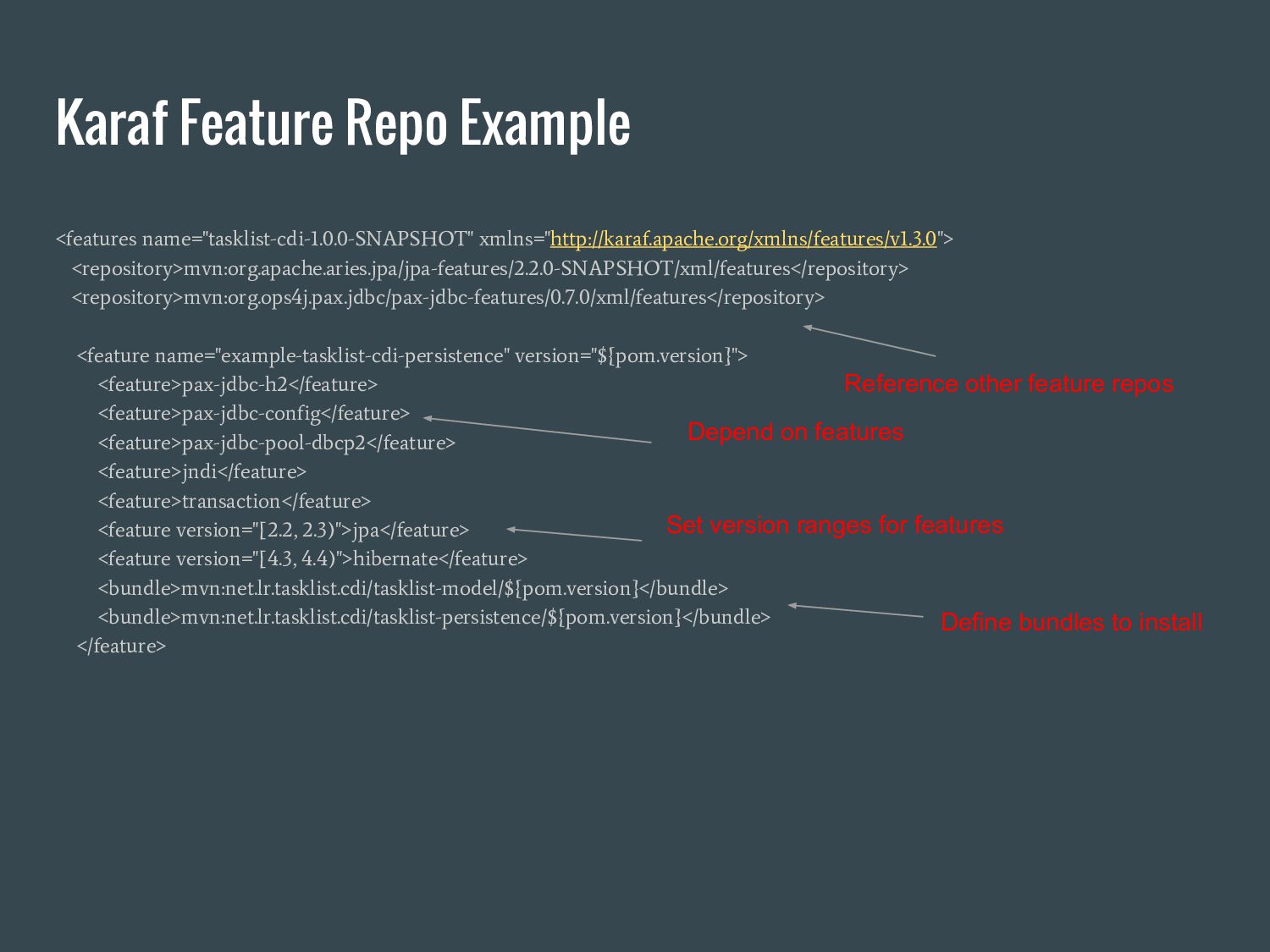
name="example-tasklist-cdi-persistence" version="${pom.version}"> <feature>pax-jdbc-h2</feature> <feature>pax-jdbc-config</feature> <feature>pax-jdbc-pool-dbcp2</feature> <feature>jndi</feature> <feature>transaction</feature> <feature version="[2.2, 2.3)">jpa</feature> <feature version="[4.3, 4.4)">hibernate</feature> <bundle>mvn:net.lr.tasklist.cdi/tasklist-model/${pom.version}</bundle> <bundle>mvn:net.lr.tasklist.cdi/tasklist-persistence/${pom.version}</bundle> </feature> Reference other feature repos Depend on features Set version ranges for features Define bundles to install
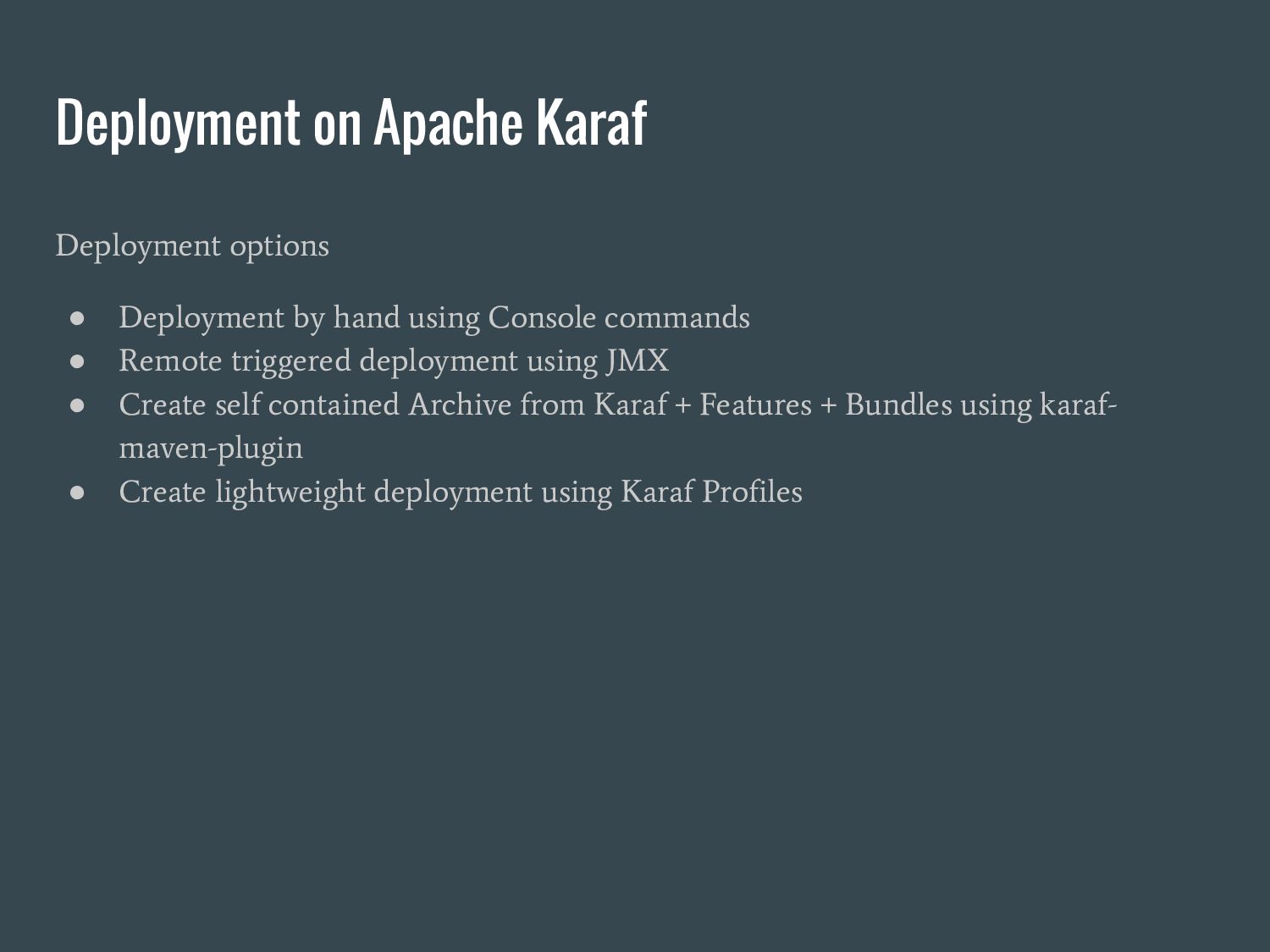
using Console commands • Remote triggered deployment using JMX • Create self contained Archive from Karaf + Features + Bundles using karaf- maven-plugin • Create lightweight deployment using Karaf Profiles
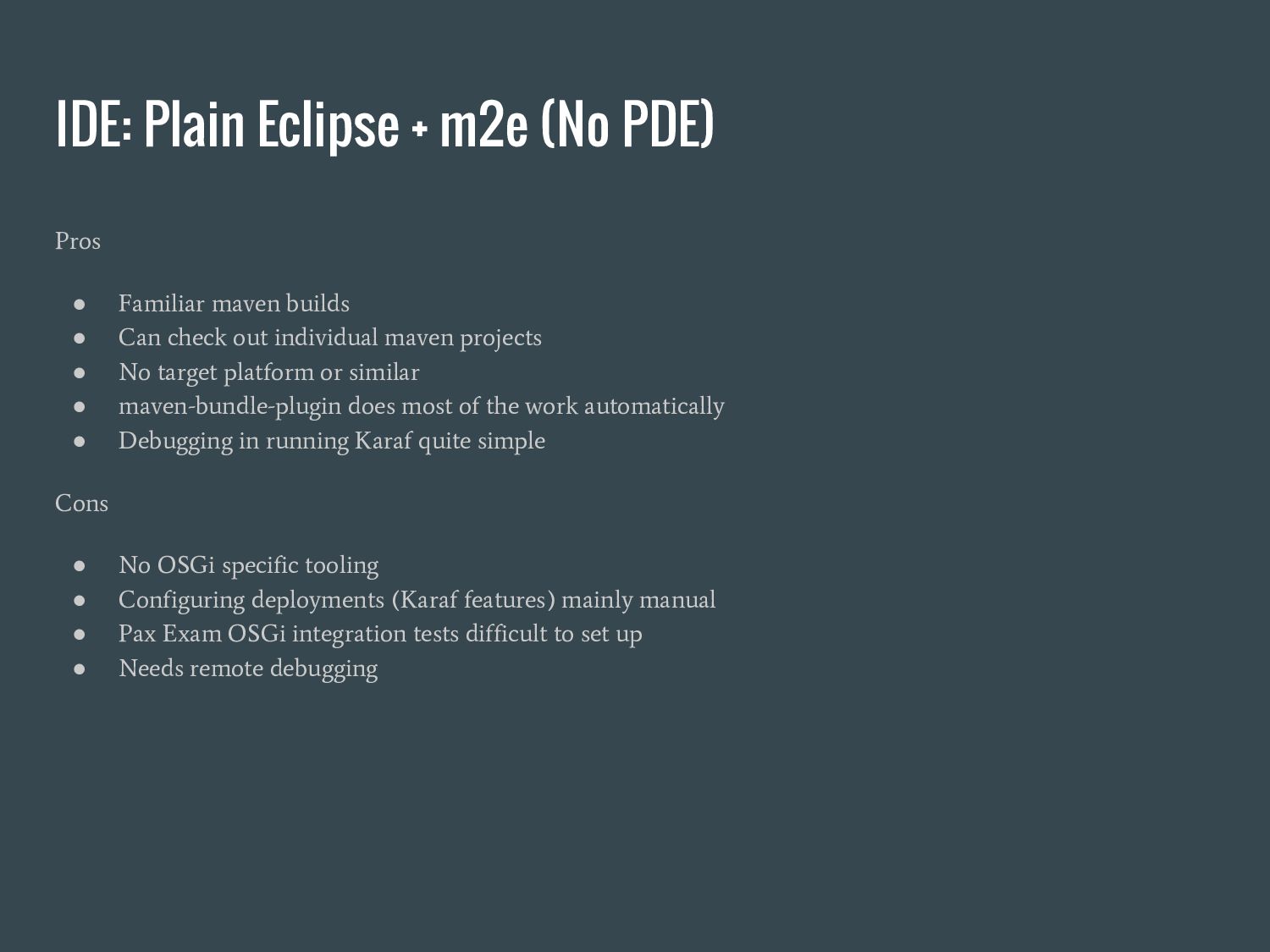
maven builds • Can check out individual maven projects • No target platform or similar • maven-bundle-plugin does most of the work automatically • Debugging in running Karaf quite simple Cons • No OSGi specific tooling • Configuring deployments (Karaf features) mainly manual • Pax Exam OSGi integration tests difficult to set up • Needs remote debugging
Code • Creation of OSGi indexes from maven dependencies • Better bndtools maven support in Version 3.1.0 • Karaf features based on requirements like in bndtools • Karaf boot: Simplified development / test / deployment lifecycle like in Spring boot
empty beans.xml in META-INF • Use CDI + JEE + pax-cdi Annotations • Annotations interpreted at runtime • Uses pax-cdi + Openwebbeans or Weld • Quite comprehensive support for CDI • JPA support planned using Apache Deltaspike (not yet working) • JSF not yet working • Lifecycle per context (bundle) • Service Damping like in Blueprint • Not yet fully mature
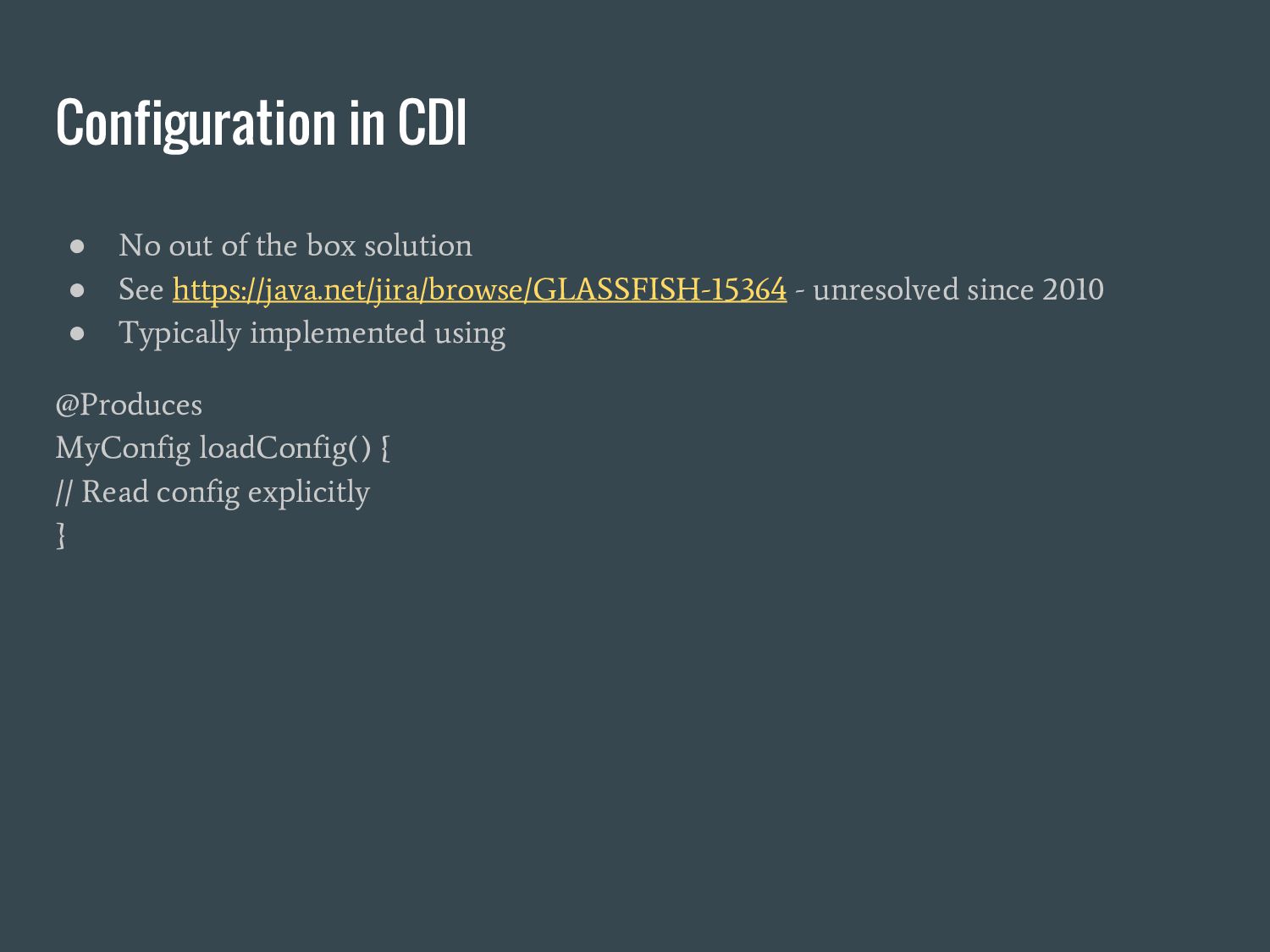
• See https://java.net/jira/browse/GLASSFISH-15364 - unresolved since 2010 • Typically implemented using @Produces MyConfig loadConfig() { // Read config explicitly }
indexes exist for the needed bundles • Fast incremental Builds • Tests and debugging easy. No remote debug Cons • OSGi ready repositories only cover very small subset of bundles in maven central • Very limited maven integration (Version 3.0.0)


 cschneider1
 y0hgi
 skydoves
 yukiny
 iwiwi
 sorah
 prota
 yub0n
 kinopeee
 takai
 morizo_1984
 artoy
 syumai
 aleyda
 codingconduct
 smashingmag
 addyosmani
 keavy
 reverentgeek
 schlessera
 inesmontani
 honnibal
 garrettdimon