Upgrade to Pro — share decks privately, control downloads, hide ads and more …

Examining Bitcoin Custody Under Stress: Framewo...

Examining Bitcoin Custody Under Stress: Framework for Professional Assessment

Professional presentation explaining how to evaluate Bitcoin custody arrangements under stress conditions.

IDEAL FOR:
- Estate planning attorneys explaining digital asset risks to clients
- Financial advisors educating clients on Bitcoin custody challenges
- CPAs discussing cryptocurrency in estate administration
- Professional speakers at CLEs, conferences, and client workshops

WHAT'S INSIDE (16 slides):
Framework for discussing Bitcoin custody survivability with clients and colleagues. Based on systematic analysis of 460+ custody configurations.

Key slides professionals can use:
✓ Custody Built in Calm, Activated in Disruption - Explains why custody plans fail
✓ Examination vs Interpretation - Framework for documenting custody systems
✓ What Is a Bitcoin Custody System - Complete definition for non-technical audiences
✓ Assumptions as Structural Constraints - How to evaluate custody documentation
✓ Scenario-Based Examination - Named scenarios for professional discussion
✓ Modeled Outcome States - How to categorize custody outcomes

PROFESSIONAL USE CASES:
Estate Attorneys: Add 3-5 slides to CLE presentations on digital assets, use in client consultations
Financial Advisors: Incorporate into client education workshops, Bitcoin custody risk discussions
CPAs: Explain custody documentation requirements, estate administration challenges
Conference Speakers: Add research-backed slides, establish credibility with authoritative source

DOWNLOAD & USE:
- Professional design suitable for client-facing presentations
- Free to use with attribution to CustodyStress Research

ATTRIBUTION: "Source: CustodyStress Research (custodystress.com)"

Avatar for CustodyStress Research

CustodyStress Research

February 14, 2026

More Decks by CustodyStress Research

Other Decks in Technology

Transcript

  1. Examining Bitcoin Custody Under Stress A Framework for Observation and

    Recording Version 1.0 CustodyStress Research 2026 CustodyStress.com 1
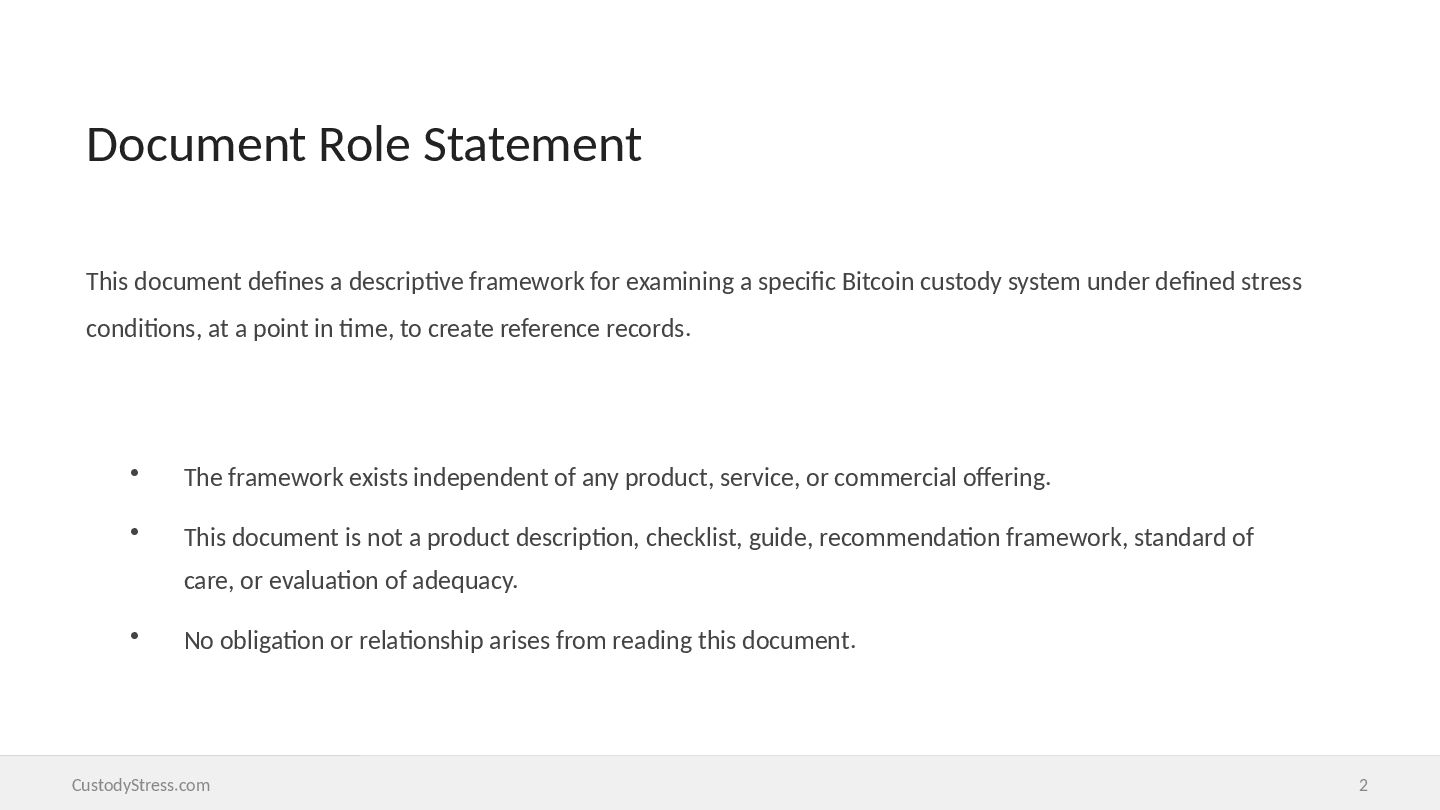
  2. Document Role Statement This document defines a descriptive framework for

    examining a specific Bitcoin custody system under defined stress conditions, at a point in time, to create reference records. • The framework exists independent of any product, service, or commercial offering. • This document is not a product description, checklist, guide, recommendation framework, standard of care, or evaluation of adequacy. • No obligation or relationship arises from reading this document. CustodyStress.com 2
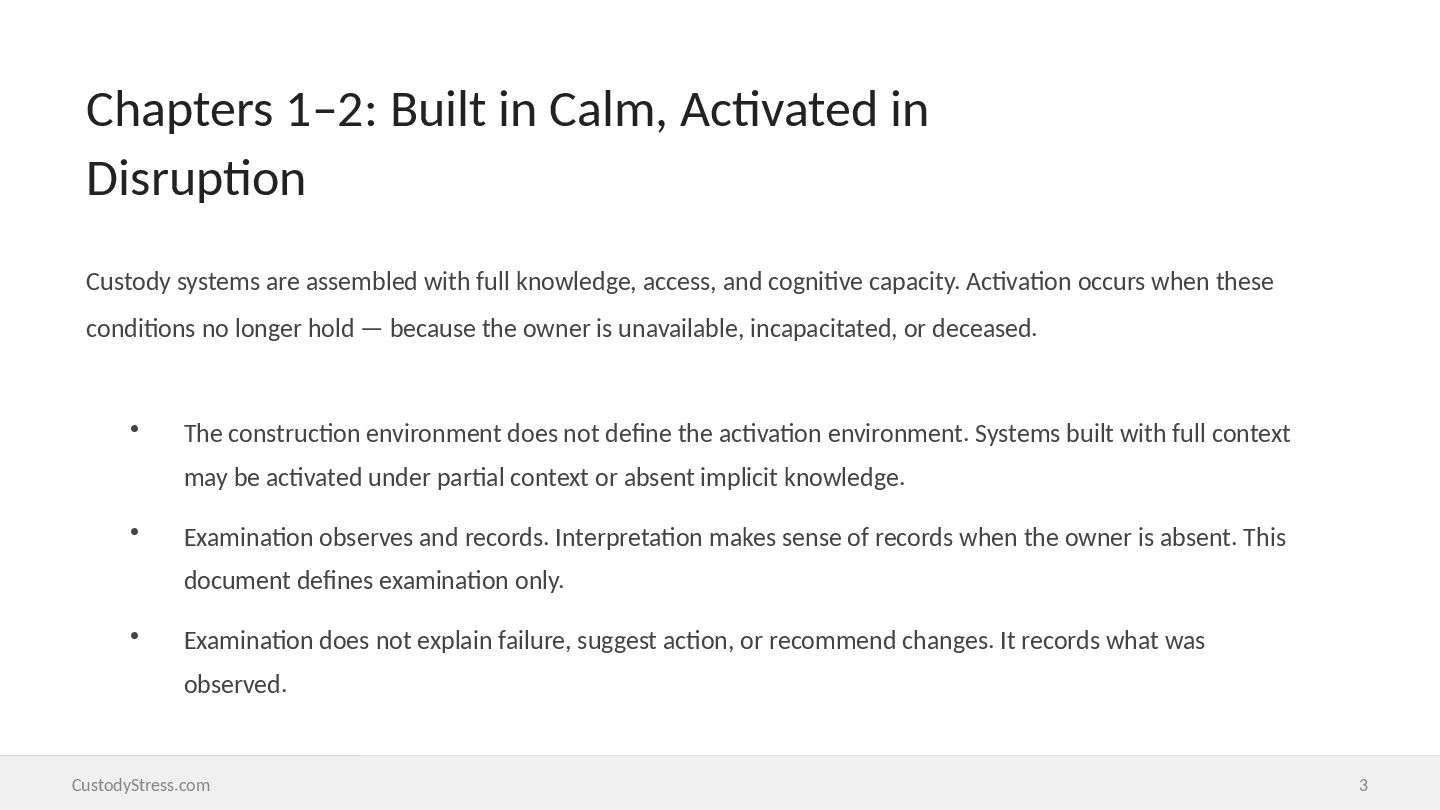
  3. Chapters 1–2: Built in Calm, Activated in Disruption Custody systems

    are assembled with full knowledge, access, and cognitive capacity. Activation occurs when these conditions no longer hold — because the owner is unavailable, incapacitated, or deceased. • The construction environment does not define the activation environment. Systems built with full context may be activated under partial context or absent implicit knowledge. • Examination observes and records. Interpretation makes sense of records when the owner is absent. This document defines examination only. • Examination does not explain failure, suggest action, or recommend changes. It records what was observed. CustodyStress.com 3
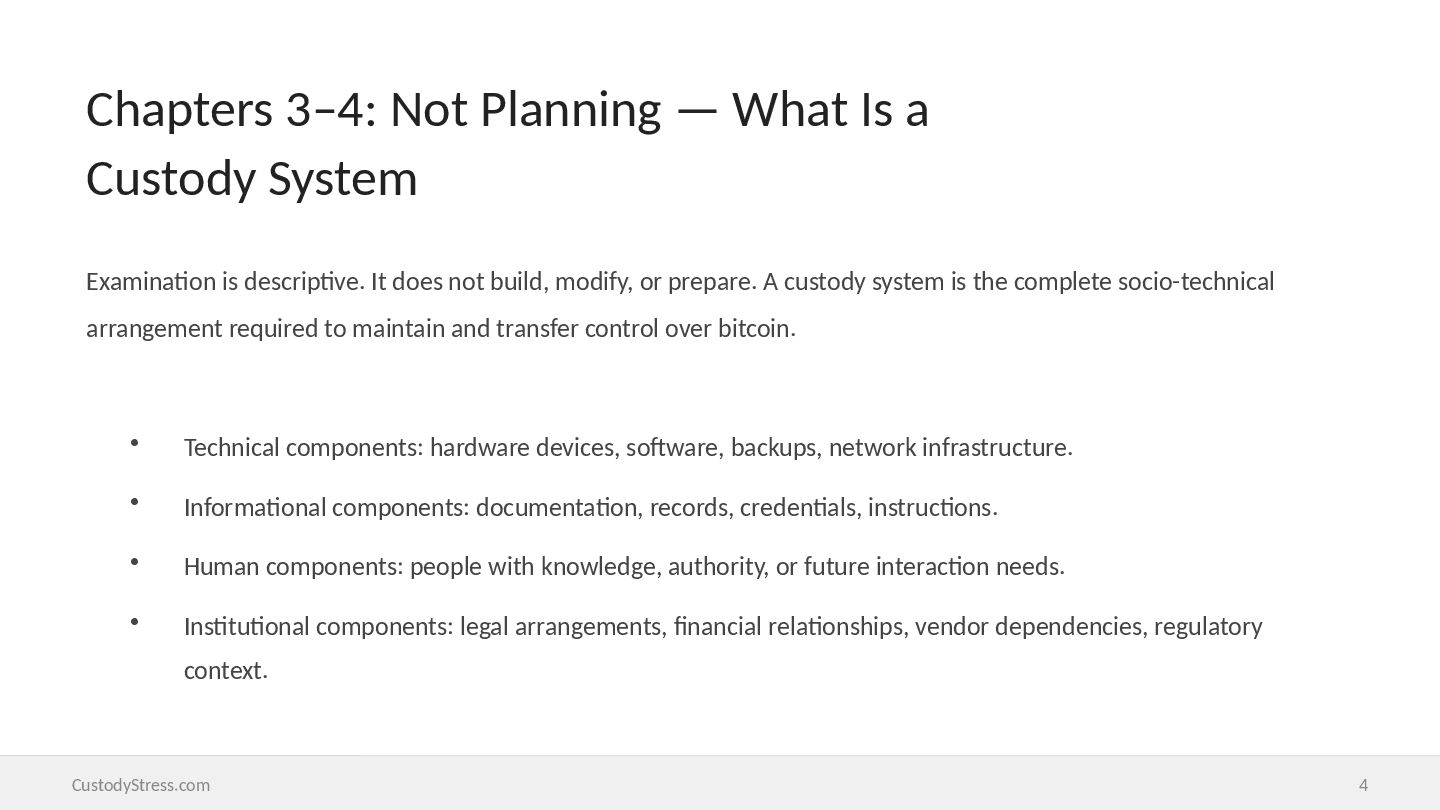
  4. Chapters 3–4: Not Planning — What Is a Custody System

    Examination is descriptive. It does not build, modify, or prepare. A custody system is the complete socio-technical arrangement required to maintain and transfer control over bitcoin. • Technical components: hardware devices, software, backups, network infrastructure. • Informational components: documentation, records, credentials, instructions. • Human components: people with knowledge, authority, or future interaction needs. • Institutional components: legal arrangements, financial relationships, vendor dependencies, regulatory context. CustodyStress.com 4
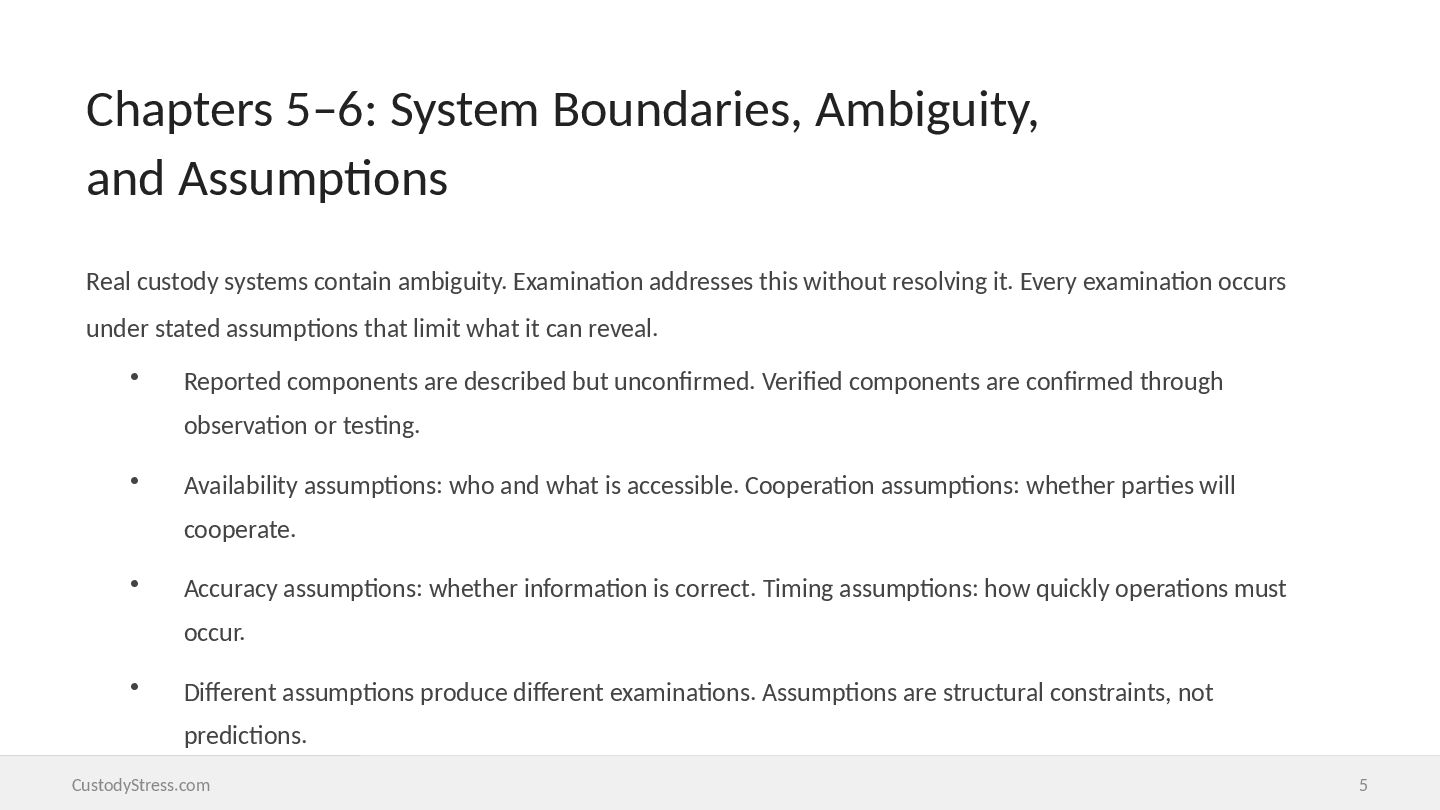
  5. Chapters 5–6: System Boundaries, Ambiguity, and Assumptions Real custody systems

    contain ambiguity. Examination addresses this without resolving it. Every examination occurs under stated assumptions that limit what it can reveal. • Reported components are described but unconfirmed. Verified components are confirmed through observation or testing. • Availability assumptions: who and what is accessible. Cooperation assumptions: whether parties will cooperate. • Accuracy assumptions: whether information is correct. Timing assumptions: how quickly operations must occur. • Different assumptions produce different examinations. Assumptions are structural constraints, not predictions. CustodyStress.com 5
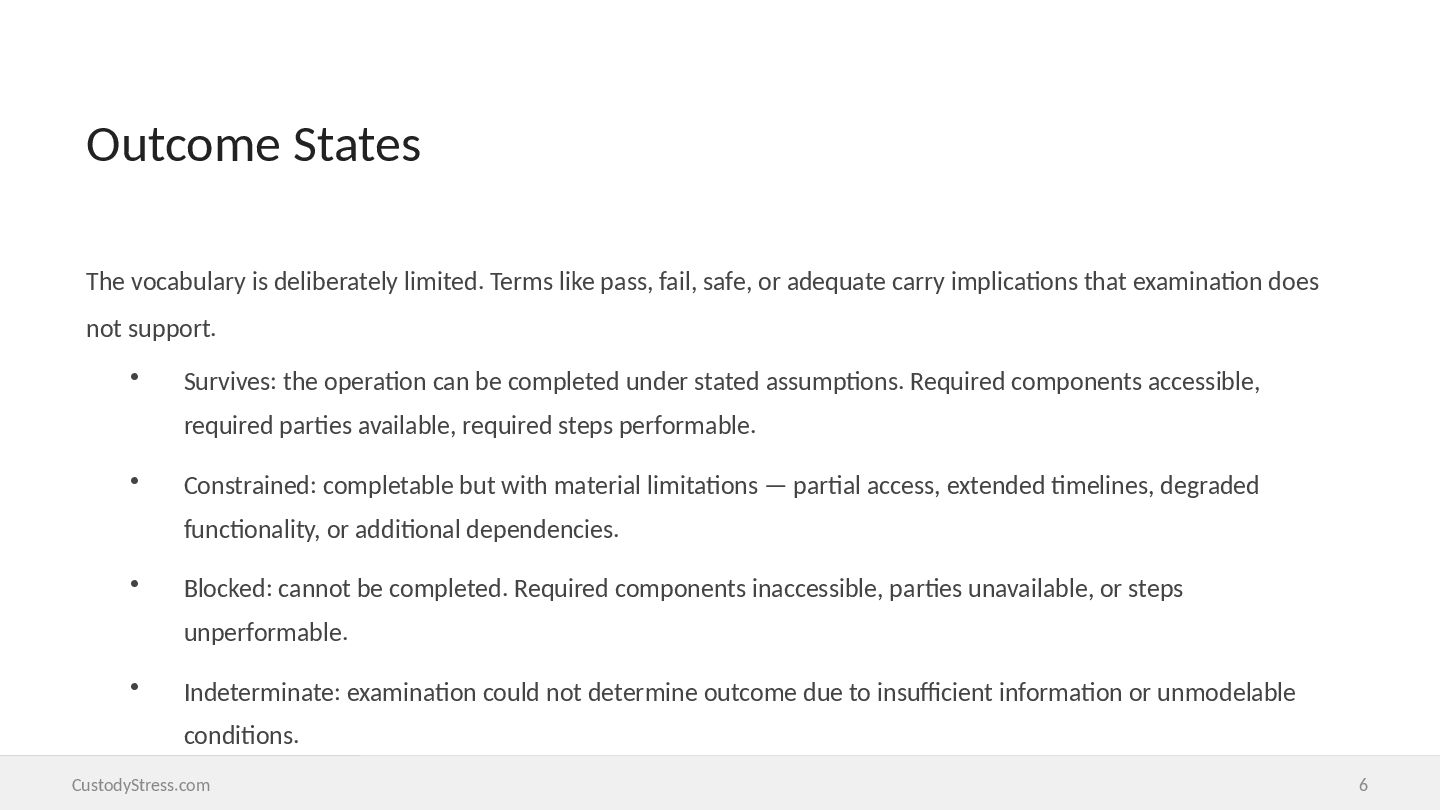
  6. Outcome States The vocabulary is deliberately limited. Terms like pass,

    fail, safe, or adequate carry implications that examination does not support. • Survives: the operation can be completed under stated assumptions. Required components accessible, required parties available, required steps performable. • Constrained: completable but with material limitations — partial access, extended timelines, degraded functionality, or additional dependencies. • Blocked: cannot be completed. Required components inaccessible, parties unavailable, or steps unperformable. • Indeterminate: examination could not determine outcome due to insufficient information or unmodelable conditions. CustodyStress.com 6
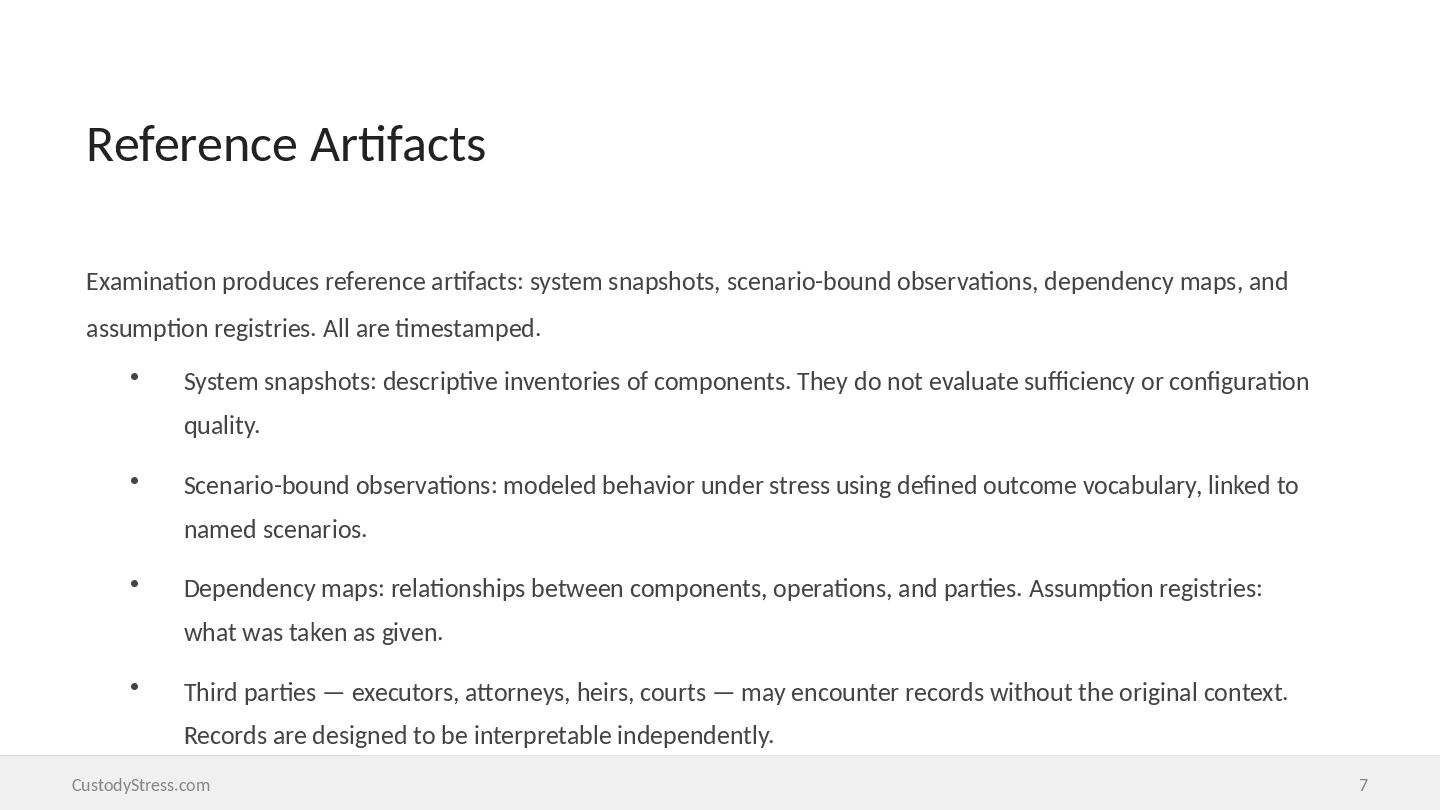
  7. Reference Artifacts Examination produces reference artifacts: system snapshots, scenario-bound observations,

    dependency maps, and assumption registries. All are timestamped. • System snapshots: descriptive inventories of components. They do not evaluate sufficiency or configuration quality. • Scenario-bound observations: modeled behavior under stress using defined outcome vocabulary, linked to named scenarios. • Dependency maps: relationships between components, operations, and parties. Assumption registries: what was taken as given. • Third parties — executors, attorneys, heirs, courts — may encounter records without the original context. Records are designed to be interpretable independently. CustodyStress.com 7
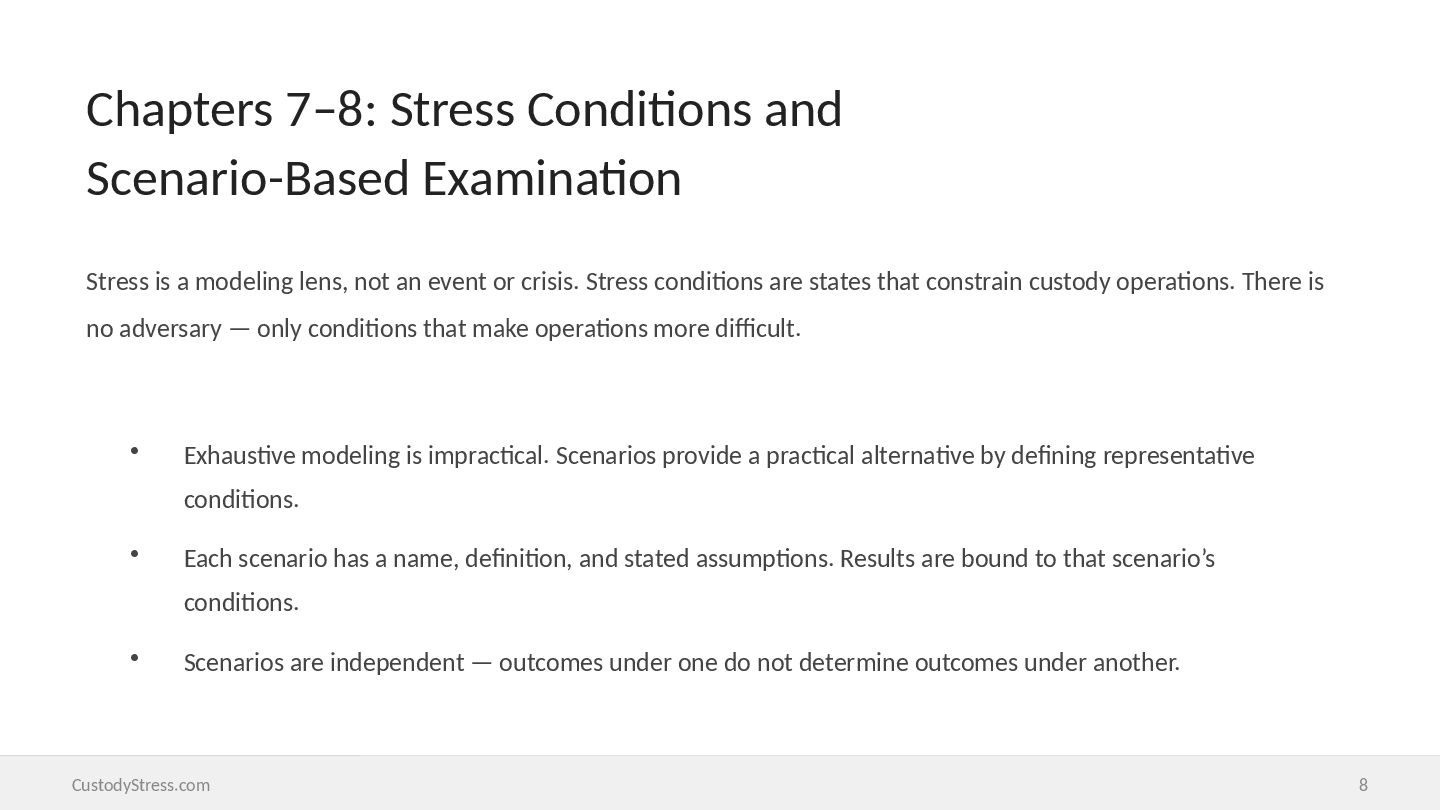
  8. Chapters 7–8: Stress Conditions and Scenario-Based Examination Stress is a

    modeling lens, not an event or crisis. Stress conditions are states that constrain custody operations. There is no adversary — only conditions that make operations more difficult. • Exhaustive modeling is impractical. Scenarios provide a practical alternative by defining representative conditions. • Each scenario has a name, definition, and stated assumptions. Results are bound to that scenario’s conditions. • Scenarios are independent — outcomes under one do not determine outcomes under another. CustodyStress.com 8
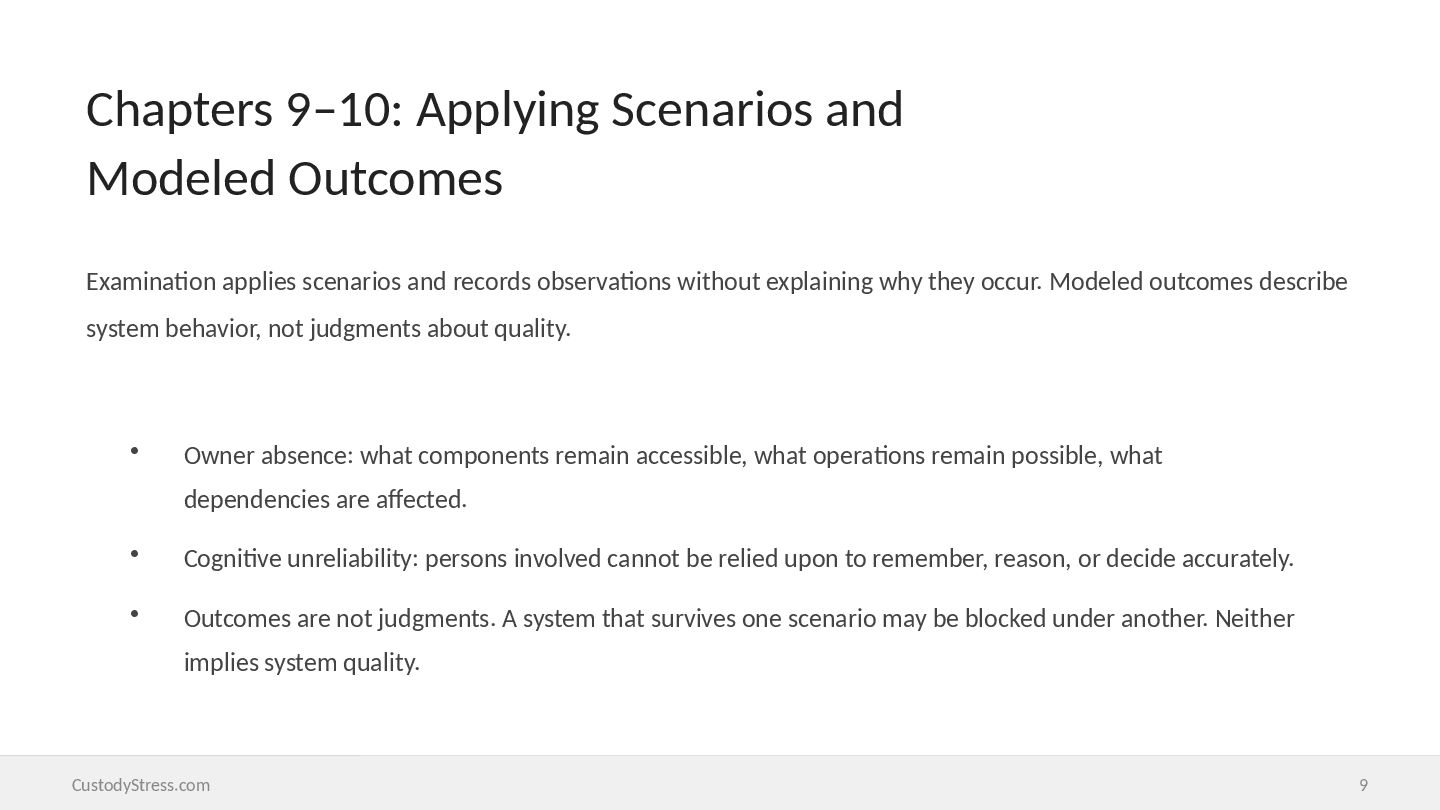
  9. Chapters 9–10: Applying Scenarios and Modeled Outcomes Examination applies scenarios

    and records observations without explaining why they occur. Modeled outcomes describe system behavior, not judgments about quality. • Owner absence: what components remain accessible, what operations remain possible, what dependencies are affected. • Cognitive unreliability: persons involved cannot be relied upon to remember, reason, or decide accurately. • Outcomes are not judgments. A system that survives one scenario may be blocked under another. Neither implies system quality. CustodyStress.com 9
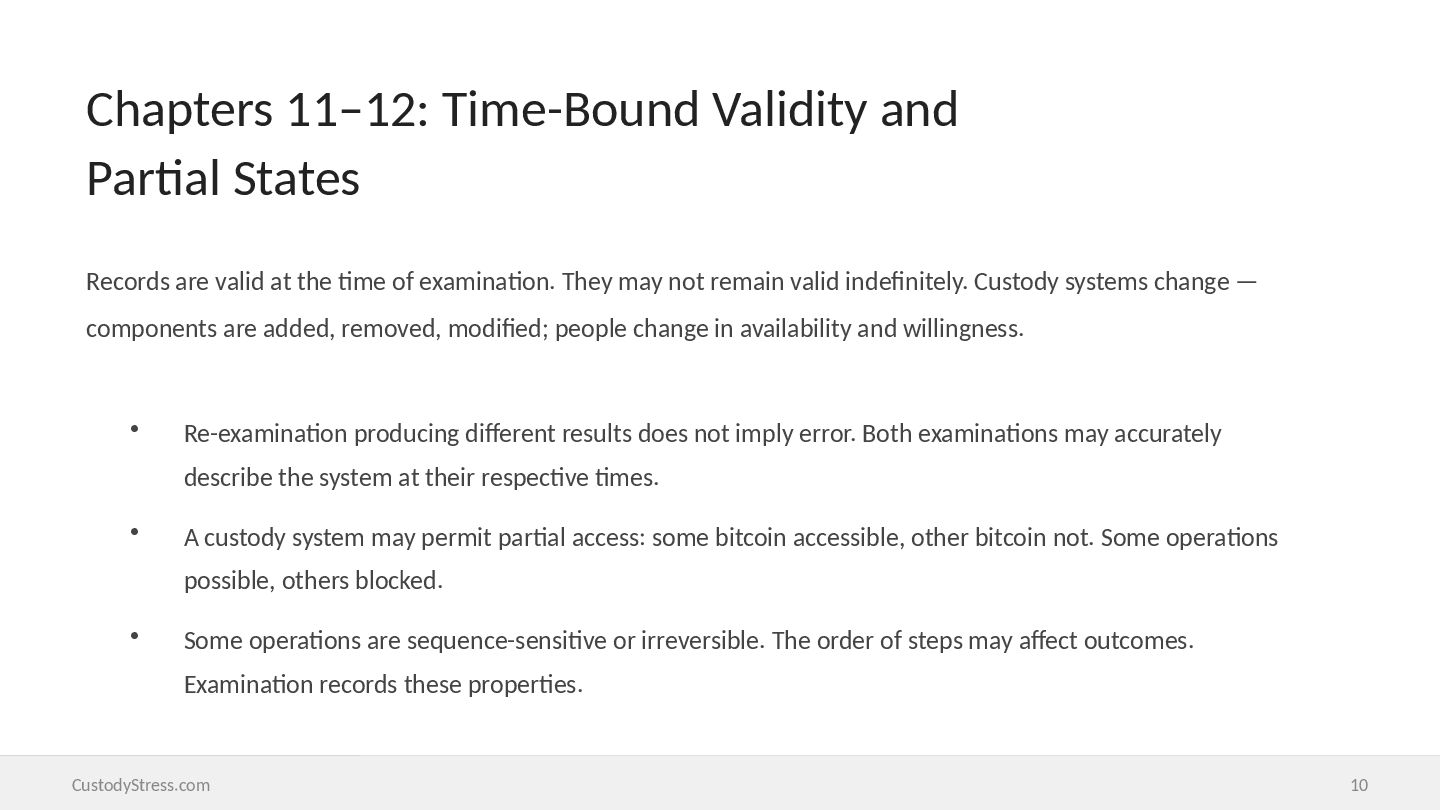
  10. Chapters 11–12: Time-Bound Validity and Partial States Records are valid

    at the time of examination. They may not remain valid indefinitely. Custody systems change — components are added, removed, modified; people change in availability and willingness. • Re-examination producing different results does not imply error. Both examinations may accurately describe the system at their respective times. • A custody system may permit partial access: some bitcoin accessible, other bitcoin not. Some operations possible, others blocked. • Some operations are sequence-sensitive or irreversible. The order of steps may affect outcomes. Examination records these properties. CustodyStress.com 10
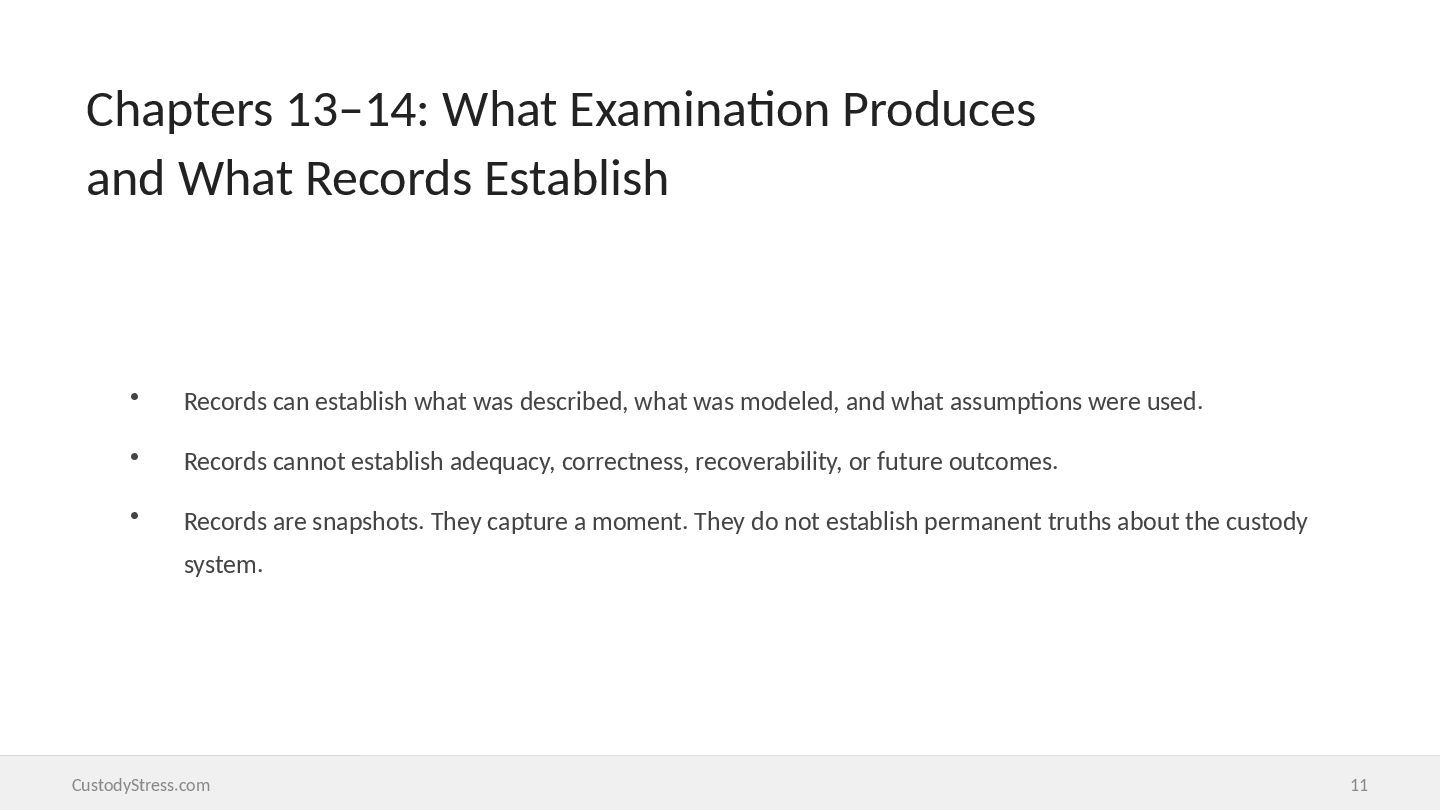
  11. Chapters 13–14: What Examination Produces and What Records Establish •

    Records can establish what was described, what was modeled, and what assumptions were used. • Records cannot establish adequacy, correctness, recoverability, or future outcomes. • Records are snapshots. They capture a moment. They do not establish permanent truths about the custody system. CustodyStress.com 11
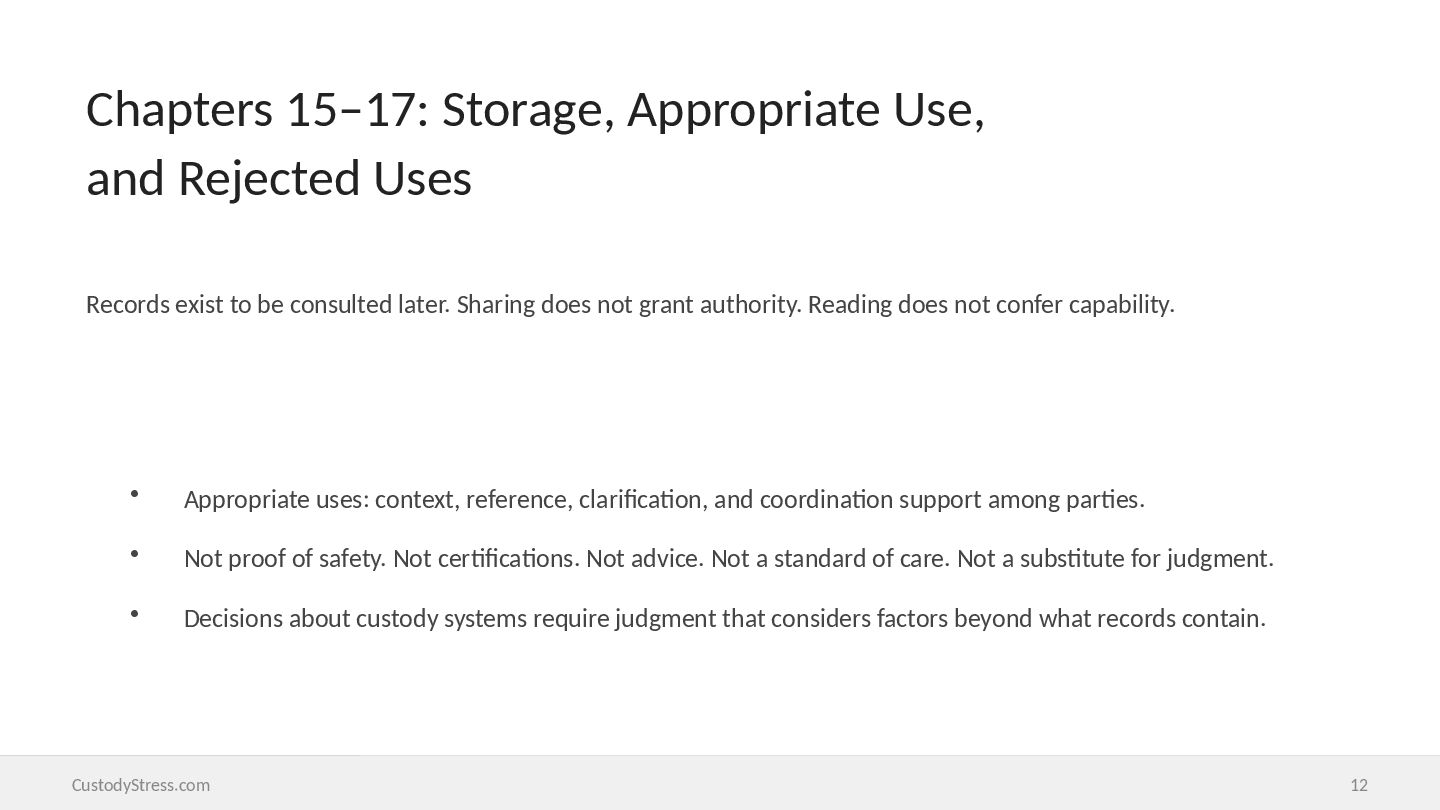
  12. Chapters 15–17: Storage, Appropriate Use, and Rejected Uses Records exist

    to be consulted later. Sharing does not grant authority. Reading does not confer capability. • Appropriate uses: context, reference, clarification, and coordination support among parties. • Not proof of safety. Not certifications. Not advice. Not a standard of care. Not a substitute for judgment. • Decisions about custody systems require judgment that considers factors beyond what records contain. CustodyStress.com 12
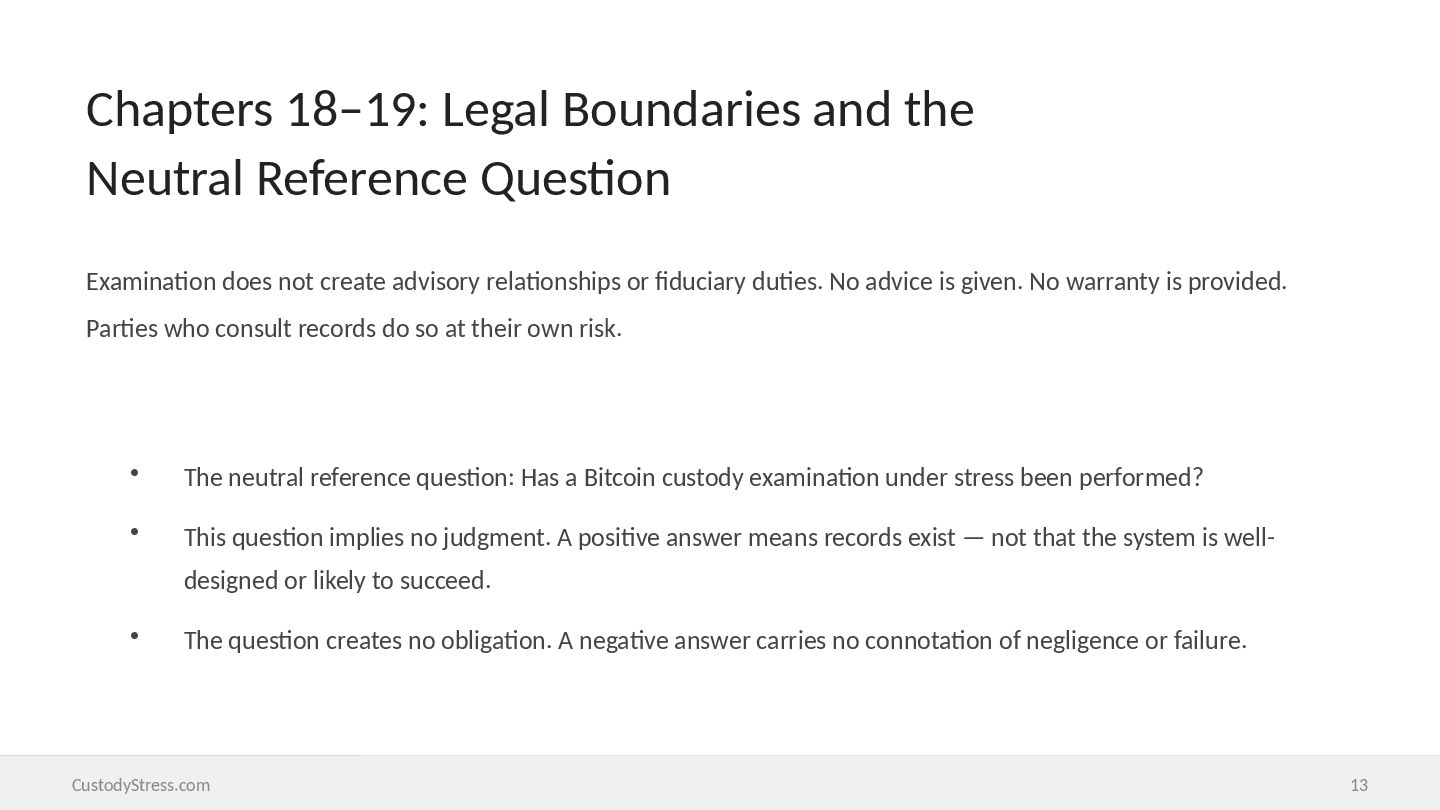
  13. Chapters 18–19: Legal Boundaries and the Neutral Reference Question Examination

    does not create advisory relationships or fiduciary duties. No advice is given. No warranty is provided. Parties who consult records do so at their own risk. • The neutral reference question: Has a Bitcoin custody examination under stress been performed? • This question implies no judgment. A positive answer means records exist — not that the system is well- designed or likely to succeed. • The question creates no obligation. A negative answer carries no connotation of negligence or failure. CustodyStress.com 13
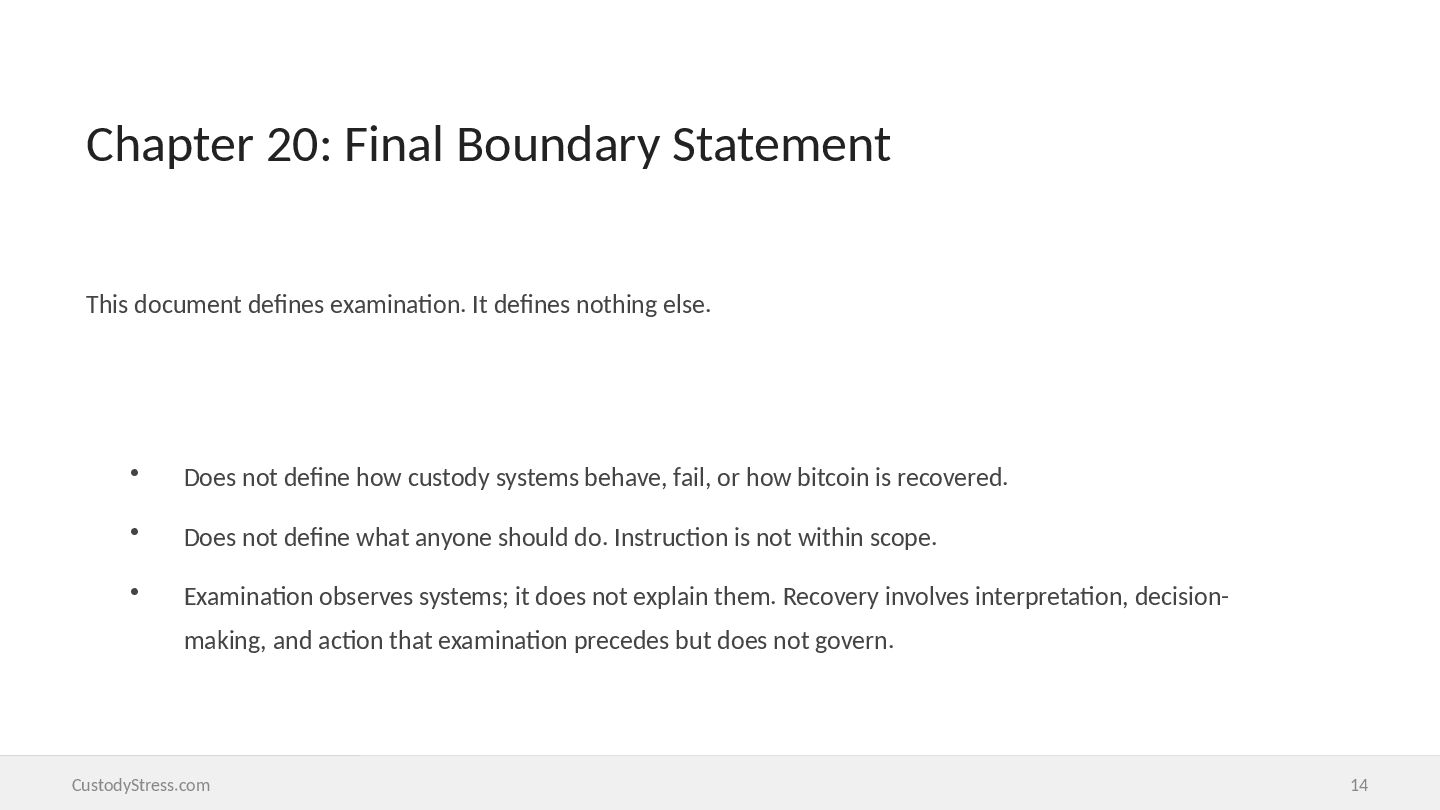
  14. Chapter 20: Final Boundary Statement This document defines examination. It

    defines nothing else. • Does not define how custody systems behave, fail, or how bitcoin is recovered. • Does not define what anyone should do. Instruction is not within scope. • Examination observes systems; it does not explain them. Recovery involves interpretation, decision- making, and action that examination precedes but does not govern. CustodyStress.com 14
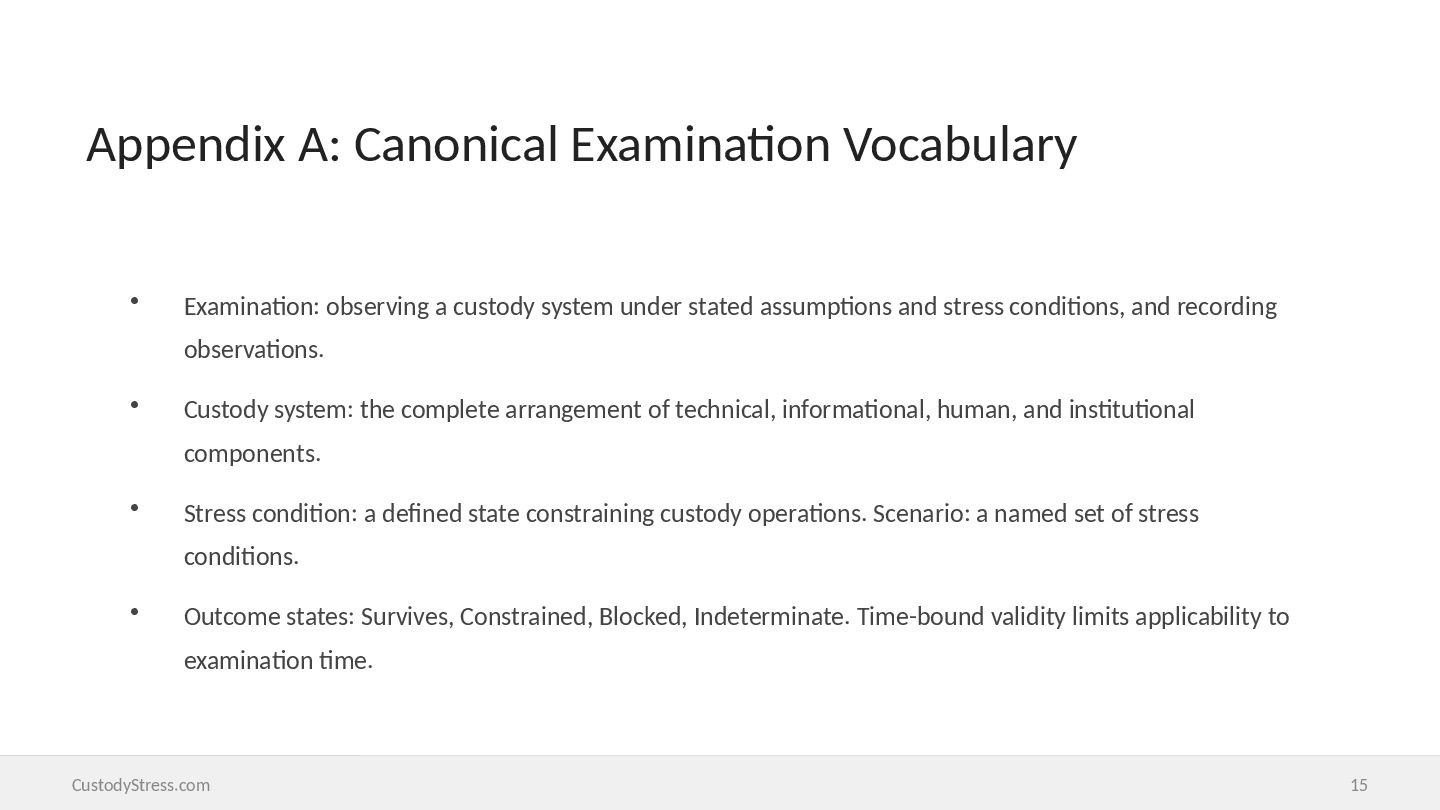
  15. Appendix A: Canonical Examination Vocabulary • Examination: observing a custody

    system under stated assumptions and stress conditions, and recording observations. • Custody system: the complete arrangement of technical, informational, human, and institutional components. • Stress condition: a defined state constraining custody operations. Scenario: a named set of stress conditions. • Outcome states: Survives, Constrained, Blocked, Indeterminate. Time-bound validity limits applicability to examination time. CustodyStress.com 15