Upgrade to Pro — share decks privately, control downloads, hide ads and more …

Bitcoin Custody Failure Modes: Professional Gui...

Bitcoin Custody Failure Modes: Professional Guide to Common Vulnerabilities

Professional presentation identifying how Bitcoin custody arrangements fail under real-world stress conditions.

IDEAL FOR:
- Estate planning attorneys counseling clients on Bitcoin inheritance
- Financial advisors evaluating custody risk for clients
- Trust officers reviewing digital asset custody plans
- Professional speakers explaining Bitcoin custody challenges

WHAT'S INSIDE (16 slides):
Professional taxonomy of Bitcoin custody failure modes. Perfect for explaining custody vulnerabilities to clients and colleagues. Based on analysis of 460+ custody configurations.

Key slides professionals can use:
✓ Authority Does Not Equal Access - Critical gap attorneys must address
✓ Survivability Is Not Security - Explains why secure ≠ recoverable
✓ Documentation Without Usability - Common estate planning failure
✓ Time as Active Dependency - Why custody plans degrade over time
✓ Dependency Overlap - Hidden single points of failure
✓ Partial Access and Sequence Traps - Recovery complications
✓ How Custody Artifacts Are Interpreted - Guide for fiduciaries

PROFESSIONAL USE CASES:
Estate Attorneys: Explain authority-access gap, add to CLE presentations, support custody documentation recommendations
Financial Advisors: Educate clients on custody vs security distinction, explain time-dependent degradation
Trust Officers: Understand failure modes when inheriting crypto estates, identify custody vulnerabilities
Speakers: Add authoritative slides, cite systematic research, establish credibility

SAVES TIME:
✓ Saves 2-3 hours creating custody failure explanations from scratch
✓ Research-backed content (460+ configurations analyzed)
✓ Professional design suitable for client-facing use

DOWNLOAD & USE:
- Add to your own presentation decks
- Free to use with attribution

ATTRIBUTION: "Source: CustodyStress Research (custodystress.com)"

Avatar for CustodyStress Research

CustodyStress Research

February 14, 2026

More Decks by CustodyStress Research

Other Decks in Technology

Transcript

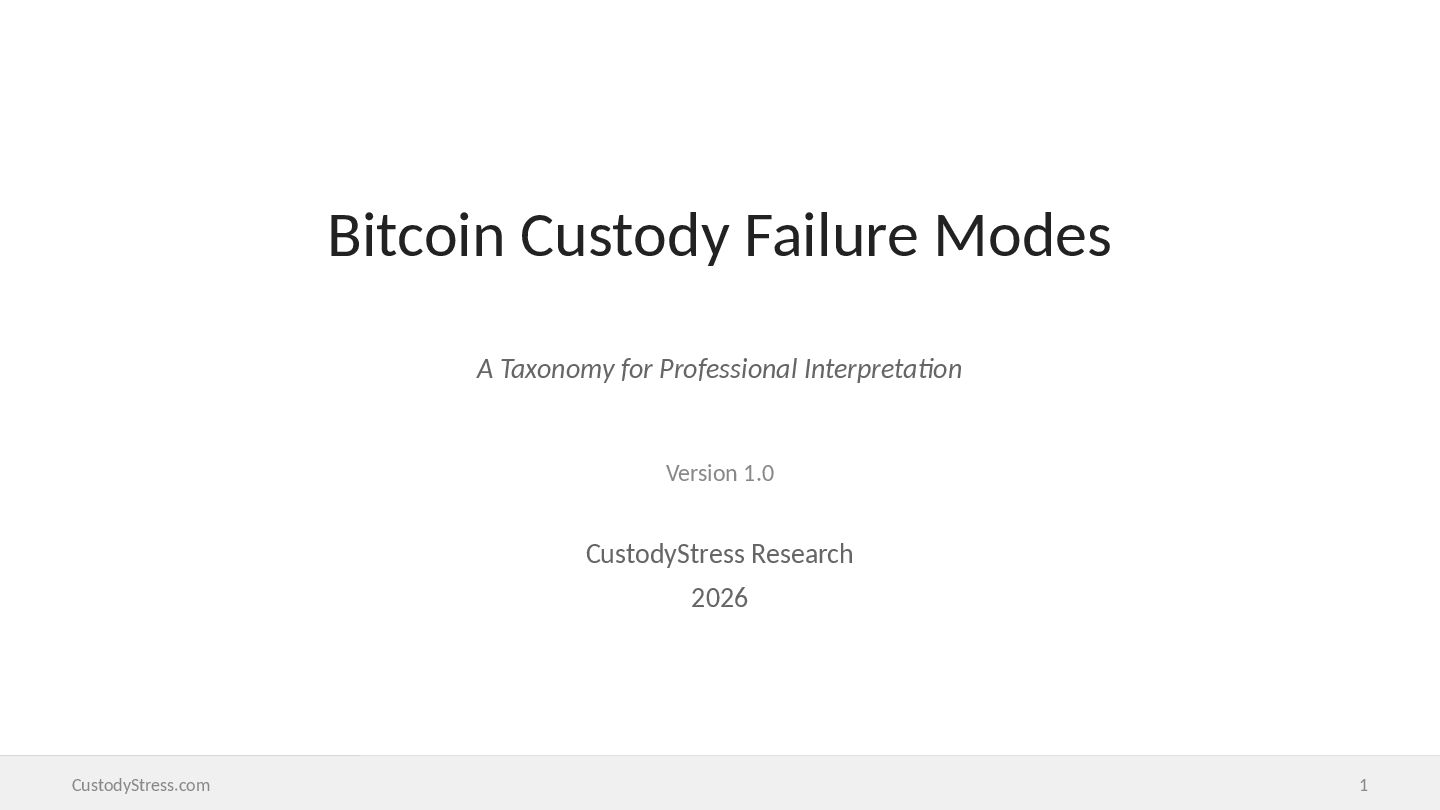
  1. Bitcoin Custody Failure Modes A Taxonomy for Professional Interpretation Version

    1.0 CustodyStress Research 2026 CustodyStress.com 1
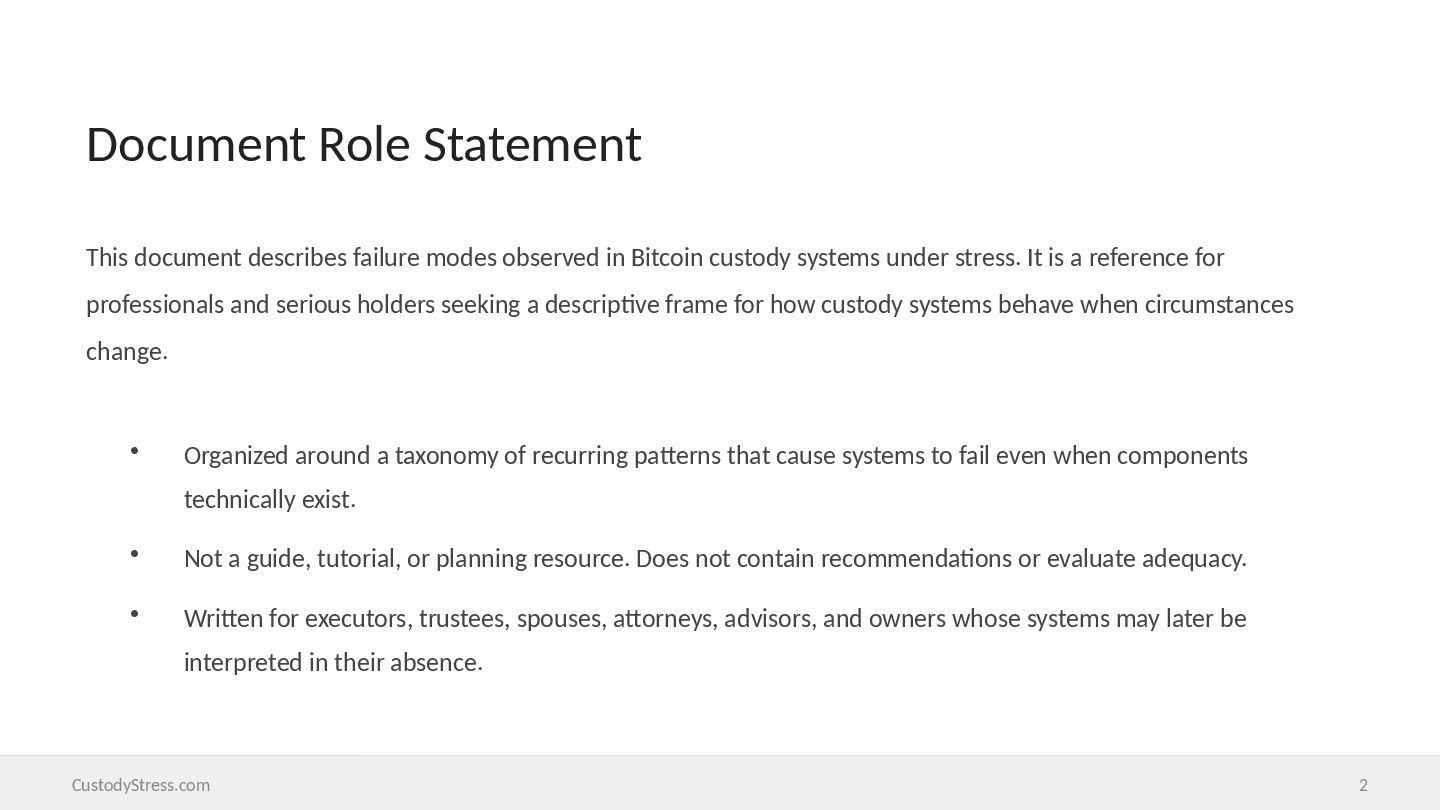
  2. Document Role Statement This document describes failure modes observed in

    Bitcoin custody systems under stress. It is a reference for professionals and serious holders seeking a descriptive frame for how custody systems behave when circumstances change. • Organized around a taxonomy of recurring patterns that cause systems to fail even when components technically exist. • Not a guide, tutorial, or planning resource. Does not contain recommendations or evaluate adequacy. • Written for executors, trustees, spouses, attorneys, advisors, and owners whose systems may later be interpreted in their absence. CustodyStress.com 2
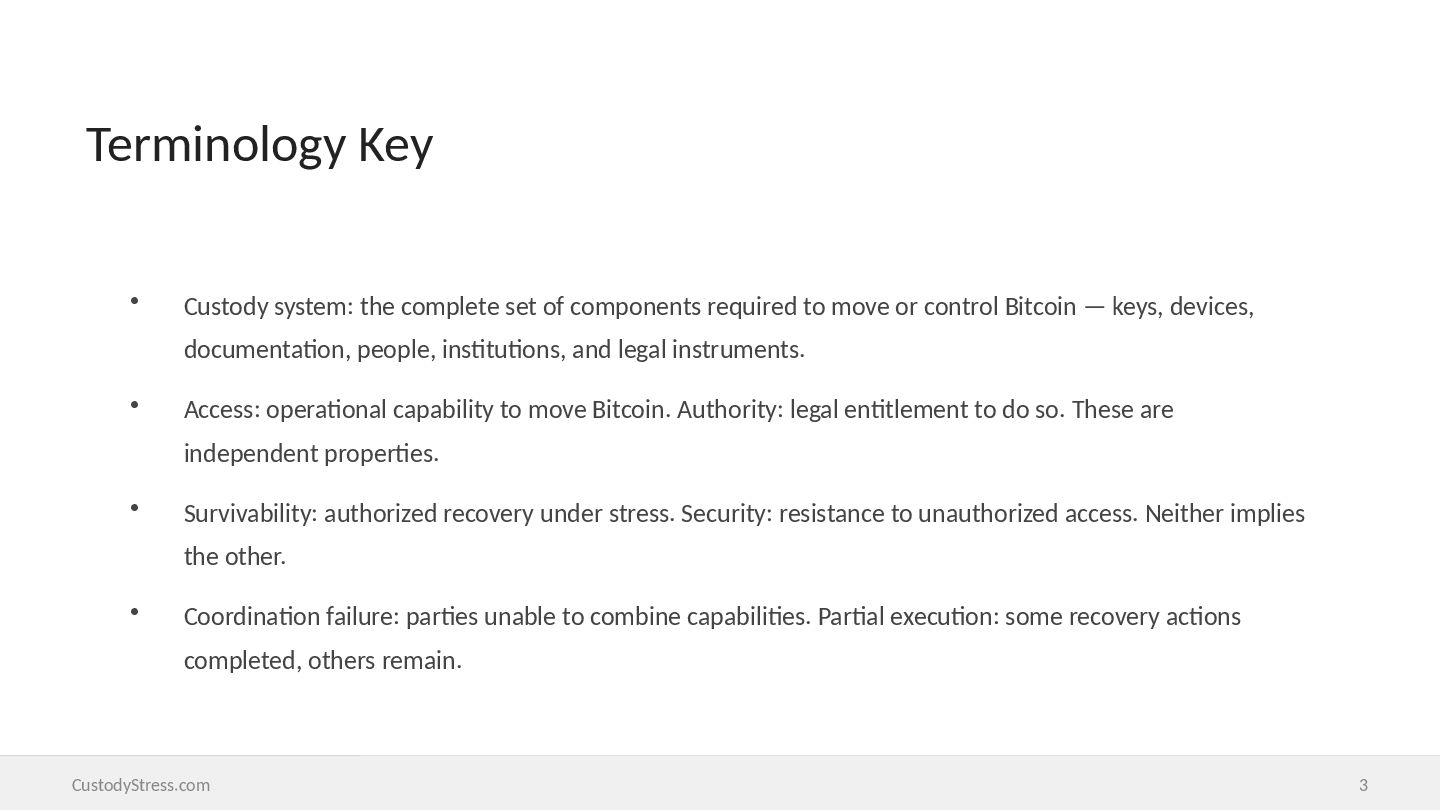
  3. Terminology Key • Custody system: the complete set of components

    required to move or control Bitcoin — keys, devices, documentation, people, institutions, and legal instruments. • Access: operational capability to move Bitcoin. Authority: legal entitlement to do so. These are independent properties. • Survivability: authorized recovery under stress. Security: resistance to unauthorized access. Neither implies the other. • Coordination failure: parties unable to combine capabilities. Partial execution: some recovery actions completed, others remain. CustodyStress.com 3
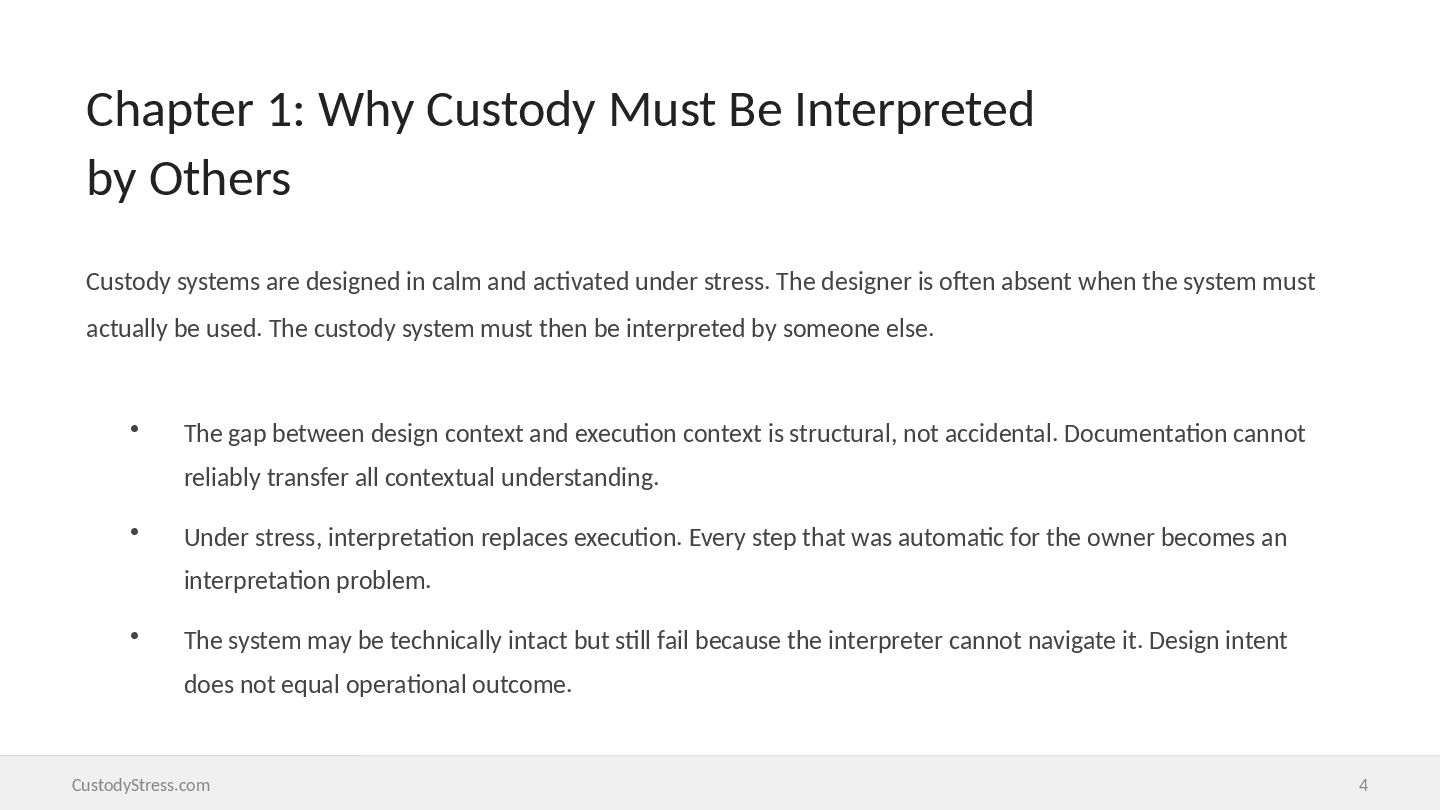
  4. Chapter 1: Why Custody Must Be Interpreted by Others Custody

    systems are designed in calm and activated under stress. The designer is often absent when the system must actually be used. The custody system must then be interpreted by someone else. • The gap between design context and execution context is structural, not accidental. Documentation cannot reliably transfer all contextual understanding. • Under stress, interpretation replaces execution. Every step that was automatic for the owner becomes an interpretation problem. • The system may be technically intact but still fail because the interpreter cannot navigate it. Design intent does not equal operational outcome. CustodyStress.com 4
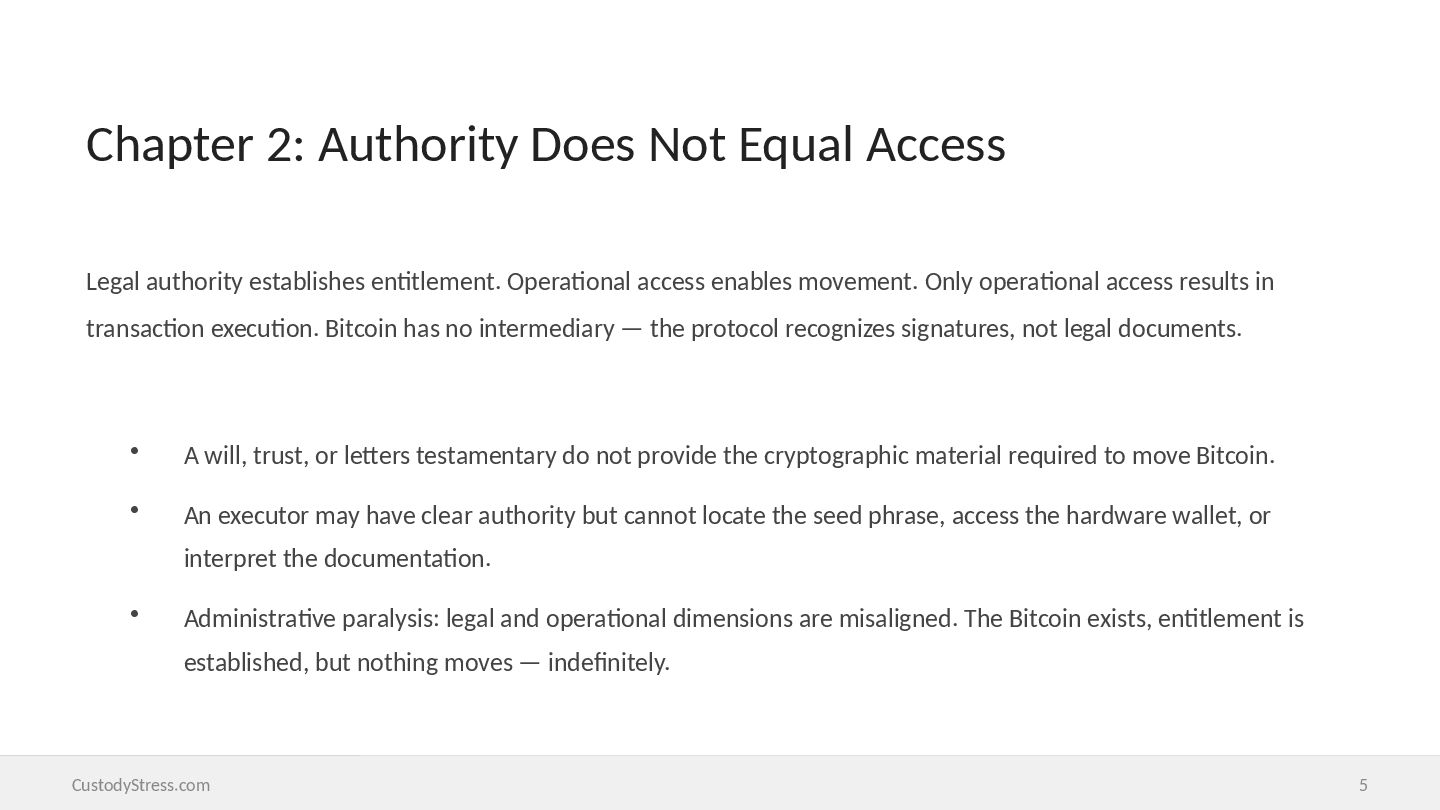
  5. Chapter 2: Authority Does Not Equal Access Legal authority establishes

    entitlement. Operational access enables movement. Only operational access results in transaction execution. Bitcoin has no intermediary — the protocol recognizes signatures, not legal documents. • A will, trust, or letters testamentary do not provide the cryptographic material required to move Bitcoin. • An executor may have clear authority but cannot locate the seed phrase, access the hardware wallet, or interpret the documentation. • Administrative paralysis: legal and operational dimensions are misaligned. The Bitcoin exists, entitlement is established, but nothing moves — indefinitely. CustodyStress.com 5
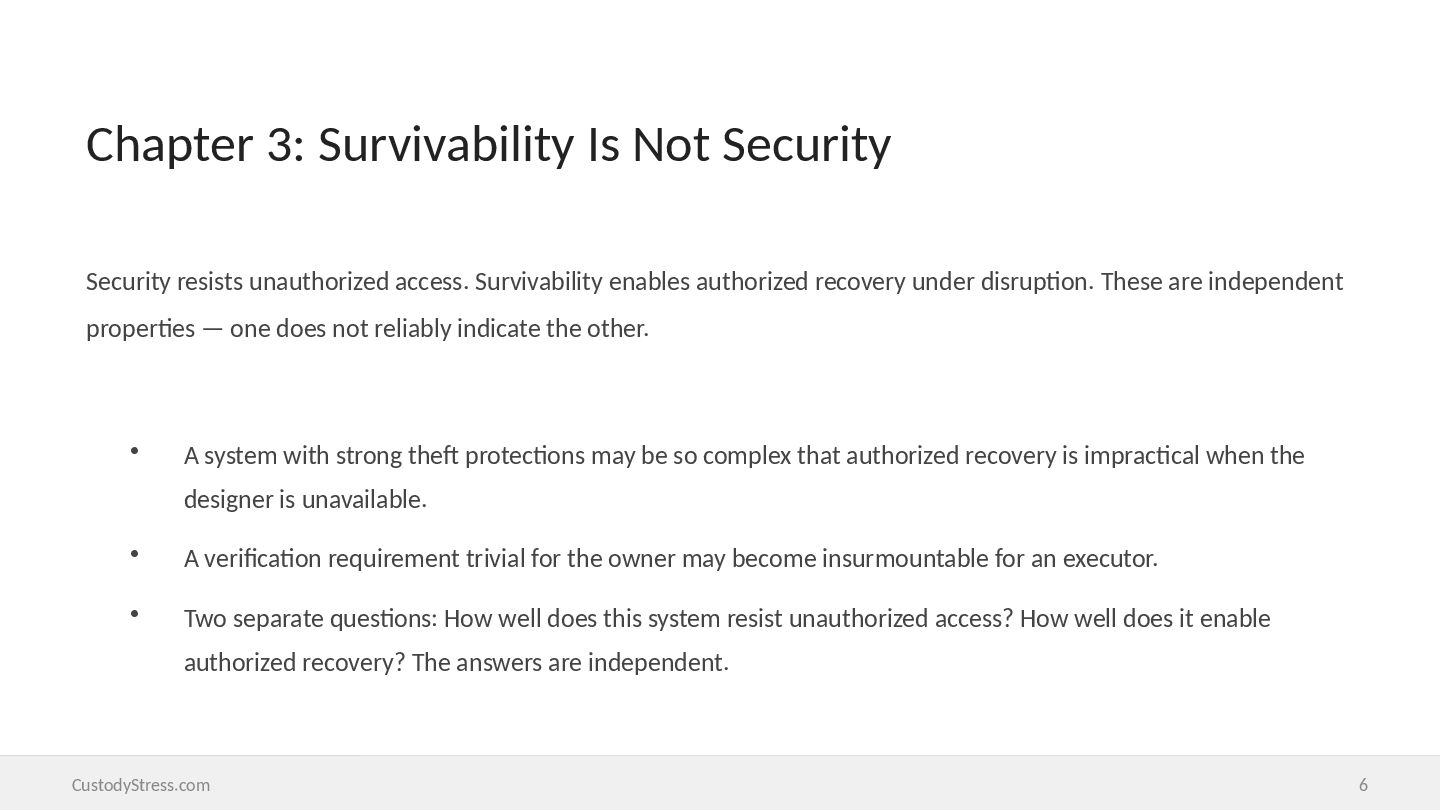
  6. Chapter 3: Survivability Is Not Security Security resists unauthorized access.

    Survivability enables authorized recovery under disruption. These are independent properties — one does not reliably indicate the other. • A system with strong theft protections may be so complex that authorized recovery is impractical when the designer is unavailable. • A verification requirement trivial for the owner may become insurmountable for an executor. • Two separate questions: How well does this system resist unauthorized access? How well does it enable authorized recovery? The answers are independent. CustodyStress.com 6
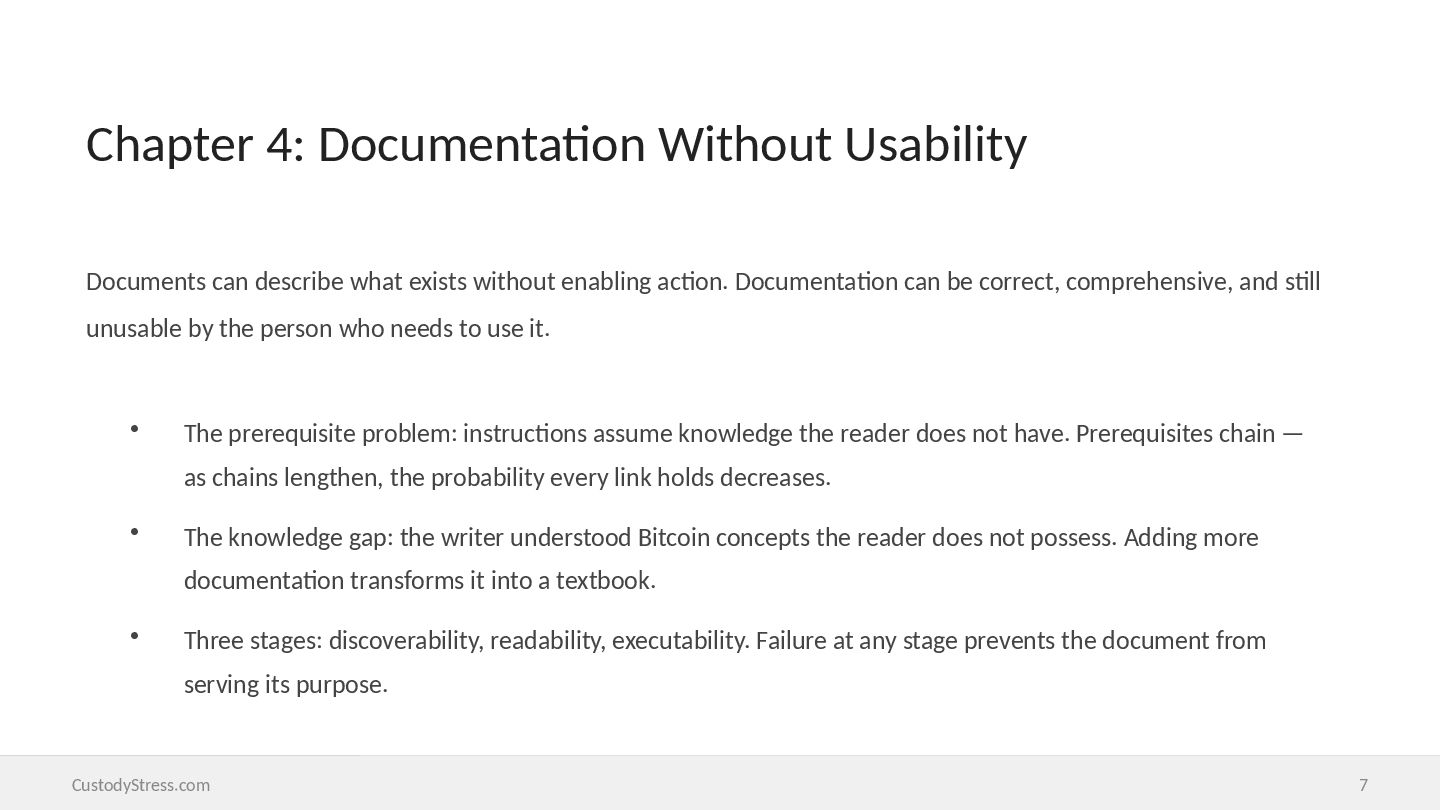
  7. Chapter 4: Documentation Without Usability Documents can describe what exists

    without enabling action. Documentation can be correct, comprehensive, and still unusable by the person who needs to use it. • The prerequisite problem: instructions assume knowledge the reader does not have. Prerequisites chain — as chains lengthen, the probability every link holds decreases. • The knowledge gap: the writer understood Bitcoin concepts the reader does not possess. Adding more documentation transforms it into a textbook. • Three stages: discoverability, readability, executability. Failure at any stage prevents the document from serving its purpose. CustodyStress.com 7
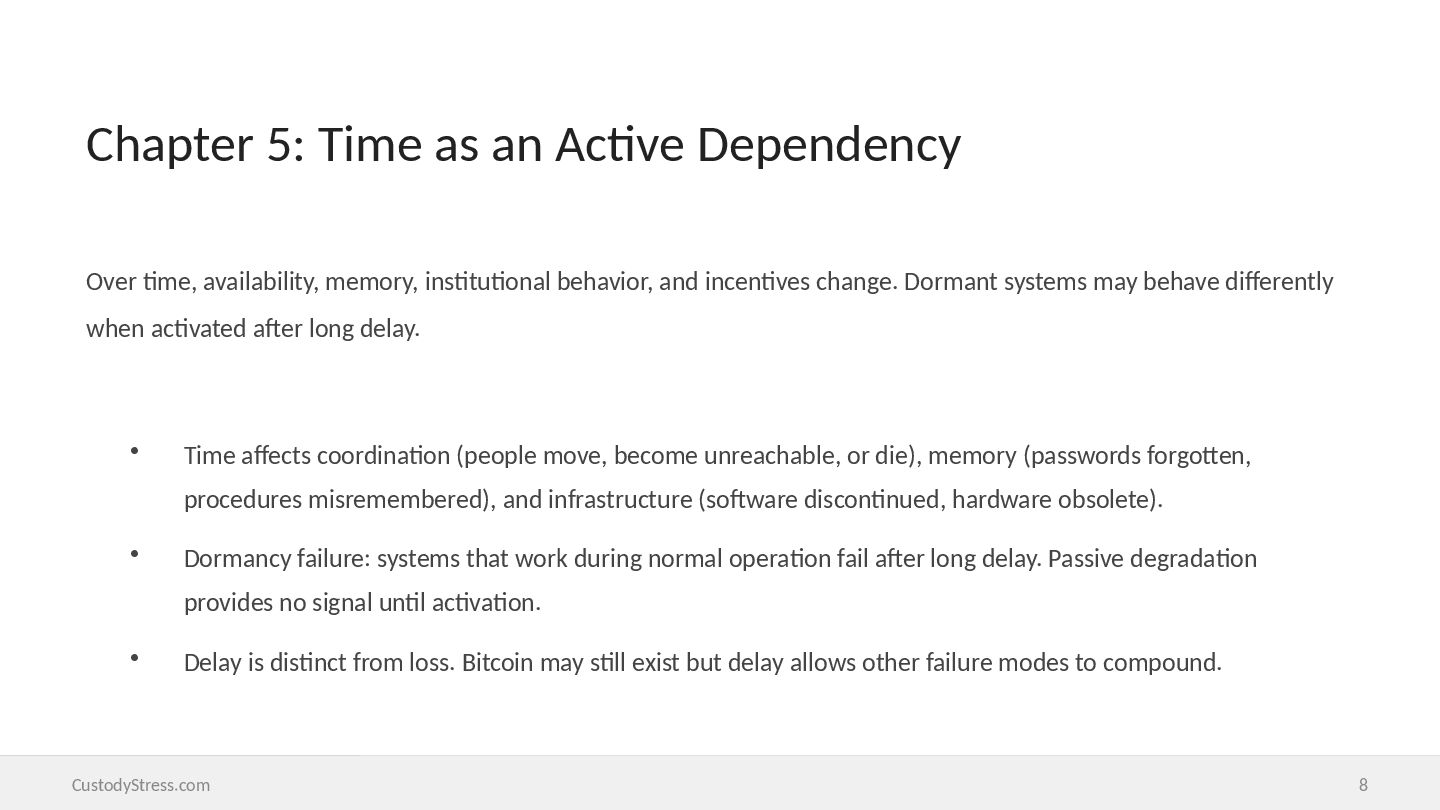
  8. Chapter 5: Time as an Active Dependency Over time, availability,

    memory, institutional behavior, and incentives change. Dormant systems may behave differently when activated after long delay. • Time affects coordination (people move, become unreachable, or die), memory (passwords forgotten, procedures misremembered), and infrastructure (software discontinued, hardware obsolete). • Dormancy failure: systems that work during normal operation fail after long delay. Passive degradation provides no signal until activation. • Delay is distinct from loss. Bitcoin may still exist but delay allows other failure modes to compound. CustodyStress.com 8
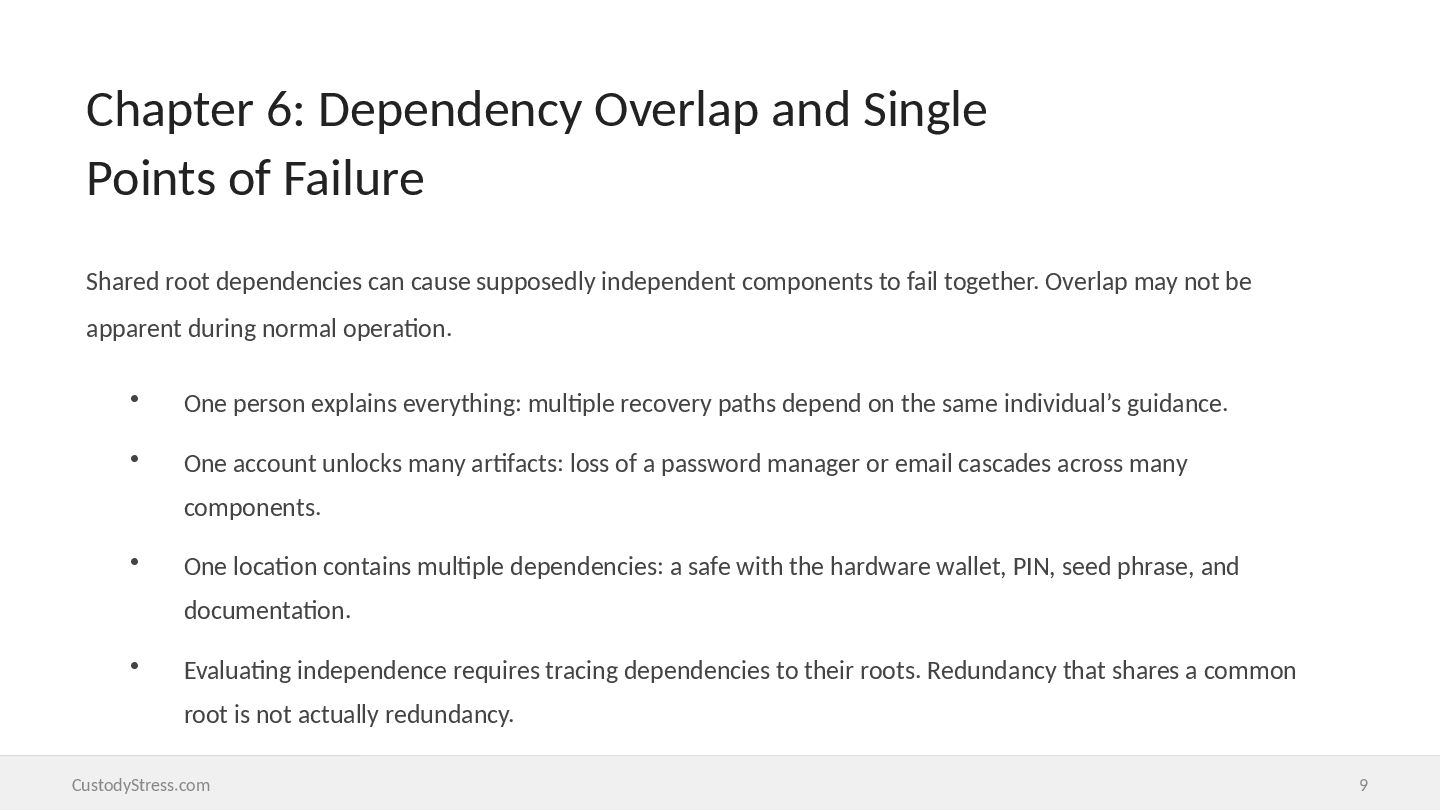
  9. Chapter 6: Dependency Overlap and Single Points of Failure Shared

    root dependencies can cause supposedly independent components to fail together. Overlap may not be apparent during normal operation. • One person explains everything: multiple recovery paths depend on the same individual’s guidance. • One account unlocks many artifacts: loss of a password manager or email cascades across many components. • One location contains multiple dependencies: a safe with the hardware wallet, PIN, seed phrase, and documentation. • Evaluating independence requires tracing dependencies to their roots. Redundancy that shares a common root is not actually redundancy. CustodyStress.com 9
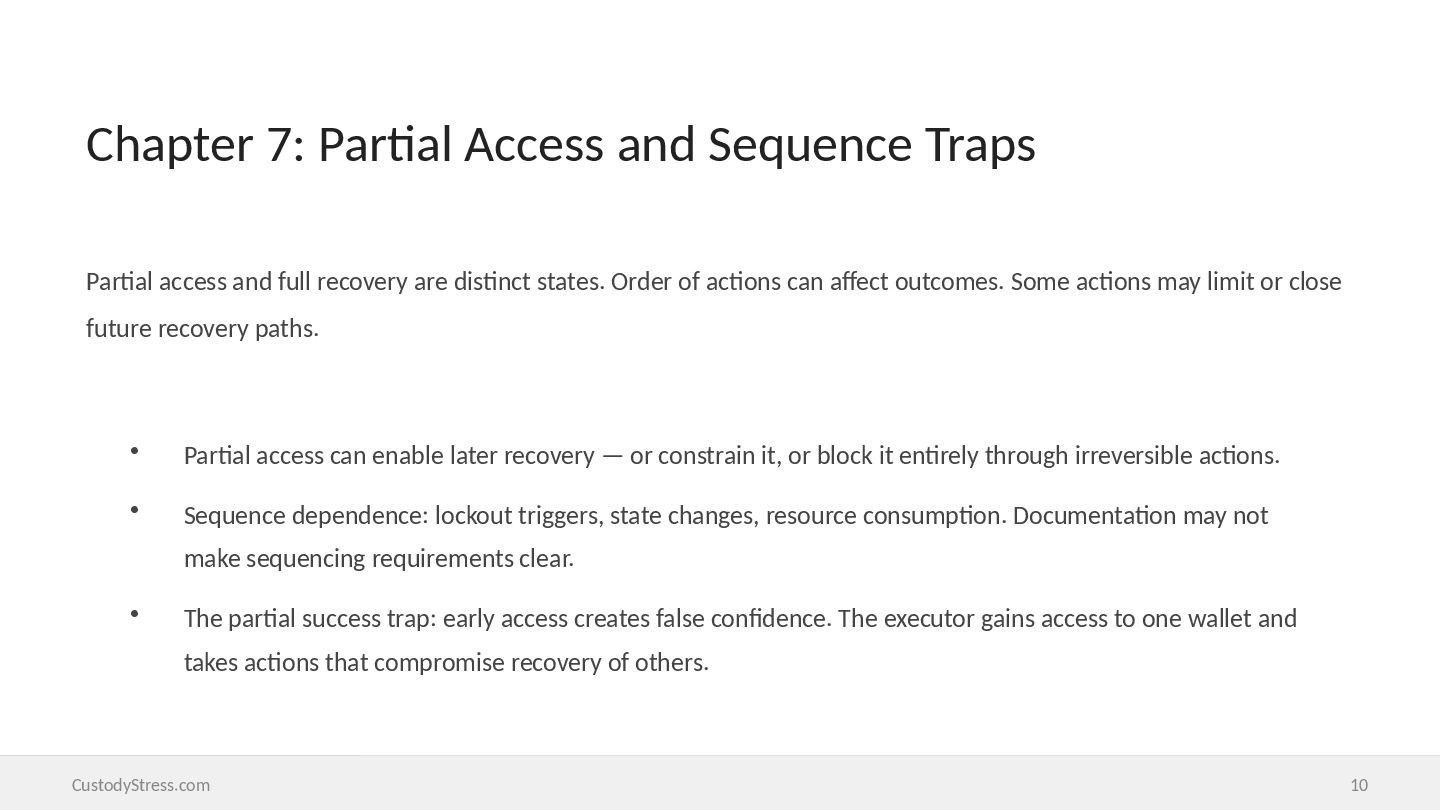
  10. Chapter 7: Partial Access and Sequence Traps Partial access and

    full recovery are distinct states. Order of actions can affect outcomes. Some actions may limit or close future recovery paths. • Partial access can enable later recovery — or constrain it, or block it entirely through irreversible actions. • Sequence dependence: lockout triggers, state changes, resource consumption. Documentation may not make sequencing requirements clear. • The partial success trap: early access creates false confidence. The executor gains access to one wallet and takes actions that compromise recovery of others. CustodyStress.com 10
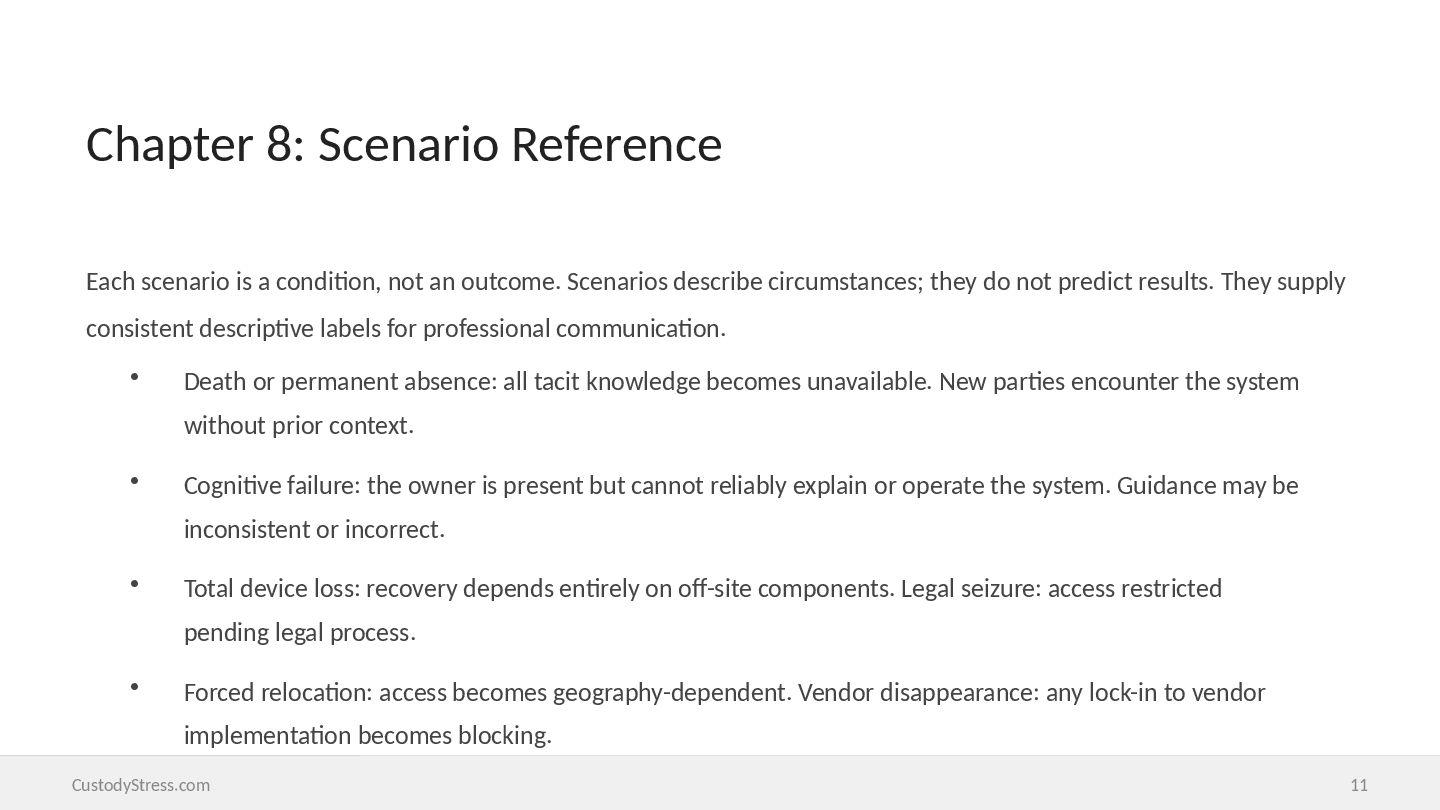
  11. Chapter 8: Scenario Reference Each scenario is a condition, not

    an outcome. Scenarios describe circumstances; they do not predict results. They supply consistent descriptive labels for professional communication. • Death or permanent absence: all tacit knowledge becomes unavailable. New parties encounter the system without prior context. • Cognitive failure: the owner is present but cannot reliably explain or operate the system. Guidance may be inconsistent or incorrect. • Total device loss: recovery depends entirely on off-site components. Legal seizure: access restricted pending legal process. • Forced relocation: access becomes geography-dependent. Vendor disappearance: any lock-in to vendor implementation becomes blocking. CustodyStress.com 11
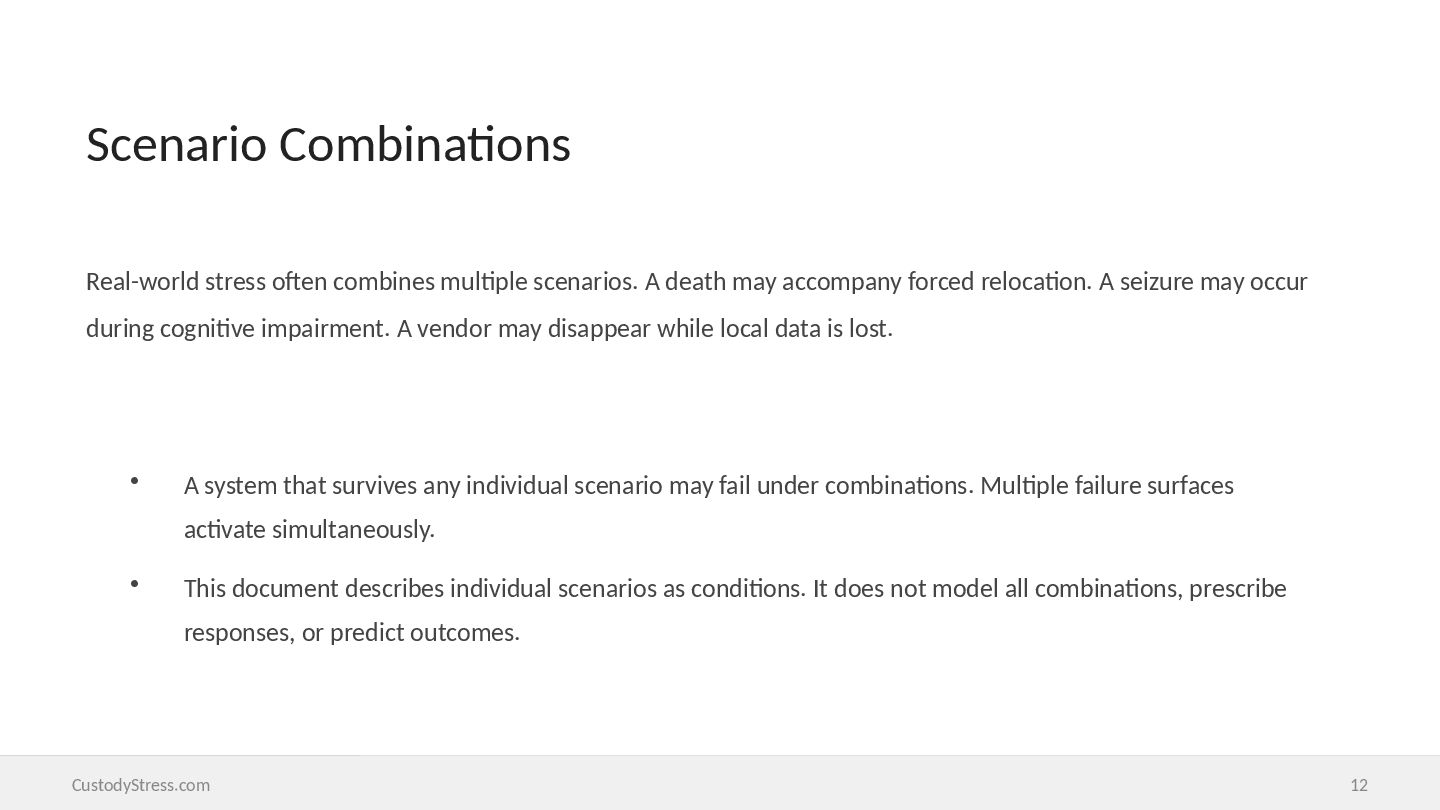
  12. Scenario Combinations Real-world stress often combines multiple scenarios. A death

    may accompany forced relocation. A seizure may occur during cognitive impairment. A vendor may disappear while local data is lost. • A system that survives any individual scenario may fail under combinations. Multiple failure surfaces activate simultaneously. • This document describes individual scenarios as conditions. It does not model all combinations, prescribe responses, or predict outcomes. CustodyStress.com 12
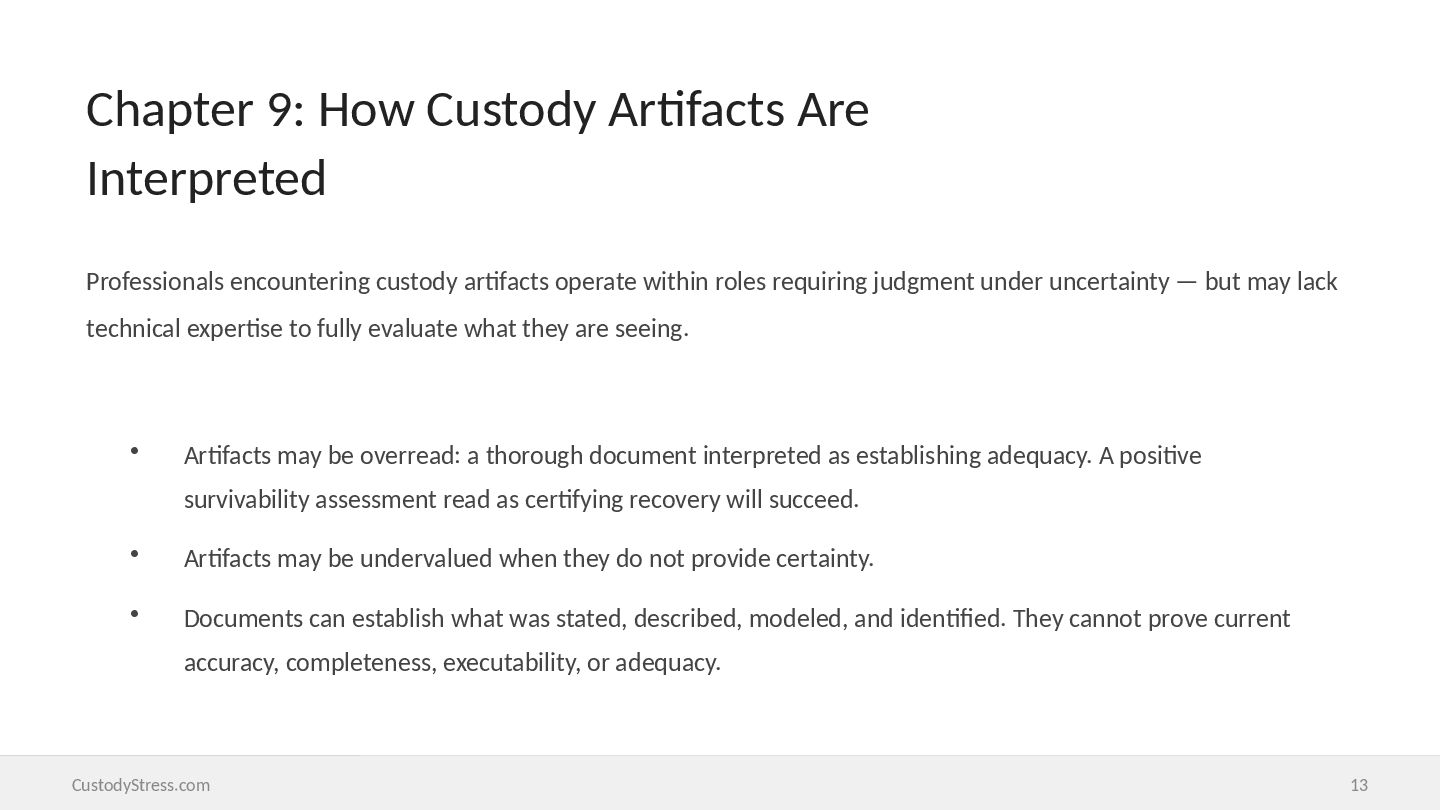
  13. Chapter 9: How Custody Artifacts Are Interpreted Professionals encountering custody

    artifacts operate within roles requiring judgment under uncertainty — but may lack technical expertise to fully evaluate what they are seeing. • Artifacts may be overread: a thorough document interpreted as establishing adequacy. A positive survivability assessment read as certifying recovery will succeed. • Artifacts may be undervalued when they do not provide certainty. • Documents can establish what was stated, described, modeled, and identified. They cannot prove current accuracy, completeness, executability, or adequacy. CustodyStress.com 13
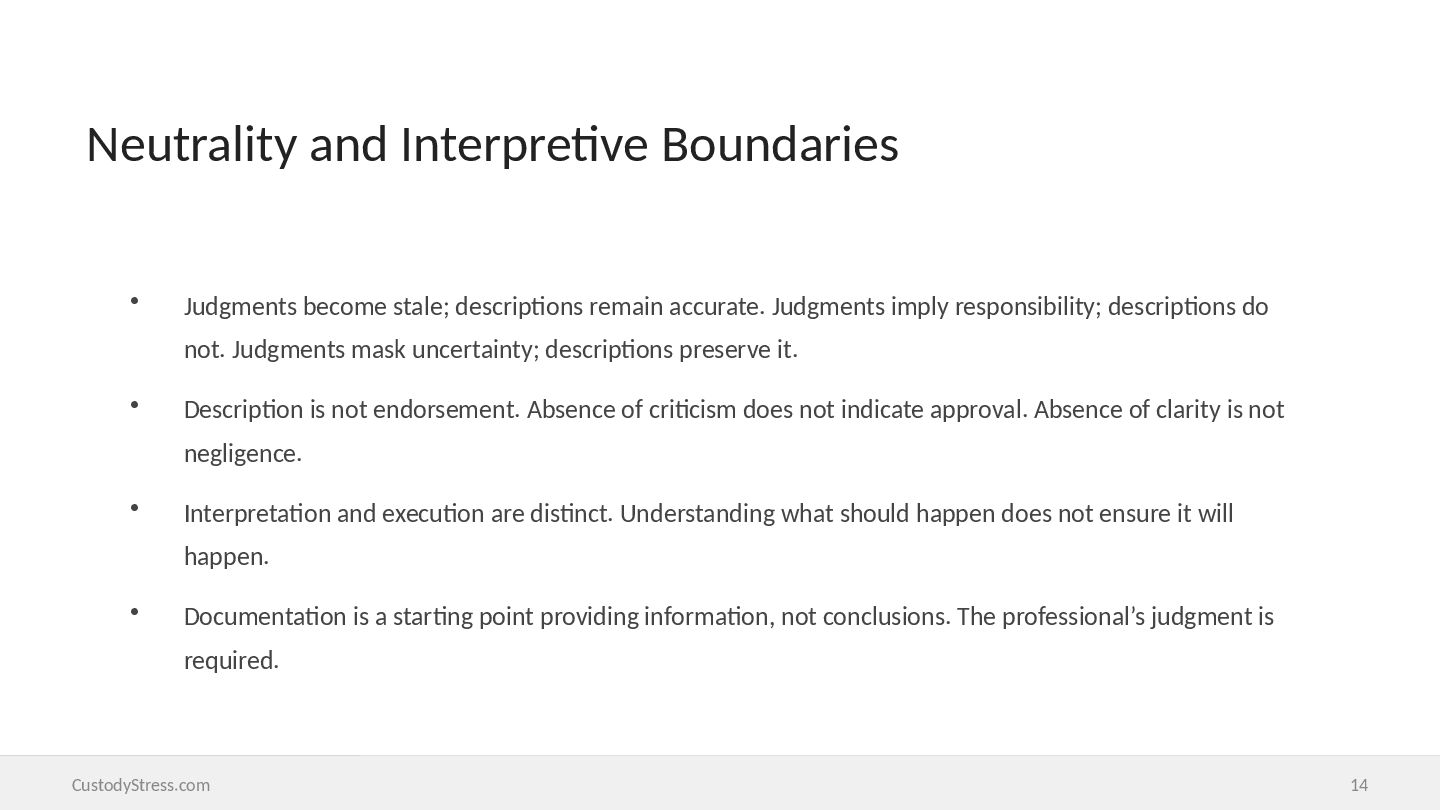
  14. Neutrality and Interpretive Boundaries • Judgments become stale; descriptions remain

    accurate. Judgments imply responsibility; descriptions do not. Judgments mask uncertainty; descriptions preserve it. • Description is not endorsement. Absence of criticism does not indicate approval. Absence of clarity is not negligence. • Interpretation and execution are distinct. Understanding what should happen does not ensure it will happen. • Documentation is a starting point providing information, not conclusions. The professional’s judgment is required. CustodyStress.com 14
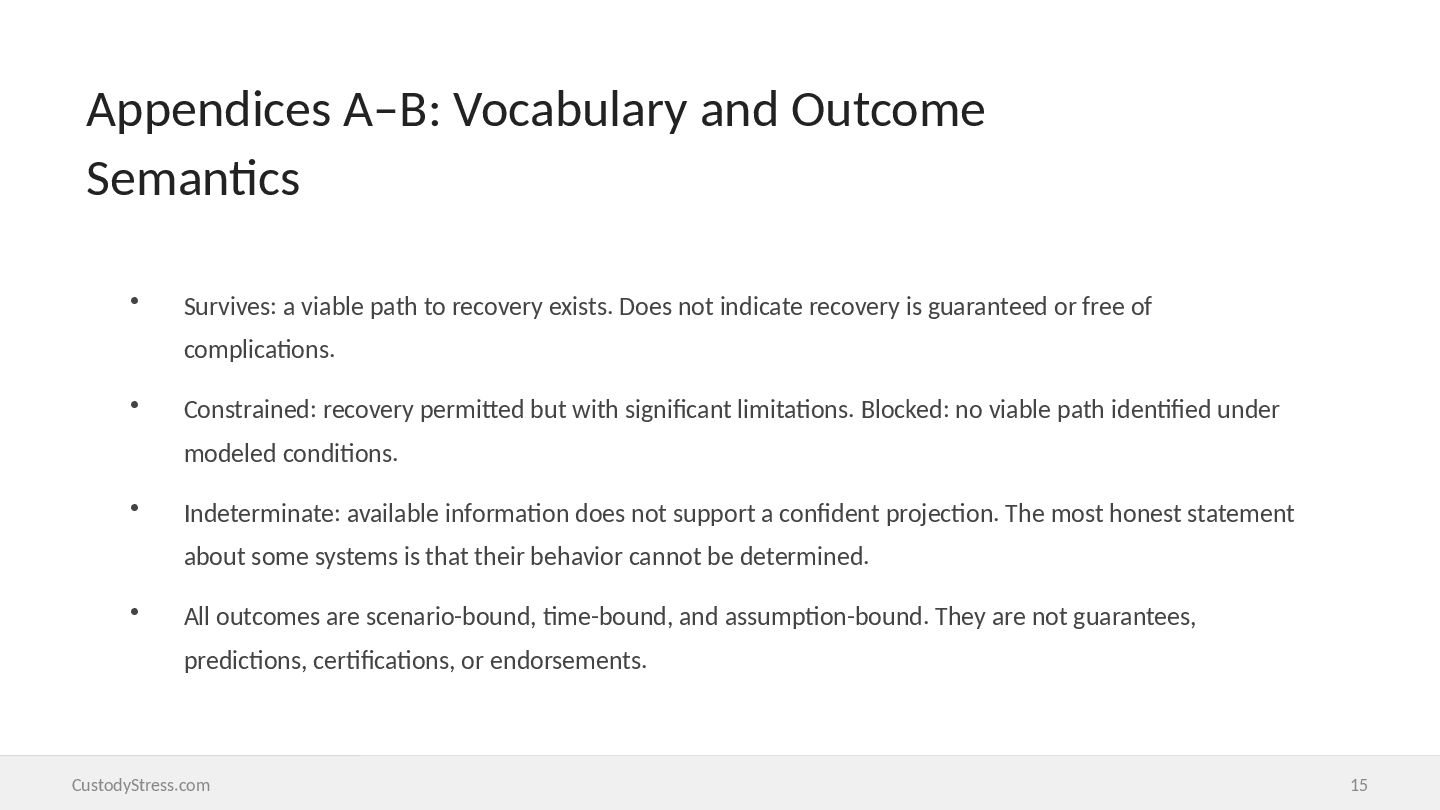
  15. Appendices A–B: Vocabulary and Outcome Semantics • Survives: a viable

    path to recovery exists. Does not indicate recovery is guaranteed or free of complications. • Constrained: recovery permitted but with significant limitations. Blocked: no viable path identified under modeled conditions. • Indeterminate: available information does not support a confident projection. The most honest statement about some systems is that their behavior cannot be determined. • All outcomes are scenario-bound, time-bound, and assumption-bound. They are not guarantees, predictions, certifications, or endorsements. CustodyStress.com 15
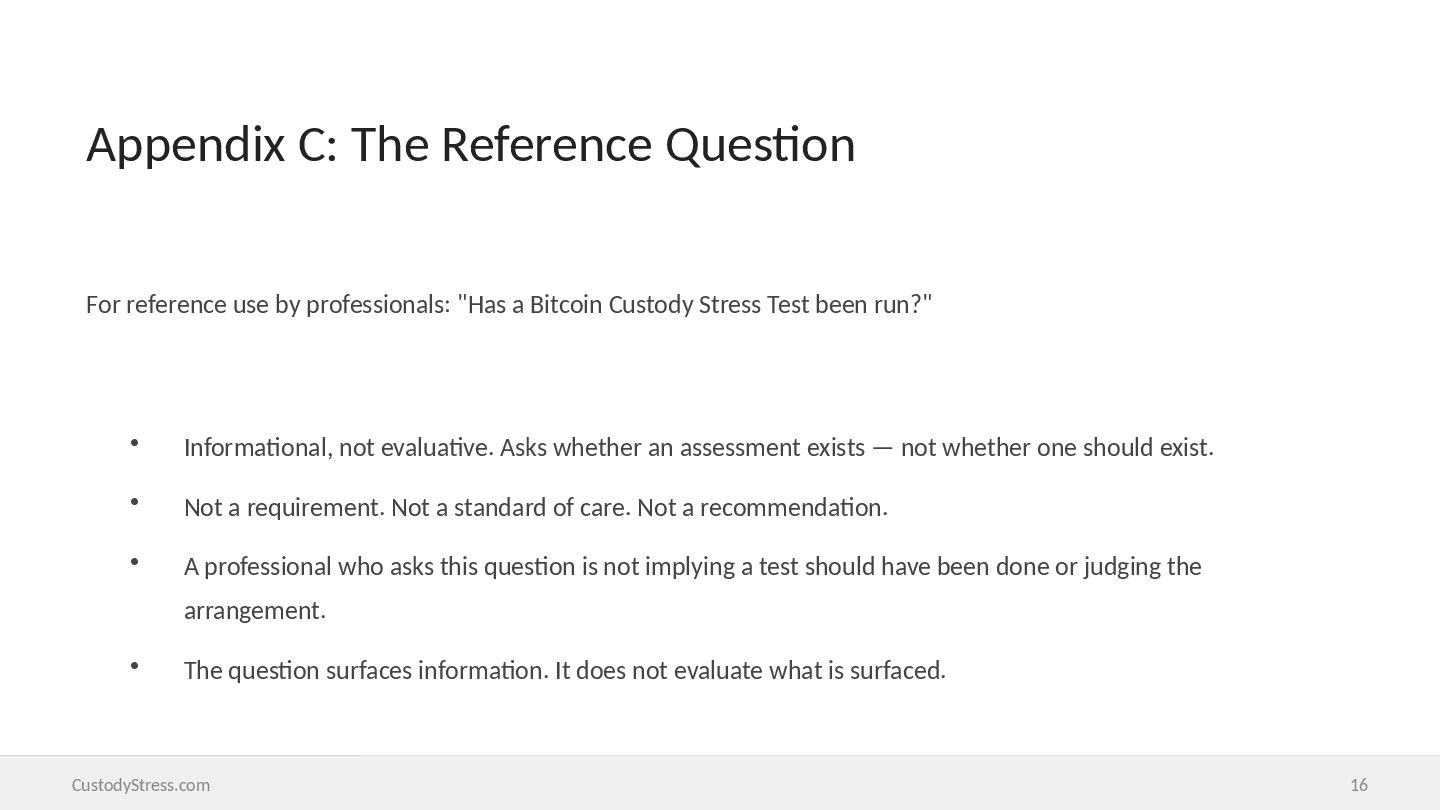
  16. Appendix C: The Reference Question For reference use by professionals:

    "Has a Bitcoin Custody Stress Test been run?" • Informational, not evaluative. Asks whether an assessment exists — not whether one should exist. • Not a requirement. Not a standard of care. Not a recommendation. • A professional who asks this question is not implying a test should have been done or judging the arrangement. • The question surfaces information. It does not evaluate what is surfaced. CustodyStress.com 16
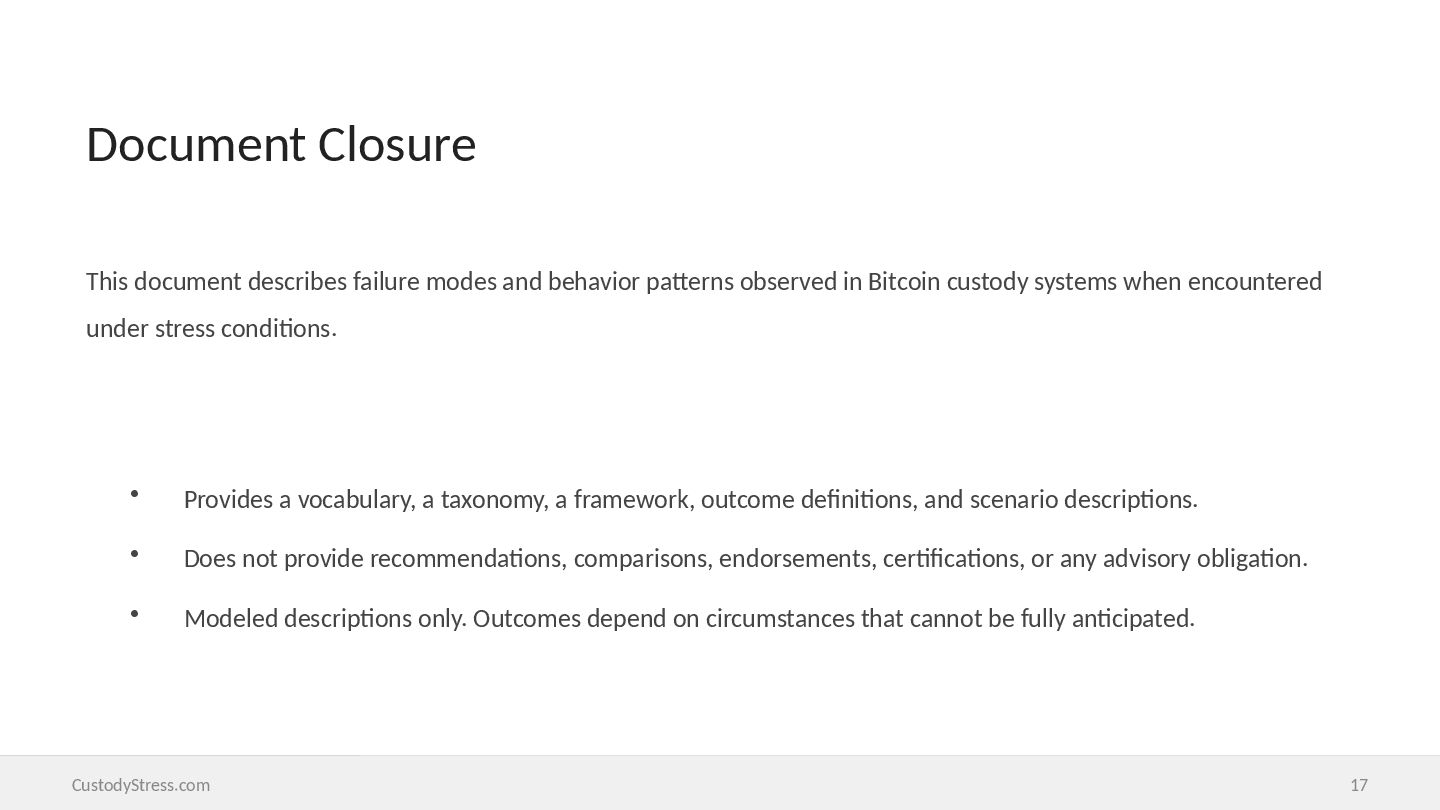
  17. Document Closure This document describes failure modes and behavior patterns

    observed in Bitcoin custody systems when encountered under stress conditions. • Provides a vocabulary, a taxonomy, a framework, outcome definitions, and scenario descriptions. • Does not provide recommendations, comparisons, endorsements, certifications, or any advisory obligation. • Modeled descriptions only. Outcomes depend on circumstances that cannot be fully anticipated. CustodyStress.com 17