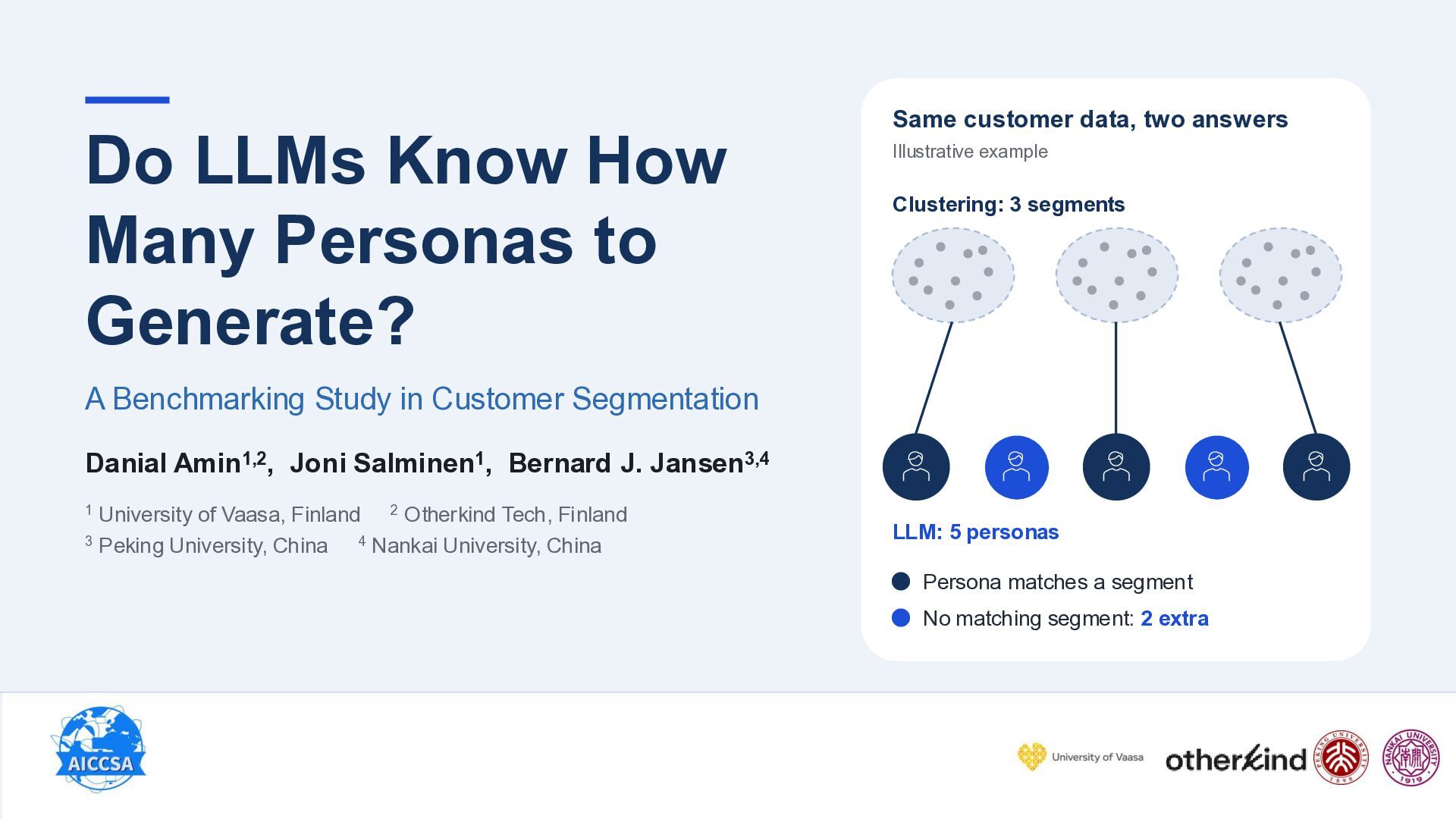
data, two answers Illustrative example Clustering: 3 segments A Benchmarking Study in Customer Segmentation Danial Amin1,2, Joni Salminen1, Bernard J. Jansen 3,4 1 University of Vaasa, Finland 3 Peking University, China 2 Otherkind Tech, Finland 4 Nankai University, China LLM: 5 personas Persona matches a segment No matching segment: 2 extra
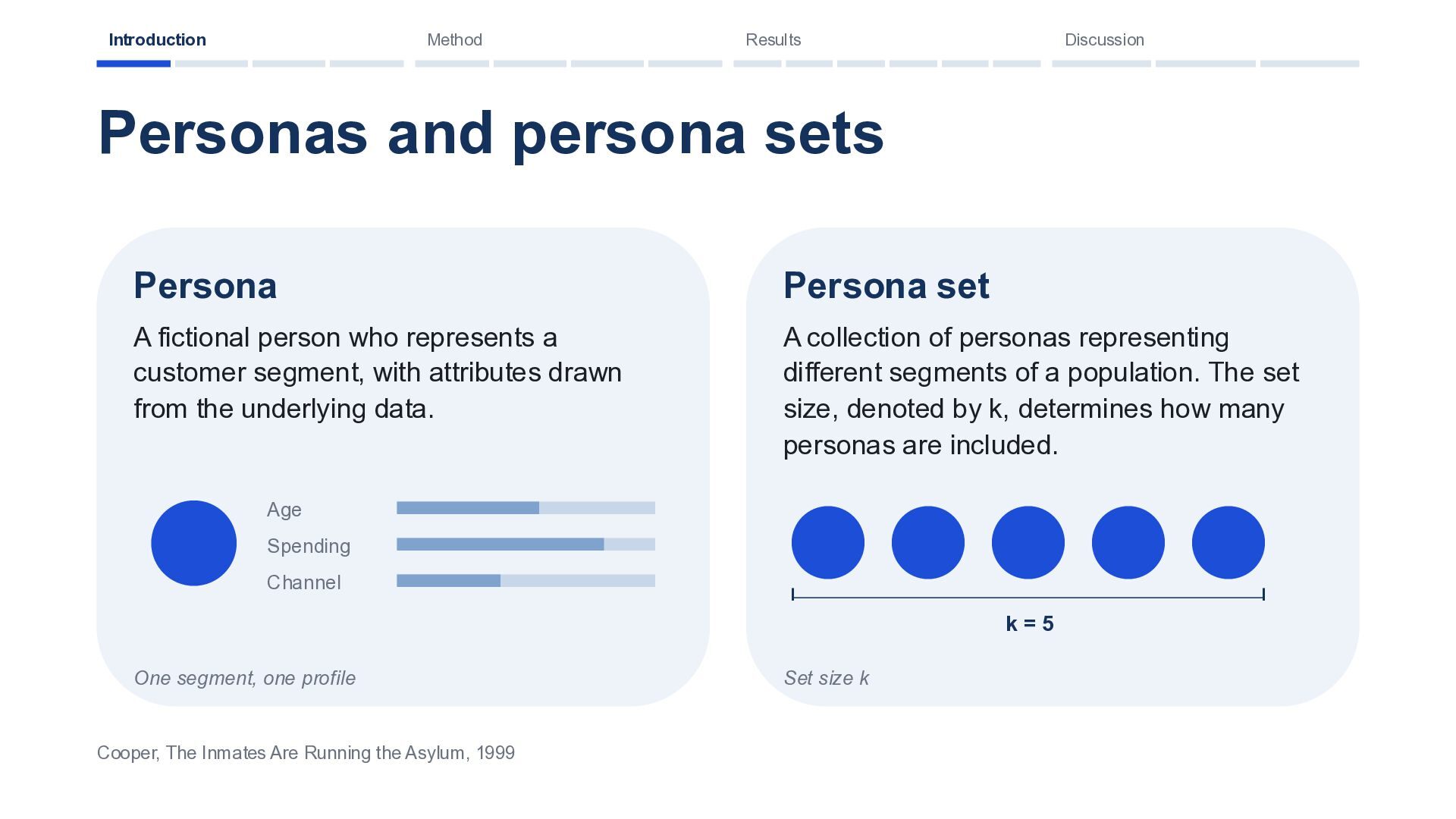
set A fictional person who represents a customer segment, with attributes drawn from the underlying data. A collection of personas representing different segments of a population. The set size, denoted by k, determines how many personas are included. Age Spending Channel k=5 One segment, one profile Cooper, The Inmates Are Running the Asylum, 1999 Set size k
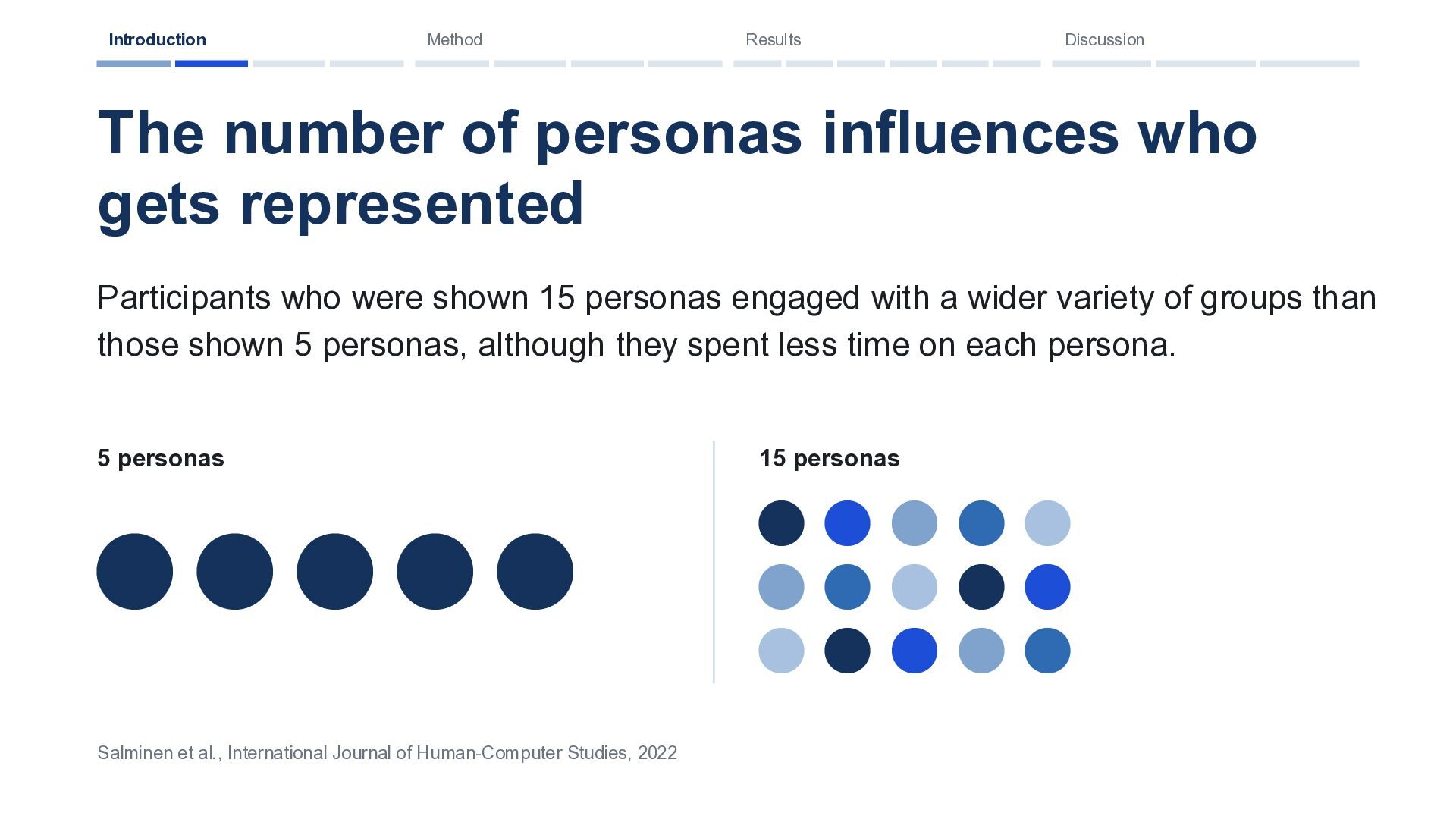
gets represented Participants who were shown 15 personas engaged with a wider variety of groups than those shown 5 personas, although they spent less time on each persona. 5 personas Salminen et al., International Journal of Human-Computer Studies, 2022 15 personas
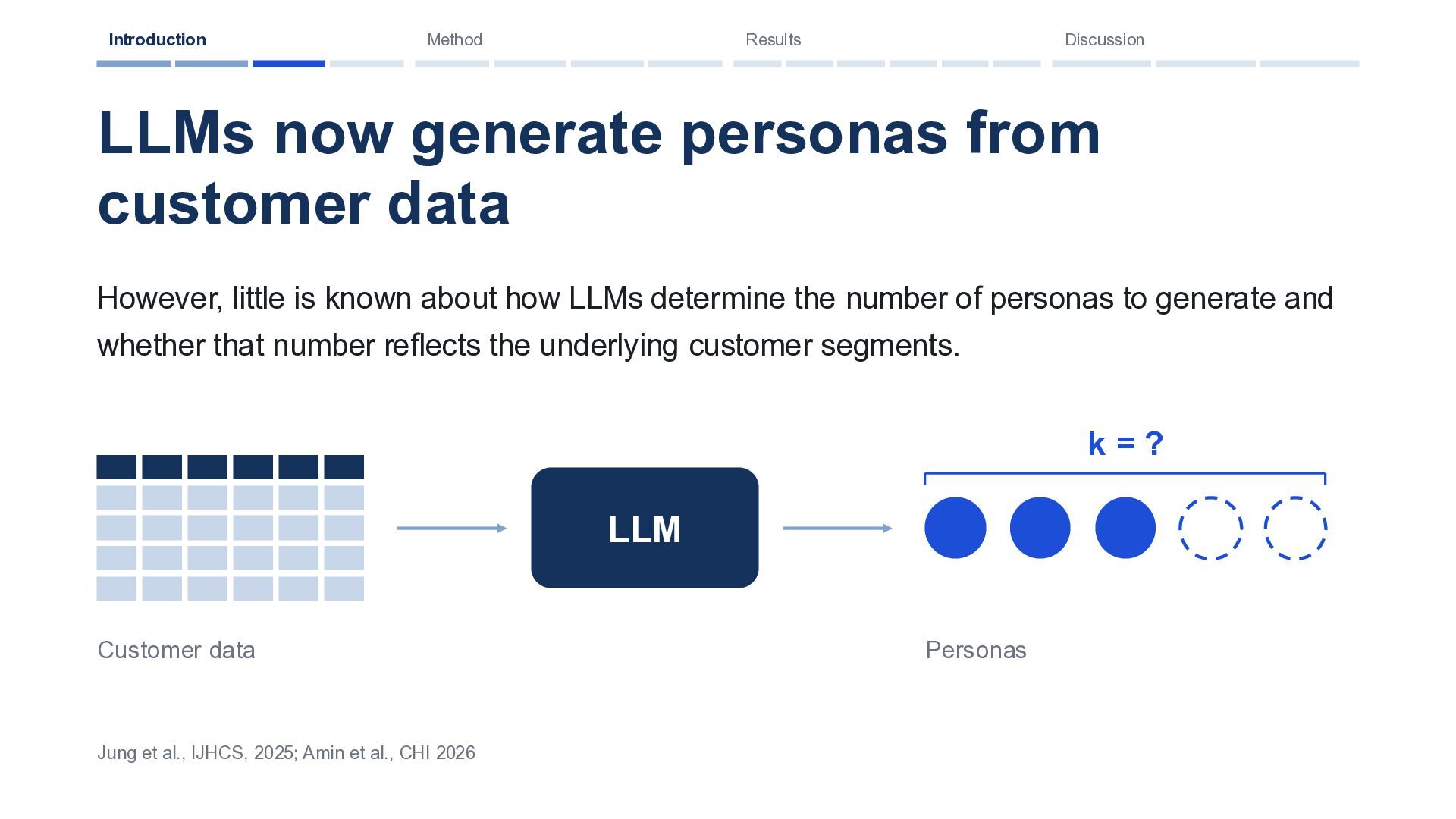
data However, little is known about how LLMs determine the number of personas to generate and whether that number reflects the underlying customer segments. k=? LLM Customer data Jung et al., IJHCS, 2025; Amin et al., CHI 2026 Personas
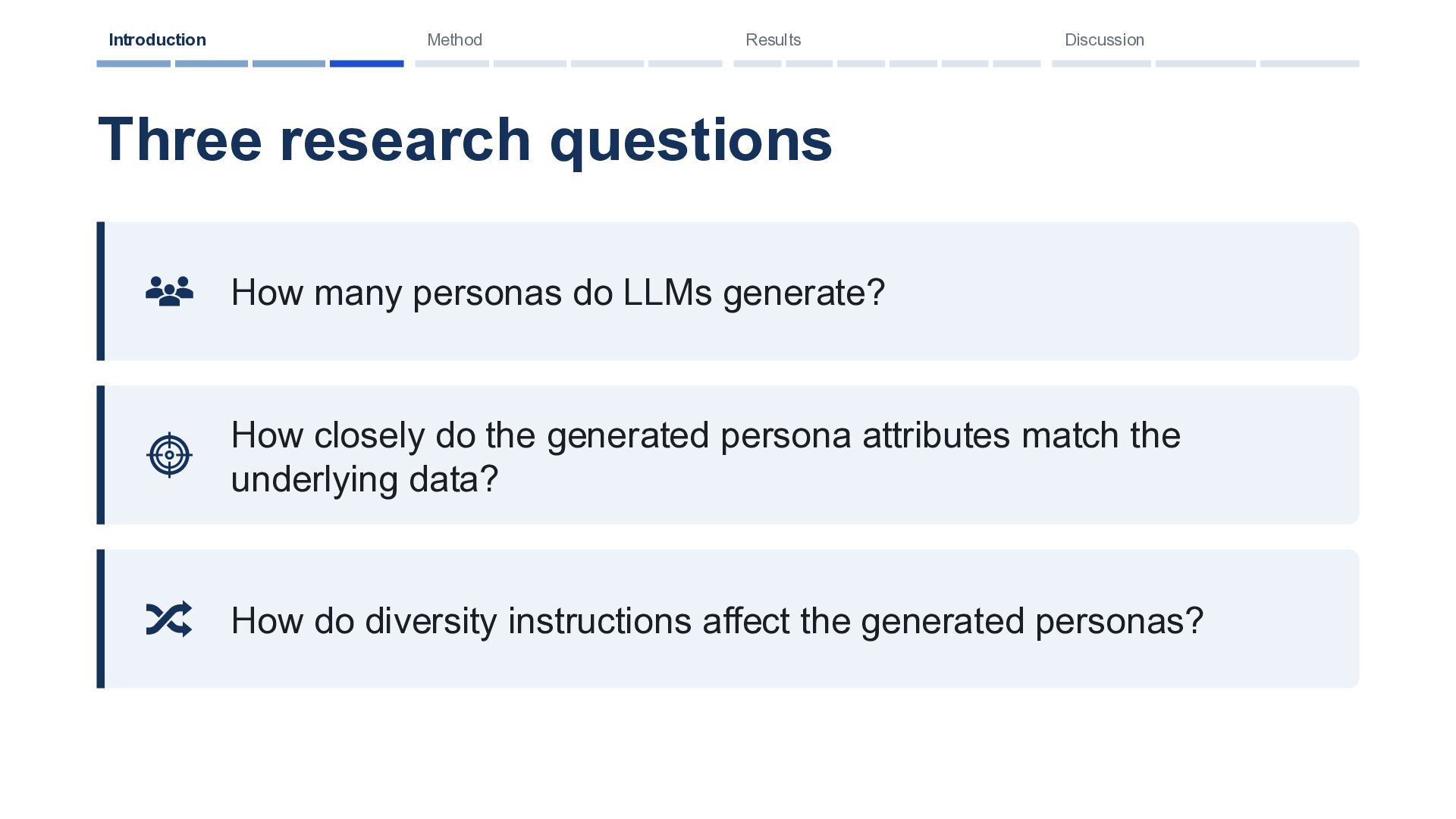
do LLMs generate? How closely do the generated persona attributes match the underlying data? How do diversity instructions affect the generated personas?
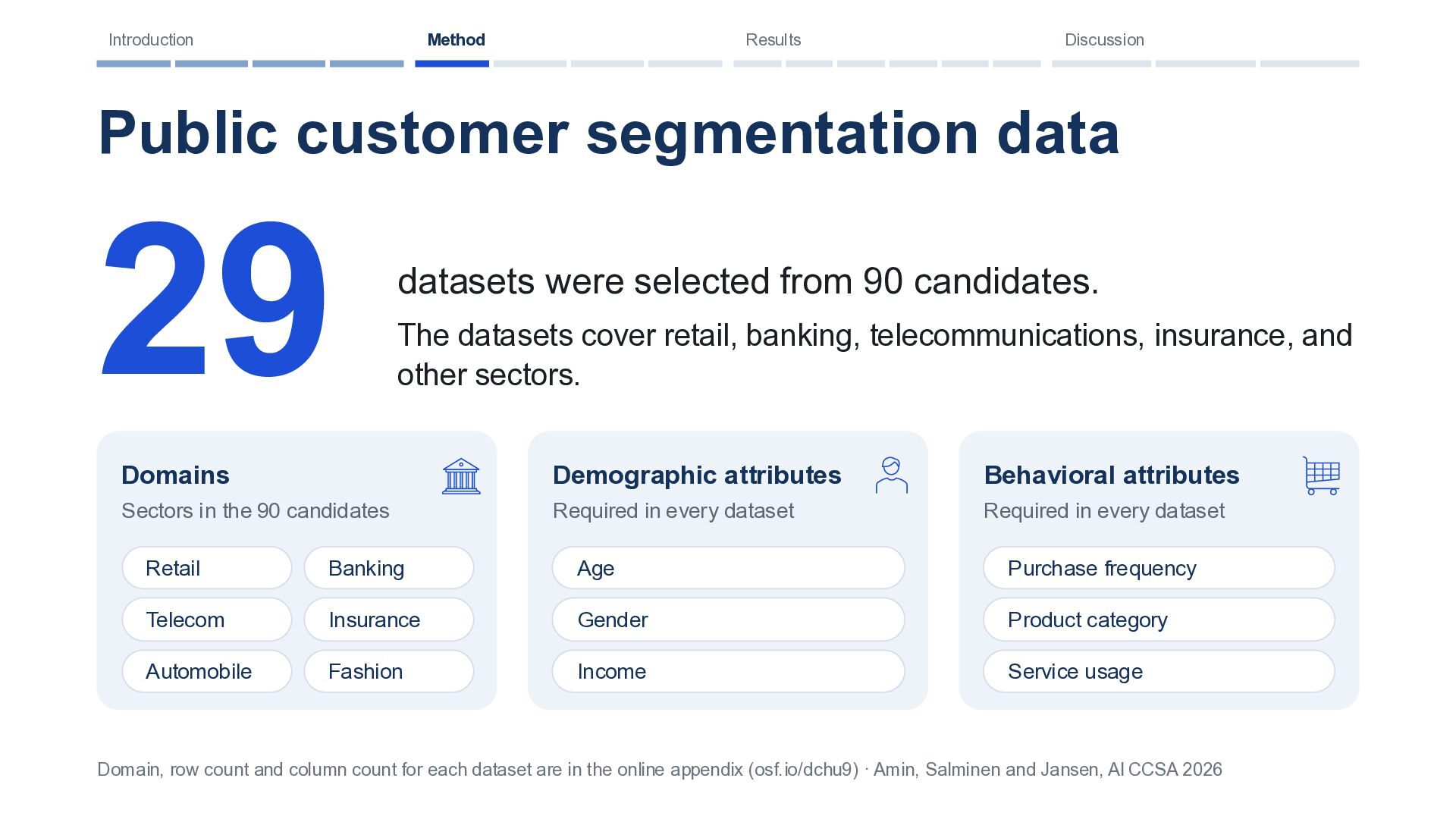
were selected from 90 candidates. The datasets cover retail, banking, telecommunications, insurance, and other sectors. Domains Demographic attributes Behavioral attributes Sectors in the 90 candidates Required in every dataset Required in every dataset Retail Banking Age Purchase frequency Telecom Insurance Gender Product category Automobile Fashion Income Service usage Domain, row count and column count for each dataset are in the online appendix (osf.io/dchu9) · Amin, Salminen and Jansen, AI CCSA 2026
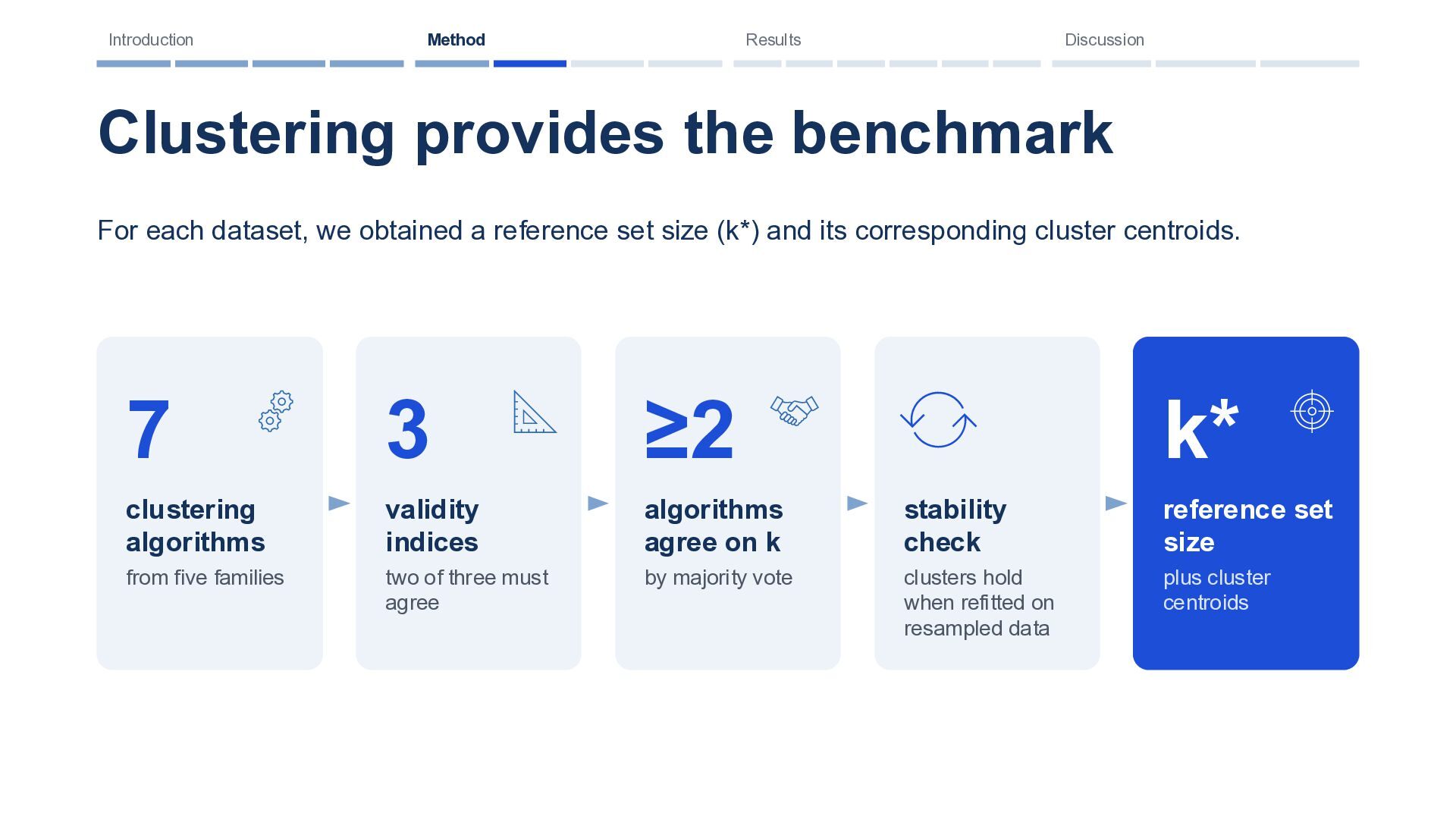
dataset, we obtained a reference set size (k*) and its corresponding cluster centroids. 7 3 ≥2 k* clustering algorithms validity indices algorithms agree on k stability check reference set size from five families two of three must agree by majority vote clusters hold when refitted on resampled data plus cluster centroids
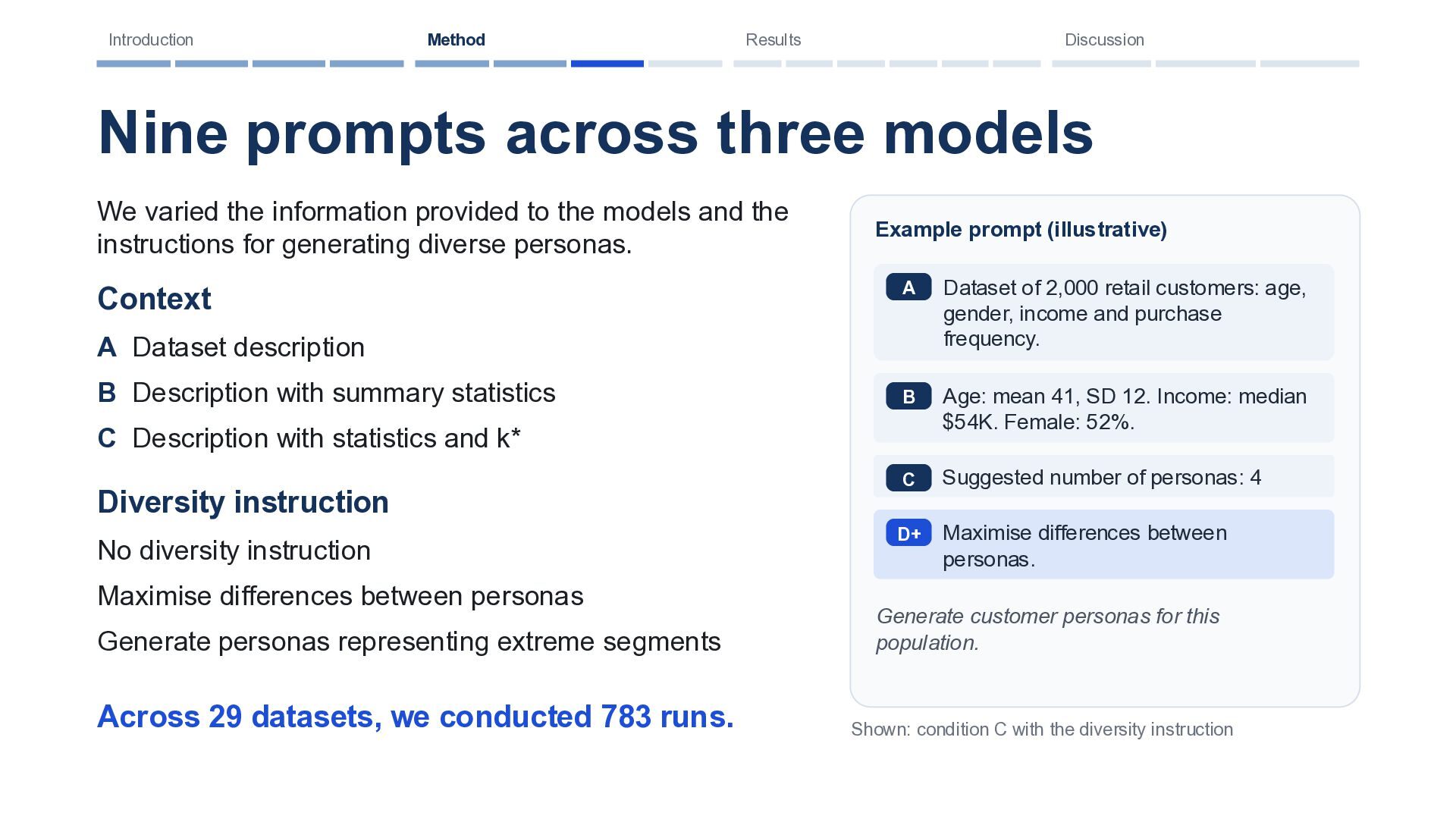
varied the information provided to the models and the instructions for generating diverse personas. Context Example prompt (illustrative) A Dataset of 2,000 retail customers: age, gender, income and purchase frequency. B Age: mean 41, SD 12. Income: median $54K. Female: 52%. C Suggested number of personas: 4 D+ Maximise differences between personas. A Dataset description B Description with summary statistics C Description with statistics and k* Diversity instruction No diversity instruction Maximise differences between personas Generate personas representing extreme segments Generate customer personas for this population. Across 29 datasets, we conducted 783 runs. Shown: condition C with the diversity instruction
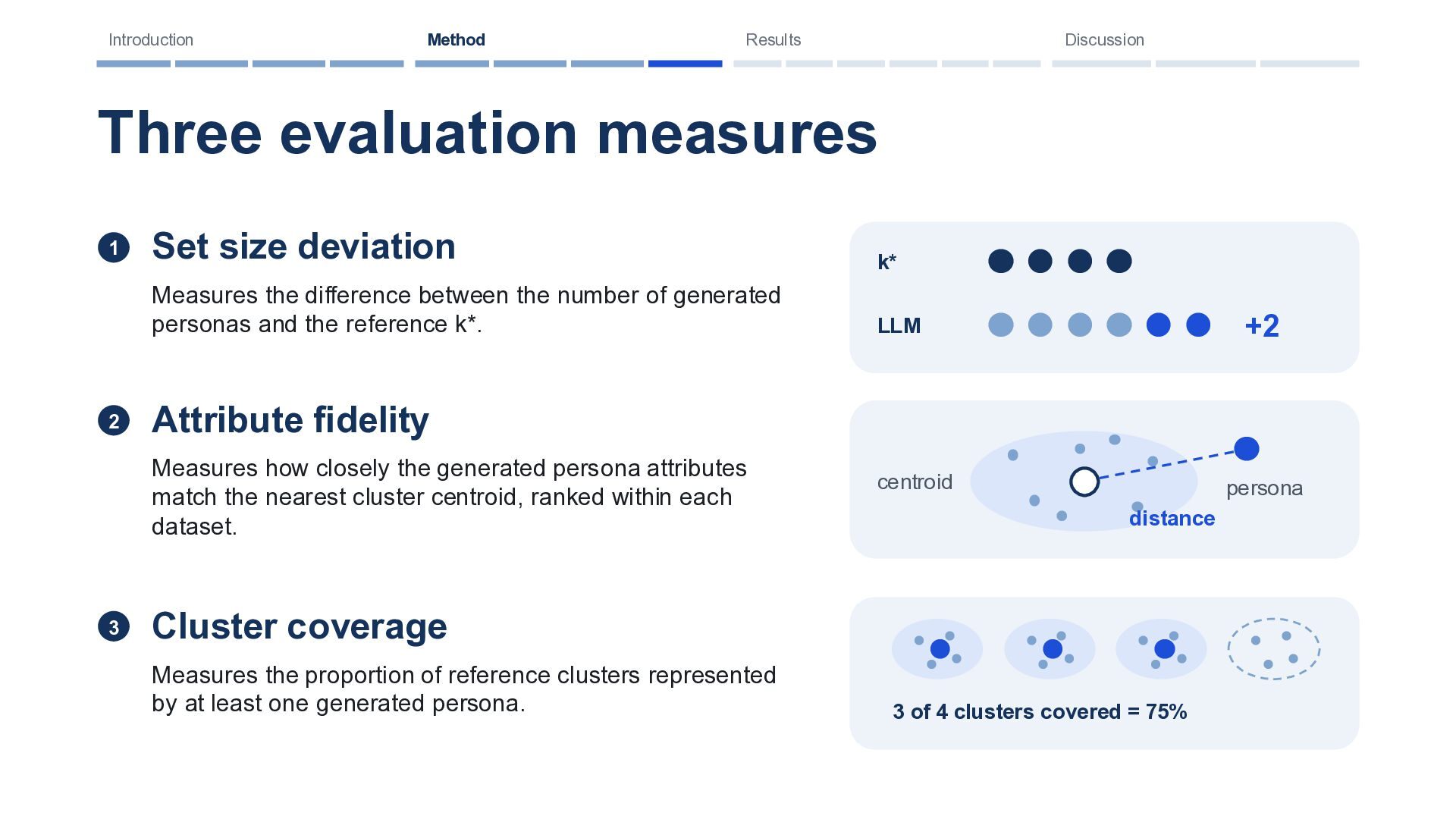
size deviation k* Measures the difference between the number of generated personas and the reference k*. LLM Attribute fidelity Measures how closely the generated persona attributes match the nearest cluster centroid, ranked within each dataset. 3 +2 centroid persona distance Cluster coverage Measures the proportion of reference clusters represented by at least one generated persona. 3 of 4 clusters covered = 75%
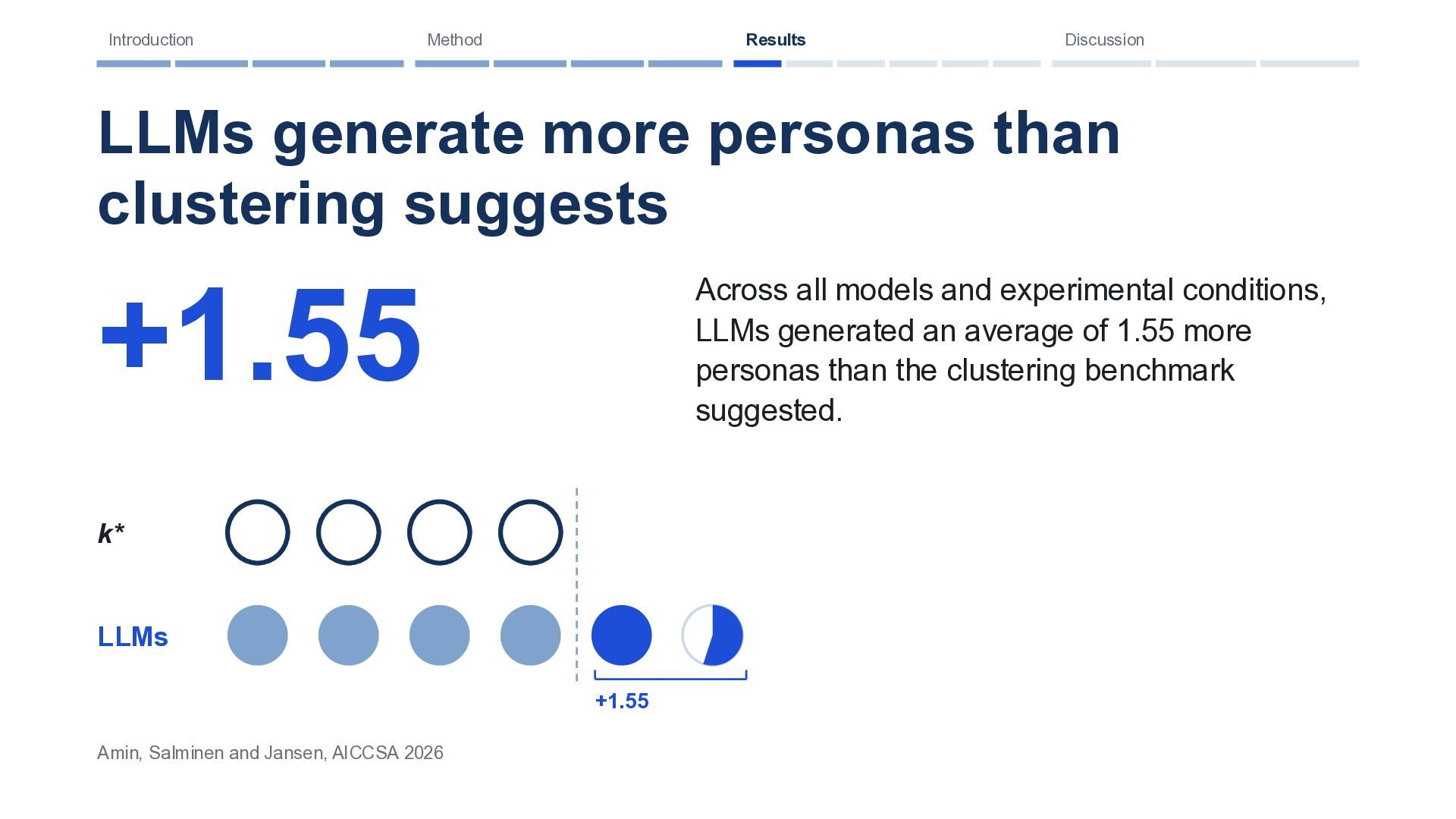
suggests +1.55 Across all models and experimental conditions, LLMs generated an average of 1.55 more personas than the clustering benchmark suggested. k* LLMs +1.55 Amin, Salminen and Jansen, AICCSA 2026
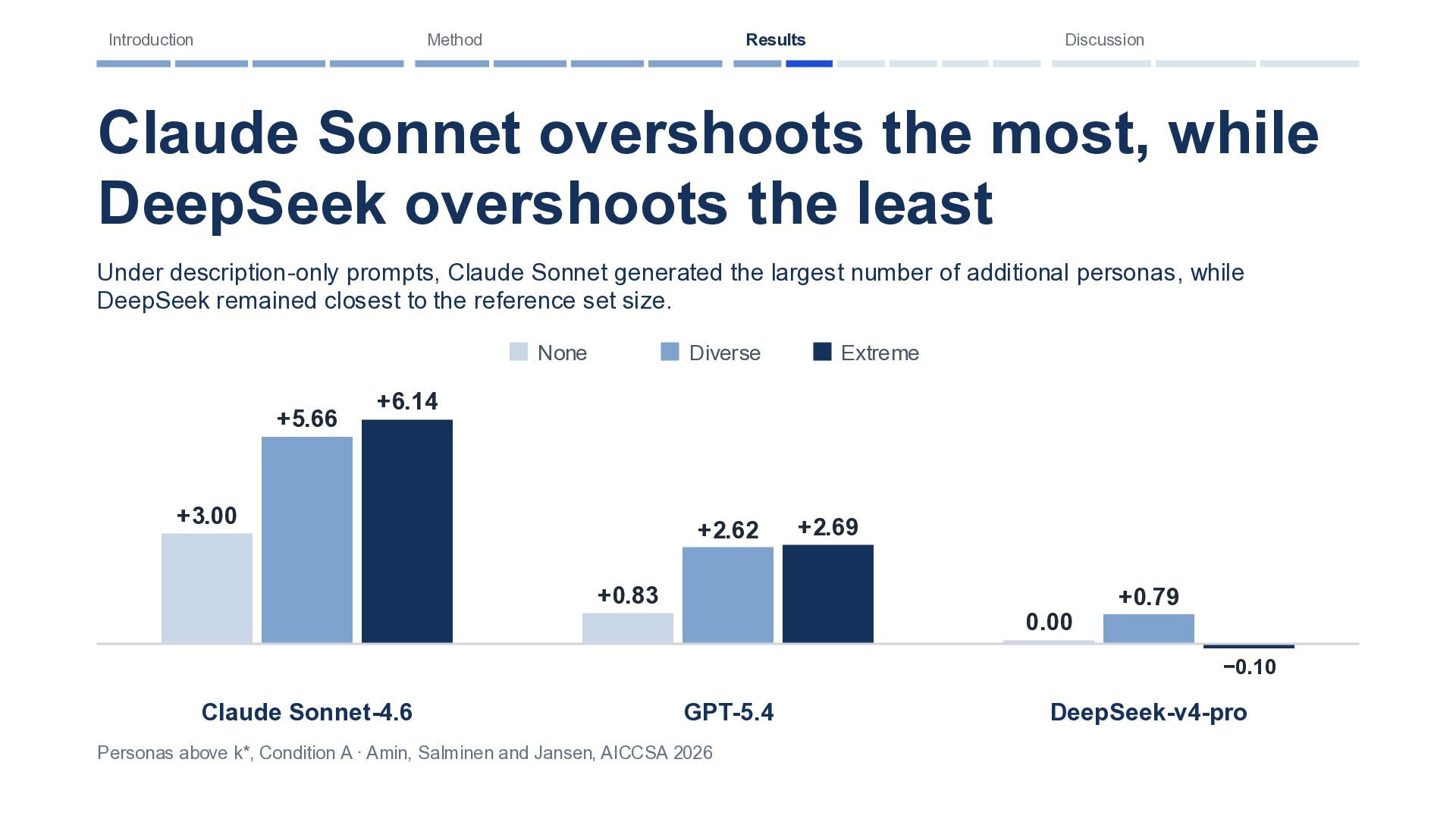
DeepSeek overshoots the least Under description-only prompts, Claude Sonnet generated the largest number of additional personas, while DeepSeek remained closest to the reference set size. None +5.66 Diverse Extreme +6.14 +3.00 +2.62 +2.69 +0.83 0.00 +0.79 −0.10 Claude Sonnet-4.6 GPT-5.4 Personas above k*, Condition A · Amin, Salminen and Jansen, AICCSA 2026 DeepSeek-v4-pro
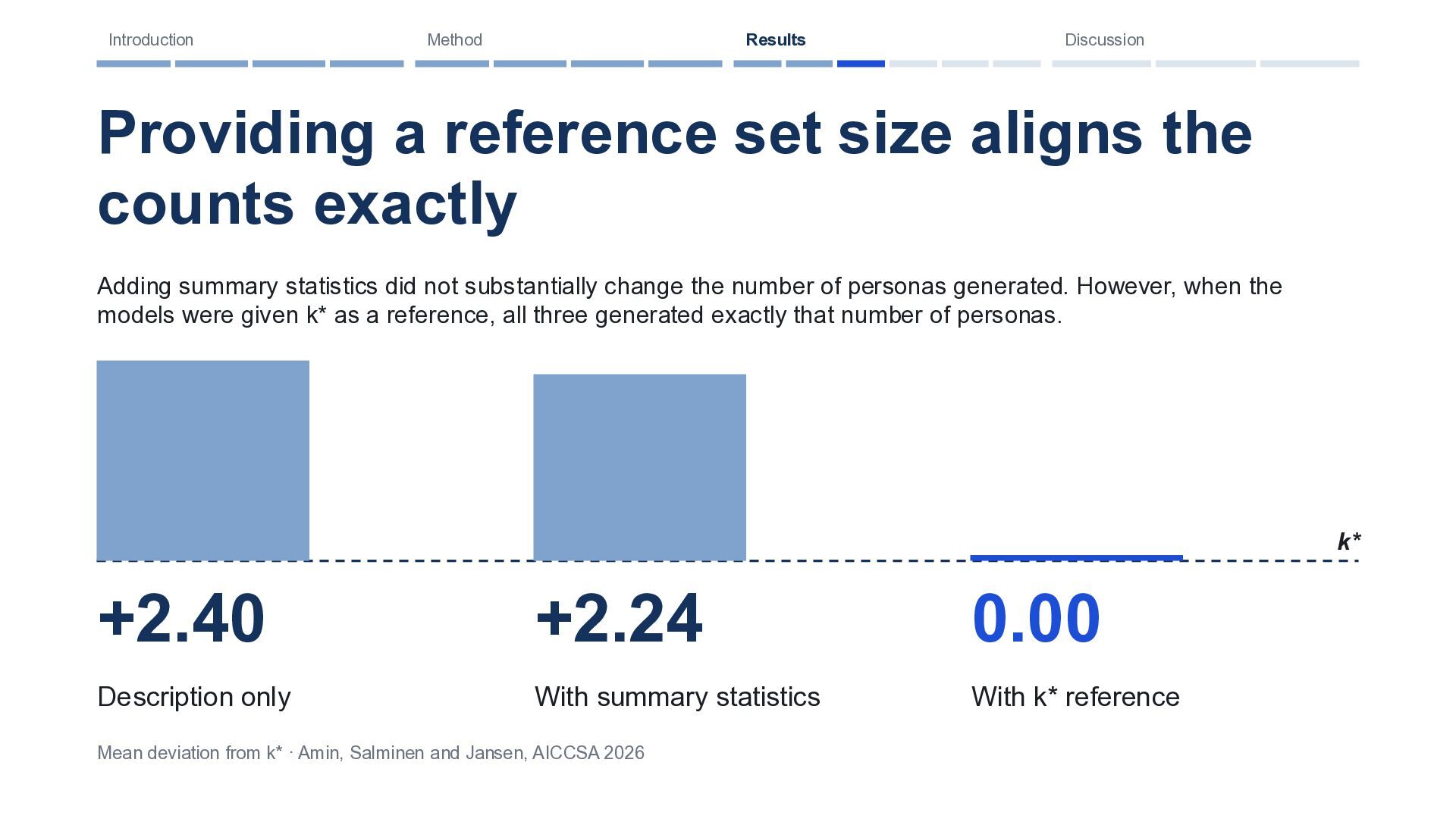
the counts exactly Adding summary statistics did not substantially change the number of personas generated. However, when the models were given k* as a reference, all three generated exactly that number of personas. k* +2.40 +2.24 0.00 Description only With summary statistics With k* reference Mean deviation from k* · Amin, Salminen and Jansen, AICCSA 2026
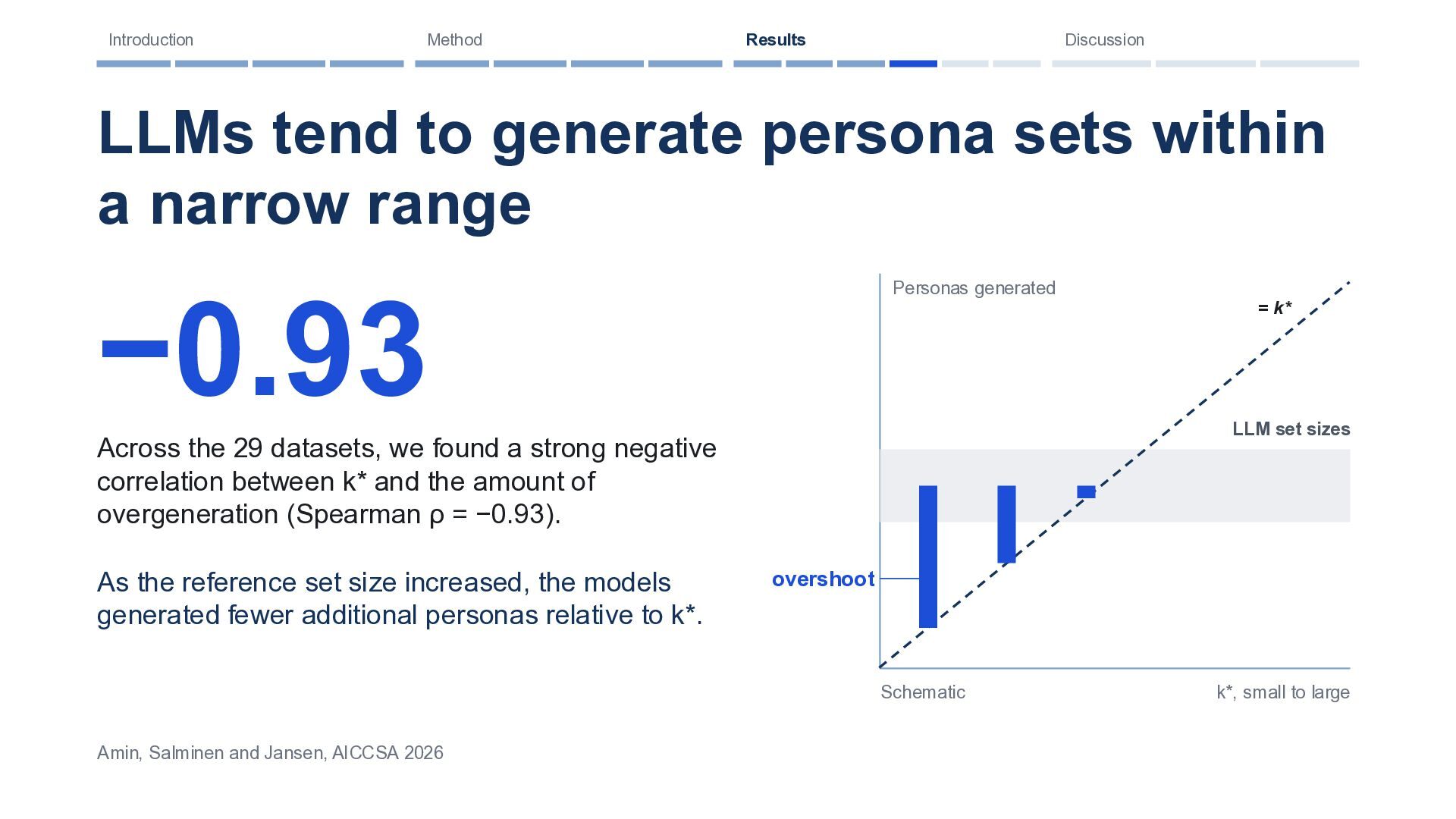
within a narrow range −0.93 Personas generated LLM set sizes Across the 29 datasets, we found a strong negative correlation between k* and the amount of overgeneration (Spearman ρ = −0.93). As the reference set size increased, the models generated fewer additional personas relative to k*. overshoot Schematic Amin, Salminen and Jansen, AICCSA 2026 = k* k*, small to large
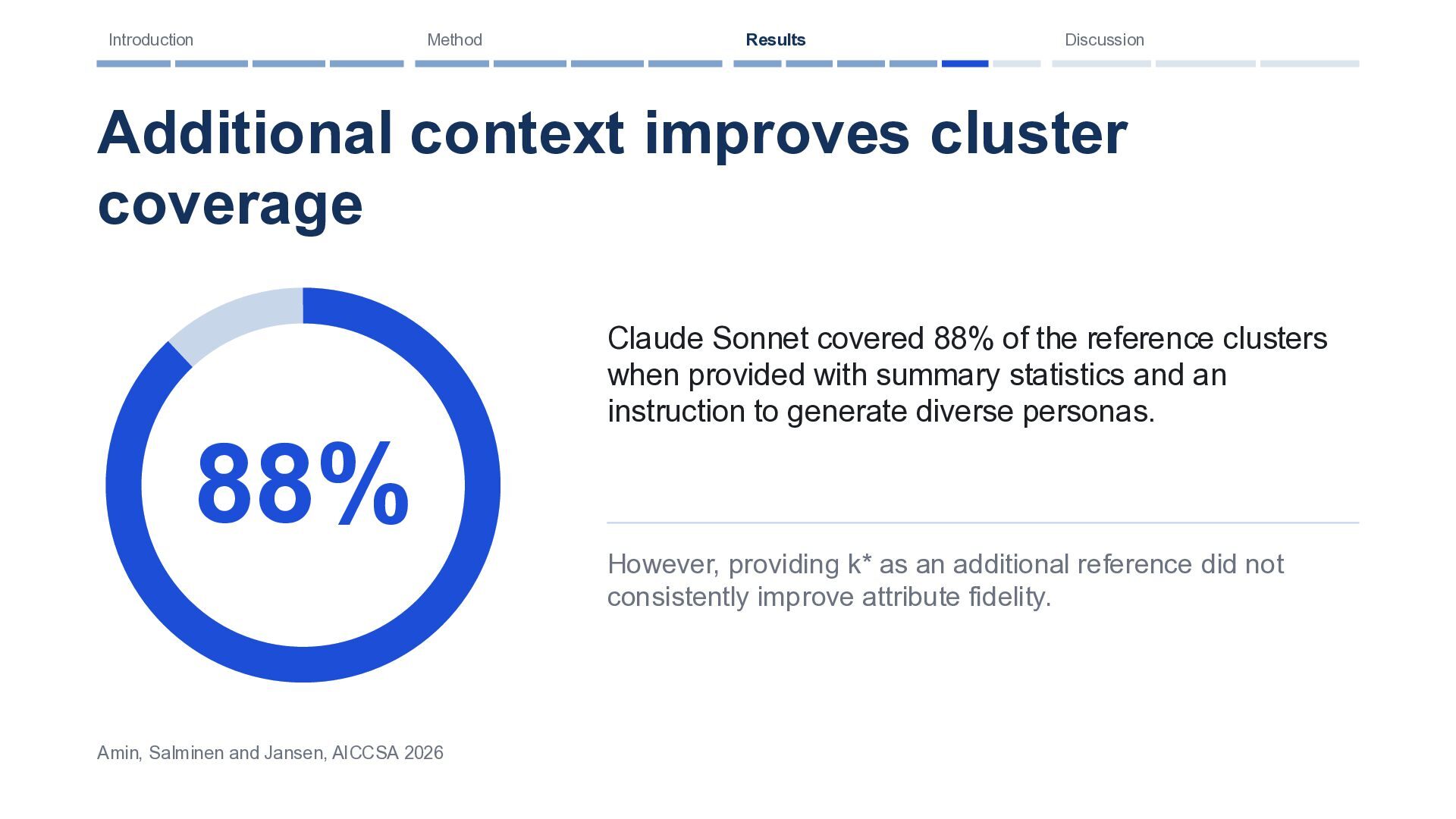
Claude Sonnet covered 88% of the reference clusters when provided with summary statistics and an instruction to generate diverse personas. However, providing k* as an additional reference did not consistently improve attribute fidelity. Amin, Salminen and Jansen, AICCSA 2026
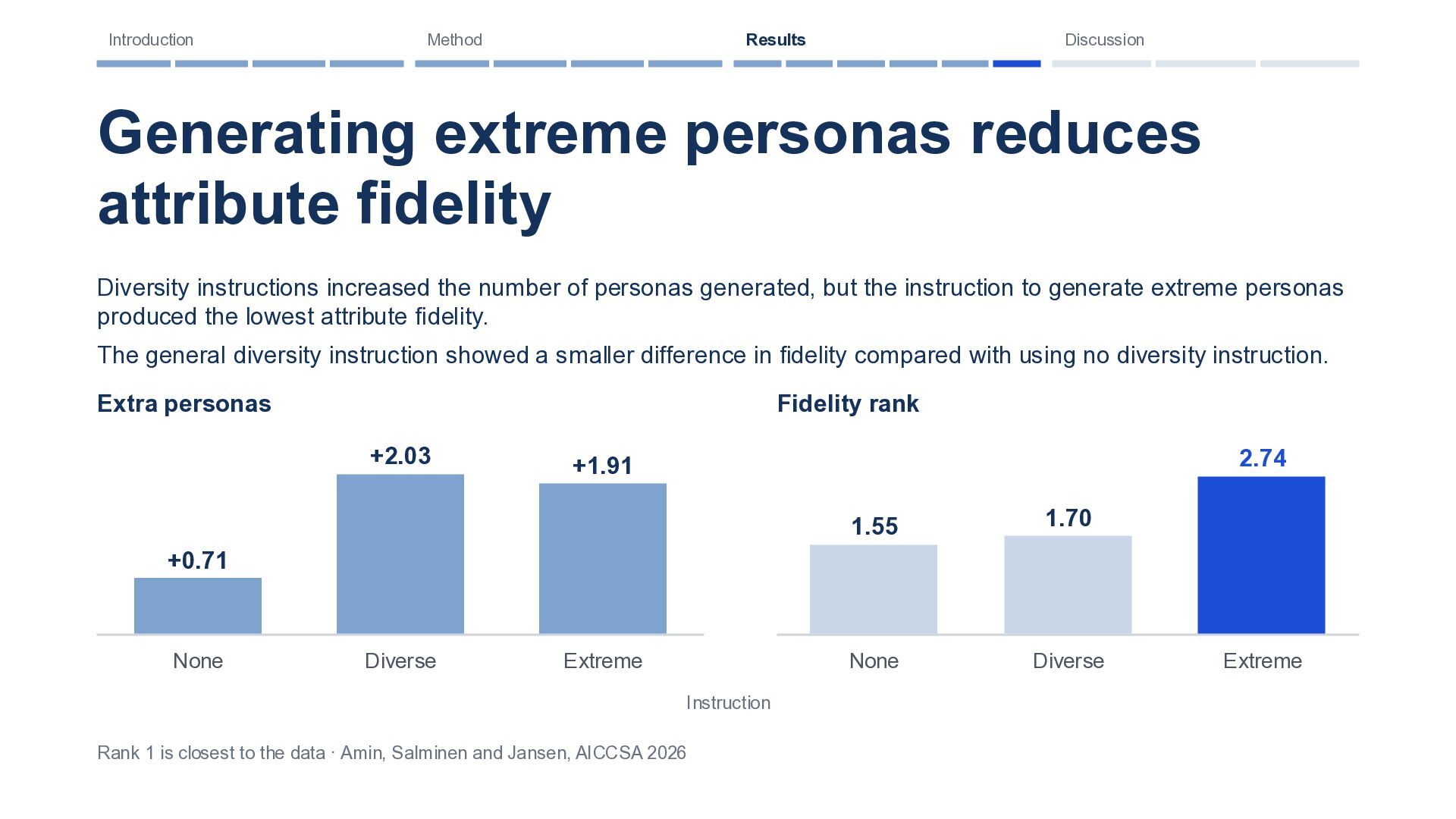
Diversity instructions increased the number of personas generated, but the instruction to generate extreme personas produced the lowest attribute fidelity. The general diversity instruction showed a smaller difference in fidelity compared with using no diversity instruction. Extra personas Fidelity rank +2.03 2.74 +1.91 1.55 1.70 None Diverse +0.71 None Diverse Extreme Instruction Rank 1 is closest to the data · Amin, Salminen and Jansen, AICCSA 2026 Extreme
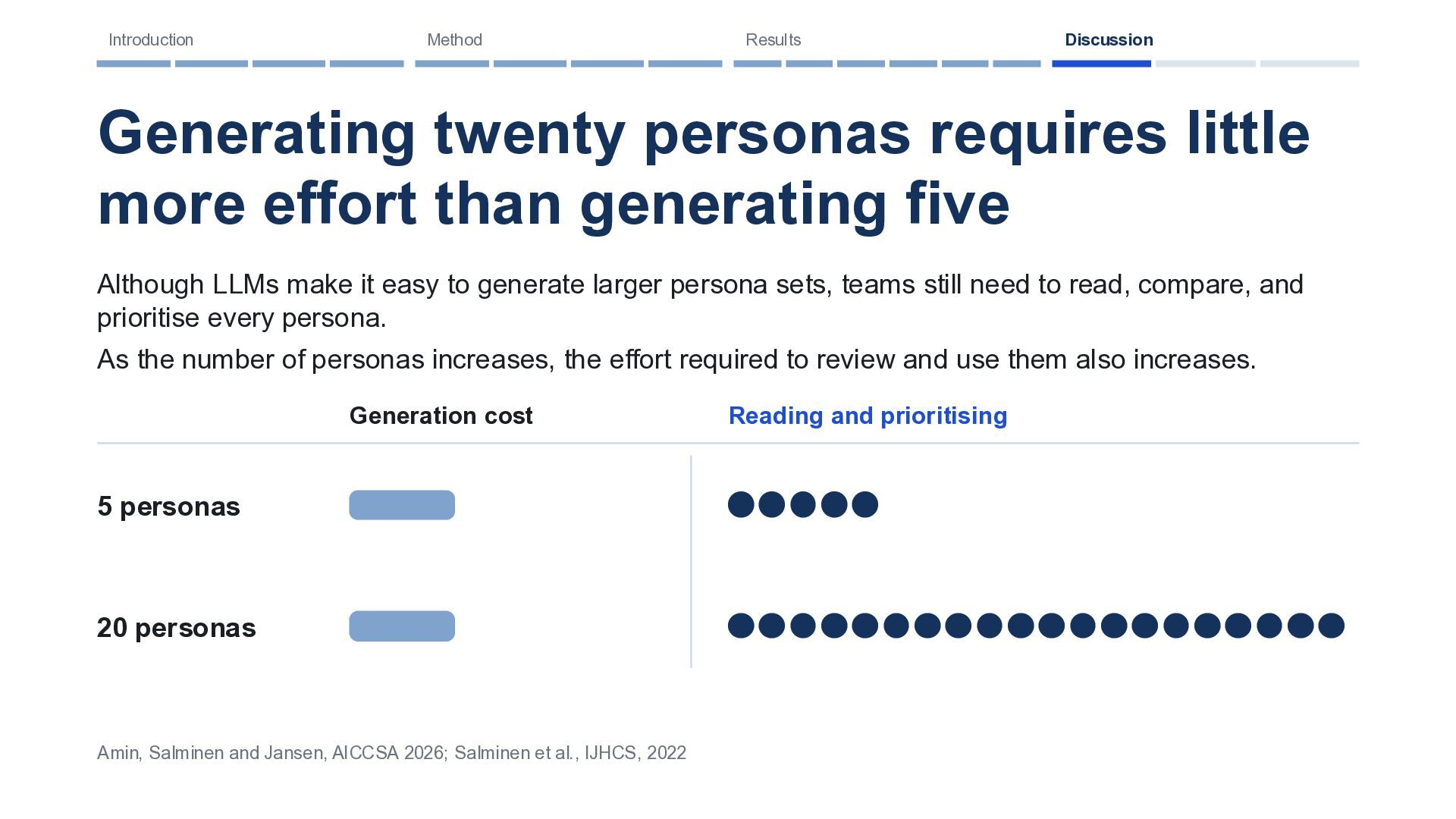
effort than generating five Although LLMs make it easy to generate larger persona sets, teams still need to read, compare, and prioritise every persona. As the number of personas increases, the effort required to review and use them also increases. Generation cost 5 personas 20 personas Amin, Salminen and Jansen, AICCSA 2026; Salminen et al., IJHCS, 2022 Reading and prioritising
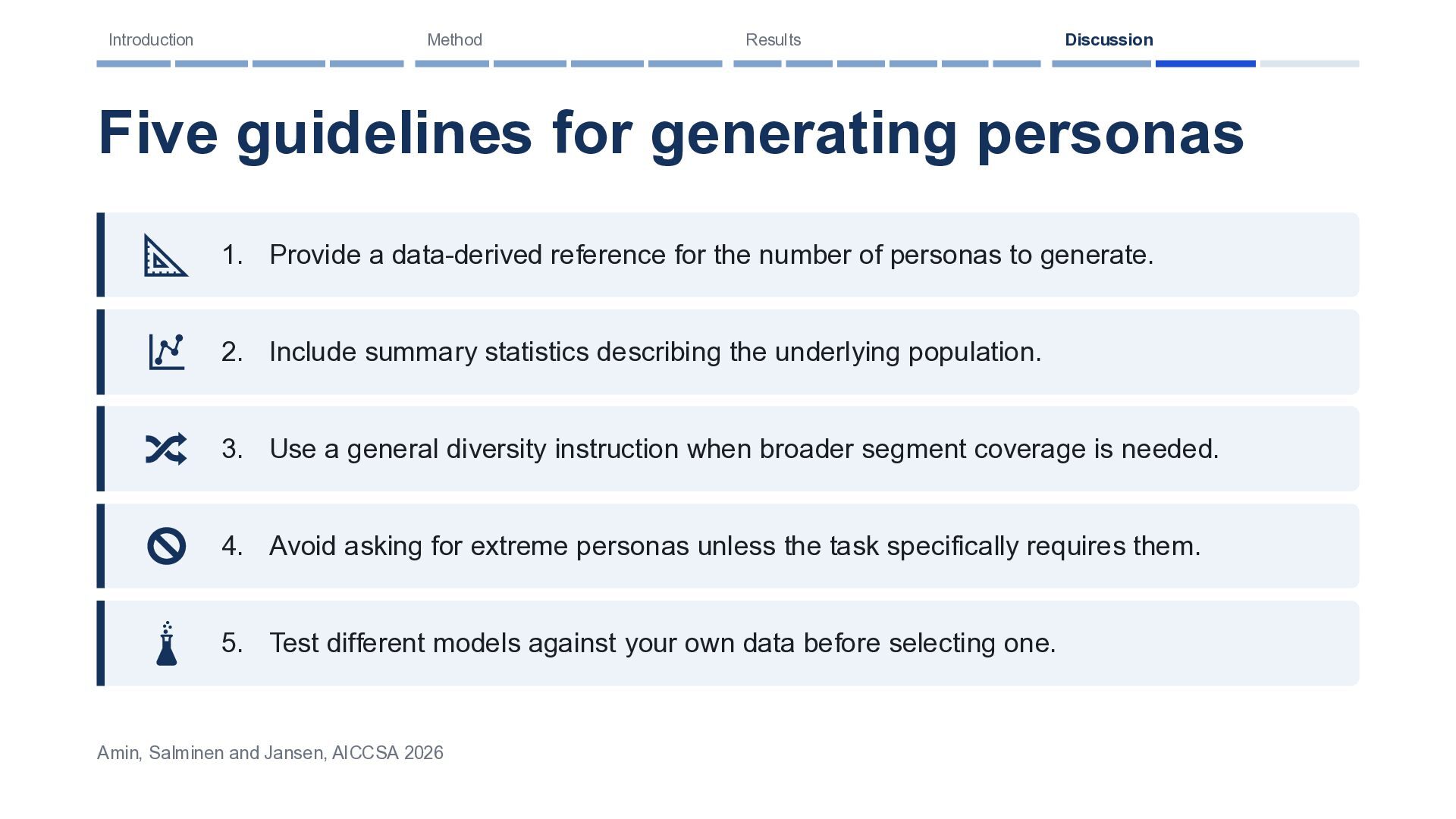
Provide a data-derived reference for the number of personas to generate. 2. Include summary statistics describing the underlying population. 3. Use a general diversity instruction when broader segment coverage is needed. 4. Avoid asking for extreme personas unless the task specifically requires them. 5. Test different models against your own data before selecting one. Amin, Salminen and Jansen, AICCSA 2026
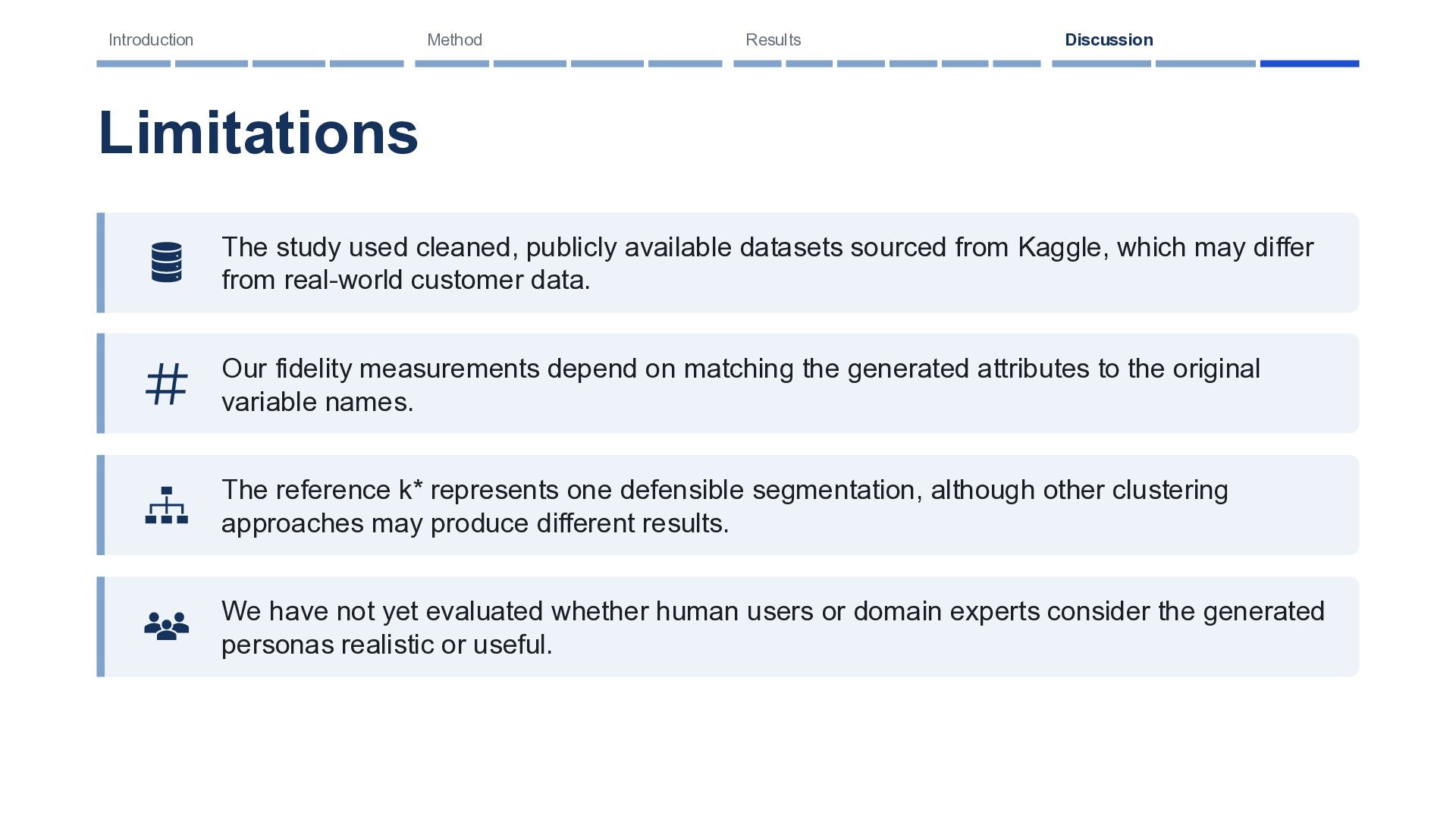
available datasets sourced from Kaggle, which may differ from real-world customer data. Our fidelity measurements depend on matching the generated attributes to the original variable names. The reference k* represents one defensible segmentation, although other clustering approaches may produce different results. We have not yet evaluated whether human users or domain experts consider the generated personas realistic or useful.
the data. Danial Amin University of Vaasa, Finland [email protected] academic.danialamin.com Data, prompts and outputs doi.org/10.17605/OSF.IO/DCHU9 Persona Team's research personateam.xyz PS. Stay tuned for the updated GenAI persona book in 2027!


 damin
 gree_tech
 ishikawa_satoru
 makocchi
 genda
 minorun365
 kairim0
 occhi
 pfn
 kentapapa
 tokuty
 stomk
 mohab1
 trallard
 marktimemedia
 samlambert
 techseoconnect
 palkan
 deanohume
 geshan
 aarron
 holman
 rkendrick25
 sabderemane
 reverentgeek