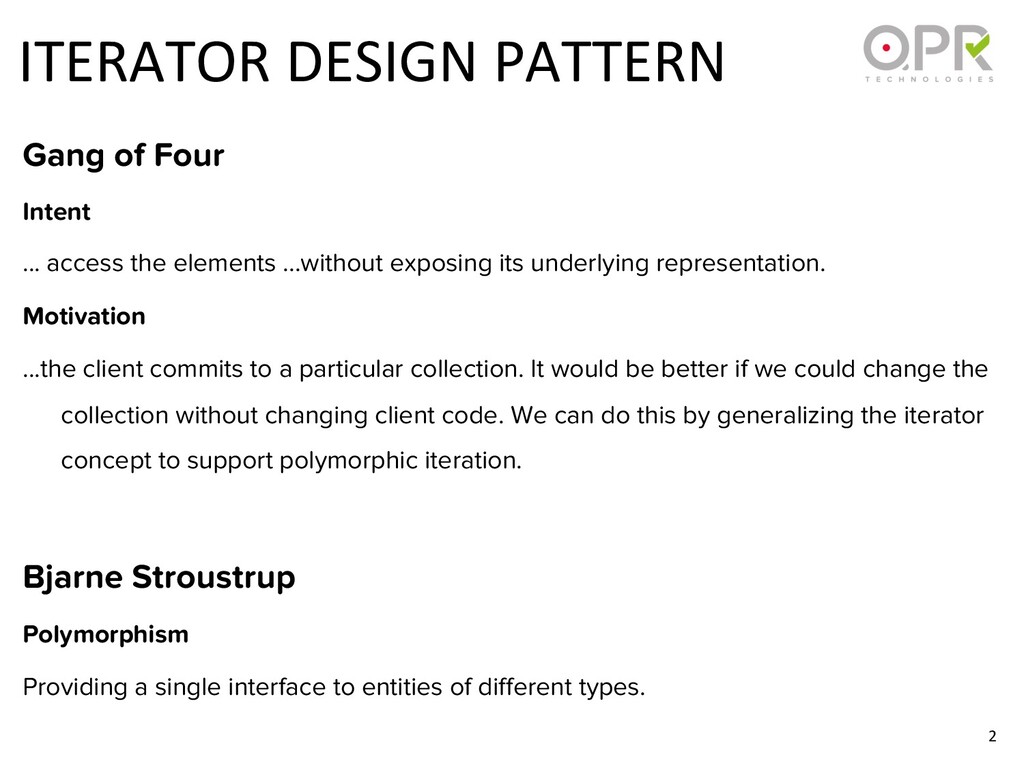
the elements ...without exposing its underlying representation. Motivation ...the client commits to a particular collection. It would be better if we could change the collection without changing client code. We can do this by generalizing the iterator concept to support polymorphic iteration. Bjarne Stroustrup Polymorphism Providing a single interface to entities of different types.
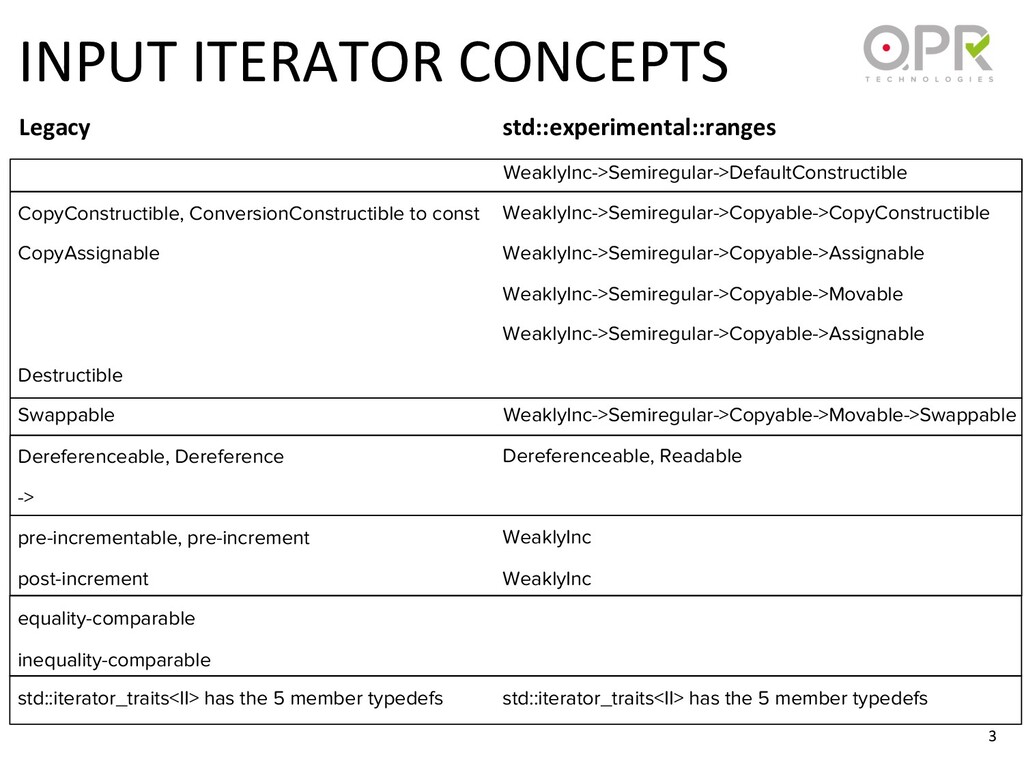
WeaklyInc->Semiregular->Copyable->Assignable WeaklyInc->Semiregular->Copyable->Movable WeaklyInc->Semiregular->Copyable->Assignable CopyConstructible, ConversionConstructible to const CopyAssignable Destructible Dereferenceable, Readable Dereferenceable, Dereference -> WeaklyInc WeaklyInc pre-incrementable, pre-increment post-increment equality-comparable inequality-comparable std::iterator_traits<II> has the 5 member typedefs std::iterator_traits<II> has the 5 member typedefs
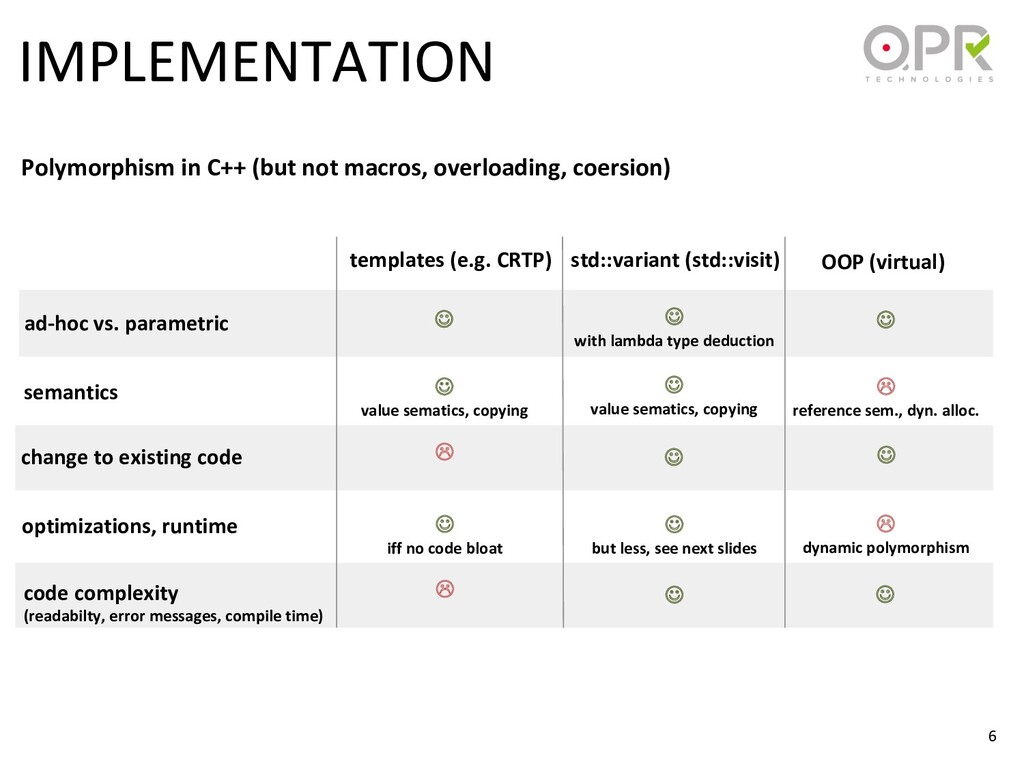
templates (e.g. CRTP) OOP (virtual) std::variant (std::visit) Polymorphism in C++ (but not macros, overloading, coersion) optimizations, runtime J J J with lambda type deduction L reference sem., dyn. alloc. J value sematics, copying J value sematics, copying L code complexity (readabilty, error messages, compile time) J J J iff no code bloat J but less, see next slides J J L dynamic polymorphism L


 davefar
 falcon8823
 kenjiyoneyama
 uyuki234
 teyamagu
 deka_morita
 rkaga
rkaga
 findyinc
 naokihaba
 o0h
o0h
 neuecc
 texmeijin
 sylph01
 aleyda
 orderedlist
 erikaheidi
 sferik
 mongodb
 jct
jct
 chriscoyier
 kevinliebholz
 rasagy
 ks91
ks91
 techseoconnect