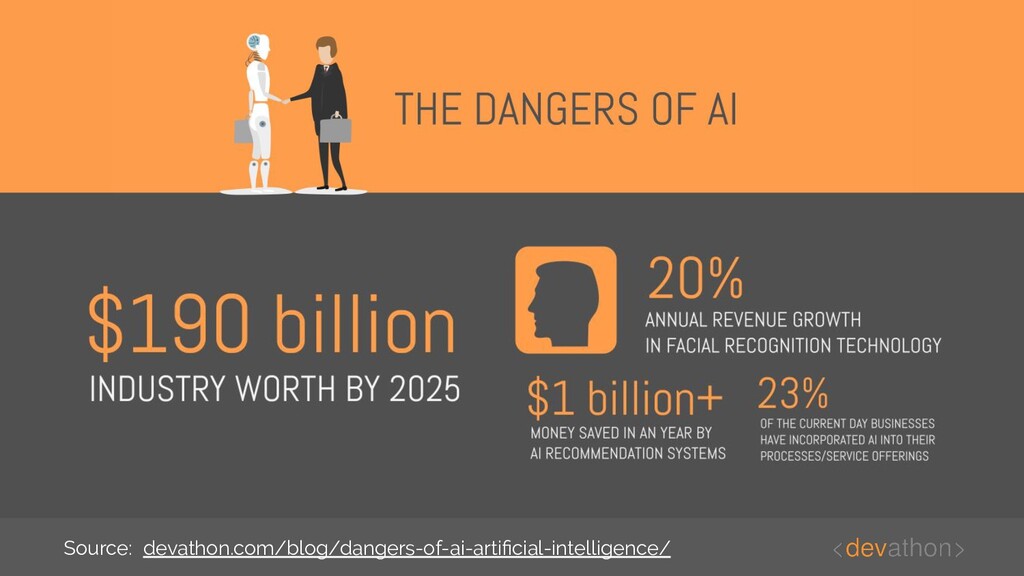
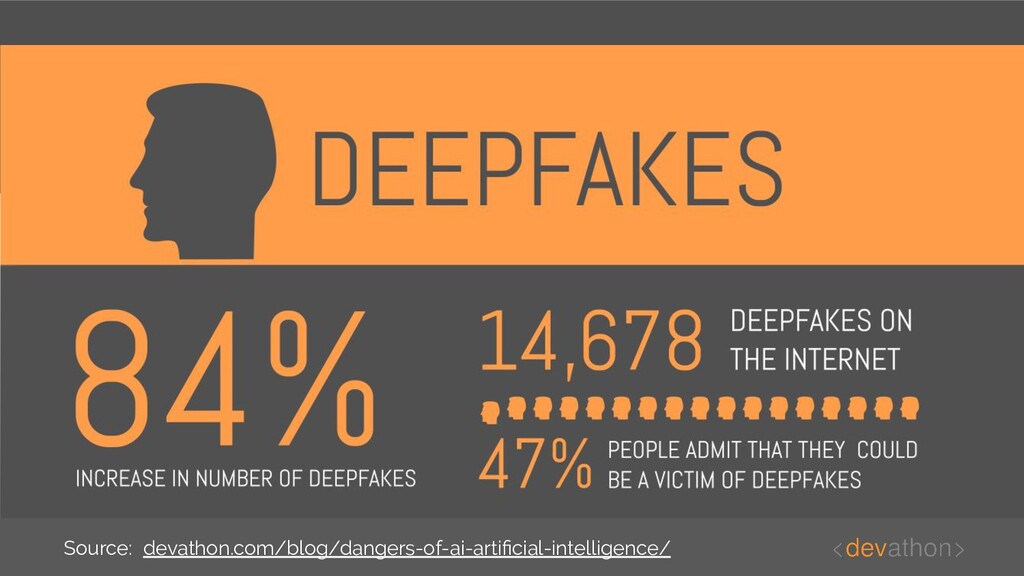
Nine out of ten people think #Deepfakes can be more harmful than good. From #Drones warfare to #Disinformation campaigns, here are 11 dangers of #AI you need to know about.
technologies, and many businesses, governments, and other organizations are using it for various reasons. The promising technology can transform many aspects of our life, however, are there any dangers of Artificial Intelligence (Al) we should worry about? Indeed, AI can have an adverse impact on many business and societal aspects, e.g., cybersecurity, national security, politics, and even the reputation of people. Should you use AI in your organization? You surely should, however, you also need to know the dangers of AI. Read on, as we explain them.. Source: devathon.com/blog/dangers-of-ai-artificial-intelligence/
therefore, it can sometimes be hard to imagine the world before AI! Well, that world was quite different, and the key reason for that was that computers couldn’t remember what they did. Computers at that time could only execute commands. They couldn’t store these commands to autonomously use them at a later time. These computers couldn’t grasp when a situation arose that was similar to a situation in the past since they couldn’t “learn”. Automation was rule-based, and it required explicit programming to implement automation. Artificial Intelligence (AI) changed that. Source: devathon.com/blog/dangers-of-ai-artificial-intelligence/
machines to “learn” from “experience”, which translates to a large data set. It enables machines to adjust to varying inputs without human intervention, which allows machines to perform tasks that could only be done by human beings earlier. AI uses mathematical algorithms to analyze a vast amount of data and “learn” from it. Alan Turing, a British scientist had started the research in this field, and AI has a long and eventful history. The term “Artificial Intelligence” emerged in a 1956 conference that took place at Dartmouth College, located in Hanover, New Hampshire, USA. The research and development concerning AI had many twists and turns. WORKING AND HISTORY OF AI Source: devathon.com/blog/dangers-of-ai-artificial-intelligence/
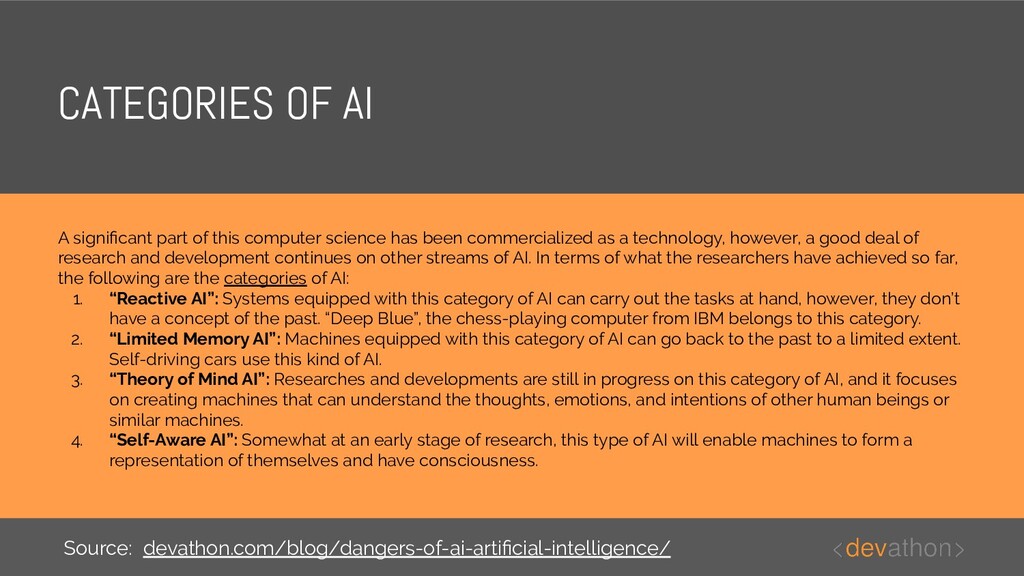
as a technology, however, a good deal of research and development continues on other streams of AI. In terms of what the researchers have achieved so far, the following are the categories of AI: 1. “Reactive AI”: Systems equipped with this category of AI can carry out the tasks at hand, however, they don’t have a concept of the past. “Deep Blue”, the chess-playing computer from IBM belongs to this category. 2. “Limited Memory AI”: Machines equipped with this category of AI can go back to the past to a limited extent. Self-driving cars use this kind of AI. 3. “Theory of Mind AI”: Researches and developments are still in progress on this category of AI, and it focuses on creating machines that can understand the thoughts, emotions, and intentions of other human beings or similar machines. 4. “Self-Aware AI”: Somewhat at an early stage of research, this type of AI will enable machines to form a representation of themselves and have consciousness. CATEGORIES OF AI Source: devathon.com/blog/dangers-of-ai-artificial-intelligence/
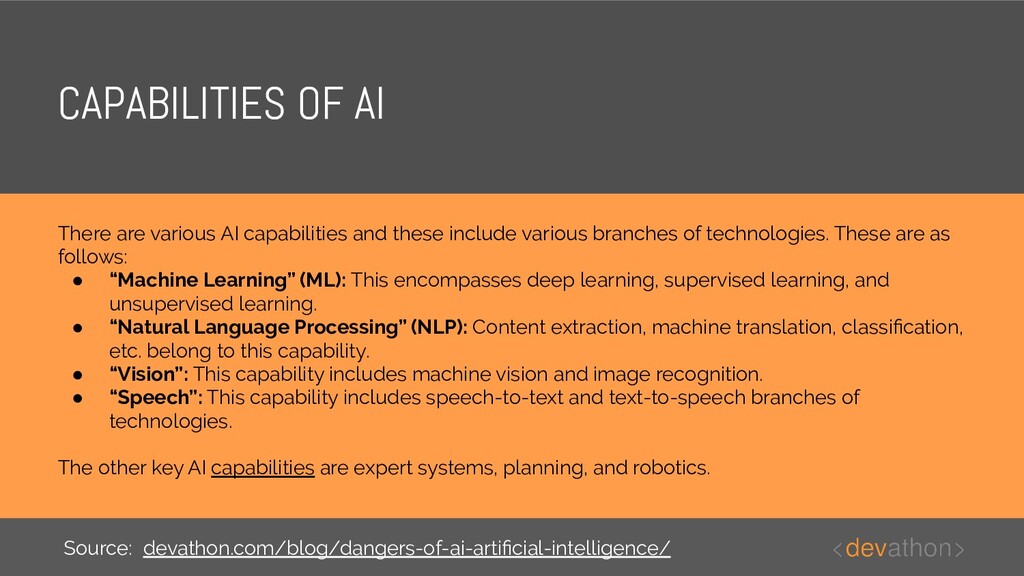
of technologies. These are as follows: • “Machine Learning” (ML): This encompasses deep learning, supervised learning, and unsupervised learning. • “Natural Language Processing” (NLP): Content extraction, machine translation, classification, etc. belong to this capability. • “Vision”: This capability includes machine vision and image recognition. • “Speech”: This capability includes speech-to-text and text-to-speech branches of technologies. The other key AI capabilities are expert systems, planning, and robotics. CAPABILITIES OF AI Source: devathon.com/blog/dangers-of-ai-artificial-intelligence/
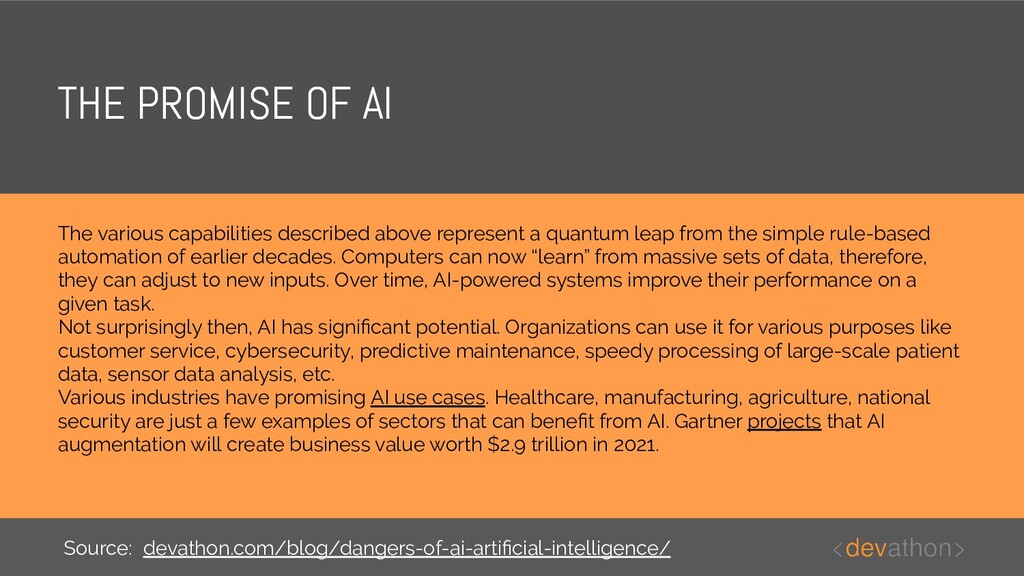
leap from the simple rule-based automation of earlier decades. Computers can now “learn” from massive sets of data, therefore, they can adjust to new inputs. Over time, AI-powered systems improve their performance on a given task. Not surprisingly then, AI has significant potential. Organizations can use it for various purposes like customer service, cybersecurity, predictive maintenance, speedy processing of large-scale patient data, sensor data analysis, etc. Various industries have promising AI use cases. Healthcare, manufacturing, agriculture, national security are just a few examples of sectors that can benefit from AI. Gartner projects that AI augmentation will create business value worth $2.9 trillion in 2021. THE PROMISE OF AI
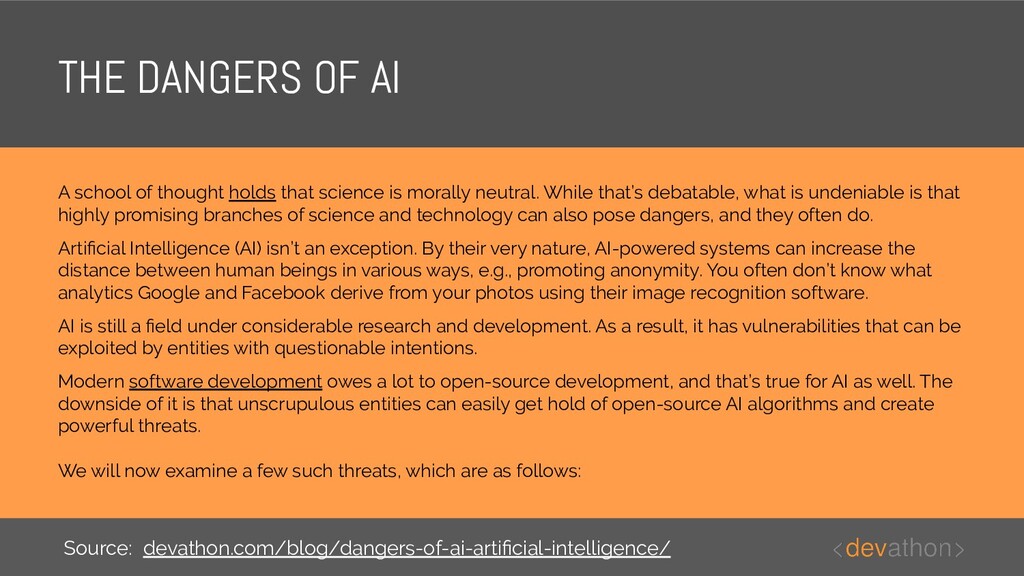
morally neutral. While that’s debatable, what is undeniable is that highly promising branches of science and technology can also pose dangers, and they often do. Artificial Intelligence (AI) isn’t an exception. By their very nature, AI-powered systems can increase the distance between human beings in various ways, e.g., promoting anonymity. You often don’t know what analytics Google and Facebook derive from your photos using their image recognition software. AI is still a field under considerable research and development. As a result, it has vulnerabilities that can be exploited by entities with questionable intentions. Modern software development owes a lot to open-source development, and that’s true for AI as well. The downside of it is that unscrupulous entities can easily get hold of open-source AI algorithms and create powerful threats. We will now examine a few such threats, which are as follows: THE DANGERS OF AI
isn’t exactly new. There have been instances of overlaying the faces of celebrities onto characters of pornographic video clips and creating defamatory contents about politicians. Creating such video contents were hard though since video content is hard to fake. It’s one of the famous dangers of AI. “Deepfake” changes that. It’s an application of AI with significant negative potential. Creating fake video contents that seemingly look original is easier with “Deepfakes”. This kind of AI applications uses two components, i.e., the “Generator” and the “Discriminator”. At the time of writing this, the world is still grappling with how to prevent Deepfakes from damaging reputations. Inspecting videos carefully to find tell-tale signs like strange blinking, a shift in skin tone and lighting, etc. can help. Governments and lawmakers will need to regulate effectively to curb the dangers of Deepfakes. Deepfakes
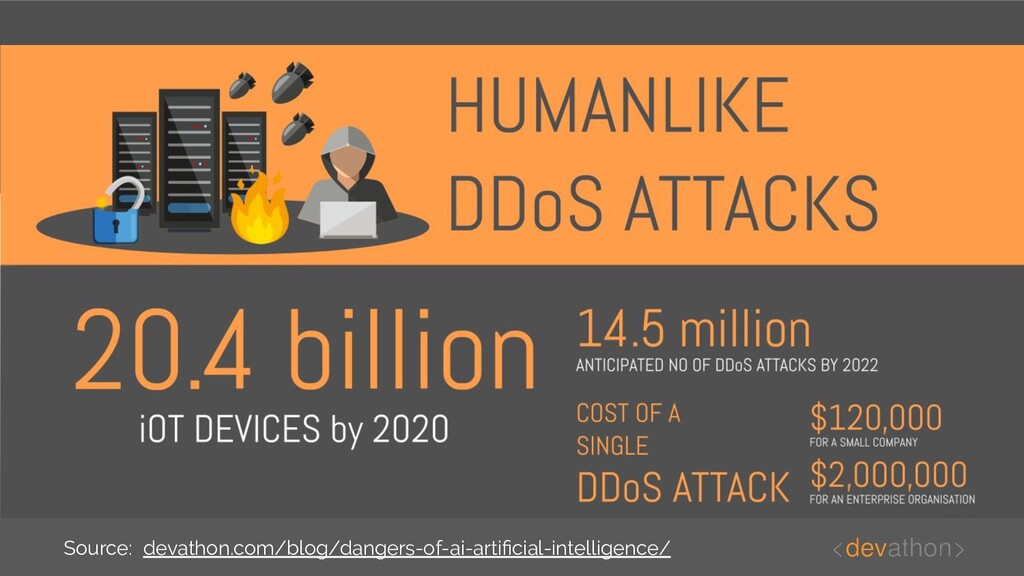
they are becoming more and more sophisticated. Human-like DoS attacks are powered by AI, and they are proving hard to address. A DoS attack is a form of cyber-attack where a cybercriminal prevents legitimate users of a networked system/service/website/application from using it. DoS attacks slow a system down by sending a large number of requests, moreover, they can even cripple a system. Such attacks typically originate from a single source. The next level is “Distributed Denial of Service” (DDoS), where cyber-attackers launch a DoS attack from multiple sources, however, they coordinate it centrally. Since DDoS attacks have better chances of reducing the availability of an information system, they can often be devastating. Not surprisingly, the answer to human-like DoS attacks can be found in AI! Organizations might need to employ cybersecurity systems that employ ML unsupervised algorithms, which are stronger than supervised algorithms as far as learning from new information is concerned. This will equip them to cope with new parameters and signatures of human-like DoS attacks. Human-like DoS attacks
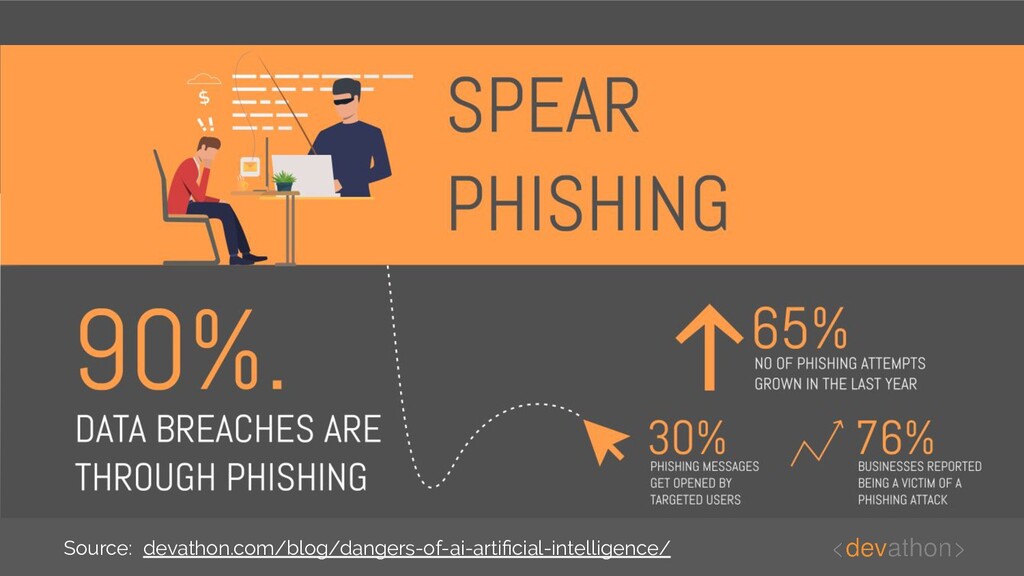
now. These attacks are among the popular modes of operation adopted by cybercriminals, and the term phishing refers to attempts to trick people to share sensitive information. Phishing attacks involve cyber-attackers posing as trusted entities and sending emails, phone calls, SMS, etc. to their potential targets. An email as part of a phishing attack could come from a seemingly trusted source, moreover, it might contain a link. When a recipient clicks the link, their computer might get infected by malware that steals their personal sensitive information. While phishing attacks simultaneously target many potential targets and involve sending mass emails, spear phishing targets specific potential victims. Cyber-attackers launching spear-phishing attacks need to study their targets and customize the messages they send. How to prevent AI-powered spear-phishing attacks? AI can bring solutions to this too, and efforts are afoot to create such solutions. These solutions involve using classification models and “Artificial Neural Networks” (ANNs) to detect spear-phishing attacks. Such solutions also incorporate AI-powered chatbots to waste the time of the hackers. The combined effect of them can make cybercriminals abandon their attack and find easier targets. Spear phishing attacks
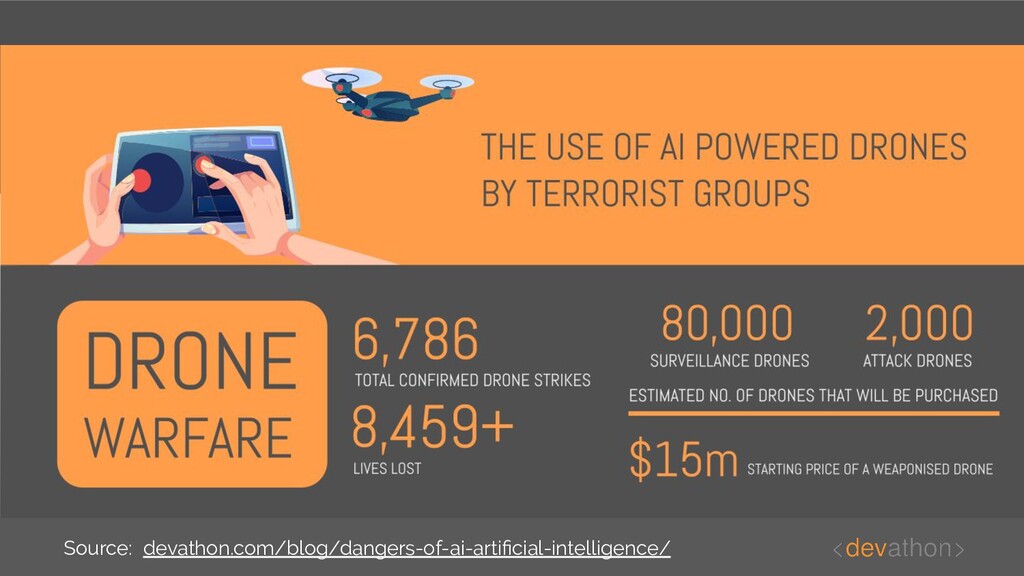
civilized world, moreover, terrorist groups are increasingly developing more sophisticated warfare capabilities. The advancement of technology has played a key part here. Take the case of drones. It’s not that only the market for commercial drones has seen a marked growth, but the usage of military drones has increased significantly, too. Unfortunately, ISIS, the dreaded terrorist group has also acquired killer drones, as it had demonstrated in a 2016 attack in Northern Iraq. At present, terrorist groups recruit suicide bombers that drive explosive-laden vehicles into crowded places. Consider a scenario where such terrorist groups employ autonomous vehicles for this purpose. They wouldn’t need to employ a suicide bomber, which reduces the threshold to launch a terror attack. Additionally, they control the entire attack from a distance, which further reduces their risks. Formulating effective and pragmatic regulations is key to preventing AI-powered drones and automated vehicles in the hands of terrorist groups. Commercial players innovating on AI and developing the technology need to be held accountable to international anti-terrorism laws. The use of AI-powered drones and explosives-laden autonomous vehicles by terrorist groups
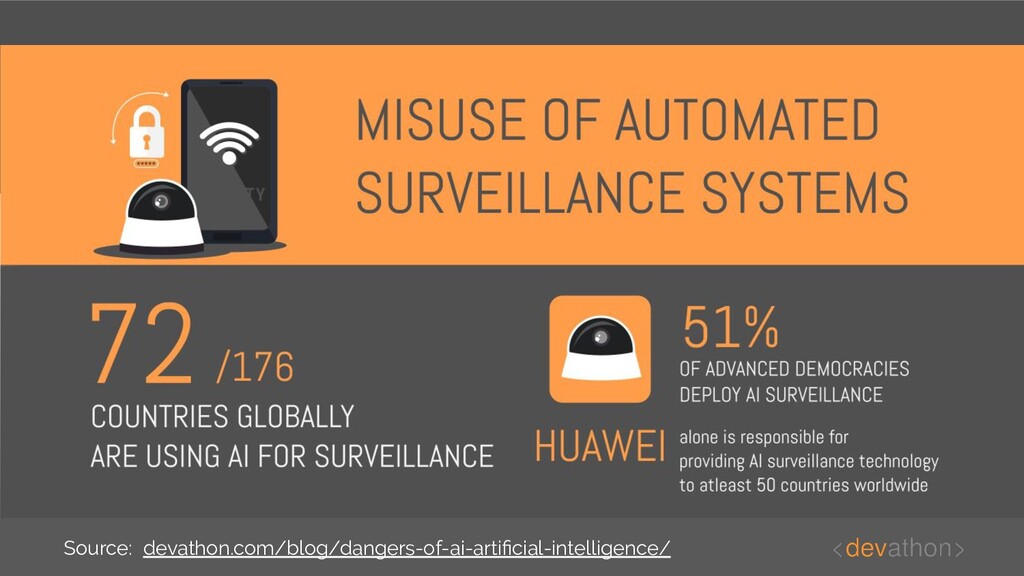
it helps them to secure their people, government installations, high-value infrastructure, and businesses. Governments use human as well as technology-based surveillance to maintain internal security and prevent external threats. That’s certainly legitimate, however, using surveillance to suppress legitimate dissent and target minorities go against the principles of universal human rights. Collecting information about citizens at large-scale and processing it are manpower-intensive tasks. While CCTV helps to gather video footage about sensitive places, the analysis of it remains a time-consuming affair. AI is changing that. The facial recognition technology can identify people quickly from a video clip. Additionally, the natural language processing technology can help security agencies to find video clips about persons of interest by simply querying the system using the language they speak. Preventing misuse of AI for mass surveillance promises to be hard. Effective international legal framework and compliance are important to ensure that a promising technology like AI doesn’t end up suppressing legitimate dissent. State use of automated surveillance platforms to suppress dissent
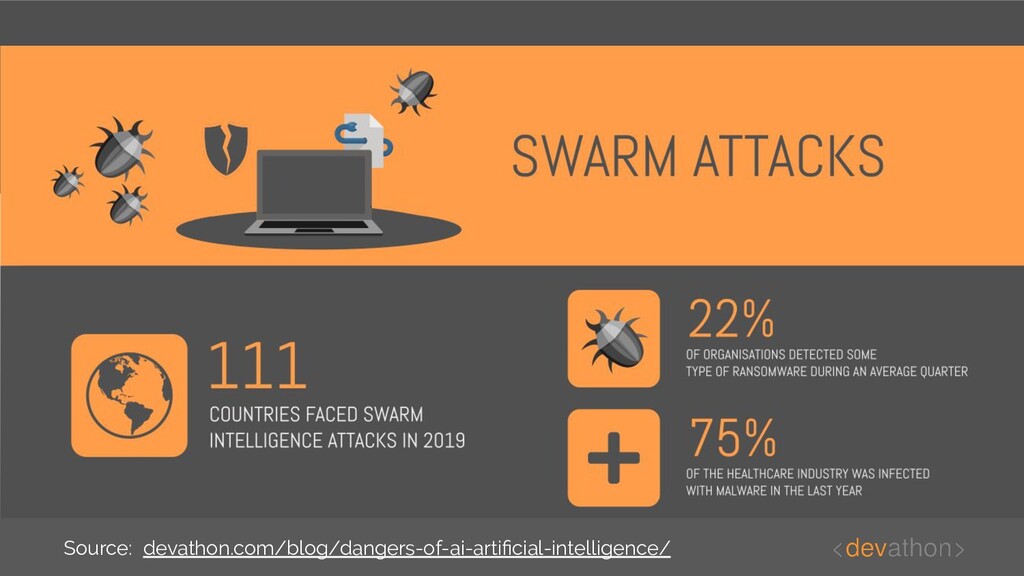
threats. This kind of attacks utilize a technology called “Swarm intelligence”, which involves swarm-based bots. The world of technology has already seen cyber-attacks using bots. Such attacks needed considerable intervention from cybercriminals, however, swarm attacks have changed that. Swarm-based bots can collaborate among themselves and operate autonomously. The significant advances in AI research and development have made this possible. Preventing swarm attacks requires a comprehensive approach, which involves the following: • Broad and consistent deployment of cybersecurity solutions across all ecosystems; • Deep integration of security into the extended technology landscape of an organization; • Automation of cybersecurity and its integration across devices and applications. Swarm attacks
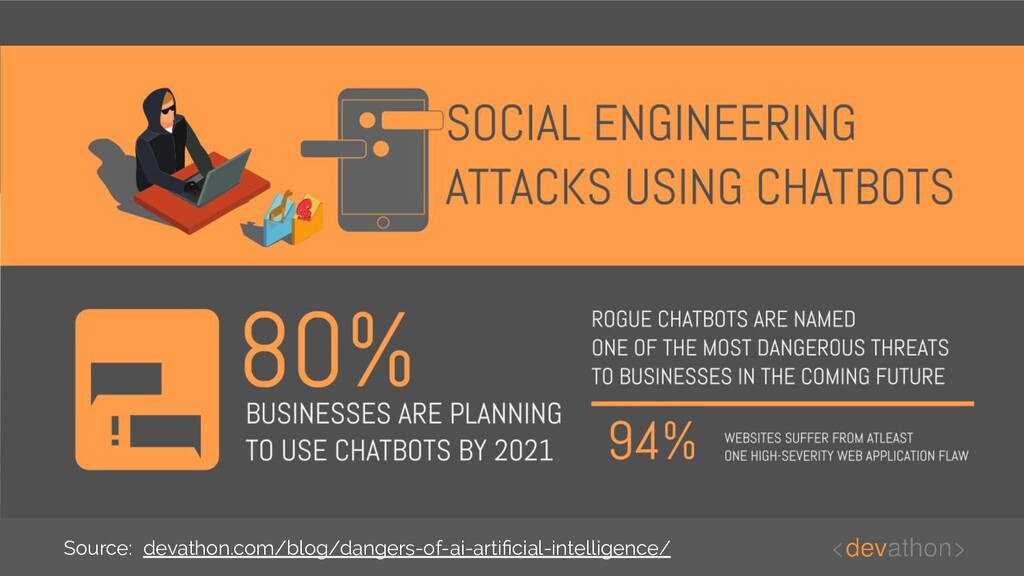
threat, which involves psychological manipulation to induce errors on the part of users of an information system. Such manipulations make users commit mistakes that create information security issues, moreover, users could divulge sensitive information due to such tricks. Cyber-attackers launching social engineering attacks need to follow a step-by-step approach, where they first investigate their potential targets and gather information, e.g., points of vulnerability. Subsequently, cybercriminals gain the trust of their potential victim. You should follow the well-established guidelines for preventing social engineering attacks, however, you need to focus on rogue chatbots. E.g., If a chatbot isn’t from a trusted source, then don’t click the links it suggests. Steer clear from offers that are “too-good-to-be-true” from chatbots, and follow the information security and privacy policies of your organization. Automated social engineering attacks using chatbots
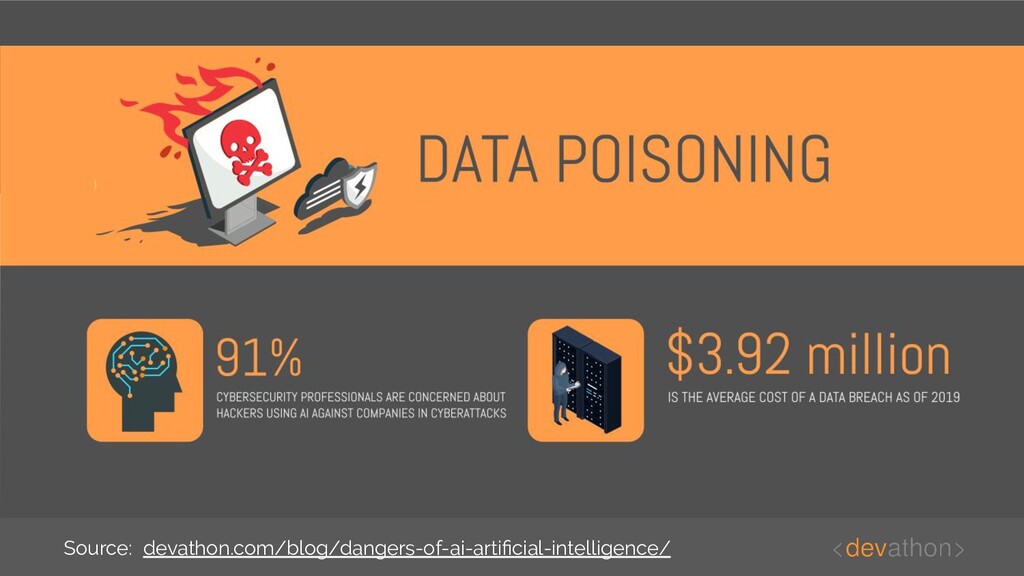
sets to deliver their intended outcome. These algorithms are used in a variety of use cases, e.g., predicting market trends, image recognition, cybersecurity, etc. Organizations implementing such AI/ML algorithms first “train” the system with training/test data, subsequently, they take data from actual operational scenarios and retrain these systems. The term “data poisoning” refers to a form of cyber-attack, where malicions players inject bad data into the data sets used for such retraining. You can guard against data poisoning attacks by using the following techniques: • Data sanitization: This technique focuses on detecting outliers in the data since a cyber-attacker would inject something very different in the data sets. • You can analyze the impact of the new training data set on the accuracy of the ML model. • “Human in the loop”: You can have experts concentrate on the statistical boundary shifts caused by the new training data to detect data poisoning. Data poisoning attacks on AI-dependent systems
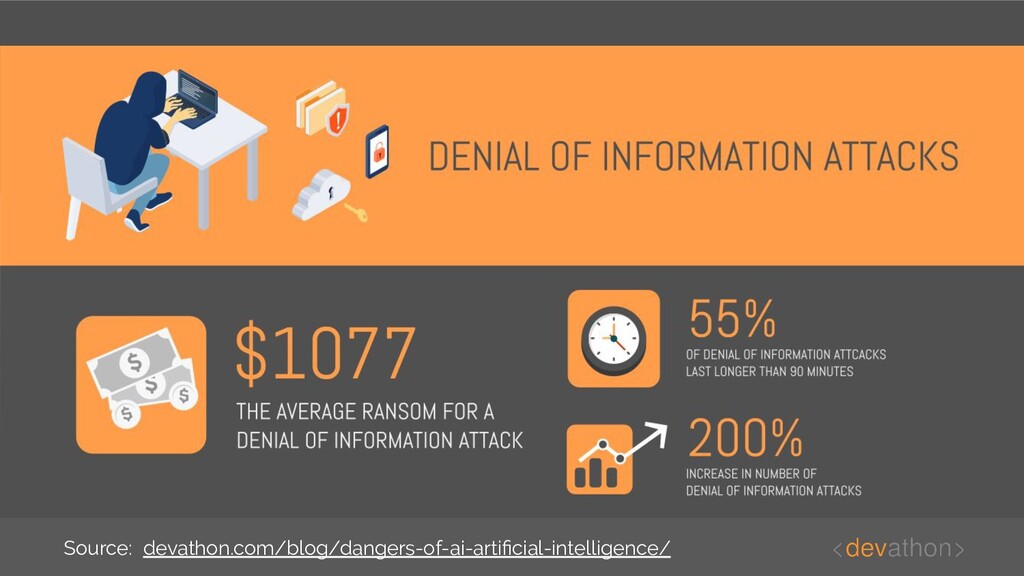
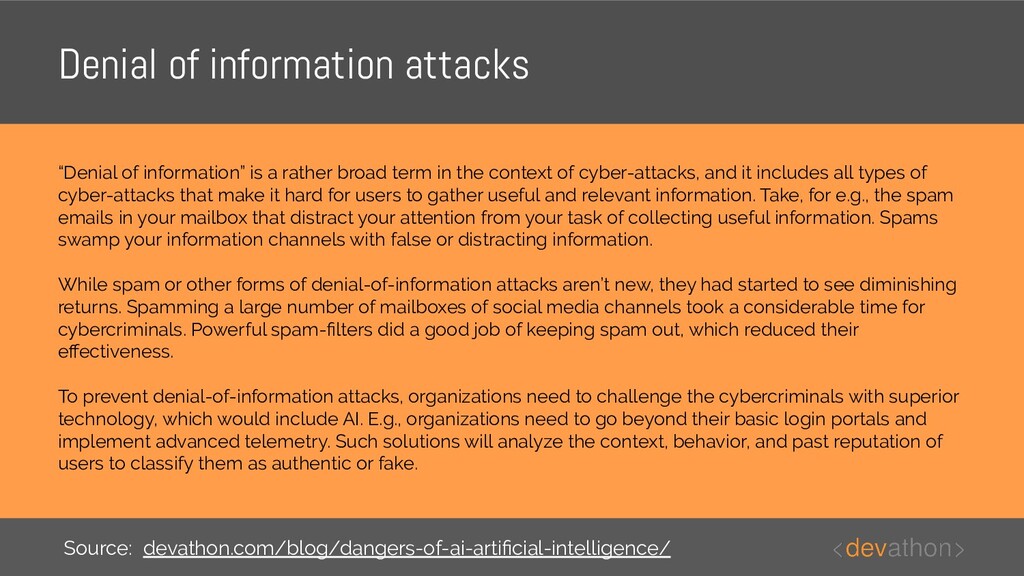
in the context of cyber-attacks, and it includes all types of cyber-attacks that make it hard for users to gather useful and relevant information. Take, for e.g., the spam emails in your mailbox that distract your attention from your task of collecting useful information. Spams swamp your information channels with false or distracting information. While spam or other forms of denial-of-information attacks aren’t new, they had started to see diminishing returns. Spamming a large number of mailboxes of social media channels took a considerable time for cybercriminals. Powerful spam-filters did a good job of keeping spam out, which reduced their effectiveness. To prevent denial-of-information attacks, organizations need to challenge the cybercriminals with superior technology, which would include AI. E.g., organizations need to go beyond their basic login portals and implement advanced telemetry. Such solutions will analyze the context, behavior, and past reputation of users to classify them as authentic or fake. Denial of information attacks
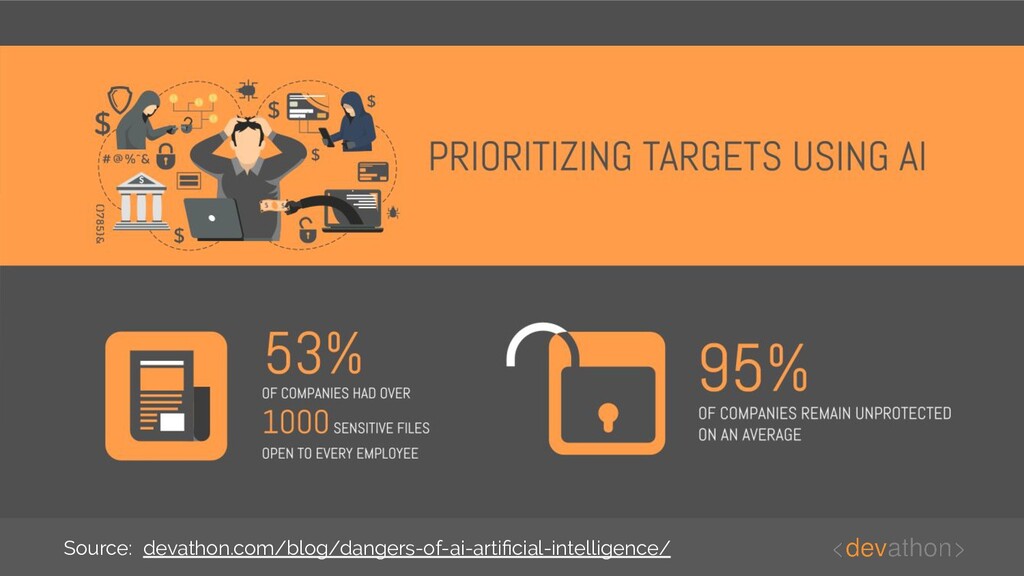
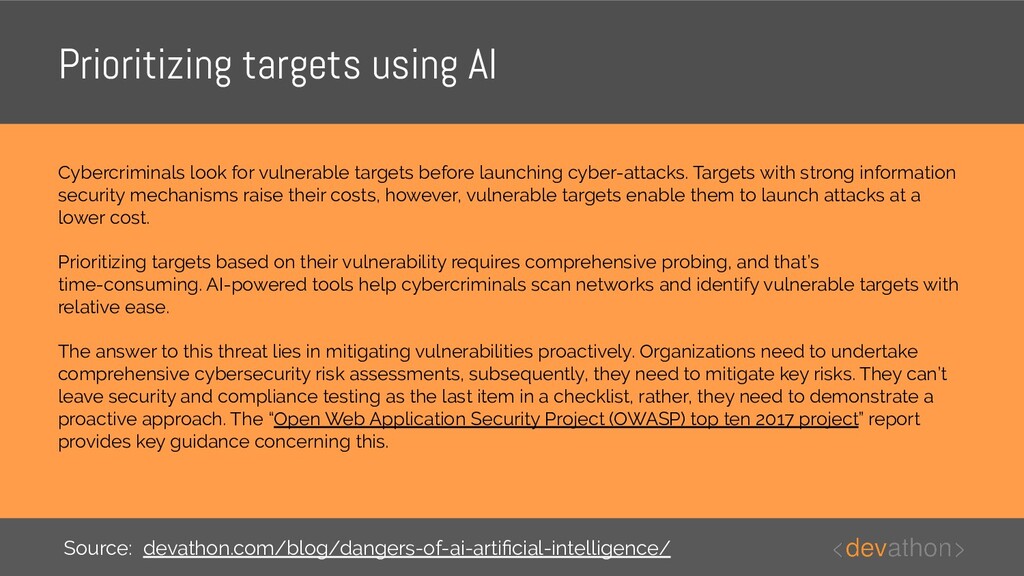
Targets with strong information security mechanisms raise their costs, however, vulnerable targets enable them to launch attacks at a lower cost. Prioritizing targets based on their vulnerability requires comprehensive probing, and that’s time-consuming. AI-powered tools help cybercriminals scan networks and identify vulnerable targets with relative ease. The answer to this threat lies in mitigating vulnerabilities proactively. Organizations need to undertake comprehensive cybersecurity risk assessments, subsequently, they need to mitigate key risks. They can’t leave security and compliance testing as the last item in a checklist, rather, they need to demonstrate a proactive approach. The “Open Web Application Security Project (OWASP) top ten 2017 project” report provides key guidance concerning this. Prioritizing targets using AI
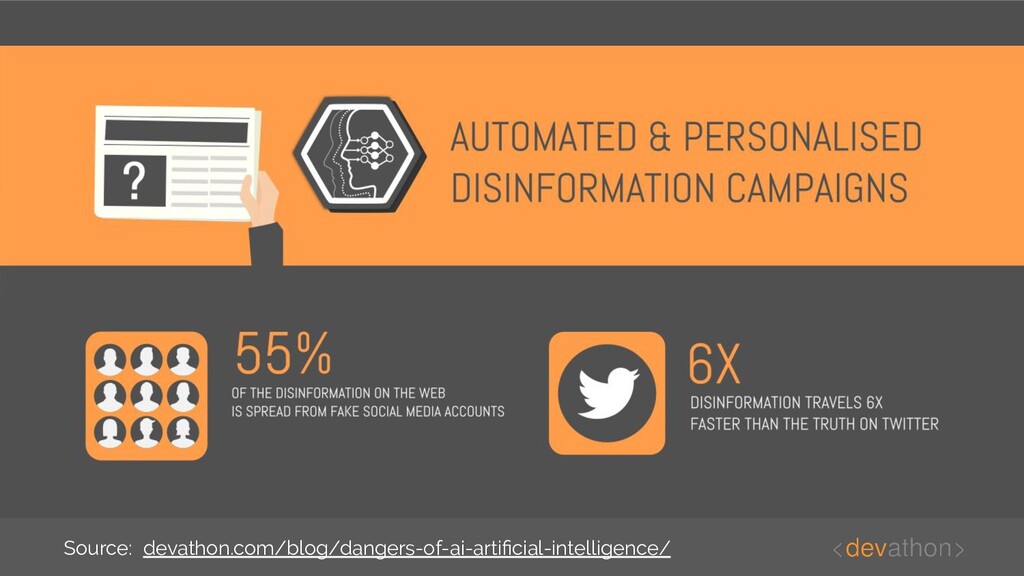
as warfare existed! Their volume and reach have increased with new media including digital media, e.g., fake news is a scourge that every civilized society is dealing with everyday. Well, as disinformation campaigns have increased in their volume and sophistication, societies around the world have improved their capability to detect them too! Nearly every civilized society has concerned citizens and media watchdogs battling the spread of fake news and disinformation campaigns. Fortunately for civilized societies battling fake news and disinformation campaigns, AI also has solutions to detect automated disinformation campaigns. E.g., an AI-powered system named BotSlayer can scan social media in real-time to detect automated Twitter accounts posting tweets in a coordinated manner. BotSlayer can detect trends of fake news and disinformation campaigns, moreover, it can distinguish between real and fake social media accounts. Automated, hyper-personalized disinformation campaigns
beneficial as well as harmful uses. AI isn’t an exception. While it has a wide range of transformative use cases that can improve the world as we know, AI also poses some clear dangers. In some cases, developing even more powerful AI solutions could help to mitigate some of the dangers posed by AI. In other cases, effective regulations can prevent the technology from falling into the hands of terrorists, while meaningful compliance with international laws can prevent its misuse by authoritarian states. Judicious use of AI is important if you want to realize true value from this promising technology. Are you looking for Mobile/Web app Development services? Contact us at [email protected] or visit our website Devathon to find out how we can breathe life into your vision with beautiful designs, quality development, and continuous testing. Conclusion


 bgpat
 tetsuya28
 riyaamemiya
 yut0naga1_fa
 teamlab
 yu23ki14
 y0hgi
 ivry_presentationmaterials
 satomasahiro2005
 terurou
 pfn
 occhi
 mayatellez
 eitanlees
 bkeepers
 panda_program
 reverentgeek
 wjessup
 dougneiner
 sarafernandez
 eileencodes
 aleyda
 lynnandtonic
 caitiem20