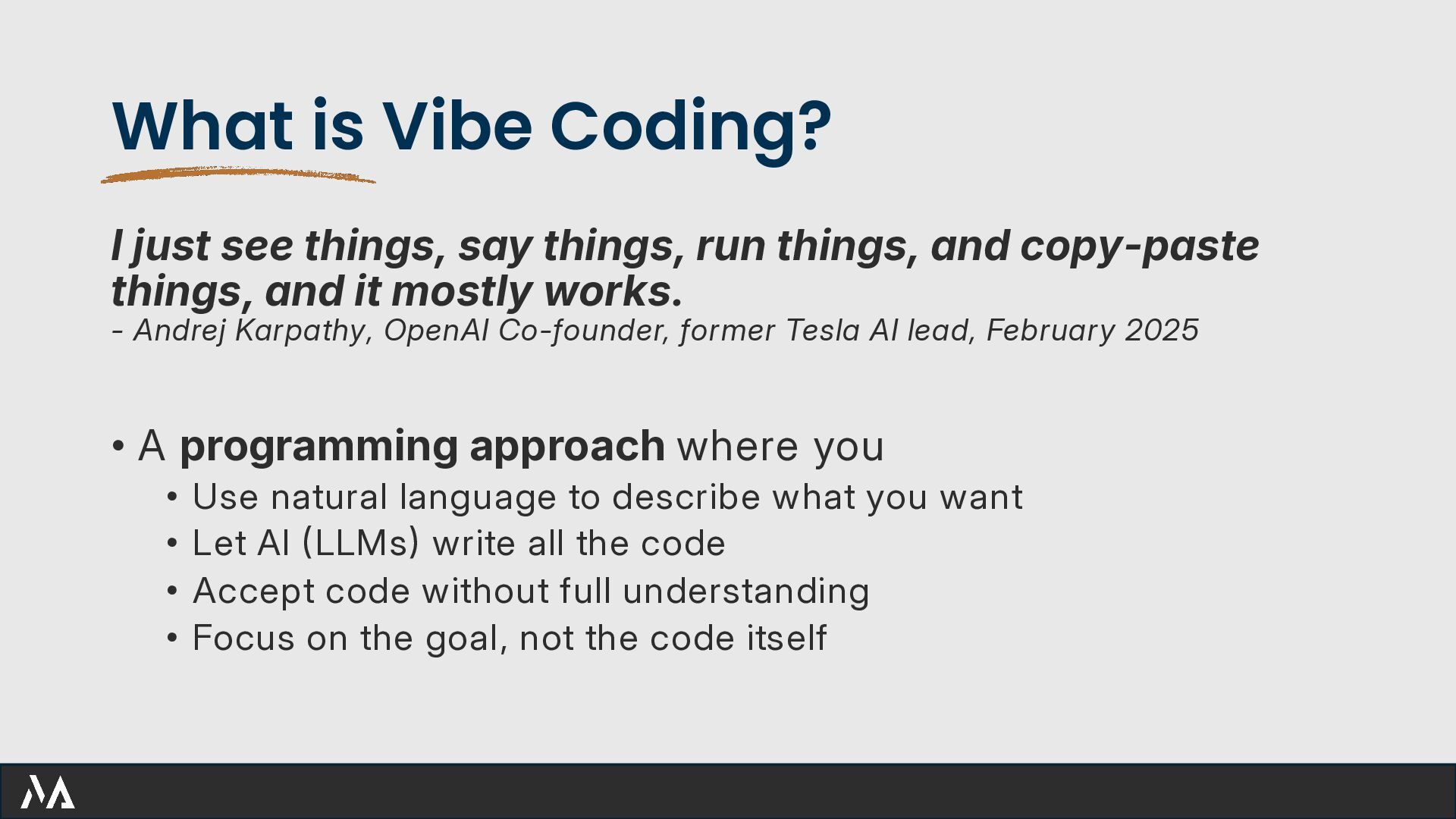
run things, and copy-paste things, and it mostly works. - Andrej Karpathy, OpenAI Co-founder, former Tesla AI lead, February 2025 • A programming approach where you • Use natural language to describe what you want • Let AI LLMs write all the code • Accept code without full understanding • Focus on the goal, not the code itself
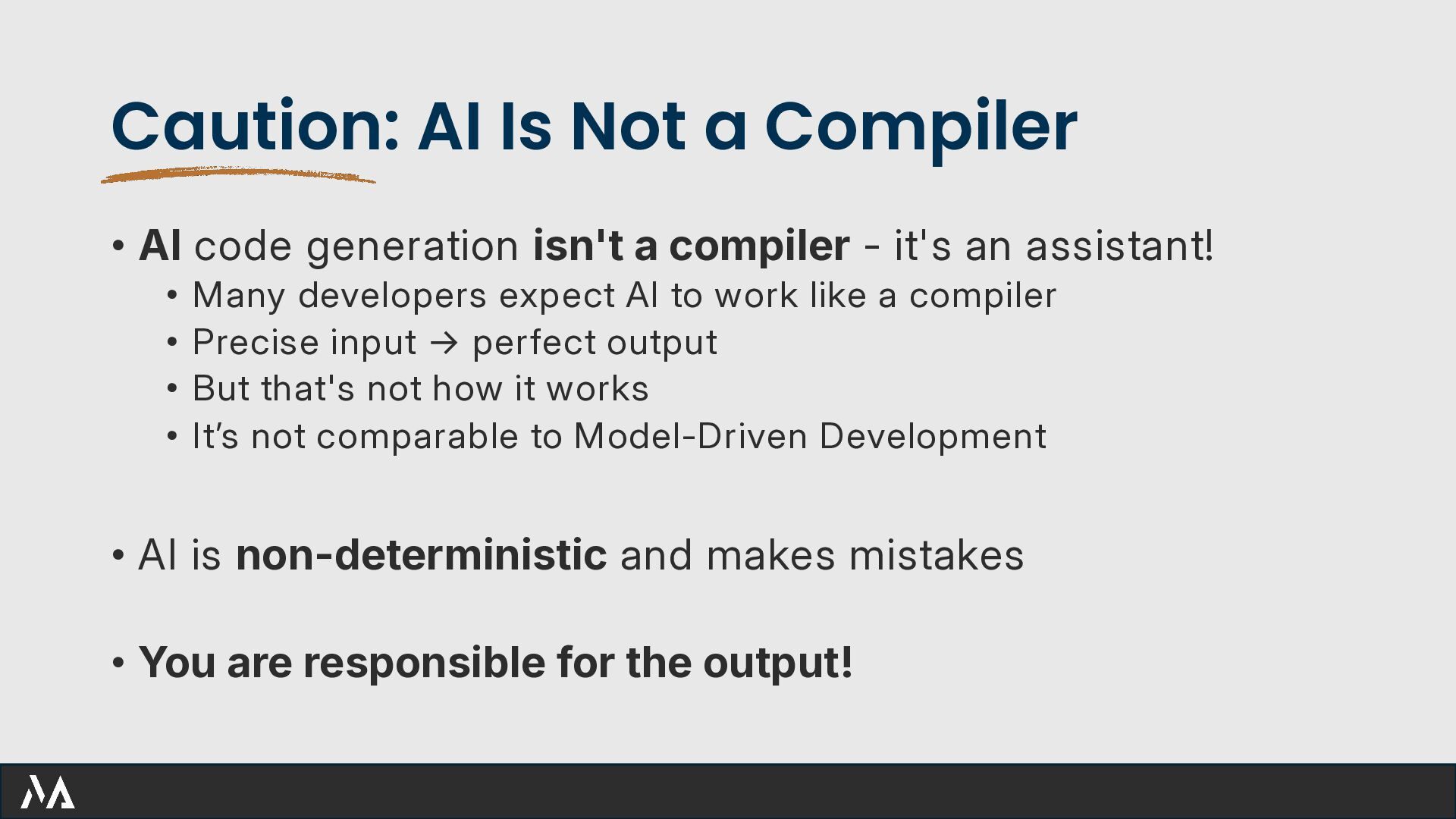
isn't a compiler - it's an assistant! • Many developers expect AI to work like a compiler • Precise input → perfect output • But that's not how it works • It’s not comparable to Model-Driven Development • AI is non-deterministic and makes mistakes • You are responsible for the output!
primarily a process and methodology with tooling support, emphasising requirements and spec quality across the entire lifecycle • Amazon Kiro is a spec-centric AI IDE with strong integrated automation where AI drives from spec to code within one environment • GitHub Spec Kit is an open-source workflow toolkit that formalizes phases and integrates with different AI coding tools rather than providing its own agentic environment
system behavior, not implementation details • It acts as a stable contract between business intent and technical implementation • It can be systematically turned into code and tests, with minimal interpretation • It helps prevent drift between requirements, code, and tests over time
so guardrails ensure the same behavior in every conversation • Encoding project knowledge • Capture coding standards, architecture decisions, and conventions • Prevent AI drift • Without rules, AI might suggest patterns or libraries that don't match your project • Reducing Repetition • Define your preferences once instead of explaining them in every prompt • Team Alignment • All developers get similar, project-appropriate suggestions from the AI • Quality Control • Enforce standards like testing requirements, documentation rules, and code style
feels like a teammate but it’s just a tool • It can accelerate development, but you must: • Review, understand, and test the output • Know your architecture and domain


 devopsbern
 utakaha
 falcon8823
 lynnswap
 takai
takai
 prota
prota
 marcoroth
 shihochan
 uyuki234
 koic
koic
 findyinc
 yuta_onishi_97
 iwiwi
iwiwi
 chriscoyier
 tammielis
 aleyda
 sergeychernyshev
 sonatard
 reverentgeek
 orderedlist
 samlambert
 jeffersonlam
 uxyall
 ipullrank

![Thank you! • Web martinelli.ch • EMail [email protected] • Bluesky](https://files.speakerdeck.com/presentations/ac5a364384584debbccdecc108281a96/slide_17.jpg)