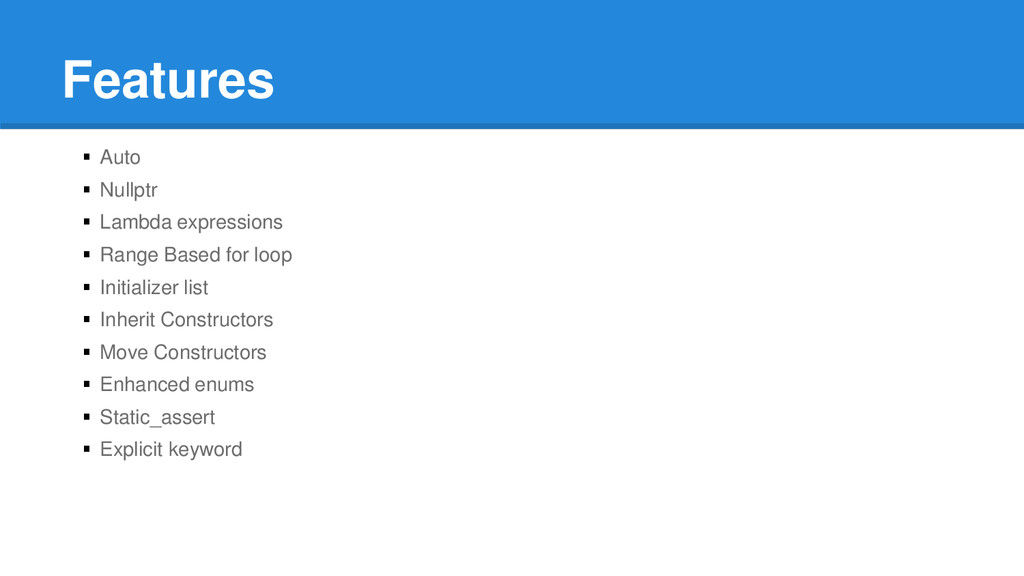
C++11 is the most recent version of the standard of the C++ programming language.From lambda expressions to range based for loops to null pointer constants,this is a basic introduction to the new standard.
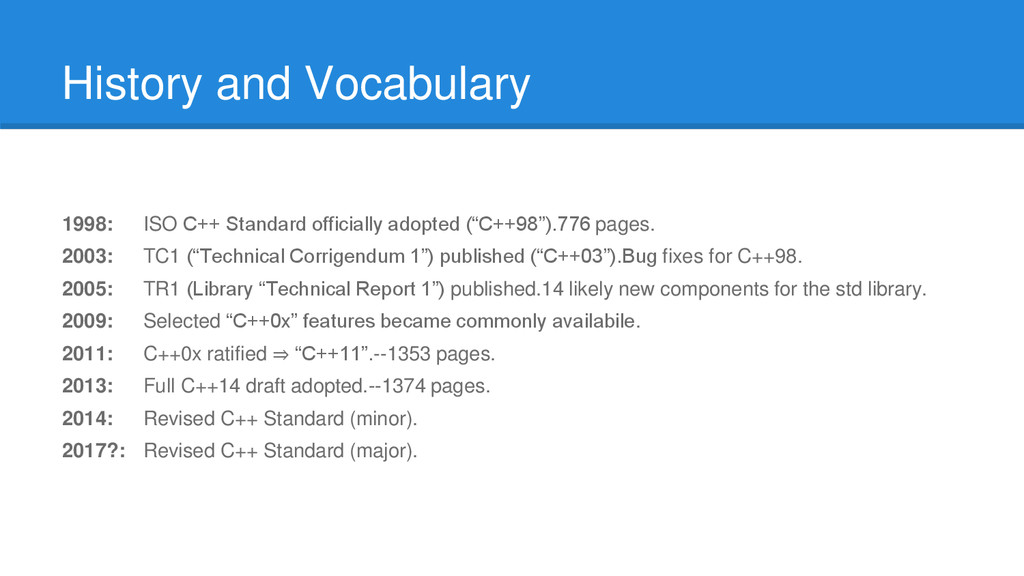
pages. 2003: TC1 (“Technical Corrigendum 1”) published (“C++03”).Bug fixes for C++98. 2005: TR1 (Library “Technical Report 1”) published.14 likely new components for the std library. 2009: Selected “C++0x” features became commonly availabile. 2011: C++0x ratified ⇒ “C++11”.--1353 pages. 2013: Full C++14 draft adopted.--1374 pages. 2014: Revised C++ Standard (minor). 2017?: Revised C++ Standard (major).
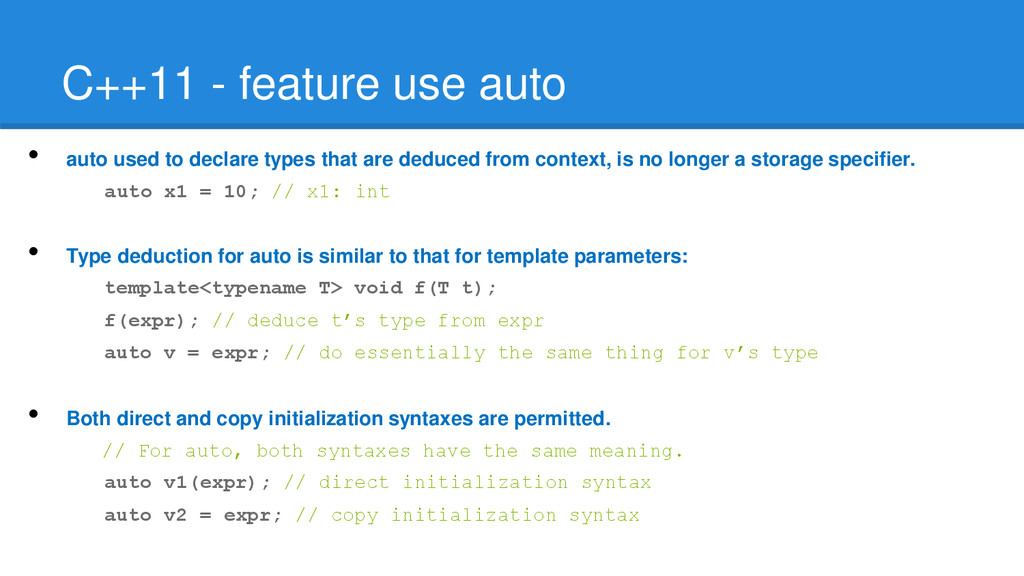
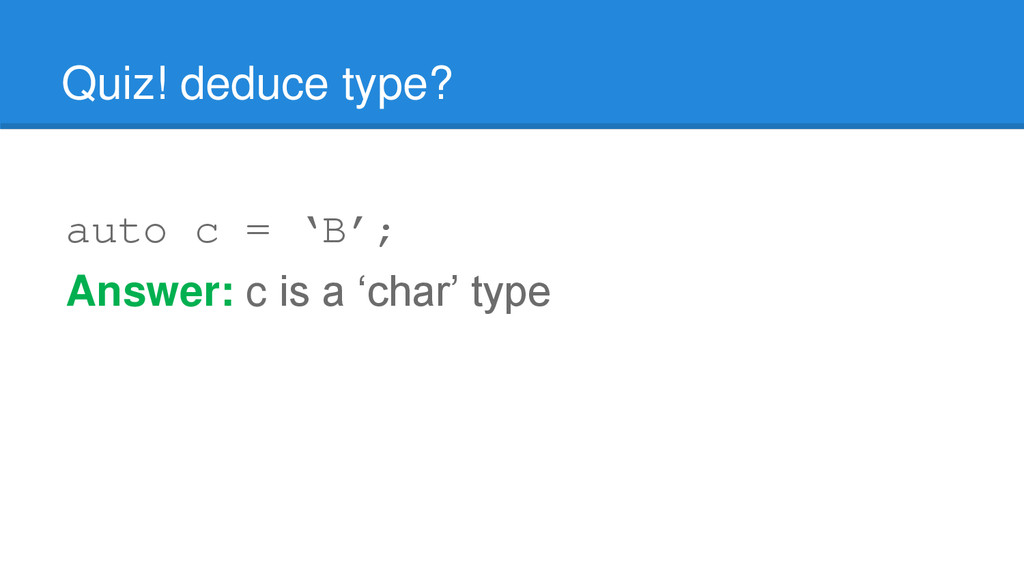
types that are deduced from context, is no longer a storage specifier. auto x1 = 10; // x1: int • Type deduction for auto is similar to that for template parameters: template<typename T> void f(T t); f(expr); // deduce t’s type from expr auto v = expr; // do essentially the same thing for v’s type • Both direct and copy initialization syntaxes are permitted. // For auto, both syntaxes have the same meaning. auto v1(expr); // direct initialization syntax auto v2 = expr; // copy initialization syntax
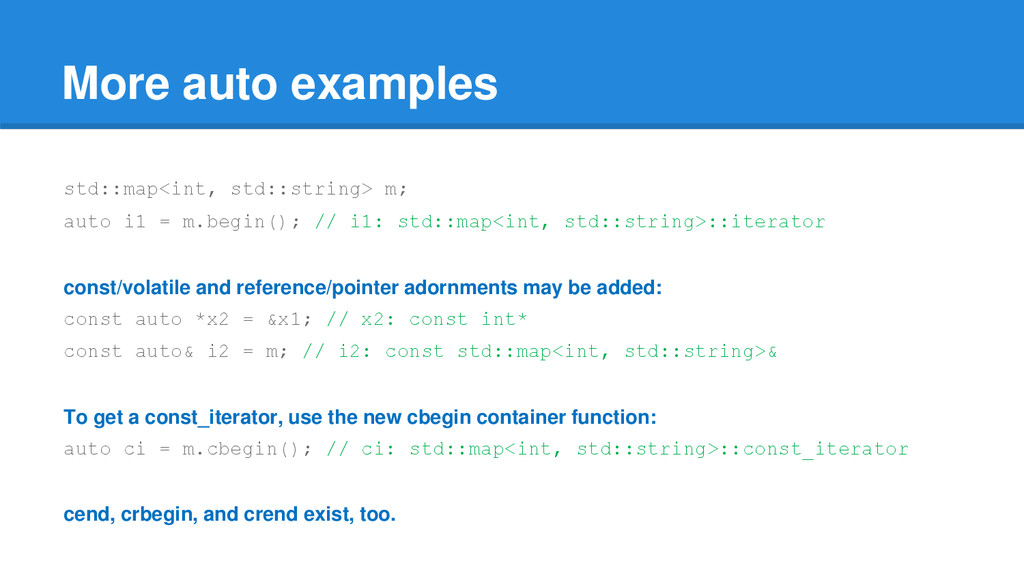
// i1: std::map<int, std::string>::iterator const/volatile and reference/pointer adornments may be added: const auto *x2 = &x1; // x2: const int* const auto& i2 = m; // i2: const std::map<int, std::string>& To get a const_iterator, use the new cbegin container function: auto ci = m.cbegin(); // ci: std::map<int, std::string>::const_iterator cend, crbegin, and crend exist, too.
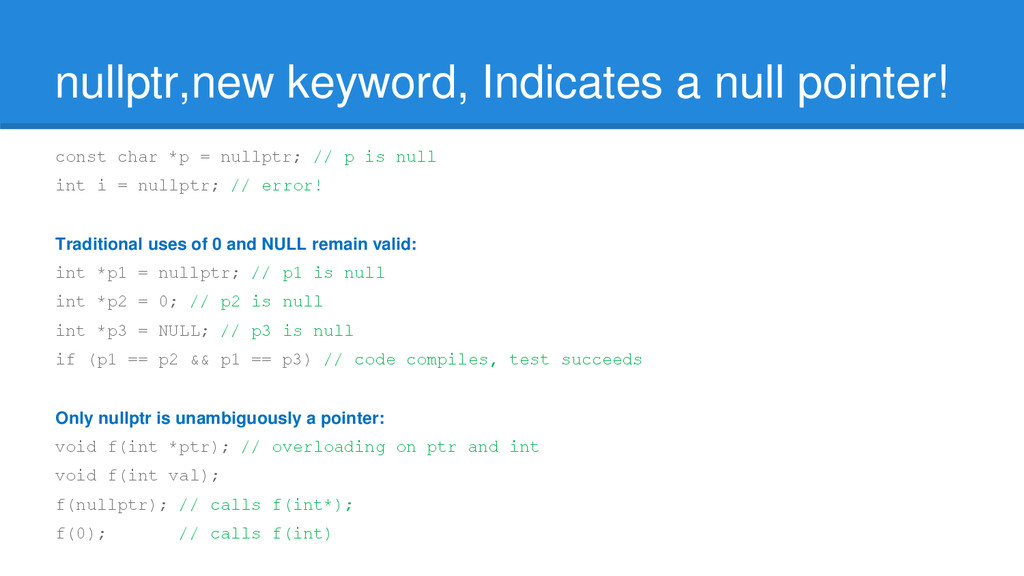
nullptr; // p is null int i = nullptr; // error! Traditional uses of 0 and NULL remain valid: int *p1 = nullptr; // p1 is null int *p2 = 0; // p2 is null int *p3 = NULL; // p3 is null if (p1 == p2 && p1 == p3) // code compiles, test succeeds Only nullptr is unambiguously a pointer: void f(int *ptr); // overloading on ptr and int void f(int val); f(nullptr); // calls f(int*); f(0); // calls f(int)
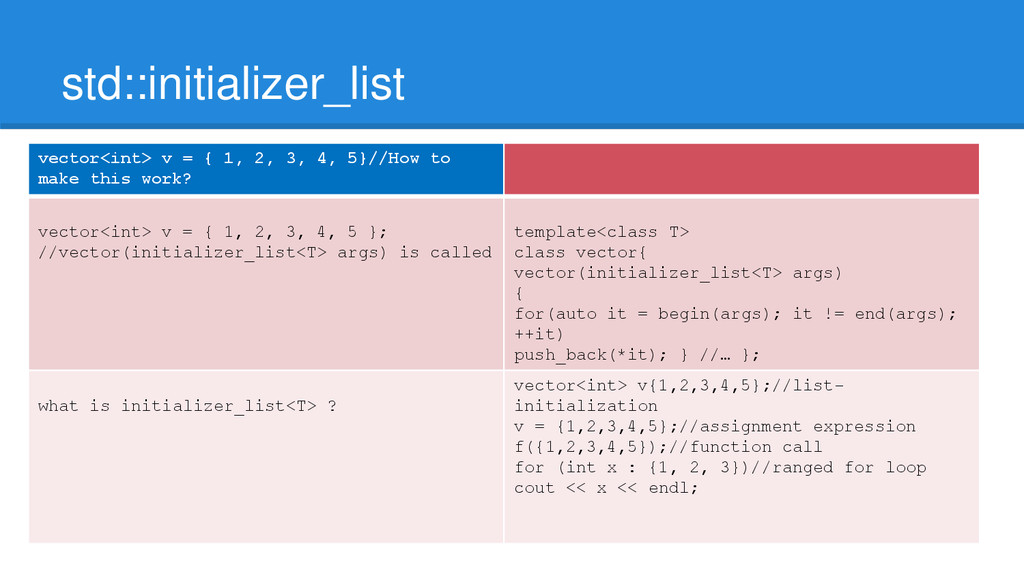
to make this work? vector<int> v = { 1, 2, 3, 4, 5 }; //vector(initializer_list<T> args) is called template<class T> class vector{ vector(initializer_list<T> args) { for(auto it = begin(args); it != end(args); ++it) push_back(*it); } //… }; what is initializer_list<T> ? vector<int> v{1,2,3,4,5};//list- initialization v = {1,2,3,4,5};//assignment expression f({1,2,3,4,5});//function call for (int x : {1, 2, 3})//ranged for loop cout << x << endl;
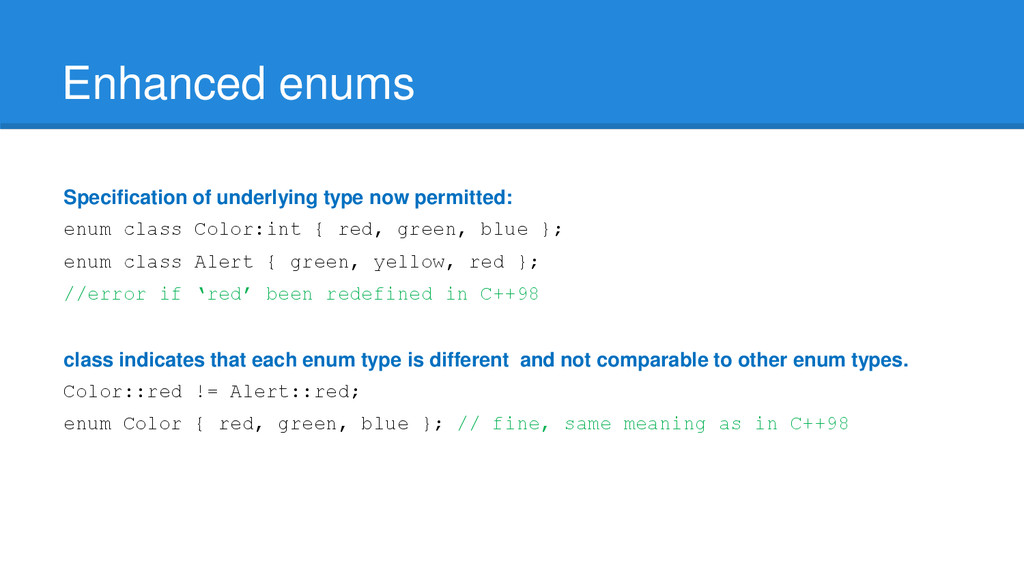
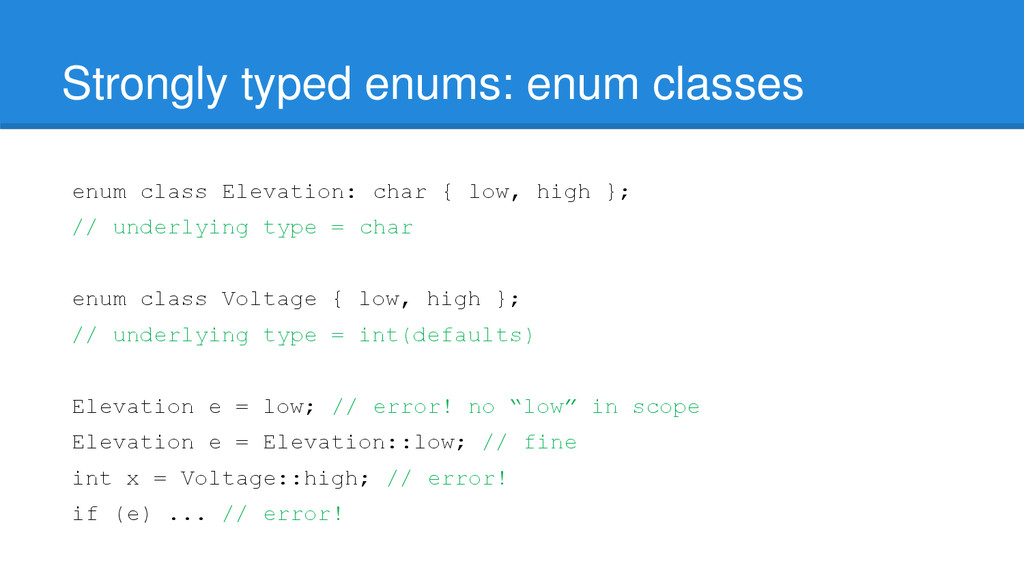
Color:int { red, green, blue }; enum class Alert { green, yellow, red }; //error if ‘red’ been redefined in C++98 class indicates that each enum type is different and not comparable to other enum types. Color::red != Alert::red; enum Color { red, green, blue }; // fine, same meaning as in C++98
low, high }; // underlying type = char enum class Voltage { low, high }; // underlying type = int(defaults) Elevation e = low; // error! no “low” in scope Elevation e = Elevation::low; // fine int x = Voltage::high; // error! if (e) ... // error!
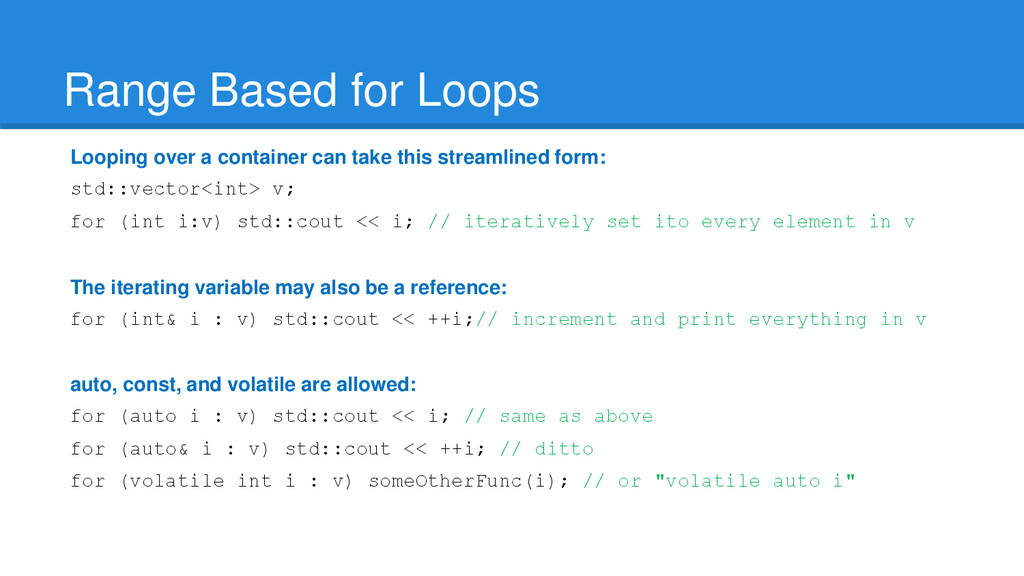
this streamlined form: std::vector<int> v; for (int i:v) std::cout << i; // iteratively set ito every element in v The iterating variable may also be a reference: for (int& i : v) std::cout << ++i;// increment and print everything in v auto, const, and volatile are allowed: for (auto i : v) std::cout << i; // same as above for (auto& i : v) std::cout << ++i; // ditto for (volatile int i : v) someOtherFunc(i); // or "volatile auto i"
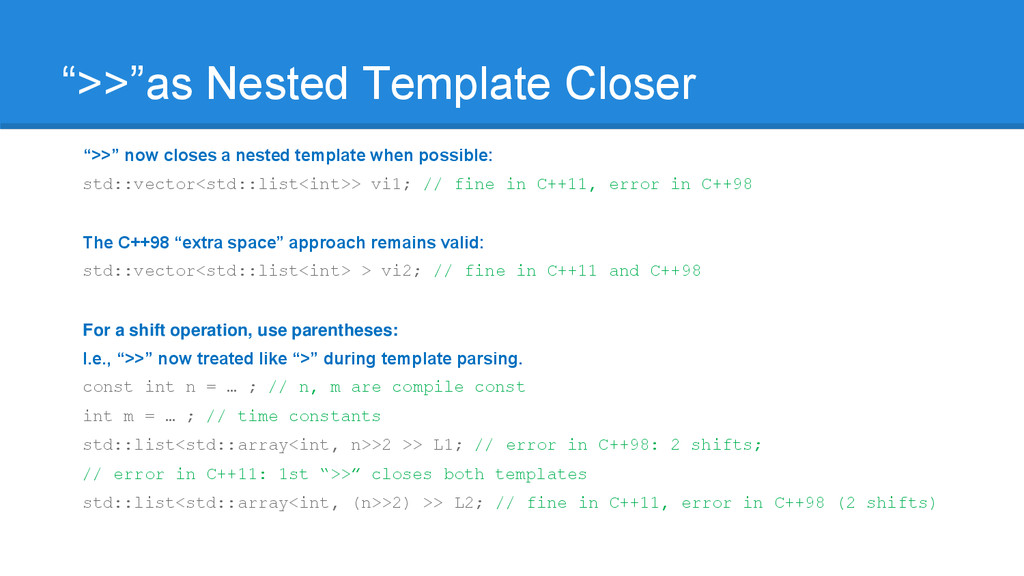
when possible: std::vector<std::list<int>> vi1; // fine in C++11, error in C++98 The C++98 “extra space” approach remains valid: std::vector<std::list<int> > vi2; // fine in C++11 and C++98 For a shift operation, use parentheses: I.e., “>>” now treated like “>” during template parsing. const int n = … ; // n, m are compile const int m = … ; // time constants std::list<std::array<int, n>>2 >> L1; // error in C++98: 2 shifts; // error in C++11: 1st “>>” closes both templates std::list<std::array<int, (n>>2) >> L2; // fine in C++11, error in C++98 (2 shifts)
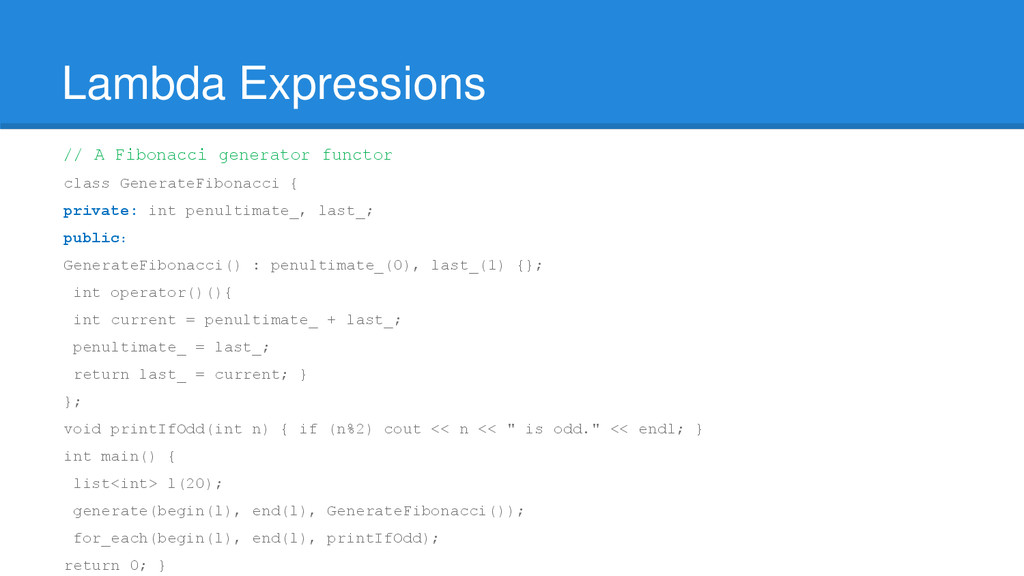
<< endl;} //goes where the function object is required [] (int n) { return n * 5.5; }//double // deduces the return value –no return void [] (int n) -> int { return ++n; } //explicit
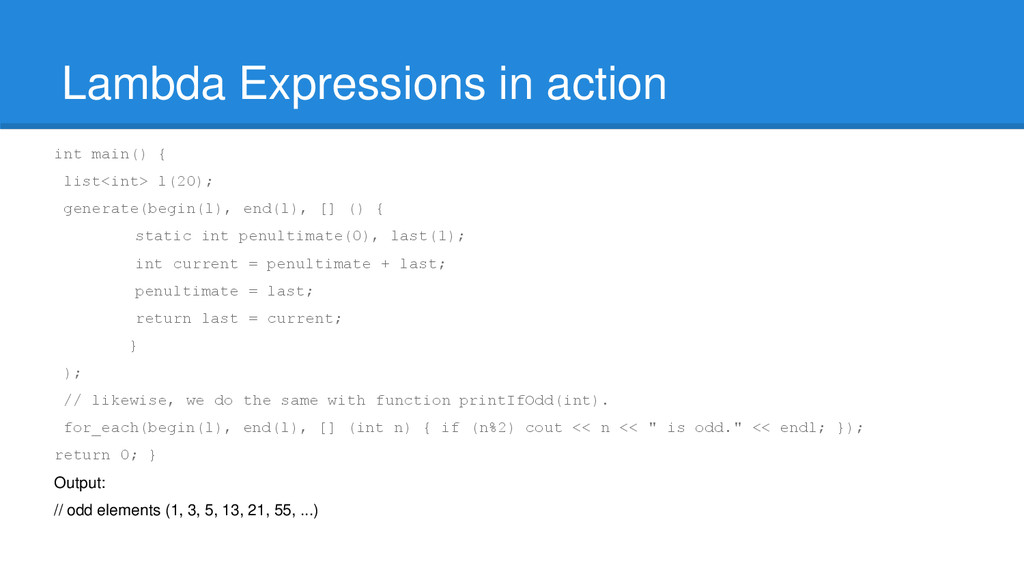
end(l), [] () { static int penultimate(0), last(1); int current = penultimate + last; penultimate = last; return last = current; } ); // likewise, we do the same with function printIfOdd(int). for_each(begin(l), end(l), [] (int n) { if (n%2) cout << n << " is odd." << endl; }); return 0; } Output: // odd elements (1, 3, 5, 13, 21, 55, ...)
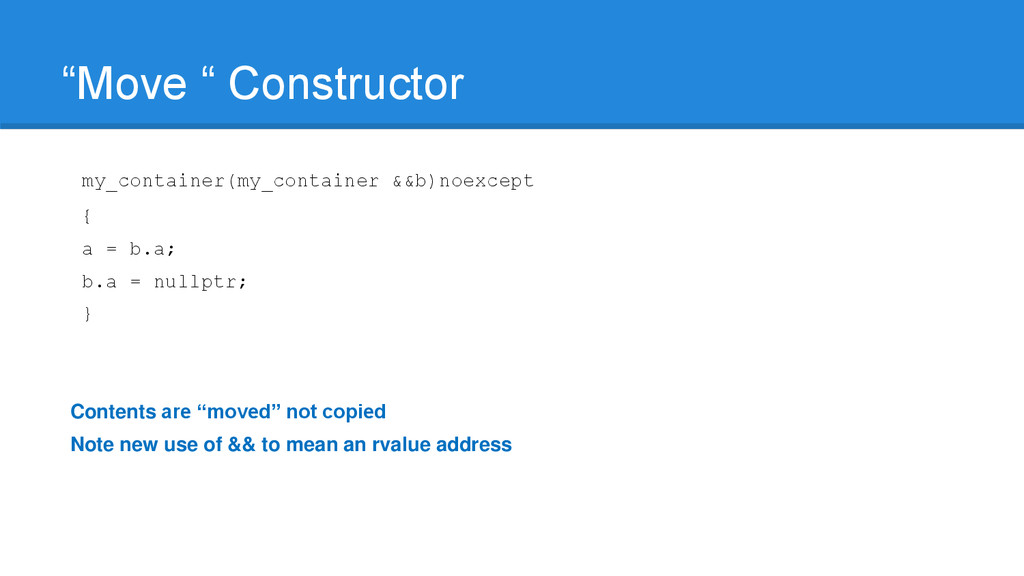
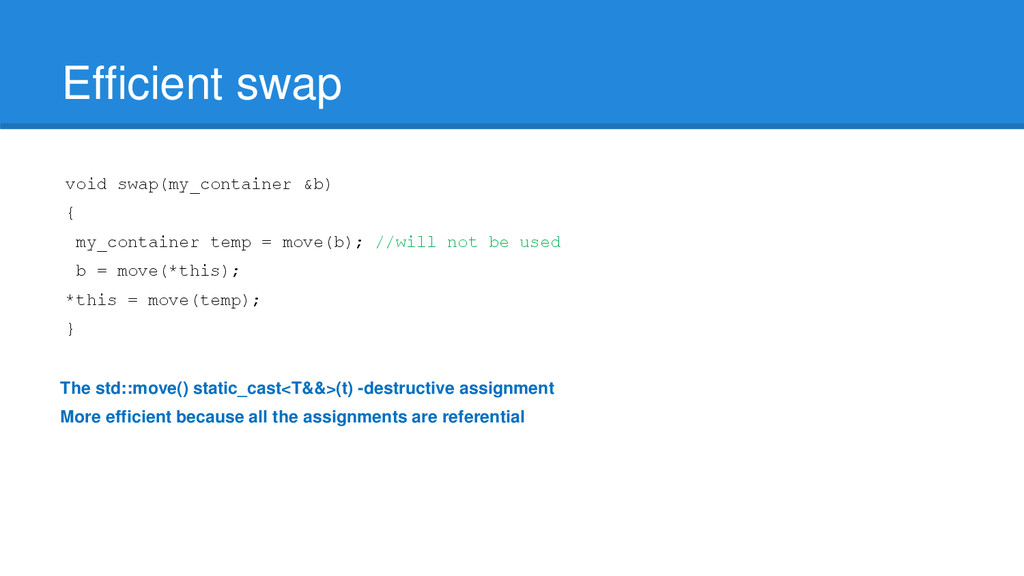
//will not be used b = move(*this); *this = move(temp); } The std::move() static_cast<T&&>(t) -destructive assignment More efficient because all the assignments are referential
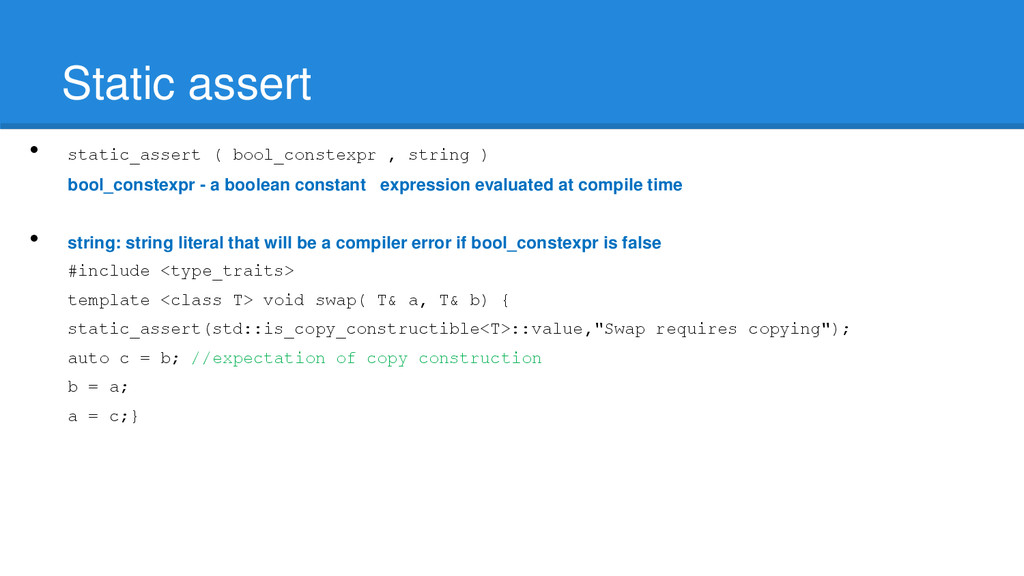
- a boolean constant expression evaluated at compile time • string: string literal that will be a compiler error if bool_constexpr is false #include <type_traits> template <class T> void swap( T& a, T& b) { static_assert(std::is_copy_constructible<T>::value,"Swap requires copying"); auto c = b; //expectation of copy construction b = a; a = c;}
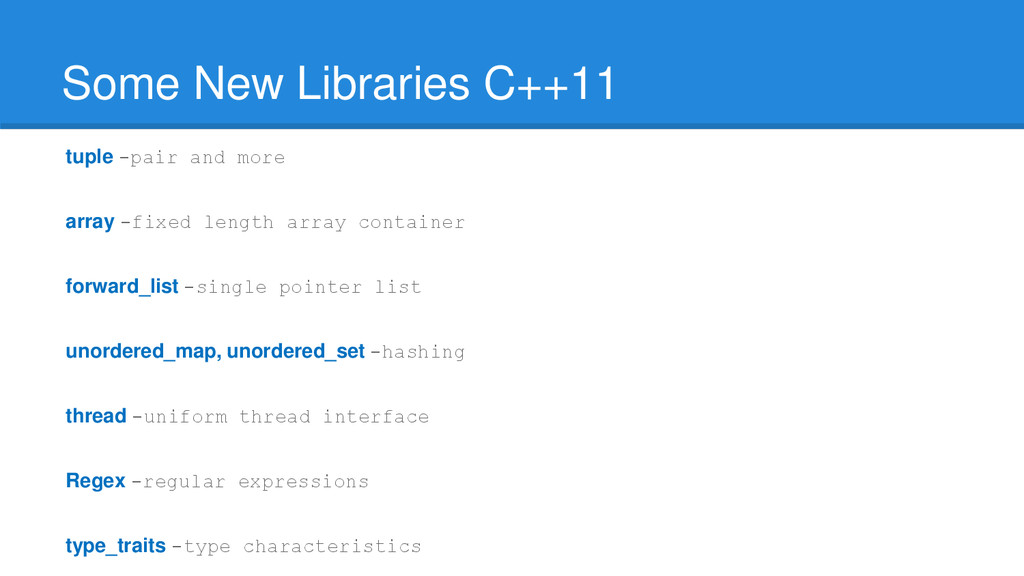
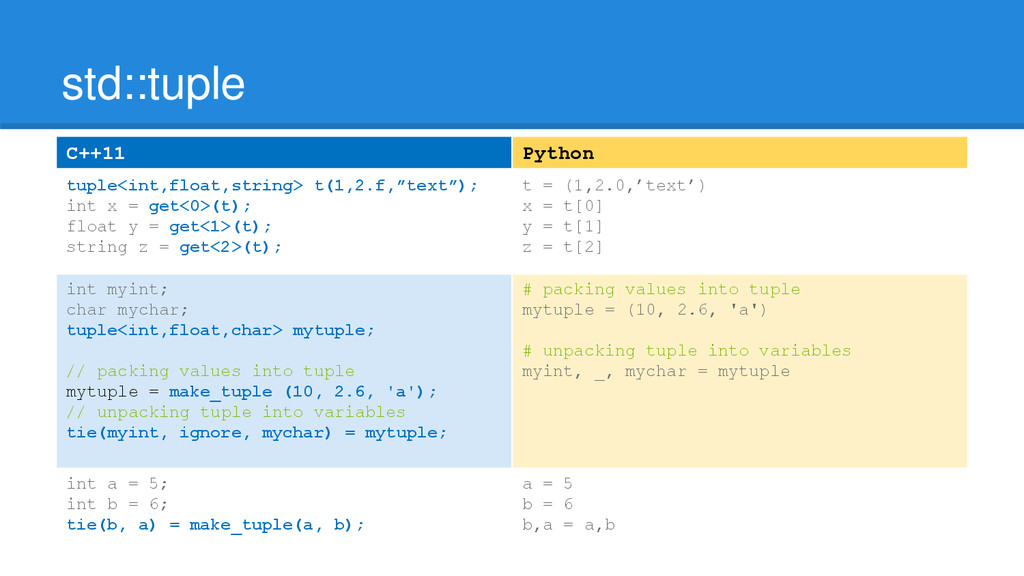
y = get<1>(t); string z = get<2>(t); t = (1,2.0,’text’) x = t[0] y = t[1] z = t[2] int myint; char mychar; tuple<int,float,char> mytuple; // packing values into tuple mytuple = make_tuple (10, 2.6, 'a'); // unpacking tuple into variables tie(myint, ignore, mychar) = mytuple; # packing values into tuple mytuple = (10, 2.6, 'a') # unpacking tuple into variables myint, _, mychar = mytuple int a = 5; int b = 6; tie(b, a) = make_tuple(a, b); a = 5 b = 6 b,a = a,b


 y0hgi
y0hgi
 minodriven
 optim
optim
 rkaga
rkaga
 tosite
 ichirokano2
 kishida
 irinanazarova
.jpg) yumnumm
yumnumm
 akihisaikeda
 artoy
artoy
 hschwentner
 reverentgeek
 geoffreycrofte
 livdayseo
 mraible
 seathinner
 lara
lara
 techseoconnect
 akashhashmi
 sugarenia
 marketingsoph
 honnibal
 smashingmag
![C++03 C++11 int a[] = { 1, 2, 3, 4,](https://files.speakerdeck.com/presentations/f7970ba062710131f7e506042d17eeba/slide_8.jpg)
{cout <<i](https://files.speakerdeck.com/presentations/f7970ba062710131f7e506042d17eeba/slide_14.jpg)
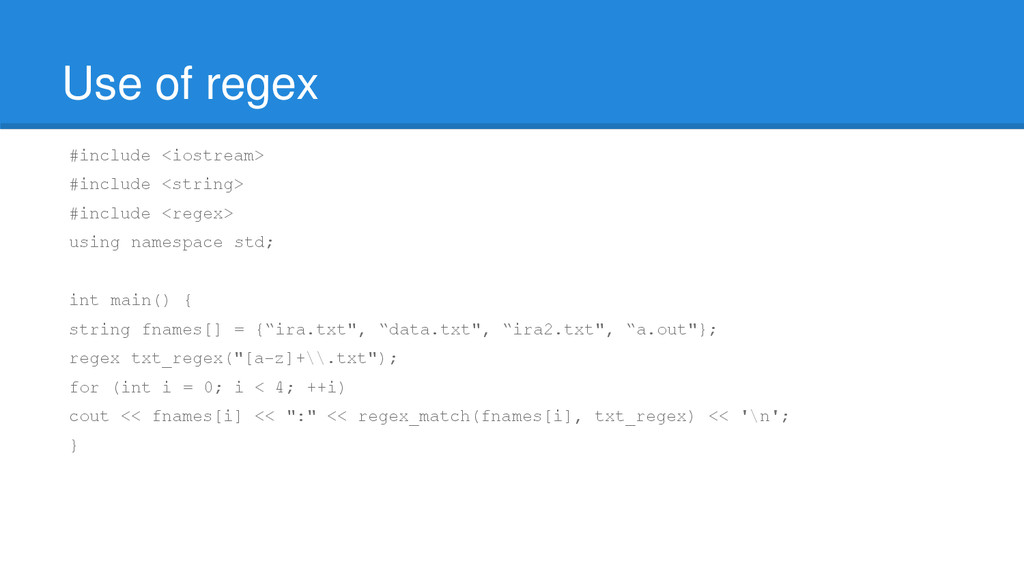
![Quiz! What’s the output ? string fnames[] = {“abc.txt", “data.txt",](https://files.speakerdeck.com/presentations/f7970ba062710131f7e506042d17eeba/slide_26.jpg)