Upgrade to Pro — share decks privately, control downloads, hide ads and more …

Is Single Payer the Best Path to a Better Healt...

Sponsored · Your Podcast. Everywhere. Effortlessly. Share. Educate. Inspire. Entertain. You do you. We'll handle the rest. →
Avatar for Ed Dolan Ed Dolan
July 05, 2018
30

Is Single Payer the Best Path to a Better Health Care?

America's progressives want a health care system that is accessible to everyone, asks everyone to pay a fair share, and is efficient and consumer friendly. But is a single-payer system like Sanders' Medicare for All the best way to get there? This slide show examines an alternative: Universal Catastrophic Care

Avatar for Ed Dolan

Ed Dolan

July 05, 2018

Transcript

  1. Is Single Payer the Best Path to a Better Health

    Care System? Presented to the Cracker Barrel Circle of Northport, Mi by Ed Dolan July 5, 2018
  2. America’s progressives are right … We need a health care

    system that –  Guarantees everyone affordable access to essential care  Asks everyone to pay their fair share of the cost, but not more  Makes health care transparent, efficient, and consumer-friendly
  3. But are they also right about how to get there?

     Why don’t we just adopt a single-payer health care system like every other rich democratic country has?  Why can’t the government just pay everyone’s medical bills and be done with it? Understandable questions, but do other countries really have single-payer health care? Is it really the best path to reform? Let’s start by looking more closely at how other countries deal with health care
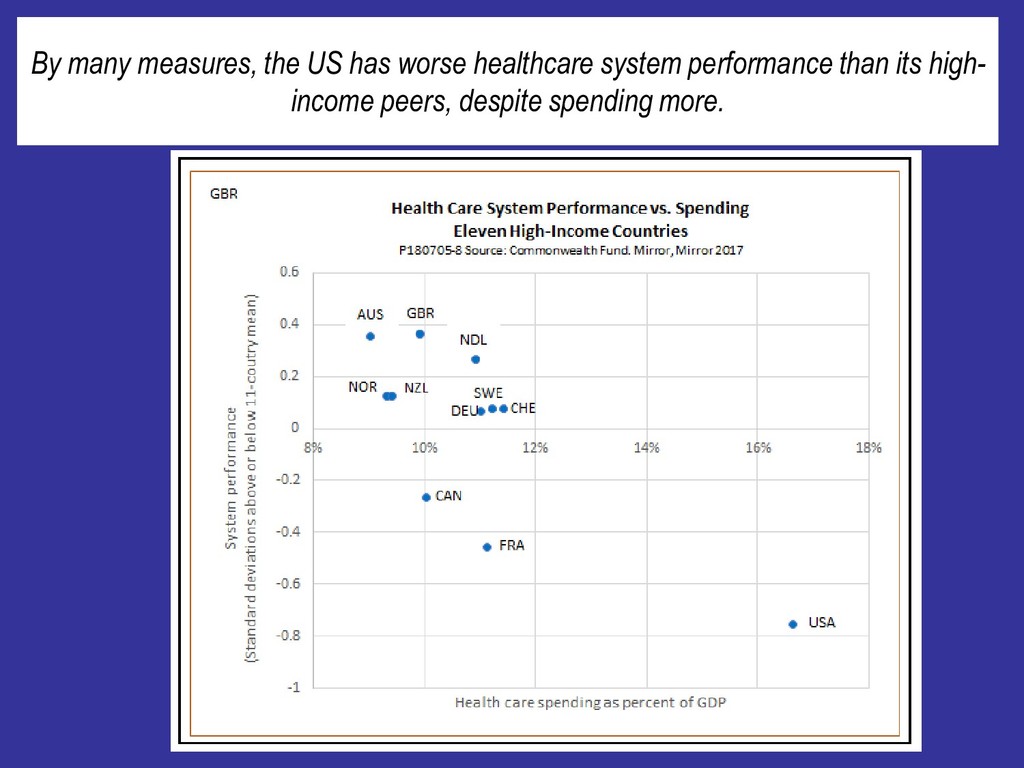
  4. By many measures, the US has worse healthcare system performance

    than its high- income peers, despite spending more.
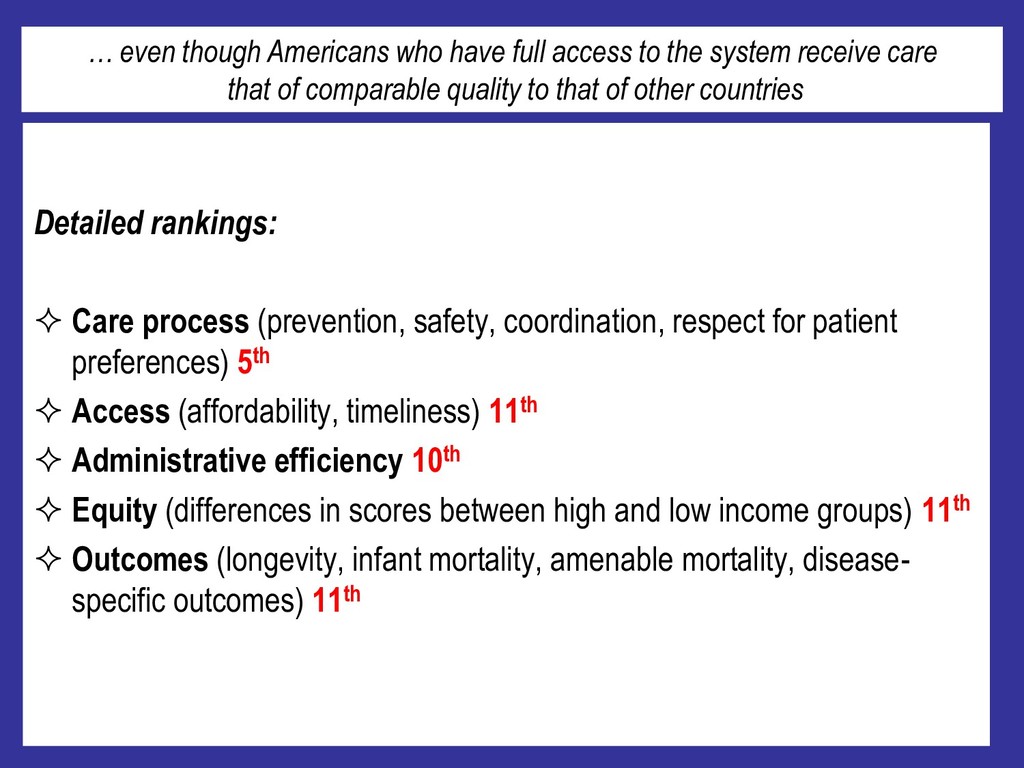
  5. … even though Americans who have full access to the

    system receive care that of comparable quality to that of other countries Detailed rankings:  Care process (prevention, safety, coordination, respect for patient preferences) 5th  Access (affordability, timeliness) 11th  Administrative efficiency 10th  Equity (differences in scores between high and low income groups) 11th  Outcomes (longevity, infant mortality, amenable mortality, disease- specific outcomes) 11th
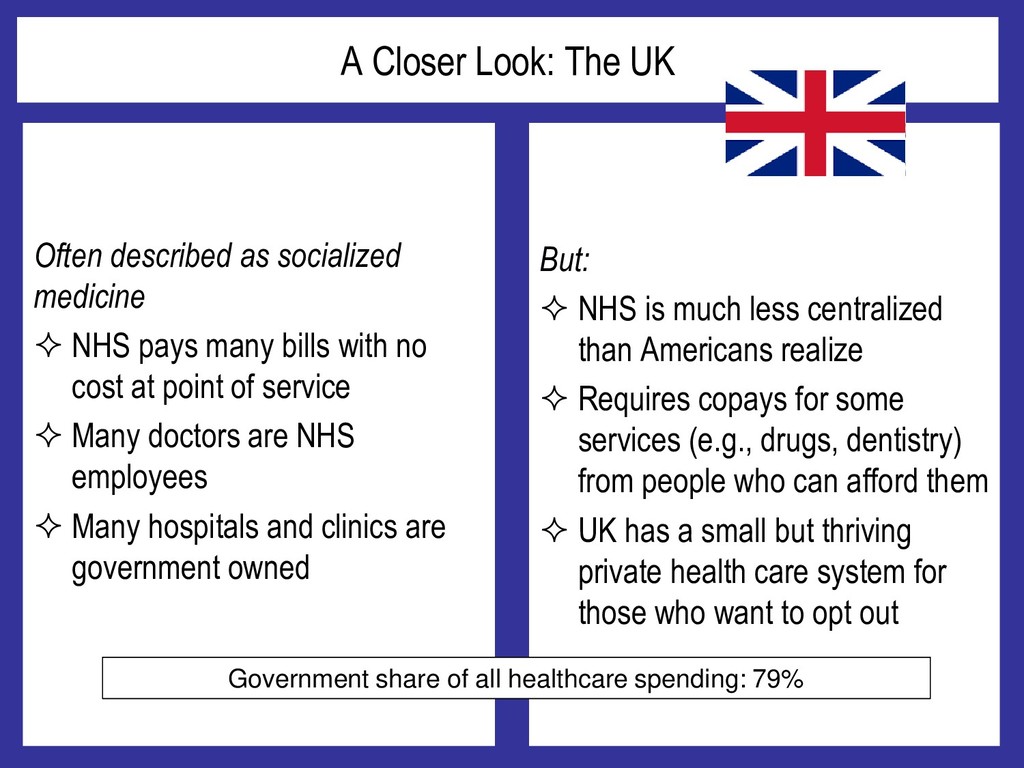
  6. A Closer Look: The UK Often described as socialized medicine

     NHS pays many bills with no cost at point of service  Many doctors are NHS employees  Many hospitals and clinics are government owned But:  NHS is much less centralized than Americans realize  Requires copays for some services (e.g., drugs, dentistry) from people who can afford them  UK has a small but thriving private health care system for those who want to opt out Government share of all healthcare spending: 79%
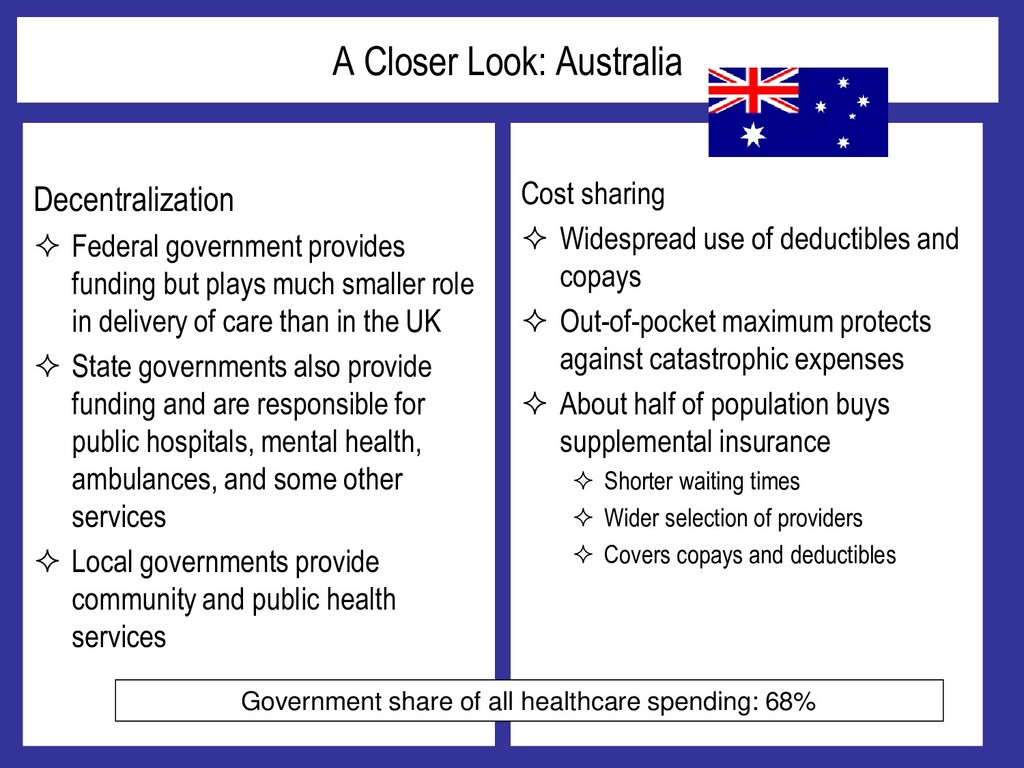
  7. A Closer Look: Australia Decentralization  Federal government provides funding

    but plays much smaller role in delivery of care than in the UK  State governments also provide funding and are responsible for public hospitals, mental health, ambulances, and some other services  Local governments provide community and public health services Cost sharing  Widespread use of deductibles and copays  Out-of-pocket maximum protects against catastrophic expenses  About half of population buys supplemental insurance  Shorter waiting times  Wider selection of providers  Covers copays and deductibles Government share of all healthcare spending: 68%
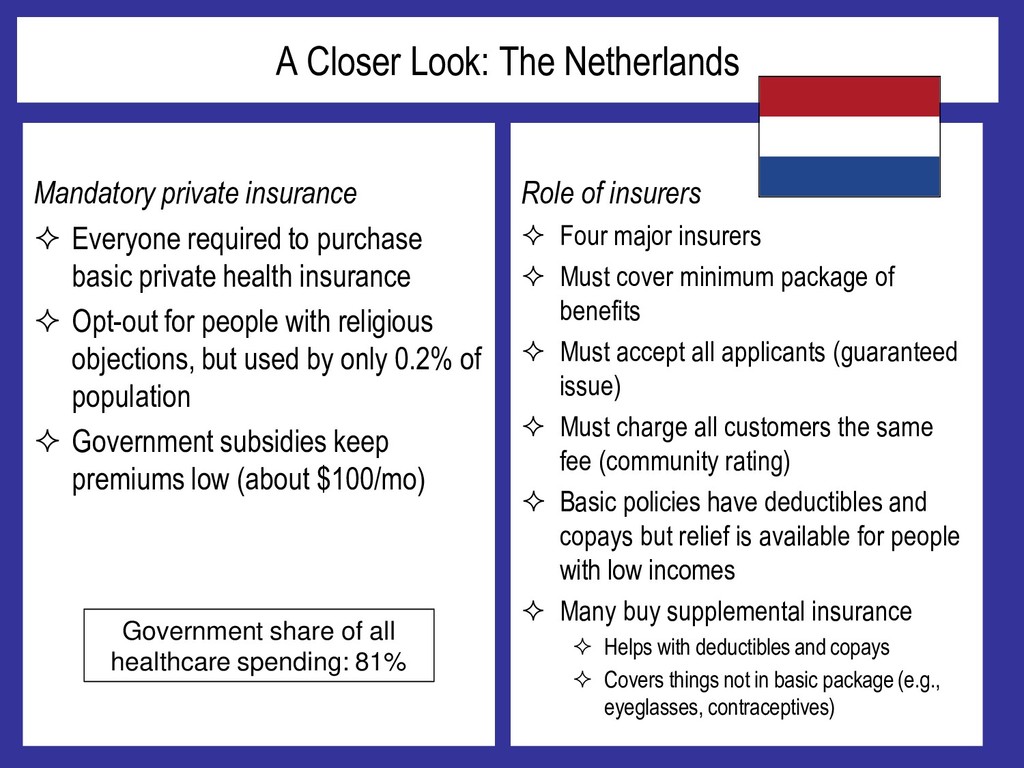
  8. A Closer Look: The Netherlands Mandatory private insurance  Everyone

    required to purchase basic private health insurance  Opt-out for people with religious objections, but used by only 0.2% of population  Government subsidies keep premiums low (about $100/mo) Role of insurers  Four major insurers  Must cover minimum package of benefits  Must accept all applicants (guaranteed issue)  Must charge all customers the same fee (community rating)  Basic policies have deductibles and copays but relief is available for people with low incomes  Many buy supplemental insurance  Helps with deductibles and copays  Covers things not in basic package (e.g., eyeglasses, contraceptives) Government share of all healthcare spending: 81%
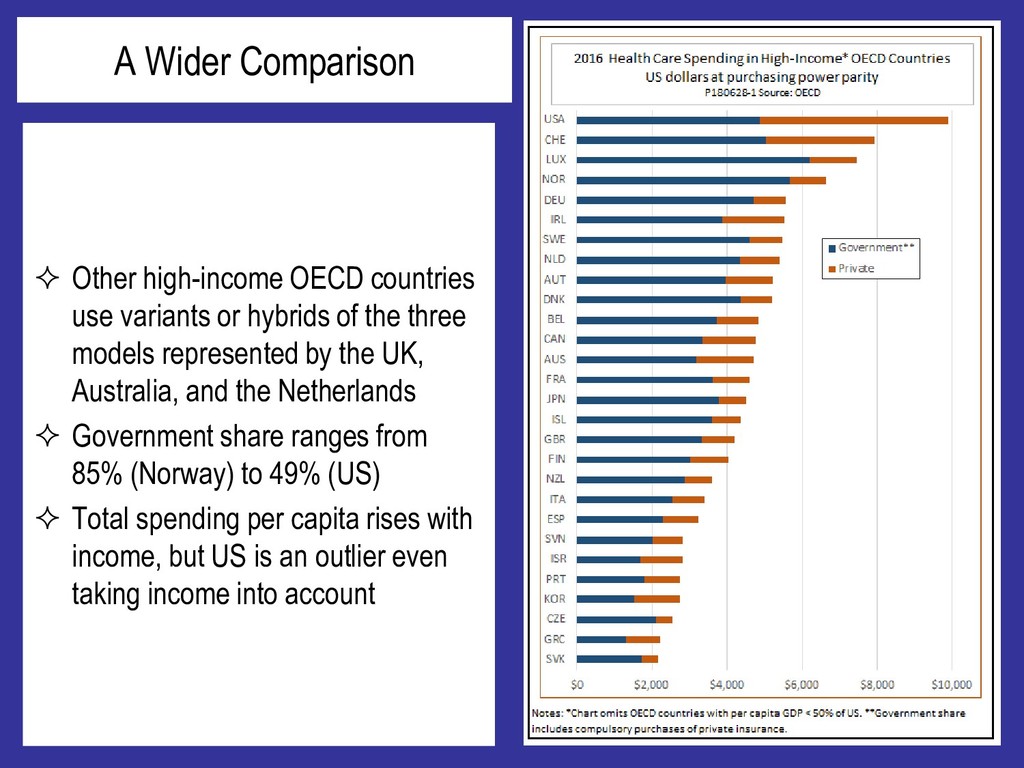
  9. A Wider Comparison  Other high-income OECD countries use variants

    or hybrids of the three models represented by the UK, Australia, and the Netherlands  Government share ranges from 85% (Norway) to 49% (US)  Total spending per capita rises with income, but US is an outlier even taking income into account
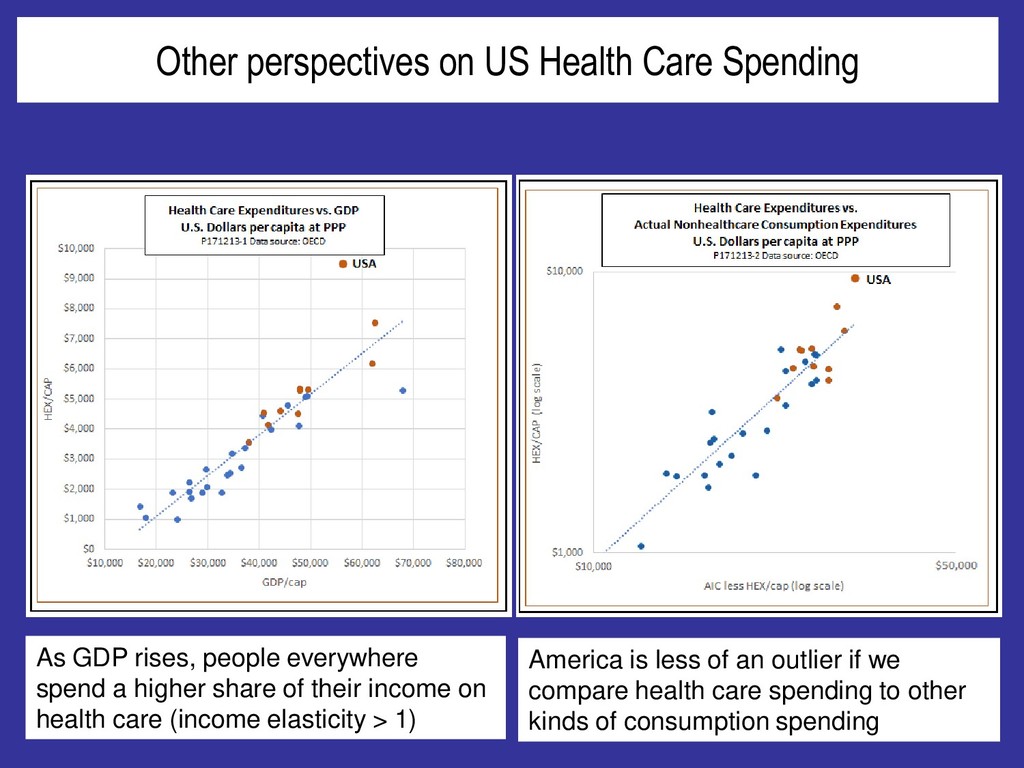
  10. Other perspectives on US Health Care Spending America is less

    of an outlier if we compare health care spending to other kinds of consumption spending As GDP rises, people everywhere spend a higher share of their income on health care (income elasticity > 1)
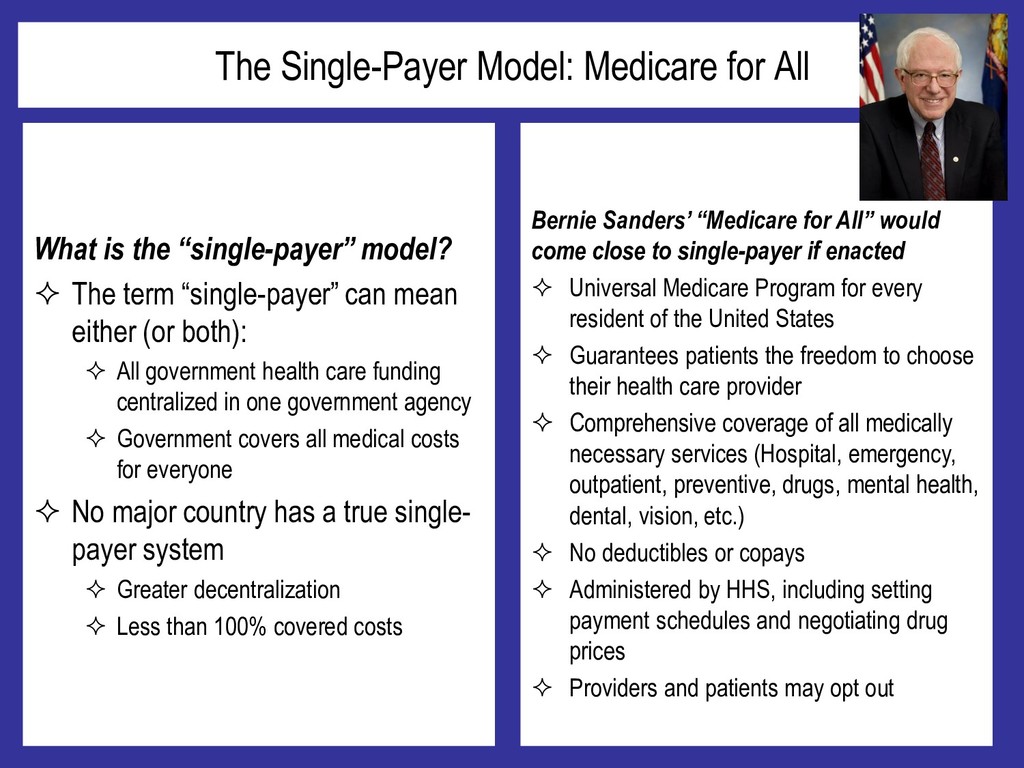
  11. The Single-Payer Model: Medicare for All What is the “single-payer”

    model?  The term “single-payer” can mean either (or both):  All government health care funding centralized in one government agency  Government covers all medical costs for everyone  No major country has a true single- payer system  Greater decentralization  Less than 100% covered costs Bernie Sanders’ “Medicare for All” would come close to single-payer if enacted  Universal Medicare Program for every resident of the United States  Guarantees patients the freedom to choose their health care provider  Comprehensive coverage of all medically necessary services (Hospital, emergency, outpatient, preventive, drugs, mental health, dental, vision, etc.)  No deductibles or copays  Administered by HHS, including setting payment schedules and negotiating drug prices  Providers and patients may opt out
  12. An Alternative: Universal Catastrophic Coverage  Everyone automatically enrolled through

    a public or private policy (think Medicare or Medicare Advantage)  Full coverage below a low-income threshold, e.g., federal poverty level (≈$25,000 for family of 4)  Deductible for higher-incomes equal to 10% of total income minus low-income threshold, e.g.  Total income <$25,000, deductible = $0  Total income = $75,000, deductible = $5,000  Total income = $1,000,000, deductible = $97,500  Deductible waived for preventive services  Health savings accounts or supplemental policies could be used to help with deductibles requirements  Full range of cost-control measures.  For administrative efficiency UCC would eventually replace other health care programs
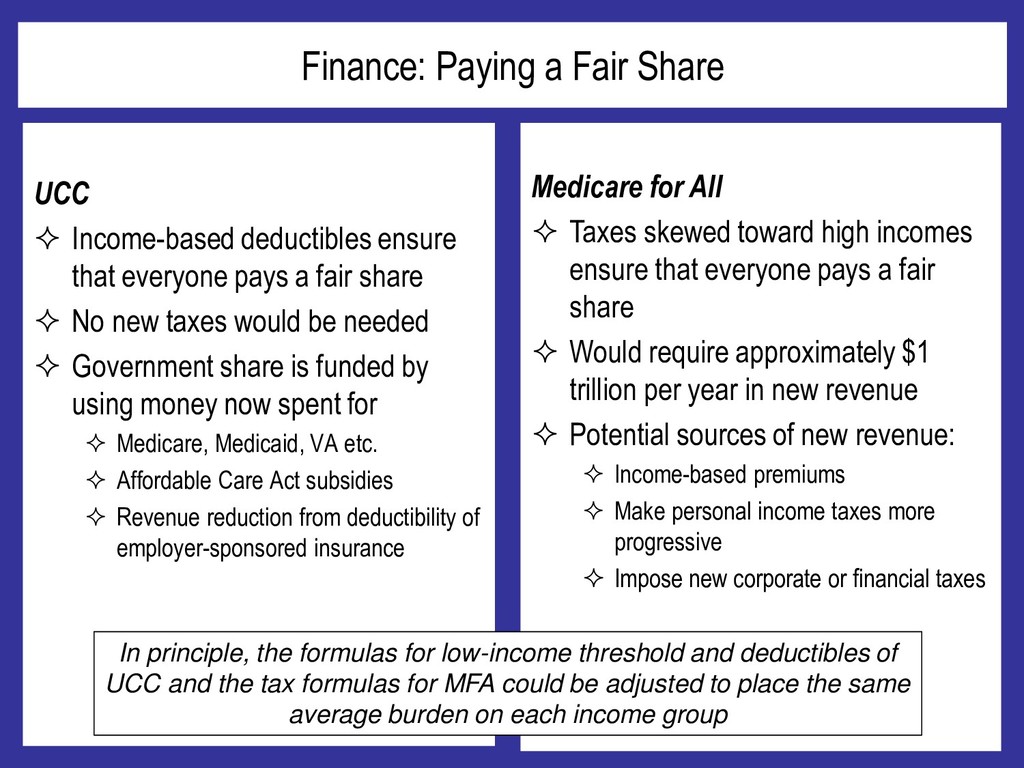
  13. Finance: Paying a Fair Share UCC  Income-based deductibles ensure

    that everyone pays a fair share  No new taxes would be needed  Government share is funded by using money now spent for  Medicare, Medicaid, VA etc.  Affordable Care Act subsidies  Revenue reduction from deductibility of employer-sponsored insurance Medicare for All  Taxes skewed toward high incomes ensure that everyone pays a fair share  Would require approximately $1 trillion per year in new revenue  Potential sources of new revenue:  Income-based premiums  Make personal income taxes more progressive  Impose new corporate or financial taxes In principle, the formulas for low-income threshold and deductibles of UCC and the tax formulas for MFA could be adjusted to place the same average burden on each income group
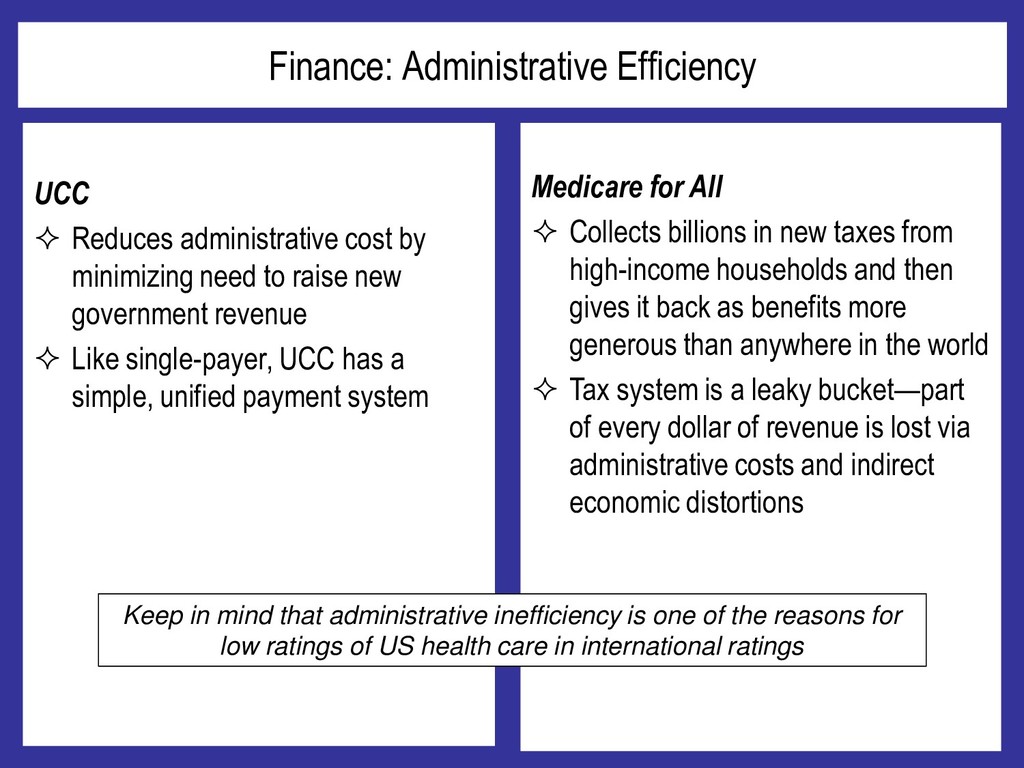
  14. Finance: Administrative Efficiency UCC  Reduces administrative cost by minimizing

    need to raise new government revenue  Like single-payer, UCC has a simple, unified payment system Medicare for All  Collects billions in new taxes from high-income households and then gives it back as benefits more generous than anywhere in the world  Tax system is a leaky bucket—part of every dollar of revenue is lost via administrative costs and indirect economic distortions Keep in mind that administrative inefficiency is one of the reasons for low ratings of US health care in international ratings
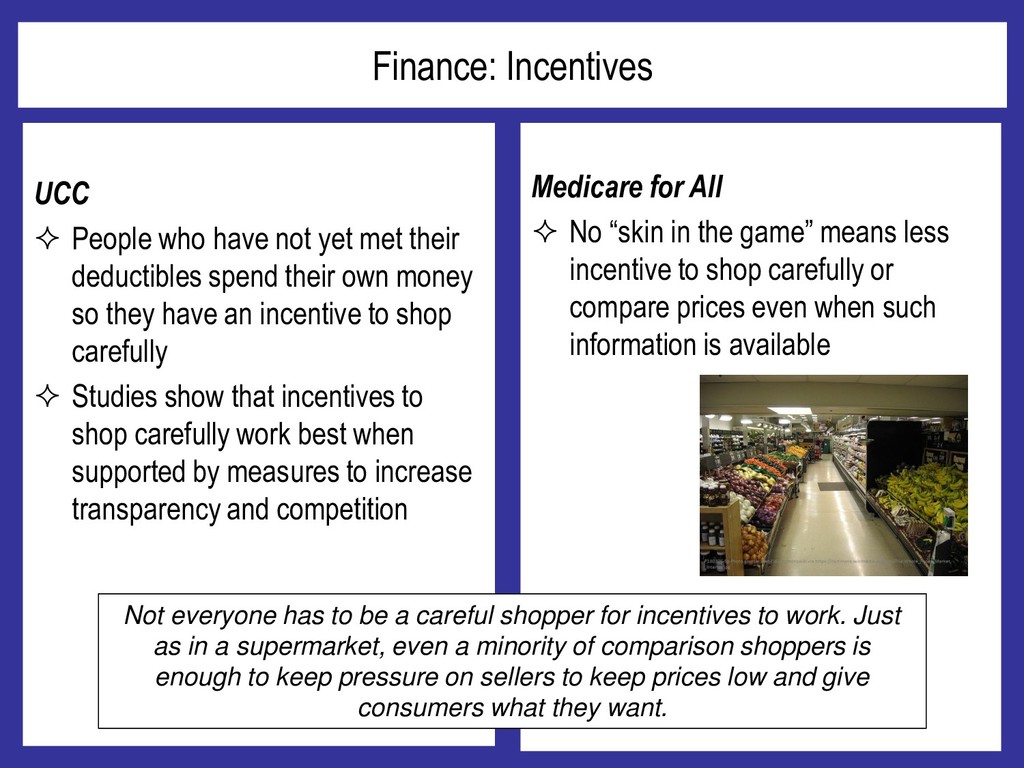
  15. Finance: Incentives UCC  People who have not yet met

    their deductibles spend their own money so they have an incentive to shop carefully  Studies show that incentives to shop carefully work best when supported by measures to increase transparency and competition Medicare for All  No “skin in the game” means less incentive to shop carefully or compare prices even when such information is available Not everyone has to be a careful shopper for incentives to work. Just as in a supermarket, even a minority of comparison shoppers is enough to keep pressure on sellers to keep prices low and give consumers what they want.
  16. Cost Saving Measures Both UCC and Single Payer would need

    a full range of cost-saving measures  Increased transparency for price and quality  Removal of barriers to competition  “Bundled payments” instead of fee for service  Full use of government bargaining power when dealing with drug companies and other providers  Greater use of nonphysician providers where full skills of MD are not needed  Maximum use of cost-effective preventive measures
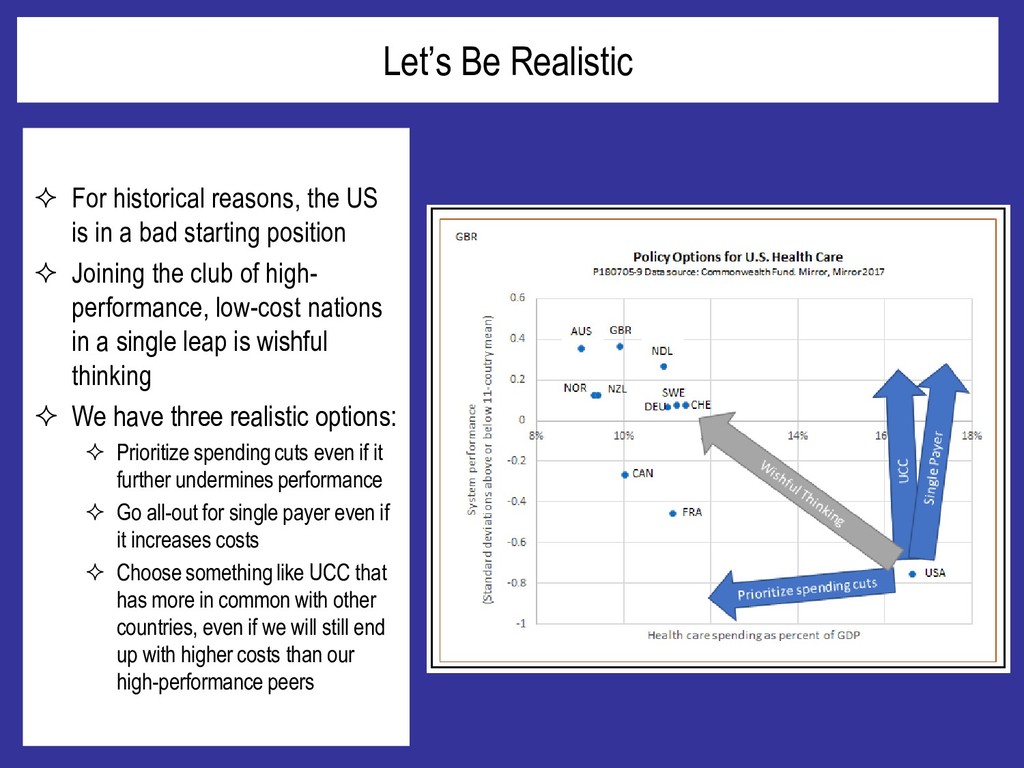
  17. Let’s Be Realistic  For historical reasons, the US is

    in a bad starting position  Joining the club of high- performance, low-cost nations in a single leap is wishful thinking  We have three realistic options:  Prioritize spending cuts even if it further undermines performance  Go all-out for single payer even if it increases costs  Choose something like UCC that has more in common with other countries, even if we will still end up with higher costs than our high-performance peers