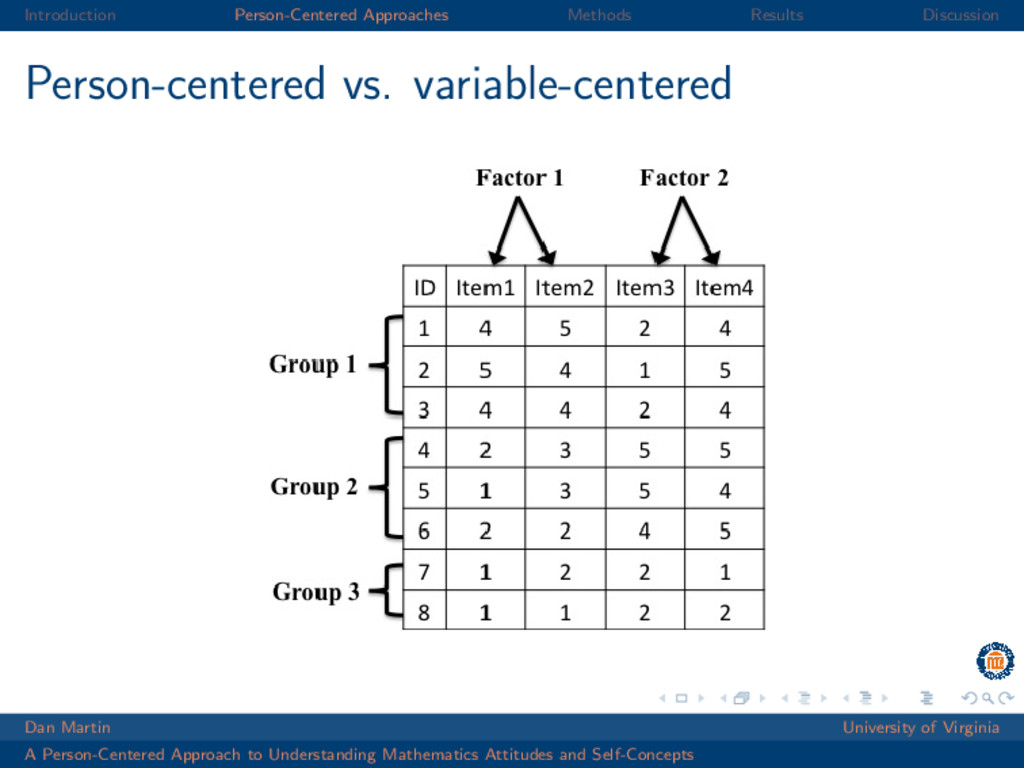
Understanding Mathematics Attitudes and Self-Concepts An Application of Latent Class Analysis Dan Martin University of Virginia Design and Data Analysis November 8, 2012 Dan Martin University of Virginia A Person-Centered Approach to Understanding Mathematics Attitudes and Self-Concepts
Brian Nosek (Full Potential Initiative) Tai Melcher and Irina Mitrea (Math faculty) Timo von Oertzen and the Mathematical Psychology Lab Jeff Spies (a.k.a. R Guru) The rest of the quant area! Dan Martin University of Virginia A Person-Centered Approach to Understanding Mathematics Attitudes and Self-Concepts
– Traditional clustering (i.e., k-means) – Finite mixture models (i.e., latent class analysis [LCA]) Methods Results Discussion Future directions – Gender differences – Longitudinal analyses Dan Martin University of Virginia A Person-Centered Approach to Understanding Mathematics Attitudes and Self-Concepts
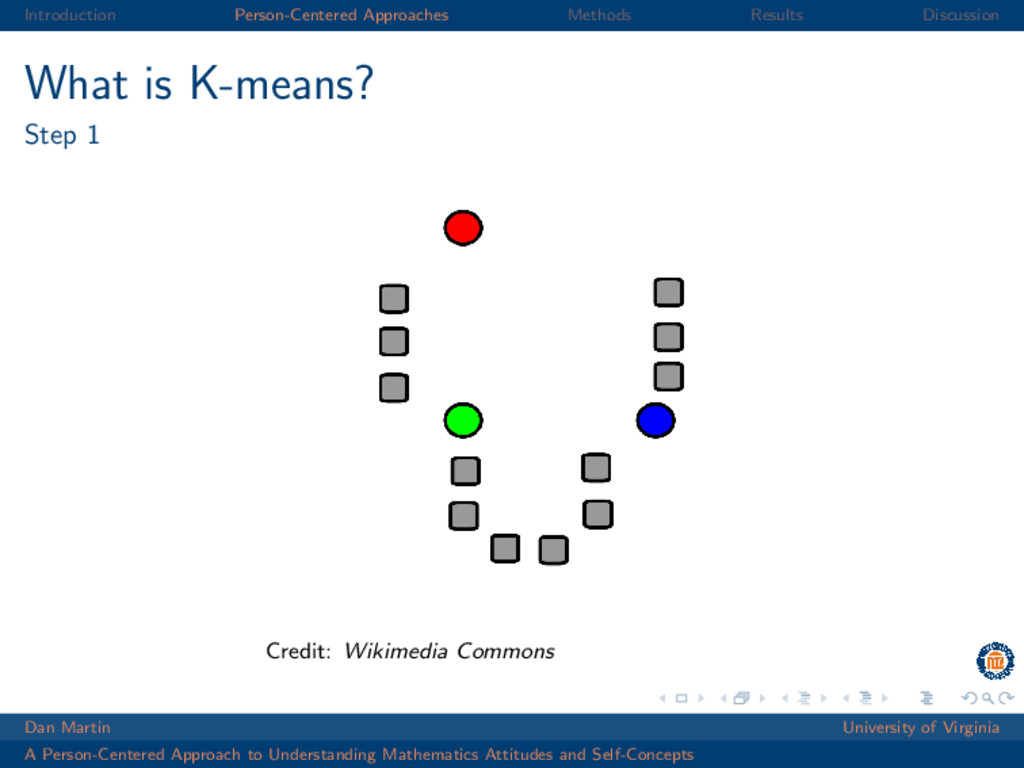
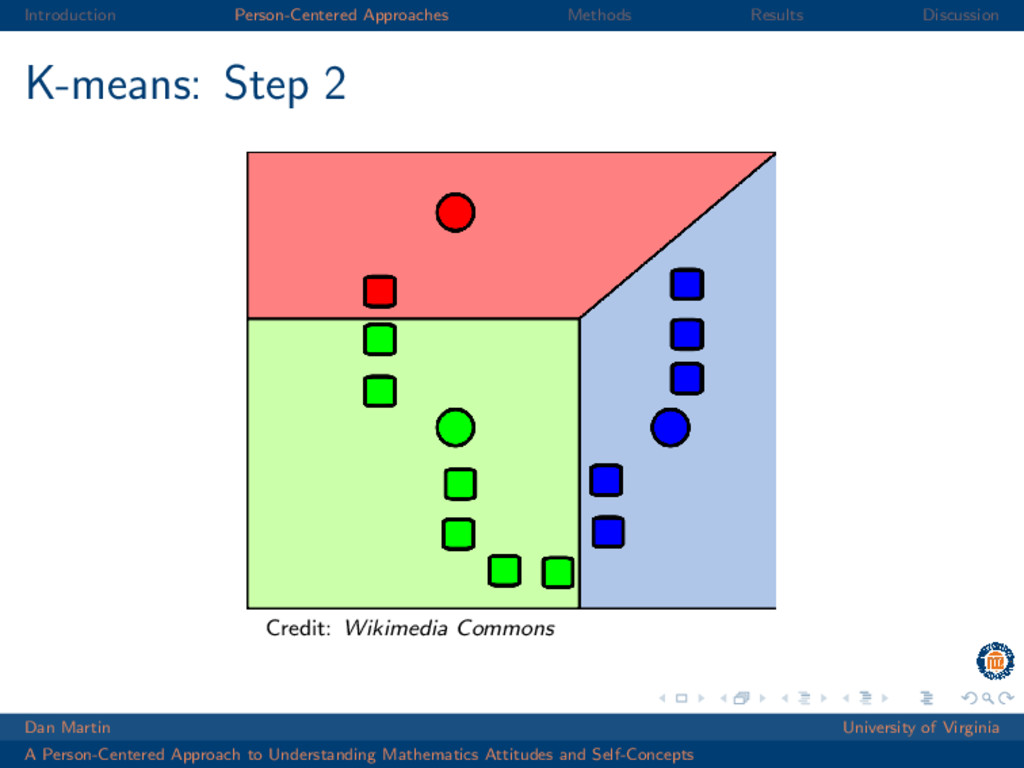
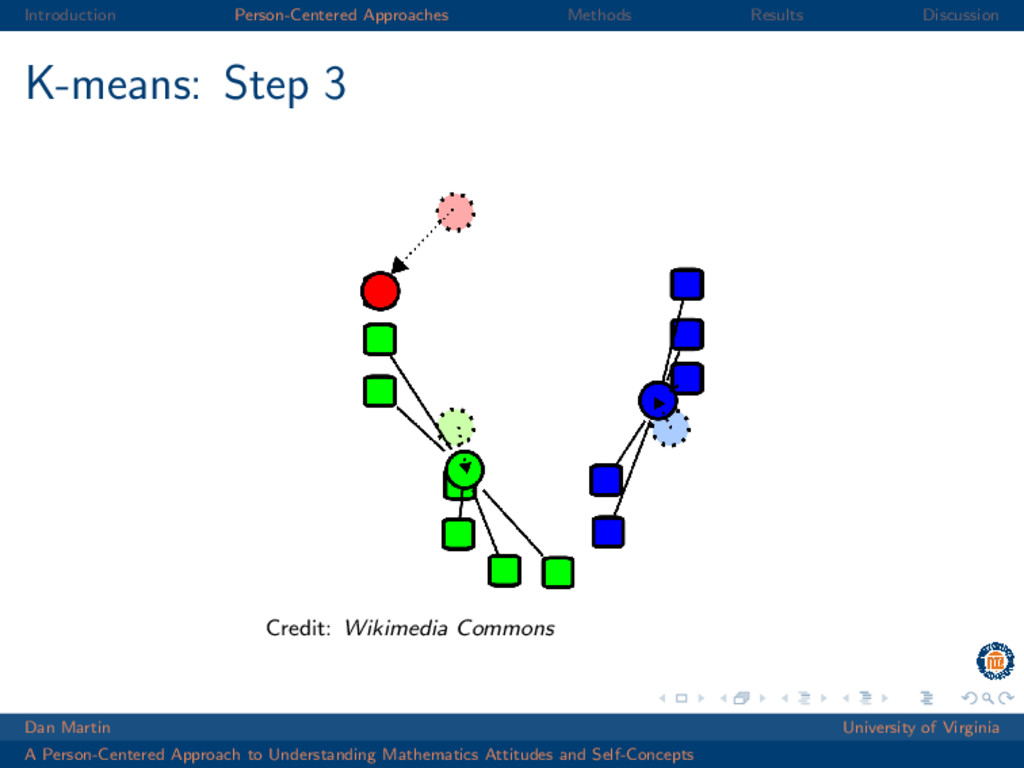
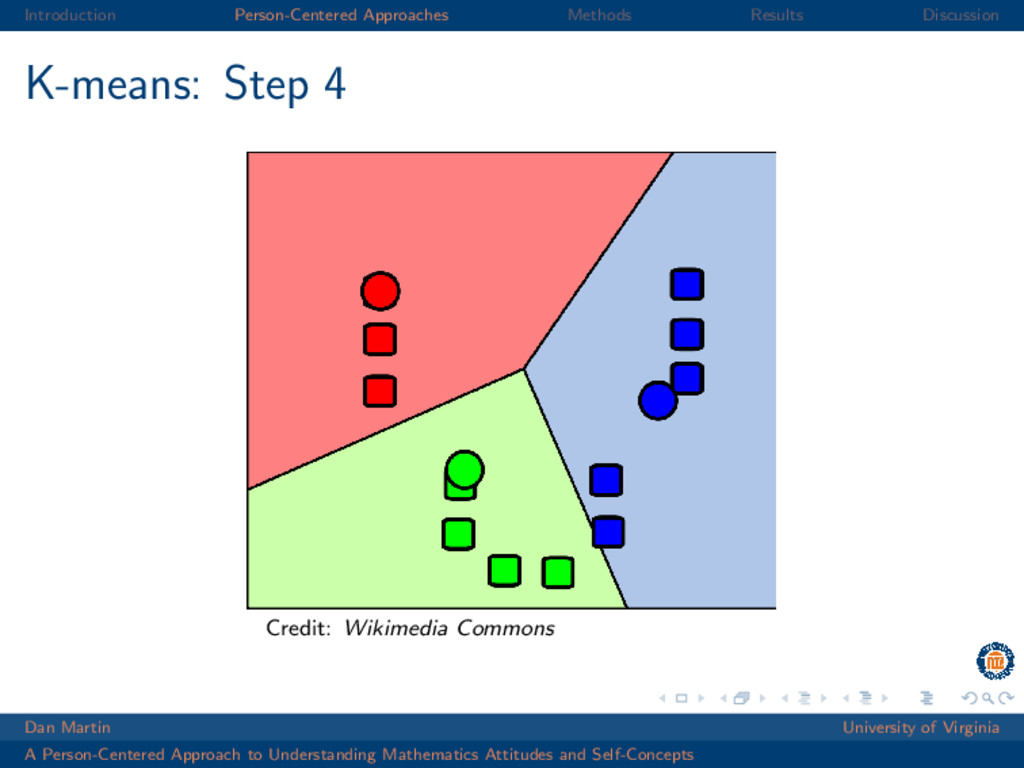
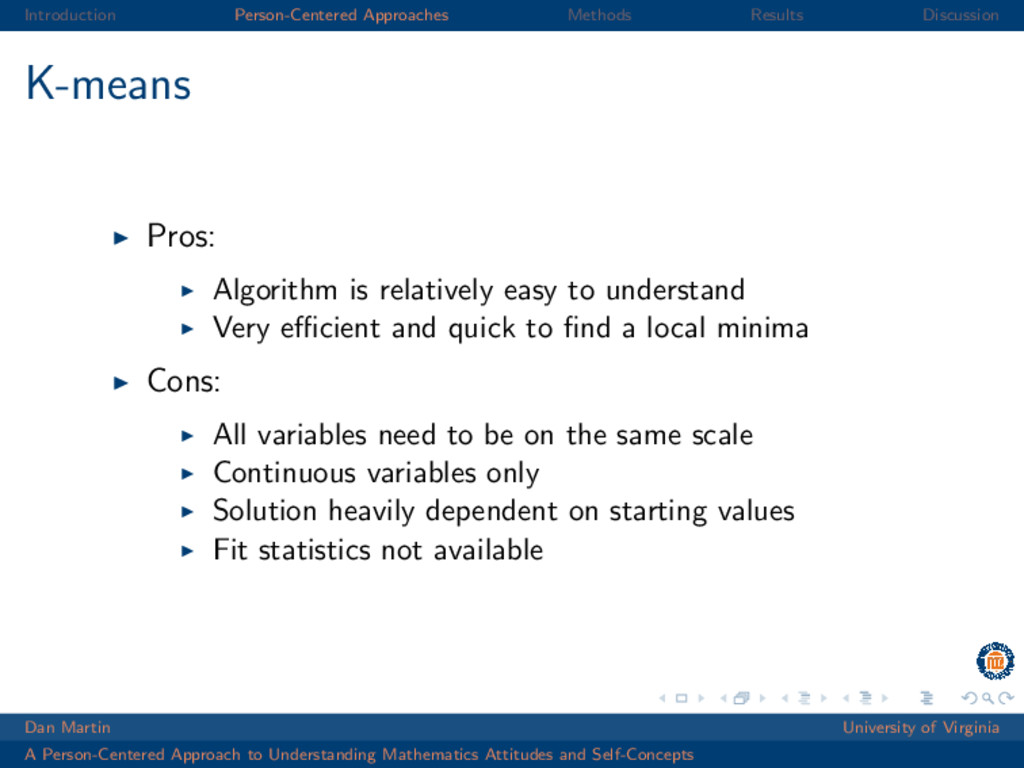
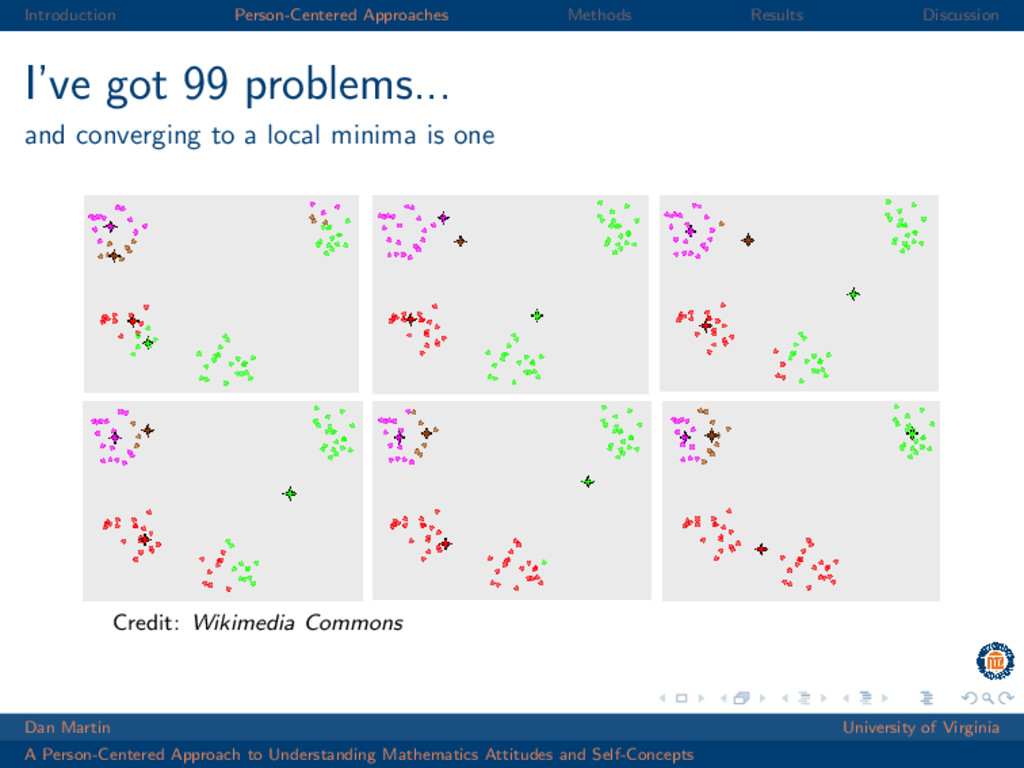
relatively easy to understand Very efficient and quick to find a local minima Cons: All variables need to be on the same scale Continuous variables only Solution heavily dependent on starting values Fit statistics not available Dan Martin University of Virginia A Person-Centered Approach to Understanding Mathematics Attitudes and Self-Concepts
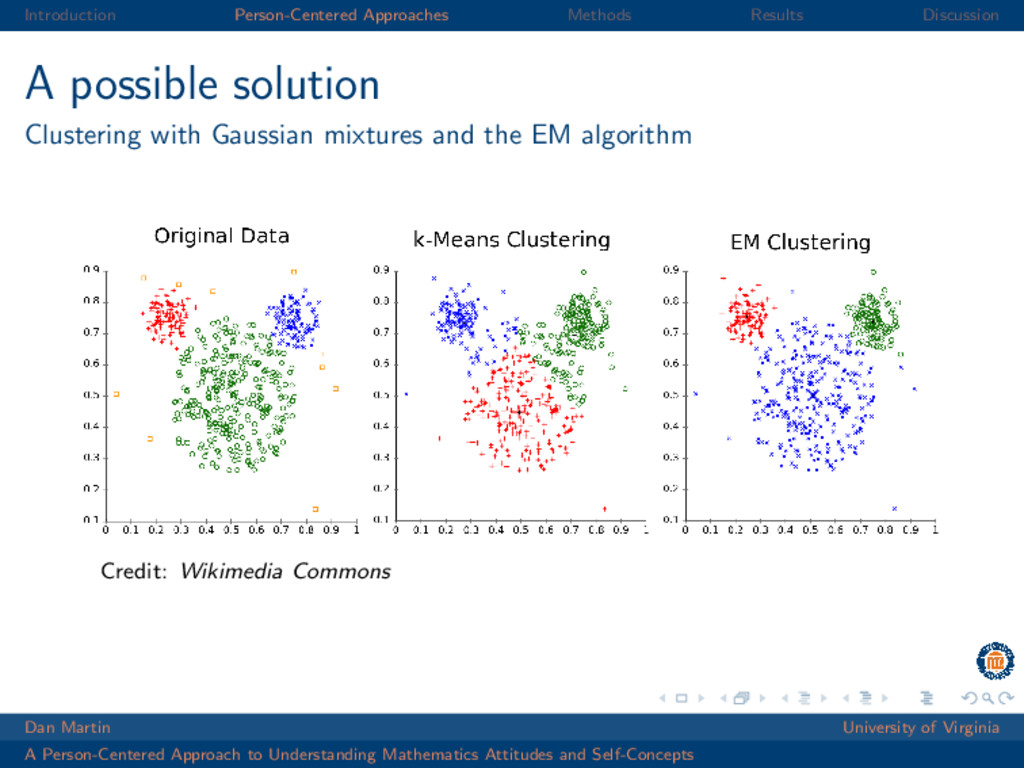
and converging to a local minima is one Credit: Wikimedia Commons Dan Martin University of Virginia A Person-Centered Approach to Understanding Mathematics Attitudes and Self-Concepts
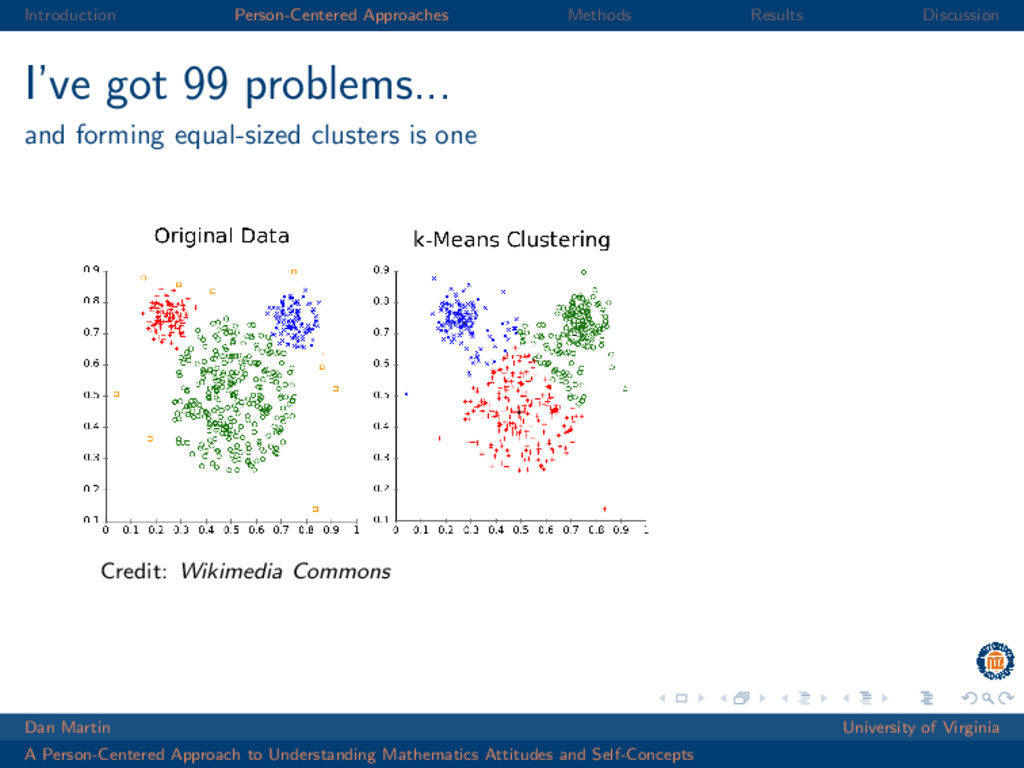
and forming equal-sized clusters is one Credit: Wikimedia Commons Dan Martin University of Virginia A Person-Centered Approach to Understanding Mathematics Attitudes and Self-Concepts
with Gaussian mixtures and the EM algorithm Credit: Wikimedia Commons Dan Martin University of Virginia A Person-Centered Approach to Understanding Mathematics Attitudes and Self-Concepts
Analysis (LCA) Goals: Derive a set of categorical latent classes to simplify large, complex contingency tables of participant responses Create profiles based on item-responses in the particular class that may be theoretically relevant or interesting Dan Martin University of Virginia A Person-Centered Approach to Understanding Mathematics Attitudes and Self-Concepts
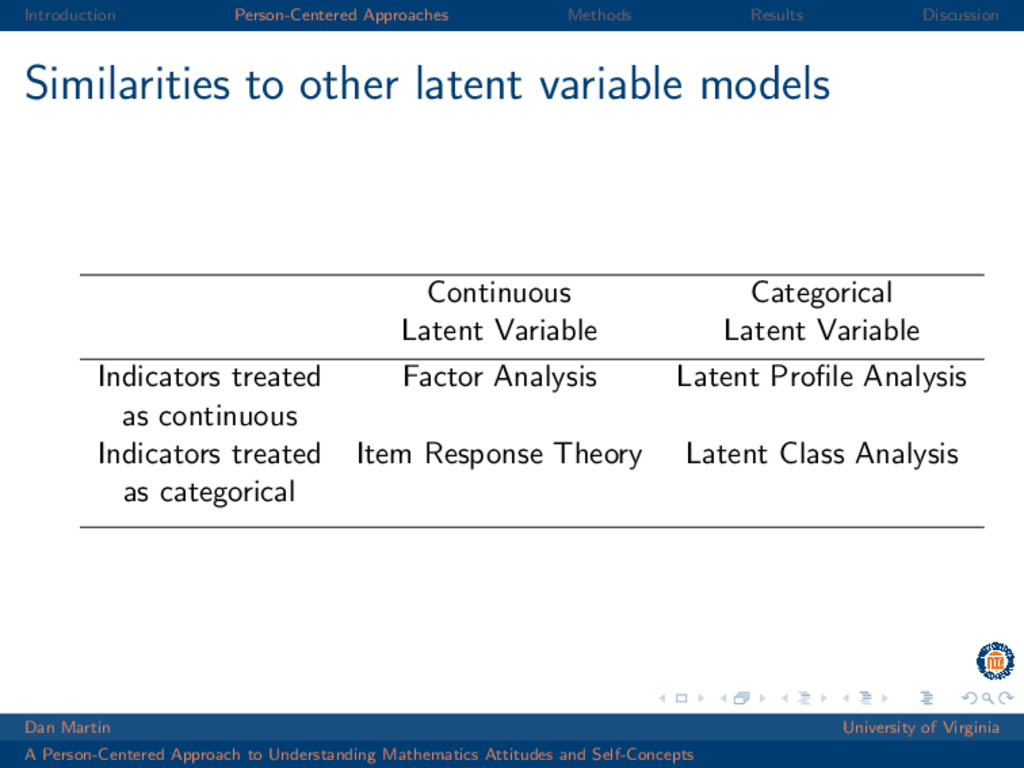
variable models Continuous Categorical Latent Variable Latent Variable Indicators treated Factor Analysis Latent Profile Analysis as continuous Indicators treated Item Response Theory Latent Class Analysis as categorical Dan Martin University of Virginia A Person-Centered Approach to Understanding Mathematics Attitudes and Self-Concepts
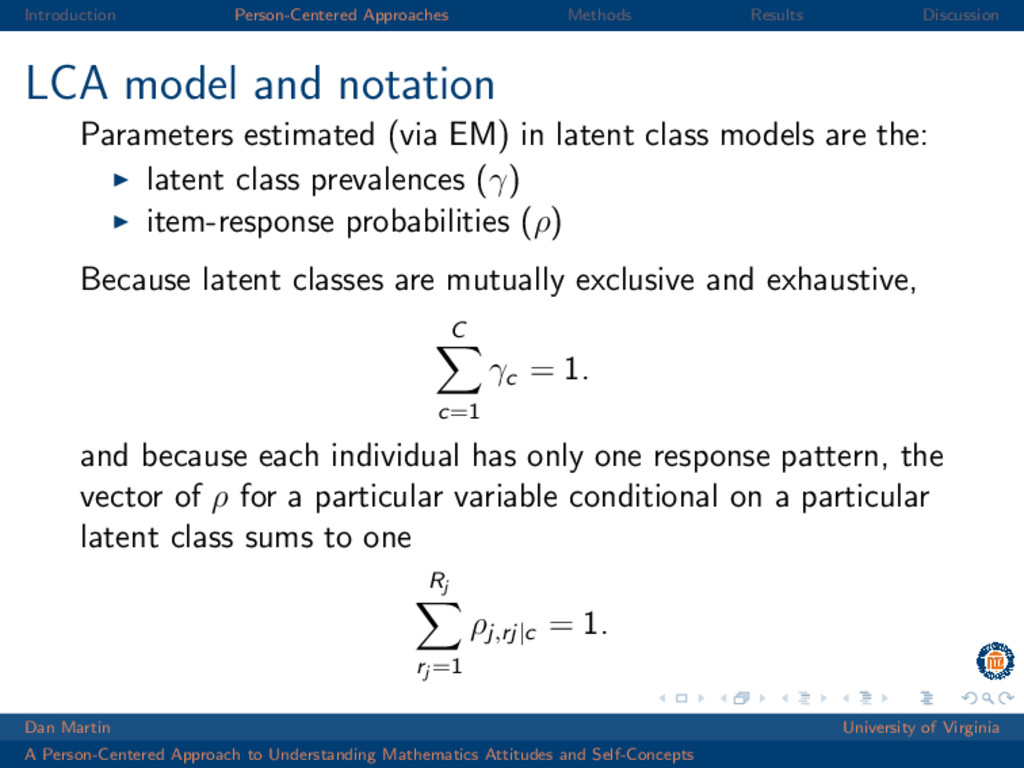
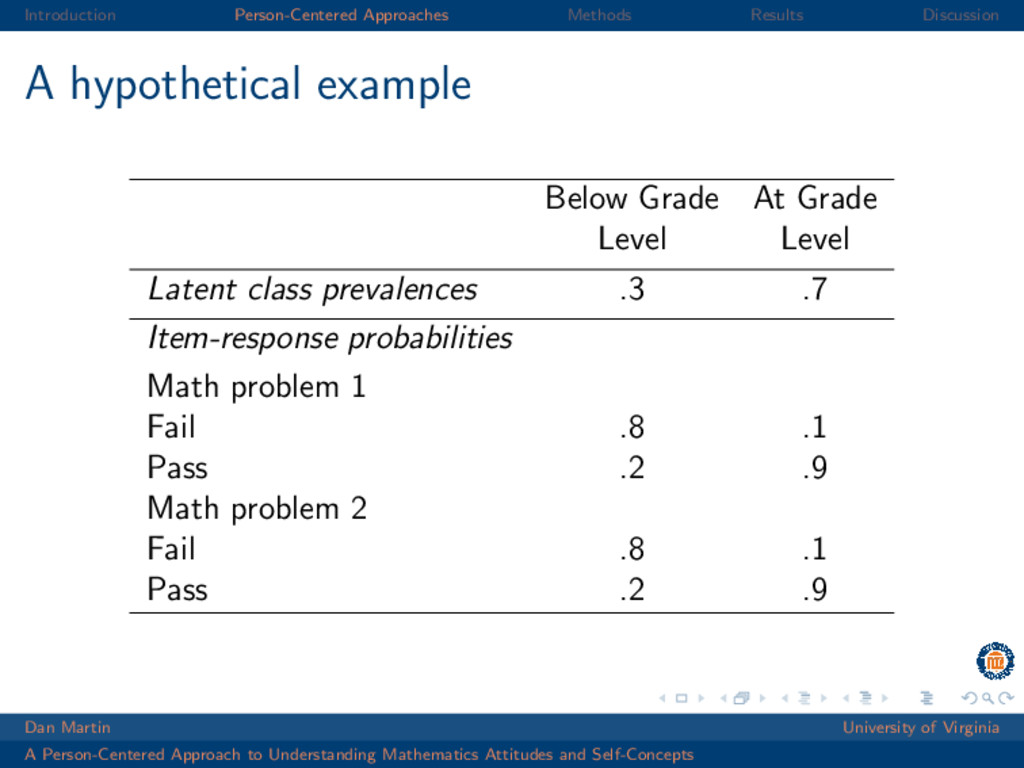
Parameters estimated (via EM) in latent class models are the: latent class prevalences (γ) item-response probabilities (ρ) Because latent classes are mutually exclusive and exhaustive, C c=1 γc = 1. and because each individual has only one response pattern, the vector of ρ for a particular variable conditional on a particular latent class sums to one Rj rj =1 ρj,rj|c = 1. Dan Martin University of Virginia A Person-Centered Approach to Understanding Mathematics Attitudes and Self-Concepts
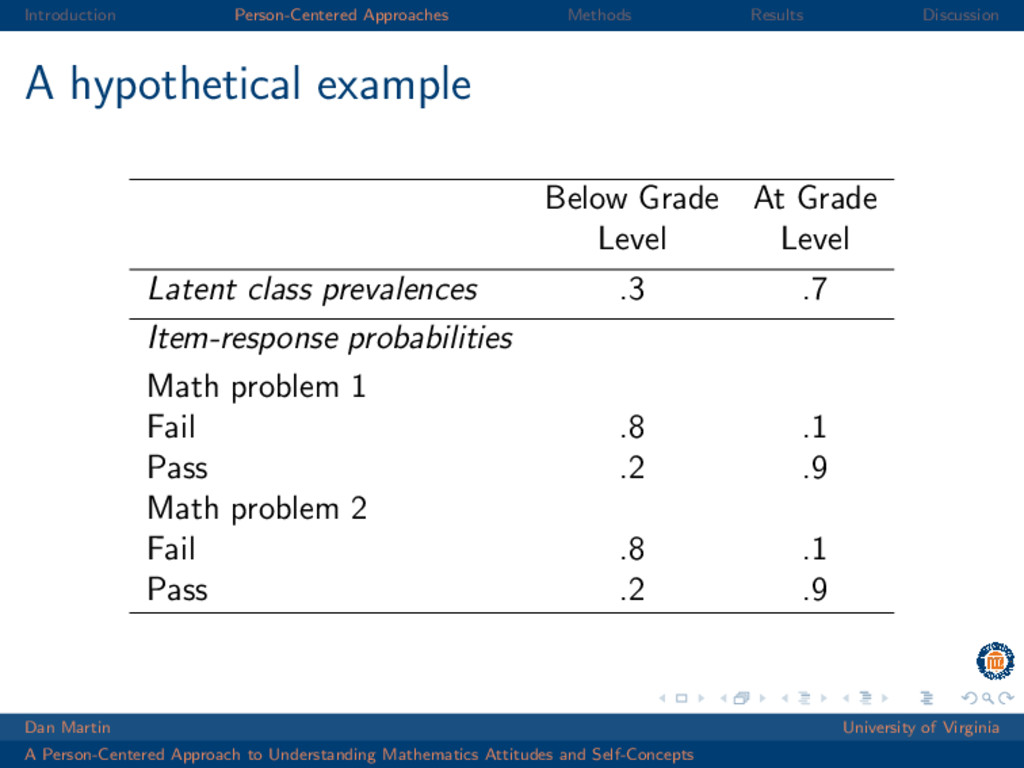
Grade At Grade Level Level Latent class prevalences .3 .7 Item-response probabilities Math problem 1 Fail .8 .1 Pass .2 .9 Math problem 2 Fail .8 .1 Pass .2 .9 Dan Martin University of Virginia A Person-Centered Approach to Understanding Mathematics Attitudes and Self-Concepts
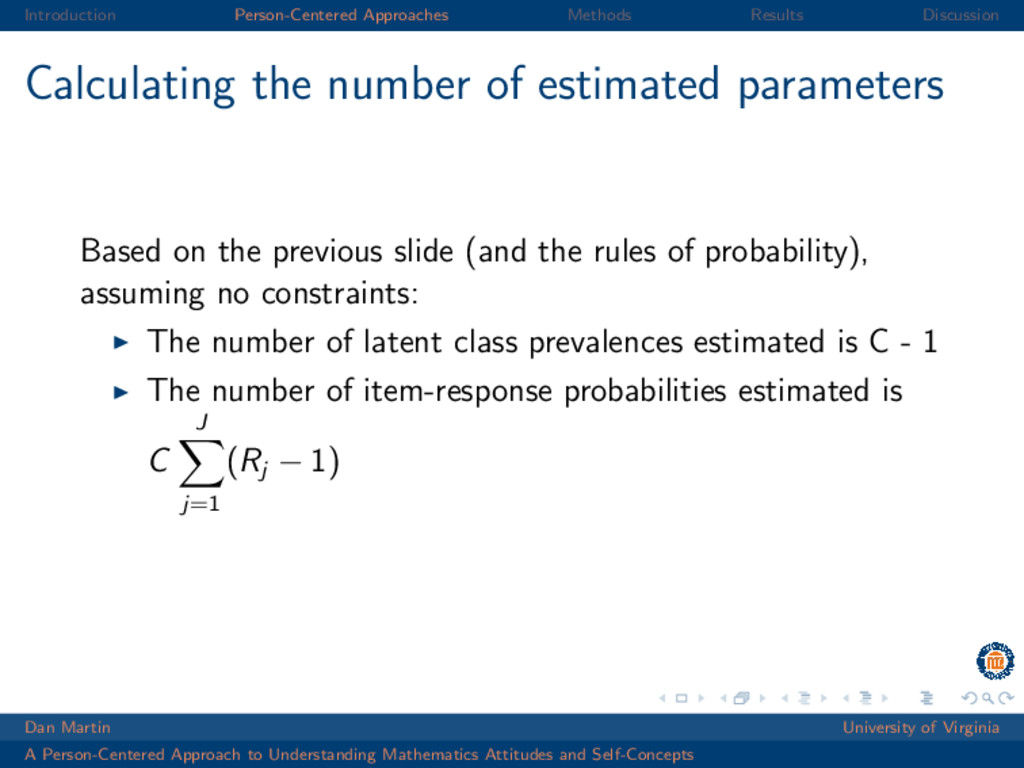
estimated parameters Based on the previous slide (and the rules of probability), assuming no constraints: The number of latent class prevalences estimated is C - 1 The number of item-response probabilities estimated is C J j=1 (Rj − 1) Dan Martin University of Virginia A Person-Centered Approach to Understanding Mathematics Attitudes and Self-Concepts
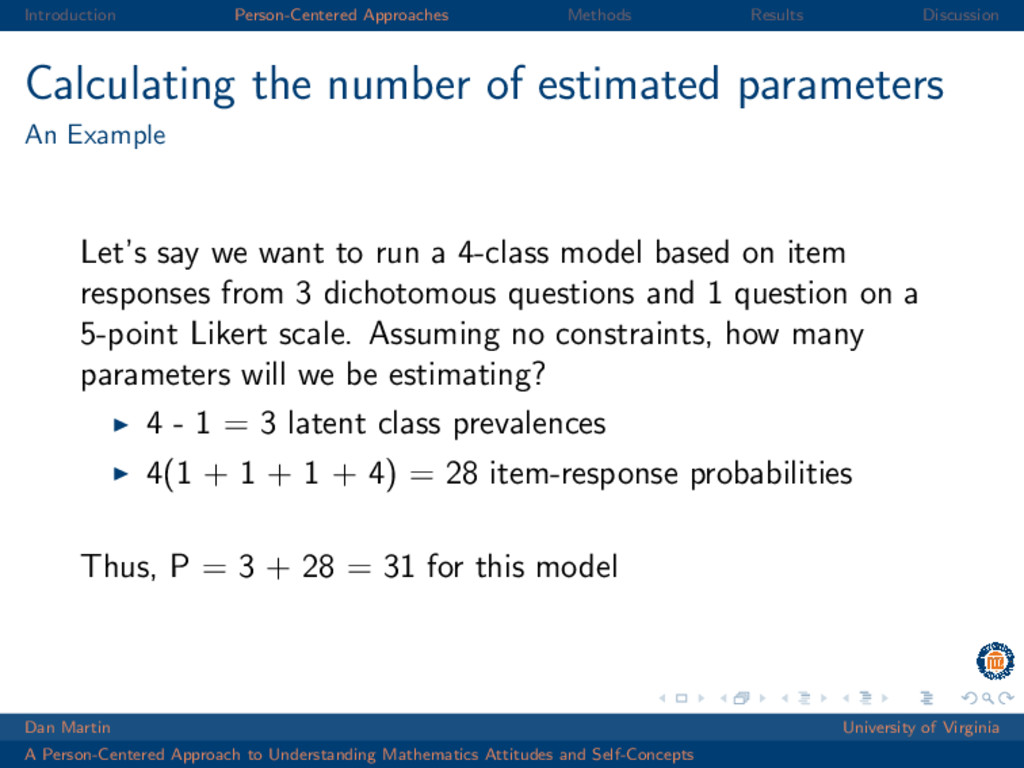
estimated parameters An Example Let’s say we want to run a 4-class model based on item responses from 3 dichotomous questions and 1 question on a 5-point Likert scale. Assuming no constraints, how many parameters will we be estimating? 4 - 1 = 3 latent class prevalences 4(1 + 1 + 1 + 4) = 28 item-response probabilities Thus, P = 3 + 28 = 31 for this model Dan Martin University of Virginia A Person-Centered Approach to Understanding Mathematics Attitudes and Self-Concepts
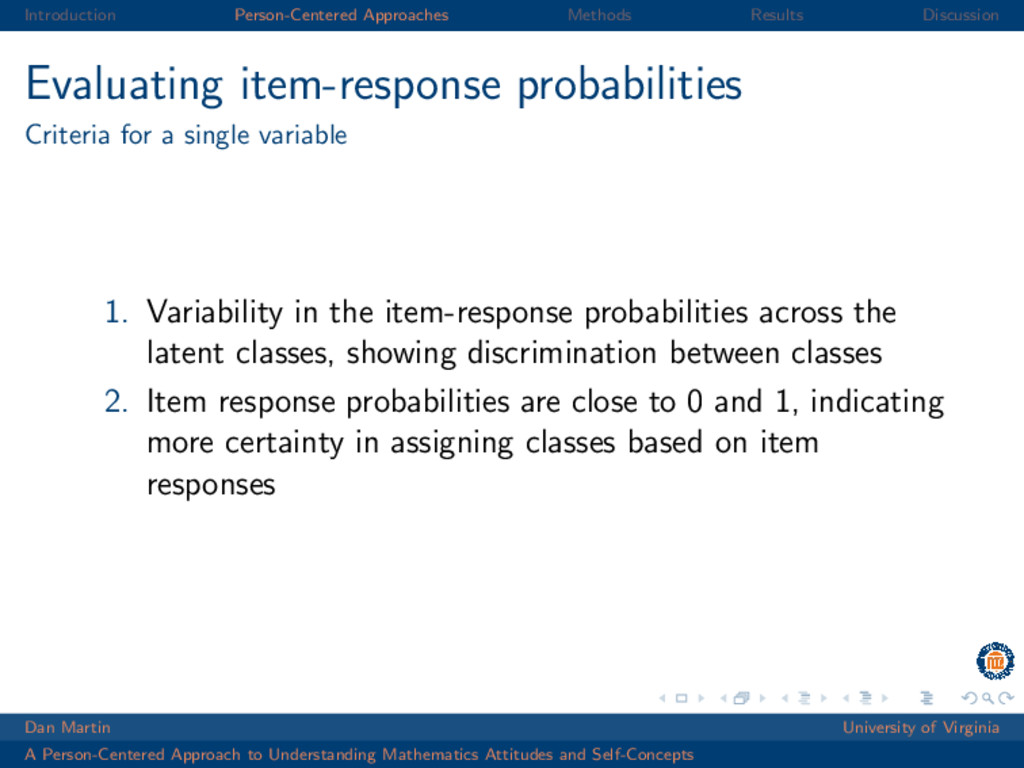
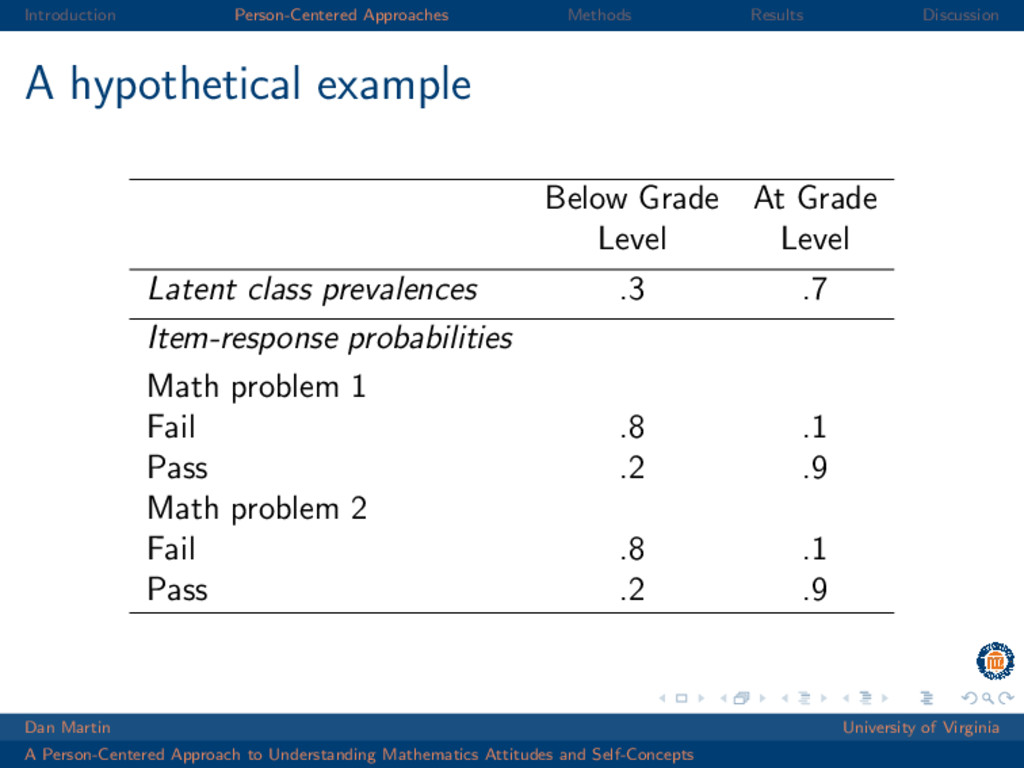
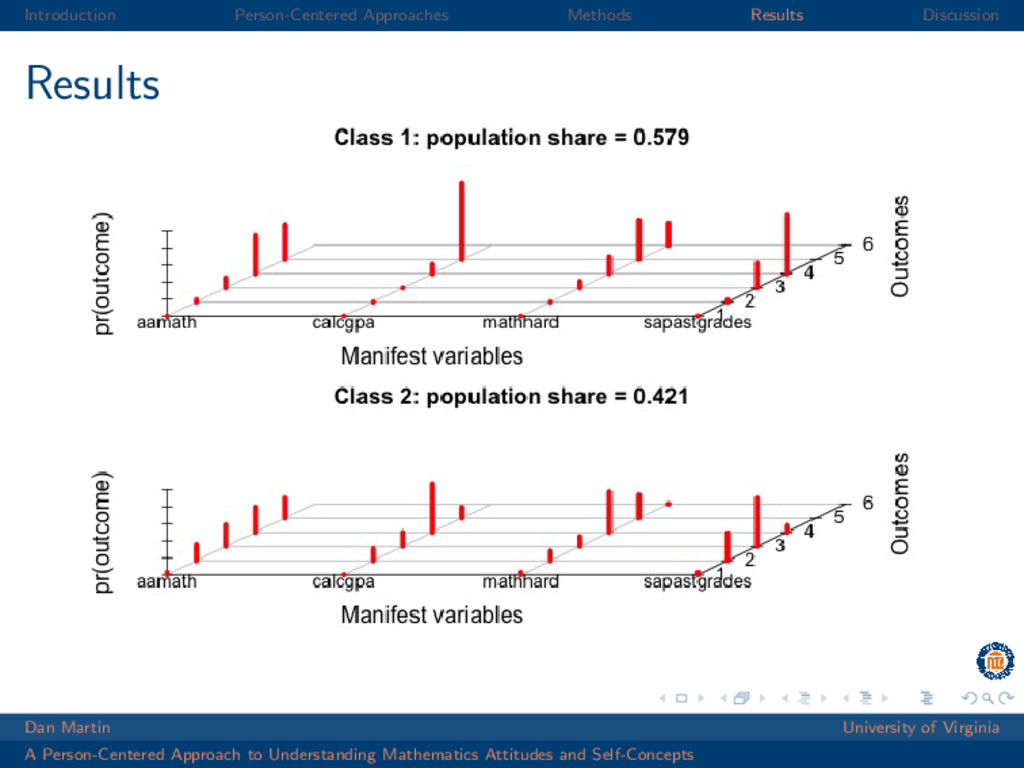
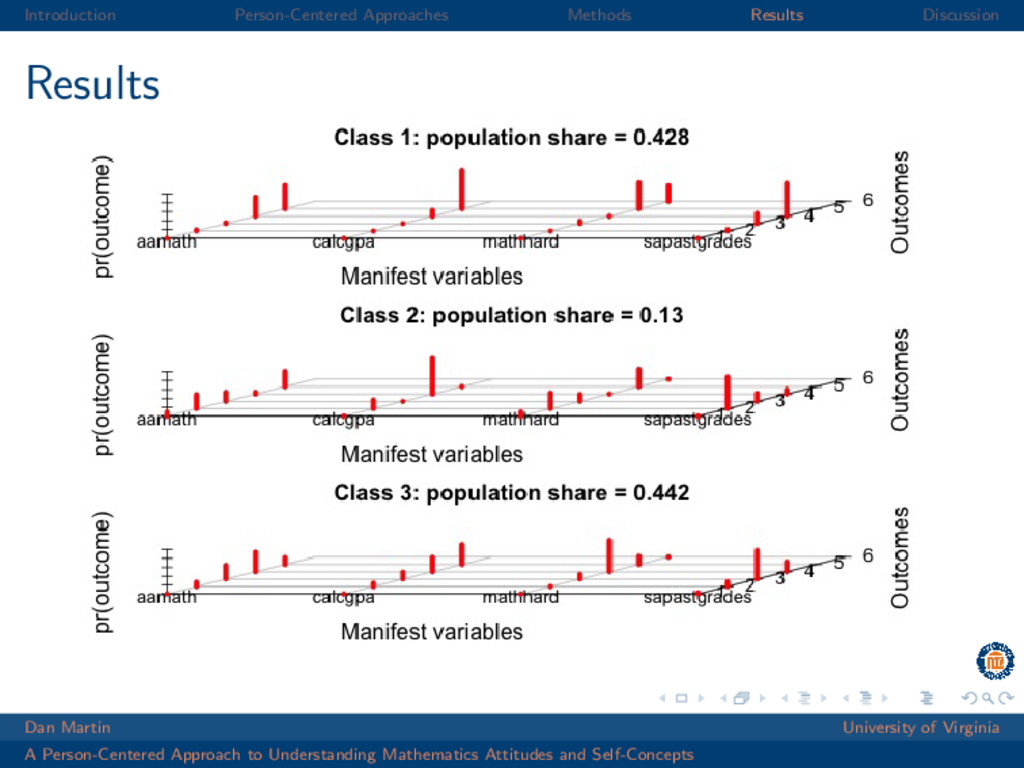
for a single variable 1. Variability in the item-response probabilities across the latent classes, showing discrimination between classes 2. Item response probabilities are close to 0 and 1, indicating more certainty in assigning classes based on item responses Dan Martin University of Virginia A Person-Centered Approach to Understanding Mathematics Attitudes and Self-Concepts
Grade At Grade Level Level Latent class prevalences .3 .7 Item-response probabilities Math problem 1 Fail .8 .1 Pass .2 .9 Math problem 2 Fail .8 .1 Pass .2 .9 Dan Martin University of Virginia A Person-Centered Approach to Understanding Mathematics Attitudes and Self-Concepts
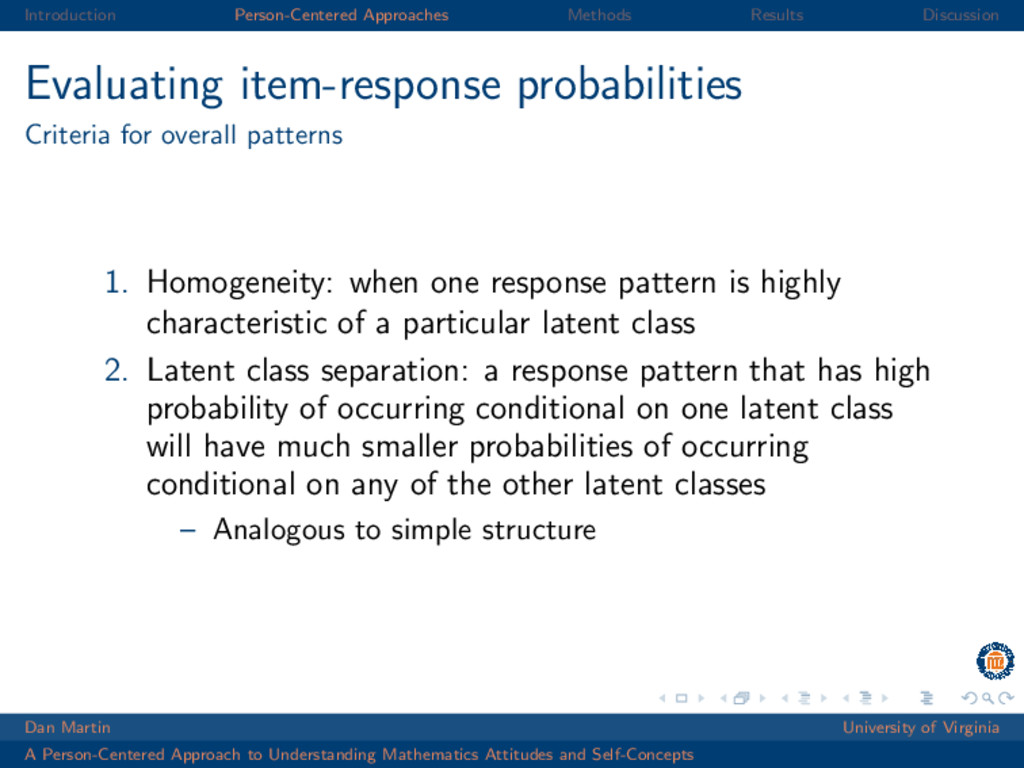
for overall patterns 1. Homogeneity: when one response pattern is highly characteristic of a particular latent class 2. Latent class separation: a response pattern that has high probability of occurring conditional on one latent class will have much smaller probabilities of occurring conditional on any of the other latent classes – Analogous to simple structure Dan Martin University of Virginia A Person-Centered Approach to Understanding Mathematics Attitudes and Self-Concepts
Grade At Grade Level Level Latent class prevalences .3 .7 Item-response probabilities Math problem 1 Fail .8 .1 Pass .2 .9 Math problem 2 Fail .8 .1 Pass .2 .9 Dan Martin University of Virginia A Person-Centered Approach to Understanding Mathematics Attitudes and Self-Concepts
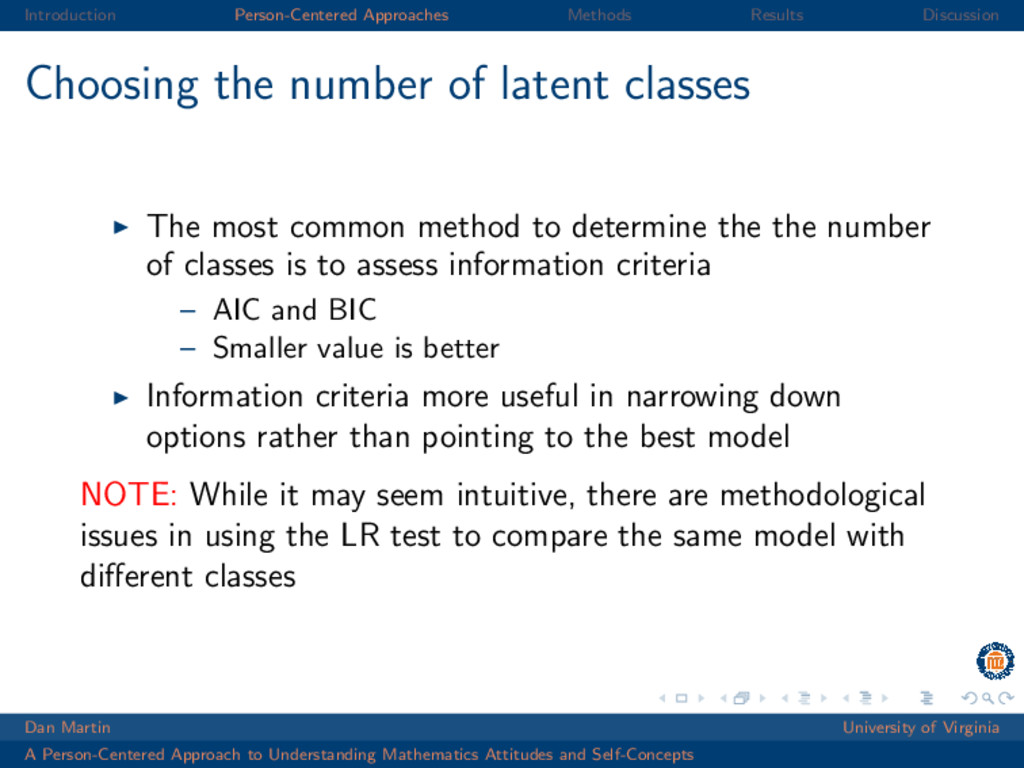
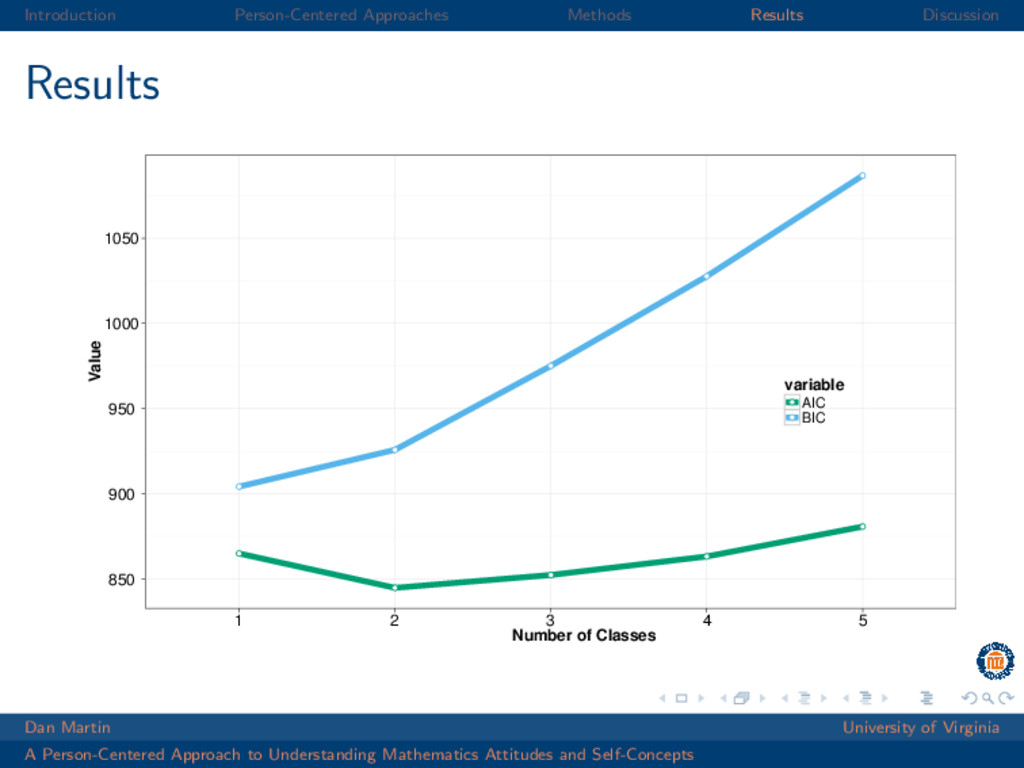
latent classes The most common method to determine the the number of classes is to assess information criteria – AIC and BIC – Smaller value is better Information criteria more useful in narrowing down options rather than pointing to the best model NOTE: While it may seem intuitive, there are methodological issues in using the LR test to compare the same model with different classes Dan Martin University of Virginia A Person-Centered Approach to Understanding Mathematics Attitudes and Self-Concepts
Full Potential Initiative (FPI) Six surveys implemented in 2 sections of Differential Equations in Spring 2009 (N = 86) – Differential Equations chosen as it involves the transition from mechanical, mathematical thinking to more sophisticated, abstract thinking – Gender representative! (women = 51%) Surveys were developed to track performance, both implicit and explicit attitudes, and math self-concept in relation to the course Dan Martin University of Virginia A Person-Centered Approach to Understanding Mathematics Attitudes and Self-Concepts
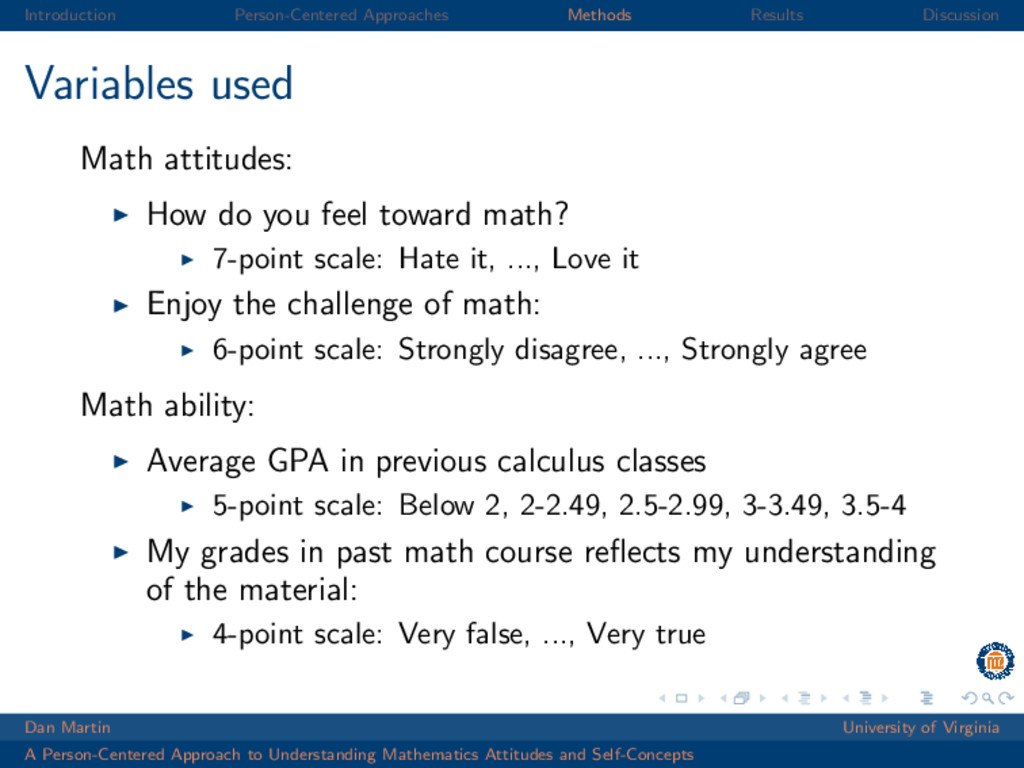
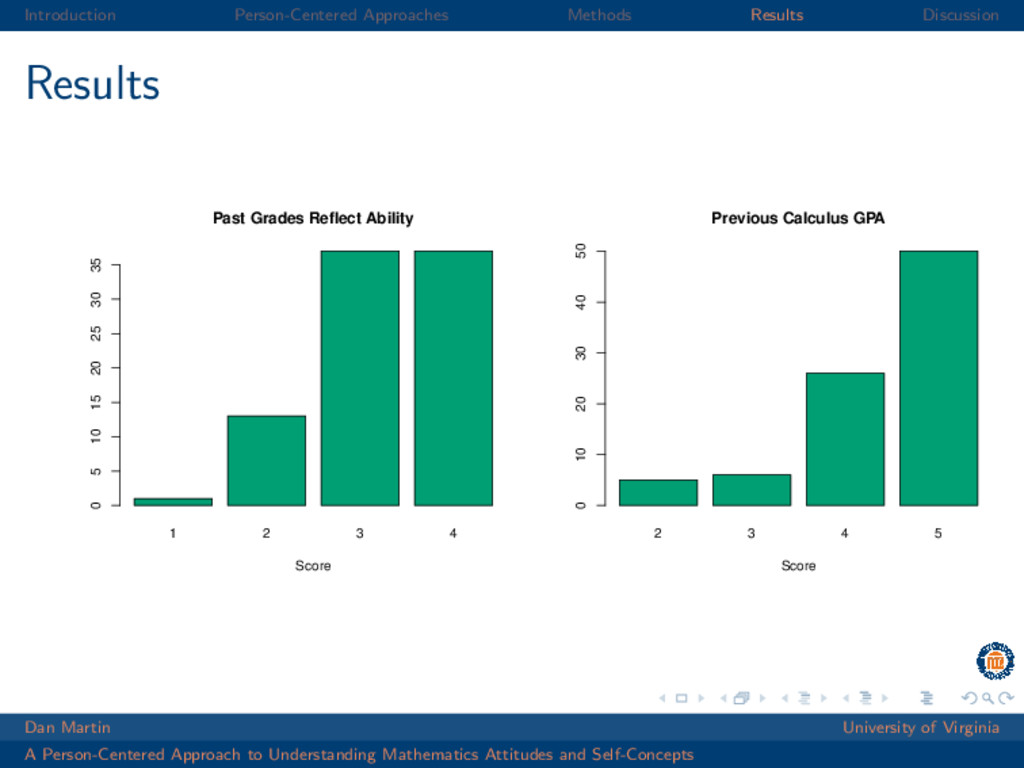
How do you feel toward math? 7-point scale: Hate it, ..., Love it Enjoy the challenge of math: 6-point scale: Strongly disagree, ..., Strongly agree Math ability: Average GPA in previous calculus classes 5-point scale: Below 2, 2-2.49, 2.5-2.99, 3-3.49, 3.5-4 My grades in past math course reflects my understanding of the material: 4-point scale: Very false, ..., Very true Dan Martin University of Virginia A Person-Centered Approach to Understanding Mathematics Attitudes and Self-Concepts
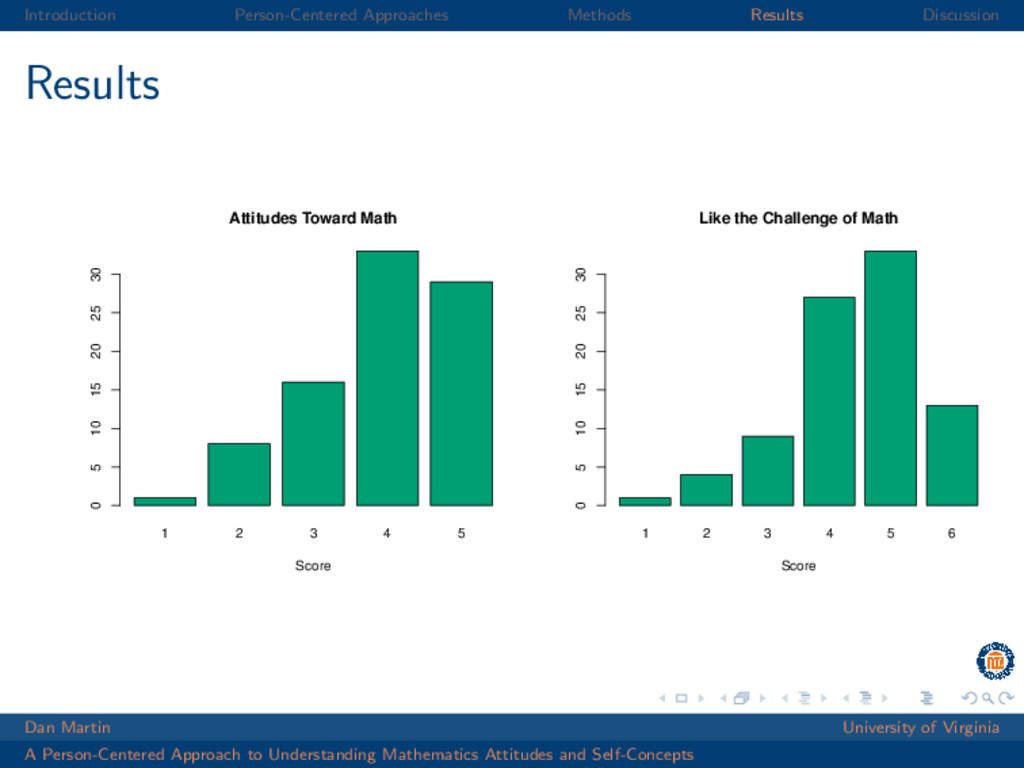
4 5 Attitudes Toward Math Score 0 5 10 15 20 25 30 1 2 3 4 5 6 Like the Challenge of Math Score 0 5 10 15 20 25 30 Dan Martin University of Virginia A Person-Centered Approach to Understanding Mathematics Attitudes and Self-Concepts
4 Past Grades Reflect Ability Score 0 5 10 15 20 25 30 35 2 3 4 5 Previous Calculus GPA Score 0 10 20 30 40 50 Dan Martin University of Virginia A Person-Centered Approach to Understanding Mathematics Attitudes and Self-Concepts
1000 1050 q q q q q q q q q q q q q q q q q q q q 1 2 3 4 5 Number of Classes Value variable q q q q AIC BIC Dan Martin University of Virginia A Person-Centered Approach to Understanding Mathematics Attitudes and Self-Concepts
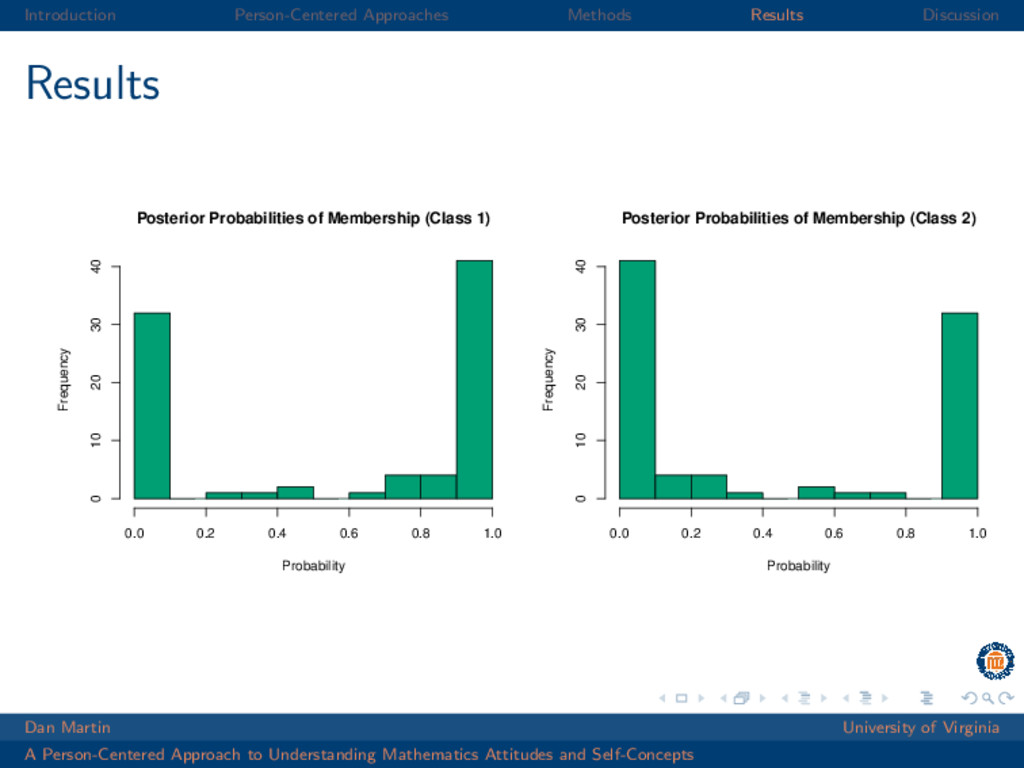
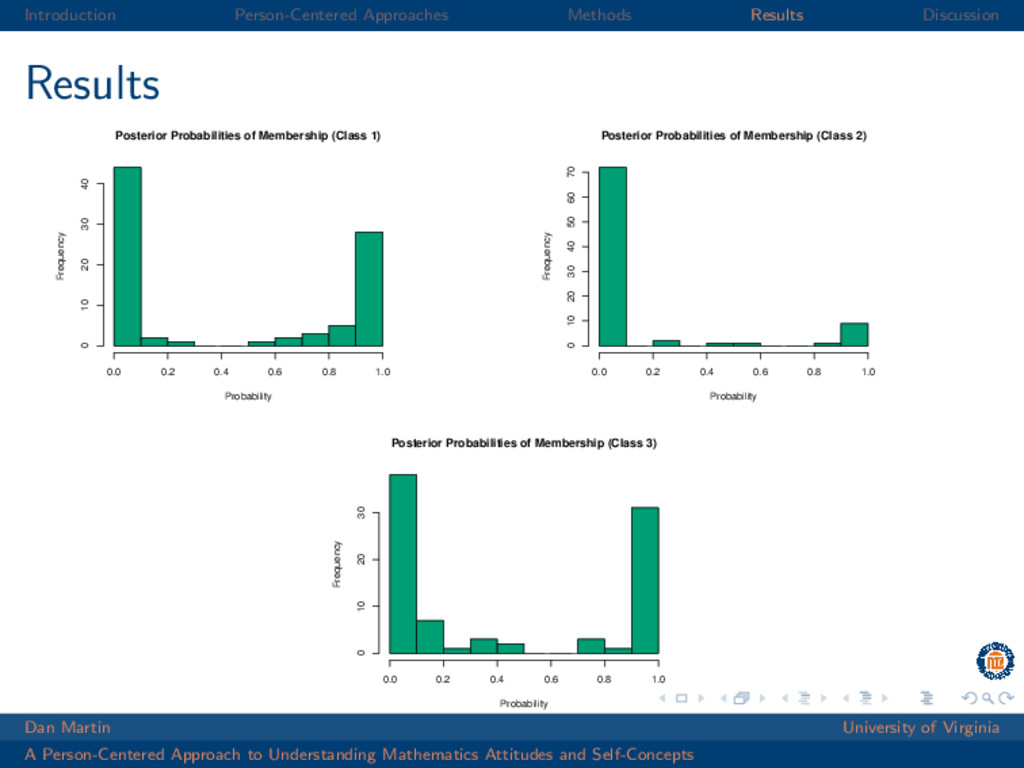
Membership (Class 1) Probability Frequency 0.0 0.2 0.4 0.6 0.8 1.0 0 10 20 30 40 Posterior Probabilities of Membership (Class 2) Probability Frequency 0.0 0.2 0.4 0.6 0.8 1.0 0 10 20 30 40 Dan Martin University of Virginia A Person-Centered Approach to Understanding Mathematics Attitudes and Self-Concepts
Membership (Class 1) Probability Frequency 0.0 0.2 0.4 0.6 0.8 1.0 0 10 20 30 40 Posterior Probabilities of Membership (Class 2) Probability Frequency 0.0 0.2 0.4 0.6 0.8 1.0 0 10 20 30 40 50 60 70 Posterior Probabilities of Membership (Class 3) Probability Frequency 0.0 0.2 0.4 0.6 0.8 1.0 0 10 20 30 Dan Martin University of Virginia A Person-Centered Approach to Understanding Mathematics Attitudes and Self-Concepts
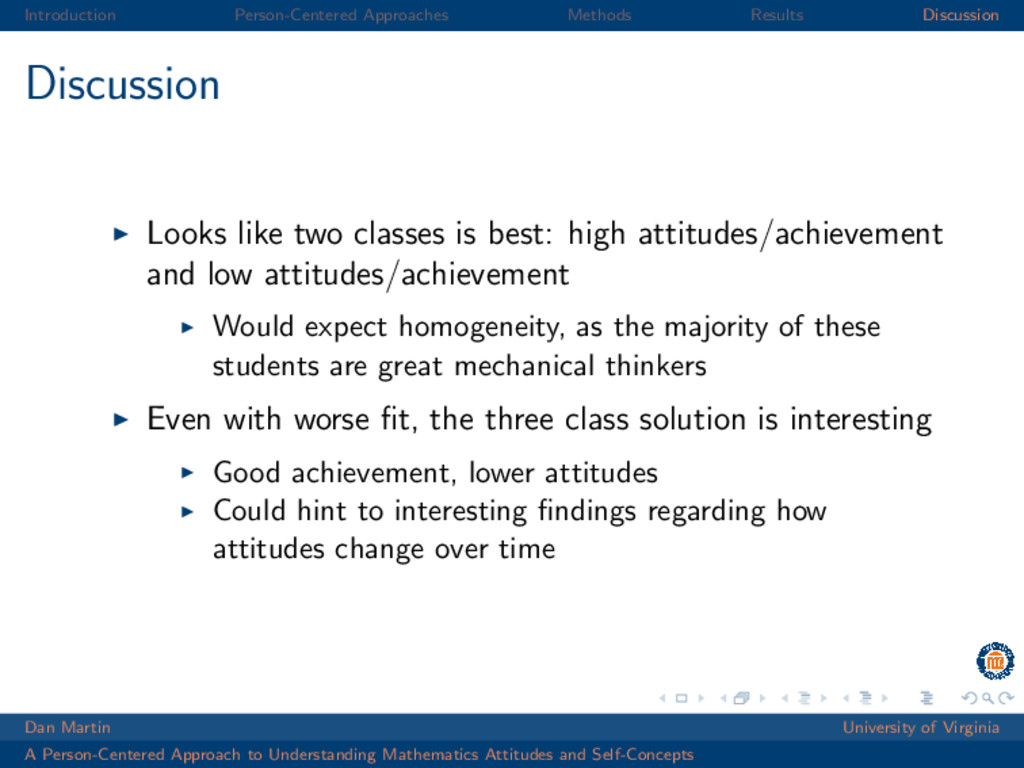
classes is best: high attitudes/achievement and low attitudes/achievement Would expect homogeneity, as the majority of these students are great mechanical thinkers Even with worse fit, the three class solution is interesting Good achievement, lower attitudes Could hint to interesting findings regarding how attitudes change over time Dan Martin University of Virginia A Person-Centered Approach to Understanding Mathematics Attitudes and Self-Concepts
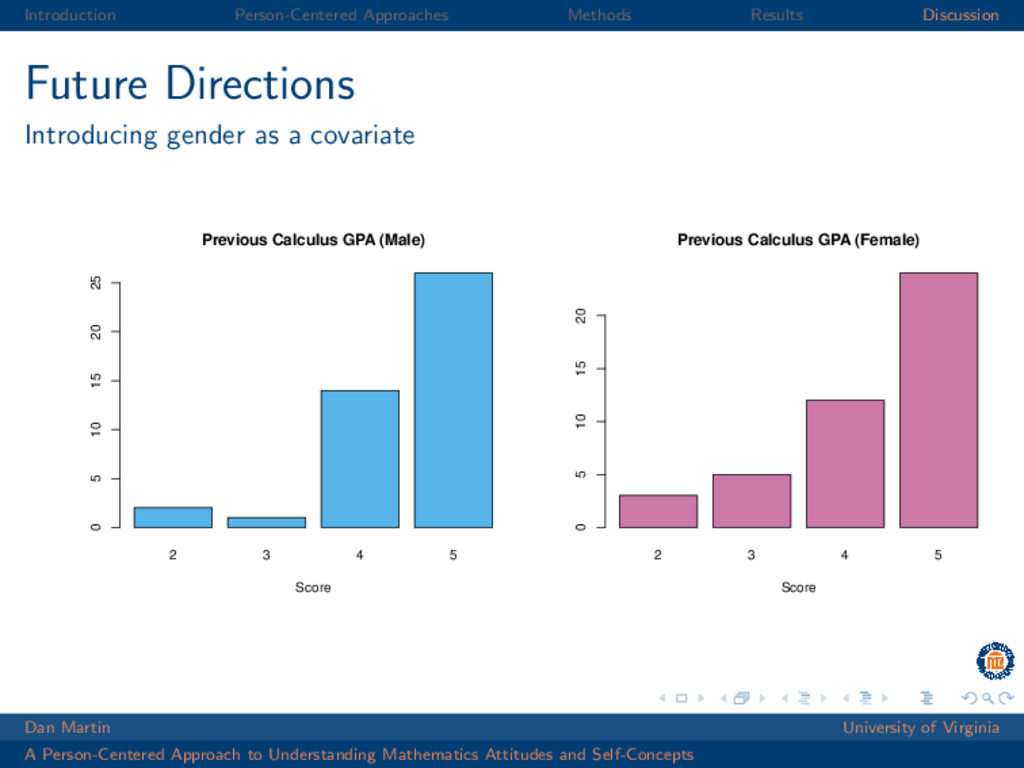
as a covariate 2 3 4 5 Previous Calculus GPA (Male) Score 0 5 10 15 20 25 2 3 4 5 Previous Calculus GPA (Female) Score 0 5 10 15 20 Dan Martin University of Virginia A Person-Centered Approach to Understanding Mathematics Attitudes and Self-Concepts
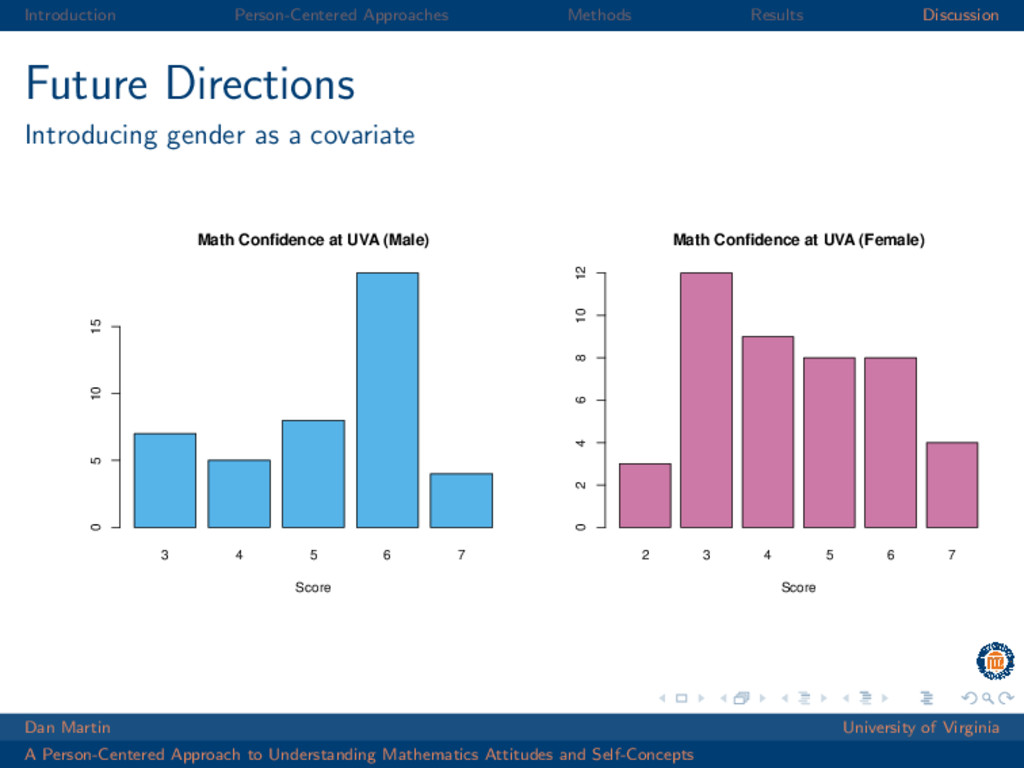
as a covariate 3 4 5 6 7 Math Confidence at UVA (Male) Score 0 5 10 15 2 3 4 5 6 7 Math Confidence at UVA (Female) Score 0 2 4 6 8 10 12 Dan Martin University of Virginia A Person-Centered Approach to Understanding Mathematics Attitudes and Self-Concepts
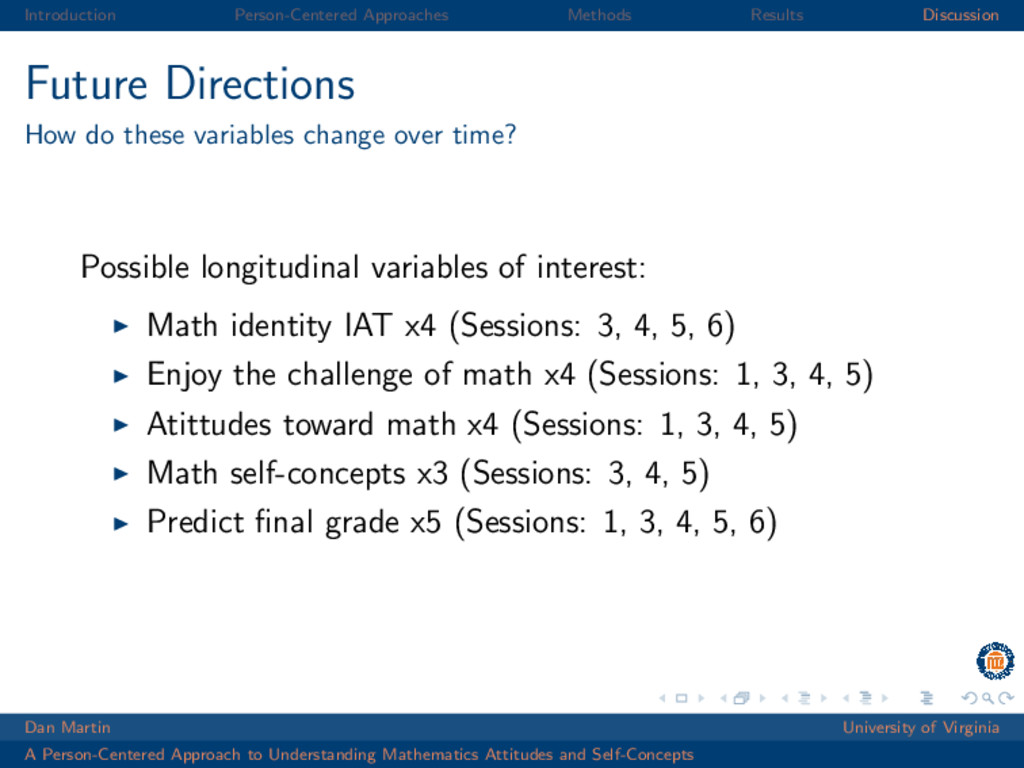
these variables change over time? Possible longitudinal variables of interest: Math identity IAT x4 (Sessions: 3, 4, 5, 6) Enjoy the challenge of math x4 (Sessions: 1, 3, 4, 5) Atittudes toward math x4 (Sessions: 1, 3, 4, 5) Math self-concepts x3 (Sessions: 3, 4, 5) Predict final grade x5 (Sessions: 1, 3, 4, 5, 6) Dan Martin University of Virginia A Person-Centered Approach to Understanding Mathematics Attitudes and Self-Concepts


 dpmartin42
 danielanewman
 lauravandoore
 jakevdp
 matthewcrist
 skipperchong
 jonoalderson
 frankvandijk
 addyosmani
 mayunak
 jct
 axbom
 techseoconnect