Share
Embed
Automate Your World (SFLiveBerlin2013 2013-11-07)
Presentation given at Symfony Live Berlin 2013 in Berlin, Germany.
David Zuelke
November 07, 2013
Transcript
74 slides
-
LOCAL VMS ON DEV BOXES • Awesome, because: • Easy
to manage centrally • Master image, hand out updates • Developers can get up to speed very quickly • Difficult, because: • “I want to use VMware” • “Did you upgrade the machine image?” • “Oh, I think I just forgot to run migrations” -
VAGRANT • Uses “boxes” as base images, provisions them for
you • Supports Virtualbox, VMware, LXC, AWS, ... • Provision using Shell scripts, Puppet, Chef, ... • Vagrantfile is the recipe for what you’ve built • All developers can easily “vagrant up” the same environment -
$ vagrant init precise32 http://files.vagrantup.com/precise32.box $ vagrant up ... $
vagrant ssh ... vagrant@precise32:~$ -
$ vagrant init $ vagrant box add precise64 http://files.vagrantup.com/precise64.box $
vagrant box add precise64 http://files.vagrantup.com/precise64_vmware.box $ vagrant up -‐-‐provider vmware_fusion ... $ vagrant ssh ... vagrant@precise64:~$ exit $ vagrant halt ... $ vagrant up -‐-‐provider virtualbox ... $ vagrant ssh ... vagrant@precise64:~$ -
$ vagrant init $ vagrant box add precise64 http://files.vagrantup.com/precise64.box $
vagrant box add precise64 http://files.vagrantup.com/precise64_vmware.box $ vagrant up -‐-‐provider vmware_fusion ... $ vagrant ssh ... vagrant@precise64:~$ exit $ vagrant halt ... $ vagrant up -‐-‐provider virtualbox -
MULTIPLE VIRTUAL MACHINES • Run several virtual machines at once
doing different things • Like you would in production • Example: two web servers, two database servers, one LB • Mimics production characteristics like firewalls and “latency” • Allows easy testing of distributed behavior • Practical limit is 4-6 VMs -
# -‐*-‐ mode: ruby -‐*-‐ # vi: set ft=ruby :
Vagrant.require_plugin('vagrant-‐hostmanager') Vagrant.require_plugin('vagrant-‐hostsupdater') $box_use = "wheezy" $synced_folder = "../" $box_url = "..." require 'pathname' if !File.exists?("#{$synced_folder}") then puts "There is no '#{$synced_folder}' directory. Check '$synced_folder' setting!" exit 1 end fox_boxes = { :fox01 => { :hostname => "fox01", :ipaddress => "192.168.123.11", :memory => "512" }, # :fox02 => { # :hostname => "fox02", # :ipaddress => "192.168.123.13" # }, } app_boxes = { :app01 => { :hostname => "app01", :ipaddress => "192.168.123.12", :memory => "512" -
Vagrant.configure("2") do |config| config.vm.box = $box_use
config.vm.box_url = $box_url config.vm.synced_folder $synced_folder, "/var/www", :nfs => (RUBY_PLATFORM =~ /linux/ or RUBY_PLATFORM =~ /darwin/) config.vm.provider :virtualbox do |v, override| # shared folders are shitty on virtualbox override.vm.synced_folder $synced_folder, "/var/www", :nfs => (RUBY_PLATFORM =~ /linux/ or RUBY_PLATFORM =~ /darwin/) end config.hostmanager.enabled = true config.hostmanager.manage_host = false config.vm.define "balancer" do |node| node.vm.provider "virtualbox" do |v| v.customize ["modifyvm", :id, "-‐-‐memory", "256"] end node.vm.provider "vmware_fusion" do |v| v.vmx["memsize"] = "256" end node.vm.hostname = 'balancer' node.vm.network :private_network, ip: "192.168.123.10" node.hostmanager.aliases = ["kiveda.dev", "www.kiveda.dev"] node.hostsupdater.aliases = ["kiveda.dev", "www.kiveda.dev"] node.vm.provision :puppet do |puppet| puppet.manifests_path = "../puppet-‐manifests/manifests" puppet.module_path = "../puppet-‐manifests/modules" puppet.manifest_file = "balancer.kiveda.dev.pp" puppet.facter = { "fqdn" => "balancer.kiveda.dev", "co_fqdn" => "balancer.kiveda.dev", "co_nginx_domain" => "www.kiveda.dev", "project_repo_folder" => "fox-‐skeleton" -
fox_boxes.each_pair do |boxname, boxoptions|
config.vm.define boxname do |node| node.vm.provider :virtualbox do |v| v.customize ["modifyvm", :id, "-‐-‐memory", boxoptions[:memory]] unless !boxoptions[:memory] end node.vm.provider :vmware_fusion do |v| v.vmx["memsize"] = boxoptions[:memory] unless !boxoptions[:memory] end node.vm.hostname = boxname.to_s node.vm.network :private_network, ip: boxoptions[:ipaddress] node.hostsupdater.aliases = [boxname.to_s+".kiveda.dev"] node.vm.provision :puppet do |puppet| puppet.manifests_path = "../puppet-‐manifests/manifests" puppet.module_path = "../puppet-‐manifests/modules" puppet.manifest_file = boxname.to_s+".kiveda.dev.pp" puppet.facter = { "fqdn" => boxname.to_s+".kiveda.dev", "co_fqdn" => boxname.to_s+".kiveda.dev", "co_nginx_domain" => "www.kiveda.dev", "project_repo_folder" => "fox-‐skeleton" } puppet.options = [ '-‐-‐verbose', '-‐-‐debug' ] end end end app_boxes.each_pair do |boxname, boxoptions| config.vm.define boxname do |node| node.vm.provider :virtualbox do |v| v.customize ["modifyvm", :id, "-‐-‐memory", boxoptions[:memory]] -
app_boxes.each_pair do |boxname, boxoptions|
config.vm.define boxname do |node| node.vm.provider :virtualbox do |v| v.customize ["modifyvm", :id, "-‐-‐memory", boxoptions[:memory]] unless !boxoptions[:memory] end node.vm.provider :vmware_fusion do |v| v.vmx["memsize"] = boxoptions[:memory] unless !boxoptions[:memory] end node.vm.hostname = boxname.to_s if(boxname == :app01) node.hostsupdater.aliases = [boxname.to_s+".kiveda.dev", "master.kiveda.dev"] else node.hostsupdater.aliases = [boxname.to_s+".kiveda.dev"] end node.vm.network :private_network, ip: boxoptions[:ipaddress] node.hostsupdater.aliases = [boxname.to_s+".kiveda.dev"] node.vm.provision :puppet do |puppet| puppet.manifests_path = "../puppet-‐manifests/manifests" puppet.module_path = "../puppet-‐manifests/modules" puppet.manifest_file = boxname.to_s+".kiveda.dev.pp" puppet.facter = { "fqdn" => boxname.to_s+".kiveda.dev", "co_fqdn" => boxname.to_s+".kiveda.dev", "co_apache_domain" => "www.kiveda.dev", "project_repo_folder" => "fox-‐skeleton" } puppet.options = [ '-‐-‐verbose', '-‐-‐debug' ] end end end -
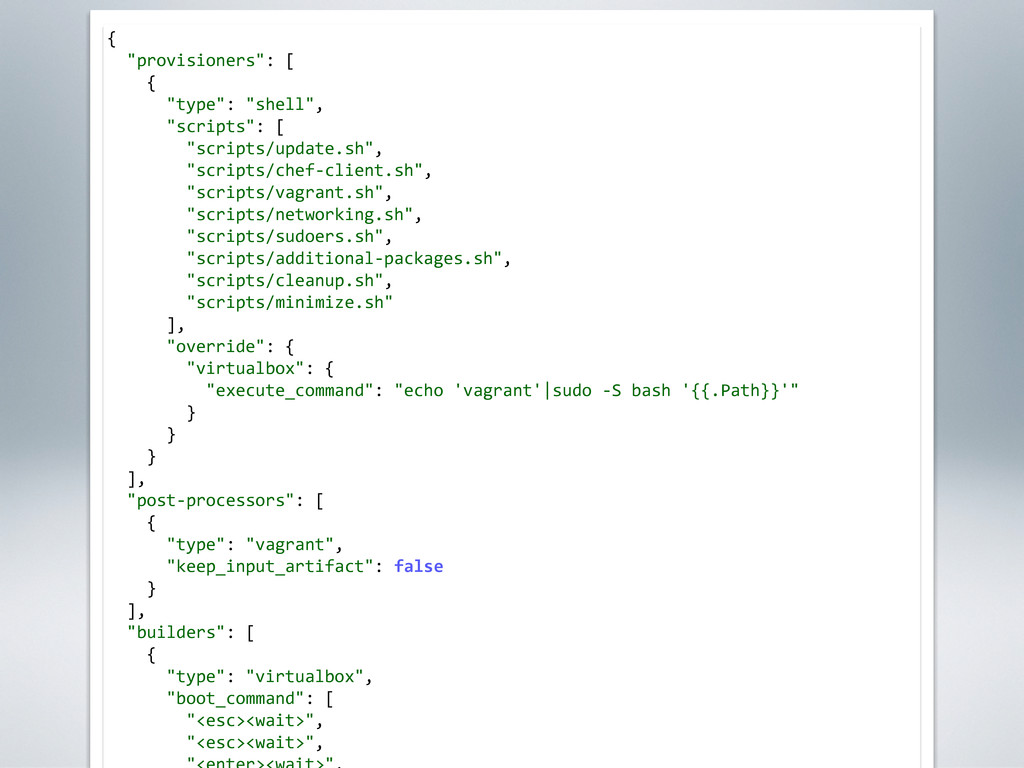
{ "provisioners": [ {
"type": "shell", "scripts": [ "scripts/update.sh", "scripts/chef-‐client.sh", "scripts/vagrant.sh", "scripts/networking.sh", "scripts/sudoers.sh", "scripts/additional-‐packages.sh", "scripts/cleanup.sh", "scripts/minimize.sh" ], "override": { "virtualbox": { "execute_command": "echo 'vagrant'|sudo -‐S bash '{{.Path}}'" } } } ], "post-‐processors": [ { "type": "vagrant", "keep_input_artifact": false } ], "builders": [ { "type": "virtualbox", "boot_command": [ "<esc><wait>", "<esc><wait>", -
" fb=false<wait>",
" initrd=/install/initrd.gz<wait>", " kbd-‐chooser/method=us<wait>", " keyboard-‐configuration/layout=USA<wait>", " keyboard-‐configuration/variant=USA<wait>", " locale=en_US<wait>", " netcfg/get_domain=vm<wait>", " netcfg/get_hostname=vagrant<wait>", " noapic<wait>", " preseed/url=http://{{ .HTTPIP }}:{{ .HTTPPort }}/preseed.cfg<wait>", " -‐-‐ <wait>", "<enter><wait>" ], "boot_wait": "10s", "disk_size": 40960, "guest_os_type": "Ubuntu_64", "http_directory": "http", "iso_checksum": "2cbe868812a871242cdcdd8f2fd6feb9", "iso_checksum_type": "md5", "iso_url": "file:///Users/fh/isos/ubuntu-‐12.04.3-‐server-‐amd64.iso", "ssh_username": "vagrant", "ssh_password": "vagrant", "ssh_port": 22, "ssh_wait_timeout": "10000s", "shutdown_command": "echo 'shutdown -‐P now' > shutdown.sh; echo 'vagrant'| sudo -‐S sh 'shutdown.sh'", "guest_additions_path": "VBoxGuestAdditions_{{.Version}}.iso", "virtualbox_version_file": ".vbox_version", "vboxmanage": [ [ "modifyvm", "{{.Name}}", "-‐-‐memory", "384" ],