Upgrade to Pro — share decks privately, control downloads, hide ads and more …

XAU/USD Trading Mastery: The Ultimate Guide to ...

Sponsored · Ship Features Fearlessly Turn features on and off without deploys. Used by thousands of Ruby developers. →
Avatar for Dvrlansf Dvrlansf
November 22, 2025

XAU/USD Trading Mastery: The Ultimate Guide to Gold Trading Strategies, Analysis, and Risk Management in Forex

XAU/USD Trading Mastery: The Ultimate Guide to Gold Trading Strategies, Analysis, and Risk Management in Forex

Discover the most comprehensive guide to mastering XAU/USD trading in 2024! This 17-page ultimate gold Forex trading manual reveals proven strategies, advanced analysis techniques, and professional risk management systems that actually work in today's volatile markets. If you're serious about profiting from gold price movements, this exhaustive guide provides everything you need to transform from beginner to expert trader.

📈 COMPLETE XAU/USD TRADING BLUEPRINT INCLUDES:

FOUNDATIONAL MASTERY:
• Gold's unique role as commodity, currency, AND safe-haven asset
• XAU/USD contract specifications, lot sizes, and margin requirements
• Advanced volatility analysis using Average True Range (ATR)
• Optimal trading sessions: Asian, London, and New York session strategies
• ECN vs Market Maker brokers - which is better for gold trading?

FUNDAMENTAL ANALYSIS EXPERTISE:
• Federal Reserve policy impact on gold prices - complete 2024 analysis
• Real yields calculation and why it's the most powerful gold indicator
• Geopolitical risk premium and trading global crises
• Central bank gold accumulation trends and de-dollarization impact
• ESG factors affecting gold mining supply and production costs
• Bitcoin vs Gold: Detailed comparison and correlation analysis

TECHNICAL ANALYSIS MASTERY:
• Multi-timeframe analysis framework for precise entries
• Advanced candlestick patterns in high-volatility environments
• Market Structure Breakdown (MSB) for early reversal signals
• Optimal moving average configurations for XAU/USD
• RSI, MACD, and Stochastic divergence trading strategies
• Fibonacci retracement and extension techniques
• Ichimoku Cloud analysis for comprehensive market insight

PROFESSIONAL TRADING SYSTEMS:
• London Open Breakout Strategy - step-by-step implementation
• New York News Spike Fade/Continuation tactics
• Fundamental-Technical Confluence Strategy for swing trading
• Seasonal pattern analysis and calendar effects
• Trend continuation systems using 200-period moving average
• Advanced scalping with order flow and market depth analysis

RISK MANAGEMENT EXCELLENCE:
• Professional position sizing methods (Fixed Fractional vs Kelly Criterion)
• Dynamic stop-loss strategies using ATR and structural levels
• Portfolio correlation hedging techniques
• Drawdown control and recovery protocols
• Trading psychology mastery for high-volatility emotions

🎯 BONUS EXPERT SECTIONS:
• Algorithmic trading and Expert Advisor implementation
• Gold tokenization and blockchain technology impact
• Central Bank Digital Currencies (CBDCs) and gold implications
• Complete trading plan template with actionable worksheets
• Advanced terminology glossary for professional traders

🔥 UPDATED 2024 MARKET ANALYSIS:
This isn't just theoretical knowledge - it's battle-tested strategies refined through the 2023-2024 Gold Super-Cycle. Learn how gold defied traditional correlations and broke all-time highs despite Fed rate hikes. Understand the new market dynamics that will dominate gold trading through 2025.

🚀 TRANSFORM YOUR TRADING RESULTS:
Whether you're a beginner seeking a solid foundation or an experienced trader wanting advanced strategies, this guide provides the complete framework for consistent profitability. Stop guessing and start executing with confidence using professional-grade trading systems.

📊 PROVEN METHODOLOGIES:
Every strategy includes real case studies, practical examples, and actionable checklists. From daily trading routines to comprehensive risk management, this guide leaves no stone unturned in your journey to XAU/USD mastery.

💡 WHY THIS GUIDE IS DIFFERENT:
While other resources offer generic advice, this guide provides specific, actionable strategies tailored specifically to XAU/USD's unique characteristics. The high volatility, 24/5 market hours, and complex fundamental drivers require specialized approaches - and this guide delivers exactly that.

🎁 SPECIAL BONUS:
Includes exclusive access to advanced Expert Advisor technologies that can automate these strategies for 24/5 trading operation. Learn how to eliminate emotional trading and execute with institutional-grade precision.

Avatar for Dvrlansf

Dvrlansf

November 22, 2025

Other Decks in Technology

Transcript

  1. XAU/USD Trading Mastery: The Ultimate Guide to Gold Trading Strategies,

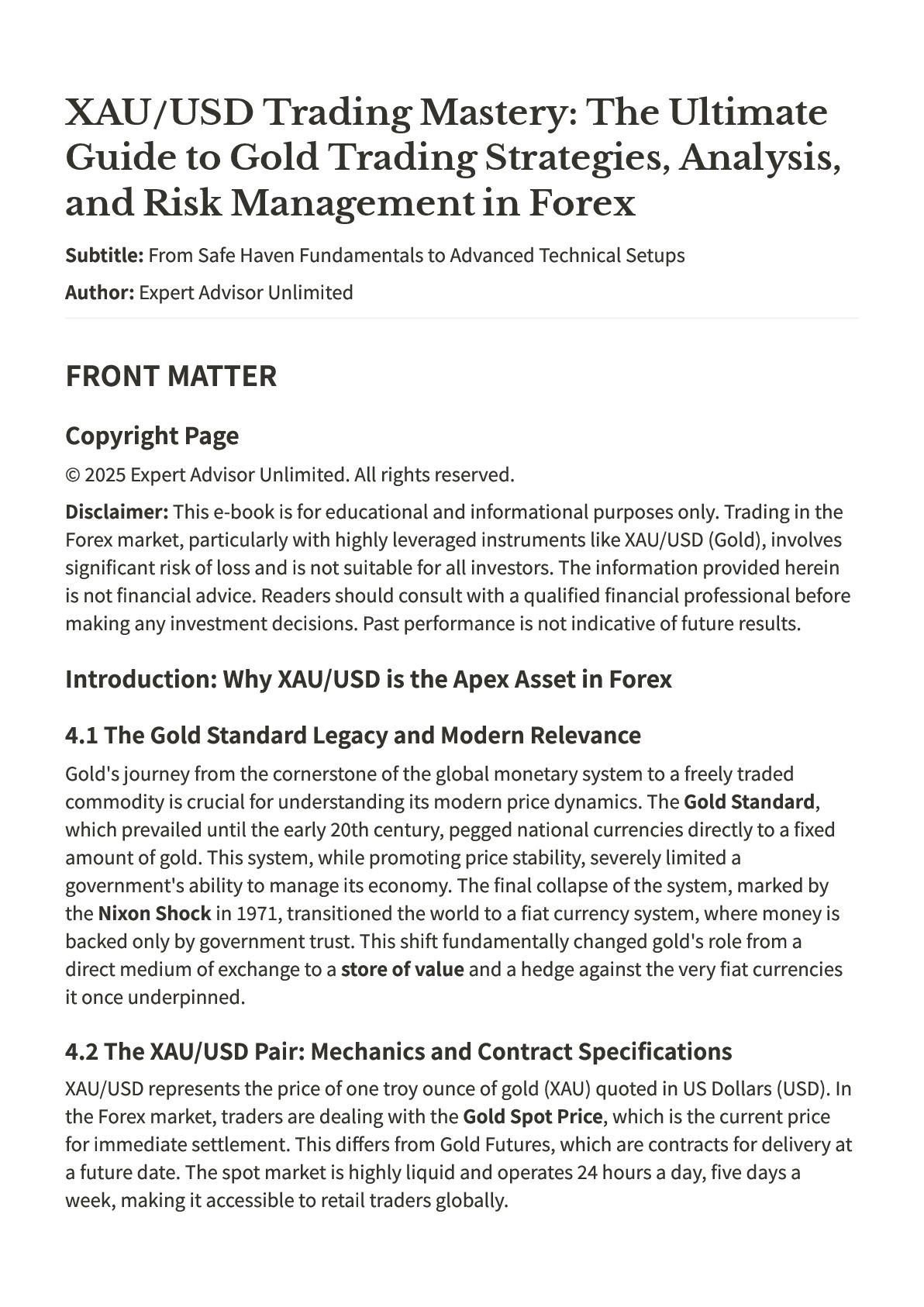
    Analysis, and Risk Management in Forex Subtitle: From Safe Haven Fundamentals to Advanced Technical Setups Author: Expert Advisor Unlimited FRONT MATTER Copyright Page © 2025 Expert Advisor Unlimited. All rights reserved. Disclaimer: This e-book is for educational and informational purposes only. Trading in the Forex market, particularly with highly leveraged instruments like XAU/USD (Gold), involves significant risk of loss and is not suitable for all investors. The information provided herein is not financial advice. Readers should consult with a qualified financial professional before making any investment decisions. Past performance is not indicative of future results. Introduction: Why XAU/USD is the Apex Asset in Forex 4.1 The Gold Standard Legacy and Modern Relevance Gold's journey from the cornerstone of the global monetary system to a freely traded commodity is crucial for understanding its modern price dynamics. The Gold Standard, which prevailed until the early 20th century, pegged national currencies directly to a fixed amount of gold. This system, while promoting price stability, severely limited a government's ability to manage its economy. The final collapse of the system, marked by the Nixon Shock in 1971, transitioned the world to a fiat currency system, where money is backed only by government trust. This shift fundamentally changed gold's role from a direct medium of exchange to a store of value and a hedge against the very fiat currencies it once underpinned. 4.2 The XAU/USD Pair: Mechanics and Contract Specifications XAU/USD represents the price of one troy ounce of gold (XAU) quoted in US Dollars (USD). In the Forex market, traders are dealing with the Gold Spot Price, which is the current price for immediate settlement. This differs from Gold Futures, which are contracts for delivery at a future date. The spot market is highly liquid and operates 24 hours a day, five days a week, making it accessible to retail traders globally.
  2. 4.3 The Dual Nature of Gold: Commodity vs. Currency vs.

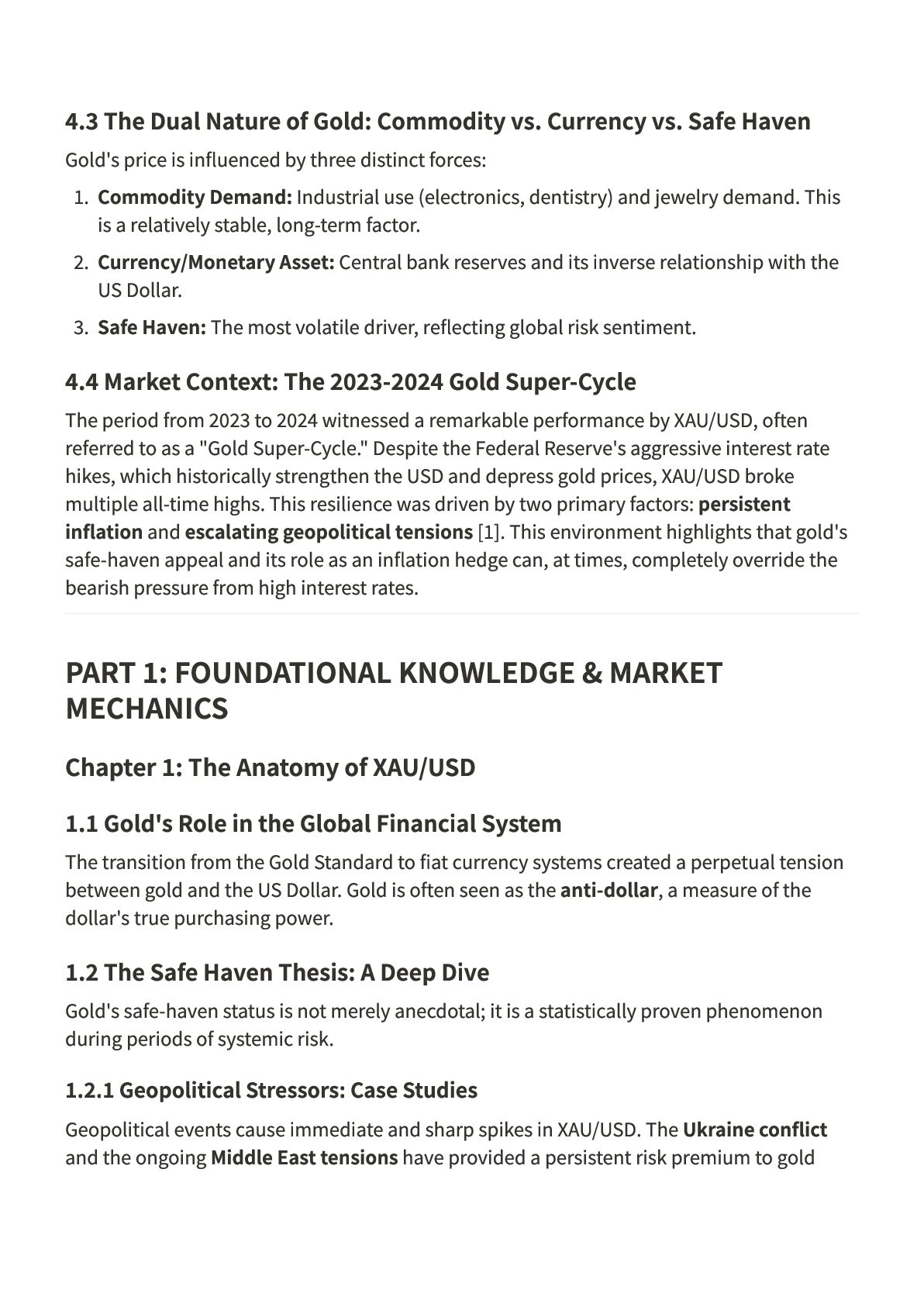
    Safe Haven Gold's price is influenced by three distinct forces: 1. Commodity Demand: Industrial use (electronics, dentistry) and jewelry demand. This is a relatively stable, long-term factor. 2. Currency/Monetary Asset: Central bank reserves and its inverse relationship with the US Dollar. 3. Safe Haven: The most volatile driver, reflecting global risk sentiment. 4.4 Market Context: The 2023-2024 Gold Super-Cycle The period from 2023 to 2024 witnessed a remarkable performance by XAU/USD, often referred to as a "Gold Super-Cycle." Despite the Federal Reserve's aggressive interest rate hikes, which historically strengthen the USD and depress gold prices, XAU/USD broke multiple all-time highs. This resilience was driven by two primary factors: persistent inflation and escalating geopolitical tensions [1]. This environment highlights that gold's safe-haven appeal and its role as an inflation hedge can, at times, completely override the bearish pressure from high interest rates. PART 1: FOUNDATIONAL KNOWLEDGE & MARKET MECHANICS Chapter 1: The Anatomy of XAU/USD 1.1 Gold's Role in the Global Financial System The transition from the Gold Standard to fiat currency systems created a perpetual tension between gold and the US Dollar. Gold is often seen as the anti-dollar, a measure of the dollar's true purchasing power. 1.2 The Safe Haven Thesis: A Deep Dive Gold's safe-haven status is not merely anecdotal; it is a statistically proven phenomenon during periods of systemic risk. 1.2.1 Geopolitical Stressors: Case Studies Geopolitical events cause immediate and sharp spikes in XAU/USD. The Ukraine conflict and the ongoing Middle East tensions have provided a persistent risk premium to gold
  3. prices since 2022. Traders must monitor geopolitical hotspots, as any

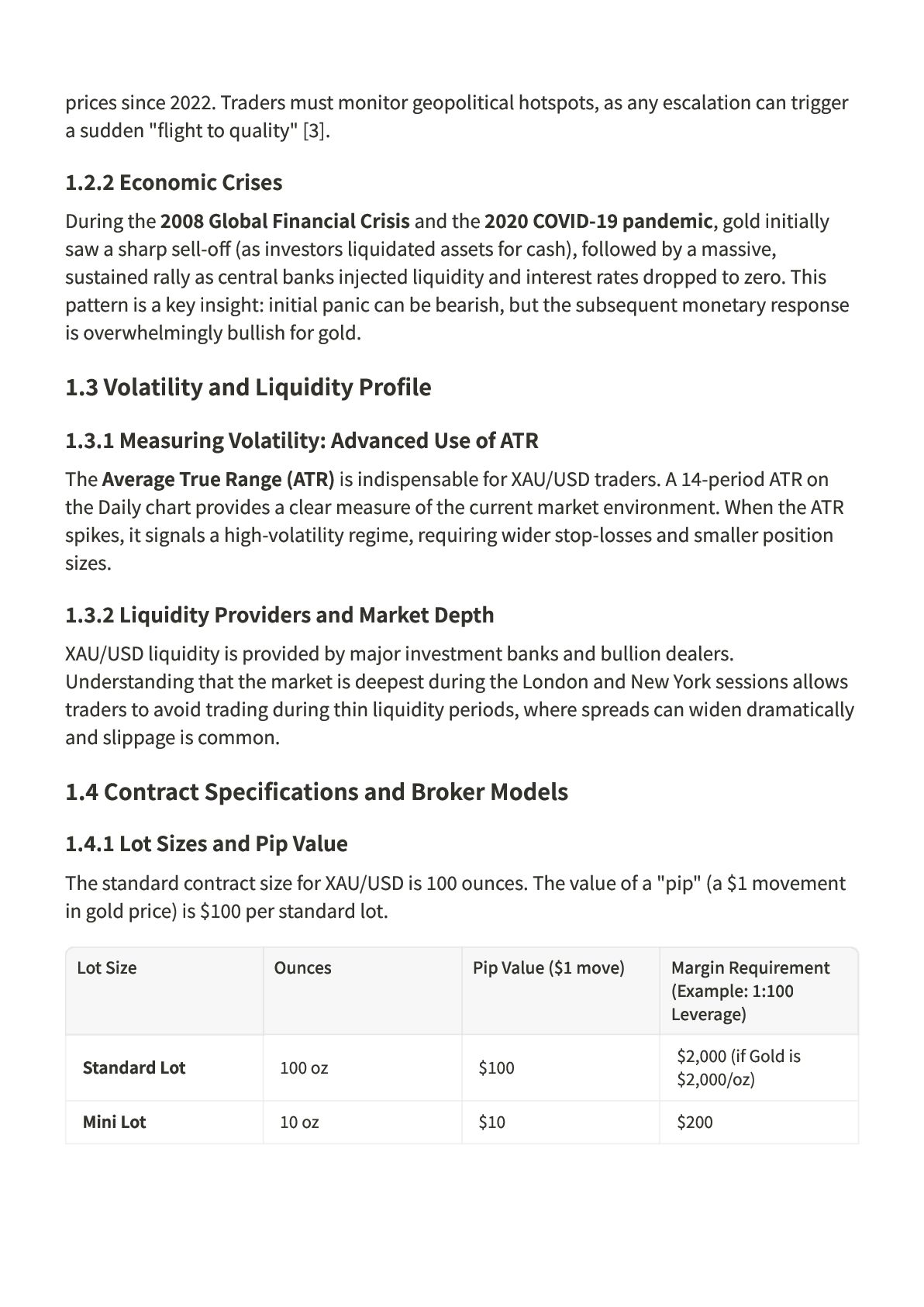
    escalation can trigger a sudden "flight to quality" [3]. 1.2.2 Economic Crises During the 2008 Global Financial Crisis and the 2020 COVID-19 pandemic, gold initially saw a sharp sell-off (as investors liquidated assets for cash), followed by a massive, sustained rally as central banks injected liquidity and interest rates dropped to zero. This pattern is a key insight: initial panic can be bearish, but the subsequent monetary response is overwhelmingly bullish for gold. 1.3 Volatility and Liquidity Profile 1.3.1 Measuring Volatility: Advanced Use of ATR The Average True Range (ATR) is indispensable for XAU/USD traders. A 14-period ATR on the Daily chart provides a clear measure of the current market environment. When the ATR spikes, it signals a high-volatility regime, requiring wider stop-losses and smaller position sizes. 1.3.2 Liquidity Providers and Market Depth XAU/USD liquidity is provided by major investment banks and bullion dealers. Understanding that the market is deepest during the London and New York sessions allows traders to avoid trading during thin liquidity periods, where spreads can widen dramatically and slippage is common. 1.4 Contract Specifications and Broker Models 1.4.1 Lot Sizes and Pip Value The standard contract size for XAU/USD is 100 ounces. The value of a "pip" (a $1 movement in gold price) is $100 per standard lot. Lot Size Ounces Pip Value ($1 move) Margin Requirement (Example: 1:100 Leverage) Standard Lot 100 oz $100 $2,000 (if Gold is $2,000/oz) Mini Lot 10 oz $10 $200
  4. Micro Lot 1 oz $1 $20 1.4.2 ECN vs. Market

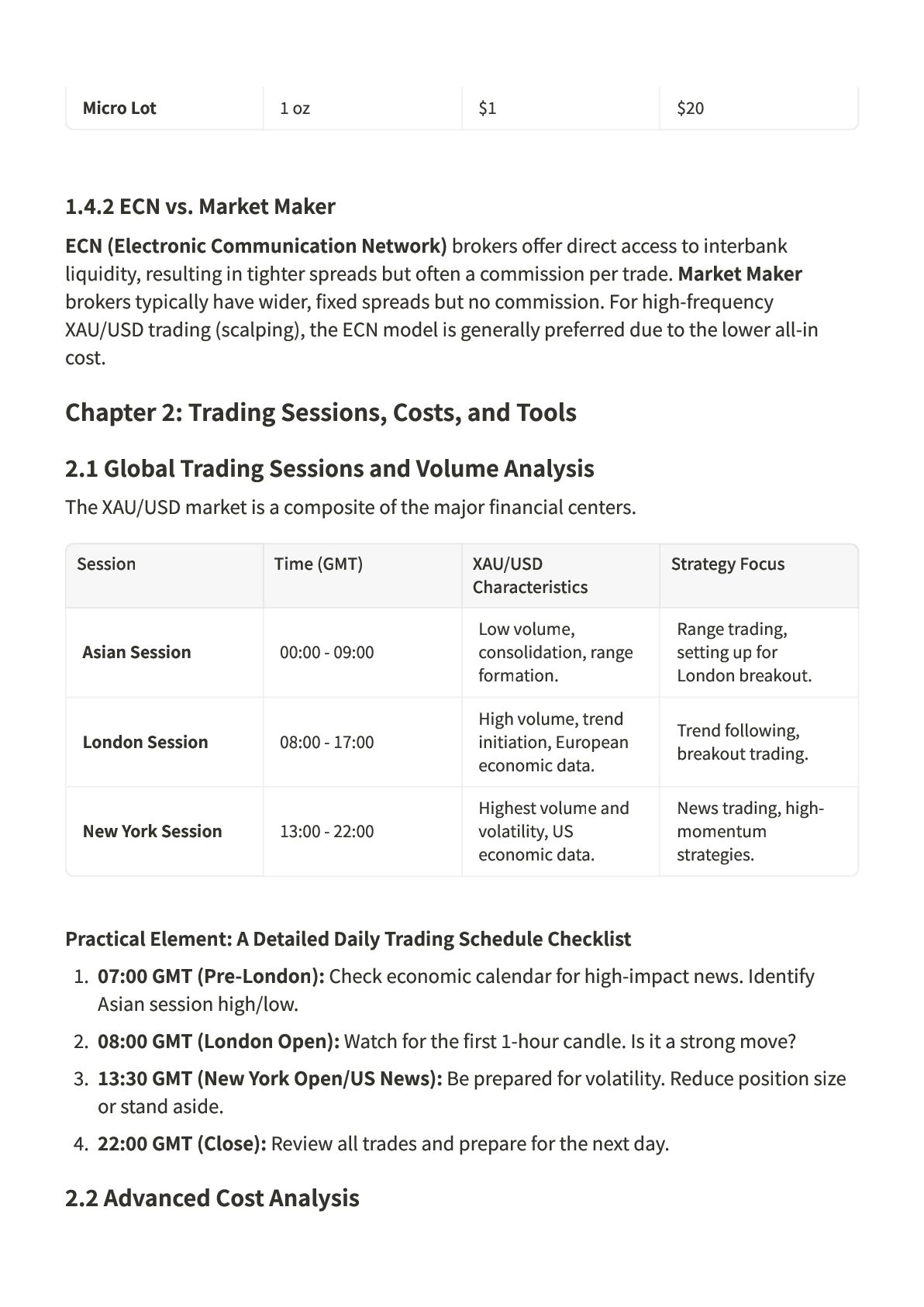
    Maker ECN (Electronic Communication Network) brokers offer direct access to interbank liquidity, resulting in tighter spreads but often a commission per trade. Market Maker brokers typically have wider, fixed spreads but no commission. For high-frequency XAU/USD trading (scalping), the ECN model is generally preferred due to the lower all-in cost. Chapter 2: Trading Sessions, Costs, and Tools 2.1 Global Trading Sessions and Volume Analysis The XAU/USD market is a composite of the major financial centers. Session Time (GMT) XAU/USD Characteristics Strategy Focus Asian Session 00:00 - 09:00 Low volume, consolidation, range formation. Range trading, setting up for London breakout. London Session 08:00 - 17:00 High volume, trend initiation, European economic data. Trend following, breakout trading. New York Session 13:00 - 22:00 Highest volume and volatility, US economic data. News trading, high- momentum strategies. Practical Element: A Detailed Daily Trading Schedule Checklist 1. 07:00 GMT (Pre-London): Check economic calendar for high-impact news. Identify Asian session high/low. 2. 08:00 GMT (London Open): Watch for the first 1-hour candle. Is it a strong move? 3. 13:30 GMT (New York Open/US News): Be prepared for volatility. Reduce position size or stand aside. 4. 22:00 GMT (Close): Review all trades and prepare for the next day. 2.2 Advanced Cost Analysis
  5. 2.2.2 Swap/Rollover Costs Holding XAU/USD positions overnight incurs a swap

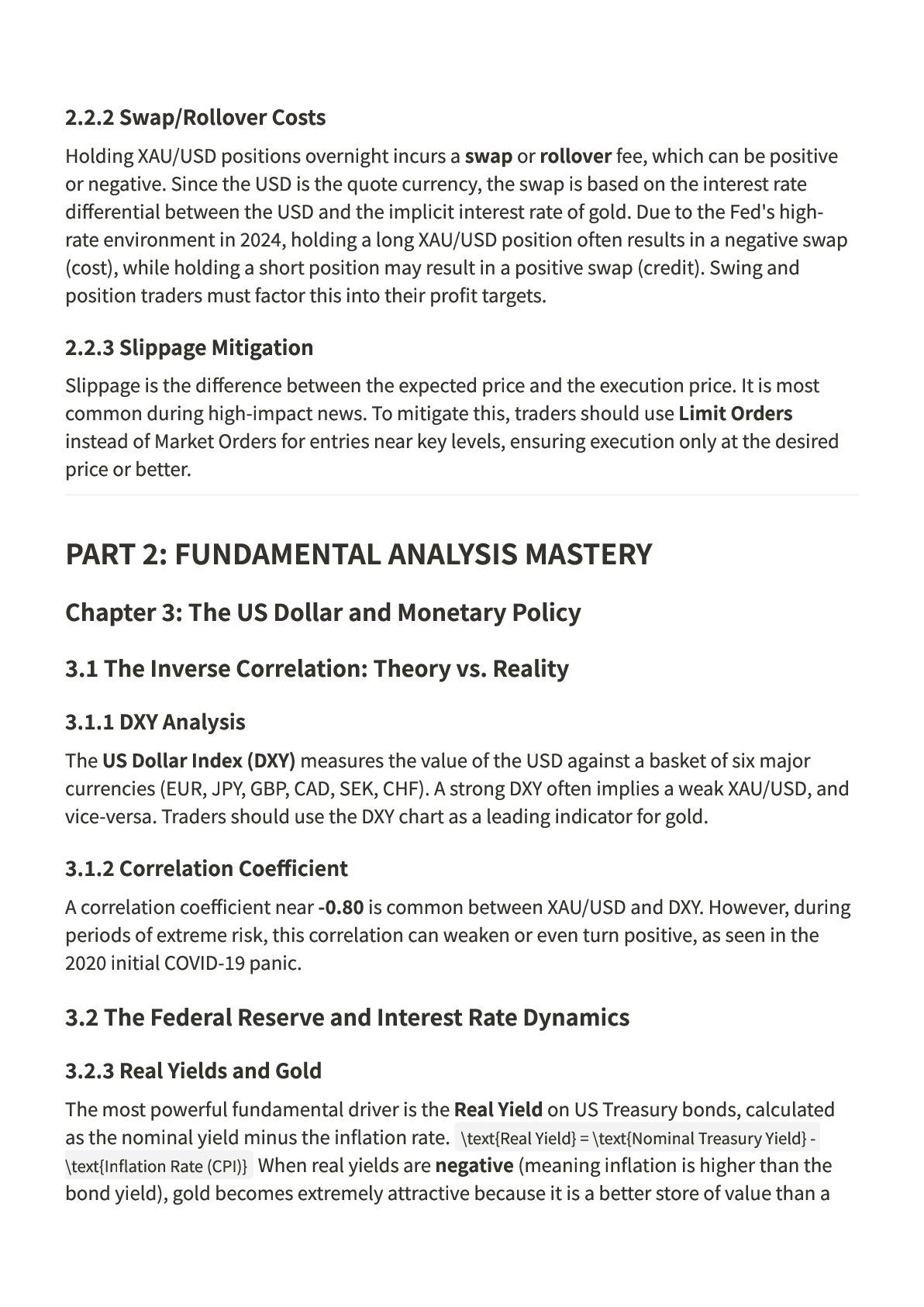
    or rollover fee, which can be positive or negative. Since the USD is the quote currency, the swap is based on the interest rate differential between the USD and the implicit interest rate of gold. Due to the Fed's high- rate environment in 2024, holding a long XAU/USD position often results in a negative swap (cost), while holding a short position may result in a positive swap (credit). Swing and position traders must factor this into their profit targets. 2.2.3 Slippage Mitigation Slippage is the difference between the expected price and the execution price. It is most common during high-impact news. To mitigate this, traders should use Limit Orders instead of Market Orders for entries near key levels, ensuring execution only at the desired price or better. PART 2: FUNDAMENTAL ANALYSIS MASTERY Chapter 3: The US Dollar and Monetary Policy 3.1 The Inverse Correlation: Theory vs. Reality 3.1.1 DXY Analysis The US Dollar Index (DXY) measures the value of the USD against a basket of six major currencies (EUR, JPY, GBP, CAD, SEK, CHF). A strong DXY often implies a weak XAU/USD, and vice-versa. Traders should use the DXY chart as a leading indicator for gold. 3.1.2 Correlation Coefficient A correlation coefficient near -0.80 is common between XAU/USD and DXY. However, during periods of extreme risk, this correlation can weaken or even turn positive, as seen in the 2020 initial COVID-19 panic. 3.2 The Federal Reserve and Interest Rate Dynamics 3.2.3 Real Yields and Gold The most powerful fundamental driver is the Real Yield on US Treasury bonds, calculated as the nominal yield minus the inflation rate. \text{Real Yield} = \text{Nominal Treasury Yield} - \text{Inflation Rate (CPI)} When real yields are negative (meaning inflation is higher than the bond yield), gold becomes extremely attractive because it is a better store of value than a
  6. bond that is losing purchasing power. When real yields are

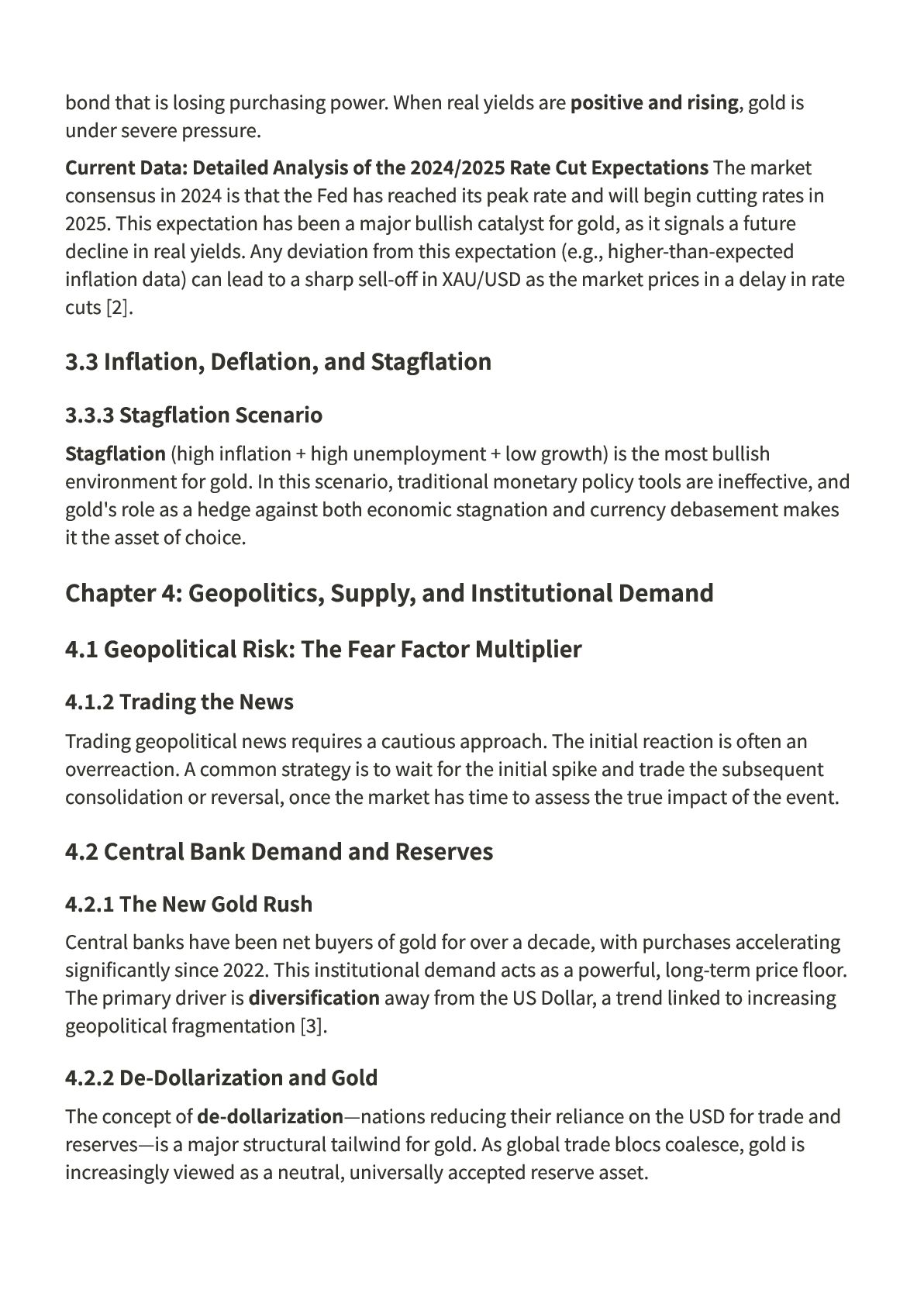
    positive and rising, gold is under severe pressure. Current Data: Detailed Analysis of the 2024/2025 Rate Cut Expectations The market consensus in 2024 is that the Fed has reached its peak rate and will begin cutting rates in 2025. This expectation has been a major bullish catalyst for gold, as it signals a future decline in real yields. Any deviation from this expectation (e.g., higher-than-expected inflation data) can lead to a sharp sell-off in XAU/USD as the market prices in a delay in rate cuts [2]. 3.3 Inflation, Deflation, and Stagflation 3.3.3 Stagflation Scenario Stagflation (high inflation + high unemployment + low growth) is the most bullish environment for gold. In this scenario, traditional monetary policy tools are ineffective, and gold's role as a hedge against both economic stagnation and currency debasement makes it the asset of choice. Chapter 4: Geopolitics, Supply, and Institutional Demand 4.1 Geopolitical Risk: The Fear Factor Multiplier 4.1.2 Trading the News Trading geopolitical news requires a cautious approach. The initial reaction is often an overreaction. A common strategy is to wait for the initial spike and trade the subsequent consolidation or reversal, once the market has time to assess the true impact of the event. 4.2 Central Bank Demand and Reserves 4.2.1 The New Gold Rush Central banks have been net buyers of gold for over a decade, with purchases accelerating significantly since 2022. This institutional demand acts as a powerful, long-term price floor. The primary driver is diversification away from the US Dollar, a trend linked to increasing geopolitical fragmentation [3]. 4.2.2 De-Dollarization and Gold The concept of de-dollarization—nations reducing their reliance on the USD for trade and reserves—is a major structural tailwind for gold. As global trade blocs coalesce, gold is increasingly viewed as a neutral, universally accepted reserve asset.
  7. 4.3 Supply Dynamics and ESG Factors 4.3.2 Environmental, Social, and

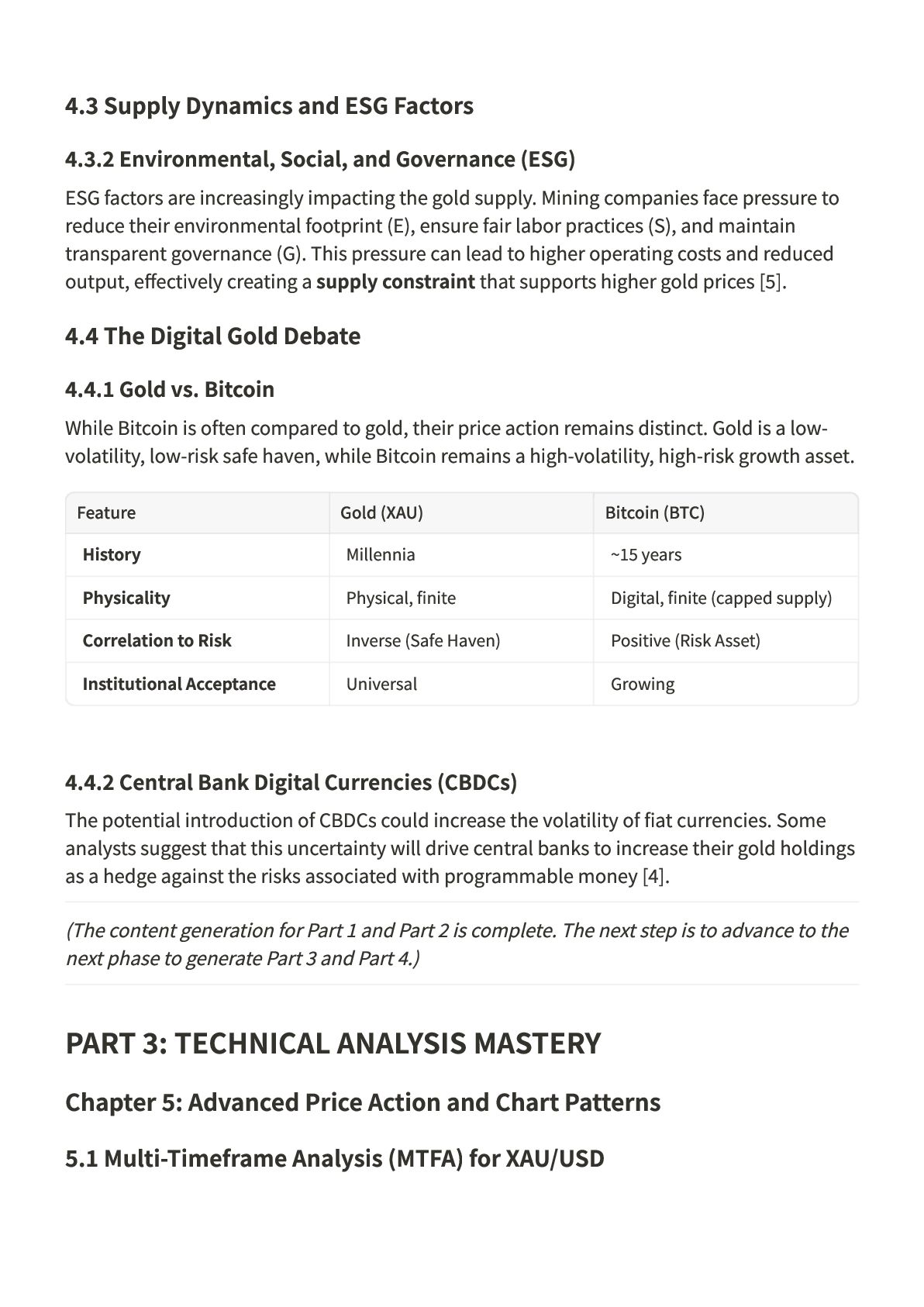
    Governance (ESG) ESG factors are increasingly impacting the gold supply. Mining companies face pressure to reduce their environmental footprint (E), ensure fair labor practices (S), and maintain transparent governance (G). This pressure can lead to higher operating costs and reduced output, effectively creating a supply constraint that supports higher gold prices [5]. 4.4 The Digital Gold Debate 4.4.1 Gold vs. Bitcoin While Bitcoin is often compared to gold, their price action remains distinct. Gold is a low- volatility, low-risk safe haven, while Bitcoin remains a high-volatility, high-risk growth asset. Feature Gold (XAU) Bitcoin (BTC) History Millennia ~15 years Physicality Physical, finite Digital, finite (capped supply) Correlation to Risk Inverse (Safe Haven) Positive (Risk Asset) Institutional Acceptance Universal Growing 4.4.2 Central Bank Digital Currencies (CBDCs) The potential introduction of CBDCs could increase the volatility of fiat currencies. Some analysts suggest that this uncertainty will drive central banks to increase their gold holdings as a hedge against the risks associated with programmable money [4]. (The content generation for Part 1 and Part 2 is complete. The next step is to advance to the next phase to generate Part 3 and Part 4.) PART 3: TECHNICAL ANALYSIS MASTERY Chapter 5: Advanced Price Action and Chart Patterns 5.1 Multi-Timeframe Analysis (MTFA) for XAU/USD
  8. MTFA is not just looking at multiple charts; it is

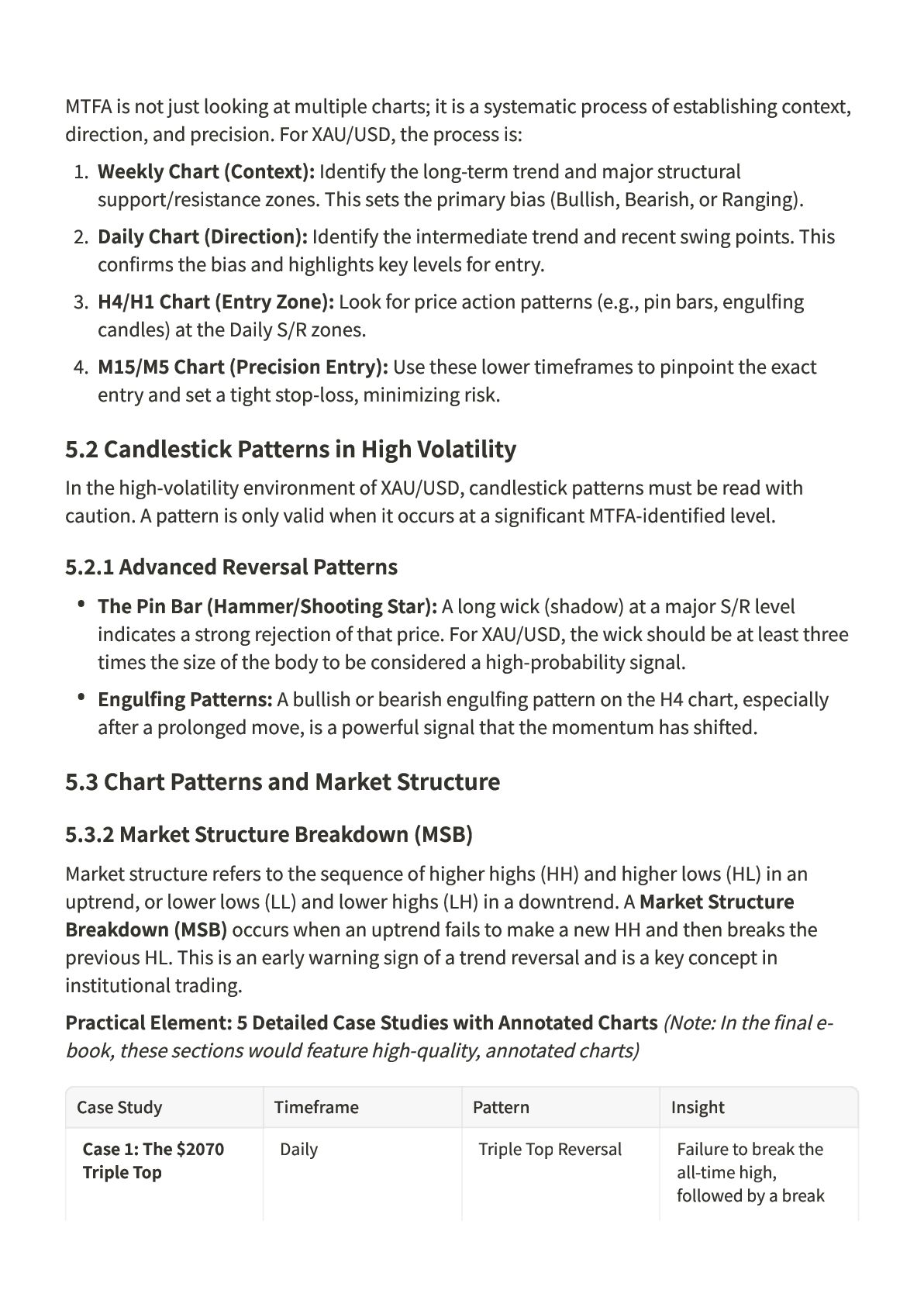
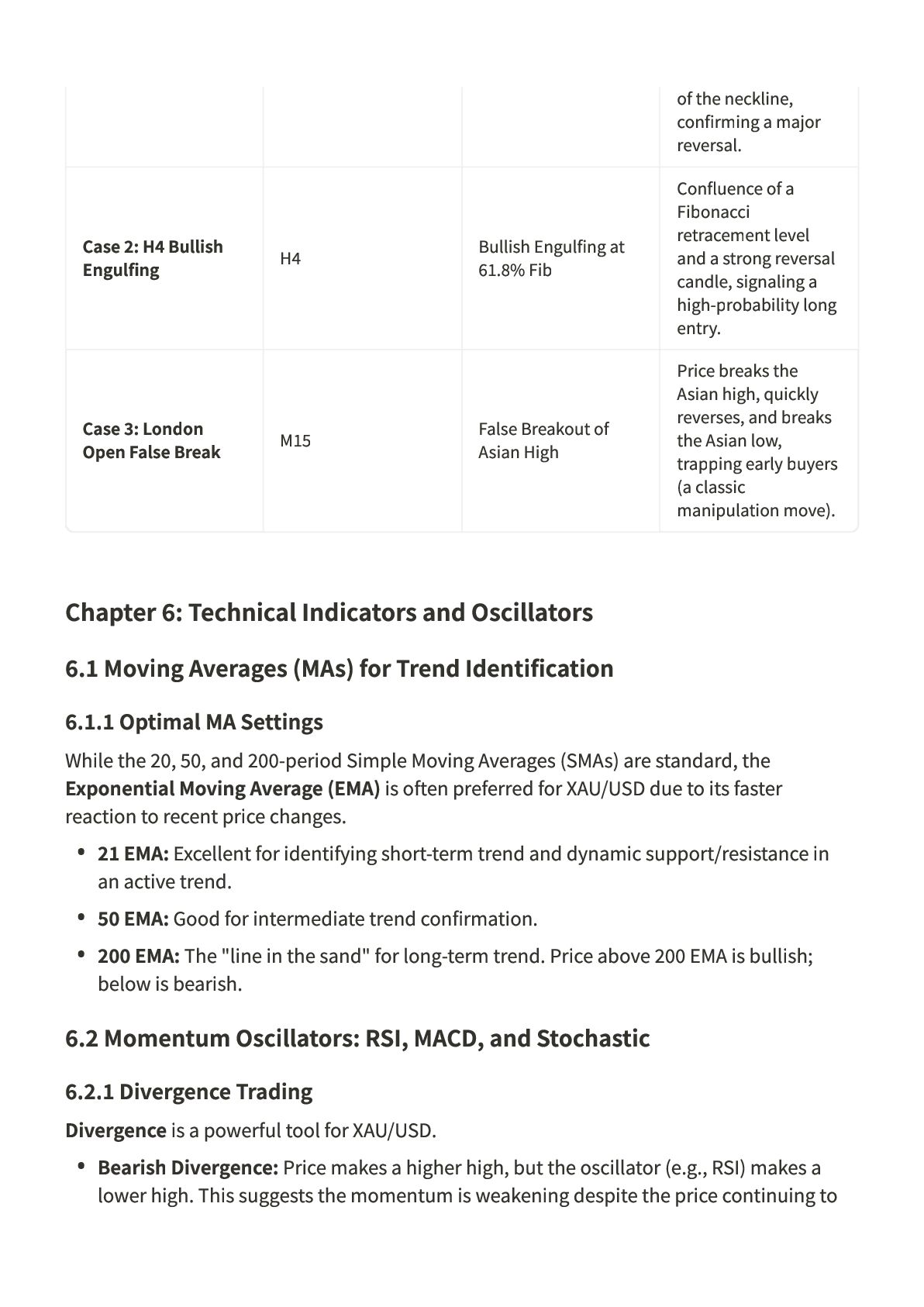
    a systematic process of establishing context, direction, and precision. For XAU/USD, the process is: 1. Weekly Chart (Context): Identify the long-term trend and major structural support/resistance zones. This sets the primary bias (Bullish, Bearish, or Ranging). 2. Daily Chart (Direction): Identify the intermediate trend and recent swing points. This confirms the bias and highlights key levels for entry. 3. H4/H1 Chart (Entry Zone): Look for price action patterns (e.g., pin bars, engulfing candles) at the Daily S/R zones. 4. M15/M5 Chart (Precision Entry): Use these lower timeframes to pinpoint the exact entry and set a tight stop-loss, minimizing risk. 5.2 Candlestick Patterns in High Volatility In the high-volatility environment of XAU/USD, candlestick patterns must be read with caution. A pattern is only valid when it occurs at a significant MTFA-identified level. 5.2.1 Advanced Reversal Patterns • The Pin Bar (Hammer/Shooting Star): A long wick (shadow) at a major S/R level indicates a strong rejection of that price. For XAU/USD, the wick should be at least three times the size of the body to be considered a high-probability signal. • Engulfing Patterns: A bullish or bearish engulfing pattern on the H4 chart, especially after a prolonged move, is a powerful signal that the momentum has shifted. 5.3 Chart Patterns and Market Structure 5.3.2 Market Structure Breakdown (MSB) Market structure refers to the sequence of higher highs (HH) and higher lows (HL) in an uptrend, or lower lows (LL) and lower highs (LH) in a downtrend. A Market Structure Breakdown (MSB) occurs when an uptrend fails to make a new HH and then breaks the previous HL. This is an early warning sign of a trend reversal and is a key concept in institutional trading. Practical Element: 5 Detailed Case Studies with Annotated Charts (Note: In the final e- book, these sections would feature high-quality, annotated charts) Case Study Timeframe Pattern Insight Case 1: The $2070 Triple Top Daily Triple Top Reversal Failure to break the all-time high, followed by a break
  9. of the neckline, confirming a major reversal. Case 2: H4

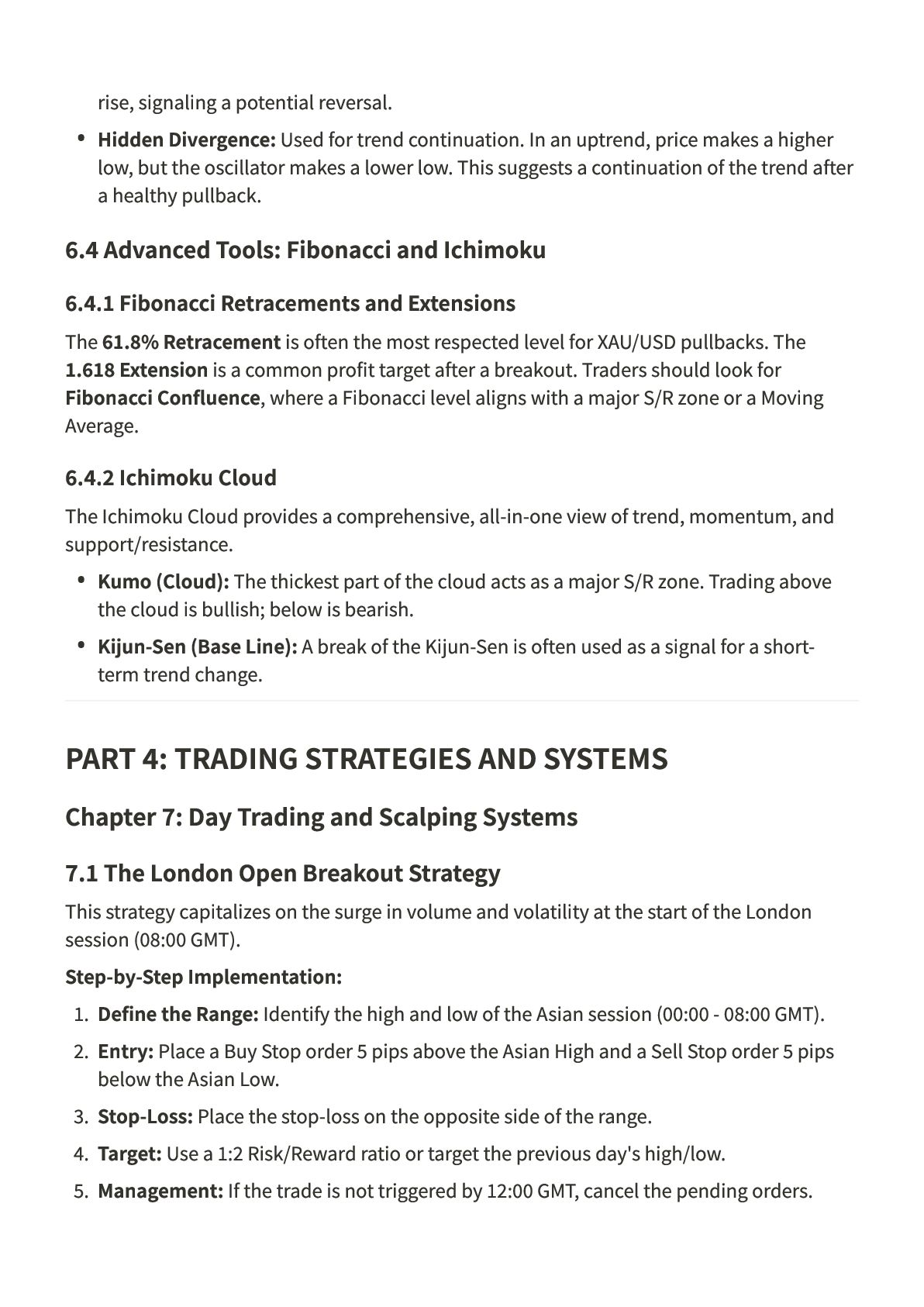
    Bullish Engulfing H4 Bullish Engulfing at 61.8% Fib Confluence of a Fibonacci retracement level and a strong reversal candle, signaling a high-probability long entry. Case 3: London Open False Break M15 False Breakout of Asian High Price breaks the Asian high, quickly reverses, and breaks the Asian low, trapping early buyers (a classic manipulation move). Chapter 6: Technical Indicators and Oscillators 6.1 Moving Averages (MAs) for Trend Identification 6.1.1 Optimal MA Settings While the 20, 50, and 200-period Simple Moving Averages (SMAs) are standard, the Exponential Moving Average (EMA) is often preferred for XAU/USD due to its faster reaction to recent price changes. • 21 EMA: Excellent for identifying short-term trend and dynamic support/resistance in an active trend. • 50 EMA: Good for intermediate trend confirmation. • 200 EMA: The "line in the sand" for long-term trend. Price above 200 EMA is bullish; below is bearish. 6.2 Momentum Oscillators: RSI, MACD, and Stochastic 6.2.1 Divergence Trading Divergence is a powerful tool for XAU/USD. • Bearish Divergence: Price makes a higher high, but the oscillator (e.g., RSI) makes a lower high. This suggests the momentum is weakening despite the price continuing to
  10. rise, signaling a potential reversal. • Hidden Divergence: Used for

    trend continuation. In an uptrend, price makes a higher low, but the oscillator makes a lower low. This suggests a continuation of the trend after a healthy pullback. 6.4 Advanced Tools: Fibonacci and Ichimoku 6.4.1 Fibonacci Retracements and Extensions The 61.8% Retracement is often the most respected level for XAU/USD pullbacks. The 1.618 Extension is a common profit target after a breakout. Traders should look for Fibonacci Confluence, where a Fibonacci level aligns with a major S/R zone or a Moving Average. 6.4.2 Ichimoku Cloud The Ichimoku Cloud provides a comprehensive, all-in-one view of trend, momentum, and support/resistance. • Kumo (Cloud): The thickest part of the cloud acts as a major S/R zone. Trading above the cloud is bullish; below is bearish. • Kijun-Sen (Base Line): A break of the Kijun-Sen is often used as a signal for a short- term trend change. PART 4: TRADING STRATEGIES AND SYSTEMS Chapter 7: Day Trading and Scalping Systems 7.1 The London Open Breakout Strategy This strategy capitalizes on the surge in volume and volatility at the start of the London session (08:00 GMT). Step-by-Step Implementation: 1. Define the Range: Identify the high and low of the Asian session (00:00 - 08:00 GMT). 2. Entry: Place a Buy Stop order 5 pips above the Asian High and a Sell Stop order 5 pips below the Asian Low. 3. Stop-Loss: Place the stop-loss on the opposite side of the range. 4. Target: Use a 1:2 Risk/Reward ratio or target the previous day's high/low. 5. Management: If the trade is not triggered by 12:00 GMT, cancel the pending orders.
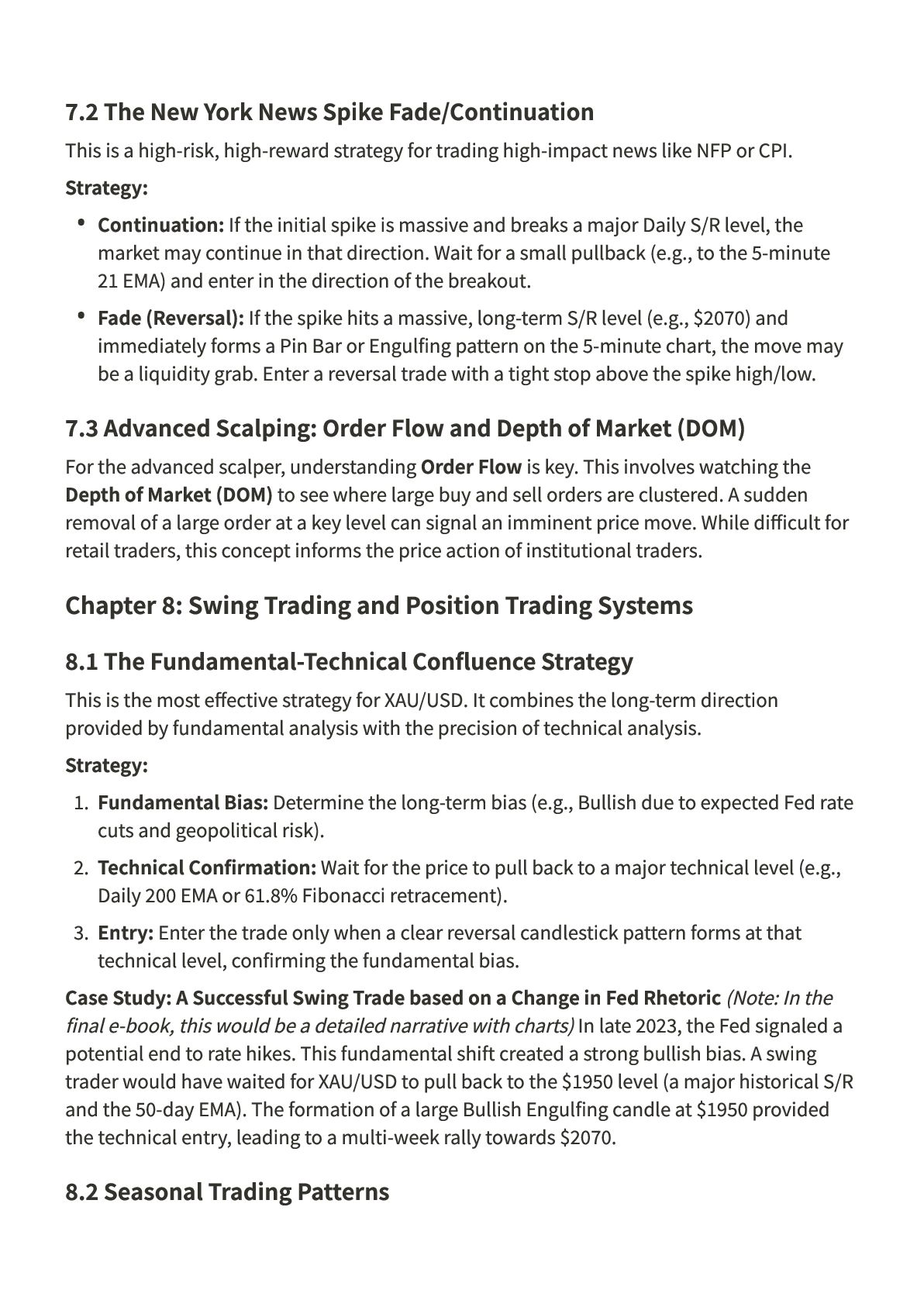
  11. 7.2 The New York News Spike Fade/Continuation This is a

    high-risk, high-reward strategy for trading high-impact news like NFP or CPI. Strategy: • Continuation: If the initial spike is massive and breaks a major Daily S/R level, the market may continue in that direction. Wait for a small pullback (e.g., to the 5-minute 21 EMA) and enter in the direction of the breakout. • Fade (Reversal): If the spike hits a massive, long-term S/R level (e.g., $2070) and immediately forms a Pin Bar or Engulfing pattern on the 5-minute chart, the move may be a liquidity grab. Enter a reversal trade with a tight stop above the spike high/low. 7.3 Advanced Scalping: Order Flow and Depth of Market (DOM) For the advanced scalper, understanding Order Flow is key. This involves watching the Depth of Market (DOM) to see where large buy and sell orders are clustered. A sudden removal of a large order at a key level can signal an imminent price move. While difficult for retail traders, this concept informs the price action of institutional traders. Chapter 8: Swing Trading and Position Trading Systems 8.1 The Fundamental-Technical Confluence Strategy This is the most effective strategy for XAU/USD. It combines the long-term direction provided by fundamental analysis with the precision of technical analysis. Strategy: 1. Fundamental Bias: Determine the long-term bias (e.g., Bullish due to expected Fed rate cuts and geopolitical risk). 2. Technical Confirmation: Wait for the price to pull back to a major technical level (e.g., Daily 200 EMA or 61.8% Fibonacci retracement). 3. Entry: Enter the trade only when a clear reversal candlestick pattern forms at that technical level, confirming the fundamental bias. Case Study: A Successful Swing Trade based on a Change in Fed Rhetoric (Note: In the final e-book, this would be a detailed narrative with charts) In late 2023, the Fed signaled a potential end to rate hikes. This fundamental shift created a strong bullish bias. A swing trader would have waited for XAU/USD to pull back to the $1950 level (a major historical S/R and the 50-day EMA). The formation of a large Bullish Engulfing candle at $1950 provided the technical entry, leading to a multi-week rally towards $2070. 8.2 Seasonal Trading Patterns
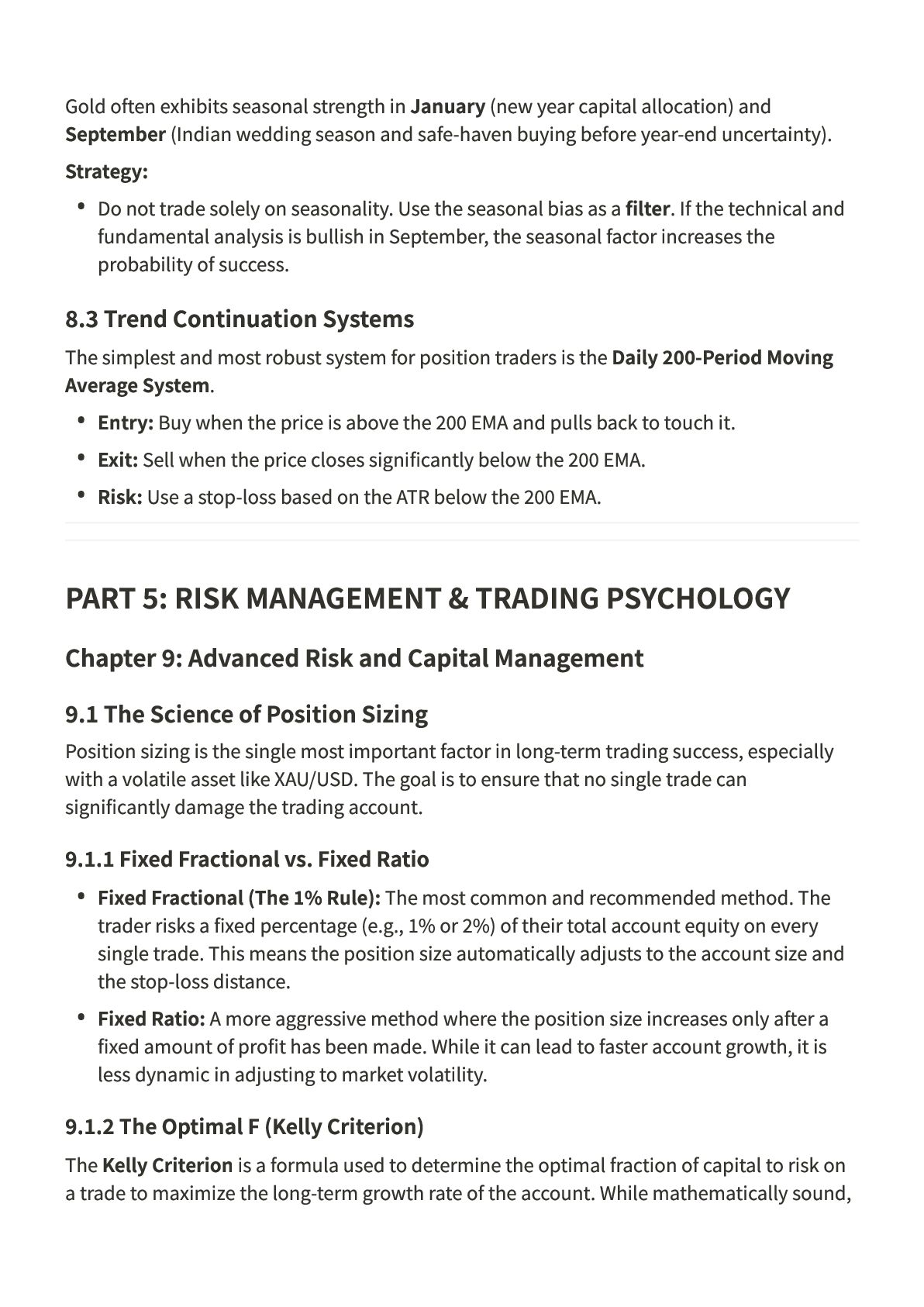
  12. Gold often exhibits seasonal strength in January (new year capital

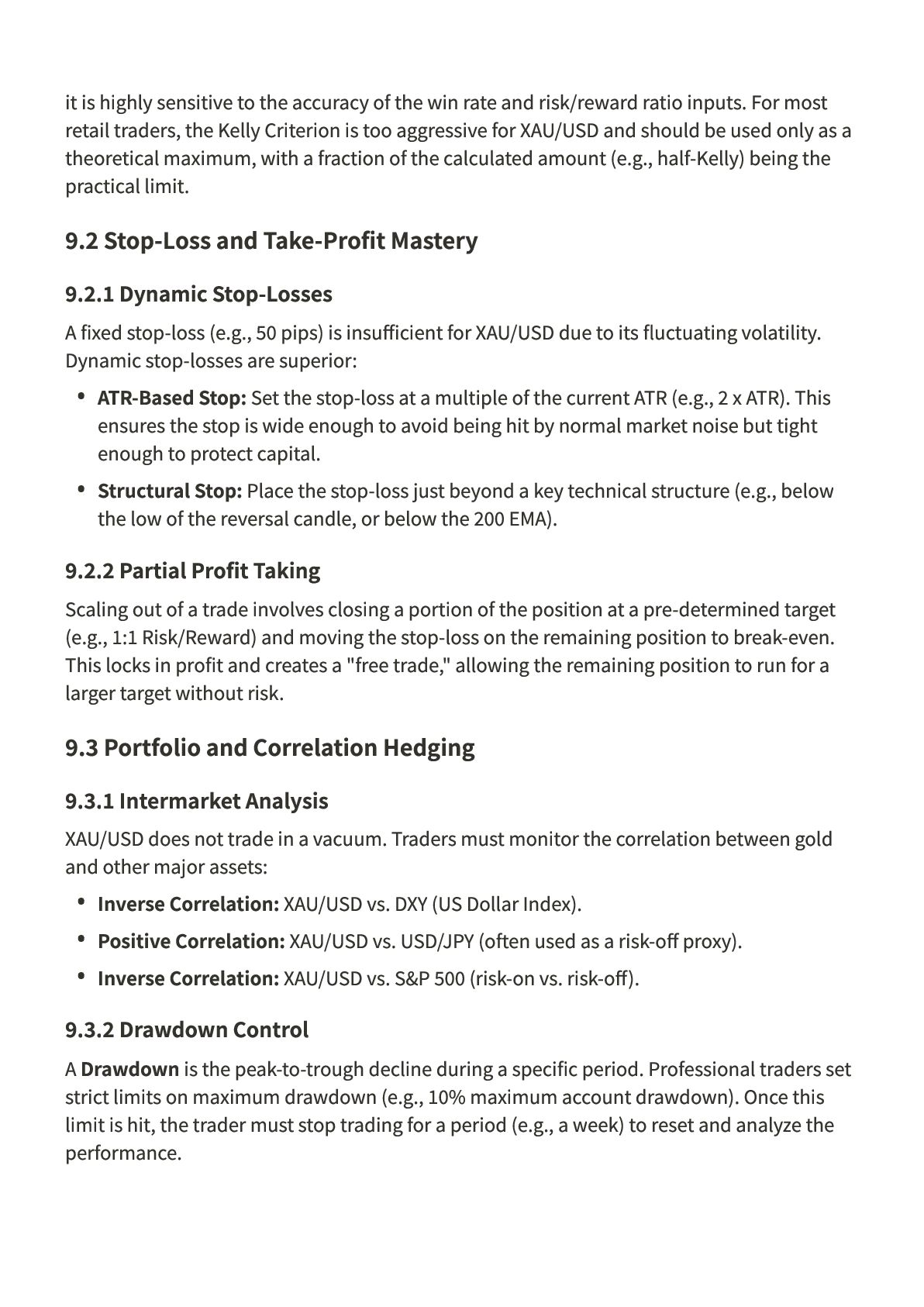
    allocation) and September (Indian wedding season and safe-haven buying before year-end uncertainty). Strategy: • Do not trade solely on seasonality. Use the seasonal bias as a filter. If the technical and fundamental analysis is bullish in September, the seasonal factor increases the probability of success. 8.3 Trend Continuation Systems The simplest and most robust system for position traders is the Daily 200-Period Moving Average System. • Entry: Buy when the price is above the 200 EMA and pulls back to touch it. • Exit: Sell when the price closes significantly below the 200 EMA. • Risk: Use a stop-loss based on the ATR below the 200 EMA. PART 5: RISK MANAGEMENT & TRADING PSYCHOLOGY Chapter 9: Advanced Risk and Capital Management 9.1 The Science of Position Sizing Position sizing is the single most important factor in long-term trading success, especially with a volatile asset like XAU/USD. The goal is to ensure that no single trade can significantly damage the trading account. 9.1.1 Fixed Fractional vs. Fixed Ratio • Fixed Fractional (The 1% Rule): The most common and recommended method. The trader risks a fixed percentage (e.g., 1% or 2%) of their total account equity on every single trade. This means the position size automatically adjusts to the account size and the stop-loss distance. • Fixed Ratio: A more aggressive method where the position size increases only after a fixed amount of profit has been made. While it can lead to faster account growth, it is less dynamic in adjusting to market volatility. 9.1.2 The Optimal F (Kelly Criterion) The Kelly Criterion is a formula used to determine the optimal fraction of capital to risk on a trade to maximize the long-term growth rate of the account. While mathematically sound,
  13. it is highly sensitive to the accuracy of the win

    rate and risk/reward ratio inputs. For most retail traders, the Kelly Criterion is too aggressive for XAU/USD and should be used only as a theoretical maximum, with a fraction of the calculated amount (e.g., half-Kelly) being the practical limit. 9.2 Stop-Loss and Take-Profit Mastery 9.2.1 Dynamic Stop-Losses A fixed stop-loss (e.g., 50 pips) is insufficient for XAU/USD due to its fluctuating volatility. Dynamic stop-losses are superior: • ATR-Based Stop: Set the stop-loss at a multiple of the current ATR (e.g., 2 x ATR). This ensures the stop is wide enough to avoid being hit by normal market noise but tight enough to protect capital. • Structural Stop: Place the stop-loss just beyond a key technical structure (e.g., below the low of the reversal candle, or below the 200 EMA). 9.2.2 Partial Profit Taking Scaling out of a trade involves closing a portion of the position at a pre-determined target (e.g., 1:1 Risk/Reward) and moving the stop-loss on the remaining position to break-even. This locks in profit and creates a "free trade," allowing the remaining position to run for a larger target without risk. 9.3 Portfolio and Correlation Hedging 9.3.1 Intermarket Analysis XAU/USD does not trade in a vacuum. Traders must monitor the correlation between gold and other major assets: • Inverse Correlation: XAU/USD vs. DXY (US Dollar Index). • Positive Correlation: XAU/USD vs. USD/JPY (often used as a risk-off proxy). • Inverse Correlation: XAU/USD vs. S&P 500 (risk-on vs. risk-off). 9.3.2 Drawdown Control A Drawdown is the peak-to-trough decline during a specific period. Professional traders set strict limits on maximum drawdown (e.g., 10% maximum account drawdown). Once this limit is hit, the trader must stop trading for a period (e.g., a week) to reset and analyze the performance.
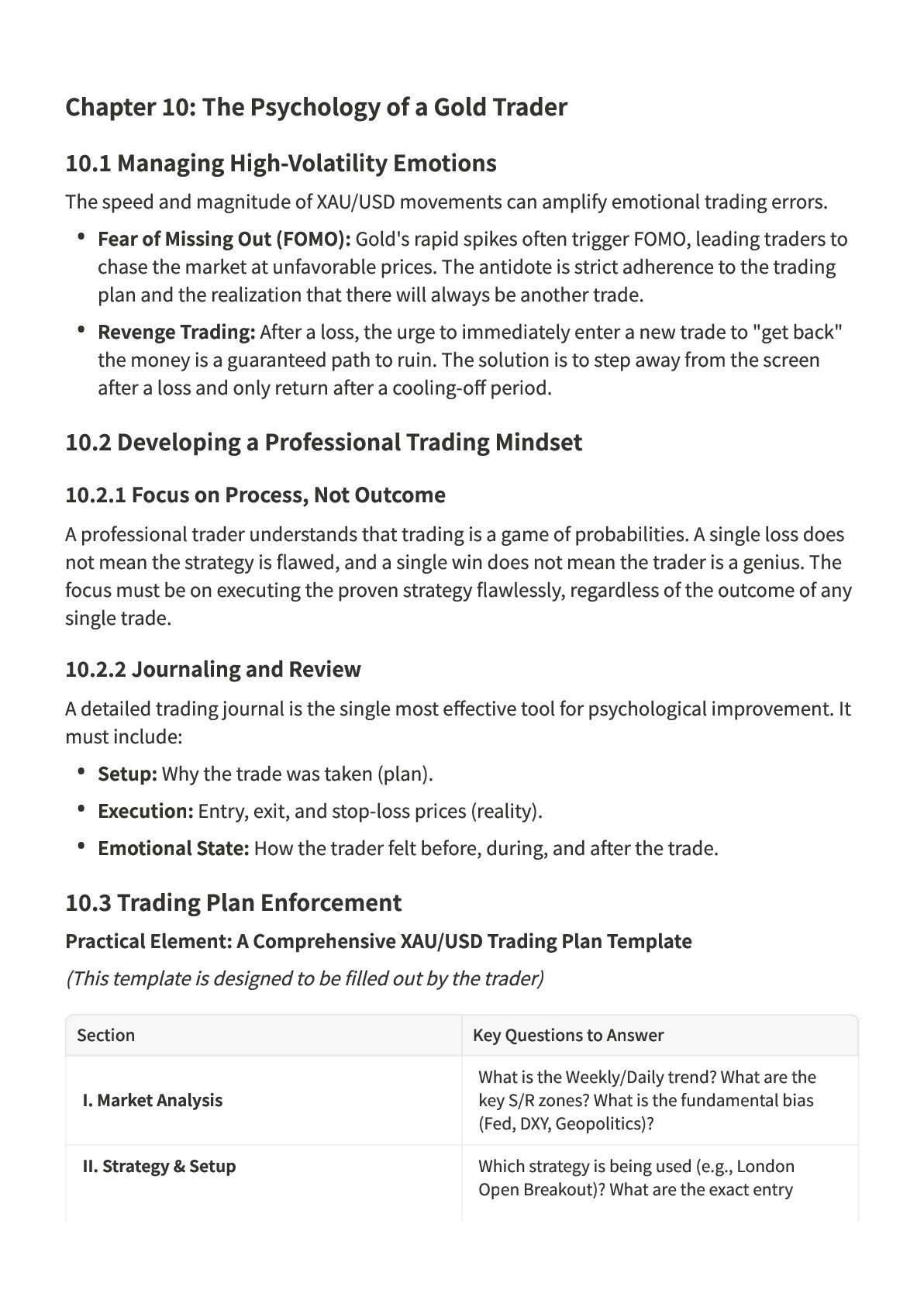
  14. Chapter 10: The Psychology of a Gold Trader 10.1 Managing

    High-Volatility Emotions The speed and magnitude of XAU/USD movements can amplify emotional trading errors. • Fear of Missing Out (FOMO): Gold's rapid spikes often trigger FOMO, leading traders to chase the market at unfavorable prices. The antidote is strict adherence to the trading plan and the realization that there will always be another trade. • Revenge Trading: After a loss, the urge to immediately enter a new trade to "get back" the money is a guaranteed path to ruin. The solution is to step away from the screen after a loss and only return after a cooling-off period. 10.2 Developing a Professional Trading Mindset 10.2.1 Focus on Process, Not Outcome A professional trader understands that trading is a game of probabilities. A single loss does not mean the strategy is flawed, and a single win does not mean the trader is a genius. The focus must be on executing the proven strategy flawlessly, regardless of the outcome of any single trade. 10.2.2 Journaling and Review A detailed trading journal is the single most effective tool for psychological improvement. It must include: • Setup: Why the trade was taken (plan). • Execution: Entry, exit, and stop-loss prices (reality). • Emotional State: How the trader felt before, during, and after the trade. 10.3 Trading Plan Enforcement Practical Element: A Comprehensive XAU/USD Trading Plan Template (This template is designed to be filled out by the trader) Section Key Questions to Answer I. Market Analysis What is the Weekly/Daily trend? What are the key S/R zones? What is the fundamental bias (Fed, DXY, Geopolitics)? II. Strategy & Setup Which strategy is being used (e.g., London Open Breakout)? What are the exact entry
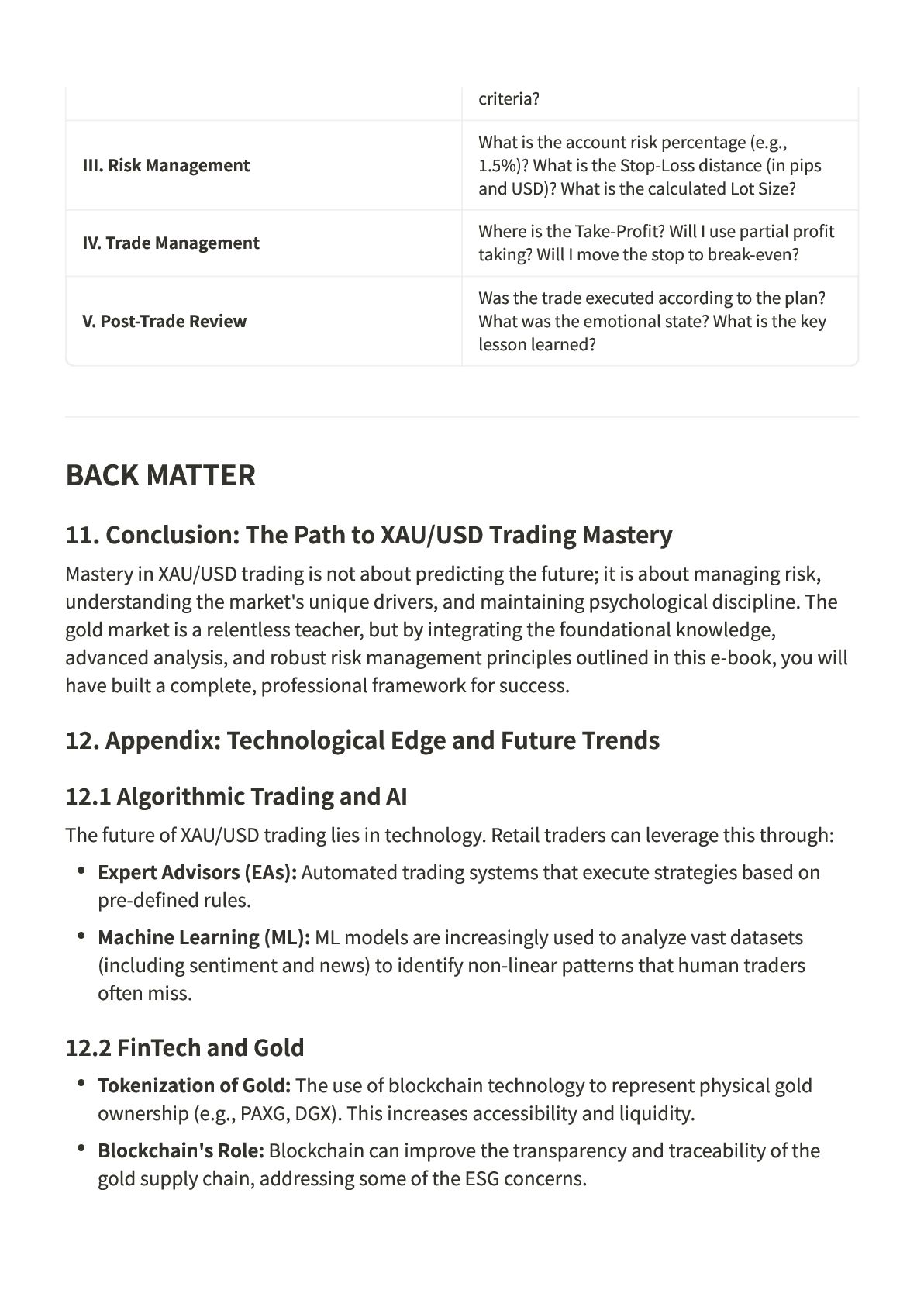
  15. criteria? III. Risk Management What is the account risk percentage

    (e.g., 1.5%)? What is the Stop-Loss distance (in pips and USD)? What is the calculated Lot Size? IV. Trade Management Where is the Take-Profit? Will I use partial profit taking? Will I move the stop to break-even? V. Post-Trade Review Was the trade executed according to the plan? What was the emotional state? What is the key lesson learned? BACK MATTER 11. Conclusion: The Path to XAU/USD Trading Mastery Mastery in XAU/USD trading is not about predicting the future; it is about managing risk, understanding the market's unique drivers, and maintaining psychological discipline. The gold market is a relentless teacher, but by integrating the foundational knowledge, advanced analysis, and robust risk management principles outlined in this e-book, you will have built a complete, professional framework for success. 12. Appendix: Technological Edge and Future Trends 12.1 Algorithmic Trading and AI The future of XAU/USD trading lies in technology. Retail traders can leverage this through: • Expert Advisors (EAs): Automated trading systems that execute strategies based on pre-defined rules. • Machine Learning (ML): ML models are increasingly used to analyze vast datasets (including sentiment and news) to identify non-linear patterns that human traders often miss. 12.2 FinTech and Gold • Tokenization of Gold: The use of blockchain technology to represent physical gold ownership (e.g., PAXG, DGX). This increases accessibility and liquidity. • Blockchain's Role: Blockchain can improve the transparency and traceability of the gold supply chain, addressing some of the ESG concerns.
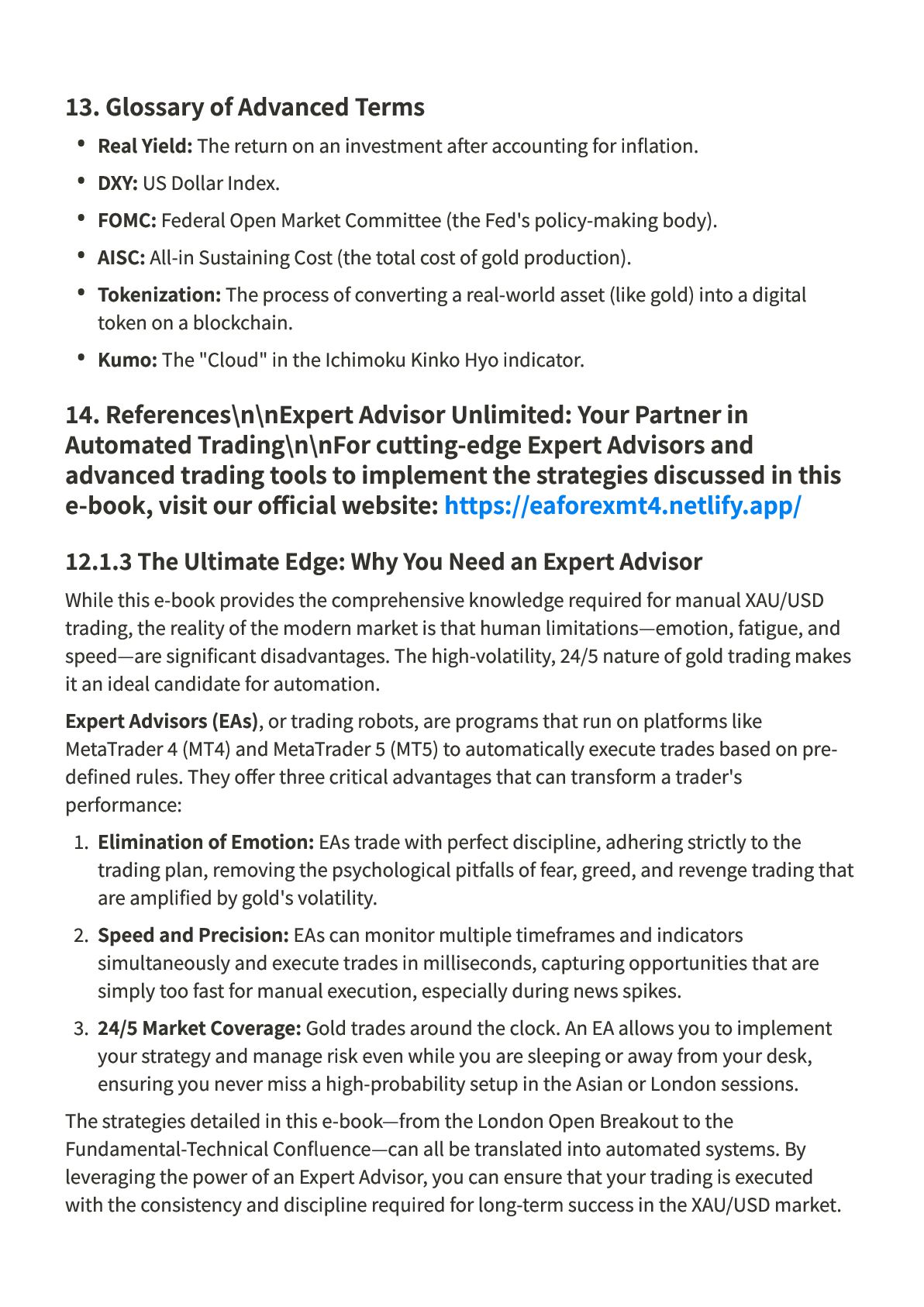
  16. 13. Glossary of Advanced Terms • Real Yield: The return

    on an investment after accounting for inflation. • DXY: US Dollar Index. • FOMC: Federal Open Market Committee (the Fed's policy-making body). • AISC: All-in Sustaining Cost (the total cost of gold production). • Tokenization: The process of converting a real-world asset (like gold) into a digital token on a blockchain. • Kumo: The "Cloud" in the Ichimoku Kinko Hyo indicator. 14. References\n\nExpert Advisor Unlimited: Your Partner in Automated Trading\n\nFor cutting-edge Expert Advisors and advanced trading tools to implement the strategies discussed in this e-book, visit our official website: https://eaforexmt4.netlify.app/ 12.1.3 The Ultimate Edge: Why You Need an Expert Advisor While this e-book provides the comprehensive knowledge required for manual XAU/USD trading, the reality of the modern market is that human limitations—emotion, fatigue, and speed—are significant disadvantages. The high-volatility, 24/5 nature of gold trading makes it an ideal candidate for automation. Expert Advisors (EAs), or trading robots, are programs that run on platforms like MetaTrader 4 (MT4) and MetaTrader 5 (MT5) to automatically execute trades based on pre- defined rules. They offer three critical advantages that can transform a trader's performance: 1. Elimination of Emotion: EAs trade with perfect discipline, adhering strictly to the trading plan, removing the psychological pitfalls of fear, greed, and revenge trading that are amplified by gold's volatility. 2. Speed and Precision: EAs can monitor multiple timeframes and indicators simultaneously and execute trades in milliseconds, capturing opportunities that are simply too fast for manual execution, especially during news spikes. 3. 24/5 Market Coverage: Gold trades around the clock. An EA allows you to implement your strategy and manage risk even while you are sleeping or away from your desk, ensuring you never miss a high-probability setup in the Asian or London sessions. The strategies detailed in this e-book—from the London Open Breakout to the Fundamental-Technical Confluence—can all be translated into automated systems. By leveraging the power of an Expert Advisor, you can ensure that your trading is executed with the consistency and discipline required for long-term success in the XAU/USD market.
  17. To explore cutting-edge Expert Advisors and advanced trading tools designed

    to implement these strategies, we invite you to visit Expert Advisor Unlimited at: https://eaforexmt4.netlify.app/