Upgrade to Pro — share decks privately, control downloads, hide ads and more …

Breaking the template: Subverting AI copywritin...

Sponsored · Your Podcast. Everywhere. Effortlessly. Share. Educate. Inspire. Entertain. You do you. We'll handle the rest.

Breaking the template: Subverting AI copywriting frameworks for SERP differentiation

Generative AI defaults heavily to templates, making outputs instantly recognisable as AI. This presentation, given at brightonSEO in April 2026, explores 7 syntactic templates that are over-represented in AI content and offers guidance in how to subvert them.

Avatar for Emily Hill Training

Emily Hill Training

April 29, 2026

More Decks by Emily Hill Training

Other Decks in Marketing & SEO

Transcript

  1. Breaking the template: Subverting AI copywriting frameworks for SERP differentiation

    Emily Hill EMILY HILL TRAINING linkedin.com/in/emilyjanehill | @askemilyhill /
  2. Emily Hill Emily Hill Training linkedin.com/in/ emilyjanehill About Me ▸

    SEO, AI and copywriting trainer for content teams ▸ Former copywriting agency owner (2006 -2022) ▸ Panel tutor at University of Cambridge Professional and Continuing Education ▸ brightonSEO trainer and speaker since 2014 www.emily-hill.com
  3. Why are we able to recognise AI content even after

    it’s been edited? We’re all talking about the language of AI, but we’re not paying enough attention to its structure.
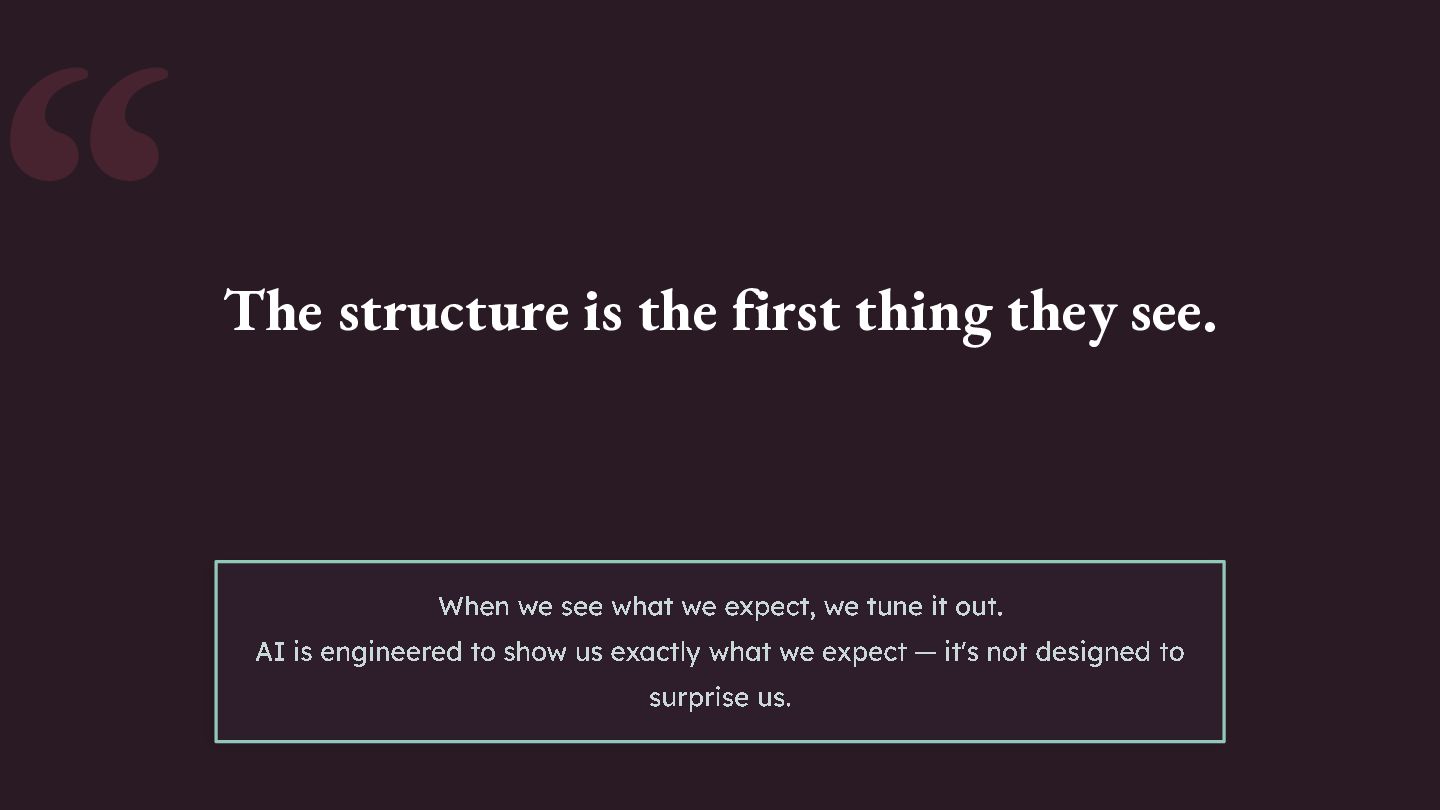
  4. The structure is the first thing they see. When we
    see what we expect, we tune it out. AI is engineered to show us exactly what we expect — it's not designed to surprise us.
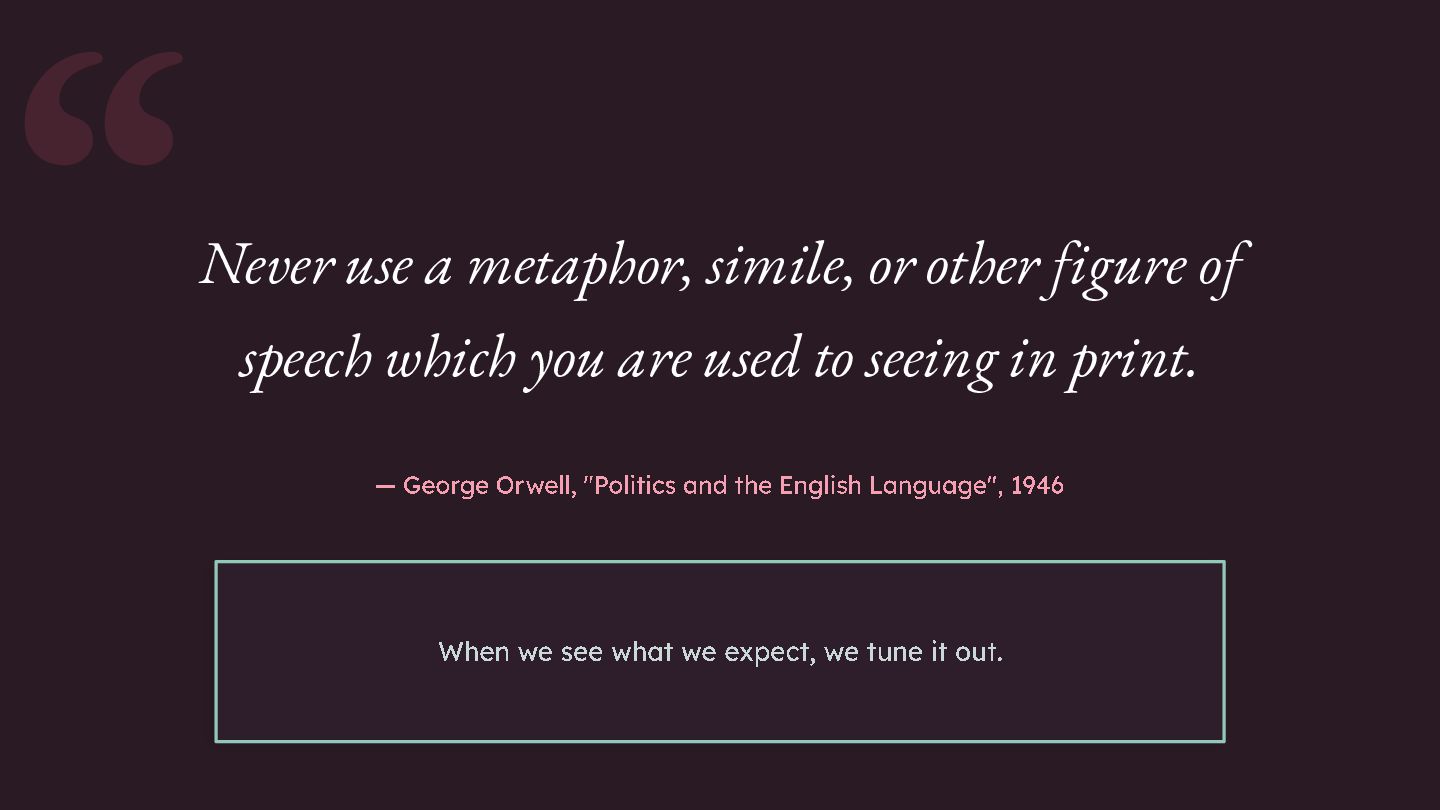
  5. Never use a metaphor, simile, or other figure of speech

    which you are used to seeing in print. — George Orwell, "Politics and the English Language", 1946 When we see what we expect, we tune it out.
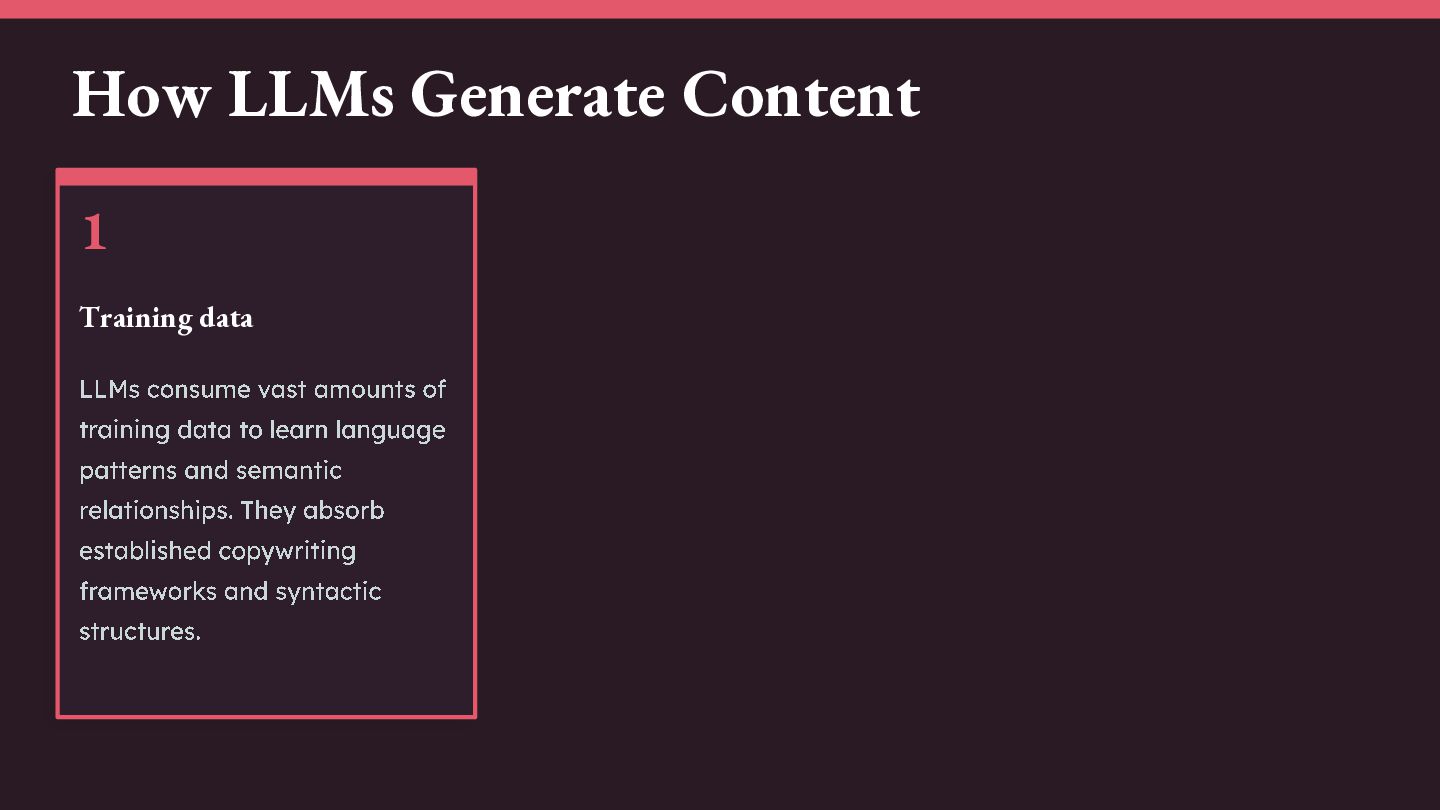
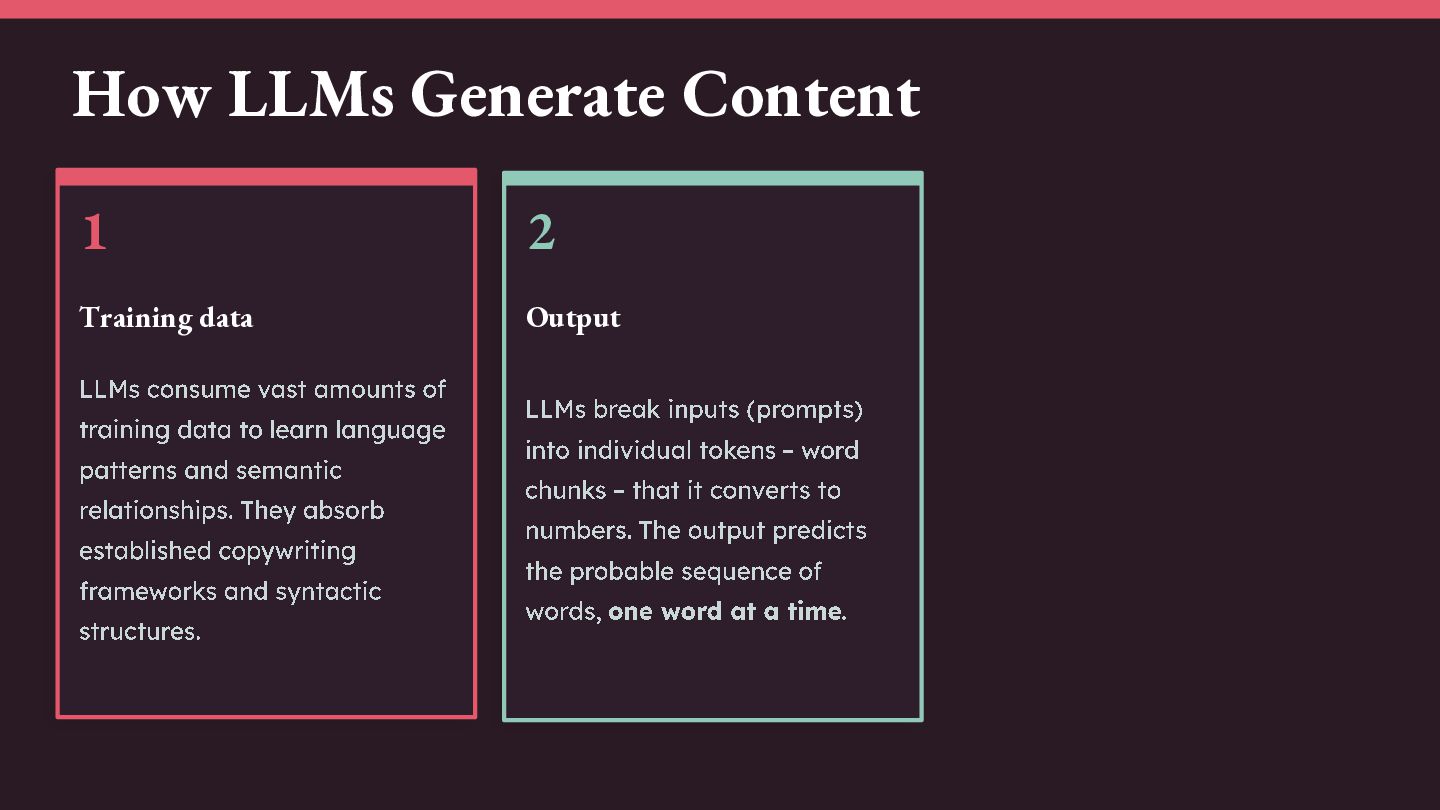
  6. How LLMs Generate Content 1 Training data LLMs consume vast

    amounts of training data to learn language patterns and semantic relationships. They absorb established copywriting frameworks and syntactic structures.
  7. How LLMs Generate Content 1 Training data LLMs consume vast

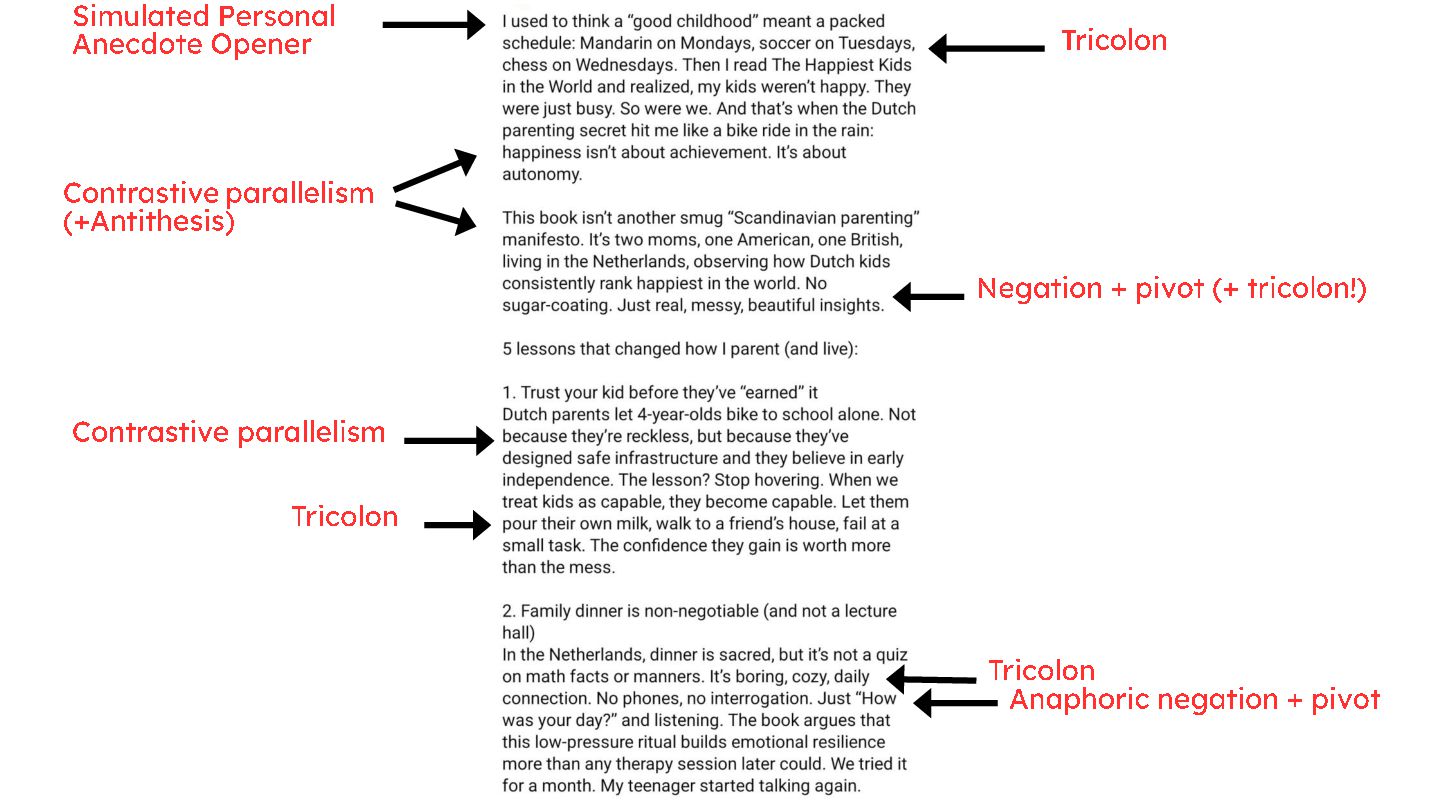
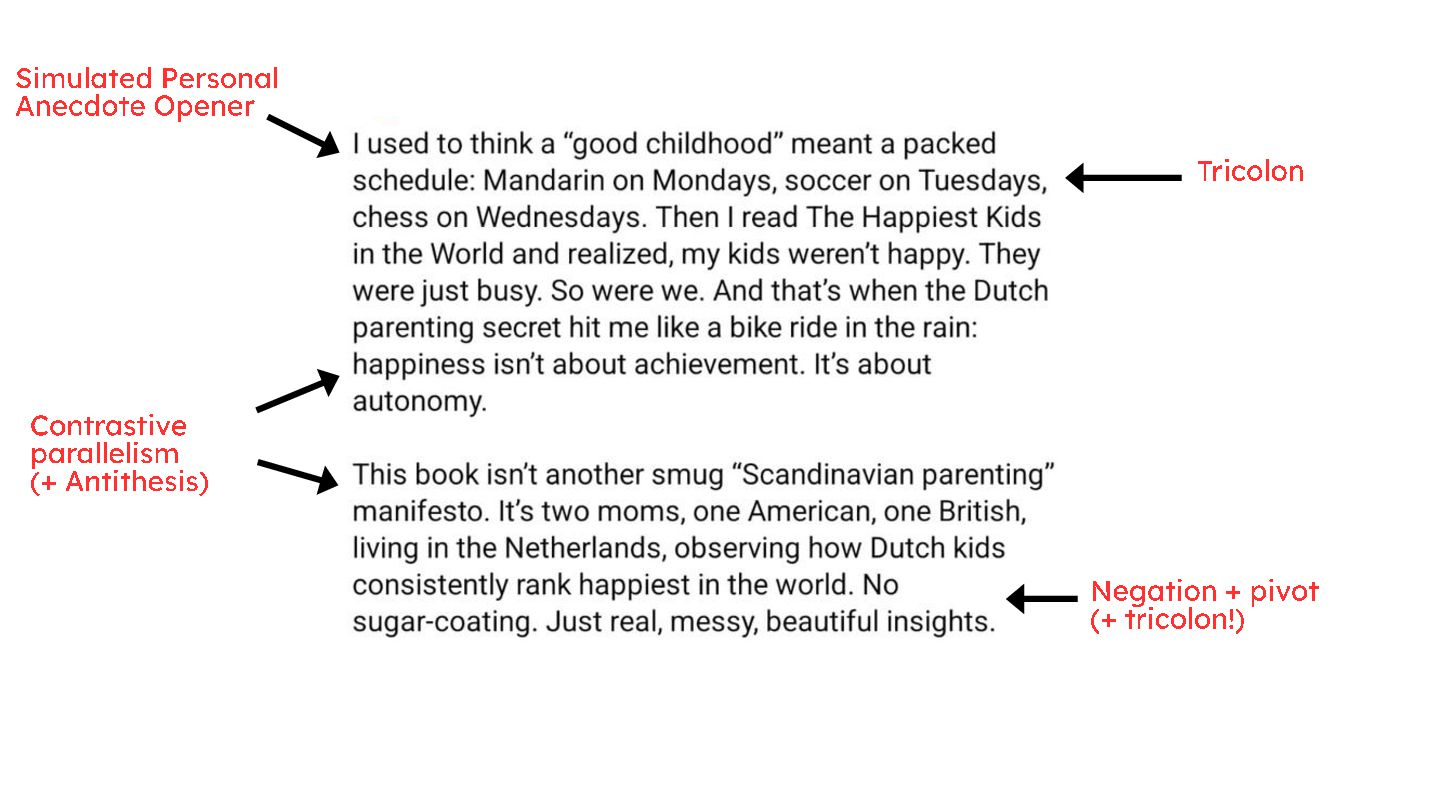
    amounts of training data to learn language patterns and semantic relationships. They absorb established copywriting frameworks and syntactic structures. 2 Output LLMs break inputs (prompts) into individual tokens – word chunks – that it converts to numbers. The output predicts the probable sequence of words, one word at a time .
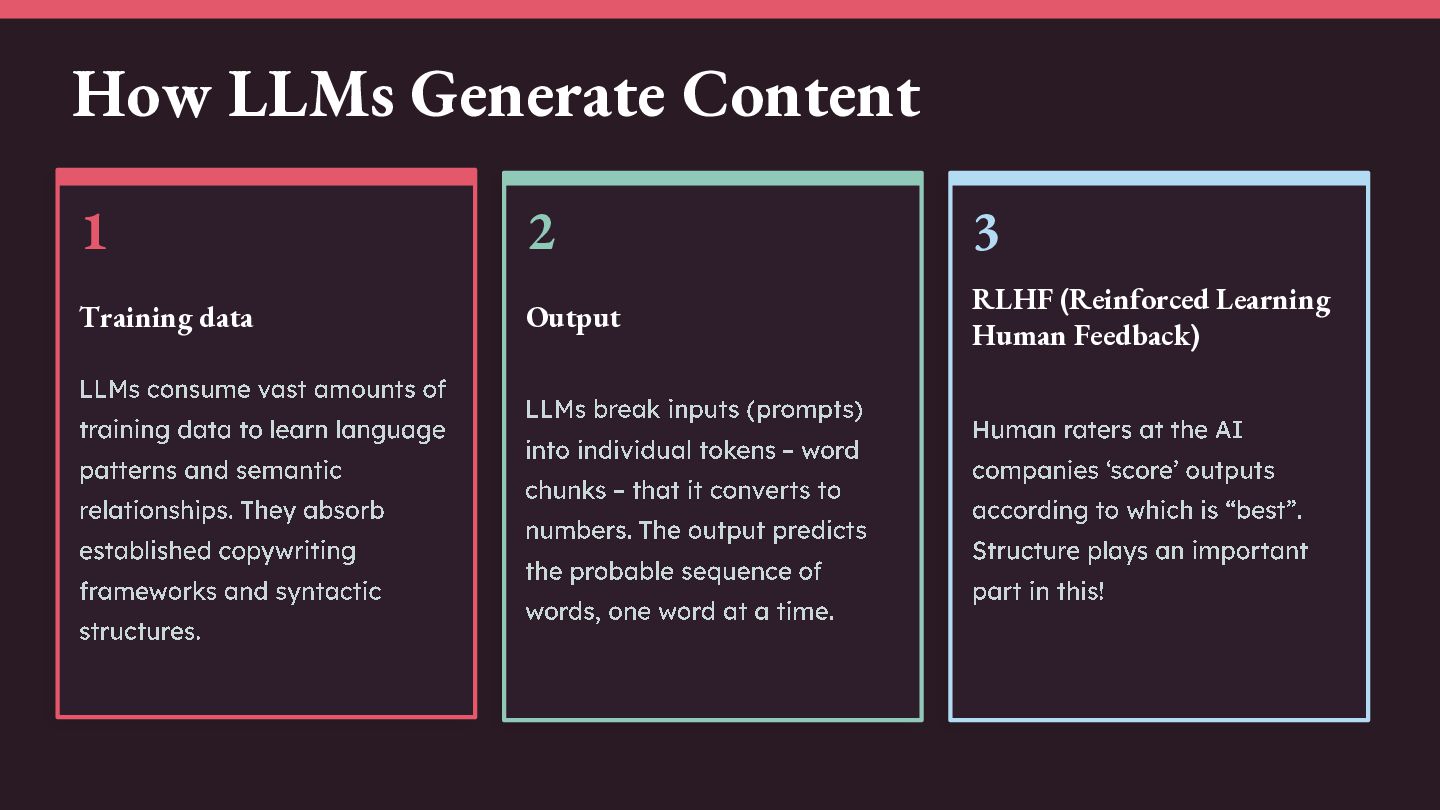
  8. How LLMs Generate Content 1 Training data LLMs consume vast

    amounts of training data to learn language patterns and semantic relationships. They absorb established copywriting frameworks and syntactic structures. 2 Output LLMs break inputs (prompts) into individual tokens – word chunks – that it converts to numbers. The output predicts the probable sequence of words, one word at a time. 3 RLHF (Reinforced Learning Human Feedback) Human raters at the AI companies ‘score’ outputs according to which is “best”. Structure plays an important part in this!
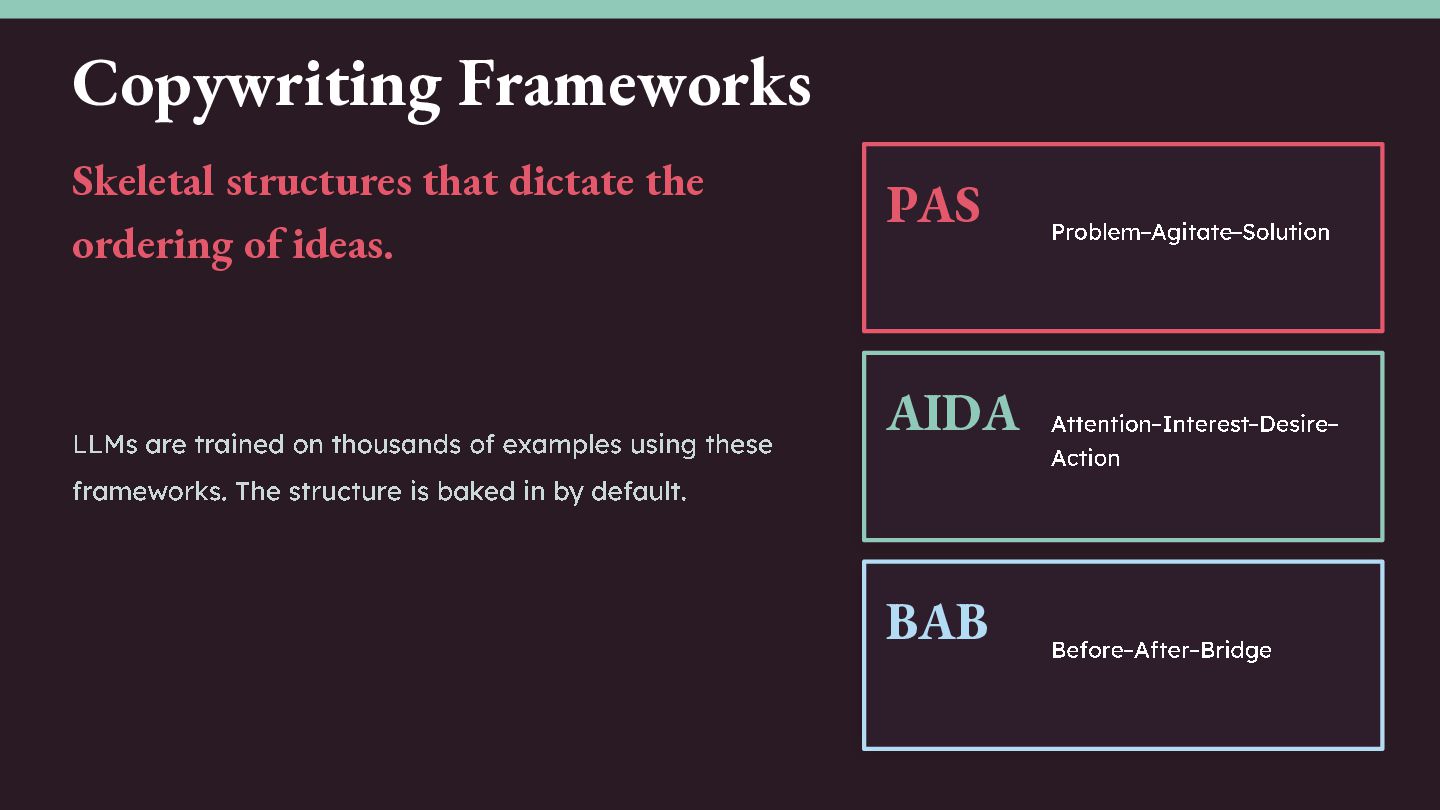
  9. Copywriting Frameworks Skeletal structures that dictate the ordering of ideas.

    LLMs are trained on thousands of examples using these frameworks. The structure is baked in by default. PAS Problem –Agitate –Solution AIDA Attention –Interest –Desire – Action BAB Before –After –Bridge
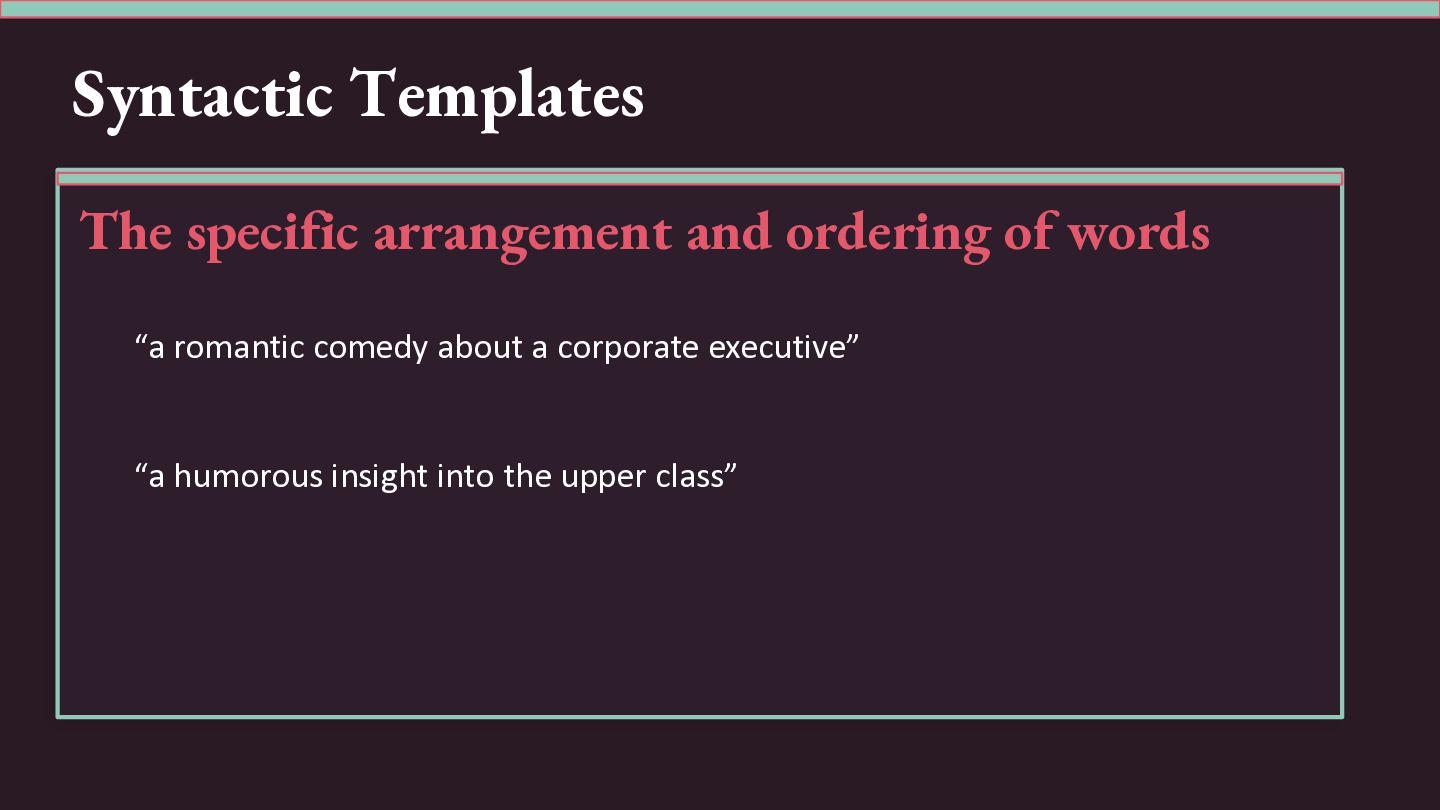
  10. Syntactic Templates The specific arrangement and ordering of words “a

    romantic comedy about a corporate executive” “a humorous insight into the upper class”
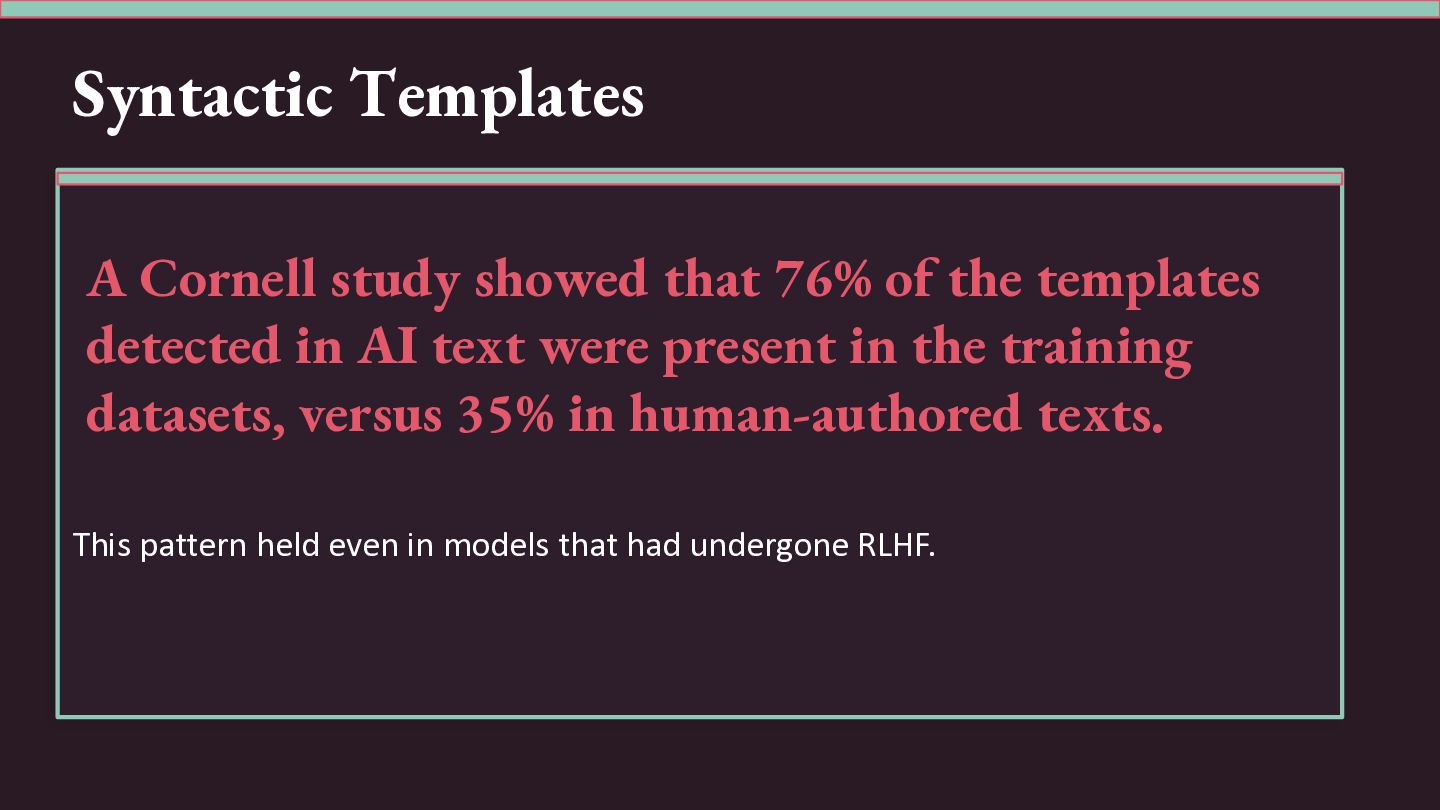
  11. Syntactic Templates This pattern held even in models that had

    undergone RLHF. A Cornell study showed that 76% of the templates detected in AI text were present in the training datasets, versus 35% in human-authored texts.
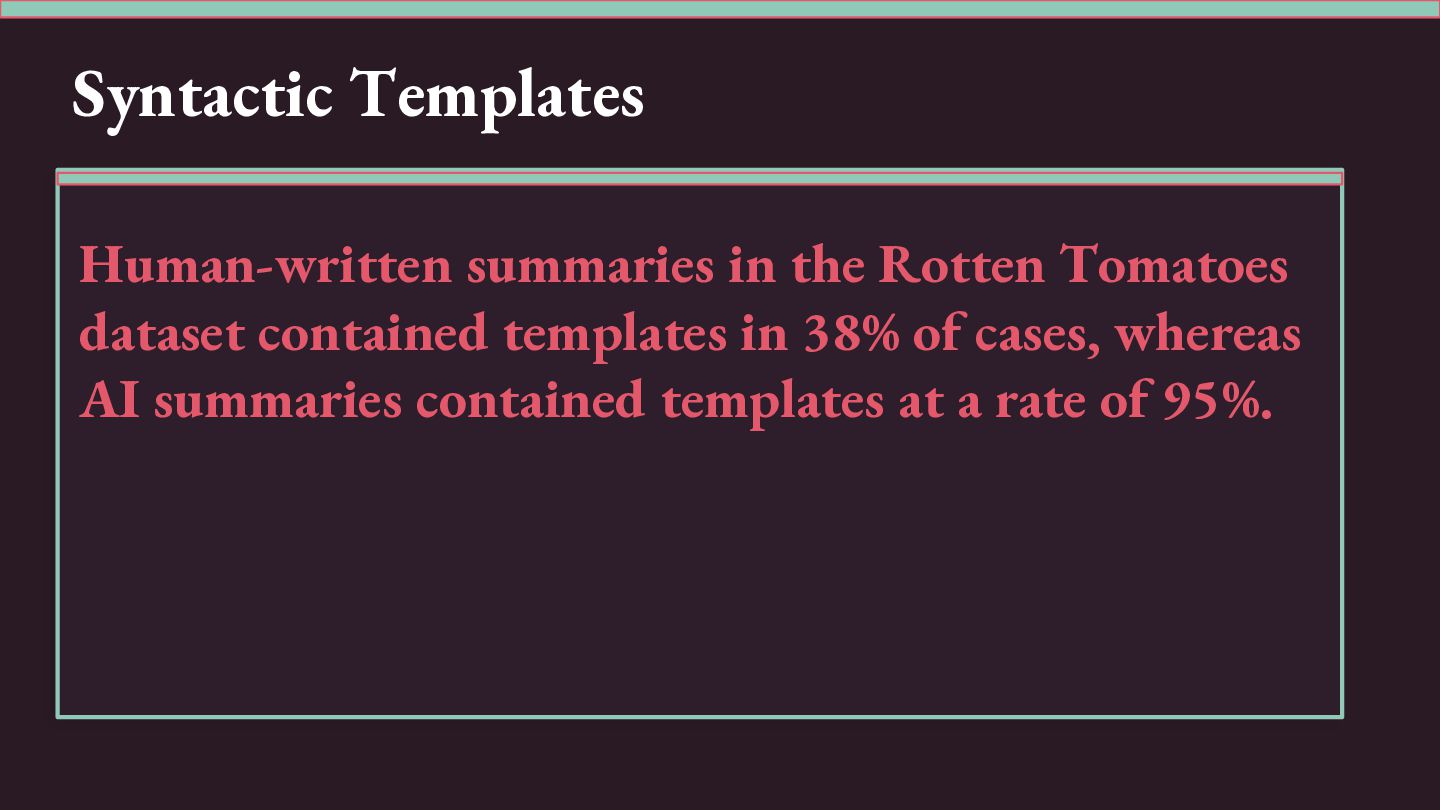
  12. Syntactic Templates Human-written summaries in the Rotten Tomatoes dataset contained

    templates in 38% of cases, whereas AI summaries contained templates at a rate of 95%.
  13. “You Just Need a Good Prompt” A “good” prompt Improves

    the relevance and accuracy of the output but does not change the fundamental way generative AI works. It will always generate the most obvious answer and it defaults heavily to templates.
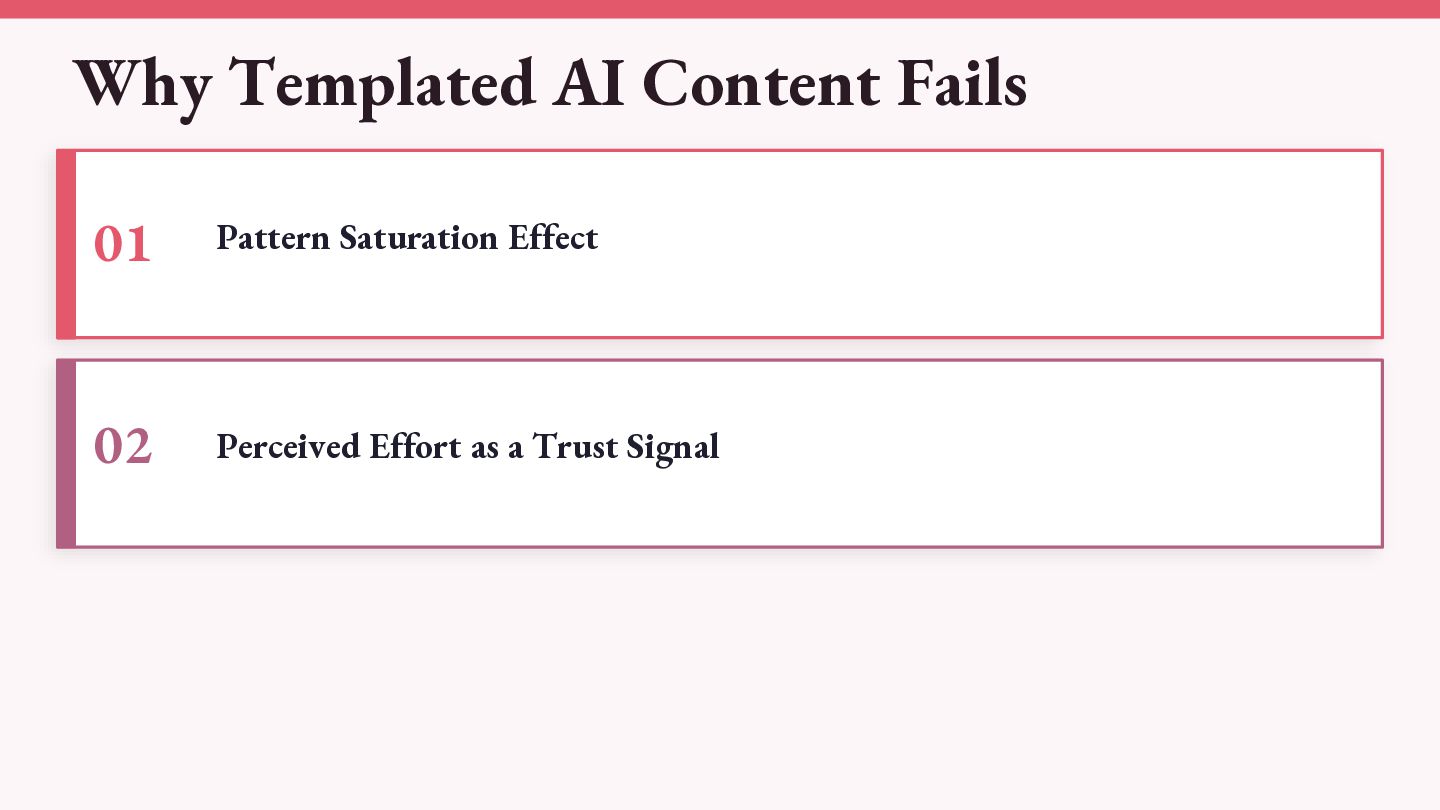
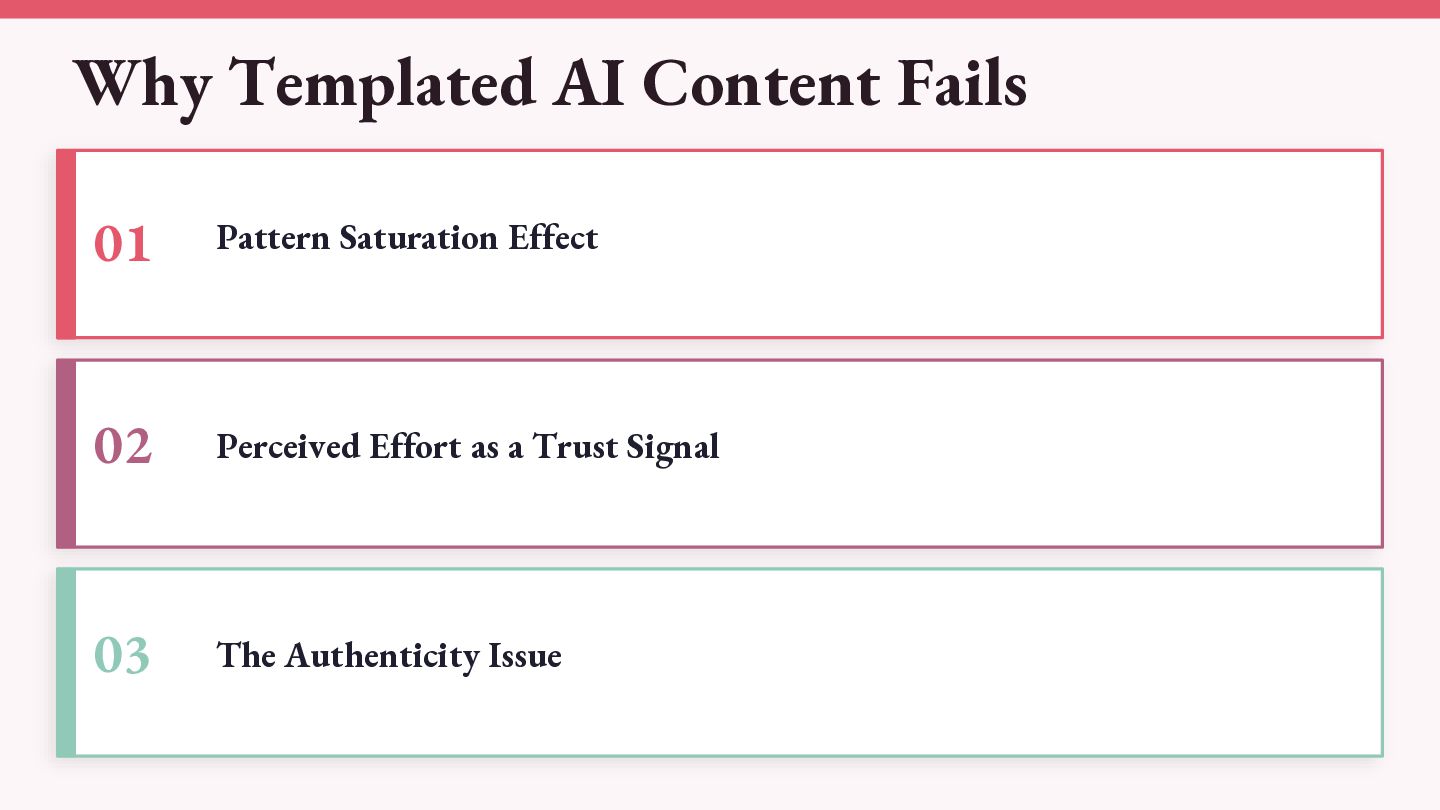
  14. Why Templated AI Content Fails 01 Pattern Saturation Effect 02

    Perceived Effort as a Trust Signal 03 The Authenticity Issue
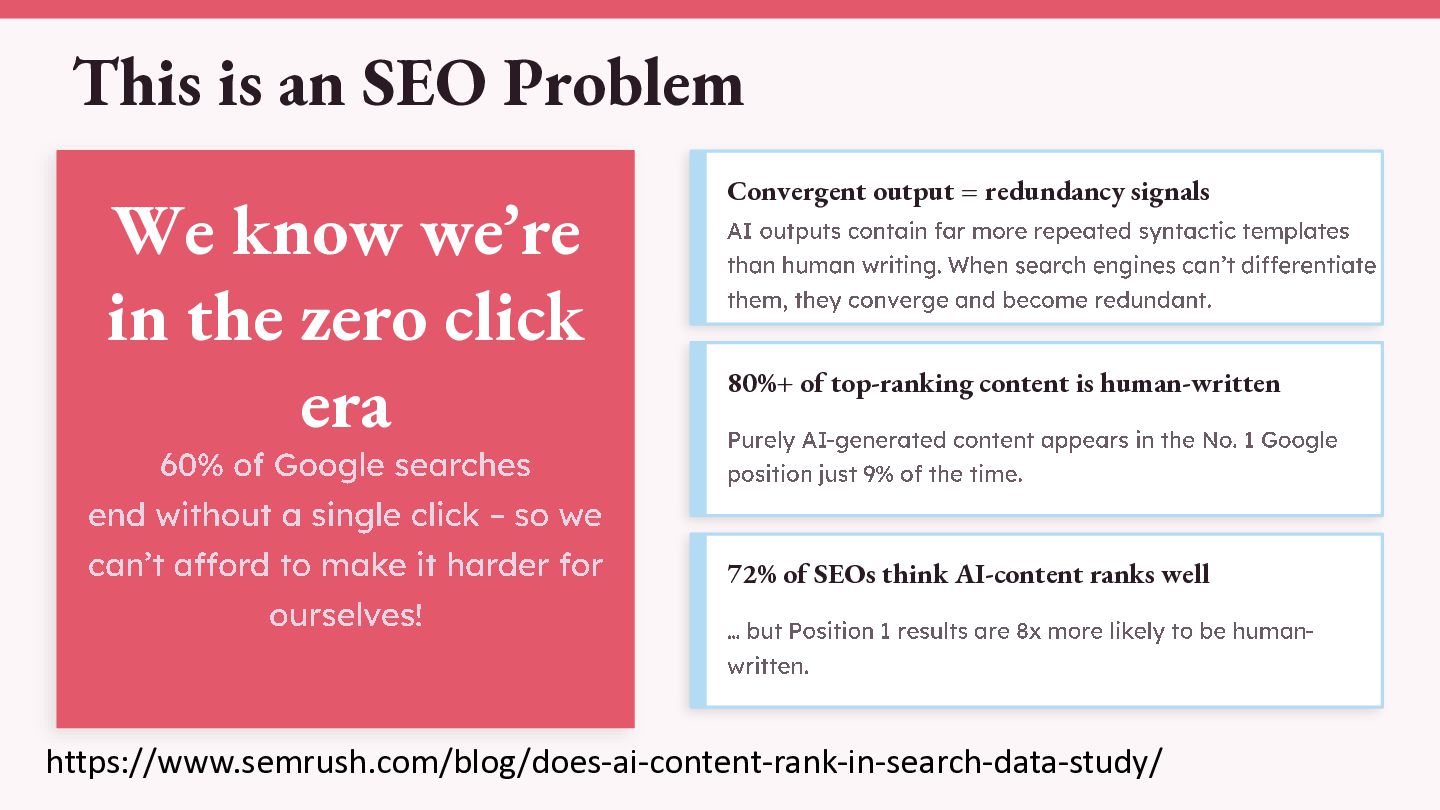
  15. This is an SEO Problem We know we’re in the

    zero click era 60% of Google searches end without a single click – so we can’t afford to make it harder for ourselves! Convergent output = redundancy signals AI outputs contain far more repeated syntactic templates than human writing. When search engines can’t differentiate them, they converge and become redundant. 80%+ of top-ranking content is human-written Purely AI -generated content appears in the No. 1 Google position just 9% of the time. 72% of SEOs think AI-content ranks well … but Position 1 results are 8x more likely to be human - written. https://www.semrush.com/blog/does-ai-content-rank-in-search-data-study/
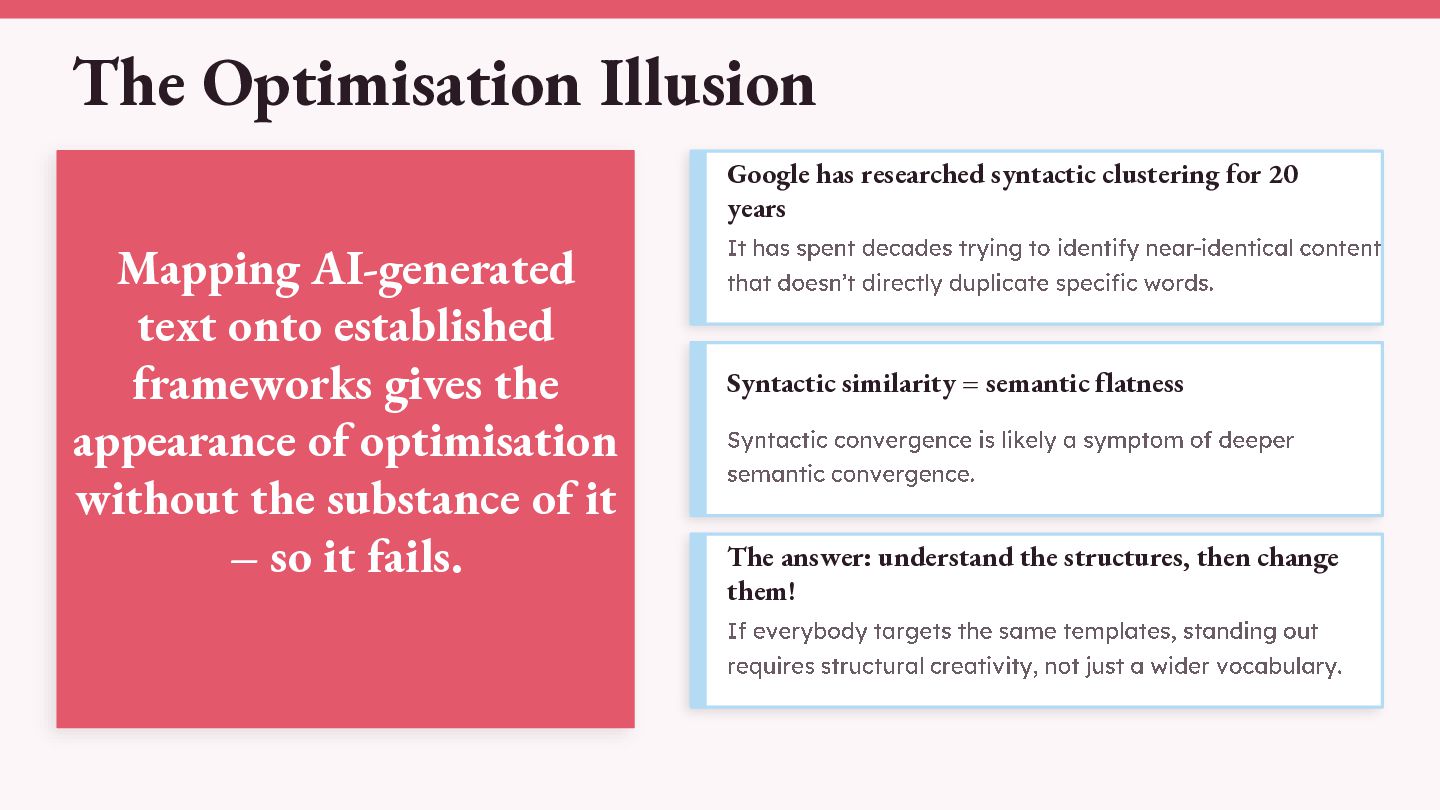
  16. The Optimisation Illusion Mapping AI-generated text onto established frameworks gives

    the appearance of optimisation without the substance of it – so it fails. Google has researched syntactic clustering for 20 years It has spent decades trying to identify near -identical content that doesn’t directly duplicate specific words. Syntactic similarity = semantic flatness Syntactic convergence is likely a symptom of deeper semantic convergence. The answer: understand the structures, then change them! If everybody targets the same templates, standing out requires structural creativity, not just a wider vocabulary.
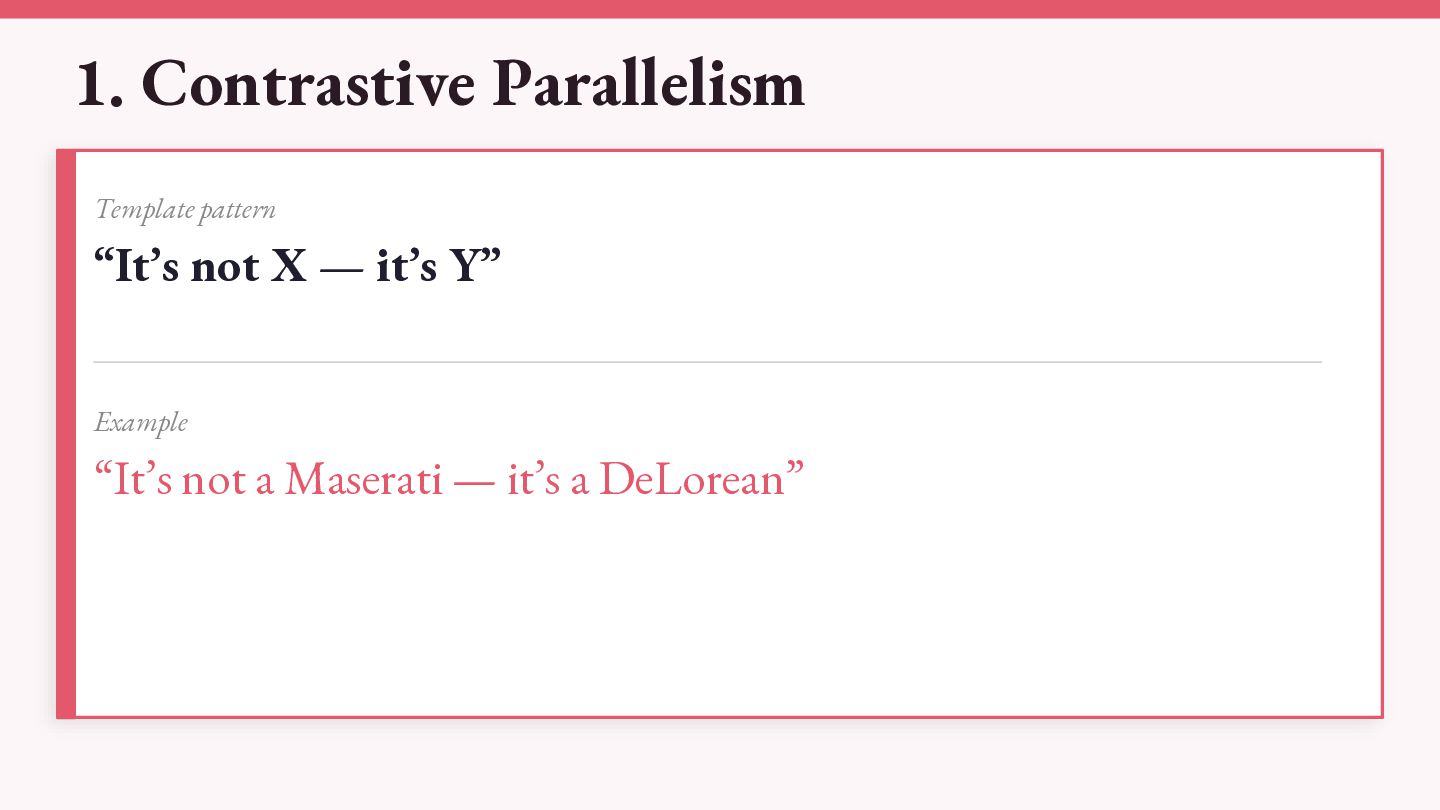
  17. 1. Contrastive Parallelism Template pattern “It’s not X — it’s

    Y” Example “It’s not a Maserati — it’s a DeLorean”
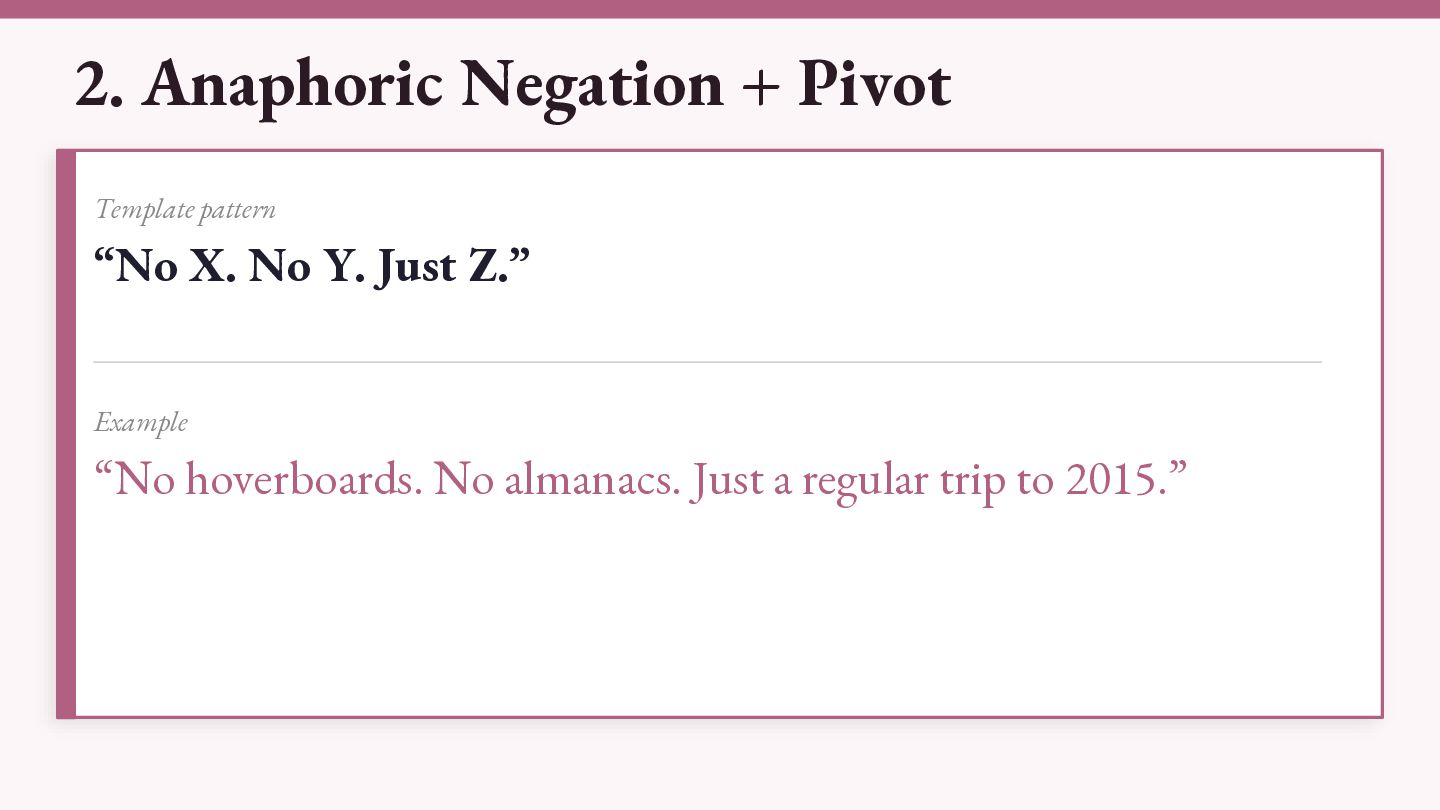
  18. 2. Anaphoric Negation + Pivot Template pattern “No X. No

    Y. Just Z.” Example “No hoverboards. No almanacs. Just a regular trip to 2015.”
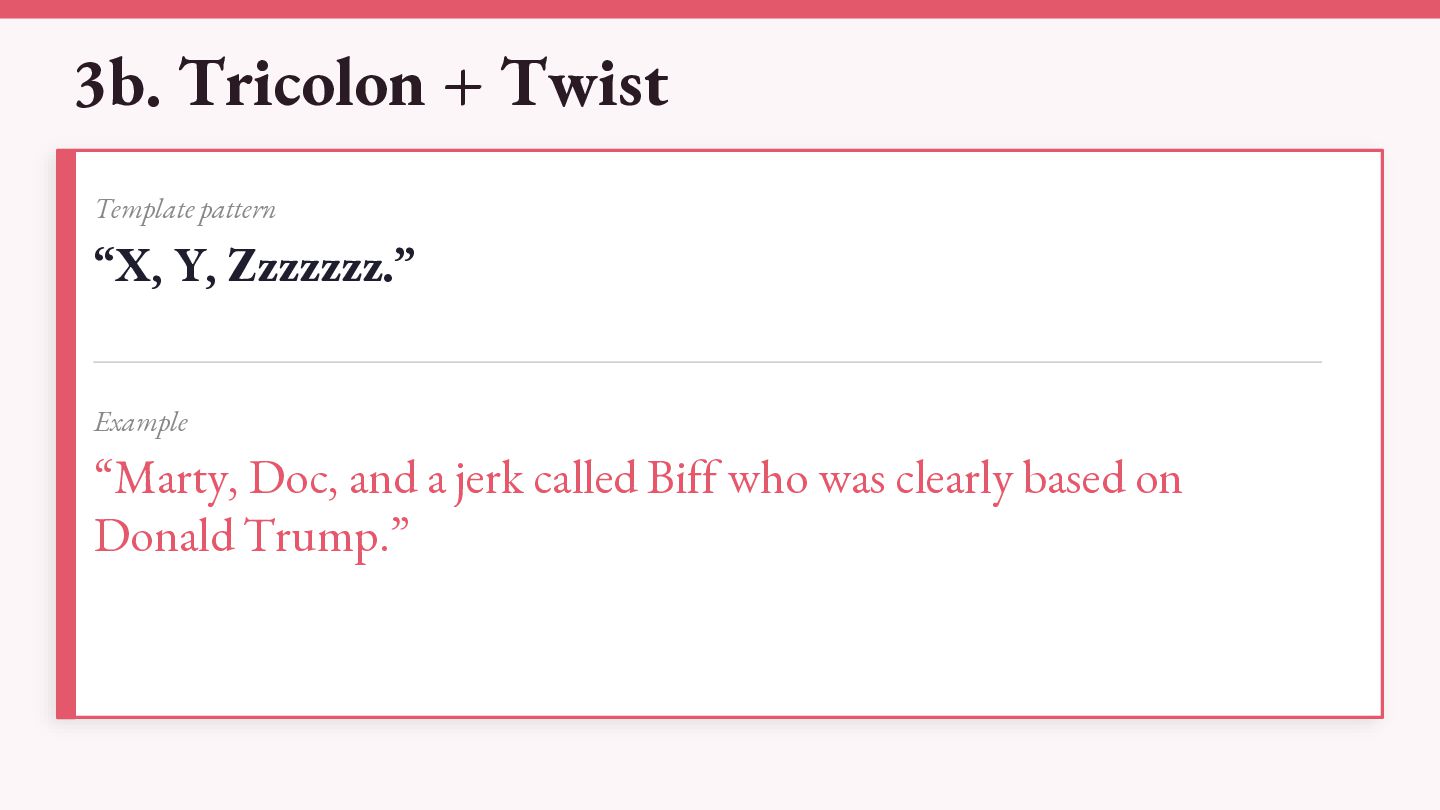
  19. 3b. Tricolon + Twist Template pattern “X, Y, Zzzzzzz.” Example

    “Marty, Doc, and a jerk called Biff who was clearly based on Donald Trump.”
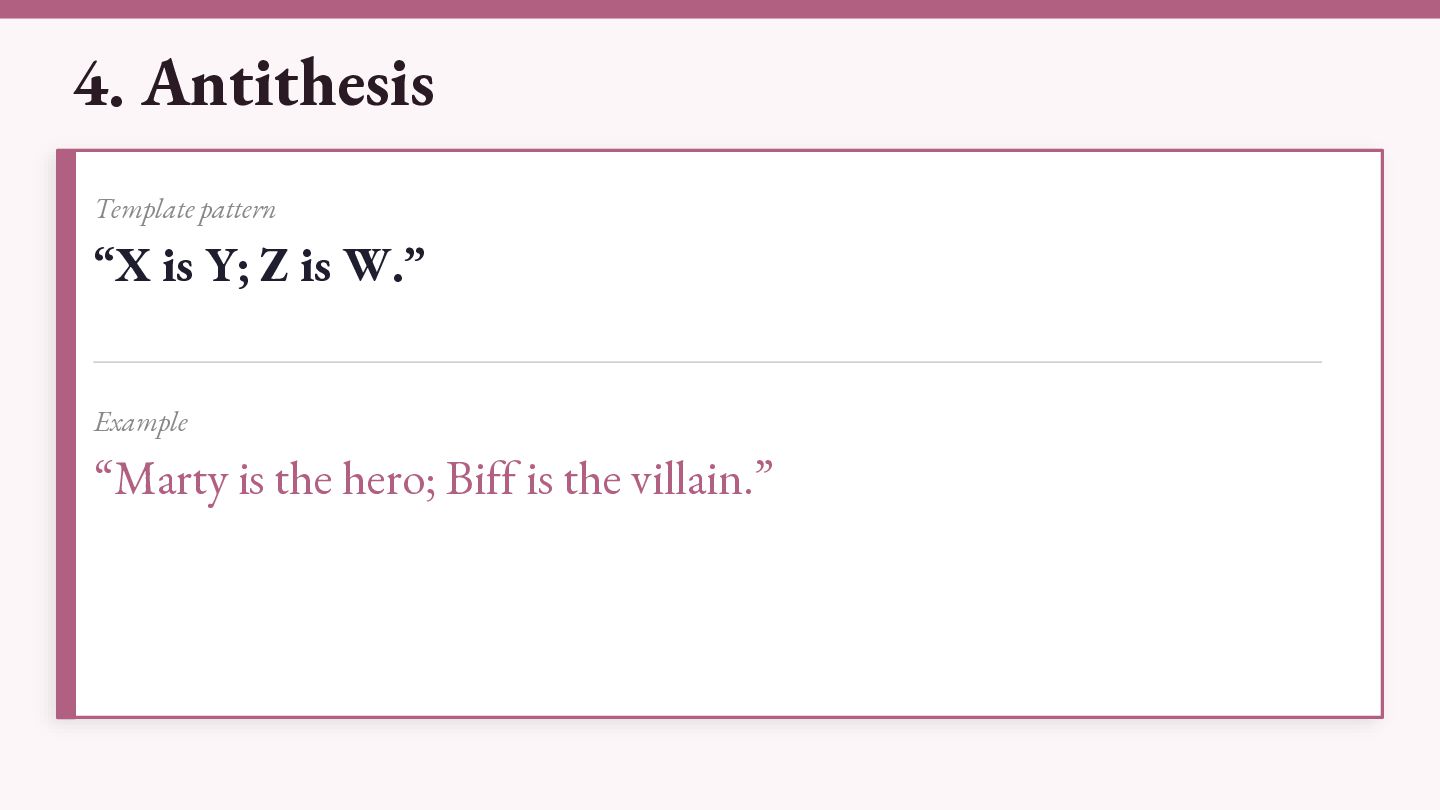
  20. 4. Antithesis Template pattern “X is Y; Z is W.”

    Example “Marty is the hero; Biff is the villain.”
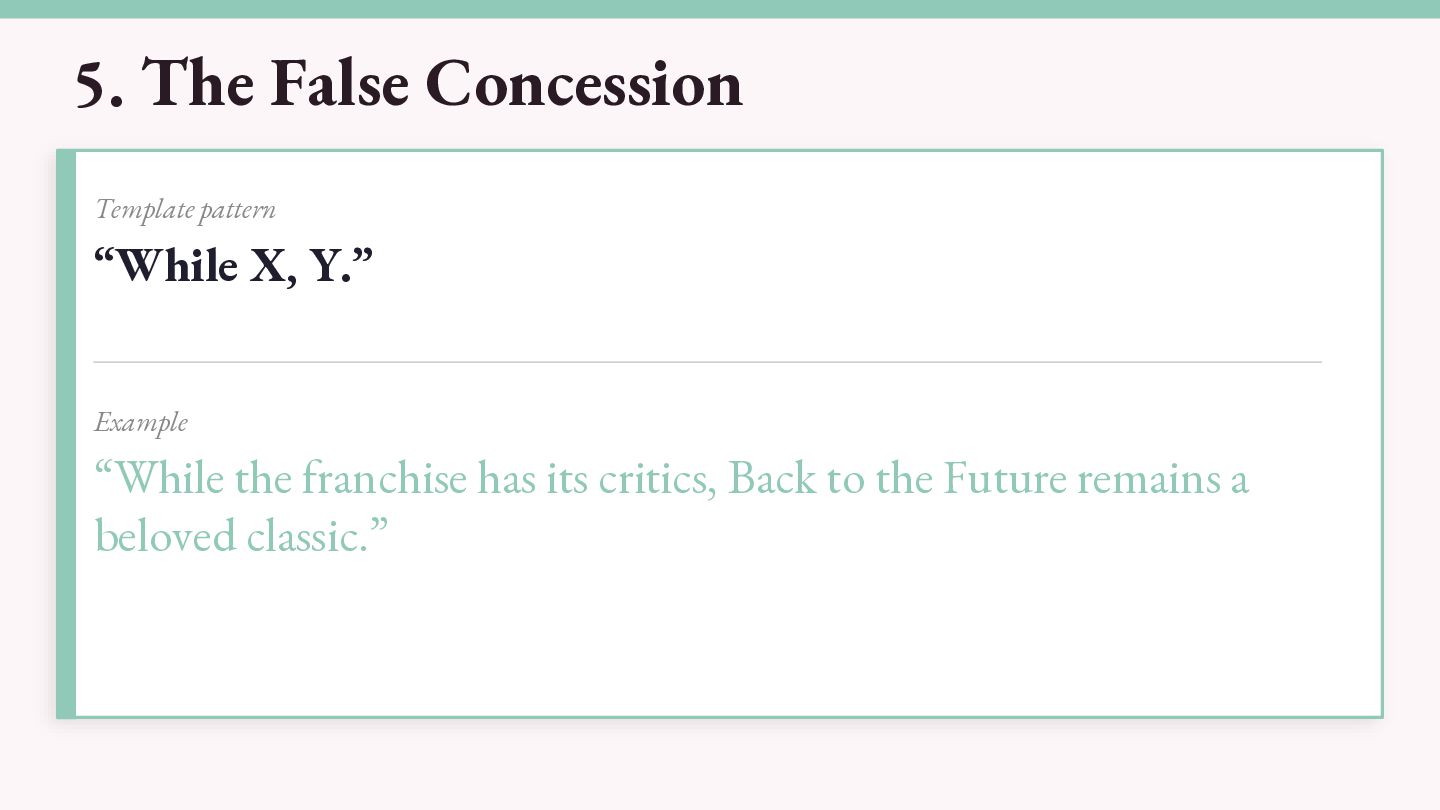
  21. 5. The False Concession Template pattern “While X, Y.” Example

    “While the franchise has its critics, Back to the Future remains a beloved classic.”
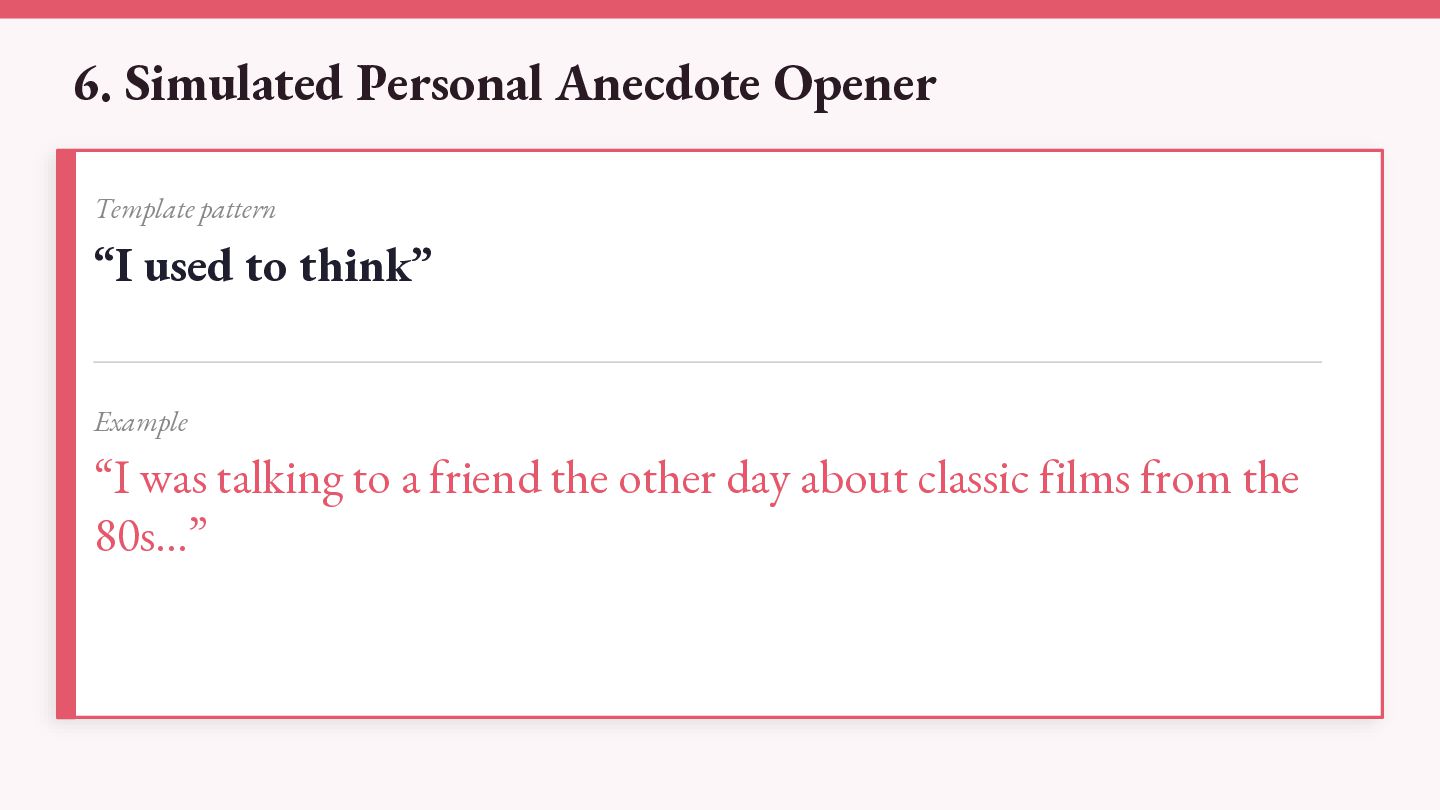
  22. 6. Simulated Personal Anecdote Opener Template pattern “I used to

    think” Example “I was talking to a friend the other day about classic films from the 80s…”
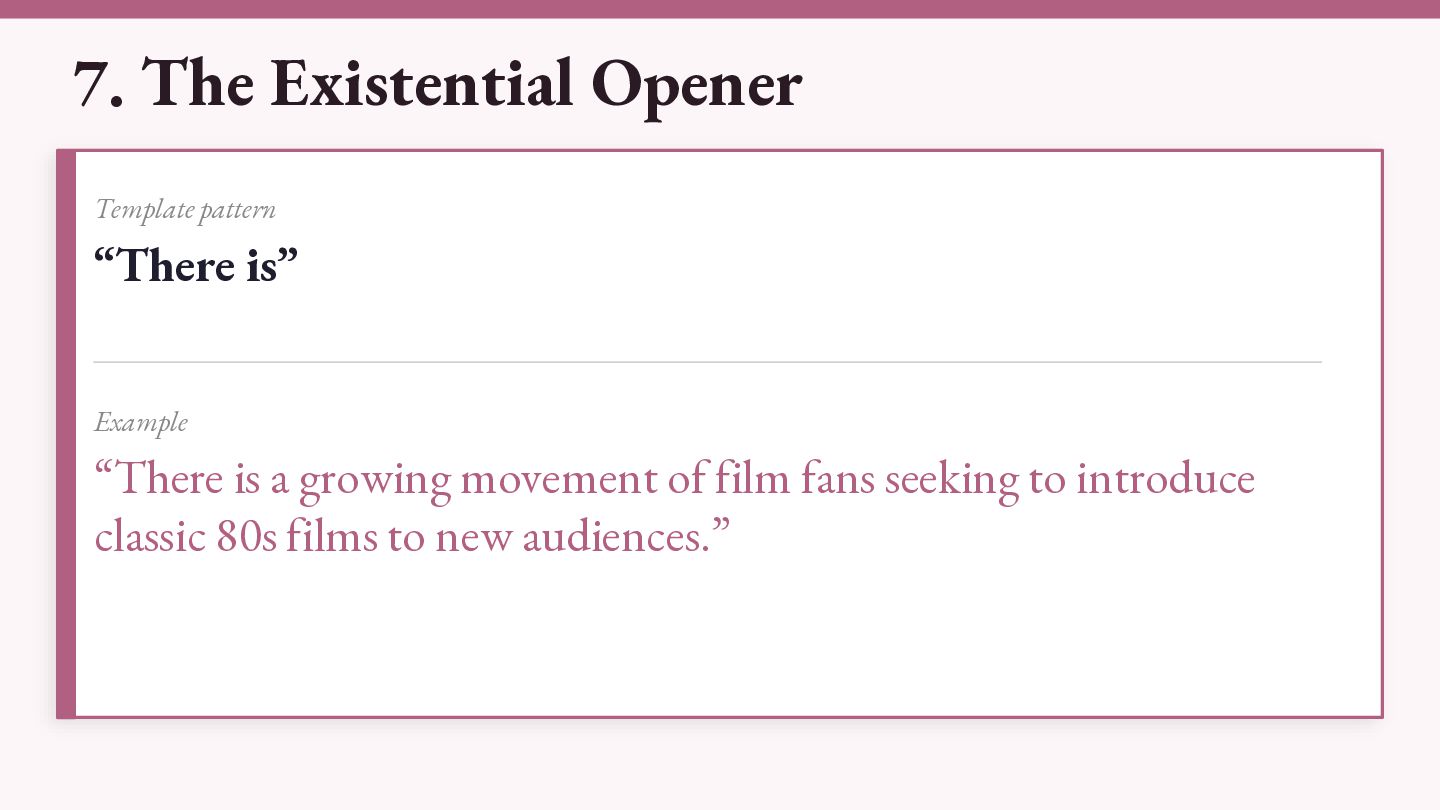
  23. 7. The Existential Opener Template pattern “There is” Example “There

    is a growing movement of film fans seeking to introduce classic 80s films to new audiences.”
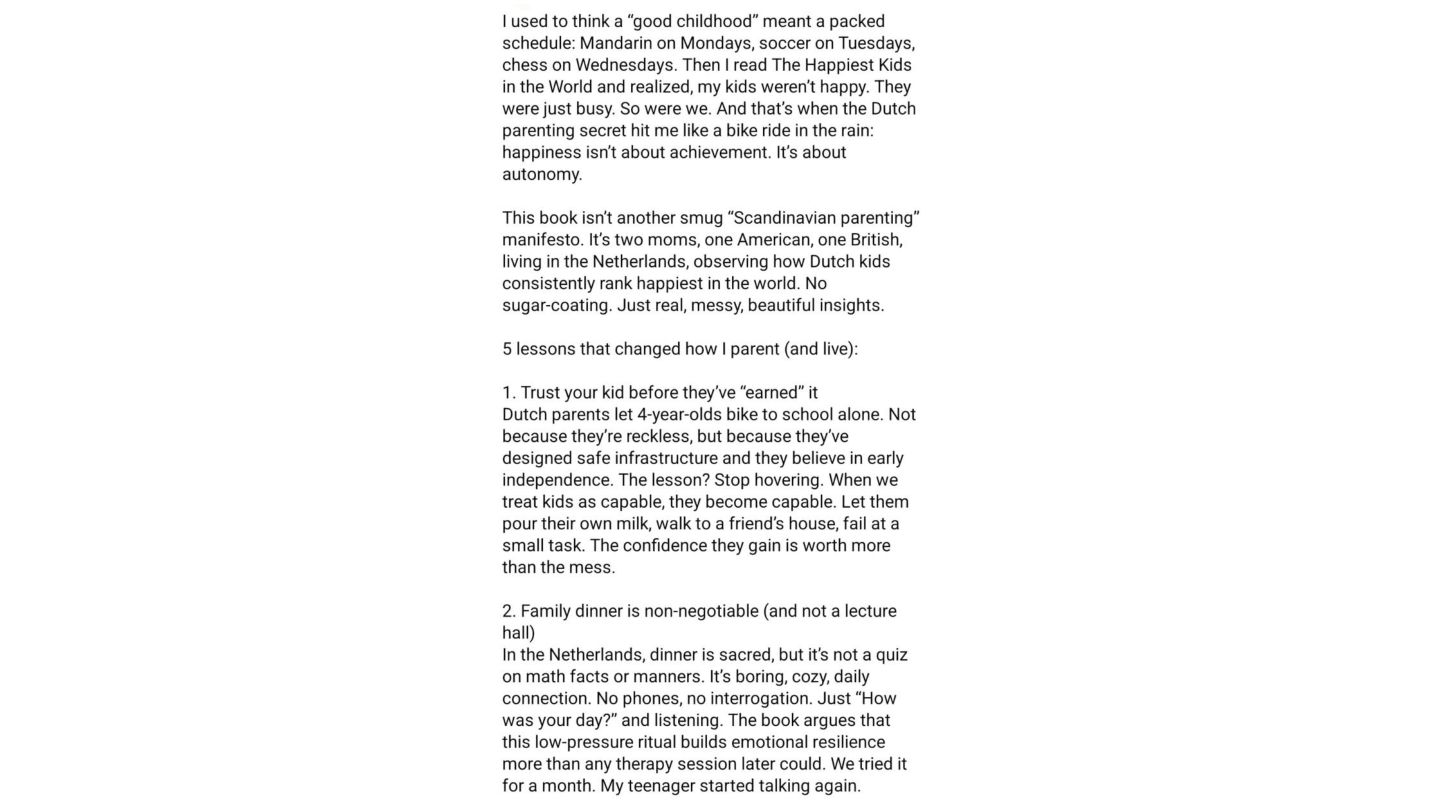
  24. Tricolon Contrastive parallelism (+Antithesis) Negation + pivot (+ tricolon!) Tricolon

    Anaphoric negation + pivot Simulated Personal Anecdote Opener Contrastive parallelism Tricolon
  25. Every now and then, a book comes along that makes

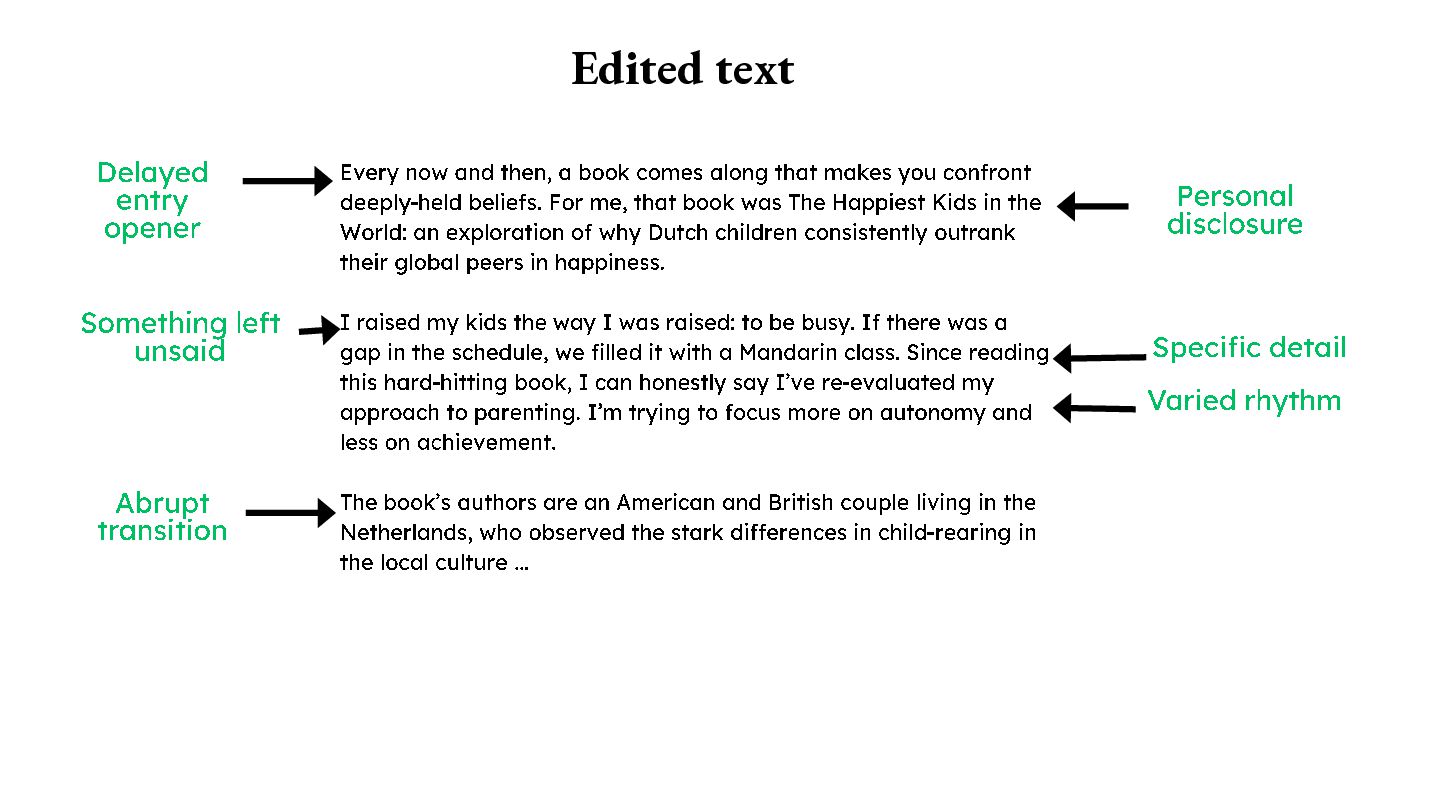
    you confront deeply -held beliefs. For me, that book was The Happiest Kids in the World: an exploration of why Dutch children consistently outrank their global peers in happiness. I raised my kids the way I was raised: to be busy. If there was a gap in the schedule, we filled it with a Mandarin class. Since reading this hard -hitting book, I can honestly say I’ve re -evaluated my approach to parenting. I’m trying to focus more on autonomy and less on achievement. The book’s authors are an American and British couple living in the Netherlands, who observed the stark differences in child -rearing in the local culture ... Edited text Delayed entry opener Personal disclosure Something left unsaid Specific detail Varied rhythm Abrupt transition
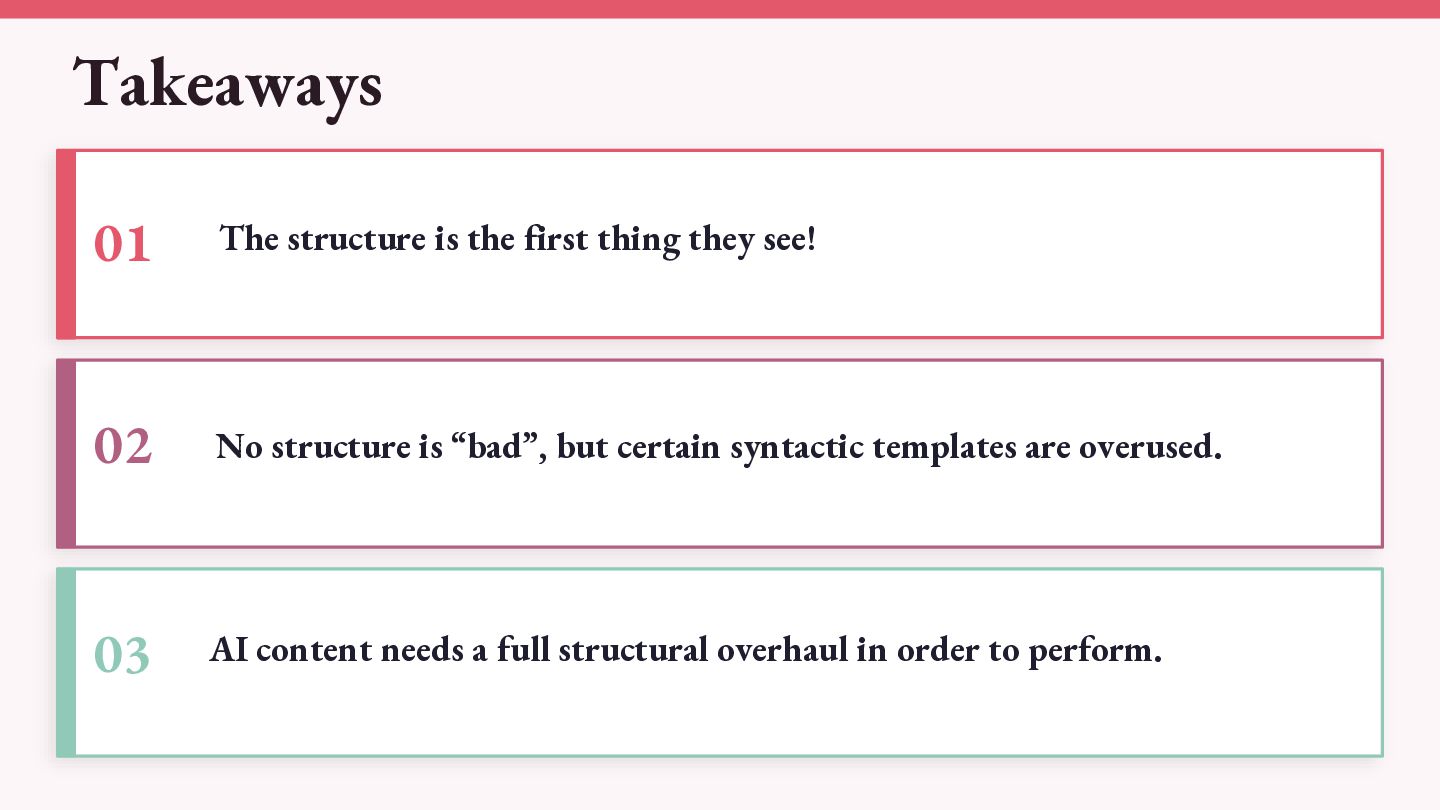
  26. Takeaways 01 02 No structure is “bad”, but certain syntactic

    templates are overused. 03 AI content needs a full structural overhaul in order to perform. The structure is the first thing they see!
  27. Thank You To receive my slide deck and my list

    of 20 syntactic templates, scan the QR code or go to: emily -hill.com/bseo26 -eh -slides Scan for slides & resources p.s. The structure is the first thing they see.