Upgrade to Pro — share decks privately, control downloads, hide ads and more …

Undefined Behavior in C – A Lost Cause?

Undefined Behavior in C – A Lost Cause?

C is a very stable programming language. This sometimes leads to the impression that nothing can be improved. This talk will try to correct this impression. I will give an overview about what is happening in the C world. In particular, I will cover the topic of undefined behavior in C and talk about existing and emerging compiler features related to undefined behavior and memory safety. With regard to the C standard, I will summarize the improvements made to ISO C 23 and give an outlook about what is currently planned for the next revision of the C standard. Finally, I will use the opportunity to explain how the standardization process works and how the kernel community could become more involved.

Martin Uecker

Avatar for Kernel Recipes

Kernel Recipes PRO

October 24, 2026

More Decks by Kernel Recipes

Other Decks in Technology

Transcript

  1. Undefined Behavior in the C Language - A Lost Cause?

    Martin Uecker Graz University of Technology
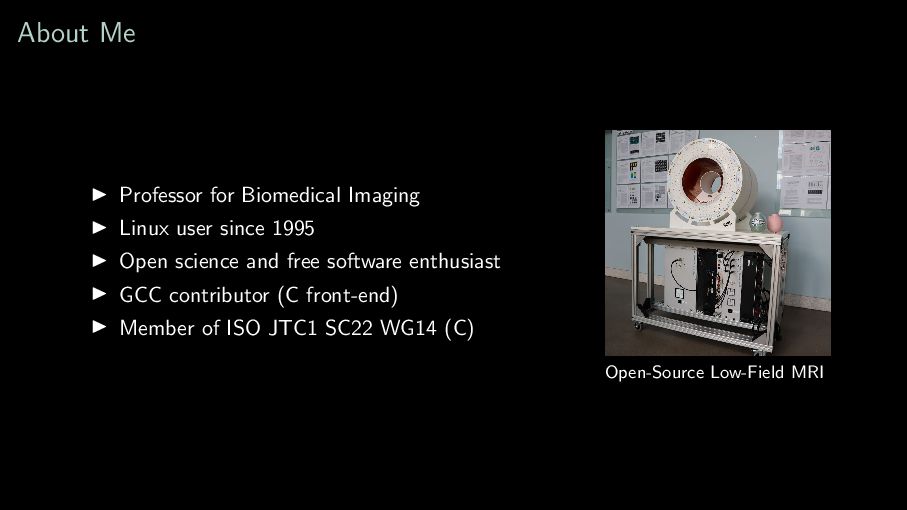
  2. About Me ▶ Professor for Biomedical Imaging ▶ Linux user

    since 1995 ▶ Open science and free software enthusiast ▶ GCC contributor (C front-end) ▶ Member of ISO JTC1 SC22 WG14 (C) Open-Source Low-Field MRI
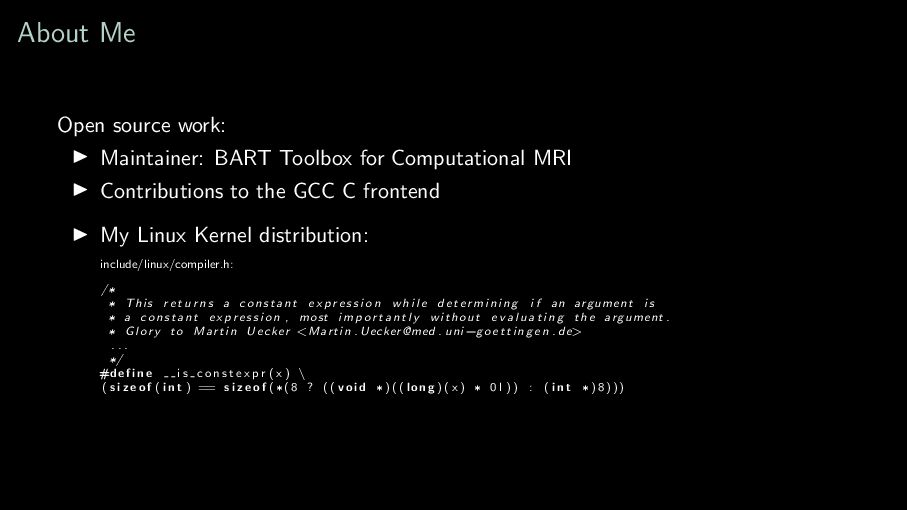
  3. About Me Open source work: ▶ Maintainer: BART Toolbox for

    Computational MRI ▶ Contributions to the GCC C frontend ▶ My Linux Kernel distribution: include/linux/compiler.h: /∗ ∗ T h i s r e t u r n s a c o n s t a n t e x p r e s s i o n w h i l e d e t e r m i n i n g i f an argument i s ∗ a c o n s t a n t e x p r e s s i o n , most i m p o r t a n t l y w i t h o u t e v a l u a t i n g t h e argument . ∗ G l o r y t o M a r t i n U e c k e r <M a r t i n . Uecker@med . u n i−g o e t t i n g e n . de> ... ∗/ is constexpr (x) \ #d e f i n e ( s i z e o f ( i n t ) == s i z e o f ( ∗ ( 8 ? ( ( v o i d ∗ ) ( ( l o n g ) ( x ) ∗ 0 l ) ) : ( i n t ∗ ) 8 ) ) )
  4. Why C? ▶ Portability ▶ Long-term stability ▶ Fast compilation

    ▶ Efficient code ▶ Interoperability ▶ Relatively simple and elegant ▶ What you see is what you get ▶ Many tools, documentation, training materials, etc. ▶ An international standard ▶ Gets out of the way when necessary
  5. ▶ The Abstract Machine ▶ Undefined Behavior ▶ Time Travel

    ▶ Progress... ▶ Memory Safety? ▶ Standardization
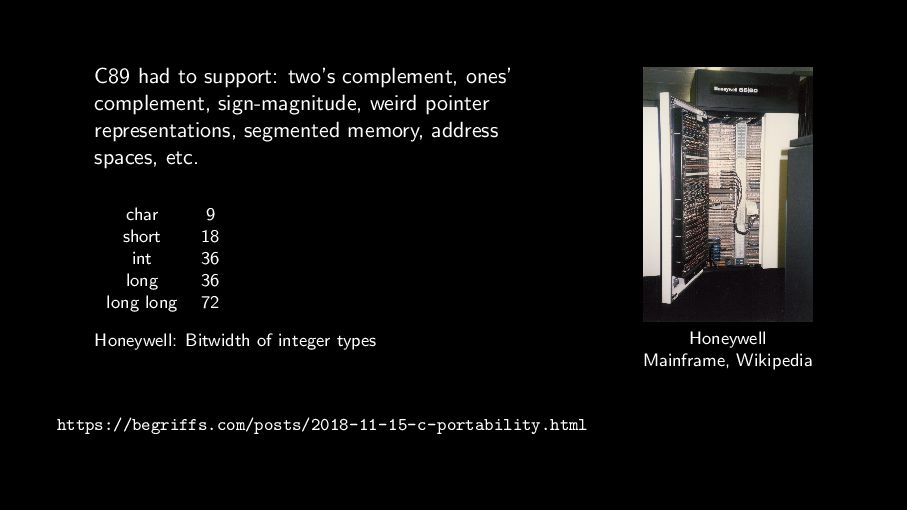
  6. C89 had to support: two’s complement, ones’ complement, sign-magnitude, weird

    pointer representations, segmented memory, address spaces, etc. char short int long long long 9 18 36 36 72 Honeywell: Bitwidth of integer types https://begriffs.com/posts/2018-11-15-c-portability.html Honeywell Mainframe, Wikipedia
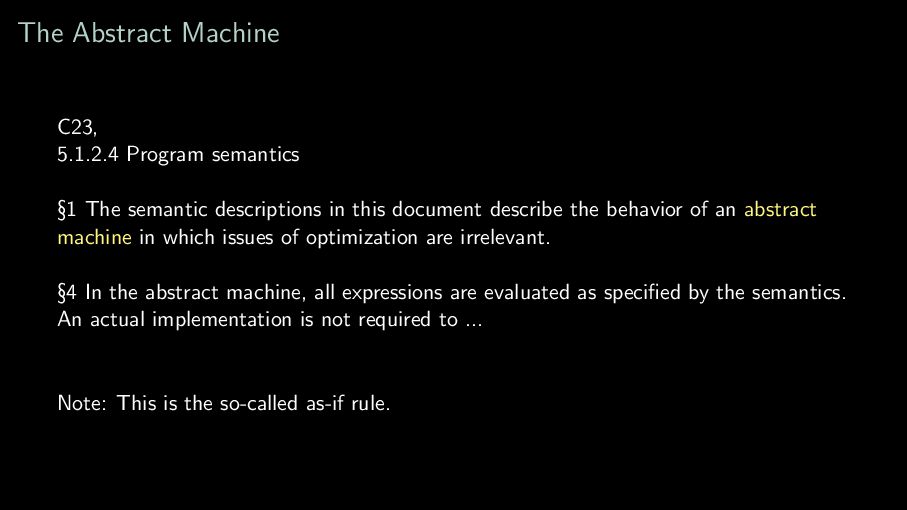
  7. The Abstract Machine C23, 5.1.2.4 Program semantics §1 The semantic

    descriptions in this document describe the behavior of an abstract machine in which issues of optimization are irrelevant. §4 In the abstract machine, all expressions are evaluated as specified by the semantics. An actual implementation is not required to ... Note: This is the so-called as-if rule.
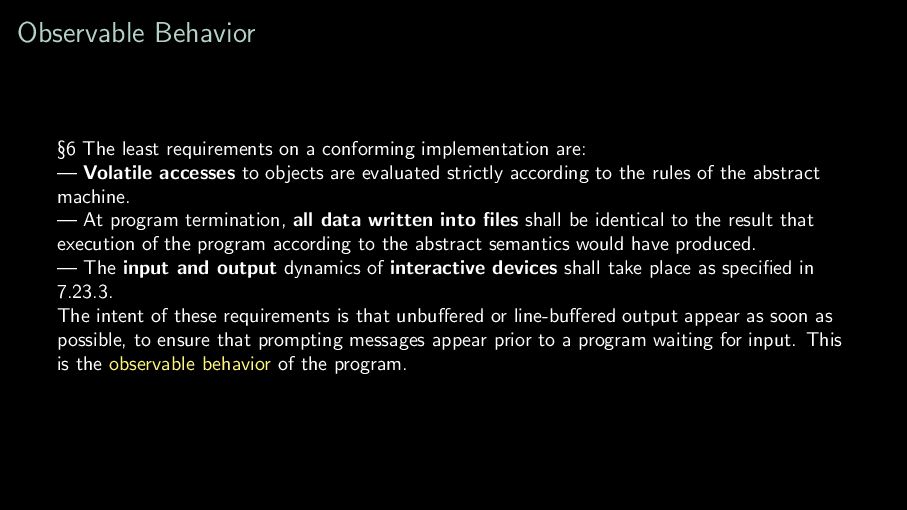
  8. Observable Behavior §6 The least requirements on a conforming implementation

    are: — Volatile accesses to objects are evaluated strictly according to the rules of the abstract machine. — At program termination, all data written into files shall be identical to the result that execution of the program according to the abstract semantics would have produced. — The input and output dynamics of interactive devices shall take place as specified in 7.23.3. The intent of these requirements is that unbuffered or line-buffered output appear as soon as possible, to ensure that prompting messages appear prior to a program waiting for input. This is the observable behavior of the program.
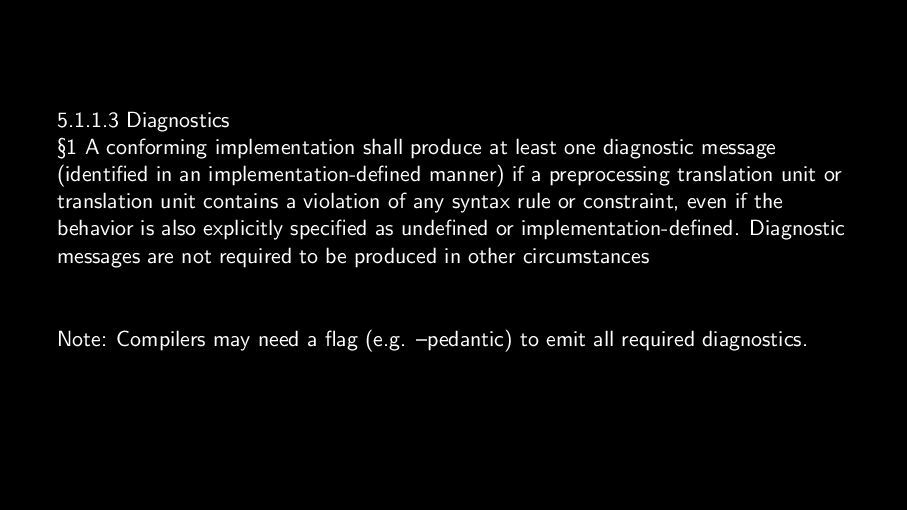
  9. 5.1.1.3 Diagnostics §1 A conforming implementation shall produce at least

    one diagnostic message (identified in an implementation-defined manner) if a preprocessing translation unit or translation unit contains a violation of any syntax rule or constraint, even if the behavior is also explicitly specified as undefined or implementation-defined. Diagnostic messages are not required to be produced in other circumstances Note: Compilers may need a flag (e.g. –pedantic) to emit all required diagnostics.
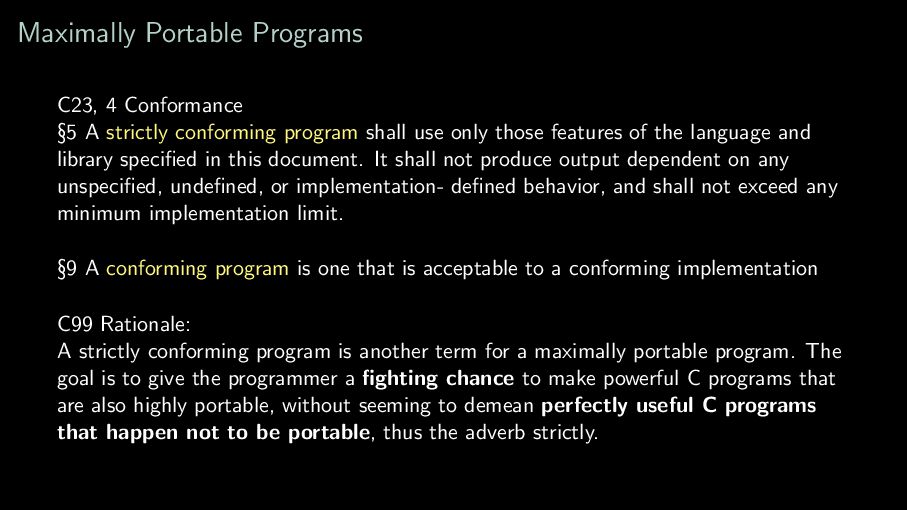
  10. Maximally Portable Programs C23, 4 Conformance §5 A strictly conforming

    program shall use only those features of the language and library specified in this document. It shall not produce output dependent on any unspecified, undefined, or implementation- defined behavior, and shall not exceed any minimum implementation limit. §9 A conforming program is one that is acceptable to a conforming implementation C99 Rationale: A strictly conforming program is another term for a maximally portable program. The goal is to give the programmer a fighting chance to make powerful C programs that are also highly portable, without seeming to demean perfectly useful C programs that happen not to be portable, thus the adverb strictly.
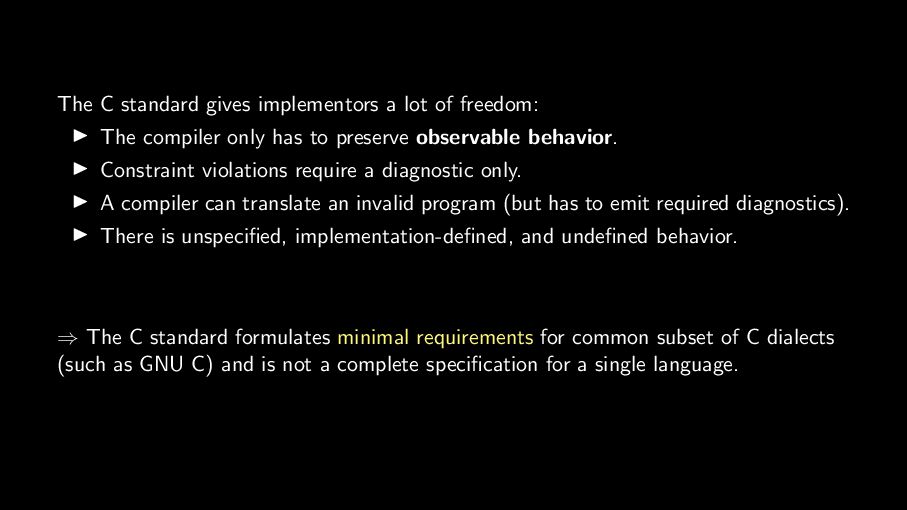
  11. The C standard gives implementors a lot of freedom: ▶

    The compiler only has to preserve observable behavior. ▶ Constraint violations require a diagnostic only. ▶ A compiler can translate an invalid program (but has to emit required diagnostics). ▶ There is unspecified, implementation-defined, and undefined behavior. ⇒ The C standard formulates minimal requirements for common subset of C dialects (such as GNU C) and is not a complete specification for a single language.
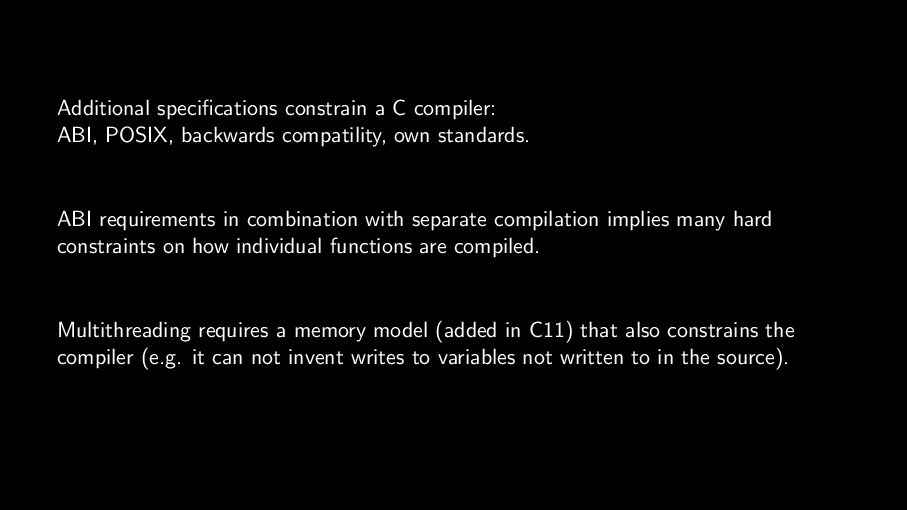
  12. Additional specifications constrain a C compiler: ABI, POSIX, backwards compatility,

    own standards. ABI requirements in combination with separate compilation implies many hard constraints on how individual functions are compiled. Multithreading requires a memory model (added in C11) that also constrains the compiler (e.g. it can not invent writes to variables not written to in the source).
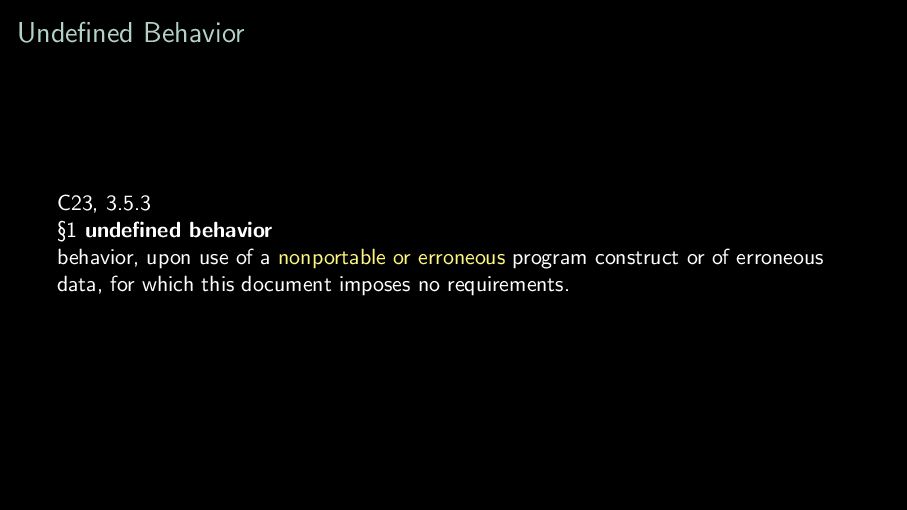
  13. Undefined Behavior C23, 3.5.3 §1 undefined behavior behavior, upon use

    of a nonportable or erroneous program construct or of erroneous data, for which this document imposes no requirements.
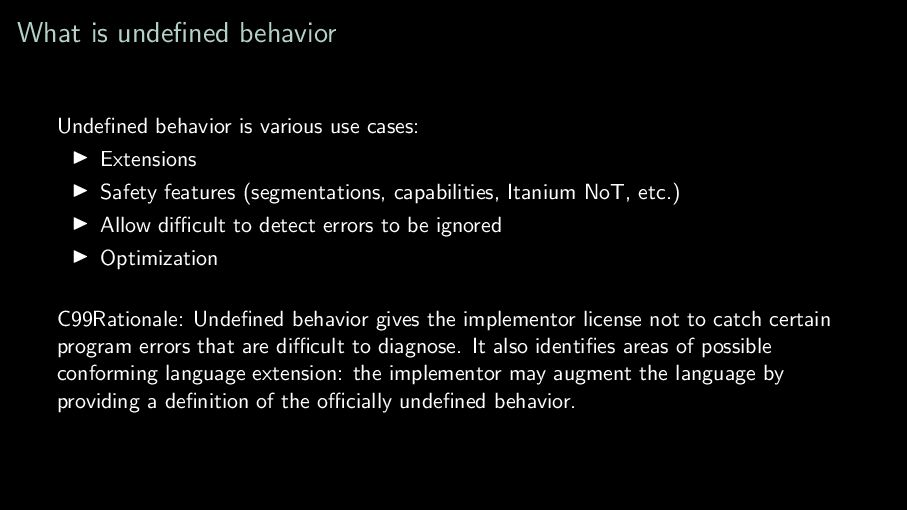
  14. What is undefined behavior Undefined behavior is various use cases:

    ▶ Extensions ▶ Safety features (segmentations, capabilities, Itanium NoT, etc.) ▶ Allow difficult to detect errors to be ignored ▶ Optimization C99Rationale: Undefined behavior gives the implementor license not to catch certain program errors that are difficult to diagnose. It also identifies areas of possible conforming language extension: the implementor may augment the language by providing a definition of the officially undefined behavior.
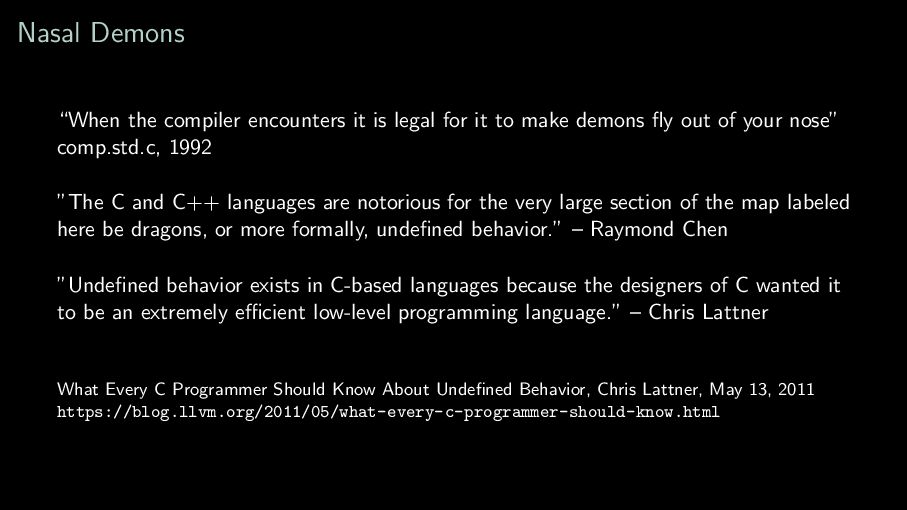
  15. Nasal Demons “When the compiler encounters it is legal for

    it to make demons fly out of your nose” comp.std.c, 1992 ”The C and C++ languages are notorious for the very large section of the map labeled here be dragons, or more formally, undefined behavior.” – Raymond Chen ”Undefined behavior exists in C-based languages because the designers of C wanted it to be an extremely efficient low-level programming language.” – Chris Lattner What Every C Programmer Should Know About Undefined Behavior, Chris Lattner, May 13, 2011 https://blog.llvm.org/2011/05/what-every-c-programmer-should-know.html
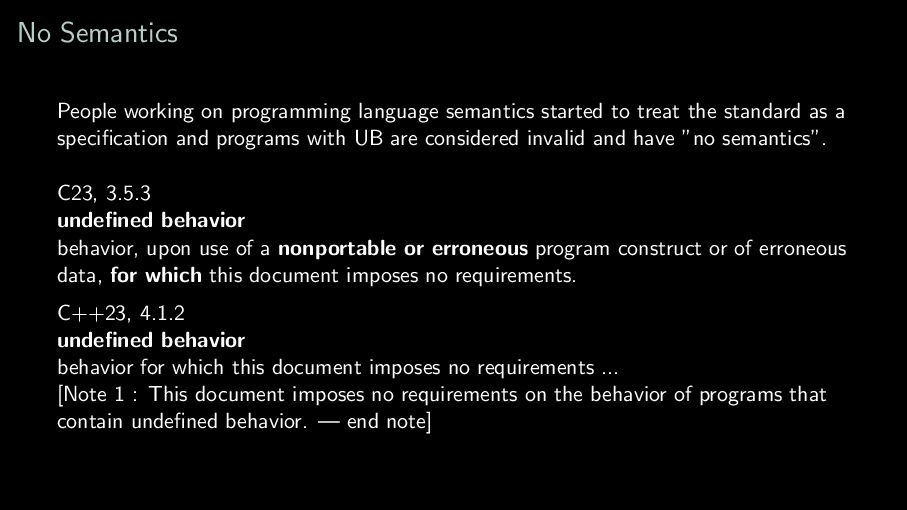
  16. No Semantics People working on programming language semantics started to

    treat the standard as a specification and programs with UB are considered invalid and have ”no semantics”. C23, 3.5.3 undefined behavior behavior, upon use of a nonportable or erroneous program construct or of erroneous data, for which this document imposes no requirements. C++23, 4.1.2 undefined behavior behavior for which this document imposes no requirements ... [Note 1 : This document imposes no requirements on the behavior of programs that contain undefined behavior. — end note]
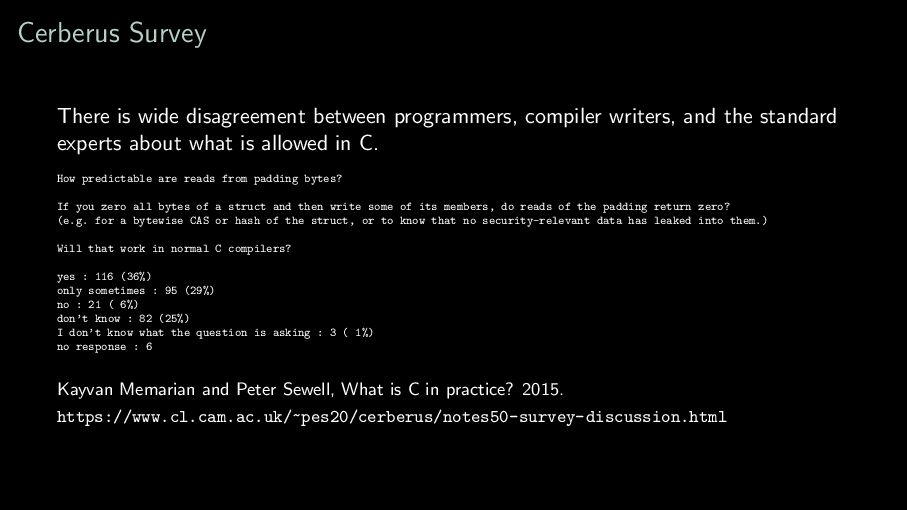
  17. Cerberus Survey There is wide disagreement between programmers, compiler writers,

    and the standard experts about what is allowed in C. How predictable are reads from padding bytes? If you zero all bytes of a struct and then write some of its members, do reads of the padding return zero? (e.g. for a bytewise CAS or hash of the struct, or to know that no security-relevant data has leaked into them.) Will that work in normal C compilers? yes : 116 (36%) only sometimes : 95 (29%) no : 21 ( 6%) don’t know : 82 (25%) I don’t know what the question is asking : 3 ( 1%) no response : 6 Kayvan Memarian and Peter Sewell, What is C in practice? 2015. https://www.cl.cam.ac.uk/~pes20/cerberus/notes50-survey-discussion.html
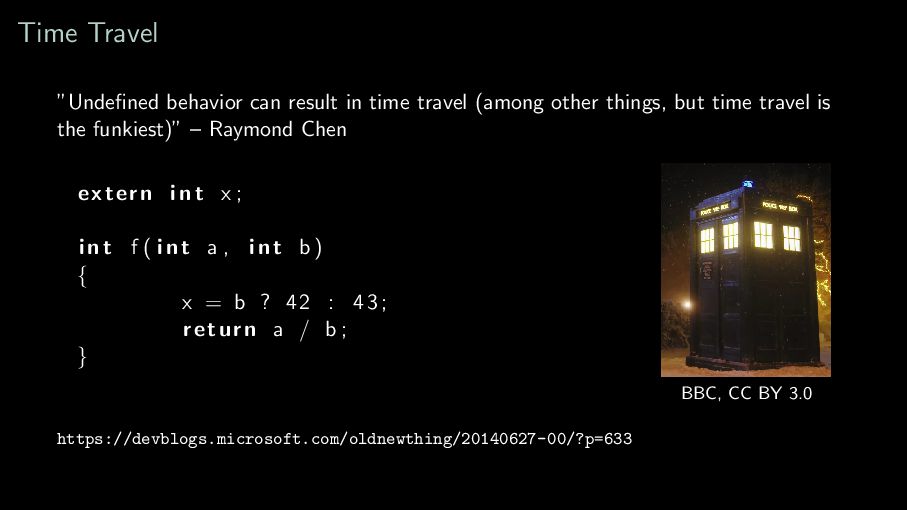
  18. Time Travel ”Undefined behavior can result in time travel (among

    other things, but time travel is the funkiest)” – Raymond Chen extern i n t x ; int f ( int a , int b) { x = b ? 42 : 4 3 ; return a / b ; } BBC, CC BY 3.0 https://devblogs.microsoft.com/oldnewthing/20140627-00/?p=633
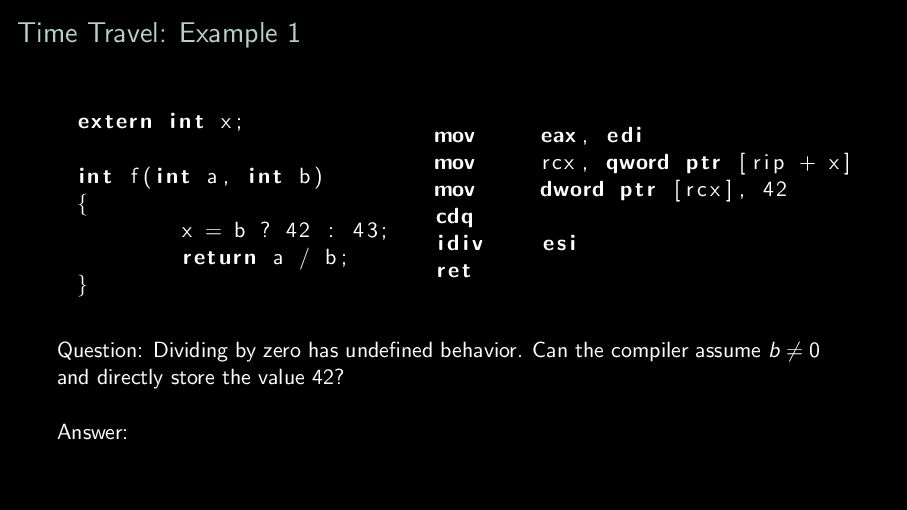
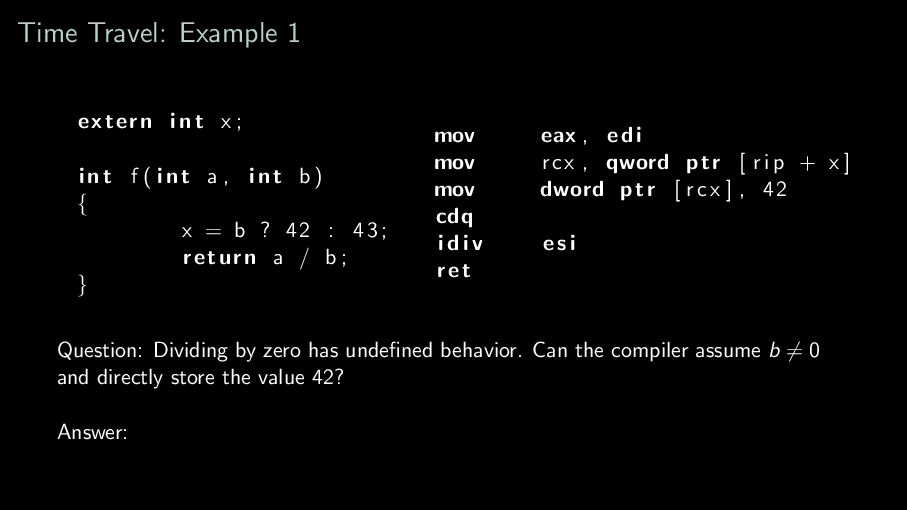
  19. Time Travel: Example 1 extern i n t x ;

    int f ( int a , int b) { x = b ? 42 : 4 3 ; return a / b ; } mov mov mov cdq idiv ret eax , e d i r c x , qword p t r [ r i p + x ] dword p t r [ r c x ] , 42 esi Question: Dividing by zero has undefined behavior. Can the compiler assume b ̸= 0 and directly store the value 42? Answer:
  20. Time Travel: Example 1 extern i n t x ;

    int f ( int a , int b) { x = b ? 42 : 4 3 ; return a / b ; } mov mov mov cdq idiv ret eax , e d i r c x , qword p t r [ r i p + x ] dword p t r [ r c x ] , 42 esi Question: Dividing by zero has undefined behavior. Can the compiler assume b ̸= 0 and directly store the value 42? Answer:
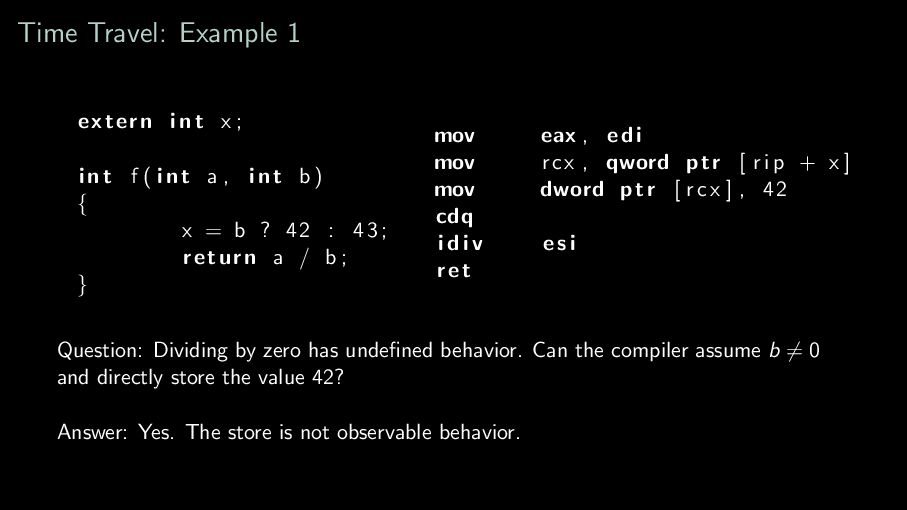
  21. Time Travel: Example 1 extern i n t x ;

    int f ( int a , int b) { x = b ? 42 : 4 3 ; return a / b ; } mov mov mov cdq idiv ret eax , e d i r c x , qword p t r [ r i p + x ] dword p t r [ r c x ] , 42 esi Question: Dividing by zero has undefined behavior. Can the compiler assume b ̸= 0 and directly store the value 42? Answer: Yes. The store is not observable behavior.
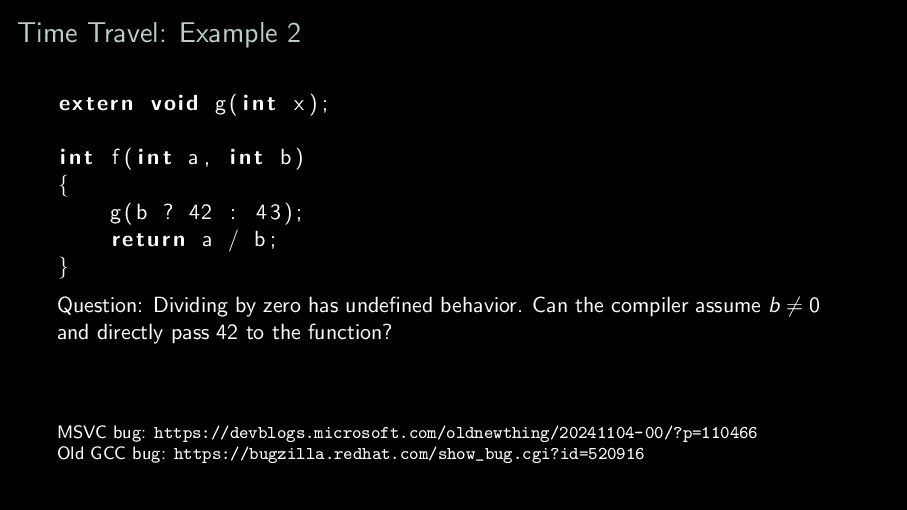
  22. Time Travel: Example 2 extern void g ( i n

    t x ) ; int f ( int a , int b) { g ( b ? 42 : 4 3 ) ; return a / b ; } Question: Dividing by zero has undefined behavior. Can the compiler assume b ̸= 0 and directly pass 42 to the function? MSVC bug: https://devblogs.microsoft.com/oldnewthing/20241104-00/?p=110466 Old GCC bug: https://bugzilla.redhat.com/show_bug.cgi?id=520916
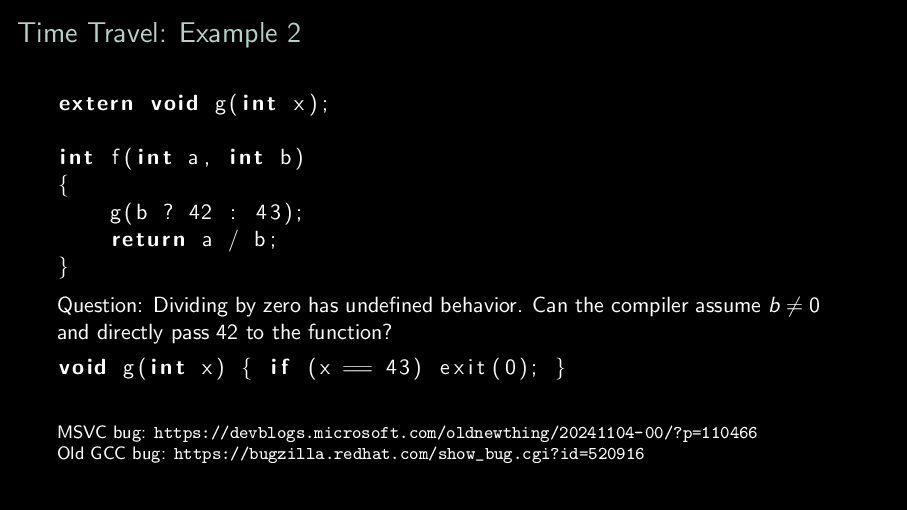
  23. Time Travel: Example 2 extern void g ( i n

    t x ) ; int f ( int a , int b) { g ( b ? 42 : 4 3 ) ; return a / b ; } Question: Dividing by zero has undefined behavior. Can the compiler assume b ̸= 0 and directly pass 42 to the function? v o i d g ( i n t x ) { i f ( x == 4 3 ) e x i t ( 0 ) ; } MSVC bug: https://devblogs.microsoft.com/oldnewthing/20241104-00/?p=110466 Old GCC bug: https://bugzilla.redhat.com/show_bug.cgi?id=520916
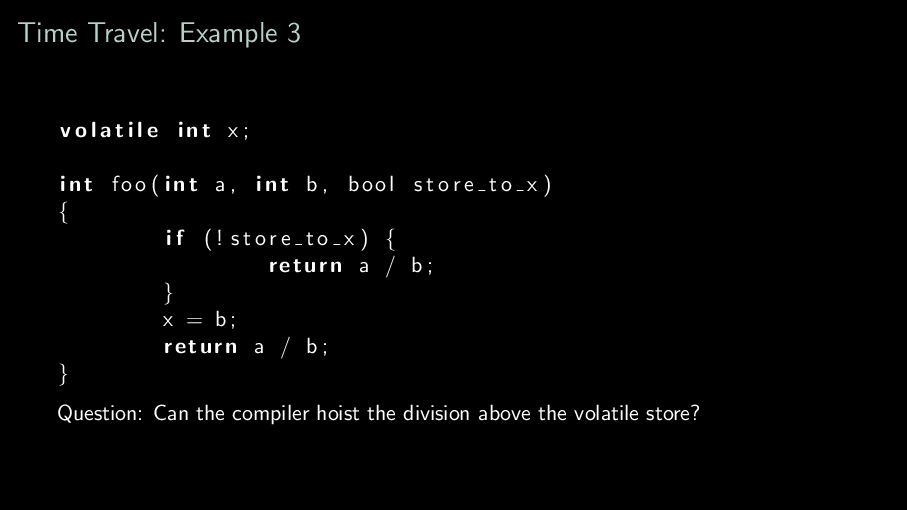
  24. Time Travel: Example 3 volatile int x ; int foo

    ( int a , int b , bool s t o r e t o x ) { if (! store to x ) { return a / b ; } x = b; return a / b ; } Question: Can the compiler hoist the division above the volatile store?
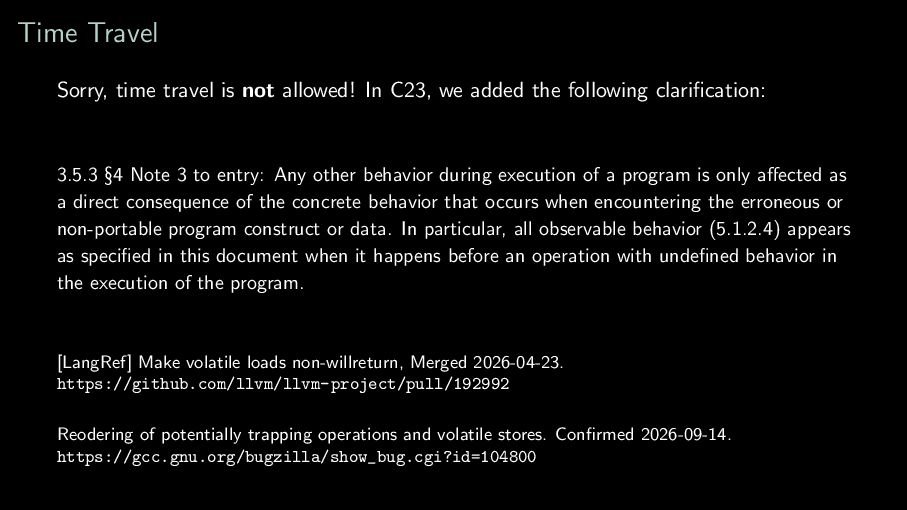
  25. Time Travel Sorry, time travel is not allowed! In C23,

    we added the following clarification: 3.5.3 §4 Note 3 to entry: Any other behavior during execution of a program is only affected as a direct consequence of the concrete behavior that occurs when encountering the erroneous or non-portable program construct or data. In particular, all observable behavior (5.1.2.4) appears as specified in this document when it happens before an operation with undefined behavior in the execution of the program. [LangRef] Make volatile loads non-willreturn, Merged 2026-04-23. https://github.com/llvm/llvm-project/pull/192992 Reodering of potentially trapping operations and volatile stores. Confirmed 2026-09-14. https://gcc.gnu.org/bugzilla/show_bug.cgi?id=104800
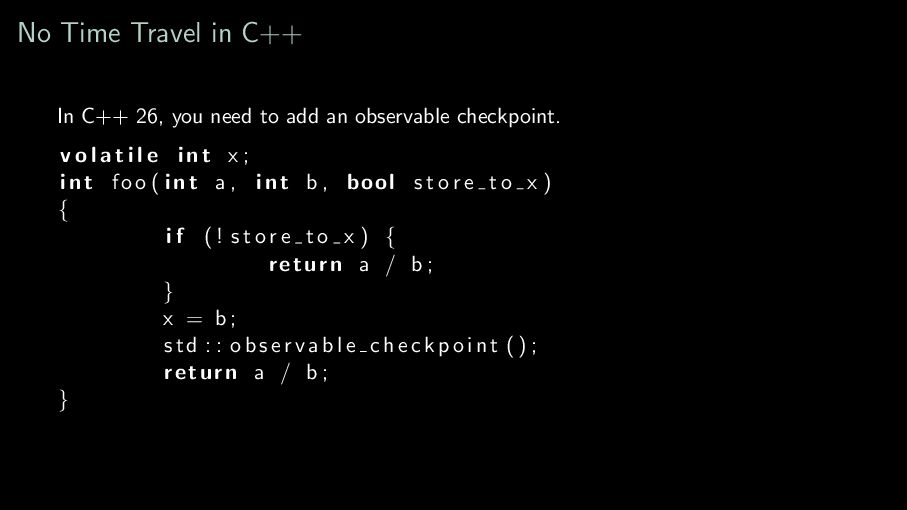
  26. No Time Travel in C++ In C++ 26, you need

    to add an observable checkpoint. volatile int x ; i n t f o o ( i n t a , i n t b , bool s t o r e t o x ) { if (! store to x ) { return a / b ; } x = b; std : : observable checkpoint ( ) ; return a / b ; }
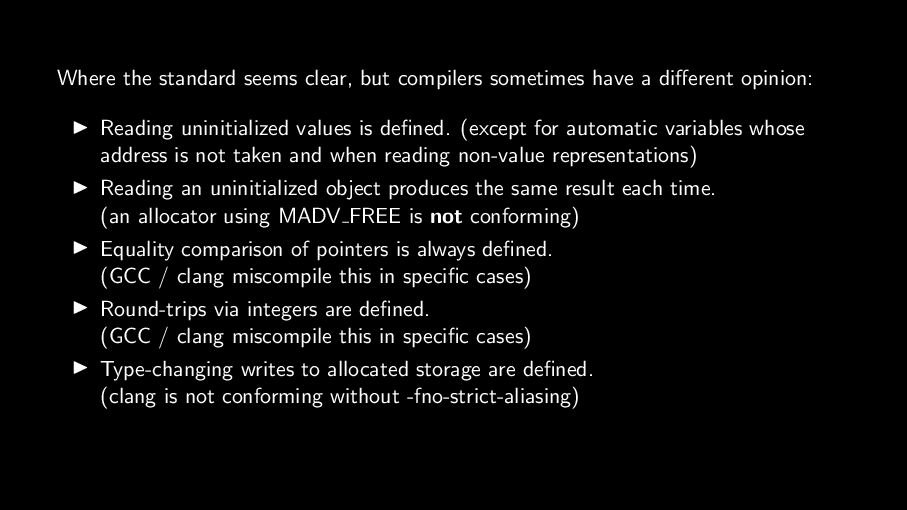
  27. Where the standard seems clear, but compilers sometimes have a

    different opinion: ▶ Reading uninitialized values is defined. (except for automatic variables whose address is not taken and when reading non-value representations) ▶ Reading an uninitialized object produces the same result each time. (an allocator using MADV FREE is not conforming) ▶ Equality comparison of pointers is always defined. (GCC / clang miscompile this in specific cases) ▶ Round-trips via integers are defined. (GCC / clang miscompile this in specific cases) ▶ Type-changing writes to allocated storage are defined. (clang is not conforming without -fno-strict-aliasing)
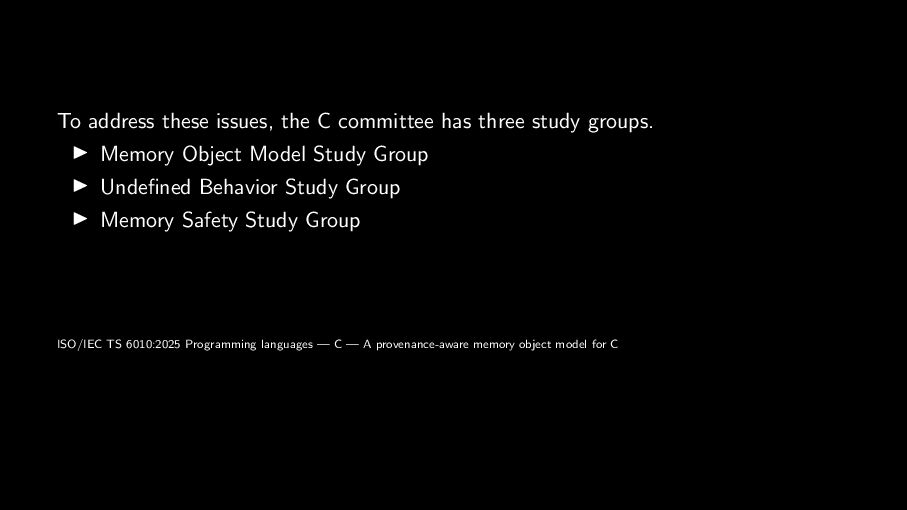
  28. To address these issues, the C committee has three study

    groups. ▶ Memory Object Model Study Group ▶ Undefined Behavior Study Group ▶ Memory Safety Study Group ISO/IEC TS 6010:2025 Programming languages — C — A provenance-aware memory object model for C
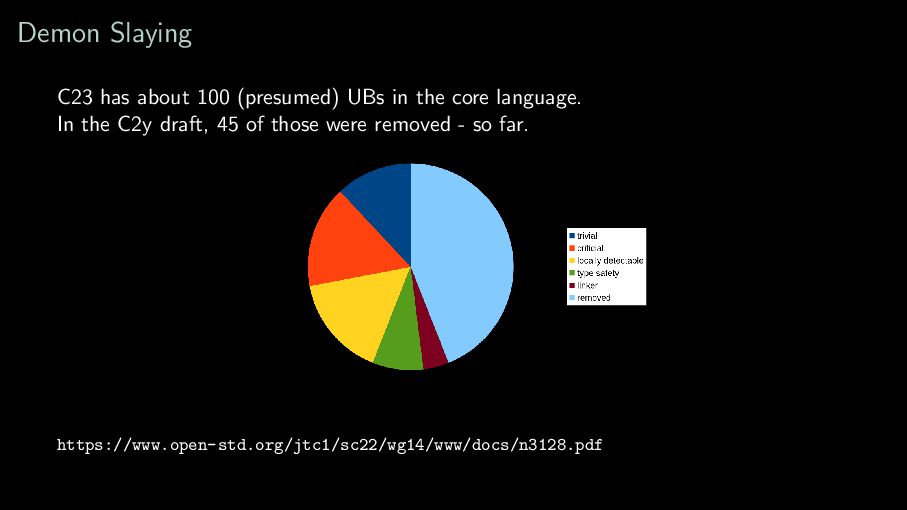
  29. Demon Slaying C23 has about 100 (presumed) UBs in the

    core language. In the C2y draft, 45 of those were removed - so far. https://www.open-std.org/jtc1/sc22/wg14/www/docs/n3128.pdf
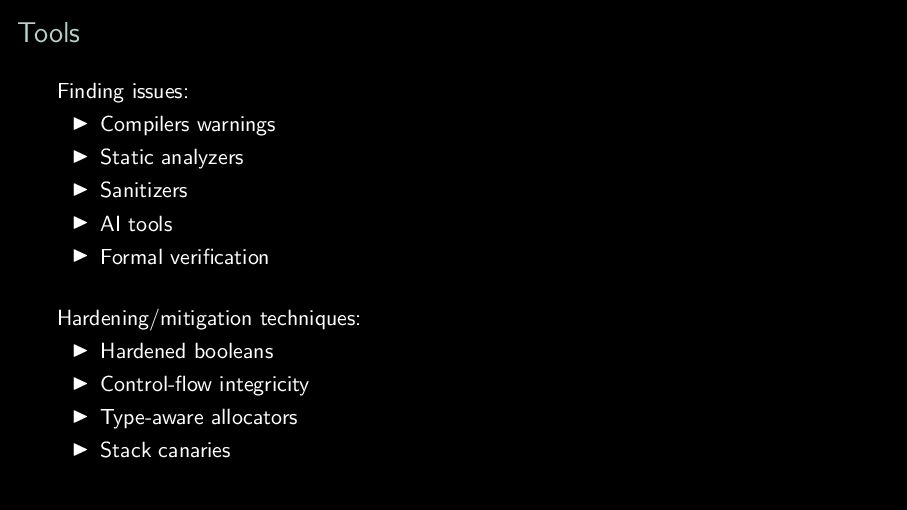
  30. Tools Finding issues: ▶ Compilers warnings ▶ Static analyzers ▶

    Sanitizers ▶ AI tools ▶ Formal verification Hardening/mitigation techniques: ▶ Hardened booleans ▶ Control-flow integricity ▶ Type-aware allocators ▶ Stack canaries
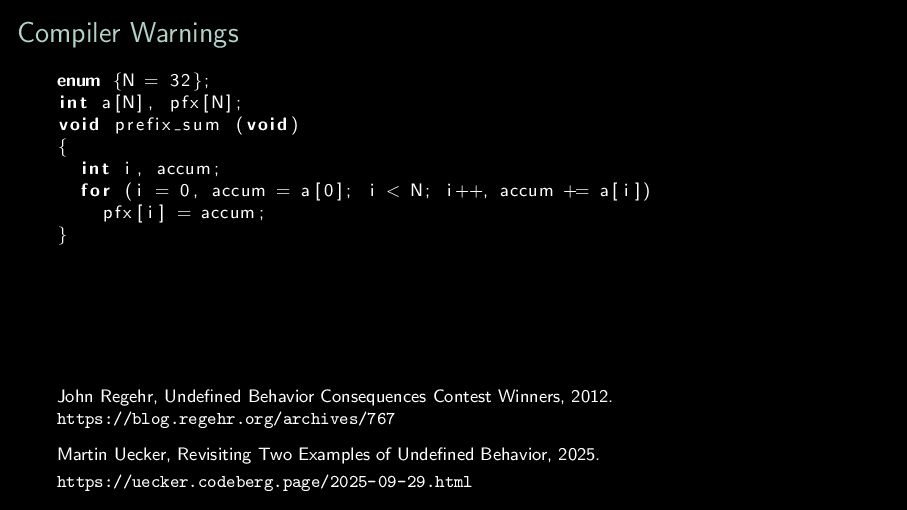
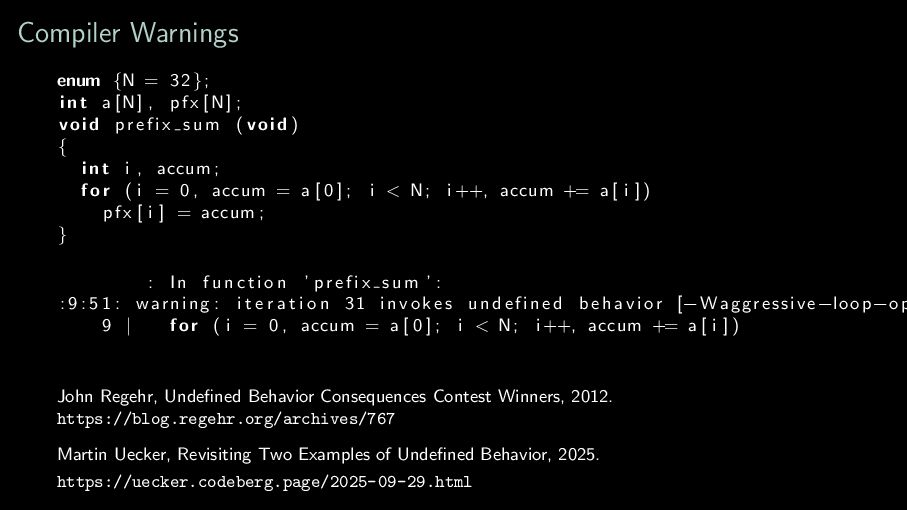
  31. Compiler Warnings enum {N = 3 2 } ; i

    n t a [N] , pfx [N ] ; void prefix sum ( void ) { i n t i , accum ; f o r ( i = 0 , accum = a [ 0 ] ; p f x [ i ] = accum ; } i < N ; i ++, accum += a [ i ] ) John Regehr, Undefined Behavior Consequences Contest Winners, 2012. https://blog.regehr.org/archives/767 Martin Uecker, Revisiting Two Examples of Undefined Behavior, 2025. https://uecker.codeberg.page/2025-09-29.html
  32. Compiler Warnings enum {N = 3 2 } ; i

    n t a [N] , pfx [N ] ; void prefix sum ( void ) { i n t i , accum ; f o r ( i = 0 , accum = a [ 0 ] ; p f x [ i ] = accum ; } i < N ; i ++, accum += a [ i ] ) : In function ’ prefix sum ’ : : 9 : 5 1 : w a r n i n g : i t e r a t i o n 31 i n v o k e s u n d e f i n e d b e h a v i o r [− W a g g r e s s i v e −l o o p −o p 9 | f o r ( i = 0 , accum = a [ 0 ] ; i < N ; i ++, accum += a [ i ] ) John Regehr, Undefined Behavior Consequences Contest Winners, 2012. https://blog.regehr.org/archives/767 Martin Uecker, Revisiting Two Examples of Undefined Behavior, 2025. https://uecker.codeberg.page/2025-09-29.html
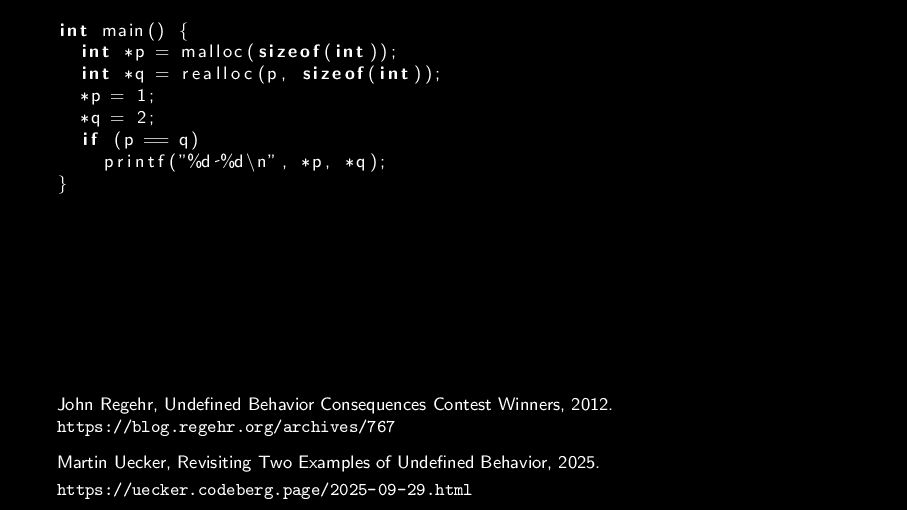
  33. i n t main ( ) { i n t

    ∗p = m a l l o c ( s i z e o f ( i n t ) ) ; i n t ∗q = r e a l l o c ( p , s i z e o f ( i n t ) ) ; ∗p = 1 ; ∗q = 2 ; i f ( p == q ) p r i n t f ( ”%d %d\n” , ∗p , ∗q ) ; } John Regehr, Undefined Behavior Consequences Contest Winners, 2012. https://blog.regehr.org/archives/767 Martin Uecker, Revisiting Two Examples of Undefined Behavior, 2025. https://uecker.codeberg.page/2025-09-29.html
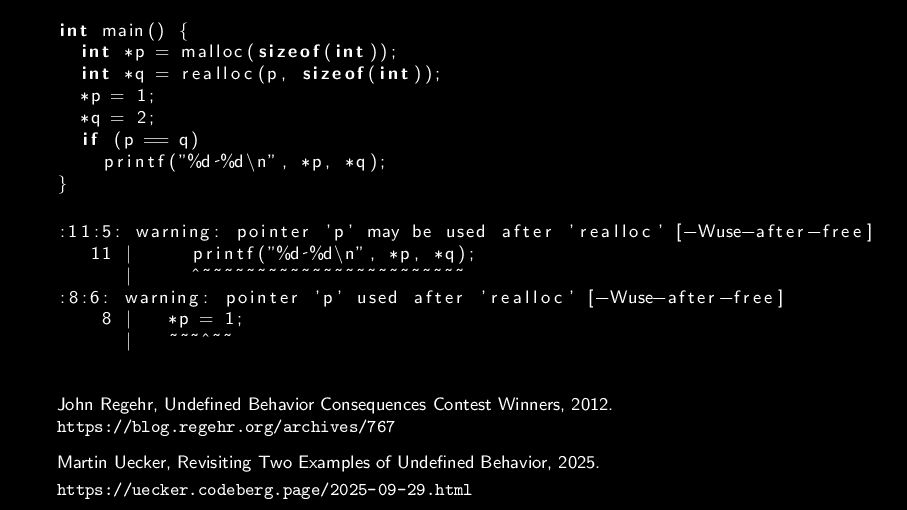
  34. i n t main ( ) { i n t

    ∗p = m a l l o c ( s i z e o f ( i n t ) ) ; i n t ∗q = r e a l l o c ( p , s i z e o f ( i n t ) ) ; ∗p = 1 ; ∗q = 2 ; i f ( p == q ) p r i n t f ( ”%d %d\n” , ∗p , ∗q ) ; } : 1 1 : 5 : w a r n i n g : p o i n t e r ’ p ’ may be u s e d a f t e r ’ r e a l l o c ’ [−Wuse−a f t e r −f r e e ] 11 | p r i n t f ( ”%d %d\n” , ∗p , ∗q ) ; | ˆ˜˜˜˜˜˜˜˜˜˜˜˜˜˜˜˜˜˜˜˜˜˜˜˜ : 8 : 6 : w a r n i n g : p o i n t e r ’ p ’ u s e d a f t e r ’ r e a l l o c ’ [−Wuse−a f t e r −f r e e ] 8 | ∗p = 1 ; | ˜˜˜ˆ˜˜ John Regehr, Undefined Behavior Consequences Contest Winners, 2012. https://blog.regehr.org/archives/767 Martin Uecker, Revisiting Two Examples of Undefined Behavior, 2025. https://uecker.codeberg.page/2025-09-29.html
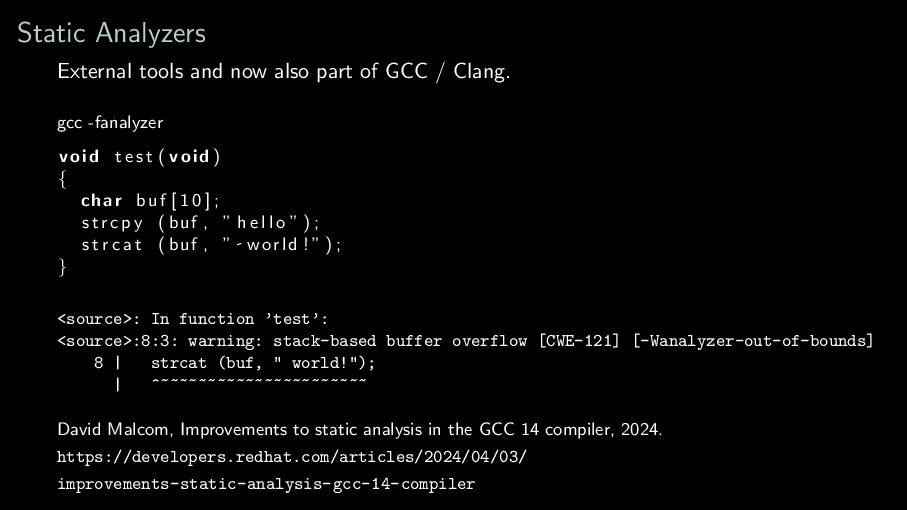
  35. Static Analyzers External tools and now also part of GCC

    / Clang. gcc -fanalyzer void t e s t ( void ) { char buf [ 1 0 ] ; s t r c p y ( buf , ” h e l l o ” ) ; s t r c a t ( buf , ” w o r l d ! ” ) ; } <source>: In function ’test’: <source>:8:3: warning: stack-based buffer overflow [CWE-121] [-Wanalyzer-out-of-bounds] 8 | strcat (buf, " world!"); | ^~~~~~~~~~~~~~~~~~~~~~~ David Malcom, Improvements to static analysis in the GCC 14 compiler, 2024. https://developers.redhat.com/articles/2024/04/03/ improvements-static-analysis-gcc-14-compiler
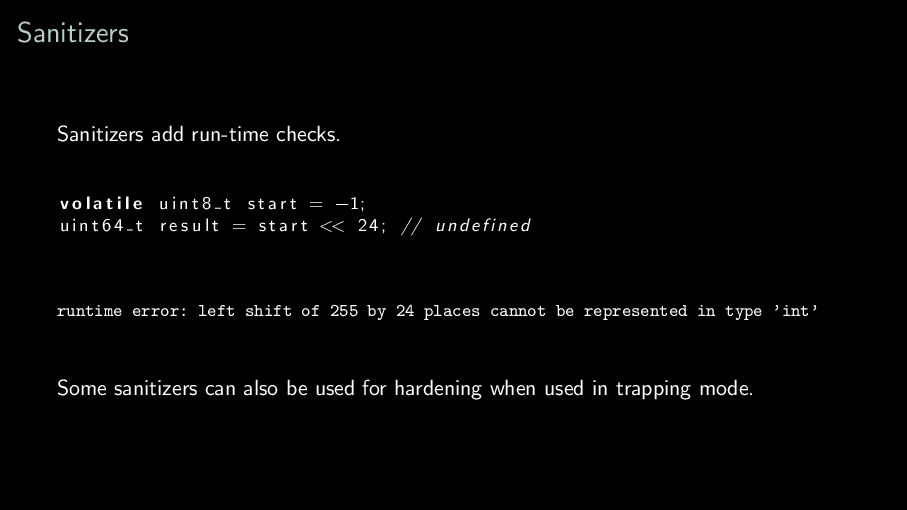
  36. Sanitizers Sanitizers add run-time checks. v o l a t

    i l e u i n t 8 t s t a r t = −1; u i n t 6 4 t r e s u l t = s t a r t << 2 4 ; // u n d e f i n e d runtime error: left shift of 255 by 24 places cannot be represented in type ’int’ Some sanitizers can also be used for hardening when used in trapping mode.
  37. Memory Safety Can we achieve memory safety? ▶ Type safety

    ▶ Spatial memory safety ▶ Temporal memory safety
  38. Type Safety C generally has a strong type system. Remaining

    issues are fixable: ▶ Tagless unions ⇒ new annotation ▶ It allows unsafe downcasts from void (or array types of unknown length) ⇒ new diagnostics ▶ Cross translation-unit type checking ▶ String literals are not const qualified.
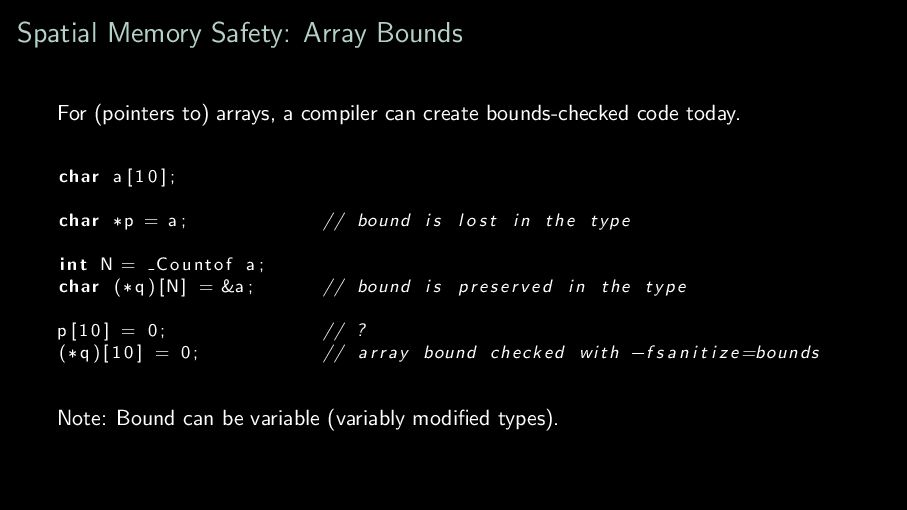
  39. Spatial Memory Safety: Array Bounds For (pointers to) arrays, a

    compiler can create bounds-checked code today. char a [ 1 0 ] ; c h a r ∗p = a ; // bound i s int N = Countof a ; c h a r ( ∗ q ) [ N ] = &a ; // bound i s p r e s e r v e d i n t h e t y p e p [10] = 0; (∗ q ) [ 1 0 ] = 0 ; // ? // a r r a y bound c h e c k e d w i t h − f s a n i t i z e =bounds l o s t in the type Note: Bound can be variable (variably modified types).
  40. Spatial Memory Safety: Array Bounds This also works for pointers

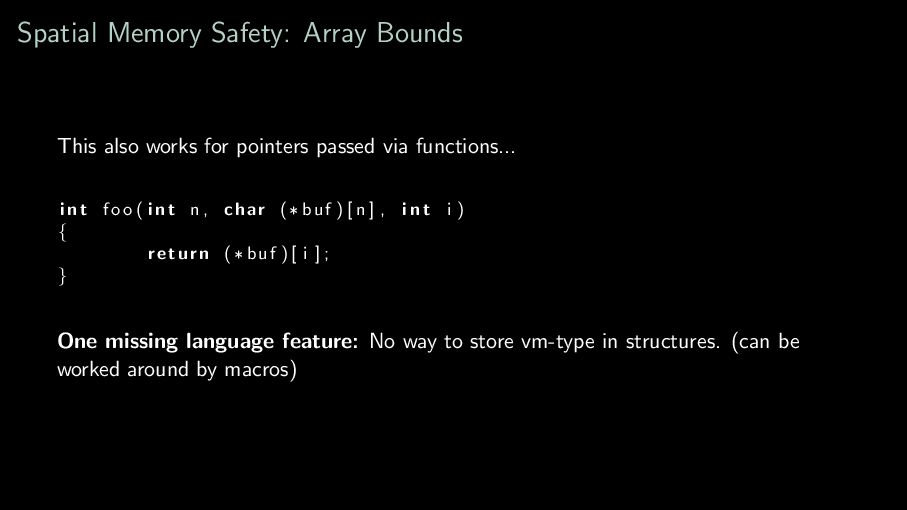
    passed via functions... i n t foo ( i n t n , char (∗ buf ) [ n ] , i n t i ) { return (∗ buf ) [ i ] ; } One missing language feature: No way to store vm-type in structures. (can be worked around by macros)
  41. Spatial Memory Safety: Array Bounds GCC’s dynamic object size pass

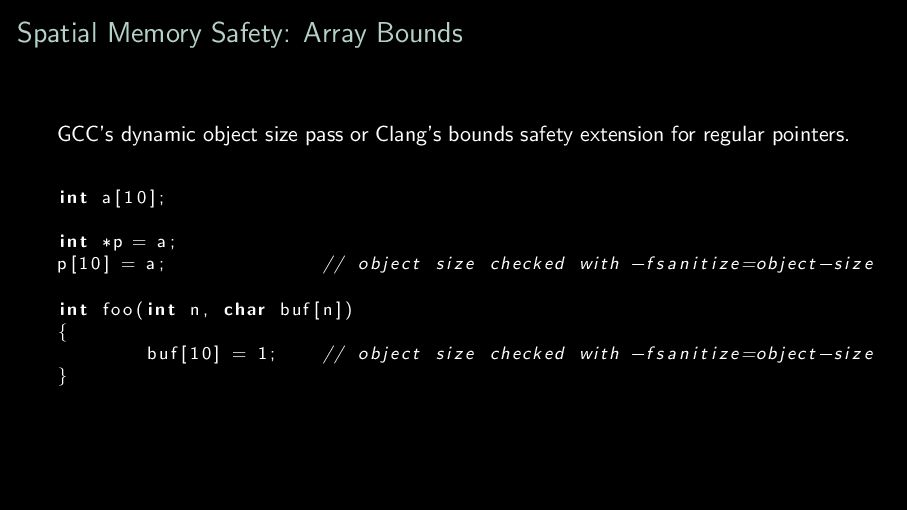
    or Clang’s bounds safety extension for regular pointers. int a [10]; i n t ∗p = a ; p[10] = a ; // o b j e c t s i z e c h e c k e d w i t h − f s a n i t i z e =o b j e c t −s i z e i n t foo ( i n t n , char buf [ n ] ) { buf [ 1 0 ] = 1; // o b j e c t s i z e c h e c k e d w i t h − f s a n i t i z e =o b j e c t −s i z e }
  42. Spatial Memory Safety: Attributes Annotations (gnu::access, clang,gnu::counted by, ...) bridge

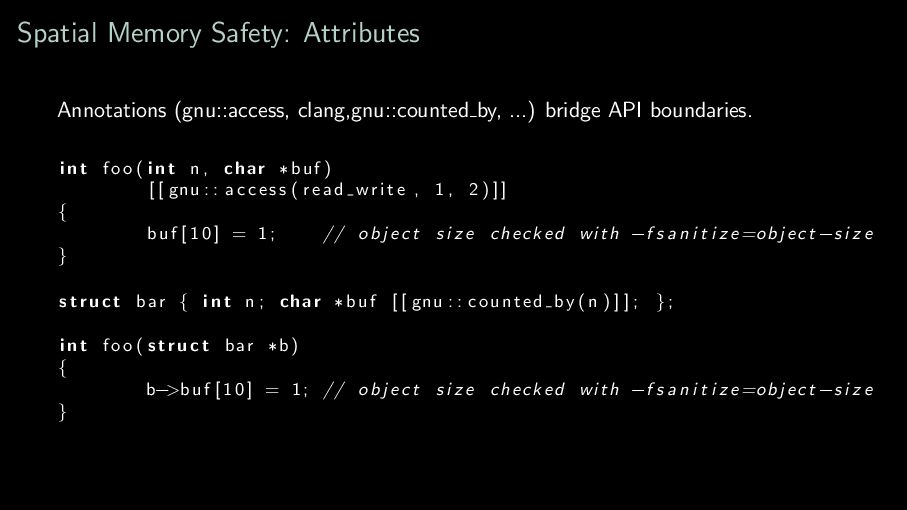
    API boundaries. i n t foo ( i n t n , char ∗ buf ) [ [ gnu : : a c c e s s ( r e a d w r i t e , 1 , 2 ) ] ] { buf [ 1 0 ] = 1; // o b j e c t s i z e c h e c k e d w i t h − f s a n i t i z e =o b j e c t −s i z e } s t r u c t b a r { i n t n ; c h a r ∗ b u f [ [ gnu : : c o u n t e d b y ( n ) ] ] ; } ; i n t f o o ( s t r u c t b a r ∗b ) { b−>b u f [ 1 0 ] = 1 ; // o b j e c t s i z e c h e c k e d w i t h − f s a n i t i z e =o b j e c t −s i z e }
  43. Temporal Memory Safety Run-time checking of largely unmodified C programs.

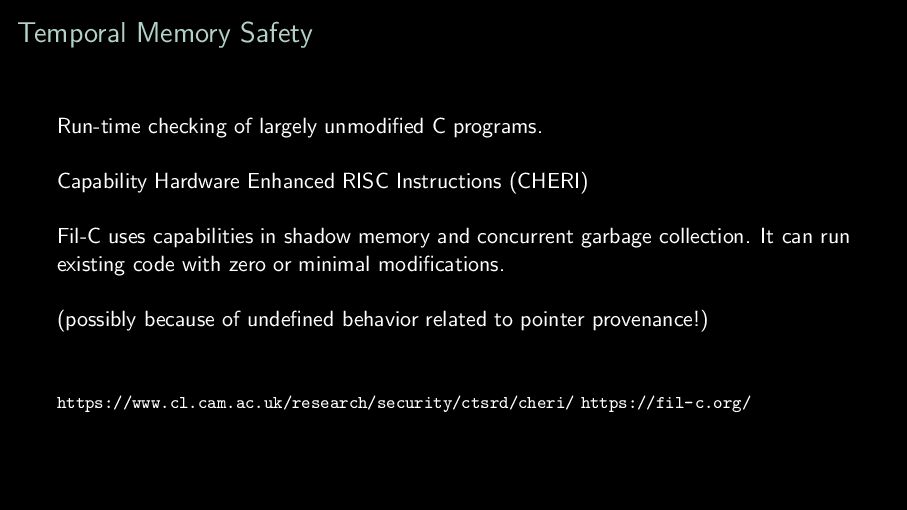
    Capability Hardware Enhanced RISC Instructions (CHERI) Fil-C uses capabilities in shadow memory and concurrent garbage collection. It can run existing code with zero or minimal modifications. (possibly because of undefined behavior related to pointer provenance!) https://www.cl.cam.ac.uk/research/security/ctsrd/cheri/ https://fil-c.org/
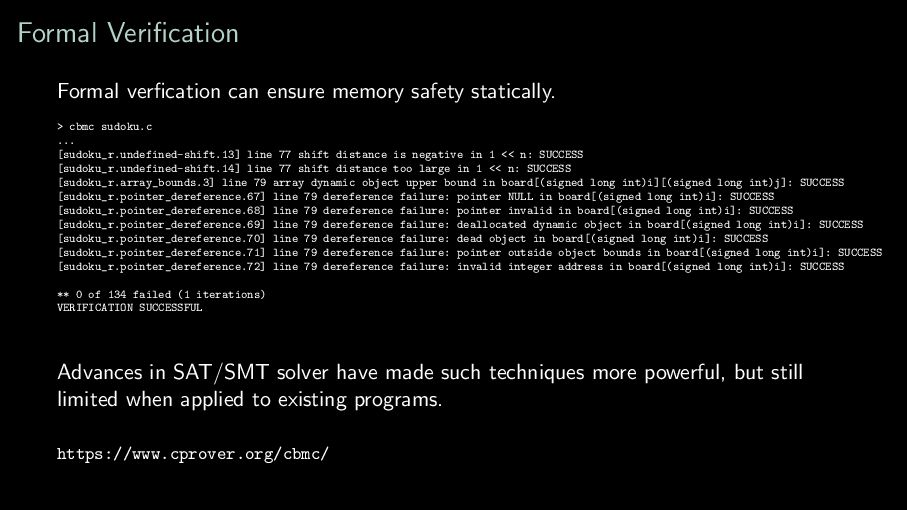
  44. Formal Verification Formal verfication can ensure memory safety statically. >

    cbmc sudoku.c ... [sudoku_r.undefined-shift.13] line 77 shift distance is negative in 1 << n: SUCCESS [sudoku_r.undefined-shift.14] line 77 shift distance too large in 1 << n: SUCCESS [sudoku_r.array_bounds.3] line 79 array dynamic object upper bound in board[(signed long int)i][(signed long int)j]: SUCCESS [sudoku_r.pointer_dereference.67] line 79 dereference failure: pointer NULL in board[(signed long int)i]: SUCCESS [sudoku_r.pointer_dereference.68] line 79 dereference failure: pointer invalid in board[(signed long int)i]: SUCCESS [sudoku_r.pointer_dereference.69] line 79 dereference failure: deallocated dynamic object in board[(signed long int)i]: SUCCESS [sudoku_r.pointer_dereference.70] line 79 dereference failure: dead object in board[(signed long int)i]: SUCCESS [sudoku_r.pointer_dereference.71] line 79 dereference failure: pointer outside object bounds in board[(signed long int)i]: SUCCESS [sudoku_r.pointer_dereference.72] line 79 dereference failure: invalid integer address in board[(signed long int)i]: SUCCESS ** 0 of 134 failed (1 iterations) VERIFICATION SUCCESSFUL Advances in SAT/SMT solver have made such techniques more powerful, but still limited when applied to existing programs. https://www.cprover.org/cbmc/
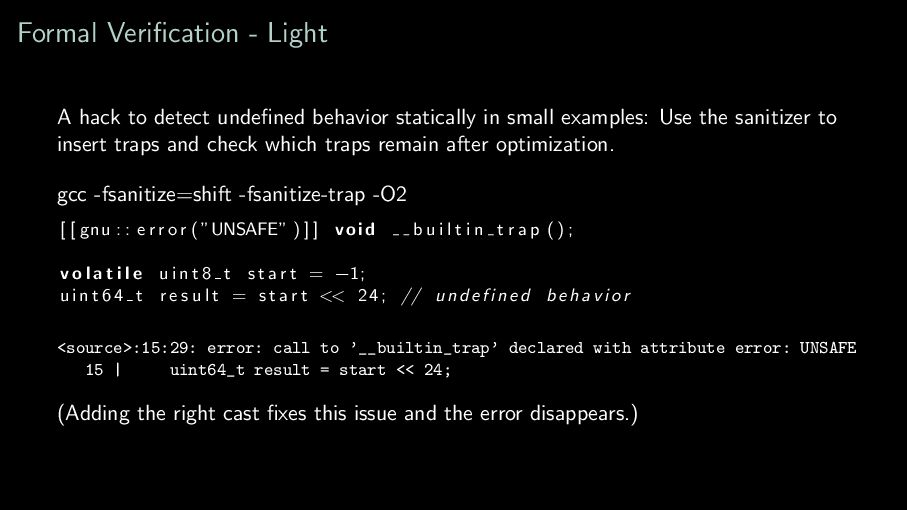
  45. Formal Verification - Light A hack to detect undefined behavior

    statically in small examples: Use the sanitizer to insert traps and check which traps remain after optimization. gcc -fsanitize=shift -fsanitize-trap -O2 [ [ gnu : : e r r o r ( ”UNSAFE” ) ] ] v o i d builtin trap (); v o l a t i l e u i n t 8 t s t a r t = −1; u i n t 6 4 t r e s u l t = s t a r t << 2 4 ; // u n d e f i n e d b e h a v i o r <source>:15:29: error: call to ’__builtin_trap’ declared with attribute error: UNSAFE 15 | uint64_t result = start << 24; (Adding the right cast fixes this issue and the error disappears.)
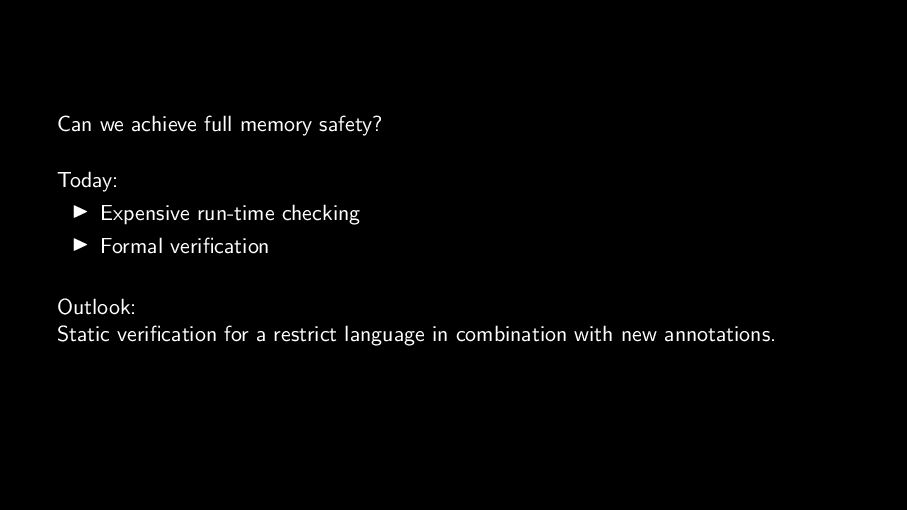
  46. Can we achieve full memory safety? Today: ▶ Expensive run-time

    checking ▶ Formal verification Outlook: Static verification for a restrict language in combination with new annotations.
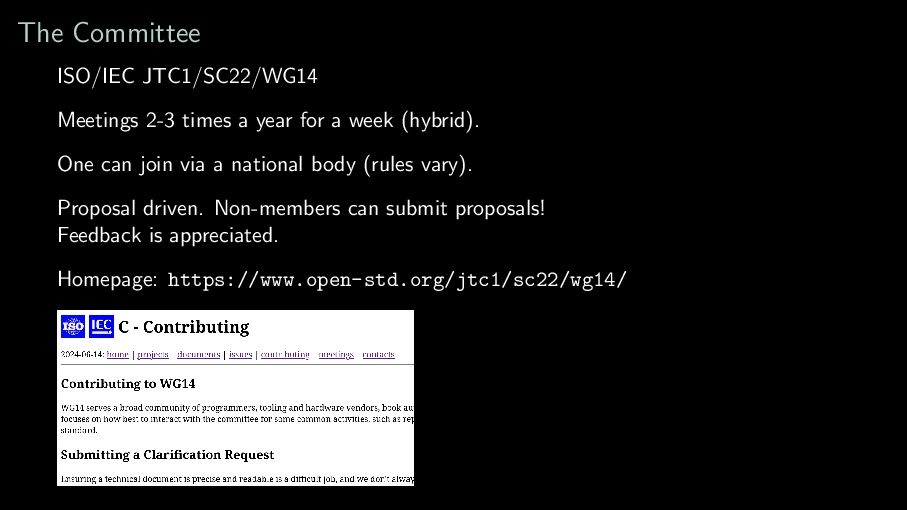
  47. The Committee ISO/IEC JTC1/SC22/WG14 Meetings 2-3 times a year for

    a week (hybrid). One can join via a national body (rules vary). Proposal driven. Non-members can submit proposals! Feedback is appreciated. Homepage: https://www.open-std.org/jtc1/sc22/wg14/
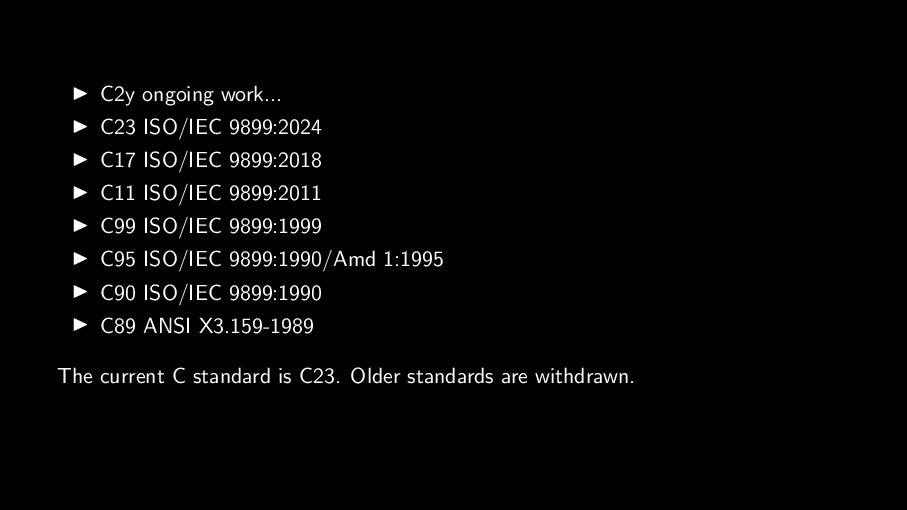
  48. ▶ C2y ongoing work... ▶ C23 ISO/IEC 9899:2024 ▶ C17

    ISO/IEC 9899:2018 ▶ C11 ISO/IEC 9899:2011 ▶ C99 ISO/IEC 9899:1999 ▶ C95 ISO/IEC 9899:1990/Amd 1:1995 ▶ C90 ISO/IEC 9899:1990 ▶ C89 ANSI X3.159-1989 The current C standard is C23. Older standards are withdrawn.
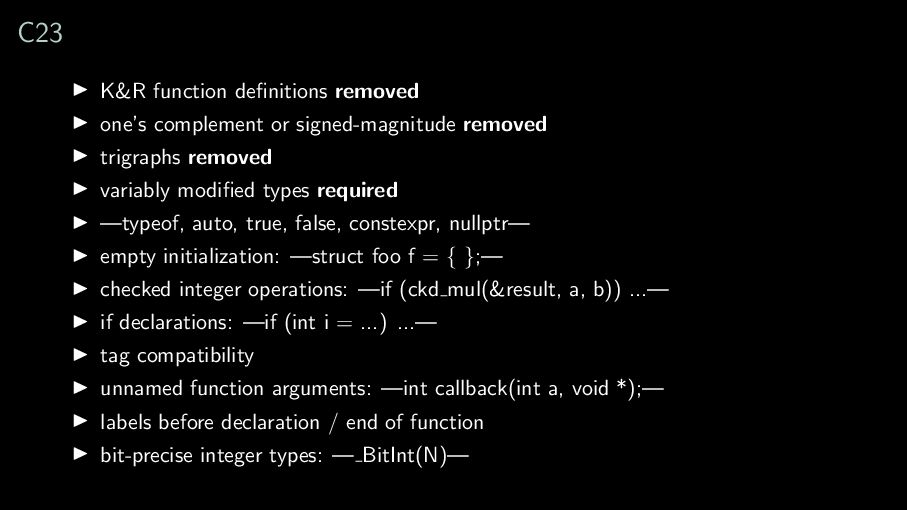
  49. C23 ▶ K&R function definitions removed ▶ one’s complement or

    signed-magnitude removed ▶ trigraphs removed ▶ variably modified types required ▶ —typeof, auto, true, false, constexpr, nullptr— ▶ empty initialization: —struct foo f = { };— ▶ checked integer operations: —if (ckd mul(&result, a, b)) ...— ▶ if declarations: —if (int i = ...) ...— ▶ tag compatibility ▶ unnamed function arguments: —int callback(int a, void *);— ▶ labels before declaration / end of function ▶ bit-precise integer types: — BitInt(N)—
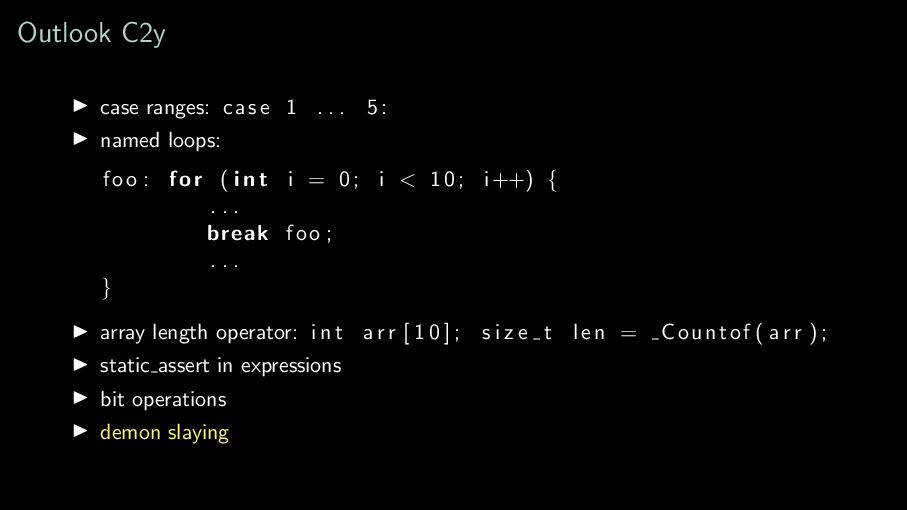
  50. Outlook C2y ▶ case ranges: c a s e 1

    . . . 5 : ▶ named loops: f o o : f o r ( i n t i = 0 ; i < 1 0 ; i ++) { ... break f o o ; ... } ▶ array length operator: i n t a r r [ 1 0 ] ; s i z e t l e n = ▶ static assert in expressions ▶ bit operations ▶ demon slaying Countof ( a r r ) ;
  51. Conclusion ▶ C is still evolving and tools are improving.

    ▶ Full memory safety is possible and will become practical. ▶ You can help!